Searching for a Measure Integrating Sustainable and Healthy Eating Behaviors



Abstract
1. Introduction
1.1. Sustainable Eating Concepts
1.2. Measures of Sustainable Food-Related Behaviors
2. Materials and Methods
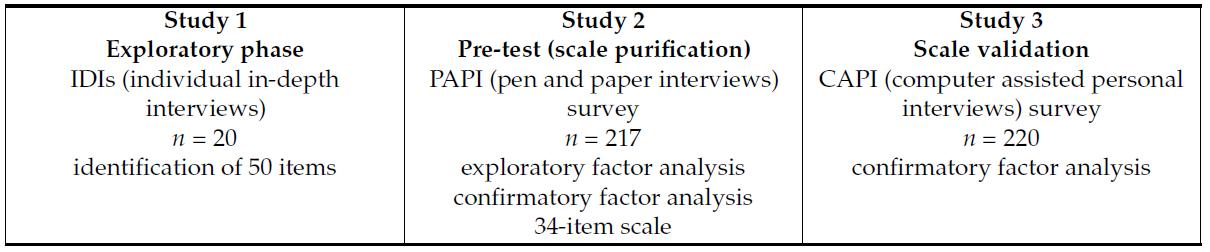
2.1. The Scale Development Process
2.2. Study 1: Item Generation and Screening—Exploratory Study
2.3. Study 2: Pre-Test (Scale Purification)
2.4. Study 3: Scale Validation
2.5. Statistical Analysis
3. Results
3.1. Perception of the Term “Sustainability” and “Sustainable Healthy Eating” by Young Adults (Study 1)
3.2. Results of Exploratory Factor Analysis in Study 2
3.3. Confirmatory Factor Analysis of the Items Measured in Study 2 and Study 3
3.4. Comparison of the Mean Values between Study 2 and Study 3
4. Discussion
5. Conclusions
Author Contributions
Funding
Acknowledgments
Conflicts of Interest
Appendix A. 50 Statements Used in the Scale Development Process
| Statement | |
| 1 | I eat five portions of fruits and vegetables a day. |
| 2 | I choose whole grains products. |
| 3 | I choose products from varied food groups. |
| 4 | I try to have a colorful plate. |
| 5 | I choose food that contains no additives. |
| 6 | I choose food that contains natural ingredients. |
| 7 | I choose food that contains no artificial ingredients. |
| 8 | Whenever possible, I buy organic food. |
| 9 | I read information placed on the product label. |
| 10 | When buying food, I check certificates and quality marks on labels. |
| 11 | I choose products with clear information/indication on country of origin. |
| 12 | I choose food products with regional certificate. |
| 13 | I pay attention to the expiry date while shopping. |
| 14 | I don’t waste food. |
| 15 | I reuse leftovers from food. |
| 16 | I don’t eat meat once a week. |
| 17 | I try not to eat meat at least once or twice a week. |
| 18 | I buy regional food. |
| 19 | I eat seasonal fruits and vegetables. |
| 20 | In season, I shop at farmer’s market. |
| 21 | I choose low processed food. |
| 22 | I drink enough water (2 L) throughout a day. |
| 23 | I avoid sugary drinks. |
| 24 | I limit my salt usage. |
| 25 | I keep food such as cakes, sweets and chocolate to an occasional treat. |
| 26 | I keep food such as fries and crisps to an occasional treat. |
| 27 | I limit my consumption of dry-cured meats/cold meats. |
| 28 | I choose food that contains a lot of vitamins & minerals. |
| 29 | I choose food that keeps me healthy. |
| 30 | I choose food that is nutritious. |
| 31 | I sport regularly. |
| 32 | I try to have a balanced diet. |
| 33 | I choose food that is produced in an environmental friendly way. |
| 34 | I buy fruits and vegetables directly from the farmer. |
| 35 | Whenever possible, I choose fruits and vegetables from my own allotments (plots). |
| 36 | I avoid buying food transported by aircrafts. |
| 37 | I buy locally produced foods. |
| 38 | I choose products that are not transported over long distances. |
| 39 | I try to eat as much pulses as possible in order to reduce meat consumption. |
| 40 | Pulses replace meat in my cooking. |
| 41 | I try to eat as much plant–protein source food products as possible, e.g., pulses. |
| 42 | I avoid eating meat. |
| 43 | I choose free-range eggs. |
| 44 | I avoid buying battery eggs. |
| 45 | Whenever possible I buy free range eggs. |
| 46 | Whenever possible, I buy fish from sustainable fishing. |
| 47 | I avoid food products containing lots of fat. |
| 48 | I choose low fat food products. |
| 49 | Whenever possible, I choose low fat food products. |
| 50 | I try not to throw away food. |
References
- Hallström, E.; Röös, E.; Börjesson, P. Sustainable meat consumption: A quantitative analysis of nutritional intake, greenhouse gas emissions and land use from a Swedish perspective. Food Policy 2014, 47, 81–90. [Google Scholar] [CrossRef] [Scilit]
- Blackstone, N.T.; El-Abbadi, N.H.; McCabe, M.S.; Griffin, T.S.; Nelson, M.E. Linking sustainability to the healthy eating patterns of the Dietary Guidelines for Americans: A modelling study. Lancet Planet. Health 2018, 2, 344–352. [Google Scholar] [CrossRef] [Scilit]
- Dixon, J.; Isaacs, B. Why sustainable and “nutritionally correct” food is not on the agenda: Western Sydney, the moral arts of everyday life and public policy. Food Policy 2013, 43, 67–76. [Google Scholar] [CrossRef] [Scilit]
- Jones, A.D.; Hoey, L.; Blesh, J.; Miller, L.; Green, A.; Shapiro, L.F. A Systematic Review of the Measurement of Sustainable Diets. Adv. Nutr. 2016, 7, 641–664. [Google Scholar] [CrossRef] [Scilit] [PubMed]
- Friel, S.; Barosh, L.J.; Lawrence, M. Towards healthy and sustainable food consumption: An Australian case study. Public Health Nutr. 2014, 17, 1156–1166. [Google Scholar] [CrossRef] [Scilit] [PubMed]
- Horgan, G.W.; Perrin, A.; Whybrow, S.; Macdiarmid, J.I. Achieving dietary recommendations and reducing greenhouse gas emissions: Modelling diets to minimise the change from current intakes. Int. J. Behav. Nutr. Phys. Act. 2016, 13, 46. [Google Scholar] [CrossRef] [Scilit]
- Seed, B. Sustainability in the Qatar national dietary guidelines, among the first to incorporate sustainability principles. Public Health Nutr. 2015, 18, 2303–2310. [Google Scholar] [CrossRef] [Scilit]
- Lei, L.; Shimokawa, S. Promoting dietary guidelines and environmental sustainability in China. China Econ. Rev. 2017. [Google Scholar] [CrossRef] [Scilit]
- Towards Healthier and More Environmentally Sustainable Food and Drink in Scotland. Available online: http://www.gov.scot/resource/0039/00392082.pdf (accessed on 10 September 2018).
- Skuland, S.E. Healthy Eating and Barriers Related to Social Class. The case of vegetable and fish consumption in Norway. Appetite 2015, 92, 217–226. [Google Scholar] [CrossRef] [Scilit]
- De Mestral, C.; Stringhini, S.; Marques-Vidal, P. Barriers to healthy eating in Switzerland: A nationwide study. Clin. Nutr. 2016, 35, 1490–1498. [Google Scholar] [CrossRef] [Scilit]
- Brown, K.A.; Timotijevic, L.; Barnett, J.; Shepherd, R.; Lähteenmäki, L.; Raats, M.M. A review of consumer awareness, understanding and use of food-based dietary guidelines. Br. J. Nutr. 2011, 106, 15–26. [Google Scholar] [CrossRef] [Scilit] [PubMed]
- Macdiarmid, J.I.; Douglas, F.; Campbell, J. Eating like there’s no tomorrow: Public awareness of the environmental impact of food and reluctance to eat less meat as part of a sustainable diet. Appetite 2016, 96, 487–493. [Google Scholar] [CrossRef] [Scilit] [PubMed]
- Van Loo, E.J.; Hoefkens, C.; Verbeke, W. Healthy, sustainable and plant-based eating: Perceived (mis)match and involvement-based consumer segments as targets for future policy. Food Policy 2017, 69, 46–57. [Google Scholar] [CrossRef] [Scilit]
- Pieniak, Z.; Aertsens, J.; Verbeke, W. Subjective and objective knowledge as determinants of organic vegetables consumption. Food Qual. Prefer. 2010, 21, 581–588. [Google Scholar] [CrossRef] [Scilit]
- Żakowska-Biemans, S. Polish consumer food choices and beliefs about organic food. Br. Food J. 2011, 113, 122–137. [Google Scholar] [CrossRef] [Scilit]
- Lee, H.J.; Hwang, J. The driving role of consumers’ perceived credence attributes in organic food purchase decisions: A comparison of two groups of consumers. Food Qual. Prefer. 2016, 54, 141–151. [Google Scholar] [CrossRef] [Scilit]
- Pieniak, Z.; Verbeke, W.; Vanhonacker, F.; Guerrero, L.; Hersleth, M. Association between traditional food consumption and motives for food choice in six European countries. Appetite 2009, 53, 101–108. [Google Scholar] [CrossRef] [Scilit] [PubMed]
- Duell, R. Is “local food” Sustainable? Localism, social justice, equity and sustainable food futures. N. Z. Sociol. 2013, 28, 123–145. [Google Scholar]
- Meise, J.N.; Rudolph, T.; Kenning, P.; Phillips, D.M. Feed them facts: Value perceptions and consumer use of sustainability-related product information. J. Retail. Consum. Serv. 2014, 21, 510–519. [Google Scholar] [CrossRef] [Scilit]
- Dagevos, H.; Voordouw, J. Sustainability and meat consumption: Is reduction realistic? Sustain. Sci. Pract. Policy 2013, 9, 1031–1207. [Google Scholar] [CrossRef] [Scilit]
- Graça, J.; Oliveira, A.; Manuela, M. Meat, beyond the plate. Data-driven hypotheses for understanding consumer willingness to adopt a more plant-based diet. Appetite 2015, 90, 80–90. [Google Scholar] [CrossRef] [Scilit] [PubMed]
- Hallström, E.; Davis, J.; Woodhouse, A.; Sonesson, U. Using dietary quality scores to assess sustainability of food products and human diets: A systematic review. Ecol. Indic. 2018, 93, 219–230. [Google Scholar] [CrossRef] [Scilit]
- Barilla Center for Food and Nutrition. Healthy and Sustainable Diets. Recommendation for People. Available online: www.barillacfn.com (accessed on 14 December 2018).
- Macdiarmid, J.I.; Kyle, J.; Horgan, G.W.; Loe, J.; Fyfe, C.; Johnstone, A.; McNeill, G. Sustainable diets for the future: Can we contribute to reducing greenhouse gas emissions by eating a healthy diet? Am. J. Clin. Nutr. 2012, 96, 632–639. [Google Scholar] [CrossRef] [Scilit] [PubMed]
- Bajželj, B.; Benton, T.G.; Clark, M.; Garnett, T.; Marteau, T.M.; Richards, K.S.; Smith, P.; Vasiljevic, M. Synergies between Healthy and Sustainable Diets. UN Global Sustainable Development Report (GSDR) Brief. Available online: https://sustainabledevelopment.un.org/content/documents/635987-Bajzelj-Synergies between healthy and sustainable diets.pdf (accessed on 20 September 2018).
- Aschemann-Witzel, J. Consumer perception and trends about health and sustainability: Trade-offs and synergies of two pivotal issues. Curr. Opin. Food Sci. 2015, 3, 6–10. [Google Scholar] [CrossRef] [Scilit]
- Macdiarmid, J.I. Seasonality and dietary requirements: Will eating seasonal food contribute to health and environmental sustainability? Proc. Nutr. Soc. 2014, 73, 368–375. [Google Scholar] [CrossRef] [Scilit] [PubMed]
- Austgulen, M.H. Environmentally Sustainable Meat Consumption: An Analysis of the Norwegian Public Debate. J. Consum. Policy 2014, 37, 45–66. [Google Scholar] [CrossRef] [Scilit]
- Irz, X.; Leroy, P.; Réquillart, V.; Soler, L. Welfare and sustainability effects of dietary recommendations. Ecol. Econ. 2016, 130, 139–155. [Google Scholar] [CrossRef] [Scilit]
- Verain, M.C.D.; Dagevos, H.; Antonides, G. Sustainable food consumption. Product choice or curtailment? Appetite 2015, 91, 375–384. [Google Scholar] [CrossRef] [Scilit]
- Report of the World Commission on Environment and Development: Our Common Future (The Brundtland Report). Available online: https://www.are.admin.ch/are/en/home/sustainable-development/international-cooperation/2030agenda/un-_-milestones-in-sustainable-development/1987--brundtland-report.html (accessed on 20 September 2018).
- Goodland, R. The concept of environmental sustainability goodland. Annu. Rev. Ecol. Syst. 1995, 26, 1–24. [Google Scholar] [CrossRef]
- Organisation for Economic Co-Operation and Development. Centre for Educational Research and Innovation Education and Learning for Sustainable Consumption. Available online: http://www.oecd.org/officialdocuments/publicdisplaydocumentpdf/?doclanguage=en&cote=COM/ENV/CERI(99)64 (accessed on 16 September 2018).
- Lawrence, M.; Burlingame, B.; Caraher, M.; Holdsworth, M.; Neff, R.; Timotijevic, L. Editorial. Public health nutrition and sustainability. Public Health Nutr. 2015, 18, 2287–2292. [Google Scholar] [CrossRef] [Scilit]
- Burlingame, B.; Dernini, S. Sustainable Diets and Biodiversity. Directions and Solutions for Policy, Research and Actions. Available online: http://www.fao.org/docrep/016/i3004e/i3004e.pdf (accessed on 26 October 2018).
- On Our Plate Today: Healthy, Sustainable Food Choices Live Well for LIFE Final Recommendations. Available online: http://livewellforlife.eu/wp-content/uploads/2014/12/LiveWell-for-LIFE_Rec-Report_English_Final.pdf (accessed on 20 August 2016).
- Tobler, C.; Visschers, V.H.M.; Siegrist, M. Eating green. Consumers’ willingness to adopt ecological food consumption behaviors. Appetite 2011, 57, 674–682. [Google Scholar] [CrossRef] [Scilit] [PubMed]
- Weller, K.E.; Greene, G.W.; Redding, C.A.; Paiva, A.L.; Lofgren, I.; Nash, J.T.; Kobayashi, H. Development and Validation of Green Eating Behaviors, Stage of Change, Decisional Balance, and Self-Efficacy Scales in College Students. J. Nutr. Educ. Behav. 2014, 46, 324–333. [Google Scholar] [CrossRef] [Scilit] [PubMed]
- Monroe, J.T.; Lofgren, I.E.; Sartini, B.L.; Greene, G.W. The Green Eating Project: Web-based intervention to promote environmentally conscious eating behaviours in US university students. Public Health Nutr. 2015, 18, 2368–2378. [Google Scholar] [CrossRef] [Scilit] [PubMed]
- Pieniak, Z.; Żakowska-Biemans, S.; Kostyra, E.; Raats, M. Sustainable healthy eating behaviour of young adults: Towards a novel methodological approach. BMC Public Health 2016, 16, 577. [Google Scholar] [CrossRef] [Scilit] [PubMed]
- Fabrigar, L.; MacCallum, R.; Wegener, D.; Strahan, E. Evaluating the Use of Exploratory Factor Analysis in Psychological Research. Psychol. Methods 1999, 4, 272–299. [Google Scholar] [CrossRef]
- Browne, M.W.; Cudeck, R. Alternative ways of assessing model fit. In Testing Structural Equation Models; Bollen, K.A., Long, J.S., Eds.; Sage Publications: Newbury Park, CA, USA, 1993; pp. 136–162. [Google Scholar]
- Bollen, K.A. Structural equations with latent variables. Wiley Ser. Probab. Math. Stat. 1989, 8, 528. [Google Scholar] [CrossRef]
- Tabachnick, B.G.; Fidell, L.S. Using Multivariate Statistics, 4th ed.; Allyn and Bacon: Boston, MA, USA, 2001. [Google Scholar]
- Hair, J.; Black, W.; Babin, B.; Anderson, R.; Tatham, R. Multivariate Data Analysis, 6th ed.; Pearson Prentice Hall: Upper Saddle River, NJ, USA, 2006. [Google Scholar]
- Barone, B.; Nogueira, R.M.; Leoni, R.; Lima De Queiroz Guimarães, S.; Behrens, J.H. Sustainable diet from the urban Brazilian consumer perspective. Food Res. Int. 2018. [Google Scholar] [CrossRef] [Scilit]
- Baigent, C.; Keech, A.; Kearney, P.M.; Blackwell, L. Efficacy and safety of cholesterol-lowering treatment: Prospective meta-analysis of data from 90,056 patients in 14 randomized trials of statins. Lancet 2005, 366, 1267–1278. [Google Scholar]
- Zatonski, W.A.; Willett, W.; Zatonski, W.; McMichael, A.; Powles, J.; Hu, F.; Stampfer, M.; Manson, J.; Ascherio, A.; Colditz, G.; et al. Changes in dietary fat and declining coronary heart disease in Poland: Population based study. BMJ 2005, 331, 187–188. [Google Scholar] [CrossRef] [Scilit]
- Grunert, K.G.; Hieke, S.; Wills, J. Sustainability labels on food products: Consumer motivation, understanding and use. Food Policy 2014, 44, 177–189. [Google Scholar] [CrossRef] [Scilit]
- Grebitus, C.; Steiner, B.; Veeman, M. The roles of human values and generalized trust on stated preferences when food is labeled with environmental footprints: Insights from Germany. Food Policy 2015, 52, 84–91. [Google Scholar] [CrossRef] [Scilit]
- Hendrie, G.; Baird, D.; Ridoutt, B.; Hadjikakou, M.; Noakes, M.; Hendrie, G.A.; Baird, D.; Ridoutt, B.; Hadjikakou, M.; Noakes, M. Overconsumption of Energy and Excessive Discretionary Food Intake Inflates Dietary Greenhouse Gas Emissions in Australia. Nutrients 2016, 8, 690. [Google Scholar] [CrossRef] [Scilit] [PubMed]
- Apostolidis, C.; McLeay, F. Should we stop meating like this? Reducing meat consumption through substitution. Food Policy 2016, 65, 74–89. [Google Scholar] [CrossRef] [Scilit]
- World Health Organization. WHO European Action Plan for Food and Nutrition Policy 2007–2012; WHO Regional Office for Europe: Copenhagen, Denmark, 2008. [Google Scholar]
- Lang, T.; Barling, D. Sustainability and food security Nutrition and sustainability: An emerging food policy discourse. Proc. Nutr. Soc. 2013, 72, 1–12. [Google Scholar] [CrossRef] [Scilit] [PubMed]
- Meyer, N.; Reguant-Closa, A. Eat as if you could save the planet and win! sustainability integration into nutrition for exercise and sport. Nutrients 2017, 9, 412. [Google Scholar] [CrossRef] [Scilit] [PubMed]
- Sörqvist, P.; Langeborg, L.; Marsh, J.E. Social desirability does not underpin the eco-label effect on perceptual experiences. Food Qual. Prefer. 2016, 50, 82–87. [Google Scholar] [CrossRef] [Scilit]
- Schösler, H.; De Boer, J. Towards more sustainable diets: Insights from the food philosophies of “gourmet” and their relevance for policy strategies. Appetite 2018, 127, 59–68. [Google Scholar] [CrossRef] [Scilit]
| Study 1 Exploratory phase IDIs (individual in-depth interviews) n = 20 identification of 50 items | Study 2 Pre-test (scale purification) PAPI (pen and paper interviews) survey n = 217 exploratory factor analysis confirmatory factor analysis 34-item scale | Study 3 Scale validation CAPI (computer assisted personal interviews) survey n = 220 confirmatory factor analysis |

| Name of the Scale | Source | Items | Scale |
|---|---|---|---|
| Index of sustainability of food practices | Tobler, C., Visschers, V.H.M., & Siegrist, M. (2011). Eating green. Consumers’ willingness to adopt ecological food consumption behaviors. Appetite, 57, 674–682 | Buy regional (local) food Avoid products with excessive packaging Buy organic food Eat only seasonal fruit and vegetables Eat meat at most twice a week or a little at a time Avoid food products that were imported by airplane | 4-point scale: (1). I am doing this already; (2). I would like to do this and already know how to start; (3). I would like to do this, but I do not know how; (4). I am not doing this and I am not willing |
| Sustainable food behavior | Verain, M., Dagevos, H., Antonides, G. (2015). Sustainable food consumption. Product choice or curtailment? Appetite, 91, 375–384 | Buying organic meat Buying organic fruits and vegetables Buying organic dairy Buying free range meat Buying products with a sustainability label Eating smaller portions of meat Eating less Eating less dairy One meat free day a week | Dichotomous scale “yes” and “no” |
| Green Eating behavior scale | Weller, K.E.; Greene, G.W.; Redding, C.A.; Paiva, A.L.; Lofgren, I.; Nash, J.T.; Kobayashi, H. (2014). Development and validation of Green Eating behaviors, stage of change, decisional balance, and self-efficacy scales in college students. Journal of Nutrition Education and Behavior, 46 (5), 324–333. | Locally grown foods are grown within 100 miles from your location. Based on this, how often do you eat locally grown foods? When in season, how often do you shop at farmer’s markets? How often do you choose foods that are labeled USDA organic? How often do you select meats, poultry, and dairy products that are raised without antibiotics or hormones? How often do you select food or beverages that are labeled fair-trade certified? How often do you buy meat or poultry labeled “free range” or “cage free”? | 5-point scale: (1) barely ever to never, rarely (25%), sometimes (50%), often (75%), almost always |
| Study 2 | Study 3 | |||
|---|---|---|---|---|
| Gender | N | % | N | % |
| Female | 116 | 53.4 | 104 | 47.3 |
| Male | 101 | 46.6 | 116 | 52.7 |
| Age | ||||
| 18–24 | 217 | 100 | 105 | 4.7 |
| 25–30 | - | - | 115 | 52.3 |
| Education | ||||
| Primary | - | - | 24 | 10.9 |
| Vocational, lower secondary school | - | 22 | 10.0 | |
| Secondary | - | - | 113 | 51.4 |
| College, University and above | 217 | 100 | 61 | 27.7 |
| Place of residence | ||||
| Up to 99 thousand inhabitants | - | - | 59 | 26.8 |
| 100–499 thousand inhabitants | - | - | 98 | 44.5 |
| Above 500 thousand inhabitants | - | - | 63 | 28.6 |
| Sustainable Food | Non-Sustainable Food |
|---|---|
| Healthy, balanced and varied eating behavior, higher consumption of fruits and vegetables, not too fatty Fresh, natural Tasty Regular meal consumption Organic production, short expiry date, known origin Good for mood: well-being, happiness Expensive (higher price) Environmental friendly, safe Local deliveries Lower availability | Not healthy, conventional food products, less natural (artificial), fertilized, “clinical” (clinically produced; plastic-looking), with additives, highly processed Artificial ingredients, preservatives, sweets, fast food No regularity in consumption (e.g., eating at night), inadequate diet (e.g., too much fat), less varied (fatty and sweet food) Lower price High availability |
| Factors | Items | Factor Loadings | Cronbach’s Alpha |
|---|---|---|---|
| Factor 1 | HEALTHY & BALANCED DIET | 0.880 | |
| I choose food that is nutritious. | 0.773 | ||
| I choose food that keeps me healthy. | 0.714 | ||
| I avoid sugary drinks. | 0.672 | ||
| I choose food that contains a lot of vitamins & minerals. | 0.644 | ||
| I choose food that contains natural ingredients. | 0.616 | ||
| I choose food that contains no additives. | 0.599 | ||
| I try to have a balanced diet. | 0.585 | ||
| I choose food that contains no artificial ingredients. | 0.575 | ||
| I choose whole grains products. | 0.550 | ||
| I limit my salt usage. | 0.547 | ||
| Factor 2 | QUALITY LABELS (REGIONAL AND ORGANIC) | 0.800 | |
| I choose food products with a regional certificate. | 0.807 | ||
| When buying food, I check certificates and quality marks on labels. | 0.733 | ||
| Whenever possible, I buy organic food. | 0.624 | ||
| I buy regional food. | 0.585 | ||
| I choose food that is produced in an environmental friendly way. | 0.498 | ||
| Factor 3 | MEAT REDUCTION | 0.848 | |
| Pulses replace meat in my cooking. | 0.858 | ||
| I try to eat as many pulses as possible in order to reduce meat consumption. | 0.790 | ||
| I try to eat as much plant–protein source food products as possible, e.g., pulses. | 0.745 | ||
| I avoid eating meat. | 0.734 | ||
| Factor 4 | LOCAL FOOD | 0.772 | |
| I buy fruits and vegetables directly from the farmer. | 0.757 | ||
| Whenever possible, I choose fruits and vegetables from my own allotments (plots). | 0.729 | ||
| I buy locally produced foods. | 0.679 | ||
| Factor 5 | LOW FAT | 0.923 | |
| Whenever possible, I choose low fat food products. | 0.901 | ||
| I choose low fat food products. | 0.873 | ||
| I avoid food products containing lots of fat. | 0.863 | ||
| Factor 6 | AVOIDING FOOD WASTE | 0.601 | |
| I don’t waste food. | 0.742 | ||
| I try not to throw away food. | 0.708 | ||
| I reuse leftovers from food. | 0.656 | ||
| Factor 7 | ANIMAL WELFARE | 0.681 | |
| I choose free-range eggs. | 0.769 | ||
| I avoid buying battery eggs. | 0.775 | ||
| Whenever possible, I buy fish from sustainable fishing. | 0.479 | ||
| Factor 8 | SEASONAL FOOD | 0.674 | |
| I eat five portions of fruits and vegetables a day. | 0.754 | ||
| In season, I shop at farmer’s market. | 0.584 | ||
| I eat seasonal fruits and vegetables. | 0.469 |
| 1 | 2 | 3 | 4 | 5 | 6 | 7 | 8 | |
|---|---|---|---|---|---|---|---|---|
| 1. Healthy balanced diet | 1 | |||||||
| 2. Quality labels | 0.567 * | 1 | ||||||
| 3. Meat reduction | 0.405 * | 0.392 * | 1 | |||||
| 4. Local foods | 0.370 * | 0.478 * | 0.314 * | 1 | ||||
| 5. Low fat | 0.428 * | 0.280 * | 0.300 * | 0.186 * | 1 | |||
| 6. Avoiding food waste | 0.319 * | 0.254 * | 0.098 | 0.223 * | 0.094 | 1 | ||
| 7. Animal welfare | 0.359 * | 0.381 * | 0.339 * | 0.474 * | 0.190 * | 0.184 * | 1 | |
| 8. Seasonal food | 0.475 * | 0.341 * | 0.330 * | 0.440 * | 0.258 * | 0.244 * | 0.324 * | 1 |
| Factors | Items | Study 2 | Study 3 |
|---|---|---|---|
| Standardized Factor Loadings | |||
| Factor 1 | HEALTHY & BALANCED DIET | ||
| I choose food that is nutritious. | 0.775 | 0.785 | |
| I choose food that keeps me healthy. | 0.778 | 0.839 | |
| I avoid sugary drinks. | 0.622 | 0.698 | |
| I choose food that contains a lot of vitamins & minerals. | 0.739 | 0.819 | |
| I choose food that contains natural ingredients. | 0.683 | 0.753 | |
| I choose food that contains no additives. | 0.643 | 0.767 | |
| I try to have a balanced diet. | 0.614 | 0.781 | |
| I choose food that contains no artificial ingredients. | 0.651 | 0.823 | |
| I choose whole grains products. | 0.587 | 0.768 | |
| I limit my salt usage. | 0.491 | 0.690 | |
| Factor 2 | QUALITY LABELS (REGIONAL AND ORGANIC) | ||
| I choose food products with regional certificate. | 0.643 | 0.754 | |
| When buying food, I check certificates and quality marks on labels. | 0.592 | 0.745 | |
| Whenever possible, I buy organic food. | 0.695 | 0.773 | |
| I buy regional food. | 0.608 | 0.696 | |
| I choose food that is produced in an environmental friendly way. | 0.753 | 0.879 | |
| Factor 3 | MEAT REDUCTION | ||
| Pulses replace meat in my cooking. | 0.826 | 0.877 | |
| I try to eat as many pulses as possible in order to reduce meat consumption. | 0.830 | 0.892 | |
| I try to eat as much plant–protein source food products as possible, e.g., pulses. | 0.754 | 0.845 | |
| I avoid eating meat. | 0.654 | 0.780 | |
| Factor 4 | LOCAL FOOD | ||
| I buy fruits and vegetables directly from the farmer. | 0.754 | 0.682 | |
| Whenever possible, I choose fruits and vegetables from my own allotments (plots). | 0.715 | 0.457 | |
| I buy locally produced foods. | 0.726 | 0.875 | |
| Factor 5 | LOW FAT | ||
| Whenever possible, I choose low fat food products. | 0.917 | 0.927 | |
| I choose low fat food products. | 0.925 | 0.897 | |
| I avoid food products containing lots of fat. | 0.840 | 0.885 | |
| Factor 6 | AVOIDING FOOD WASTE | ||
| I don’t waste food. | 0.558 | 0.670 | |
| I try not to throw away food. | 0.492 | 0.732 | |
| I reuse leftovers from food. | 0.667 | 0.691 | |
| Factor 7 | ANIMAL WELFARE | ||
| I choose free-range eggs. | 0.708 | 0.869 | |
| I avoid buying battery eggs. | 0.613 | 0.821 | |
| Whenever possible, I buy fish from sustainable fishing. | 0.627 | 0.648 | |
| Factor 8 | SEASONAL FOOD | ||
| I eat five portions of fruits and vegetables per day. | 0.515 | 0.657 | |
| In season, I shop at farmer’s market. | 0.797 | 0.622 | |
| I eat seasonal fruits and vegetables. | 0.639 | 0.325 | |
| Factors | Study 2 | Study 3 | ||
|---|---|---|---|---|
| Mean | St. Dev. | Mean | St. Dev. | |
| 1. Healthy & balanced diet | 4.17 | 1.06 | 4.03 | 0.96 |
| 2. Quality labels | 3.18 | 1.17 | 3.89 | 1.18 |
| 3. Meat reduction | 2.44 | 1.28 | 3.36 | 1.45 |
| 4. Local food | 4.32 | 1.59 | 3.98 | 1.20 |
| 5. Low fat | 4.07 | 1.62 | 4.42 | 1.40 |
| 6. Avoiding food waste | 4.92 | 1.16 | 4.67 | 1.16 |
| 7. Animal welfare | 4.39 | 1.56 | 3.91 | 1.52 |
| 8. Seasonal food | 4.50 | 1.20 | 4.59 | 0.97 |
© 2019 by the authors. Licensee MDPI, Basel, Switzerland. This article is an open access article distributed under the terms and conditions of the Creative Commons Attribution (CC BY) license (http://creativecommons.org/licenses/by/4.0/).
Share and Cite
Żakowska-Biemans, S.; Pieniak, Z.; Kostyra, E.; Gutkowska, K. Searching for a Measure Integrating Sustainable and Healthy Eating Behaviors. Nutrients 2019, 11, 95. https://doi.org/10.3390/nu11010095
Żakowska-Biemans S, Pieniak Z, Kostyra E, Gutkowska K. Searching for a Measure Integrating Sustainable and Healthy Eating Behaviors. Nutrients. 2019; 11(1):95. https://doi.org/10.3390/nu11010095
Chicago/Turabian StyleŻakowska-Biemans, Sylwia, Zuzanna Pieniak, Eliza Kostyra, and Krystyna Gutkowska. 2019. "Searching for a Measure Integrating Sustainable and Healthy Eating Behaviors" Nutrients 11, no. 1: 95. https://doi.org/10.3390/nu11010095
APA StyleŻakowska-Biemans, S., Pieniak, Z., Kostyra, E., & Gutkowska, K. (2019). Searching for a Measure Integrating Sustainable and Healthy Eating Behaviors. Nutrients, 11(1), 95. https://doi.org/10.3390/nu11010095