Utilising the Potential of a Robust Three-Band Hyperspectral Vegetation Index for Monitoring Plant Moisture Content in a Summer Maize-Winter Wheat Crop Rotation Farming System

 ,
,  , ,
, , 
Highlights
- Normalised water stress index (NWSI), a new three-band index has high potential for better monitoring of drought in winter wheat-summer maize fields.
- Combining these new indices (NWSI and NDI) with the traditional moisture stress monitoring indices improves monitoring accuracy.
- The new three-band indices provide good options for accurate plant moisture stress monitoring in winter wheat-summer maize rotation systems.
- The NWSI and NDI, combined with traditional moisture stress monitoring indices, lay a scientific basis for precision irrigation.
Abstract
1. Introduction
2. Materials and Methods
2.1. Experiment Site and Treatments
2.2. Spectral Data Measurement
2.3. Plant Water and Soil Moisture Content Measurement
2.4. Construction of Novel Hyperspectral Indices
2.5. Regression Using Machine Learning Models
3. Results
3.1. Canopy Spectral Response to Changes in Plant Moisture Content
3.2. Performance of New Indices in Monitoring PMC
3.3. Plant Moisture Simulation Ability of the New Three-Band Indices
4. Discussion
4.1. Monitoring Summer Maize and Winter Wheat Water Content Using the New Three-Band Vegetation Indices
4.2. PMC Simulation Ability of the New Indices and Spectral Response to PMC Changes
4.3. Remote Sensing (RS) and Machine Learning (ML) for Summer Maize Water Content Monitoring
5. Conclusions
Supplementary Materials
Author Contributions
Funding
Data Availability Statement
Conflicts of Interest
Abbreviations
| Abbreviation | Meaning |
| CV-GS | Cross-validation and grid search |
| DWP | Dry weight of plants |
| EWSI | Exponential water stress index |
| FWP | Fresh weight of plants |
| KNN | K-nearest neighbours |
| MAE | Mean absolute error |
| mm | Millimetre |
| MSI | Moisture stress index |
| NCP | North China Plain |
| NDI | Normalised drought index |
| NDII | Normalised difference infrared index |
| NDVI | Normalised index vegetation index |
| NDWI | Normalised index water index |
| NIR | Near-infrared |
| NWSI | Normalised water stress index |
| OSAVI | Optimised soil-adjusted vegetation index |
| PLSR | Partial least squares regression |
| PMC | Plant moisture content |
| RE-NDVI | Red-edge normalised difference vegetation index |
| RF | Random forest |
| RMSE | Root mean square error |
| SM | Summer maize |
| SRWI | Simple ratio water index |
| UAVs | Unmanned area vehicles |
| VI | Vegetation index |
| VIS | Visible |
| WBI | Water band index |
| WI | Water index |
| WW | Winter wheat |
References
- Luo, N.; Meng, Q.; Feng, P.; Qu, Z.; Yu, Y.; Liu, D.L.; Müller, C.; Wang, P. China Can Be Self-Sufficient in Maize Production by 2030 with Optimal Crop Management. Nat. Commun. 2023, 14, 2637. [Google Scholar] [CrossRef] [PubMed]
- Ha, T.V.; Uereyen, S.; Kuenzer, C. Agricultural Drought Conditions over Mainland Southeast Asia: Spatiotemporal Characteristics Revealed from MODIS-Based Vegetation Time-Series. Int. J. Appl. Earth Obs. Geoinf. 2023, 121, 103378. [Google Scholar] [CrossRef]
- Mohanty, T.A.; Singh, U.K.; Singh, S.K.; Singh, D.; Kushwaha, N. Assessment of Genetic Diversity in Sesame (Sesamum indicum L.) Based on Agro-Morphological Traits. Curr. J. Appl. Sci. Technol. 2020, 39, 100–107. [Google Scholar] [CrossRef]
- Rapaport, T.; Hochberg, U.; Cochavi, A.; Karnieli, A.; Rachmilevitch, S. The Potential of the Spectral ‘Water Balance Index’ (WABI) for Crop Irrigation Scheduling. New Phytol. 2017, 216, 741–757. [Google Scholar] [CrossRef]
- Jetz, W.; Cavender-Bares, J.; Pavlick, R.; Schimel, D.; Davis, F.W.; Asner, G.P.; Guralnick, R.; Kattge, J.; Latimer, A.M.; Moorcroft, P.; et al. Monitoring Plant Functional Diversity from Space. Nat. Plants 2016, 2, 16024. [Google Scholar] [CrossRef]
- Mulla, D.J. Twenty Five Years of Remote Sensing in Precision Agriculture: Key Advances and Remaining Knowledge Gaps. Biosyst. Eng. 2013, 114, 358–371. [Google Scholar] [CrossRef]
- Ban, S.; Liu, W.; Tian, M.; Wang, Q.; Yuan, T.; Chang, Q.; Li, L. Rice Leaf Chlorophyll Content Estimation Using UAV-Based Spectral Images in Different Regions. Agronomy 2022, 12, 2832. [Google Scholar] [CrossRef]
- Sun, J.; Yang, W.; Zhang, M.; Feng, M.; Xiao, L.; Ding, G. Estimation of Water Content in Corn Leaves Using Hyperspectral Data Based on Fractional Order Savitzky-Golay Derivation Coupled with Wavelength Selection. Comput. Electron. Agric. 2021, 182, 105989. [Google Scholar] [CrossRef]
- Mariotto, I.; Thenkabail, P.S.; Huete, A.; Slonecker, E.T.; Platonov, A. Hyperspectral versus Multispectral Crop-Productivity Modeling and Type Discrimination for the HyspIRI Mission. Remote Sens. Environ. 2013, 139, 291–305. [Google Scholar] [CrossRef]
- Zununjan, Z.; Turghan, M.A.; Sattar, M.; Kasim, N.; Emin, B.; Abliz, A. Combining the Fractional Order Derivative and Machine Learning for Leaf Water Content Estimation of Spring Wheat Using Hyper-Spectral Indices. Plant Methods 2024, 20, 97. [Google Scholar] [CrossRef]
- Sun, H.; Feng, M.; Xiao, L.; Yang, W.; Ding, G.; Wang, C.; Jia, X.; Wu, G.; Zhang, S. Potential of Multivariate Statistical Technique Based on the Effective Spectra Bands to Estimate the Plant Water Content of Wheat Under Different Irrigation Regimes. Front Plant Sci. 2021, 12, 631573. [Google Scholar] [CrossRef] [PubMed]
- Zhang, Z.; Dou, G.; Zhao, X.; Gao, Y.; Liu, S.; Qin, A. Inversion of Crop Water Content Using Multispectral Data and Machine Learning Algorithms in the North China Plain. Agronomy 2024, 14, 2361. [Google Scholar] [CrossRef]
- Ahmad, U.; Alvino, A.; Marino, S. A Review of Crop Water Stress Assessment Using Remote Sensing. Remote Sens. 2021, 13, 4155. [Google Scholar] [CrossRef]
- Crusiol, L.G.T.; Sun, L.; Sun, Z.; Chen, R.; Wu, Y.; Ma, J.; Song, C. In-Season Monitoring of Maize Leaf Water Content Using Ground-Based and UAV-Based Hyperspectral Data. Sustainability 2022, 14, 9039. [Google Scholar] [CrossRef]
- Crusiol, L.G.T.; Nanni, M.R.; Furlanetto, R.H.; Sibaldelli, R.N.R.; Sun, L.; Gonçalves, S.L.; Foloni, J.S.S.; Mertz-Henning, L.M.; Nepomuceno, A.L.; Neumaier, N.; et al. Assessing the Sensitive Spectral Bands for Soybean Water Status Monitoring and Soil Moisture Prediction Using Leaf-Based Hyperspectral Reflectance. Agric. Water Manag. 2023, 277, 108089. [Google Scholar] [CrossRef]
- Nguyen, C.; Sagan, V.; Maimaitiyiming, M.; Maimaitijiang, M.; Bhadra, S.; Kwasniewski, M.T. Early Detection of Plant Viral Disease Using Hyperspectral Imaging and Deep Learning. Sensors 2021, 21, 742. [Google Scholar] [CrossRef]
- Ren, Y.; Zhang, W.; Wang, H.; Zhang, Z.; Sheng, W.; Qiu, R.; Zhang, M. Estimation Models for Maize Leaf Water Content at Various Stages Using Near-Infrared Spectroscopy. Infrared. Phys. Technol. 2025, 145, 105732. [Google Scholar] [CrossRef]
- Li, N.; Huo, L.; Zhang, X. Using Only the Red-Edge Bands Is Sufficient to Detect Tree Stress: A Case Study on the Early Detection of PWD Using Hyperspectral Drone Images. Comput. Electron. Agric. 2024, 217, 108665. [Google Scholar] [CrossRef]
- Wu, Y.; Jiang, J.; Zhang, X.; Zhang, J.; Cao, Q.; Tian, Y.; Zhu, Y.; Cao, W.; Liu, X. Combining Machine Learning Algorithm and Multi-Temporal Temperature Indices to Estimate the Water Status of Rice. Agric. Water Manag. 2023, 289, 108521. [Google Scholar] [CrossRef]
- Zhang, J.; Zhang, W.; Xiong, S.; Song, Z.; Tian, W.; Shi, L.; Ma, X. Comparison of New Hyperspectral Index and Machine Learning Models for Prediction of Winter Wheat Leaf Water Content. Plant Methods 2021, 17, 34. [Google Scholar] [CrossRef]
- Thenkabail, P.S.; Lyon, J.G.; Alfredo, H. Hyperspectral Remote Sensing of Vegetation. Volume I, Fundamentals, Sensor Systems, Spectral Libraries, and Data Mining for Vegetation; CRC Press/Taylor & Francis Group: Boca Raton, FL, USA, 2019; ISBN 9781315164151. [Google Scholar]
- Zhang, X.; Xu, H.; She, Y.; Hu, C.; Zhu, T.; Wang, L.; Wu, L.; You, C.; Ke, J.; Zhang, Q.; et al. Improving the Prediction Performance of Leaf Water Content by Coupling Multi-Source Data with Machine Learning in Rice (Oryza sativa L.). Plant Methods 2024, 20, 1–16. [Google Scholar] [CrossRef] [PubMed]
- Li, C.; Xiao, Z.; Liu, Y.; Meng, X.; Li, X.; Wang, X.; Li, Y.; Zhao, C.; Ren, L.; Yang, C.; et al. Hyperspectral Estimation of Winter Wheat Leaf Water Content Based on Fractional Order Differentiation and Continuous Wavelet Transform. Agronomy 2022, 13, 56. [Google Scholar] [CrossRef]
- Zhou, Z.; Ecol, B.; Zhang, F.; Zhou, G. Estimation of Vegetation Water Content Using Hyperspectral Vegetation Indices: A Comparison of Crop Water Indicators in Response to Water Stress Treatments for Summer Maize. BMC Ecol. 2019, 19, 18. [Google Scholar] [CrossRef] [PubMed]
- Chandel, N.S.; Rajwade, Y.A.; Golhani, K.; Tiwari, P.S.; Dubey, K.; Jat, D. Canopy Spectral Reflectance for Crop Water Stress Assessment in Wheat (Triticum aestivum L.)*. Irrig. Drain. 2021, 70, 321–331. [Google Scholar] [CrossRef]
- Jjagwe, P.; Chandel, A.K.; Langston, D. Pre-Harvest Corn Grain Moisture Estimation Using Aerial Multispectral Imagery and Machine Learning Techniques. Land 2023, 12, 2188. [Google Scholar] [CrossRef]
- Sun, X.; Zhang, B.; Dai, M.; Jing, C.; Ma, K.; Tang, B.; Li, K.; Dang, H.; Gu, L.; Zhen, W.; et al. Accurate Irrigation Decision-Making of Winter Wheat at the Filling Stage Based on UAV Hyperspectral Inversion of Leaf Water Content. Agric. Water Manag. 2024, 306, 109171. [Google Scholar] [CrossRef]
- Yang, N.; Zhang, Z.; Yang, X.; Dong, N.; Xu, Q.; Chen, J.; Sun, S.; Cui, N.; Ning, J. Evaluation of Crop Water Status Using UAV-Based Images Data with a Model Updating Strategy. Agric. Water Manag. 2025, 312, 109445. [Google Scholar] [CrossRef]
- Thomas, J.R.; Gausman, H.W. Leaf Reflectance vs. Leaf Chlorophyll and Carotenoid Concentrations for Eight Crops1. Agron. J. 1977, 69, 799–802. [Google Scholar] [CrossRef]
- Steidle Neto, A.; Lopes, D.; Borges Júnior, J. Assessment of Photosynthetic Pigment and Water Contents in Intact Sunflower Plants from Spectral Indices. Agriculture 2017, 7, 8. [Google Scholar] [CrossRef]
- Noda, H.M.; Muraoka, H.; Nasahara, K.N. Plant Ecophysiological Processes in Spectral Profiles: Perspective from a Deciduous Broadleaf Forest. J. Plant Res. 2021, 134, 737–751. [Google Scholar] [CrossRef]
- Jurdao, S.; Yebra, M.; Guerschman, J.P.; Chuvieco, E. Regional Estimation of Woodland Moisture Content by Inverting Radiative Transfer Models. Remote Sens. Environ. 2013, 132, 59–70. [Google Scholar] [CrossRef]
- Rapaport, T.; Hochberg, U.; Shoshany, M.; Karnieli, A.; Rachmilevitch, S. Combining Leaf Physiology, Hyperspectral Imaging and Partial Least Squares-Regression (PLS-R) for Grapevine Water Status Assessment. ISPRS J. Photogramm. Remote Sens. 2015, 109, 88–97. [Google Scholar] [CrossRef]
- Braga, P.; Crusiol, L.G.T.; Nanni, M.R.; Caranhato, A.L.H.; Fuhrmann, M.B.; Nepomuceno, A.L.; Neumaier, N.; Farias, J.R.B.; Koltun, A.; Gonçalves, L.S.A.; et al. Vegetation Indices and NIR-SWIR Spectral Bands as a Phenotyping Tool for Water Status Determination in Soybean. Precis. Agric. 2020, 22, 249–266. [Google Scholar] [CrossRef]
- Kim, D.M.; Zhang, H.; Zhou, H.; Du, T.; Wu, Q.; Mockler, T.C.; Berezin, M.Y.; Danforth, D. Highly Sensitive Image-Derived Indices of Water-Stressed Plants Using Hyperspectral Imaging in SWIR and Histogram Analysis OPEN. Sci. Rep. 2015, 5, 15919. [Google Scholar] [CrossRef]
- Sims, D.A.; Gamon, J.A. Relationships between Leaf Pigment Content and Spectral Reflectance across a Wide Range of Species, Leaf Structures and Developmental Stages. Remote Sens. Environ. 2002, 81, 337–354. [Google Scholar] [CrossRef]
- Nocita, M.; Stevens, A.; Noon, C.; Van Wesemael, B. Prediction of Soil Organic Carbon for Different Levels of Soil Moisture Using Vis-NIR Spectroscopy. Geoderma 2012, 199, 37–42. [Google Scholar] [CrossRef]
- Maimaitijiang, M.; Sagan, V.; Sidike, P.; Hartling, S.; Esposito, F.; Fritschi, F.B. Soybean Yield Prediction from UAV Using Multimodal Data Fusion and Deep Learning. Remote Sens. Environ. 2020, 237, 111599. [Google Scholar] [CrossRef]
- Elsayed, S.; Darwish, W. Hyperspectral Remote Sensing to Assess the Water Status, Biomass, and Yield of Maize Cultivars under Salinity and Water Stress. Bragantia 2017, 76, 62–72. [Google Scholar] [CrossRef]
- Mndela, Y.; Ndou, N.; Nyamugama, A. Irrigation Scheduling for Small-Scale Crops Based on Crop Water Content Patterns Derived from UAV Multispectral Imagery. Sustainability 2023, 15, 12034. [Google Scholar] [CrossRef]
- El-Hendawy, S.E.; Al-Suhaibani, N.A.; Elsayed, S.; Hassan, W.M.; Dewir, Y.H.; Refay, Y.; Abdella, K.A. Potential of the Existing and Novel Spectral Reflectance Indices for Estimating the Leaf Water Status and Grain Yield of Spring Wheat Exposed to Different Irrigation Rates. Agric. Water Manag. 2019, 217, 356–373. [Google Scholar] [CrossRef]
- Li, Z.; Cheng, Q.; Chen, L.; Zhai, W.; Zhang, B.; Mao, B.; Li, Y.; Ding, F.; Zhou, X.; Chen, Z. Novel Spectral Indices and Transfer Learning Model in Estimat Moisture Status across Winter Wheat and Summer Maize. Comput. Electron. Agric. 2025, 229, 109762. [Google Scholar] [CrossRef]
- Tian, Y.C.; Yao, X.; Yang, J.; Cao, W.X.; Hannaway, D.B.; Zhu, Y. Assessing Newly Developed and Published Vegetation Indices for Estimating Rice Leaf Nitrogen Concentration with Ground-and Space-Based Hyperspectral Reflectance. Field Crops Res. 2011, 120, 299–310. [Google Scholar] [CrossRef]
- Mwinuka, P.R.; Mourice, S.K.; Mbungu, W.B.; Mbilinyi, B.P.; Tumbo, S.D.; Schmitter, P. UAV-Based Multispectral Vegetation Indices for Assessing the Interactive Effects of Water and Nitrogen in Irrigated Horticultural Crops Production under Tropical Sub-Humid Conditions: A Case of African Eggplant. Agric. Water Manag. 2022, 266, 107516. [Google Scholar] [CrossRef]
- Xiao, Q.; Wu, N.; Tang, W.; Zhang, C.; Feng, L.; Zhou, L.; Shen, J.; Zhang, Z.; Gao, P.; He, Y. Visible and Near-Infrared Spectroscopy and Deep Learning Application for the Qualitative and Quantitative Investigation of Nitrogen Status in Cotton Leaves. Front. Plant Sci. 2022, 13, 1080745. [Google Scholar] [CrossRef]
- Beegum, S.; Hassan, M.A.; Ramamoorthy, P.; Bheemanahalli, R.; Reddy, K.N.; Reddy, V.; Reddy, K.R. Hyperspectral Reflectance-Based High Throughput Phenotyping to Assess Water-Use Efficiency in Cotton. Agriculture 2024, 14, 1054. [Google Scholar] [CrossRef]
- Zhao, Z.; Wang, K. Capability of Existing Drought Indices in Reflecting Agricultural Drought in China. J. Geophys. Res. Biogeosci. 2021, 126, e2020JG006064. [Google Scholar] [CrossRef]
- Wang, R.; Cherkauer, K.; Bowling, L.; Su, Z.; Zeng, Y.; Vekerdy, Z.; Roy, P.S.; Thenkabail, P.S. Corn Response to Climate Stress Detected with Satellite-Based NDVI Time Series. Remote Sens. 2016, 8, 269. [Google Scholar] [CrossRef]
- Gholinia, A.; Abbaszadeh, P. Agricultural Drought Monitoring: A Comparative Review of Conventional and Satellite-Based Indices. Atmosphere 2024, 15, 1129. [Google Scholar] [CrossRef]
- Thapa, S.; Rudd, J.C.; Xue, Q.; Bhandari, M.; Reddy, S.K.; Jessup, K.E.; Liu, S.; Devkota, R.N.; Baker, J.; Baker, S. Use of NDVI for Characterizing Winter Wheat Response to Water Stress in a Semi-Arid Environment. J. Crop Improv. 2019, 33, 633–648. [Google Scholar] [CrossRef]
- Gao, B.C. NDWI—A Normalized Difference Water Index for Remote Sensing of Vegetation Liquid Water from Space. Remote Sens. Environ. 1996, 58, 257–266. [Google Scholar] [CrossRef]
- Ihuoma, S.O.; Madramootoo, C.A. Sensitivity of Spectral Vegetation Indices for Monitoring Water Stress in Tomato Plants. Comput. Electron. Agric. 2019, 163, 104860. [Google Scholar] [CrossRef]
- Yang, B.; Zhang, H.; Lu, X.; Wan, H.; Zhang, Y.; Zhang, J.; Jin, Z. Inversion of Leaf Water Content of Cinnamomum Camphora Based on Preferred Spectral Index and Machine Learning Algorithm. Forests 2023, 14, 2285. [Google Scholar] [CrossRef]
- Claudio, H.C.; Cheng, Y.; Fuentes, D.A.; Gamon, J.A.; Luo, H.; Oechel, W.; Qiu, H.L.; Rahman, A.F.; Sims, D.A. Monitoring Drought Effects on Vegetation Water Content and Fluxes in Chaparral with the 970 Nm Water Band Index. Remote Sens. Environ. 2006, 103, 304–311. [Google Scholar] [CrossRef]
- Rouse, J.W., Jr.; Haas, R.H.; Schell, J.A.; Deering, D.W. Monitoring Vegetation Systems in the Great Plains with ERTS. In Third NASA Earth Resources Technology Satellite Symposium; U.S. Government Printing Office (GPO): Washington, DC, USA, 1974; Volume 1, pp. 309–317. [Google Scholar]
- Gitelson, A.; Merzlyak, M.N. Spectral Reflectance Changes Associated with Autumn Senescence of Aesculus Hippocastanum L. and Acer Platanoides L. Leaves. Spectral Features and Relation to Chlorophyll Estimation. J. Plant Physiol. 1994, 143, 286–292. [Google Scholar] [CrossRef]
- Hardisky, M.A.; Michael Smart, R.; Klemas, V. Growth Response and Spectral Characteristics of a Short Spartina Alterniflora Salt Marsh Irrigated with Freshwater and Sewage Effluent. Remote Sens. Environ. 1983, 13, 57–67. [Google Scholar] [CrossRef]
- Rondeaux, G.; Steven, M.; Baret, F. Optimization of Soil-Adjusted Vegetation Indices. Remote Sens. Environ. 1996, 55, 95–107. [Google Scholar] [CrossRef]
- Zarco-Tejada, P.J.; Rueda, C.A.; Ustin, S.L. Water Content Estimation in Vegetation with MODIS Reflectance Data and Model Inversion Methods. Remote Sens. Environ. 2003, 85, 109–124. [Google Scholar] [CrossRef]
- Ceccato, P.; Flasse, S.; Tarantola, S.; Jacquemoud, S.; Grégoire, J.M. Detecting Vegetation Leaf Water Content Using Reflectance in the Optical Domain. Remote Sens. Environ. 2001, 77, 22–33. [Google Scholar] [CrossRef]
- Hunt, E.R.; Rock, B.N. Detection of Changes in Leaf Water Content Using Near- and Middle-Infrared Reflectances. Remote Sens. Environ. 1989, 30, 43–54. [Google Scholar] [CrossRef]
- Penuelas, J.; Pinol, J.; Ogaya, R.; Filella, I. Estimation of Plant Water Concentration by the Reflectance Water Index WI (R900/R970). Int. J. Remote Sens. 1997, 18, 2869–2875. [Google Scholar] [CrossRef]
- Peñuelas, J.; Gamon, J.A.; Fredeen, A.L.; Merino, J.; Field, C.B. Reflectance Indices Associated with Physiological Changes in Nitrogen- and Water-Limited Sunflower Leaves. Remote Sens. Environ. 1994, 48, 135–146. [Google Scholar] [CrossRef]
- Ndlovu, H.S.; Odindi, J.; Sibanda, M.; Mutanga, O.; Clulow, A.; Chimonyo, V.G.P.; Mabhaudhi, T. A Comparative Estimation of Maize Leaf Water Content Using Machine Learning Techniques and Unmanned Aerial Vehicle (UAV)-Based Proximal and Remotely Sensed Data. Remote Sens. 2021, 13, 4091. [Google Scholar] [CrossRef]
- Wold, S.; Sjöström, M.; Eriksson, L. PLS-Regression: A Basic Tool of Chemometrics. Chemom. Intell. Lab. Syst. 2001, 58, 109–130. [Google Scholar] [CrossRef]
- Dhillon, M.S.; Dahms, T.; Kuebert-Flock, C.; Rummler, T.; Arnault, J.; Steffan-Dewenter, I.; Ullmann, T. Integrating Random Forest and Crop Modeling Improves the Crop Yield Prediction of Winter Wheat and Oil Seed Rape. Front. Remote Sens. 2023, 3, 1010978. [Google Scholar] [CrossRef]
- Wang, H.; Xiong, J.; Yao, Z.; Lin, M.; Ren, J. Research Survey on Support Vector Machine. In Proceedings of the 10th EAI International Conference on Mobile Multimedia Communications, Xi’an, China, 18–19 June 2017; EAI: Bubeneč, Czech Republic, 2017. [Google Scholar]
- Zhang, Z.; Lu, C. Assessing Changes in Potential Yields and Yield Gaps of Summer Maize in the North China Plain. Food Energy Secur. 2024, 13, e489. [Google Scholar] [CrossRef]
- An, G.; Xing, M.; He, B.; Liao, C.; Huang, X.; Shang, J.; Kang, H. Using Machine Learning for Estimating Rice Chlorophyll Content from In Situ Hyperspectral Data. Remote Sens. 2020, 12, 3104. [Google Scholar] [CrossRef]
- Zhai, W.; Cheng, Q.; Duan, F.; Huang, X.; Chen, Z. Remote Sensing-Based Analysis of Yield and Water-Fertilizer Use Efficiency in Winter Wheat Management. Agric. Water Manag. 2025, 311, 109390. [Google Scholar] [CrossRef]
- Irik, H.A.; Kaymaz, E.; Saban Polu, P.; Beyzi, E.; Varol, İ.S.; Unlukara, A.; Kirnak, H. Potential Use of Crop Water Stress Index (CWSI) and Spectral Vegetation Indices for Black Cumin under Deficit Irrigation. Environ. Sci. Eur. 2024, 36, 93. [Google Scholar] [CrossRef]
- Prudnikova, E.; Savin, I.; Vindeker, G.; Grubina, P.; Shishkonakova, E.; Sharychev, D. Influence of Soil Background on Spectral Reflectance of Winter Wheat Crop Canopy. Remote Sens. 2019, 11, 1932. [Google Scholar] [CrossRef]
- Li, W.; Li, D.; Liu, S.; Baret, F.; Ma, Z.; He, C.; Warner, T.A.; Guo, C.; Cheng, T.; Zhu, Y.; et al. RSARE: A Physically-Based Vegetation Index for Estimating Wheat Green LAI to Mitigate the Impact of Leaf Chlorophyll Content and Residue-Soil Background. ISPRS J. Photogramm. Remote Sens. 2023, 200, 138–152. [Google Scholar] [CrossRef]
- Zou, X.; Mõttus, M. Sensitivity of Common Vegetation Indices to the Canopy Structure of Field Crops. Remote Sens. 2017, 9, 994. [Google Scholar] [CrossRef]
- Chen, H.; Chen, H.; Zhang, S.; Chen, S.; Cen, F.; Zhao, Q.; Huang, X.; He, T.; Gao, Z. Comparison of CWSI and Ts-Ta-VIs in Moisture Monitoring of Dryland Crops (Sorghum and Maize) Based on UAV Remote Sensing. J. Integr. Agric. 2024, 23, 2458–2475. [Google Scholar] [CrossRef]
- Wang, X.; Zhao, C.; Guo, N.; Li, Y.; Jian, S.; Yu, K. Determining the Canopy Water Stress for Spring Wheat Using Canopy Hyperspectral Reflectance Data in Loess Plateau Semiarid Regions. Spectrosc. Lett. 2015, 48, 492–498. [Google Scholar] [CrossRef]
- Peñuelas, J.; Gamon, J.A.; Griffin, K.L.; Field, C.B. Assessing Community Type, Plant Biomass, Pigment Composition, and Photosynthetic Efficiency of Aquatic Vegetation from Spectral Reflectance. Remote Sens. Environ. 1993, 46, 110–118. [Google Scholar] [CrossRef]
- Cao, Z.; Wang, Q.; Zheng, C. Best Hyperspectral Indices for Tracing Leaf Water Status as Determined from Leaf Dehydration Experiments. Ecol. Indic. 2015, 54, 96–107. [Google Scholar] [CrossRef]
- Schmidt, K.; Colovic, M.; Yu, K.; Todorovic, M.; Cantore, V.; Hamze, M.; Albrizio, R.; Stellacci, A.M. Hyperspectral Vegetation Indices to Assess Water and Nitrogen Status of Sweet Maize Crop. Agronomy 2022, 12, 2181. [Google Scholar] [CrossRef]
- Witteveen, M.; Sterenborg, H.J.C.M.; van Leeuwen, T.G.; Aalders, M.C.G.; Ruers, T.J.M.; Post, A.L. Comparison of Preprocessing Techniques to Reduce Nontissue-Related Variations in Hyperspectral Reflectance Imaging. J. Biomed. Opt. 2022, 27, 106003. [Google Scholar] [CrossRef]
- Das, B.; Sahoo, R.N.; Pargal, S.; Krishna, G.; Verma, R.; Viswanathan, C.; Sehgal, V.K.; Gupta, V.K. Evaluation of Different Water Absorption Bands, Indices and Multivariate Models for Water-Deficit Stress Monitoring in Rice Using Visible-near Infrared Spectroscopy. Spectrochim. Acta A Mol. Biomol. Spectrosc. 2021, 247, 119104. [Google Scholar] [CrossRef]
- Zhang, F.; Zhou, G. Estimation of Canopy Water Content by Means of Hyperspectral Indices Based on Drought Stress Gradient Experiments of Maize in the North Plain China. Remote Sens. 2015, 7, 15203–15223. [Google Scholar] [CrossRef]
- Naik, B.B.; Naveen, H.R.; Sreenivas, G.; Choudary, K.K.; Devkumar, D.; Adinarayana, J. Identification of Water and Nitrogen Stress Indicative Spectral Bands Using Hyperspectral Remote Sensing in Maize During Post-Monsoon Season. J. Indian Soc. Remote Sens. 2020, 48, 1787–1795. [Google Scholar] [CrossRef]
- Baranoski, G.V.G.; Van Leeuwen, S.R. Detecting and Monitoring Water Stress States in Maize Crops Using Spectral Ratios Obtained in the Photosynthetic Domain. J. Appl. Remote Sens. 2017, 11, 036025. [Google Scholar] [CrossRef]
- Shi, B.; Yuan, Y.; Zhuang, T.; Xu, X.; Schmidhalter, U.; Ata-UI-Karim, S.T.; Zhao, B.; Liu, X.; Tian, Y.; Zhu, Y.; et al. Improving Water Status Prediction of Winter Wheat Using Multi-Source Data with Machine Learning. Eur. J. Agron. 2022, 139, 126548. [Google Scholar] [CrossRef]
- Mirzaie, M.; Darvishzadeh, R.; Shakiba, A.; Matkan, A.A.; Atzberger, C.; Skidmore, A. Comparative Analysis of Different Uni- and Multi-Variate Methods for Estimation of Vegetation Water Content Using Hyper-Spectral Measurements. Int. J. Appl. Earth Obs. Geoinf. 2014, 26, 1–11. [Google Scholar] [CrossRef]





| Soil Depth Range (cm) | Soil Bulk Density (g/cm−3) | Field Capacity (%) | Porosity (%) |
|---|---|---|---|
| 0–20 | 1.28 | 30 | 42.5 |
| 20–40 | 1.54 | 21.9 | 40.2 |
| 40–60 | 1.56 | 22.4 | 40.8 |
| Name | Abbreviation | Formula | Reference |
|---|---|---|---|
| Normalised Difference Vegetation Index | NDVI | (NIR-RED)/(NIR + RED) = (R783 − R667)/(R783 + R667) | [55] |
| Normalised Difference Water Index | NDWI | (NIR-IR)/(NIR + IR) = (R860 − R1240)/(R860 + R1240) | [51] |
| Red-edge NDVI | RE-NDVI | (NIR-Red)/(NIR + Red) = (R781 − R670)/(R781 + R670) | [56] |
| Normalised Difference Infrared Index | NDII | (NIR-IR)/(NIR + IR) = (R780 − R1660)/(R780 + R1660) | [57] |
| Optimised Soil Adjusted Vegetation Index | OSAVI | (1 + 0.16) × (R850-R668)/(R850 + R660 + 0.16) | [58] |
| Simple Ratio Water Index | SRWI | RED/IR = R668/R1240 | [59] |
| Moisture Stress Index | MSI | SWIR/NIR = R1596/R830 | [60,61] |
| Water Index | WI | RED/NIR = R673/R850 | [62] |
| Water Band Index | WBI | NIR/NIR = R970/R900 | [63] |
| Dataset | Median | Mean | Maximum | Std. Dev. | Coefficient of Variation | Number of Samples |
|---|---|---|---|---|---|---|
| Full | 79.7799 | 76.1399 | 90.0515 | 11.4491 | 15.037 | 225 |
| Training | 79.8434 | 76.1666 | 89.1839 | 11.8007 | 15.4933 | 160 |
| Testing | 78.8624 | 76.0743 | 90.0515 | 10.6214 | 13.9619 | 65 |
| Crop | Growth Stage | Sampling Dates | Sample Size | Vegetation Index | |||
|---|---|---|---|---|---|---|---|
| NWSI | EWSI | NDI | Published | ||||
| Winter wheat | Booting | 17 & 25 March | 30 | (12), −0.3768 * | (17), −0.5978 *** | (16), 0.5027 ** | WBI, −0.4996 * |
| Heading | 2 & 10 April | 30 | (12), −0.6681 *** | (17), −0.1785 ns | (10), −0.1334 ns | OSAVI, 0.6675 *** | |
| Flowering | 18 April | 15 | (7), −0.8694 **** | (4), −0.7981 **** | (16), 0.8779 **** | WBI, 0.8931 **** | |
| Filling | 26 April | 15 | (14), −0.8680 **** | (2), −0.8193 **** | (7), 0.7468 **** | NDVI, 0.8559 **** | |
| Dough | 4 May | 15 | (15), −0.8963 **** | (11), −0.9003 **** | (16), 0.9336 **** | MSI, −0.9236 **** | |
| Ripening | 12 May | 15 | (3), −0.9539 **** | (2), −0.9476 **** | (7), 0.9477 **** | WBI, −0.9456 **** | |
| Maturity | 18 May | 15 | (7), −0.9892 **** | (4), −0.9905 **** | (1), 0.9905 **** | SRWI, −0.9917 **** | |
| All | NA | 135 | (12), −0.9313 **** | (11), −0.9393 **** | (7), 0.9393 **** | SRWI, −0.9511 **** | |
| Summer maize | Tasseling | 28 July, 5 August | 30 | (5), −0.7151 **** | (17), −0.5907 ** | (16), 0.6147 *** | SRWI, 0.5379 * |
| Milking | 13 August & 1 September | 30 | (14), −0.4222 * | (14), −0.4982 * | (20), 0.4980 * | NDWI, 0.5984 *** | |
| Hard dough | 16 September & 2 October | 30 | (14), −0.5521 ** | (2), −0.2986 ns | (4), 0.1963 ns | NDWI, 0.4697 * | |
| All | NA | 90 | (5), −0.8369 **** | (2), −0.7507 **** | (6), 0.7380 **** | NDVI, 0.8125 **** | |
| All data | All | NA | 225 | (12), −0.8908 **** | (2), −0.8608 **** | (16), 0.8428 **** | SRWI, −0.8845 **** |
| Models | NWSI | EWSI | NDI | Published Indices | ||||||||||||||||
|---|---|---|---|---|---|---|---|---|---|---|---|---|---|---|---|---|---|---|---|---|
| R2 | R2 CI | RMSE | MAE | R2 | R2 CI | RMSE | MAE | R2 | R2 CI | RMSE | MAE | R2 | R2 CI | RMSE | MAE | |||||
| LL | UL | LL | UL | LL | UL | LL | UL | |||||||||||||
| RF | 0.8524 | 0.96 | 0.99 | 4.1699 | 2.9750 | 0.8154 | 0.95 | 0.98 | 4.9207 | 3.5184 | 0.8213 | 0.95 | 0.98 | 4.8422 | 3.5591 | 0.8881 | 0.96 | 0.99 | 3.8510 | 2.7826 |
| PLSR | 0.8428 | 0.74 | 0.84 | 5.3586 | 3.5987 | 0.7816 | 0.70 | 0.86 | 5.7246 | 4.2421 | 0.7926 | 0.72 | 0.89 | 5.0859 | 3.8943 | 0.8038 | 0.73 | 0.88 | 5.2322 | 3.6851 |
| SVM | 0.8348 | 0.92 | 0.98 | 4.4180 | 3.0589 | 0.7948 | 0.90 | 0.97 | 5.2677 | 3.4942 | 0.7822 | 0.86 | 0.97 | 5.3841 | 3.6217 | 0.8646 | 0.95 | 0.98 | 4.5686 | 3.0312 |
| ANN | 0.8670 | 0.92 | 0.97 | 3.9600 | 2.8800 | 0.8270 | 0.90 | 0.97 | 4.6868 | 3.4901 | 0.8267 | 0.79 | 0.93 | 4.4894 | 3.3951 | 0.8360 | 0.96 | 0.99 | 4.6375 | 3.3064 |
| Models | NWSI-Published Indices | EWSI-Published Indices | NDI-Published Indices | ||||||||||||
|---|---|---|---|---|---|---|---|---|---|---|---|---|---|---|---|
| R2 | R2 CI | RMSE | MAE | R2 | R2 CI | RMSE | MAE | R2 | R2 CI | RMSE | MAE | ||||
| LL | UL | LL | UL | LL | UL | ||||||||||
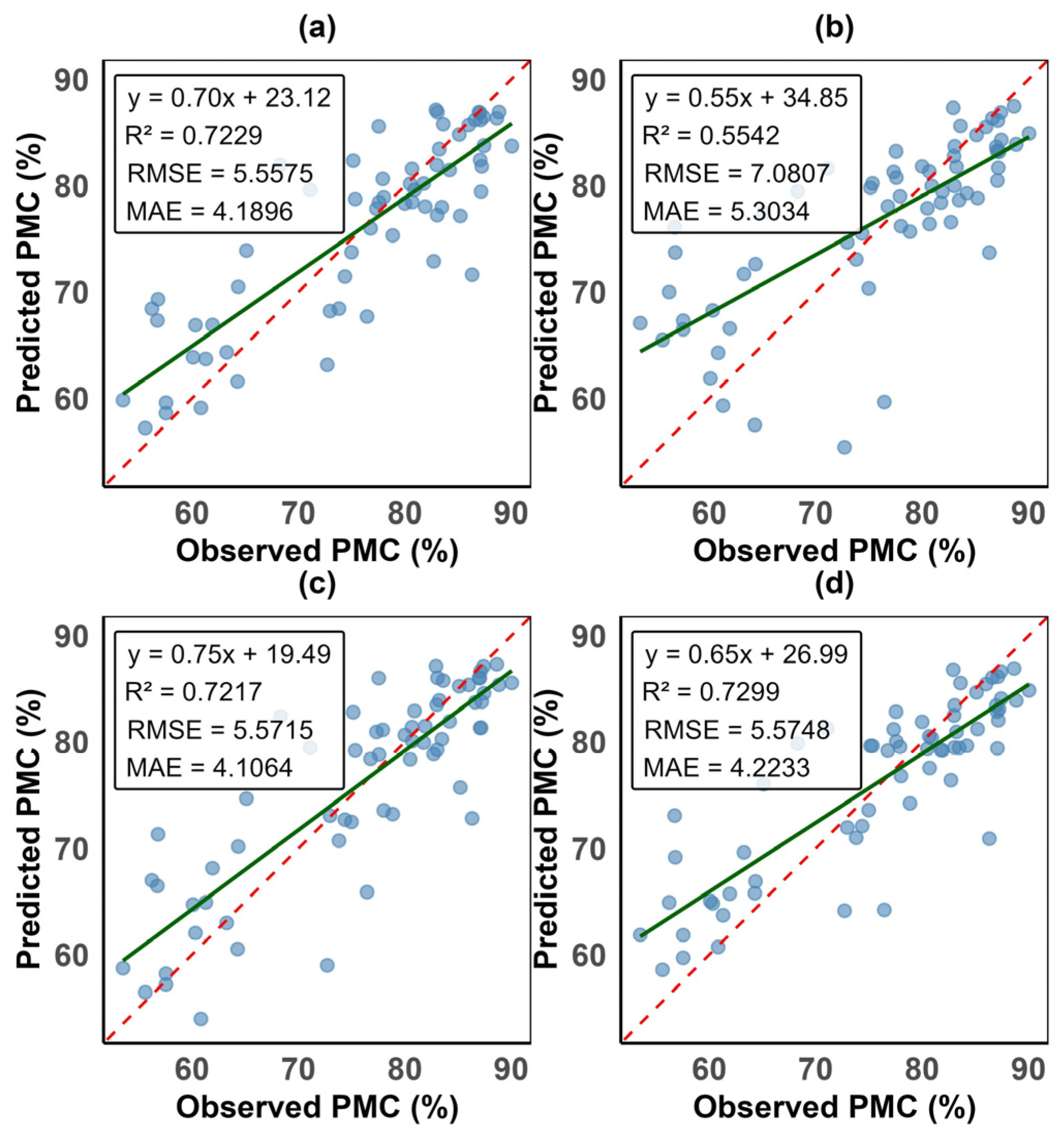
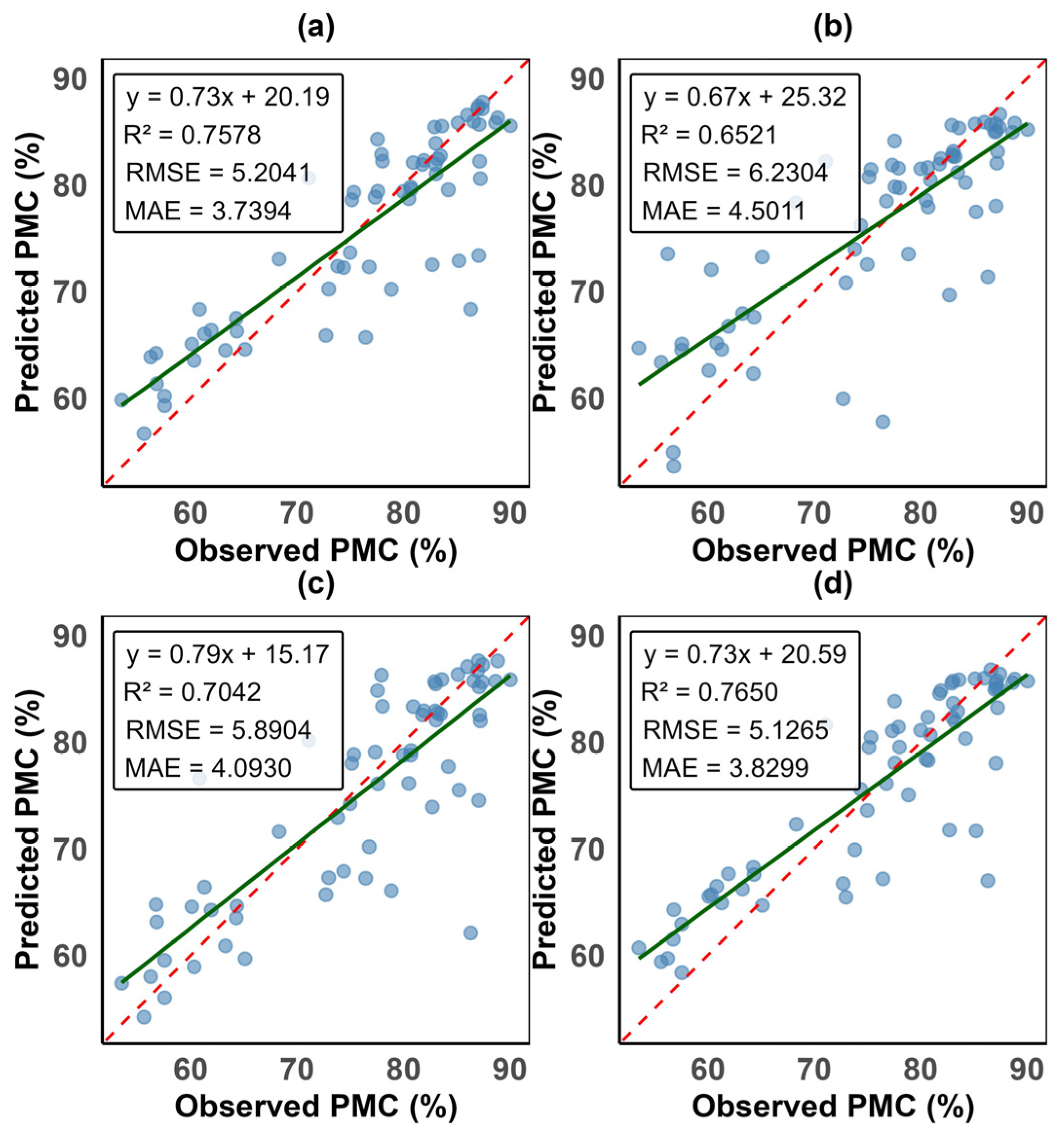
| RF | 0.8822 | 0.96 | 0.99 | 3.8091 | 2.6434 | 0.8817 | 0.97 | 0.99 | 3.8928 | 2.7541 | 0.8825 | 0.97 | 0.99 | 3.9321 | 2.8059 |
| PLSR | 0.8065 | 0.75 | 0.85 | 5.1428 | 3.5870 | 0.8106 | 0.72 | 0.88 | 5.0961 | 3.6773 | 0.8349 | 0.78 | 0.91 | 4.7837 | 3.4400 |
| SVM | 0.8573 | 0.96 | 0.99 | 4.4463 | 2.9927 | 0.8537 | 0.96 | 0.99 | 4.7592 | 3.1269 | 0.8545 | 0.98 | 0.99 | 4.6366 | 3.0676 |
| ANN | 0.8983 | 0.97 | 0.99 | 3.6654 | 2.6705 | 0.9020 | 0.98 | 0.99 | 3.5745 | 2.7405 | 0.9024 | 0.98 | 0.99 | 3.7406 | 2.5989 |
| Models | NWSI-Published Indices | EWSI-Published Indices | NDI-Published Indices | ||||||||||||
|---|---|---|---|---|---|---|---|---|---|---|---|---|---|---|---|
| R2 | R2 CI | RMSE | MAE | R2 | R2 CI | RMSE | MAE | R2 | R2 CI | RMSE | MAE | ||||
| LL | UL | LL | UL | LL | UL | ||||||||||
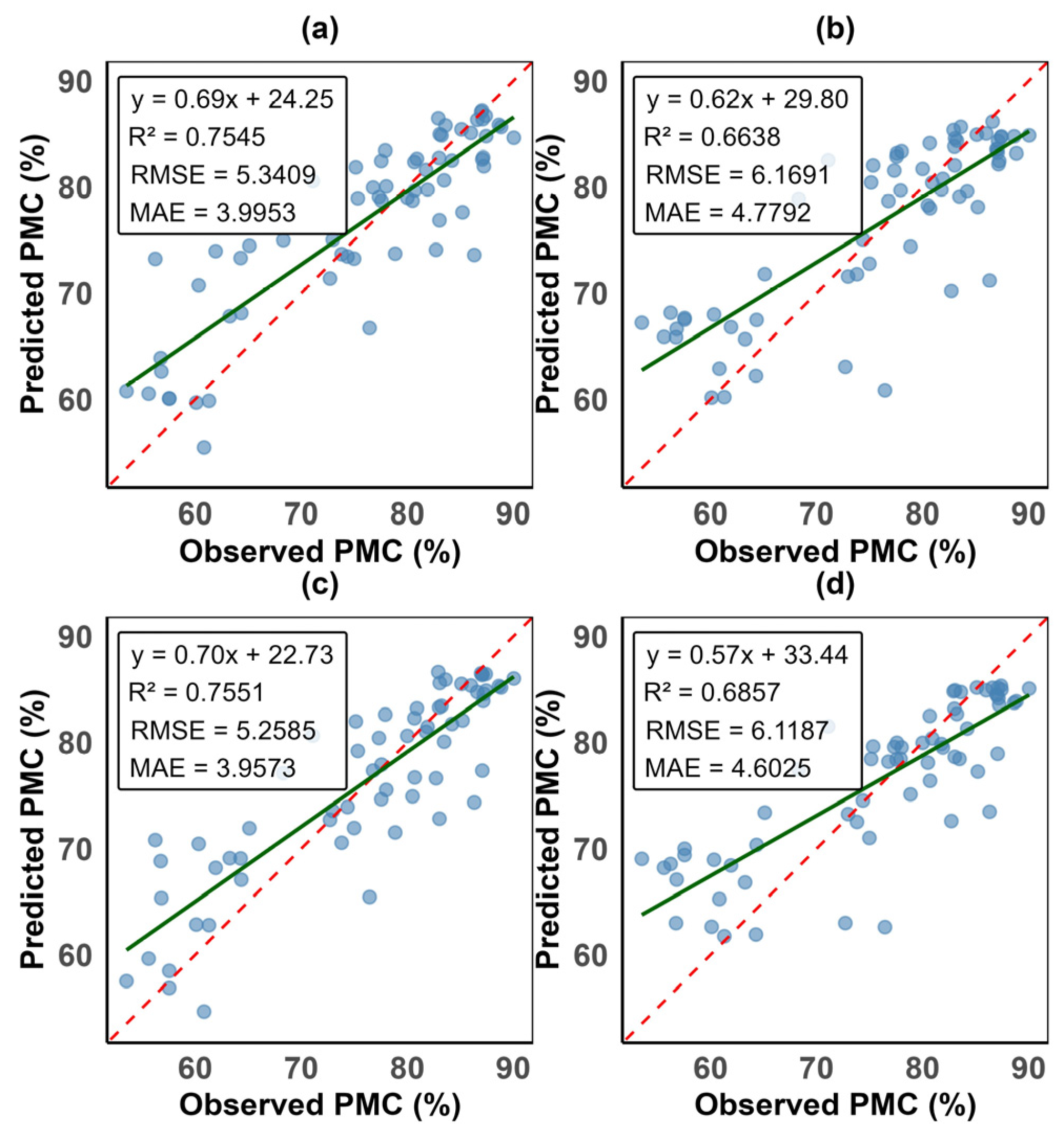
| RF | 0.7855 | 0.67 | 0.89 | 4.8949 | 3.4195 | 0.7508 | 0.60 | 0.87 | 5.3071 | 3.7089 | 0.7819 | 0.64 | 0.88 | 4.9832 | 3.5951 |
| PLSR | 0.7249 | 0.65 | 0.87 | 5.5852 | 4.2168 | 0.5950 | 0.55 | 0.85 | 6.7356 | 4.7861 | 0.5709 | 0.40 | 0.76 | 7.0638 | 4.9135 |
| SVM | 0.8203 | 0.70 | 0.90 | 4.4849 | 3.2050 | 0.7597 | 0.63 | 0.88 | 5.1718 | 3.7078 | 0.7894 | 0.63 | 0.90 | 4.8423 | 3.4395 |
| ANN | 0.7039 | 0.62 | 0.88 | 5.7500 | 4.1072 | 0.5708 | 0.49 | 0.81 | 7.2146 | 4.9354 | 0.7858 | 0.65 | 0.87 | 4.9949 | 3.5208 |
Disclaimer/Publisher’s Note: The statements, opinions and data contained in all publications are solely those of the individual author(s) and contributor(s) and not of MDPI and/or the editor(s). MDPI and/or the editor(s) disclaim responsibility for any injury to people or property resulting from any ideas, methods, instructions or products referred to in the content. |
© 2026 by the authors. Licensee MDPI, Basel, Switzerland. This article is an open access article distributed under the terms and conditions of the Creative Commons Attribution (CC BY) license.
Share and Cite
Kanneh, J.E.; Li, C.; Ma, Y.; Li, S.; BE, M.C.; Wang, Z.; Zhong, D.; Han, Z.; Li, H.; Wang, J. Utilising the Potential of a Robust Three-Band Hyperspectral Vegetation Index for Monitoring Plant Moisture Content in a Summer Maize-Winter Wheat Crop Rotation Farming System. Remote Sens. 2026, 18, 271. https://doi.org/10.3390/rs18020271
Kanneh JE, Li C, Ma Y, Li S, BE MC, Wang Z, Zhong D, Han Z, Li H, Wang J. Utilising the Potential of a Robust Three-Band Hyperspectral Vegetation Index for Monitoring Plant Moisture Content in a Summer Maize-Winter Wheat Crop Rotation Farming System. Remote Sensing. 2026; 18(2):271. https://doi.org/10.3390/rs18020271
Chicago/Turabian StyleKanneh, James E., Caixia Li, Yanchuan Ma, Shenglin Li, Madjebi Collela BE, Zuji Wang, Daokuan Zhong, Zhiguo Han, Hao Li, and Jinglei Wang. 2026. "Utilising the Potential of a Robust Three-Band Hyperspectral Vegetation Index for Monitoring Plant Moisture Content in a Summer Maize-Winter Wheat Crop Rotation Farming System" Remote Sensing 18, no. 2: 271. https://doi.org/10.3390/rs18020271
APA StyleKanneh, J. E., Li, C., Ma, Y., Li, S., BE, M. C., Wang, Z., Zhong, D., Han, Z., Li, H., & Wang, J. (2026). Utilising the Potential of a Robust Three-Band Hyperspectral Vegetation Index for Monitoring Plant Moisture Content in a Summer Maize-Winter Wheat Crop Rotation Farming System. Remote Sensing, 18(2), 271. https://doi.org/10.3390/rs18020271