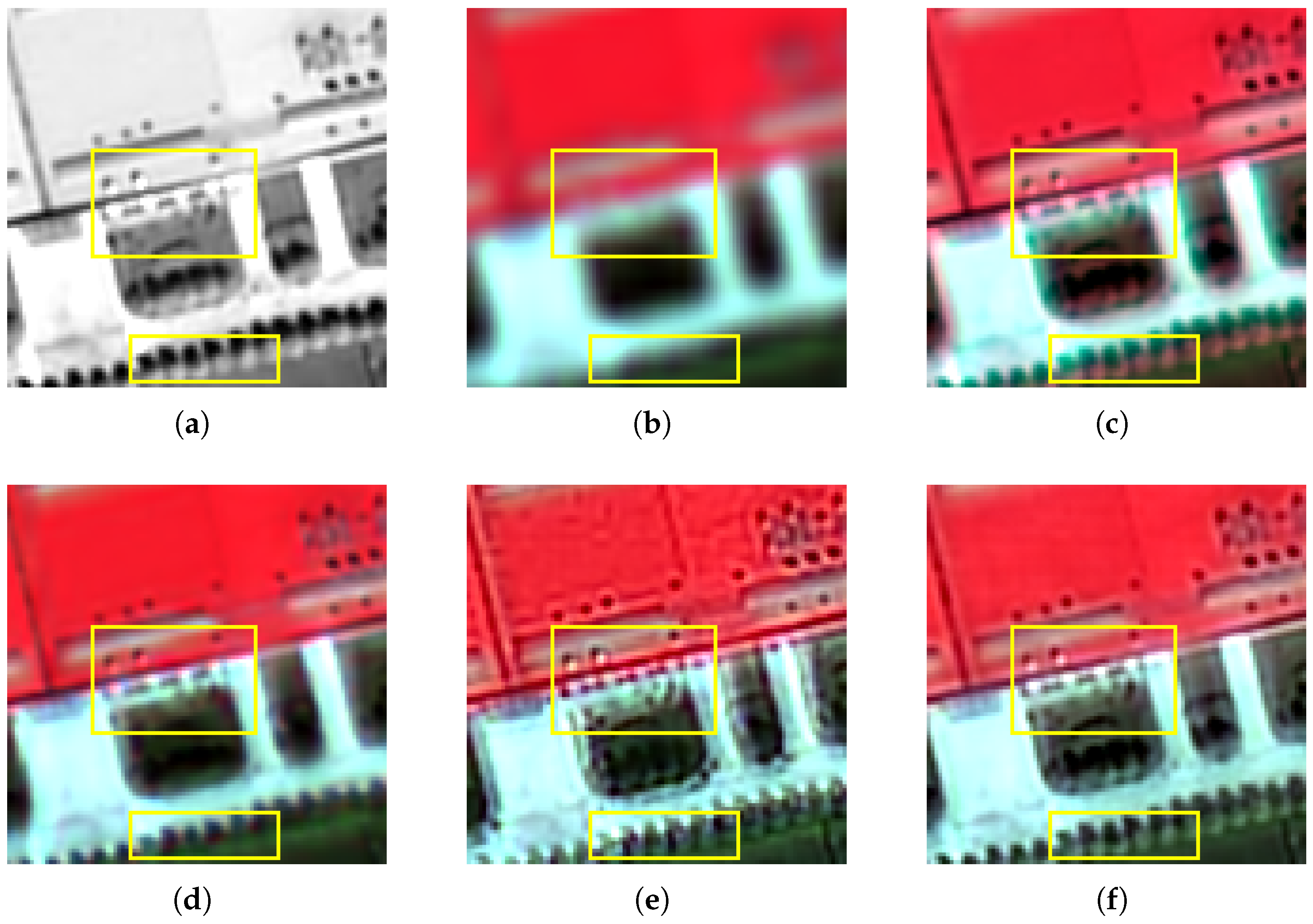
Figure 1.
Fused results on the GF2 dataset. As marked by the rectangles, duplicated contours and spectral distortion appear in GSA and DDIF. In contrast, these artifacts in fusion results are eliminated in SIUPan (ours). (a) HRPan; (b) LRMS; (c) GSA; (d) DDIF; (e) -PNN; (f) SIUPan.
Figure 1.
Fused results on the GF2 dataset. As marked by the rectangles, duplicated contours and spectral distortion appear in GSA and DDIF. In contrast, these artifacts in fusion results are eliminated in SIUPan (ours). (a) HRPan; (b) LRMS; (c) GSA; (d) DDIF; (e) -PNN; (f) SIUPan.
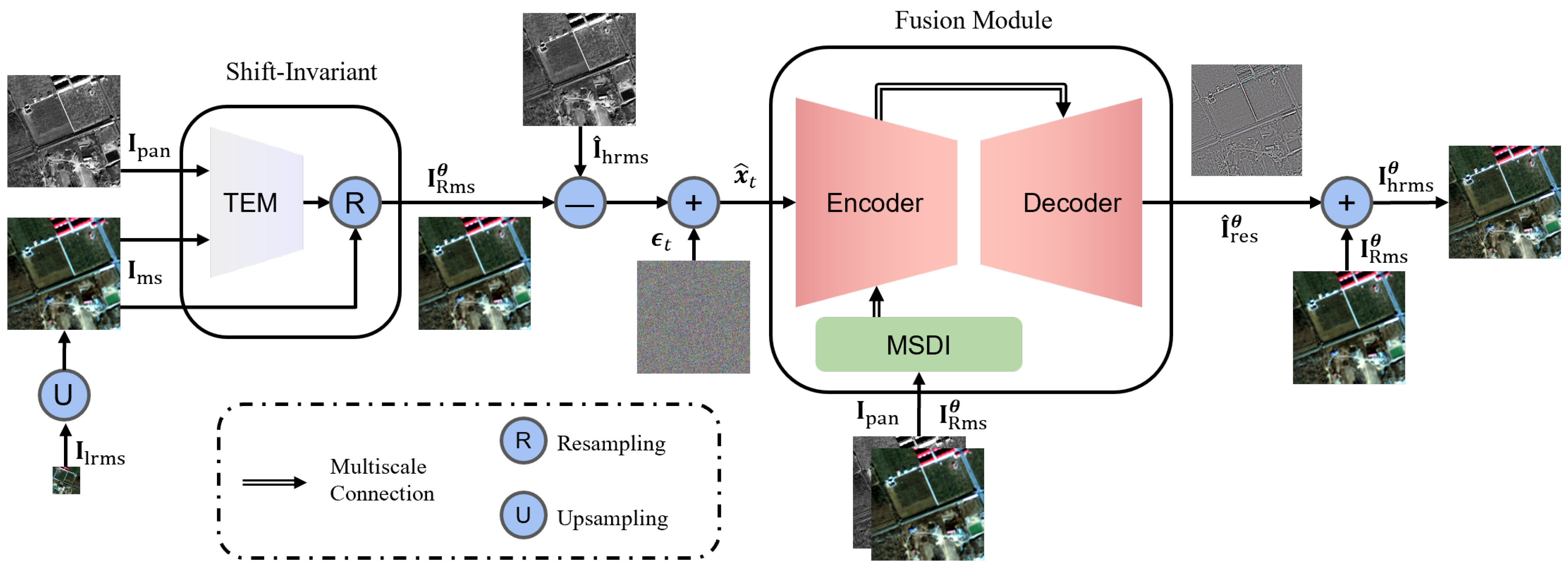
Figure 2.
Overall flowchart of the proposed method. The and are first fed into TEM to obtain the displacements between them. The displacements are utilized to resample to obtain , which is employed for fusion and loss calculation. is generated by the diffusion model with MSDI. Fusion result, , is obtained by adding and together.
Figure 2.
Overall flowchart of the proposed method. The and are first fed into TEM to obtain the displacements between them. The displacements are utilized to resample to obtain , which is employed for fusion and loss calculation. is generated by the diffusion model with MSDI. Fusion result, , is obtained by adding and together.
Figure 3.
The forward process and reverse process of diffusion model in our work. In the forward process (indicated by the black solid arrows), is used to sample . In the reverse process (indicated by the pink solid arrows), our network predicts directly, and the generated is used to sample .
Figure 3.
The forward process and reverse process of diffusion model in our work. In the forward process (indicated by the black solid arrows), is used to sample . In the reverse process (indicated by the pink solid arrows), our network predicts directly, and the generated is used to sample .
Figure 4.
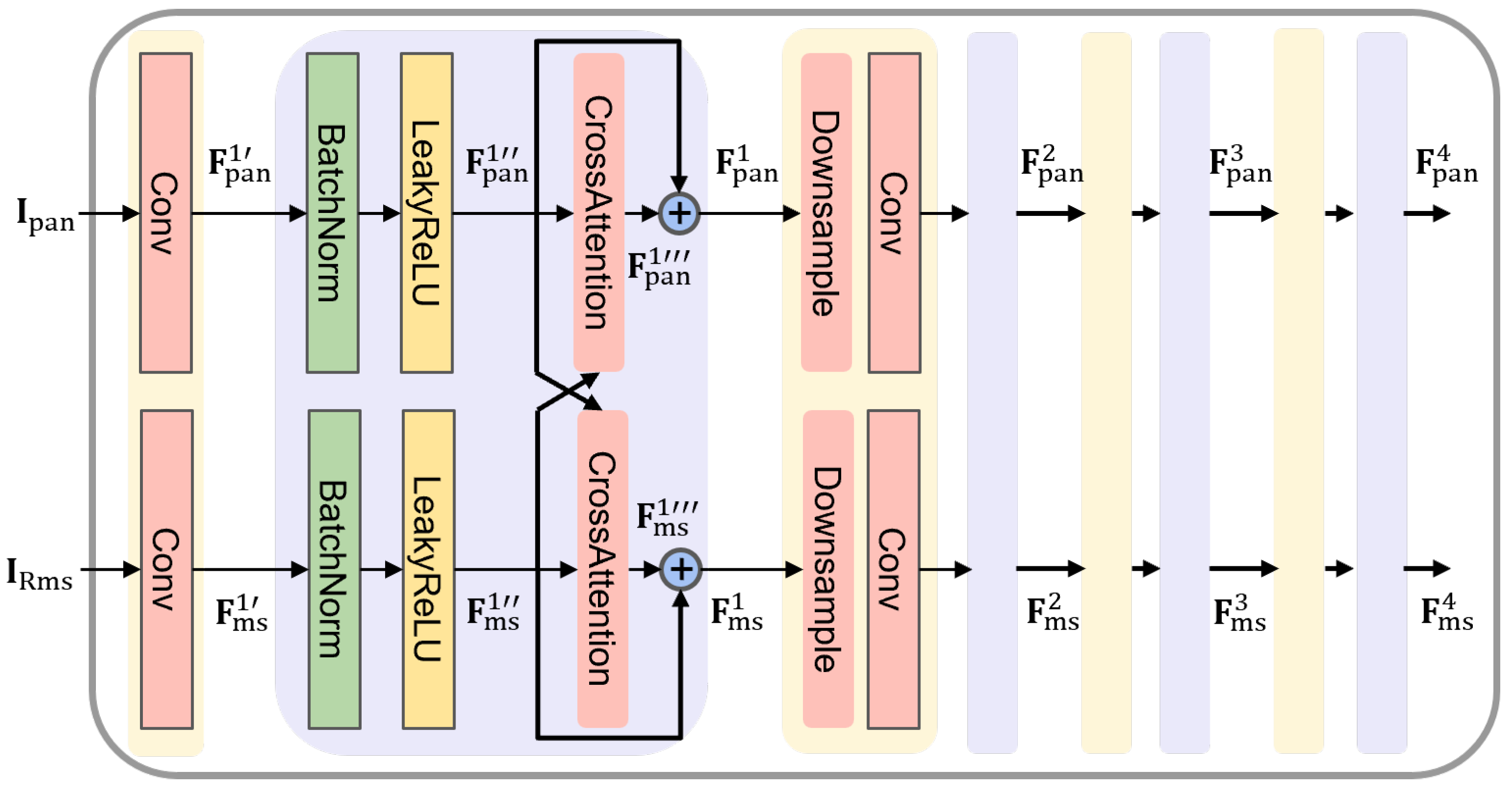
The architecture of the MSDI module. Each layer of the MSDI consists of four blocks: two cross-attention blocks and two downsample blocks. The cross-attention blocks are used to exploit the potential information from HRPan and MS, and the downsampling blocks are used to reduce the size of the feature map.
Figure 4.
The architecture of the MSDI module. Each layer of the MSDI consists of four blocks: two cross-attention blocks and two downsample blocks. The cross-attention blocks are used to exploit the potential information from HRPan and MS, and the downsampling blocks are used to reduce the size of the feature map.
Figure 5.
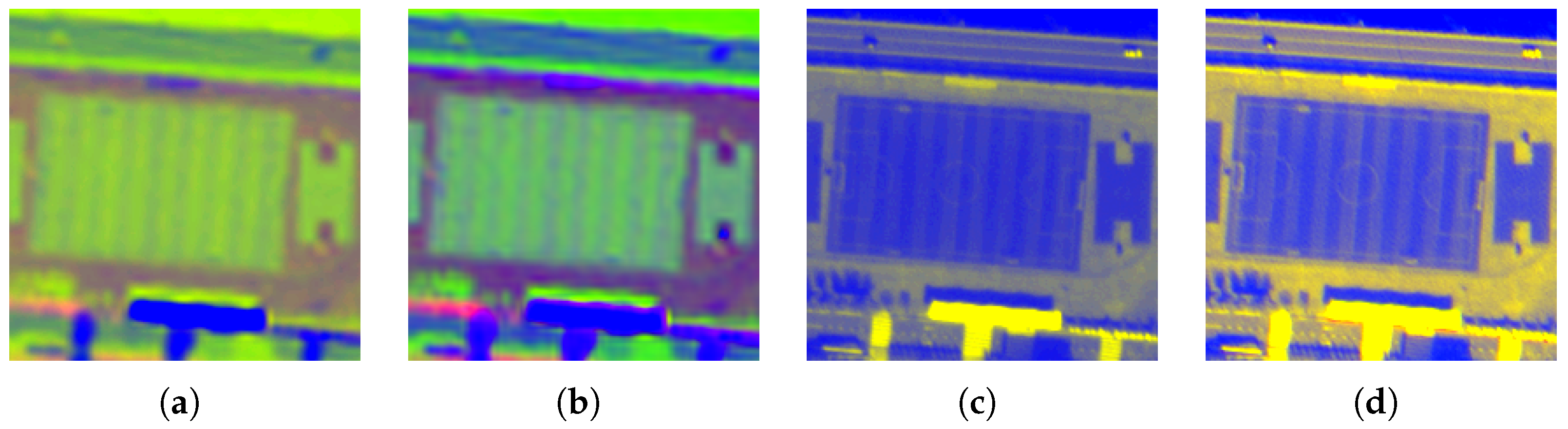
False-color images of feature maps. (a) . (b) . (c) . (d) .
Figure 5.
False-color images of feature maps. (a) . (b) . (c) . (d) .
Figure 6.
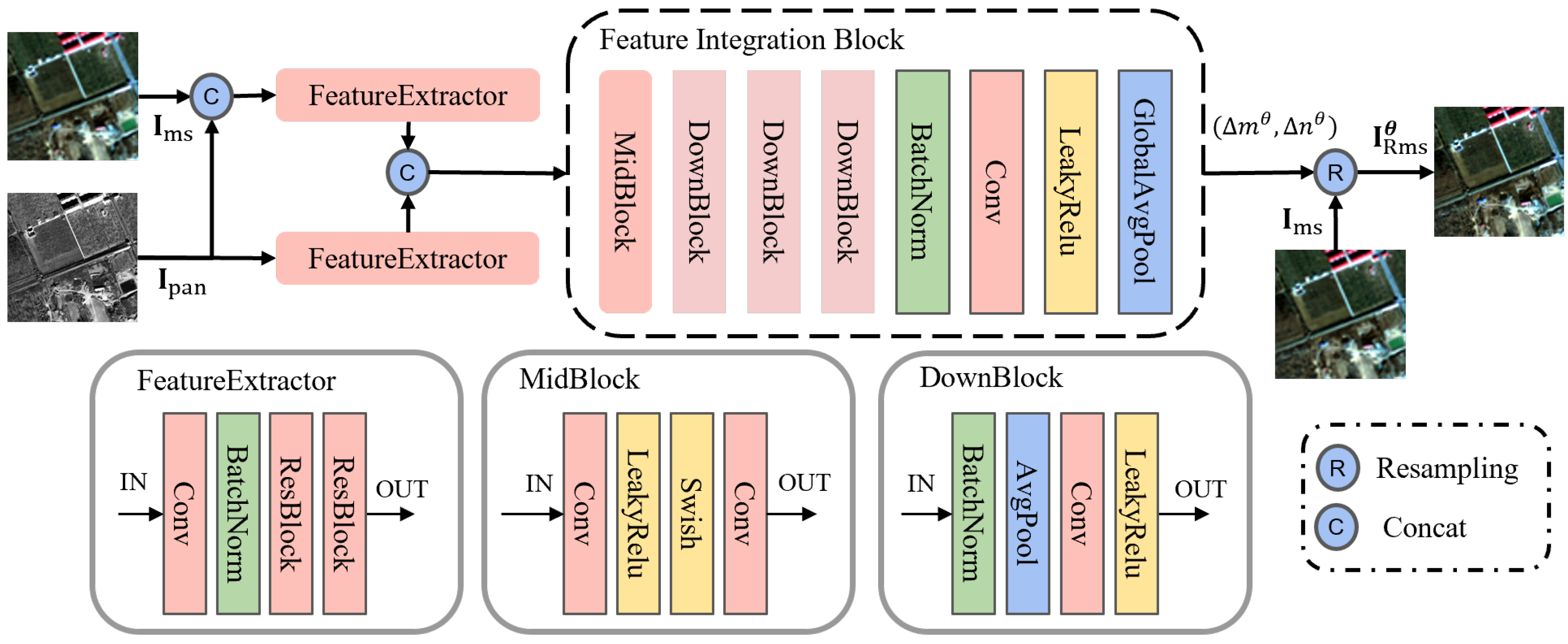
The architecture of TEM. Two feature extractors map and into the feature domain. A feature integration block, consisting of a MidBlock, three DownBlocks, a convolutional layer, an activation function, and a global average pooling, extracts their differences and outputs the displacement vector .
Figure 6.
The architecture of TEM. Two feature extractors map and into the feature domain. A feature integration block, consisting of a MidBlock, three DownBlocks, a convolutional layer, an activation function, and a global average pooling, extracts their differences and outputs the displacement vector .
Figure 7.
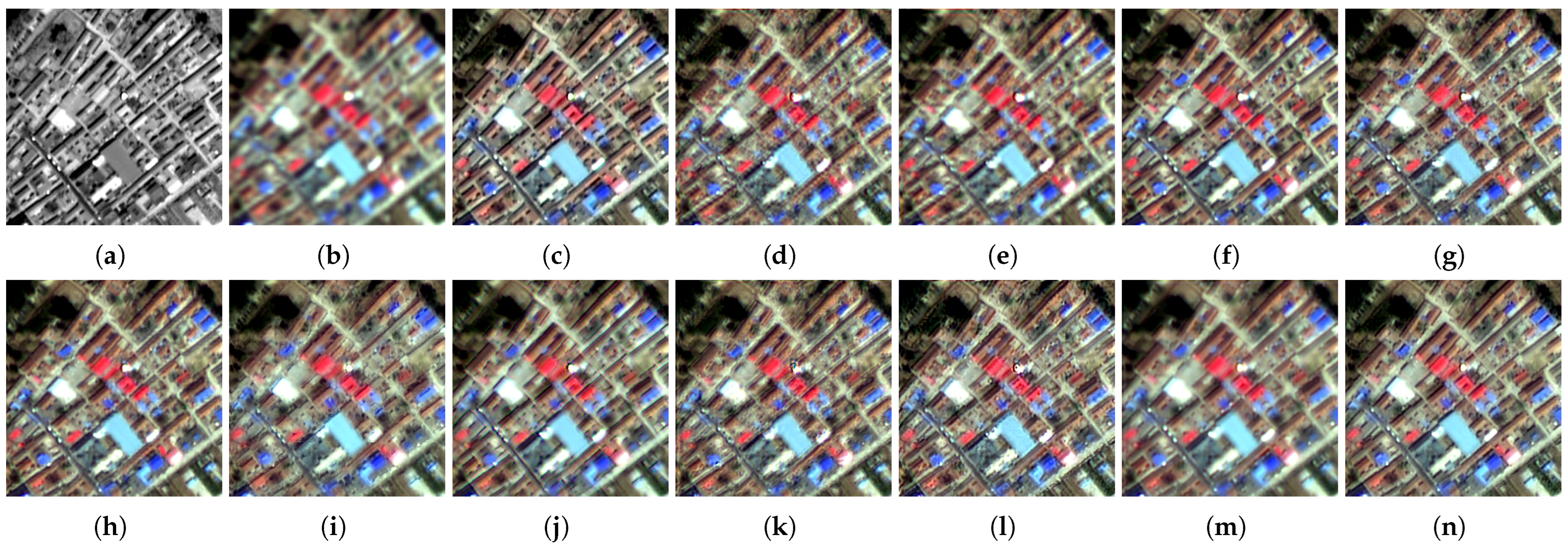
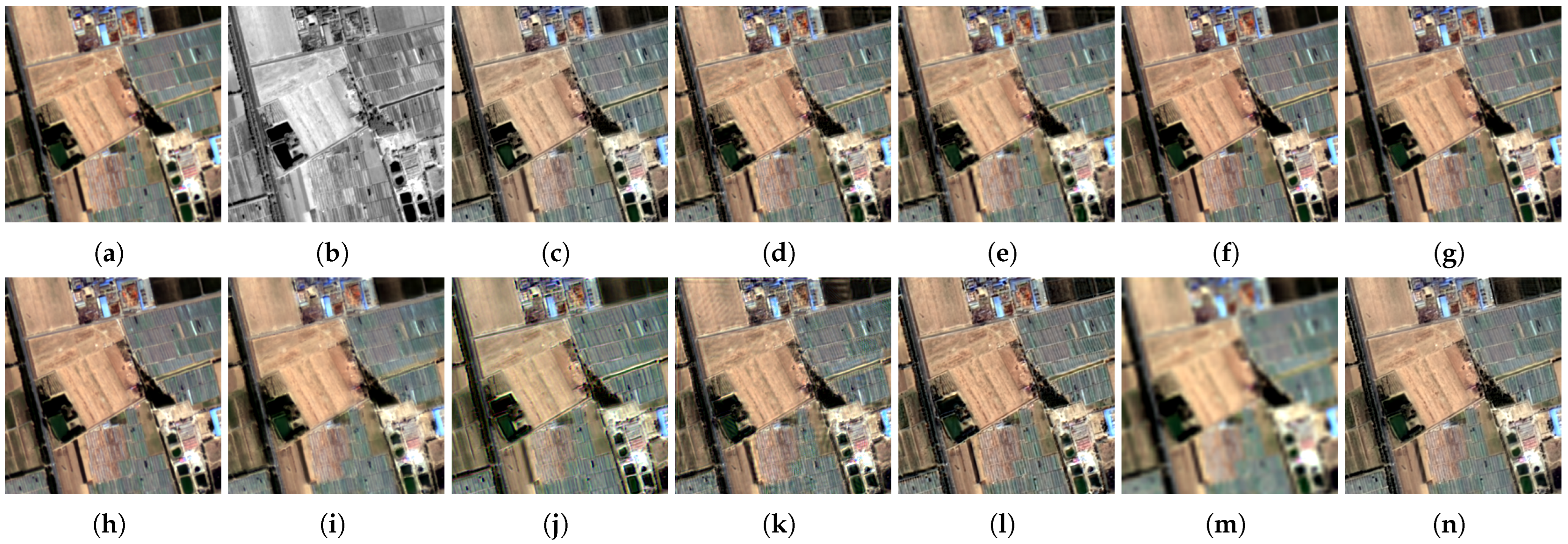
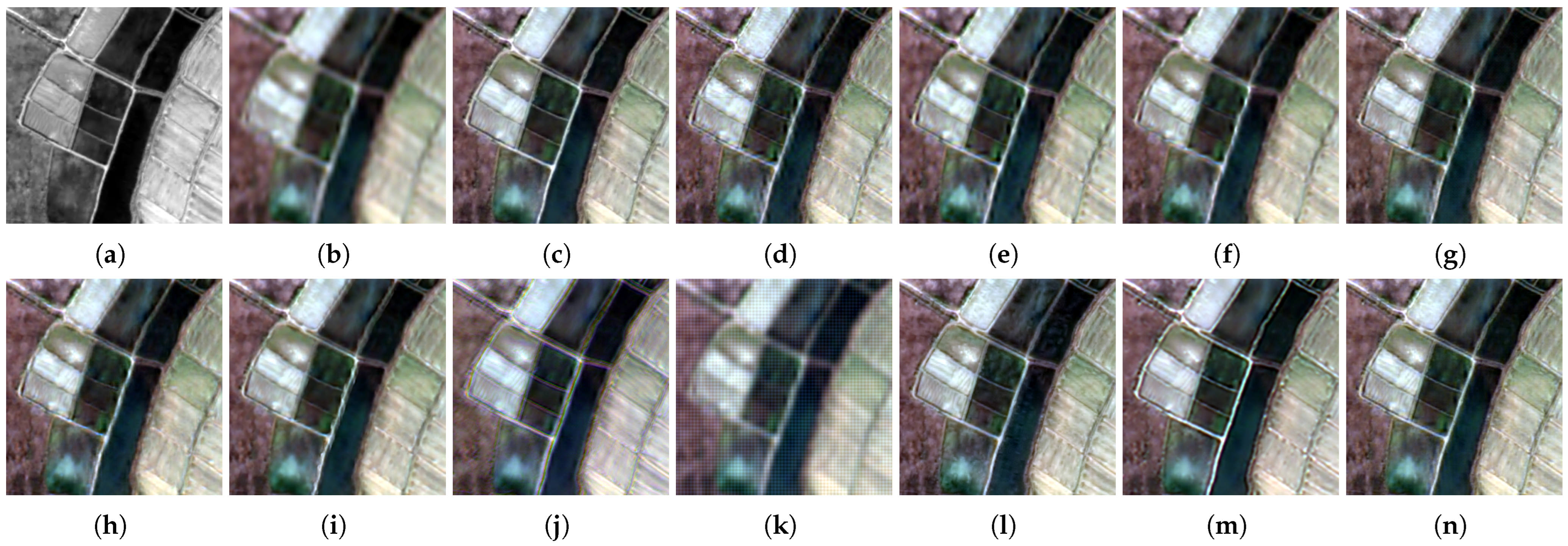
Fused results on the GF2 full resolution dataset. Visualized in RGB. (a) HRPan. (b) MS. Traditional: (c) GSA, (d) SFNLR, (e) NC-FSRM. Supervised: (f) DDIF, (g) S2DBPN, (h) PSGAN, (i) RFDifNet. Unsupervised: (j) ZSPan, (k) PSDip, (l) -PNN, (m) UCGAN. (n) SIUPan.
Figure 7.
Fused results on the GF2 full resolution dataset. Visualized in RGB. (a) HRPan. (b) MS. Traditional: (c) GSA, (d) SFNLR, (e) NC-FSRM. Supervised: (f) DDIF, (g) S2DBPN, (h) PSGAN, (i) RFDifNet. Unsupervised: (j) ZSPan, (k) PSDip, (l) -PNN, (m) UCGAN. (n) SIUPan.
Figure 8.
Fused results on the GF2 reduced resolution dataset. Visualized in RGB. (a) GT. (b) HRPan. Traditional: (c) GSA, (d) SFNLR, (e) NC-FSRM. Supervised: (f) DDIF, (g) S2DBPN, (h) PSGAN. (i) RFDifNet. Unsupervised: (j) ZSPan, (k) PSDip, (l) -PNN, (m) UCGAN, (n) SIUPan.
Figure 8.
Fused results on the GF2 reduced resolution dataset. Visualized in RGB. (a) GT. (b) HRPan. Traditional: (c) GSA, (d) SFNLR, (e) NC-FSRM. Supervised: (f) DDIF, (g) S2DBPN, (h) PSGAN. (i) RFDifNet. Unsupervised: (j) ZSPan, (k) PSDip, (l) -PNN, (m) UCGAN, (n) SIUPan.
Figure 9.
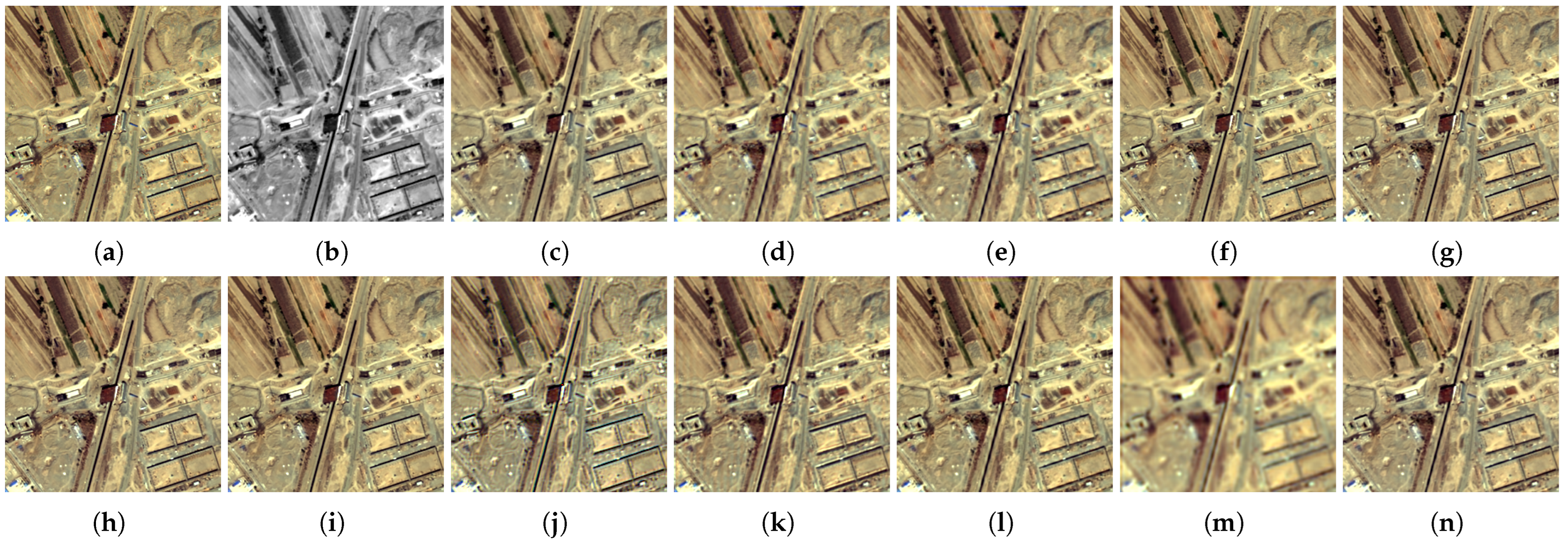
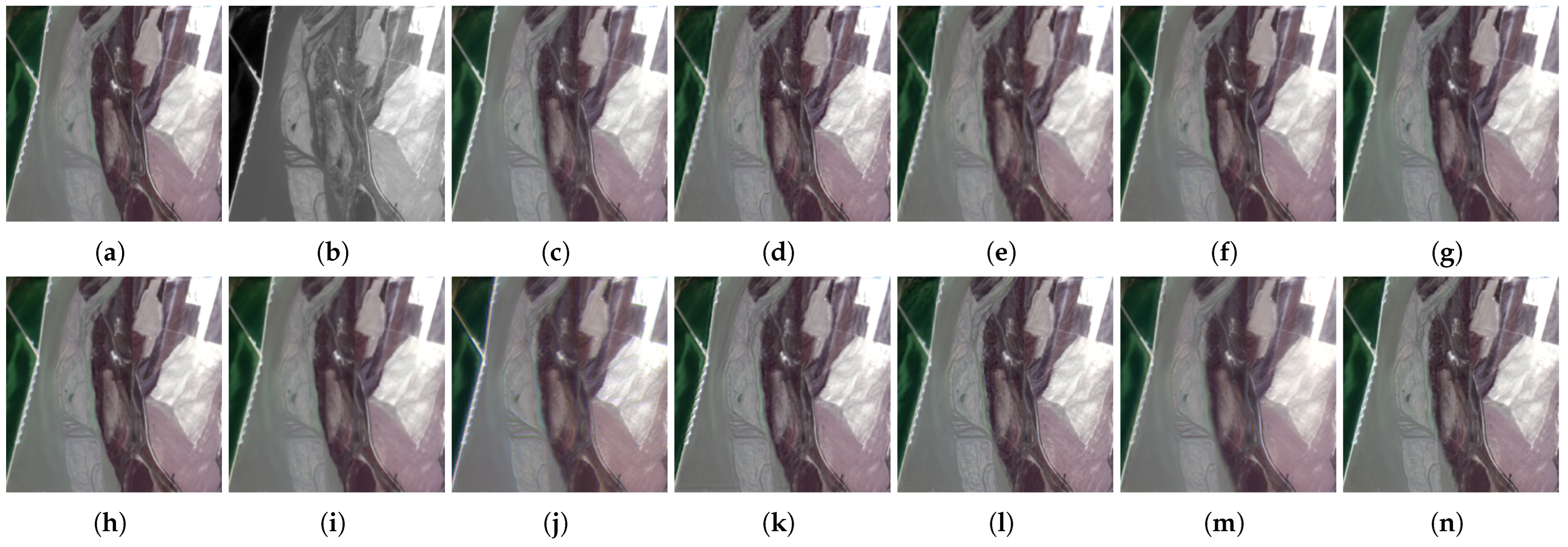
Fused results on the GF1 full resolution dataset. Visualized in RGB. (a) HRPan. (b) MS. Traditional: (c) GSA, (d) SFNLR, (e) NC-FSRM. Supervised: (f) DDIF, (g) S2DBPN, (h) PSGAN, (i) RFDifNet. Unsupervised: (j) ZSPan, (k) PSDip, (l) -PNN, (m) UCGAN. (n) SIUPan.
Figure 9.
Fused results on the GF1 full resolution dataset. Visualized in RGB. (a) HRPan. (b) MS. Traditional: (c) GSA, (d) SFNLR, (e) NC-FSRM. Supervised: (f) DDIF, (g) S2DBPN, (h) PSGAN, (i) RFDifNet. Unsupervised: (j) ZSPan, (k) PSDip, (l) -PNN, (m) UCGAN. (n) SIUPan.
Figure 10.
Fused results on the GF1 reduced resolution dataset. Visualized in RGB. (a) GT. (b) HRPan. Traditional: (c) GSA, (d) SFNLR, (e) NC-FSRM. Supervised: (f) DDIF, (g) S2DBPN, (h) PSGAN, (i) RFDifNet. Unsupervised: (j) ZSPan, (k) PSDip, (l) -PNN, (m) UCGAN, (n) SIUPan.
Figure 10.
Fused results on the GF1 reduced resolution dataset. Visualized in RGB. (a) GT. (b) HRPan. Traditional: (c) GSA, (d) SFNLR, (e) NC-FSRM. Supervised: (f) DDIF, (g) S2DBPN, (h) PSGAN, (i) RFDifNet. Unsupervised: (j) ZSPan, (k) PSDip, (l) -PNN, (m) UCGAN, (n) SIUPan.
Figure 11.
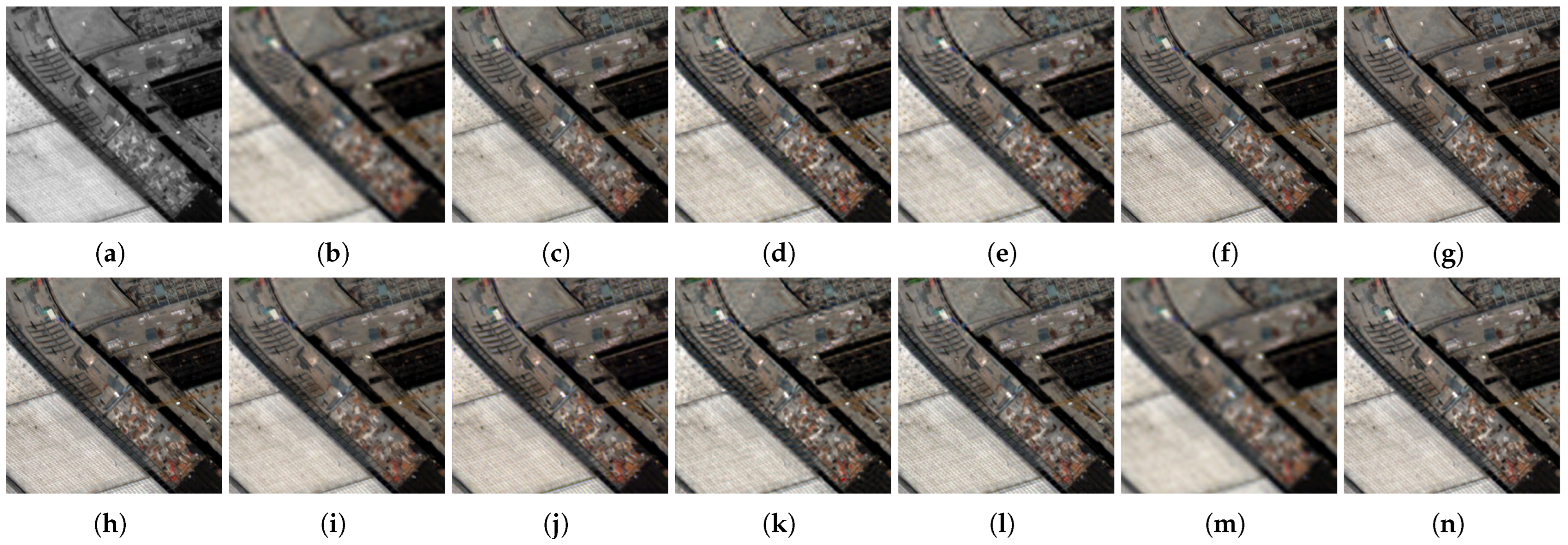
Fused results on the WV2 full resolution dataset. Visualized in RGB. (a) HRPan. (b) MS. Traditional: (c) GSA, (d) SFNLR, (e) NC-FSRM. Supervised: (f) DDIF, (g) S2DBPN, (h) PSGAN, (i) RFDifNet. Unsupervised: (j) ZSPan, (k) PSDip, (l) -PNN, (m) UCGAN, (n) SIUPan.
Figure 11.
Fused results on the WV2 full resolution dataset. Visualized in RGB. (a) HRPan. (b) MS. Traditional: (c) GSA, (d) SFNLR, (e) NC-FSRM. Supervised: (f) DDIF, (g) S2DBPN, (h) PSGAN, (i) RFDifNet. Unsupervised: (j) ZSPan, (k) PSDip, (l) -PNN, (m) UCGAN, (n) SIUPan.
Figure 12.
Fused results on the WV2 reduced resolution dataset. Visualized in RGB. (a) GT. (b) HRPan. Traditional: (c) GSA, (d) SFNLR, (e) NC-FSRM. Supervised: (f) DDIF, (g) S2DBPN, (h) PSGAN, (i) RFDifNet. Unsupervised: (j) ZSPan, (k) PSDip, (l) -PNN, (m) UCGAN, (n) SIUPan.
Figure 12.
Fused results on the WV2 reduced resolution dataset. Visualized in RGB. (a) GT. (b) HRPan. Traditional: (c) GSA, (d) SFNLR, (e) NC-FSRM. Supervised: (f) DDIF, (g) S2DBPN, (h) PSGAN, (i) RFDifNet. Unsupervised: (j) ZSPan, (k) PSDip, (l) -PNN, (m) UCGAN, (n) SIUPan.
Figure 13.
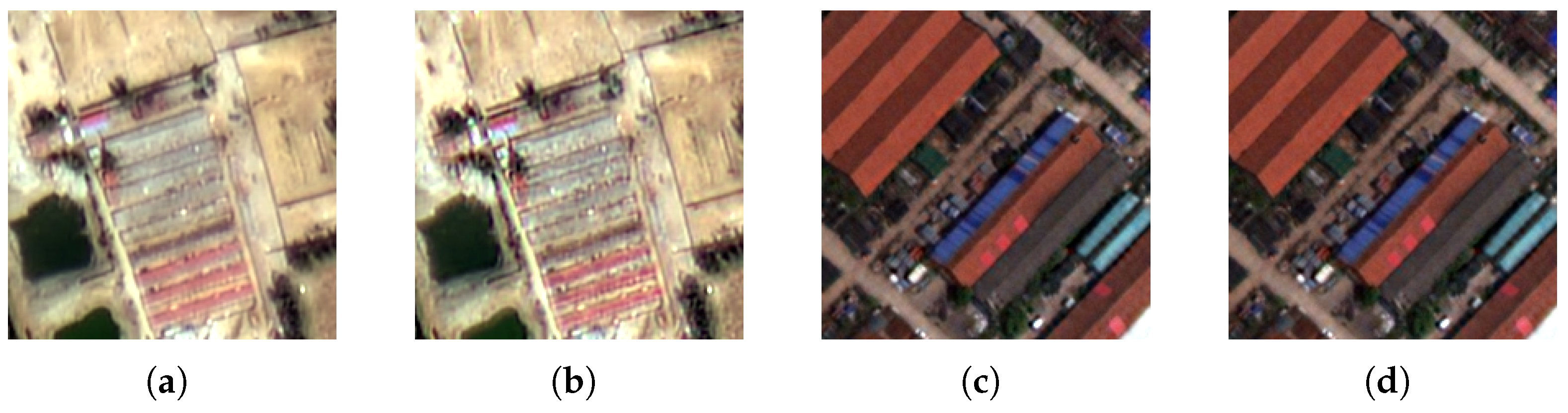
Results of TEM ablation study. Visualized in RGB. (a) With TEM on the GF2 dataset. (b) Without TEM on the GF2 dataset. (c) With TEM on the WV2 dataset. (d) Without TEM on the WV2 dataset.
Figure 13.
Results of TEM ablation study. Visualized in RGB. (a) With TEM on the GF2 dataset. (b) Without TEM on the GF2 dataset. (c) With TEM on the WV2 dataset. (d) Without TEM on the WV2 dataset.
Table 1.
The frequently used notations.
Table 1.
The frequently used notations.
| Notation | Size | Description |
|---|
| | Multi-spectral image |
| | Panchromatic image |
| | Upsampled multi-spectral image |
| | Perfectly registered |
| | Translation corrected |
| | Fused multi-spectral image we desire |
| | Estimate of |
| | The output image of SIUPan |
| | |
| | |
| | |
Table 2.
Details of the datasets. We build full resolution and reduced resolution datasets on GF2, WV2, and GF1 images.
Table 2.
Details of the datasets. We build full resolution and reduced resolution datasets on GF2, WV2, and GF1 images.
| Sensor | Image Details | Resolution | Image Crop |
|---|
| Bands | Bit | Displacement | Train | Test |
|---|
| GF2 | 4 | 10 | [1.8 1.9] | Reduced | PAN:3.2m | 64 × 64 × 1 | 512 × 512 × 1 |
| MS:12.8m | 16 × 16 × 4 | 128 × 128 × 4 |
| Number | 16,000 | 30 |
| Full | PAN:0.8m | 64 × 64 × 1 | 512 × 512 × 1 |
| MS:3.2m | 16 × 16 × 4 | 128 × 128 × 4 |
| Number | 16,000 | 30 |
| GF1 | 4 | 10 | [0.6 0.8] | Reduced | PAN:8.0m | 64 × 64 × 1 | 512 × 512 × 1 |
| MS:32.0m | 16 × 16 × 4 | 128 × 128 × 4 |
| Number | 15,616 | 27 |
| Full | PAN:2.0m | 64 × 64 × 1 | 512 × 512 × 1 |
| MS:8.0m | 16 × 16 × 4 | 128 × 128 × 4 |
| Number | 15,616 | 27 |
| WV2 | 4 | 11 | [0.4 0.3] | Reduced | PAN:2.0m | 64 × 64 × 1 | 512 × 512 × 1 |
| MS:8.0m | 16 × 16 × 4 | 128 × 128 × 4 |
| Number | 16,000 | 30 |
| Full | PAN:0.5m | 64 × 64 × 1 | 512 × 512 × 1 |
| MS:2.0m | 16 × 16 × 4 | 128 × 128 × 4 |
| Number | 16,000 | 30 |
Table 3.
Quantitative results on the GF2 dataset based on translation-corrected LRMS and HRPan. The best result in each group is in bold font.
Table 3.
Quantitative results on the GF2 dataset based on translation-corrected LRMS and HRPan. The best result in each group is in bold font.
| Type | Model | Full-Resolution Dataset | Reduced-Resolution Dataset |
|---|
| | QNR | ERGAS | SSIM | SCC | SAM |
|---|
| Traditional | GSA | 0.0897 | 0.0884 | 0.8348 | 1.5926 | 0.9206 | 0.9666 | 0.0288 |
| SFNLR | 0.0577 | 0.1961 | 0.7577 | 2.6620 | 0.8631 | 0.9064 | 0.0393 |
| NC-FSRM | 0.0629 | 0.2051 | 0.7454 | 2.4518 | 0.8838 | 0.9171 | 0.0372 |
| Supervised | DDIF | 0.0631 | 0.1194 | 0.8258 | 1.2568 | 0.9569 | 0.9770 | 0.0184 |
| S2DBPN | 0.0573 | 0.1174 | 0.8327 | 1.2840 | 0.9550 | 0.9765 | 0.0205 |
| PSGAN | 0.0598 | 0.1306 | 0.8183 | 1.3197 | 0.9552 | 0.9756 | 0.0187 |
| RFDifNet | 0.0477 | 0.2580 | 0.7066 | 1.9688 | 0.8760 | 0.9392 | 0.0264 |
| Unsupervised | ZSPan | 0.1309 | 0.0992 | 0.7826 | 2.8301 | 0.8516 | 0.9095 | 0.0500 |
| PSDip | 0.0737 | 0.2525 | 0.6923 | 3.7595 | 0.7951 | 0.8641 | 0.0442 |
| λ-PNN | 0.0687 | 0.1081 | 0.8296 | 2.7382 | 0.8546 | 0.9029 | 0.0369 |
| UCGAN | 0.0600 | 0.1267 | 0.8213 | 2.5537 | 0.8323 | 0.9073 | 0.0344 |
| SIUPan | 0.0557 | 0.0521 | 0.8954 | 1.4554 | 0.9238 | 0.9673 | 0.0238 |
Table 4.
Quantitative results on the GF2 dataset based on original LRMS and HRPan. The best result in each group is in bold font.
Table 4.
Quantitative results on the GF2 dataset based on original LRMS and HRPan. The best result in each group is in bold font.
| Type | Model | Full-Resolution Dataset | Reduced-Resolution Dataset |
|---|
| | QNR
|
ERGAS
|
SSIM
|
SCC
|
SAM
|
|---|
| Traditional | GSA | 0.0872 | 0.0641 | 0.8589 | 1.9471 | 0.8954 | 0.9504 | 0.0324 |
| SFNLR | 0.0532 | 0.2210 | 0.7376 | 2.3560 | 0.8748 | 0.9274 | 0.0364 |
| NC-FSRM | 0.0590 | 0.2300 | 0.7249 | 2.1972 | 0.8885 | 0.9347 | 0.0348 |
| Supervised | DDIF | 0.0585 | 0.1293 | 0.8204 | 0.6769 | 0.9817 | 0.9928 | 0.0140 |
| S2DBPN | 0.0530 | 0.1298 | 0.8245 | 0.8675 | 0.9726 | 0.9892 | 0.0180 |
| PSGAN | 0.0556 | 0.1442 | 0.8089 | 0.7950 | 0.9780 | 0.9914 | 0.0152 |
| RFDifNet | 0.0435 | 0.2840 | 0.6848 | 2.0089 | 0.8889 | 0.9416 | 0.0293 |
| Unsupervised | ZSPan | 0.1269 | 0.1058 | 0.7801 | 2.7796 | 0.8525 | 0.9132 | 0.0496 |
| PSDip | 0.0697 | 0.2779 | 0.6714 | 3.3020 | 0.8325 | 0.9026 | 0.0409 |
| -PNN | 0.0658 | 0.1247 | 0.8163 | 2.4448 | 0.8636 | 0.9211 | 0.0342 |
| UCGAN | 0.0566 | 0.1493 | 0.8027 | 2.7057 | 0.8077 | 0.9006 | 0.0369 |
| SIUPan | 0.0520 | 0.0642 | 0.8868 | 1.7824 | 0.9015 | 0.9541 | 0.0282 |
Table 5.
Quantitative results on the GF1 dataset based on translation-corrected LRMS and HRPan. The best result in each group is in bold font.
Table 5.
Quantitative results on the GF1 dataset based on translation-corrected LRMS and HRPan. The best result in each group is in bold font.
| Type | Model | Full-Resolution Dataset | Reduced-Resolution Dataset |
|---|
| |
QNR
|
ERGAS
|
SSIM
|
SCC
|
SAM
|
|---|
| Traditional | GSA | 0.0675 | 0.0672 | 0.8717 | 1.3197 | 0.9208 | 0.9627 | 0.0291 |
| SFNLR | 0.0425 | 0.0668 | 0.8936 | 1.7499 | 0.9028 | 0.9401 | 0.0344 |
| NC-FSRM | 0.0445 | 0.0698 | 0.8891 | 1.6488 | 0.9125 | 0.9435 | 0.0331 |
| Supervised | DDIF | 0.0442 | 0.0880 | 0.8720 | 0.7454 | 0.9729 | 0.9871 | 0.0160 |
| S2DBPN | 0.0421 | 0.0629 | 0.8979 | 0.8622 | 0.9642 | 0.9831 | 0.0190 |
| PSGAN | 0.0393 | 0.0841 | 0.8800 | 0.8508 | 0.9667 | 0.9843 | 0.0184 |
| RFDifNet | 0.0416 | 0.0631 | 0.8980 | 1.0630 | 0.9547 | 0.9760 | 0.0216 |
| Unsupervised | ZSPan | 0.0551 | 0.0723 | 0.8777 | 1.6870 | 0.8811 | 0.9295 | 0.0394 |
| PSDip | 0.0498 | 0.0837 | 0.8707 | 2.0766 | 0.8707 | 0.9148 | 0.0397 |
| -PNN | 0.0616 | 0.0669 | 0.8766 | 1.4342 | 0.9162 | 0.9542 | 0.0283 |
| UCGAN | 0.0402 | 0.0687 | 0.8945 | 1.8216 | 0.8817 | 0.9357 | 0.0395 |
| SIUPan | 0.0419 | 0.0520 | 0.9086 | 1.3738 | 0.9125 | 0.9609 | 0.0283 |
Table 6.
Quantitative results on the GF1 dataset based on original LRMS and HRPan. The best result in each group is in bold font.
Table 6.
Quantitative results on the GF1 dataset based on original LRMS and HRPan. The best result in each group is in bold font.
| Type | Model | Full-Resolution Dataset | Reduced-Resolution Dataset |
|---|
| | QNR
| ERGAS
| SSIM
| SCC
| SAM
|
|---|
| Traditional | GSA | 0.0667 | 0.0692 | 0.8706 | 1.4269 | 0.9133 | 0.9558 | 0.0312 |
| SFNLR | 0.0423 | 0.0661 | 0.8945 | 1.9427 | 0.8891 | 0.9267 | 0.0376 |
| NC-FSRM | 0.0442 | 0.0691 | 0.8900 | 1.8574 | 0.8967 | 0.9295 | 0.0364 |
| Supervised | DDIF | 0.0440 | 0.0873 | 0.8728 | 0.6684 | 0.9743 | 0.9882 | 0.0154 |
| S2DBPN | 0.0418 | 0.0624 | 0.8985 | 0.8545 | 0.9615 | 0.9824 | 0.0197 |
| PSGAN | 0.0392 | 0.0832 | 0.8811 | 0.7770 | 0.9680 | 0.9852 | 0.0180 |
| RFDifNet | 0.0413 | 0.0619 | 0.8994 | 1.0244 | 0.9540 | 0.9769 | 0.0219 |
| Unsupervised | ZSPan | 0.0761 | 0.0549 | 0.8736 | 1.7844 | 0.8737 | 0.9221 | 0.0411 |
| PSDip | 0.0495 | 0.0824 | 0.8721 | 2.3010 | 0.8511 | 0.8970 | 0.0431 |
| -PNN | 0.0613 | 0.0681 | 0.8757 | 1.6296 | 0.9048 | 0.9435 | 0.0318 |
| UCGAN | 0.0401 | 0.0681 | 0.8952 | 1.9599 | 0.8668 | 0.9274 | 0.0418 |
| SIUPan | 0.0415 | 0.0526 | 0.9083 | 1.4971 | 0.9063 | 0.9542 | 0.0312 |
Table 7.
Quantitative results on the WV2 dataset based on translation-corrected LRMS and HRPan. The best result in each group is in bold font.
Table 7.
Quantitative results on the WV2 dataset based on translation-corrected LRMS and HRPan. The best result in each group is in bold font.
| Type | Model | Full-Resolution Dataset | Reduced-Resolution Dataset |
|---|
| | QNR
| ERGAS
| SSIM
|
SCC
|
SAM
|
|---|
| Traditional | GSA | 0.0492 | 0.0603 | 0.8946 | 1.5177 | 0.9532 | 0.9723 | 0.0375 |
| SFNLR | 0.0525 | 0.0553 | 0.8955 | 2.1754 | 0.9306 | 0.9469 | 0.0401 |
| NC-FSRM | 0.0514 | 0.0531 | 0.8987 | 2.5857 | 0.9075 | 0.9253 | 0.0460 |
| Supervised | DDIF | 0.0472 | 0.0601 | 0.8967 | 1.0864 | 0.9772 | 0.9863 | 0.0212 |
| S2DBPN | 0.0485 | 0.0540 | 0.9029 | 1.1842 | 0.9729 | 0.9831 | 0.0254 |
| PSGAN | 0.0497 | 0.0591 | 0.8965 | 1.0987 | 0.9762 | 0.9858 | 0.0224 |
| RFDifNet | 0.0440 | 0.0582 | 0.9005 | 1.1228 | 0.9749 | 0.9840 | 0.0227 |
| Unsupervised | ZSPan | 0.0886 | 0.0808 | 0.8400 | 2.8627 | 0.9274 | 0.9295 | 0.0448 |
| PSDip | 0.0515 | 0.0782 | 0.8748 | 2.7615 | 0.9004 | 0.9149 | 0.0482 |
| -PNN | 0.0618 | 0.0601 | 0.8833 | 2.1212 | 0.9413 | 0.9531 | 0.0391 |
| UCGAN | 0.0509 | 0.0945 | 0.8610 | 2.8051 | 0.8678 | 0.9109 | 0.0471 |
| SIUPan | 0.0472 | 0.0511 | 0.9050 | 1.6833 | 0.9533 | 0.9684 | 0.0358 |
Table 8.
Quantitative results on the WV2 dataset based on original LRMS and HRPan. The best result in each group is in bold font.
Table 8.
Quantitative results on the WV2 dataset based on original LRMS and HRPan. The best result in each group is in bold font.
| Type | Model | Full-Resolution Dataset | Reduced-Resolution Dataset |
|---|
| | QNR
| ERGAS
| SSIM
| SCC
| SAM
|
|---|
| Traditional | GSA | 0.0487 | 0.0688 | 0.8870 | 1.8513 | 0.9362 | 0.9606 | 0.0423 |
| SFNLR | 0.0510 | 0.0522 | 0.9000 | 2.5727 | 0.9123 | 0.9277 | 0.0454 |
| NC-FSRM | 0.0498 | 0.0515 | 0.9017 | 2.5857 | 0.9075 | 0.9253 | 0.0460 |
| Supervised | DDIF | 0.0471 | 0.0590 | 0.8983 | 0.9485 | 0.9802 | 0.9883 | 0.0221 |
| S2DBPN | 0.0486 | 0.0562 | 0.9015 | 1.1909 | 0.9709 | 0.9827 | 0.0273 |
| PSGAN | 0.0497 | 0.0588 | 0.8976 | 1.0521 | 0.9766 | 0.9859 | 0.0239 |
| RFDifNet | 0.0439 | 0.0562 | 0.9028 | 1.0787 | 0.9750 | 0.9842 | 0.0240 |
| Unsupervised | ZSPan | 0.0872 | 0.0786 | 0.8430 | 3.1150 | 0.9094 | 0.9137 | 0.0487 |
| PSDip | 0.0504 | 0.0737 | 0.8801 | 3.2033 | 0.8725 | 0.8869 | 0.0539 |
| -PNN | 0.0624 | 0.0618 | 0.8820 | 2.5124 | 0.9240 | 0.9346 | 0.0447 |
| UCGAN | 0.0489 | 0.0867 | 0.8699 | 3.1174 | 0.8437 | 0.8931 | 0.0516 |
| SIUPan | 0.0473 | 0.0526 | 0.9040 | 2.0620 | 0.9366 | 0.9535 | 0.0412 |
Table 9.
Quantitative assessment of translation correction on GF2 and WV2 datasets. GSA is used to fuse HRPan and MS.
Table 9.
Quantitative assessment of translation correction on GF2 and WV2 datasets. GSA is used to fuse HRPan and MS.
| Dataset | MS | GSA Fusion Results |
|---|
| |
QNR
|
|---|
| GF2 | | 0.0897 | 0.0884 | 0.8348 |
| 0.0800 | 0.0748 | 0.8553 |
| WV2 | | 0.0492 | 0.0603 | 0.8946 |
| 0.0485 | 0.0595 | 0.8960 |
Table 10.
Quantitative assessment of TEM ablation study on GF2 and WV2 datasets.
Table 10.
Quantitative assessment of TEM ablation study on GF2 and WV2 datasets.
| Dataset | TEM | Full-Resolution Datasets | Reduced-Resolution Dataset |
|---|
| |
QNR
|
ERGAS
|
SSIM
|
SCC
|
SAM
|
|---|
| GF2 | w/o | 0.0607 | 0.1041 | 0.8409 | 2.3472 | 0.8749 | 0.9298 | 0.0337 |
| w/ | 0.0557 | 0.0521 | 0.8954 | 1.4554 | 0.9238 | 0.9673 | 0.0238 |
| WV2 | w/o | 0.0481 | 0.0524 | 0.9027 | 1.8962 | 0.9482 | 0.9625 | 0.0386 |
| w/ | 0.0472 | 0.0511 | 0.9050 | 1.6833 | 0.9533 | 0.9684 | 0.0358 |
Table 11.
Quantitative assessment of ablation study on the WV2 dataset.
Table 11.
Quantitative assessment of ablation study on the WV2 dataset.
| Full-Resolution Dataset | Reduced-Resolution Dataset |
|---|
| | QNR
| ERGAS
| SSIM
| SCC
| SAM
|
|---|
| 0.0491 | 0.0545 | 0.9006 | 1.7288 | 0.9516 | 0.9669 | 0.0364 |
| 0.0472 | 0.0511 | 0.9050 | 1.6833 | 0.9533 | 0.9684 | 0.0358 |
| 0.0475 | 0.0519 | 0.9041 | 1.6856 | 0.9531 | 0.9687 | 0.0356 |
| GT | - | - | - | 1.6889 | 0.9530 | 0.9682 | 0.0357 |
Table 12.
Quantitative assessment of MSDI ablation study on the WV2 dataset.
Table 12.
Quantitative assessment of MSDI ablation study on the WV2 dataset.
| MSDI | Full-Resolution Dataset | Reduced-Resolution Dataset |
|---|
| |
QNR
|
ERGAS
|
SSIM
|
SCC
|
SAM
|
|---|
| w/o | 0.0470 | 0.1154 | 0.8440 | 2.7202 | 0.8667 | 0.9152 | 0.0396 |
| w/ | 0.0472 | 0.0511 | 0.9050 | 1.6833 | 0.9533 | 0.9684 | 0.0358 |
Table 13.
Quantitative assessment of different loss functions on the WV2 dataset.
Table 13.
Quantitative assessment of different loss functions on the WV2 dataset.
| Loss Term | Full-Resolution Dataset | Reduced-Resolution Dataset |
|---|
| | | | | |
QNR
|
ERGAS
|
SSIM
|
SCC
|
SAM
|
|---|
| × | √ | √ | √ | 0.0459 | 0.0536 | 0.9044 | 1.7838 | 0.9455 | 0.9654 | 0.0355 |
| √ | × | √ | √ | 0.1367 | 0.6200 | 0.3307 | 51.8171 | 0.0429 | 0.1461 | 0.0845 |
| √ | √ | × | √ | 0.0542 | 0.0629 | 0.8871 | 1.5635 | 0.9548 | 0.9701 | 0.0362 |
| √ | √ | √ | × | 0.0508 | 0.0546 | 0.8984 | 1.7283 | 0.9520 | 0.9670 | 0.0360 |
| √ | √ | √ | √ | 0.0472 | 0.0511 | 0.9050 | 1.6833 | 0.9533 | 0.9684 | 0.0358 |




 ,
,