Figure 1.
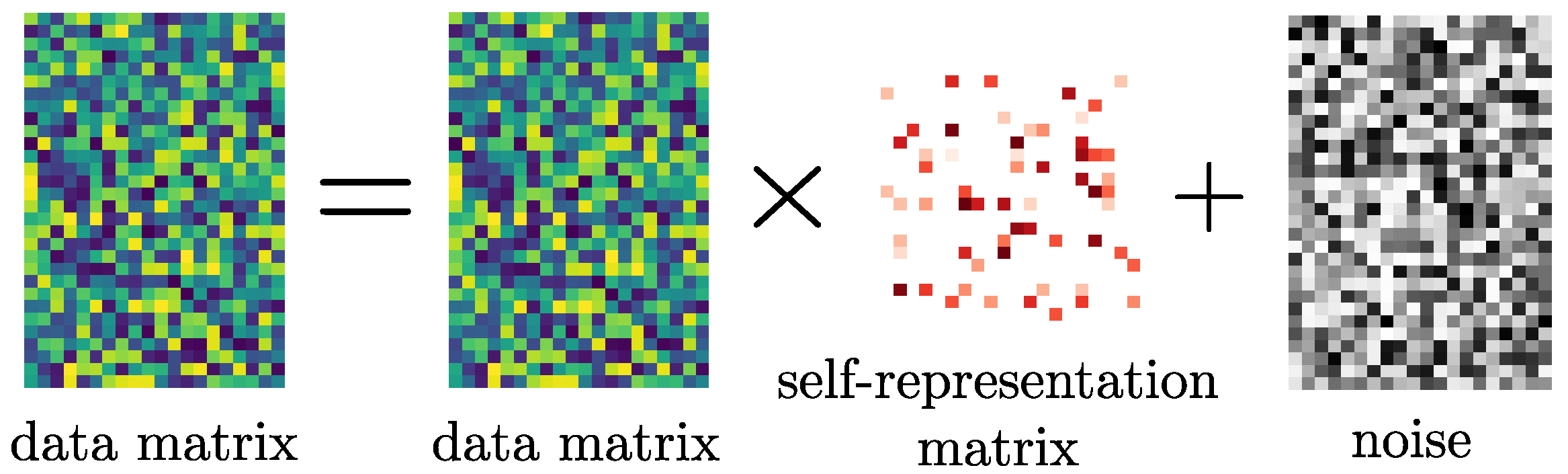
An illustration of the self-representation model.
Figure 1.
An illustration of the self-representation model.
Figure 2.
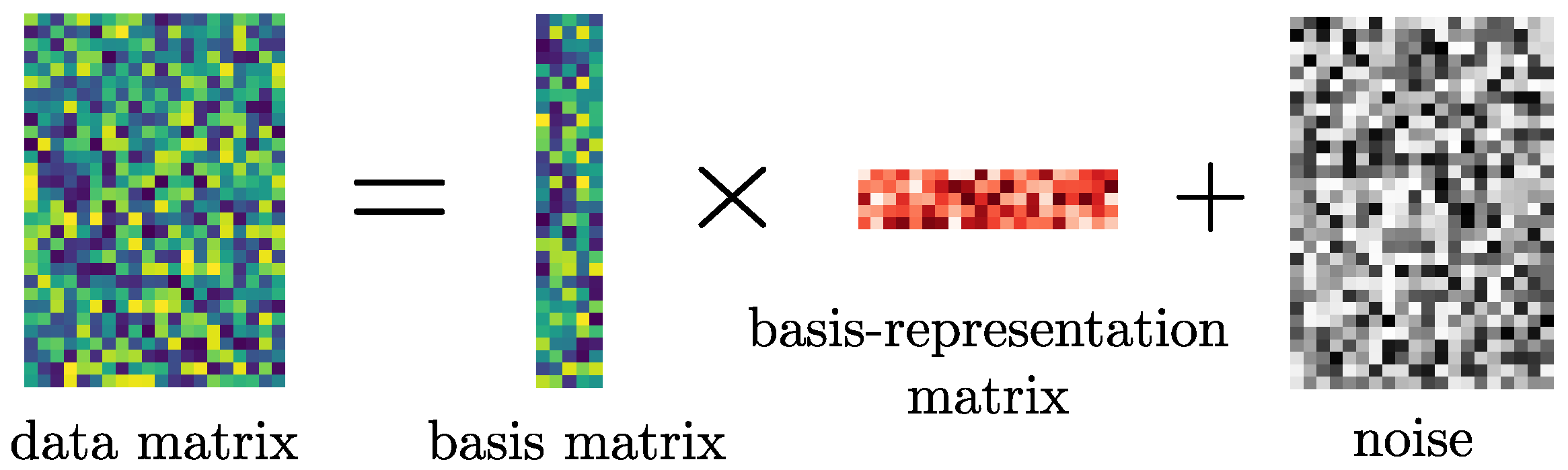
An illustration of the basis-representation model.
Figure 2.
An illustration of the basis-representation model.
Figure 3.
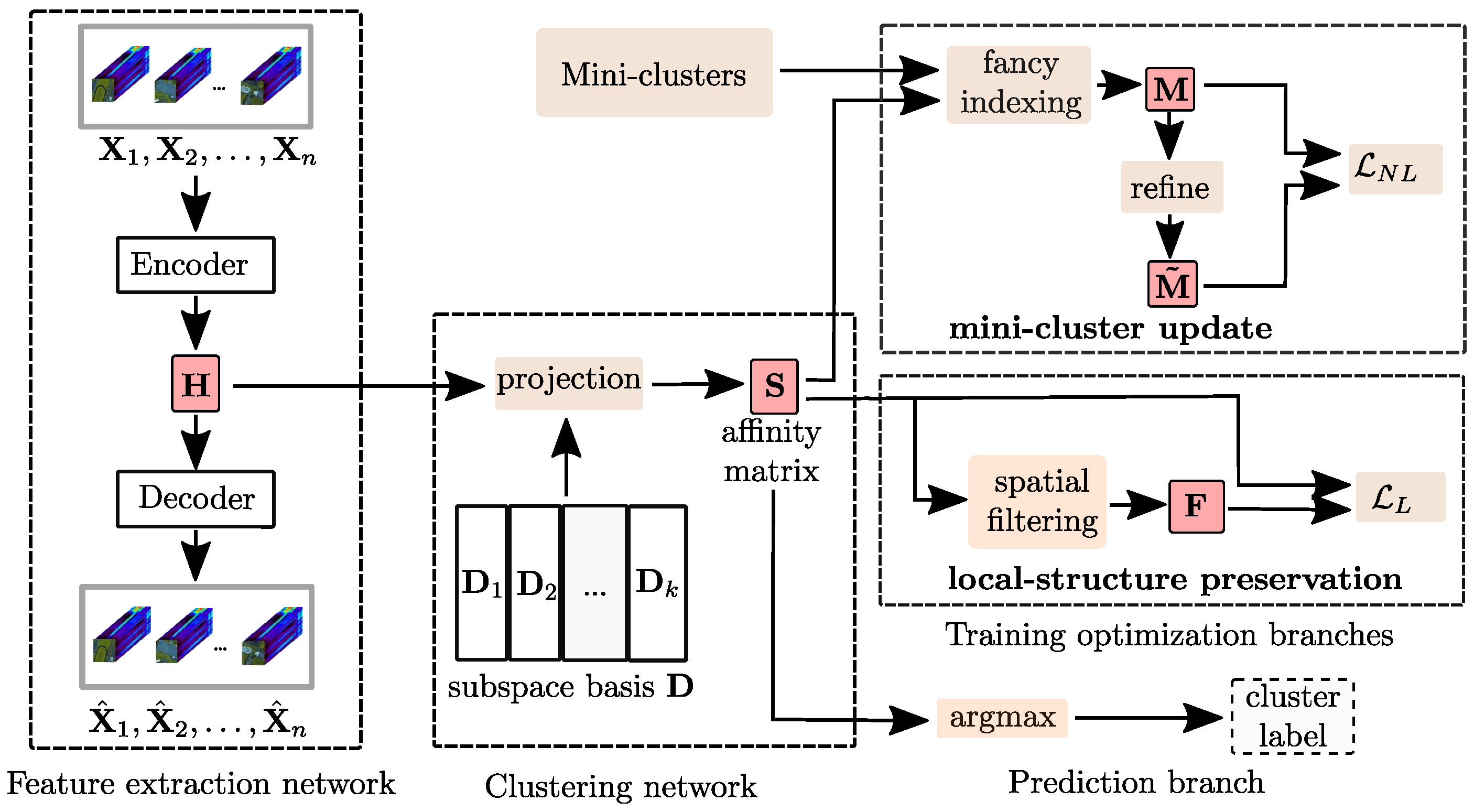
Structure of the proposed method. The autoencoder maps the input data nonlinearly to a latent representation . This representation is then projected onto various subspace bases to form the subspace affinity matrix . To enhance the quality of the subspace basis, the following optimization modules are applied: (1) the mini-cluster updating module, which generates mini-cluster assignment and updates it by minimizing the KL divergence loss to a refined version ; (2) the local-structure-preserving module, which encourages the subspace affinity matrix to be similar to its smooth version .
Figure 3.
Structure of the proposed method. The autoencoder maps the input data nonlinearly to a latent representation . This representation is then projected onto various subspace bases to form the subspace affinity matrix . To enhance the quality of the subspace basis, the following optimization modules are applied: (1) the mini-cluster updating module, which generates mini-cluster assignment and updates it by minimizing the KL divergence loss to a refined version ; (2) the local-structure-preserving module, which encourages the subspace affinity matrix to be similar to its smooth version .
Figure 4.
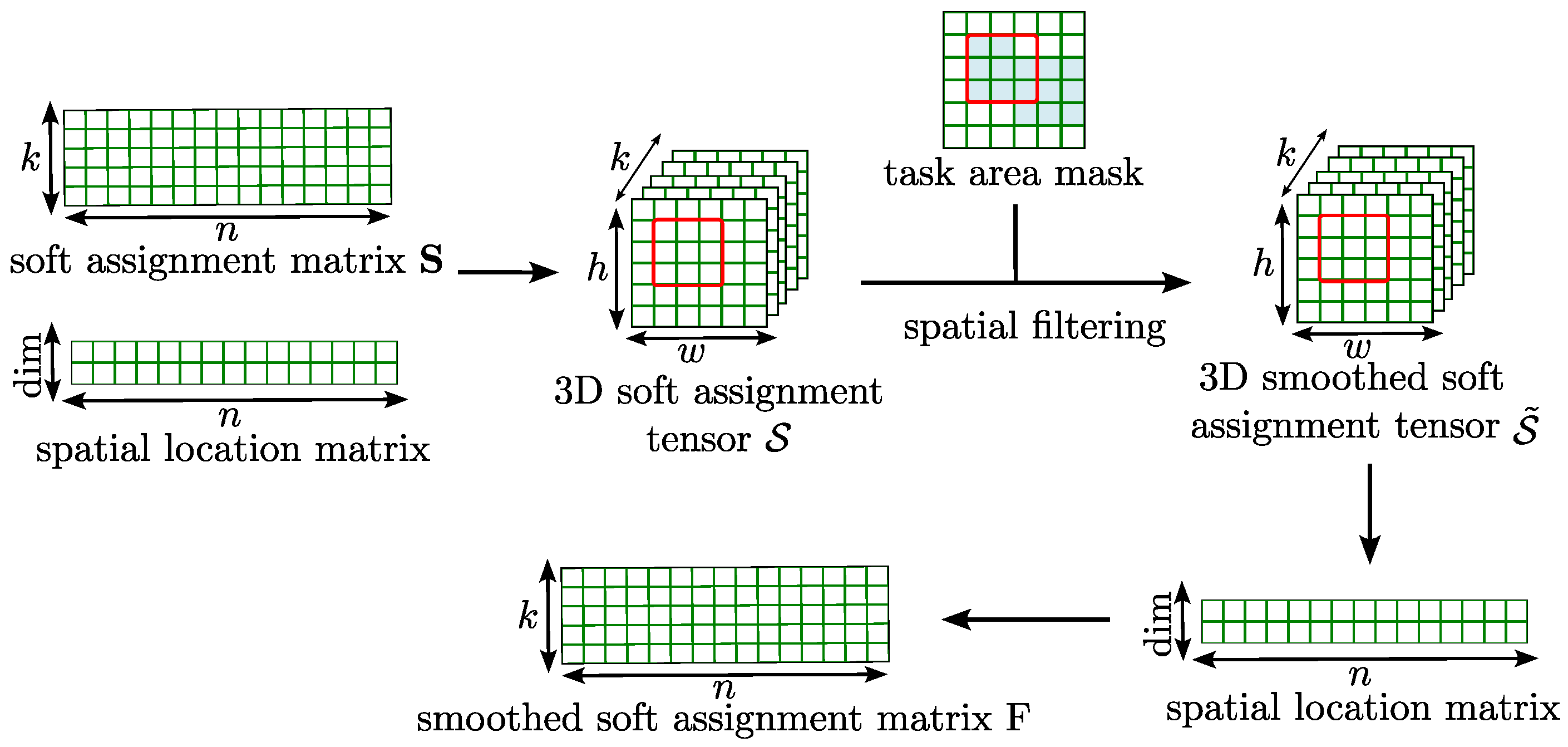
Calculation process of the smoothed soft assignment matrix . First, the soft assignments of image pixels are arranged into a 3D tensor based on their spatial locations. Next, a local window is applied to perform mean filtering for each point. Specifically, the filtering is calculated within the task area defined by a mask , where labeled data are available, to facilitate effective evaluation of the results.
Figure 4.
Calculation process of the smoothed soft assignment matrix . First, the soft assignments of image pixels are arranged into a 3D tensor based on their spatial locations. Next, a local window is applied to perform mean filtering for each point. Specifically, the filtering is calculated within the task area defined by a mask , where labeled data are available, to facilitate effective evaluation of the results.
Figure 5.
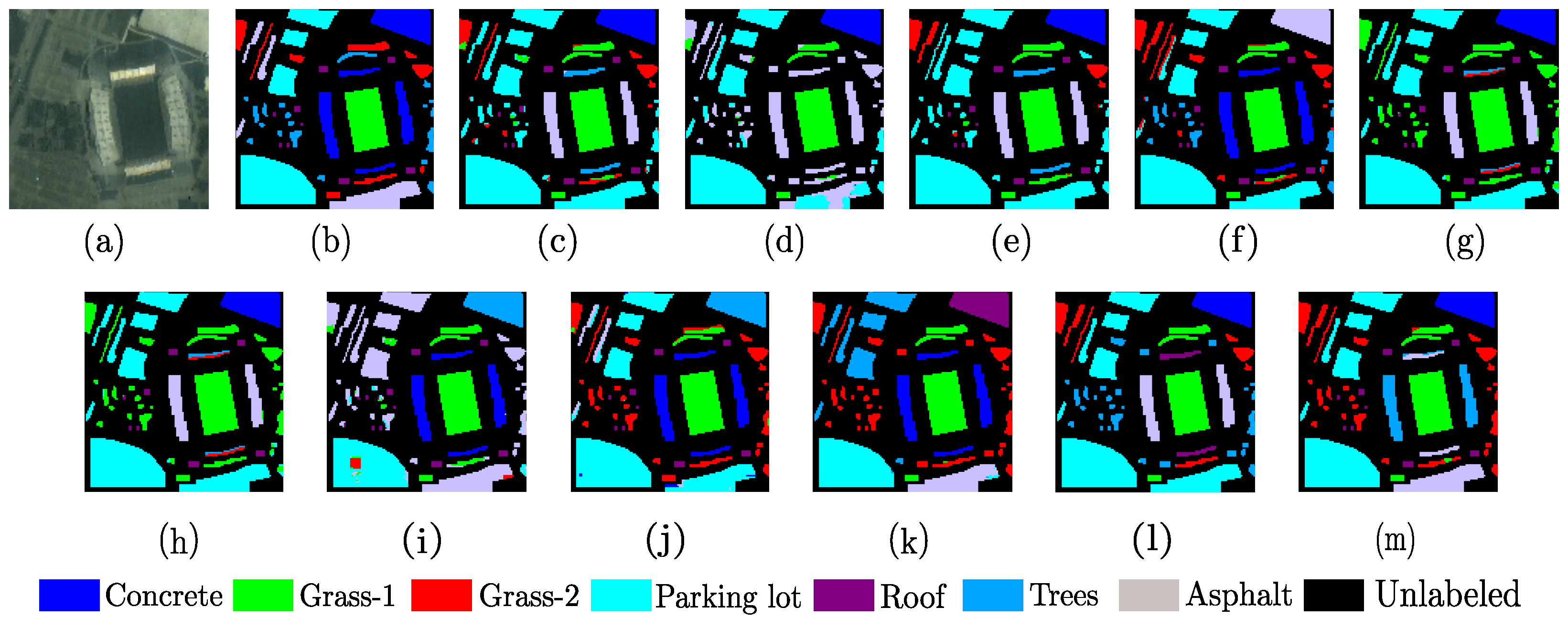
Houston dataset. (a) False-color image. (b) Ground truth and the clustering results obtained by (c) K-means, (d) FCM, (e) SC, (f) IDEC, (g) FINCH, (h) DEKM, (i) SpectralNet, (j) HyperAE, (k) N2D, (l) MADL, and (m) SCDSC.
Figure 5.
Houston dataset. (a) False-color image. (b) Ground truth and the clustering results obtained by (c) K-means, (d) FCM, (e) SC, (f) IDEC, (g) FINCH, (h) DEKM, (i) SpectralNet, (j) HyperAE, (k) N2D, (l) MADL, and (m) SCDSC.
Figure 6.
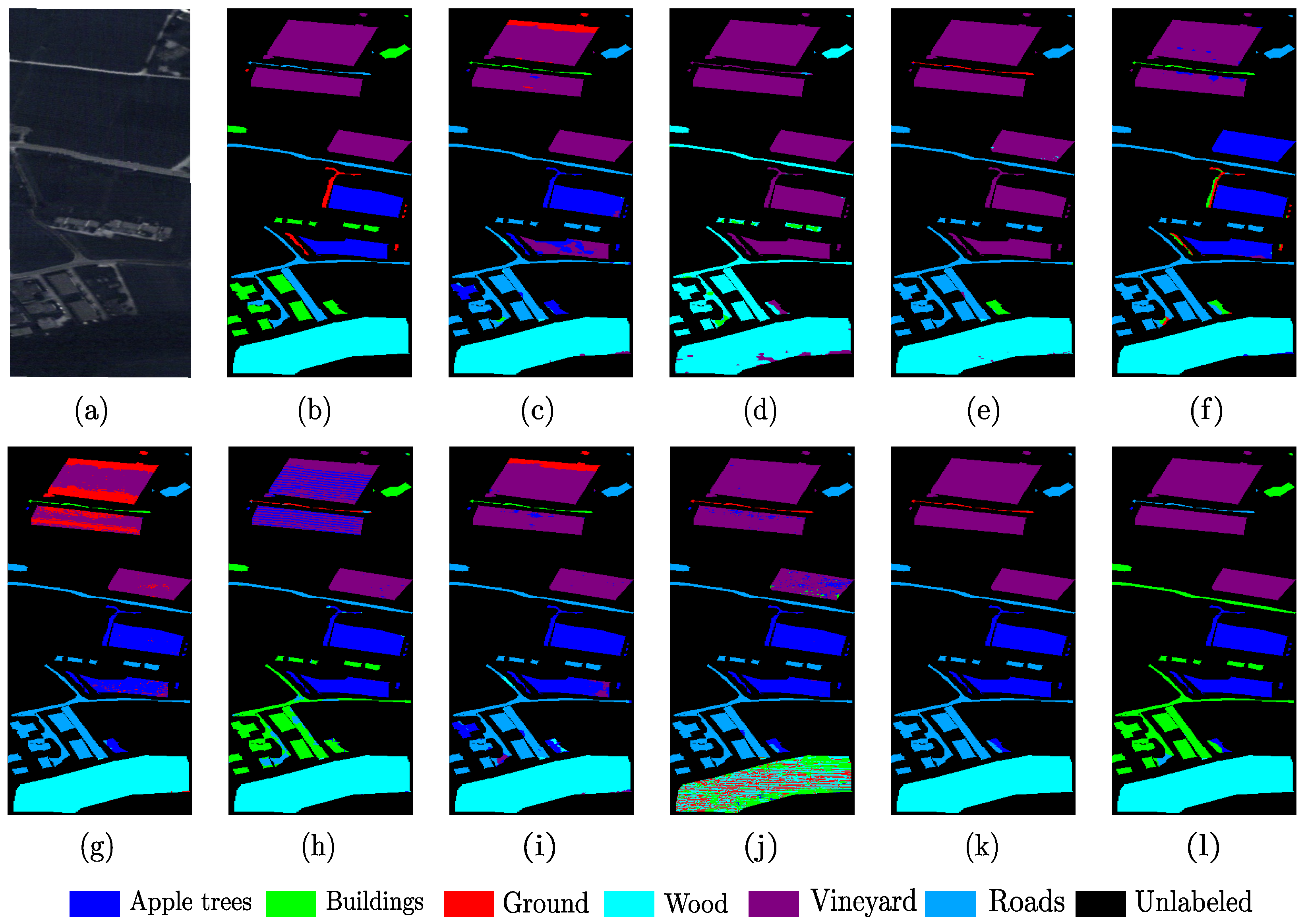
Trento dataset. (a) False-color image. (b) Ground truth and the clustering results obtained by (c) K-means, (d) FCM, (e) SC, (f) IDEC, (g) FINCH, (h) DEKM, (i) SpectralNet, (j) N2D, (k) MADL, and (l) SCDSC.
Figure 6.
Trento dataset. (a) False-color image. (b) Ground truth and the clustering results obtained by (c) K-means, (d) FCM, (e) SC, (f) IDEC, (g) FINCH, (h) DEKM, (i) SpectralNet, (j) N2D, (k) MADL, and (l) SCDSC.
Figure 7.
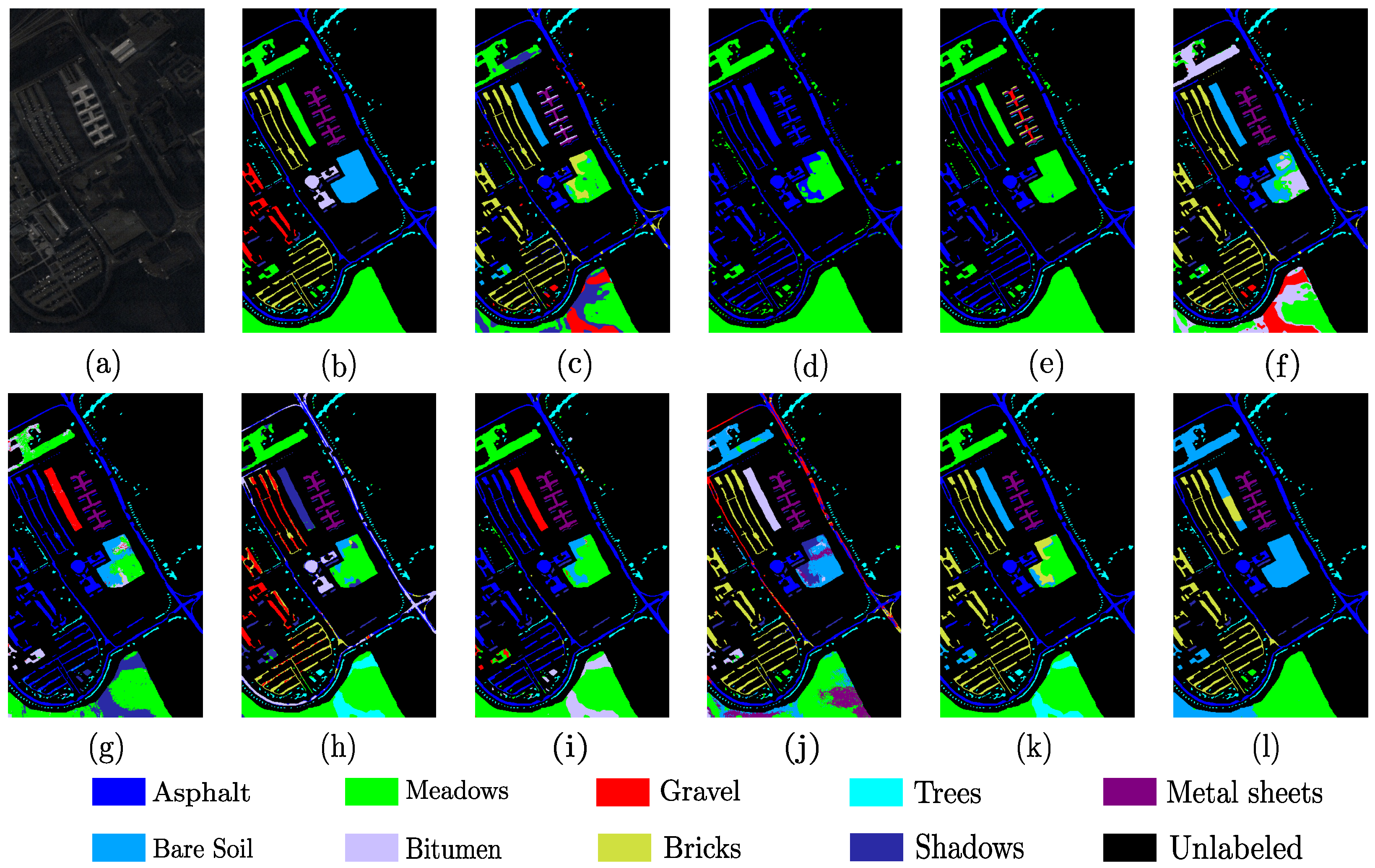
PaviaU dataset. (a) False-color image. (b) Ground truth and the clustering results obtained by (c) K-means, (d) FCM, (e) SC, (f) IDEC, (g) FINCH, (h) DEKM, (i) SpectralNet, (j) N2D, (k) MADL, and (l) SCDSC.
Figure 7.
PaviaU dataset. (a) False-color image. (b) Ground truth and the clustering results obtained by (c) K-means, (d) FCM, (e) SC, (f) IDEC, (g) FINCH, (h) DEKM, (i) SpectralNet, (j) N2D, (k) MADL, and (l) SCDSC.
Figure 8.
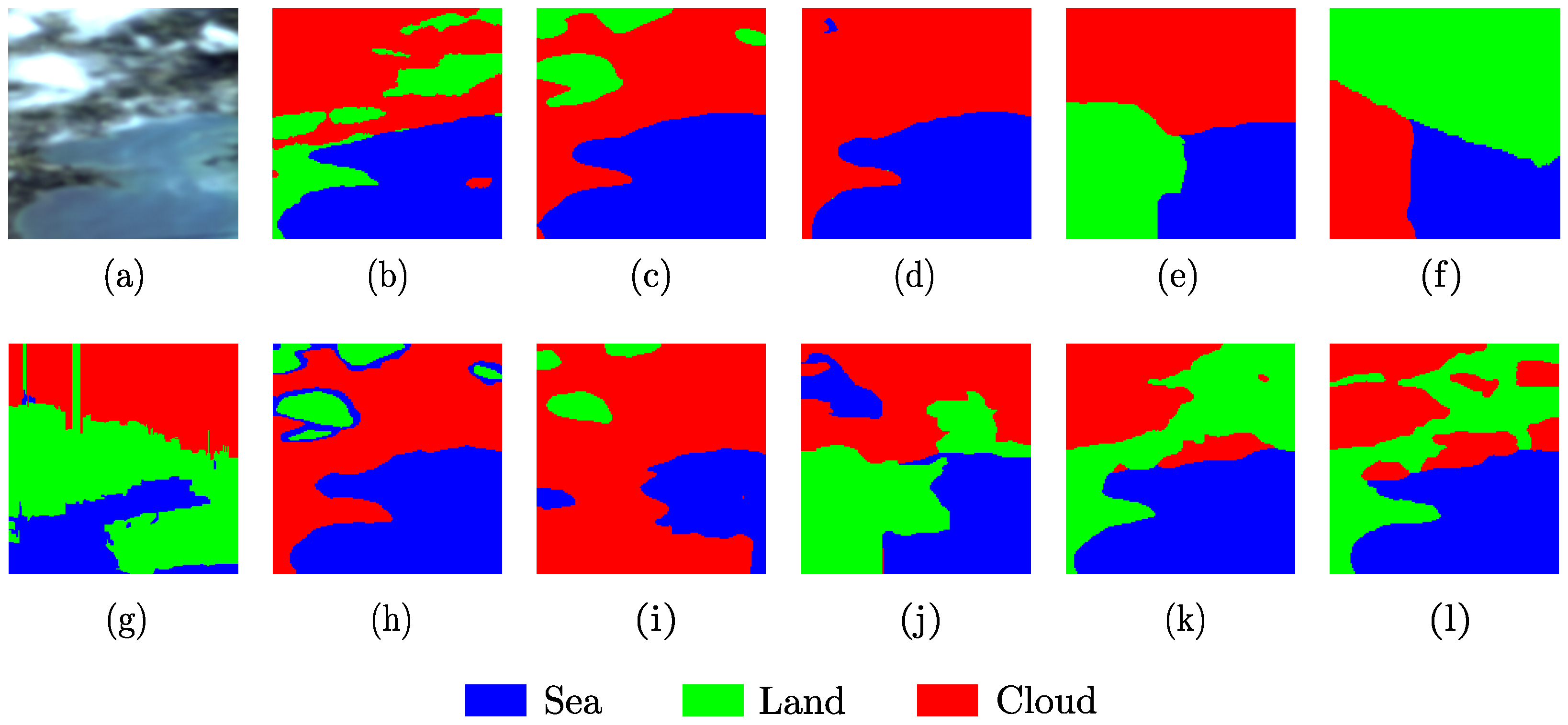
HYPSO-1 dataset. (a) False-color image. (b) Ground truth and the clustering results obtained by (c) K-means, (d) FCM, (e) SC, (f) IDEC, (g) FINCH, (h) DEKM, (i) SpectralNet, (j) N2D, (k) MADL, and (l) SCDSC.
Figure 8.
HYPSO-1 dataset. (a) False-color image. (b) Ground truth and the clustering results obtained by (c) K-means, (d) FCM, (e) SC, (f) IDEC, (g) FINCH, (h) DEKM, (i) SpectralNet, (j) N2D, (k) MADL, and (l) SCDSC.
Figure 9.
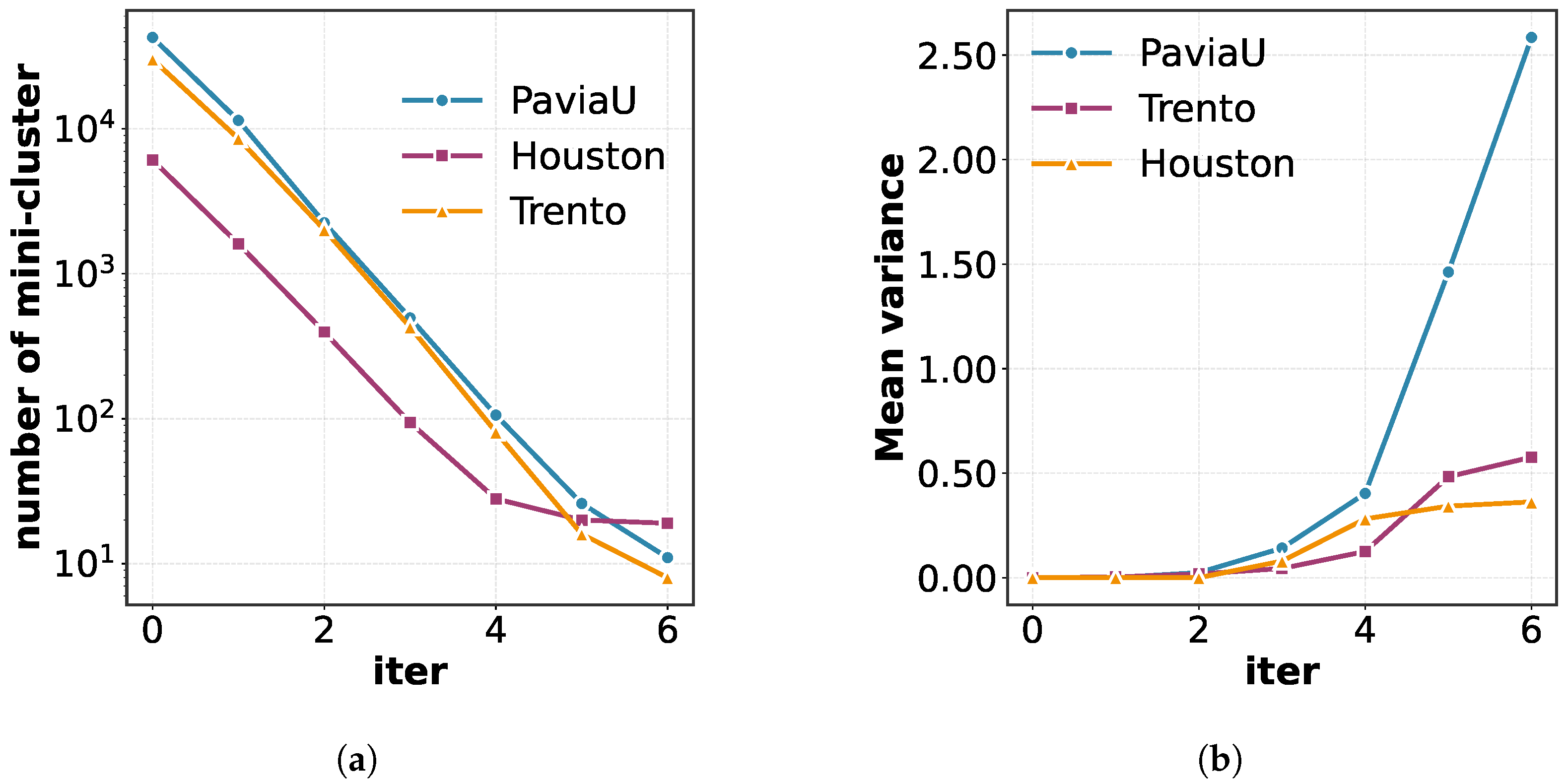
Mini-cluster generation across FINCH iterations. (a) Mini-cluster number by number of FINCH iterations, (b) Mini-cluster variance by number of FINCH iterations.
Figure 9.
Mini-cluster generation across FINCH iterations. (a) Mini-cluster number by number of FINCH iterations, (b) Mini-cluster variance by number of FINCH iterations.
Figure 10.
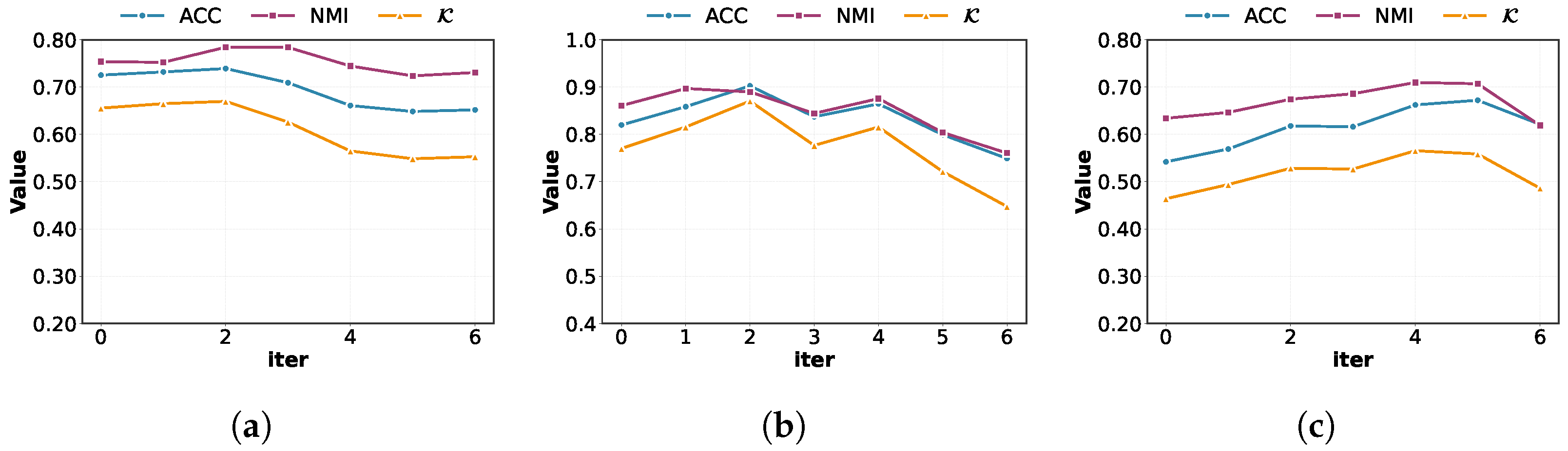
Performance with mini-clusters generated by the number of FINCH iterations. (a) Houston, (b) Trento, (c) PaviaU.
Figure 10.
Performance with mini-clusters generated by the number of FINCH iterations. (a) Houston, (b) Trento, (c) PaviaU.
Figure 11.
The impact of mini-cluster updating in clustering results. (a) Houston, (b) Trento, (c) PaviaU.
Figure 11.
The impact of mini-cluster updating in clustering results. (a) Houston, (b) Trento, (c) PaviaU.
Figure 12.
The impact of local structure preservation in clustering results. (a) Houston, (b) Trento, (c) PaviaU.
Figure 12.
The impact of local structure preservation in clustering results. (a) Houston, (b) Trento, (c) PaviaU.
Figure 13.
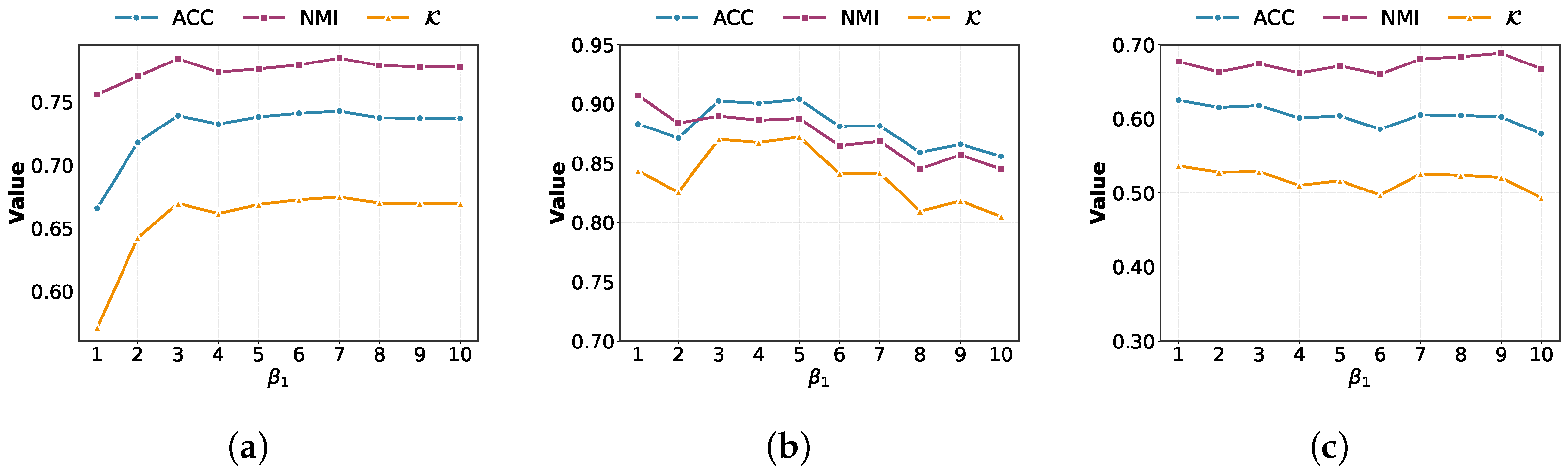
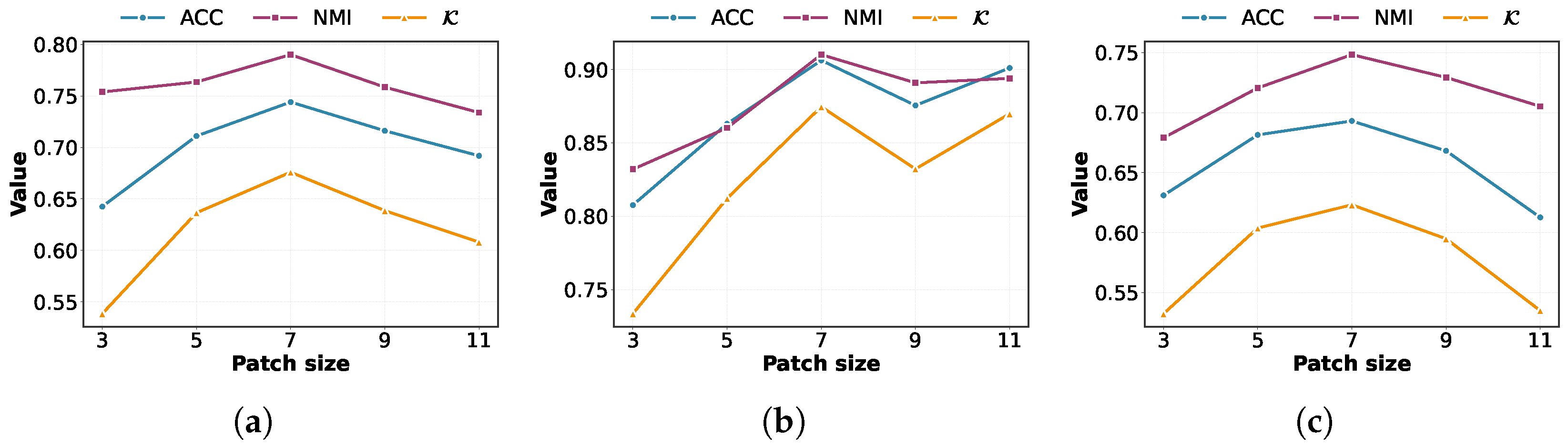
Impact of patch size on clustering performance across different datasets. (a) Houston, (b) Trento, (c) PaviaU.
Figure 13.
Impact of patch size on clustering performance across different datasets. (a) Houston, (b) Trento, (c) PaviaU.
Figure 14.
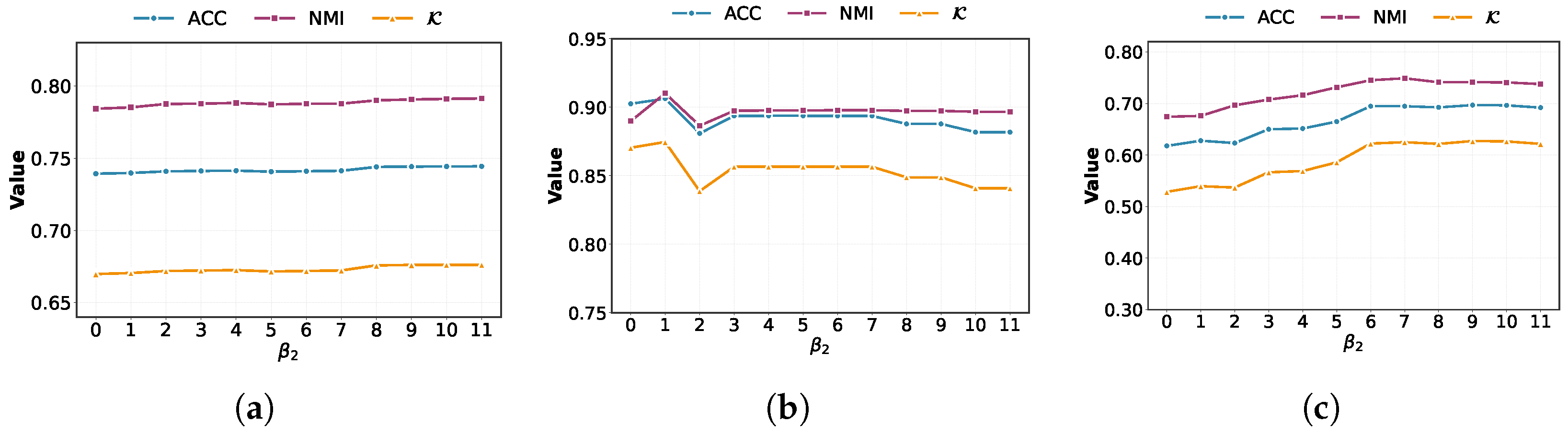
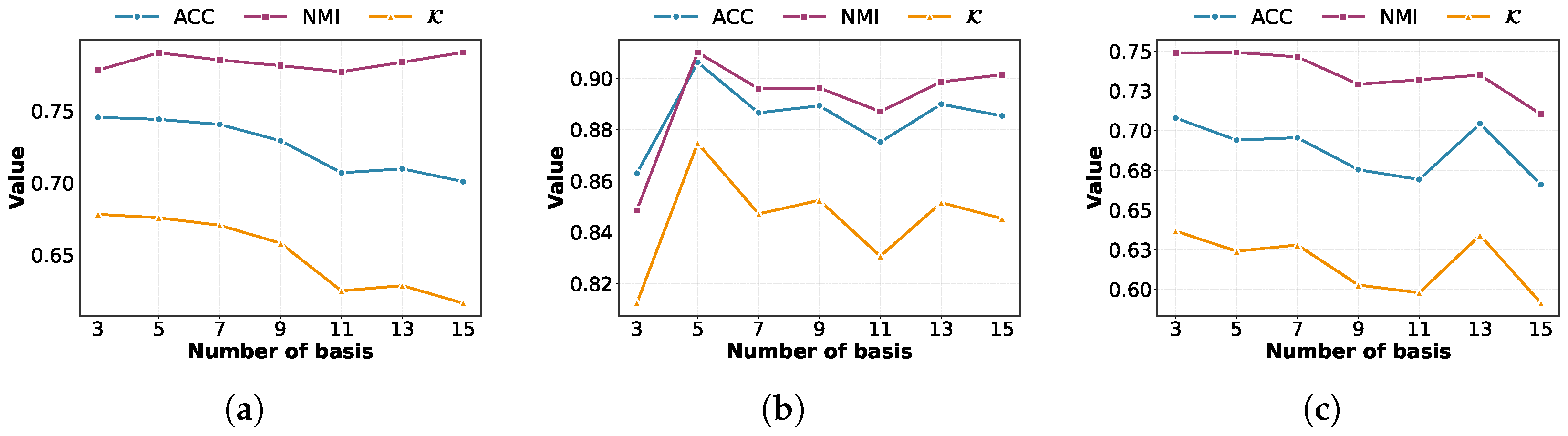
Impact of the number of basis components on clustering performance across datasets. (a) Houston, (b) Trento, (c) PaviaU.
Figure 14.
Impact of the number of basis components on clustering performance across datasets. (a) Houston, (b) Trento, (c) PaviaU.
Figure 15.
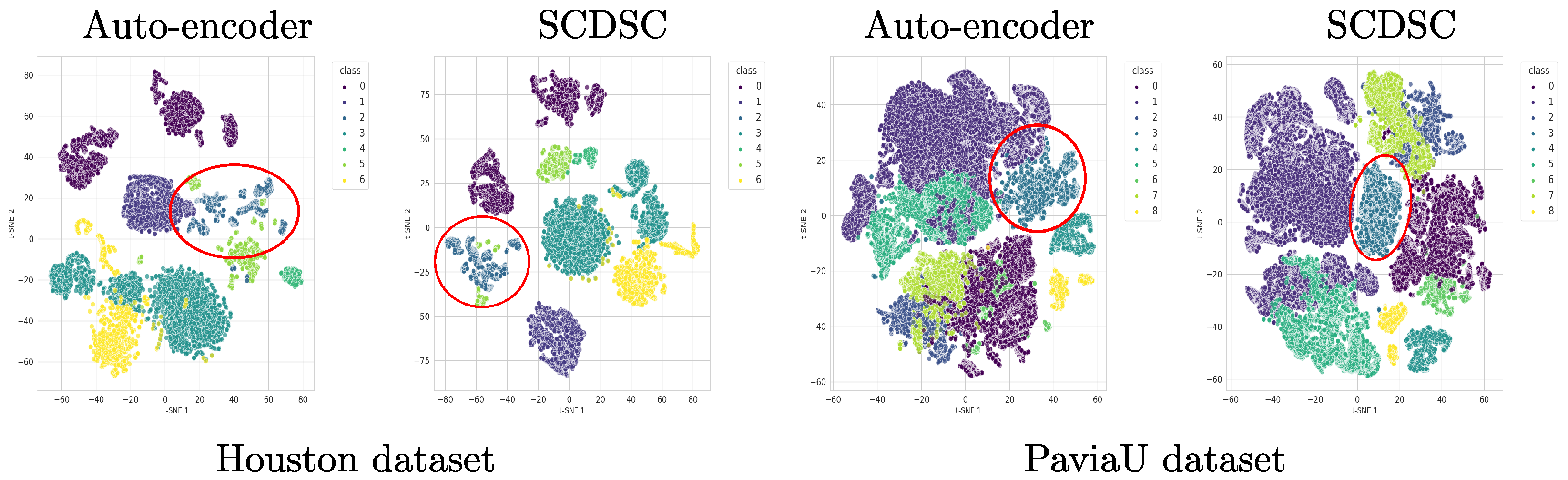
Visualization of the latent representation with t-SNE on the Houston and PaviaU datasets.
Figure 15.
Visualization of the latent representation with t-SNE on the Houston and PaviaU datasets.
Figure 16.
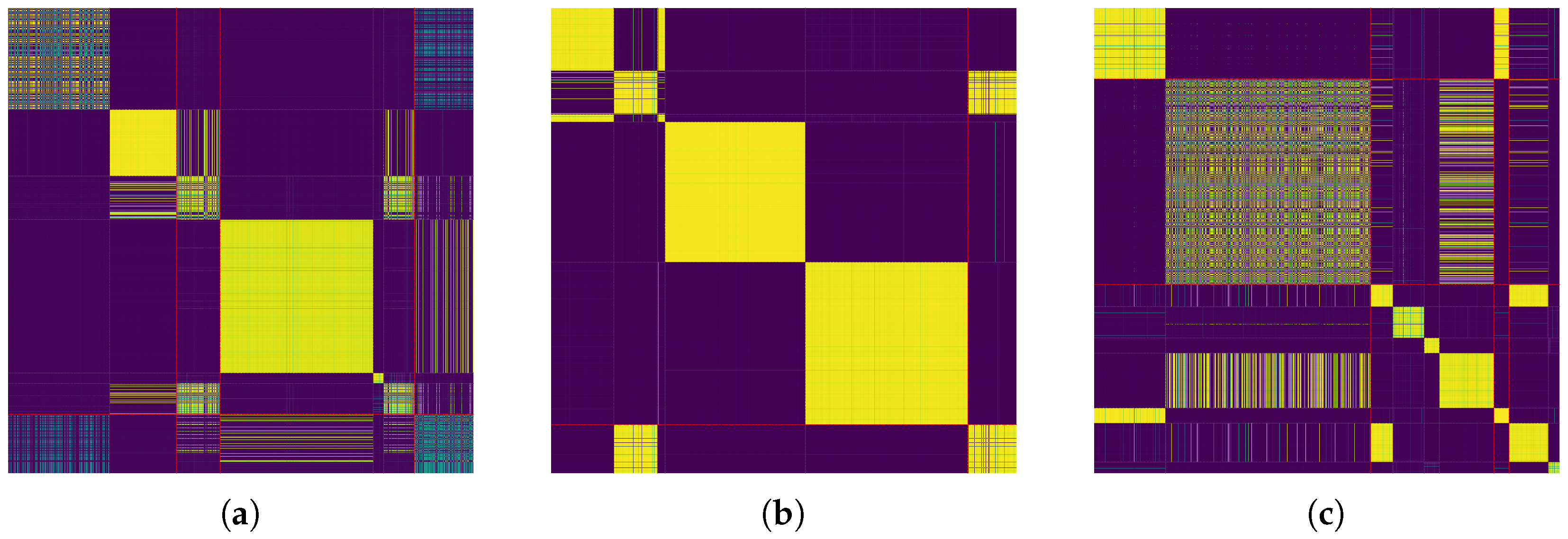
Visualization of matrix on three datasets. (a) Houston, (b) Trento, (c) PaviaU.
Figure 16.
Visualization of matrix on three datasets. (a) Houston, (b) Trento, (c) PaviaU.
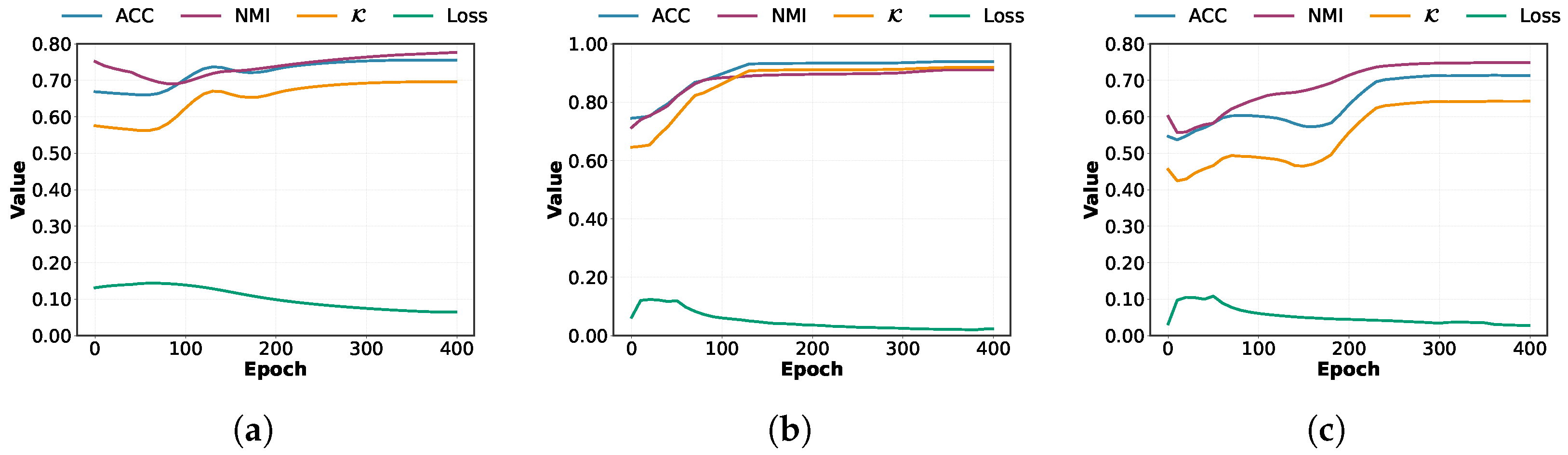
Figure 17.
Training loss and accuracy curves on three datasets. (a) Houston, (b) Trento, (c) PaviaU.
Figure 17.
Training loss and accuracy curves on three datasets. (a) Houston, (b) Trento, (c) PaviaU.
Table 1.
Summary of representative clustering methods for hyperspectral images.
Table 1.
Summary of representative clustering methods for hyperspectral images.
| Category | Sub-Category | Algorithms | Remarks |
|---|
| Model-based | Self-representation | SSC [5], LRR [7], JSSC [13], S4C [21], LCR-FLDA [43] | Learn global or structured self-representation coefficients; effective for capturing subspace structure; performance degrades on nonlinear manifolds; do not scale well. |
| Dictionary-based | Sketch-TV [24], IDLSC [25], SPGSC [27], (TV-CRC-LAD) [26] | Use compact or structured dictionaries to improve scalability; suitable for large HSIs but still rely on linear reconstruction assumptions. |
| Deep learning-based | Data-driven | DEC [32], DEN [28], PICA [34], PARTY [29]
SpectralNet [30], N2D [31] | Learn latent representations in an end-to-end manner; flexible and scalable, but rely heavily on network design and sufficient data. |
| Model-aware | DSCNet [10], SDSC-AI [14], HyperAE [42], LRDSC [15]
PSSC [12], DSC [11] | Incorporate model priors into deep networks to improve accuracy; usually involve complex architectures and higher computational cost. |
Table 2.
Quantitative evaluation of different clustering methods on the dataset Houston.
Table 2.
Quantitative evaluation of different clustering methods on the dataset Houston.
| Class | K-Means [45] | FCM [46] | SC [47] | IDEC [48] | FINCH [20] | DEKM [49] | SN [30] | HyperAE [42] | N2D [31] | MADL [19] | SCDSC |
|---|
| 1 | 46.50 | 46.50 | 62.46 | 47.20 | 53.50 | 45.53 | 41.40 | 47.16 | 51.84 | 47.20 | 48.60 |
| 2 | 100 | 100 | 100 | 100 | 100 | 100 | 100 | 99.62 | 99.98 | 100 | 100 |
| 3 | 58.05 | 0.0 | 35.66 | 88.94 | 70.61 | 24.30 | 32.11 | 70.03 | 67.76 | 74.70 | 79.66 |
| 4 | 100 | 100 | 100 | 96.37 | 100 | 100 | 76.44 | 99.36 | 63.10 | 99.96 | 99.65 |
| 5 | 94.77 | 0.70 | 90.00 | 94.54 | 100 | 85.69 | 80.00 | 100.00 | 38.92 | 69.38 | 60.00 |
| 6 | 0 | 27.07 | 0 | 0 | 70.94 | 0 | 1.54 | 0 | 10.85 | 23.05 | 30.70 |
| 7 | 0 | 0.46 | 0 | 9.97 | 0 | 4.00 | 59.16 | 36.60 | 73.84 | 39.56 | 47.97 |
| OA(%) Mean | 64.50 | 63.23 | 65.86 | 67.58 | 72.10 | 61.01 | 60.77 | 70.36 | 63.61 | 72.33 | 74.41 |
| OA Std | 0.08 | 0.01 | 5.24 | 1.20 | 0.00 | 3.00 | 3.79 | 5.50 | 2.22 | 5.85 | 4.21 |
| NMI Mean | 0.6973 | 0.5935 | 0.6181 | 0.7851 | 0.7702 | 0.7011 | 0.6439 | 0.7697 | 0.7465 | 0.7656 | 0.7902 |
| NMI Std | 0.0006 | 0.0002 | 0.0692 | 0.0269 | 0.00 | 0.0484 | 0.0475 | 0.0400 | 0.0213 | 0.0266 | 0.0329 |
| Mean | 0.5354 | 0.5250 | 0.5441 | 0.5859 | 0.6424 | 0.4922 | 0.5057 | 0.6225 | 0.5679 | 0.6492 | 0.6759 |
| Std | 0.0011 | 0.0001 | 0.0715 | 0.0204 | 0.00 | 0.0412 | 0.0568 | 0.0700 | 0.0276 | 0.0793 | 0.0590 |
| Time (sec) Mean | 2.21 | 7.32 | 2.68 | 42.96 | 0.73 | 67.88 | 16.75 | 419.40 | 26.40 | 60.52 | 33.43 |
| Time Std | 0.17 | 3.06 | 0.30 | 0.48 | 0.16 | 9.31 | 0.37 | 42.10 | 0.80 | 1.07 | 1.11 |
Table 3.
Quantitative evaluation of different clustering methods on the dataset Trento. “–” indicates out-of-memory during execution.
Table 3.
Quantitative evaluation of different clustering methods on the dataset Trento. “–” indicates out-of-memory during execution.
| Class | K-Means [45] | FCM [46] | SC [47] | IDEC [48] | FINCH [20] | DEKM [49] | SN [30] | HyperAE [42] | N2D [31] | MADL [19] | SCDSC |
|---|
| 1 | 71.37 | 0 | 0 | 89.50 | 93.95 | 99.39 | 73.69 | – | 99.62 | 99.98 | 100 |
| 2 | 14.33 | 1.2 | 7.82 | 35.38 | 0 | 31.85 | 39.84 | – | 26.32 | 10 | 87.98 |
| 3 | 0 | 1.1 | 0 | 53.90 | 0 | 0 | 0 | – | 8.79 | 0 | 0 |
| 4 | 99.29 | 95.96 | 99.52 | 99.16 | 99.54 | 99.91 | 99.41 | – | 82.08 | 100 | 100 |
| 5 | 92.19 | 99.48 | 95.54 | 76.92 | 91.96 | 76.44 | 92.55 | – | 54.78 | 100 | 100 |
| 6 | 84.72 | 14.00 | 92.82 | 70.47 | 67.13 | 80.04 | 69.99 | – | 73.88 | 86.05 | 36.80 |
| OA(%) Mean | 81.83 | 65.16 | 73.76 | 80.28 | 76.23 | 81.47 | 83.20 | – | 67.55 | 88.30 | 90.61 |
| OA Std | 3.15 | 3.00 | 1.32 | 5.21 | 0.00 | 6.57 | 7.16 | – | 6.05 | 0.19 | 2.87 |
| NMI Mean | 0.7717 | 0.5685 | 0.7612 | 0.8234 | 0.8200 | 0.8257 | 0.7835 | – | 0.7568 | 0.9144 | 0.9101 |
| NMI Std | 0.0155 | 0.0529 | 0.0148 | 0.0411 | 0.00 | 0.0388 | 0.0831 | – | 0.0246 | 0.0044 | 0.0024 |
| Mean | 0.7566 | 0.4885 | 0.6353 | 0.7430 | 0.6963 | 0.7607 | 0.7720 | – | 0.5978 | 0.8434 | 0.8746 |
| Std | 0.0423 | 0.0499 | 0.0164 | 0.0694 | 0.00 | 0.0811 | 0.1046 | – | 0.0690 | 0.0025 | 0.0392 |
| Time (sec) Mean | 12.81 | 5.34 | 154.15 | 211.69 | 16.99 | 291.12 | 81.56 | – | 267.49 | 230.38 | 148.87 |
| Time Std | 0.85 | 0.49 | 9.40 | 1.36 | 0.37 | 83.83 | 1.02 | – | 52.23 | 7.58 | 2.99 |
Table 4.
Quantitative evaluation of different clustering methods on the dataset PaviaU. “–” indicates out-of-memory during execution.
Table 4.
Quantitative evaluation of different clustering methods on the dataset PaviaU. “–” indicates out-of-memory during execution.
| Class | K-Means [45] | FCM [46] | SC [47] | IDEC [48] | FINCH [20] | DEKM [49] | SN [30] | HyperAE [42] | N2D [31] | MADL [19] | SCDSC |
|---|
| 1 | 92.44 | 99.98 | 100 | 96.53 | 99.98 | 77.04 | 95.17 | – | 88.66 | 99.55 | 93.64 |
| 2 | 47.75 | 88.99 | 100 | 38.48 | 58.88 | 75.33 | 63.97 | – | 32.15 | 70.83 | 57.67 |
| 3 | 0 | 0 | 0 | 0 | 0 | 10.57 | 0 | – | 95.28 | 0 | 0 |
| 4 | 72.63 | 0.16 | 73.76 | 95.59 | 89.49 | 65.43 | 77.44 | – | 80.40 | 97.24 | 98.98 |
| 5 | 66.40 | 0 | 39.18 | 76.68 | 100 | 93.42 | 100 | – | 80.00 | 99.96 | 100 |
| 6 | 3.92 | 0.02 | 0 | 53.16 | 44.04 | 22.13 | 14.94 | – | 55.30 | 18.65 | 85.46 |
| 7 | 0 | 0 | 0 | 0 | 0 | 17.32 | 0.28 | – | 15.04 | 0 | 0 |
| 8 | 93.69 | 0 | 0 | 99.33 | 0 | 82.31 | 54.66 | – | 97.11 | 79.84 | 99.98 |
| 9 | 0 | 0 | 76.24 | 14.20 | 0 | 68.00 | 94.41 | – | 89.50 | 9.10 | 42.20 |
| OA(%) Mean | 50.97 | 54.31 | 67.30 | 56.11 | 55.90 | 64.66 | 59.89 | – | 52.88 | 65.69 | 69.48 |
| OA Std | 0.01 | 0.02 | 0.00 | 3.39 | 0.00 | 4.94 | 4.87 | – | 5.66 | 3.07 | 8.02 |
| NMI Mean | 0.5926 | 0.3459 | 0.6905 | 0.6722 | 0.6510 | 0.6480 | 0.6408 | – | 0.6262 | 0.6511 | 0.7490 |
| NMI Std | 0.0001 | 0.0002 | 0.00 | 0.0193 | 0.00 | 0.0196 | 0.0313 | – | 0.0223 | 0.0260 | 0.0358 |
| Mean | 0.3918 | 0.3491 | 0.5290 | 0.4811 | 0.4762 | 0.5408 | 0.4805 | – | 0.4551 | 0.5521 | 0.6250 |
| Std | 0.0004 | 0.0003 | 0.0001 | 0.0333 | 0.00 | 0.0509 | 0.0625 | – | 0.0285 | 0.0385 | 0.0892 |
| Time (sec) Mean | 22.09 | 5.34 | 297.12 | 301.53 | 38.01 | 839.60 | 115.77 | – | 376.29 | 391.85 | 320.33 |
| Time Std | 0.77 | 0.49 | 9.20 | 3.48 | 0.64 | 75.04 | 0.84 | – | 54.09 | 17.96 | 5.31 |
Table 5.
Quantitative evaluation of different clustering methods on the HYPSO-1 dataset. “–” indicates out-of-memory during execution.
Table 5.
Quantitative evaluation of different clustering methods on the HYPSO-1 dataset. “–” indicates out-of-memory during execution.
| Class | K-Means [45] | FCM [46] | SC [47] | IDEC [48] | FINCH [20] | DEKM [49] | SN [30] | HyperAE [42] | N2D [31] | MADL [19] | SCDSC |
|---|
| 1 | 99.87 | 99.01 | 66.45 | 88.73 | 96.98 | 97.75 | 42.32 | – | 74.77 | 99.13 | 93.91 |
| 2 | 0.00 | 0.12 | 52.92 | 83.23 | 66.26 | 53.21 | 19.98 | – | 72.50 | 92.99 | 95.75 |
| 3 | 69.04 | 93.65 | 89.72 | 64.19 | 94.04 | 37.06 | 76.25 | – | 61.52 | 60.59 | 71.83 |
| OA(%) Mean | 67.61 | 77.66 | 73.64 | 77.34 | 75.79 | 63.59 | 52.30 | – | 68.75 | 81.81 | 84.96 |
| OA Std | 0.00 | 0.02 | 0.01 | 6.30 | 0.00 | 7.91 | 6.82 | – | 10.95 | 0.41 | 2.43 |
| NMI Mean | 0.5892 | 0.6102 | 0.4546 | 0.6064 | 0.4662 | 0.4250 | 0.2725 | – | 0.4221 | 0.6353 | 0.6380 |
| NMI Std | 0.00 | 0.0017 | 0.00 | 0.0566 | 0.00 | 0.1246 | 0.0753 | – | 0.0882 | 0.0048 | 0.0195 |
| Mean | 0.4762 | 0.6237 | 0.5931 | 0.6592 | 0.5971 | 0.4430 | 0.2458 | – | 0.5308 | 0.7269 | 0.7739 |
| Std | 0.00 | 0.0003 | 0.00 | 0.1049 | 0.00 | 0.1373 | 0.1067 | – | 0.1647 | 0.0057 | 0.0340 |
| Time (sec) Mean | 6.88 | 30.77 | 21.35 | 141.43 | 16.87 | 262.37 | 63.10 | – | 110.59 | 145.00 | 131.10 |
| Time Std | 0.37 | 16.55 | 1.33 | 1.11 | 0.35 | 48.72 | 1.93 | – | 0.55 | 2.09 | 3.66 |
Table 6.
Hyperparameter settings for each dataset.
Table 6.
Hyperparameter settings for each dataset.
| Dataset | Learning Rate | | | Smooth Window |
|---|
| Houston | 0.0001 | 3 | 8 | |
| Trento | 0.005 | 3 | 1 | |
| PaviaU | 0.005 | 3 | 7 | |
| HYPSO-1 | 0.005 | 3 | 0.001 | |
Table 7.
Results of the ablation study.
Table 7.
Results of the ablation study.
| Model | Houston | | Trento | | PaviaU | | HYPSO-1 |
|---|
| OA(%) | NMI | | | OA(%) | NMI | | | OA(%) | NMI | | | OA(%) | NMI | |
|---|
| Baseline | 72.53 | 0.7538 | 0.6555 | | 81.98 | 0.8607 | 0.7701 | | 54.19 | 0.6340 | 0.4638 | | 83.72 | 0.6305 | 0.7563 |
| L | 72.47 | 0.7619 | 0.6545 | | 81.85 | 0.8611 | 0.7651 | | 60.13 | 0.6744 | 0.5282 | | 83.68 | 0.6302 | 0.7558 |
| MC | 73.92 | 0.7843 | 0.6698 | | 90.25 | 0.8898 | 0.8704 | | 61.78 | 0.6743 | 0.5286 | | 84.89 | 0.6369 | 0.7729 |
| MC&L | 74.41 | 0.7902 | 0.6759 | | 90.61 | 0.9101 | 0.8746 | | 69.48 | 0.7490 | 0.6250 | | 84.96 | 0.6380 | 0.7739 |



 ,
,