Highlights
What are the main findings?
- Ensemble stacking regression enhances the accuracy of predicting physiological parameters from in situ hyperspectral measurements.
- First derivative of reflectance (FDR) preprocessing mitigates the performance loss associated with decreasing spectral resolution.
What are the implications of the main findings?
- Multivariate modeling approaches show great potential for estimating plant physiological parameters from hyperspectral data, as well as low-resolution spectral data.
- The results suggest that, with appropriate preprocessing, low-resolution spectral sensors could potentially be used for this task, as they bring acceptable prediction accuracy.
Abstract
Accurate prediction of photosynthetic parameters is pivotal for precision viticulture, as it enables non-invasive monitoring of plant physiological status and informed management decisions. In this study, spectral reflectance data were used to predict key photosynthetic parameters such as assimilation rate (A), effective photosystem II (PSII) quantum yield (), and electron transport rate (ETR), as well as stem and leaf water potential ( and ), in Vitis vinifera (cv. Müller-Thurgau) grown in an experimental vineyard in Lower Franconia (Germany). Measurements were obtained on 25 July, 7 August, and 12 August 2024 using a LI-COR LI-6800 system and a PSR+ hyperspectral spectroradiometer. Various machine learning models (SVR, Lasso, ElasticNet, Ridge, PLSR, a simple ANN, and Random Forest) were evaluated, both as standalone predictors and as base learners in a stacking ensemble regressor with a Random Forest meta-learner. First derivative reflectance (FDR) preprocessing enhanced predictive performance, particularly for and ETR, with the ensemble approach achieving R2 values up to 0.92 for and 0.85 for A at 1 nm resolution. At coarser spectral resolutions, predictive accuracy declined, though FDR preprocessing provided some mitigation of the performance loss. Diurnal patterns revealed that morning to mid-morning measurements, particularly between 9:00 and 11:00, captured peak photosynthetic activity, making them optimal for assessing vine vigor, while midday water potential declines indicated favorable timing for irrigation scheduling. These findings demonstrate the potential of integrating hyperspectral data with ensemble machine learning and FDR preprocessing for accurate, scalable, and high-throughput monitoring of grapevine physiology, supporting real-time vineyard management and the use of cost-effective sensors under diverse environmental conditions.
1. Introduction
Photosynthesis is the fundamental process that drives plant productivity, directly impacting biomass production, grape yield, and quality. However, in viticulture, managing photosynthetic efficiency is a complex trade-off between yield and quality [1]. While high photosynthetic rates are generally favorable for crop production due to the associated increase in yield [2,3,4], controlled photosynthesis through conventionally unfavorable growing conditions [1], such as regulated deficit or late irrigation [5,6,7,8,9] and canopy and crop regulation, can be beneficial in optimizing grape composition and wine quality, particularly in the context of climate change and its associated challenges, including rising temperatures and higher atmospheric CO2 levels [10,11,12,13,14,15,16,17,18,19], even though this may come at the expense of yield [6]. The quantification of photosynthesis in this context becomes important, especially when photosynthetic activity is being artificially altered, to understand the impact of these measures [17,18]. The main methods for evaluating photosynthetic performance are gas exchange measurements and chlorophyll fluorescence quantification.
Relevant parameters derived from gas exchange include stomatal conductance, which is important for estimating drought stress and the regulation of plant water [20,21]. Furthermore, the assimilation rate directly reflects net photosynthesis [22] and, in the case of grapevines, is correlated with sugar accumulation [23]. Traditional single leaf gas exchange measurements, though accurate, are time-consuming [24] and lack the scalability required for precise vineyard management. Moreover, the transferability from individual leaf measurements to plant scale is not always guaranteed due to variations in illumination and leaf age and maturity [1,25].
Fluorometry is a valuable and precise technique for assessing vine chlorophyll fluorescence, and it provides insights into photosynthetic efficiency, photosynthetic capacity, and reaction to biotic and abiotic environmental factors. Similar to gas exchange measurements, the technique is not suited for large-scale applications. The measurement of fluorescence is based on Pulse-Amplitude Modulation (PAM) fluorometry, in which light pulses of constant amplitude and frequency are applied to a sample. When applied under light-adapted conditions, PAM fluorometry facilitates quantification of fluorescence parameters including minimum (), maximum (), and steady-state fluorescence (), which, in turn, enables the calculation of various photosynthetic indicators. The derived parameters include, among others, the effective photosystem II (PSII) quantum yield () and the electron transport rate (ETR). , in particular, indicates the efficiency with which absorbed light is used in the photochemical process of photosynthesis, reflecting the plant’s overall health and ability to harness light for carbon fixation and biomass accumulation, and it is therefore of special interest for monitoring plant and crop vigor. ETR indicates how fast electrons are being transferred through the photosynthetic electron transport chain and provides a quantitative assessment of photosynthetic performance under light conditions.
Although a highly accurate method, the use of modulated light pulses for individual measurements makes this technique unsuitable for large-scale applications such as extensive plant canopies, limiting its applicability in field-based studies. Recent research interest has largely focused on Solar-Induced Fluorescence (SIF), which relies on passive excitation by sunlight rather than artificial modulated light. This enables remote sensing of vegetation at canopy to global scales using spectrometers in situ, airborne imagery, or spectral satellite data for larger scales [26,27,28]. Although SIF is of great value for large-scale applications, its weak signal, complex retrieval [29,30], related concerns over limitations for quantifying photosynthetic activity [31,32], and, in particular, its limited spatial resolution still restrict precise vineyard health assessments [33].
Ensuring the scalability of monitoring photosynthesis while conserving accuracy and spatial detail remains one of the main challenges in remote sensing applications. This is particularly relevant for precision viticulture, where detailed, large-scale monitoring of grapevine health and photosynthesis in a trellis system is crucial for optimizing vineyard management [34,35]. As highlighted in this section, both, gas exchange and fluorometry provide accurate assessments of photosynthetic performance, yet they face limitations with respect to large-scale applications [36]. The use of spectral measurements to overcome these limitations can provide an effective and scalable method for assessing grapevine performance or stress in a rapid, non-invasive manner across extensive areas [37].
Numerous approaches for estimating photosynthetic traits in plants based on spectral measurements have been proposed in the literature. Among those methods are vegetation indices, partial least squares regression (PLSR), derivative reflectance information, and multivariate machine learning techniques. The plant traits that were investigated by utilizing these methods include the maximum carboxylation rate of Rubisco (Vc, max) and the maximum electron transport rate (Jmax) [38,39,40,41,42], the assimilation rate and stomatal conductance [43,44,45,46], water potential [43,47], the actual electron transport rate [48,49], and fluorescence and fluorescence-derived parameters [30,44,45,50,51,52].
While these methods provide a wide range of analytical tools for estimating photosynthetic traits, their predictive performance varies considerably depending on species, trait, measurement setup, and environmental conditions. Selected studies illustrating reported accuracies are summarized below.
For assimilation rate, Maimaitiyiming et al. [44] investigated grapevine of the Chambourcin variety using field spectroscopy and obtained comparatively low prediction accuracies, along with R2 values up to 0.26. Water potential has been examined by many researchers. For example, Zarco-Tejada et al. [43] achieved R2 values of up to 0.66 for stem water potential in citrus orchards using UAV-based hyperspectral imagery and Fraunhofer Line Depth-based methods, and Matese et al. [47] reported values of up to 0.65 (predawn) and 0.27 (midday) in grapevine of the Barbera variety, achieved using UAV-based hyperspectral imagery. For electron transport rate, Wang et al. [48] reported a moderate relationships in deciduous forest trees, with R2 ranging from 0.44 to 0.54 depending on illumination and shading, based on field spectroscopy, while Jin et al. [49] demonstrated substantially higher accuracies in mango leaves (R2 up to 0.80) when combining field spectroscopy with Photosynthetic Active Radiation (PAR) measurements. Effective PSII quantum yield has been estimated with varying success, with R2 values of up to 0.72 in aspen and cherry reported by Peng et al. [30] using field spectroscopy and R2 values of up to 0.63 being achieved under controlled indoor conditions in grapevine of the Cabernet Sauvignon variety by Yang et al. [50] using an imaging system. Zhuang et al. [51] investigated mango leaves with field spectroscopy and found differences between sunlit and shaded conditions, with R2 values of up to 0.80 depending on illumination. In a later study on mixed temperate deciduous forest species, Zhuang et al. [52] reported an R2 of up to 0.73 using field spectroscopy and fractional-order spectral derivatives.
Taken together, these examples illustrate both the potential and the variability of spectrally based predictions of photosynthetic traits across species and experimental contexts, and they provide a useful reference framework for evaluating new approaches and situating the predictive performance of the methods applied in the present study. These studies collectively demonstrate that hyperspectral remote sensing can effectively bridge the gap between traditional leaf-level photosynthetic measurements and the scalability requirements of large-scale environmental monitoring and precision agriculture, thus allowing for continuous monitoring throughout the growing season. This integration enables non-invasive assessment of plant physiology at varying spatial scales, addressing the challenge of accurately monitoring photosynthesis across large areas (in our case, entire vineyards). The application of these methodologies in viticulture offers particular advantages given the industry’s increasing need for precise monitoring in the context of climate change adaptation [47]. As inter-annual climate variability intensifies [53], efficiently detecting subtle changes in photosynthetic efficiency across vineyards could substantially improve decision-making regarding irrigation scheduling, canopy management, and harvest timing.
In this study, we propose an approach that uses hyperspectral in situ measurements to establish a basis for adjusting the scalability of leaf-level accuracies to plant or plot level based on leaf reflectance to derive key photosynthetic parameters in grapevine leaves, including the assimilation rate (A), effective PSII quantum yield (), and the electron transport rate (ETR), as well as leaf and stem water potential ( and ). We evaluate different machine learning models and ensemble techniques to determine their effectiveness in predicting multiple physiological traits at high accuracy. The primary objective of this study was to develop a robust, non-invasive approach for evaluating grapevine photosynthetic performance and water availability. We focused on these parameters because they collectively provide insights into grapevine physiology and potential stress, and their high-throughput estimation can support vineyard management decisions and advance precision viticulture practices. This study introduces a novel approach by integrating diurnal variations in photosynthetic parameters and water potential, measured and modeled across the day, enabling scalable, time-resolved predictions that offer holistic monitoring insights into grapevine physiology with implications for future climate change scenarios and precision viticulture application strategies.
The main objectives of this study were, therefore, (i) to analyze diurnal patterns in key grapevine physiological parameters (A, , ETR, , ), (ii) to deploy and evaluate individual and ensemble regression models for predicting these parameters from hyperspectral reflectance data at full (1 nm) spectral resolution, and (iii) to assess model performance across resampled spectral resolutions, with minimum resolutions of 100 nm, to determine the impact of reduced spectral detail on predictive accuracy. This constitutes one of the key requirements for transferring high-accuracy leaf-level estimations to cost-effective, vineyard-scale monitoring systems with broader implications for scalable physiological monitoring in precision agriculture and environmental remote sensing.
2. Materials and Methods
2.1. Study Area
The study area consists of an experimental vineyard of the Bavarian State Institute of Viticulture and Horticulture (LWG) near Himmelstadt in Lower Franconia (Bavaria, Germany (49.92332°N, 9.81944°E)). Lower Franconia is characterized by a humid temperate transitional climate with relatively warm temperatures, making this region favorable for grape cultivation [54]. Although vineyards in Franconia cover less than 1% of the total surface area, they play a significant role in the region’s economic output [55]. Precise and large-scale monitoring of local vineyards is therefore of great interest to ensure the sustainability of a large cultural and economic part of the regional identity [55]. The climate at the study site, based on local weather station data, exhibited annual mean temperatures of 11.3 °C in 2022 and 11.4 °C in 2023, with annual precipitation totals of 425.2 mm and 609.8 mm, respectively. The specific study site is usually used to investigate different irrigation strategies and heat and drought stress management techniques. For this purpose, the vineyard is divided into different strip types: no irrigation, moderate irrigation, and intensive irrigation. For moderate irrigation, drip irrigation is used if the pre-dawn water potential falls below a threshold value of −0.25 MPa three weeks after flowering. For intensive irrigation, the threshold value is −0.2 MPa during the entire period. However, as the pre-dawn water potential did not fall below these values during the entire growth season in 2024, no artificial irrigation was applied at any time, which means that the plants were not subjected to varying water availabilities. The cultivated grape type is of the Müller-Thurgau variety and was planted in 2015.
2.2. Data Collection
Light-adapted gas exchange and fluorescence measurements were obtained in situ using a LI-COR LI-6800 system (LI-COR Environmental, Lincoln, NE, USA). These measurements focused on assimilation rate (A), effective PSII quantum yield measured under light-adapted conditions (), and electron transport rate (ETR). The measurements were conducted with the standard 6 cm2 leaf chamber and a CO2 concentration of 430 ppm, representing atmospheric levels at time of measurement. The light intensity was adjusted to match the value recorded by the LI-6800’s PAR sensor, ensuring that chamber conditions reflected natural environmental lighting conditions. The LI-6800 system determines (A) through differential CO2 analysis between the reference and sample air streams, measuring gas exchange in real time. is then derived from PAM fluorescence measurements, using modulated light pulses to assess steady-state () and maximum () fluorescence under light-adapted conditions. ETR is then calculated as the product of and the set actinic light intensity (adjusted via the PAR sensor).
Spectral reflectance data were collected afterwards on the same leaves with a Spectral Evolution PSR+ 3500 hyperspectral spectroradiometer (Spectral Evolution, Inc., Lawrence, MA, USA) equipped with a contact probe, covering a spectral range from 350 to 2500 nm, with a spectral sampling of 1 nm. The spectral resolution is specified as 2.8 nm at 700 nm, 8 nm at 1500 nm, and 6 nm at 2100 nm [56]. Five individual spectral measurements were taken per leaf and averaged into one.
Leaf and stem water potential ( and , respectively) were determined shortly thereafter using the Scholander pressure chamber technique [57]. For , leaves were covered for at least 1 h before water potential measurements. It is important to note, however, that and were not determined for the same plant on which the gas exchange, fluorescence, and spectral measurements were conducted, but for plants in the immediate vicinity. This step was taken in order to minimize the effect of possible stress induced by the destructive measurement. By expert knowledge, we determined which leaves were subject to the same environmental conditions, as well as which leaves were of a similar age, height, illumination, and vigor. The water potential measurements are therefore considered representative for the plants on which the other measurements were conducted.
Measurements on the leaves of ten plants were conducted at two-hour intervals—07:00, 09:00, 11:00, 13:00, 15:00, 17:00, and 19:00—on all three consecutive days. An exception occurred on 7 August 2024, when data collection ceased after the 15:00 measurements due to an approaching storm. Data from 19:00 on 12 August 2024 were excluded from analysis due to visible anomalies in the spectral graphs that were likely attributable to instrument or battery errors. This applied only to the last day. To ensure data consistency and to maintain constant illumination conditions, row sides were alternated at midday to account for the changing sun position throughout the day.
The resulting dataset spanned morning to afternoon or late afternoon hours and, therefore, captured diurnal variation in plant physiological responses throughout the day. In total, 190 individual measurements of photosynthetic parameters and water potential were conducted. Of these, 180 measurements could be combined with the spectral data for analysis, as the last ten measurements were excluded due to anomalies in the spectrometer readings.
2.3. Data Preprocessing
Spectral data were resampled by averaging bands from the original 1 nm resolution to produce six additional datasets using the full measured spectrum with reduced resolutions of 5 nm, 10 nm, 25 nm, 50 nm and 100 nm in order to investigate the effect of different spectral resolutions on the capabilities to infer plant physiological parameters. Each dataset, including the original 1 nm resolution, was then divided into training and testing sets using an 80/20 ratio. This split was performed before any normalization to prevent data leakage between the training and testing sets and to ensure independent evaluation. Z-score normalization was applied to the spectral reflectance data in the training sets, transforming the values to have a mean of zero and a standard deviation of one. The parameters for this transformation were calculated exclusively from the training data and then applied to the test data. For computation of the FDR, the spectral data was first smoothed using a Savitzky–Golay filter with a window length of 5 to reduce the influence of noise in the resulting derivative values [58]. Resulting FDR values were then normalized with Z-score normalization.
2.4. Methods
The analysis comprised three main components: (i) diurnal physiology analysis to characterize temporal patterns in grapevine photosynthetic parameters, (ii) development and evaluation of individual and ensemble regression models for estimating these parameters from hyperspectral reflectance data at 1 nm spectral resolution, and (iii) assessment of model performance across resampled spectral resolutions to evaluate the effect of reduced spectral detail.
Diurnal variations in grapevine physiological parameters A, , ETR, and and were analyzed to characterize temporal patterns in photosynthetic and hydraulic responses across the day for all three days of measurements. Following this characterization, predictive modeling was applied to estimate these parameters based on hyperspectral reflectance data.
All analyses regarding the regression models were performed using Python with the scikit-learn library (version 1.4.2). Individual models were first evaluated separately to assess their respective performance. These included Support Vector Regression (SVR), Lasso, ElasticNet, Ridge, partial least squares regression (PLSR), a simple Artificial Neural Network (ANN), and Random Forest Regressor (RF). For clarification purposes, the standalone RF is further referred to as RFS. Hyperparameter tuning via grid-search cross-validation was conducted for each dataset and each target variable to ensure optimal model performances. Details on the hyperparameter search ranges and the optimal parameter values for each model are provided in the Supplementary Materials.
In addition, an ensemble method was implemented to examine whether combining multiple base learners in a stacking framework could improve predictive accuracy. For this ensemble approach, all the previously named models, with the exception of RFS, were selected as the base learners. A separate RF for which no hyperparameter tuning was conducted was chosen as the meta-model for the ensemble, with the number of trees being set to 100. The meta-model uses the outputs of all base learners as input and combines them to produce the final result. To assess the effect of direct access to the input features, the meta-model was implemented once with the ability to access the outputs from the individual base learners as well as the training data and once only utilizing the outputs from the base learners using the pass-through parameter provided by scikit-learn, with path-through enabled, allowing the meta-model to access the training data. In the following, the model with pass-through enabled is referred to as SR-PT, whereas the model without pass-through is referred to as SR-NP. Model performances were evaluated using the coefficient of determination (R2) and root mean squared error (RMSE) on the test set.
In the initial step, the analyses focused exclusively on the original spectral data at 1 nm resolution to establish the fundamental capacity of the models to infer plant physiological parameters from high-resolution reflectance measurements. This evaluation provides a baseline for assessing model performance under optimal spectral conditions. In a subsequent and methodologically separate step, we investigated and analyzed the impact of progressively coarser spectral resolutions (ranging from 5 nm to 100 nm) on model performance. The results of this resampling analysis are presented separately to illustrate how the estimation capabilities are affected by reduced spectral detail.
3. Results
3.1. Diurnal Physiology Analysis
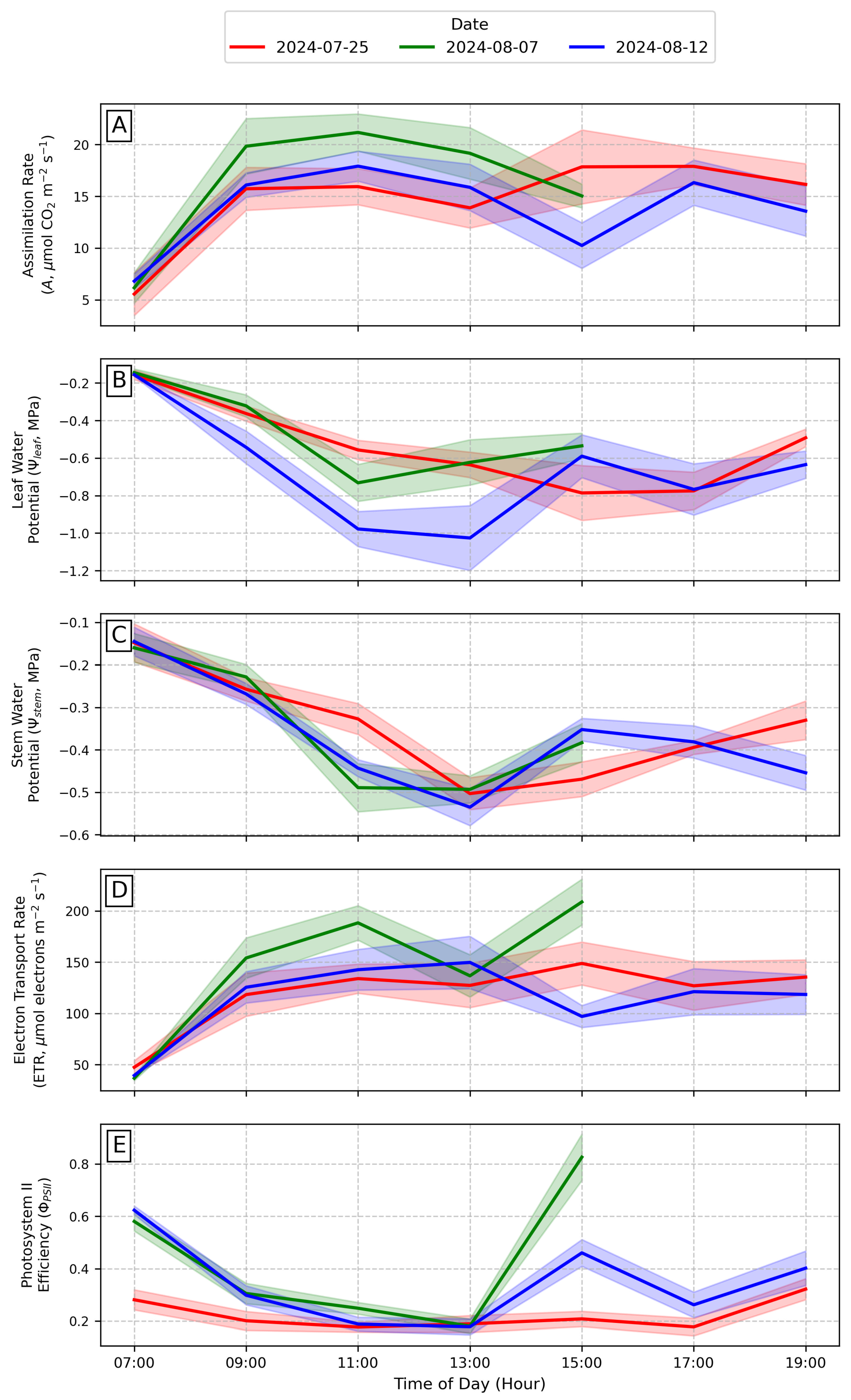
Assimilation rate (A, μmol m−2s−1, Figure 1A) exhibited notable diurnal variations across the three measurement dates. Across all dates, A was typically lowest at 7:00, peaking between 9:00 and 15:00 and declining towards the afternoon. Afterwards, a slight rise occurred in the late afternoon, followed by a decline towards dusk.
Figure 1.
Diurnal dynamics of grapevine physiology across three measurement dates (25 July, 7 August, and 12 August, 2024). (A) Assimilation rate (A, μmol m−2s−1); (B) leaf water potential (, ); (C) stem water potential (, ); (D) electron transport rate (ETR, μmol m−2s−1); (E) effective PSII quantum yield (). Shaded areas around the curves represent the standard deviation.
Diurnal dynamics are also discernible in the progression of leaf water potential (, , Figure 1B). Throughout the measurement period, was generally highest in the early morning, lowest around midday, and showed a steady increase towards dusk.
Stem water potential (, , Figure 1C) decreased steadily from 7:00 and fell to a minimum on all the days until 13:00. Afterwards, gradually increased again, except for the last measurement day, showing a brief increase until 15:00 and a decrease again towards dusk. The midday drop on the first day is not as pronounced as on the other days.
Electron transport rate (ETR, μmol m−2s−1, Figure 1D) exhibited diurnal patterns across the measurement dates. In general, ETR was typically lowest in the early morning, peaked between 11:00 and 15:00, and declined towards the afternoon. Afterwards, a slight rise occurs in the late afternoon, followed by a decline towards dusk
Effective PSII quantum yield (, Figure 1E) showed variability across the measurement periods. Across all dates, was typically higher in the early morning, lowest at midday, and showed a slight rise in the late afternoon, followed by a decline towards dusk.
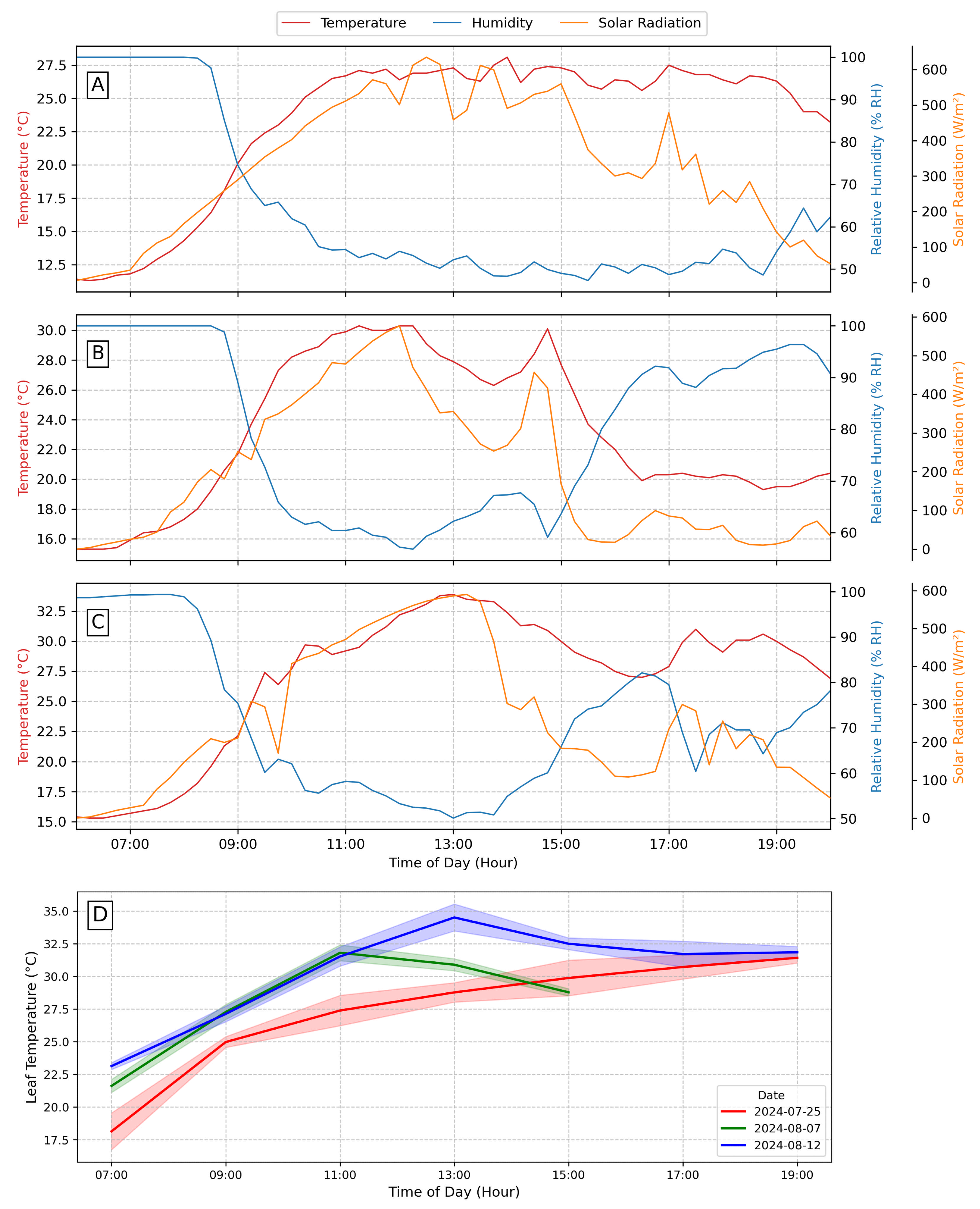
A potential explanation for the unusually high values at 14:46–14:55 (recorded as the 15:00 measurement in Figure 1E) on 7 August could lie in short-term fluctuations of incident radiation. Although the cuvette PAR sensor of the LI-6800 recorded stable values around the programmed 600 μmol m−2s−1, the pyranometer data for that date (Figure 2B) indicate a steep increase in global radiation shortly before the measurements. Specifically, incoming radiation rose from 311.4 at 14:15 to 457 at 14:30. This rapid increase in light intensity may have temporarily markedly enhanced the photosynthetic activity, possibly contributing to the observed peak in .
Figure 2.
Diurnal course of temperature, relative humidity, and solar radiation between 06:00 and 20:00 on the selected measurement days ((A) 25 July 2024; (B) 7 August 2024; (C) 12 August 2024). Data were recorded by a weather station located within the experimental site and provided by the Weinbauring Franken facility. (D) shows leaf temperature recorded by the LI-COR LI-6800 system during measurements of gas exchange and chlorophyll fluorescence. The shaded areas around the curves in (D) represent the standard deviation.
The diurnal dynamics of assimilation rate A, ETR, , , , and leaf temperature (, Figure 2D) show related patterns across the measurement dates, indicating connections between photosynthetic activity, water status, and temperature in grapevine physiology. Assimilation rate A, ETR, and are linked through their roles in photosynthesis and follow similar diurnal trends. On all dates, A and ETR are lowest in the early morning, peaking around midday, and decreasing towards dusk, with some recovery in the late afternoon. The effective PSII quantum yield () generally follows this pattern but shows more variation, often decreasing at midday when A and ETR peak. This suggests lower photosystem II efficiency under high light, possibly due to photoinhibition. On 7 August, the high values in the afternoon did not correspond closely with A or ETR. Leaf and stem water potentials (, ) show opposite trends to photosynthetic parameters. Both are highest in the early morning, lowest around midday to early afternoon, and increase towards dusk. These decreases align with peaks in A and ETR, indicating that high photosynthetic activity and associated transpiration reduce water availability. The recovery of water potentials in the late afternoon corresponds to lower photosynthetic rates, as reduced transpiration supports water replenishment, suggesting water status acts as a limiting factor to photosynthesis during periods of high environmental demand. Leaf temperature () influences these patterns, increasing from early morning to a peak in the early afternoon and decreasing towards dusk. Higher temperatures correspond to increased A and ETR. However, high temperatures may lower , suggesting potential stress. Increased also promotes transpiration, reducing and . Across all dates, A, ETR, and peak at midday with higher , while and reach their lowest values, reflecting the impact of photosynthetic activity on plant water status. Early mornings show low photosynthetic activity, high water potentials, and low , while midday conditions reduce water potentials. The late afternoon shows increases in water potentials, and suggest reduced environmental stress.
The diurnal courses of air temperature, relative humidity, and solar radiation (Figure 2A–C) provide a framework for interpreting the observed physiological dynamics. Across all three days, solar radiation increased sharply in the morning, reached peak values around midday, and gradually declined towards the evening. This pattern coincided with the increase in A and ETR (Figure 1A and Figure 1D, respectively) during the morning hours, reflecting the strong dependence of photosynthetic activity on light availability. The midday peaks in A and ETR thus appear closely linked to the maximum incoming radiation. In contrast, (Figure 1E) tended to decrease at midday despite high radiation levels, indicating reduced photosystem II efficiency under strong light, possibly as a result of photoinhibition or protective downregulation mechanisms.
Air temperature followed a parallel pattern, with low values in the early morning and maxima in the afternoon. Increasing (Figure 2D) was associated with higher A and ETR up to a point, but excessive heating likely contributed to declines in and accelerated midday reductions in water potential (, ) (Figure 1B and Figure 1C, respectively). High temperatures enhance transpirational demand, which, together with peak solar radiation, drives declines in water potentials. This coupling of high photosynthetic activity and low water status indicates that environmental stress during midday constrained the physiological performance of the vines.
Relative humidity showed an inverse pattern to temperature, with higher values in the morning that decreased towards midday. The resulting increase in atmospheric vapor pressure deficit (VPD) around midday further amplified transpirational water loss and contributed to the observed drops in and . The recovery of water potentials and during the late afternoon coincided with declining radiation, lower leaf temperatures, and increasing humidity, reflecting reduced evaporative demand and partial alleviation of stress.
Taken together, the physiological responses align with the diurnal dynamics of the climatic drivers. The observed inter-date variability in diurnal physiological patterns also reflects distinct climatic conditions during measurement periods. The earlier photosynthetic maximum and subsequent decline in A (Figure 1A) observed on 7 and 12 August (Figure 2B,C) corresponded with more rapid solar radiation increases and elevated leaf temperatures by midday (Figure 2D), suggesting an early onset of protective stomatal closure and, therefore, reduced photosynthetic activity. In contrast, the sustained afternoon photosynthetic activity on 25 July (Figure 1A) occurred under lower air temperature and substantially lower relative humidity (Figure 2A), conditions that supported continued stomatal opening. Generally, photosynthetic activity was promoted by increasing light and temperature in the morning but was constrained around midday by high radiation load, elevated leaf temperature, and low humidity. The observed relationships between these environmental variables showcases that short-term changes in temperature, radiation, and humidity are important factors influencing the diurnal dynamics of photosynthesis and water status in grapevines.
3.2. Model Performance at 1 nm Resolution
Modeling results are summarized in Table 1 and Table 2. The performance of various machine learning models for predicting physiological parameters from hyperspectral data was evaluated under two preprocessing conditions: raw spectral reflectance at 1 nm resolution (Table 1) and its first derivative reflectance (FDR) transformation (Table 2). Across all evaluated physiological traits, assimilation rate A, ETR, , and leaf and stem water potentials( and ), the use of FDR preprocessing generally led to improved model performance in terms of coefficient of determination (R2) and root mean squared error (RMSE) values.
Table 1.
Results derived from using 1 nm resolution spectral data for estimating assimilation rate (A), electron transport rate (ETR), effective PSII quantum yield (), and leaf and stem water potential ( and , respectively). R2 and RMSE are given for the individual models and the Stacking Regressor using all other models except the standalone Random Forest (RFS) as base learners with pass-through (SR-PT) and without pass-through enabled (SR-NP). The Stacking Regressor uses a separate RF with a number of trees of 100 as a meta-model. RMSE values are reported in the same units as the corresponding parameter. Bold numbers indicate the best values for each variable.
Table 2.
Results derived from using the first derivative reflectance (FDR) from the 1 nm resolution spectral data for estimating assimilation rate (A), electron transport rate (ETR), effective PSII quantum yield (), and leaf and stem water potential ( and , respectively). R2 and RMSE are given for the individual models and the Stacking Regressor using all other models except the Random Forest (RFS) as base learners with pass-through (SR-PT) and without pass-through enabled (SR-NP). The Stacking Regressor uses a separate RF with a number of trees of 100 as a meta-model. RMSE values are reported in the same units as the corresponding parameter. Bold numbers indicate the best values for each variable.
The most substantial gains in predictive performance due to FDR transformation were observed for and ETR. For instance, with FDR, the R2 values for increased from 0.5389 and RMSE 0.1263 (SVR) and 0.6242 and RMSE 0.114 (SR-PT) in the original data to 0.8147 and RMSE 0.0801 and 0.9219 and RMSE 0.052, respectively, accompanied by a considerable reduction in RMSE (from 0.114 to 0.052 in the best-case stacked model). Similarly, ETR saw improvements, with SVR and SR-PT increasing from R2 values of 0.4785 and RMSE 31.8939 and 0.5646 and RMSE 29.1436 to 0.7101 and RMSE 23.7809 and 0.8159 and RMSE 18.9491, respectively.
Moderate but consistent improvements were also observed for and , especially in ensemble models. SR-PT improved from R2 values of 0.6595 and RMSE 1.7202 () and 0.7876 and RMSE 0.5491 () in the raw reflectance condition to 0.7025 and RMSE 1.6079 and 0.7956 and RMSE 0.5387, respectively, under the FDR condition. While this performance gain was smaller for , the model robustness across physiological traits improved with the FDR approach.
The assimilation rate (A) showed more variable trends. While some models (e.g., LASSO, ELASTICNET, and especially SR-PT) improved under FDR (e.g., SR-PT R2 increased from 0.4912 and RMSE 2.842 to 0.8451 and RMSE 1.5683), others showed marginal improvement or even decreased performance (e.g., ANN dropped from an R2 value of 0.5076 and RMSE 2.7958 to R2 0.1133 and RMSE 3.7519).
Among individual models, Random Forest (RFS) showed particularly strong performance under FDR for A (R2 0.7860 and RMSE 1.8433), outperforming all other non-ensemble models. Similarly, the RFS outperformed all other individual models for , with an R2 of 0.8362 and RMSE of 0.4823, also outperforming both of the stacked ensemble models, which achieved an R2 of 0.7956 with an RMSE of 0.5387 for SR-PT and 0.7911 and RMSE 0.5446 for SR-NP.
However, the stacked RF models, especially SR-PT, mostly outperformed all individual models across most traits.
Overall, the application of the first derivative of reflectance generally enhanced the predictive capacity of machine learning models, with the most pronounced improvements observed in traits associated with photosynthetic efficiency and electron transport.
3.3. Model Performance Across Resampled Resolutions
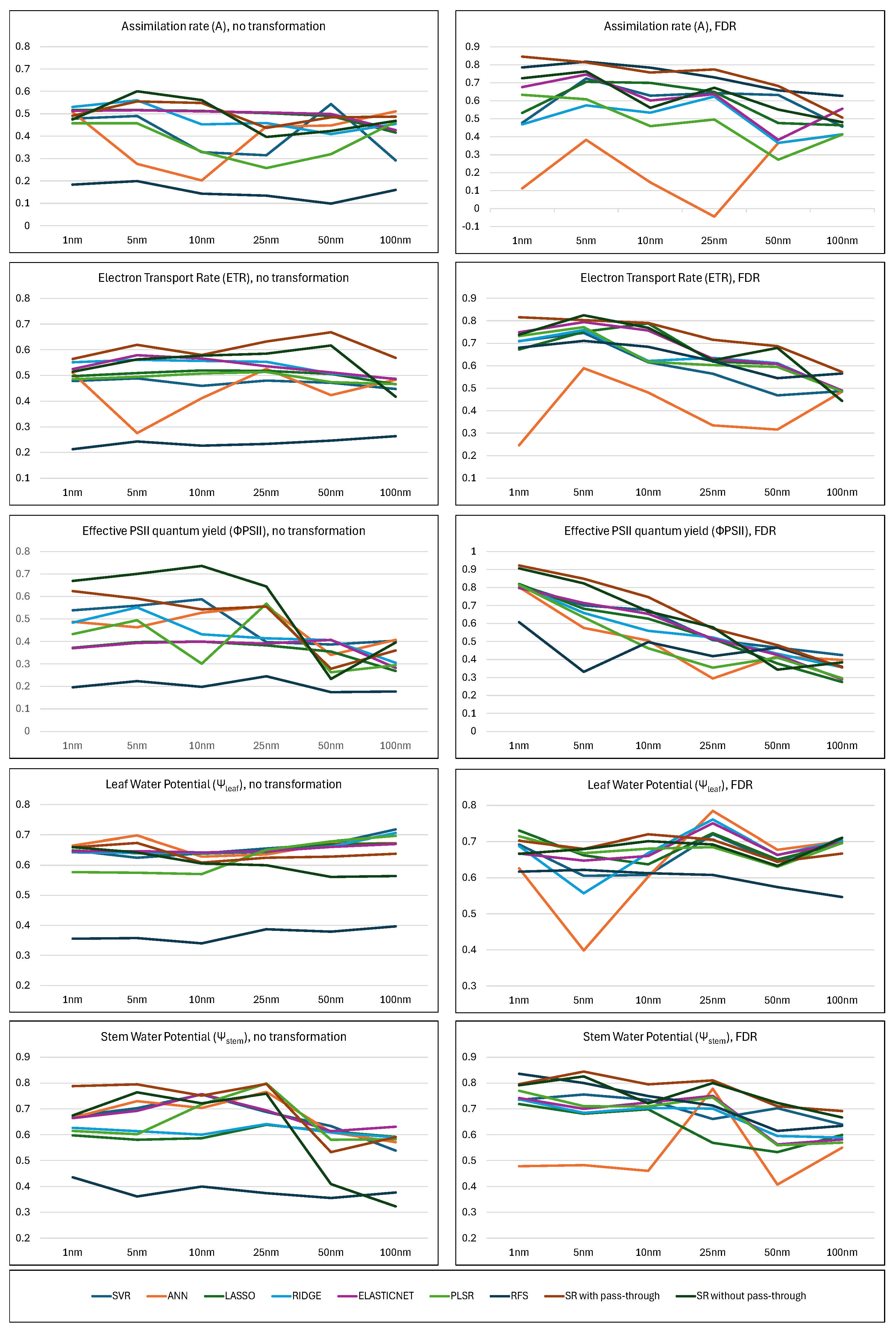
The results of the resampling analysis are shown in Figure 3. A general decline in model performance was observed with increasing spectral bandwidths, indicating that reduced spectral detail compromises predictive accuracy. This trend was consistent across all physiological parameters examined (assimilation rate A, ETR, , , and ), although the degree of sensitivity varied by parameter and algorithm.
Figure 3.
R2 values (y-Axis) for assimilation rate (A), electron transport rate (ETR), effective quantum yield of PSII (), leaf water potential (), and stem water potential () at spectral resolutions of 1, 5, 10, 25, 50, and 100 nm. Results are presented separately for raw reflectance (left column) and first derivative reflectance (FDR) preprocessing (right column).
For most models, peak R2 values were achieved at the original 1 nm resolution or modestly degraded at 5–10 nm resampling. predictions, in particular, suffered a drop in performance beyond 10 nm resolution, with several models showing lower R2 at 50 and 100 nm. By contrast, some robustness was observed for water potential parameters, especially , where several models (e.g., SVR, Ridge, PLSR) retained relatively high R2 values up to 25 nm resolution.
Stacked ensemble approaches (both with and without pass-through of original data enabled) were generally among the top-performing configurations. These models not only outperformed most individual learners at finer resolutions but also maintained relatively stable R2 values as resolution decreased, with the exception of , where the stacked models suffered a notable decrease in predictive performance at 50 nm and 100 nm. In particular, SR-PT frequently produced the highest R2 values across all parameters and resolutions.
For derivative preprocessing, the first derivative of reflectance (FDR) was applied to the resampled spectra; this transformation often averted the performance losses previously observed with resampling of the original data. While a decline in accuracy still occurred, such degradation typically required more severe resampling to reach the same level of degradation. However, the effectiveness of the derivative approach varied between algorithms and was not universally beneficial. ANN models, in particular, exhibited erratic performance across FDR datasets.
The standalone random forest model (RFS) performed poorly on the original spectral data across all resolutions, with consistently lower R2 values compared to other algorithms. However, its predictive performance showed relatively little degradation as spectral resolution decreased, and in some cases, such as for A and ETR, the highest R2 values were reached at intermediate resolutions (e.g., 10 or 25 nm). When first derivative preprocessing (FDR) was applied, RFS performance improved substantially across all parameters and remained robust even at coarse spectral resolutions for most, with the exception of , which exhibited a more pronounced decline in R2 at coarser resolutions compared to the other parameters. Nonetheless, under FDR, RFS still demonstrated both high accuracy and low sensitivity to spectral resampling.
and stood out as more robust parameters across the resampling analysis. Regardless of spectral resolution or preprocessing method, both parameters could be predicted with relatively high and stable accuracy, indicating that their estimation is less reliant on high spectral detail compared to other physiological traits.
4. Discussion
4.1. Diurnal Patterns of Grapevine Physiology
The diurnal patterns observed in the assimilation rate (A), effective PSII quantum yield (), electron transport rate (ETR), and leaf and stem water potentials (, ) provide critical insights into grapevine physiology and its temporal dynamics.
These findings underscore the importance of capturing diurnal variations for a comprehensive understanding of grapevine physiological status. For precision viticulture, such data can inform irrigation scheduling, as midday water potential drops indicate periods of increased water demand or reduced water availability, which could help to further support targeted irrigation either before or during these drops to mitigate short-term drought effects and achieve consistent desired soil moisture conditions and, therefore, desired plant water statuses [6,7,9]. Similarly, the peak in A and ETR during mid-morning to early afternoon suggests favorable periods for assessing photosynthetic performance, which is critical for evaluating vine vigor and yield potential. For studies or applications limited to a single daily measurement, our results suggest that measurements taken around midday would capture peak photosynthetic activity (A, ETR) while still reflecting relatively high water potentials, providing a balanced representation of vine health. This time window avoids the diurnal trough, making this period of the day suitable for standardized monitoring protocols in vineyards. It is important to note, however, that water status at this time of day might not accurately reflect water stress, as stomata closure can be a natural reaction to high radiation, and thus incoming solar radiation should be taken into account for reliability of stress assessment [59].
4.2. Predictive Modeling at Full Spectral Resolution (1 nm)
The relationship between hyperspectral reflectance and the targeted physiological parameters could be effectively captured by linear models, highlighted by the consistently high accuracies achieved by the individual linear learners. The stacking ensemble approach, however, particularly SR-PT, consistently outperformed individual models, including the widely used partial least squares regression (PLSR), across all physiological parameters. At 1 nm spectral resolution with FDR preprocessing, SR-PT achieved R2 values as high as 0.9219 for and 0.8451 for A, surpassing PLSR’s performance (e.g., R2 of 0.8144 for , 0.6329 for A). This superiority could be attributed to the ensemble’s ability to integrate the strengths of multiple base learners while mitigating their individual weaknesses [38]. The pass-through mechanism further enhanced performance by allowing the Random Forest meta-learner to directly access spectral features, enabling the model to capture complex non-linear relationships that individual linear models might miss. Similar performance gains from combining different modeling strategies have also been reported by Fu et al. [38] for modeling of Vc, max and Jmax.
The application of first derivative reflectance (FDR) preprocessing generally enhanced model performance, particularly for predicting and ETR, where R2 values increased by up to 0.2977 and 0.2513, respectively, when compared with the stacking ensemble approach using the raw reflectance data at the original 1 nm resolution. FDR’s effectiveness lies in its ability to emphasize changes in spectral curvature, which can be associated with physiological traits such as chlorophyll content, as well as stress detection [30,47,60]. By reducing the impact of baseline reflectance variations, FDR facilitated more robust regression performance, leading to lower RMSE values (e.g., from 0.114 to 0.052 for in SR-PT). Convergent evidence for this conclusion was recently provided by Zhuang et al. [52], who showed that low-order fractional derivative spectra likewise enhanced the retrieval of chlorophyll fluorescence parameters by mitigating baseline drift effects. However, the impact of FDR varied across models and parameters. For instance, while FDR significantly improved predictions for A in the stacked model (R2 from 0.4912 to 0.8451), FDR led to a performance drop for ANN (R2 from 0.5076 to 0.1133). The decline in ANN performance can be attributed to the derivative transformation amplifying noise. Although a Savitzky–Golay filter was applied to reduce the impact of noise amplification, residual noise in spectral regions with a low signal-to-noise ratio (SNR) can still be emphasized by FDR. Additionally, the ANN architecture and hyperparameter tuning were limited to relatively small and simple networks with few hidden units, basic activation functions, and low regularization (see Supplementary Materials), which may have reduced the model’s robustness against noisy inputs, even more so than for the other, more robust models, such as SVR or PLSR. This highlights the need for data- and model-specific optimization of filter parameters to minimize residual noise after derivative preprocessing [61].
The overall variability suggests that FDR’s benefits are model-dependent and may require careful tuning or model selection to maximize its advantages. Although improvements were observed at multiple spectral resolutions, the magnitude of FDR’s impact differed across traits, with the most consistent benefits appearing for , ETR, and A. Nonetheless, FDR’s overall positive impact highlights its importance for hyperspectral applications in viticulture, as derivative information appears to mitigate performance losses associated with reduced spectral detail and supports robust predictions across diverse conditions.
4.3. Spectral Resampling
Beyond the methodological aspects, the resampling analysis also highlights the practical implications of spectral resolution for remote sensing of grapevine physiology. The observed robustness of model performance at coarser spectral resolutions demonstrates that low-cost hyperspectral or even multispectral systems with fewer channels and broader bandwidths may still provide sufficient accuracy for monitoring key physiological traits such as , and, to a somewhat lesser extent, photosynthetic parameters (A, ETR, ). Prediction performance for was generally least affected by the coarser spectral resolution, likely because leaf water content is highly associated with the near- and middle-infrared regions [62,63,64], which remain largely preserved after resampling. This, in turn, could explain the performance reduction observed for the other parameters, as they are not directly linked to the structural properties of the leaf but instead seem to rely on information distributed across the entire measured spectrum, where the overall reduction in detail has a more direct effect on prediction performance. This finding is particularly relevant for viticulture applications where sensor affordability and scalability are critical factors, suggesting that precision monitoring does not necessarily require high-end laboratory-grade spectrometers. This finding is also supported by recent research conducted by Antoniuk et al. into the applicability of RGB-based vegetation indices for estimating water status [65].
In addition to field-deployable low-cost sensors, these results are also highly relevant for spaceborne remote sensing. Satellite missions typically operate with broad spectral bands, limiting their capacity to resolve fine-scale spectral features. Nevertheless, our findings suggest that even with reduced spectral detail, meaningful retrieval of photosynthetic and water status parameters is possible. This provides support for leveraging existing multispectral satellites for vineyard monitoring and underlines the potential of fluorescence-oriented missions such as the European Space Agency’s Fluorescence Explorer (FLEX) satellite, which is specifically designed to retrieve chlorophyll fluorescence at canopy scale [66]. The FLEX mission offers unique opportunities to assess photosynthetic activity and stress responses at large spatial scales, complementing ground- or UAV-based hyperspectral approaches. Our results reinforce the notion that while high spectral resolution enhances predictive power, operational monitoring can be achieved with coarser spectral information, thereby bridging the gap between ground-based spectroscopy and spaceborne observations.
Direct comparisons with prior studies are challenging due to significant limitations, including differences in plant species or even varieties, environmental conditions (e.g., field or indoor conditions), and measurement setups (e.g., field spectroscopy vs. UAV based measurements). These factors substantially influence predictive accuracies, rendering absolute equivalences unreliable. Selected studies on similar parameters often report varying accuracies depending on their specific contexts, further complicating direct comparisons. Nonetheless, two studies conducted on Vitis vinifera provide a partial reference, namely those by Matese et al. [47] and Yang et al. [50]. Matese et al. [47] achieved an R2 of up to 0.65 for predawn in cv. Barbera using UAV-based hyperspectral imagery and PLSR, whereas Yang et al. [50] reported R2 of up to 0.63 for () in cv. Cabernet Sauvignon under indoor conditions with an imaging system and selected reflectance or derivative indices. Both approaches were constrained to the visible near-infrared range (400–1000 nm) and involved an air path between sensor and leaf, possibly introducing atmospheric distortions. In contrast, our contact probe measurements (350–2500 nm) eliminated such air-path effects and incorporated near- and middle-infrared information unavailable to either study. The resulting stacked ensemble with FDR preprocessing yielded markedly higher accuracies (R2 = 0.836 for and R2 = 0.922 for ) for cv. Müller-Thurgau. Further investigations, including upscaling to UAV data, are necessary to show whether a comparable improvement can be achieved at this scale. While cautious interpretation of quantitative values is necessary, our ensemble approach with FDR preprocessing demonstrates a robust improvement in predictive performance for grapevine physiology under field conditions, highlighting its potential to advance precision viticulture and strengthen applications in plant physiology.
5. Conclusions
This study highlights the efficacy of integrating hyperspectral data with ensemble machine learning and FDR preprocessing for vineyard monitoring. The approach effectively captures diurnal physiological dynamics and enables accurate, scalable predictions, offering a robust tool for precision viticulture and supporting sustainable grape production. In summary, three main objectives were addressed: (i) characterizing diurnal dynamics of grapevine physiology, (ii) evaluating the performance of individual and ensemble machine learning models at 1 nm spectral resolution using a hyperspectral device, and (iii) assessing the robustness of these models across resampled spectral resolutions.
Regarding (i), the diurnal analysis revealed clear temporal patterns in photosynthetic activity and water status, highlighting periods for physiological monitoring. For (ii), stacking ensemble models combined with first derivative reflectance preprocessing provided accurate predictions of photosynthetic parameters and water potentials at high spectral resolution. Concerning (iii), the resampling analysis demonstrated that water potential and photosynthetic traits could still be predicted with acceptable accuracy at coarser spectral resolutions, supporting the use of cost-effective sensors in field and remote sensing applications.
The integration of hyperspectral measurements with ensemble machine learning and FDR preprocessing offers a powerful, non-invasive approach for monitoring plant physiology at high temporal and spatial resolutions. This methodology addresses the scalability limitations of traditional gas exchange and fluorometry techniques, enabling high-throughput monitoring across entire vineyards. The ability to accurately predict parameters like , ETR, and water potentials supports real-time decision-making in precision viticulture, with applications including optimizing irrigation to mitigate midday water deficiency or adjusting canopy management to control photosynthetic activity under possible climate change-induced stressors such as prolonged periods of drought and reduced water availability. Furthermore, model performance remains effective even when spectral resolution is reduced, as appropriate model selection and preprocessing strategies like stacking and first derivative reflectance mitigate declines in accuracy, particularly for photosynthetic parameters, allowing for the use of cost-effective, lower-resolution sensors in commercial vineyards.
The robustness of water potential predictions, particularly , across spectral resolutions suggests that hyperspectral methods can be adapted to cost-effective sensors with lower resolution, broadening their applicability in commercial vineyards. However, limitations in the current study, such as the lack of irrigation variability in 2024 and the use of nearby plants for water potential measurements, highlight the need for further validation under diverse environmental conditions. Future research should explore the integration of additional variables (e.g., soil moisture, temperature) into the models and test their performance under varied irrigation regimes to enhance generalization ability. Additionally, investigating other ensemble techniques, such as gradient boosting or deep learning-based stacking, could further improve predictive accuracy.
Supplementary Materials
The following supporting information can be downloaded at: https://www.mdpi.com/article/10.3390/rs1010000/s1, Supplementary Material for Machine Learning documentation.
Author Contributions
Conceptualization, M.B., D.H. and M.L.; data collection, D.H., E.L. and M.L.; methodology, M.L. and E.L.; writing—original draft preparation, M.L.; writing—review and editing, M.L., M.B., D.H. and T.U.; project administration, M.B.; All authors have read and agreed to the published version of the manuscript.
Funding
This research is part of the Artificial Intelligence for Precision Viticulture (AIVY) project and was funded by the Bavarian State Ministry of Science and the Arts. Partial funding was also provided by the publication fund of the Technical University of Applied Sciences Würzburg-Schweinfurt.
Data Availability Statement
The data presented in this study are available from the corresponding author upon reasonable request.
Acknowledgments
We would like to give our sincere thanks to the Bavarian State Institute for Viticulture and Horticulture (LWG) for providing access to the vineyard site and for their active support during data collection. During the preparation of this work, the authors used ChatGPT (GPT-5, OpenAI) as a writing assistance tool. In addition, ChatGPT (GPT-5, OpenAI) was used to generate the initial version of the Python script employed for figure creation. After using these tools, the authors thoroughly reviewed, verified, and edited all content and code, and take full responsibility for the final version of the publication. The data analysis and interpretation were performed entirely by the authors without the use of generative AI tools.
Conflicts of Interest
The authors declare no conflicts of interest.
References
- Medrano, H.; Tomás, M.; Martorell, S.; Flexas, J.; Hernández, E.; Rosselló, J.; Pou, A.; Escalona, J.M.; Bota, J. From leaf to whole-plant water use efficiency (WUE) in complex canopies: Limitations of leaf WUE as a selection target. Crop J. 2015, 3, 220–228. [Google Scholar] [CrossRef]
- Jiang, G.M.; Sun, J.Z.; Liu, H.Q.; Qu, C.M.; Wang, K.J.; Guo, R.J.; Bai, K.Z.; Gao, L.M.; Kuang, T.Y. Changes in the rate of photosynthesis accompanying the yield increase in wheat cultivars released in the past 50 years. J. Plant Res. 2003, 116, 347–354. [Google Scholar] [CrossRef] [PubMed]
- Wu, A.; Hammer, G.L.; Doherty, A.; von Caemmerer, S.; Farquhar, G.D. Quantifying impacts of enhancing photosynthesis on crop yield. Nat. Plants 2019, 5, 380–388. [Google Scholar] [CrossRef] [PubMed]
- Simkin, A.J.; López-Calcagno, P.E.; Raines, C.A. Feeding the world: Improving photosynthetic efficiency for sustainable crop production. J. Exp. Bot. 2019, 70, 1119–1140. [Google Scholar] [CrossRef]
- Tarara, J.M.; Peña, J.E.P.; Keller, M.; Schreiner, R.P.; Smithyman, R.P. Net carbon exchange in grapevine canopies responds rapidly to timing and extent of regulated deficit irrigation. Funct. Plant Biol. 2011, 38, 386. [Google Scholar] [CrossRef]
- Romero, P.; Gil-Muñoz, R.; del Amor, F.M.; Valdés, E.; Fernández, J.I.; Martinez-Cutillas, A. Regulated Deficit Irrigation based upon optimum water status improves phenolic composition in Monastrell grapes and wines. Agric. Water Manag. 2013, 121, 85–101. [Google Scholar] [CrossRef]
- Pérez-Álvarez, E.; Intrigliolo Molina, D.; Vivaldi, G.; García-Esparza, M.; Lizama, V.; Álvarez, I. Effects of the irrigation regimes on grapevine cv. Bobal in a Mediterranean climate: I. Water relations, vine performance and grape composition. Agric. Water Manag. 2021, 248, 106772. [Google Scholar] [CrossRef]
- Drori, E.; Munitz, S.; Pinkus, A.; Stanevsky, M.; Netzer, Y. The Effect of Irrigation-Initiation Timing on the Phenolic Composition and Overall Quality of Cabernet Sauvignon Wines Grown in a Semi-Arid Climate. Foods 2022, 11, 770. [Google Scholar] [CrossRef]
- Kang, C.; Diverres, G.; Karkee, M.; Zhang, Q.; Keller, M. Decision-support system for precision regulated deficit irrigation management for wine grapes. Comput. Electron. Agric. 2023, 208, 107777. [Google Scholar] [CrossRef]
- Hall, A.; Jones, G. Effect of potential atmospheric warming on temperature-based indices describing Australian winegrape growing conditions. Aust. J. Grape Wine Res. 2009, 15, 97–119. [Google Scholar] [CrossRef]
- Greer, D.; Weedon, M. Modelling photosynthetic responses to temperature of grapevine (Vitis vinifera cv. Semillon) leaves on vines grown in a hot climate. Plant Cell Environ. 2011, 35, 1050–1064. [Google Scholar] [CrossRef]
- Schultz, H.R. Global Climate Change, Sustainability, and Some Challenges for Grape and Wine Production. J. Wine Econ. 2016, 11, 181–200. [Google Scholar] [CrossRef]
- Smith, J.P.; Edwards, E.J.; Walker, A.R.; Gouot, J.C.; Barril, C.; Holzapfel, B.P. A whole canopy gas exchange system for the targeted manipulation of grapevine source-sink relations using sub-ambient CO2. BMC Plant Biol. 2019, 19, 535. [Google Scholar] [CrossRef] [PubMed]
- van Leeuwen, C.; Destrac-Irvine, A.; Dubernet, M.; Duchêne, E.; Gowdy, M.; Marguerit, E.; Pieri, P.; Parker, A.; de Rességuier, L.; Ollat, N. An Update on the Impact of Climate Change in Viticulture and Potential Adaptations. Agronomy 2019, 9, 514. [Google Scholar] [CrossRef]
- Vasylenko, O.; Kondratenko, T.; Havryliuk, O.; Andrusyk, Y.; Kutovenko, V.; Dmytrenko, Y.; Grevtseva, N.; Marchyshyna, Y. The study of the productivity potential of grape varieties according to the indicators of functional activity of leaves. Slovak J. Food Sci. 2021, 15, 639–647. [Google Scholar] [CrossRef]
- Jogaiah, S. Vineyard Management Strategies in Scenario of Climate Change—A Review. Grape Insight 2023, 1, 11–22. [Google Scholar] [CrossRef]
- Tosin, R.; Portis, I.; Rodrigues, L.; Gonçalves, I.; Barbosa, C.; Teixeira, J.; Mendes, R.J.; Santos, F.; Santos, C.; Martins, R.; et al. Integrating Spectral Sensing and Systems Biology for Precision Viticulture: Effects of Shade Nets on Grapevine Leaves. Horticulturae 2024, 10, 873. [Google Scholar] [CrossRef]
- Del Zozzo, F.; Magnanini, E.; Poni, S. Physiological efficiency of grapevine canopies having varying geometries: Seasonal and diurnal whole canopy gas exchange assessment under well-watered and water deficit conditions. Environ. Exp. Bot. 2024, 221, 105716. [Google Scholar] [CrossRef]
- Palliotti, A.; Tombesi, S.; Silvestroni, O.; Lanari, V.; Gatti, M.; Poni, S. Changes in vineyard establishment and canopy management urged by earlier climate-related grape ripening: A review. Sci. Hortic. 2014, 178, 43–54. [Google Scholar] [CrossRef]
- Flexas, J.; Bota, J.; Escalona, J.M.; Sampol, B.; Medrano, H. Effects of drought on photosynthesis in grapevines under field conditions: An evaluation of stomatal and mesophyll limitations. Funct. Plant Biol. 2002, 29, 461. [Google Scholar] [CrossRef]
- Maroco, J.P.; Rodrigues, M.L.; Lopes, C.; Chaves, M.M. Limitations to leaf photosynthesis in field-grown grapevine under drought — metabolic and modelling approaches. Funct. Plant Biol. 2002, 29, 451. [Google Scholar] [CrossRef]
- Farquhar, G.D.; von Caemmerer, S.; Berry, J.A. A biochemical model of photosynthetic CO2 assimilation in leaves of C3 species. Planta 1980, 149, 78–90. [Google Scholar] [CrossRef]
- Pallotti, L.; Partida, G.; Laroche-Pinel, E.; Lanari, V.; Pedroza, M.; Brillante, L. Late-season source limitation practices to cope with climate change: Delaying ripening and improving colour of Cabernet-Sauvignon grapes and wine in a hot and arid climate. OENO One 2025, 59. [Google Scholar] [CrossRef]
- Kar, S.; Montague, T.; Villanueva-Morales, A.; Hellman, E. Measurement of Gas Exchange on Excised Grapevine Leaves Does Not Differ from In Situ Leaves, and Potentially Shortens Sampling Time. Appl. Sci. 2021, 11, 3644. [Google Scholar] [CrossRef]
- Poni, S.; Bernizzoni, F.; Civardi, S.; Gatti, M.; Porro, D.; Camin, F. Performance and water-use efficiency (single-leaf vs. whole-canopy) of well-watered and half-stressed split-root Lambrusco grapevines grown in Po Valley (Italy). Agric. Ecosyst. Environ. 2009, 129, 97–106. [Google Scholar] [CrossRef]
- Joiner, J.; Guanter, L.; Lindstrot, R.; Voigt, M.; Vasilkov, A.P.; Middleton, E.M.; Huemmrich, K.F.; Yoshida, Y.; Frankenberg, C. Global monitoring of terrestrial chlorophyll fluorescence from moderate-spectral-resolution near-infrared satellite measurements: Methodology, simulations, and application to GOME-2. Atmos. Meas. Tech. 2013, 6, 2803–2823. [Google Scholar] [CrossRef]
- Porcar-Castell, A.; Tyystjärvi, E.; Atherton, J.; van der Tol, C.; Flexas, J.; Pfündel, E.E.; Moreno, J.; Frankenberg, C.; Berry, J.A. Linking chlorophyll a fluorescence to photosynthesis for remote sensing applications: Mechanisms and challenges. J. Exp. Bot. 2014, 65, 4065–4095. [Google Scholar] [CrossRef]
- Murchie, E.H.; Kefauver, S.; Araus, J.L.; Muller, O.; Rascher, U.; Flood, P.J.; Lawson, T. Measuring the dynamic photosynthome. Ann. Bot. 2018, 122, 207–220. [Google Scholar] [CrossRef]
- Meroni, M.; Rossini, M.; Guanter, L.; Alonso, L.; Rascher, U.; Colombo, R.; Moreno, J. Remote sensing of solar-induced chlorophyll fluorescence: Review of methods and applications. Remote Sens. Environ. 2009, 113, 2037–2051. [Google Scholar] [CrossRef]
- Peng, Y.; Zeng, A.; Zhu, T.; Fang, S.; Gong, Y.; Tao, Y.; Zhou, Y.; Liu, K. Using remotely sensed spectral reflectance to indicate leaf photosynthetic efficiency derived from active fluorescence measurements. J. Appl. Remote Sens. 2017, 11, 026034. [Google Scholar] [CrossRef]
- Mayo, A.M.; Moshelion, M.; Liran, O. Limitations of Solar-Induced Chlorophyll Fluorescence (SIF) for Estimating Photosynthesis Under Stress. bioRxiv 2022. [Google Scholar] [CrossRef]
- Liu, X.; Liu, L.; Du, S.; Qi, M. Inconsistent Diurnal Patterns of Far-Red Solar-Induced Chlorophyll Fluorescence Retrieved with Different Algorithms from Tower-Based Observations. J. Remote Sens. 2025, 5, 0429. [Google Scholar] [CrossRef]
- De Petris, S.; Sarvia, F.; Parizia, F.; Ghilardi, F.; Farbo, A.; Borgogno-Mondino, E. Assessing mixed-pixels effects in vineyard mapping from Satellite: A proposal for an operational solution. Comput. Electron. Agric. 2024, 222, 109092. [Google Scholar] [CrossRef]
- Tardaguila, J.; Stoll, M.; Gutiérrez, S.; Proffitt, T.; Diago, M.P. Smart applications and digital technologies in viticulture: A review. Smart Agric. Technol. 2021, 1, 100005. [Google Scholar] [CrossRef]
- Pascoal, D.; Silva, N.; Adão, T.; Lopes, R.D.; Peres, E.; Morais, R. A technical survey on practical applications and guidelines for IoT sensors in precision agriculture and viticulture. Sci. Rep. 2024, 14, 29793. [Google Scholar] [CrossRef]
- Khruschev, S.S.; Plyusnina, T.Y.; Antal, T.K.; Pogosyan, S.I.; Riznichenko, G.Y.; Rubin, A.B. Machine learning methods for assessing photosynthetic activity: Environmental monitoring applications. Biophys. Rev. 2022, 14, 821–842. [Google Scholar] [CrossRef]
- Cogato, A.; Wu, L.; Jewan, S.Y.Y.; Meggio, F.; Marinello, F.; Sozzi, M.; Pagay, V. Evaluating the Spectral and Physiological Responses of Grapevines (Vitis vinifera L.) to Heat and Water Stresses under Different Vineyard Cooling and Irrigation Strategies. Agronomy 2021, 11, 1940. [Google Scholar] [CrossRef]
- Fu, P.; Meacham-Hensold, K.; Guan, K.; Bernacchi, C.J. Hyperspectral Leaf Reflectance as Proxy for Photosynthetic Capacities: An Ensemble Approach Based on Multiple Machine Learning Algorithms. Front. Plant Sci. 2019, 10, 730. [Google Scholar] [CrossRef]
- Meacham-Hensold, K.; Montes, C.M.; Wu, J.; Guan, K.; Fu, P.; Ainsworth, E.A.; Pederson, T.; Moore, C.E.; Brown, K.L.; Raines, C.; et al. High-throughput field phenotyping using hyperspectral reflectance and partial least squares regression (PLSR) reveals genetic modifications to photosynthetic capacity. Remote Sens. Environ. 2019, 231, 111176. [Google Scholar] [CrossRef]
- Fu, P.; Meacham-Hensold, K.; Guan, K.; Wu, J.; Bernacchi, C. Estimating photosynthetic traits from reflectance spectra: A synthesis of spectral indices, numerical inversion, and partial least square regression. Plant Cell Environ. 2020, 43, 1241–1258. [Google Scholar] [CrossRef]
- Meacham-Hensold, K.; Fu, P.; Wu, J.; Serbin, S.; Montes, C.M.; Ainsworth, E.; Guan, K.; Dracup, E.; Pederson, T.; Driever, S.; et al. Plot-level rapid screening for photosynthetic parameters using proximal hyperspectral imaging. J. Exp. Bot. 2020, 71, 2312–2328. [Google Scholar] [CrossRef] [PubMed]
- Jin, J.; Wang, Q.; Song, G. Selecting informative bands for partial least squares regressions improves their goodness-of-fits to estimate leaf photosynthetic parameters from hyperspectral data. Photosynth. Res. 2021, 151, 71–82. [Google Scholar] [CrossRef] [PubMed]
- Zarco-Tejada, P.; González-Dugo, V.; Berni, J. Fluorescence, temperature and narrow-band indices acquired from a UAV platform for water stress detection using a micro-hyperspectral imager and a thermal camera. Remote Sens. Environ. 2012, 117, 322–337. [Google Scholar] [CrossRef]
- Maimaitiyiming, M.; Ghulam, A.; Bozzolo, A.; Wilkins, J.L.; Kwasniewski, M.T. Early Detection of Plant Physiological Responses to Different Levels of Water Stress Using Reflectance Spectroscopy. Remote Sens. 2017, 9, 745. [Google Scholar] [CrossRef]
- Maimaitiyiming, M.; Sagan, V.; Sidike, P.; Maimaitijiang, M.; Miller, A.J.; Kwasniewski, M. Leveraging Very-High Spatial Resolution Hyperspectral and Thermal UAV Imageries for Characterizing Diurnal Indicators of Grapevine Physiology. Remote Sens. 2020, 12, 3216. [Google Scholar] [CrossRef]
- Zhou, J.J.; Zhang, Y.H.; Han, Z.M.; Liu, X.Y.; Jian, Y.F.; Hu, C.G.; Dian, Y.Y. Evaluating the Performance of Hyperspectral Leaf Reflectance to Detect Water Stress and Estimation of Photosynthetic Capacities. Remote Sens. 2021, 13, 2160. [Google Scholar] [CrossRef]
- Matese, A.; Di Gennaro, S.F.; Orlandi, G.; Gatti, M.; Poni, S. Assessing Grapevine Biophysical Parameters From Unmanned Aerial Vehicles Hyperspectral Imagery. Front. Plant Sci. 2022, 13, 898722. [Google Scholar] [CrossRef]
- Wang, Q.; Sonobe, R. Tracing photosynthetic electron transport rate based on hyperspectral reflectance. In Proceedings of the 2016 IEEE International Geoscience and Remote Sensing Symposium (IGARSS), Beijing, China, 10–15 July 2016; pp. 1723–1726. [Google Scholar] [CrossRef]
- Jin, J.; Wang, Q.; Zhuang, J. Coupling Light Intensity and Hyperspectral Reflectance Improve Estimations of the Actual Electron Transport Rate of Mango Leaves (Mangifera indica L.). Remote Sens. 2024, 16, 3523. [Google Scholar] [CrossRef]
- Yang, Z.; Tian, J.; Feng, K.; Gong, X.; Liu, J. Application of a hyperspectral imaging system to quantify leaf-scale chlorophyll, nitrogen and chlorophyll fluorescence parameters in grapevine. Plant Physiol. Biochem. 2021, 166, 723–737. [Google Scholar] [CrossRef]
- Zhuang, J.; Wang, Q.; Song, G.; Jin, J. Validating and Developing Hyperspectral Indices for Tracing Leaf Chlorophyll Fluorescence Parameters under Varying Light Conditions. Remote Sens. 2023, 15, 4890. [Google Scholar] [CrossRef]
- Zhuang, J.; Wang, Q. Estimating Leaf Chlorophyll Fluorescence Parameters Using Partial Least Squares Regression with Fractional-Order Derivative Spectra and Effective Feature Selection. Remote Sens. 2025, 17, 833. [Google Scholar] [CrossRef]
- Santos, J.A.; Fraga, H.; Malheiro, A.C.; Moutinho-Pereira, J.; Dinis, L.T.; Correia, C.; Moriondo, M.; Leolini, L.; Dibari, C.; Costafreda-Aumedes, S.; et al. A Review of the Potential Climate Change Impacts and Adaptation Options for European Viticulture. Appl. Sci. 2020, 10, 3092. [Google Scholar] [CrossRef]
- Brandmeier, M.; Heßdörfer, D.; Siebenlist, P.; Meyer-Spelbrink, A.; Kraus, A. Time Series Analysis of Multisensor Data for Precision Viticulture—Assessing Microscale Variations in Plant Development with Respect to Irrigation and Topography. Remote Sens. 2024, 16, 1419. [Google Scholar] [CrossRef]
- Paeth, H.; Schönbein, D.; Keupp, L.; Abel, D.; Bangelesa, F.; Baumann, M.; Büdel, C.; Hartmann, C.; Kneisel, C.; Kobs, K.; et al. Climate change information tailored to the agricultural sector in Central Europe, exemplified on the region of Lower Franconia. Clim. Change 2023, 176. [Google Scholar] [CrossRef]
- Spectral Evolution. PSR+ Spectroradiometer. Available online: https://spectralevolution.com/product/psr-spectroradiometer/ (accessed on 3 January 2025).
- Scholander, P.F.; Bradstreet, E.D.; Hemmingsen, E.A.; Hammel, H.T. Sap Pressure in Vascular Plants: Negative hydrostatic pressure can be measured in plants. Science 1965, 148, 339–346. [Google Scholar] [CrossRef]
- Savitzky, A.; Golay, M.J.E. Smoothing and Differentiation of Data by Simplified Least Squares Procedures. Anal. Chem. 1964, 36, 1627–1639. [Google Scholar] [CrossRef]
- Antoniuk, V.; Manevski, K.; Kørup, K.; Larsen, R.; Sandholt, I.; Zhang, X.; Andersen, M.N. Diurnal and Seasonal Mapping of Water Deficit Index and Evapotranspiration by an Unmanned Aerial System: A Case Study for Winter Wheat in Denmark. Remote Sens. 2021, 13, 2998. [Google Scholar] [CrossRef]
- Kochubey, S.M.; Kazantsev, T.A. Derivative vegetation indices as a new approach in remote sensing of vegetation. Front. Earth Sci. 2012, 6, 188–195. [Google Scholar] [CrossRef]
- Yan, C. A review on spectral data preprocessing techniques for machine learning and quantitative analysis. iScience 2025, 28, 112759. [Google Scholar] [CrossRef]
- Tucker, C.J. Remote sensing of leaf water content in the near infrared. Remote Sens. Environ. 1980, 10, 23–32. [Google Scholar] [CrossRef]
- Danson, F.M.; Steven, M.D.; Malthus, T.J.; Clark, J.A. High-spectral resolution data for determining leaf water content. Int. J. Remote Sens. 1992, 13, 461–470. [Google Scholar] [CrossRef]
- Li, H.; Yang, W.; Lei, J.; She, J.; Zhou, X. Estimation of leaf water content from hyperspectral data of different plant species by using three new spectral absorption indices. PLoS ONE 2021, 16, e0249351. [Google Scholar] [CrossRef]
- Antoniuk, V.; Zhang, X.; Andersen, M.N.; Kørup, K.; Manevski, K. Spatiotemporal Winter Wheat Water Status Assessment Improvement Using a Water Deficit Index Derived from an Unmanned Aerial System in the North China Plain. Sensors 2023, 23, 1903. [Google Scholar] [CrossRef]
- FLEX—Earth Online. Available online: https://earth.esa.int/eogateway/missions/flex (accessed on 1 March 2025).
Disclaimer/Publisher’s Note: The statements, opinions and data contained in all publications are solely those of the individual author(s) and contributor(s) and not of MDPI and/or the editor(s). MDPI and/or the editor(s) disclaim responsibility for any injury to people or property resulting from any ideas, methods, instructions or products referred to in the content. |
© 2025 by the authors. Licensee MDPI, Basel, Switzerland. This article is an open access article distributed under the terms and conditions of the Creative Commons Attribution (CC BY) license (https://creativecommons.org/licenses/by/4.0/).