Article

Building Footprint Extraction from Multispectral, Spaceborne Earth Observation Datasets Using a Structurally Optimized U-Net Convolutional Neural Network


by
Giorgio Pasquali
1,
Gianni Cristian Iannelli
2 and
Fabio Dell’Acqua
1,*
1
Department of Electrical, Computer, Biomedical Engineering, University of Pavia, Via Adolfo Ferrata, 5, I-27100 Pavia, Italy
2
Ticinum Aerospace, via Ferrini 17/C, I-27100 Pavia, Italy
*
Author to whom correspondence should be addressed.
Remote Sens. 2019, 11(23), 2803; https://doi.org/10.3390/rs11232803
Submission received: 15 October 2019 / Revised: 12 November 2019 / Accepted: 22 November 2019 / Published: 27 November 2019

Abstract

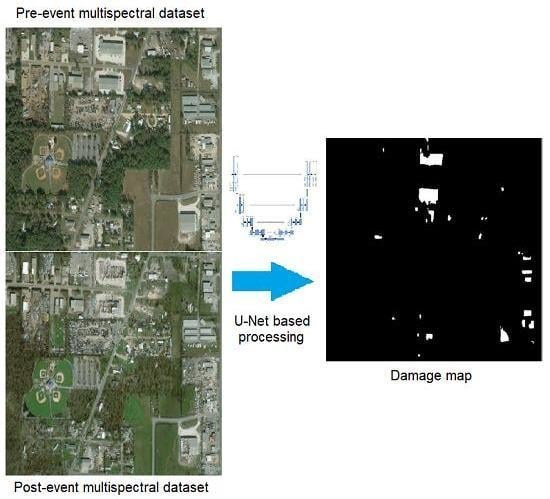
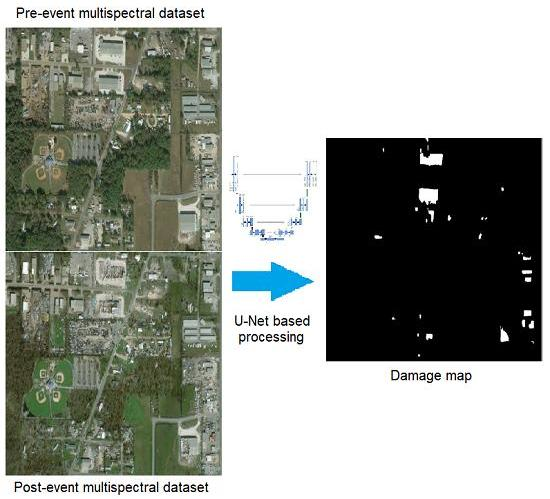
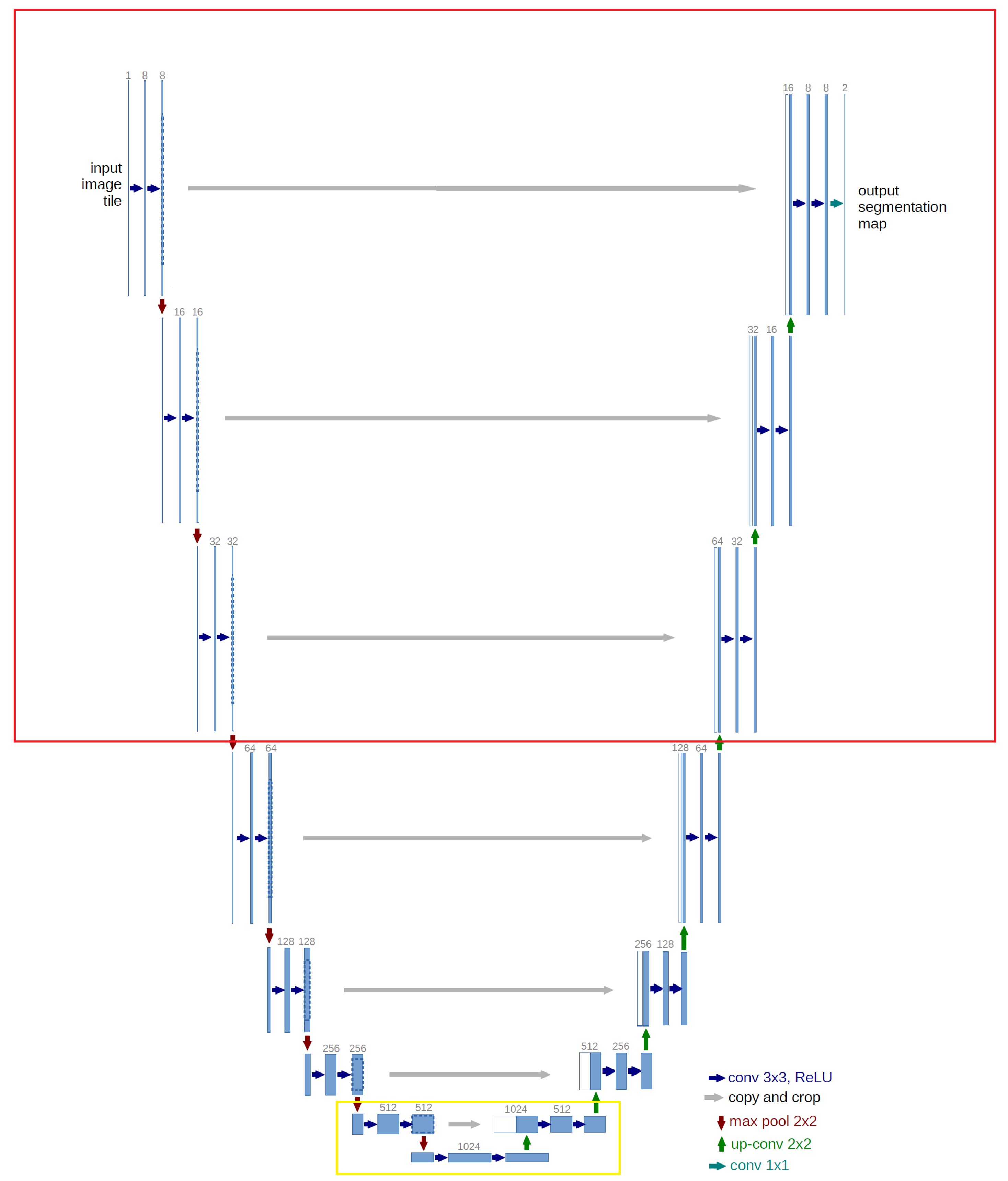
Building footprint detection and outlining from satellite imagery represents a very useful tool in many types of applications, ranging from population mapping to the monitoring of illegal development, from urban expansion monitoring to organizing prompter and more effective rescuer response in the case of catastrophic events. The problem of detecting building footprints in optical, multispectral satellite data is not easy to solve in a general way due to the extreme variability of material, shape, spatial, and spectral patterns that may come with disparate environmental conditions and construction practices rooted in different places across the globe. This difficult problem has been tackled in many different ways since multispectral satellite data at a sufficient spatial resolution started making its appearance on the public scene at the turn of the century. Whereas a typical approach, until recently, hinged on various combinations of spectral–spatial analysis and image processing techniques, in more recent times, the role of machine learning has undergone a progressive expansion. This is also testified by the appearance of online challenges like SpaceNet, which invite scholars to submit their own artificial intelligence (AI)-based, tailored solutions for building footprint detection in satellite data, and automatically compare and rank by accuracy the proposed maps. In this framework, after reviewing the state-of-the-art on this subject, we came to the conclusion that some improvement could be contributed to the so-called U-Net architecture, which has shown to be promising in this respect. In this work, we focused on the architecture of the U-Net to develop a suitable version for this task, capable of competing with the accuracy levels of past SpaceNet competition winners using only one model and one type of data. This achievement could pave the way for achieving better performances than the current state-of-the-art. All these results, indeed, have yet to be augmented through the integration of techniques that in the past have demonstrated a capability of improving the detection accuracy of U-net-based footprint detectors. The most notable cases are represented by an ensemble of different U-Net architectures, the integration of distance transform to improve boundary detection accuracy, and the incorporation of ancillary geospatial data on buildings. Our future work will incorporate those enhancements.
Keywords: U-Net; building footprint; multispectral satellite imagery; damage assessment; convolutional neural networks; CNNs U-Net; building footprint; multispectral satellite imagery; damage assessment; convolutional neural networks; CNNs
Graphical Abstract