Abstract
Amidst the global drive toward sustainable development, this study responds to China’s pressing imperative for a green and low-carbon transition. The research begins by theoretically examining the viability and intrinsic mechanisms through which the cultivation of new-pattern productive forces can foster environmentally sound, high-quality economic growth. Subsequently, by leveraging panel data from 30 Chinese provinces covering the period 2011–2023, a two-way fixed-effects model is deployed to empirically assess the linkage between new-pattern productive forces and green total factor productivity (GTFP). The empirical results demonstrate the following: (1) New-pattern productive forces exert a statistically significant positive influence on GTFP—a finding that withstands multiple robustness checks; (2) Heterogeneity tests reveal that the GTFP-enhancing effect is pronounced in provinces with relatively low carbon intensity, whereas it remains insignificant in high-carbon-intensity regions; (3) Mechanism analysis identifies green technology innovation as a pivotal mediator in the process through which new-pattern productivity improves GTFP; (4) A non-linear, dual-threshold effect characterizes the relationship, wherein the GTFP-promoting impact of new-pattern productive forces strengthens progressively as the development level of green finance crosses successive thresholds. Collectively, these insights advance the understanding of how new-pattern productive forces enable GTFP gains, furnish novel evidence for steering high-quality economic development, and thereby support the broader global sustainability agenda.
1. Introduction
Amidst the critical global transition toward sustainable development, the resource depletion and environmental pressures stemming from conventional development models have become increasingly pronounced, posing significant challenges to long-term human well-being. According to World Bank statistics, the global GDP surpassed $100 trillion in 2024, alongside a population of 8.2 billion. While economic growth and urbanization continue to generate development opportunities, they have also intensified energy and ecological unsustainability. The long-standing industrialization paradigm, characterized by high input and high emissions, has not only compromised the integrity of ecosystems but also posed severe obstacles to the global implementation of the Sustainable Development Goals. Against this backdrop, exploring a development path that can balance economic, social, and environmental needs to achieve truly resilient and inclusive growth has become a shared concern of the international community.
Within this global discourse, the transformation of productivity quality is widely regarded as a pivotal force driving the transition of development models. Leading-edge global research, including studies on sustainability-oriented digital twins and international green finance productivity frameworks, reflects this shift. In 2023, China articulated the concept of New Quality Productive Forces (NQPF) establishing a key theoretical lens for analyzing such transformation. Centered on technological innovation, these forces constitute a productivity paradigm that fundamentally diverges from conventional factor-driven growth models. They deeply integrate advanced trends such as digitalization and greening, emphasizing a development pathway that is efficient, high-caliber, and sustainable. In essence, they constitute green productivity, aiming to achieve synergistic improvements in economic performance, social equity, and ecological integrity. Although this concept originated within the Chinese context, its underlying principles strongly align with the global green transition and the sustainable development agenda.
Under this framework, accurately assessing the quality of green development is of paramount importance. GTFP, as an enhanced version of the traditional Total Factor Productivity (TFP) indicator, incorporates energy consumption and environmental pollution into the efficiency evaluation framework. Thus, it offers a more holistic gauge of growth quality and sustainability, acting as a crucial composite metric for green progress. However, the effect of NQPF—an advanced form of productive capacity—on GTFP is still inadequately studied. This oversight is especially critical considering the pronounced regional disparities in both NQPF and GTFP development levels throughout China. Against this backdrop, the actual effect of NQPF on GTFP is likely to exhibit considerable spatial variation. Furthermore, it remains unclear whether other contextual factors moderate the relationship between NQPF and GTFP. Investigating these questions warrants in-depth scholarly inquiry and carries significant implications for policy formulation.
This research therefore seeks to theoretically examine the mechanism by which NQPF affects GTFP. Following a scientific measurement of both NQPF and GTFP across Chinese provinces, we will construct a provincial panel data model to conduct a comprehensive empirical examination. The research seeks to provide theoretical underpinnings and policy insights for fostering green transformation through productivity paradigm shifts within a global context.
2. Literature Review
Following the introduction of the NQPF concept, its theoretical connotations have been interpreted from multiple perspectives in academia. There is a general consensus that it is centered on technological innovation and represents a fundamental transcendence of traditional productivity pathways [1]. Scholars have emphasized different aspects of its conceptual characteristics such as the tripartite attributes of new, quality, and productive forces, while others provide in-depth analysis from the three dimensions of laborer, means of labor, and subject of labor [2,3]. This has laid a theoretical foundation for subsequent empirical inquiry.
After introducing the NQPF, the scope of related empirical studies has continued to expand, covering multiple dimensions such as macroeconomic performance, industrial structure adjustment, organizational transformation of enterprises, and regional coordinated development.
At the level of macroeconomic development, research generally acknowledges that NQPF serve as a core driver for enhancing TFP and the quality of economic development [4]. In recent years, related studies have further expanded to explore the mechanism linking NQPF with green development. Multiple empirical analyses based on the Chinese context indicate that NQPF substantially advance inclusive green growth, enhance green total-factor energy efficiency, and foster regional green technology innovation, among other aspects [5,6]. Using urban panel data, Kong et al. investigated the heterogeneous, moderating, and threshold effects of NQPF on ecological resilience, utilizing quantile regression, moderation models, and threshold regression, which collectively affirm their beneficial impact [7]. Utilizing the CRITIC-entropy method and the Spatial Durbin Model, research confirms that NQPF significantly promote Inclusive Green Growth (IGG). This impact is primarily channeled through economic agglomeration and technological innovation, with a more pronounced effect observed in cities boasting higher internet penetration and greater economic development. Furthermore, financial development exhibits a double-threshold effect in this process, whereby its enhancement substantially strengthens the promotional effect of NQPF on IGG [5].
Regarding industrial upgrading and structural refinement, NQPF demonstrates significant leading and driving effects. Research indicates that NQPF promotes industrial structure rationalization and chain modernization primarily through green technological innovation, supported by the positive moderating role of environmental regulation. This systematic advancement facilitates the upgrading of industrial structure and the optimization of industrial chains [8]. This is reflected in the continuous expansion of strategic emerging industries and a notable increase in their share of output value, alongside an accelerated pace of intelligent and green transformation in traditional industries. Research indicates that higher environmental performance significantly enhances the level of intelligent transformation in firms, thereby driving the shift toward technology- and knowledge-intensive modes across the industrial system. Such structural shifts not only enhance the overall value-added and competitiveness of industries but also lay a foundation for building a resource-efficient and environmentally friendly modern industrial ecosystem [9].
From a micro-enterprise perspective, NQPF profoundly reshape firm behavior and competitiveness. They encourage firms to increase their investment intensity in technological innovation, improve R&D efficiency, and accelerate intelligent transformation, thereby reducing marginal costs, speeding up product iteration, and strengthening market responsiveness and profitability [10]. Furthermore, they provide clear empirical pathways and evidence-based rationales for firms to achieve high-quality development by optimizing their technological, talent, and management structures [11].
In the realm of regional balanced development, NQPF demonstrate an optimizing effect on the efficiency of factor allocation, contributing to the narrowing of development disparities between regions and playing a positive role in promoting common prosperity and urban-rural integration [12]. Its mechanism of action is primarily reflected in breaking down institutional and spatial barriers to factor mobility, enhancing industrial synergy and economic vitality, thereby providing systematic support for the effective allocation of technology, talent, and capital across broader geographic scopes.
However, existing research still holds theoretical space for further deepening. Current discussions on NQPF largely focus on their role in enhancing traditional TFP, yet they have not systematically integrated resource and environmental constraints into theoretical construction and empirical measurement. Against the backdrop of the global carbon neutrality process and the ongoing advancement of China’s “Dual Carbon” goals, the assessment of development quality must balance economic output with ecological benefits. GTFP, because it simultaneously contains both desirable and undesirable outputs, has become a main indicator for measuring the comprehensive performance of green, low-carbon transition and sustainable development. Although recent literature has gradually turned to the green characteristics of NQPF and their possible influence on low-carbon advancement—for instance, Huang and Hu (2025) explicitly define it as “green productivity”—the intrinsic connection between the two, especially the specific mechanisms, transmission pathways, and moderating factors through which NQPF influence GTFP, remains systematically not revealed or integrated at the theoretical and empirical levels [13]. This constitutes the core research starting point of this paper.
Given this context, this paper focuses on the relationship between NQPF and GTFP and examines the internal logic and transmission pathways through which NQPF empowers GTFP. The original contributions of this study are threefold: Firstly, methodologically, grounded in the core constituents of productive forces, a provincial NQPF assessment framework is developed encompassing laborers, labor objects, and means of labor, thereby further enriching the measurement research on NQPF. Second, from a research perspective, this paper places NQPF within the framework of green sustainable development, empirically tests its relationship with GTFP, and reveals the mediating mechanism of green technology innovation therein. Third, regarding mechanism extension, this study not only verifies the transmission pathway of NQPF on GTFP but also explores the nonlinear threshold effect of green finance development (GFD) level in their relationship, thus furnishing fresh empirical substantiation for comprehending the contextual conditions of its effectiveness.
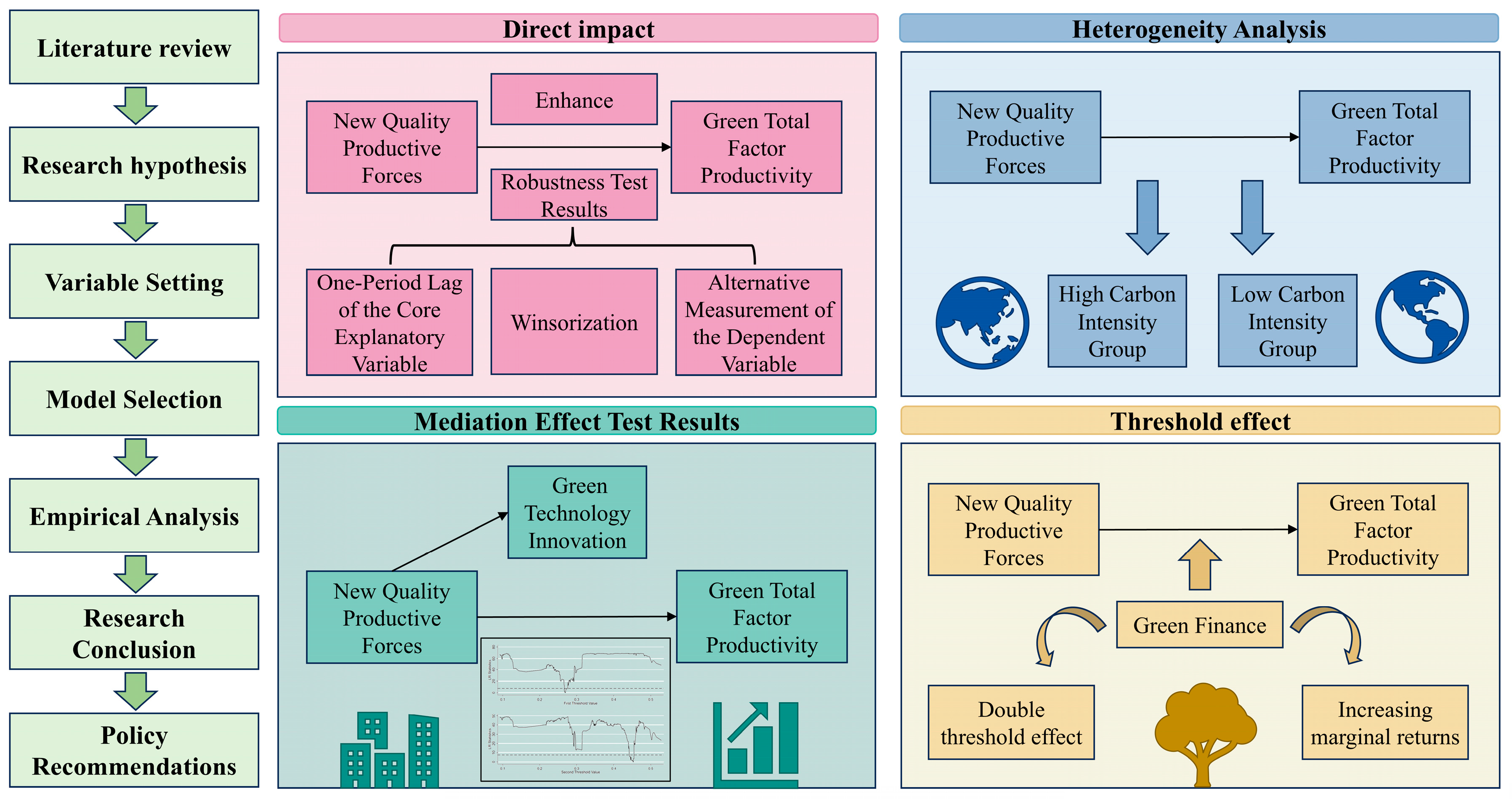
The overall research framework is shown in Figure 1, which outlines the logical progression from theoretical foundations to empirical verification. It clearly delineates the investigation of both direct effects and transmission mechanisms, including the mediating role of green technology innovation and the threshold effects associated with GFD, thereby providing a comprehensive roadmap for examining how NQPF contribute to the enhancement of GTFP.
Figure 1.
Graphical Summary. Note: The black dashed line in the figure represents the critical value of the likelihood ratio (LR) statistic at the 5% significance level.
3. Theoretical Framework and Hypotheses
3.1. The Direct Impact of NQPF on GTFP
The mechanism through which NQPF influence GTFP can be analyzed through the tripartite lens of Marxist productive forces theory: laborers, labor means, and objects of labor.
From the perspective of laborers, high-caliber workers, who serve as the core agents of NQPF, possess specialized knowledge, innovative capacity, and a consciousness for green production. These attributes enable them to drive technological R&D and process optimization. In practical operations, such laborers are more inclined to prioritize resource conservation and pollution control, often improving production processes to reduce energy consumption and waste discharge, thereby directly enhancing green production efficiency [5].
The means of labor under NQPF are characterized by informatization, digitalization, and intellectualization. These advanced means optimize production processes through technological penetration, achieving cost reduction, efficiency gains, energy savings, and emission reductions—all of which contribute to the improvement of GTFP. Furthermore, as these means continuously evolve and upgrade within the NQPF framework, they establish a cyclical mechanism of “technological innovation → efficiency leap,” steering production assets toward higher energy efficiency and providing dynamic technological support for green development.
The objects of labor within NQPF are expanding from traditional material inputs to immaterial elements like technology and data. These new factors of production optimize industrial chain collaboration, drive the low-carbon transition of traditional industries, and underpin the development of strategic emerging sectors like new energy, thereby laying the foundation for GTFP enhancement [14]. The diversification and upgrading of labor objects form a critical foundation for the green transformation of the economic system. In light of the theoretical analysis, the following research hypothesis is proposed:
H1.
NQPF significantly enhances GTFP.
3.2. The Mechanism Through Which NQPF Influence GTFP
NQPF serves as a robust underpinning for advancing green technology innovation. Green technology innovation includes technologies, processes, and products designed to protect the environment, conserve resources and energy, and reduce environmental pollution and damage [15]. The essential elements for such innovation, as established in the literature, include human capital, technology, and funding. NQPF anchored in scientific and technological innovation represents a qualitative leap in productive forces driven by disruptive technological advances, embodying a high level of technical superiority.
Through its highly efficient laborers, advanced means of labor, and high-quality objects of labor, NQPF utilizes digital technologies to optimize energy allocation and industrial design within production processes. This facilitates the replacement of high-carbon technologies and steers traditional industries from a factor-driven, high-carbon growth model towards an innovation-driven, low-carbon, and sustainable development path, thereby stimulating green technology innovation. Furthermore, NQPF commonly materializes in strategic emerging and future-oriented industries, which naturally aggregate significant S&T innovation resources. A core R&D priority within these sectors is green transition and green technology innovation [16]. Consequently, within this new development paradigm, NQPF is positioned to propel green technology innovation forward. The beneficial impact of such innovation on GTFP improvement is extensively substantiated in the literature [17,18,19,20]. Accordingly, we posit the following hypothesis:
H2.
NQPF enhance GTFP by promoting green technology innovation.
3.3. The Threshold Effect of New Quality Productive Forces on Green Total Factor Productivity
NQPF on GTFP may be moderated by external factors such as green finance. Green finance’s core function is to direct capital toward green sectors and bolster green technology innovation, thus facilitating economic greening via financial instruments [21,22,23]. Against this backdrop, in regions where green finance is still in its nascent stages of development, many green industries struggle to secure sufficient and effective financing, often facing financing constraints and significant operational pressures. This environment is not conducive to nurturing green technologies, consequently hindering substantial improvement in GTFP.
Conversely, in regions with a more mature green finance system, social capital can be effectively channeled from polluting industries into sectors such as environmental protection, energy conservation, and renewable energy. Furthermore, enterprises’ green technology innovation initiatives are more likely to receive support from green financial instruments, thereby accelerating the green transition of production modes. As NQPF inherently represent productive forces conducive to green development, a well-developed green finance environment provides more favorable conditions for their growth. Simultaneously, because green finance accelerates capital allocation toward green industries and green technology innovation, optimizing the distribution of production factors, NQPF’s effect on GTFP improvement grows more distinct and potent. Following this logic, we advance the subsequent hypothesis:
H3.
NQPF’s influence on GTFP demonstrates a threshold characteristic contingent upon GFD levels. As green finance advances, the influence of NQPF on GTFP transitions from being statistically insignificant to demonstrating increasing marginal effects.
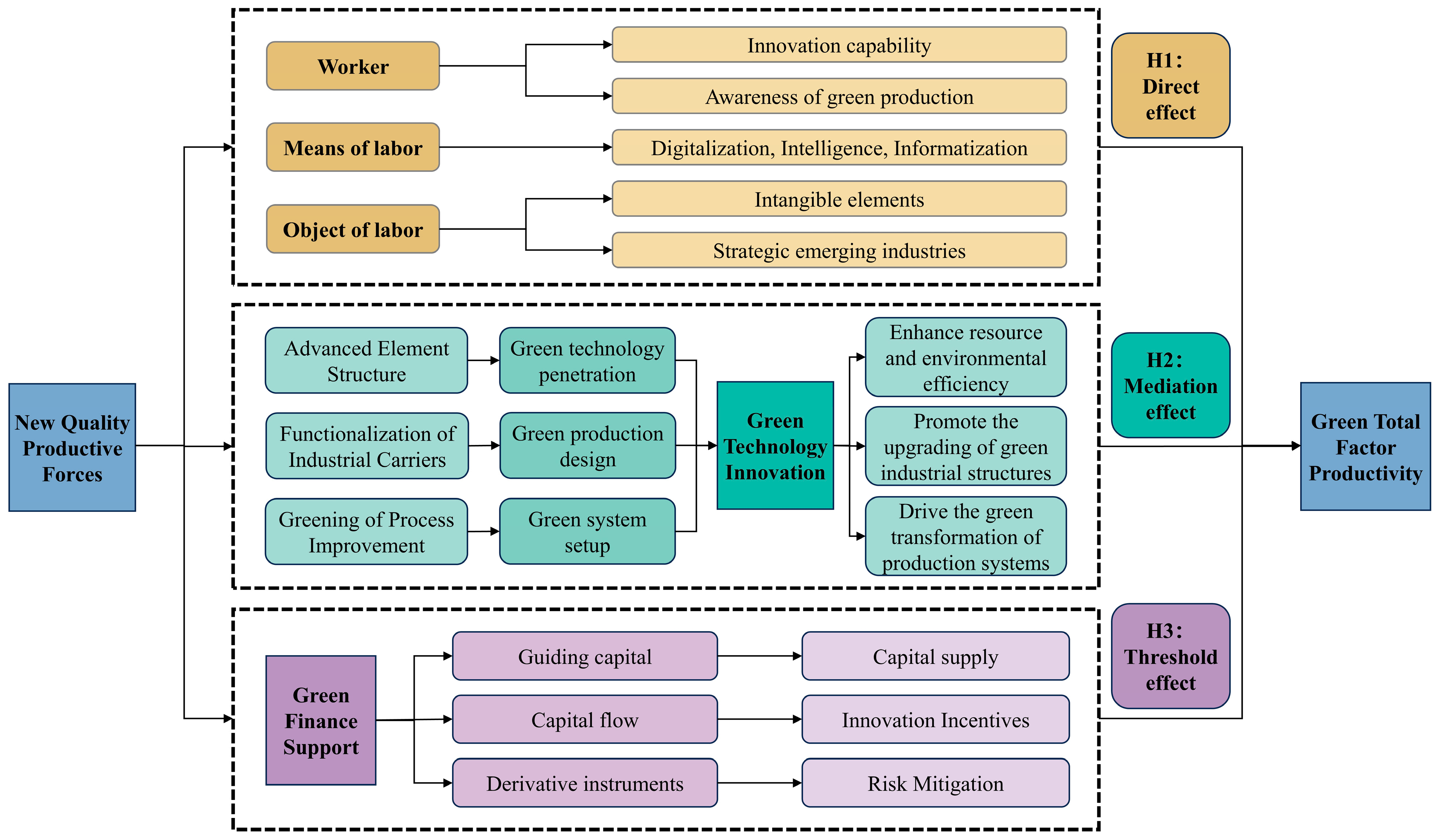
This paper constructs the research framework shown in Figure 2 to enhance the clarity and intuition of the theoretical relationships and research logic.
Figure 2.
Research Framework Diagram.
4. Model Specification and Data Description
4.1. Model Specification
To test Hypothesis 1 and examine the direct influence of NQPF on China’s GTFP, the regression model is established:
where i and t index province and year. GTFPit signifies the Green Total Factor Productivity level of province i in year t. NQPFit captures the NQPF development level in province i in year t. controlsit denotes a set of control variables. μi represents time-invariant province-specific effects; γt captures year-specific effects common to all provinces; εit is the error term.
To empirically assess Hypothesis 2 and investigate the mediating effect of green technology innovation in the link between NQPF and GTFP, this study follows the mediation effect testing procedure outlined by Jiang (2022) [24]. Specifically, conditional on a statistically significant relationship being established in Equation (1), we proceed to estimate and test the following set of models:
Among these, GTECit represents the mediating variable, green technology innovation. All remaining variable symbols retain the definitions provided in Equation (1).
To test Hypothesis 3, this research employs the panel threshold regression methodology developed by Hansen (1999) [25], constructing the following threshold model with green finance development level as the threshold variable:
The empirical specification takes the following form:
In the equation, GREit represents the threshold variable, specifically denoting the GFD level. The terms r1, …, rn correspond to different threshold values, while I(·) is an indicator function equaling 1 if the parenthetical condition holds and 0 otherwise.
4.2. Variable Selection and Measurement
4.2.1. Dependent Variable
The measurement of GTFP primarily relies on parametric and non-parametric methods. Stochastic Frontier Analysis (SFA), a common parametric approach, is contingent on the pre-specification of a production function, introducing a degree of subjectivity. In contrast, Data Envelopment Analysis (DEA) constructs a production frontier to evaluate efficiency without requiring an explicit functional form. However, conventional DEA models face limitations in handling undesirable outputs. Tone (2001) introduced the Slacks-Based Measure (SBM) model, integrating slack variables to properly accommodate undesirable outputs, thereby offering a more accurate representation of production efficiency [26]. To better estimate GTFP with multiple input and output indicators across different periods, this work applies the approach advanced by Yong and Shan [27] while incorporating the indicator selection approach from Yan and Zhao (2024) [28]. A super-efficient SBM-GML model that includes undesirable outputs is used to compute the global GML index, from which GTFP is derived through cumulative multiplication.
(i) Input Indicators
The input variables consist of labor, energy, and capital. Provincial labor input is quantified by the total employed population at year-end. Energy input is assessed through aggregate provincial energy consumption. Capital input is captured by real capital stock, which is estimated employing the Perpetual Inventory Method (PIM):
Here, K denotes the capital stock, δ is the depreciation rate, I represents the total investment in fixed assets, and P indicates the investment price index for fixed assets. Given the critical role of the base year in PIM estimation—where errors diminish with distance from the base year—this study sets the base year as 2000. Additionally, since the National Bureau of Statistics ceased publishing this price index after 2020, this paper substitutes the missing fixed asset investment price index with the regional GDP deflator. Following Shan (2008) [29], we set the annual capital depreciation rate at 9.6% and calculate the base-period initial capital stock by dividing the starting year’s real fixed-asset investment by the sum of this depreciation rate and the average annual provincial investment growth rate from 2011 to 2023.
(ii) Output Indicators
We distinguish between desirable and undesirable outputs. The former is the price-adjusted real gross regional product. The latter includes industrial wastewater discharge, industrial SO2 emissions, and general industrial solid waste generation.
4.2.2. Core Explanatory Variable
NQPF represent a relatively novel concept, and consequently, both its theoretical underpinnings and statistical measurement methodologies are still evolving. In the existing literature, the prevailing approach for quantifying NQPF involves constructing a comprehensive evaluation system using multiple indicators. However, a standardized or universally accepted measurement framework has not yet been established. Given the multifaceted nature of the NQPF concept, this study likewise employs a multi-dimensional indicator system to measure its development level.
Specifically, an NQPF evaluation system is built along three axes: workforce, objects of labor, and instruments of labor. This framework focuses specifically on the enhancement of laborer quality, the innovation of means of labor, and the expansion of objects of labor. The detailed selection of indicators is presented in Table 1, where “+” indicates a positive indicator and “−” indicates a negative indicator.
Table 1.
New Quality Productivity Assessment Indicator Framework.
All monetary indicators involved in the system were deflated using appropriate price indices to eliminate the impact of price changes. Subsequently, the data underwent normalization via the fixed-base range method to render them dimensionless. Finally, the entropy method was utilized to allocate weights to each indicator, ultimately yielding a composite metric for NQPF development level.
4.2.3. Mediating Variable
In this study, the level of green technology innovation (GTEC) is introduced as a key mediating variable and measured using two complementary indicators to enhance the robustness of the findings. The first indicator, “green patent applications per capita” (GTEC-PA), follows the approach of Cheng et al. [6] and employs patent application data to capture contemporaneous innovation output. The use of application counts rather than granted patents is motivated by the inherent time lag between patent filing and grant; relying solely on the number of granted patents could underestimate the actual level of innovative activity in a given year. Second, to further test the robustness of the results, we also introduce “green patents granted per capita” (GTEC-PG) as an alternative measure. By examining both application and grant dimensions, we can more comprehensively and robustly capture the actual level of green technology innovation and its policy implications.
4.2.4. Threshold Variable
The potential threshold variable examined is the level of GFD. Given the absence of a universally established standard for measuring GFD, this study constructs a comprehensive evaluation index system according to Guidelines for Establishing the Green Financial System issued by the People’s Bank of China and six other ministries, combined with evaluation indicators selected in prior research [30]. The system encompasses seven distinct dimensions, as detailed in Table 2.
Table 2.
Green Finance Evaluation Indicator System.
4.2.5. Control Variables
Given the multitude of factors influencing GTFP, and to alleviate potential omitted-variable bias, this research includes four control variables as follows:
① Government Intervention (GOV): Measured as the ratio of local government general budgetary expenditure to regional GDP.
② Foreign Direct Investment (FDI): Represented by the ratio of actually utilized foreign direct investment to regional GDP.
③ Digital Financial Inclusion (DIG): Measured using the Digital Financial Inclusion Index, co-developed by Peking University’s Institute of Digital Finance and Ant Group [31]. To mitigate scale-driven estimation bias arising from substantial differences in magnitude between this index and other variables, the original index values are divided by 100.
④ Environmental Regulation (ENV): It is calculated as the completed investment in industrial pollution control divided by the value added of the secondary sector.
4.3. Data Sources
Considering data availability, this study utilizes a panel dataset covering 30 provinces in China (excluding Tibet, Hong Kong, Macao, and Taiwan) in the period of 2021–2023. All data originate from official Chinese statistical publications, such as those released by the National Bureau of Statistics, including the China Statistical Yearbook, China Statistical Yearbook on Science and Technology, China Energy Statistical Yearbook, China Financial Yearbook and China Statistical Yearbook on Environment. Occasional gaps in the data were filled via interpolation. The descriptive statistics for every variable are summarized in Table 3.
Table 3.
Descriptive Statistics Summary.
5. Empirical Findings and Discussion
5.1. Baseline Regression
As panel data are utilized, a Hausman test was first carried out. The result, with a p-value of 0.0007 for the chi-squared statistic, rejects the null hypothesis, indicating the appropriateness of the fixed effects model. Columns (1)–(5) in Table 4 present the regression results examining the impact of NQPF on GTFP, with control variables introduced progressively. The estimated coefficients for NQPF remain positively signed and achieve statistical significance in every model specification, irrespective of whether control variables are added. This outcome is consistent with our theoretical expectations and offers empirical validation for Hypothesis 1.
Table 4.
Baseline Regression Results.
This beneficial impact can largely be ascribed to the inherent characteristics of NQPF, which is driven by technological innovation, informatization, and intellectualization. The technological advancements inherent to NQPF facilitate a shift away from traditional production models marked by intensive energy use and substantial emissions. This transition enhances resource utilization efficiency while mitigating negative environmental impacts, thereby ultimately elevating GTFP.
Among the control variables, some demonstrate statistically significant effects. The coefficient for Foreign Direct Investment (FDI) is significantly negative across multiple model specifications. This finding may correspond to the “Pollution Haven Hypothesis” proposed in the existing literature, suggesting that in certain periods or regions, inward FDI may concentrate in energy-intensive or high-emission industries or introduce relatively outdated technologies, thereby exerting a certain inhibiting effect on local GTFP [32]. Conversely, the coefficient for Environmental Regulation (ENV) is significantly positive, indicating that increased investment in industrial pollution control effectively promotes the improvement of GTFP. This is consistent with the “Porter Hypothesis,” contending that suitably designed environmental regulations could encourage enterprises to engage in green technology innovation and seek efficiency gains [33]. The directional effects of other control variables are generally consistent with prior research, collectively supporting the reasonableness of the model specification.
Given that Column (5), which includes the full set of controls, demonstrates the best model fit, it is designated as our baseline specification for the subsequent robustness checks and heterogeneity analysis.
5.2. Robustness Checks
To verify the stability of the main regression findings, this research performs multiple checks, such as applying a one-period lag to the key explanatory variable, trimming extreme data points, and adopting a different measure for the outcome variable.
5.2.1. One-Period Lag of the Core Explanatory Variable
Applying a one-period lag to the primary explanatory variable serves to alleviate possible endogeneity arising from reverse causality and more effectively captures the sustained influence of NQPF. The lagged NQPF continues to generate a statistically significant positive influence on GTFP at the 1% level, evident in the first column in Table 5. This finding not only corroborates the positive relationship identified in the baseline analysis but also suggests that the effect of NQPF on GTFP exhibits a degree of persistence.
Table 5.
Robustness Test Results.
5.2.2. Winsorization
To counteract the possible distortion caused by extreme values in the sample, all continuous variables were winsorized at both the 1st and 99th percentiles. The regression outcomes using this trimmed dataset are shown in Column (2) of Table 5. The persistently positive and significant coefficient for NQPF indicates that the central result is robust and not attributable to outlier influence.
5.2.3. Alternative Measurement of the Dependent Variable
Departing from the baseline measurement, an alternative GTFP measure (denoted as DGTFP) is constructed. First, to create a single composite measure, the entropy method is employed to integrate data on industrial wastewater discharge, industrial SO2 emissions, and general industrial solid waste. This composite indicator is then incorporated into the GTFP calculation. As evidenced in the third column in Table 5, NQPF’s estimated coefficient stays positive and reaches 1% statistical significance, thereby strengthening the validity of core findings.
5.2.4. Change the Measurement Method of Core Explanatory Variables
To test whether the research conclusions depend on specific measurement methods, this study reconstructs the core explanatory variable using the following two approaches and conducts robustness checks:
The principal component analysis (PCA) method is used to reconstruct the composite index of New Quality Productivity. This approach reduces dimensionality by extracting principal components with eigenvalues greater than one, retaining essential information while mitigating multicollinearity issues. After standardizing the indicators, PCA is performed, and an index (labeled PCA.NQPF) is constructed by weighting components according to their variance contribution rates. This index is then reintroduced into the baseline model for re-estimation.
To avoid conceptual overlap between NQPF and GTFP, all environment-related indicators are excluded when constructing the NQPF index for sensitivity analysis. Based on the streamlined indicator system, the entropy weight method is applied again to compute a new index (labeled EX.NQPF), followed by further regression analysis.
The results show that whether using PCA.NQPF or EX.NQPF, the impact of NQPF on GTFP remains significantly positive, with coefficient directions consistent with the baseline findings. This indicates that the core conclusions are robust across different measurement methods and do not rely on a specific index construction approach.
5.2.5. System GMM
To address endogeneity concerns and verify the robustness of the findings, we further employ the System GMM method for estimation. Following the standard approach for dynamic panel models, we use the first lags of the dependent variable (GTFP) and the lagged levels of the endogenous regressors (NQPF) as instruments in the difference equation, and the lagged differences as instruments in the level equation. The first lag of the dependent variable (L.GTFP) is utilized as an instrumental variable in the GMM regression. The sixth column in Table 5 demonstrates that after accounting for the long-term effects inherent in GTFP and mitigating endogeneity, the regression coefficient of NQPF on GTFP remains significantly positive at the 1% level. The model passes both the Arellano-Bond test for autocorrelation and the Hansen test for over-identification, confirming the validity of the instruments and the absence of serial correlation. Therefore, the positive promoting effect of NQPF on GTFP is robust, and the conclusions are not compromised by endogeneity issues.
5.2.6. Change the Depreciation Rate of Capital Stock
In the baseline regression, this study adopts a fixed depreciation rate (δ = 9.6%) commonly used in the literature to estimate capital stock. To examine the sensitivity of the core findings to this parameter setting, we further re-estimate the capital stock using two different depreciation rates, 5% and 10%, and re-run the regression analysis. As shown in Columns (7) and (8) of Table 5, under different depreciation rate assumptions, the promoting effect of NQPF on GTFP remains positive and significant, with no substantial changes in the coefficient magnitude or statistical significance. This indicates that the research conclusions of this paper are not sensitive to the setting of the capital depreciation rate and demonstrate good robustness.
5.3. Heterogeneity Analysis
Owing to considerable inter-regional differences in China’s industrial composition, energy-use efficiency, and carbon emission profiles, the developmental stages of both NQPF and GTFP are expected to differ markedly. This variation may, in turn, lead to differences in the relationship between NQPF and GTFP across regions. To investigate this potential heterogeneity, the sample is partitioned into high- and low-carbon-intensity subgroups according to the median provincial carbon emission intensity. A grouped regression analysis is subsequently performed in Table 6.
Table 6.
Heterogeneity Analysis Results.
Table 6 displays NQPF’s significantly positive influence on GTFP in regions with lower carbon intensity. In contrast, no significant effect is observed in high carbon intensity regions. This divergence might stem from the stronger enforcement of environmental and sustainable development policies in low carbon intensity regions. Well-designed policy incentives in these areas effectively guide enterprises to adopt green technologies and operational practices. Consequently, these regions typically possess more advanced technological foundations and cleaner industrial structures, enabling NQPF to be integrated into production processes more rapidly, optimize resource allocation, and thereby enhance GTFP.
In contrast, high carbon intensity regions often face structural inertia and economic dependence on traditional industries. The effectiveness of green policies may be constrained in these contexts, as these regions remain dominated by energy-intensive, high-emission traditional sectors and face substantial pressure for industrial transformation. Consequently, NQPF may struggle to significantly alter the established production paradigms in the short term, resulting in its limited observed impact on GTFP in these areas.
5.4. Mediation Effects
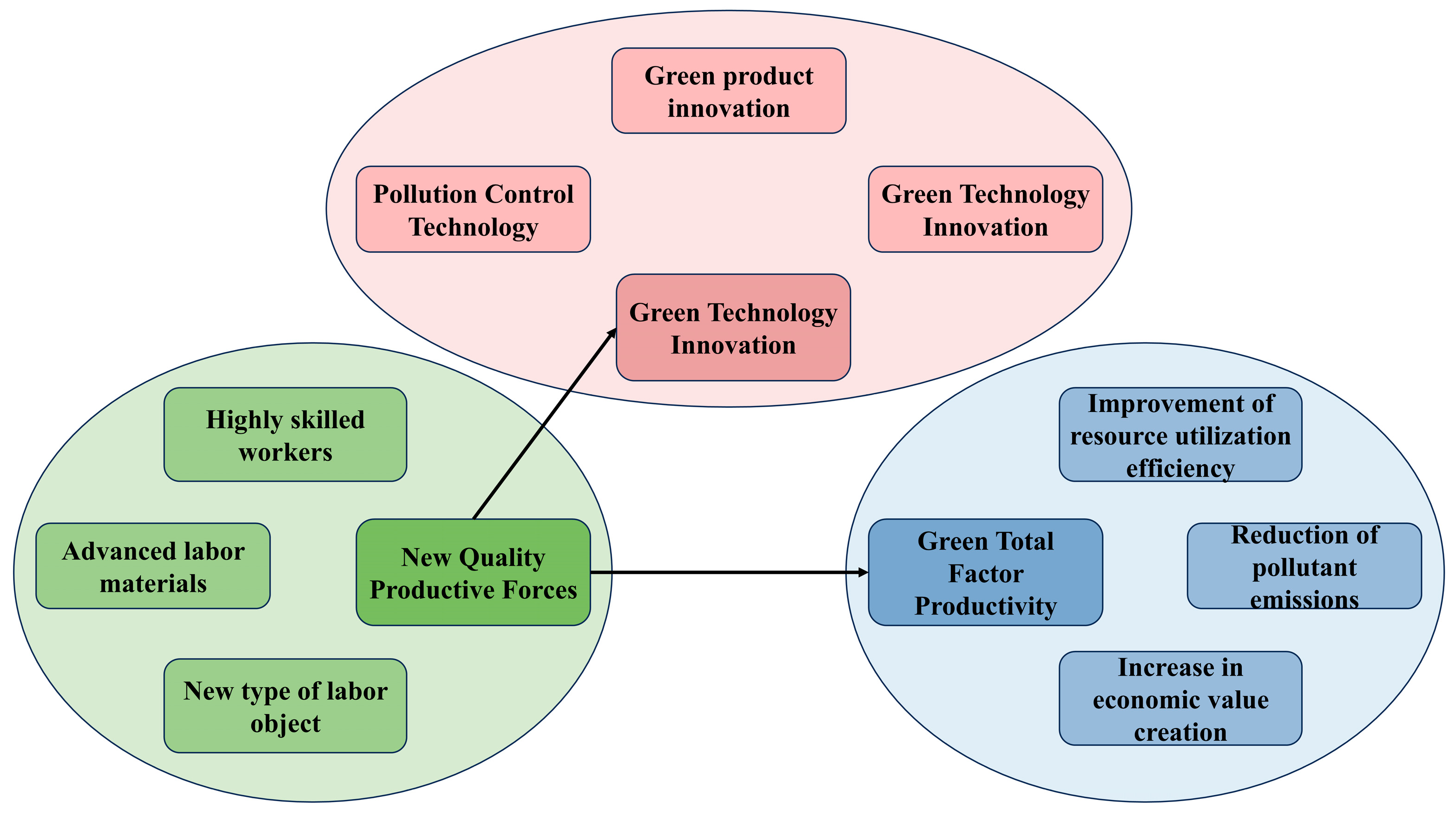
To further investigate the transmission mechanism through which NQPF enhance GTFP, this study develops a mediation effect model, as presented in Figure 3.
Figure 3.
Mediation Effect Theory Analysis Diagram.
The baseline regression outputs confirm that NQPF exert a significant positive impact on GTFP. Furthermore, our theoretical analysis posits that green technology innovation serves as a potential channel through which NQPF influences GTFP. To empirically examine this mechanism, we employ the two-step procedure proposed by Jiang (2022) [24]. Table 7 presents the mediation test outputs.
Table 7.
Mediation Effect Test Results.
As shown in Table 7, the results in Column (1) are consistent with the baseline regression, indicating a statistically significant positive effect of NQPF on GTFP. Building on this, this study further examines the mediation effect using GTEC-PA and GTEC-PG as two alternative measures of green technology innovation. Column (2) shows that NQPF has a significant positive impact on GTEC-PA, while Column (4) demonstrates that NQPF also exerts a significant positive influence on GTEC-PG. This suggests that NQPF can effectively enhance the level of green technology innovation.
To verify the robustness of the mediation effect, this study employs the bootstrap method for further testing. Based on 1000 replications, Table 7 reports the 95% confidence intervals for the indirect effects under both measurement approaches, none of which includes zero, confirming the significance of the mediation effect of green technology innovation. Specifically, when GTEC-PA is used as the mediator, the total effect of the core explanatory variable on the dependent variable is 1.5648, with an indirect effect of 0.5797 transmitted through green technology innovation, accounting for 37.04% of the total effect. Results based on GTEC-PG also support a similar mediation channel. This indicates that green technology innovation serves as an important transmission mechanism through which the core explanatory variable affects the dependent variable, and its mediating role carries substantial economic significance. Thus, the second hypothesis of this paper is supported.
5.5. Threshold Effects
The preceding analysis demonstrates that cultivating NQPF can significantly enhance GTFP. A pertinent question, however, is whether this causal effect is subject to conditioning by other factors. As suggested by Hypothesis 3, the level of GFD represents a potentially significant threshold variable. We proceed to empirically test this possibility.
First, we employ the bootstrap method developed by Hansen (1999) [25] to test for the existence of a threshold effect using the GFD level as the threshold variable. The findings, displayed in Table 8, demonstrate that the specification employing green finance as the threshold variable satisfactorily meets the criteria for a double-threshold effect.
Table 8.
Threshold Existence Test.
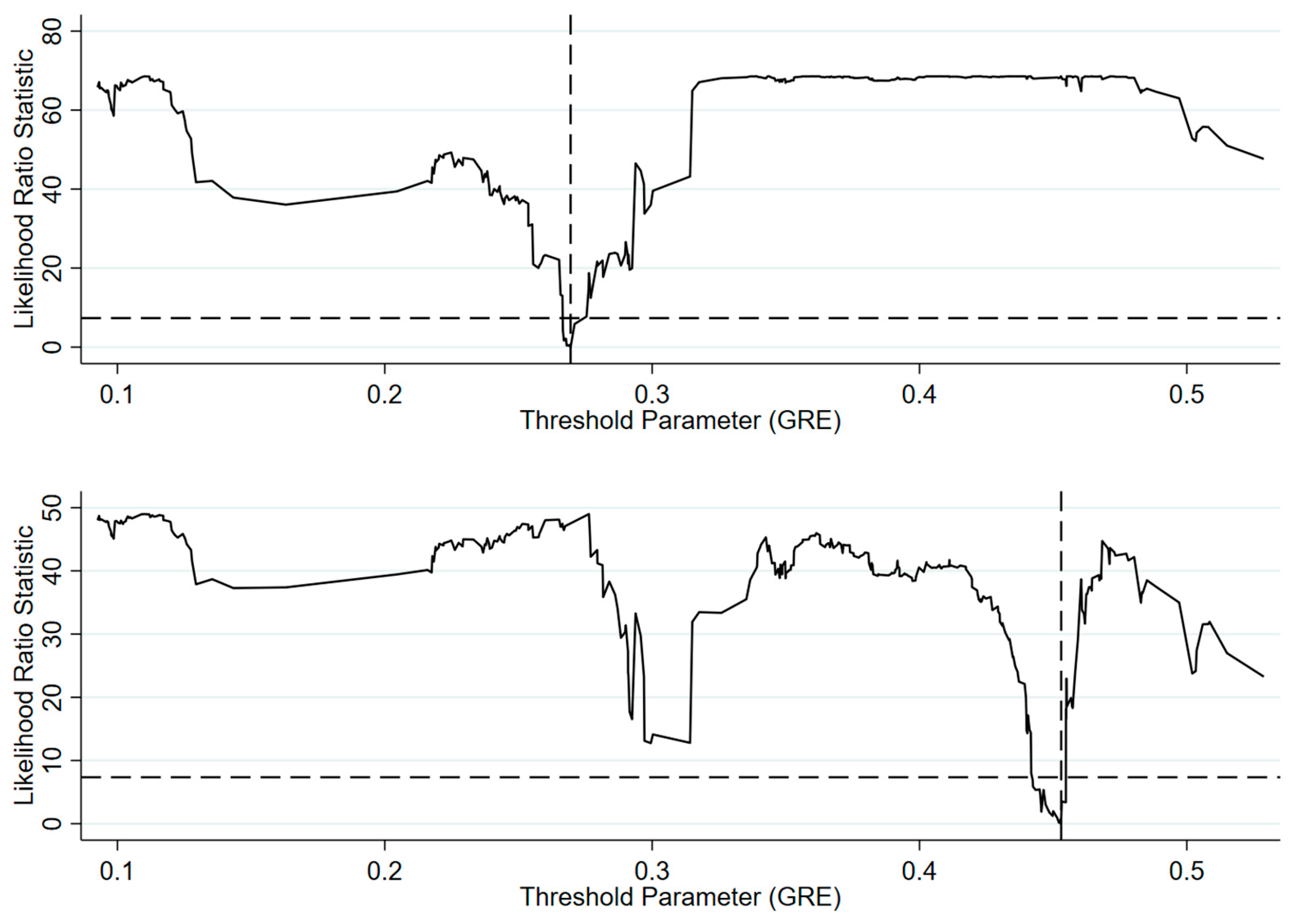
In Table 9, the two estimated threshold values for the GFD level are 0.2695 and 0.4530, respectively. Figure 4 additionally graphs the likelihood ratio (LR) function for the dual-threshold model, with the dashed line marking the 95% confidence critical value. The outcomes reveal that the LR statistics corresponding to both threshold estimates lie beneath this critical line, affirming that the identified thresholds possess statistical significance and validity.
Table 9.
Threshold Estimate.
Figure 4.
Likelihood Ratio Function Plot of Dual Threshold Values for Green Finance Development Level. Note: The black dashed line in the figure represents the critical value of the likelihood ratio (LR) statistic at the 5% significance level.
The threshold regression results are displayed in Table 10. When the GFD level is at or below the first threshold value of 0.2695, NQPF’s impact on GTFP is not statistically significant. However, when the GFD level surpasses the first threshold but remains below the second threshold (i.e., within the interval [0.2695, 0.4530)), NQPF begins to exert a significant positive influence on GTFP, significant at the 1% level. To be specific, a one-standard-deviation increase (0.110) in NQPF leads to a 0.239 percentage-point rise in GTFP (=2.169 × 0.110). Furthermore, as the GFD level continues to increase and surpasses the second threshold of 0.4530, the significant positive impact of NQPF on GTFP persists. In this high regime, a one-standard-deviation increase (0.110) in NQPF results in a 0.315 percentage-point increase in GTFP (=2.860 × 0.110), indicating a pattern of increasing marginal effects. Therefore, Hypothesis 3 is supported.
Table 10.
Threshold Regression Results.
A plausible explanation for these findings is as follows. When GFD is at a low level, green industries within the region face challenges in obtaining adequate and targeted financial support, leading to binding financing constraints. This not only intensifies operational pressures for relevant enterprises but also hinders the cultivation of green technologies. Consequently, NQPF fails to demonstrate a significant effect on GTFP at this stage.
As the development of green finance improves, more capital is directed toward green, environmentally friendly, and sustainable projects. This enhances resource allocation and boosts investment in green technologies, thereby driving green technological innovation. Given that NQPF itself is inherently oriented toward technological innovation and green advancement—often termed “green productive forces”—its sustained development is effectively supported by a more developed green finance system. This synergy ultimately leads to higher GTFP.
With further advancement in GFD, the interaction between green finance and NQPF may enter a phase characterized by the superposition of scale effects and structural effects. This phase facilitates the transition of NQPF from mere technological breakthroughs to systematic industrial upgrading, promotes the formation of green industrial clusters, and amplifies technological spillovers. As a result, the impact of NQPF on GTFP exhibits the characteristic of continuously increasing marginal effects.
An analysis of the sample data from 2023 reveals distinct regional patterns in the development of green finance. Five provinces, all located in Western China (namely Inner Mongolia, Yunnan, Qinghai, Ningxia, and Xinjiang), had not yet surpassed the first threshold value. Nine provinces were positioned between the first and second thresholds, comprising two from Eastern China (Tianjin, Hainan), four from Central China (Shanxi, Anhui, Jiangxi, Henan), two from Western China (Chongqing, Sichuan), and one from Northeast China (Jilin). Sixteen provinces had crossed the second threshold, including eight from Eastern China (Beijing, Hebei, Shanghai, Jiangsu, Zhejiang, Fujian, Shandong, Guangdong), two from Central China (Hubei, Hunan), four from Western China (Guangxi, Guizhou, Shaanxi, Gansu), and two from Northeast China (Liaoning, Heilongjiang). This distribution indicates that all provinces in the Eastern, Central, and Northeast regions have surpassed the first threshold. Notably, the majority of provinces in the Eastern and Northeast regions have crossed the second threshold, whereas nearly half of the provinces in Western China remain below the first threshold of GFD.
Following the empirical tests conducted, including benchmark regression, robustness tests, mechanism identification, and threshold effect analysis, all three research hypotheses proposed in this study have been fully validated. To clearly present the correspondence between the empirical results and the research hypotheses, the hypothesis validation outcomes are summarized in Table 11.
Table 11.
Research Hypothesis Verification Outcomes.
The results indicate that NQPF not only directly and robustly enhance GTFP but also exert an indirect promotional effect through the key pathway of incentivizing green technological innovation. Furthermore, the effectiveness of this promotional role significantly depends on the supportive environment provided by the regional level of GFD and exhibits a dynamic characteristic of increasing marginal effects as this level improves.

6. Conclusions and Policy Recommendations
6.1. Conclusions
Enhancing green development and fostering harmonious coexistence between humanity and nature has become a widespread global consensus and an urgent imperative. China is actively pursuing its “Dual Carbon” goals, leveraging them to steer a comprehensive green transformation of its economy and society. Within this historic context, accurately assessing the effectiveness of green, high-quality economic development is crucial. This study first theorized the potential and intrinsic logic of cultivating NQPF to drive this transition. This study empirically examines the relationship between NQPF and GTFP in China through a three-step approach: first, developing a provincial NQPF evaluation index system; second, measuring GTFP with the Super-SBM-GML model; and finally, conducting analysis using a two-way fixed effects model. The key findings are as follows:
Firstly, NQPF exerts a statistically significant positive effect on GTFP, a result that persists across a battery of robustness examinations. Second, the promoting effect of NQPF on GTFP currently exhibits heterogeneity: it has a positive impact in regions with low carbon intensity, but its effect is not yet statistically significant in regions with high carbon intensity. Third, green technology innovation serves as a significant mediating channel; NQPF boosts GTFP partly by strengthening green technology innovation. Fourth, the relationship between NQPF and GTFP displays a dual-threshold pattern contingent on the degree of GFD. As green finance develops, the influence of NQPF on GTFP transitions from being statistically insignificant to demonstrating increasing marginal effects.
The findings of this study engage in dialogue with and extend the scholarly perspectives discussed in the literature review. First, this paper confirms NQPF’s positive impact on green development, which is in line with the conclusions of Kong et al. (2025) regarding its role in promoting green development and ecological resilience [7]. More importantly, this study deepens the discussion to the core level of “green efficiency” by empirically testing the direct enhancement effect of NQPF on GTFP. This responds to the assertion by Huang and Hu (2025) that NQPF are essentially green productivity and supplies empirical corroboration using provincial-level panel data [13]. Second, this research reveals the critical mediating role of green technology innovation. This mechanism echoes the research of Liu and Jiao (2025) on the mediating effect of green technology innovation while extending the research context from industrial chain modernization to the more comprehensive process of improving GTFP [34]. Finally, the green finance threshold effect identified in this study enriches the research on the contextual conditions for the green efficacy of NQPF, indicating that its impact is nonlinear and dependent on the greening level of the financial system. This provides new empirical evidence for understanding the synergistic relationship between NQPF and green finance.
While this study has yielded some findings, it still has certain limitations. Future research could extend the inquiry along several lines. Firstly, regarding data, this study employs provincial-level panel data for macro-level analysis and thus fails to uncover the specific mechanisms at the micro-level of firms. Future work could integrate firm-level data to delve into how the elements of NQPF permeate enterprises and drive their green production practices and innovation activities. Second, in terms of measurement methods, NQPF is a dynamically rich concept. While the indicator system developed in this study is grounded in theoretical considerations, there may still be dimensions that have not been captured. Future research could explore incorporating emerging methods such as big data and text analysis to develop a more real-time and precise measurement system. This study adopts a standard econometric framework to examine the direct impact of NQPF on GTFP and uncover its underlying mechanisms. Future research could proceed along the following lines: on the one hand, by incorporating spatial econometric analysis to examine regional spillover effects; on the other hand, by employing techniques like machine learning to reveal intricate nonlinear dynamics between variables. Finally, regarding the research context, the inferences drawn in this analysis are chiefly derived from the context of China as an economy undergoing transition. Their generalizability requires testing in economies with different institutional backgrounds and development stages. Future cross-country comparative studies will help identify the common patterns and contextual differences in how NQPF drive green development.
6.2. Policy Implications
Drawing on the empirical evidence obtained, this research puts forward the subsequent policy suggestions:
6.2.1. Regionally Differentiated Policy Design Based on Carbon Intensity Heterogeneity
Given the significant difference in the promoting effect of NQPF on GTFP between low-carbon and high-carbon intensity regions, a homogeneous policy supply model should be abandoned in favor of a classified-guidance and targeted-intervention approach.
For low-carbon intensity regions (such as most coastal provinces in eastern China), where industrial structures are relatively clean and technological foundations are solid, the policy focus should center on “deepening and upgrading” and “radiation and diffusion.” Efforts should be undertaken to foster the profound integration of digital technologies, intelligent technology, and green infrastructure, to strategically deploy R&D in forward-looking green technologies, and to expand the innovative application of data elements in scenarios such as energy conservation, emission reduction, and circular economy. These measures will strengthen these regions’ role in demonstrating and exporting capabilities for the nationwide green transition.
For high-carbon intensity regions (such as some resource-dependent provinces in central and western China), where industrial inertia and path dependence hinder the penetration of NQPF, policies should emphasize “structural transformation” and “foundation cultivation.” Through targeted policy instruments such as fiscal subsidies and tax incentives, support should be provided for green technological retrofitting and equipment upgrading in traditional high-carbon industries, so as to resolve distortions in factor allocation. Additionally, in line with local resource endowments, strategic emerging industries such as new energy and environmental protection should be purposefully nurtured to build a suitable industrial ecosystem for the rooting and growth of NQPF.
6.2.2. Strengthening Comprehensive Policy Backing for the Mediating Role of Green Technology Innovation
To consolidate and amplify the mediating channel through which NQPF influence GTFP via green technology innovation, comprehensive, whole-chain systemic support must be implemented.
At the front-end R&D stage, the proportion of additional deductions for corporate R&D expenditures on green technologies should be increased, and innovation venture capital funds should be established to reduce the R&D risks associated with green technologies and applicable energy-saving technologies.
At the mid-stage transformation stage, specialized green technology trading markets and transfer institutions should be established, and a technology transfer brokerage system should be strengthened to overcome the “lab-to-production” conversion bottleneck.
At the back-end market stage, a “Green Technology Promotion Catalog” should be formulated to create stable market demand through government procurement and green standard regulations, accelerate the industrial application of green technologies, and solidify the terminal support for the mediation and transmission mechanism.
6.2.3. Building a Phased and Multi-Level Financial Support Framework Corresponding to the Green Finance Threshold Effect
Based on the empirical findings regarding the dual-threshold effect of green finance, a hierarchical financial support policy tailored to regions at different developmental stages should be implemented to optimize the environment for realizing the green efficacy of NQPF.
For regions where GFD has not yet crossed the first threshold, the policy priority lies in breaking initial financing constraints. Special policy-oriented green-credit funds and risk-sharing mechanisms should be established to guide financial institutions toward achieving “inclusive coverage” of green sectors.
For regions situated between the dual thresholds, the focus should be on improving market mechanisms and expanding supply. Diversified direct financing instruments such as green bonds and green funds should be promoted, and a standardized, transparent platform for green project certification and information disclosure should be established.
For developed regions that have already crossed the second threshold, efforts should be directed toward market deepening and ecosystem development. Environmental-rights trading markets, including those for carbon emission rights and energy-use rights, should be further refined, and the deep integration of green finance with fintech should be actively advanced.
Author Contributions
Conceptualization, H.C.; methodology, H.C.; software, Z.W. and H.C.; validation, Z.W. and H.C.; formal analysis, Z.W. and H.C.; investigation, Z.W. and H.C.; resources, Z.W. and H.C.; data curation, X.Z. and H.C.; writing—original draft preparation, Z.W. and H.C.; writing—review and editing, X.Z. and H.C.; visualization, Z.W. and H.C.; supervision, Z.W. and H.C.; project administration, Z.W. and H.C.; funding acquisition, H.C. All authors have read and agreed to the published version of the manuscript.
Funding
This study was funded by Humanities and Social Science Research Project of Hebei Education Department, grant number BJ2025298 and “The APC was funded by Humanities and Social Science Research Project of Hebei Education Department”.
Institutional Review Board Statement
Not applicable.
Informed Consent Statement
Not applicable.
Data Availability Statement
Data are contained within the article.
Conflicts of Interest
The authors declare no conflicts of interest.
References
- Ren, B.P.; Wang, Z.Y. The Strategic Focus, Task and Path of Chinese-style Modernization Advanced by the New Quality Productivity. J. Xi’an Univ. Financ. Econ. 2024, 1, 3–11. [Google Scholar] [CrossRef]
- Zhang, L.; Pu, Q.P. The connotation characteristic, theoretical innovation and value implication of new quality productivity. J. Chongqing Univ. (Soc. Sci. Ed.) 2023, 29, 137–148. [Google Scholar] [CrossRef]
- Pu, Q.P.; Xiang, W. New Quality Productivity and Its Utilizations—New Driving Force for Chinese Modernization. J. Xinjiang Norm. Univ. (Philos. Soc. Sci. Ed.) 2024, 45, 77–85. [Google Scholar] [CrossRef]
- Yang, Y.; Guo, J.Q.; Wang, S.G. New Quality Productive Forces, Entrepreneurial Activity and High-Quality Urban Development. Sci. Technol. Prog. Policy 2024, 41, 1–12. [Google Scholar] [CrossRef]
- Wang, Q.; Chen, X. Can new quality productive forces promote inclusive green growth: Evidence from China. Front. Environ. Sci. 2024, 12, 1499756. [Google Scholar] [CrossRef]
- Cheng, K.; Yin, J.; Wang, F.; Wang, M. The impact pathway of new quality productive forces on regional green technology innovation: A spatial mediation effect based on intellectual property protection. PLoS ONE 2025, 20, e0319838. [Google Scholar] [CrossRef]
- Kong, S.X.; Zhang, C.T.; Zhang, M.R.; Lu, W.X. Heterogeneity analysis of the effects of new quality productive forces on ecological resilience in the Yangtze River Delta Economic Belt. Sci. Rep. 2025, 15, 20563. [Google Scholar] [CrossRef]
- Liu, X.; Sun, F.; Li, Y. The impact of new quality productive forces on urban carbon emission performance in the Yangtze river economic belt of China. Sci. Rep. 2026. [Google Scholar] [CrossRef]
- Zhou, Q.J.; Sun, J.M.; Ran, L.J.; Qu, Y.H. Impact of environmental performance on intelligent transformation in Chinese manufacturing enterprises. Sci. Rep. 2025, 15, 33337. [Google Scholar] [CrossRef]
- Hu, Y.; Jia, X. Empowering the Intelligent Transformation of the Manufacturing Sector Through New Quality Productive Forces: Value Implications, Theoretical Analysis, and Empirical Examination. Sustainability 2025, 17, 7006. [Google Scholar] [CrossRef]
- Wu, C. Studies on How New Quality Productivity Drives High-Quality Development of Enterprises. Adv. Econ. Manag. Political Sci. 2024, 94, 221–228. [Google Scholar] [CrossRef]
- Cui, J.; Du, D. New quality productive forces, urban-rural integration and industrial chain resilience. Int. Rev. Econ. Financ. 2025, 102, 104245. [Google Scholar] [CrossRef]
- Huang, X.; Hu, A.G. The Understanding Dimension of Green Productivity, China′s Innovation and Practice Prospect—Also on the New Quality Productivity Itself is Green Productivity. J. Beijing Univ. Technol. (Soc. Sci. Ed.) 2025, 25, 56–67. [Google Scholar] [CrossRef]
- Zou, C.; Li, S.; Xiong, B.; Liu, H.; Zhang, G.; Yang, Z.; Pan, S.; Wu, S.; Guan, C.; Li, T. Status and role of emerging industries of new energy in promoting new quality productive forces. Acta Pet. Sin. 2024, 45, 889–899. [Google Scholar] [CrossRef]
- Hellström, T. Dimensions of environmentally sustainable innovation: The structure of eco-innovation concepts. Sustain. Dev. 2007, 15, 148–159. [Google Scholar] [CrossRef]
- Zhang, X.; Luo, W.; Xiang, D. Strategic emerging industries and innovation: Evidence from China. Int. Rev. Econ. Financ. 2025, 98, 103858. [Google Scholar] [CrossRef]
- Wang, H.; Cui, H.; Zhao, Q. Effect of green technology innovation on green total factor productivity in China: Evidence from spatial durbin model analysis. J. Clean. Prod. 2021, 288, 125624. [Google Scholar] [CrossRef]
- Ma, Y.; Lin, T.; Xiao, Q. The relationship between environmental regulation, green-technology innovation and green total-factor productivity—Evidence from 279 cities in China. Int. J. Environ. Res. Public Health 2022, 19, 16290. [Google Scholar] [CrossRef]
- Wu, J.; Xia, Q.; Li, Z. Green innovation and enterprise green total factor productivity at a micro level: A perspective of technical distance. J. Clean. Prod. 2022, 344, 131070. [Google Scholar] [CrossRef]
- Fan, M.; Yang, P.; Li, Q. Impact of environmental regulation on green total factor productivity: A new perspective of green technological innovation. Environ. Sci. Pollut. Res. 2022, 29, 53785–53800. [Google Scholar] [CrossRef]
- Hu, M.; Sima, Z.; Chen, S.; Huang, M. Does green finance promote low-carbon economic transition? J. Clean. Prod. 2023, 427, 139231. [Google Scholar] [CrossRef]
- Wang, S.; Shu, W.; Cui, L. Green finance policy and green economic transformation. Int. Rev. Financ. Anal. 2024, 96, 103785. [Google Scholar] [CrossRef]
- Lee, J.W. Green finance and sustainable development goals: The case of China. J. Asian Financ. Econ. Bus. 2020, 7, 577–586. [Google Scholar] [CrossRef]
- Jiang, T. Mediating Effects and Moderating Effects in Causal Inference. China’s Ind. Econ. 2022, 5, r120. [Google Scholar] [CrossRef]
- Hansen, B.E. Threshold effects in non-dynamic panels: Estimation, testing, and inference. J. Econom. 1999, 93, 345–368. [Google Scholar] [CrossRef]
- Tone, K. A slacks-based measure of efficiency in data envelopment analysis. Eur. J. Oper. Res. 2001, 130, 498–509. [Google Scholar] [CrossRef]
- Yong, Z.; Shan, L. Smart city construction, entrepreneurial vitality and high-quality economic development: Analysis based on the GTFP perspective. J. Financ. Econ. 2022, 48, 4–18. [Google Scholar] [CrossRef]
- Yan, F.; Zhao, X.Y. Does Intelligent Manufacturing Promote Green Total Factor Productivity of Enterprises?—Research Based on Intelligent Manufacturing Demonstration Site Enterprises. Commer. Res. 2024, 3, 41–49. [Google Scholar] [CrossRef]
- Shan, H.J. Reestimating the Capital Stock of China: 1952–2006. J. Quant. Tech. Econ. 2008, 25, 17–31. [Google Scholar] [CrossRef]
- Fan, Z.; Qin, Z.; Yu, S. Impact of extreme temperature on the resilience of grain production: Perspectives on green finance. Chin. J. Eco-Agric. 2024, 32, 896–910. [Google Scholar] [CrossRef]
- Guo, F.; Wang, J.Y.; Wang, F.; Kong, T.; Zhang, X.; Cheng, Z.Y. Measuring China’s Digital Financial Inclusion: Index Compilation and Spatial Characteristics. China Econ. Q. 2020, 19, 1401–1418. [Google Scholar] [CrossRef]
- Zhang, Y. Analysis of China’s energy efficiency and influencing factors under carbon peaking and carbon neutrality goals. J. Clean. Prod. 2022, 370, 133604. [Google Scholar] [CrossRef]
- Porter, M.E.; Linde, C. Toward a new conception of the environment-competitiveness relationship. J. Econ. Perspect. 1995, 9, 97–118. [Google Scholar] [CrossRef]
- Liu, J.; Jiao, F. New-Quality Productive Forces, Green Technological Innovation and Modernization of the Industrial Chain. Sustainability 2025, 17, 10013. [Google Scholar] [CrossRef]
Disclaimer/Publisher’s Note: The statements, opinions and data contained in all publications are solely those of the individual author(s) and contributor(s) and not of MDPI and/or the editor(s). MDPI and/or the editor(s) disclaim responsibility for any injury to people or property resulting from any ideas, methods, instructions or products referred to in the content. |
© 2026 by the authors. Licensee MDPI, Basel, Switzerland. This article is an open access article distributed under the terms and conditions of the Creative Commons Attribution (CC BY) license.