1. Introduction
Saudi Arabia’s financial system, one of the largest in the Middle East, has remained relatively stable during recent episodes of global turbulence, including the COVID-19 pandemic and the 2020 oil price shock, owing to prudent regulation and substantial capital buffers [
1]. The Saudi Arabian Monetary Authority (SAMA) has implemented Basel III standards, diversified its supervisory approach, and promoted stress-testing practices aligned with G20 guidelines [
2]. However, the increasing integration with global financial markets and the ongoing diversification of the Saudi economy under Vision 2030 have created new channels for systemic risk, including exposure to oil price volatility, foreign exchange fluctuations, and cross-border capital flows [
3].
The global financial system has undergone a profound transformation since the 2008 Global Financial Crisis (GFC). The crisis revealed how interconnectedness between banks, capital markets, and the real economy could amplify localized shocks into system-wide crises [
4,
5]. Traditional risk management tools, centered on micro prudential supervision, proved inadequate for identifying and mitigating these spillovers. In response, regulators introduced macroprudential frameworks that emphasize system-wide resilience rather than the health of individual institutions [
6,
7].
Macro stress testing (MST) has therefore become an indispensable tool for regulators and policymakers in Saudi Arabia. Unlike micro stress tests, which evaluate the resilience of individual institutions, MST captures feedback effects and contagion mechanisms across the financial system [
8]. It provides forward-looking assessments of how adverse macroeconomic scenarios, such as a sharp decline in GDP growth, rising unemployment, or exchange rate pressure, might affect banks’ capital adequacy and liquidity positions [
9]. For emerging economies, these tests serve an additional policy purpose, identifying macro-financial linkages that may amplify domestic vulnerabilities during external shocks [
10].
The importance of such frameworks is underscored by the Saudi banking sector’s rapid credit growth from 2010 to 2025, as well as its increasing exposure to real estate, consumer, and corporate loans [
1]. The interaction between fiscal expansion, oil market cycles, and monetary policy transmission channels implies that systemic stress in Saudi Arabia could arise from both domestic and external sources [
11]. Therefore, a comprehensive macro stress-testing framework tailored to the Kingdom’s economic structure and data realities is essential for forward-looking financial stability surveillance.
This study contributes to the literature by developing an evidence-based MST framework customized for Saudi Arabia’s financial sector between 2010 and 2025. It models the probability of default (PD) of banks as a function of key macroeconomic variables such as GDP growth, inflation, unemployment, government debt, exchange rate, and economic growth to capture the complex macro-financial linkages observed in emerging markets. The analysis builds upon the methodology used in the Malaysia-wide stress test (MAST) conducted by [
12]. It adapts to the Saudi context, where oil-linked revenues and fiscal buffers play a central role in credit dynamics.
By focusing on systemic vulnerabilities and potential capital shortfalls, the study offers insights into the resilience of the Saudi banking sector. It contributes to the broader discourse on macroprudential policy design in the GCC. It seeks to answer three core questions:
- (1)
How do macroeconomic shocks translate into banking sector vulnerabilities in Saudi Arabia?
- (2)
Which macro-financial variables most significantly influence credit risk and capital adequacy?
- (3)
What policy insights can be drawn for SAMA and other GCC regulators to enhance financial stability under Vision 2030?
In this way, the research not only fills a literature gap on systemic risk assessment in the Kingdom but also provides a comparative perspective for emerging market economies facing similar challenges in financial deepening and regulatory modernization.
3. Methodology
The methodological framework for this study integrates both conceptual and empirical components of macro stress testing (MST), drawing upon established practices of the International Monetary Fund [
7], the Bank for International Settlements [
25], and comparable studies in emerging markets [
10,
12]. The goal is to design a Top-Down (TD) model that quantifies the resilience of Saudi Arabia’s banking sector under severe but plausible macroeconomic shocks between 2010 and 2025.
The TD approach is chosen because it allows consistent, system-level assessment using aggregated supervisory and macroeconomic data, reducing dependence on bank-specific internal models while maintaining analytical rigor [
26].
3.1. Overall Framework
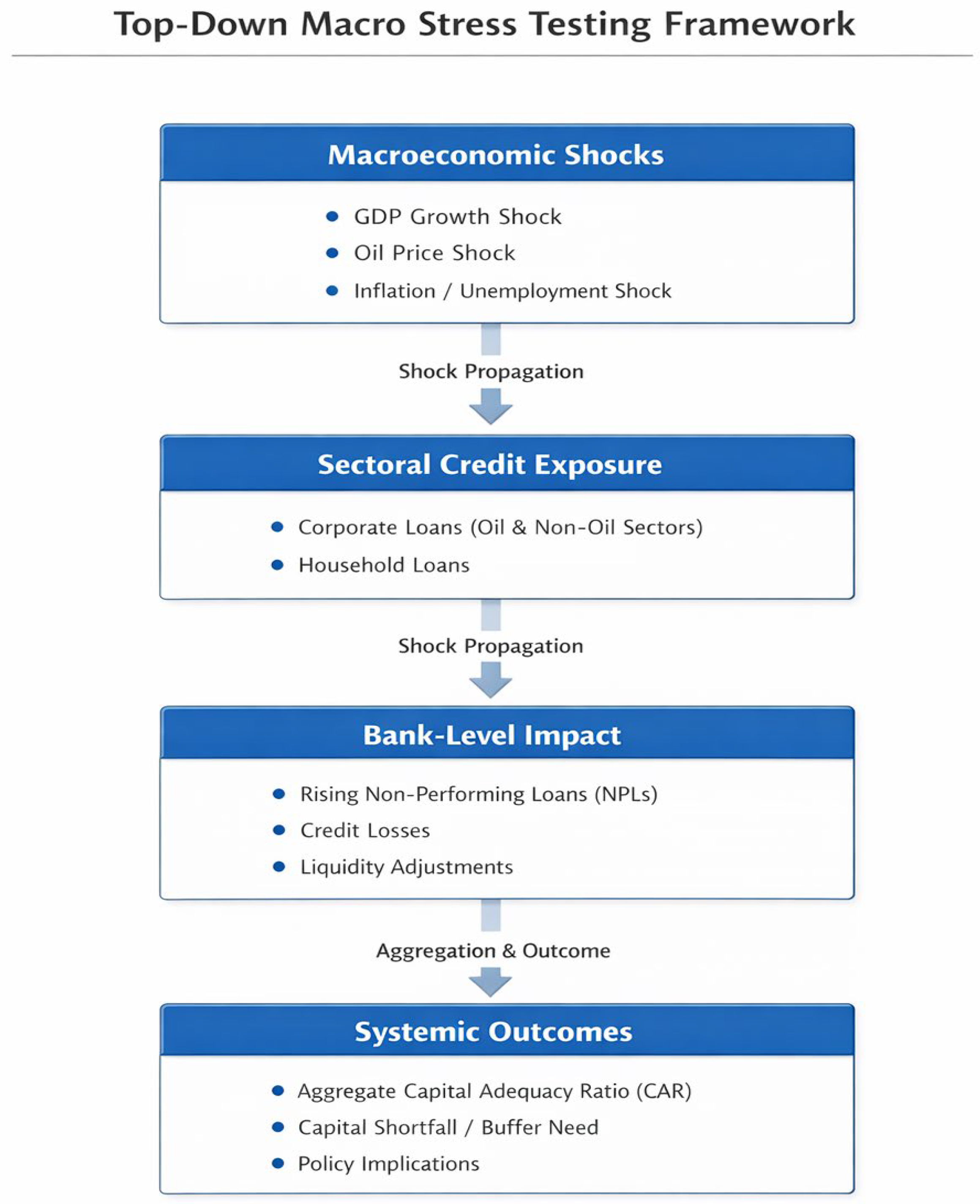
Based on the previous literature review, we developed a flow-chart model as follows in
Figure 1:
The macro stress-testing process comprises five interlinked stages, provided in the following
Table 1.
The structure ensures internal consistency and transparency [
9].
3.2. Modeling Framework and Econometric Specification
The model follows a macro-financial linkages approach in which each bank’s credit risk exposure is modeled as a function of selected macroeconomic indicators.
3.2.1. Credit Risk Equation
The Probability of Default (PD) at time t is derived from the ratio of non-performing loans (NPLs) to total loans:
Following [
27] and recent extensions by [
28], the PD is converted into a macro-index using a logit transformation:
Changes in y
t; are regressed on key macroeconomic variables:
where the vector X
t includes GDP growth, inflation, unemployment, exchange rate, government debt/GDP, and economic growth. This specification enables the estimation of both contemporaneous and lagged effects using a Vector Autoregression (VAR) framework when multivariate dynamics are significant.
3.2.2. Model Selection and Estimation
The VAR approach was selected because it allows for the modeling of dynamic interrelationships among multiple macroeconomic and financial variables simultaneously, capturing feedback effects that are essential for stress testing. Unlike single-equation or static models, VAR can accommodate endogenous interactions between GDP, oil prices, inflation, unemployment, and banking sector indicators, which are central to our study of systemic risk in Saudi Arabia.
Additionally, VAR provides a flexible framework to simulate the propagation of shocks and generate scenario-based forecasts, making it well-suited for macro stress testing where understanding the time-path of responses is crucial. We have added a brief explanation in the methodology section to clarify this rationale and to guide readers on why VAR was chosen over alternative approaches such as single-equation regressions or structural models.
A VAR specification is typically adequate for capturing macro-financial feedback in quarterly data [
29]. Parameters are estimated via Ordinary Least Squares (OLS) under stability constraints. Model adequacy is verified using the Akaike Information Criterion (AIC) and serial-correlation diagnostics. For robustness, a Bayesian Vector Autoregressive (BVAR) model can be app lied to address small-sample uncertainty [
30]. The summary of the variables, expected signs, and data sources is provided in
Table 2.
3.3. Scenario Design and Stress Calibration
Stress scenarios are constructed to represent baseline, adverse I, and adverse II conditions over a three-year horizon (2025–2027). Each scenario applies shocks consistent with historical extremes in Saudi macroeconomic data (2010–2025), given in
Table 3.
The shocks are based on one to two standard deviations of historical movements in each variable [
7,
25]. The adverse II scenario corresponds roughly to conditions similar to 2020’s oil-price collapse compounded by global financial tightening.
3.4. Solvency and Capital Adequacy Computation
The Capital Adequacy Ratio (CAR) is calculated according to the Basel III standard:
where Risk-Weighted Assets (RWA) comprise credit, market, and operational components, and the post-stress CAR for each scenario is derived by adjusting regulatory capital and RWA according to projected PDs and losses.
If post-stress CAR < 10.5% (minimum Basel III requirement plus conservation buffer), the shortfall is computed as follows:
The aggregate systemic shortfall is expressed as a percentage of GDP to gauge fiscal implications [
12].
A stylized example of CAR computation is shown in
Table 4.
3.5. Sensitivity and Robustness Checks
To ensure reliability, the model undergoes several robustness assessments:
3.6. Data and Implementation Strategy
Data are obtained from the Saudi Central Bank (SAMA), General Authority for Statistics (GASTAT), the World Bank, and the IMF’s World Economic Outlook database. The study employs quarterly data (2010–2025) to ensure granularity sufficient for macro financial interactions. Missing observations are imputed using multiple imputation techniques to preserve sample size [
33].
All computations are implemented in Python 3.12 and EViews 13, ensuring replicability. Parameter uncertainty is assessed through bootstrapped confidence intervals (10,000 iterations) following EBA (2023) standards for stress-testing disclosure.
3.7. Expected Analytical Outcomes
The final model produces estimates of:
Macro financial elasticities (β-coefficients) indicating the sensitivity of bank PDs to each macro variable;
Scenario-adjusted CARs for each bank category;
Aggregate capital shortfall (% of GDP) under baseline and adverse scenarios;
Policy elasticities, demonstrating how fiscal and monetary adjustments affect systemic resilience.
These outcomes enable the identification of key macroprudential levers, such as counter-cyclical capital buffers or liquidity coverage ratios, that can mitigate the propagation of systemic risk in the Saudi financial system.
5. Findings, Conclusions, and Policy Implications
5.1. Synthesis of Findings
This study developed a macro stress-testing framework to evaluate systemic risk and financial sector resilience in Saudi Arabia between 2010 and 2025. By linking key macroeconomic variables to banks’ probabilities of default (PDs) through a top-down econometric model, it quantified how adverse macro-financial conditions are transmitted through the banking system.
The empirical results show that:
GDP growth and oil price shocks exert the most decisive influence on credit risk, confirming the pro-cyclicality of bank asset quality in Saudi Arabia’s oil-based economy.
Inflation and unemployment contribute to short-term deterioration in loan performance, reflecting sensitivity to domestic demand conditions.
Exchange rate and government-debt variables, though stable in regular times, amplify stress when combined with global tightening or fiscal deficits.
The post-stress CAR remains above the regulatory threshold under moderate shocks (Adverse I). However, it falls to around 9.6% in severe conditions (Adverse II), requiring an estimated capital injection of 3.7% of GDP.
Table 10 summarizes the key empirical insights and their macro prudential relevance.
Table 10 systematically translates empirical stress-testing results into operational macroprudential policy actions. The table links each major risk transmission channel identified in the model to a corresponding regulatory response, implementation tool, and expected stabilizing effect.
First, the empirical finding that GDP growth and oil price shocks are the dominant drivers of credit risk confirms the strong pro-cyclicality of bank asset quality in Saudi Arabia’s oil-dependent economy. During economic expansions and oil price booms, credit grows rapidly, and risk tends to be underestimated, while downturns generate sharp deterioration in asset quality. This motivates the recommendation to introduce a dynamic counter-cyclical capital buffer linked to the credit-to-GDP gap and supported by semi-annual internal stress testing. The expected effect is to accumulate capital buffers during upswings and release them during downturns.
Second, the sensitivity of loan performance to inflation and unemployment reflects short-term exposure to domestic demand fluctuations and household purchasing power. These dynamics increase liquidity pressure and refinancing risk during tightening cycles or labor market stress.
Third, although exchange rate and government debt variables remain stable under normal conditions, the stress scenarios demonstrate that they amplify systemic risk when combined with global monetary tightening or fiscal pressures. This interaction highlights the importance of institutional coordination between fiscal and financial authorities. The recommended policy response is enhanced fiscal and financial coordination through structured mechanisms.
Fourth, sectoral concentration risks, particularly exposure to oil-linked corporates, are implicitly captured in the sensitivity of credit risk to oil price shocks. The recommended response is to promote sectoral diversification by applying differentiated sectoral risk weights and encouraging SME financing.
Finally, the stress test shows that while the aggregate capital adequacy ratio remains above regulatory thresholds under moderate scenarios, it declines to approximately 9.6% under severe stress, implying a potential capital shortfall equivalent to about 3.7% of GDP. This quantitative result justifies stronger capital buffer calibration, forward-looking capital planning, and improved data transparency. The establishment of granular credit registries and the regular publication of macro stress-testing outcomes enhance supervisory effectiveness, market discipline, and investor confidence.
5.2. Comparative and Regional Perspective
Comparing results across Malaysia, Bahrain, and Kuwait reveals that Saudi Arabia’s banking system ranks among the most resilient in the GCC region, yet exhibits greater macro-financial cyclicality due to its oil dependence. Malaysia’s MAST [
12] achieved comparable stability through diversification of credit exposures and active macro-prudential calibration.
By contrast, Saudi Arabia’s stress outcomes indicate room for improvement in sectoral diversification and dynamic capital-buffer adjustment, especially as Vision 2030 initiatives expand non-oil sectors and expose banks to new credit risks.
In the GCC context, the results strengthen the argument for a regional stress-testing platform, coordinated by the GCC Monetary Council or Arab Monetary Fund, to harmonize methodologies and data standards for systemic risk assessment [
7,
25].
5.3. Policy Framework for Saudi Arabia
The empirical results provide an evidence-based foundation for policy design under the Saudi Central Bank’s financial stability mandate.
The dynamic counter-cyclical capital buffer (CCyB) can be operationalized by linking buffer levels to the credit-to-GDP gap, a widely used indicator of cyclical credit expansion. During periods of strong credit growth relative to GDP, SAMA could gradually increase the CCyB to build additional capital buffers. Conversely, during downturns or credit contractions, the buffer can be partially released to support lending and absorb losses, ensuring that banks remain resilient without constraining economic recovery.
Implementation would require semi-annual monitoring of macroeconomic and credit indicators, stress-testing of banks’ capital adequacy under alternative scenarios, and regulatory guidance communicated through formal directives or FSC coordination. Similar approaches could be applied to sectoral diversification policies, liquidity requirements, and fiscal–financial coordination, tailoring each tool to the observed risk exposures in the banking sector.
Specifically, the dominant influence of GDP growth and oil price shocks on credit risk directly motivates the introduction of a dynamic counter-cyclical capital buffer and sectoral exposure limits to mitigate pro-cyclicality and concentration risk. The observed sensitivity of loan performance to inflation and unemployment supports strengthening liquidity resilience and forward-looking stress testing to absorb short term macro demand shocks. The amplification role of exchange rate and government debt variables under global tightening conditions justifies enhanced fiscal–financial coordination and contingency capital planning frameworks. Furthermore, the finding that aggregate CAR remains above regulatory thresholds under moderate stress but declines to approximately 9.6% under severe scenarios informs the calibration of capital buffers and the estimated scale of potential public or private capital backstopping (3.7% of GDP).
To improve transparency and operational relevance, we have consolidated these linkages in a structured policy matrix (
Table 10) that maps empirical drivers to policy tools, expected effects, implementation mechanisms, while
Table 11 provides Strategic framework for macro prudential and fiscal coordination, and we have strengthened the comparative policy discussion (
Table 12) to position Saudi Arabia’s framework relative to Malaysia and GCC peers. These revisions enhance the coherence between empirical evidence and actionable policy guidance.
Based on the findings, discussion, and results above, we recommend the following practical timelines and benchmarks for policymakers to facilitate the adoption of the recommendations.
Counter Cyclical Capital Buffer: Semi-annual assessment of the credit to GDP gap, with buffer adjustments phased in over one to two quarters to avoid sudden capital shocks.
Liquidity Requirements: Quarterly monitoring of liquidity ratios, with corrective actions implemented within the same quarter if thresholds are breached.
Sectoral Diversification: Annual review of sectoral exposures, with policy adjustments incorporated in the next supervisory cycle.
Fiscal Financial Coordination: Annual joint meetings of SAMA and the Ministry of Finance under the Financial Stability Council (FSC), with contingency planning and stress-test results reviewed each cycle.
These benchmarks provide actionable timelines while maintaining flexibility for macroeconomic developments. The manuscript has been updated to include these suggestions, making the policy recommendations more concrete and operationally implementable.
Table 11 below provides a strategic framework for macro prudential and fiscal coordination.
5.4. Comparative Policy Insights (Malaysia vs. Saudi vs. GCC)
The comparison highlights that Saudi Arabia’s framework is evolving toward global best practices but requires greater transparency and public disclosure of stress test outcomes to enhance market confidence [
2].
5.5. Broader Policy Implications
Table 12 benchmarks Saudi Arabia’s macroprudential framework against Malaysia and the GCC peer average, allowing an assessment of institutional maturity, coordination mechanisms, and stress-testing practices.
Malaysia represents a mature macroprudential regime characterized by proactive regulation, centralized policy coordination between the central bank and fiscal authorities, publicly disclosed annual stress tests, and relatively high capital buffers (15% to 17%). Systemic risks are primarily driven by domestic credit cycles and market liquidity, reflecting a diversified economic structure.
Saudi Arabia occupies a transitional position. Although its average capital adequacy ratio is relatively high (17% to 18%), systemic risk remains heavily influenced by macroeconomic variables such as GDP growth, oil prices, and public debt. Policy coordination has improved with the establishment of the Financial Stability Council since 2020, but stress test disclosure remains limited. This indicates progress toward an integrated macroprudential framework, while highlighting the need for greater transparency, formalized coordination protocols, and enhanced scenario governance.
GCC peers, on average, exhibit more fragmented regulatory coordination, irregular stress-testing practices, and stronger exposure to real estate and exchange rate risks. While capital buffers remain adequate, institutional alignment and policy integration are comparatively weaker, suggesting vulnerability to cross-border spillovers and synchronized shocks.
The comparative analysis reinforces the paper’s policy conclusions by showing that Saudi Arabia has a solid capital base but must continue strengthening governance structures, transparency, and cross-institutional coordination to reach its best.
Institutional Strengthening: Establish a permanent Macro Financial Stability Unit within SAMA to integrate stress testing, early-warning indicators, and policy simulation tools.
Regional Data Sharing: Collaborate with GCC counterparts to create a unified systemic-risk database, enabling cross-border contagion analysis.
Inclusion of Non-Banking Financial Institutions (NBFIs): Extend MST coverage beyond commercial banks to insurance, fintech, and investment funds.
Climate and ESG-related Risks: Incorporate energy-transition scenarios in future stress tests as carbon pricing and sustainability mandates evolve under Vision 2030.
Public–Private Communication: Periodic disclosure of aggregate stress test outcomes can reduce uncertainty and anchor market expectations.
5.6. Limitations and Future Research
While the current model provides a robust quantitative framework, limitations remain. First, the time series (2010–2025) may not fully capture the structural breaks resulting from post-COVID fiscal dynamics or the expansion of financial technology. Second, the lack of granular, loan-level data hinders the modeling of heterogeneous exposures across banks. Future work could incorporate agent-based simulations and macro financial network models [
20] to map contagion paths more precisely. Additionally, integrating climate stress variables and digital finance metrics would enhance predictive accuracy and policy relevance.
5.7. Conclusions
In summary, the Saudi financial system demonstrates strong resilience under moderate macroeconomic stress and manageable vulnerability under severe shocks. Macro stress testing emerges as a vital instrument for Saudi policymakers, bridging micro prudential supervision with macroeconomic surveillance. The findings reinforce the need to institutionalize MST as a recurring analytical exercise within SAMA’s Financial Stability Report cycle. By adopting dynamic buffers, diversifying credit exposures, and enhancing transparency, Saudi Arabia can further solidify its position as a regional benchmark for financial stability and a leading example among G20 emerging markets.