1. Introduction
In the second decade of the 21st century, several nations around the globe are excelling in adapting smart technology in agriculture [
1,
2,
3,
4]. Especially in developing nations, such as India, smart IoT technology is being used widely in agricultural supply chains [
5]. The share of agriculture and allied sectors in India’s national GDP was 20.19% in 2021 [
6]; hence, any effort to improve the efficiency of agricultural operations using smart technology will have many benefits for the Indian economy. In this research, we consider India to explore smart technology’s diffusion into the agricultural sector.
India is one of the top producers of agricultural goods in the world. There are many small family holders involved in farming, and it is their main source of income. The prevalence of small and marginal farmers contributes to growing a wide range of fruits and vegetables, depending on various climatic conditions throughout the year. Despite its enormous potential, Indian agriculture is hampered by several difficulties [
7]. Farming crises such as water shortage, lower productivity, and natural calamities are often reported in the news headlines. Several studies have reported that the adoption of modern technologies could help overcome these challenges [
7].
The sustainable development goals (SDG) proposed by the United Nations aim to achieve zero hunger (SDG 2) and responsible consumption and production (SDG 12) around the globe. According to the United Nations description of SDG 12, high-income countries contribute a larger environmental footprint compared to low-income countries. In this era of technology, every nation aims to adopt smart technology in every field of production and the service sector [
1]. This diffusion of technology will bring progress in production and services [
8]. The resulting higher productivities will support the socio-economic position of the local population, which in turn can support the SDGs, including SDG 12.
In spite of several success stories on the contribution of smart technology, such as the Internet of Things sensors, Big Data, cloud computing, and artificial intelligence, farmers in India have differing perspectives on the use of smart technology in their everyday activities [
9]. Here, we use the term smart technology as a comprehensive term for several modern technologies, including Internet of Things (IoT), sensors, blockchain, temperature-controlled logistics with monitoring options, connected devices, smart farming, and precision farming. Although we did not follow a systematic literature review, our search terms included the smart technology terms included in this paragraph and two more terms namely “agriculture” and “India”.
Mohan et al. [
7] discussed the role of smart technology in food storage and distribution to avoid post-harvest waste in the Indian context. They highlighted the role of temperature-controlled logistics with simple smart technology, to reduce the wastage of fresh food. Danese at al. [
10] used blockchain technology in wine supply chains to prevent counterfeiting. In this article, the authors used multiple case studies to identify a set of key variables, but no interaction effect was discussed.
A recent article by Wang et al. [
11] developed a technology-based model, namely the YOLO-BLBE model using multi-scale Retinex with a color restoration method, to identify the maturity of blueberry fruits. On the other hand, Mohan et al. [
7] suggested a postharvest loss management using a simple temperature control option. Several business studies have reported the potential of smart agriculture in the Indian scenario, but to the best of our knowledge, there is no comprehensive academic study that discusses the factors behind smart technology adoption, as well as which combinations of these factors would support the large-scale application of smart technology to boost productivity in Indian agriculture.
This study fills these two research gaps (i) via a qualitative study to understand the factors behind smart technology adoption and (ii) by exploring whether these factors acting alone or in combination will help large-scale adoption. Accordingly, the main aim of this research is to understand how smart technologies affect agricultural operations in India. The main research question is as follows: How does smart technology diffusion make a positive change in the agricultural sector of India? The following are the associated research questions.
RQ 1: What is the status of adoption of smart technology in the Indian agriculture sector?
RQ 2: What are the primary factors contributing to the adoption or non-adoption of smart technology?
RQ 3: To what extent are the previous theories on technology adoption frameworks meaningful in explaining the behavior of Indian farmers in adopting smart technologies in this era?
RQ 4: Which factor(s) will expedite the adoption of smart technology in the agriculture sector?
RQ 5: How can the adoption of smart technology in the agriculture sector help to achieve SDG 12?
We employed a mixed methods approach to answer these research questions. First, in Phase 1, we conducted a set of interviews in a rural area of Southern India, specifically in the state of Karnataka. We designed the interviews without linking to any previous theoretical frameworks to ensure that we receive unbiased responses from the farmers. This approach helped us to understand the current scenario and factors conducive to smart technology adoption in the agriculture sector. This, in turn, helped to answer the first two RQs. Interestingly, a thorough analysis of the qualitative responses helped us to link the responses to the tenets of the well-known Diffusion of Innovations (DoI) theory [
12]. Further, in this process we identified DoI as the theoretical background, which addresses RQ3. The DoI theory helps to approach smart technology adoption from the perspectives of success factors and barriers such as the relative advantage and complexity of the new technology. The interviews shed light on the factors responsible for successful adoption or otherwise. We then build on the knowledge of these factors to understand whether these factors on their own or in combination could help in successful adoption. For this purpose, the well-known Qualitative Comparative Analysis (QCA) is employed. We use fuzzy ideas and, hence, we use the fuzzy-set version (called fsQCA). This fsQCA analysis introduces possible solutions to the research questions—RQ4 and RQ5.
Thus, this study makes multiple contributions to the literature. First, this is one of the first studies to collect empirical data on the adoption of smart technology in Indian agriculture from the theoretical lens of the DoI theory. Second, it not only synthesizes the factors based on the results of the interviews but extends the results further using fsQCA. By doing so, it provides a contextual empirical configurational test of the DoI theory in the Indian smart farming context. While traditional innovation studies focus only on the specific characteristics stipulated in the DoI theory towards successful adoption, we try to determine the combinations of some factors that could support successful adoption. To our knowledge, this is the first study that provides an empirical test for the applicability of the DoI theory in Indian smart farming context.
This paper is structured as follows.
Section 2 provides a background study including a literature review of the Indian agriculture scenario and Fuzzy-Set Qualitative Comparative Analysis (FsQCA). The qualitative research methodology is elaborated in
Section 3. This also explains the research design and two phases of data analysis.
Section 4 discusses the results of the analysis of the interview data from Phase 1 and the application of fuzzy-set QCA (fsQCA) in Phase 2. This section highlights the theories identified from the qualitative study. Our findings of the analyses, presented in
Section 4, are discussed further in
Section 5. This section not only contextualizes our findings for the Indian agriculture context but also provides an empirical configurational test of the DoI theory.
Section 6 provides a summary including contributions to practice, especially to SDGs, and also highlights the future research opportunities.
2. Background Study and Methodology
India’s expertise in smart technology has created several new avenues for farmers to make the agriculture production process simple and reliable. Despite having the resources in place, the adoption of smart technology for the purpose of agriculture sector (hereafter, this will be mentioned as the agri-sector) is following a slow phase of diffusion in India and around the globe. This research focuses on the critical factors that limit farmers’ adoption of smart technologies using empirical research. We also explore the ways to more quickly diffuse this smart technology within the community to bring young farmers into the agribusiness.
In view of answering the proposed research questions, we have conducted a background study in the southern part of India, and we have devised a research method accordingly.
We have used a qualitative case study approach in Phase 1, as this is the best way to explore the less studied area of research in the context of Indian agriculture, in comparison to developed nations [
13]. The case study data are used to validate the smart-farming acceptance model and also to address the research questions considered in this study. We have performed qualitative data analysis from the interview transcripts to arrive at initial observations on technology use in the Indian agri-sector.
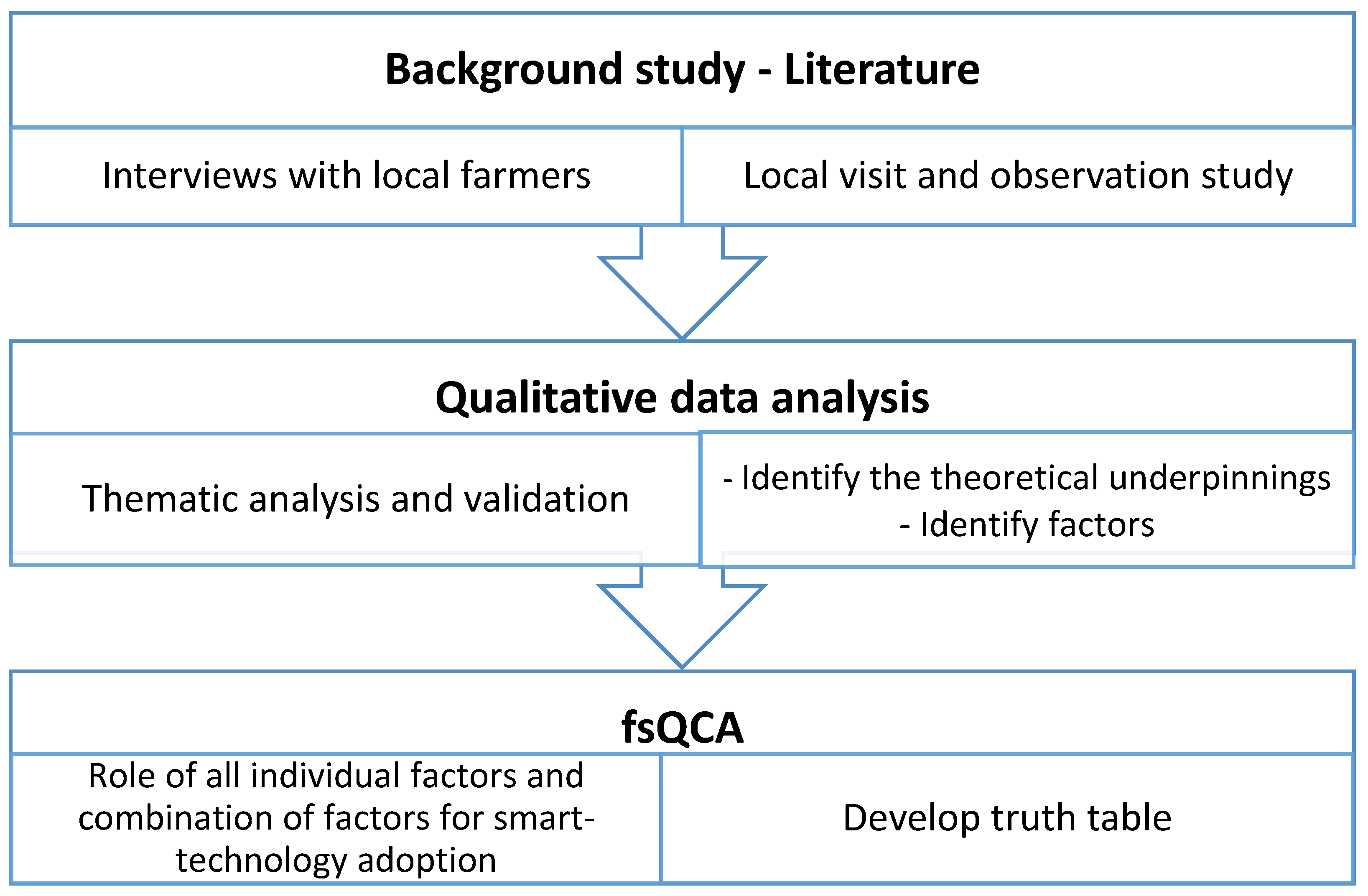
We conducted the case study in three stages as shown in
Figure 1. In the first stage, we performed initial observation field visits to understand the current practices of agri-food production. In Stage two, we interviewed four groups of farmers, totaling 20 individual farm-holders. A previous version of this part has been presented at the EurOMA 2023 conference [
14]. In Stage three, we collated the interview data and analyzed the data. The results of the data analysis were discussed with the focus groups to raw thematic conclusions. Following these thematic conclusions, we further analyzed the data using fsQCA to derive variables and their interactions in smart technology adoption decisions.
In this section, we present the literature on the Indian agriculture sector and introduce the Fuzzy-set Qualitative Comparative Analysis (fsQCA) approach.
2.1. Studies on the Indian Agriculture Scenario
The growing global population demands a high volume of food production to feed human beings and household animals. Small and marginal farmers, with around an 85% share, still dominate the number of holdings at the national level [
15]. Since the invention of smartphones with abundant Wi-Fi-internet connectivity, the use of IoT in Indian agri-sector has gained a rapid advantage [
16]. The level of readiness for technology differs for each sector in various geographical locations [
17]. The Indian agri-sector uses IoT in various forms, namely, precision farming, smart irrigation, greenhouse automation, and predictive analytics by well-established technology companies such as mKRISHI from Tata Consultancy Services, Fasal, WayCool, Farm again, and many more [
16].
Smart Farming is one of the recent innovations of IoT technology that emphasizes the use of information and communication technology (ICT) in agricultural farm management with the support of cloud computing and data analysis [
1,
2,
3,
4,
5,
6]. The technologies include Internet of Things sensors, drones, blockchain, computer vision, machine learning, deep learning, image recognition, artificial intelligence, and more [
17]. As Artificial Intelligence (AI) and Big Data are becoming an integral part of our life and businesses around the globe [
18,
19], adopting these technologies in the food sector and agriculture will enrich the productivity of food products [
17].
There are some interesting studies on the adoption of new smart technology in Indian agriculture. General reviews of technology in Indian agriculture are available [
20]. Jarial [
18] has provided a review of such studies focusing on a description of various technologies, their potential, and their issues and challenges. The study has provided a list of leading Indian companies engaged in various smart technology development. While this paper provides a good overview of smart technologies in Indian agriculture, it does not look at specific factors affecting individual farmers. Pal et al. [
21] describe an empirical study on the adoption of a specific smart technology, called Laser Land Levelling, in some parts of Indian agriculture. Thus, there are some studies that have focused on the application of smart agriculture in Indian context. However, a detailed review shows that there is no holistic attempt to look at the factors that promote or inhibit the application of smart agriculture in the Indian context. We fill this gap by drawing on the tenets of the Diffusion of Innovations theory. This theory is discussed in the next section.
Some small/medium farm holders and several large-scale farmers are interested in adapting Internet of Things (IoT) in smart farming to take their yield to the next level. Although agricultural operations look simple from the outset, the agri-sector has inherited complexity, which needs an innovative approach to achieve dynamic solutions [
22]. However, some initial investment is required to have smart IoT in place, and the small amount of maintenance/service cost for using the smart technology is not perceived as a positive investment but as a recurring expenditure. Local government and councils are supporting farmers to adopt smart technology by showcasing technology demonstration projects and through some financial support such as grants and small incentives for using the technology. Now, several young entrepreneurs and farmers realize the potential of using the smart technology in agriculture, replacing human labor [
7]. We explore the diffusion of innovation in the agri-sector of India to be able to make suggestions for stakeholders and policy makers in this prominent field of agriculture, in the era of technology. Then, we use Qualitative Comparative Analysis (QCA) to analyze the results of the qualitative study; we briefly describe this methodology in the next sub-section.
2.2. Fuzzy-Set Qualitative Comparative Analysis (fsQCA)
The idea of QCA was introduced by Ragin [
23] as a tool for detecting causal complexity in an outcome of interest across different scientific fields. QCA is based on set theoretic ideas and the basic operations of Boolean algebra (i.e., union, intersection, and negation of sets). Based on empirical observations of the occurrence of the outcome of interest and the presence or absence of causal factors linked to the outcome, QCA is used in an outcome’s membership score in complex situations (indicated by the presence or absence of one or more causal factors). Saridakis et al. [
24] highlight that QCA uses Boolean methods to assess whether a complex causal condition is necessary and/or sufficient for the outcome of interest to occur.
If empirical observations indicate that a particular factor is present in all observations of the presence of the outcome, then the factor could be considered a necessary factor. Thus, a necessary factor (but not a sufficient factor) is indicated if the factor is always present for the outcome to occur, but this factor alone is not enough. In set theory language, the outcome set will be the subset of the set of the necessary factor. That is, 100% of the outcome set will be the subset of the necessary factor.
In contrast, a sufficient factor (but not a necessary factor) is indicated if the factor itself can produce the outcome, even though there are other factors that may also produce the outcome even if this factor is not present. In set theory language, the set of a sufficient factor will be a subset of outcome set. That is, 100% of the sufficient factor will be the subset of outcome set.
However, based on limited empirical observations, a factor may not be a fully necessary or a fully sufficient factor, as there might be a small number of empirical observations that can deviate from expected patterns. Hence, we need to establish some thresholds (less than 100%) to claim that a factor is a necessary factor or sufficient factor. In QCA, consistency and coverage are used to assess whether a factor can be called necessary or sufficient using some threshold values. These two measures range from 0 to 1. Consistency measures the degree to which a causal factor (or a combination of factors) leads to the outcome. Coverage measures how many cases in the observations with the presence of positive outcome that also have the presence of the particular factor (or a combination). The recommended threshold for necessary consistency is 0.9 [
24] when analyzing individual factors. In general, the higher the consistency score is, the lower the solution coverage will be [
23], and hence, some compromise is necessary in choosing appropriate threshold values, especially when considering a combination of factors. In this case, an acceptable threshold for consistency (above 0.70) and coverage between 0.25 and 0.65 have been suggested.
The truth table is considered the main part of a QCA. If there are k factors in consideration in the analysis, then there are 2
k possible combinations of the factors. Based on empirical observations, QCA identifies all possible 2
k combinations of the factors and the corresponding presence or absence of the outcome and estimates the corresponding consistency score. If the consistency score is 1, then the combination of factors represented by the corresponding row is always present when the outcome is present. If the consistency score is less than but close to 1, then there might be some observations when the outcome is absent, even though the outcome is present for most of the corresponding combinations of factors. In QCA, a measure called “raw consistency” is usually used to interpret the sufficiency condition. Thus, if a combination of factors has a raw consistency of 0.9 or more in indicating the presence of the outcome, then the combination of factors is considered sufficient for predicting the outcome. Combinations with high consistency scores signify that these combinations almost always lead to the given outcome condition [
25,
26].
Please note that when the membership values of factors and coverage are crisp (either 0 or 1), then the analysis will be QCA. However, it is possible to provide fuzzy membership functionality. If some or all the factors and outcome are specified using fuzzy membership, then the analysis will be called fsQCA.
3. Research Design and Data Collection
3.1. Data Collection
The present study was carried out in Karnataka state in India during 2021. The state of Karnataka was selected purposefully because it is one among the top states in India promoting the adoption of smart farming technologies in rural India through various initiatives. Karnataka is one of the established agri-tech start-up ecosystems in the country, and it has the highest number of agri-tech start-ups. Hence it was assumed that there would be a high rate of diffusion of smart farming technologies in the state, which would support and facilitate conducting this study.
3.2. Interview Question Design
Our qualitative study was designed as an exploratory study, without any preconception to link to any previous theoretical frameworks. This is because there are relatively few studies in the Indian context that link existing technology adoption theories. This approach has helped us ensure that we receive unbiased responses from the farmers. Our interview instrument consisted of 10 open-ended questions to elicit rich responses from farmers, and the questions are listed in
Table 1. These interview questions are related to RQs 1–5.
3.3. Sample and Data Collection
Respondents who were willing to provide the required information voluntarily across the rural side of the state of Karnataka, India, were selected for the research study. Following initial field visits and observation study, the respondents were categorized into four segments, namely, full technology adoption farmers, partial technology adoption farmers, willing to adopt but not yet adopted, and farmers least interested in technology adoption.
Full technology adoption: This means they understand fully and accept, adopt the technology, use it productively and intuitively, and look out for further enhancements. This segment will basically help us understand what influenced them to fully adopt the technology and how can this help other segments of farmers to adopt the technology.
Partial technology adoption: This means they do not fully rely on the technology or have some hesitation to invest fully into the technology, but they have some form of technological adoption. The partially adopted segment is the extension of segment 1, which will give a clear understanding of factors limiting full adoption. We collected the farmers’ opinion on ground level problems while adopting the technology.
Willing to adopt but not yet adopted: This means they are interested to learn, invest and use the technology, but they have not adopted technology yet due to various factors. This is mainly related to farmers with a dilemma regarding technology adoption. ‘Willing to adopt’ will be the focus group, to understand the factors that are stopping them from adopting the technology and how to help this segment of farmers to start adopting technology.
Not willing to adopt: This group includes those least interested in technological adoption or people having resistance to change. This segment basically helps us understand the gap and difference between segment 1 and 4 (i.e., fully technology adoption farmers and those not willing to adopt). It also helps us in understanding the ground level problems for an unwillingness to adopt technology.
Five respondents from each category were selected using a stratified random sampling technique, making the total sample size 20 (
Table 2). With due consideration to the scope of the study, a systematically structured interview schedule was developed after a pilot study. For data collection, the personal interview technique was used. All the interviews were recorded in raw audio format with consent from the responding farmer. The technology use of the farmers varied widely from local providers for simple sensors to established service providers for fully automated Smart Irrigation Systems. The farmers from two segments, namely ‘willing to adopt’ and ‘not willing to adopt’, did not provide much information on technology, and this is reflected in the empty cells in
Table 2.
4. Data Analysis and Findings
4.1. Case Study: Interview Data
As shown in
Table 2, the ‘full technology adoption farmers’ from Segment 1 use an array of technologies namely Fassal Smart sensors, environmentally controlled poultry farms and fish farms, and high-level sensors to monitor the water quality and greenhouse parameters. These are investment-intensive farms having medium- and large-sized agriculture lands. In Segment 2, ‘partial technology adoption farmers’ provide high-value agriculture production such as aquaponics, poultry, and smart irrigation systems, including smart flow systems. These farmers are small and medium size, mainly family growers having a sizable portion of their agriculture fields fitted with sensors and other smart technology (low- to medium-range equipment) for seamless operations in their fields. These farmers are benefited by availing themselves of the local agri-tech companies sale offers and incentives provided by the local government. Segment 3 are family growers with a medium- or small-sized limited area of land. These farmers are influenced by success stories of the technology use in neighboring fields. Eventually in the next few years these farmers will embrace smart agriculture technologies. Category 4 farmers are above 50 years of age, are not familiar with smart technology, and are reluctant to use technology. This is due to ‘resistance to change behavior’ and fear of embracing technology without having knowledge of the ease of use.
A transcript of all the interviews was prepared to support the analysis. The interview protocol covered the following areas: product variety (crop), use of technology, knowledge of smart technology for agri use, limitations, advantages of using technology in agriculture over conventional methods, impact of technology on employability and manual labor, factors that drive use/non-use of technology, overall performance, and knowledge dissemination. Some of the respondents from Segment 4 expressed distrust in the technology, and some were not willing to talk about the technology use. We analyzed the interview data using the content analysis for thematic consideration (see
Table 3). We used repeated words such as technology, interest, benefit, trust, future, agriculture yield, smart IoT, and sensors. We also used several other key words in this process, in line with our research questions.
We have made a detailed analysis of the interview data to identify the underlying factors for smart technology adoption. In this effort, we also tried to identify the link with the existing theories. Excerpts of the interview transcripts are given below:
Segment 1 farmers expressed their full support for technology adoption in the agriculture field, F2 mentioned—“…So smart farming is the need of the day because if we do not adopt technologies, the next generation is never going to enter farming. For them to come into farming we need to make it more certain.”
F4 mentioned—“…Especially in Pomegranate, where the plant’s 50% growth depends on irrigation. So, I would like to suggest farmers to install this technology, keep track on updates from their app and plan for future of their farm”.
Statements from farmers F2 and F4 clearly expressed interests of 21st century farmers in considering smart farming as the first option in contrast to a conventional farming approach. Young technology entrepreneurs are willing to consider smart farming as the same as any technology-related job, as it does not demand as much physical effort for farmers as in previous generations.
Segment 2 farmers who use technology partially for their routine agriculture field operations have limited investment and use automation for essential operations. One of the farmers F1 in this group strongly expressed his view on technology use—“After installing these sensors we are able take right decision on when and how much to water”.
Farmer F5 said—“I first saw this technology when I visited my friend’s plot. He had adopted this automated drip system for 1 acre land. Seeing this, I decided to take up the fertigation system in my 0.5-acre polyhouse.”
As the size of the farms are not huge, and the investment is not heavily required for simple smart technologies such as sensors for temperature and humidity monitoring, these smart agri-technologies have been adopted by a large group of farmers in this category. Real opinions of F1 and F5 evidenced the role of technology for small farms with a minimum investment. It also expressed the possibility of having a partial technology system instead of having a full adoption with high investment. This flexibility in adoption may help young farmers to choose agriculture as their choice of job or business in the future.
Three young farmers from Segment 3 expressed their willingness to adopt technology and also showed their concerns. The following quotes will be linked to the theory in the next section.
“It would be great if such support is provided. Now they are already giving weather-based insurance and few assistances. We are making use of them. It would be great if they update about these to farmers.” “It will be helpful and will yield better results. It is necessary. But to cost factor people are hesitating. If costs are managed people would adopt it.”. “…Yes, there is a good future. Many farmers having larger farms could be benefitted by such technologies”.
Segment 3 farmers have two different viewpoints on adoption. The first point is their lack of investment capability, and the other important point is questioning the use of technology and its need in small farms.
Based on the interview transcripts and data analysis, our preliminary results are given below: While educational background and initial success were the main drivers of the full adoption of technology in Segment 1, partial success (not realizing the full potential of technology adoption) was the reason for the partial adoption in Segment 2. The difference in production performance of Segments 1 and 2 are mainly due to the variety of crop and soil conditions. This difference in adoption by Segment 3 could be easily altered if the mindset of the farmers is tuned through appropriate training programs and demonstration of technologies locally within the community.
Finally, a document comprising the comparative study of each segment for each of the questions was prepared using the transcript. All qualitative responses were closely compared and analyzed to obtain the key findings. Before reporting the key findings, we discussed the preliminary results with the respondents in a focus group dissemination activity. This is further listed in
Table 4. The farmers and their fully IoT-fitted agricultural fields from Segment 1 can be a catalyst for diffusion of technology in the local farming community, and they can co-create value for all potential new generation farmers. This could also create a distributed demand for crops and produce in relation to seasonal cultivations. Segment 2 farmers can integrate themselves with Segment 1 farmers by actively participating in the dissemination programs. While Segment 3 intends to adopt technology, the group of farmers from Segments 1 and 2 can encourage and support these farmers through knowledge dissemination. Social media and smart phones can play a role in taking technology to the next level in the Indian agri-sector. Segment 4 farmers, who are exhausted due to strenuous agricultural activities in the past, do not have any further interest in spending money or acquiring new knowledge of adopting technology. Family members of this group can be trained and supported. Training programs for young family members can attract the next generation of farmers in the existence of technology and ease of use. In addition, fertile agriculture land (not currently in use) can be made available for young farmers within a legal framework. Local government organizations, councils, and technology companies can work together to achieve this objective (refer to
Table 4).
4.2. Analysis of the Results of the Qualitative Study and Linking to the DoI Theory
The results presented in
Table 3 and
Table 4 yield interesting insights on the factors that influence the adoption of smart technology in the Indian agriculture sector.
First, there is evidence that the sample of farmers that we approached have differing levels of adoption—full adoption, partial adoption, willingness to adopt, and no adoption. This is consistent with technology adoption theories such as the Diffusion of Innovations theory by Rogers [
12].
The second insight is that those farmers who have fully or partially adopted the technology have shown some positive results such the ability to measure important variables such as humidity, pH, luminous intensity, etc. This has helped these farmers to simplify some traditional operations. For example, farmers traditionally relied on their own perceptions of humidity before the use of smart technology, but with sensors they are more confident on the level of humidity. This has helped to confirm that the farmers who have adopted smart technologies are able to improve the observability of complex agriculture data, to register a relative advantage compared to other farmers. Similarly, the data from sensors have helped them to reduce the level of complexity in agricultural operations. These three tenets, namely observability, relative advantage, and complexity, are primarily employed in the Diffusion of Innovations theory. Thus, the responses of farmers seem to concur with similar theoretical properties of the DoI theory. Several farmers have found the output from sensors to be reliable, confirming the reliability of smart technologies.
By trialing smart technology, those who have either fully adopted or partially adopted it are able to see the benefits of 24 × 7 monitoring, a reduction in manpower, and the reduced use of resources. Thus, there is evidence that the technology can be trialed by farmers before a larger level of adoption. This resonates well with the tenet of trialability in the DoI theory. Given that farmers who partially adopted the technology first are able increase the level of adoption gradually signifies high levels of compatibility of the technology with existing farming operations.
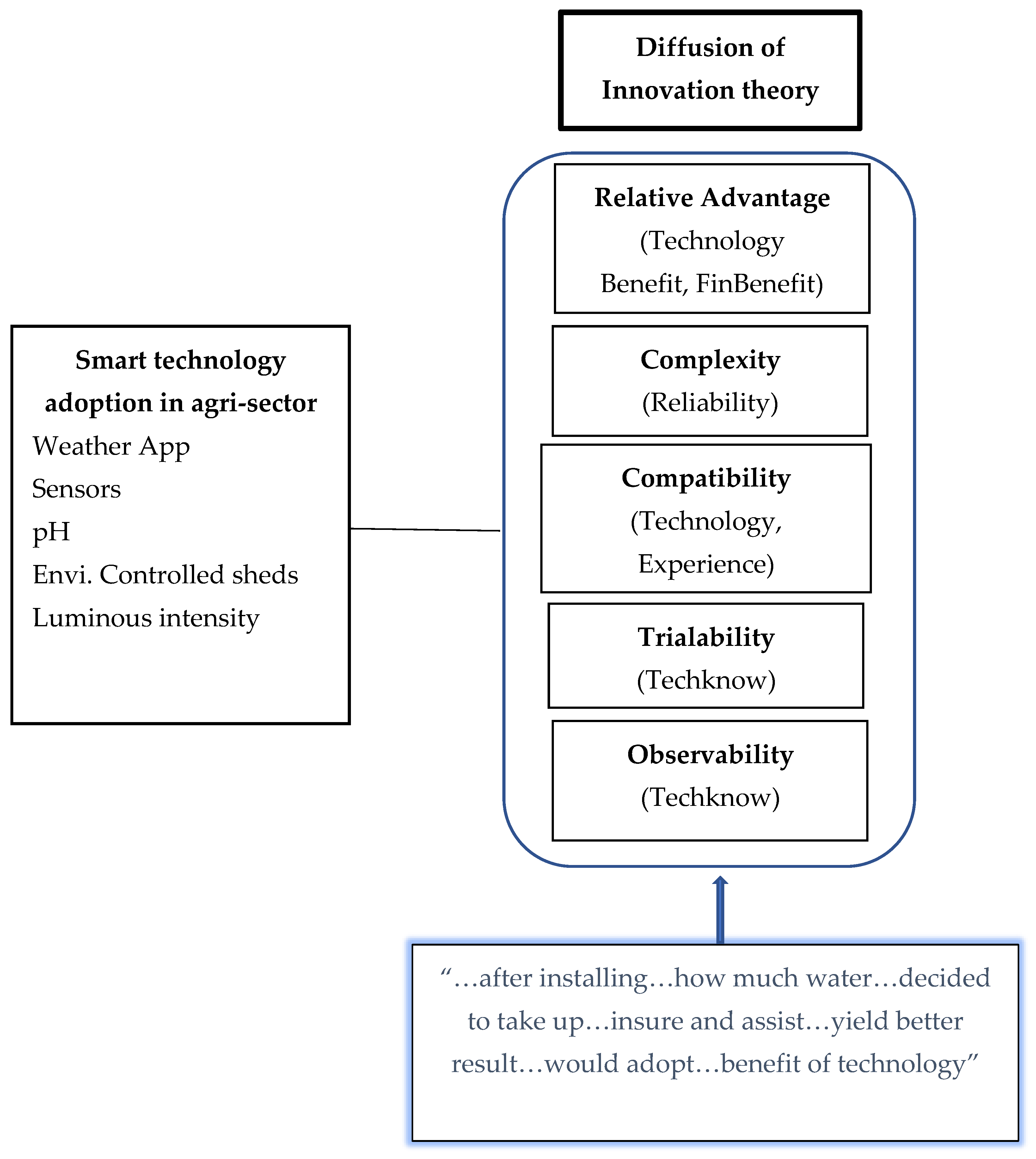
A mapping of the observed characteristics from the qualitative study with the tenets of the DoI theory is shown in
Figure 2. The interview data analysis highlighted the points that coincide with the attributes of DoI theory namely relative advantage, complexity, compatibility, trialability, and observability (please refer to the quotes from the interview data in
Section 4.1).
4.3. Theoretical Observations from the Case Study
The Diffusion of Innovations (DoI) theory [
12] is one of the most widely applied theories in the prediction of the level technology adoption in private organizations [
27]. The basic idea of this theory is that certain characteristics of the innovation can affect the rate of adoption [
28]. The DoI theory has been used to establish the interface of e-commerce with the marketing and operational functions of SMEs [
5]. A recent article by Wang et al. [
29] considered DoI for a construction project by linking it with organizational innovation. DoI is able to be adapted to different fields, as long as the innovation is the one of the key elements. Specifically, the following characteristics have been suggested in this theory.
Relative Advantage: the extent to which users or organizations believe that the new innovation is better than the previous practices.
Complexity: the extent to which the new innovation is perceived by users as relatively difficult to understand and use.
Compatibility: the degree to which the new innovation is perceived as consistent with the existing values, past values, and needs of potential adopters.
Trialability: the extent to which users or organizations believe that there are chances for the new innovation to be experienced before deciding whether to adopt it or not.
Observability: the degree to which the benefits of the new innovations are observable to the users and others.
In this research, the primary research instrument, the qualitative interviews, are based on these innovation characteristics. Thus, the DoI theory has helped to understand what made the adopters of smart agriculture to implement the innovation fully and also to understand why others are reluctant to adopt or slow to adopt. Additional information (refer to
Table 1,
Table 2 and
Table 3) has helped us to understand the reasons for adoption or non-adoption.
During the course of our research, we observed that, although the DoI theory, introduced by Rogers in 1962, has been widely applied in various innovation contexts, there has been little effort to extend this theory in different disciplines. Following Roger’s Diffusion of Innovations theory, a few researchers improved the DoI concept in multi-dimensions, fitting it to the context of study [
30]. Efforts have been made to determine whether these factors are all necessary or a few combinations are sufficient (e.g., Moore and Benbasat [
30]. In the current paper, we focus more on whether the identified factors alone are sufficient to encourage adoption or whether we should consider a combination of factors. These combinations of factors, if identified, could help in extending DoI theory. Hence, we have attempted a fuzzy set QCA analysis in Phase 2 after identifying the factors of technology diffusion in Phase 1.
4.4. Qualitative Comparative Analysis
The first step in this Phase 2 is to identify important success factors from Phase 1. Based on the interview analysis presented in
Section 3, we have identified six factors for the adoption of smart technology in Indian agriculture. These factors are based on the characteristics of DoI theory but further built on additional insights generated from the interview analysis.
Technology: This factor captures the totality of several DoI characteristics, such as the relative advantage and compatibility, of the new smart agriculture technology. Our interview analysis shows that these characteristics play a critical role in encouraging adoption. For example, farmers who have already fully or partly adopted the technology and those who are planning to introduce these technologies are convinced of these characteristics, namely the advantage of use and compatibility. Those who have not adopted so far with no plans to adopt in the near future seem unconvinced by the new technologies.
We consider the adoption of current technology in routine operations of farm activities. Here, the smart technology for agriculture includes both simple technology such as sensors and an automated watering system and advanced technology such as data-driven decisions-making using apps and the use of multi-sensors in the agri-fields, logistics, and distribution centers.
Technical knowledge (Techknow): This refers to the knowledge of the user in handling the technology used within their agri-businesses. This factor captures the observability and trialability characteristics specified in the DoI theory. If farmers are able to observe the results, have the technical knowledge to apply (trial) the technology, and are convinced of the new technology, then they have a higher intention to adopt the new technology. As
Table 3 shows, the reason for farmers’ partial adoption of technology is the lack of accuracy observed in the results.
Reliability: This is related to the users’ experience, based on consistent results and the benefits achieved through the IoT technology in their agri-business. The level of reliability required seems to influence the decision on technology adoption. This factor is related the complexity characteristic specified in the DoI theory. For situations where the application of the new smart agriculture is perceived as complex, its reliability is affected. This factor is critical in that those who have partly or fully adopted the technology perceive investment as an important need. Investment requirements seem to be an important barrier for the other two categories (wiling to adopt and no adoption).
Experience: In the agri-sector, family experience plays a vital role for day-to-day activities. However, in this research we consider that the experience of the user in handling the technology for their routine operations is vital for decision-making on the adoption of technology. These data are captured through our interviews with the participants.
Benefit: The interview data brought several benefits for our consideration, such as the low labor cost, easy solution, and quick update. The actual benefit of using the technology could be realized in various stages of the supply chain such as less manpower, production, logistics, distribution, and other operations. Here, we consider benefit as the benefits to the farmers of using smart technology.
Financial benefit (Finbenefit): The financial outcome from agriculture operations is crucial to continue farming activities. For several small landholders, farming is the only lifeline for the entire family. We consider Finbenefit as the financial benefit realized by the user when using the smart technology in their agri-businesses.
We have used the above six factors as our scale items to measure the technology adoption level in the agri-sector.
Saridakis [
24] has introduced a clear guide for qualitative comparative analysis (QCA); the authors have highlighted the importance of relating the theory with actual practices in QCA (see
Table 5).
Application of FSQCA to Predict the Successful Adoption of Smart Farming in Indian Agriculture
In this section, we apply fsQCA to the data derived from the interviews. We have first used the results of the interviews to (i) identify various success factors for adoption and then (ii) to develop membership functions. The resulting table is shown below (
Table 5). The responses of the interviewees highlighted their level of importance for specific variables: adoption, technology, knowledge, experience, benefit, reliability, and financial benefits. These are expressed in their usage of words. To accomplish this exercise, we used insights from trained local representatives who supported the interview process. For example, if a farmer mentions highly appreciating the smart technology, a membership score of 0.8 was assigned, while the membership of 1 was used if a farmer is confident of fully adopting the smart technology. If no response was provided, we represented this through ‘x’. This case is treated equivalent to non-adoption with a membership value of zero.
The methodology of fsQCA has been applied to the data in
Table 5. The details are described below.
As indicated in
Section 2.2, the first step in fsQCA is to verify whether the factors on their own are necessary. We used the fsQCA software version 4.1 developed by the original QCA team for our analysis. The results are shown in
Table 6.
Table 6 indicates that some factors have high consistency above 0.9. However, the corresponding coverages are not high. Setting a combination of high consistency (above 0.9) and high coverage (above 0.9), we conclude that there is no individual factor that meets the necessary condition for successful adoption.
The next step is to develop a truth table for the 2
6 = 64 combinations of factors. This analysis was conducted using the software. After reducing the results,
Table 7 shows the combinations of factors that lead to high consistency scores.
Thus, all the above combinations yield a consistency above 0.7 and coverage above the bottom threshold of 0.25. Thus, these are the combinations that could predict the successful adoption of smart technologies in Indian agriculture.
Please note that technical knowledge and experience occur in all these pathways (combinations). Thus, our analysis places the highest importance on these two factors. Pathway # 1 indicates that the presence of all but the financial benefit could lead to the successful adoption of smart technologies. Pathway # 2 shows that all but the presence of reliability may also help in successful adoption. Pathways 3 and 4 show that if technology is not present, then its reliability is not important in fostering adoption. Finally, the last pathway # 5 shows that the presence of all the six factors will always result in the successful adoption of smart technologies in Indian agriculture.
We believe that the results of the fsQCA have the potential to extend the DoI theory. First, we observed that individual factors are not sufficient to predict the successful adoption of smart agriculture in Indian scenario. This is somewhat counterintuitive to the tenets of DoI theory, which claims that some of the characteristics are important for successful adoption. However, we did find evidence of the successful application of the theory when we consider certain combinations of these factors rather than individual factors. Thus, we propose that the DoI theory can be extended to consider combinations of characteristics in explaining adoption in addition to the stress on individual characteristics.
5. Further Discussion
In this section, we revisit our research questions and summarize the answers on the basis of the analysis presented earlier.
RQ1: What is the status of adoption of smart technology in the Indian agriculture sector?
RQ 2: What are the primary factors contributing to the adoption or non-adoption of smart technology?
These two research questions (RQ1 and RQ2) have been answered through the observation field visits and interview data analysis. RQ3 related to the theory was established from the qualitative interview data analysis. In this paper, the Diffusion of Innovations theory is identified as a suitable theoretical framework.
Our next research question on factors that will expedite the adoption of smart technology in the agriculture sector, used the fsQCA approach to identify six factors from the qualitative data: technology, technology knowledge, experience, benefit, reliability, and financial benefit. Five pathways have been discussed with combinations of factors (
Table 7). In Pathway 1, the combination of all factors except FinBenefit has been considered as technology adoption with a coverage of 58%; in Pathway 2, the combination of factors except reliability provides a positive adoption with a coverage of 61%. In the third pathway, technology and reliability do not play a role, but the adoption will take place with a coverage of 66%. In the fourth pathway, the combination of factors that lead successful adoption (coverage 70%) of technology includes technology knowledge, experience, and financial benefit. Interestingly, the final pathway includes all six factors for adoption with a coverage of 51%. These results show the highest consistency for pathways 1, 2, and 5. This implies that all factors are important for adoption. However, some combinations will work better together: although the technology is not in place currently, the farmers will eventually adopt the smart technology if they have realized the benefits with good technology knowledge. Financial benefit will also be positive in this case.
Further, if we look at
Table 6, two factors (Techknow and Experience) occur constantly in all the pathways. Thus, we find that these two are critical factors for successful adoption. Two more factors, FinBenefit and Benefit, occur in four of the five pathways and thus can be considered the next critical factors.
Thus, the fsQCA shows not only the combinations of factors that would lead to successful adoption, but it also provides a way of understanding the criticality of the factors in encouraging adoption. We have found TechKnow and Experience are extremely critical for adoption. In other words, for Indian farmers to consider adopting smart agriculture technology, they should have adequate experience and a level of technical knowledge. The expectation of benefits, financial or otherwise, is the next set of critical factors.
6. Conclusions, Contribution, Limitations, and Future Research
This research focused on understanding how smart technologies support Indian agriculture and join world leading efforts in this direction (e.g., Nikolić et al. [
1]). It included a detailed interview with practitioners who use smart farming technology at various stages of operations. A total of five factors identified from the analysis of interview data have been used to conduct fsQCA. While all five factors, on their own, can help influence the successful adoption of smart technologies, the fsQCA further identified that five different combinations of factors could also influence adoption. Further analysis of the combinations of factors revealed that technical knowledge and experience are the most critical factors for facilitating adoption, followed by benefits (financial and other).
In this research article, we reflected on our empirical study considering a practice-based research question: How does technology diffusion make a positive change in the agricultural sector of India? In this attempt, we identified some individual factors and specific primary factors contributing to full and partial adoption of the technology for routine operations in the agri-sector: financial investment and technological knowledge. While technology diffusion is imperative among young professionals, farmers using traditional approaches are reluctant to change due to age and ignorance of technical aspects. We identified from two phases of data analysis that the Indian agriculture sector will benefit from a combination of factors. Technology diffusion is possible in every agri-business, irrespective of the size of the operation, by involving technology professionals. Family landholders can make use of the younger generations with a technology background to achieve responsible high production. Diffusion of technology in the field of agriculture is one of the best possible approaches to achieve success.
SDG 12, “Responsible Consumption and Production”, can be made possible in a highly populated country like India by involving technology professionals in agri-sector operations. Here, digitalization supports the dynamic changes in production and agri-business sector [
31]. Creating synergy between smart technology and traditional agri-sector can make a major change in food production and distribution. This will also enhance the economic and social value of the local society.
About 86.2% of the country’s farmers are small farm holders who cultivate 47.3% of the country’s arable land [
12]. Fragmented landholdings result in poor bargaining power and reduced-price realization of agri-produce. Achieving economies of scale through technology adoption will attract the future generation of farmers. We suggest that a feasible approach to current farming in India is to adopt simple, cost-effective, and smart agri-technology. This can be achieved through systematic training and involvement. DoI in the agri-sector [
12,
30] is possible only if the full potential of the chosen technology reaches a wider population with reliable consistent benefits.
6.1. Theoretical Contribution
The literature on IoT technology for agriculture is growing steadily. Though DoI has been applied to several fields, not many academic articles highlight technology diffusion in the agriculture sector, specific to the Indian context [
4]. After the qualitative interview data analysis, we identified a strong link with the DoI. This was further tested with fsQCA by analyzing the combination of factors and their influence on smart technology adoption. Two prominent factors, namely technical knowledge and experience, turned out to be the critical factors for all pathways.
6.2. Practical Contribution
This research contributes directly to practitioners intending to adopt technology (see
Table 3). Several barriers that inhibit adoption have been identified. Age and technology use are highly related and limit the exploration of technology in a traditional agriculture set-up. In particular, farmers in rural India with less exposure to technology have resistance to change unless and until there is a push from young members of the family or friends. A higher level of the demonstration of technology adoption in the rural agriculture sector can influence the previous generation of farmers. At the same time, it is wise to think about the financial aspects of the agricultural production and its growth after the installation of smart IoT in small or medium farms. Testing farms and demonstration fields with live agri-technology facilities can help increase the adoption of technology.
The results of this research will contribute directly to farmers who are intending to consider smart farming. The dissemination of the results will help many young farmers to embrace smart farming and IoT technologies for routine processes in farming operations. Farmers who adopted and benefited through complete adoption can co-create and support societal welfare.
6.3. Research Propositions, Limitations, and Future Research
On the basis of the findings of this research, we highlight multiple propositions in the context of the use of modern technologies for smart agriculture:
RP1: an awareness program on smart farming will help remove the phobia of technology in agriculture.
RP2: a training program on smart farming will help provide hands-on experience to young agricultural professionals.
RP3: involving young professionals in smart farming may encourage several others to focus on the agri-sector.
RP4: the IT sector can include more and more career opportunities for smart-farming related technologies.
Future research can consider a longitudinal experimental study with specific cases, having observations in real-time on the adoption of technology and the behavior change along with the business performance. Our research included data from 20 interviews of individual farm holders, and hence, the results of this study are difficult to generalize. We consider this as the main limitation of our study. A larger sample size covering multiple parts of the country could be attempted. A large dataset can also help in refining the fuzzy membership estimates for the fsQCA analysis. More discussions with interviewees linking more directly to SDG12 could be attempted. A large-scale quantitative study could be attempted to confirm the above propositions. In addition, our data were from 2021 to 2023; more recent data will support new research on technology adoption in the agriculture sector. A detailed recording of the benefits and complexities of using smart technology will help farmers to choose their path of smart farming. Finally, the results will inspire more millennials to consider agriculture as their profession, which is currently not favorable in rural India.