


Abstract
Education in entrepreneurship offers university students the opportunity to develop sound problem-solving and critical-thinking dexterity, which are crucial for navigating contemporary higher education. This research explores the opportunities and challenges of education in entrepreneurship within universities based in Lebanon, focusing on the role of fostering entrepreneurial alertness/awareness. This paper further examines how emerging technologies—specifically Generative Artificial Intelligence (Gen-AI)—impact these relationships. In spite of the increasing relevance of entrepreneurship, the results reveal constant limitations in students’ innovation and creativity, together with a lack of mentorship and training prospects for teachers. The study underlines the importance of integrating innovative systems, digital technological means, and sustainable education values to support SDG 4 (Quality Education) and reinforce learning quality environments. To empirically explore the relationships between the variables, the research uses a quantitative research design, using SmartPLS4 to investigate the structural paths between entrepreneurship education, student innovative behavior, entrepreneurial alertness, and the use of Gen-AI. Our data was collected from 197 participants through a validated survey scheme, together with insights received from instructors and students. The results indicate that instructors consider entrepreneurship education positively and recognize the potential of Gen-AI to improve teaching quality, encourage entrepreneurial alertness, and strengthen quality learning practices. Students also highlighted their requirement to acquire new skills and access new opportunities to enhance their decision-making abilities. Generally, the results/findings suggest that entrepreneurship education—emboldened by entrepreneurial alertness and moderated by Gen-AI—plays a vital role in improving students’ innovative behaviors and progressing SDG 4 through high-quality, inclusive, and transformative higher education.
1. Introduction
In an era characterized by rapid technological advancement, increasing globalization, and evolving economic landscapes, the influence of entrepreneurs on countries’ futures is substantial and warrants careful consideration [1]. Entrepreneurs’ skills are necessary to focus on sustainability’s economic, social, and environmental issues and to conquer today’s challenges in an ever-changing world [2]. This includes structured processes targeted to encourage individuals’ awareness, knowledge, and mindsets, which are vital for entrepreneurial aptitude [3]. This is an interdisciplinary tactic for education in entrepreneurial skills, targeting collaboration through disciplines that create a distinct set of skills for entrepreneurial achievements. Jones and Matlay [4] examine the universal perspective, focusing on the requirement for a custom-made teaching initiative relating to cultural aspects to maximize the impact. Education on entrepreneurship involves a wide range of skills and activities designed to develop entrepreneurial skills, such as critical thinking, problem-solving, initiative, and mental strength. These are essential skills for highlighting and exploring business opportunities, specifically in undefined areas [5]. The importance of entrepreneurial teaching is to prepare people for sustainable-focused ventures, which is apparent through the prominence of the entrepreneurial ideology as the shift with regard to sustainable groups continues [2].
The significance of entrepreneurship education has risen appreciably within the last few decades as countries’ governments look to develop competitively in the global economy [6]. Educational institutions, more specifically those involved in higher education, are vital in shaping and honing future generations to embrace the continually changing requirements of global economies. Higher education establishments play a critical role in nurturing and developing students’ entrepreneurial capability [7]. Gradually, its range has grown from a business school curriculum to a more interdisciplinary schedule that endorses a more entrepreneurial mindset through diverse areas of education [8]. Higher education in entrepreneurship is required to emphasize interlinking core AI concepts, offering practical assignments with internship prospects, nurturing interdisciplinary cooperation, and creating a curriculum to cover industry-oriented programs [9]. Universities in Lebanon reported a high adoption rate of 91.7% among their respondents, who indicated they have used Gen-AI tools, mainly ChatGPT (88.2%). While most faculties comprehend the potential of Gen-AI to enhance teaching and learning experiences (60%), and to enhance efficiency in educational assignments (nearly 58%), as a research tool (52.9%), and in producing ideas for assignments or exams (50%), significant reservations persist [10]. Concurrently, researchers have continually stressed that entrepreneurial achievement relies not on education and tuition but on mental capability, such as entrepreneurial awareness, which comprises people’s aptitude to highlight and capitalize on undiscovered opportunities, a lesson widely examined in entrepreneurship research [11]. This study strongly suggested that the alertness of an entrepreneur is a unique awareness of market conditions, enabling one to find innovative prospects. Entrepreneurship is extensively taught globally and is well established; however, there continues to be restricted empirical proof of how these intellectual processes perform with university students in emerging educational environments like Lebanon.
A number of studies examine the connection between entrepreneurship education and student innovative behavior [1,12,13,14]. Faisal Iddris [1] and Iddris et al. [15] considered the mediating role of entrepreneurial awareness. However, the integration of digital technologies into universities and the moderating impact of Generative Artificial Intelligence (Gen-AI) on students’ inventive performance have not been effectively examined. Generative AI, an emerging technology, presents capabilities like automating recurring chores, making innovative solutions, and assisting decision-making procedures [16]. As a result, this research looks to address these missing areas by empirically exploring the role of entrepreneurship education in shaping student innovative behavior, while also contemplating the mediating impact of entrepreneurship awareness and the moderating impact of Generative AI. The authors examined how GAI can be implemented for assessments, personalized learning, and intellectual tutoring processes in universities.
Furthermore, as worldwide disputes intensify, there is a serious requirement for higher education to adapt to changing global pressures, including but not limited to climate change, pandemics, and volatile economies. The suggested framework highlights the necessity for higher education to demonstrate its targets in the growing global disputes [2]. In this situation, sustainable education is in keeping with SDG 4: Quality Education, which highlights inclusion, being future-focused, and being driven by innovative learning quality, remaining in line with worldwide approaches to improve the role in promoting responsible economic growth [17]. SDG 4 directs the growth of quality education and teaching opportunities in society for sustainable development. Furthermore, it requests inclusive and equitable quality education and the progression of continual learning prospects for everyone, and as a result, offering access to the public for quality education and learning results, together with state law and global understanding [18].
This paper adds to the existing literature in a number of ways. Theoretically, it amalgamates education in entrepreneurship, awareness of entrepreneurial ways, and students’ innovative attitudes into a combined structure, while also integrating Gen-AI as a moderating variable that can increase educational results. Empirically, it offers verification from Lebanon—an area where educational establishments face serious financial and infrastructural restrictions; however, entrepreneurship is progressively noted to be a route forward to strong and sustainable development. The research further progresses the comprehension of how emerging technologies promote sustainable education, providing an extensive view of innovation-promoting teaching schemes in higher education. Finally, the research explicitly contextualizes its findings within the framework of SDG 4 (Quality Education), emphasizing the role of innovation-driven and technology-enhanced entrepreneurship education in fostering sustainable and high-quality higher education outcomes.
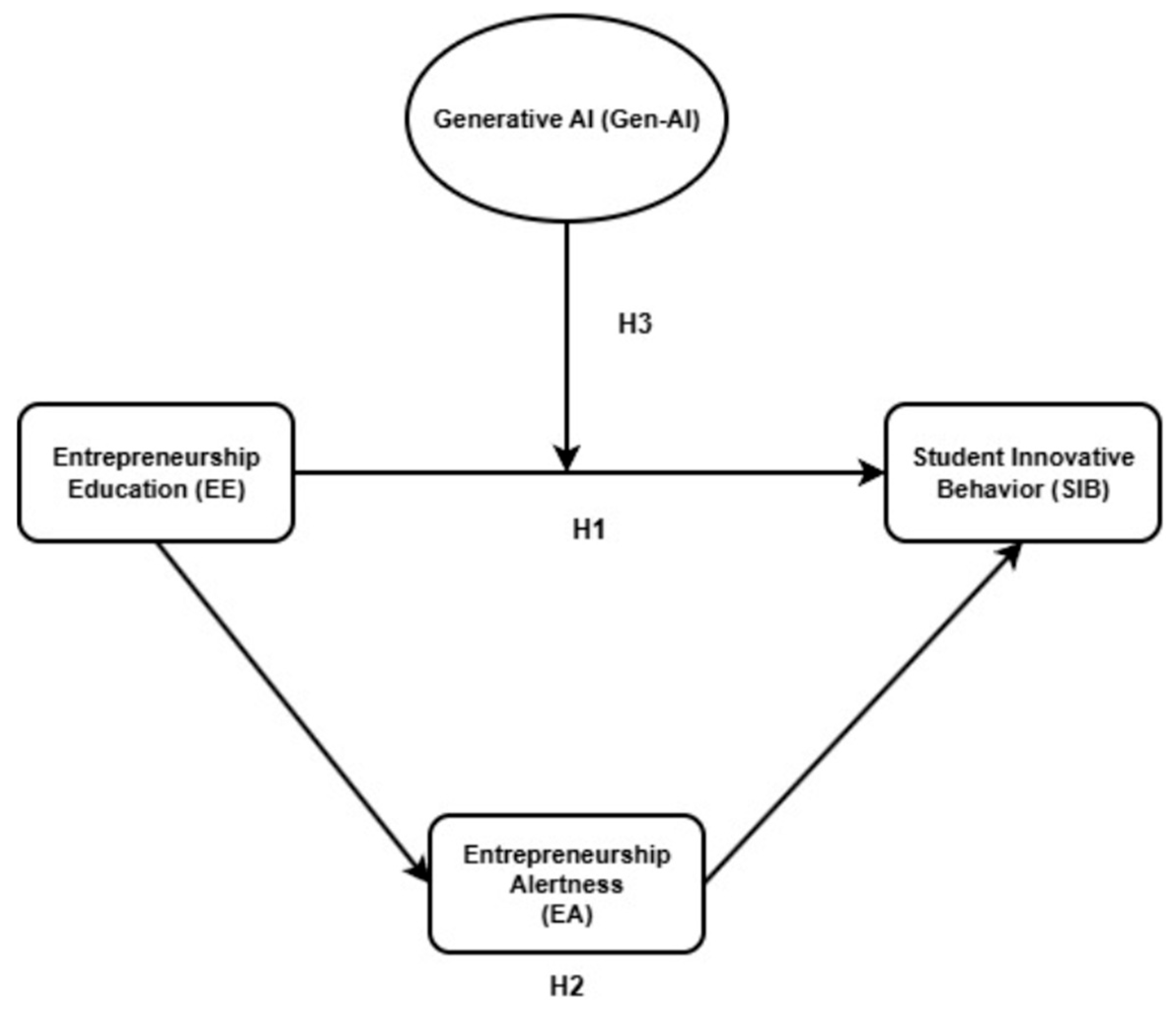
Additionally, the purposes of this research are as follows: (1) To explore the impact of entrepreneurship education on student innovative behavior (H1). (2) To evaluate the mediating role of entrepreneurial alertness in this relationship (H2). (3) To examine whether Gen-AI strengthens the impact of entrepreneurship education on student innovative behavior (H3) (see Figure 1).
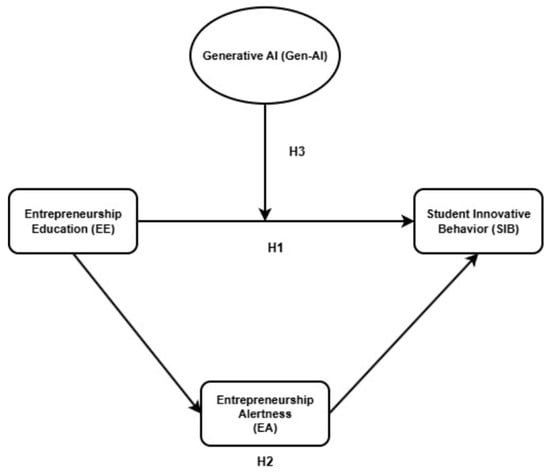
Figure 1.
Conceptual model.
A number of theoretical viewpoints support the relationships proposed by this research. The link between entrepreneurship education and student innovative behavior is founded on the Theory of Planned Behavior (TBP). TBP, initially proposed by Ajzen in late 1991 [19], provides a view through which to examine the dynamics inherent in human behavior, focused on teaching and the learning process, in both generalized education and in the area of utilizing technology with research and education processes [20]. The mediating role of entrepreneurial alertness pulls on Kirzner’s Theory of Entrepreneurial Alertness, highlighting the cognitive capability of people to detect and realize the opportunities in their setting. The implementation of Gen-AI as a moderating factor is sustained by the Technology-Enhanced Learning (TEL) Framework, which proposes that digital technologies can enhance learning results by growing access to information, cultivating cognitive progression, and improving creativity.
The balance of this paper is designed as follows: The following section presents the theoretical background and develops the hypotheses (Section 2), followed by the methodology with our findings (Section 3 and Section 4). The discussion and limitations (Section 5) explore the findings and clarify the theoretical and practical implications. The conclusion (Section 6) finalizes the paper, offering recommendations for further research.
2. Literature Review
2.1. Theoretical Background
Numerous theoretical viewpoints corroborate the relationships suggested by this study. TPB, Theory of Planned Behavior, as developed by Ajzen [19], an American psychologist, considers that all areas that impact a person’s specific behavior should indirectly act on the actual behavior through intention. On the other hand, behavior, attitude, subjective norms, and considered behavioral control are the single factors that impact behavioral intention corresponding to the Theory of Planned Behavior [21].
Alertness Theory theorizes that businesspeople have an exclusive skill in identifying opportunities previously overlooked, an ability cultivated by entrepreneurship instruction. This more focused awareness facilitates objectives in relation to innovation. Empirical data from Soni and Bakhru [22] maintain this, demonstrating that knowledge and experience from the students’ side improve their consciousness of business opportunities, creating entrepreneurial intentions as a result.
Technology-Enhanced Learning (TEL) is a recognized area of academic research with the opportunity to transform pedagogical practices and results. Due to this, we examine the use of technology within the scope of education and learning scenarios (Schneider et al., 2025 [23]). Furthermore, technology-enhanced education or similarly technology-based learning offers an education style in which educators use a variety of technological instruments, like videos, projectors, e-books, and laptops, to offer and support quality learning for pupils. By implementing Technology-Enhanced Learning (TEL) into learning structures, it can improve students’ interest and create curiosity, leading to increased motivation and more active involvement in lessons [24].
Within this comprehensive framework, entrepreneurship education provides the psychological and intentional underpinnings for innovation, as elucidated by the Theory of Planned Behavior, while Generative AI—based on Technology-Enhanced Learning—augments or diminishes the translation of these intentions into innovative actions by fostering cognitive engagement, creativity, and problem-solving capabilities.
2.2. Entrepreneurship Education and Student Innovative Behavior
Education of entrepreneurship is a vital part of nurturing sustainable economic development by preparing individuals with knowledge, abilities, and the necessary mindset to initiate and grow innovative businesses. This education endorses an ethos for entrepreneurship which propels economic growth, creating employment and improving society’s well-being [1]. Entrepreneurship education comprises structured programs focused on encouraging pupils’ knowledge, abilities, and mindsets vital for innovative competency (Kuratko, 2005 [3]). Considered fundamental for creating an approach for entrepreneurial abilities, including entrepreneurial tutoring in educational curricula, creates a culture of entrepreneurship and improves the capabilities of future entrepreneurs. Furthermore, the results consider that a strong entrepreneurship education structure can significantly improve students’ ability to innovate sustainably, in so doing contributing to the wider goals of economic stability and environmental protection [5]. People who are disturbed about further management and entrepreneurship education are more inventive. Additionally, although indirectly, through the correlation between innovation and achievement, specific entrepreneurship education offers better business outcomes. Although achieving greater levels of formal education causes entrepreneurs to be less conformist in the innovative structure [13], the research indicates that most of the interviewed college-student entrepreneurs have increased educational backgrounds with shorter venture-startup times. The majority of entrepreneurs demonstrate greater entrepreneurial endeavors during their university years. Within work environments, the interviewed entrepreneurs demonstrate a sound innovative attitude and strong innovative intentions. Most entrepreneurs utilize innovative processes to resolve practical difficulties within their occupation; thus, an innovative mindset plays a crucial role in increasing the venture’s results. Innovation attitude and innovation performance provide a substantial positive influence on innovation behavior [25]. Entrepreneurship education, alongside a pedagogical method, substantially impacts innovative behavior and varies from the different approaches used by Generation Z students in Indonesia [12].
Although prior studies generally report a positive association between entrepreneurship education and innovative behavior, it is suggested that entrepreneurship education alone may be insufficient to consistently stimulate innovative behavior, highlighting the need to examine the personality and work experience of the entrepreneurs [13].
Adeel et al. [26] argued that students participating in entrepreneurship education are more inclined to leverage prior knowledge and to demonstrate greater interest in identifying new business opportunities, thereby aligning their motivations more effectively toward establishing a new business than other students. Similarly, a study conducted by Cui and Bell [27] indicated that effective entrepreneurial education activities positively influence entrepreneurial behavior, which subsequently mediates the relationship between entrepreneurial education activities and entrepreneurial intention. Grounded in the Theory of Planned Behavior (TPB), entrepreneurship education is hypothesized to affect students’ innovative behavior by influencing their attitudes toward innovation, perceived social norms, and perceived behavioral control. Therefore, we propose the following hypothesis:
H1.
Entrepreneurship education is positively associated with students’ innovative behavior among university students.
2.3. Entrepreneurship Alertness as Mediator
Entrepreneurial alertness, as explained by Kirzner [11], is the capacity to highlight and then capitalize on overlooked prospects, a perception comprehensively examined in collected works relating to entrepreneurship. Kirzner highlighted that entrepreneurs are alert to unique market opportunity signals that offer the chance to explore an innovative opening. Ref. [22] discovered that the intelligence and expertise of students motivate this awareness, leading to stimulating entrepreneurial intentions. These viewpoints together underline the multilevel characteristics of EA, impacted by social, temporal, and cognitive aspects. Entrepreneurship education certainly influences innovation, with EA mediating the relationship. In the research by Cruz et al. [13], the positive influence of education on entrepreneurship and innovative behavior was demonstrated, with respondents reporting greater levels of satisfaction. Furthermore, a study by Ike et al. [28] showed that entrepreneurial alertness significantly mediates the relationship linking proactive personality and entrepreneurial intention within undergraduates; however, it did not mediate the relationship linking proactive personality and innovativeness. This highlights the interaction between endogenous and exogenous implications that influence intention behavior [29]. Additionally, entrepreneurship education positively impacts entrepreneurial alertness, and an entrepreneurial mindset also certainly influences it.
Alternative studies’ results suggest that a positive relationship linking innovative education and learners’ innovative behavior, together with entrepreneurial alertness and higher education support, offers a crucial role in nurturing this relationship [1,15]. Also, EA acts as a mediator between innovative behavior and EE [1]. Entrepreneurship education exerts a positive influence on innovation, and entrepreneurial alertness functions as a mediator in this relationship. The research conducted by Cruz et al. [13] underscores the direct and positive impact of entrepreneurship education on innovative behavior, demonstrating increased participant satisfaction. Kirzner’s alertness theory [11] proposes that entrepreneurs demonstrate a distinctive capacity to recognize previously unnoticed opportunities, a capability that is developed through entrepreneurship education. Therefore, we hypothesize the following:
H2.
Entrepreneurship alertness mediates the relationship between entrepreneurship education and student innovative behavior among university students.
2.4. Generative AI as a Moderator
Generative AI presents progressive emerging technological abilities that improve the entrepreneurial procedure, including automating complicated jobs, refining decision-making, and encouraging innovation [30]. Dwivedi [31] examined the impact of Gen-AI on pupils’ cognitive capabilities in education, specifically in entrepreneurship, as critical thinking and problem-solving are vital aspects. The AI era offers unparalleled opportunities as well as challenges for entrepreneurship education in universities. It encourages universities to amend and innovate their entrepreneurship education programs to offer better opportunities for students and society for the next generation of entrepreneurs [9]. The results indicate that Gen-AI can not only enhance self-efficacy but also boost motivation and involvement and increase entrepreneurial occupation ambitions. The integration of Gen-AI is also predicted to moderate the indirect impact of EE on e-entrepreneurial intention via e-entrepreneurial self-efficacy. EE offers the fundamental abilities and assurance required to engage in entrepreneurship [32]. Gen-AI can reinforce or reduce the transformation of these abilities from intent into accomplishment, contingent on its availability and combination, and it may add value by creating numerous functionalities, such as automating tasks, boosting ingenuity, and assisting with data-driven decision-making [16,33]. The transition for students is to prepare them to succeed in the entrepreneurial environment of the AI age, developing a new generation of entrepreneurs who possess innovative skills, multi-disciplinary abilities, and a strong mindset for social responsibility [9]. Where AI is thoroughly integrated, those with high electronic self-efficacy are more likely to translate their beliefs into intention, as devices reduce the time, effort, and uncertainty associated with the action [34]. On the other hand, in low-AI settings, even the most confident people can experience restrictions that may reduce their limit of expression of their e-entrepreneurial intention [16]. The implementation of AI into education and teaching practices has demonstrated a number of advantages, for example, greater pupil interaction, higher information retention, improved critical thinking abilities, and greater performance all around [34,35]. Additionally, this study’s results/findings offer empirical evidence of the impact of integrating Generative AI into entrepreneurship education and demonstrate the critical significance of supportive higher educational programs in nurturing student entrepreneurship [36]. In spite of the fact that Gen-AI can greatly help enhance humans’ creativity, it may have systemic risk, partly because it can have a negative impact on human creativity and critical thinking. This might lead to over-dependency on Gen-AI and Gen-AI-enhanced processes, potentially bypassing human critical or creative efforts [37]. Many participants were concerned that using AI tools would prevent them from developing self-sufficiency as programmers [38].
Based on Technology-Enhanced Learning (TEL) theory, Gen-AI is anticipated to influence the relationship between entrepreneurship education and student innovative behavior by enhancing cognitive engagement, creativity, and problem-solving abilities. TEL asserts that digital technologies can improve learning outcomes when thoughtfully incorporated into instructional design, facilitating active engagement, feedback, and collaborative knowledge construction. Therefore, Gen-AI integration serves as an appropriate element that moderates the relationship between EE and students’ innovative behavior. As a result, we propose the following hypothesis:
H3.
Generative AI moderates the relationship between entrepreneurship education and student innovation behavior among university students.
3. Materials and Methods
This section includes the research design process, data collection, data analysis, measurement, research participants, and ethical considerations.
3.1. Research Design
This study employs a quantitative research method based on structural equation modeling (SEM). Data were collected at a single point in time to explore the relationships among entrepreneurship education (EE), student innovative behavior (SIB), entrepreneurship alertness (EA), and Generative AI (Gen-AI) within private universities in Lebanon. This study used a simple random sampling strategy to obtain various insights. The authors selected private universities in Lebanon because they focus on innovative methodologies, such as integrating technological advancements in the educational context [10]. G*power software v. 3.1.9.2 was used to estimate the required sample size for this research [39]. To calculate a precise sample size, a small effect size (f2) = 0.1 is selected. The alpha level (α = 0.05) and the statistical power (1 − β = 0.95) were specified, and two predictors were selected based on the study model. According to the software’s recommendation, a minimum of 158 participants is required.
The sample was collected through a non-probability sampling method, focusing on university students who had participated in entrepreneurship-related coursework. Although this sampling approach was considered suitable for the research’s theory-expanding objectives, it has some practical limitations related to access to the target demographic. Simultaneously, it guarantees that participants have the requisite educational background to provide meaningful assessments of entrepreneurship education, entrepreneurial vigilance, and innovative conduct.
The authors distributed 250 questionnaires among students and teachers across private universities in Lebanon. Their responses reflect educational and instructional perspectives on students’ innovative behavior within entrepreneurship education contexts. While data screening was completed and missing data were handled, a total of 197 valid questionnaires were identified as eligible for further analysis. This final number (78%) was an acceptable rate of return.
3.2. Data Collection Tools
The primary data collection tool of the study was a questionnaire. The survey questionnaire had three main sections: a cover letter, demographic information, and the survey. The questionnaire was distributed electronically through different platforms. The electronic distribution approach was selected because it can be performed in real time and is cost-effective. The other advantage is the rapid and easy response from a wide range of locations.
3.3. Data Analysis Procedure
Structural equation modeling (SEM) is used to analyze the data. The authors use Smart PLS rather than other covariance-based methods because Smart PLS4 is less sensitive to non-normal data and is also suitable for smaller sample sizes. From a theoretical perspective, PLS-SEM is appropriate for this study because it supports a prediction-oriented and theory-extending analytical approach. Initially, the outer model was evaluated, including reliability and validity assessments and model fit indicators. In the second stage, the authors assessed the structural model and reported the outer weights and path coefficients, including T-values and p-values. The author also examined the mediating and moderating roles of the variables.
3.4. Measurement
This study used a survey questionnaire developed from previous studies to evaluate the proposed research model, and it was carefully reviewed to ensure contextual relevance to the Lebanese higher-education environment. Entrepreneurship education, student innovative behavior, and the entrepreneurship alertness questionnaire were adapted from Iddris [1]. The five-scale questionnaire on EE evaluates their understanding of entrepreneurial concepts and theories, as well as the necessity of entrepreneurship courses to stimulate interest in entrepreneurship (e.g., I understand the concept of entrepreneurial education). EA was assessed using a five-item instrument. This scale measures alertness as the main factor in attracting profitable opportunities (e.g., I frequently interact with others to acquire new information). SIB was measured using a six-item scale. This tool measures how well innovative ideas and creative solutions in the educational context are supported (e.g., I develop ideas to approach difficult problems in new ways). The moderating variable, Gen-AI use, was measured through a five-item scale developed by Duong and Vu [16]. Although the measurement of Generative AI focuses on its functional use, the construct is conceptualized in this study from a pedagogical rather than a purely instrumental perspective. Specifically, this scale evaluates the incorporation of Gen-AI into the role of entrepreneurship to conduct specific jobs (e.g., Incorporating generative AI into my e-entrepreneurial role would substantially improve business productivity). The items describe the use of Gen-AI as a learning-support tool that facilitates idea generation, problem-solving, feedback, and exploratory learning activities aligned with educational objectives. The survey was rated on a five-point Likert scale ranging from strongly disagree (1) to strongly agree (5).
3.5. Participants’ Profile
The participants’ demographic information encompasses 197 students and teachers from private universities in Lebanon. The gender distribution shows slightly more male respondents (53.3%) than female respondents (46.7%). The age structure indicates that the majority of participants are relatively young, with individuals under 25 years (38.1%) and those aged 25–30 years (36.5%) forming the largest groups. However, 25.4% of participants are over 30 years old, indicating that younger participants constitute the core of the sample. In terms of academic role, students represent the majority (75.1%), while teachers account for 24.9% of the respondents.
3.6. Ethical Consideration
This study followed all required research standards for the inclusion of human participants. The authors have obtained ethical approval for the research from the Ethics Committee of the Islamic University of Lebanon (IUL). Contribution to the study was entirely voluntary, and participants were notified of the study’s goal, scope, and confidentiality by completing the questionnaire. Informed consent was obtained via a cover letter that clarified that all responses would remain anonymous and would be used only for academic and research purposes.
4. Result
4.1. Evaluation of the Reflective Measurement Model
Table 1 presents the reliability assessment of four reflective variables: Entrepreneurship education (EE), student innovative behavior (SIB), entrepreneurship alertness (EA), and Generative AI (Gen-AI). In the table, the observed variables met the recommended outer loading threshold of 0.708 [40]. Internal consistency tests comprise Cronbach’s alpha (α), CR (composite reliability), and AVE (average variance extracted). The assessment demonstrated a strong reliability for the variables that exceeded the 0.7 and 0.5 thresholds for α and CR [40], and AVE, respectively.

Table 1.
Reliability and validity assessment of the constructs.
4.2. Discriminant Validity Assessment
The discriminant validity of the construct was measured by the Heterotrait–Monotrait ratio of correlations (HTMT). All HTMT index values, as displayed in Table 2, are less than 0.9, demonstrating discriminant validity and aligning with [41].
Table 2.
Discriminant validity.
4.3. Model Fit
Model fit was evaluated by the saturated SRMR (0.026), which is well below the 0.08 threshold, and the NFI (0.953), which exceeds the recommended 0.90 cutoff. Both coefficients confirmed a satisfactory model fit.
4.4. Common Method Bias
Based on the results in Table 3, the model is free of common method bias. All VIFs from the whole collinearity test are less than five, suggesting that common method bias is unlikely to be a serious concern in this study [42].
Table 3.
Common method bias.
4.5. Evaluation of the Structural Model
4.5.1. Direct Effects
Table 4 shows that EE has a positive and significant effect on SIB, which supports H1 (β = 0.352, t = 4.972, p < 0.001). The hypothesis indicates that higher levels of entrepreneurship education are associated with greater innovative behavior among students in the Lebanese educational context.
Table 4.
Hypothesis testing of the structural model.
4.5.2. Mediation Analysis
The entrepreneurial alertness plays a significant role in entrepreneurship education and student innovative behavior, which supports H2 (β = 0.394, t = 6.657, p < 0.001). This finding indicates that entrepreneurship education enhances entrepreneurial alertness, which, in turn, boosts students’ innovative behavior, thereby representing a meaningful mediating mechanism.
4.5.3. Moderation Analysis
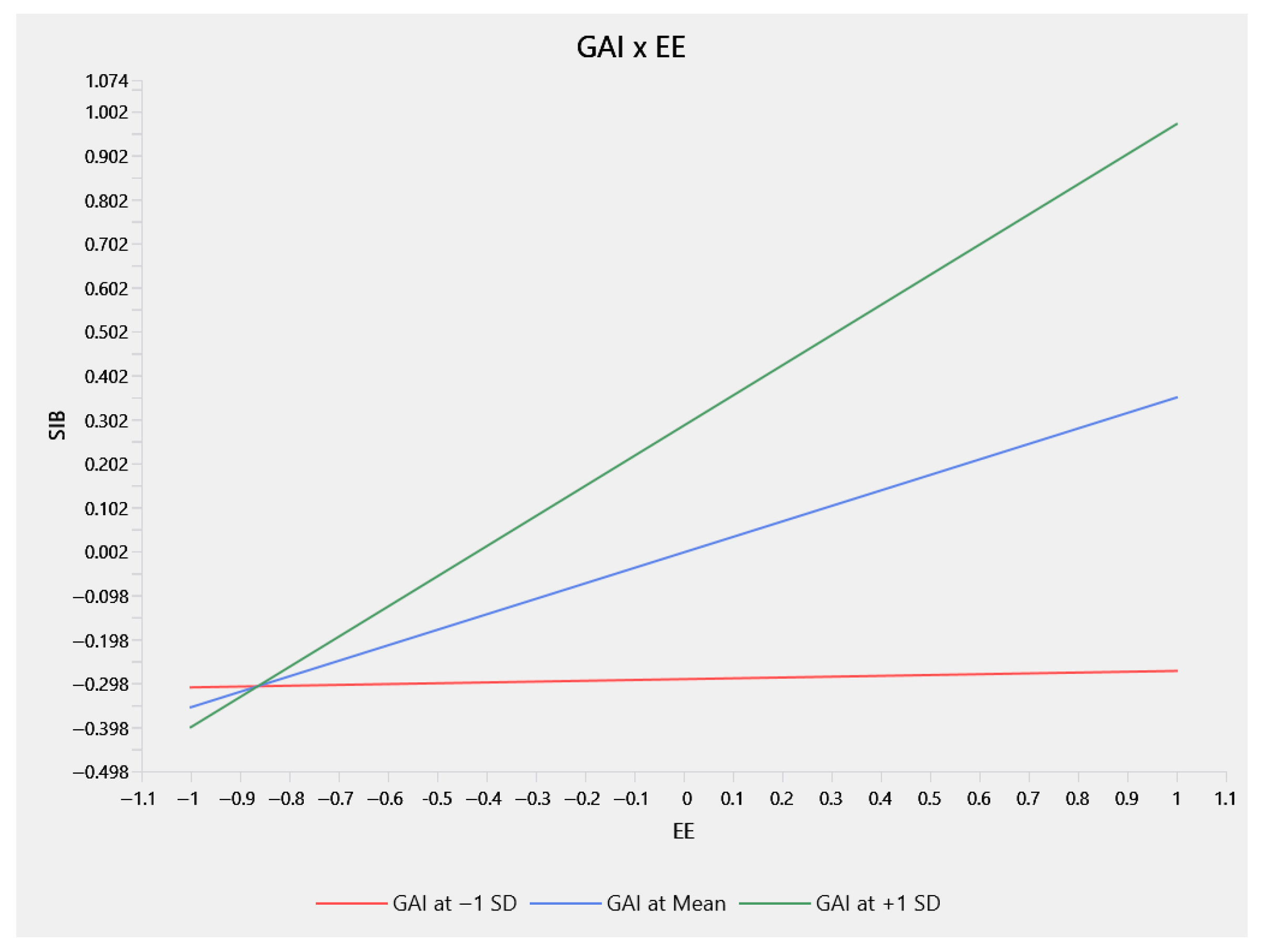
H3 of the study is also supported by measuring the interaction effect of Generative AI between entrepreneurship education and student innovative behavior (β = 0.333, t = 7.913, p < 0.001). This indicates that Generative AI strengthens EE’s influence on SIB. In other words, when Generative AI use is higher, the positive effect of entrepreneurship education on innovation becomes more pronounced.
4.5.4. The Assessment of the Moderator
Figure 2 demonstrates that Generative AI (Gen-AI) markedly enhances the positive correlation between Entrepreneurship Education (EE) and Student Innovative Behavior (SIB). When Gen-AI is elevated (+1 SD), the slope between EE and SIB becomes significantly steeper, suggesting that students with greater exposure to Generative AI derive larger advantages from entrepreneurship education in terms of innovative behavior. At low Gen-AI (−1 SD), the correlation remains positive but significantly attenuated. This pattern affirms that Generative AI enhances the influence of entrepreneurship education on student innovative behavior, offering unambiguous evidence of a substantial moderating effect within the structural model.
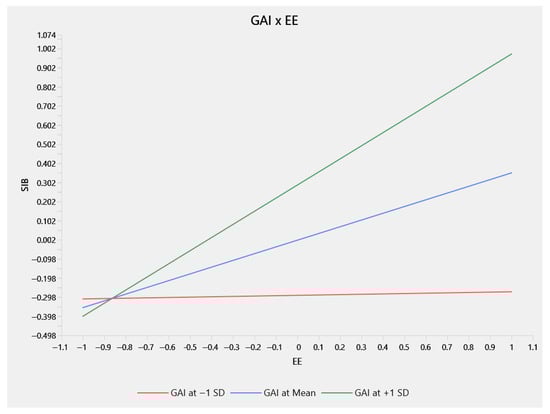
Figure 2.
Structural model coefficients.
5. Discussion
This research examined the impact of EE on SIB, with a focus on the mediating role of EA. Furthermore, the interaction effect of Gen-AI was investigated in the Lebanese setting, relating to the Theory of Planned Behavior (TPB), the Theory of Entrepreneurial Alertness, and the Technology-Enhanced Learning (TEL) framework. This study’s findings were in accordance with the articulated hypotheses and prior research [1,16]. Lebanese higher education operates within a setting marked by economic uncertainty, labor market instability, and constrained employment opportunities, which may intensify students’ sensitivity to entrepreneurship education as a pathway for self-reliance and innovation [43].
The initial hypothesis theorized that entrepreneurship education has a direct positive impact on students’ innovative behavior. The study’s findings support the first hypothesis (H1), confirming previous studies’ results that entrepreneurship education can promote students’ innovative behavior [1]. This suggests that EE creates an environment where students develop vital knowledge, understandings, and skills that boost their proficiencies for self-employment by way of small businesses, therefore stimulating economic growth and development [7].
The study’s second hypothesis (H2) is also validated, indicating that alertness mediates the relationship between EE and SIB. EE provides students with the ability to recognize innovative opportunities and adopt EA. This correlates with previous research demonstrating that students’ alertness enhances innovative behavior [15]. The students who have greater alertness can distinguish innovative solutions that will effectively assist market and customer requirements by creating accessible data [28].
Additionally, our findings support H3, reiterating the results of Ji et al. [44], Xu et al. [45], and Pang et al. [46] to underline the importance of Generative AI in reinforcing innovative behavior. Entrepreneurship education emboldens students with information, abilities, and experiences, promoting quality learning practices. Furthermore, the implementation of Generative AI offers progressive technological capabilities that boost the entrepreneurial process, like systematizing complex jobs, assisting with managerial decision-making, and nurturing initiatives (Duong & Vu, 2025 [16]).
Furthermore, quality education is a deliberate instrument to achieve goal four of the SDGs, which encourages countries to create organizations and human resources to operationalize and accomplish the target. The development of quality education has assisted the evolution of individuals and organizations, which has helped significantly to achieve stronger institutions and more educated individuals than ever before [18].
5.1. Theoretical Implications
Our research offers tremendous theoretical contributions to the area of higher education by further growing the prevailing collected works and giving insights into the complicated relationship between EE and students’ innovative behavior. Initially, our study offers to entrepreneurship education literature by exploring the effect of EE on SIB. Our research expands the Theory of Planned Behavior (TPB) by showing that entrepreneurship education does not just shape students’ approaches and suggested behavioral control, as posited by TPB, but further converts these psychological parts into actual innovative behaviors. This widens the TPB’s empirical scope and demonstrates the importance of official educational policies to create innovation-promoting behaviors.
Secondly, this research strengthens and expands Kirzner’s Theory of Entrepreneurial Alertness by focusing on the significance of mental developments and enhanced consciousness in creating ground-breaking actions. This is because EE is inclined to improve mental capabilities by promoting people to actively look at new business opportunities [1]. The findings highlight that individuals opened up to entrepreneurship education acquire heightened skills to detect patterns, explore opportunities, and understand appropriate suggestions—talents central to Kirzner’s perception of the alert entrepreneur.
Thirdly, the research develops the Technology-Enhanced Learning (TEL) Framework by demonstrating that Generative AI bolsters the educational route to innovation by individuals. Teachers can offer more interactive and personal teaching environments, providing for wider pupils’ requirements and learning choices through Technology Enhanced Learning (TEL) [47]. As TEL findings validate Gen-AI implementation in real learning environments, the extensive integration is developing into a central focus [35]. By demonstrating how Gen-AI enhances the relationship between entrepreneurship education and students’ innovative behavior, it further moderates the indirect impacts. This study highlights the transformation function of advanced technologies in entrepreneurial procedures. The transformational potential of Gen-AI remains in its capacity to generate personalized learning experiences designed for diverse requirements, nurturing a more equitable and current set of educational needs [35].
5.2. Practical Implications
The constructive relationship between EE and SIB requires a change in educational focus to enthusiastically engage and generate critical and analytical thinking and inspiration [48]. Comprehending how instruction molds consistent advanced practices alongside successes in the global business environment should help manage the expansion of active educational programs [1]. Universities and Higher Educational establishments vigorously drive the revolution of entrepreneurship education through collaboration and integration with businesses, offering mentorship courses and integrating industries with education. This thorough methodology aims to enable students to possess a more comprehensive understanding and use of AI technology, focusing more on the practical applications and generating holistic abilities, together with ethical mindsets and a sense of social responsibility [9]. Implementing Gen-AI with EE within educational facilities might improve students’ electronic entrepreneurial development. Furthermore, teachers are required to weigh up the use of Gen-AI training against the development of additional crucial entrepreneurship skills. For example, pupils must be educated to integrate Generative AI within planning for business, customer analysis, and innovation in product design, while further advancing strong skills in other aspects of business, including leadership, strategizing, and decision-making. This even approach enables students to use Generative AI to progress further without overlooking fundamental entrepreneurial principles. Policymakers and teachers must work together to advance approaches that nurture electronic literacy and entrepreneurial proficiency to train pupils for business opportunities, which are mainly technology-focused [16]. Additionally, policymakers must promote policies that endorse creative thinking, problem-solving, and innovation within entrepreneurship education.
5.3. Limitations of the Study
Although this research offers valuable perceptions in relation to entrepreneurship education and student innovative behavior, a number of limitations should be observed. Initially, the research depended on data from students and lecturers from universities in Lebanon, and although this group is a vital aspect of our research, the results may not be generalized to other locations and populations. Future studies could examine different regions or countries to corroborate and expand these findings. Secondly, the research used random sample data, thus limiting the capability to make causal inferences concerning the association between the study’s variables. Although the data are in line with existing theories and previous research, longitudinal research provides stronger evidence of the impact of entrepreneurship education, entrepreneurship alertness, and the integration of Generative AI on students’ innovative behavior over time. Third, this study is restricted to exploring only the interaction impact of one moderator. Thus, further studies can examine additional moderating factors that influence the relationship between EE and SIB. Such factors could be universal networking prospects, cultural diversity, and multicultural training, which refine the intensity and objective of these associations. Exploring these interaction effects could play a role in a more complete comprehension of the relationship between EE, EA, and students’ innovative behavior. Although this study is based on a quantitative research method, future research could employ mixed-methods strategies, integrating surveys with qualitative interviews, focus groups, or classroom observations to obtain more comprehensive insights into students’ learning processes, mechanisms of opportunity recognition, and practices related to technology use.
6. Conclusions
This study examined how entrepreneurship education focuses on student innovative behavior within Lebanese universities. It also clarifies how entrepreneurial alertness and Generative AI strengthen this relationship. The findings offer clear empirical support for the proposed model. In accordance with the study findings, H1 demonstrates the significant impact of entrepreneurship education on student innovative behavior. It verifies that exposure to entrepreneurial conceptions, real-world procedures, and opportunity-driven educational environments improves students’ creative problem-solving and idea initiation capabilities. H2 reaffirms the mediating role of entrepreneurial alertness, which means students who took entrepreneurship education acquired increased alertness, thereby significantly elevating their innovative behavior. H3 underlines the vital role of Gen-AI as a moderating variable, highlighting that students who keenly utilize or engage with Gen-AI advance more effectively from entrepreneurship education. Regardless of the increasing relevance of entrepreneurship education, the results reveal constant limitations in students’ creativity and innovation, together with inadequate mentorship and training prospects for university lecturers in Lebanon. As a result, the study highlights the relevance of integrating innovative practices, digital tools, and sustainable education values into pedagogical advancement to foster innovative behavior within university students.
Author Contributions
Conceptualization, P.F., N.S.D., F.E.Z.R., and H.H.; methodology, P.F., N.S.D., F.E.Z.R., and H.H.; software, P.F., N.S.D., F.E.Z.R., and H.H.; validation, P.F., N.S.D., F.E.Z.R., and H.H.; formal analysis, P.F., N.S.D., F.E.Z.R., and H.H.; investigation, P.F., N.S.D., F.E.Z.R., and H.H.; resources, P.F., N.S.D., F.E.Z.R., and H.H.; data curation, P.F., N.S.D., F.E.Z.R., and H.H.; writing—original draft preparation, P.F., N.S.D., F.E.Z.R., and H.H.; writing—review and editing, P.F., N.S.D., F.E.Z.R., and H.H.; visualization, P.F., N.S.D., F.E.Z.R., and H.H.; supervision, P.F., N.S.D., F.E.Z.R., and H.H.; and project administration, P.F., N.S.D., F.E.Z.R., and H.H. All authors contributed equally. All authors have read and agreed to the published version of the manuscript.
Funding
This research received no external funding.
Institutional Review Board Statement
The study was conducted in accordance with the Declaration of Helsinki and approved by the Ethics Committee of the Islamic University of Lebanon (IUL-EC-25-A003 on 23 October 2025).
Informed Consent Statement
Informed consent was obtained from all respondents participating in the survey.
Data Availability Statement
The data are restricted due to ethical and privacy considerations.
Acknowledgments
The authors appreciate the efforts of the anonymous reviewers in improving the quality and presentation of their work.
Conflicts of Interest
The authors declare no conflict of interest.
References
- Iddris, F. Entrepreneurship Education on International Entrepreneurship Intention: The Role of Entrepreneurship Alertness, Proactive Personality, Innovative Behaviour and Global Mindset. J. Appl. Res. High. Educ. 2025, 17, 640–662. [Google Scholar] [CrossRef]
- Suguna, M.; Sreenivasan, A.; Ravi, L.; Devarajan, M.; Suresh, M.; Almazyad, A.S.; Xiong, G.; Ali, I.; Wagdy Mohamed, A. Entrepreneurial Education and Its Role in Fostering Sustainable Communities. Sci. Rep. 2024, 14, 7588. [Google Scholar] [CrossRef] [PubMed]
- Kuratko, D. The Emergence of Entrepreneurship Education: Development, Trends, and Challenges. Entrep. Theory Pract. 2005, 29, 577–597. [Google Scholar] [CrossRef]
- Jones, C.; Matlay, H. Understanding the Heterogeneity of Entrepreneurship Education: Going beyond Gartner. Educ. + Train. 2011, 53, 692–703. [Google Scholar] [CrossRef]
- Egbetola, O.; Oyewole, O. Promoting Sustainable Economic Development Through Entrepreneurship Education. J. Sci. Vocat. Tech. Educ. 2024, 11, 74–82. [Google Scholar]
- Zappe, S. Teaching for Creativity, Entrepreneurship, and Leadership in Engineering. Int. Handb. Eng. Educ. Res. 2023, 1, 433–456. [Google Scholar]
- Enebe, N.; Heystek, J. Key Determinants of Instructional Leadership in Advancing Entrepreneurship Education Implementation in Senior Phase Schools, North West Province, South Africa. Interdiscip. J. Educ. Res. 2025, 7, a18. [Google Scholar] [CrossRef]
- KomKodromos, M. A Literature Review on the Emergence of Entrepreneurship Education: Development, Trends, and Challenges. In Integrating Simulation Tools into Entrepreneurship Education; IGI Global Scientific Publishing: Hershey, PA, USA, 2025. [Google Scholar]
- Mu, Q.; Zhao, Y. Transforming Entrepreneurship Education in the Age of Artificial Intelligence. Resour. Data J. 2024, 3, 2–20. [Google Scholar]
- Chible, H. Perspectives on Generative Artificial Intelligence Among Professors from the Lebanese University: A Sample-Based Overview. 2025. Available online: https://www.researchgate.net/profile/Hussein-Chible/publication/392557671_Perspectives_on_Generative_Artificial_Intelligence_Among_Professors_from_the_Lebanese_University_A_Sample-Based_Overview/links/684884516a754f72b591b558/Perspectives-on-Generative-Artificial-Intelligence-Among-Professors-from-the-Lebanese-University-A-Sample-Based-Overview.pdf (accessed on 22 November 2025).
- Kirzner, I. Competition and Entrepreneurship. Available online: https://scholar.google.com/scholar?q=Kirzner,+I.M.+(1973),+Competition+and+Entrepreneurship,+University+of+Chicago+Press,+Chicago,+IL.&hl=en&as_sdt=0,5 (accessed on 22 November 2025).
- Irawanto, D.W.; Novianti, K.R. Entrepreneurship Education in Higher Education: Optimizing Innovative Behaviour of z Generation. Indones. J. Bus. Entrep. (IJBE) 2021, 7, 11. [Google Scholar] [CrossRef]
- Cruz, N.M.; Rodriguez Escudero, A.I.; Hernangomez Barahona, J.; Saboia Leitao, F. The Effect of Entrepreneurship Education Programmes on Satisfaction with Innovation Behaviour and Performance. J. Eur. Ind. Train. 2009, 33, 198–214. [Google Scholar] [CrossRef]
- Wei, X.; Liu, X.; Sha, J. How Does the Entrepreneurship Education Influence the Students’ Innovation? Testing on the Multiple Mediation Model. Front. Psychol. 2019, 10, 1557. [Google Scholar] [CrossRef]
- Iddris, F.; Salifu, I.; Mensah Kparl, E. Leveraging Learner Innovative Behaviour through Innovation Education: The Mediating Role of Entrepreneurial Alertness and the Moderating Effect of University Support. Innov. Educ. Teach. Int. 2024, 1–18. [Google Scholar] [CrossRef]
- Duong, C.D.; Vu, T.N. Entrepreneurial Education and Higher Education Students’ e-Entrepreneurial Intention: A Moderated Mediation Model of Generative AI Incorporation and e-Entrepreneurial Self-Efficacy. High. Educ. Ski. Work.-Based Learn. 2025, 15, 1024–1048. [Google Scholar] [CrossRef]
- Branca, E.; Vanderstraeten, J.; Slabbinck, H.; Maes, I.M. The Impact of Entrepreneurial Education on Key Entrepreneurial Competencies: A Systematic Review of Learning Strategies and Tools. Int. J. Manag. Educ. 2025, 23, 101144. [Google Scholar] [CrossRef]
- Awini, G.; Mensah, K.; Majeed, M.; Mahmoud, M.A.; Braimah, S.M. The Use of Innovative Pedagogies in Attaining Un Sustainable Development Goal 4: Quality Education for Learning Outcomes in Emerging Markets. In Digital Analytics Applications for Sustainable Training and Education; Apple Academic Press: Palm Bay, FL, USA, 2024; pp. 257–274. [Google Scholar] [CrossRef]
- Ajzen, I. The Theory of Planned Behavior. Organ. Behav. Hum. Decis. Process. 1991, 50, 179–211. [Google Scholar] [CrossRef]
- Ivanov, S.; Soliman, M.; Tuomi, A. Drivers of Generative AI Adoption in Higher Education through the Lens of the Theory of Planned Behaviour. Technol. Soc. 2024, 77, 102521. [Google Scholar] [CrossRef]
- Ma, L.; Lan, Z.; Tan, R. Influencing factors of innovation and entrepreneurship education based on the theory of planned behavior. Int. J. Emerg. Technol. Learn. (Ijet) 2020, 15, 190–206. [Google Scholar] [CrossRef]
- Soni, A.; Bakhru, K. Mediation Effect of Entrepreneurial Alertness between Prior Knowledge and Experience on Entrepreneurial Intention among Accountancy Students. Bus. Perspect. Res. 2023, 22785337231162755. [Google Scholar] [CrossRef]
- Schneider, J.; Limbu, B.; Kiesler, N. Of House of Cards and Air Castles, a Deep Dive into the Fertile Fields of Educational Technologies and Technology Enhanced Learning. J. Comput. High. Educ. 2025, 37, 561–613. [Google Scholar] [CrossRef]
- Novitriani, G.; Sari, N.; Arnelita, M. Learning Interest: How Does the Experimentation of the Technology-Enhanced Learning (TEL) Models? Action Res. J. Indones. (ARJI) 2025, 7, 1548–1562. [Google Scholar] [CrossRef]
- Zhang, B.; Han, S.; Xu, Q.; Jiao, L. Construction of Innovation Behavior of College-Student Entrepreneurs Using Entrepreneurship and Innovation Theory under Educational Psychology. Front. Psychol. 2021, 12, 697924. [Google Scholar] [CrossRef]
- Adeel, S.; Daniel, A.; Botelho, A. The Effect of Entrepreneurship Education on the Determinants of Entrepreneurial Behaviour among Higher Education Students: A Multi-Group Analysis. J. Innov. Knowl. 2023, 8, 100324. [Google Scholar] [CrossRef]
- Cui, J.; Bell, R. Behavioural Entrepreneurial Mindset: How Entrepreneurial Education Activity Impacts Entrepreneurial Intention and Behaviour. Int. J. Manag. Educ. 2022, 20, 100639. [Google Scholar] [CrossRef]
- Ike, O.O.; Okwuchukwu, E.I.; Eyisi, D.C. Through Entrepreneurial Alertness as a Mediator between Innovativeness, Proactive Personality, and Entrepreneurial Intention among Undergraduate Students. Discov. Psychol. 2025, 5, 56. [Google Scholar] [CrossRef]
- Wandana, J.; Soelaiman, L. Bridging Entrepreneurship Education and Entrepreneurial Alertness: The Mediating Role of Entrepreneurial Mindset. Int. J. Manang. Econ. Invent. 2024, 10, 3532–3539. [Google Scholar] [CrossRef]
- Farmanesh, P.; Solati Dehkordi, N.; Vehbi, A.; Chavali, K. Artificial Intelligence and Green Innovation in Small and Medium-Sized Enterprises and Competitive-Advantage Drive Toward Achieving Sustainable Development Goals. Sustainability 2025, 17, 2162. [Google Scholar] [CrossRef]
- Dwivedi, Y.K. Generative Artificial Intelligence (GenAI) in Entrepreneurial Education and Practice: Emerging Insights, the GAIN Framework, and Research Agenda. Int. Entrep. Manag. J. 2025, 21, 82. [Google Scholar] [CrossRef]
- Şahin, E.; Sarı, U.; Şen, Ö.F. STEM Professional Development Program for Gifted Education Teachers: STEM Lesson Plan Design Competence, Self-Efficacy, Computational Thinking and entrepreneurial skills. Think. Ski. Creat. 2024, 51, 101439. [Google Scholar] [CrossRef]
- Farmanesh, P.; Vehbi, A.; Solati Dehkordi, N. AI Literacy in Achieving Sustainable Development Goals: The Interplay of Student Engagement and Anxiety Reduction in Northern Cyprus Universities. Sustainability 2025, 17, 4763. [Google Scholar] [CrossRef]
- Farmanesh, P.; Gharibi Khoshkar, P.; Vehbi, A.; Solati Dehkordi, N. Leading Sustainability in the Age of Eco-Anxiety: The Role of Employee Well-Being in Driving Environmental Performance Among Green Companies. Sustainability 2025, 17, 10989. [Google Scholar] [CrossRef]
- Shankar, S.K.; Pothancheri, G.; Sasi, D.; Mishra, S. Bringing Teachers in the Loop: Exploring Perspectives on Integrating Generative AI in Technology-Enhanced Learning. Int. J. Artif. Intell. Educ. 2025, 35, 155–180. [Google Scholar] [CrossRef]
- Xie, Y.; Wang, S. Generative Artificial Intelligence in Entrepreneurship Education Enhances Entrepreneurial Intention through Self-Efficacy and University Support. Sci. Rep. 2025, 15, 24079. [Google Scholar] [CrossRef] [PubMed]
- Cabrero-Daniel, B. How Reliance on GenAI Might Limit Human Creativity and Critical Thinking in Requirements Engineering. 2025. Available online: https://ceur-ws.org/Vol-3959/CreaRE-paper1.pdf (accessed on 22 November 2025).
- Farmanesh, P.; Vehbi, A.; Dehkordi, N.S. Uprooting Technostress: Digital Leadership Empowering Employee Well-Being in the Era of Industry 4.0. Sustainability 2025, 17, 8868. [Google Scholar] [CrossRef]
- Vehbi, A.; Farmanesh, P.; Solati Dehkordi, N. Nexus Amid Green Marketing, Green Business Strategy, and Competitive Business Among the Fashion Industry: Does Environmental Turbulence Matter? Sustainability 2025, 17, 1769. [Google Scholar] [CrossRef]
- Hair, J.F., Jr.; Hult, G.T.M.; Ringle, C.M.; Sarstedt, M.; Danks, N.P.; Ray, S. Partial Least Squares Structural Equation Modeling (PLS-SEM) Using R: A Workbook; Springer Nature: London, UK, 2021. [Google Scholar]
- Henseler, J.; Ringle, C.M.; Sarstedt, M. A New Criterion for Assessing Discriminant Validity in Variance-Based Structural Equation Modeling. J. Acad. Mark. Sci. 2025, 43, 115–135. [Google Scholar] [CrossRef]
- Kock, N.; Lynn, G. Lateral Collinearity and Misleading Results in Variance-Based SEM: An Illustration and Recommendations. J. Assoc. Inf. Syst. 2012, 13, 546–580. [Google Scholar] [CrossRef]
- Dabbous, A.; Boustani, N. Digital Explosion and Entrepreneurship Education: Impact on Promoting Entrepreneurial Intention for Business Students. J. Risk Financ. Manag. 2023, 16, 27. [Google Scholar] [CrossRef]
- Ji, Y.; Zhong, M.; Lyu, S.; Li, T.; Niu, S.; Zhan, Z. How Does AI Literacy Affect Individual Innovative Behavior: The Mediating Role of Psychological Need Satisfaction, Creative Self-Efficacy, and Self-Regulated Learning. Educ. Inf. Technol. 2025, 30, 16133–16162. [Google Scholar] [CrossRef]
- Xu, H.; Xu, R.; Lin, H. The Impact of Generative Artificial Intelligence on Organizational Innovation Performance: Roles of AI Generated Content Quality, AI Experience, and AI Usage Environment. In Proceedings of the 2024 ASU International Conference in Emerging Technologies for Sustainability and Intelligent Systems (ICETSIS), Manama, Bahrain, 28–29 January 2024; IEEE: New York, NY, USA, 2024. [Google Scholar]
- Pang, H.; Wang, Y. Deciphering Dynamic Effects of Mobile App Addiction, Privacy Concern and Cognitive Overload on Subjective Well-Being and Academic Expectancy: The Pivotal Function of Perceived Technostress. Technol. Soc. 2025, 81, 102861. [Google Scholar] [CrossRef]
- Song, Y.; Wong, L.-H.; Looi, C.-K. Fostering Personalized Learning in Science Inquiry Supported by Mobile Technologies. Educ. Technol. Res. Dev. 2012, 60, 679–701. [Google Scholar] [CrossRef]
- Yang, H.; Zhu, H.; Luo, W.; Peng, W. Design and Practice of Innovative Practice Workshop for New Nurses Based on Creativity Component Theory and Outcome Based Education (OBE) Concept. BMC Med. Educ. 2023, 23, 700. [Google Scholar] [CrossRef]
Disclaimer/Publisher’s Note: The statements, opinions and data contained in all publications are solely those of the individual author(s) and contributor(s) and not of MDPI and/or the editor(s). MDPI and/or the editor(s) disclaim responsibility for any injury to people or property resulting from any ideas, methods, instructions or products referred to in the content. |
© 2026 by the authors. Licensee MDPI, Basel, Switzerland. This article is an open access article distributed under the terms and conditions of the Creative Commons Attribution (CC BY) license.