Artificial Intelligence and Sustainability in Industry 4.0 and 5.0: Trends, Networks of Leading Countries and Evolution of the Research Focus



Abstract
1. Introduction
1.1. Background
1.2. Literature Review
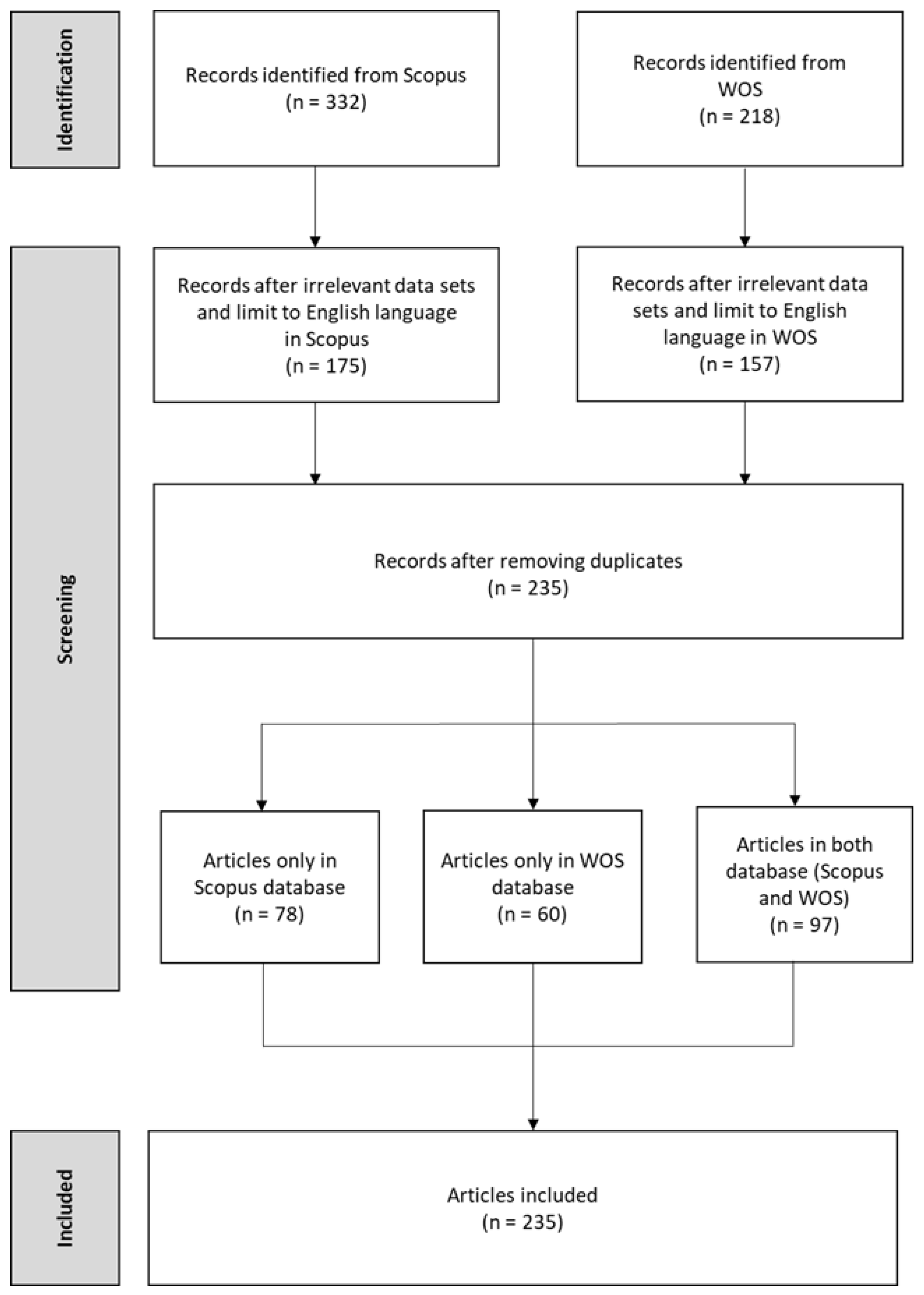
2. Materials and Methods
3. Results
3.1. Relations to Journals of Publication
3.2. Categorization of Published Studies by Variables and Sub-Variables
- Sector, where economic activities are classified into: primary (agriculture, forestry, fisheries), secondary (industry, mining, construction, energy), tertiary (trade, tourism, transportation), and quaternary (healthcare, education, culture) [271];
- Types of AI, divided into: (1) machine learning, (2) neural networks, (3) expert systems, (4) robotics, (5) natural language processing, and (6) fuzzy logic [18];
- Sustainability aspects, focusing on SDG 12, which addresses responsible consumption and production. On this basis, we included the variables energy usage and efficiency, waste reduction, greenhouse gas emissions, and carbon footprint reduction [272]. In addition, in accordance with the document of the European Banking Authority, we also included the variables air pollutants and water usage and recycling [273].
3.3. Bibliometric Analysis of Reviewed Literature Network Connectivity
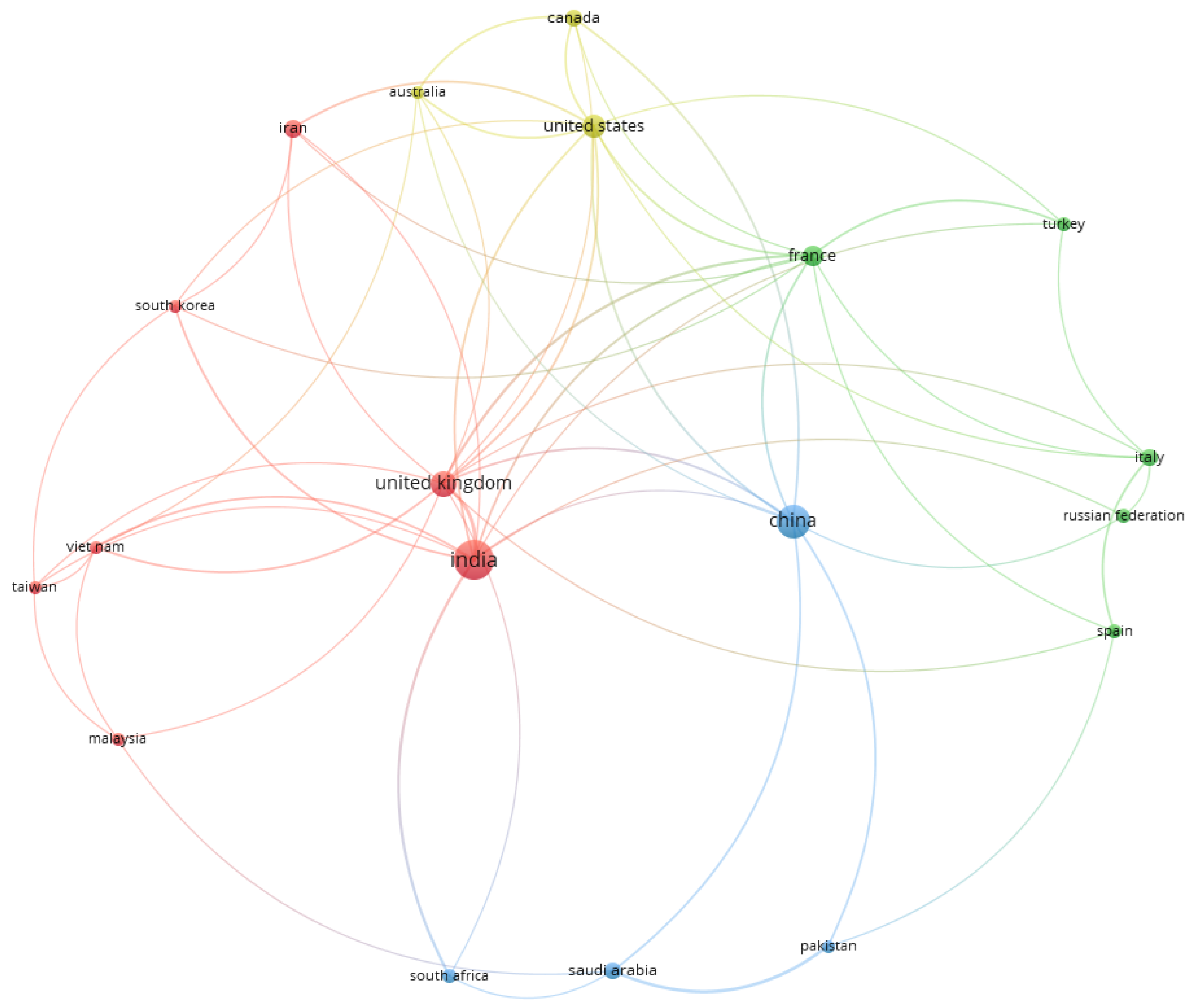
3.3.1. Geographical Distribution Analysis of Countries
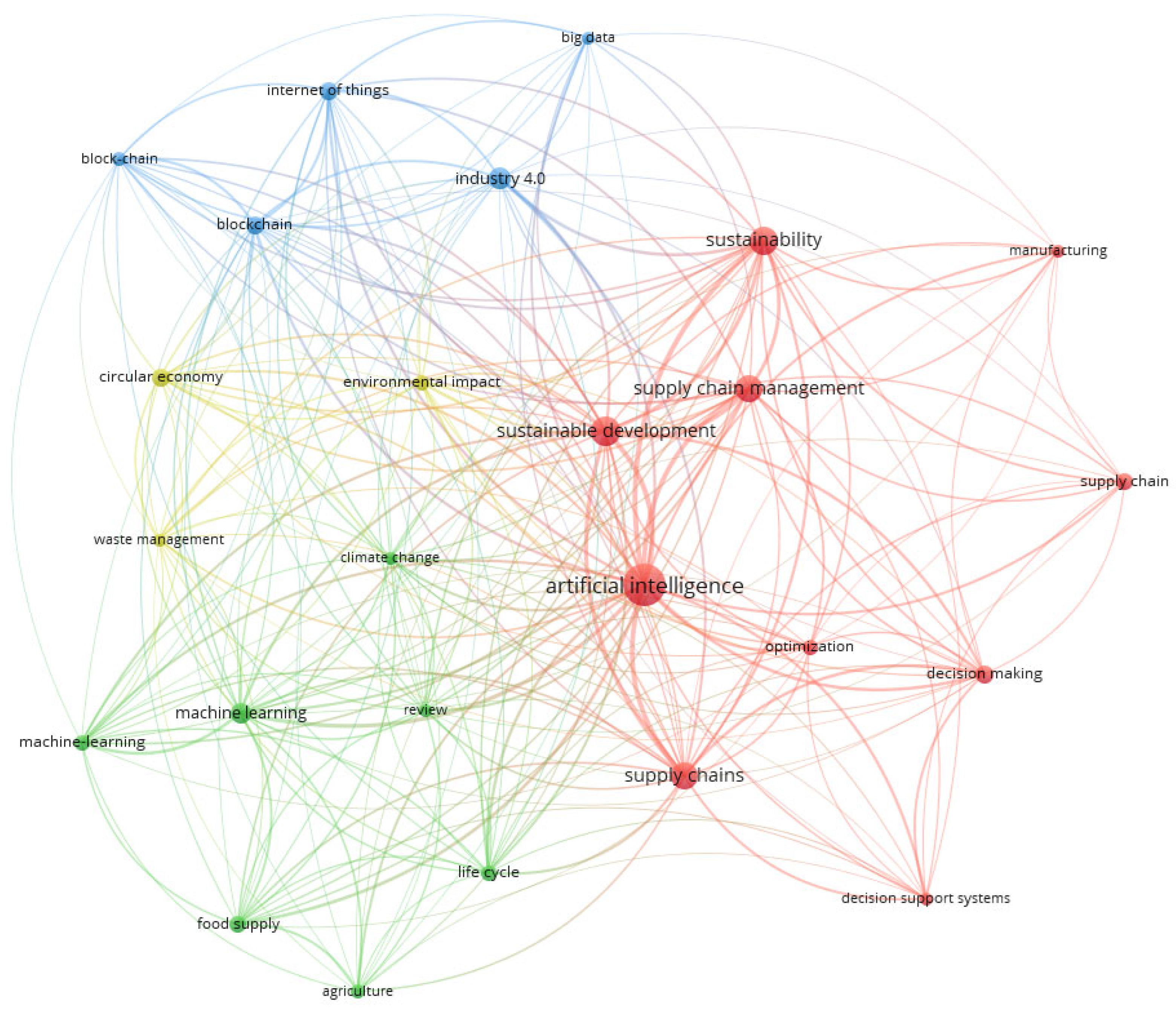
3.3.2. Co-Occurrence Analysis of All Keywords
4. Discussion
- Examining the circular economy in the context of both managerial and technical research focus provides insights into how strategic and operational practices support the effective implementation of circular models to achieve sustainability goals. The managerial perspective defines sustainability objectives, policies, and decision-making frameworks, while the technical perspective, particularly through the application of AI, enables their operational realization by optimizing resources, reducing waste, and enhancing circular processes in supply chain management. Integrating both perspectives with AI is essential for the effective implementation of circular economy practices and for their measurable contribution to SDG 12.
- Research connecting the development of Industry 5.0 with sustainable development, particularly SDG 12, is essential, as Industry 5.0 emphasizes human-centered approaches and environmental care, which can significantly contribute to more responsible consumption and production. This includes the development of measurable KPIs to monitor the impact of Industry 5.0 on sustainability practices. Integrating Industry 5.0 practices with circular economy principles can enhance sustainable outcomes and provide practical guidance for both research and industry.
- Integrating AI with sustainable development, particularly SDG 12, enables practical applications across industrial sectors. Machine learning and neural networks can optimize energy consumption in manufacturing, allowing real-time adjustments that reduce greenhouse gas emissions. Predictive maintenance using expert systems helps prevent equipment failures and minimize defective products, contributing to waste reduction and efficient resource use. Robotics combined with computer vision can automate waste sorting, enhancing circularity and resource recovery, while natural language processing can analyze supplier reports to monitor sustainability compliance. Together, these AI applications link operational efficiency with sustainability objectives and provide a foundation for methodological frameworks to systematically assess contributions to circular economy practices and SDG 12.
- Examining the connections between AI and Industry 4.0 and 5.0 supports the development of solutions that enhance operational efficiency and drive sustainable industrial transformation. For example, in Industry 4.0, machine learning and neural networks can optimize energy consumption in automated production lines, while in Industry 5.0, AI combined with human-centric robotics can assist workers in adaptive assembly processes, improving efficiency and reducing waste. Future research will focus on developing methodological frameworks that link AI techniques with both industrial paradigms, enabling the assessment of their contribution to circularity and SDG 12 through measurable sustainability indicators.
5. Conclusions
Author Contributions
Funding
Institutional Review Board Statement
Informed Consent Statement
Data Availability Statement
Conflicts of Interest
References
- Geels, F.W. Technological Transitions and System Innovations: A Co-Evolutionary and Socio-Technical Analysis; Edward Elgar Publishing: Cheltenham, UK, 2005. [Google Scholar] [CrossRef]
- Makridakis, S. The Forthcoming Artificial Intelligence (AI) Revolution: Its Impact on Society and Firms. Futures 2017, 90, 46–60. [Google Scholar] [CrossRef]
- Vinuesa, R.; Azizpour, H.; Leite, I.; Balaam, M.; Dignum, V.; Domisch, S.; Felländer, A.; Langhans, S.D.; Tegmark, M.; Fuso Nerini, F. The Role of Artificial Intelligence in Achieving the Sustainable Development Goals. Nat. Commun. 2020, 11, 233. [Google Scholar] [CrossRef]
- Cenek, M.; Haro, R.; Sayers, B.; Peng, J. Climate Change and Power Security: Power Load Prediction for Rural Electrical Microgrids Using Long Short Term Memory and Artificial Neural Networks. Appl. Sci. 2018, 8, 749. [Google Scholar] [CrossRef]
- Zhong, R.Y.; Xu, X.; Klotz, E.; Newman, S.T. Intelligent Manufacturing in the Context of Industry 4.0: A Review. Engineering 2017, 3, 616–630. [Google Scholar] [CrossRef]
- Kazancoglu, Y.; Sezer, M.D.; Ozkan-Ozen, Y.D.; Mangla, S.K.; Kumar, A. Industry 4.0 Impacts on Responsible Environmental and Societal Management in the Family Business. Technol. Forecast. Soc. Change 2021, 173, 121108. [Google Scholar] [CrossRef]
- Coelho, P.; Bessa, C.; Landeck, J.; Silva, C. Industry 5.0: The Arising of a Concept. Procedia Comput. Sci. 2023, 217, 1137–1144. [Google Scholar] [CrossRef]
- Leng, J.; Sha, W.; Wang, B.; Zheng, P.; Zhuang, C.; Liu, Q.; Wuest, T.; Mourtzis, D.; Wang, L. Industry 5.0: Prospect and Retrospect. J. Manuf. Syst. 2022, 65, 279–295. [Google Scholar] [CrossRef]
- Adel, A. Future of Industry 5.0 in Society: Human-Centric Solutions, Challenges and Prospective Research Areas. J. Cloud Comput. 2022, 11, 46. [Google Scholar] [CrossRef]
- Platon, V.; Pavelescu, F.; Antonescu, D.; Constantinescu, A.; Frone, S.; Surugiu, M.; Mazilescu, R.; Popa, F. New Evidence about Artificial Intelligence and Eco-Investment as Boosters of the Circular Economy. Environ. Technol. Innov. 2024, 35, 103685. [Google Scholar] [CrossRef]
- Romero-Hernández, O.; Romero, S. Maximizing the Value of Waste: From Waste Management to the Circular Economy. Thunderbird Int. Bus. Rev. 2018, 60, 757–764. [Google Scholar] [CrossRef]
- Tisserant, A.; Pauliuk, S.; Merciai, S.; Schmidt, J.; Fry, J.; Wood, R.; Tukker, A. Solid Waste and the Circular Economy: A Global Analysis of Waste Treatment and Waste Footprints. J. Ind. Ecol. 2017, 21, 628–640. [Google Scholar] [CrossRef]
- Jaeger, B.; Upadhyay, A. Understanding Barriers to Circular Economy: Cases from the Manufacturing Industry. J. Enterp. Inf. Manag. 2020, 33, 729–745. [Google Scholar] [CrossRef]
- Gunawan, J.; Permatasari, P.; Tilt, C. Sustainable Development Goal Disclosures: Do They Support Responsible Consumption and Production? J. Clean. Prod. 2020, 246, 118989. [Google Scholar] [CrossRef]
- Nahavandi, S. Industry 5.0—A Human-Centric Solution. Sustainability 2019, 11, 4371. [Google Scholar] [CrossRef]
- Geisendorf, S.; Pietrulla, F. The Circular Economy and Circular Economic Concepts—A Literature Analysis and Redefinition. Thunderbird Int. Bus. Rev. 2018, 60, 771–782. [Google Scholar] [CrossRef]
- Russell, S.J.; Norvig, P. Artificial Intelligence: A Modern Approach, 4th ed.; Pearson: Harlow, UK, 2021. [Google Scholar]
- Brainalyst. Top Most Important Branches of Artificial Intelligence. Available online: https://brainalyst.in/branches-of-artificial-intelligence/ (accessed on 20 June 2025).
- Goel, A.; Goel, A.K.; Kumar, A. The Role of Artificial Neural Network and Machine Learning in Utilizing Spatial Information. Spat. Inf. Res. 2023, 31, 275–285. [Google Scholar] [CrossRef]
- LeCun, Y.; Bengio, Y.; Hinton, G. Deep Learning. Nature 2015, 521, 436–444. [Google Scholar] [CrossRef]
- Bahrammirzaee, A. A Comparative Survey of Artificial Intelligence Applications in Finance: Artificial Neural Networks, Expert System and Hybrid Intelligent Systems. Neural Comput. Appl. 2010, 19, 1165–1195. [Google Scholar] [CrossRef]
- Doncieux, S.; Chatila, R.; Straube, S.; Kirchner, F. Human-Centered AI and Robotics. AI Perspect. 2022, 4, 1. [Google Scholar] [CrossRef]
- Choudhury, A. Implementing Fuzzy Logic in Natural Language Processing in Pharma Supply Chain. SSRN Electron. J. 2024, 17–38. [Google Scholar] [CrossRef]
- Khurana, D.; Koli, A.; Khatter, K.; Singh, S. Natural Language Processing: State of the Art, Current Trends and Challenges. Multimed. Tools Appl. 2023, 82, 3713–3744. [Google Scholar] [CrossRef] [PubMed]
- Akinode, J.L.; Oloruntoba, S.A. Artificial Intelligence in the Transition to Circular Economy. Am. J. Eng. Res. (AJER) 2020, 9, 185–190. [Google Scholar]
- Kirchherr, J.; Reike, D.; Hekkert, M. Conceptualizing the Circular Economy: An Analysis of 114 Definitions. Resour. Conserv. Recycl. 2017, 127, 221–232. [Google Scholar] [CrossRef]
- Purvis, B.; Mao, Y.; Robinson, D. Three Pillars of Sustainability: In Search of Conceptual Origins. Sustain. Sci. 2019, 14, 681–695. [Google Scholar] [CrossRef]
- Roberts, H.; Zhang, J.; Bariach, B.; Cowls, J.; Gilburt, B.; Juneja, P.; Tsamados, A.; Ziosi, M.; Taddeo, M.; Floridi, L. Artificial Intelligence in Support of the Circular Economy: Ethical Considerations and a Path Forward. SSRN Electron. J. 2022, 39, 1451–1464. [Google Scholar] [CrossRef]
- Geissdoerfer, M.; Savaget, P.; Bocken, N.M.P.; Hultink, E.J. The Circular Economy–A New Sustainability Paradigm? J. Clean. Prod. 2017, 143, 757–768. [Google Scholar] [CrossRef]
- McWilliams, A.; Parhankangas, A.; Coupet, J.; Welch, E.; Barnum, D.T. Strategic Decision Making for the Triple Bottom Line. Bus. Strat. Environ. 2016, 25, 193–204. [Google Scholar] [CrossRef]
- Ivanov, D. The Industry 5.0 Framework: Viability-Based Integration of the Resilience, Sustainability, and Human-Centricity Perspectives. Int. J. Prod. Res. 2023, 61, 1683–1695. [Google Scholar] [CrossRef]
- Özdemir, V.; Hekim, N. Birth of Industry 5.0: Making Sense of Big Data with Artificial Intelligence, “The Internet of Things” and Next-Generation Technology Policy. Omics 2018, 22, 65–76. [Google Scholar] [CrossRef]
- Bonsón, E.; Lavorato, D.; Lamboglia, R.; Mancini, D. Artificial Intelligence Activities and Ethical Approaches in Leading Listed Companies in the European Union. Int. J. Account. Inf. Syst. 2021, 43, 100535. [Google Scholar] [CrossRef]
- Schönherr, N.; Martinuzzi, A. (Eds.) Business and the Sustainable Development Goals: Measuring and Managing Corporate Impacts; Springer International Publishing: Cham, Switzerland, 2019. [Google Scholar] [CrossRef]
- Firoiu, D.; Ionescu, G.H.; Cismaș, C.M.; Costin, M.P.; Cismaș, L.M.; Ciobanu, Ș.C.F. Sustainable Production and Consumption in EU Member States: Achieving the 2030 Sustainable Development Goals (SDG 12). Sustainability 2025, 17, 1537. [Google Scholar] [CrossRef]
- Sudusinghe, J.I.; Seuring, S. Supply Chain Collaboration and Sustainability Performance in Circular Economy: A Systematic Literature Review. Int. J. Prod. Econ. 2022, 245, 108402. [Google Scholar] [CrossRef]
- Shafique, M.N.; Adeel, U.; Rashid, A. The Synergy between Industry 5.0 and Circular Economy for Sustainable Performance in the Chinese Manufacturing Industry. Sustainability 2024, 16, 9952. [Google Scholar] [CrossRef]
- Năstasă, A.; Dumitra, T.-C.; Grigorescu, A. Artificial Intelligence and Sustainable Development During the Pandemic: An Overview of the Scientific Debates. Heliyon 2024, 10, e30412. [Google Scholar] [CrossRef]
- Ajayi, A.; Akhigbe, E.; Egbuhuzor, N.S.; Agbede, O.O. Bridging Data and Decision Making: AI Enabled Analytics for Project Management in Oil and Gas Infrastructure. Int. J. Multidiscip. Res. Growth Eval. 2021, 2, 567–580. [Google Scholar] [CrossRef]
- Kanungo, A. The Green Dilemma: Can AI Fulfil Its Potential Without Harming the Environment? Earth.Org. 18 July 2023. Available online: https://earth.org/the-green-dilemma-can-ai-fulfil-its-potential-without-harming-the-environment/ (accessed on 24 June 2025).
- Baig, M.A.; Huang, J.; Xu, J. AI for United Nations Sustainable Development Goals. Engrxiv 2024, 2, 3866. [Google Scholar] [CrossRef]
- Doorn, N. Artificial Intelligence in the Water Domain: Opportunities for Responsible Use. Sci. Total Environ. 2021, 755, 142561. [Google Scholar] [CrossRef]
- Farahani, M.S.; Ghasemi, G. How Artificial Intelligence Plays a Role in Achieving Sustainable Development Goals. Sustain. Econ. 2024, 2, 66. [Google Scholar] [CrossRef]
- Mongeon, P.; Paul-Hus, A. The Journal Coverage of Web of Science and Scopus: A Comparative Analysis. Scientometrics 2016, 106, 213–228. [Google Scholar] [CrossRef]
- Aladaileh, M.J.; Lahuerta-Otero, E. A Holistic Framework for Assessing Risks in Sustainable Supply Chain Innovation in the Garment, Textile, and Leather Industry. Sustain. Technol. Entrep. 2025, 4, 100101. [Google Scholar] [CrossRef]
- Nazari, M.; Dehghan Nayeri, M.; Fathi Hafshjani, K. Prediction of Uncertain Parameters of a Sustainable Supply Chain Using an Artificial Intelligence Approach. Oper. Res. Forum 2025, 6, 16. [Google Scholar] [CrossRef]
- Khan, M.I.; Yasmeen, T.; Khan, M.; Hadi, N.U.; Asif, M.; Farooq, M.; Al-Ghamdi, S.G. Integrating Industry 4.0 for Enhanced Sustainability: Pathways and Prospects. Sustain. Prod. Consum. 2025, 54, 149–189. [Google Scholar] [CrossRef]
- Pallottino, P.; Violino, S.; Figorilli, S.; Pane, C.; Aguzzi, J.; Colle, G.; Nerio Nemmi, E.; Montaghi, A.; Chatzievangelou, D.; Antonucci, F.; et al. Applications and Perspectives of Generative Artificial Intelligence in Agriculture. Comput. Electron. Agric. 2025, 230, 109919. [Google Scholar] [CrossRef]
- Mohamad Zaki, M.A.; Ooi, J.; Qin Ng, W.P.; How, B.S.; Lam, H.L.; Foo, D.C.Y.; Lim, C.H. Impact of Industry 4.0 Technologies on the Oil Palm Industry: A Literature Review. Smart Agric. Technol. 2025, 10, 100685. [Google Scholar] [CrossRef]
- Bassyouni, M.; Nasser, R.; El-Bagoury, M.; Shaker, I.; Attia, A.M.; Elhenawy, Y.; Aboelela, D. Integrating Medical Plastic Waste Pyrolysis and Circular Economy for Environmental Sustainability. Renew. Sustain. Energy Rev. 2025, 209, 115062. [Google Scholar] [CrossRef]
- Jiang, P.; Dong, Z.; Sun, H.; Song, Y.; Zou, Q. Grey System Theory in Supply Chain: Emerging Hotspots and Trends. Grey Syst. Theory Appl. 2025, 15, 124–144. [Google Scholar] [CrossRef]
- Serrano-Torres, G.J.; López-Naranjo, A.L.; Larrea-Cuadrado, P.L.; Mazón-Fierro, G. Transformation of the Dairy Supply Chain through Artificial Intelligence: A Systematic Review. Sustainability 2025, 17, 982. [Google Scholar] [CrossRef]
- Hajipour Machiani, N.; Taleizadeh, A.A.; Toloo, M.; Abedsoltan, H. Designing a New Sustainable Healthcare Network Considering the COVID-19 Pandemic: Artificial Intelligence-Based Solutions. Expert Syst. Appl. 2025, 260, 125357. [Google Scholar] [CrossRef]
- Balamurugan, M.; Narayanan, K.; Raghu, N.; Arjun Kumar, G.B.; Trupti, V.N. Role of Artificial Intelligence in Smart Grid—A Mini Review. Front. Artif. Intell. 2025, 8, 155166. [Google Scholar] [CrossRef]
- Sunmola, F.; Baryannis, G.; Tan, A.; Co, K.; Papadakis, E. Holistic Framework for Blockchain-Based Halal Compliance in Supply Chains Enabled by Artificial Intelligence. Systems 2025, 13, 21. [Google Scholar] [CrossRef]
- Corallo, A.; Di Prizio, A.; Lazoi, M.; Pascarelli, C. Economic Sustainability of Scrapping Electric and Internal Combustion Vehicles: A Comparative Multiple Italian Case Study. World Electr. Veh. J. 2025, 16, 32. [Google Scholar] [CrossRef]
- B., A.; Joseph, G. Embracing Resilience in Pharmaceutical Manufacturing: “Digital Twins”–Forging a Resilient Path in the VUCA Maze. Int. J. Pharm. Healthc. Mark. 2025, 19, 750–772. [Google Scholar] [CrossRef]
- Zaid, M.; Farooqi, R.; Azmi, S.N. Driving Sustainable Supply Chain Performance through Digital Transformation: The Role of Information Exchange and Responsiveness. Cogent Bus. Manag. 2024, 12, 2443047. [Google Scholar] [CrossRef]
- Chauhan, S.; Solanki, P.; Putatunda, C.; Walia, A.; Keprate, A.; Kumar Bhatt, A.; Kumar Thakur, V.; Kant Bhatia, R. Recent Advancements in Biomass to Bioenergy Management and Carbon Capture through Artificial Intelligence Integrated Technologies to Achieve Carbon Neutrality. Sustain. Energy Technol. Assess. 2025, 73, 104123. [Google Scholar] [CrossRef]
- Feng, M.; Zhang, M.; Bhandari, B.; Li, C.; Mujumdar, A.S. Utilizing 3D Printing to Create Sustainable Novel Food Products with Innovative Ingredients. Innov. Food Sci. Emerg. Technol. 2025, 99, 103873. [Google Scholar] [CrossRef]
- Wang, X.; Tian, X.; Geng, Y. Uncovering the Key Determinants on the Disruption of Ores Supply. Resour. Conserv. Recycl. 2025, 212, 107953. [Google Scholar] [CrossRef]
- Soo, A.; Gao, L.; Shon, H.K. Machine Learning Framework for Wastewater Circular Economy—Towards Smarter Nutrient Recoveries. Desalination 2024, 592, 118092. [Google Scholar] [CrossRef]
- Aït-Kaddour, A.; Hassoun, A.; Tarchi, I.; Loudiyi, M.; Boukria, O.; Cahyana, Y.; Ozogul, F.; Khwaldia, K. Transforming Plant-Based Waste and By-Products into Valuable Products Using Various “Food Industry 4.0” Enabling Technologies: A Literature Review. Sci. Total Environ. 2024, 955, 176872. [Google Scholar] [CrossRef] [PubMed]
- Gamage, A.; Gangahagedara, R.; Subasinghe, S.; Gamage, J.; Guruge, C.; Senaratne, S.; Randika, T.; Rathnayake, C.; Hameed, Z.; Madhujith, T.; et al. Advancing Sustainability: The Impact of Emerging Technologies in Agriculture. Curr. Plant Biol. 2024, 40, 100420. [Google Scholar] [CrossRef]
- Lin, K. Circular Supply Chain for Smart Production in Industry 4.0. Comput. Ind. Eng. 2024, 198, 110682. [Google Scholar] [CrossRef]
- Dalal, S.; Lilhore, U.K.; Simaiya, S.; Radulescu, M.; Belascu, L. Improving Efficiency and Sustainability via Supply Chain Optimization through CNNs and BiLSTM. Technol. Forecast. Soc. Change 2024, 209, 123841. [Google Scholar] [CrossRef]
- Sharma, C.; Pathak, P.; Kumar, A.; Gautam, S. Sustainable Regenerative Agriculture Allied with Digital Agri-Technologies and Future Perspectives for Transforming Indian Agriculture. Environ. Dev. Sustain. 2024, 26, 30409–30444. [Google Scholar] [CrossRef]
- Hong, Z.; Xiao, K. Digital Economy Structuring for Sustainable Development: The Role of Blockchain and Artificial Intelligence in Improving Supply Chain and Reducing Negative Environmental Impacts. Sci. Rep. 2024, 14, 3912. [Google Scholar] [CrossRef]
- Al-Shboul, M.A. Do Artificial Intelligence System Adoptions Foster Production Management Supply Chain Performance in Pharmaceutical Manufacturing Firms? An Empirical Exploring Study from the MENA Region. Bus. Process Manag. J. 2024, 30, 2427–2455. [Google Scholar] [CrossRef]
- Amirova, E.; Garbuzova, T.; Gazieva, L. Environmental Management in the Era of Digitalization: Opportunities and Challenges for Green Technologies. BIO Web Conf. 2024, 140, 04009. [Google Scholar] [CrossRef]
- Mao, Q.; Li, Y. Blockchain Evolution, Artificial Intelligence and Ferrous Metal Trade. Resour. Policy 2024, 98, 105369. [Google Scholar] [CrossRef]
- Jiang, H.; He, B.; Mubarik, M.S.; Shi, S. Role of Supply Chain Digitalization and Global Supply Chain in Decarbonization of Natural Resources Sector Supply Chain. J. Environ. Manag. 2024, 370, 122689. [Google Scholar] [CrossRef]
- Ulaş Koyuncuoğlu, M. Most Important Performance Evaluation Methods of Production Lines: A Comprehensive Review on Historical Perspective and Emerging Trends. Comput. Ind. Eng. 2024, 197, 110623. [Google Scholar] [CrossRef]
- Zavrazhnyi, K.; Kulyk, A.; Viacheslav, V.; Sokolov, M.; De Abreu, O.A. Formation of Strategic Directions for the Use of Artificial Intelligence in the Enterprise to Achieve the Goals of Sustainable Development. Financ. Credit Act. Probl. Theory Pract. 2024, 5, 470–483. [Google Scholar] [CrossRef]
- Habib, M.S.; Hwang, S.-J. Developing Sustainable, Resilient, and Responsive Biofuel Production and Distribution Management System: A Neutrosophic Fuzzy Optimization Approach Based on Artificial Intelligence and Geographic Information Systems. Appl. Energy 2024, 372, 123683. [Google Scholar] [CrossRef]
- Kulova, I.; Nikolova-Alexieva, V.; Peev, K. Advancing Green Entrepreneurship through Industry 4.0 Technologies: An Analysis of Sustainable Manufacturing and Logistics Optimization. BIO Web Conf. 2024, 130, 05001. [Google Scholar] [CrossRef]
- Aldhahri, E.A.; Almazroi, A.A.; Ayub, N. Nature-Inspired Approaches for Clean Energy Integration in Smart Grids. Alex. Eng. J. 2024, 105, 640–654. [Google Scholar] [CrossRef]
- Beinabadi, H.Z.; Baradaran, V.; Komijan, A.R. Sustainable Supply Chain Decision-Making in the Automotive Industry: A Data-Driven Approach. Socio-Econ. Plan. Sci. 2024, 95, 101908. [Google Scholar] [CrossRef]
- Taner, O.O. Sustainable Food and Agriculture Production: Reducing Food Waste through Technological Advancements and Assessing Its Economic Impact. Res. World Agric. Econ. 2024, 5, 144–165. [Google Scholar] [CrossRef]
- Andrei, N.; Scarlat, C.; Ioanid, A. Transforming E-Commerce Logistics: Sustainable Practices through Autonomous Maritime and Last-Mile Transportation Solutions. Logistics 2024, 8, 71. [Google Scholar] [CrossRef]
- Hu, L.; Wang, C.; Fan, T. Sustainable Operation and Management of a Dynamic Supply Chain under the Framework of a Community with a Shared Future for Mankind. Sustainability 2024, 16, 7780. [Google Scholar] [CrossRef]
- Qiao, J.; Zhang, M.; Wang, D.; Mujumdar, A.S.; Chu, C. AI-Based R&D for Frozen and Thawed Meat: Research Progress and Future Prospects. Compr. Rev. Food Sci. Food Saf. 2024, 23, e70016. [Google Scholar] [CrossRef] [PubMed]
- Nikkhah, A.; Esmaeilpour, M.; Kosari-Moghaddam, A.; Rohani, A.; Nikkhah, F.; Ghnimi, S.; Blackstone, N.T.; Van Haute, S. Machine Learning-Based Life Cycle Assessment for Environmental Sustainability Optimization of a Food Supply Chain. Integr. Environ. Assess. Manag. 2024, 20, 1759–1769. [Google Scholar] [CrossRef]
- Patalas-Maliszewska, J.; Szmołda, M.; Łosyk, H. Integrating Artificial Intelligence into the Supply Chain in Order to Enhance Sustainable Production—A Systematic Literature Review. Sustainability 2024, 16, 7110. [Google Scholar] [CrossRef]
- Nath, P.C.; Mishra, A.K.; Sharma, R.; Bhunia, B.; Mishra, B.; Tiwari, A.; Nayak, P.K.; Sharma, M.; Bhuyan, T.; Kaushal, S.; et al. Recent Advances in Artificial Intelligence towards the Sustainable Future of Agri-Food Industry. Food Chem. 2024, 447, 138945. [Google Scholar] [CrossRef] [PubMed]
- Ratner, S.; Sergi, B.S.; Gomonov, K. Eco-Efficiency of Hydrogen Supply Chains: NDEA-Based Approach. Int. J. Hydrogen Energy 2024, 73, 598–608. [Google Scholar] [CrossRef]
- Agrawal, M.; Bansal, A.; Khandelwal, V.; Bansal, N. Sustainable Pharma: The Need, Current Status and Mission for the Future. Scr. Medica 2024, 55, 489–499. [Google Scholar] [CrossRef]
- Martini, B.; Bellisario, D.; Coletti, P. Human-Centered and Sustainable Artificial Intelligence in Industry 5.0: Challenges and Perspectives. Sustainability 2024, 16, 5448. [Google Scholar] [CrossRef]
- Rojek, I.; Jasiulewicz-Kaczmarek, M.; Piszcz, A.; Galas, K.; Mikołajewski, D. Review of the 6G-Based Supply Chain Management within Industry 4.0/5.0 Paradigm. Electronics 2024, 13, 2624. [Google Scholar] [CrossRef]
- Bains, A.; Sridhar, K.; Dhull, S.B.; Chawla, P.; Sharma, M.; Sarangi, P.K.; Gupta, V.K. Circular Bioeconomy in Carbon Footprint Components of Nonthermal Processing Technologies towards Sustainable Food System: A Review. Trends Food Sci. Technol. 2024, 149, 104520. [Google Scholar] [CrossRef]
- Ghulam Kadir, A.P. Oil Palm Economic Performance in Malaysia and R&D Progress in 2023. J. Oil Palm Res. 2024, 36, 171–186. [Google Scholar] [CrossRef]
- Rowan, N.J. Digital Technologies to Unlock Safe and Sustainable Opportunities for Medical Device and Healthcare Sectors with a Focus on the Combined Use of Digital Twin and Extended Reality Applications: A Review. Sci. Total Environ. 2024, 926, 171672. [Google Scholar] [CrossRef] [PubMed]
- Bisht, B.; Begum, J.P.; Dmitriev, A.A.; Kurbatova, A.; Singh, N.; Nishinari, K.; Nanda, M.; Kumar, S.; Vlaskin, M.S.; Kumar, V. Unlocking the Potential of Future Version 3D Food Products with Next Generation Microalgae Blue Protein Integration: A Review. Trends Food Sci. Technol. 2024, 147, 104471. [Google Scholar] [CrossRef]
- Song, Y.; Dong, Y. Influence of Resource Compensation and Complete Information on Green Sustainability of Semiconductor Supply Chains. Int. J. Prod. Econ. 2024, 271, 109227. [Google Scholar] [CrossRef]
- Xu, Z. Supply Chain Benefit Distribution and Economic Sustainable Development by Shapley Model in Smart City. Expert Syst. 2022, 41, e13078. [Google Scholar] [CrossRef]
- Barthwal, R.; Kathuria, D.; Joshi, S.; Kaler, R.; Singh, N. New Trends in the Development and Application of Artificial Intelligence in Food Processing. Innov. Food Sci. Emerg. Technol. 2024, 92, 103600. [Google Scholar] [CrossRef]
- Tian, N.; Shao, B.; Bian, G.; Zeng, H.; Li, X.; Zhao, W. Application of Forecasting Strategies and Techniques to Natural Gas Consumption: A Comprehensive Review and Comparative Study. Eng. Appl. Artif. Intell. 2024, 129, 107644. [Google Scholar] [CrossRef]
- Singh, P.A.; Dash, S.; Choudhury, A.; Bajwa, N. Factors Affecting Long-Term Availability of Medicinal Plants in India. J. Crop Sci. Biotechnol. 2023, 27, 145–173. [Google Scholar] [CrossRef]
- Ahmed, H.N.; Ahmed, S.; Ahmed, T.; Taqi, H.M.; Ali, S.M. Disruptive Supply Chain Technology Assessment for Sustainability Journey: A Framework of Probabilistic Group Decision Making. Heliyon 2024, 10, e25630. [Google Scholar] [CrossRef]
- Ochoa-Barragán, R.; Serrano-Arévalo, T.I.; Pulido-Ocegueda, J.C.; Cerda-Flores, S.C.; Ramírez-Márquez, C.; Nápoles-Rivera, F.; Ponce-Ortega, J.M. Sustainable Lime Production in Michoacan Mexico: An Optimal and Equitable Approach with Machine Learning. J. Clean. Prod. 2024, 442, 141017. [Google Scholar] [CrossRef]
- Sánchez-García, E.; Martínez-Falcó, J.; Marco-Lajara, B.; Manresa-Marhuenda, E. Revolutionizing the Circular Economy through New Technologies: A New Era of Sustainable Progress. Environ. Technol. Innov. 2024, 33, 103509. [Google Scholar] [CrossRef]
- Bag, S.; Rahman, M.S. Navigating Circular Economy: Unleashing the Potential of Political and Supply Chain Analytics Skills among Top Supply Chain Executives for Environmental Orientation, Regenerative Supply Chain Practices, and Supply Chain Viability. Bus. Strat. Environ. 2023, 33, 504–528. [Google Scholar] [CrossRef]
- Kumari, B.M.K.; Hirolikar, D.S.; Surana, A.V.; D., M.; Keswani, S. Application of Artificial Intelligence and Machine Learning in Manufacturing Industry: A Bibliometric Study. Int. J. Intell. Syst. Appl. Eng. 2024, 12, 309–321. [Google Scholar]
- Kiliç, S.K.; Özdemir, K.; Yavanoğlu, U.; Özdemir, S. Enhancing Smart Grid Efficiency through AI Technologies. In Proceedings of the 2024 IEEE International Conference on Big Data (BigData), Washington, DC, USA, 15–18 December 2024; pp. 7068–7074. [Google Scholar] [CrossRef]
- Baiyin, B.; Yang, Q. Applications of Vertical Farming in Urban Agriculture. Eur. J. Hortic. Sci. 2024, 89, 4. [Google Scholar] [CrossRef]
- Cicek, D.; Simsek, M.; Kantarci, B. Green and Intelligent Planning of Drone Launch in Truck-Drone Collaborative Delivery. In Proceedings of the 2024 IEEE 10th World Forum Internet Things (WF-IoT), Ottawa, ON, Canada, 10–13 November 2024; pp. 1–6. [Google Scholar] [CrossRef]
- Ermolovskaya, O.; Belikova, I.; Kushch, E.; Grudina, O.; Sitokhova, T. Digital Technologies as a Tool for Economic Stimulation of Sustainable Consumption and Production. Reliab. Theory Appl. 2024, 19, 1477–1490. [Google Scholar]
- Kushch, E.; Grudina, O.; Sitokhova, T. Digital Solutions in Circular Economy Frameworks. Reliab. Theory Appl. 2024, 19, 1202–1215. [Google Scholar]
- Popova, P.; Popov, V. Artificial Intelligence and Big Data Analytics for Supply Chain Sustainability. In Proceedings of the 2024 7th International Conference on Advanced Communication Technologies and Networking (CommNet), Rabat, Morocco, 4–6 December 2024; pp. 1–8. [Google Scholar] [CrossRef]
- Ermolovskaya, O.E. The Impact of Digital Technologies on Sustainable Consumption and Production. Reliab. Theory Appl. 2024, 19, 290–299. [Google Scholar]
- Seeliger, R.; Lasak, M.; Güclü, G.; Arbanowski, S.; Steglich, S. Towards Green Video: Energy-Saving Potentials in Streaming. In Proceedings of the 2024 IEEE Cyber Science and Technology Congress (CyberSciTech), Boracay Island, Philippines, 5–8 November 2024; pp. 548–553. [Google Scholar] [CrossRef]
- Kittappa, T.; Priyadarsini, P.; Muzhumathi, R.; Akurati, M.; Sakthiganapathy, R.; Ramachandran, G. Artificial Intelligence of Sustainability and Internet of Things Industry 4.0 Automation Applications. In Proceedings of the 2024 4th International Conference on Sustainable Expert Systems (ICSES), Kaski, Nepal, 15–17 October 2024; pp. 898–901. [Google Scholar] [CrossRef]
- Bieńkowska, J. The Effects of Artificial Intelligence on the Fashion Industry—Opportunities and Challenges for Sustainable Transformation. Sustain. Dev. 2024, 33, 3774–3790. [Google Scholar] [CrossRef]
- Rugji, J.; Erol, Z.; Taşçı, F.; Musa, L.; Hamadani, A.; Gündemir, M.G.; Karalliu, E.; Siddiqui, S.A. Utilization of AI–Reshaping the Future of Food Safety, Agriculture and Food Security–A Critical Review. Crit. Rev. Food Sci. Nutr. 2024, 41, 5136–5180. [Google Scholar] [CrossRef]
- Syafiq, Z. Development of Blockchain-Based System for Tracking Fish Species’ Taxonomy and Conservation Status. FishTaxa 2024, 31, 22–31. [Google Scholar]
- Gohil, K.; Gohil, A.; Gupta, R.; Tanwar, S. Deep Learning and Proxy Smart Contract-Based Supply Chain Management for Electric Vehicles. In Proceedings of the 2024 IEEE Third International Conference on Power Electronics, Intelligent Control and Energy Systems (ICPEICES), Delhi, India, 26–28 April 2024; pp. 1172–1177. [Google Scholar] [CrossRef]
- Saber, A.Y.; Ashraful Alam, M.; Khandelwal, T. CO2 Footprint and Nodal Marginal Emission up to Distribution End Users for Energy Mix. IEEE Access 2024, 12, 83733–83739. [Google Scholar] [CrossRef]
- Strazzullo, S.; Cricelli, L.; Troise, C.; Camilleri, M. Leveraging Industry 4.0 Technologies for Sustainable Value Chains: Raising Awareness on Digital Transformation and Responsible Operations Management. SSRN Electron. J. 2024, 33, 2189–2202. [Google Scholar] [CrossRef]
- Manikandan, S.; Kaviya, R.S.; Shreeharan, D.H.; Subbaiya, R.; Vickram, S.; Karmegam, N.; Kim, W.; Govarthanan, M. Artificial Intelligence-Driven Sustainability: Enhancing Carbon Capture for Sustainable Development Goals—A Review. Sustain. Dev. 2024, 33, 2004–2029. [Google Scholar] [CrossRef]
- Sriram, K.; Kola Sujatha, P.; Athinarayanan, S.; Kanimozhi, G.; Joel, M. Transforming Agriculture: A Synergistic Approach Integrating Topology with Artificial Intelligence and Machine Learning for Sustainable and Data-Driven Practice. In Proceedings of the 2024 2nd International Conference on Sustainable Computing and Smart Systems (ICSCSS), Coimbatore, India, 10–12 July 2024; pp. 1350–1354. [Google Scholar] [CrossRef]
- Albawi, S.; Alkhaisi, W.; Almadany, Y.; Almashhadni, M.I. Applications of Information Technology (IT) in Iraq’s Petroleum Industry. Iraq. J. Comput. Sci. Math. 2024, 5, 2. [Google Scholar] [CrossRef]
- Okika, M.C.; Vermeulen, A.; Pretorius, J.H. A Systematic Approach to Identify and Manage Supply Chain Risks in Construction Projects. J. Financ. Manag. Prop. Constr. 2024, 30, 42–66. [Google Scholar] [CrossRef]
- Ammar, E.E.; Aziz, S.A.; Zou, X.; Elmasry, S.A.; Ghosh, S.; Khalaf, B.M.; EL-Shershaby, N.A.; Tourky, G.F.; AL-Farga, A.; Khan, A.N.; et al. An In-Depth Review on the Concept of Digital Farming. Environ. Dev. Sustain. 2024. [Google Scholar] [CrossRef]
- Sai, S.; Sai, R.; Chamola, V. Generative AI for Industry 5.0: Analyzing the Impact of ChatGPT, DALLE, and Other Models. IEEE Open J. Commun. Soc. 2024, 6, 3056–3066. [Google Scholar] [CrossRef]
- Yadav, A.; Sharma, N. Deep Learning’s Diverse Impact on Sustainability of Agricultural Tech Startup. In Proceedings of the 2024 IEEE International Conference on Computing, Power and Communication Technologies (IC2PCT), Greater Noida, India, 9–10 February 2024; pp. 610–615. [Google Scholar] [CrossRef]
- Tamym, L.; Benyoucef, L. How Can Big Data Analytics and Artificial Intelligence Improve Networked Enterprises’ Sustainability? In Proceedings of the 2024 International Conference on Artificial Intelligence, Computer, Data Sciences and Applications (ACDSA), Victoria, Seychelles, 1–2 February 2024; pp. 1–6. [Google Scholar] [CrossRef]
- Kopeinig, J.; Woschank, M.; Olipp, N. Industry 4.0 Technologies and Their Implications for Environmental Sustainability in the Manufacturing Industry. Procedia Comput. Sci. 2024, 232, 2777–2789. [Google Scholar] [CrossRef]
- Nguyen, T.H.; Paramasivam, P.; Dong, V.H.; Le, H.C.; Nguyen, D.C. Harnessing a Better Future: Exploring AI and ML Applications in Renewable Energy. JOIV Int. J. Inform. Vis. 2024, 8, 55. [Google Scholar] [CrossRef]
- Gerrero-Molina, M.; Vásquez-Suárez, Y.; Valdés-Mosquera, D. Smart, Green, and Sustainable: Unveiling Technological Trajectories in Maritime Port Operations. IEEE Access 2024, 12, 47713–47723. [Google Scholar] [CrossRef]
- Nazari, M.; Nayeri, M.D.; Hafshjani, K.F. Developing Mathematical Models and Intelligent Sustainable Supply Chains by Uncertain Parameters and Algorithms. AIMS Math. 2024, 9, 5204–5233. [Google Scholar] [CrossRef]
- Albaaji, G.F.; Chandra, S.S.V. Blockchain Technology in Agriculture: Digitizing the Iraqi Agricultural Environment. Environ. Dev. Sustain. 2024, 27, 17741–17752. [Google Scholar] [CrossRef]
- Patalas-Maliszewska, J.; Łosyk, H. Changes in Sustainable Development in Manufacturing in Cases of Unexpected Occurrences—A Systematic Review. Sustainability 2024, 16, 717. [Google Scholar] [CrossRef]
- Dey, P.K.; Chowdhury, S.; Abadie, A.; Yaroson, E.V.; Sarkar, S. Artificial Intelligence-Driven Supply Chain Resilience in Vietnamese Manufacturing Small-and Medium-Sized Enterprises. Int. J. Prod. Res. 2023, 62, 5417–5456. [Google Scholar] [CrossRef]
- Wang, Z.; Ye, C.; Guo, J. Robust Optimization of Multi-Objective Multi-Cycle Remanufacturing Supply Chain Network Considering Incentive Compatibility Theory under Improved Algorithm. Comput. Ind. Eng. 2024, 187, 109777. [Google Scholar] [CrossRef]
- Yap, C.K.; Al-Mutairi, K.A. A Conceptual Model Relationship between Industry 4.0—Food-Agriculture Nexus and Agroecosystem: A Literature Review and Knowledge Gaps. Foods 2024, 13, 150. [Google Scholar] [CrossRef]
- Yang, Z.; Guo, X.; Sun, J.; Zhang, Y.; Wang, Y. What Does Not Kill You Makes You Stronger: Supply Chain Resilience and Corporate Sustainability through Emerging IT Capability. IEEE Trans. Eng. Manag. 2022, 71, 10507–10521. [Google Scholar] [CrossRef]
- Wang, J.; Ma, D.; Lou, Y.; Ma, J.; Xing, D. Optimization of Biogas Production from Straw Wastes by Different Pretreatments: Progress, Challenges, and Prospects. Sci. Total Environ. 2023, 905, 166992. [Google Scholar] [CrossRef]
- Akhai, S. Navigating the Potential Applications and Challenges of Intelligent and Sustainable Manufacturing for a Greener Future. Evergreen 2023, 10, 2237–2243. [Google Scholar] [CrossRef]
- Bagani, M.; Kotsanis, D.; Vafeias, M.; Pilichou, A.; Balomenos, E.; Panias, D. Leaching Study of Guinean Bauxite Tailings in Aqueous HCl Solution for the Extraction of Aluminum. Sustainability 2023, 15, 16232. [Google Scholar] [CrossRef]
- Sinha, G.K.; Mishra, S. Sustainable Supply Chain Management Practices in the Dairy Industry: A Comparative Study of Leading Dairy Firms and Future Research Directives. Asian J. Dairy Food Res. 2023, 42, 435–446. [Google Scholar] [CrossRef]
- Das, S.; Barve, A.; Sahu, N.C.; Muduli, K. Enabling Artificial Intelligence for Sustainable Food Grain Supply Chains: An Agri 5.0 and Circular Economy Perspective. Oper. Manag. Res. 2023, 16, 2104–2124. [Google Scholar] [CrossRef]
- Almazroi, A.A.; Ul Hassan, C.A. Nature-Inspired Solutions for Energy Sustainability Using Novel Optimization Methods. PLoS ONE 2023, 18, e0288490. [Google Scholar] [CrossRef] [PubMed]
- Yevu, S.K.; Owusu, E.K.; Chan, A.P.; Sepasgozar, S.M.; Kamat, V.R. Digital Twin-Enabled Prefabrication Supply Chain for Smart Construction and Carbon Emissions Evaluation in Building Projects. J. Build. Eng. 2023, 78, 107598. [Google Scholar] [CrossRef]
- Sridhar, A.; Ponnuchamy, M.; Kumar, P.S.; Kapoor, A.; Nguyen Vo, D.; Rangasamy, G. Digitalization of the Agro-Food Sector for Achieving Sustainable Development Goals: A Review. Sustain. Food Technol. 2023, 1, 783–802. [Google Scholar] [CrossRef]
- Ivanova, T.; Shkrobot, M. Digitalization in the Reverse Supply Chain: A Bibliometric Analysis. LogForum 2023, 19, 683–702. [Google Scholar] [CrossRef]
- Aljabhan, B. Economic Strategic Plans with Supply Chain Risk Management (SCRM) for Organizational Growth and Development. Alex. Eng. J. 2023, 79, 411–426. [Google Scholar] [CrossRef]
- Zeng, X.; Yi, J. Analysis of the Impact of Big Data and Artificial Intelligence Technology on Supply Chain Management. Symmetry 2023, 15, 1801. [Google Scholar] [CrossRef]
- Jararweh, Y.; Fatima, S.; Jarrah, M.; AlZu’bi, S. Smart and Sustainable Agriculture: Fundamentals, Enabling Technologies, and Future Directions. Comput. Electr. Eng. 2023, 110, 108799. [Google Scholar] [CrossRef]
- Wang, Y.; Qin, J.; Mou, S.; Huang, K.; Zhao, X. DSS Approach for Sustainable System Design of Shuttle-Based Storage and Retrieval Systems. Flex. Serv. Manuf. J. 2022, 35, 698–726. [Google Scholar] [CrossRef]
- Sharma, V.; Tsai, M.; Chen, C.; Sun, P.; Nargotra, P.; Dong, C. Advances in Machine Learning Technology for Sustainable Biofuel Production Systems in Lignocellulosic Biorefineries. Sci. Total Environ. 2023, 886, 163972. [Google Scholar] [CrossRef]
- Sousa, E.L.d.; Marques, L.A.d.A.; Lima, I.d.S.F.d.; Neves, A.B.M.; Cunha, E.N.; Kreutz, M.E.; Neto, A.J.V. Development a Low-Cost Wireless Smart Meter with Power Quality Measurement for Smart Grid Applications. Sensors 2023, 23, 7210. [Google Scholar] [CrossRef] [PubMed]
- Neethirajan, S. Artificial Intelligence and Sensor Technologies in Dairy Livestock Export: Charting a Digital Transformation. Sensors 2023, 23, 7045. [Google Scholar] [CrossRef]
- Hiloidhari, M.; Sharno, M.A.; Baruah, D.; Bezbaruah, A.N. Green and Sustainable Biomass Supply Chain for Environmental, Social and Economic Benefits. Biomass Bioenergy 2023, 175, 106893. [Google Scholar] [CrossRef]
- Trollman, H.; Jagtap, S.; Trollman, F. Crowdsourcing Food Security: Introducing Food Choice Derivatives for Sustainability. Food Secur. 2023, 15, 953–965. [Google Scholar] [CrossRef]
- Onyeaka, H.; Tamasiga, P.; Nwauzoma, U.M.; Miri, T.; Juliet, U.C.; Nwaiwu, O.; Akinsemolu, A.A. Using Artificial Intelligence to Tackle Food Waste and Enhance the Circular Economy: Maximising Resource Efficiency and Minimising Environmental Impact: A Review. Sustainability 2023, 15, 10482. [Google Scholar] [CrossRef]
- Zheng, F.; Zhou, X. Sustainable Model of Agricultural Product Logistics Integration Based on Intelligent Blockchain Technology. Sustain. Energy Technol. Assess. 2023, 57, 103258. [Google Scholar] [CrossRef]
- Sun, F.; Diao, Z. Federated Learning and Blockchain-Enabled Intelligent Manufacturing for Sustainable Energy Production in Industry 4.0. Processes 2023, 11, 1482. [Google Scholar] [CrossRef]
- Gupta, M.; Jauhar, S.K. Digital Innovation: An Essence for Industry 4.0. Thunderbird Int. Bus. Rev. 2023, 65, 279–292. [Google Scholar] [CrossRef]
- Kazancoglu, I.; Ozbiltekin-Pala, M.; Mangla, S.K.; Kumar, A.; Kazancoglu, Y. Using Emerging Technologies to Improve the Sustainability and Resilience of Supply Chains in a Fuzzy Environment in the Context of COVID-19. Ann. Oper. Res. 2022, 322, 217–240. [Google Scholar] [CrossRef]
- Sridhar, A.; Balakrishnan, A.; Jacob, M.M.; Sillanpää, M.; Dayanandan, N. Global Impact of COVID-19 on Agriculture: Role of Sustainable Agriculture and Digital Farming. Environ. Sci. Pollut. Res. 2022, 30, 42509–42525. [Google Scholar] [CrossRef]
- Forno, A.J.D.; Bataglini, W.V.; Steffens, F.; Ulson de Souza, A.A. Industry 4.0 in Textile and Apparel Sector: A Systematic Literature Review. Res. J. Text. Appar. 2021, 27, 95–117. [Google Scholar] [CrossRef]
- Tambo, E.; Zhang, C.-S.; Tazemda-Kuitsouc, G.B.; Fankep, B.; Tappa, N.T.; Bkamko, B.; Tsague, L.M.; Tchemembe, D.; Ngazoue, E.F.; Korie, K.K.; et al. Triple-Crises-Induced Food Insecurity: Systematic Understanding and Resilience Building Approaches in Africa. Sci. One Health 2023, 2, 100044. [Google Scholar] [CrossRef] [PubMed]
- Asilian, A.; Shahinzadeh, H.; Zanjani, S.M.; Gharehpetian, G.B.; Abdelaziz, A.Y.; Tanwar, S. The Role of Microelectronics for Smart Cities, Smart Grids and Industry 5.0: Challenges, Solutions, and Opportunities. In Proceedings of the 2023 13th Smart Grid Conference (SGC), Tehran, Iran, 5–6 December 2023; pp. 1–12. [Google Scholar] [CrossRef]
- Krzos, G.; Piwoni-Krzeszowska, E.; Kowalski, J.; Prause, G.K. Use of Hydrogen and AI as an Opportunities to Increase Energy Autarky and Create Business More Sustainable. Procedia Comput. Sci. 2023, 225, 3276–3285. [Google Scholar] [CrossRef]
- Efendy, M.; Darmawan, A.K.; Kartini; Umam, B.A.; Anekawati, A.; Komarudin, A. AHP-TOPSIS-Based Decision Support System (DSS) for Assessing the Salt Quality for Indonesian Salt E-Farming. In Proceedings of the 2023 Eighth International Conference on Informatics and Computing (ICIC), Manado, Indonesia, 8–9 December 2023. [Google Scholar] [CrossRef]
- Allahham, M.; Sharabati, A.A.; Hatamlah, H.; Ahmad, A.Y.; Sabra, S.; Daoud, M.K. Big Data Analytics and AI for Green Supply Chain Integration and Sustainability in Hospitals. WSEAS Trans. Environ. Dev. 2023, 19, 1218–1230. [Google Scholar] [CrossRef]
- Namkhah, Z.; Fatemi, S.F.; Mansoori, A.; Nosratabadi, S.; Ghayour-Mobarhan, M.; Sobhani, S.R. Advancing Sustainability in the Food and Nutrition System: A Review of Artificial Intelligence Applications. Front. Nutr. 2023, 10, 1295241. [Google Scholar] [CrossRef] [PubMed]
- Doshi, S.; Ghatage, P.; Borole, R. IIoT for Factory Optimization and Logistics Management Using PTC Thingworx and Kepware. In Proceedings of the 2023 11th International Conference on Emerging Trends in Engineering & Technology–Signal and Information Processing (ICETET–SIP), Nagpur, India, 28–29 April 2023; pp. 1–5. [Google Scholar] [CrossRef]
- Ikumapayi, O.M.; Laseinde, O.T.; Ogedengbe, T.S.; Afolalu, S.A.; Ogundipe, A.T.; Akinlabi, E.T. An Insight into AI and ICT Towards Sustainable Manufacturing. In Proceedings of the Fourth International Conference on Communication, Computing and Electronics Systems, Singapore, 15–16 September 2022; Lecture Notes in Electrical Engineering. pp. 271–280. [Google Scholar] [CrossRef]
- Chauhan, S.; Singh, R.; Gehlot, A.; Akram, S.V.; Twala, B.; Priyadarshi, N. Digitalization of Supply Chain Management with Industry 4.0 Enabling Technologies: A Sustainable Perspective. Processes 2022, 11, 96. [Google Scholar] [CrossRef]
- YounesSinaki, R.; Sadeghi, A.; Mosadegh, H.; Almasarwah, N.; Suer, G. Cellular Manufacturing Design 1996–2021: A Review and Introduction to Applications of Industry 4.0. Int. J. Prod. Res. 2022, 61, 5585–5636. [Google Scholar] [CrossRef]
- Singh, R.; Singh, R.; Gehlot, A.; Akram, S.V.; Priyadarshi, N.; Twala, B. Horticulture 4.0: Adoption of Industry 4.0 Technologies in Horticulture for Meeting Sustainable Farming. Appl. Sci. 2022, 12, 12557. [Google Scholar] [CrossRef]
- Raja Santhi, A.; Muthuswamy, P. Pandemic, War, Natural Calamities, and Sustainability: Industry 4.0 Technologies to Overcome Traditional and Contemporary Supply Chain Challenges. Logistics 2022, 6, 81. [Google Scholar] [CrossRef]
- Akbari, M.; Hopkins, J.L. Digital Technologies as Enablers of Supply Chain Sustainability in an Emerging Economy. Oper. Manag. Res. 2022, 15, 689–710. [Google Scholar] [CrossRef]
- Amani, M.A.; Sarkodie, S.A. Mitigating Spread of Contamination in Meat Supply Chain Management Using Deep Learning. Sci. Rep. 2022, 12, 5037. [Google Scholar] [CrossRef]
- Al-Haidous, S.; Govindan, R.; Elomri, A.; Al-Ansari, T. An Optimization Approach to Increasing Sustainability and Enhancing Resilience Against Environmental Constraints in LNG Supply Chains: A Qatar Case Study. Energy Rep. 2022, 8, 9742–9756. [Google Scholar] [CrossRef]
- Wu, S.R.; Shirkey, G.; Celik, I.; Shao, C.; Chen, J. A Review on the Adoption of AI, BC, and IoT in Sustainability Research. Sustainability 2022, 14, 7851. [Google Scholar] [CrossRef]
- Moosavi, J.; Fathollahi-Fard, A.M.; Dulebenets, M.A. Supply Chain Disruption During the COVID-19 Pandemic: Recognizing Potential Disruption Management Strategies. Int. J. Disaster Risk Reduct. 2022, 75, 102983. [Google Scholar] [CrossRef]
- Skene, K.R. How Can Economics Contribute to Environmental and Social Sustainability? The Significance of Systems Theory and the Embedded Economy. Front. Sustain. 2022, 3, 980583. [Google Scholar] [CrossRef]
- Hassoun, A.; Boukid, F.; Pasqualone, A.; Bryant, C.J.; García, G.G.; Parra-López, C.; Jagtap, S.; Trollman, H.; Cropotova, J.; Barba, F.J. Emerging Trends in the Agri-Food Sector: Digitalisation and Shift to Plant-Based Diets. Curr. Res. Food Sci. 2022, 5, 2261–2269. [Google Scholar] [CrossRef]
- Rahman, H.; D’Cruze, R.S.; Ahmed, M.U.; Sohlberg, R.; Sakao, T.; Funk, P. Artificial Intelligence-Based Life Cycle Engineering in Industrial Production: A Systematic Literature Review. IEEE Access 2022, 10, 133001–133015. [Google Scholar] [CrossRef]
- Akram, S.V.; Malik, P.K.; Singh, R.; Gehlot, A.; Juyal, A.; Ghafoor, K.Z.; Shrestha, S. Implementation of Digitalized Technologies for Fashion Industry 4.0: Opportunities and Challenges. Sci. Program. 2022, 2022, 7523246. [Google Scholar] [CrossRef]
- Noman, A.A.; Akter, U.H.; Pranto, T.H.; Haque, A.B. Machine Learning and Artificial Intelligence in Circular Economy: A Bibliometric Analysis and Systematic Literature Review. Ann. Emerg. Technol. Comput. 2022, 6, 13–40. [Google Scholar] [CrossRef]
- Javaid, M.; Haleem, A.; Singh, R.P.; Suman, R.; Gonzalez, E.S. Understanding the Adoption of Industry 4.0 Technologies in Improving Environmental Sustainability. Sustain. Oper. Comput. 2022, 3, 203–217. [Google Scholar] [CrossRef]
- Li, Q.; Xue, Z.; Wu, Y.; Zeng, X. The Status Quo and Prospect of Sustainable Development of Smart Clothing. Sustainability 2022, 14, 990. [Google Scholar] [CrossRef]
- Liu, K.; Lin, M. Performance Assessment on the Application of Artificial Intelligence to Sustainable Supply Chain Management in the Construction Material Industry. Sustainability 2021, 13, 12767. [Google Scholar] [CrossRef]
- Aoun, A.; Ibrahim, H.; Ghandour, M.; Ilinca, A. Blockchain-Enabled Energy Demand Side Management Cap and Trade Model. Energies 2021, 14, 8600. [Google Scholar] [CrossRef]
- Sharma, S.; Gahlawat, V.K.; Rahul, K.; Mor, R.S.; Malik, M. Sustainable Innovations in the Food Industry Through Artificial Intelligence and Big Data Analytics. Logistics 2021, 5, 66. [Google Scholar] [CrossRef]
- Alves, L.; Ferreira Cruz, E.; Lopes, S.I.; Faria, P.M.; Rosado da Cruz, A.M. Towards Circular Economy in the Textiles and Clothing Value Chain Through Blockchain Technology and IoT: A Review. Waste Manag. Res. J. Sustain. Circ. Econ. 2021, 40, 3–23. [Google Scholar] [CrossRef]
- Magas, M.; Kiritsis, D. Industry Commons: An Ecosystem Approach to Horizontal Enablers for Sustainable Cross-Domain Industrial Innovation (A Positioning Paper). Int. J. Prod. Res. 2021, 60, 479–492. [Google Scholar] [CrossRef]
- Meena, M.; Shubham, S.; Paritosh, K.; Pareek, N.; Vivekanand, V. Production of Biofuels from Biomass: Predicting the Energy Employing Artificial Intelligence Modelling. Bioresour. Technol. 2021, 340, 125642. [Google Scholar] [CrossRef] [PubMed]
- Vernier, C.; Loeillet, D.; Thomopoulos, R.; Macombe, C. Adoption of ICTs in Agri-Food Logistics: Potential and Limitations for Supply Chain Sustainability. Sustainability 2021, 13, 6702. [Google Scholar] [CrossRef]
- Lillford, P.; Hermansson, A. Global Missions and the Critical Needs of Food Science and Technology. Trends Food Sci. Technol. 2021, 111, 800–811. [Google Scholar] [CrossRef]
- Lee, Y.K. Transformation of the Innovative and Sustainable Supply Chain with Upcoming Real-Time Fashion Systems. Sustainability 2021, 13, 1081. [Google Scholar] [CrossRef]
- Stanisławski, R.; Szymonik, A. Impact of Selected Intelligent Systems in Logistics on the Creation of a Sustainable Market Position of Manufacturing Companies in Poland in the Context of Industry 4.0. Sustainability 2021, 13, 3996. [Google Scholar] [CrossRef]
- Dayıoğlu, M.A.; Turker, U. Digital Transformation for Sustainable Future-Agriculture 4.0: A Review. Tarım Bilim. Derg. 2021, 27, 373–399. [Google Scholar] [CrossRef]
- Monteiro, J.; Barata, J. Artificial Intelligence in Extended Agri-Food Supply Chain: A Short Review Based on Bibliometric Analysis. Procedia Comput. Sci. 2021, 192, 3020–3029. [Google Scholar] [CrossRef]
- Walling, E.; Vaneeckhaute, C. Greenhouse Gas Emissions from Inorganic and Organic Fertilizer Production and Use: A Review of Emission Factors and Their Variability. J. Environ. Manag. 2020, 276, 111211. [Google Scholar] [CrossRef]
- Flores, H.; Villalobos, J.R. A Stochastic Planning Framework for the Discovery of Complementary, Agricultural Systems. Eur. J. Oper. Res. 2020, 280, 707–729. [Google Scholar] [CrossRef]
- Mohseni, S.; Brent, A.C. Economic Viability Assessment of Sustainable Hydrogen Production, Storage, and Utilisation Technologies Integrated into On-and Off-Grid Micro-Grids: A Performance Comparison of Different Meta-Heuristics. Int. J. Hydrogen Energy 2020, 45, 34412–34436. [Google Scholar] [CrossRef]
- Woolley, E.; Jellil, A.; Simeone, A. Wasting Less Food: Smart Mass Customisation of Food Provision. Procedia CIRP 2021, 96, 189–194. [Google Scholar] [CrossRef]
- Vivas, R.D.; Sant’Anna, A.M.; Esquerre, K.P.; Freires, F.G. Integrated Method Combining Analytical and Mathematical Models for the Evaluation and Optimization of Sustainable Supply Chains: A Brazilian Case Study. Comput. Ind. Eng. 2020, 139, 105670. [Google Scholar] [CrossRef]
- Bianchini, A.; Rossi, J.; Pellegrini, M. Overcoming the Main Barriers of Circular Economy Implementation Through a New Visualization Tool for Circular Business Models. Sustainability 2019, 11, 6614. [Google Scholar] [CrossRef]
- Duan, C.; Xiu, G.; Yao, F. Multi-Period E-Closed-Loop Supply Chain Network Considering Consumers’ Preference for Products and AI-Push. Sustainability 2019, 11, 4571. [Google Scholar] [CrossRef]
- Panetto, H.; Iung, B.; Ivanov, D.; Weichhart, G.; Wang, X. Challenges for the Cyber-Physical Manufacturing Enterprises of the Future. Annu. Rev. Control 2019, 47, 200–213. [Google Scholar] [CrossRef]
- Scholz, J.; De Meyer, A.; Marques, A.S.; Pinho, T.M.; Boaventura-Cunha, J.; Van Orshoven, J.; Rosset, C.; Künzi, J.; Kaarle, J.; Nummila, K. Digital Technologies for Forest Supply Chain Optimization: Existing Solutions and Future Trends. Environ. Manag. 2018, 62, 1108–1133. [Google Scholar] [CrossRef]
- Farahani, N.Z.; Noble, J.S.; Klein, C.M.; Enayati, M. A Decision Support Tool for Energy Efficient Synchromodal Supply Chains. J. Clean. Prod. 2018, 186, 682–702. [Google Scholar] [CrossRef]
- De Armas, J.; Moreno-Pérez, J. A Survey on Variable Neighborhood Search for Sustainable Logistics. Algorithms 2025, 18, 38. [Google Scholar] [CrossRef]
- Blazkova, T.; Pedersen, E.R.; Andersen, K.R. Sentiments and Sustainability: Stakeholder Perceptions of Sustainable Fashion on Social Media. J. Fash. Mark. Manag. Int. J. 2025, 29, 585–604. [Google Scholar] [CrossRef]
- Balsalobre-Lorente, D.; Pilař, L.; Shah, S.A.; Radulescu, M. Is Supply Chain Digitization a Supportive Instrument for Green Energy Resilience? A Heterogeneity Factors Analysis for OECD Economies Under Environmental Sustainability. Energy Convers. Manag. 2025, 325, 119384. [Google Scholar] [CrossRef]
- Lin, B.; Zhu, Y. Does AI Elevate Corporate ESG Performance? A Supply Chain Perspective. Bus. Strategy Environ. 2024, 34, 586–597. [Google Scholar] [CrossRef]
- Al Halbusi, H.; Al-Sulaiti, K.I.; Alalwan, A.A.; Al-Busaidi, A.S. AI Capability and Green Innovation Impact on Sustainable Performance: Moderating Role of Big Data and Knowledge Management. Technol. Forecast. Soc. Change 2025, 210, 123897. [Google Scholar] [CrossRef]
- Kalenyuk, I.; Riashchenko, V.; Uninets, I. Smart Marketing and Global Logistics Networks. Balt. J. Econ. Stud. 2024, 10, 113–122. [Google Scholar] [CrossRef]
- Aslam, B.; Abbas, S.; Ahmad, Y.; Shah, S.T.; Raza, M. Interplay of Emerging Industrial Technologies, Ambidexterity, and Sustainability: The Case of the Textile Sector. Sustain. Prod. Consum. 2024, 49, 372–386. [Google Scholar] [CrossRef]
- Mukherjee, S.; Nagariya, R.; Mathiyazhagan, K.; Baral, M.M.; Pavithra; Appolloni, A. Artificial Intelligence-Based Reverse Logistics for Improving Circular Economy Performance: A Developing Country Perspective. Int. J. Logist. Manag. 2024, 35, 1779–1806. [Google Scholar] [CrossRef]
- Wamba, S.F.; Queiroz, M.M.; Pappas, I.O.; Sullivan, Y. Artificial Intelligence Capability and Firm Performance: A Sustainable Development Perspective by the Mediating Role of Data-Driven Culture. Inf. Syst. Front. 2024, 26, 2189–2203. [Google Scholar] [CrossRef]
- Kazancoglu, Y.; Lafci, C.; Kumar, A.; Luthra, S.; Garza-Reyes, J.A.; Berberoglu, Y. The Role of Agri-Food 4.0 in Climate-Smart Farming for Controlling Climate Change-Related Risks: A Business Perspective Analysis. Bus. Strat. Environ. 2023, 33, 2788–2802. [Google Scholar] [CrossRef]
- Bai, L.; Liu, M.; Sun, Y. Overview of Food Preservation and Traceability Technology in the Smart Cold Chain System. Foods 2023, 12, 2881. [Google Scholar] [CrossRef]
- Wankhede, V.A.; Agrawal, R.; Kumar, A.; Luthra, S.; Pamucar, D.; Stević, Ž. Artificial Intelligence an Enabler for Sustainable Engineering Decision-Making in Uncertain Environment: A Review and Future Propositions. J. Glob. Oper. Strateg. Sourc. 2023, 17, 384–401. [Google Scholar] [CrossRef]
- Wang, Y.; Yang, Y.; Qin, Z.; Yang, Y.; Li, J. A Literature Review on the Application of Digital Technology in Achieving Green Supply Chain Management. Sustainability 2023, 15, 8564. [Google Scholar] [CrossRef]
- Varriale, V.; Cammarano, A.; Michelino, F.; Caputo, M. Industry 5.0 and Triple Bottom Line Approach in Supply Chain Management: The State-of-the-Art. Sustainability 2023, 15, 5712. [Google Scholar] [CrossRef]
- Bachmann, N.; Tripathi, S.; Brunner, M.; Jodlbauer, H. The Contribution of Data-Driven Technologies in Achieving the Sustainable Development Goals. Sustainability 2022, 14, 2497. [Google Scholar] [CrossRef]
- Hassoun, A.; Aït-Kaddour, A.; Abu-Mahfouz, A.M.; Rathod, N.B.; Bader, F.; Barba, F.J.; Biancolillo, A.; Cropotova, J.; Galanakis, C.M.; Jambrak, A.R.; et al. The Fourth Industrial Revolution in the Food Industry—Part I: Industry 4.0 Technologies. Crit. Rev. Food Sci. Nutr. 2023, 63, 6547–6563. [Google Scholar] [CrossRef]
- Khan, S.A.; Shah, A.S.; Yu, Z.; Tanveer, M. A Systematic Literature Review on Circular Economy Practices: Challenges, Opportunities and Future Trends. J. Entrep. Emerg. Econ. 2022, 14, 754–795. [Google Scholar] [CrossRef]
- Liao, M.; Lan, K.; Yao, Y. Sustainability Implications of Artificial Intelligence in the Chemical Industry: A Conceptual Framework. J. Ind. Ecol. 2021, 26, 164–182. [Google Scholar] [CrossRef]
- De Felice, F.; Petrillo, A. Green Transition: The Frontier of the Digicircular Economy Evidenced from a Systematic Literature Review. Sustainability 2021, 13, 11068. [Google Scholar] [CrossRef]
- Aziz, N.A.; Adnan, N.A.; Wahab, D.A.; Azman, A.H. Component Design Optimisation Based on Artificial Intelligence in Support of Additive Manufacturing Repair and Restoration: Current Status and Future Outlook for Remanufacturing. J. Clean. Prod. 2021, 296, 126401. [Google Scholar] [CrossRef]
- Zhou, X.; Li, T.; Ma, X. A Bibliometric Analysis of Comparative Research on the Evolution of International and Chinese Green Supply Chain Research Hotspots and Frontiers. Environ. Sci. Pollut. Res. Int. 2021, 28, 6302–6323. [Google Scholar] [CrossRef] [PubMed]
- Cajo, R.; Ghita, M.; Copot, D.; Birs, I.; Muresan, C.I.; Ionescu, C.M. Context Aware Control Systems: An Engineering Applications Perspective. IEEE Access 2020, 8, 215550–215569. [Google Scholar] [CrossRef]
- Kuo, T.; Smith, S. A Systematic Review of Technologies Involving Eco-Innovation for Enterprises Moving towards Sustainability. J. Clean. Prod. 2018, 192, 207–220. [Google Scholar] [CrossRef]
- Choy, K.L.; Ho, G.T.S.; Lee, C.K.H.; Lam, H.Y.; Cheng, S.W.Y.; Siu, P.K.Y.; Pang, G.K.H.; Tang, V.; Lee, J.C.H.; Tsang, Y.P. A Recursive Operations Strategy Model for Managing Sustainable Chemical Product Development and Production. Int. J. Prod. Econ. 2016, 181, 262–272. [Google Scholar] [CrossRef]
- Xiao, X. Sustainable Agriculture with Self-Powered Wireless Sensing. Agriculture 2025, 15, 234. [Google Scholar] [CrossRef]
- Pacios, R.; Bekaert, E.; Antuñano, N.; Reynaud, M.; Gandiaga, I. Recycling of Lithium Ion Batteries: The Black Spot of the Green Deal. DYNA 2024, 99, 629–635. [Google Scholar] [CrossRef]
- Jiang, Q.; Wang, H.; Tang, L. Robust Fuzzy Decision Support Framework for Comprehensive Evaluating of Food Supply Chain Performance. IEEE Access 2024, 12, 188874–188889. [Google Scholar] [CrossRef]
- Izquierdo-Bueno, I.; Moraga, J.; Cantoral, J.M.; Carbú, M.; Garrido, C.; González-Rodríguez, V.E. Smart Viniculture: Applying Artificial Intelligence for Improved Winemaking and Risk Management. Appl. Sci. 2024, 14, 10277. [Google Scholar] [CrossRef]
- Bran, F.; Bodislav, D.A.; Gombos, S.; Angheluță, S.P. Artificial Intelligence for Sustainable Agribusiness: Innovations and Challenges. Eur. J. Sustain. Dev. 2024, 13, 233. [Google Scholar] [CrossRef]
- Li, X.; Abed, A.M.; Shaban, M.; Le, L.T.; Zhou, X.; Abdullaev, S.; Alhomayani, F.M.; Elmasry, Y.; Mahariq, I.; Afzal, A.R. Artificial Intelligence Application for Assessment/Optimization of a Cost-Efficient Energy System: Double-Flash Geothermal Scheme Tailored Combined Heat/Power Plant. Energy 2024, 313, 133594. [Google Scholar] [CrossRef]
- Zhang, M.; Han, Y.; Li, D.; Xu, S.; Huang, Y. Smart Horticulture as an Emerging Interdisciplinary Field Combining Novel Solutions: Past Development, Current Challenges, and Future Perspectives. Hortic. Plant J. 2024, 10, 1257–1273. [Google Scholar] [CrossRef]
- Akter, J.; Nilima, S.I.; Hasan, R.; Tiwari, A.; Ullah, M.W.; Kamruzzaman, M. Artificial Intelligence on the Agro-Industry in the United States of America. AIMS Agric. Food 2024, 9, 959–979. [Google Scholar] [CrossRef]
- Phung, P.T.; Luu, N.T.; Nguyen, A.T.; Siriwardana, A.; Halibas, A. A Bibliometric Perspective: Three Stages of Green Knowledge Management Thematic Evolution in Business Literature. VINE J. Inf. Knowl. Manag. Syst. 2024; Epub ahead of printing. [Google Scholar] [CrossRef]
- Lampropoulos, G.; Garzón, J.; Misra, S.; Siakas, K. The Role of Artificial Intelligence of Things in Achieving Sustainable Development Goals: State of the Art. Sensors 2024, 24, 1091. [Google Scholar] [CrossRef]
- Narkhede, G.; Chinchanikar, S.; Narkhede, R.; Chaudhari, T. Role of Industry 5.0 for Driving Sustainability in the Manufacturing Sector: An Emerging Research Agenda. J. Strateg. Manag. 2024; Epub ahead of printing. [Google Scholar] [CrossRef]
- Ding, H.; Tian, J.; Yu, W.; Wilson, D.I.; Young, B.R.; Cui, X.; Xin, X.; Wang, Z.; Li, W. The Application of Artificial Intelligence and Big Data in the Food Industry. Foods 2023, 12, 4511. [Google Scholar] [CrossRef]
- Narkhede, G.; Mahajan, S.; Narkhede, R.; Chaudhari, T. Significance of Industry 4.0 Technologies in Major Work Functions of Manufacturing for Sustainable Development of Small and Medium-Sized Enterprises. Bus. Strat. Dev. 2023, 7, e325. [Google Scholar] [CrossRef]
- Djekić, I.; Velebit, B.; Pavlić, B.; Putnik, P.; Merkulov, D.Š.; Markovinović, A.B.; Kovačević, D.B. Food Quality 4.0: Sustainable Food Manufacturing for the Twenty-First Century. Food Eng. Rev. 2023, 15, 577–608. [Google Scholar] [CrossRef]
- Behera, R.K.; Bala, P.K.; Rana, N.P. Creation of Sustainable Growth with Explainable Artificial Intelligence: An Empirical Insight from Consumer Packaged Goods Retailers. J. Clean. Prod. 2023, 399, 136605. [Google Scholar] [CrossRef]
- Ferreira, J.J.; Lopes, J.M.; Gomes, S.; Rammal, H.G. Industry 4.0 Implementation: Environmental and Social Sustainability in Manufacturing Multinational Enterprises. J. Clean. Prod. 2023, 404, 136841. [Google Scholar] [CrossRef]
- Leong, R.Z.; Tee, J.J.; Lim, L.H.; Teo, S.S. Decolourization of Crystal Violite and Methylene Blue Wastewater Using Anaerobic Fermented Bio-Waste. Water Conserv. Sci. Eng. 2023, 8, 15. [Google Scholar] [CrossRef]
- Helal, M.A.; Anderson, N.; Wei, Y.; Thompson, M. A Review of Biomass-to-Bioenergy Supply Chain Research Using Bibliometric Analysis and Visualization. Energies 2023, 16, 1187. [Google Scholar] [CrossRef]
- Di Vaio, A.; Latif, B.; Gunarathne, N.; Gupta, M.; D’Adamo, I. Digitalization and Artificial Knowledge for Accountability in SCM: A Systematic Literature Review. J. Enterp. Inf. Manag. 2023, 37, 606–672. [Google Scholar] [CrossRef]
- Kannan, D.; Shankar, K.M.; Gholipour, P. Paving the Way for a Green Transition through Mitigation of Green Manufacturing Challenges: A Systematic Literature Review. J. Clean. Prod. 2022, 368, 132578. [Google Scholar] [CrossRef]
- Tsui, T.-H.; van Loosdrecht, M.C.M.; Dai, Y.; Tong, Y.W. Machine Learning and Circular Bioeconomy: Building New Resource Efficiency from Diverse Waste Streams. Bioresour. Technol. 2023, 369, 128445. [Google Scholar] [CrossRef] [PubMed]
- Rabaia, M.K.; Semeraro, C.; Olabi, A. Recent Progress towards Photovoltaics’ Circular Economy. J. Clean. Prod. 2022, 373, 133864. [Google Scholar] [CrossRef]
- Ronaghi, M.H. The Influence of Artificial Intelligence Adoption on Circular Economy Practices in Manufacturing Industries. Environ. Dev. Sustain. 2022, 25, 14355–14380. [Google Scholar] [CrossRef]
- Al-Wesabi, F.N.; Malibari, A.A.; Mustafa Hilal, A.; NEMRI, N.; Kumar, A.; Gupta, D. Intelligent Ensemble of Voting Based Solid Fuel Classification Model for Energy Harvesting from Agricultural Residues. Sustain. Energy Technol. Assess. 2022, 52, 102040. [Google Scholar] [CrossRef]
- Kamble, S.S.; Gunasekaran, A.; Parekh, H.; Mani, V.; Belhadi, A.; Sharma, R. Digital Twin for Sustainable Manufacturing Supply Chains: Current Trends, Future Perspectives, and an Implementation Framework. Technol. Forecast. Soc. Change 2022, 176, 121448. [Google Scholar] [CrossRef]
- Trabucco, M.; De Giovanni, P. Achieving Resilience and Business Sustainability during COVID-19: The Role of Lean Supply Chain Practices and Digitalization. Sustainability 2021, 13, 12369. [Google Scholar] [CrossRef]
- Torbacki, W. A Hybrid MCDM Model Combining DANP and PROMETHEE II Methods for the Assessment of Cybersecurity in Industry 4.0. Sustainability 2021, 13, 8833. [Google Scholar] [CrossRef]
- Gupta, S.; Justy, T.; Kamboj, S.; Kumar, A.; Kristoffersen, E. Big Data and Firm Marketing Performance: Findings from Knowledge-Based View. Technol. Forecast. Soc. Change 2021, 171, 120986. [Google Scholar] [CrossRef]
- Tirkolaee, E.B.; Sadeghi, S.; Mooseloo, F.M.; Vandchali, H.R.; Aeini, S. Application of Machine Learning in Supply Chain Management: A Comprehensive Overview of the Main Areas. Math. Probl. Eng. 2021, 2021, 1476043. [Google Scholar] [CrossRef]
- Tseng, M.; Tran, T.P.; Ha, H.M.; Bui, T.; Lim, M.K. Sustainable Industrial and Operation Engineering Trends and Challenges toward Industry 4.0: A Data Driven Analysis. J. Ind. Prod. Eng. 2021, 38, 581–598. [Google Scholar] [CrossRef]
- Jamwal, A.; Agrawal, R.; Sharma, M.; Giallanza, A. Industry 4.0 Technologies for Manufacturing Sustainability: A Systematic Review and Future Research Directions. Appl. Sci. 2021, 11, 5725. [Google Scholar] [CrossRef]
- Andronie, M.; Lăzăroiu, G.; Ștefănescu, R.; Uță, C.; Dijmărescu, I. Sustainable, Smart, and Sensing Technologies for Cyber-Physical Manufacturing Systems: A Systematic Literature Review. Sustainability 2021, 13, 5495. [Google Scholar] [CrossRef]
- McClements, D.J.; Barrangou, R.; Hill, C.; Kokini, J.L.; Lila, M.A.; Meyer, A.S.; Yu, L. Building a Resilient, Sustainable, and Healthier Food Supply through Innovation and Technology. Annu. Rev. Food Sci. Technol. 2021, 12, 1–28. [Google Scholar] [CrossRef] [PubMed]
- Hong, Z.; Zhang, H.; Gong, Y.; Yu, Y. Towards a Multi-Party Interaction Framework: State-of-the-Art Review in Sustainable Operations Management. Int. J. Prod. Res. 2021, 60, 2625–2661. [Google Scholar] [CrossRef]
- Pham, T.T.; Kuo, T.; Tseng, M.; Tan, R.R.; Tan, K.; Ika, D.S.; Lin, C.J. Industry 4.0 to Accelerate the Circular Economy: A Case Study of Electric Scooter Sharing. Sustainability 2019, 11, 6661. [Google Scholar] [CrossRef]
- Fan, Y.V.; Chin, H.H.; Klemeš, J.J.; Varbanov, P.S.; Liu, X. Optimisation and Process Design Tools for Cleaner Production. J. Clean. Prod. 2020, 247, 119181. [Google Scholar] [CrossRef]
- Klerkx, L.; Jakku, E.; Labarthe, P. A Review of Social Science on Digital Agriculture, Smart Farming and Agriculture 4.0: New Contributions and a Future Research Agenda. NJAS Wagening. J. Life Sci. 2019, 90–91, 100315. [Google Scholar] [CrossRef]
- Kusiak, A. Smart Manufacturing. Int. J. Prod. Res. 2017, 56, 508–517. [Google Scholar] [CrossRef]
- van Eck, N.J.; Waltman, L. Visualizing Bibliometric Networks. In Measuring Scholarly Impact; Ding, Y., Rousseau, R., Wolfram, D., Eds.; Springer: Cham, Switzerland, 2014; pp. 285–320. [Google Scholar] [CrossRef]
- Bole, D. Ekonomska Preobrazba Slovenskih Mest; Založba ZRC SAZU, Geografski Inštitut Antona Melika: Ljubljana, Slovenia, 2008. [Google Scholar] [CrossRef]
- Gillis, A.S. What Is ESG (Environmental, Social and Governance)? TechTarget. 3 October 2024. Available online: https://www.techtarget.com/whatis/definition/environmental-social-and-governance-ESG (accessed on 24 June 2025).
- European Banking Authority. EBA Report on Management and Supervision of ESG Risks for Credit Institutions and Investment Firms (EBA/REP/2021/18); European Banking Authority: Paris, France, 2021; Available online: https://www.eba.europa.eu/sites/default/files/document_library/Publications/Reports/2021/1015656/EBA%20Report%20on%20ESG%20risks%20management%20and%20supervision.pdf (accessed on 17 July 2025).
- Herrera-Vidal, G.; Coronado-Hernández, J.R.; Maheut, J. Complexity Management Challenges in the Industry 4.0 Era: A Systematic Review in Production Systems. Results Eng. 2025, 26, 105329. [Google Scholar] [CrossRef]
- Xu, J.; Shang, Y.; Yu, W.; Liu, F. Intellectual Capital, Technological Innovation and Firm Performance: Evidence from China’s Manufacturing Sector. Sustainability 2019, 11, 5328. [Google Scholar] [CrossRef]
- Rogers, E.M. Diffusion of Innovations, 5th ed.; Free Press: New York, NY, USA, 2003. [Google Scholar]
- Kirchherr, J.; Yang, N.N.; Schulze-Spüntrup, F.; Heerink, M.J.; Hartley, K. Conceptualizing the circular economy (Revisited): An analysis of 221 definitions. Resour. Conserv. Recycl. 2023, 194, 107001. [Google Scholar] [CrossRef]
- Acemoglu, D.; Restrepo, P. Robots and Jobs: Evidence from US Labor Markets. J. Polit. Econ. 2020, 128, 2188–2244. [Google Scholar] [CrossRef]
- Floridi, L.; Cowls, J.; Beltrametti, M.; Chatila, R.; Chazerand, P.; Dignum, V.; Luetge, C.; Madelin, R.; Pagallo, U.; Rossi, F.; et al. AI4People—An Ethical Framework for a Good AI Society: Opportunities, Risks, Principles, and Recommendations. Minds Mach. 2018, 28, 689–707. [Google Scholar] [CrossRef] [PubMed]



| Variable | Sub-Variable | Share of Published Studies | |
|---|---|---|---|
| Studies (%) | N | ||
| Focus | Managerial | 71.06 | 167 |
| Technical | 28.94 | 68 | |
| Industry | Industry 4.0 | 46.38 | 109 |
| Industry 5.0 | 9.79 | 23 | |
| Industry 4.0 & Industry 5.0 | 9.36 | 22 | |
| Circularity | Circular economy | 38.30 | 90 |
| Sector | Not defined | 30.64 | 72 |
| Primary | 22.55 | 53 | |
| Secondary | 44.68 | 105 | |
| Tertiary | 0.85 | 2 | |
| Quaternary | 1.28 | 3 | |
| Artificial intelligence | Machine learning | 69.36 | 163 |
| Neural network | 41.28 | 97 | |
| Expert systems | 8.51 | 20 | |
| Robotics | 53.19 | 125 | |
| Natural language processing | 20.00 | 47 | |
| Fuzzy logic | 26.81 | 63 | |
| Responsible consumption and production | Water usage and recycling | 2.13 | 5 |
| Air pollutants | 4.68 | 11 | |
| Greenhouse gas emissions | 16.60 | 39 | |
| Waste reduction | 50.21 | 118 | |
| Energy usage and efficiency | 18.72 | 44 | |
| Carbon footprint reduction | 15.74 | 37 | |
| Period | Keyword 1 | Keyword 2 | Keyword 3 | Keyword 4 |
|---|---|---|---|---|
| 2015–2021 | Life cycle | Manufacturing | Decision support systems | Supply chains |
| 2022–2024 | Environmental impact | Industry 4.0 | Machine learning | Industry 4.0 |
| 2025 onward | Circular economy | Industry 5.0 | Sustainable developing | AI |
| Future Directions (From 2025 Onwards) | Suggestions for Further Research |
|---|---|
| Circular economy | In relation to focus of published study (managerial vs. technical) |
| Industry 5.0 | Connection with Responsible Consumption and Production (SDG 12) |
| Sustainable development | Linking AI with Responsible Consumption and Production as part of SDG 12 |
| AI | How AI connects with Industry 4.0 and subsequently with Industry 5.0 |
Disclaimer/Publisher’s Note: The statements, opinions and data contained in all publications are solely those of the individual author(s) and contributor(s) and not of MDPI and/or the editor(s). MDPI and/or the editor(s) disclaim responsibility for any injury to people or property resulting from any ideas, methods, instructions or products referred to in the content. |
© 2026 by the authors. Licensee MDPI, Basel, Switzerland. This article is an open access article distributed under the terms and conditions of the Creative Commons Attribution (CC BY) license.
Share and Cite
Lazarević, M.; Obrecht, M. Artificial Intelligence and Sustainability in Industry 4.0 and 5.0: Trends, Networks of Leading Countries and Evolution of the Research Focus. Sustainability 2026, 18, 877. https://doi.org/10.3390/su18020877
Lazarević M, Obrecht M. Artificial Intelligence and Sustainability in Industry 4.0 and 5.0: Trends, Networks of Leading Countries and Evolution of the Research Focus. Sustainability. 2026; 18(2):877. https://doi.org/10.3390/su18020877
Chicago/Turabian StyleLazarević, Mirjana, and Matevž Obrecht. 2026. "Artificial Intelligence and Sustainability in Industry 4.0 and 5.0: Trends, Networks of Leading Countries and Evolution of the Research Focus" Sustainability 18, no. 2: 877. https://doi.org/10.3390/su18020877
APA StyleLazarević, M., & Obrecht, M. (2026). Artificial Intelligence and Sustainability in Industry 4.0 and 5.0: Trends, Networks of Leading Countries and Evolution of the Research Focus. Sustainability, 18(2), 877. https://doi.org/10.3390/su18020877