


Abstract
China’s traditional courtyard drainage systems have evolved over millennia, embodying distinctive wisdom in sustainable rainwater management. This study aims to clarify the evolutionary logic of these systems, which shifted from relying on surface runoff to adopting more systematic drainage approaches. This addresses a gap in existing research on the systemic evolution of micro-scale units. From a sustainability perspective, the study also explores the relevance of traditional drainage practices to contemporary sponge city development. This research examines traditional courtyard drainage systems through a comprehensive methodology that integrates literature reviews, historical evidence analyses, and comparative historical research. The results reveal an evolutionary trajectory from localized and passive interventions to more holistic and systematic regulation. This process was driven by three interrelated factors: the natural environment, socio-technical conditions, and ritual–cultural systems. Based on this analysis, the study elucidates the logical connections between historical experiences and contemporary practice across three dimensions of sustainability: environmental, technological, and sociocultural. The findings offer both theoretical and practical insights for improving modern urban stormwater management.
1. Introduction
Amid global climate change and frequent urban flooding, building resilient and sustainable regional stormwater management systems has become a critical issue. The introduction of the sponge city concept signifies a shift in urban stormwater management, moving from rapid drainage to sustainable regulation through processes such as infiltration, detention, storage, purification, reuse, and discharge. In China, sponge city development has gradually created a transformation pathway for stormwater management that aligns with policy advancements [1]. This shift also calls for a renewed examination of traditional drainage wisdom. Over centuries of managing water resources and addressing flood and drought disasters, ancient Chinese civilization adapted and transformed drainage systems across cities and regions. The ecological wisdom embedded in these practices offers valuable historical insights for contemporary sustainable development.
Research on ancient drainage systems is extensive and in-depth, spanning multiple scales and directions. Macro-scale studies focus on the planning, design, and management of hydraulic engineering or urban drainage systems, with the core aim of uncovering and summarizing the wisdom of ancient civilizations. Larry W. Mays analyzed ancient hydraulic engineering technologies in Egypt, Greece, and Rome from architectural, geographical, hydrological, and water resource engineering perspectives [2]. Angelakis A. and Zheng X. outlined the history of Western and Eastern hydraulic technologies, discussing the global history of water and sanitation, their significance for future cities, and challenges for future research [3]. Ortloff C. R. offered new insights into the complexity of water systems by studying the historical evolution of the unique urban water supply system at the pre-Columbian World Heritage site of Tiwanaku, combining CFD analysis [4]. Cun C. and Zhang W. et al. summarized the “Chinese experience” in stormwater management through systematic thinking about traditional drainage systems at different scales [5]. Wu Qingzhou systematically reviewed the historical overview of flood control in ancient Chinese cities, thoroughly summarizing the strategies, measures, and systemic characteristics of ancient Chinese urban flood prevention and drainage systems [6]. At the mesoscale, greater attention has been directed toward optimizing drainage systems within historic districts and villages. Si Shuai, Li Junqi et al. proposed a series of renovation strategies addressing issues in historic district drainage and flood prevention systems [7]. Jiang X. et al. employed combined qualitative and quantitative methods to interpret water resource management knowledge in the ancient village of Changqi, using SWMM simulation to quantify its stormwater processes [8]. At the micro-scale, research delves into building courtyard clusters or individual structures, exploring how ancient inhabitants implemented refined management through rainwater collection, utilization, and discharge. Hou Jialin summarized the evolution of traditional residential forms and the emergence of drainage awareness, conducting an in-depth analysis of the design theories and construction techniques for five typical residential rainwater systems [9]. Through investigating the water storage and drainage systems of the Thousand-Pillar House in Sizhai Village, Zhejiang, Chi Fangai, Huang Di, and others explored the differences between traditional residential and modern building drainage [10,11].
Existing research on ancient drainage systems has yielded abundant findings at the macro levels of hydraulic engineering and urban drainage planning. Although numerous case studies on rainwater utilization in traditional settlements and dwellings exist, three main shortcomings remain. First, micro-level courtyard units are often treated as isolated cases, lacking systematic cross-period comparisons. Second, the connections between drainage structures, organizational logic, and socio-cultural mechanisms are primarily presented in parallel, without a coherent explanatory framework. Third, the correspondence between traditional practices and the contemporary sponge city framework—“infiltration, detention, storage, purification, utilization, and discharge”—remains unclear, leading to superficial adaptations.
To address these gaps, this study investigates two core questions: how traditional Chinese courtyard drainage systems evolved historically and what factors drove this evolution. Unlike existing micro-level research, which focuses primarily on case studies and technical manifestations, this study examines courtyards—a micro-scale system spanning multiple eras—as the research subject. By doing so, it uncovers the underlying mechanisms of evolution and explores pathways for applying traditional wisdom in contemporary contexts. Key contributions include: filling the research gap regarding the cross-era evolution of micro-scale courtyard drainage systems; establishing the first integrated framework for courtyard drainage systems encompassing natural, social, and cultural dimensions; and creating a logical bridge between traditional wisdom and the sustainable development of sponge cities.
2. Research Subjects and Methods
2.1. Research Subjects
The traditional courtyards examined in this study primarily refer to open-air enclosed spaces within various architectural complexes constructed before the late Qing Dynasty. These complexes adhere to China’s indigenous construction systems, with the courtyard serving as the fundamental spatial unit. Case selections include major types such as palaces, ritual sites, and residential dwellings. The drainage system refers to a composite system designed to collect, discharge, and regulate rainwater within the courtyards. It consists of a collection surface, water-guiding components, conveyance facilities, storage terminals, and the organizational logic underlying these elements.
2.2. Research Framework
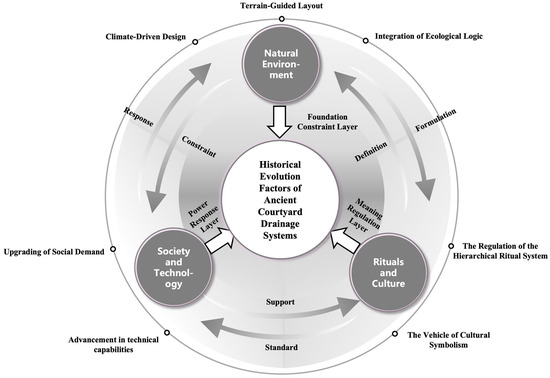
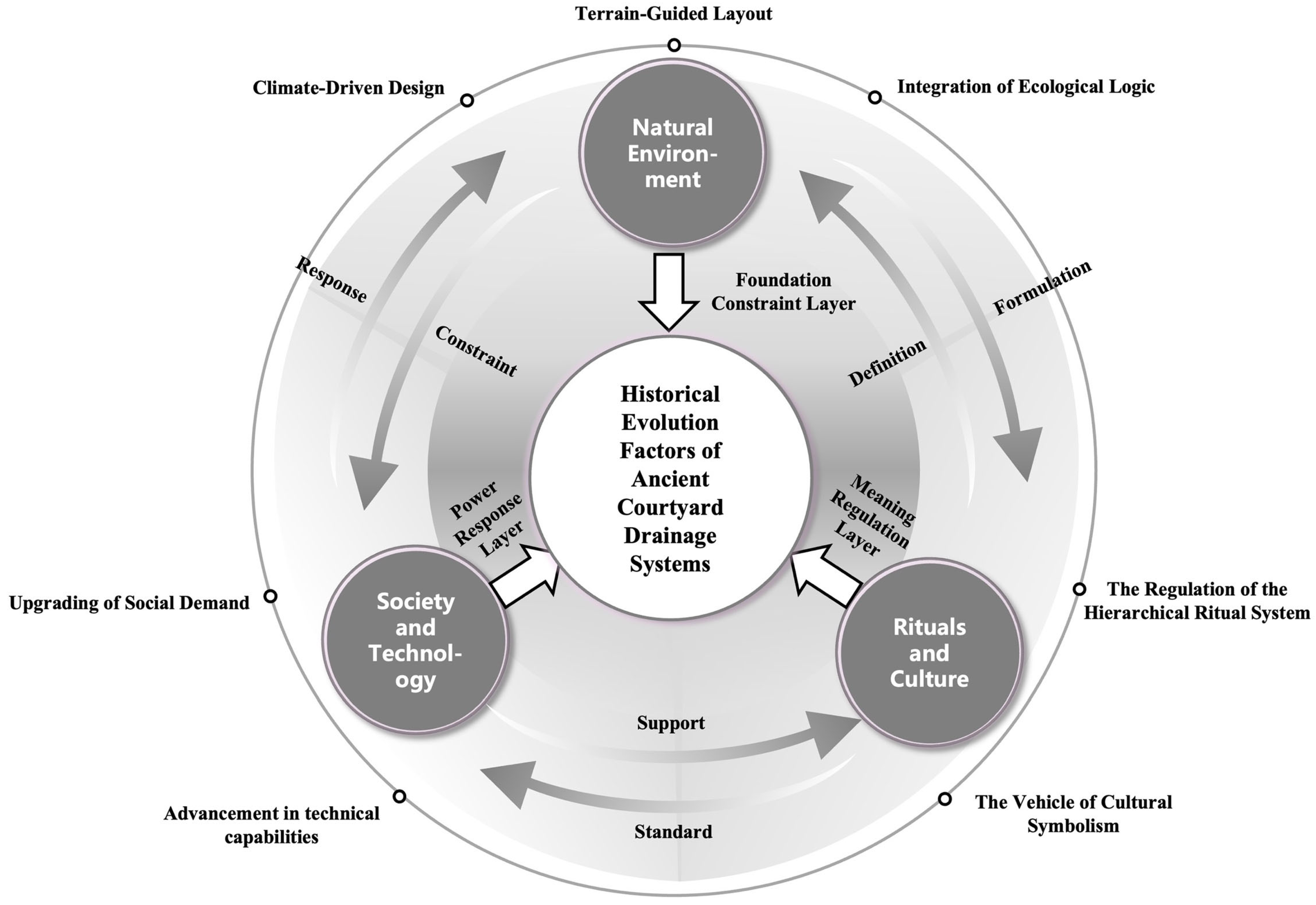
The evolution of ancient Chinese courtyard drainage systems was not a linear process driven by a single factor, but rather the result of multiple forces interacting. To systematically explain the evolutionary mechanisms of traditional courtyard drainage systems, this study constructs a three-dimensional “nature–society–culture” analytical framework (Figure 1). This framework identifies the primary factors influencing the evolutionary process.
Figure 1.
“Nature–Society–Culture” Analytical Framework.
The natural environment serves as the foundational constraint layer for drainage system evolution. Multiple natural elements collectively define the core challenges that drainage technologies must address and the boundaries within which solutions must be realized. This constraint is not passively accepted but continuously stimulates demand for technological innovation, perpetually providing the practical arena and boundary conditions for engineering practice. The natural environment directly shapes the physical form of drainage systems and molds ritual-based cultural norms.
Within the boundaries set by the natural environment, the dual forces of escalating social demands and technological advancement constitute the driving forces behind drainage system evolution. Through a synergistic mechanism of “demand-driven—technology-responsive,” society and technology continuously transform latent needs constrained by nature into feasible engineering practices, thereby tangibly supporting ritual-based cultural systems.
In traditional Chinese society, ritual systems and culture were not merely external adornments to drainage systems but intrinsic screening mechanisms and coding systems embedded within their evolutionary processes. Through institutional regulations and symbolic meanings, these systems standardized technological achievements, imbued the natural environment with new cultural significance, and integrated technical components into specific meaning systems. Acting as layers of meaning mediation, ritual systems and culture elevated drainage systems from mere engineering constructs to cultural entities embodying social values and spiritual concepts.
These three dimensions do not operate in isolation but unfold in a progressive and interwoven relationship. The natural environment defines problem boundaries and implementation space, while socio-technical systems provide solutions and engineering methods. Ritual and cultural systems, in turn, imbue these systems with social meaning and value expression. Together, they propel drainage systems beyond being mere “technical tools” into composite entities of “nature–society–culture.” The composite entity referred to here denotes a systemic form that achieves multifunctional coupling within specific engineering contexts. This “nature–society–culture” composite elevates drainage systems beyond basic infrastructure, transforming them into conduits that link natural environments, social structures, and cultural concepts. Building upon this framework, the subsequent sections will first trace the historical evolution of traditional courtyard drainage systems. Next, an in-depth analysis of the driving forces behind this evolution across the three dimensions will be presented. Finally, insights from these findings will be explored in the context of sponge city development.
2.3. Research Methods
This study employs a combination of three methodologies: literature review, historical evidence analysis, and comparative historical analysis.
Using the literature review method, the research systematically organizes academic findings from classical texts, archaeological excavation reports, and other scholarly works to construct a foundational historical database on the evolution of drainage systems.
The historical evidence analysis method selects representative courtyard drainage cases from different historical periods and geographical regions as research subjects. Case selection adhered to the following principles. First, temporal breadth spanning major historical periods, including primitive society and Xia–Shang, Western Zhou, Eastern Zhou, Qin–Han, Tang–Song, and Ming–Qing dynasties. Second, architectural diversity encompassing palaces, tombs, government offices, and residential dwellings to observe drainage technology variations across hierarchical structures. Third, extensive geographical distribution covering northern and southern climatic zones to reflect adaptive characteristics under diverse environments. Fourth, archaeological reliability: all selected cases are supported by explicit excavation reports or documented historical records.
The study employs historical comparative analysis. While examining overall systems, it also investigates individual drainage components across dimensions such as systems, materials, forms, configurations, and functions. Vertical comparisons trace the evolution of comprehensive drainage systems across historical periods and the form evolution of identical component types across eras. Horizontal comparisons analyze variations in drainage design within the same period across different regions and architectural hierarchies. The study compares these systems based on the following analytical criteria. First, it examines the systemic integration of courtyard drainage systems, specifically whether drainage components have evolved from single-function elements to comprehensive systems. Second, it evaluates the types and organizational patterns of drainage components across different historical periods. Finally, it investigates how drainage systems have transitioned from purely functional discharge systems to integrated management models that incorporate ecological functions.
By synthesizing these methodologies, the study ultimately draws lessons from ancient practices to distill theoretical references and practical guidance applicable to modern sponge cities. However, this research primarily relies on archaeological excavation data and historical records, presenting certain limitations. Materials from some historical periods are relatively scattered, leading to interpretations of certain evolutionary details that involve some degree of conjecture and subjectivity.
3. Historical Evolution of Traditional Courtyard Drainage Systems
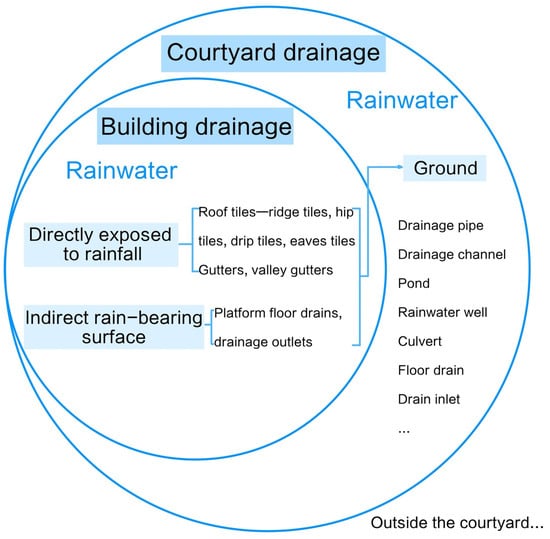
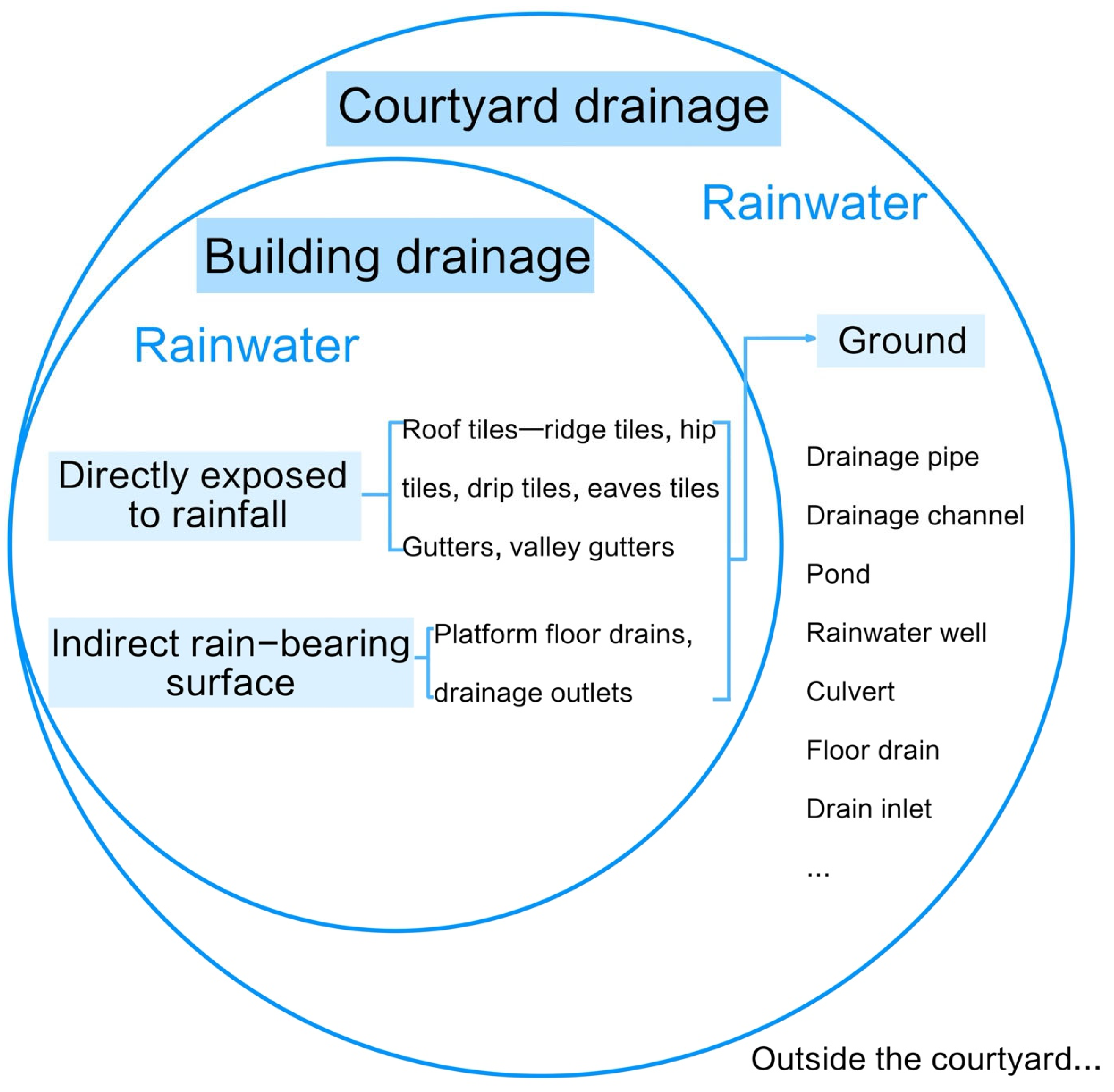
Courtyards form the soul of ancient Chinese architectural complexes. Enclosed by buildings and walls on all sides, they feature an open, unroofed space at their center, serving as the fundamental unit of architectural clusters. By demarcating portions of open space, courtyards act as transitional zones between architecture and nature. Through regulating the microclimate, they enhance human comfort. As the core spatial element of ancient architecture, courtyards fulfilled diverse social functions. Ancient daily life, festive rituals, and even governance activities largely took place within these enclosed spaces. Consequently, creating a comfortable physical environment and shaping a spiritual space remained paramount concerns for ancient craftsmen. The design of courtyard drainage systems was a crucial component, primarily divided into building drainage and courtyard drainage (Figure 2). Rainwater falls directly onto building roofs and courtyard surfaces. As the primary rain-receiving surface in the building drainage system, roofs channel collected water through tiles and various drainage components (gutters, corner drains, eaves, and tile ends) to the plinth or courtyard. The plinth then directs rainwater into the courtyard via floor drains and drainage outlets. Rainwater falling onto courtyard surfaces relies on slope to flow into courtyard drainage facilities such as gully inlets, ditches, drainage pipes, and infiltration wells. After being collected and conveyed through both the building and courtyard systems, the rainwater either infiltrates the ground or is discharged outside the courtyard. The orderly integration of these two systems constitutes the fundamental mechanism of traditional courtyard drainage.
Figure 2.
Traditional Courtyard Drainage System Design.
The overall evolution of courtyard drainage systems reveals a broader technological progression. This paper examines the drainage characteristics of selected traditional Chinese courtyards (Table 1), concluding that their historical development progressed from localized interventions to systematic regulation.
Table 1.
Characteristics of Drainage in Some Traditional Chinese Courtyards.
Primitive Society to the Xia and Shang Dynasties: Courtyard drainage facilities began to emerge, evolving from reliance on natural slopes to the introduction of artificial interventions such as drainage pipes, ditches, and pond gardens. This marked a shift from passive to active drainage. In addition to basic water diversion, rudimentary erosion control measures and water storage/sedimentation facilities appeared, reflecting early awareness of waterproofing, water storage, and purification. No fully integrated drainage systems were discovered during this period, indicating that facilities primarily addressed localized drainage needs.
Western Zhou to Qin–Han Period: Drainage structures diversified significantly, with improved technical adaptability and spatial compatibility. Clay drainage pipes evolved beyond the rudimentary jointing methods of the Xia–Shang era, featuring numerous new forms and combinations tailored to specific requirements. Drainage design became more sophisticated, incorporating customized integrated solutions. Larger courtyards featured more complex systems, confirming the correlation between facility types and courtyard scale. By the Han period in Chang’an, palace districts integrated drainage ditches, pipes, rainwater wells, and garden ponds, with clay pipes custom-shaped to meet specific needs. This marked the preliminary formation of integrated courtyard drainage systems.
Tang–Song to Ming–Qing Periods: Traditional Chinese courtyard drainage design evolved toward systematization and ecological integration. While earlier drainage systems were found only in palace gardens, ritual buildings, and aristocratic districts, this period saw the inclusion of drainage facilities in residential courtyards. Courtyard drainage design became more systematic, with rainwater management shifting toward controlled regulation. Purification and silt-prevention facilities grew more sophisticated, marking the evolution of traditional drainage from “simple discharge” to an ecological approach of “storage–purification–discharge”—a form of proactive management.
Reviewing the evolution of courtyard drainage systems from primitive societies through the Ming and Qing dynasties reveals a clear trajectory of technological advancement: from simple to complex, from localized to systematic, and from passive to proactive. Technologically, drainage systems progressed through nascent, developmental, and mature stages. Spatially, drainage facilities evolved from early ground-level systems to a three-tiered, coordinated structure encompassing rooftops, surfaces, and underground levels. The systems evolved from isolated drainage within individual courtyards to organic integration between courtyard systems and urban networks. Functionally, drainage systems expanded from basic “discharge” to a composite organization encompassing “water diversion—storage—filtration—purification—discharge.” The application scope broadened from early concentration in high-status structures like palaces and tombs to gradual extension into ordinary buildings, including residences and gardens.
4. Historical Evolution Factors of Traditional Courtyard Drainage Systems
The historical overview in the previous section traces the evolutionary trajectory of traditional courtyard drainage systems from their inception to maturity. However, the underlying driving mechanisms behind this evolution remain unclear. This section will explore the intrinsic logic of this evolution through three dimensions: the natural environment, society and technology, and ritual systems and culture.
4.1. Natural Environment
The selection of traditional courtyard drainage systems was not arbitrary but was rigidly constrained by the natural environment. Natural factors such as climate, topography, and hydrology limited the scope of technical choices.
4.1.1. Climate-Driven Design
Precipitation levels, snowfall amounts, and the frequency of extreme weather events across different regions profoundly influenced the design of drainage structures. The Classic of Rites: Records of the Craftsmen states, “When the roof is steep and the eaves low, water flows swiftly and drains far.” This illustrates that ancient people early recognized the impact of roof slope on drainage efficiency. Traditional roof pitches progressively increased to accelerate rainwater runoff. The Tang Dynasty’s Foguang Temple main hall featured a pitch ratio (rise-to-run) of 1:4.77. During the Song, Liao, Jin, and Yuan dynasties, pitches typically ranged from 1:4 to 1:3, with the Qing Dynasty mandating a minimum of 1:3—though actual constructions often employed steeper slopes. The increase in roof pitch was also closely tied to architectural ritual systems and technological advancements. Additionally, the onset of the Ming–Qing Little Ice Age contributed to this trend. According to Zhu Kezhen’s research on China’s climate fluctuations over the past five millennia, the Ming and Qing periods witnessed a significant cooling phase marked by frequent extreme weather events [32]. The steeper roof pitches adapted to these climatic changes, facilitating faster runoff of rainwater and snow.
The differences between northern and southern China similarly demonstrate how climate influences roof drainage design. Traditional northern courtyard roofs feature gentler slopes, prioritizing courtyard enclosure and snow load resistance. Southern roofs, by contrast, have steeper pitches, emphasizing rapid drainage and natural ventilation. This adaptation of roofs to climate variations has, to some extent, driven the advancement and development of certain building technologies. Such site-specific adjustments reflect the drainage system’s direct adaptation to climate.
The tile end-piece designs at the Nanyue Kingdom site further illustrate how climate shapes drainage components. Located in the rainy Lingnan region, all tile end-pieces at this site adopt a circular form for superior drainage efficiency. This departure from the semicircular end-pieces prevalent in the Central Plains during the same period demonstrates how identical components adapt to differing rainfall conditions [33]. Circular tiles provide a larger surface area for rainwater collection and protection, with a lowest point along the lower edge facilitating efficient drainage. In contrast, the straight lower edge of semicircular tiles allows rainwater to form a curtain-like cascade. Thus, circular tiles better meet architectural rainproofing requirements. These adaptive processes also drove advancements in drainage technology, though they remained constrained to some extent by social ritual systems and technological–economic factors.
4.1.2. Terrain-Guided Layout
Different terrains, such as mountains, plains, and river valleys, require drainage systems that harmonize with their surroundings. For instance, the Ming Tombs employed curved retaining walls and exposed brick-and-stone ditches to protect the sacred city from flood damage. Rainwater from the sacred city flowed through surrounding gutters and exited via spouts at the crenellations of the retaining walls [30]. The gutters featured drainage holes fitted with stone grates, allowing rainwater to flow into concealed drainage ditches on both sides of the courtyard. In the drainage design of the ceremonial courtyards at the front, the Ming Qingling Mausoleum differs from other Ming tombs. Due to the terrain, its courtyards are divided into two distinct layers. Its drainage system employs a unique combination of above-ground open ditches and “T”-shaped underground culverts, aligning with the tomb’s feng shui principles. Other Ming tombs, however, relied on floor drains encircling the courtyards and subterranean channels to discharge rainwater outside the compound. This demonstrates how ancient engineers adapted to local conditions, flexibly addressing drainage requirements across diverse topographies and courtyard layouts. The adaptation of drainage systems to terrain not only concerned engineering efficacy but was often intertwined with feng shui and ritualistic concepts, relying on the engineering capabilities of the era to achieve implementation.
4.1.3. Integration of Ecological Logic
Climate and topography impose direct constraints on drainage system design, while the natural environment’s influence extends to deeper ecological principles. From primitive society’s low-lying water collection areas to the purification ponds of the Ming and Qing dynasties, drainage systems gradually integrated into an ecological logic of “water storage–purification–reuse.” The functional evolution of drainage systems can be divided into three distinct phases (Table 2).
Table 2.
Evolution of Ecological Functions in Courtyard Drainage Systems.
Primitive Societies to the Xia and Shang Dynasties: Low-lying areas and rudimentary ponds emerged, marking the nascent awareness of water storage and sedimentation within courtyards. However, this remained a passive response.
Western Zhou to Qin–Han Periods: Storage and drainage facilities diversified. Ponds, infiltration pits, and rainwater wells were used in combination, marking the initial formation of integrated systems.
Tang–Song to Ming–Qing Periods: Active filtration and purification began. Filtration devices appeared in drainage facilities, along with multi-tiered purification ponds. Courtyard drainage shifted from “simple discharge” to “filtration + discharge,” with early explorations into water resource reuse beginning.
This evolution reveals the profound influence of the ecological environment on drainage systems. The natural environment not only established the fundamental challenge of drainage but also progressively introduced higher demands for “purification” and “recycling.” Ancient responses to these demands reflected advancements in technical capabilities and, to a certain extent, addressed higher-level societal needs.
In summary, the natural environment constrains the evolution of drainage systems through three mechanisms. First, climate sets design parameters. Second, topography guides spatial layout. Finally, ecology drives functional advancement. The history of drainage system development is fundamentally a narrative of humanity’s ongoing technical struggle to perceive, respond to, and actively adapt to the natural environment. This adaptation is not passive acceptance; rather, it stimulates the demand for technological innovation, providing practical grounds and space for subsequent engineering practices and cultural expressions. The objective conditions of the natural environment define the problems and boundaries within which drainage systems evolve. However, as the foundational constraint layer for courtyard drainage systems, the natural environment does not directly provide solutions. The transformation of natural constraints into engineering practice relies on social organizational capacity and technological proficiency.
4.2. Society and Technology
While natural constraints define the boundaries of design possibilities, they cannot fully explain the phenomenon of drainage systems becoming increasingly sophisticated over time. The driving force behind this evolution stems from both societal and technological factors.
4.2.1. Upgrading Social Demands
The upgrading of social demands represents a process in which the core problems drainage systems must address evolve from simple to complex. This shift directly defines the direction of technological development.
Early architecture primarily addressed the fundamental issue of preventing roof leaks. However, as building scales expanded, the need to rapidly drain rainwater and protect wooden structures and rammed-earth foundations became more urgent. This need directly drove the functional evolution of roof drainage components, shifting the focus from leak prevention to efficient water diversion. For instance, the Song Dynasty’s triangular drip tiles replaced ornamental and double-lip tiles. Their core advantage lay in the acute angle at their ends, which created a defined rainwater path and enabled directed dripping. This significantly enhanced drainage efficiency while reducing splash erosion at eaves. This evolution demonstrates that societal demands for drainage efficiency and building durability were the fundamental drivers behind component form optimization.
As settlements evolved into capital cities, the emergence of large courtyard complexes generated heightened demands for public infrastructure services. Rainwater management ceased to be a localized issue, transitioning from piecemeal interventions to systematic regulation. During the Xia and Shang dynasties, limited settlement scales meant that discovered courtyard drainage systems did not form comprehensive drainage networks. It is presumed that drainage facilities during the Xia and Shang dynasties primarily addressed localized needs, lacking comprehensive courtyard coverage systems. By the Qin and Han periods, the formation of a centralized state transformed drainage into a public engineering project requiring unified planning. For instance, the drainage design in the palace district of Han Chang’an City exhibited preliminary systematic characteristics. Through a combination of drainage ditches, pipes, rainwater wells, and garden ponds, Han Chang’an organized the collection, conveyance, and regulation of rainwater within larger courtyards. This demand for systematization stemmed from architectural complexes requiring higher standards for maintaining internal environments, reflecting increased social centralization and enhanced engineering capabilities. By the Ming and Qing dynasties, the drainage system of the Shenyang Imperial Palace had evolved into a comprehensive network. It utilized ground slopes, brick-paved surfaces, drainage grates, underground channels, and manholes working in concert. This marked the maturation of a holistic regulatory system designed to fulfill complex societal functions.
4.2.2. Advancements in Technical Capabilities
Technical capabilities form the material foundation for fulfilling societal demands. Every advancement in materials, processes, and engineering methods directly translates into enhanced efficiency and reliability of drainage systems.
The evolution of roof tiles reflects the continuous optimization of drainage efficiency through material technology. Tiles evolved from primitive simple clay tiles to standardized flat and barrel tiles during the Song and Qing dynasties. Materials progressed from basic clay tiles to high-quality gray clay tiles, glazed tiles, and glazed roof tiles, progressively enhancing waterproofing performance. Tile dimensions also gradually decreased and became standardized. Smaller tiles featured denser overlapping points, narrower and more stable joint gaps, and grooves, facilitating layered rainwater drainage and reducing leakage. It was the maturation of tile-making technology that enabled the realization of intricate structures like gutters and corner drains to address complex roof water collection challenges. A prime example is the precision-coordinated drainage system of gutters and corner drains in the Tian Yuan Di Fang Double-Eave Cross Pavilion at the Forbidden City.
The evolution of ceramic drainage pipes demonstrates craftsmen’s advancing ability to customize designs for varying flow rates, orientations, and spatial constraints (Table 3). This evolution was not merely technical self-development but a response to escalating societal demands. It progressed from using three-way ceramic pipes for single-point drainage to multi-drainage pipes addressing complex, large-scale requirements. From basic straight pipe designs to curved and “U”-shaped specialized layouts, these adaptations demonstrate craftsmen proactively innovating to meet changing drainage requirements. Such innovations enabled drainage networks to flexibly integrate beneath intricate architectural foundations, fulfilling both the social aesthetic and functional demands for concealed, orderly drainage within large courtyards. The mature drainage systems of these grand courtyards required comprehensive planning, relying heavily on sophisticated engineering division of labor and management capabilities—itself a manifestation of highly organized social technical capacity.
Table 3.
Evolutionary Chart of Traditional Courtyard Clay Drainage Pipes.
The lag in material selection similarly reveals societal and technological constraints. Bricks were already used in high-grade architectural paving and tombs during the Qin and Han dynasties. However, brick-made drainage slopes and channels were rare, becoming more common only during the Tang and Song periods and widespread by the Ming and Qing eras. This delay likely stemmed from fuel shortages and technical limitations in early brick production [34]. Early bricks were primarily reserved for critical structural components. Courtyard drainage components in the early period favored readily available materials such as clay, wood, and stone. Only after brick-making techniques matured did bricks become the primary drainage material. This demonstrates that technological adoption depends not only on technical readiness but also on resource allocation priorities.
The evolution of drainage systems was driven by a synergistic mechanism of “demand-driven innovation and technological response.” As societal needs grew increasingly complex, the overall efficiency of courtyard drainage systems improved. Technological advancements provided solutions to emerging demands. Material improvements, design innovations, and accumulated engineering methods offered concrete means to meet these increasingly complex requirements. Additionally, the allocation of social resources influenced technological diffusion to some extent. The synergy between society and technology transformed the latent demands set by the natural environment into feasible engineering practices. However, the adoption, dissemination, and interpretation of technological achievements required the mediation of ritual systems and cultural frameworks.
4.3. Ritual Systems and Culture
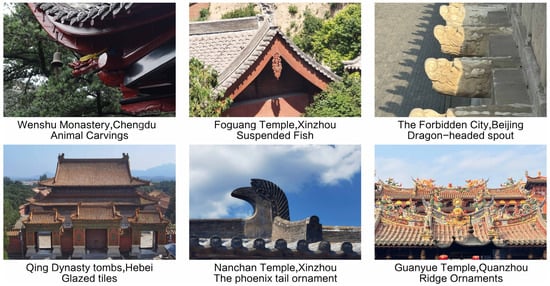
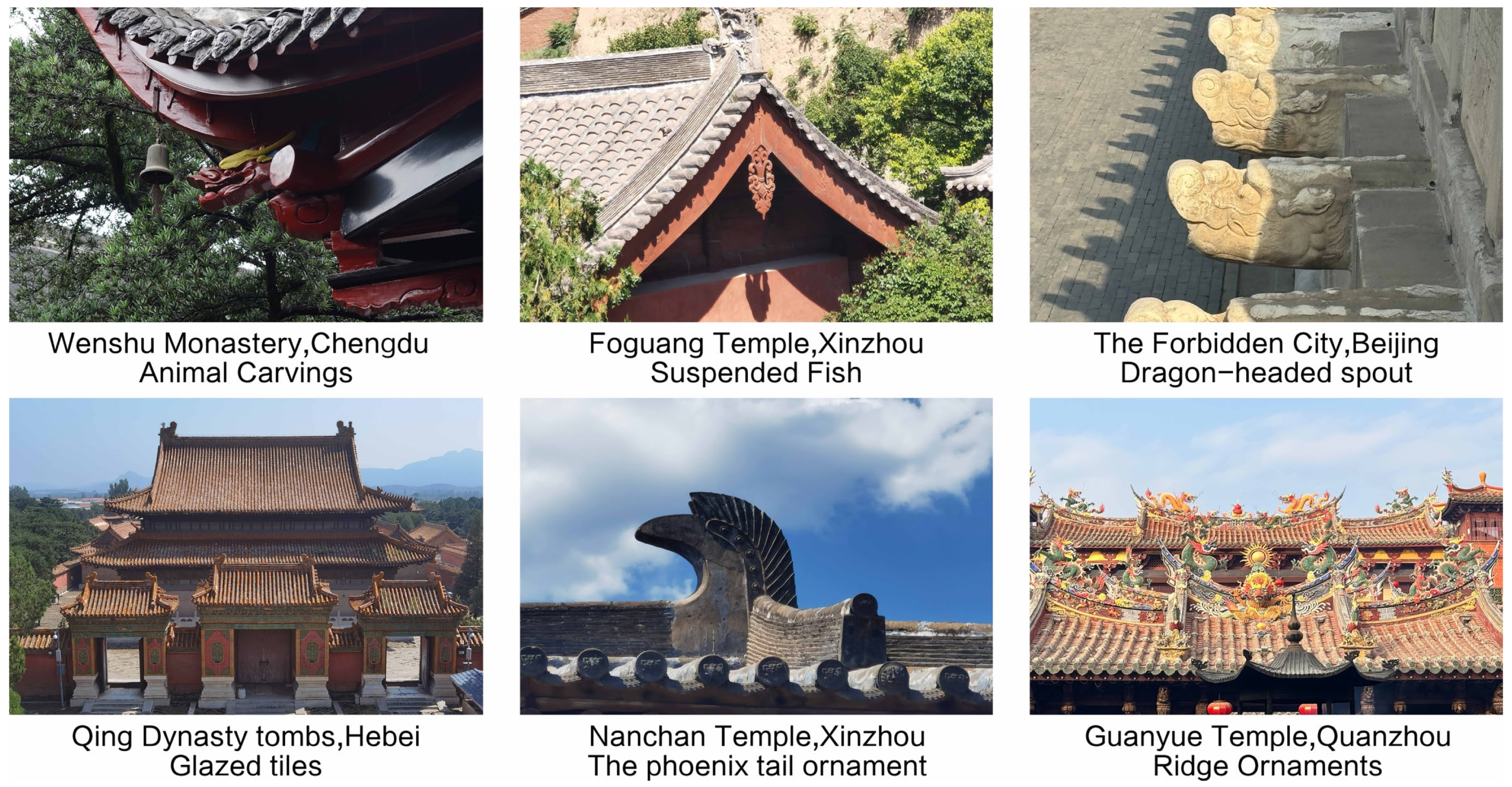
Natural constraints and social drivers can explain why and how drainage systems evolved. However, they struggle to account for another phenomenon: why a technical system became imbued with rich cultural symbolism. Ritual systems and cultural factors played a pivotal role in this process. The image below depicts courtyard drainage components related to architectural ritual systems and culture (Figure 3).
Figure 3.
Drainage components associated with ritual culture.
4.3.1. Regulations of the Hierarchical Ritual System
The ritual system established strict regulations governing the use of social technological achievements, transforming drainage systems into symbols of power hierarchy and status. According to the Da Qing Huidian (Imperial Code of the Qing Dynasty), neither officials nor commoners were permitted to use glazed tiles on the walls of their dwellings. Due to their brilliant colors and exceptional waterproofing properties, glazed tiles were reserved exclusively for imperial architecture and high-ranking temples. Their very use served as an external expression of power. The Qing-dynasty Engineering Manual’s distinction between large-scale and small-scale tilework concerned not merely craftsmanship differences but also hierarchical regulations regarding the social status of building owners.
Ritual regulations produced a dual effect on drainage technology. On one hand, through material exclusivity and hierarchical division, drainage components acquired symbolic value beyond their practical function. On the other hand, they created class barriers to technological diffusion. As a result, courtyard drainage techniques typically emerged first in high-status buildings before gradually spreading to the common populace.
It should be noted that the above analysis is based on existing literature and archaeological artifacts. Discrepancies may exist between ritual regulations and actual implementation, as conditions varied across regions and periods.
4.3.2. Cultural Symbolism Embodied
The design of drainage components often carries cultural symbolism, serving as multifunctional artifacts. The series of mythical beast ornaments adorning roofs exemplifies this phenomenon. The evolution from the chiwei to the chikun not only reinforced the functional role of the ridge’s waterproofing junction but also incorporated cultural symbolism. The Tang Huyao records that after a fire at the Bailiang Hall during the Han Dynasty, a carved fish statue was placed on the roof ridge to spout waves and bring rain. This indicates the connection between the installation of the chiwei and the wish for fire prevention. Similarly, beasts like the yayu and douniu on Qing Dynasty roof ridges served both the practical purpose of reinforcing nail caps and the auspicious meaning of summoning clouds and rain, extinguishing fires, and preventing disasters. The spectacular scene of dragons spouting water from the dragon-headed eaves of the Hall of Supreme Harmony in the Forbidden City combines efficient drainage from the base with the majestic grandeur of imperial architecture. Certain ecological facilities were also imbued with cultural significance. The placement of infiltration wells and purification ponds within courtyards, beyond their practical functions of water infiltration and purification, was often linked to feng shui concepts of wealth accumulation and capturing auspicious energy.
It is noteworthy that the practice of assigning cultural symbolism to drainage components is not unique to China. Islamic courtyard gardens integrated drainage and water collection systems as symbols of the Garden of Paradise, with courtyard-scale water features serving as core elements of religious spaces [35]. However, the cultural symbolism of traditional Chinese drainage systems was deeply intertwined with hierarchical rituals, transforming technical components into tangible expressions of social order. Regulations governing glazed tiles, the number of roof animals, and the patterns on dripstones all embedded the drainage system within a cultural expressive framework.
Cultural symbolism sometimes persists beyond the practical function of a component, evolving into new forms. Suspended fish originated from the practical need to protect beam ends and the symbolic belief that water overcomes fire, appearing alongside matching grass ornaments. The Song Dynasty’s Yingzao Fashi (Construction Standards) provided explicit specifications for both. In Ming and Qing dynasty official architecture, the prevalence of enclosed pediment panels reduced their use. The practical function of suspended fish gradually faded. Yet, in folk architecture, suspended fish persisted as cultural symbols, evolving while retaining practical elements but increasingly emphasizing ornamentation. This transformation reflects the dynamic interplay between utilitarian function and cultural symbolism.
In summary, ritual systems and culture function as layers of meaning regulation, filtering and standardizing technical achievements while integrating them into specific cultural frameworks. This transforms drainage systems from purely engineering entities into “nature–society–culture” complexes that embody social values and spiritual concepts. This constitutes a key distinction between traditional drainage systems and purely technical historical subjects, offering a multidimensional analytical perspective for exploring their contemporary relevance. It should be noted that the cultural interpretations in this section primarily rely on textual records and analysis of extant artifacts. Some inferences regarding ancient designers’ intentions carry interpretive elements. We should avoid over-projecting modern sustainability concepts onto the motivations of ancient practitioners.
4.4. Analysis of Three-Dimensional Interactions
The three dimensions described above are not parallel and independent but form an intricate, interwoven relationship. Understanding this relational structure helps reveal the underlying logic behind the evolution of traditional courtyard drainage systems.
4.4.1. The Interplay of Nature, Society, and Technology
Natural factors pose challenges, while society and technology provide solutions. Under the same monsoon climate constraints, distinctly different technological responses emerged at varying levels of social organization. Early settlements, characterized by loose organization, could only develop rudimentary natural drainage systems. As bureaucratic systems and artisan institutions matured, they enabled the construction of complex, multi-tiered drainage networks. Conversely, specific societal demands amplified the significance of certain natural constraints, driving targeted technological innovations. The establishment of the Golden Water River within the Forbidden City, for instance, was a direct response to fire risks.
4.4.2. The Interplay of Society, Technology, and Culture
Social hierarchies determined technological allocation, while cultural concepts provided the legitimizing discourse for such allocation. The restriction of glazed tiles to imperial use was both a social choice under resource scarcity and legitimized by ritual systems. Technological stratification and cultural narratives of hierarchy mutually reinforced each other. Social practices shaped material forms, while cultural interpretations endowed them with meaning. Together, they sustained the social order function of drainage systems.
4.4.3. The Interplay of Culture and Nature
Cultural concepts regulate perceptions of ecological constraints and responses to them. The feng shui principle that “water gathers, wealth gathers” reinforced the emphasis on water retention, driving the development of purification ponds and wealth-gathering pools. Conversely, successful ecological adaptation practices became embedded in cultural narratives. The “Four Waters Return to the Hall” layout, a rational response to a rainy climate, was also interpreted as a cultural symbol of “water not flowing to strangers’ fields”.
4.4.4. Three-Dimensional Interconnectedness
The interweaving of these three dimensions reveals that the evolution of traditional courtyard drainage systems is a co-evolutionary process. The natural environment, society and technology, along with ritual systems and culture, mutually shaped and co-evolved over the long term. Any single-dimensional explanation struggles to encompass the full complexity of this system. All three dimensions are indispensable, collectively forming a comprehensive analytical perspective for understanding traditional courtyard drainage systems.
5. Insights from Traditional Courtyard Drainage Wisdom for Sustainable Sponge City Development
The preceding analysis demonstrates that the evolution of traditional courtyard drainage systems represents the wisdom of ancient people seeking equilibrium across three dimensions: natural constraints, socio-technical factors, and ritual-based culture. These historical experiences are not directly applicable methods; they require critical adaptation to serve contemporary practice.
The core objective of contemporary sponge city development is achieving sustainable urban stormwater management. This goal aligns closely with the wisdom of traditional courtyard drainage. By pursuing long-term stable operation under constraints, these systems inherently represent a form of primitive sustainable practice. The sustainability discussed herein encompasses three core dimensions—environmental, technological, and cultural—corresponding directly to the three evolutionary factors analyzed earlier: natural constraints, social and technological factors, and ritual-based cultural systems. Environmental sustainability focuses on long-term coordination with natural systems, corresponding to the traditional courtyard drainage system’s wisdom of adapting to local conditions and harmonizing with nature. Technological sustainability emphasizes system efficiency and resilience, aligning with the systematic design logic of traditional courtyard drainage. Cultural sustainability addresses social recognition and intergenerational transmission, mirroring the cultural integration and meaning-imbuing mechanisms of traditional courtyard drainage systems. These three dimensions of sustainability provide the theoretical foundation for transforming ancient wisdom into modern applications.
5.1. Environmental Sustainability
Traditional courtyard drainage systems were based on the philosophy of “harmony between heaven and humanity,” achieving orderly rainwater management by respecting topography, climate, and hydrological patterns. The inspiration this philosophy offers for modern sponge cities lies not in replicating specific practices, but in establishing adaptable principles of ecological synergy design.
One such principle is climate-responsive design. Adjustments to traditional roof slopes and the use of circular roof tiles in the ancient state of Nanyue exemplify how design parameters responded precisely to climatic conditions. This principle can be directly applied to sponge facility design. Water collection methods and drainage parameters should be determined based on local hydrological characteristics—such as rainfall intensity, duration, and frequency—to achieve tailored, precise configurations. For instance, in regions with heavy rainfall and frequent typhoons, drawing inspiration from traditional gutters’ rapid water collection capabilities can enhance the combined capacity for swift drainage and distributed retention. In arid, water-scarce areas, the focus shifts to maximizing infiltration and safe reuse.
Another principle is the topography-responsive layout. Traditional systems utilized natural ground slopes and elevation differences for water conveyance, rarely requiring large-scale terrain modification. Modern sponge cities should protect and utilize natural runoff pathways, ponds, and depressions as the backbone of blue-green infrastructure at the planning level. Site design should employ micro-topography to guide runoff, minimizing interference with natural hydrological processes and reducing reliance on gray infrastructure networks.
However, certain traditional strategies require adaptation based on actual conditions. The evolution of traditional courtyard drainage systems—from infiltration wells to purification ponds—reflects a rudimentary awareness of water resource recycling. These systems primarily served self-sufficient courtyard-scale operations. Modern sponge cities must coordinate stormwater resources across larger scales, further developing the complete chain of “infiltration–retention–storage–purification–reuse–discharge.” This should be integrated with urban reclaimed water systems to enhance water resource efficiency. Moreover, traditional systems adapted passively and slowly to extreme weather events. Facing climate change uncertainties, modern cities require resilient systems with sustainability and adaptive capacity. Design should incorporate overflow channels for rainfall exceeding design standards or utilize modular facilities to facilitate future expansion and adjustments.
5.2. Technical Sustainability
The evolutionary logic of traditional courtyard drainage systems, shaped by societal demands, also offers directly applicable design principles.
The first principle is function-driven component optimization. The evolution of drip-edge designs exemplifies precision engineering focused on performance enhancement. Modern sponge city infrastructure should follow this logic by establishing quantitative relationships between drainage component performance and design parameters. For instance, computational fluid dynamics simulations can optimize the cross-sectional shape and grating design of linear gutters to achieve optimal flow diversion and minimal sedimentation.
The second principle is scale-matched system configuration. Traditional drainage facilities consistently matched architectural hierarchy and courtyard scale. This principle suggests that modern sponge cities should establish tiered management mechanisms. At the urban scale, regional drainage corridors should be built based on natural water systems. At the community scale, pocket parks should be arranged, and at the building scale, green roofs or rain barrels should be promoted. Scale matching avoids inefficient, one-size-fits-all construction. Simultaneously, systematic consideration must be given to the connections between hierarchical scales.
Some technical wisdom requires adaptation from past to present. The refinement of traditional courtyard drainage systems relied on the accumulated experience and intergenerational transmission of craftsmen. Modern sponge cities can leverage digital technology to upgrade this wisdom, transforming implicit artisan knowledge into explicit data assets. This represents a contemporary expression grounded in traditional logic, rather than a direct historical replication. Furthermore, the hierarchical differentiation of traditional technologies concentrated advanced methods in high-grade buildings, while grassroots adoption lagged. Modern sponge city development must overcome this limitation, ensuring equitable distribution of sponge infrastructure across all areas and extending the benefits of technological progress to every citizen.
5.3. Cultural Sustainability
The ritual and cultural dimensions of traditional courtyard drainage systems primarily offer symbolic value concepts. These dimensions provide direction for modern practice, rather than specific methods.
One core principle is the unity of technology and culture. Traditional courtyard drainage components endow technical infrastructure with existential value beyond its material function. This principle informs modern sponge cities: basic public facilities should not be viewed solely as engineering challenges but should be integrated into the broader vision of urban cultural development. When sponge infrastructure carries local memory, embodies community identity, and fosters public recognition, its long-term maintenance gains stronger social momentum.
The second core principle is the harmonious coexistence of humans and water. Traditional systems integrated drainage facilities with concepts such as “accumulating wealth” and “capturing wind and energy,” reflecting a value orientation of harmonious human–water cohabitation. This principle inspires modern sponge cities to cultivate public awareness of the water cycle and re-evaluate the utility value of rainwater.
At the strategic level, traditional wisdom requires creative transformation. Traditional landscapes, like the “thousand dragons spouting water,” served as symbols of imperial power and were inaccessible for public engagement. Modern sponge cities should transform such landscapes into interactive practices, designing sponge facilities as community spaces that invite participation. Establishing emotional connections between residents and infrastructure can be achieved through initiatives like plant adoption and collaborative maintenance. Furthermore, rather than mechanically replicating traditional forms, we should abstract and refine the underlying philosophical concepts, employing modern materials and technologies for innovative expression.
6. Conclusions
This paper systematically traces the historical evolution of traditional Chinese courtyard drainage systems from their inception and development to maturity. It reveals their progression from passive drainage to systematic regulation, and from localized interventions to holistic, ecological management. The study analyzes the three core dimensions driving this evolution: the natural environment, society and technology, and ritual systems and culture. The interplay of these dimensions ultimately transformed drainage systems from utilitarian engineering into a composite wisdom entity integrating nature, society, and culture.
This study advances understanding of traditional courtyard drainage systems within sustainability research across three dimensions: theory, methodology, and practice. Theoretically, it constructs a “nature–society–culture” analytical framework. This framework transcends existing research’s singular focus on technical descriptions, providing micro-level empirical evidence for understanding the evolution of ancient drainage systems. Methodologically, it establishes correspondences between traditional wisdom and contemporary sustainability frameworks, offering analytical pathways for translating historical experience into modern contexts. Practically, it identifies aspects of traditional wisdom that are both relevant and adaptable, avoiding rigid application and providing actionable historical references for sponge city development.
Looking ahead, future research could deepen in the following directions. First, quantitative performance studies of traditional drainage components could be conducted. For instance, computational fluid dynamics could be employed to simulate drainage efficiency differences among various pipe configurations and establish corresponding quantitative relationships. Second, cross-regional and cross-cultural comparative studies should be undertaken. The scope could expand to include traditional courtyards in diverse climatic zones—such as Lingnan, Southwest, and Northwest cave dwellings—to construct a regional spectrum of sustainable rainwater management in Chinese traditional courtyards. Simultaneously, comparative analyses with other civilizational traditions should be conducted to identify both the distinctiveness and universality of traditional water management wisdom within a global context. Third, innovative practices integrating ancient and modern approaches could be explored. In the renewal of traditional courtyards, pilot projects could combine traditional infiltration wells with modern rain gardens. This approach would breathe new life into historical wisdom through contemporary implementation.
Author Contributions
M.L. was responsible for the thesis’ conceptual framework, data collection and analysis, and drafting. S.W. provided guidance and supervision, undertaking critical review and revision of the thesis. All authors have read and agreed to the published version of the manuscript.
Funding
This research was funded by the National Key R&D Program of China (Grant No. 2022YFC3800500).
Institutional Review Board Statement
Not applicable.
Informed Consent Statement
Not applicable.
Data Availability Statement
The original contributions presented in this study are included in the article. Further inquiries can be directed to the corresponding author.
Conflicts of Interest
The authors declare no conflicts of interest.
References
- Wang, C.X.; Qin, S.Y.; Xie, X.H. Research on Planning Policy and Construction Measures of Sponge City Based on Environmental Behavior Theory. Landsc. Archit. 2019, 26, 97–102. [Google Scholar]
- Mays, L.W. Ancient Water Technologies; Springer: Dordrecht, The Netherlands, 2010. [Google Scholar]
- Angelakis, A.N.; Zheng, X.Y. Evolution of water supply, sanitation, wastewater, and stormwater technologies globally. Water 2015, 7, 455–463. [Google Scholar] [CrossRef] [Scilit]
- Ortloff, C.R. Water Engineering at Precolumbian AD 600–1100 Tiwanaku’s Urban Center (Bolivia). Water 2020, 12, 3562. [Google Scholar] [CrossRef] [Scilit]
- Cun, C.; Zhang, W.; Che, W.; Tang, L.; Cao, J. Review of urban drainage and stormwater management in ancient China. Landsc. Urban Plan. 2019, 190, 103600. [Google Scholar] [CrossRef] [Scilit]
- Wu, Q.Z. The historical experience and lessons of the flood control in ancient China. City Plan. Rev. 2002, 4, 021. [Google Scholar]
- Si, S.; Li, J.; Wang, Y.; Zhang, Z.; Wang, S.; Gao, S.; Gong, H.; Li, M. Thinking Critically through Key Issues in Improving the Effectiveness of Waterlogging Prevention and Control System in China’s Historic Districts. Sustainability 2022, 14, 2913. [Google Scholar] [CrossRef] [Scilit]
- Jiang, X.; He, S.; Li, Z. A Study on the Water Management Knowledge of Traditional Villages from the Perspective of Stormwater Resilience—A Case Study of Changqi Ancient Village in Guangdong, China. Sustainability 2024, 16, 9807. [Google Scholar] [CrossRef] [Scilit]
- Hou, J.L. Study on the Stormwater System of Chinese Traditional Residential Buildings. Master’s Thesis, Beijing University of Civil Engineering and Architecture, Beijing, China, 2017. (In Chinese) [Google Scholar]
- Chi, F.A.; Guan, B.J. The Drainage System of Thousand Pillars Dwelling Based on the Sponge. Chin. Landsc. Archit. 2016, 32, 110–115. (In Chinese) [Google Scholar]
- Huang, D. The Differential Expression of Water in Traditional Timber Architecture and Construction in Central Zhejiang. New Arts 2018, 39, 90–116. (In Chinese) [Google Scholar]
- Ma, M.; Zhai, L.L.; Zhang, H.; Guo, X.J.; Zhu, X.F.; Di, N.; Zhao, Z.Y.; Wang, J.L. The Lushanmao site of the neolithic age in Yan’an City Shaanxi. Kaogu (Archaeol.) 2019, 7, 29–45. [Google Scholar]
- He, N. Utilization and Control of Water Resources at the Taosi Site. Palace Mus. J. 2019, 85–98, 111. Available online: http://kaogu.cssn.cn/zwb/xsyj/yjxl/wmtyyj/201912/W020191209561276359362.pdf (accessed on 9 January 2026). (In Chinese)
- Liu, Y.F. A Preliminary Study on the Water Management System in the Palace City of Erlitou. Jianghan Archaeol. 2025, 75–83. Available online: https://kns.cnki.net/KCMS/detail/detail.aspx?dbcode=CJFQ&dbname=CJFDAUTO&filename=JHKG202501007 (accessed on 9 January 2026). (In Chinese)
- Wang, X.R.; Gu, F.; Cao, H.Q.; Zhang, J.H.; Wang, Y.; Liang, F.H. Pool-site in the Palace-city of the Shang City at Yanshi, Henan. Archaeology 2006, 2, 13–31, 100–102. (In Chinese) [Google Scholar]
- Guo, M. An Analysis on the Large Buildings of Shang Dynasty in Panlongcheng Site. Jianghan Archaeol. 2015, 45–52. Available online: https://kns.cnki.net/KCMS/detail/detail.aspx?dbcode=CJFQ&dbname=CJFDLAST2015&filename=JHKG201505005 (accessed on 9 January 2026). (In Chinese)
- Institute of Archaeology, Chinese Academy of Social Sciences. Dasikong in Anyang: Excavation Report of 2004; Cultural Relics Press: Beijing, China, 2014; Volume 1. (In Chinese) [Google Scholar]
- Anyang Excavation Team, Institute of Archaeology, Chinese Academy of Sciences. Pottery Water Pipes and Stone Chimes Unearthed at Yinxu. Archaeology 1976, 16, 61. (In Chinese) [Google Scholar]
- Xu, L.G.; Liu, X.; Sun, B.J. Excavation of Western Zhou Building Foundations at Yuntang and Qizhen in Fufeng County, Shaanxi, in 1999–2000. Archaeology 2002, 2–26, 97, 100–101. Available online: https://kns.cnki.net/KCMS/detail/detail.aspx?dbcode=CJFQ&dbname=CJFD2002&filename=KAGU200209000 (accessed on 9 January 2026). (In Chinese)
- Wu, Z.L. Excavation Brief of the Architectural Complex Site at Chengwang Road, Houma. Archaeology 1987, 1071–1085, 1156–1157. Available online: https://kns.cnki.net/KCMS/detail/detail.aspx?dbcode=CJFQ&dbname=CJFD8589&filename=KAGU198712002 (accessed on 9 January 2026). (In Chinese)
- Han, W.; Shang, Z.R.; Ma, Z.Z.; Wang, G.H.; Sun, J.L.; Li, J.F. Excavation Brief of the No.1 Architectural Complex Site at Majiazhuang in Fengxiang. Cult. Relics 1985, 1–29, 98. Available online: https://kns.cnki.net/KCMS/detail/detail.aspx?dbcode=CJFQ&dbname=CJFD8589&filename=WENW198502000 (accessed on 9 January 2026). (In Chinese)
- Xu, Z.F.; Xue, F.; Hu, X.B.; Zhao, X.J.; Fan, J.J.; Gu, F. Excavation Brief of the Large-scale Rammed-earth Building Foundation of the Eastern Zhou Dynasty at Qujiatun, Luoyang. Cult. Relics 2007, 1, 43–53. (In Chinese) [Google Scholar]
- Zhang, L.H.; Zhu, Y.D. The Drainage System of the Ancient Capital of Qi State in Linzi. Archaeology 1988, 784–787, 866. Available online: https://kns.cnki.net/KCMS/detail/detail.aspx?dbcode=CJFQ&dbname=CJFD8589&filename=KAGU198809002 (accessed on 9 January 2026). (In Chinese)
- Hua, Y.B.; Yang, R.C. Excavation Brief of the Qin-Han Palace City Site at Shibei Site in Suizhong County, Liaoning, from 1993 to 1995. Archaeology 1997, 47–57. Available online: https://kns.cnki.net/KCMS/detail/detail.aspx?dbcode=CJFQ&dbname=CJFD9697&filename=KAGU199710007 (accessed on 9 January 2026). (In Chinese)
- Hua, Y.B.; Yang, R.C. Excavation of the Shibei Site in Suizhong County, Liaoning, in 1996. Archaeology 2001, 45–58, 108. Available online: https://kns.cnki.net/KCMS/detail/detail.aspx?dbcode=CJFQ&dbname=CJFD2001&filename=KAGU200108004 (accessed on 9 January 2026). (In Chinese)
- Zhang, J.F. Archaeological Study on the Drainage Pipelines of Chang’an City of the Han Dynasty. Cult. Relics Cent. China 2014, 51–59. Available online: https://kns.cnki.net/KCMS/detail/detail.aspx?dbcode=CJFQ&dbname=CJFD2014&filename=ZYWW201405007 (accessed on 9 January 2026). (In Chinese)
- Fujian Museum; Fujian Minyue King City Museum. Excavation Report of the Han Dynasty City Site at Chengcun in Wuyishan; Fujian People’s Publishing House: Fuzhou, China, 2004. (In Chinese) [Google Scholar]
- Wang, Y.Q. Brief Report on the Cleaning of the Tang Dynasty Water Channel in the Northern Suburbs of Xi’an. Cult. Relics 1959, 27–28. Available online: https://kns.cnki.net/KCMS/detail/detail.aspx?dbcode=CJFQ&dbname=CJFD7984&filename=WENW195908006 (accessed on 9 January 2026). (In Chinese)
- Liu, W.Q.; Liu, D.P. The Study on Capital Cities’ Drainage System of Bohai Kingdom Viewed From Building Archaeology. Tradit. Chin. Archit. Gard. 2019, 13–16. Available online: https://kns.cnki.net/KCMS/detail/detail.aspx?dbcode=CJFQ&dbname=CJFDLAST2020&filename=GJYL201904005 (accessed on 9 January 2026). (In Chinese)
- Xu, T.L. A Brief Study on Drainage and Seepage Prevention of Ming Imperial Tombs. Haihe Water Resour. 1993, 59. Available online: https://kns.cnki.net/KCMS/detail/detail.aspx?dbcode=CJFQ&dbname=CJFD9093&filename=HHSL199304017 (accessed on 9 January 2026). (In Chinese)
- Li, J.H. A Brief Account of the Drainage System and Maintenance of Shenyang Imperial Palace. J. Gugong Stud. 2018, 241–249. Available online: https://kns.cnki.net/KCMS/detail/detail.aspx?dbcode=CCJD&dbname=CCJDLAST2&filename=GGXK201801019 (accessed on 9 January 2026). (In Chinese)
- Zhu, K.Z. A Preliminary Study on the Climate Change in China over the Past 5000 Years. Acta Archaeol. Sin. 1972, 15–38. Available online: https://kns.cnki.net/KCMS/detail/detail.aspx?dbcode=CJFQ&dbname=CJFD7984&filename=KGXB197201001 (accessed on 9 January 2026). (In Chinese)
- Zhang, Y. A Premilitary Study on the Bricks and Tiles Unearthed from the Nanyue Kingdom Palace Site and Their Production. J. Archaeol. Mus. 2019, 66–74, 93. Available online: https://kns.cnki.net/KCMS/detail/detail.aspx?dbcode=CJFQ&dbname=CJFDLAST2019&filename=WBXK201903009 (accessed on 9 January 2026). (In Chinese)
- Wang, G.X. Earth-Wood, Brick-Tile, Stone-Iron, Glazed Tile, Color Painting, and the Chronological Rings of Chinese Architectural History. J. Chin. Archit. Hist. 2020, 3–23. Available online: https://m.thepaper.cn/newsDetail_forward_12243129 (accessed on 9 January 2026). (In Chinese)
- Campbell, J.W.P.; Boyington, A. Fountains and water: The development of the hydraulic technology of display in Islamic gardens 700–1700 CE. Stud. Hist. Gard. Des. Landsc. 2018, 38, 247–267. [Google Scholar] [CrossRef] [Scilit]

Disclaimer/Publisher’s Note: The statements, opinions and data contained in all publications are solely those of the individual author(s) and contributor(s) and not of MDPI and/or the editor(s). MDPI and/or the editor(s) disclaim responsibility for any injury to people or property resulting from any ideas, methods, instructions or products referred to in the content. |
© 2026 by the authors. Licensee MDPI, Basel, Switzerland. This article is an open access article distributed under the terms and conditions of the Creative Commons Attribution (CC BY) license.