


Abstract
Taiwan has set an ambitious target of net-zero carbon emissions by 2050, relying heavily on offshore wind capacity of 13.1 GW by 2030 and 40–55 GW by 2050. Floating offshore wind (FOW) is expected to play a central role in meeting these targets, particularly in deep-water areas where fixed-bottom technology is technically constrained. This study combined S-curve modeling for capacity projections, learning curves for cost estimation, and input–output analysis to quantify economic and environmental impacts under three deployment scenarios. Our findings indicate that FOW development provides substantial economic benefits, particularly under the high-growth scenario. During the construction phase through 2040, total output is projected to exceed NTD 1.97 trillion, generating more than NTD 1 trillion in gross value added (GVA) and over 470,000 full-time equivalent (FTE) jobs. By 2050, operations and maintenance (O&M) output is expected to reach approximately NTD 50 billion, supporting roughly 14,200 jobs and about NTD 13.8 billion in income. Annual CO2 reduction could reach up to 10.4 Mt by 2050 under the high-growth scenario, or about 6.86 Mt under the low-growth case, demonstrating the potential of FOW to drive industrial development while advancing national decarbonization.
1. Introduction
In response to worsening global climate change, many countries are seeking to minimize carbon emissions in the generation of grid electrical power. The International Energy Agency (IEA) projects that by 2030, global renewable capacity will be 2.7 times the 2023 level—nearly 25% above what current policies would deliver. Even so, these projections still fall short of the goal of tripling renewables by 2030. Global policies pertaining to the climate and energy security play a pivotal role in the on-going deployment of renewable energy, ensuring that green energy remains cost-competitive with energy generated via fossil fuels. The IEA has projected that the share of renewables in global electricity generation will grow from roughly 30% in 2023 to 46% by 2030, with solar and wind energy accounting for nearly all of the expansion [1].
Offshore wind power benefits from the abundance of offshore wind resources and higher capacity factors, while reducing exposure to land-use constraints and near-surface turbulence associated with onshore facilities. In fact, offshore wind is increasingly considered a cornerstone of efforts to decarbonize electricity systems [2]. The European Union currently aims to reach 60 GW of installed offshore wind capacity by 2030 and 300 GW by 2050 [3]. Floating Offshore Wind (FOW) power generation is expected to play a crucial role in the next phase of offshore wind development as suitable shallow-water sites become increasingly scarce. Unlike conventional fixed-bottom turbines, which are generally limited to shallow and intermediate waters, floating turbines can be deployed in deep-water environments, enabling access to stronger wind resources over a broader offshore area and allowing for the installation of larger turbine units [4]. As a result, FOW expands the range of feasible offshore wind sites to locations where seabed conditions make fixed foundations impractical and is increasingly regarded as a structurally necessary pathway for large-scale offshore wind deployment in deep-water settings. Europe, the US, and parts of Asia have launched demonstration projects and developed industrial roadmaps to advance the commercial deployment of FOW to bolster energy security, expand renewable capacity, and accelerate carbon abatement [5,6].
Taiwan has set ambitious targets for offshore wind development, as part of its strategy to achieve net-zero emissions by 2050. The government has set a goal of 13.1 GW installed capacity by 2030, with a further expansion to 40–55 GW by 2050 [7]. FOW is expected to play a major role in this expansion. In 2024, Taiwan increased its installed offshore wind capacity by 1200 MW, the fifth largest expansion globally. By the end of 2024, Taiwan had installed 374 offshore wind turbines with a cumulative capacity exceeding 3 GW, the seventh largest in the world. An additional 8.3 GW of offshore wind capacity is scheduled for deployment between 2025 and 2030 [8].
At present, the offshore wind sector in Taiwan remains dominated by fixed-bottom turbines with FOW still in the early stages of commercialization. Taiwan is ideally suited to FOW, due to strong offshore winds and a notable lack of shallow-water areas, particularly along the west coast. The vast number of FOW turbines required to achieve current goals is expected to spawn a new industry dedicated entirely to FOW development and manufacturing. The enormous investment required to achieve these goals is expected to generate wide-ranging economic spillover effects. Quantifying the economic and environmental benefits is essential to dealing with the challenges of sustainable energy development.
Most existing research in this field has focused on countries with advanced offshore wind development, such as those in Europe and the US [9]. Relatively little attention has been paid to the system-level and cross-sectoral impacts of FOW in emerging wind energy markets. Taiwan is a particularly relevant case for addressing this gap. Large parts of its coastline (particularly along the west coast) face water-depth and seabed constraints that limit the use of fixed foundations, creating the need for floating offshore wind. Taiwan is also an emerging offshore wind market, with rapid recent growth and ambitious long-term deployment goals. Unlike mature European and U.S. markets, Taiwan is in the early stages of FOW commercialization. This creates a valuable setting for examining the economic, industrial, and environmental implications of FOW development while technologies and policies continue to evolve. It is expected that FOW expansion will generate spillover benefits for a range of related industries, particularly in upstream manufacturing and equipment supply chains. Insights gained from our analysis of the Taiwan case could inform policy design and planning in other emerging offshore wind economies facing similar geographical and developmental constraints.
Based on the above research background, this study addressed the following research questions:
- (1)
- What are the economy-wide economic effects of FOW deployment in Taiwan, in terms of output, value added, income, and employment, after taking both direct and indirect inter-industry effects into account?
- (2)
- How do these effects differ between the construction phase and the operations and maintenance (O&M) phase, and what do these differences imply for short-term industrial activity and longer-term structural change in the economy?
- (3)
- To what degree will FOW deployment affect carbon emission mitigation in the electricity sector under plausible long-term development scenarios toward 2050?
In the current study, we constructed an input–output (I–O) model to evaluate the cross-sectoral economic and environmental effects of FOW development in Taiwan. The I–O analysis framework, which captures both direct and indirect economic effects, is well-suited to evaluating the cross-sectoral impacts of such developments. We first collected input ratios specific to FOW technologies and then applied an S-curve formulation to define three scenarios for capacity expansion through 2050 under various installation trajectories. The I–O model was subsequently used to quantify the corresponding economic outputs and carbon emissions across relevant sectors. Simulation results were then used to derive policy implications for promoting sustainable FOW development. The proposed I–O approach is applicable to other emerging economies where relevant I–O data is available, offering a transferable methodology for assessing the broader impacts of offshore wind deployment.
2. Literature Review
Recent technological advancements and the rapid expansion of the emerging industry have spurred a growing body of research investigating its economic and environmental impacts through various analytical frameworks. I–O analysis, in particular, has gained prominence as a widely used tool for capturing both direct and indirect effects across the economy. Developed by Wassily Leontief in the 1930s [10], the I–O model offers a systematic approach to analyzing inter-industry linkages by quantifying the flow of goods and services among sectors. This enables researchers to evaluate the broader economic ripple effects triggered by changes in energy investment or policy. Numerous studies have applied I–O models to assess renewable energy development, especially in relation to gross domestic product (GDP), employment generation, and industrial output [11,12,13,14,15,16,17]. Moreover, I–O analysis can be extended with energy and environmental coefficients to estimate impacts on energy consumption [18], carbon emissions [19], and to support low-carbon transition planning [20]. More recently, multi-regional I–O models have been applied to assess embodied renewable energy along global supply chains and to identify key renewable sectors driving the global energy transition [21,22]. While the methodology has been widely applied to various renewable technologies, its application to FOW remains relatively limited. Therefore, this review highlights studies that have utilized I–O analysis in the context of offshore wind, with an emphasis on those addressing the economic and environmental implications of FOW deployment.
Markaki et al. [23] employed an I–O framework to estimate the green energy investments required by Greece to meet energy and climate targets stipulated by the European Commission. They projected that the necessary investment of €47.9 billion between 2010 and 2020 would increase the annual national energy output by €9.4 billion and create 108,000 full-time equivalent jobs.
The I–O approach has been extended to analyze the economic potential of offshore and FOW development. Based on projections for demand, resource quality, and technology costs, Jimenez et al. [24] evaluated the employment and economic effects of hypothetical FOW installations in Hawaii under two scenarios: 400 MW and 800 MW by 2050. The same framework was then applied to Oregon [25] and California [26] under scenarios ranging from 2.9 to 16 GW by 2050. These studies, commissioned by the Bureau of Ocean Energy Management (BOEM) and conducted by the National Renewable Energy Laboratory (NREL), offer some of the most complete macroeconomic appraisals of U.S. FOW to date.
Nagashima et al. [27] combined life-cycle assessment with I–O analysis for Japan, extending the 2005 national I–O table to include turbine manufacturing and construction. They determined that gains in production and value added outweighed the substitution effects from displacing conventional power. Allan et al. [28] used an I–O approach to examine 2019–2029 offshore wind growth in the UK under a range of local-content assumptions and policy contexts (e.g., the Sector Deal, Brexit). Their findings illustrated how supply-chain configuration can shape economic and environmental outcomes.
Lochot et al. [29] employed an extended I–O model combined with a multi-objective optimization framework to explore other low-carbon transition pathways in France. Their analysis identified strategies that simultaneously reduce CO2 emissions while maximizing GDP and employment. By accounting for both direct and indirect intersectoral effects, they demonstrated the strength of I–O-based approaches in balancing economic growth with environmental objectives.
Our literature review demonstrated the versatility of I–O analysis in evaluating the broad economic and environmental impacts of renewable energy investments. Nonetheless, most existing studies on FOW have focused primarily on deployment in developed economies, with comparatively limited attention given to emerging markets such as Taiwan. This study linked an I–O framework with a learning-curve model and an S-curve deployment profile in the construction of high-, baseline-, and low-adoption scenarios through 2050. This design supports a robust assessment of cross-sector economic effects and CO2 reductions under technological and market uncertainty, using Taiwan as a case study.
3. Methods
This study adopted a hybrid methodology combining I–O analysis with scenario construction based on S-curve diffusion modeling and learning curve theory. This framework simulates the multidimensional economic and environmental impacts of FOW development in Taiwan under technological and market uncertainty. Despite ambitious targets including the addition 40–55 GW of offshore wind capacity by 2050, many long-term issues such as the split between fixed-bottom and floating have yet to be resolved. To bracket outcomes, this study developed three FOW adoption scenarios: high, baseline, and low. Capacity trajectories under each scenario were projected using an S-curve model to reflect typical technology diffusion patterns, while associated cost reductions were estimated using a learning curve model that accounts for improvements driven by cumulative deployment and economies of scale.
In the following subsections, we outline the analytical frameworks employed in this study, including the I–O model, the S-curve model, and the learning curve model, followed by a detailed description of the data sources and processing procedures.
3.1. Methodological Framework
3.1.1. Input–Output Model
An I–O table typically comprises three main components: intermediate consumption, value added, and final demand. Intermediate consumption refers to the exchange of goods and services among industries, indicating the value of inputs required for the production processes within a specific economic system and time frame. In an I–O matrix, the rows illustrate the distribution of a sector’s output to other sectors, while the columns illustrate the inputs required from other industries to produce a unit of output in a particular sector. Value added captures the net output generated in the production process and is calculated as the difference between gross output and intermediate input. It reflects the income allocated to the primary factors of production, including labor compensation, operating surplus, depreciation of fixed capital, and net production taxes. Final demand includes goods and services not used for further production, but consumed by end users such as households, governments, or exportation. These three components together provide a comprehensive representation of the economic flows across sectors. At the national level, the balance between total supply and total demand ensures internal consistency in the system.
The I–O model is based on three key assumptions: (1) single-product output, where each industry produces only one primary product; (2) constants return to scale, which fixes technical I–O coefficients regardless of production level; and (3) fixed input proportions, indicating no technological substitution among input factors. Based on this framework, the fundamental accounting identities of the I–O model can be expressed as follows:
where Xi is the total output of sector i; Zij is the intermediate demand from sector j to sector i; fi is the final demand; and υj is the primary input. The balance condition requires that
The technical coefficient aij represents the intermediate input from sector i required to produce one unit of output in sector j:
The technical coefficient matrix A = [aij] serves as the foundation for subsequent analytical procedures.
The Leontief inverse matrix, denoted as , captures both direct and indirect input requirements across all sectors of the economy. This formulation enables the estimation of ripple effects resulting from exogenous changes in final demand (ΔF). It also provides a basis for calculating various economic multipliers, including those for output, gross value added (GVA), employment, and income.
- Output Effect:
This equation measures the total output effect resulting from a change in final demand. The Leontief inverse matrix captures both the direct and indirect interindustry linkages triggered by exogenous demand shocks.
- 2.
- GVA Effect:
Let υi = Vi/Xi be the GVA coefficient for sector i, where Vi is the GVA and Xi is total output in that sector, such that
This expression estimates the change in GVA attributable to variations in final demand, weighted by sector-specific GVA-output ratios.
- 3.
- Employment Effect:
Let li = Ei/Xi denote the employment coefficient, where Ei represents the number of employees in sector i, such that
This equation quantifies the employment effects arising from changes in final demand, based on sector-level labor intensity.
- 4.
- Income Effect:
Let wi = Wi/Xi be the income coefficient, where Wi denotes total labor compensation in sector i, such that
This formulation estimates the change in income induced by demand-driven output shocks, weighted by sector-specific income-to-output ratios.
3.1.2. S-Curve Model
The S-curve model, also known as the logistic growth model, is widely used to characterize the development and diffusion of new technologies. It captures the typical trajectory of technological adoption, which generally progresses through three key stages: an initial phase of slow growth during early adoption, followed by a period of rapid acceleration as market penetration increases, and finally a deceleration as the technology approaches market saturation. This model is particularly suitable for representing the transition of an industry from an emerging to a mature stage, and has been extensively applied in the renewable energy sector to analyze trends in technology advancement, cost reduction, and market uptake. Harijan et al. [30], for example, employed a logistic model and analogical forecasting methods to project the diffusion of wind power in Pakistan under various policy scenarios. Their study provided a quantitative assessment of wind power’s market penetration potential and illustrated how diffusion modeling can inform energy planning and policy decisions.
In this study, the S-curve model is used to estimate the future installed capacity of FOW in Taiwan under three distinct development scenarios. The S-Curve function is expressed as follows:
where y(t) denotes the cumulative installed capacity at time t; K represents the saturation level or maximum potential capacity; r is the growth rate; t0 is the inflection point at which growth shifts from acceleration to deceleration; and e is the base of the natural logarithm. The calibration of scenario-specific K and r was based on national policy targets, international benchmarks, and assumed levels of technological maturity. This approach enabled the projection of FOW deployment trajectories up to 2050 under high-, baseline-, and low-growth scenarios, providing a basis for subsequent economic and environmental impact analysis.
3.1.3. Learning Curve Model
The learning curve, also referred to as the experience curve, has been widely adopted for forecasting cost reductions associated with cumulative production or installed capacity [31]. This approach has been extensively applied in the energy sector to estimate future reductions in capital expenditures and levelized cost of electricity across various technologies. As cumulative capacity increases, improvements in manufacturing efficiency, economies of scale, and technological innovation contribute to lower unit costs. This phenomenon can be quantitatively described by the learning curve model, which assumes that decreases in follow a negative exponential function of cumulative output. As noted by Hernandez-Negron et al. [32], the learning curve is particularly useful in evaluating the cost evolution of emerging renewable technologies, including offshore wind, where cost trajectories are sensitive to deployment scale and learning effects. The general form of the learning curve can be expressed as follows:
where Ct represents the unit cost at time t; C0 denotes the initial unit cost; Qt refers to the cumulative installed capacity at time t; Q0 is the initial cumulative capacity; and b is the learning coefficient, which is derived from the learning rate (R). The learning rate reflects the cost reduction associated with each doubling of cumulative capacity.
In this study, parameter values for the learning rate (R) were drawn from international literature on FOW technologies and then calibrated to reflect Taiwan-specific cost structures and deployment conditions. This allowed a more realistic projection of investment requirements and cost declines under each scenario.
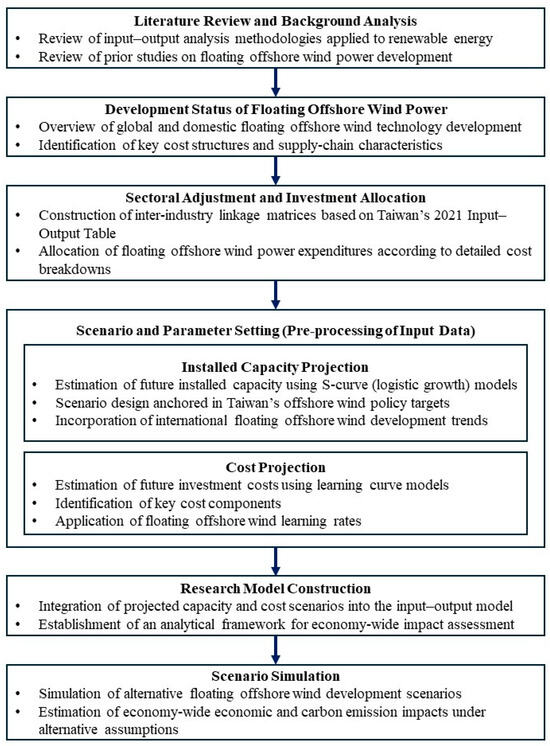
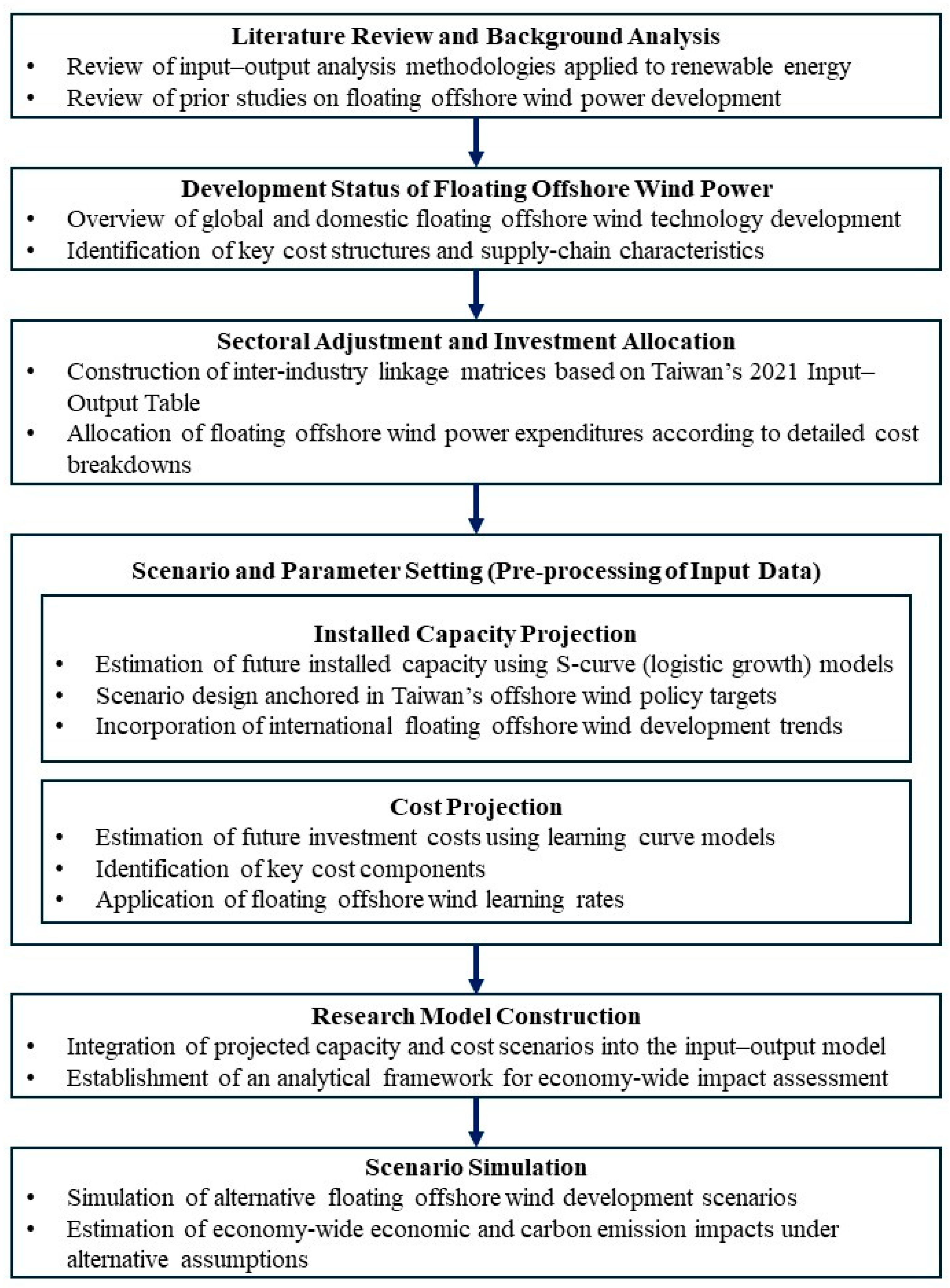
Figure 1 illustrates the overall methodological flow of this study, clarifying the integration of the various analytic components. Analysis began with a review of relevant I–O methodologies and previous studies on FOW, followed by an assessment of the development status and key techno-economic characteristics of FOW at global and domestic levels. Detailed cost breakdowns were then used to align FOW spending with Taiwan’s official 2021 I–O table, adjusting sectors as needed and mapping investment items to the appropriate categories.
Figure 1.
Integrated analytic framework combining scenario analysis with learning curves and input–output modeling to assess floating offshore wind development in Taiwan.
In the scenario and parameter-setting stage, we developed alternative development pathways using two linked components. Future installed capacity trajectories were projected using S-curve (logistic growth) models based on offshore wind policy targets established in Taiwan and developmental trends observed in other countries. Investment cost trajectories were estimated using learning curve models designed to capture cost reductions associated with cumulative deployment. The projected capacity and cost outcomes were subsequently integrated within the I–O framework to construct the research model. Finally, scenario simulations were conducted to quantify the effects of FOW on economy-wide economic impacts and carbon emission reduction under three plausible developmental pathways.
3.2. Data Sources and Processing
This study employed I–O analysis to quantify the economic and environmental impacts of FOW development in Taiwan, using the latest I–O table published by the Directorate-General of Budget, Accounting and Statistics (DGBAS), comprising 63 industrial sectors in 2021 [33]. To improve analytical tractability and minimize sectoral complexity, the original 63 sectors were consolidated into 39 aggregated industries. To reflect the distinct economic characteristics of the FOW lifecycle, the sector was disaggregated into two functional phases—construction and O&M—and mapped to the relevant sectors in the aggregated I–O table.
Cost structure data for these two phases were sourced from the Cost of Wind Energy Review: 2024 Edition, published by Stehly et al. [34] at the U.S. NREL. In the absence of commercial-scale FOW deployment in Taiwan, the NREL cost structure was adopted as an international benchmark, providing an internally consistent representation of expenditures across both construction and O&M phases. The expenditure items identified in the NREL report were classified according to the type of economic activity and systematically mapped to the 39-sector I–O classification. This mapping process established the foundational structure for I–O analysis, ensuring that each component of FOW-related investment and spending was appropriately allocated to domestic industry sectors for impact estimation.
Our cost structure mapping results revealed clear differences in industrial composition between the construction and O&M phases of FOW projects in Taiwan. As shown in Table 1 and Table 2, the construction phase was characterized by high domestic expenditures in fabricated metal products (29.8%), machinery and equipment (24.1%), and construction (19.4%), reflecting the capital-intensive nature of offshore wind farm installation. Electrical equipment and apparatus accounted for 9.7%, while service-related sectors, such as financial and insurance services, professional and technical services, and support services, collectively contributed less than 20% of total expenditures.
Table 1.
Share of expenditures by sector in the construction phase of FOW in Taiwan (39-sector classification).
Table 2.
Share of expenditures by sector in the O&M phase of FOW in Taiwan (39-sector classification).
The O&M phase exhibited a different expenditure profile dominated by transportation and storage (56.5%), followed by financial and insurance services (17.6%) and support services (15.7%). Capital goods sectors, such as fabricated metal products (1.7%), machinery and equipment (1.4%), and electrical equipment (0.6%), represent only a small fraction of total O&M expenditures during this phase.
3.3. Scenario Setting
To align with Taiwan’s 2050 net-zero emissions target, the Ministry of Economic Affairs (MOEA) has set an ambitious offshore wind power target of 40–55 GW by 2050. However, the official roadmap has yet to differentiate the contribution of fixed-bottom versus FOW technologies. Given this uncertainty, it is necessary to establish development scenarios that simulate potential capacity trajectories under varying policy and market conditions.
By the end of 2024, Taiwan had completed the grid connection of 374 fixed-bottom offshore wind turbines with total output of 3.04 GW; however, no FOW projects had yet been deployed. Thus, the FOW industry in Taiwan has not generated any historical data by which to estimate domestic growth parameters for capacity expansion. This study addressed this limitation by adopting market data from international sources to parameterize the S-curve diffusion model used for future growth projections.
Specifically, the growth-rate parameter (r) was taken from reports by Global Market Insights (GMI), which provide forecasts for both fixed-bottom and FOW. We set the annual average growth rate to 15.6% for fixed-bottom offshore wind based on the Fixed Offshore Wind Energy Market forecast [35], and to 31.5% for FOW based on the Floating Offshore Wind Energy Market Size forecast [36]. This differentiation is considered reasonable given that fixed-bottom offshore wind is a relatively mature market, while FOW remains in the early development phase. Moreover, it was assumed that growth rate parameters (r) for each technology type were identical across developmental pathways, while differences among scenario were captured by adjusting the inflection year and maximum capacity.
The plausibility of these assumptions was verified by reviewing international benchmarks. According to the Global Wind Energy Council (GWEC), global offshore wind capacity is expected to grow from 16 GW in 2025 to 34 GW in 2030, increasing its share of total wind energy installations from 11.8% to 17.5% [8]. McCoy et al. [37] predicted that FOW would enter a second wave of industrialization within the next five years, based on AEGIR Insights. This growth will be driven by cost reductions, modularization, and the standardization of supply chains, with a key inflection point expected around 2030.
Based on these international references and market parameters, this study simulated the trajectories for installed capacity in Taiwan’s offshore wind sector between 2030 and 2050 under three distinct scenarios that reflect varying degrees of policy support, technological progress, and market maturity (see Table 3):
Table 3.
Key scenario parameters for offshore wind development in Taiwan.
- High-growth scenario: Characterized by robust policy incentives, accelerated technological innovation, strong supply chain development, and heavy capital investment. This scenario represents an optimistic pathway involving rapid industrial scaling and early FOW commercialization.
- Baseline-growth scenario: Represents a business-as-usual pathway based on current policy commitments and existing market forecasts. It assumes steady but moderate progress in both fixed and floating offshore wind development.
- Low-growth scenario: Reflects a more conservative outlook in which deployment is delayed due to weaker policy intervention, slower technological progress, or constrained investment. This scenario anticipates slower capacity expansion and limited FOW adoption.
The three scenarios were based on total offshore wind capacity targets for 2050 established by the government of Taiwan. A total capacity of 55 GW was adopted for the high-growth scenario, reflecting an accelerated deployment pathway with strong policy support and rapid industrial scaling. A more conservative capacity ceiling of 40 GW was adopted for the low-growth scenario, corresponding to delayed deployment and weaker policy momentum. The baseline-growth scenario assumed a capacity level falling between these two bounds, representing a continuation of current policy commitments and market expectations. These exogenously defined capacity ceilings serve as boundary conditions for the S-curve diffusion modeling of fixed-bottom and FOW technologies, which in turn underpin the subsequent simulations of economic and environmental impacts across alternative development pathways.
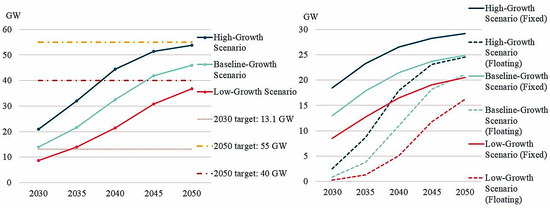
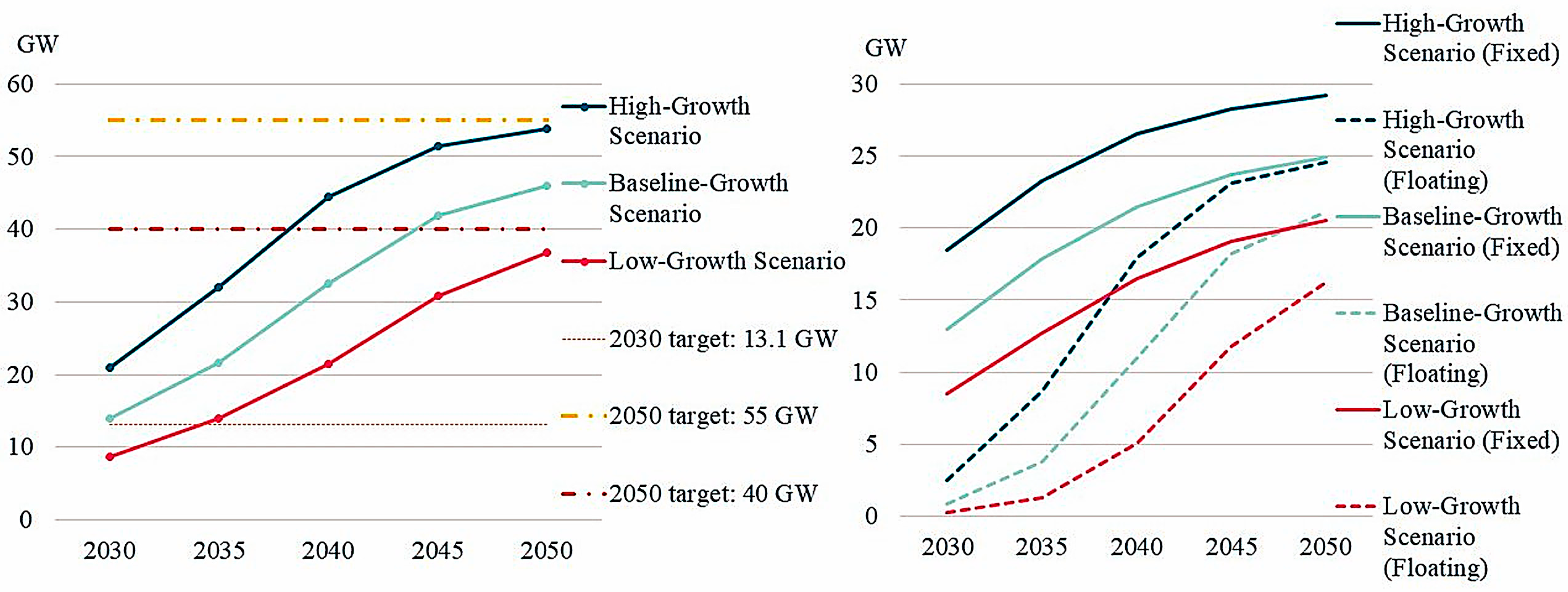
The projected installed capacity of fixed and floating offshore wind in Taiwan was estimated for the period 2030~2050 using the S-curve model, based on the three scenarios defined in Table 3. Under the high-growth scenario, fixed offshore wind capacity is expected to increase from 18.45 GW in 2030 to 29.19 GW in 2050 with FOW capacity increasing from 2.48 GW to 24.59 GW. This suggests that over the next two decades, FOW will overtake fixed-bottom installations as the dominant technology. Under this scenario, the combined installed capacity is expected to increase from 20.93 GW in 2030 to 53.78 GW in 2050.
Under the baseline-growth scenario, fixed capacity is expected to increase steadily from 13 GW in 2030 to 24.9 GW in 2050 with FOW capacity increasing from 0.90 GW to 21.1 GW over the same period. Under this scenario, the combined installed capacity is expected to increase from 13.9 GW in 2030 to 46 GW in 2050.
Under the low-growth scenario, fixed offshore wind capacity would only increase from 8.47 GW in 2030 to 20.55 GW in 2050 with FOW capacity increasing from 0.29 GW to 16.21 GW. Under this scenario, the combined installed capacity is expected to increase from 8.77 GW in 2030 to 36.76 GW in 2050. The capacity trajectories are shown in Figure 2.
Figure 2.
Projections of offshore wind installed capacity under three development scenarios for the period 2030–2050: total capacity (left); fixed versus floating (right).
3.4. Learning Curve
Cost projections were performed using the Cost of Wind Energy Review: 2024 Edition, published by the U.S. NREL [34], which provides detailed data pertaining to capital and operational expenditures for FOW. Construction costs were estimated using a learning curve model based on capital expenditure figures reported in the NREL study in conjunction with a 9.5% learning rate, as suggested by ORE Catapult [38]. The base year was set as 2023, representing the starting point of FOW development in Taiwan. Given that no commercial-scale FOW installations had been completed in Taiwan by that time, the cumulative installed capacity for the baseline year was assumed to be near zero. Because the learning curve formulation requires a strictly positive initial cumulative capacity, the initial value Q0 was set to a very small positive number (0.001 GW) to ensure the numerical tractability of the model when used to represent FOW development during the pre-commercial stage. Under these conditions, the learning coefficient (b) used in the model was derived as follows:
where R = 0.095 denotes the learning rate. Using this coefficient, the unit installation costs for the period 2030~2050 were estimated under different scenarios using the standard learning curve formula. The consolidated results are summarized in Table 4.
Table 4.
Projected unit installation costs of FOW under different growth scenarios (USD/kW, 2030~2050).
O&M costs were derived from estimates reported by Santhakumar et al. [39], which were originally presented in units of k€/MW/year. To ensure consistency, the values were converted to USD/kW/year using an exchange rate of €1 = USD 1.08. For scenarios with installed capacity below 1 GW, we used 2023 O&M cost estimates as a baseline, with linear interpolation applied to project future changes in costs. These adjustments ensured that O&M cost assumptions remained consistent with capacity development across all growth scenarios.
4. Results and Discussion
4.1. Economic Impacts
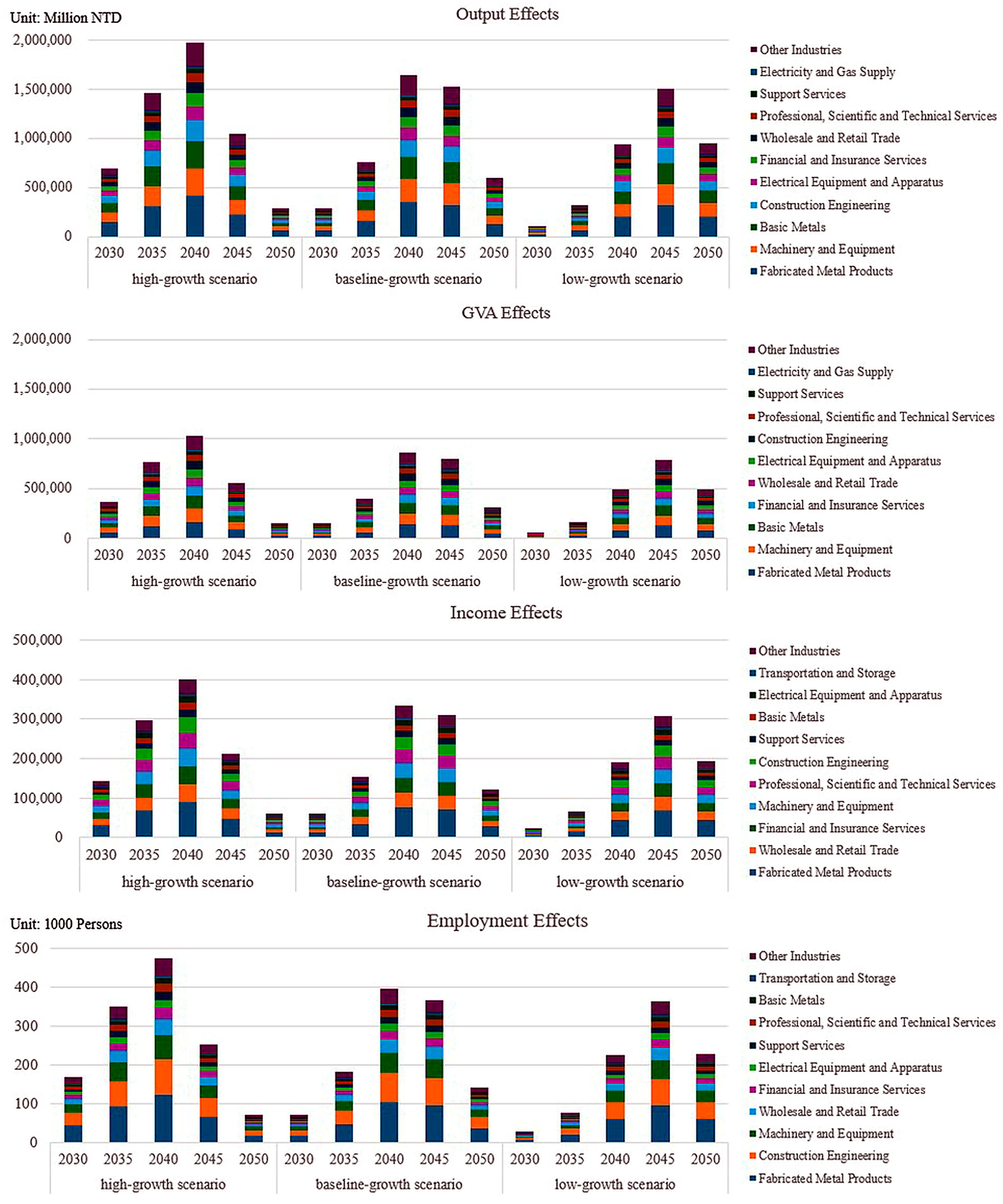
The construction phase of FOW development is characterized by significant short-term economic stimulation, with pronounced output and income effects concentrated in capital-intensive sectors such as fabricated metal products, machinery and equipment, construction, and electrical equipment. This period represents a critical window for concentrated investment in domestic manufacturing, infrastructure, professional services, and financial sectors.
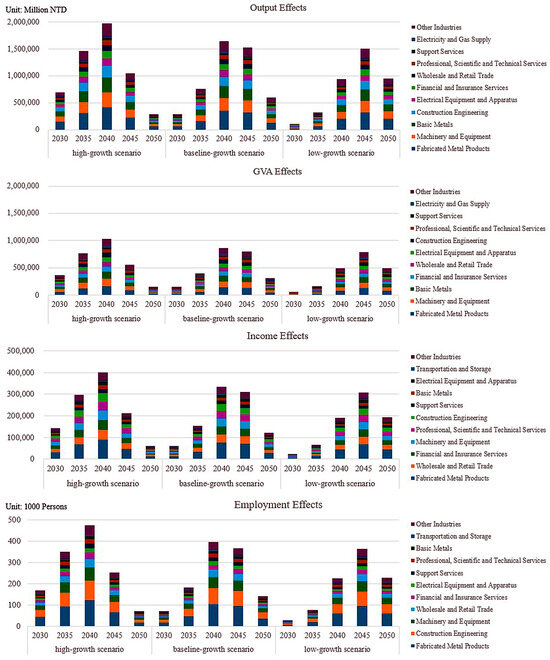
Under the high-growth scenario, total economic output is projected to peak at NTD (NTD stands for New Taiwan Dollar. On averages (2024Y), 1 USD is approximately equivalent to 32 NTD.) 1.97 trillion in 2040, with GVA of over NTD 1 trillion and 470,000 full-time equivalent jobs generating NTD 400 billion in income. Under the baseline-growth scenario, the most intensive construction activity is projected to occur between 2040 and 2045, with output exceeding NTD 1.5 trillion with NTD 864 billion of GVA and 390,000 jobs generating over NTD 330 billion in income. Under the low-growth scenario, output exceeding NTD 1.5 trillion in 2045 with NTD 793.2 billion of GVA and 360,000 jobs generating NTD 306.1 billion in income (see Figure 3).
Figure 3.
Estimated economic impacts of FOW during the construction phase, including total output, GVA, income, and employment.
During the O&M phase, the contribution to the economy will be moderate but sustained, providing continuous employment and stable service-sector demand with substantial cumulative effects throughout the project lifecycle.
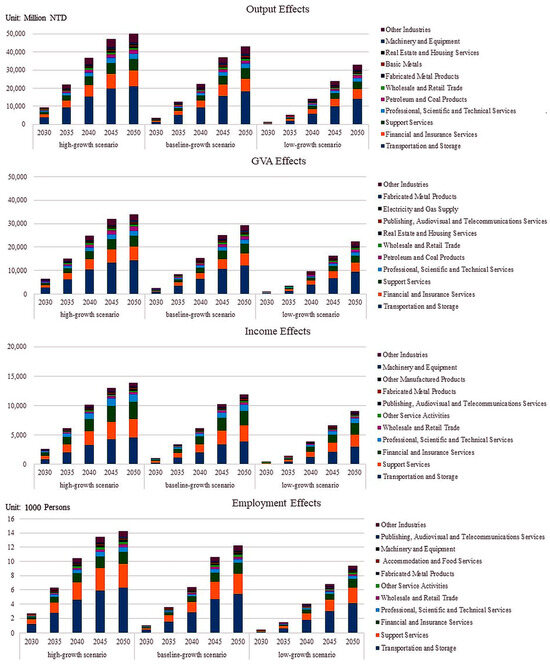
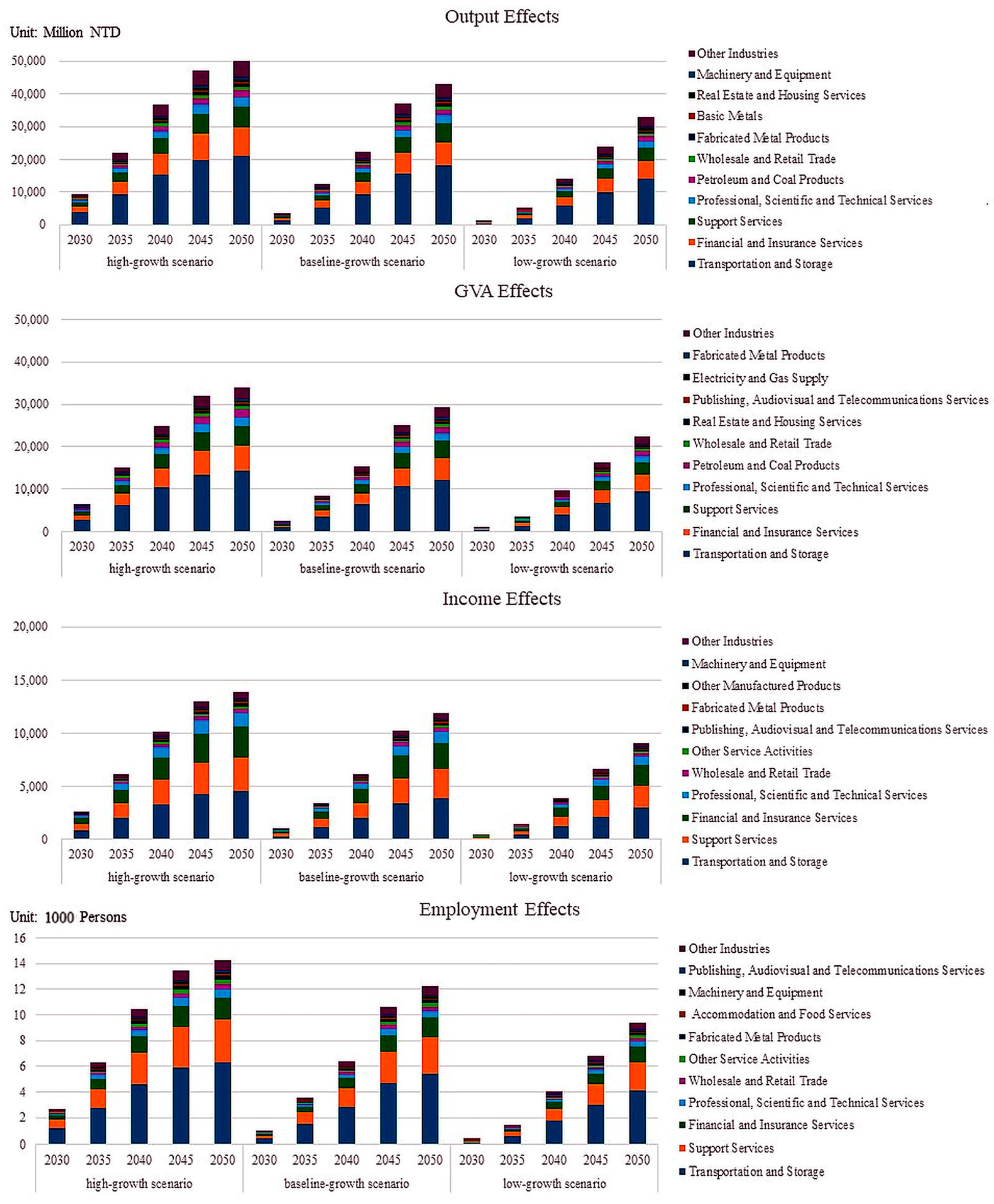
Under the high-growth scenario, O&M activities are projected to generate NTD 50 billion in annual output by 2050, with NTD 33.9 billion in GVA and the creation of 14,200 jobs generating NTD 13.8 billion in income. Under the baseline-growth scenario, output is projected to reach NTD 42.9 billion, with NTD 29.1 billion in GVA and the creation of 12,200 jobs generating NTD 11.8 billion in income. Under the low-growth scenario, output is projected to reach NTD 33.0 billion in output with NTD 22.4 billion in GVA and the creation of 9000 jobs generating NTD 9.1 billion in income. The sectors the benefit the most during the O&M phase include transportation and storage, support services, and financial and insurance services (see Figure 4).
Figure 4.
Estimated economic impacts of FOW during the O&M phase, including total output, GVA, income, and employment.
Table 5 and Table 6, respectively, list the top ten industrial sectors ranked according to output, GVA, income, and employment effects during the construction and O&M phases of FOW development. The rankings reveal distinct sectoral dynamics across project life cycle stages. As shown in Table 5, the economic impact during the construction phase will be driven primarily by traditional heavy industries and high-value-added services. Output effects will be most pronounced in industries that play a central role in the manufacture and installation of offshore wind infrastructure, including the fabrication of metal products, machinery and equipment, basic metals, construction and civil engineering, and electrical equipment. As project scale increases, financial services, professional and technical services, and support services will also emerge as significant contributors, reflecting an expansion of the value chain toward knowledge-intensive sectors.
Table 5.
Top 10 sectors in terms of output, GVA, income, and employment impacts during the FOW construction phase.
Table 6.
Top 10 sectors by output, GVA, income, and employment impacts during the FOW O&M phase.
GVA results underscore the critical role of domestic industrial capacity. The three largest manufacturing contributors (fabricated metal products, machinery, and basic metals) together account for 41.6% of total value added. Non-manufacturing sectors, including finance and insurance and professional services, provide essential capital, risk management, and project execution capabilities. Income effects are likewise led by the fabricated metal products sector, confirming its central role in the wind-energy supply chain, with additional contributions from finance, retail, construction, and logistics-related industries. Employment effects follow the same pattern: Job creation is most concentrated in fabricated metal products, construction, and machinery, with steady contributions from logistics and administrative services. Taken together, these results indicate substantial labor demand for both on-site construction activities and project coordination functions.
As shown in Table 6, the O&M phase will generate a pattern of longer-term, service-driven economic engagement, with relatively stable expenditures generating persistent effects across key sectors. As the logistical backbone of wind farm operations, transportation and storage are expected to dominate across all four economic indicators, accounting for 42.4% of total output effects. There will also be a heavy reliance on mid- to long-term network of service-oriented sectors, including financial and insurance services, professional and technical services, support services, and wholesale and retail trade. These findings confirm that even after the construction stage, FOW development will continue to generate substantial domestic value.
GVA effects will be concentrated in finance, technical support, and auxiliary services, with modest but important contributions to the material supply and backup energy sectors. In terms of income and employment, the O&M phase will be shaped primarily by labor-intensive service industries. Transportation and storage are expected to contribute the most to income effects, due to a heavy reliance on shipping, warehousing, and logistics. Across all scenarios, support services, financial and insurance sectors, and technical consulting firms are expected to maintain steady performance throughout the operational lifecycle. The economic footprint of FOW operations will extend across core as well as auxiliary service sectors, including wholesale and retail, accommodation and food services, and real estate.
From the perspective of economic structure, the patterns across output, value added, income, and employment helped clarify the economic benefits of FOW over the projected life cycle. During the construction phase, the largest gains in output and value added are concentrated in manufacturing and engineering activities that require substantial capital investment. This suggests that the economic payoff depends strongly on upstream industrial capacity, the ability to scale production, and the extent to which components and installation services can be supplied locally.
Income and employment effects during construction also indicate that near-term benefits include increased demand for labor associated with project delivery, coordination, and on-site work. Overall, these results highlight the importance of industrial preparedness and a well-developed supply chain for strengthening domestic participation and maximizing local value creation.
The O&M phase exhibited economic effects more evenly distributed across service-oriented sectors, with logistics, finance and insurance, technical services, and wholesale, and retail trade jointly supporting sustained output and value-added generation. The dominance of these sectors across multiple indicators implies that long-term economic benefits from FOW deployment depend less on manufacturing intensity and more on the availability of specialized services, operational reliability, and institutional support functions.
These findings indicate that FOW development delivers front-loaded industrial stimulus during the construction phase, followed by durable service-based value creation during the operation phase. This underscores the need to consider both industrial and service-sector dynamics when evaluating the broader economic implications of offshore wind deployment.
4.2. Environmental Benefits
To evaluate the effects of FOW on carbon emission reductions, we employed projections of Taiwan’s electricity sector published by the Industrial Technology Research Institute (ITRI), which were generated using the Long-range Energy Alternatives Planning (LEAP) model [40]. These simulations provide annual projections of both the grid emission factor and total greenhouse gas emissions from 2030 to 2050, during which the average grid emission factor is expected to decline progressively from 0.317 kgCO2e/kWh in 2030 to 0.105 kgCO2e/kWh by 2050, reflecting Taiwan’s ongoing energy transition toward decarbonization.
We estimated the annual electricity generation from FOW under each of the three development scenarios by applying a net capacity factor of 46%, as recommended by Mai et al. [41] in the U.S. NREL report. The resulting generation figures were then multiplied by the projected grid emission factors to quantify the corresponding reductions in annual carbon emissions.
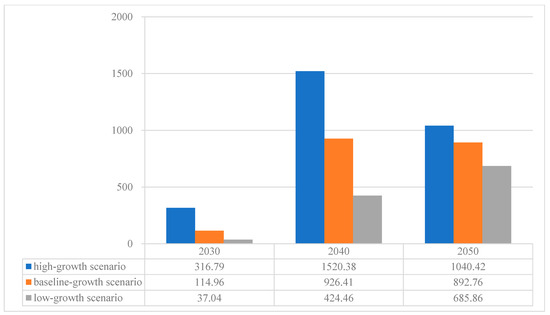
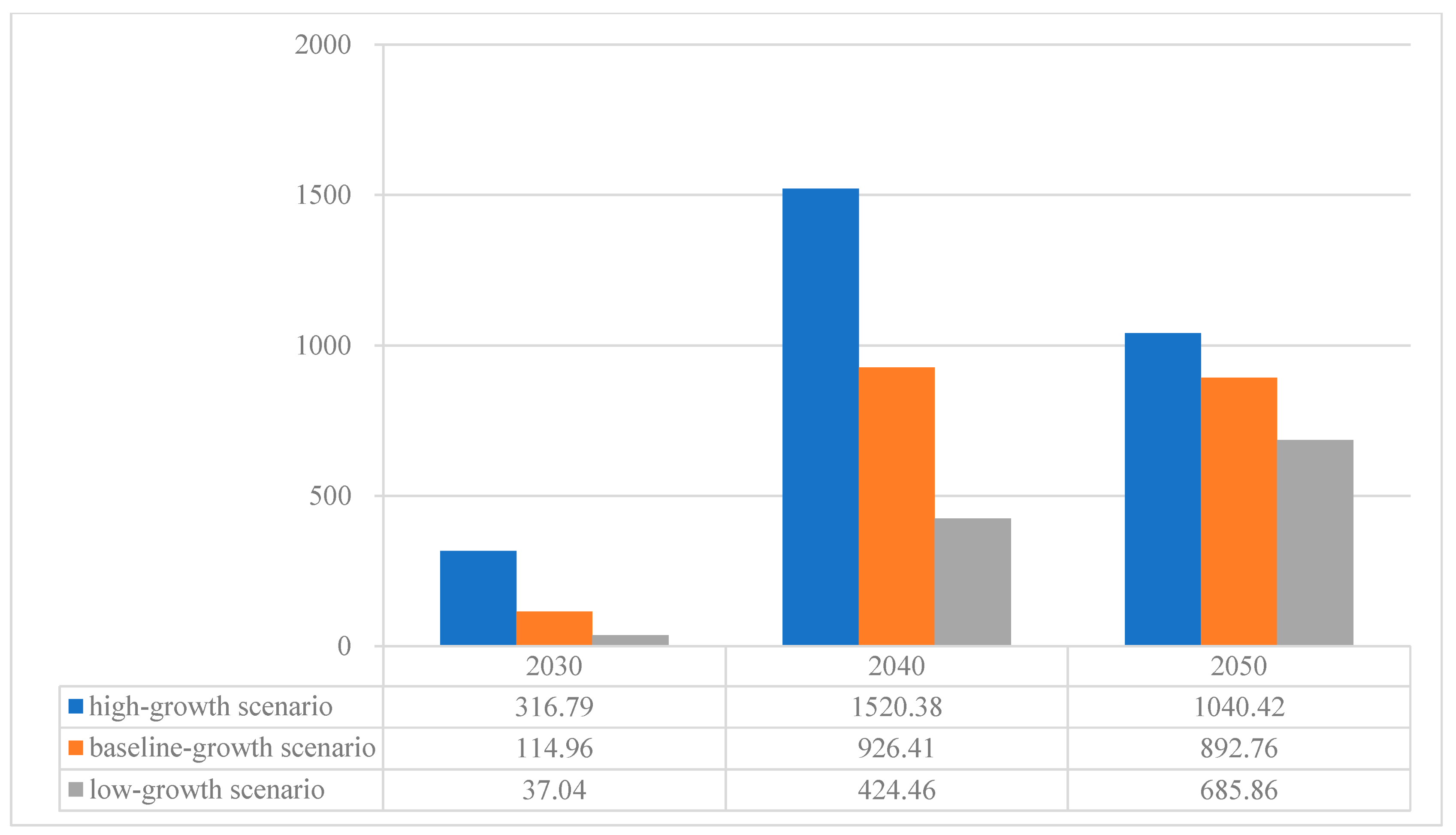
Our analysis revealed a strong correlation between the scale of FOW deployment and its contribution to decarbonization in the power sector. Under the high-growth scenario, annual generation will reach 9993.41 GWh in 2030, corresponding to a reduction of 3.17 million metric tons of CO2 equivalent (MtCO2e). By 2040, annual generation will increase to 72,475.8 GWh with estimated reductions of 15.20 MtCO2e. In 2050, FOW generation will reach 99,087.86 GWh with annual reductions of 10.40 MtCO2e.
Under the baseline-growth scenario, annual electricity generation will reach 85,024.56 GWh by 2050 with an estimated carbon reduction of 8.93 MtCO2e. Under the low-growth scenario, annual electricity generation will reach 65,319.82 GWh with a carbon reduction of 6.86 MtCO2e (see Figure 5). These findings underscore the pivotal role of FOW in mitigating emissions over the long-term, particularly under more ambitious deployment trajectories. Across all scenarios, the installed capacity and annual generation in 2050 will exceed those in 2040; however, the carbon reduction per unit of electricity is expected to decrease over time due a decrease in the grid emission factor as the power system moves toward decarbonization. This outcome reflects Taiwan’s broader progress and does not indicate a smaller absolute contribution from FOW. Instead, it highlights the complementary role of FOW within a progressively cleaner electricity mix.
Figure 5.
Projected carbon emission reductions from FOW under different development scenarios (2030–2050), expressed in 104 tCO2e.
These results highlight the role of FOW in supporting Taiwan’s efforts to achieve long-term decarbonization. As part of an integrated renewable-energy portfolio, FOW could have a profound effect on reducing emissions and achieving the 2050 net-zero emissions target.
4.3. Discussion and Limitations
This subsection synthesizes our results by comparing the structural effects of FOW deployment during the construction and O&M phases. The construction phase is characterized by short-term but highly concentrated economic effects, generating substantial output, value added, and employment in capital-intensive manufacturing and engineering sectors, such as fabricated metal products, machinery, basic metals, and civil engineering. These effects are likely to peak during periods of intensive investment, reflecting the upfront industrial and infrastructure requirements of large-scale FOW development.
The annual economic effects of O&M, predominantly in service-oriented sectors, are expected to be less pronounced but more persistent throughout the project lifecycle. Value added and employment during this phase will be dominated by logistics, transportation, financial services, insurance, and technical support activities, indicating a structural shift from manufacturing-led growth toward service-based economic engagement.
From an environmental perspective, the benefits for emission reduction are not expected to occur until the operational phase, during which the generated electricity will contribute cumulatively to CO2 mitigation over the long term. Taken together, it appears that FOW deployment will require a dual policy tailored to the distinct stages of the project life-cycle.
We determined that the magnitudes of economic outcomes during the construction and O&M phases are broadly comparable to those reported in the international literature. In addressing the construction phase, Jimenez et al. [24] estimated that a 400 MW FOW project in Hawaii could generate approximately 5000–6500 jobs and USD 0.6–0.75 billion in value added, while Speer et al. [26] reported that large-scale deployment of 10–16 GW along the U.S. West Coast would increase the GDP by USD 16.2–39.7 billion. Under the high-growth scenario examined in this study, Taiwan’s construction-phase would generate NTD 1.97 trillion in total output with over NTD 1 trillion in value added and roughly 470,000 jobs. These effects are comparable to those reported in large-scale deployments in other countries.
Evidence from the EU further highlights the role of domestic supply-chain integration in shaping economic outcomes. Studies focusing on the UK and Scotland suggest that higher localization rates and mature industrial ecosystems substantially enhance value-added and employment effects. Allan et al. [28] reported that increasing localization rates in the UK offshore wind sector to roughly 60% could yield cumulative economic benefits approaching GBP 30 billion, while Connolly [42] estimated that large-scale offshore wind expansion in Scotland could generate GBP 3.88 billion in gross value added and more than 82,000 annual jobs. Taiwan’s value added and employment per unit of installed capacity are expected to be lower than those of these mature markets, reflecting differences in development stage, supply-chain maturity, and industrial linkages.
Previous studies focusing on the O&M phase reported moderate but persistent contributions to the economy. Estimates for large-scale regional deployment along the U.S. West Coast suggest an annual effect on the GDP ranging from USD 0.1–0.3 billion at the state level [25] to USD 3.5–7.9 billion under large-scale regional deployment [26]. Our findings suggest that under the high-growth scenario in Taiwan, the O&M phase could generate NTD 33–50 billion in annual output by 2050, with gross value added of around NTD 33.9 billion and employment effects ranging from 9000 to 14,200 jobs. These results are consistent with international evidence pertaining to medium- and large-scale deployment.
Overall, the estimates of economic impact generated in this study are reasonable in terms of magnitude and phase-specific structure. Differences between Taiwan and mature offshore wind markets reflect variations in localization levels, industrial maturity, and supply-chain integration, underscoring the importance of conducting Taiwan-specific assessments while situating the results within a broader international context.
Finally, this study was subject to several limitations and challenges, which should be taken into account when interpreting our findings.
- FOW in Taiwan remains an emerging technology with no deployment to date. Due to a lack of domestic empirical data on cost structures, supply-chain composition, and operational characteristics, current assessments rely on international sources such as NREL and GMI to calibrate estimates of capital expenditures, O&M costs, and growth trajectories. The accumulation of local data as the FOW industry develops will enable future researchers to refine these parameters to improve the accuracy of the findings and enhance their relevance to policy decisions.
- The learning rate applied in this study was adopted from the international literature (e.g., ORE Catapult [38]). Although it provides a useful benchmark, it does not capture the cost dynamics specific to the Taiwanese market. It is likely that localized learning effects, shaped by supply chain maturity, industrial policy, and domestic innovation, will diverge from global patterns. Thus, it will be necessary to update these parameters with Taiwan-specific learning curves to improve cost projections in the future.
- A core limitation of I–O analysis is its reliance on fixed technical coefficients, which do not account for dynamic changes such as technological advances, import substitution, improvements in productivity, or price fluctuations. Static assumptions inevitably lead to overestimates or underestimates of economic outcomes. Future researchers should address these limitations by integrating I–O analysis with dynamic econometric or CGE models.
- The I–O framework used in this study relies on the most recent dataset from DGBAS. As this dataset is anchored to the 2021 I–O table, it does not capture structural changes in the economy or supply chain that have occurred since 2021. Input data should be updated once newer I–O tables are released.
- This study assumed a constant net capacity factor of 46% for FOW across all scenarios, consistent with international practice. However, actual capacity factors are likely to differ with site-specific wind resources, turbine technology, and maintenance schedules. Moreover, this analysis does not incorporate likely advances in energy efficiency or system integration. These factors should be included in more detailed simulations.
5. Conclusions and Policy Implications
FOW power generation is emerging as a critical pillar in the global energy transition. toward net-zero emissions. Despite positioning offshore wind as a cornerstone of its 2050 Net-Zero Emissions Pathway, Taiwan has yet to clearly delineate capacity targets for floating versus fixed-bottom systems or systematically assess the broader economic implications. This study employed scenario-based analysis integrating S-curve modeling for capacity trajectories with a learning curve approach to estimate cost reductions associated with FOW implementation during the critical period from 2030 to 2050.
Under the high-growth scenario, FOW capacity is projected to expand from 2.48 GW in 2030 to 24.59 GW in 2050, increasing total offshore wind capacity from 20.93 GW to 53.78 GW. This would also decrease installation costs from USD 4628.21/kW in 2030 to USD 3326.09/kW in 2050, due to learning effects and economies of scale. The growth in capacity and cost benefits is less pronounced under the baseline and low-growth scenarios, but FOW is expected to deliver robust economic returns and substantial emissions reductions regardless of the speed of implementation. In 2040, during the construction phase, the high-growth scenario is projected to generate NTD 1.97 trillion in total output while reducing emissions by 15.20 MtCO2. By 2050, annual reductions remain considerable at 10.40 MtCO2, underscoring the role of FOW in displacing fossil-based electricity generation over the long term.
FOW development is expected to deliver substantial economic benefits across both the construction and O&M phases. Initial construction will produce short-term gains, primarily in capital-intensive sectors such as fabricated metals, machinery, construction, and electrical equipment. Under the high-growth scenario, economic output in 2040 is projected to reach NTD 1.97 trillion, generating more than NTD 1 trillion in GVA and over 470,000 jobs. The O&M phase will provide modest but stable returns in the long term, mainly in service-oriented industries such as logistics, finance, and support services. By 2050, annual O&M output is expected to reach NTD 50 billion and generate about 14,200 jobs.
Based on the quantitative findings, this study proposes the following policy considerations to optimize the socio-economic and environmental benefits of FOW deployment in Taiwan:
- Optimize the capture of domestic value by developing infrastructure to increase supply-chain capacityOur findings indicate that upstream industrial capacity will play a pivotal role in generating economy-wide spillover effects with the most pronounced effects observed in output, value added, and employment during the construction phase. These effects will be driven predominantly by capital-intensive industries, such as civil engineering, and the development of facilities for machining and metal fabrication. Thus, policy measures should prioritize the expansion of domestic supply-chain capacity and the elimination of structural bottlenecks that might otherwise constrain large-scale project implementation. Key actions include supporting manufacturing capability for critical components, advancing workforce development in specialized industrial skills, and investing in enabling infrastructure such as port facilities, installation capacity, and dedicated logistics. By aligning industrial development strategies with principal economic drivers, it should be possible to enhance domestic value capture and transform short-term construction activity into longer-term industrial capability.
- Consolidating long-term economic benefits through O&M service-sector developmentEconomic effects during the O&M phase are not expected to reach the magnitude of those in the construction phase; however, the O&M will provide long-term benefits, particularly in logistics and professional services, including transportation, finance, insurance, and technical consultancy. Nonetheless, realizing these durable benefits will require policy geared toward an integrated O&M ecosystem with enhanced logistic coordination, inspection services, and associated professional expertise. It will also be necessary to promote the development of human capital through certification and skill-upgrading programs to ensure labor availability and bolster productivity throughout the FOW value chain.
- Aligning policy and financing frameworks with quantified decarbonization outcomesOur environmental assessment revealed that FOW deployment will greatly reduce CO2 emissions, even as the grid emission factor declines over time. FOW is expected to play an important role in Taiwan’s long-term decarbonization pathway; however, this issue should be assessed in terms of installed capacity as well as measurable mitigation outcomes within an evolving electricity mix. Public policy and financing frameworks should incorporate these quantified effects on emissions into investment appraisals and climate-aligned financial instruments. This could include the linking of support mechanisms and risk-sharing arrangements to emissions performance. A coordinated institutional framework that links industrial development, energy planning, and climate governance could enhance policy coherence and help realize the combined economic and environmental returns identified in this study.
Author Contributions
Conceptualization, Y.-H.H. and Y.-S.C.; methodology, Y.-H.H.; software, Y.-S.C.; validation, Y.-S.C.; formal analysis, Y.-S.C.; investigation, Y.-H.H.; writing—original draft preparation, Y.-H.H.; writing—review and editing, Y.-H.H. and Y.-S.C.; supervision, Y.-H.H.; funding acquisition, Y.-H.H. All authors have read and agreed to the published version of the manuscript.
Funding
This research was funded by the National Science and Technology Council, Taiwan, R.O.C. (grant number 113-2410-H-006-120-).
Institutional Review Board Statement
Not applicable.
Informed Consent Statement
Not applicable.
Data Availability Statement
The datasets analyzed during the current study are available from the corresponding author upon reasonable request.
Conflicts of Interest
The authors declare no conflicts of interest.
References
- International Energy Agency (IEA). Renewables 2024: Analysis and Forecasts to 2030. 2024. Available online: https://www.iea.org/reports/renewables-2024 (accessed on 14 March 2025).
- D’Adamo, I.; Di Leo, S.; Gastaldi, M.; Ozturk, I.; di Bergamo, U.T. Exploring the economic feasibility of offshore wind energy for sustainable development. Energy Rep. 2025, 14, 3093–3104. [Google Scholar] [CrossRef] [Scilit]
- European Commission. Communication from the Commission to the European Parliament, the Council, the European Economic and Social Committee. 2023. Available online: https://eur-lex.europa.eu/legal-content/EN/TXT/?uri=CELEX:52023DC0668&qid=1702455230867 (accessed on 25 March 2025).
- Barooni, M.; Ashuri, T.; Velioglu Sogut, D.; Wood, S.; Ghaderpour Taleghani, S. Floating offshore wind turbines: Current status and future prospects. Energies 2022, 16, 2. [Google Scholar] [CrossRef] [Scilit]
- Diaconita, A.I.; Andrei, G.; Rusu, L. An overview of the offshore wind energy potential for twelve significant geographical locations across the globe. Energy Rep. 2022, 8, 194–201. [Google Scholar] [CrossRef] [Scilit]
- Raghukumar, K.; Chartrand, C.; Chang, G.; Cheung, L.; Roberts, J. Effect of floating offshore wind turbines on atmospheric circulation in California. Front. Energy Res. 2022, 10, 863995. [Google Scholar] [CrossRef] [Scilit]
- National Development Council. Taiwan’s Pathway to Net-Zero Emissions in 2050. 2022. Available online: https://www.ndc.gov.tw/en/Content_List.aspx?n=B154724D802DC488 (accessed on 7 April 2025).
- Global Wind Energy Council (GWEC). Global Wind Report 2025. 2025. Available online: https://www.gwec.net/reports/globalwindreport#Download (accessed on 8 May 2025).
- Gallaher, A.; Graziano, M.; Axon, S.; Bertana, A. Breaking wind: A comparison between US and European approaches in offshore wind energy leadership in the North Atlantic region. Renew. Sustain. Energy Rev. 2023, 187, 113766. [Google Scholar] [CrossRef] [Scilit]
- Leontief, W.W. Quantitative input and output relations in the economic systems of the United States. Rev. Econ. Stat. 1936, 18, 105–125. [Google Scholar] [CrossRef] [Scilit]
- Ciorba, U.; Pauli, F.; Menna, P. Technical and economical analysis of an induced demand in the photovoltaic sector. Energy Policy 2004, 32, 949–960. [Google Scholar] [CrossRef] [Scilit]
- De Arce, R.; Mahía, R.; Medina, E.; Escribano, G. A simulation of the economic impact of renewable energy development in Morocco. Energy Policy 2012, 46, 335–345. [Google Scholar] [CrossRef] [Scilit]
- Kamidelivand, M.; Cahill, C.; Llop, M.; Rogan, F.; O’Gallachoir, B. A comparative analysis of substituting imported gas and coal for electricity with renewables: An input-output simulation. Sustain. Energy Technol. Assess. 2018, 30, 1–10. [Google Scholar] [CrossRef] [Scilit]
- Keček, D.; Mikulić, D.; Lovrinčević, Ž. Deployment of renewable energy: Economic effects on the Croatian economy. Energy Policy 2019, 126, 402–410. [Google Scholar] [CrossRef] [Scilit]
- Fatiha, B.; Anouar, G.; Zineb, Z.; Karim, M. Empirical evaluation of the socio-economic impacts of renewable energies in Morocco by 2035: An input-output model. Econ. Policy Energy Environ. 2022, 2, 193–217. [Google Scholar] [CrossRef] [Scilit]
- Lee, I.; Jang, S.; Chung, Y.; Seo, H. Economic spillover from renewable energy industries: An input-output analysis. Int. J. Green Energy 2022, 19, 809–817. [Google Scholar] [CrossRef] [Scilit]
- Woollacott, J.; Henry, C.L.; de Hernández, A.B.; DiVenanzo, L.; Oliveira, H.; Cai, Y.; Larson, J. Quantifying the local economic supply chain impacts of renewable energy investment in Kenya. Energy Econ. 2023, 125, 106810. [Google Scholar] [CrossRef] [Scilit]
- Li, Z.; Lin, Y.Y.; Song, Y.; Li, Z. Linkages and flow paths of energy consumption: Evidence from China’s sectors. Energy Rep. 2023, 9, 4594–4603. [Google Scholar] [CrossRef] [Scilit]
- Dell’Anna, F. Green jobs and energy efficiency as strategies for economic growth and the reduction of environmental impacts. Energy Policy 2021, 149, 112031. [Google Scholar] [CrossRef] [Scilit]
- Guionie, R.; Loisel, R.; Lemiale, L.; Guerineau, M. Industrial Planning with Input-Output Models: Empirical Evidence from Low-Carbon Hydrogen in France; HAL Working Paper HAL-04011936; HAL: Villeurbanne, France, 2023. [Google Scholar]
- Wang, Q.; Jiang, F.; Li, R. Assessing supply chain greenness from the perspective of embodied renewable energy—A data envelopment analysis using multi-regional input-output analysis. Renew. Energy 2022, 189, 1292–1305. [Google Scholar] [CrossRef] [Scilit]
- Feng, C.; Pan, G.; Yang, J. Identification of key renewable energy sectors for global energy transition based on industrial linkage analysis. Renew. Energy 2025, 245, 122651. [Google Scholar] [CrossRef] [Scilit]
- Markaki, M.; Belegri-Roboli, A.; Michaelides, P.; Mirasgedis, S.; Lalas, D.P. The impact of clean energy investments on the Greek economy: An input–output analysis (2010–2020). Energy Policy 2013, 57, 263–275. [Google Scholar] [CrossRef] [Scilit]
- Jimenez, T.; Keyser, D.; Tegen, S. Floating Offshore Wind in Hawaii: Potential for Jobs and Economic Impacts from Two Future Scenarios; National Renewable Energy Laboratory (NREL) Report No. NREL/TP-5000-65481; Bureau of Ocean Energy Management: Golden, CO, USA, 2016.
- Jimenez, T.; Keyser, D.; Tegen, S.; Speer, B. Floating Offshore Wind in Oregon: Potential for Jobs and Economic Impacts from Two Future Scenarios; National Renewable Energy Laboratory (NREL) Report No. NREL/TP-5000-65421; Bureau of Ocean Energy Management: Golden, CO, USA, 2016.
- Speer, B.; Keyser, D.; Tegen, S. Floating Offshore Wind in California: Gross Potential for Jobs and Economic Impacts from Two Future Scenarios; National Renewable Energy Laboratory (NREL) Report No. NREL/TP-5000-65352; Bureau of Ocean Energy Management: Golden, CO, USA, 2016.
- Nagashima, S.; Uchiyama, Y.; Okajima, K. Hybrid input–output table method for socioeconomic and environmental assessment of a wind power generation system. Appl. Energy 2017, 185, 1067–1075. [Google Scholar] [CrossRef] [Scilit]
- Allan, G.; Comerford, D.; Connolly, K.; McGregor, P.; Ross, A.G. The economic and environmental impacts of UK offshore wind development: The importance of local content. Energy 2020, 199, 117436. [Google Scholar] [CrossRef] [Scilit]
- Lochot, V.; Khalilpour, K.; Hoadley, A.F.; Sánchez, D.R. French economy and clean energy transition: A macroeconomic multi-objective extended input-output analysis. Sustain. Futures 2024, 8, 100285. [Google Scholar] [CrossRef] [Scilit]
- Harijan, K.; Uqaili, M.A.; Memon, M.; Mirza, U.K. Forecasting the diffusion of wind power in Pakistan. Energy 2011, 36, 6068–6073. [Google Scholar] [CrossRef] [Scilit]
- Wright, T.P. Factors affecting the cost of airplanes. J. Aeronaut. Sci. 1936, 3, 122–128. [Google Scholar] [CrossRef] [Scilit]
- Hernandez-Negron, C.G.; Baker, E.; Goldstein, A.P. A hypothesis for experience curves of related technologies with an application to wind energy. Renew. Sustain. Energy Rev. 2023, 184, 113492. [Google Scholar] [CrossRef] [Scilit]
- Directorate General of Budget, Accounting and Statistics (DGBAS), Executive Yuan. The Report on 2021 Input-Output Statistics; Executive Yuan: Taipei, Taiwan, 2025. [Google Scholar]
- Stehly, T.; Duffy, P.; Mulas Hernando, D. Cost of Wind Energy Review: 2024 Edition; National Renewable Energy Laboratory (NREL) Report No. NREL/PR-5000-91775; The National Renewable Energy Laboratory (NREL): Golden, CO, USA, 2024.
- Global Market Insights (GMI). Fixed Offshore Wind Energy Market. 2025. Available online: https://www.gminsights.com/industry-analysis/fixed-offshore-wind-energy-market (accessed on 16 June 2025).
- Global Market Insights (GMI). Floating Offshore Wind Energy Market Size. 2025. Available online: https://www.gminsights.com/industry-analysis/floating-offshore-wind-energy-market (accessed on 16 June 2025).
- McCoy, A.; Musial, W.; Hammond, R.; Mulas Hernando, D.; Duffy, P.; Beiter, P.; Pérez, P.; Baranowski, R.; Reber, G.; Spitsen, P. Offshore Wind Market Report: 2024 Edition; National Renewable Energy Laboratory (NREL) Report No. NREL/TP-5000-90525; The National Renewable Energy Laboratory (NREL): Golden, CO, USA, 2024.
- Offshore Renewable Energy Catapult (ORE Catapult). Floating Offshore Wind: Cost Reduction Pathways to Subsidy Free; ORE Catapult: Blyth, UK, 2021. [Google Scholar]
- Santhakumar, S.; Heuberger-Austin, C.; Meerman, H.; Faaij, A. Technological learning potential of offshore wind technology and underlying cost drivers. Sustain. Energy Technol. Assess. 2023, 60, 103545. [Google Scholar] [CrossRef] [Scilit]
- Industrial Technology Research Institute (ITRI). Study on the Long-Term Greenhouse Gas Reduction Strategy and Its Environmental Impact Correlations; Industrial Technology Research Institute: Hsinchu, Taiwan, 2023. [Google Scholar]
- Mai, T.; Beiter, P.; Mowers, M.; Shields, M.; Duffy, P. Deployment Implications of Reaching the DOE Floating Offshore Wind Shot Goal: A Summary of Initial Results and Methods; National Renewable Energy Laboratory (NREL) Report No. NREL/PR-5000-86020; The National Renewable Energy Laboratory (NREL): Golden, CO, USA, 2023.
- Connolly, K. The regional economic impacts of offshore wind energy developments in Scotland. Renew. Energy 2020, 160, 148–159. [Google Scholar] [CrossRef] [Scilit]

Disclaimer/Publisher’s Note: The statements, opinions and data contained in all publications are solely those of the individual author(s) and contributor(s) and not of MDPI and/or the editor(s). MDPI and/or the editor(s) disclaim responsibility for any injury to people or property resulting from any ideas, methods, instructions or products referred to in the content. |
© 2026 by the authors. Licensee MDPI, Basel, Switzerland. This article is an open access article distributed under the terms and conditions of the Creative Commons Attribution (CC BY) license.