Abstract
This study investigates the “insurance-like effect” of corporate Environmental, Social, and Governance (ESG) performance amid financial restatement events among Chinese listed firms and examines the moderating role of ESG rating divergence. Employing an event study methodology on a sample of 1552 financial restatement events in China’s A-share market from 2013 to 2023, we measure market reactions using the cumulative abnormal return (CAR) over a [−1, +1] day window. Our findings reveal that strong ESG performance significantly mitigates the negative market reactions triggered by financial restatements. However, this protective effect of ESG is significantly weakened by the inconsistency in ESG assessments among rating agencies, known as ESG rating divergence, particularly when such divergence is persistent. We argue that the underlying mechanism is that rating divergence creates signal conflicts, exacerbates information asymmetry, and erodes the credibility of ESG signals. This, in turn, undermines the stakeholder trust and moral capital that underpin the insurance-like effect. This research sheds light on the complex impact of ESG rating divergence on the value-protective mechanism of ESG and contributes new empirical evidence to the literature on ESG and its insurance-like effect, especially within the context of an emerging market.
1. Introduction
Since its formal introduction by the United Nations Global Compact in 2004, the Environmental, Social, and Governance (ESG) framework has become a key indicator for assessing corporate sustainability [1,2,3]. In recent years, the Chinese government has also promoted ESG integration through policy initiatives, encouraging firms to voluntarily disclose their ESG information. Influenced by both policy and market pressures, Chinese firms are increasingly integrating ESG into their strategies and practices to bolster their ESG performance [4,5].
As ESG has grown in prominence, scholars have extensively explored its multifaceted impact on firm value. One stream of research suggests that corporate ESG practices can build a sustainable competitive advantage by optimizing managerial efficiency, driving technological innovation, and integrating resources [6,7]. Another line of inquiry, drawing on signaling theory, emphasizes that strong ESG performance transmits positive reputational signals to the market. This allows firms to accumulate reputational capital, which in turn strengthens trust with stakeholders, lowers the cost of capital, and enhances operational efficiency [8,9]. Building on this, further research contends that the reputational capital accumulated through ESG activities serves less to directly enhance performance and more to protect it. This is particularly evident during periods of adversity, where it provides an “insurance-like effect” that cushions against losses in market value when a firm faces a crisis [10,11].
However, the effectiveness of a signal depends not only on its content but also on its clarity and consistency [12]. Although strong ESG performance is intended to convey positive signals for accumulating moral capital, this process involves a critical yet often overlooked complexity: the transmission of ESG signals does not occur in a vacuum. Prior literature examining the insurance-like effect of ESG has typically operated under the implicit assumption that a firm’s ESG signal is clear and singular. In reality, stakeholders primarily rely on third-party rating agencies to interpret these signals [13]. Yet, the complexity and heterogeneity inherent in rating systems often lead to widely divergent assessments of the same firm by different agencies, giving rise to the phenomenon known as “ESG rating divergence” [14].
This rating divergence acts as “noise” in the signal transmission process, obscuring the core signal of a firm’s ESG performance, and can trigger adverse economic consequences. For instance, existing research has demonstrated that ESG rating divergence can undermine the stability of ESG investment returns [15], complicate the linkage between ESG performance and executive compensation [16], and impede the market’s ability to efficiently price ESG information [17,18]. While these studies reveal how rating divergence diminishes the “value-creating” function of ESG, little research has explored whether and how this signal noise erodes ESG’s “value-protecting” function. This leads to a crucial yet overlooked research question: When a firm faces a negative shock, does ESG rating divergence weaken the insurance-like effect of ESG performance by creating signal conflicts?
Furthermore, signaling theory also emphasizes that the temporal consistency of a signal is a core element in establishing its credibility [12]. Consequently, short-term ESG rating divergence might be perceived merely as temporary informational friction. In contrast, persistent, long-term rating divergence could be interpreted by the market as ambiguity in a firm’s ESG strategy or a lack of regulatory oversight. The negative signal conveyed by such long-term divergence is more likely to conflict with the firm’s own ESG performance signals, thereby raising stakeholder doubts about the authenticity of its ESG commitments [19]. This signal conflict, stemming from long-term rating divergence, may cause even more severe damage to the integrity of a firm’s ESG signal, particularly when its reputation is under severe scrutiny following negative events like financial restatements. Nevertheless, the differential impacts of short-term versus long-term ESG rating divergence on the value of ESG performance remain underexplored in the existing literature.
Concurrently, with the continuous improvement of China’s capital market regulatory system and the strengthening of enforcement, financial restatement incidents among Chinese listed companies have increased significantly in recent years [20,21]. As a major accounting event, a financial restatement not only indicates that prior financial statements were unreliable, thereby damaging investor trust, but also triggers a negative chain reaction in the market [9,22]. Furthermore, although some studies have explored the buffering role of ESG in the context of financial restatements (e.g., Bartov et al. [23]), research focusing on the Chinese market, particularly on the reactions of local stakeholders and the applicability of the ESG insurance-like effect, remains scarce. Given the significant differences between China and developed economies in terms of market mechanisms and cultural contexts [24], which can lead to different economic consequences even under similar adverse conditions such as the 2008 financial crisis and the COVID-19 pandemic [25], this study focuses on the context of frequent financial restatements in the Chinese market and the existing research gap. We aim to not only investigate whether ESG activities provide an insurance-like effect for Chinese firms undergoing financial restatements but also to further examine how ESG rating divergence, especially long-term divergence, moderates this effect.
In summary, this study examines a sample of 1552 restatement events involving A-share listed companies that experienced financial restatements between 2013 and 2023. Employing an event study methodology, we construct and test three core hypotheses by capturing cumulative abnormal returns (CAR). Specifically, we first hypothesize that superior ESG performance can effectively mitigate the negative market shock from financial restatements, thereby exerting an “insurance-like effect” (Hypothesis 1). Building on this, we further posit that ESG rating divergence weakens this protective effect, as inconsistency among rating agencies exacerbates information asymmetry and diminishes the credibility of ESG signals (Hypothesis 2). Finally, we propose that the attenuating effect of long-term ESG rating divergence is more pronounced than that of its short-term counterpart (Hypothesis 3). Our findings indicate that strong ESG performance does, to some extent, buffer the negative impact of financial restatements on firm value, thus demonstrating an insurance-like effect. However, this effect is constrained and weakened by ESG rating divergence, with persistent long-term divergence further exacerbating this attenuation.
The main contributions of this study are as follows. First, this paper extends the literature on the ESG insurance-like effect. Existing literature on this effect often implicitly assumes that a firm’s ESG performance is a clear, singular, and easily perceptible signal, overlooking the signal conflict and noise caused by the heterogeneity among ESG rating agencies [14]. By introducing ESG rating divergence as a moderating variable, this study reveals how rating divergence can interfere with and diminish the positive value generated by ESG practices. Our research confirms that ESG rating divergence not only has a direct negative impact on firm value but also indirectly harms it by weakening ESG’s protective effect when firms encounter adverse events.
Second, this study introduces the construct of long-term ESG rating divergence, thereby extending the research on this topic. Current literature predominantly measures ESG rating divergence from a short-term perspective (e.g., R. He et al. [26]; H. Wang et al. [27]), overlooking the fact that, as a negative signal accompanying a firm’s ESG practices, it shares a similar dynamic with ESG performance itself—consistent behavior is more valuable than a one-time action [28]. By investigating the impact of long-term ESG rating divergence on the ESG insurance-like effect, our study not only provides a deeper understanding of the potential damage that rating divergence can inflict on firm value but also highlights the persistent challenges firms face in converting their ESG efforts into tangible value in an information-asymmetric environment.
Finally, this study provides new empirical evidence for understanding the value realization mechanism of ESG in emerging markets. Distinct from existing literature on the ESG insurance-like effect, which primarily focuses on financial restatement scenarios in developed Western markets (e.g., Bartov et al. [23]), or examines non-financial negative events such as environmental violations and media reports in the Chinese context (e.g., Sun et al. [29]; Yang et al. [30]), this study concentrates on financial restatement events in China. On one hand, it extends the applicability of findings from Western markets by providing evidence from a major emerging market, offering insights for other emerging economies. On the other hand, it enriches the literature on financial restatements within China’s specific institutional context, filling a gap in the current understanding of ESG’s role in this setting.
The remainder of this paper is structured as follows. Section 2 reviews the existing literature on the ESG insurance-like effect, as well as the causes and consequences of ESG rating divergence. It then develops our hypotheses by explaining why the ESG insurance-like effect is applicable in the context of financial restatements in China, and how ESG rating divergence—particularly long-term divergence—moderates this effect. Section 3 describes the research methodology, including data collection and variable construction. Section 4 presents the empirical results, covering the direct and moderating effects, a series of robustness checks, mechanism tests, heterogeneity analyses, and further analyses. Section 5 discusses the research findings. Finally, Section 6 and Section 7 explore the practical implications and research limitations, respectively.
2. Literature Review and Hypothesis Development
2.1. ESG Insurance-like Effect
According to signaling theory, a firm’s active engagement in and recognition for ESG activities are perceived as sending a series of positive signals to stakeholders. These signals indicate that the firm is not solely profit-driven and focused on short-term profit maximization, but also demonstrates its commitment to social responsibility and long-term sustainable development [31,32]. The transmission of these positive signals helps the firm build favorable relationships with its stakeholders and accumulate moral capital [31]. Moral capital, an intangible asset, encompasses the degree of trustworthiness and goodwill that stakeholders attribute to the firm, representing the extent of their positive evaluation [33,34]. Stakeholders’ positive evaluations become embedded in the firm’s value [23], creating competitive advantages such as reducing the costs of debt and equity financing [35].
When a firm confronts a negative event, moral capital can similarly influence its value. For instance, firms with high moral capital are perceived as more reliable and well-governed organizations [36]. According to cognitive dissonance theory and attribution theory [37], when a negative event occurs, moral capital can influence stakeholders’ causal attributions, making them more inclined to attribute the problem to external factors or unintentional managerial errors rather than malicious fraud or deliberate concealment. This helps stakeholders avoid cognitive inconsistency, thereby mitigating their negative assessments and penalties against the firm and its management, which in turn protects firm value [10,38]. This tendency to give the firm the “benefit of the doubt” effectively provides a protective mechanism, the insurance-like effect [28]. Therefore, from a risk management perspective, ESG can be viewed as a hedging instrument, where a firm’s upfront investments (ESG costs) are exchanged for a reduction in potential future losses [31,38]. Previous empirical studies have shown that a firm’s ESG practices can effectively mitigate the negative impact of adverse events on firm value, such as environmental violations, product recalls, accounting scandals, consumer complaints, and connections to corrupt officials [11,39,40,41,42]. Further research indicates that the ESG insurance-like effect becomes more pronounced during uncontrollable crises, such as the global financial crisis and the COVID-19 pandemic [43,44].
However, the protective role of moral capital is not unconditional. Godfrey [10] pointed out that when a negative event significantly conflicts with a firm’s previously established moral image, the insurance effect of moral capital may become ineffective or even exacerbate the negative impact by exposing corporate hypocrisy. Sohn and Lariscy [45] argued that stakeholders’ reactions to negative events often depend on their attributional judgments. They suggested that if an event is attributed to a lack of competence, stakeholders tend to focus on positive information, and the previously accumulated ESG reputation may continue to serve its protective function. Conversely, if the event is attributed to a lack of integrity (e.g., fraudulent behavior), stakeholders are more likely to focus on negative information. In this case, according to expectancy violation theory, the firm’s prior ESG performance not only fails to provide protection but may also trigger a stronger negative reaction from stakeholders due to the discrepancy between their expectations and reality, leading to a “backfire effect” or “boomerang effect.” Zhang et al. [46] further substantiated this by distinguishing between intentional and unintentional corporate social irresponsibility (CSIR), finding that prior CSR investments exacerbate stakeholders’ negative moral judgments of intentional CSIR, while eliciting a milder negative emotional response to unintentional CSIR. Furthermore, studies by Wagner et al. [47] and Koch et al. [48] both found that the alignment between the domain of the negative event and the firm’s prior areas of ESG focus is a key determinant of whether ESG generates a buffering effect or a backfire effect. Differentiating between stakeholder groups, Kim et al. [49] further discovered that ESG efforts directed at secondary stakeholders (e.g., the public, communities) provide a protective effect regardless of the nature of the negative event (intentional or unintentional), whereas ESG efforts aimed at primary stakeholders may be damaging or have no effect, depending on the event’s nature.
2.2. Causes and Consequences of ESG Rating Divergence
Existing literature attributes the causes of ESG rating divergence to factors related to both the rating agencies and the firms being rated [16]. From the perspective of rating agencies, divergence stems from the lack of a unified ontological foundation for rating systems, manifesting in differences across three dimensions: Scope, Measurement, and Weight [14]. First, regarding scope definition, the absence of a standardized framework leads rating agencies to construct distinct evaluation categories based on different social origins and client needs, resulting in fundamental disagreements over the definition of ESG attributes [50]. For example, Chen et al. [51] find that, compared to international agencies, local Chinese raters incorporate a unique localized indicator: “participation in poverty alleviation.” Second, heterogeneity in measurement methodologies is the primary driver of rating divergence [14]. This is reflected not only in the use of different quantitative indicators for the same attribute but also in the influence of the “rater effect,” where analysts’ subjective cognitive biases affect the scoring of specific indicators. Furthermore, choices of data sources, data cleaning rules, and the transparency of the rating process further exacerbate the dispersion of outcomes [52,53]. Finally, subjective preferences in weight assignment constitute the third dimension of divergence. Although Berg et al. [14] suggest that weighting differences contribute relatively little, the variations in values and risk appetites reflected by rating agencies in specific industries or contexts cannot be overlooked [53,54].
From the perspective of the rated firms, information disclosure characteristics, heterogeneity in corporate attributes, and managerial strategic behaviors are the main drivers of rating divergence. First, information asymmetry and disclosure quality are crucial. While some studies suggest that high-quality disclosure helps to bridge divergence [55,56], Christensen et al. [57] and Gyönyörová et al. [58] find that increased disclosure levels may, paradoxically, intensify divergence by increasing the complexity of information interpretation. Second, the inherent characteristics of rated firms, such as firm size, industry affiliation, and geographic location, also significantly affect rating consistency. Large firms, due to their operational complexity and multinational presence, face more diverse institutional environments and stakeholder demands, making it difficult for rating agencies to reach a consensus in their assessments [59]. Moreover, the validity and consistency of ESG scores vary significantly by industry and country of registration [58]. For instance, domestic rating agencies in China exhibit greater tolerance for alcohol-related businesses, whereas their international counterparts do not [53]. Lastly, managers’ strategic disclosure behaviors cannot be ignored. To secure more favorable ratings, firms may engage in impression management, emphasizing positive news with an optimistic tone while obscuring negative information with vague language. This subjective presentation of information further amplifies data processing and interpretation biases among rating agencies [60].
As a source of information uncertainty, ESG rating divergence carries significant economic consequences, primarily by increasing market friction and distorting corporate behavior. At the asset pricing level, because rating divergence exacerbates the information asymmetry and evaluation risks faced by investors, the market often demands a higher risk premium. For example, studies by Tan and Pan [61] and Wang et al. [27] show a significant negative correlation between ESG rating divergence and stock returns as well as excess returns. This uncertainty has also been shown to elevate stock price crash risk [62,63] and increase idiosyncratic volatility in the stock market [64]. Simultaneously, for institutional investors, ESG rating divergence can also distort their expectations and asset allocation decisions, leading to lower equity holdings [65]. Furthermore, the effects of rating divergence spill over to the debt market, leading to wider bond spreads [66] and higher corporate debt financing costs [67], indicating that creditors also view rating disagreement as a signal of credit risk arising from information opacity. Finally, this uncertainty also affects information intermediaries, leading to decreased analyst forecast accuracy [68] and increased audit fees [69], further deteriorating the market’s information environment.
Beyond capital market reactions, ESG rating divergence profoundly influences corporate strategic behavior by altering managerial incentive structures. The research by Li and Cheng [16] indicates that, when faced with inconsistent external ratings, managers are more inclined to engage in real earnings management to meet market expectations or smooth valuation fluctuations, a short-termist behavior that can harm long-term firm value. On the topic of green innovation, prior research presents conflicting views: some studies argue that rating divergence inhibits green innovation by tightening financing constraints and diverting managerial attention [15,70], while others contend that the legitimacy crisis induced by rating divergence compels firms to send positive signals through tangible actions like green innovation [71,72]. In the context of digital transformation, ESG rating divergence is found to impede the progress and effectiveness of corporate digitalization by exacerbating financing constraints [53].
2.3. Hypothesis Development
2.3.1. The Insurance-like Effect of ESG During Financial Restatements
In summary, whether a firm’s ESG performance provides an insurance-like effect depends on the type of negative event and the attributions made by stakeholders. This study posits that in the context of financial restatements in China, corporate ESG performance will generate a protective effect rather than backfire effects. This expectation is based on the following arguments:
First, a restatement occurs when a firm needs to amend one or more previously disclosed financial reports. This action not only indicates that the firm’s prior financial reports contained errors but also signifies issues with its financial reporting quality [73]. The causes of financial restatements can be twofold. One category involves simple issues like clerical or numerical mistakes, which typically stem from unintentional acts such as accountant oversight, calculation errors, or improper accounting treatments, and are thus related to firm ability. The other category involves major issues like fraud or managerial misconduct, which are intentional acts related to the firm’s character and integrity [74]. Previous research indicates that financial restatements are predominantly caused by unintentional errors within the company rather than intentional or fraudulent acts [75,76].
In China, a key emerging market, unintentional errors are similarly the dominant cause of financial restatements. A series of studies on the Chinese market, despite using different sample periods and classification methods, have reached highly consistent conclusions. Early research, through manual analysis of restatement announcements, found that restatements due to non-intentional acts such as errors and omissions in accounting records or improper application of standards accounted for as high as 80.99% [77].
Subsequently, Chinese scholars widely adopted the classification framework of Hennes et al. [78] to distinguish between unintentional errors and fraudulent activities. For example, Ma et al. [79] found that restatements due to unintentional errors constituted approximately 81.9%. Using a similar standard, studies by Wu et al. [21] and Li et al. [80] reported similar proportions (79.46% and 84.12%, respectively). Notably, Li et al. [80], after comparing data from China and the US, pointed out that although the proportions are not identical, the predominance of ‘errors’ is a common pattern in both markets. Furthermore, research using other classification standards supports this conclusion. Luo and Song [73], adopting the methodology of GAO [81], found that error-induced restatements accounted for 83.5%. Meanwhile, Xiu and Liu [82], applying a stricter definition of fraud, found an even higher proportion of error-driven restatements at 87.9%. Corroborating evidence also comes from the professional DIB database, which shows that between 2011 and 2019, restatements directly caused by accounting fraud or scandals constituted only 1.3% [83].
Collectively, substantial and consistent evidence indicates that financial restatement events in China are predominantly characterized by unintentional errors. This characteristic makes it more likely that stakeholders will attribute them to issues of firm competence or systemic problems, rather than severe character flaws or malicious concealment. According to the arguments in the preceding section, when a negative event is attributed to ability rather than character, stakeholders are more inclined to maintain their positive perceptions of the firm. This allows the moral capital previously accumulated by the firm to serve as a buffer, thereby generating the ESG insurance-like effect.
Second, compared to their global peers, Chinese firms exhibit a lower overall level of ESG performance [51], with a more pronounced lag in the Governance dimension [84]. Based on RepRisk data from 2009 to 2021, Chen et al. [51] show that Chinese firms experience a higher frequency of negative ESG incidents related to the Governance dimension than to the Environmental and Social dimensions. The quality of a firm’s financial reporting is often considered by both academia and rating agencies as a reflection of its performance in the Governance pillar of ESG [85]. On the other hand, the general public in China typically pays low attention to ESG-related topics in normal circumstances, with discussions on corporate governance being particularly scarce [86]. Public attention tends to spike only in response to negative corporate events, such as “greenwashing” allegations [87]. Therefore, given the relatively low investment in ESG, especially in the Governance dimension, by Chinese firms and the limited public discourse on these topics, a financial restatement is less likely to be immediately perceived by stakeholders as a severe negative event or an instance of corporate hypocrisy. This, in turn, mitigates the risk of triggering backfire effects.
In summary, based on the prevalent causes of financial restatements in the Chinese market, the level of corporate ESG performance, and the state of public awareness, this study predicts that a firm’s strong ESG performance will successfully exert an insurance-like effect during a financial restatement event.
Hypothesis 1 (H1).
A firm’s strong ESG performance can significantly mitigate the negative impact of a financial restatement on its value (i.e., generate an insurance-like effect).
2.3.2. The Insurance-like Effect of ESG and ESG Rating Divergence
According to signaling theory, the efficacy of a signal often depends on the receiver’s ability to notice it and the value they assign to it [88]. Therefore, the accumulation of moral capital depends not only on a firm’s actual investment in ESG activities but also on stakeholders’ perception and recognition of these activities [89]. Avramov et al. [18] argue that ESG rating divergence acts as “noise” in the transmission of ESG signals. This noise obstructs the positive signals that firms attempt to send to stakeholders through their ESG practices, interferes with investor decision-making based on ESG ratings, and consequently leads to higher perceived market risk and reduced investor willingness to invest.
We contend that ESG rating divergence systematically hinders the accumulation of moral capital, thereby weakening the ESG insurance-like effect, through the following three mechanisms.
First, rating divergence weakens the credibility of ESG signals by creating “signal conflict.” According to signaling theory, a signal’s effectiveness hinges on its clarity and consistency [12]. While a firm’s strong ESG performance is meant to send a positive signal about its high quality and reliability, the very existence of ESG rating divergence constitutes a strong negative signal about the firm’s “chaotic information environment and questionable signal credibility.” When these two signals coexist, a classic signal conflict arises, where signals contradict each other [90]. This conflict is not a simple informational offset; rather, it systematically contaminates the purity of the positive signal and directly diminishes its signal strength [91]. This reduces the perceived correlation in investors’ minds between ESG performance and the firm’s true underlying qualities, such as robust governance and a long-term orientation [72]. Ultimately, this renders the firm’s prior ESG activities less credible, making it difficult for stakeholders to verify the authenticity of its ESG claims [67], exacerbating information asymmetry in capital markets, and widening the information gap between the firm and its stakeholders [57,92]. In such a scenario, the credibility of the positive signals the firm attempts to convey is severely compromised. When the foundation of moral capital—the ESG signal itself—becomes ambiguous and unreliable, it becomes difficult for stakeholders to form stable, positive evaluations of the firm, directly impeding the effective conversion of ESG actions into moral capital.
Second, rating divergence reduces stakeholder attention to ESG signals by increasing their “information processing costs.” Signaling theory emphasizes that a signal’s true effectiveness is determined by the receiver’s willingness and ability to process it [88,90]. By creating a complex environment filled with contradictory information, rating divergence often compels stakeholders to invest additional time and cognitive resources to screen, discern, and integrate this conflicting information [15,27]. The theory of limited attention suggests that individuals have finite information processing capacity [93]. Consequently, when faced with such high decision-making costs, stakeholders may either avoid ESG-related issues and reduce their attention to ESG factors [27,94] or resort to heuristic decision-making, making less accurate judgments based on limited information and intuition [95,96]. For institutional investors in particular, this cognitive burden may exacerbate the asymmetry in cognitive resources between their “buy” and “sell” decisions, leading them to rely more on intuition when making sell decisions [97]. Ultimately, in either case, the effective reception and processing of ESG signals are hindered. When stakeholders abandon the effort to distinguish between “real” and “fake” ESG signals due to excessive costs, or even treat all ESG performance equally, genuinely high-quality ESG achievements fail to translate into additional moral capital. This creates an injustice for firms that are truly committed to sustainable development, particularly in a context where the ESG rating process is highly subjective and fragmented [98].
Finally, ESG rating divergence may be interpreted as a negative signal of corporate “opportunistic behavior” or “greenwashing,” directly eroding stakeholder trust in the firm’s motives. Godfrey [10] emphasizes that the formation of moral capital requires not only “act-based evaluation” but also “actor-based evaluation,” which involves positive attributions about the firm’s intentions. Rating divergence provides a fertile ground for opportunistic behavior [16]. Stakeholders may suspect that a firm is exploiting loopholes in different rating systems for “rating arbitrage” or that its ESG practices are more symbolic than substantive—i.e., “greenwashing” [58,99,100]. Once such suspicion arises, it severely damages stakeholder trust in the firm’s character and integrity. This pre-existing distrust is amplified, especially when the firm confronts a negative event like a financial restatement [101]. Stakeholders become even more uncertain about the reliability of the firm’s previously accumulated ESG reputation and are less likely to grant it the “benefit of the doubt.” Consequently, the protective value of moral capital is further diminished in this high-noise environment.
In summary, ESG rating divergence systematically obstructs the accumulation of moral capital by weakening signal credibility, increasing information processing costs, and triggering negative attributions about firm motives. With an insufficient reserve of moral capital, a firm’s ESG performance is unlikely to serve as an effective buffer when it faces a crisis such as a financial restatement. It is worth noting that this divergence can manifest at multiple levels, such as the discrepancies between domestic and international rating agencies, or inconsistencies across the individual Environmental, Social, and Governance pillars. While our primary hypothesis focuses on the overall effect of divergence, we will explore these specific dimensions in further analyses to provide a more nuanced understanding. Therefore, we propose the second hypothesis of this study.
Hypothesis 2 (H2).
When a firm experiences a financial restatement, ESG rating divergence will negatively moderate the insurance-like effect, such that the more pronounced the rating divergence, the weaker the positive effect of ESG on firm value.
2.3.3. The Insurance-like Effect of ESG and Long-Term ESG Rating Divergence
Existing research indicates that the duration of a firm’s ESG practices influences the accumulation of its moral capital and the strength of the insurance-like effect [28,29]. Similarly, ESG rating divergence may also have a lagged effect, meaning historical divergence can impact a firm’s current condition. For instance, the empirical study by Li and Cheng [16] finds that ESG rating divergence lagged by one or two periods significantly affects a firm’s current real earnings management behavior.
Signaling theory not only focuses on the immediate content of a signal but also emphasizes the critical role of a signal’s persistence and frequency over time in establishing its credibility [12,102]. A stable and continuous stream of signals is substantially more effective at shaping a receiver’s long-term perceptions and trust than a one-off, isolated signal [103,104]. Short-term rating divergence might be interpreted by the market and stakeholders as temporary “information friction,” such as adjustments in rating methodologies, data coverage lags, or normal fluctuations in an emerging rating market [105]. However, if this divergence persists over the long term, it ceases to be temporary “information friction” and evolves into a credible negative signal about the ambiguity of the firm’s ESG strategy or its consistently poor information disclosure quality. This persistent negative signal is more salient and more easily captured and remembered by stakeholders, especially when the firm encounters a negative event [106]. Consequently, stakeholders are more likely to attribute long-term divergence to fundamental internal issues, such as strategic inconsistency, managerial opportunism, or a lack of integrity, rather than temporary external disturbances. This negative attribution regarding the firm’s character will more profoundly erode the foundation of moral capital, namely, the trust in the firm as an actor [10].
Second, drawing from the “stock vs. flow signals” perspective in crisis management, long-term rating divergence, as a “stock-type” negative signal, possesses greater destructive power during a crisis. The study by Gomulya and Mishina [107] found that after a firm encounters a negative event, stakeholders shift their focus from the firm’s recent “flow” signals (e.g., annual profits) to scrutinizing its historically accumulated “stock” signals (e.g., net assets). Analogously, in the ESG domain, a firm’s ESG performance in a given year is a “flow” signal, whereas its long-term, sustained ESG investments build a “stock” of moral capital [28]. Similarly, short-term rating divergence can be viewed as “flow-level” information noise, while long-term rating divergence constitutes a “stock” of negative signals regarding the unreliability of the firm’s ESG information. When a financial restatement occurs, stakeholder attention shifts to historical and accumulated evidence. At this juncture, the weight of long-term rating divergence, as a stable and enduring piece of negative “stock” evidence, increases significantly. It creates a more intense conflict with the firm’s positive ESG reputation, thereby more severely weakening the protective power of the latter.
Finally, from the perspective of moral capital reserves, long-term rating divergence continuously erodes a firm’s reservoir of moral capital. Godfrey [10] likens moral capital to a “reservoir of goodwill” stored up to face future risks. If short-term rating divergence merely creates a minor crack in this reservoir, long-term divergence acts like a persistent leak. It systematically obstructs the conversion of each ESG investment into moral capital, causing the firm’s moral capital reservoir to be at a low level even before a crisis strikes. This implies that long-term rating divergence has already depleted much of the insurance value that ESG was supposed to provide, well before the crisis occurs.
Therefore, compared to short-term divergence, which is often dismissed as temporary noise, long-term rating divergence acts as a more salient, systematic, and destructive negative signal, more severely undermining the transmission of ESG signals and the accumulation of moral capital. In summary, we propose the third hypothesis of this study.
Hypothesis 3 (H3).
When a firm experiences a financial restatement, the negative moderating effect of long-term ESG rating divergence on the ESG insurance-like effect is more significant than that of short-term ESG rating divergence.
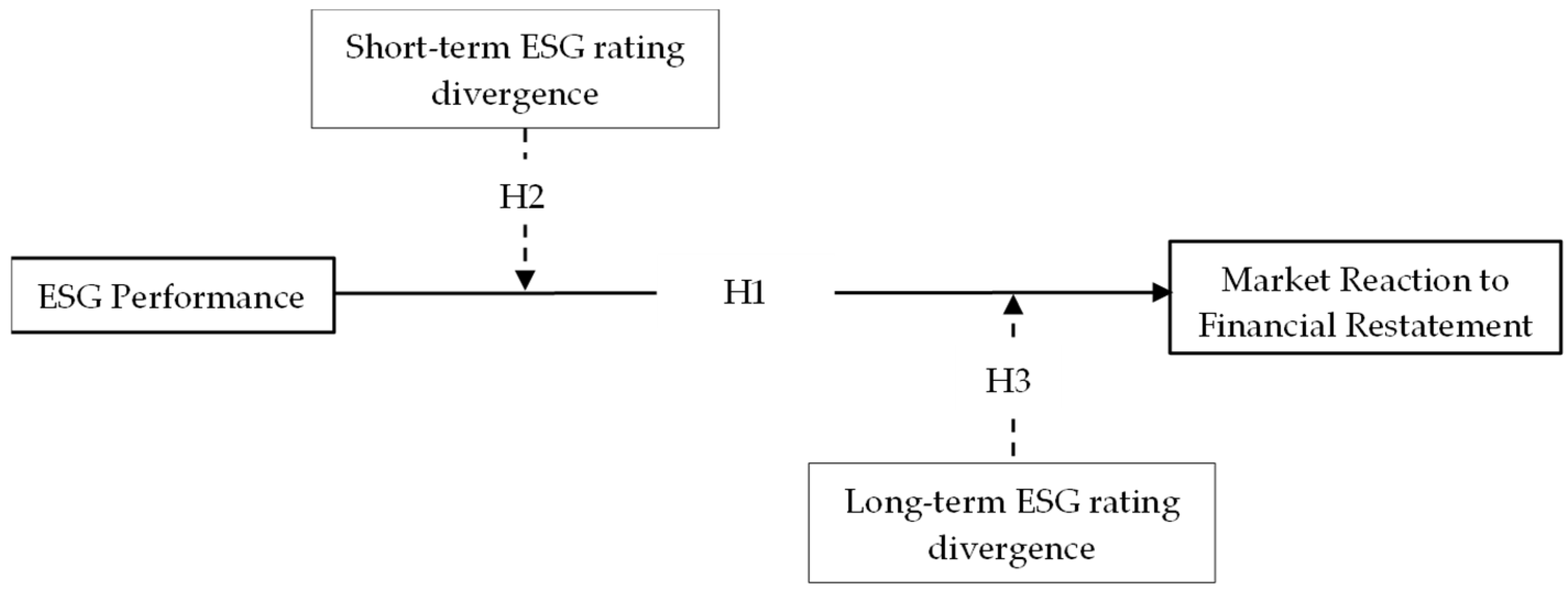
In summary, this study first proposes that high ESG performance can provide an insurance-like effect for firms during financial restatement events (H1). It then argues that this protective effect is negatively moderated by ESG rating divergence (H2). Finally, it posits that the attenuating effect of long-term divergence is more pronounced than its short-term counterpart (H3). To visually summarize the theoretical framework and the hypothesized relationships, we present our conceptual model in Figure 1.
Figure 1.
Conceptual Model.
3. Research Design
3.1. Data
Our initial sample comprises all Chinese A-share companies listed on the Shanghai and Shenzhen Stock Exchanges that experienced a financial restatement between 2013 and 2023. To ensure rating reliability and coverage, we source ESG data from five prominent third-party rating agencies widely used in academic literature on the Chinese market [27,108]. These include four domestic Chinese agencies (Huazheng, CNRDS, Wind, and Hexun) and one major international agency (Bloomberg). Furthermore, to ensure the robustness and comparability of our composite ESG measure, we follow the approach of Mao et al. [108] and apply an additional screening criterion: sample firms must have ratings from at least three of these agencies in each observation year; otherwise, they are excluded.
This study adopts the same combination of rating agencies as Li and Cheng [16], which includes four domestic agencies and one international agency (a 4:1 ratio). We chose this specific combination over the approach of Mao et al. [108], who used only domestic agencies, and that of Wang et al. [27], who included other international agencies (e.g., FTSE, MSCI) to increase the proportion of international raters, for two primary reasons. First, existing research has already identified systematic differences between domestic and international ESG ratings, and these differences can negatively impact firm value [51,109]. Therefore, including data from an international rating agency allows us to more effectively capture this divergence. Second, considering data availability, other major international rating agencies accessible to us (e.g., FTSE, MSCI) only began formally publishing ESG ratings for Chinese firms in 2018, and their coverage of firms is limited [110]. Increasing the proportion of international agencies would lead to a substantial reduction in our sample size, particularly within our study period, potentially introducing unnecessary sample selection bias.
Financial restatement data are obtained from the CSMAR database. To ensure sample homogeneity and research rigor, we follow the practices of prior literature [72,111] and process the raw financial restatement sample from CSMAR as follows: (1) we exclude firms in the financial industry; (2) remove listed companies marked with ST or *ST designations; (3) we retain only restatements pertaining to annual reports; (4) if a firm issues multiple restatement announcements on the same day, we consolidate them into a single restatement event; (5) we exclude restatements related to stock splits, dividend distributions, discontinued operations, mergers and acquisitions, and the adoption of new accounting policies; and (6) to control for potential confounding effects from other events during the event window, any financial restatement event is excluded if a major potential confounding event (such as a merger or acquisition, new product announcement, litigation, or earnings announcement) occurs within five days before or after it.
The control variable data on listed companies’ financial conditions and corporate governance structures are sourced from the DIB, CSMAR, and CNRDS databases. After merging all datasets, we excluded samples with missing values. To mitigate the impact of outliers, we applied Winsorization to all continuous variables at the 1st and 99th percentiles. Ultimately, this process yielded a final sample comprising 1552 financial restatement events from 1104 distinct companies.
3.2. Variable Selection
3.2.1. Dependent Variable: Market Reaction
Following the methodology of Godfrey et al. [31] and Ouyang et al. [11], this study employs the event study methodology to measure the market reaction to corporate financial restatements. We use the market model to calculate the cumulative abnormal return (CAR).
First, we estimate the coefficients and by applying an Ordinary Least Squares (OLS) regression to the market model, as shown in Equation (1):
where is the daily return of stock i on day t during the estimation window, considering the reinvestment of cash dividends. is the return of the market m on day t during the estimation window, represented by the Shanghai Stock Exchange Composite Index and the Shenzhen Stock Exchange Component Index, respectively. The estimation window is defined as the period from 150 days to 30 days prior to the event date [29,112]. Next, we calculate the abnormal return () using Equation (2):
where represents the difference between the actual return and the expected return (had the financial restatement not occurred) for firm i on day t within the event window. The event window is set from one day before to one day after the event date [−1, +1]. This approach not only minimizes confounding effects from other concurrent events but also allows for a precise measurement of the market reaction of local Chinese stakeholders to negative corporate events [11,29,113]. Finally, we sum the over the event window to obtain the :
The event study calculations in this research are performed using the eventstudy2 command in Stata 18.0 (see Kaspereit [114]).
3.2.2. Independent Variable: ESG Performance
To address the phenomenon of ESG rating divergence [57], this study, following the approach of Avramov et al. [18] and Mao et al. [108], constructs the corporate ESG performance variable (ESG_R) by standardizing the scores from each of the five selected ESG rating agencies into percentile ranks (Huazheng’s ESG ratings are divided into nine grades, which, from lowest to highest, are C, CC, CCC, B, BB, BBB, A, AA, and AAA. In this study, these are assigned scores from 1 to 9, respectively. Wind’s ESG ratings consist of seven grades: CCC, B, BB, BBB, A, AA, and AAA, from lowest to highest, which are assigned scores from 1 to 7 in this study. Hexun’s ESG ratings have five grades: E, D, C, B, and A, from lowest to highest, and are assigned scores from 1 to 5. The ESG ratings from CNRDS and Bloomberg are presented as scores ranging from 0 to 100. Among these, Huazheng, Wind, Hexun, and CNRDS are local Chinese ESG rating agencies, while Bloomberg is an international ESG rating agency). Avramov et al. [18] note that standardizing via percentile ranks not only addresses the issue of varying rating scales across agencies, thereby ensuring the comparability of their data and methodological transparency, but more importantly, it respects the inherent nature of ESG ratings as “ordinal” rather than “cardinal.” Furthermore, this method is highly robust to the systematic score drift caused by changes in rating agency methodologies. For example, adjustments in rating methodologies often lead to an overall drift (either upward or downward) in the scores of all firms. The percentile ranking method, however, is unaffected by such score “inflation” or “deflation” because it focuses solely on relative order, thus ensuring the measure’s temporal comparability.
Specifically, we take the following steps: (1) For each rating agency j in year t, we rank the raw score of firm i relative to the raw scores of all other firms rated by the same agency in the same year to obtain the rank for firm i. (2) We convert this rank into a percentile rank, , which reflects the relative position of firm i within that agency-year: (where is the total number of firms evaluated by agency j in year t). (3) For firm i in year t, we calculate the average of all its available percentile ranks, , to derive our final variable, . The ESG_R variable is calculated annually for each firm throughout our study period (2013–2023).
3.2.3. Moderator Variable: ESG Rating Divergence
Existing literature commonly quantifies the disagreement among rating agencies by measuring the dispersion of ESG rating data. Standard deviation is a common metric for measuring this dispersion [16,57,72,92]. While some studies also employ other methods, such as the average standardized pairwise difference between scores [18,108,115] or the absolute difference between ratings [56], standard deviation is widely used because it is a direct and intuitive measure of data dispersion that effectively captures the level of consistency for a specific firm-year observation across different rating agencies.
Therefore, following the approach of He et al. [26] and Mao et al. [108], this study uses the standard deviation of the ratings given to the same firm in the same year by multiple ESG rating agencies as the core measure of ESG rating divergence, denoted as DIS_R1. Specifically, it is calculated as follows:
where represents the number of available ratings for firm i in year t (3 ≤ ≤ 5). Concurrently, to ensure comparability across different agencies, the individual agency ESG ratings used to calculate the standard deviation are based on the standardized data described previously—that is, the percentile ranks () obtained by each firm from each agency. DIS_R1 is calculated annually for each firm throughout our study period (2013–2023).
3.2.4. Moderator Variable: Long-Term ESG Rating Divergence
To capture the persistent nature of ESG rating divergence, we construct a measure of long-term ESG rating divergence based on the principle from signaling theory regarding signal consistency over time [12,102]. As prior literature offers few established methods for measuring long-term rating divergence, we innovate by adapting a methodology from a related domain. Specifically, drawing on Shiu and Yang’s [28] approach to measuring long-term ESG performance, we construct our measure of long-term ESG rating divergence (LDIS_R1) using a three-year rolling window with exponentially decaying weights. We use a three-year rolling window with exponentially decaying weights to measure long-term ESG rating divergence, which we label LDIS_R1. A higher value of LDIS_R1 indicates that a firm has experienced more severe and persistent ESG rating divergence over the past three years. The specific formula is as follows:
We adopt this approach to construct the variable based on the following three considerations:
First, regarding the time window for “persistence.” We select a three-year look-back period for historical divergence data, primarily based on findings from research on the Chinese market. On one hand, Li and Cheng [16] found that the impact of ESG rating divergence on firm behavior is significant in the current year and the subsequent two years, meaning the impact spans three periods (t, t − 1, t − 2), with the effect diminishing over time. On the other hand, similar research on ESG performance also indicates that its impact on firm value can persist for up to three years (including the year of value creation) [116]. Although some studies have identified longer-term effects [117], taken together, a three-year window can capture the primary impact period of historical divergence. This is sufficient to distinguish persistent signal noise from short-term fluctuations without incorporating outdated information, and it aligns with the common pattern of influence decaying over time.
Second, regarding the weight allocation scheme. Instead of using the equal weights of a simple moving average, we adapt the approach of Shiu and Yang [28] and employ a method similar to an exponentially weighted moving average (EWMA) (i.e., 0.5, 0.25, 0.125). This scheme assigns higher weights to more recent divergence, reflecting the market’s tendency to prioritize the latest information. At the same time, it does not completely ignore the role of more distant history and still considers the cumulative impact of historical signal noise, making it a reasonable starting point [118,119]. Furthermore, the weights in this formula are intentionally not normalized. This design reflects our theoretical emphasis on capturing the cumulative effect of historical rating inconsistency, rather than merely calculating an average level of divergence. This ultimately ensures that a firm with persistently high divergence throughout the period will receive a significantly higher score than a firm whose divergence improves over time. Finally, this setup, resembling an EWMA model, facilitates future research replication and the exploration of more effective models [120,121].
Third, regarding the robustness to alternative specifications. We acknowledge that this operationalization is one of many possibilities. To ensure our results do not depend on this specific long-term divergence scheme, we conducted extensive robustness checks. As described in Section 4.3.3, we tested our hypotheses using several alternative measures, including: (a) a simple three-year rolling standard deviation of the firm’s composite ESG score, which captures volatility without imposing weights; and (b) two different declining weight schemes to validate the robustness of our chosen weight structure. This systematic approach strongly supports the validity of our conclusions regarding the impact of persistent rating divergence.
3.2.5. Control Variables
Following prior literature [122,123], this study includes the following variables as controls. (1) Firm-level characteristics: Firm size (Size), measured as the natural logarithm of the firm’s total assets; and firm age (Age), measured as the natural logarithm of the number of years since the firm’s establishment. (2) Financial and audit characteristics: Leverage (Lev), calculated as the ratio of total debt to total assets; return on assets (ROA); book-to-market ratio (Btm), calculated as the ratio of shareholders’ equity to total market capitalization; and auditor characteristics (BigN), a dummy variable that equals 1 if the auditor is one of the Big Four international accounting firms or a top-ten Chinese firm, and 0 otherwise. (3) Corporate governance characteristics: CEO duality (Dual), a dummy variable that equals 1 if the CEO also serves as the chairman of the board, and 0 otherwise; board financial expertise (FinExper), measured as the proportion of board members with an accounting or finance background; board independence (Indep), calculated as the proportion of independent directors on the board; and internal control quality (IC), measured as the natural logarithm of the internal control index for listed companies (sourced from the DIB database).
3.3. Model Specification
Following Zhang et al. [123] and Ouyang et al. [11], we sequentially test our hypotheses using a fixed-effects model with both industry and year fixed effects. To mitigate potential endogeneity concerns from reverse causality, all independent, moderating, and control variables are lagged by one year (i.e., measured at year t − 1), while the dependent variable is measured at year t. Additionally, considering the tendency of Chinese firms to disclose financial restatement information at the “last minute” [124], we will employ robust standard errors clustered by both firm ID and the financial restatement date. Our baseline model to test Hypothesis 1 is:
Subsequently, using model (7) and model (8), we examine the moderating effects of ESG rating divergence and long-term ESG rating divergence on the insurance-like effect of ESG, respectively:
4. Empirical Results
4.1. Descriptive Statistics
Table 1 lists the descriptive statistics for all variables. The data show that the dependent variable, cumulative abnormal return (CAR) within the [−1, +1] event window, has a mean of −0.002 and ranges from −0.151 to 0.257. This indicates significant volatility and preliminarily suggests that financial restatement events have a negative impact on market value, which is consistent with the expectations of our research background. The main explanatory variable, ESG rating (ESG_R), has a mean of 0.468 and a median of 0.464, suggesting that firms experiencing financial restatements do not have universally poor ESG performance but are, on average, at a moderate level. Concurrently, its range from 0.047 to 0.965 implies that firms with either excellent or poor ESG performance are susceptible to financial restatements.
Table 1.
Description of the variables.
The moderating variable, short-term ESG rating divergence (DIS_R1), has a mean of 0.243. Compared to the results obtained by Mao et al. [108] using a similar method, the mean in our sample is higher, which may imply that firms undergoing restatements have deficiencies in their ESG information disclosure [55]. Furthermore, the mean (0.209) and maximum value (0.453) of LDIS_R1, which represents long-term ESG rating divergence, are both slightly lower than those of the short-term divergence measure DIS_R1. However, its minimum value is higher, which might suggest that some firms have begun to pay attention to and address their ESG rating divergence.
To examine the correlations among variables and diagnose potential multicollinearity issues, this study conducted a correlation analysis and calculated the variance inflation factors (VIFs), with the results presented in Table 2. The analysis shows that the absolute values of the correlation coefficients among all variables are below 0.8. Moreover, the VIF values for all variables are less than 5, and the average VIF is only 1.36. These results indicate that there are no significant multicollinearity issues in the model [125].
Table 2.
Correlation and Multicollinearity Analysis.
4.2. Regression Results
Table 3 reports the regression results testing the insurance-like effect of ESG performance. In column (1), the regression coefficient for the core independent variable, ESG rating (ESG_R), is positive and significant at the 5% level (β = 0.015), providing support for Hypothesis 1. In terms of economic significance, this coefficient indicates that when facing a negative event like a financial restatement, a one-standard-deviation increase in a firm’s ESG rating is associated with a significant increase of approximately 0.25 percentage points in its stock’s cumulative abnormal return (CAR). In other words, within the context of the Chinese market, a firm’s superior ESG performance can effectively buffer the negative market reactions triggered by financial restatement events, promptly recovering substantial market value for the firm in a short period.
Table 3.
Regression results of ESG’s insurance-like effect during financial restatements.
Furthermore, the results for several control variables are also noteworthy. Board independence (Indep), profitability (ROA), and internal control quality (IC) are all significantly and negatively correlated with cumulative abnormal returns, whereas firm age (Age) and auditor characteristics (BigN) show a positive correlation. We argue that the negative relationships for the first three variables can be explained by expectancy violation theory. Stakeholders typically hold higher governance expectations for firms with better governance structures (e.g., a higher proportion of independent directors), stronger profitability, and superior internal controls [126,127]. Therefore, when such “excellent firms” experience a financial restatement, it constitutes a severe violation of these high expectations, thereby triggering a stronger market penalty. Conversely, the positive relationship with firm age may stem from the organizational resilience it has accumulated. As noted by Rasoulian et al. [128], firms with a longer history often possess more abundant resources and greater crisis-management capabilities. This historically accumulated organizational capital may, to some extent, buffer the negative shock from a financial restatement, thus mitigating the market’s adverse reaction. On the other hand, the milder impact on firms audited by large accounting firms (BigN) reflects the market’s recognition of auditor reputation. The market may perceive that for companies audited by large firms, the process of identifying, correcting, and disclosing issues is more standardized and transparent, and the quality of post-restatement financial reports is more assured [129]. This confidence in the quality of the audit process helps to stabilize investor sentiment.
Columns (2) and (3) of Table 3 further examine the moderating mechanisms of short-term ESG rating divergence (DIS_R1) and long-term ESG rating divergence (LDIS_R1) on the value-protective role of ESG. In column (2), the interaction term between ESG_R and DIS_R1 is significantly negative (β = −0.126, p < 0.05), supporting the prediction of Hypothesis 2. From an economic significance perspective, this means that for every one-standard-deviation increase in a company’s short-term rating divergence (DIS_R1), the positive protective effect of ESG performance (i.e., the coefficient of ESG_R) is weakened by approximately 1.27 percentage points. This implies that for firms with chaotic ESG information and severe rating divergence, the value-protective effect that can be converted from their ESG investments during a crisis is substantially diminished, even if their own ESG investments are high.
In column (3), the interaction term between ESG_R and LDIS_R1 is also significantly negative (β = −0.226, p < 0.01), and the absolute value of its coefficient is larger than that of the interaction term between ESG_R and DIS_R1, supporting the prediction of Hypothesis 3. This indicates that long-term rating divergence has a more severe erosive effect on the ESG insurance-like effect. Specifically, when a company’s long-term rating divergence (LDIS_R1) increases by one standard deviation, the positive impact of ESG performance is further weakened by approximately 1.63 percentage points. This demonstrates that the erosive effect of long-term rating divergence on the ESG insurance-like effect is more severe.
Taken together, these findings indicate that both short-term and long-term rating divergence significantly undermine the insurance-like effect of ESG. However, the market and stakeholders exhibit a stronger negative reaction and lower tolerance for persistent “signal noise” (i.e., long-term divergence). This makes long-term, persistent rating inconsistency a more formidable challenge to a company’s ability to rely on its ESG reputation to protect its value during a crisis.
4.3. Robustness Test
4.3.1. Alternative Variable Definitions: Dependent Variable
We first test whether our results are sensitive to the choice of model used to calculate abnormal returns. Following the methods of Bartov et al. [23] and Sun et al. [29], we reconstruct the dependent variable by changing the estimation model while keeping the estimation and event windows unchanged. We use the Fama-French three-factor model () and the market-adjusted model (), respectively. We then re-test Hypotheses 1 through 3. The results are presented in Table 4, where columns (1) through (3) show the results using the Fama-French three-factor model, and columns (4) through (6) show the results using the market-adjusted model.
Table 4.
Regression results: Fama–French three-factor and market–adjustment models.
Second, based on prior literature and using our original estimation window and market model, we adopt alternative event windows commonly used in the Chinese market context to measure market reactions to corporate events. These windows are [−3, +3] [122,130] and [−5, +5] [131,132]. We recalculate CAR based on these windows to capture stakeholder reactions to financial restatements with greater granularity. We then re-test Hypotheses 1 through 3. The results are presented in Table 5, where columns (1) through (3) and columns (4) through (6) report the findings for the [−3, +3] and [−5, +5] event windows, respectively.
Table 5.
Regression results with alternative event window.
4.3.2. Alternative Variable Definitions: Independent Variable
To ensure our results are not driven by our choice of the percentile rank standardization method, we construct an alternative measure of corporate ESG performance (ESG_Z) and moderating variables based on Z-score standardization [108]. Specifically, ESG_Z is measured as follows: First, for each raw score given by agency j to firm i in year t, we calculate its corresponding Z-score: (where and are the mean and standard deviation of all scores given by agency j in year t, respectively). Then, for each firm-year (i, t), we take the average of all available Z-scores, , to create ESG_Z.
Finally, based on ESG_Z, we generate a corresponding measure of short-term ESG rating divergence, DIS_Z, using the same standard deviation method as for DIS_R1. We also generate a measure of long-term ESG rating divergence, LDIS_Z, using Equation (5). We then substitute these variables back into Models (6) through (8), with the results presented in Table 6. The results in Table 6 show that after changing the measurement method for ESG performance, although the coefficients related to ESG change to some extent, their significance levels remain satisfied. Hypotheses 1 through 3 continue to hold, indicating that our results are robust.
Table 6.
Regression results of independent variables constructed using Z-score standardization.
4.3.3. Alternative Variable Definitions: Moderating Variable
For ESG rating divergence, we also construct an alternative measure, DIS_R2, for robustness testing. Specifically, following the method used by Avramov et al. [18] and Mao et al. [108], we calculate DIS_R2 as follows: for each firm-year (i, t), we compute the standardized pairwise differences among all its available ratings (from a minimum of 3 to a maximum of 5 agencies): (where and represent the percentile ranks given to firm i by rating agencies and in year t, respectively). We then take the average of these pairwise differences to obtain DIS_R2. Correspondingly, we substitute DIS_R2 into Equation (5) to generate an alternative measure of long-term ESG rating divergence, LDIS_R2. Subsequently, we substitute DIS_R2 and LDIS_R2 into Models (7) and (8), respectively, to re-test Hypotheses 2 and 3.
As shown in columns (1) and (2) of Table 7, the effects of the core interaction terms remain significant even after changing the measurement method. Specifically, the coefficient of ESG_R × DIS_R2 is significantly negative (β = −0.142, p < 0.05), and its absolute value is smaller than the absolute value of the coefficient of ESG_R × LDIS_R2 (β = −0.263, p < 0.01). These results reconfirm that both short-term and long-term ESG rating divergence weaken the insurance-like effect of ESG performance, with the latter having a stronger attenuating effect. Thus, Hypotheses 2 and 3 continue to hold.
Table 7.
Regression results with alternative moderating variables.
Second, given the time lags in the publication of ESG ratings and information dissemination delays [16], ESG rating divergence may have varying impacts over different periods. Therefore, when measuring long-term ESG rating divergence, the weight allocation for the influence of historical divergence on the current firm may require recalibration. Based on this, we again draw on two other long-term ESG performance measurement frameworks proposed by Shiu and Yang [28], adopting different weighting schemes to construct two additional alternative variables for long-term ESG rating divergence, LDIS_RW1 and LDIS_RW2, and substitute them to test Hypothesis 3:
One is a linear decay weighting scheme (LDIS_RW1): This scheme assumes that the importance of past divergence diminishes at a stable, linear rate over time, with weights of 1/2, 1/3, and 1/6 for years t, t − 1, and t − 2, respectively (Formula (9)).
The other is based on the research of Barron and Barrett [133], employing rank-order centroid weights to measure long-term ESG rating divergence (LDIS_RW2): This scheme assumes a situation where only the rank order of importance of past periods’ divergence is known, but the precise relative weights between periods are unclear. It converts this ambiguous ranking information into a set of unbiased and robust numerical weights by calculating the mathematical expectation (or geometric center) of all possible weight combinations that conform to this ranking (Formula (10)).
As shown in columns (3) and (4) of Table 7, the interaction terms ESG_R × LDIS_RW1 (β = −0.193, p < 0.01) and ESG_R × LDIS_RW2 (β = −0.198, p < 0.01) remain significantly negative. Crucially, the absolute values of both coefficients are still substantially larger than the absolute value of the short-term interaction term ESG_R × DIS_R1 (β = −0.126) reported in Table 3. This confirms that long-term divergence has a more significant attenuating effect, thus supporting Hypothesis 3.
Next, to test a fundamentally different approach, we draw on the research of Uyar et al. [134] and replace the weighted-average method with a rolling standard deviation (SD). This method, often used to measure historical volatility, operationalizes long-term divergence as the volatility of the firm’s own ESG performance over the past three years. We calculate LDIS_Roll as the three-year rolling standard deviation of the composite ESG score (ESG_R). A higher value of LDIS_Roll indicates greater inconsistency in a firm’s ESG performance over time. The regression results reported in column (5) of Table 7 show that the coefficient of the interaction term ESG_R × LDIS_Roll is −0.194 and statistically significant (p < 0.05). Its absolute value is again larger than that of the short-term interaction term, providing further robust support for Hypothesis 3.
Finally, to explore the threshold of “persistent” divergence, we convert the continuous variable LDIS_R1 into a dichotomous variable. We define a firm as having “high persistent divergence” (High_LDIS) if its LDIS_R1 value is in the top 25% of the sample distribution for that year, and 0 otherwise [135]. We then interact this dummy variable with ESG_R. The results are shown in column (6) of Table 7. The coefficient of the interaction term ESG_R × High_LDIS is −0.024, significant at the 5% level. This finding indicates that the erosion of the ESG insurance-like effect is more pronounced for firms in the high long-term divergence group compared to those with low or moderate long-term divergence, further corroborating our theory.
In summary, these tests demonstrate that our core conclusion, that persistent ESG rating divergence more severely weakens the ESG insurance-like effect, is robust to various alternative specifications of the long-term divergence construct.
4.3.4. Changing the Combination of ESG Rating Agencies
Our main analysis includes both domestic and international ESG rating agencies. To test whether our findings are robust to the composition of the rating sample, and specifically to ensure that the results are not driven by the inclusion of an international rating agency (Bloomberg), we conduct an additional robustness check using a sample composed exclusively of domestic rating agencies. Specifically, we adjusted the original combination of rating agencies by removing the international agency, Bloomberg, and introducing another influential local rating agency in the Chinese market, SynTao Green Finance [26]. This resulted in a new data source composed of five local rating agencies (Huazheng, CNRDS, Wind, Hexun, and SynTao Green Finance).
Based on this purely domestic rating combination, we followed the same variable construction process as in the main analysis. First, after applying the screening criterion of “receiving at least three ratings per year,” we generated a measure of corporate ESG performance based solely on domestic ratings, denoted as ESG_Dom, using the exact same method as for ESG_R. Subsequently, employing the same calculation methods as for DIS_R1 and LDIS_R1, we generated measures for short-term divergence (DIS_Dom) and long-term divergence (LDIS_Dom) based on these domestic ratings. Finally, we substituted these variables into Formulas (6)–(8), with the test results presented in Table 8. The results in Table 8 show that even when using a purely domestic combination of agencies, Hypotheses 1 through 3 continue to hold.
Table 8.
Regression results using a sample of domestic ESG rating agencies.
4.3.5. Addressing Reverse Causality and Regional Heterogeneity
To further mitigate potential issues of reverse causality or omitted variable bias, we conducted two additional robustness checks. First, considering that the impact of corporate ESG performance can have lagged effects and that longer-term reverse causality might exist [136], we re-ran our main models using the ESG performance variable lagged by two periods, ESG_R(t−2), as the core independent variable. Second, while our main models already control for year and industry fixed effects, unobserved, time-invariant regional characteristics could still confound the results. For example, factors such as the local economic development level, provincial-level ESG policy support, or regional investor culture might simultaneously affect a firm’s ESG performance and the market’s reaction to financial restatements. To control for this unobserved heterogeneity, we added province-level fixed effects to our baseline regression models (Models 6, 7, and 8).
Table 9 presents the results of these tests. Column (1) shows that the coefficient of the two-period lagged ESG performance variable, ESG_R(t−2), is significantly positive (β = 0.022, p < 0.10). This indicates that a firm’s prior ESG performance can effectively mitigate the value loss it faces during a financial restatement, thereby further strengthening the credibility of our main findings. Columns (2) through (4) report the results after including provincial fixed effects. The coefficient of ESG_R in column (2) remains positive and significant, supporting H1. Likewise, in columns (3) and (4), the interaction terms for both short-term (ESG_R × DIS_R1) and long-term (ESG_R × LDIS_R1) divergence are significantly negative. Moreover, the absolute value of the long-term interaction coefficient continues to be larger than that of the short-term interaction. These results indicate that our primary findings remain robust after controlling for unobserved province-specific factors. In summary, these additional tests further bolster the robustness of our conclusions against potential endogeneity concerns.
Table 9.
Regression results with lagged explanatory variable and additional fixed effects.
4.3.6. Placebo Test
We conduct a placebo test to ensure that our main finding is indeed linked to the financial restatement event itself, rather than reflecting a general, persistent tendency for high-ESG firms to experience lower stock volatility. The core logic of this test is that if the insurance-like effect of ESG is genuinely triggered by the actual financial restatement event, then the coefficient of ESG performance should be insignificant around artificially constructed “pseudo-event dates” that are unrelated to the real event.
Drawing on the research design of Schuetz et al. [137], we constructed two independent placebo event windows by shifting the actual financial restatement announcement dates forward by 45 and 90 days, respectively. For example, if an actual restatement announcement date was 1 October 2018, its two corresponding placebo event dates were artificially set to 17 August 2018 (45 days earlier) and July 3, 2018 (90 days earlier). Subsequently, we calculated two new dependent variables, CAR45[−1, +1] and CAR90[−1, +1], around these fictitious event dates using the exact same methodology as for CAR[−1, +1] in the main analysis. Finally, we substituted these two alternative dependent variables into the baseline model (Formula (6)) for regression analysis.
The results of the placebo test are presented in Table 10. After artificially shifting the event dates forward by 45 and 90 days, the coefficients of the core variable, ESG performance (ESG_R), are no longer significant in either model (β = 0.011, p > 0.10; β = 0.0004, p > 0.10). The null results in these placebo tests strongly suggest that the documented insurance-like effect is specifically triggered by the financial restatement event and is not a manifestation of some unobserved firm characteristic that consistently affects stock returns in non-event periods. Therefore, this test provides strong support for our hypothesized relationships.
Table 10.
Regression results with fictitious event dates.
4.3.7. Sample Selection Bias
It is possible that firms with better ESG performance experience a smaller negative market reaction after a financial restatement not because of their ESG performance itself, but because these firms possess inherent advantages in other aspects that are not controlled for in our model. Therefore, to address this potential sample selection bias, we follow the research designs of He et al. [2] and Su et al. [138] and employ both propensity score matching (PSM) and the Heckman two-step method.
For the PSM approach, we first use the 30th percentile of ESG performance in our sample as a cutoff to divide firms into a treatment group (ESG performance above the cutoff) and a control group (ESG performance below the cutoff). Second, using all the control variables from our main model as matching variables, we estimate propensity scores via a Logit model and then use 1:1 nearest-neighbor matching to obtain the final control group sample. For the Heckman two-step method, we use the same 30th percentile cutoff to define the treatment and control groups.
The final results are presented in Table 11. Column (1) of Table 11 shows the regression results from the Logit model, while column (2) presents the regression results for the successfully matched sample. As seen in column (2), the coefficient of ESG_R is 0.031 and is significant at the 1% level, which is similar to our baseline regression results. Columns (3) and (4) of Table 11 report the first-stage and second-stage results of the Heckman two-step method, respectively. The result in column (4) shows that the coefficient of ESG_R remains significantly positive (β = 0.018, p < 0.10). However, the Inverse Mills Ratio (IMR) is not significant, which indicates that there is no serious sample selection bias in our study. Overall, these results confirm that our research conclusions are robust.
Table 11.
Regression results from PSM and Heckman’s two-step.
4.3.8. Instrumental Variable (IV) Approach
To further mitigate potential endogeneity issues, this study also constructs an instrumental variable and employs a two-stage least squares (2SLS) regression analysis.
The construction of the instrumental variable follows the research of Kim et al. [49], utilizing an instrument based on the firm’s headquarters location. Synthesizing prior literature, Kim et al. [49] argue that while a firm’s ESG performance in a specific region is influenced by the ESG levels of its geographic neighbors, the firm’s headquarters location itself is highly exogenous as it is typically determined early in the firm’s life. Consequently, an instrumental variable constructed based on geographic location is unlikely to be directly correlated with the firm’s current market valuation, particularly during a negative event.
Specifically, for each firm-year observation, we identify all firms headquartered within a 100-mile radius based on the longitude and latitude of the sample firm’s headquarters. From this group of neighboring firms, we exclude those belonging to the same industry classification as the target firm and those located in different provinces. The instrumental variable, ESG_Ratio, is then calculated as the number of these neighboring firms that rank in the top 10% of ESG performance within their own industries, divided by the total number of firms within the 100-mile radius.
Table 12 presents the IV estimation results. Column (1) shows the first-stage regression, where the coefficient of ESG_Ratio is 0.543 (p < 0.01), satisfying the relevance condition for the instrument. Column (2) displays the second-stage regression results. The coefficient of ESG_R is 0.076 and remains significant (p < 0.10), indicating that after mitigating potential endogeneity with the instrumental variable, a firm’s ESG performance can still protect its value during a financial restatement. Furthermore, the instrument passes the Kleibergen–Paap and Stock–Wright LM S tests, indicating that it is not a weak instrument. In summary, the introduction of the instrumental variable further enhances the robustness of our findings.
Table 12.
IV-2SLS regression results.
4.4. Further Analysis
4.4.1. Test of the Mediating Mechanism of Corporate Reputation
Our theoretical framework posits that firms accumulate moral capital through their ESG activities, and this moral capital, in turn, provides the insurance-like effect. However, at the operational level, measuring moral capital, a perception-based construct, presents certain challenges. Godfrey [10] defines moral capital as an intangible asset derived from stakeholders’ evaluations and attributions of a firm’s social actions. This definition highly overlaps with the concept of corporate reputation from a resource-based view, which also emphasizes that reputation is an intangible asset accumulated over the long term, reflecting stakeholder trust and value recognition [139]. In fact, existing literature on the ESG insurance-like effect often treats moral capital and corporate reputation as functionally overlapping or interchangeable concepts (e.g., Liu et al. [140]; Ouyang et al. [11]; T. Zhang et al. [123]). Given this, and considering that corporate reputation itself has been proven to have a value-protective function [141,142] and its relationship with ESG [143], we use corporate reputation as an observable proxy for moral capital to test its mediating role in the pathway of the ESG insurance-like effect.
The measurement of corporate reputation follows the method of Guan and Zhang [144]. We select 12 indicators for evaluating corporate reputation, which specifically include: the firm’s industry rankings in assets, revenue, net profit, and value; debt-to-asset ratio, current ratio, and long-term debt ratio; earnings per share and dividends per share; whether the firm is audited by a Big Four international accounting firm; sustainable growth rate; and the proportion of independent directors. We then use factor analysis on these 12 indicators to calculate a corporate reputation score. Finally, firms are divided into ten groups based on their reputation scores from low to high, and each group is assigned a value from 1 to 10 to create the reputation variable, Rep.
To test the mediating effect, we employ the stepwise regression method, with the results presented in Table 13. The results in columns (1) and (2) show that the coefficients of ESG performance (ESG_R) on both the dependent variable (CAR) and the mediating variable (Rep) are significantly positive (β = 0.021, p < 0.01; β = 1.266, p < 0.01), satisfying the prerequisite conditions for a mediation test. In column (3), when the mediating variable (Rep) and the independent variable (ESG_R) are included in the model simultaneously, the coefficient of Rep is significantly positive (β = 0.003, p < 0.01). This indicates that corporate reputation plays a mediating role in the pathway through which ESG protects firm value. The mechanism is as follows: firms accumulate reputational capital through their ESG activities, and this reputational capital acts as a value-protective cushion when the firm encounters a financial restatement.
Table 13.
Regression results of the mediating mechanism of corporate reputation.
To further validate the mediating effect, this study also employs the Sobel test and the Bootstrap method (with 1000 replications) for robustness checks. As shown in Table 13, the p-value of the Sobel test is less than 0.01. The results of the Bootstrap sampling test show that the 95% confidence interval for the mediating effect is (0.001, 0.006), which does not include 0. These results robustly confirm the mediating role of corporate reputation.
4.4.2. Divergence Between Domestic and International ESG Ratings
As the world’s largest emerging market, China continues to attract the attention of international investors. However, in ESG investment decision-making, international investors often rely on data from major international rating agencies (such as MSCI) to screen Chinese firms, owing to their recognized rating quality, credibility, and global coverage [27]. Yet, research by Chen et al. [51] points out that, compared to major international rating agencies, domestic Chinese ESG rating agencies have a deeper understanding and integration of China’s unique national conditions and institutional nuances, allowing them to more accurately assess corporate ESG risks. This leads to a natural divergence between the ESG ratings of domestic Chinese and international agencies. More importantly, prior research indicates that this divergence between domestic and international ratings has a significant impact on investors, weakening their attention to firms and thereby negatively affecting firm valuation [109]. Against this backdrop, to deepen our understanding of the mechanism through which ESG rating divergence affects firm value, this study further investigates the impact of the divergence between domestic and international ESG ratings on the corporate ESG insurance-like effect.
To examine the systematic divergence between domestic and international ESG rating agencies, this study follows the method of Wang et al. [27] and constructs a variable for the divergence between domestic and foreign ESG ratings (DIS_NF) using the following model:
where is the Bloomberg ESG rating for firm i in year t, while , , , and are the ESG ratings for firm i in year t from Huazheng, CNRDS, Wind, and Hexun, respectively.
Column (1) of Table 14 reports the test results for the impact of the divergence between domestic and international ESG ratings on the ESG insurance-like effect. The results show that the interaction term between ESG_R and DIS_NF is significantly negative (β = −0.054, p < 0.10), confirming that the divergence between domestic and international ESG ratings effectively weakens the protective effect of ESG.
Table 14.
Moderating Effects of Domestic-International and Sub-Pillar ESG Rating Divergence.
In addition to the mechanisms discussed earlier, this weakening effect may also stem from the growing influence of domestic Chinese ESG rating agencies. Stakeholders, particularly domestic investors, are increasingly recognizing and adopting information from local ratings to support their decision-making. For example, while previous research found that international ratings like MSCI had a significant impact on the stock price crash risk of Chinese firms, whereas the impact of domestic ratings (such as Sino-Securities Index Information) was not significant [145], more recent studies indicate that Chinese investors’ reliance on Sino-Securities Index Information has already surpassed that of MSCI [51]. Literature reviews also point out that in ESG research focusing on the Chinese market, data from domestic rating agencies have become the most frequently used [110,146].
Therefore, as the market position of domestic ESG rating agencies strengthens, the impact of their divergence from international ratings becomes increasingly important. This phenomenon offers a crucial insight for corporate managers and investors: they need to critically evaluate ESG rating information from different sources, discerning their respective strengths and limitations, to more effectively improve ESG practices or uncover the true value behind a firm’s ESG performance.
4.4.3. The Impact of Divergence in ESG Sub-Item Ratings
Given that prior research has confirmed that rating divergence across the individual ESG pillars (Environmental, Social, and Governance) has differential impacts on firms (e.g., on analyst forecast quality, [147]; on stock excess returns, [27]), this study further explores whether rating divergence in the E, S, and G pillars differentially moderates the ESG insurance-like effect.
In this analysis, we specifically examine the differential moderating effects of rating divergence across the three pillars: Environmental (E), Social (S), and Governance (G). Due to the limited availability of data on sub-pillar scores, we follow the methodology of Wang et al. [27] and select three agencies that provide such detailed ratings: Huazheng, Bloomberg, and Wind. To ensure the comparability of scores across different rating systems, and following the logic used in our main analysis to construct ESG_R and DIS_R1, we generate a composite ESG performance measure based on these three agencies (ESG_HPW), as well as rating divergence measures for the Environmental (DIS_E), Social (DIS_S), and Governance (DIS_G) pillars, respectively.
Specifically, for each rating agency in a given year, we first convert its raw score for the Environmental pillar into a percentile rank based on that agency’s full sample for that year. We then independently process the raw scores for the Social and Governance pillars in the same manner. This process creates, for each firm on each pillar from each agency, a standardized set of scores that ranges from 0 to 1 and has a uniform distribution. Next, we calculate the rating divergence measures for the Environmental (DIS_E), Social (DIS_S), and Governance (DIS_G) pillars, respectively: for each pillar, we take the standard deviation of its standardized percentile ranks across the three rating agencies. The composite ESG performance measure used in this subsample analysis, ESG_HPW, is obtained by averaging the percentile ranks of the overall ESG scores from the three agencies. For the specific indicators and their detailed composition included in each pillar by each rating agency, please refer to the correspondence Table A1 in Appendix A. The results are reported in columns (2) through (4) of Table 14. The findings show that rating divergence in both the Social pillar (β = −0.054, p < 0.10) and the Governance pillar (β = −0.049, p < 0.10) significantly weakens the ESG insurance-like effect, whereas divergence in the Environmental pillar has no significant impact (β = −0.001, p > 0.10).
This finding can be explained by two lines of reasoning. First, the significant negative impact of rating divergence in the Social (S) and Governance (G) dimensions arises because they directly touch upon the firm’s core operational integrity and decision-making quality [147]. Therefore, when a firm exhibits significant rating disagreement in these two core dimensions, especially after a governance crisis like a financial restatement, stakeholder doubts about the firm’s operational capabilities are sharply amplified, thereby eroding their trust in the firm’s overall ESG signal. The Social dimension, in particular, has a more pronounced negative impact due to its involvement with issues like labor relations and public values, which are easily influenced by Confucian culture and receive considerable market attention [27,148]. This is consistent with existing research findings that the Social dimension often has a stronger determinative effect on financial performance and stock returns in the Chinese context [27,149] and covers a broader and more decisive range of stakeholders [150].
Second, the insignificant impact of rating divergence in the Environmental dimension may be because it is currently perceived as information noise rather than genuinely incremental information in the Chinese market [147]. Wanyan and Zhao [148] point out that due to relatively weak relevant regulations in China, corporate environmental performance (e.g., carbon emissions) is difficult to effectively monitor externally, leading much of it to be superficial without substantive improvement. Non-mandatory disclosure rules and limited access to information, especially in western regions and smaller cities, further weaken stakeholders’ ability to monitor or support corporate environmental behavior [150]. Consequently, stakeholders may perceive divergence in environmental ratings as a reflection of information asymmetry rather than a substantive issue with the firm’s fundamentals, leading to a weaker reaction to such divergence. This view is supported by related research; for example, Li and Chen [147] find that rating divergence in the S and G dimensions provides incremental information for analysts, whereas divergence in the E dimension does not. This is also consistent with the observation by Shi et al. [151] that the E dimension typically carries the lowest weight in existing rating frameworks.
4.4.4. Heterogeneity Analysis Based on Meeting ESG Performance Expectations
Godfrey [10] points out that the generation of moral capital not only requires alignment between corporate actions and community ethical values (a necessary condition) but also depends on community members’ positive attributions of the firm’s and its managers’ motives (a sufficient condition). In other words, stakeholders not only need to observe a firm’s good deeds but also need to positively evaluate the motives behind them. This perspective aligns with the concept of “signal fit” in signaling theory, which posits that the value of a signal is maximized only when the perceived signal aligns with the expected signal; if the signal does not match expectations, it may be disregarded due to a lack of credibility [12,152]. For example, Chen et al. [153] found that when venture capitalists evaluate investment decisions, they place greater value on the depth, logic, and rigor demonstrated in an entrepreneur’s business plan rather than merely on a passionate pitch. Only when entrepreneurs present substantive content that meets expectations can their signals most effectively influence investment decisions. Therefore, we posit that for a firm to maximize the insurance-like effect of its ESG performance, its ESG performance must not only be strong but, more crucially, must meet or even exceed stakeholder expectations to maximize positive evaluations from stakeholders. That is, the ESG insurance-like effect will be stronger for firms that meet stakeholder ESG performance expectations than for those that do not.
To measure stakeholders’ expected level of a firm’s ESG performance (ESG_Exp), we follow Luo and Su [154] and define it as a composite measure comprising the firm’s historical ESG performance (historical expectation) and the ESG performance of its industry peers (industry expectation), as shown in Equation (12):
where the weight is set to 0.5, following Luo and Su [154], while the weight is set to 0.4, following Chen [155]. is the historical ESG expectation for firm i, measured following Chen [155]. is the industry ESG expectation for firm i, measured following Xu & Lyu [156], where is the industry-year median of ESG_R for the industry to which firm i belongs. We then create a dummy variable, . If a firm’s actual ESG performance in year t () is greater than the stakeholder expectation level (), the firm is considered to have met expectations and is classified into the “meeting expectations” group, with set to 0. Conversely, if the firm’s actual performance fails to meet expectations, it is classified into the “not meeting expectations” group, and is set to 1.
Table 15 reports the regression results for the “meeting expectations” and “not meeting expectations” groups, respectively. A comparison of the results in columns (1) and (2) of Table 15 shows that when a firm’s ESG performance meets stakeholder expectations, its ESG insurance-like effect (β = 0.028, p < 0.05) is stronger than that of firms that do not meet expectations (β = 0.003, p > 0.10). This is consistent with our prediction. To provide a more rigorous test of this difference, we employ a full-sample interaction model (Column 3). The results once again confirm our findings. The interaction term ESG_R × ESG_Gap is significantly negative (β = −0.025, p < 0.10), indicating that the insurance-like effect is statistically weaker for firms that fail to meet stakeholder expectations. This provides robust evidence that meeting performance expectations is a critical condition for ESG to serve as a protective asset in times of crisis. These results suggest that if firms wish to enhance their ESG insurance-like effect, they must pay constant attention to stakeholder feedback from various channels, promptly adjust their strategies, and improve environmental processes to avoid neglecting stakeholder expectations. Only when a firm’s ESG performance meets stakeholder expectations can the ESG insurance-like effect be activated to ultimately protect firm value when a negative event occurs.
Table 15.
Heterogeneity test results on whether firms meet ESG performance expectations.
4.4.5. Heterogeneity Analysis Based on Corporate Information Transparency
Existing research indicates that higher corporate information transparency can reduce the costs of signal transmission and processing, thereby strengthening the positive relationship between ESG performance and firm value, for instance, by promoting green innovation or enhancing trade credit [157,158]. Building on this logic, we expect a firm’s information transparency to act as an enhancing mechanism, strengthening the ESG insurance-like effect. This inference is based on the following two lines of reasoning.
First, from the “quality” dimension of moral capital, higher information transparency helps to lower information barriers and enhance the credibility of ESG information disclosure [158]. This not only reduces the transmission cost of ESG signals but also ensures that these signals can be received more quickly and accurately by stakeholders. When stakeholders can clearly perceive a firm’s genuine efforts in sustainable development, the accumulated moral capital is more resilient and thus can exert a stronger protective effect during a crisis. Second, from the “quantity” dimension of moral capital, information transparency effectively reduces stakeholders’ information search costs by enhancing the observability of ESG activities [159]. This allows a broader range of stakeholder groups to become aware of the firm’s ESG achievements and incorporate these positive signals into their decision-making. As a result, the firm can accumulate moral capital on a larger scale, expanding its potential support base when facing a negative event. In summary, we argue that when a firm experiences a financial restatement, the ESG insurance-like effect will be stronger for firms with high information transparency than for those with low information transparency.
To measure information transparency, we follow the method of Hutton et al. [160] and use the sum of the absolute values of discretionary accruals over the past three years (Opaque) as a proxy for information opacity; a higher value of this metric indicates lower information transparency. The sample is then divided into high and low information transparency groups based on the annual median of the Opaque measure. The specific measurement of Opaque is as follows:
where AbsV(DiscAcc) represents the absolute value of discretionary accruals. DiscAcc is calculated using the Modified Jones Model [161]: First, estimate the coefficients for Equation (16) below by industry and year. Then, substitute the regression coefficients from Equation (16) into Equation (17) to compute discretionary accruals (DiscAcc):
where TA is total book profit (operating profit minus net cash flow from operating activities); Assets is total assets; ΔSales is incremental sales revenue; ΔReceivables is incremental accounts receivable; PPE is total fixed assets.
Columns (1) and (2) of Table 16 present the results of the heterogeneity analysis based on information transparency, where column (1) represents low-transparency firms and column (2) represents high-transparency firms. A comparison of the results in columns (1) and (2) reveals that the coefficient of ESG_R in the high-transparency group is significantly positive (β = 0.023, p < 0.01), and both its coefficient and significance level are higher than those in the low-transparency group (β = 0.015, p < 0.10). This supports the expectation that the ESG insurance-like effect is stronger in high-transparency contexts. To further test this moderating effect more rigorously using a continuous variable, we introduce an interaction term between ESG performance and information opacity (ESG_R × Opaque) into the baseline model. As shown in column (3) of Table 16, the coefficient of this interaction term is significantly negative (β = −0.100, p < 0.05). This result provides stronger and more direct support for our hypothesis: as a firm’s information opacity increases, the positive value-protective effect of its ESG performance is significantly weakened.
Table 16.
Heterogeneity test results on corporate information transparency.
These findings suggest that firms should enhance their information transparency. While continuously practicing ESG, they should not neglect to publicize their achievements in this area. By timely disclosing ESG performance and engaging in more frequent and sincere interactions with stakeholders, firms can create a more transparent information environment. This ultimately enables ESG signals to be transmitted to stakeholders in a timely and effective manner, thereby fully leveraging the positive role of ESG signals.
4.4.6. Heterogeneity Analysis Based on the Nature of Financial Restatements
Although most financial restatements stem from unintentional errors, a portion are caused by deliberate managerial fraud. Compared to unintentional errors, fraudulent restatements not only trigger more severe market penalties [74] but, more importantly, they directly point to a firm’s character flaws [162]. According to the theoretical framework discussed earlier, when a negative event is attributed to character-related issues, a firm’s prior ESG reputation may not only fail to provide protection but could even trigger a backfire effect by exposing its hypocrisy, thereby exacerbating market losses [45]. Therefore, we predict that the insurance-like effect of ESG will exhibit significant heterogeneity depending on whether the financial restatement involves fraud.
To test this prediction, we draw on the methodology of Wu et al. [21] and Hu et al. [163] to construct a binary variable (Fraud) to identify fraudulent restatements. If a firm’s financial restatement announcement explicitly mentions “fraud” or “violation,” or if the restatement is triggered by an investigation or penalty from regulatory bodies such as the China Securities Regulatory Commission (CSRC), the Ministry of Finance, or the Shanghai or Shenzhen Stock Exchanges, the restatement is considered fraudulent, and Fraud is coded as 1. Otherwise, it is classified as a restatement due to unintentional error, and Fraud is coded as 0.
Column (1) of Table 17 reports the regression results for the error-based restatement subsample. The coefficient of ESG_R is positive and significant (β = 0.019, p < 0.01), indicating that for restatements attributed to unintentional errors, strong ESG performance does indeed exert a significant insurance-like effect, which is consistent with our baseline findings. In stark contrast, column (2) shows that for fraudulent restatements, the coefficient of ESG_R is significantly negative (β = −0.022, p < 0.10). This result clearly indicates that when a restatement is attributed to character-related issues, strong ESG performance instead triggers a “backfire effect,” exacerbating the firm’s value loss. The results from the interaction term model, reported in column (3) of Table 17, further support the above conclusions in a more rigorous manner. The coefficient of the interaction term ESG_R × Fraud is significantly negative (β = −0.038, p < 0.01), which formally demonstrates that the nature of the restatement significantly moderates the relationship between ESG performance and market reaction.
Table 17.
Heterogeneity test results on the nature of financial restatements.
Taken together, these results strongly indicate that the nature of the financial restatement is a key moderating factor for the ESG insurance-like effect. The protective function of ESG is contingent upon stakeholders’ attributions regarding the firm’s integrity. This finding is highly consistent with related research in the U.S. market [23], providing strong cross-market evidence for the conditional nature of ESG’s value-protective mechanism.
5. Conclusions
Set against the backdrop of China as a key emerging market, this study investigates whether corporate ESG performance can exert an insurance-like effect when firms face a negative event such as a financial restatement. Our findings reveal that superior ESG performance transmits positive and benevolent signals to stakeholders, helping firms accumulate valuable moral capital. This, in turn, effectively buffers the negative market reactions following the shock of a financial restatement, providing significant protection for firm value—that is, exerting an insurance-like effect. This finding offers robust empirical evidence for the applicability of the ESG insurance-like effect theory in China, particularly in the context of financial restatements.
Furthermore, the contributions of this study extend beyond this initial finding. We introduce ESG rating divergence as a key moderating variable, uncovering the complexities in the ESG value-realization process from a signaling theory perspective. The research demonstrates that the divergence in assessments of the same firm’s ESG performance by different rating agencies, i.e., ESG rating divergence, itself constitutes a negative signal. This signal not only interferes with the positive signals that firms attempt to convey through their ESG practices, creating signal conflict and exacerbating market information asymmetry, but also directly undermines a firm’s ability to efficiently convert its ESG efforts into stakeholder-recognized moral capital. Ultimately, this significantly weakens the insurance-like effect that ESG can provide in times of crisis.
More importantly, this study further incorporates a temporal dimension by distinguishing between the impacts of short-term and long-term ESG rating divergence. The results confirm that, compared to short-term, temporary rating inconsistencies, the signal conflict effect induced by persistent, long-term rating divergence is more enduring and severe. This persistent signal noise more severely impedes stakeholders’ ability to process ESG signals and depletes a firm’s accumulated stock of moral capital. This indicates that the market exhibits lower tolerance and imposes stronger negative penalties for long-term, structural signal ambiguity. Additionally, further analyses reveal that divergence between domestic and international rating agencies, as well as disagreement on the Social (S) and Governance (G) pillars, also play crucial negative moderating roles, providing more nuanced evidence for understanding the complex mechanisms of ESG value realization.
6. Practical Implications
The findings of this study offer important practical implications for corporate managers, investors, and regulatory bodies.
For corporate managers, this research underscores the necessity of shifting from “passively accepting ratings” to “proactively managing divergence.” Enhancing ESG performance requires attention not only to the “level” of scores but also to the “consistency” of rating outcomes. Managers should strive to shape a clearer and more credible ESG image by strengthening communication with rating agencies and investors [164], improving the transparency and quality of ESG information disclosure [55,165], and reducing impression management behaviors [60]. These actions can ensure that ESG investments genuinely translate into a protective “moat” for firm value in critical moments.
For investors, particularly institutional investors, this study serves as a reminder that they should not rely solely on a single rating or an average score in their investment decisions. Instead, they should treat ESG rating divergence as an independent risk indicator. A company with a high average score but significant divergence may exhibit far less resilience in a crisis than expected. Furthermore, institutional investors should not act merely as passive users of ratings but should actively exercise their governance role. Through deep engagement in corporate governance, institutional investors can guide firms to focus on substantive issues, encourage them to build strategic resilience that transcends any single rating framework, and transform rating divergence into an opportunity for governance upgrades, ultimately achieving a win-win outcome for both investors and the firm [166].
For regulatory bodies and the ESG rating industry, this research provides strong empirical support for the urgency of promoting convergence in ESG rating standards and enhancing methodological transparency. A fragmented and noisy rating market can misdirect resource allocation and dampen firms’ motivation for sustainable practices. Specifically, regulators can take action in the following areas: (1) Optimize mandatory disclosure mechanisms. By promoting a disclosure system that combines mandatory requirements with a “comply-or-explain” approach [167], regulators can increase the volume of information while affording firms a degree of flexibility. This can help reconcile the potential contradiction that mandatory disclosure might exacerbate rating divergence [57]. (2) Promote unified, high-quality disclosure standards aligned with international norms. Regulators could draw inspiration from emerging global standards, such as the EU’s Corporate Sustainability Reporting Directive (CSRD) and Sustainable Finance Disclosure Regulation (SFDR), as well as the IFRS Foundation’s S1/S2 standards. By adapting these to China’s specific context, they can help establish a reporting standards framework suitable for the country, thereby reducing the “fragmentation” of global reporting standards [168,169] and further mitigating ESG rating divergence. (3) Explore systematic solutions to enhance rating quality. Regulators can take the lead in establishing a standardized underlying ESG database, encourage collaboration among different rating agencies, or promote the public disclosure of ESG rating methodologies to enhance transparency. Through such initiatives aimed at information exchange and standards convergence, the rating divergence caused by data and methodological differences can be fundamentally reduced.
7. Limitations and Future Research
Although this study strives for rigor, it has several limitations, which also point to directions for future research.
First, regarding the measurement of the dependent variable, this study uses cumulative abnormal returns to reflect the overall reaction of the capital market but does not differentiate the responses of various stakeholder groups (e.g., institutional vs. individual investors, suppliers, communities). Future research could delve deeper into the heterogeneous manifestations of the ESG insurance-like effect among different stakeholder groups, with a particular focus on the key group of institutional investors. For instance, future studies could explore whether top-tier institutional investors and ordinary institutional investors exhibit different shareholding behaviors and firm value assessments when faced with rating divergence [170].
Second, concerning the measurement and causes of rating divergence, while the rating data sources used in this study are authoritative, there is still room for expansion. Future research could construct more comprehensive rating divergence measures by incorporating more international (e.g., MSCI) or emerging local (e.g., Menglang) rating agencies [171]. More importantly, research could shift to investigating the “antecedents and consequences” of rating divergence. For example, studies could examine how the adoption of global reporting standards (e.g., GRI, ISSB) affects corporate behavior, leading to an increase or decrease in ESG rating divergence [172,173,174], and whether these standards can mitigate the negative economic consequences of such divergence [175,176].
Third, in terms of expanding the research context, the conclusions of this study are limited to the single market of China. Future research could conduct cross-national comparisons (e.g., comparing China, the US, and Europe) to test whether the ESG insurance-like effect and its moderation by rating divergence differ across varying levels of regulatory intensity, market maturity, and cultural backgrounds. For instance, does the attenuating effect of rating divergence weaken in the EU market, where mandatory ESG disclosure (CSRD) has been implemented [177]? Does the value-protective mechanism of ESG exhibit similar patterns in other emerging markets, such as the Middle East and North Africa [178]? Furthermore, this study relies heavily on quantitative data for its analysis and lacks complementary qualitative data. Future research could incorporate qualitative methods, such as in-depth interviews or case studies of firms that have experienced financial restatements. This would allow for a deeper understanding of firms’ ESG strategies, disclosure tactics, and interaction processes with rating agencies when confronting a crisis, thereby providing richer theoretical support for the quantitative findings.
Fourth, this study’s exploration of long-term ESG rating divergence is still in its nascent stages. Although we introduce the construct of long-term rating divergence, the measurement method employed has its limitations and scope for exploration. Future research needs to develop and validate more robust measures of long-term rating divergence (e.g., by exploring different time-series models or decay functions). A superior measurement method would lay the foundation for in-depth exploration of its driving factors (is it due to corporate strategic ambiguity or the institutional environment?) and firms’ response strategies (how do firms proactively manage long-term divergence?), thereby building a complete theoretical framework for long-term signal conflict.
Finally, this study did not delve into intra-pillar interaction effects. While we revealed the heterogeneous impacts of rating divergence across different ESG pillars (E, S, and G), we did not test whether divergence in a specific pillar differentially affects the protective effect generated by that pillar’s own performance (e.g., does divergence in the E dimension most strongly weaken the protective effect of E-dimension performance?). Future research could construct more refined models to systematically examine this precise interaction between “pillar performance” and “pillar divergence,” thereby providing more targeted guidance on which area of rating consistency firms should prioritize managing.
Author Contributions
Conceptualization, Q.P. and H.J.; methodology, Q.P.; software, Q.P.; validation, Q.P.; formal analysis, Q.P.; investigation, Q.P.; resources, Q.P. and H.J.; data curation, H.J.; writing—original draft preparation, Q.P. and H.J.; writing—review and editing, Q.P. and H.J.; visualization, H.J.; supervision, H.J.; project administration, H.J.; funding acquisition, H.J. All authors have read and agreed to the published version of the manuscript.
Funding
This research received no external funding.
Institutional Review Board Statement
Not applicable.
Informed Consent Statement
Not applicable.
Data Availability Statement
The original contributions presented in this study are included in the article. Further inquiries can be directed to the corresponding author.
Conflicts of Interest
The authors declare no conflicts of interest.
Appendix A
Table A1.
ESG Pillar and Indicator Correspondence across Rating Agencies.
Table A1.
ESG Pillar and Indicator Correspondence across Rating Agencies.
| Rating Agency | Pillar | Key Topics/Categories Covered (Illustrative Examples) |
|---|---|---|
| Huazheng | Environmental | Climate change (e.g., GHG emissions, green finance), Resource utilization (e.g., land & water use), Pollution (e.g., industrial emissions, waste), Environmental management systems, Green products. |
| Social | Human capital (e.g., employee health & safety, labor relations), Product responsibility (e.g., quality certification, recalls), Supply chain management, Social contribution (e.g., community investment), Data security & privacy. | |
| Governance | Shareholder rights, Governance structure (e.g., board composition, risk control), Disclosure quality, Governance risks (e.g., major shareholder behavior), Business ethics (e.g., anti-corruption). | |
| Bloomberg | Environmental | Air quality, Climate change, Ecological & biodiversity impacts, Energy management, Materials & waste, Water management, Environmental supply chain. |
| Social | Community & customers (e.g., human rights, data protection), Diversity, Ethics & compliance, Health & safety, Human capital (e.g., training, labor relations), Social supply chain (e.g., number of suppliers audited). | |
| Governance | Audit risk & oversight, Board composition, Compensation, Diversity (e.g., number of female executives), Independence, Nominations & governance oversight, Sustainability governance, Board tenure. | |
| Wind | Environmental | Environmental management, Energy & resource consumption, Climate change, Waste & emissions (air/water), Biodiversity, Green building *, Sustainable finance *. |
| Social | Employment practices, Development & training, Occupational health & safety, Products & services, R&D & innovation, Information security & privacy, Customer & supply chain relations, Community involvement, Healthcare accessibility *, Inclusive finance *. | |
| Governance | ESG, Board and executive oversight, Shareholder rights, Audit, Anti-corruption & fair competition, Tax transparency. |
Note: This table summarizes the main indicator categories for the E, S, and G pillars as provided by Huazheng, Bloomberg, and Wind. The terms are translated from their original frameworks and represent thematic groupings rather than an exhaustive list of all underlying data points. The information is compiled from the rating agencies’ public documentation. * denotes industry-specific topics.
References
- Gillan, S.L.; Koch, A.; Starks, L.T. Firms and Social Responsibility: A Review of ESG and CSR Research in Corporate Finance. J. Corp. Financ. 2021, 66, 101889. [Google Scholar] [CrossRef]
- He, F.; Du, H.; Yu, B. Corporate ESG Performance and Manager Misconduct: Evidence from China. Int. Rev. Financ. Anal. 2022, 82, 102201. [Google Scholar] [CrossRef]
- Martiny, A.; Taglialatela, J.; Testa, F.; Iraldo, F. Determinants of Environmental Social and Governance (ESG) Performance: A Systematic Literature Review. J. Clean. Prod. 2024, 456, 142213. [Google Scholar] [CrossRef]
- Liu, H.; Zhang, Z. The Impact of Managerial Myopia on Environmental, Social and Governance (ESG) Engagement: Evidence from Chinese Firms. Energy Econ. 2023, 122, 106705. [Google Scholar] [CrossRef]
- Wang, J.; Ma, M.; Dong, T.; Zhang, Z. Do ESG Ratings Promote Corporate Green Innovation? A Quasi-Natural Experiment Based on SynTao Green Finance’s ESG Ratings. Int. Rev. Financ. Anal. 2023, 87, 102623. [Google Scholar] [CrossRef]
- Huang, D.Z.-X. An Integrated Theory of the Firm Approach to Environmental, Social and Governance Performance. Account. Financ. 2022, 62, 1567–1598. [Google Scholar] [CrossRef]
- Zhou, G.; Liu, L.; Luo, S. Sustainable Development, ESG Performance and Company Market Value: Mediating Effect of Financial Performance. Bus. Strategy Environ. 2022, 31, 3371–3387. [Google Scholar] [CrossRef]
- Wang, X.; Ren, K.; Li, L.; Qiao, Y.; Wu, B. How Does ESG Performance Impact Corporate Outward Foreign Direct Investment? J. Int. Financ. Manag. Account. 2024, 35, 534–583. [Google Scholar] [CrossRef]
- Zhang, L.; Shan, Y.G.; Chang, M. Can CSR Disclosure Protect Firm Reputation during Financial Restatements? J. Bus. Ethics 2021, 173, 157–184. [Google Scholar] [CrossRef]
- Godfrey, P.C. The Relationship between Corporate Philanthropy and Shareholder Wealth: A Risk Management Perspective. Acad. Manag. Rev. 2005, 30, 777–798. [Google Scholar] [CrossRef]
- Ouyang, Z.; Lv, R.; Liu, Y. Can Corporate Social Responsibility Protect Firm Value during Corporate Environmental Violation Events? Corp. Soc. Responsib. Environ. Manag. 2023, 30, 1942–1952. [Google Scholar] [CrossRef]
- Connelly, B.L.; Certo, S.T.; Ireland, R.D.; Reutzel, C.R. Signaling Theory: A Review and Assessment. J. Manag. 2011, 37, 39–67. [Google Scholar] [CrossRef]
- Clementino, E.; Perkins, R. How Do Companies Respond to Environmental, Social and Governance (ESG) Ratings? Evidence from Italy. J. Bus. Ethics 2021, 171, 379–397. [Google Scholar] [CrossRef]
- Berg, F.; Kölbel, J.F.; Rigobon, R. Aggregate Confusion: The Divergence of ESG Ratings. Rev. Financ. 2022, 26, 1315–1344. [Google Scholar] [CrossRef]
- Li, J.; Ye, Y.; Li, J. Corporate Behavior under Confusion: ESG Disagreement and Green Innovation. Asia-Pac. J. Account. Econ. 2025, 1–20. [Google Scholar] [CrossRef]
- Li, G.; Cheng, Y. Impact of Environmental, Social, and Governance Rating Disagreement on Real Earnings Management in Chinese Listed Companies. Glob. Financ. J. 2024, 62, 101015. [Google Scholar] [CrossRef]
- Anselmi, G.; Petrella, G. ESG Ratings: Disagreement across Providers and Effects on Stock Returns. J. Int. Financ. Mark. Inst. Money 2025, 100, 102133. [Google Scholar] [CrossRef]
- Avramov, D.; Cheng, S.; Lioui, A.; Tarelli, A. Sustainable Investing with ESG Rating Uncertainty. J. Financ. Econ. 2022, 145, 642–664. [Google Scholar] [CrossRef]
- Zhang, Y.; Zhang, Z.; Jia, M. When and Why Perceived Organizational Environmental Support Fails to Work: From a Congruence Perspective. Manag. Organ. Rev. 2022, 18, 519–550. [Google Scholar] [CrossRef]
- Fang, W.; Rahmat, M.M. Non-Audit Services, Audit Quality, and Financial Statement Restatements: Evidence from Chinese Listed Companies. Asian J. Account. Gov. 2023, 20, 184–196. [Google Scholar] [CrossRef]
- Wu, P.; Gao, L.; Chen, Z.; Li, X. Managing Reputation Loss in China: In-Depth Analyses of Financial Restatements. Chin. Manag. Stud. 2016, 10, 312–345. [Google Scholar] [CrossRef]
- Cahan, S.F.; Chen, C.; Chen, L. In Financial Statements We Trust: Institutional Investors’ Stockholdings after Restatements. Account. Rev. 2024, 99, 143–168. [Google Scholar] [CrossRef]
- Bartov, E.; Marra, A.; Momenté, F. Corporate Social Responsibility and the Market Reaction to Negative Events: Evidence from Inadvertent and Fraudulent Restatement Announcements. Account. Rev. 2021, 96, 81–106. [Google Scholar] [CrossRef]
- Bruton, G.D.; Ahlstrom, D. An Institutional View of China’s Venture Capital Industry: Explaining the Differences between China and the West. J. Bus. Ventur. 2003, 18, 233–259. [Google Scholar] [CrossRef]
- Xing, S.; Cheng, T.; Sun, S. Do Investors Herd under Global Crises? A Comparative Study between Chinese and the United States Stock Markets. Financ. Res. Lett. 2024, 62, 105120. [Google Scholar] [CrossRef]
- He, R.; Chen, H.; Zhu, X. Corporate Hypocrisy and ESG Rating Divergence. Corp. Soc. Responsib. Environ. Manag. 2025, 32, 1122–1146. [Google Scholar] [CrossRef]
- Wang, H.; Jiao, S.; Ge, C.; Sun, G. Corporate ESG Rating Divergence and Excess Stock Returns. Energy Econ. 2024, 129, 107276. [Google Scholar] [CrossRef]
- Shiu, Y.-M.; Yang, S.-L. Does Engagement in Corporate Social Responsibility Provide Strategic Insurance-like Effects? Strateg. Manag. J. 2017, 38, 455–470. [Google Scholar] [CrossRef]
- Sun, W.; Lu, Y.; Yang, J.; Xue, Z.; Wang, Q. Market Penalty, Collective Punishment, and Buffering: A Study on the Insurance-like Effect of CSR in Environmental Violations. Bus. Ethics Environ. Responsib. 2025, 34, 884–899. [Google Scholar] [CrossRef]
- Yang, S.-L.; Shiu, Y.-M.; Liu, T.-C. Reexamination of the Insurance-like Effect of Corporate Social Responsibility: Empirical Evidence from China-Listed Companies. Chin. Manag. Stud. 2015, 9, 295–310. [Google Scholar] [CrossRef]
- Godfrey, P.C.; Merrill, C.B.; Hansen, J.M. The Relationship between Corporate Social Responsibility and Shareholder Value: An Empirical Test of the Risk Management Hypothesis. Strateg. Manag. J. 2009, 30, 425–445. [Google Scholar] [CrossRef]
- Li, Z.; Sun, Y.; Liu, J.; Li, Y.; Zhou, Z. Corporate Violations and Bank Debt Cost: The Insurance Effect of Corporate Social Responsibility. Corp. Soc. Responsib. Environ. Manag. 2024, 31, 4487–4503. [Google Scholar] [CrossRef]
- Bright, D. Virtuousness Is Necessary for Genuineness in Corporate Philanthropy. Acad. Manag. Rev. 2006, 31, 752–754. [Google Scholar] [CrossRef]
- Wang, X. The Theory of Moral Capital; Springer: Singapore, 2018; ISBN 978-981-13-0477-4. [Google Scholar]
- Karpoff, J.M.; Lee, D.S.; Martin, G.S. The Cost to Firms of Cooking the Books. J. Financ. Quant. Anal. 2008, 43, 581–611. [Google Scholar] [CrossRef]
- Hur, W.-M.; Kim, H.; Woo, J. How CSR Leads to Corporate Brand Equity: Mediating Mechanisms of Corporate Brand Credibility and Reputation. J. Bus. Ethics 2014, 125, 75–86. [Google Scholar] [CrossRef]
- Barbarossa, C.; Murphy, P.E. The Buffering and Backfiring Effects of CSR Strategies during a Crisis: A US Perspective. In Rethinking Business Responsibility in a Global Context: Challenges to Corporate Social Responsibility, Sustainability and Ethics; Schlegelmilch, B.B., Szőcs, I., Eds.; Springer International Publishing: Cham, Switzerland, 2020; pp. 257–277. ISBN 978-3-030-34261-6. [Google Scholar]
- Koh, P.; Qian, C.; Wang, H. Firm Litigation Risk and the Insurance Value of Corporate Social Performance. Strateg. Manag. J. 2014, 35, 1464–1482. [Google Scholar] [CrossRef]
- Chang, Y.; Li, S. When a Political Sinner Does a Good Deed: The Role of Government Officials’ Stigma Anxiety in Granting Political Access. J. Manag. Stud. 2025. [Google Scholar] [CrossRef]
- Hampton, C.; Knutson, M.; Masli, A.; Stefaniak, C. How Negative Accounting News Events, Voluntary ESG Assurance, and Assurance Provider Influence Consumer Purchasing Intentions. Account. Organ. Soc. 2025, 115, 101599. [Google Scholar] [CrossRef]
- Hayes, R.M.; Jiang, F.; Pan, Y.; Tang, H. Racial Disparities in Financial Complaints and the Role of Corporate Social Attitudes. J. Account. Res. 2025, 63, 1289–1333. [Google Scholar] [CrossRef]
- Minor, D.; Morgan, J. CSR as Reputation Insurance: Primum Non Nocere. Calif. Manag. Rev. 2011, 53, 40–59. [Google Scholar] [CrossRef]
- Broadstock, D.C.; Chan, K.; Cheng, L.T.W.; Wang, X. The Role of ESG Performance during Times of Financial Crisis: Evidence from COVID-19 in China. Financ. Res. Lett. 2021, 38, 101716. [Google Scholar] [CrossRef] [PubMed]
- Shahrour, M.H.; Girerd-Potin, I.; Taramasco, O. Corporate Social Responsibility and Firm Default Risk in the Eurozone: A Market-Based Approach. Manag. Financ. 2021, 47, 975–997. [Google Scholar] [CrossRef]
- Sohn, Y.; Lariscy, R.W. A “Buffer” or “Boomerang?”—The Role of Corporate Reputation in Bad Times. Commun. Res. 2015, 42, 237–259. [Google Scholar] [CrossRef]
- Zhang, Z.; Gong, M.; Zhang, S.; Jia, M. Buffering or Aggravating Effect? Examining the Effects of Prior Corporate Social Responsibility on Corporate Social Irresponsibility. J. Bus. Ethics 2023, 183, 147–163. [Google Scholar] [CrossRef]
- Wagner, T.; Lutz, R.J.; Weitz, B.A. Corporate Hypocrisy: Overcoming the Threat of Inconsistent Corporate Social Responsibility Perceptions. J. Mark. 2009, 73, 77–91. [Google Scholar] [CrossRef]
- Koch, T.; Viererbl, B.; Beckert, J.; Keilmann, J. CSR in Times of Crisis: Why CSR Activities Can Be Both a Blessing and Burden during an Organizational Crisis. J. Commun. Manag. 2024, 28, 442–458. [Google Scholar] [CrossRef]
- Kim, C.; Zang, Y.; Wang, H.; Niu, K. When Do Corporate Good Deeds Become a Burden? The Role of Corporate Social Responsibility Following Negative Events. J. Bus. Ethics 2024, 192, 285–306. [Google Scholar] [CrossRef]
- Chatterji, A.K.; Durand, R.; Levine, D.I.; Touboul, S. Do Ratings of Firms Converge? Implications for Managers, Investors and Strategy Researchers. Strateg. Manag. J. 2016, 37, 1597–1614. [Google Scholar] [CrossRef]
- Chen, J.Z.; Li, Z.; Mao, T.; Yoon, A. Global versus Local ESG Ratings: Evidence from China. Account. Rev. 2025, 100, 161–192. [Google Scholar] [CrossRef]
- Abhayawansa, S.; Tyagi, S. Sustainable Investing: The Black Box of Environmental, Social and Governance (ESG) Ratings. J. Wealth Manag. 2021, 24, 49–54. [Google Scholar] [CrossRef]
- Shi, Y.; Yao, T. ESG Rating Divergence: Existence, Driving Factors, and Impact Effects. Sustainability 2025, 17, 4717. [Google Scholar] [CrossRef]
- Eccles, R.G.; Lee, L.-E.; Stroehle, J.C. The Social Origins of ESG: An Analysis of Innovest and KLD. Organ. Environ. 2020, 33, 575–596. [Google Scholar] [CrossRef]
- Bayat, A.; Qu, R.; Rahmani, Z. ESG Rating Uncertainty: Causes, Consequences and Potential Remedies. SSRN Electron. J. 2025. [Google Scholar] [CrossRef]
- Kimbrough, M.D.; Wang, X.; Wei, S.; Zhang, J. Does Voluntary ESG Reporting Resolve Disagreement among ESG Rating Agencies? Eur. Account. Rev. 2024, 33, 15–47. [Google Scholar] [CrossRef]
- Christensen, D.M.; Serafeim, G.; Sikochi, A. Why Is Corporate Virtue in the Eye of the Beholder? The Case of ESG Ratings. Account. Rev. 2022, 97, 147–175. [Google Scholar] [CrossRef]
- Gyönyörová, L.; Stachoň, M.; Stašek, D. ESG Ratings: Relevant Information or Misleading Clue? Evidence from the S&P Global 1200. J. Sustain. Financ. Invest. 2023, 13, 1075–1109. [Google Scholar] [CrossRef]
- Gibson Brandon, R.; Krueger, P.; Schmidt, P.S. ESG Rating Disagreement and Stock Returns. Financ. Anal. J. 2021, 77, 104–127. [Google Scholar] [CrossRef]
- Luo, Y.; Zhang, X.; Li, R. Does ESG Report Tone Influence ESG Rating Divergence? Evidence from China. J. Int. Financ. Manag. Account. 2025. [Google Scholar] [CrossRef]
- Tan, R.; Pan, L. ESG Rating Disagreement, External Attention and Stock Return: Evidence from China. Econom. Lett. 2023, 231, 111268. [Google Scholar] [CrossRef]
- Luo, D.; Yan, J.; Yan, Q. The Duality of ESG: Impact of Ratings and Disagreement on Stock Crash Risk in China. Financ. Res. Lett. 2023, 58, 104479. [Google Scholar] [CrossRef]
- Sun, G.; Yan, Z.; Gong, Z.; Li, M. The Impact of ESG Rating Divergence on Stock Price Crash Risk. Int. Rev. Financ. Anal. 2025, 102, 104081. [Google Scholar] [CrossRef]
- Liu, X.; Yang, Q.; Wei, K.; Dai, P.-F. ESG Rating Disagreement and Idiosyncratic Return Volatility: Evidence from China. Res. Int. Bus. Financ. 2024, 70, 102368. [Google Scholar] [CrossRef]
- Chen, G.; Wang, Q. ESG Rating Disagreement, Market Information Efficiency and Institutional Investor Shareholding Behavior. J. Ind. Bus. Econ. 2025. [Google Scholar] [CrossRef]
- Zou, J.; Yan, J.; Deng, G. ESG Rating Confusion and Bond Spreads. Econ. Model. 2023, 129, 106555. [Google Scholar] [CrossRef]
- Zhang, X.; Shan, Y.G.; Zhang, Y.; Xing, C. Does ESG Rating Divergence Affect the Cost of Corporate Debt? Account. Financ. 2025, 65, 2244–2280. [Google Scholar] [CrossRef]
- Liu, X.; Dai, J.; Dong, X.; Liu, J. ESG Rating Disagreement and Analyst Forecast Quality. Int. Rev. Financ. Anal. 2024, 95, 103446. [Google Scholar] [CrossRef]
- Yuan, D. ESG Rating Disagreement and Audit Fees: Evidence from China. Manag. Audit. J. 2025, 40, 551–583. [Google Scholar] [CrossRef]
- Xiao, Z.; Shum, W.Y.; Lai, F.; Xiang, C. How Do Firms Respond to Divergent ESG Ratings? The Perspective of Green Innovation. Res. Int. Bus. Financ. 2025, 75, 102741. [Google Scholar] [CrossRef]
- Zhou, C.; Cai, P.; Wu, Y. ESG Rating Divergence and Corporate Green Innovation: Evidence from Chinese A-Share Listed Companies. Environ. Dev. Sustain. 2025. [Google Scholar] [CrossRef]
- Zhou, J.; Lei, X.; Yu, J. ESG Rating Divergence and Corporate Green Innovation. Bus. Strategy Environ. 2024, 33, 2911–2930. [Google Scholar] [CrossRef]
- Luo, S.; Song, F. Principles-Based versus Rules-Based: Accounting Standards Precision and Financial Restatements in China. Asian Rev. Account. 2022, 30, 581–615. [Google Scholar] [CrossRef]
- Fragoso, J.L.F.R.; Peixinho, R.M.T.; Coelho, L.M.S.; Paiva, I.C.S. The Impact of Financial Restatements on Financial Markets: A Systematic Review of the Literature. Meditari Account. Res. 2020, 28, 1119–1147. [Google Scholar] [CrossRef]
- Plumlee, M.; Yohn, T.L. An Analysis of the Underlying Causes Attributed to Restatements. Account. Horiz. 2010, 24, 41–64. [Google Scholar] [CrossRef]
- Velte, P. The Link between Corporate Governance and Corporate Financial Misconduct. A Review of Archival Studies and Implications for Future Research. Manag. Rev. Q. 2023, 73, 353–411. [Google Scholar] [CrossRef]
- Cao, Q. Causes of Financial Restatement for Chinese Listed Companies. Econ. Manag. 2010, 32, 119–126. [Google Scholar] [CrossRef]
- Hennes, K.M.; Leone, A.J.; Miller, B.P. The Importance of Distinguishing Errors from Irregularities in Restatement Research: The Case of Restatements and CEO/CFO Turnover. Account. Rev. 2008, 83, 1487–1519. [Google Scholar] [CrossRef]
- Ma, C.; Zhang, J.; Yang, B. Financial Restatement and Auditor Dismissal. China J. Account. Stud. 2015, 3, 209–229. [Google Scholar] [CrossRef]
- Li, Z.; Ye, K.; Zeng, C.; Zhang, B. Ending at the Wrong Time: The Financial Reporting Consequences of a Uniform Fiscal Year-End. Account. Rev. 2023, 98, 367–396. [Google Scholar] [CrossRef]
- Government Accountability Office. Financial Restatements: Update of Public Company Trends, Market Impacts, and Regulatory Enforcement Activities. Available online: https://www.gao.gov/products/gao-06-678 (accessed on 3 December 2025).
- Xiu, Z.; Liu, R. Corporate Financial Restatement, Supply Chain Relationship, and Trade Credit Financing. J. Ind. Eng. Eng. Manag. 2022, 36, 86–107. [Google Scholar] [CrossRef]
- Niu, X.; Jia, Y. Research on Financial Restatement of Listed Companies in China—Based on Internal Control and Risk Management Database (DIB). In Proceedings of the HCI International 2022—Late Breaking Papers: HCI for Today’s Community and Economy; Rauterberg, M., Fui-Hoon Nah, F., Siau, K., Krömker, H., Wei, J., Salvendy, G., Eds.; Springer Nature: Cham, Switzerland, 2022; Volume 13520, pp. 196–207. [Google Scholar]
- Shaikh, I. Environmental, Social, and Governance (ESG) Practice and Firm Performance: An International Evidence. J. Bus. Econ. Manag. 2022, 23, 218–237. [Google Scholar] [CrossRef]
- Sica, F.; Tajani, F.; Sáez-Pérez, M.P.; Marín-Nicolás, J. Taxonomy and Indicators for ESG Investments. Sustainability 2023, 15, 15979. [Google Scholar] [CrossRef]
- Yang, B.; Park, S.D. Under the ESG Dome of China. Sustainability 2024, 16, 6983. [Google Scholar] [CrossRef]
- Liu, M.; Luo, X.; Lu, W.-Z. Public Perceptions of Environmental, Social, and Governance (ESG) Based on Social Media Data: Evidence from China. J. Clean. Prod. 2023, 387, 135840. [Google Scholar] [CrossRef]
- Colombo, O. The Use of Signals in New-Venture Financing: A Review and Research Agenda. J. Manag. 2021, 47, 237–259. [Google Scholar] [CrossRef]
- Costa, R.; Menichini, T. A Multidimensional Approach for CSR Assessment: The Importance of the Stakeholder Perception. Expert Syst. Appl. 2013, 40, 150–161. [Google Scholar] [CrossRef]
- Bafera, J.; Kleinert, S. Signaling Theory in Entrepreneurship Research: A Systematic Review and Research Agenda. Entrep. Theory Pract. 2023, 47, 2419–2464. [Google Scholar] [CrossRef]
- Chan, C.S.R.; Parhankangas, A.; Sahaym, A.; Oo, P. Bellwether and the Herd? Unpacking the u-Shaped Relationship between Prior Funding and Subsequent Contributions in Reward-Based Crowdfunding. J. Bus. Ventur. 2020, 35, 105934. [Google Scholar] [CrossRef]
- Serafeim, G.; Yoon, A. Stock Price Reactions to ESG News: The Role of ESG Ratings and Disagreement. Rev. Account. Stud. 2023, 28, 1500–1530. [Google Scholar] [CrossRef]
- Campbell, J.Y.; Hentschel, L. No News Is Good News: An Asymmetric Model of Changing Volatility in Stock Returns. J. Financ. Econ. 1992, 31, 281–318. [Google Scholar] [CrossRef]
- Banerjee, S.; David, R. Does ESG Really Matter? Accessing the Relevance of ESG in Indian Investors’ Decision-Making Dynamics. Qual. Res. Financ. Mark. 2024. ahead-of-print. [Google Scholar] [CrossRef]
- Kackovic, M.; Wijnberg, N.M. Artists Finding Galleries: Entrepreneurs Gaining Legitimacy in the Art Market. Entrep. Theory Pract. 2022, 46, 1092–1116. [Google Scholar] [CrossRef]
- Tversky, A.; Kahneman, D. Judgment under Uncertainty: Heuristics and Biases. Science 1974, 185, 1124–1131. [Google Scholar] [CrossRef]
- Akepanidtaworn, K.; Mascio, R.D.; Imas, A.; Schmidt, L.D.W. Selling Fast and Buying Slow: Heuristics and Trading Performance of Institutional Investors. J. Financ. 2023, 78, 3055–3098. [Google Scholar] [CrossRef]
- Yu, Z.; Liu, X.; Hsu, Y.-T.; Wang, X. Gender and ESG Rating Divergence: Evidence from Chinese Board Secretaries. J. Bus. Ethics 2025. [Google Scholar] [CrossRef]
- Billio, M.; Costola, M.; Hristova, I.; Latino, C.; Pelizzon, L. Inside the ESG Ratings: (Dis)Agreement and Performance. Corp. Soc. Responsib. Environ. Manag. 2021, 28, 1426–1445. [Google Scholar] [CrossRef]
- Guo, K.; Bian, Y.; Zhang, D.; Ji, Q. ESG Performance and Corporate External Financing in China: The Role of Rating Disagreement. Res. Int. Bus. Financ. 2024, 69, 102236. [Google Scholar] [CrossRef]
- Torelli, R.; Balluchi, F.; Lazzini, A. Greenwashing and Environmental Communication: Effects on Stakeholders’ Perceptions. Bus. Strategy Environ. 2020, 29, 407–421. [Google Scholar] [CrossRef]
- Connelly, B.L.; Certo, S.T.; Reutzel, C.R.; DesJardine, M.R.; Zhou, Y.S. Signaling Theory: State of the Theory and Its Future. J. Manag. 2025, 51, 24–61. [Google Scholar] [CrossRef]
- Power, E.A. Discerning Devotion: Testing the Signaling Theory of Religion. Evol. Hum. Behav. 2017, 38, 82–91. [Google Scholar] [CrossRef]
- Przepiorka, W. Applications of Signaling Theory in Sociological Scholarship. Annu. Rev. Sociol. 2025, 51, 67–88. [Google Scholar] [CrossRef]
- Steinwender, C. Real Effects of Information Frictions: When the States and the Kingdom Became United. Am. Econ. Rev. 2018, 108, 657–696. [Google Scholar] [CrossRef]
- Dertwinkel-Kalt, M.; Köster, M. Salient Cues and Complexity. Manag. Sci. 2024, 71, 428–469. [Google Scholar] [CrossRef]
- Gomulya, D.; Mishina, Y. Signaler Credibility, Signal Susceptibility, and Relative Reliance on Signals: How Stakeholders Change Their Evaluative Processes after Violation of Expectations and Rehabilitative Efforts. Acad. Manag. J. 2017, 60, 554–583. [Google Scholar] [CrossRef]
- Mao, Z.; Wang, S.; Lin, Y.-E. ESG, ESG Rating Divergence and Earnings Management: Evidence from China. Corp. Soc. Responsib. Environ. Manag. 2024, 31, 3328–3347. [Google Scholar] [CrossRef]
- Zhang, Z.; Geng, L. Does Divergence in ESG Ratings between Domestic and Foreign Agencies Impact Firm Valuation in China? Asia-Pac. J. Account. Econ. 2025, 1–17. [Google Scholar] [CrossRef]
- Shen, H.; Lin, H.; Han, W.; Wu, H. ESG in China: A Review of Practice and Research, and Future Research Avenues. China J. Account. Res. 2023, 16, 100325. [Google Scholar] [CrossRef]
- Singer, Z.; Zhang, J. Auditor Tenure and the Timeliness of Misstatement Discovery. Account. Rev. 2018, 93, 315–338. [Google Scholar] [CrossRef]
- Peterson, P.P. Event Studies: A Review of Issues and Methodology. Q. J. Bus. Econ. 1989, 28, 36–66. [Google Scholar]
- Wei, J.; Ouyang, Z.; Chen, H. Well Known or Well Liked? The Effects of Corporate Reputation on Firm Value at the Onset of a Corporate Crisis. Strateg. Manag. J. 2017, 38, 2103–2120. [Google Scholar] [CrossRef]
- Kaspereit, T. Event Studies with Daily Stock Returns in Stata: Which Command to Use? Stata J. 2021, 21, 462–497. [Google Scholar] [CrossRef]
- Hu, X.; Hua, R.; Liu, Q.; Wang, C. The Green Fog: Environmental Rating Disagreement and Corporate Greenwashing. Pac.-Basin Financ. J. 2023, 78, 101952. [Google Scholar] [CrossRef]
- Ni, X.; Yuan, F.; Gao, H. Research on the Impact of Environment, Social and Governance Performance on Corporate Valuation: Evidence from China. Corp. Soc. Responsib. Environ. Manag. 2024, 31, 948–961. [Google Scholar] [CrossRef]
- Liu, J. Time Lagged Effects of ESG Scores and Investor Attention on Stock Returns. In Proceedings of the 7th International Conference on Economic Management and Green Development; Li, X., Yuan, C., Kent, J., Eds.; Springer Nature: Singapore, 2024; pp. 9–17. [Google Scholar]
- Mao, H.; Carson, J.M.; Ostaszewski, K.M.; Wang, Y. Unified and Dynamic Monitoring of Solvency of Property and Liability Insurance Companies. Qual. Technol. Quant. Manag. 2014, 11, 363–382. [Google Scholar] [CrossRef]
- Riegel Sant’Anna, L.; Pascoal Filomena, T.; Frois Caldeira, J.; Borenstein, D. Investigating the Use of Statistical Process Control Charts for Index Tracking Portfolios. J. Oper. Res. Soc. 2019, 70, 1622–1638. [Google Scholar] [CrossRef]
- Mabude, K.; Malela-Majika, J.-C.; Castagliola, P.; Shongwe, S.C. Generally Weighted Moving Average Monitoring Schemes: Overview and Perspectives. Qual. Reliab. Eng. Int. 2021, 37, 409–432. [Google Scholar] [CrossRef]
- Smit, A.C.; Schat, E.; Ceulemans, E. The Exponentially Weighted Moving Average Procedure for Detecting Changes in Intensive Longitudinal Data in Psychological Research in Real-Time: A Tutorial Showcasing Potential Applications. Assessment 2023, 30, 1354–1368. [Google Scholar] [CrossRef]
- Ma, L.; Ma, S.; Tian, G. Family Control, Accounting Misstatements, and Market Reactions to Restatements: Evidence from China. Emerg. Mark. Rev. 2016, 28, 1–27. [Google Scholar] [CrossRef][Green Version]
- Zhang, T.; Zhang, Z.; Yang, J. When Does Corporate Social Responsibility Backfire in Acquisitions? Signal Incongruence and Acquirer Returns. J. Bus. Ethics 2022, 175, 45–58. [Google Scholar] [CrossRef]
- Ma, C.; Du, H.; Zhang, J. Chinese Accounting Restatement and the Timeliness of Annual Report. Appl. Econ. 2018, 50, 5436–5453. [Google Scholar] [CrossRef]
- Shrestha, N. Detecting Multicollinearity in Regression Analysis. Am. J. Appl. Math. Stat. 2020, 8, 39–42. [Google Scholar] [CrossRef]
- Hasnan, S.; Mohd Razali, M.H.; Mohamed Hussain, A.R. The Effect of Corporate Governance and Firm-Specific Characteristics on the Incidence of Financial Restatement. J. Financ. Crime 2020, 28, 244–267. [Google Scholar] [CrossRef]
- Kibiya, M.U.; Che-ahmad, A.; Amran, N.A. Audit Committee Independence, Financial Expertise, Share Ownership and Financial Reporting Quality: Further Evidence from Nigeria. Int. J. Econ. Financ. Issues 2016, 6, 125–131. [Google Scholar]
- Rasoulian, S.; Grégoire, Y.; Legoux, R.; Sénécal, S. The Effects of Service Crises and Recovery Resources on Market Reactions: An Event Study Analysis on Data Breach Announcements. J. Serv. Res. 2023, 26, 44–63. [Google Scholar] [CrossRef]
- Gong, G.; Xiao, L.; Xu, S.; Gong, X. Do Bond Investors Care about Engagement Auditors’ Negative Experiences? Evidence from China. J. Bus. Ethics 2019, 158, 779–806. [Google Scholar] [CrossRef]
- Wang, Y.; Chen, X.; Zhang, Y. Do Alumni Relationships between Executive Directors and Auditors Matter for Financial Reporting Quality? Account. Forum 2025, 49, 395–423. [Google Scholar] [CrossRef]
- Firth, M.; Rui, O.M.; Wu, W. Cooking the Books: Recipes and Costs of Falsified Financial Statements in China. J. Corp. Financ. 2011, 17, 371–390. [Google Scholar] [CrossRef]
- Yin, C.; Cheng, X.; Yang, Y.; Palmon, D. Do Corporate Frauds Distort Suppliers’ Investment Decisions? J. Bus. Ethics 2021, 172, 115–132. [Google Scholar] [CrossRef]
- Barron, F.H.; Barrett, B.E. Decision Quality Using Ranked Attribute Weights. Manag. Sci. 1996, 42, 1515–1523. [Google Scholar] [CrossRef]
- Uyar, A.; Kuzey, C.; Karaman, A.S. ESG Performance and CSR Awards: Does Consistency Matter? Financ. Res. Lett. 2022, 50, 103276. [Google Scholar] [CrossRef]
- Höck, A.; Bauckloh, T.; Dumrose, M.; Klein, C. ESG Criteria and the Credit Risk of Corporate Bond Portfolios. J. Asset Manag. 2023, 24, 572–580. [Google Scholar] [CrossRef]
- Adegbite, E.; Guney, Y.; Kwabi, F.; Tahir, S. Financial and Corporate Social Performance in the UK Listed Firms: The Relevance of Non-Linearity and Lag Effects. Rev. Quant. Financ. Account. 2019, 52, 105–158. [Google Scholar] [CrossRef]
- Schuetz, S.W.; Chen, Y.; Forderer, J.; Ma, Y. Does Ransomware Make Investors “WannaCry”? On Investors’ Divergent Reactions to Ransomware Hits and near Misses. Manag. Inf. Syst. Q. 2025, 49, 1153–1168. [Google Scholar] [CrossRef]
- Su, F.; Guan, M.; Liu, Y.; Liu, J. ESG Performance and Corporate Fraudulence: Evidence from China. Int. Rev. Financ. Anal. 2024, 93, 103180. [Google Scholar] [CrossRef]
- Maaloul, A.; Zéghal, D.; Ben Amar, W.; Mansour, S. The Effect of Environmental, Social, and Governance (ESG) Performance and Disclosure on Cost of Debt: The Mediating Effect of Corporate Reputation. Corp. Reput. Rev. 2023, 26, 1–18. [Google Scholar] [CrossRef]
- Liu, Y.; Hyun, E.; Choi, Y. Buffering Effect of CSR Reputation during Product Recalls: Evidence from Global Automakers across Institutional Contexts. Systems 2025, 13, 402. [Google Scholar] [CrossRef]
- Adamska, A.; Dąbrowski, T.J.; Gad, J.; Tomaszewski, J. Is Reputation for Corporate Social Responsibility a Double-Edged Sword? Lessons from Investor Reactions on Foreign Companies Activity in Russia during the Invasion of Ukraine. Corp. Reput. Rev. 2024. [Google Scholar] [CrossRef]
- Liu, M.; Xiong, W. Well-Known or Well-Liked? The Effects of Brand Reputation on Customers’ Responses to Service Failure. J. Travel Tour. Mark. 2023, 40, 221–241. [Google Scholar] [CrossRef]
- Chen, A.; Zhao, G.; He, Z.; Ma, L. Reputation of the Emerging Market Companies: Does ESG Rating Help? J. Bus. Ethics 2025. [Google Scholar] [CrossRef]
- Guan, K.; Zhang, R. Corporate Reputation and Earnings Management: Efficient Contract Theory or Rent-Seeking Theory. Account. Res. 2019, 1, 59–64. [Google Scholar] [CrossRef]
- Li, S.; Yin, P.; Liu, S. Evaluation of ESG Ratings for Chinese Listed Companies from the Perspective of Stock Price Crash Risk. Front. Environ. Sci. 2022, 10, 933639. [Google Scholar] [CrossRef]
- Zhu, Y.; Yang, H.; Zhong, M. Do ESG Ratings of Chinese Firms Converge or Diverge? A Comparative Analysis Based on Multiple Domestic and International Ratings. Sustainability 2023, 15, 12573. [Google Scholar] [CrossRef]
- Li, M.; Chen, Q. ESG Rating Disagreement and the Quality of Analysts’ Forecasts: Information or Noise. Int. J. Financ. Econ. 2025, 30, 3744–3760. [Google Scholar] [CrossRef]
- Wanyan, R.; Zhao, T. The Contradictory Impact of ESG Performance on Corporate Competitiveness: Empirical Evidence from China’s Capital Market. J. Environ. Manag. 2024, 371, 123088. [Google Scholar] [CrossRef] [PubMed]
- Liu, P.; Zhu, B.; Yang, M.; Chu, X. ESG and Financial Performance: A Qualitative Comparative Analysis in China’s New Energy Companies. J. Clean. Prod. 2022, 379, 134721. [Google Scholar] [CrossRef]
- Zhang, C.; Zhang, S.; Zhou, Z.; He, B. Merging Economic Aspirations with Sustainability: ESG and the Evolution of the Corporate Development Paradigm in China. Sustainability 2025, 17, 9108. [Google Scholar] [CrossRef]
- Shi, J.; Zhang, C.; Wen, J.; Zhang, Z.; Wu, T. Research on Improving the Key Indicators of Enterprise ESG Rating. Procedia Comput. Sci. 2024, 242, 912–919. [Google Scholar] [CrossRef]
- Eddleston, K.A.; Ladge, J.J.; Mitteness, C.; Balachandra, L. Do You See What I See? Signaling Effects of Gender and Firm Characteristics on Financing Entrepreneurial Ventures. Entrep. Theory Pract. 2016, 40, 489–514. [Google Scholar] [CrossRef]
- Chen, X.-P.; Yao, X.; Kotha, S. Entrepreneur Passion and Preparedness In Business Plan Presentations: A Persuasion Analysis of Venture Capitalists’ Funding Decisions. Acad. Manag. J. 2009, 52, 199–214. [Google Scholar] [CrossRef]
- Luo, J.; Su, Y. The Supply Chain Spillover Effect of ESG Performance Aspiration Gap: Empirical Evidence from Trade Credit Financing. Foreign Econ. Manag. 2025, 47, 3–19. [Google Scholar] [CrossRef]
- Chen, W.-R. Determinants of Firms’ Backward- and Forward-Looking R&D Search Behavior. Organ. Sci. 2008, 19, 609–622. [Google Scholar] [CrossRef]
- Xu, L.; Lyu, M. Speak More or Less: How Firms Adjust Environmental Information Disclosure to Performance Feedback. Chin. Manag. Stud. 2025, 19, 1952–1975. [Google Scholar] [CrossRef]
- Qin, M.; Lee, E.T. Does Information Transparency Moderate the Relationship between ESG and Green Innovation? Empirical Evidence from China. Sustainability 2024, 16, 10245. [Google Scholar] [CrossRef]
- Zheng, H.; Aishan, W. ESG Ratings and Trade Credit: Inverted U-Shaped Moderating Role of Information Transparency and Executives with Overseas Backgrounds. Environ. Sci. Pollut. Res. 2023, 30, 78554–78568. [Google Scholar] [CrossRef]
- Li, Q.; Liu, C.; Lin, Y.-E. ESG and Firm Value: The Moderating Effects of Corporate Transparency and Institutional Environment. Int. J. Financ. Econ. 2025. [Google Scholar] [CrossRef]
- Hutton, A.P.; Marcus, A.J.; Tehranian, H. Opaque Financial Reports, R2, and Crash Risk. J. Financ. Econ. 2009, 94, 67–86. [Google Scholar] [CrossRef]
- Dechow, P.M.; Sloan, R.G.; Sweeney, A.P. Detecting Earnings Management. Account. Rev. 1995, 70, 193–225. [Google Scholar]
- Almer, E.D.; Gramling, A.A.; Kaplan, S.E. Impact of Post-Restatement Actions Taken by a Firm on Non-Professional Investors’ Credibility Perceptions. J. Bus. Ethics 2008, 80, 61–76. [Google Scholar] [CrossRef]
- Hu, S.; Qian, Y.; Hu, S. Do Customers’ Financial Restatements Affect How Auditors Respond to Their Suppliers? Evidence from China. Manag. Audit. J. 2024, 39, 294–319. [Google Scholar] [CrossRef]
- Liu, X.; Liu, J.; Liu, J.; Zhai, Q. Can Investor-Firm Interactions Mitigate ESG Rating Divergence? Evidence from China. Int. Rev. Financ. Anal. 2024, 96, 103612. [Google Scholar] [CrossRef]
- Cao, Q.; Ren, Q.; Wang, W.; Ren, M.; Jia, H. Can Readability of the ESG Report Alleviate Rating Divergence? Int. Rev. Financ. Anal. 2025, 106, 104544. [Google Scholar] [CrossRef]
- Shang, T.; Song, G.; Yu, Y.; Wei, Y. The Impact of Discrepancies in ESG Ratings and Institutional Investors’ Shareholding on Corporate Sustainability Development. Financ. Res. Lett. 2025, 86, 108538. [Google Scholar] [CrossRef]
- Wu, L.; Liu, S.; Qi, L.; Lin, D. Mandatory Disclosure and Corporate ESG Performance: Evidence from China’s “Explanation for Nondisclosure” Requirement. Corp. Soc. Responsib. Environ. Manag. 2025, 32, 176–191. [Google Scholar] [CrossRef]
- Fagbemi, B.T.; Saah, B.P.; Nduka, A.I.; Aloke, E.M. The Evolution of ESG and Sustainability Reporting: A Review of Standards, Challenges, and Impacts on Corporate Transparency. J. Econ. Bus. Commer. 2025, 2, 297–305. [Google Scholar] [CrossRef]
- Molnár, P.; Lukács, B.; Tóth, Á. Toward Social Disclosure Alignment: Evaluating the Interoperability of ISSB S2 with ESRS and GRI Standards. Societies 2025, 15, 273. [Google Scholar] [CrossRef]
- Lopez-de-Silanes, F.; McCahery, J.A.; Pudschedl, P.C. Institutional Investors and ESG Preferences. Corp. Gov. Int. Rev. 2024, 32, 1060–1086. [Google Scholar] [CrossRef]
- Ling, S.; Xia, H.; Liu, Z. ESG Rating Divergence and Audit Fees: Evidence from China. Financ. Res. Lett. 2024, 67, 105749. [Google Scholar] [CrossRef]
- Bochkay, K.; Hales, J.; Serafeim, G. Disclosure Standards and Communication Norms: Evidence of Voluntary Sustainability Standards as a Coordinating Device for Capital Markets. Rev. Account. Stud. 2025, 30, 3021–3064. [Google Scholar] [CrossRef]
- Sun, Y.; Wang, J.J.; Huang, K.T. Does IFRS and GRI Adoption Impact the Understandability of Corporate Reports by Chinese Listed Companies? Account. Financ. 2022, 62, 2879–2904. [Google Scholar] [CrossRef]
- Xu, L.; Xie, L.; Mei, S.; Hao, J.; Zhang, Y.; Song, Y. Corporate Sustainability Reporting and Stakeholders’ Interests: Evidence from China. Sustainability 2024, 16, 3443. [Google Scholar] [CrossRef]
- Liao, Y.; Wu, Y. An Analysis of the Influence of ESG Rating Divergence on Investor Sentiment. Int. J. Glob. Econ. Manag. 2024, 3, 162–177. [Google Scholar] [CrossRef]
- Zou, L.; Bai, Y. The Role of ESG Rating Divergence in Goodwill Impairment: Evidence from China. SSRN 2024. [Google Scholar] [CrossRef]
- Krueger, P.; Sautner, Z.; Tang, D.Y.; Zhong, R. The Effects of Mandatory ESG Disclosure around the World. J. Account. Res. 2024, 62, 1795–1847. [Google Scholar] [CrossRef]
- Al-Hiyari, A.; Kolsi, M.C. How Do Stock Market Participants Value ESG Performance? Evidence from Middle Eastern and North African Countries. Glob. Bus. Rev. 2024, 25, 934–956. [Google Scholar] [CrossRef]
Disclaimer/Publisher’s Note: The statements, opinions and data contained in all publications are solely those of the individual author(s) and contributor(s) and not of MDPI and/or the editor(s). MDPI and/or the editor(s) disclaim responsibility for any injury to people or property resulting from any ideas, methods, instructions or products referred to in the content. |
© 2026 by the authors. Licensee MDPI, Basel, Switzerland. This article is an open access article distributed under the terms and conditions of the Creative Commons Attribution (CC BY) license.