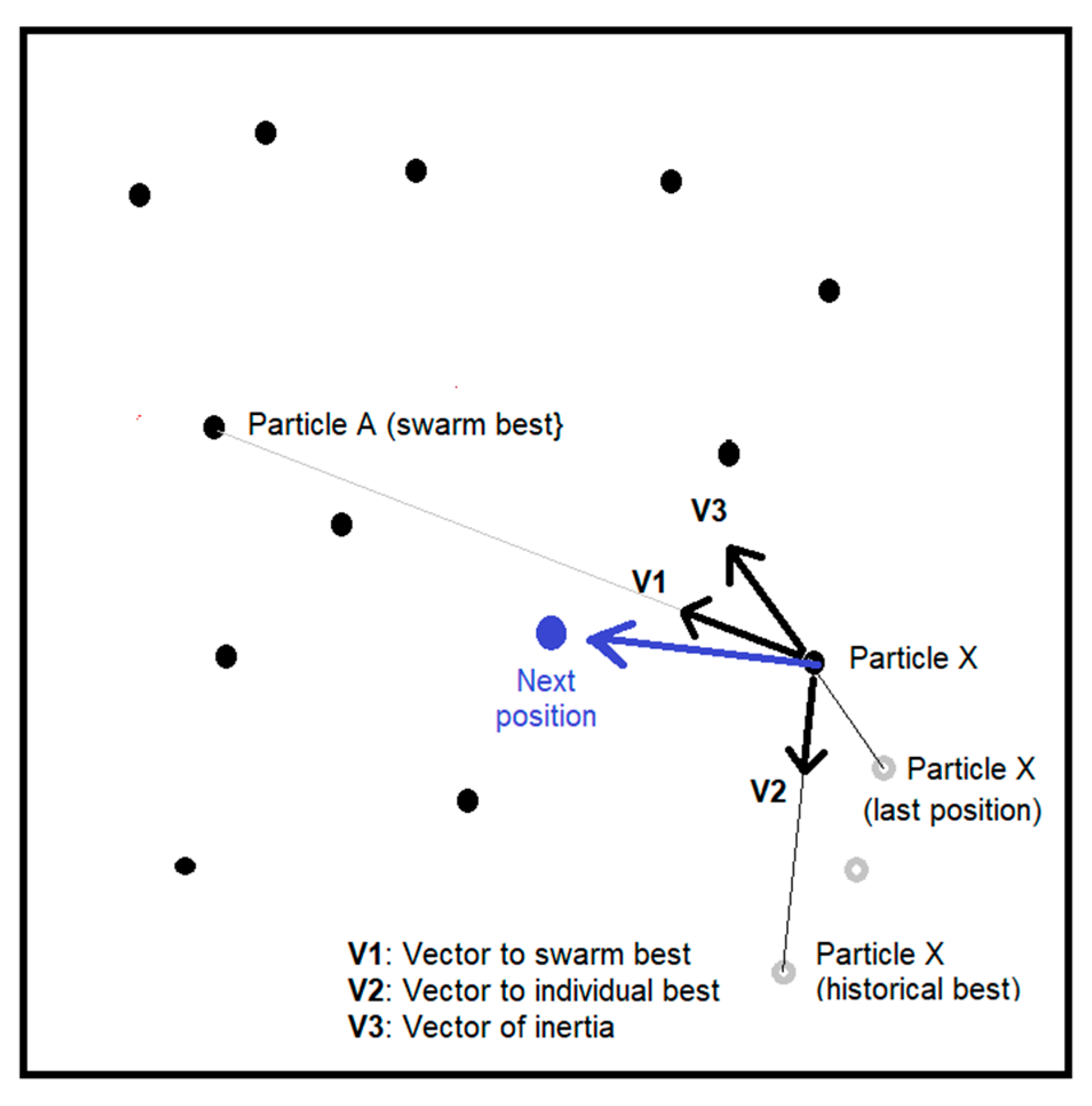
Microgrid Optimization with Metaheuristic Algorithms—A Review of Technologies and Trends for Sustainable Energy Systems



Abstract
1. Introduction
2. Microgrids
3. Metaheuristic Algorithms
4. Microgrid Optimization Algorithms
- -
- For traditional, low-dimensional sizing: If the problem involves a handful of well-established components (e.g., standard PV–battery–diesel), ES (e.g., using HOMER) remain viable. For faster results, GA or PSO are excellent, proven metaheuristic alternatives.
- -
- For higher-dimensional, multi-technology design: When the design space expands to include novel storage, sector coupling, or multiple technology options, prioritize algorithms with strong exploration capabilities. GWO or manta ray foraging are strong candidates to effectively navigate the enlarged search space.
- -
- For complex, constrained, and multi-objective problems: For optimizations with stringent reliability (LPSP), environmental, or cost objectives, consider hybrid algorithms (e.g., GWO-PSO). Their balanced approach is tailored to find robust solutions in complex, constrained landscapes.
- -
- The pragmatic benchmarking step: Given the NFL theorem, the most reliable approach for a specific, novel microgrid project is to shortlist two to three promising algorithms based on the above guidelines and benchmark them on a simplified version of the problem. This empirically identifies the most efficient solution for the task at hand.
5. Conclusions
Author Contributions
Funding
Institutional Review Board Statement
Informed Consent Statement
Data Availability Statement
Conflicts of Interest
Abbreviations
| CEC | Congress on Evolutionary Computation |
| CHP | Combined Heat and Power |
| COCO | Comparing Continuous Optimizer |
| DIRECT | Dividing Rectangles Algorithm |
| DSM | Demand-Side Management |
| ES | Exhaustive Search |
| EV | Electric Vehicle |
| FESS | Flywheel Energy Storage System |
| GA | Genetic Algorithms |
| GWO | Gray Wolf Optimizer |
| IoT | Internet of Things |
| LCoE | Levelized Cost of Electricity |
| Li-ion battery | Lithium-Ion Battery |
| LFP battery | Lithium–Iron–Phosphate Battery |
| LPSP | Loss of Power Supply Probability |
| Na-ion battery | Sodium-Ion Battery |
| NFL | No Free Lunch |
| P2P | Peer-to-Peer |
| PSO | Particle Swarm Optimization |
| PVT | Photovoltaic Thermal Hybrid Solar Collector |
| V1G | Unidirectional Smart Charging |
| V2G | Vehicle-to-Grid |
References
- Thirunavukkarasu, M.; Sawle, Y.; Lala, H. A comprehensive review on optimization of hybrid renewable energy systems using various optimization techniques. Renew. Sustain. Energy Rev. 2023, 176, 113192. [Google Scholar] [CrossRef]
- Kavadias, K.A.; Triantafyllou, P. Hybrid renewable energy systems’ optimisation, A review and extended comparison of the most used software tools. Energies 2021, 14, 8268. [Google Scholar] [CrossRef]
- Global Wind Energy Council. Global Wind Report 2024; Global Wind Energy Council: Brussels, Belgium, 2024. [Google Scholar]
- Kabir, E.; Kumar, P.; Kumar, S.; Adelodun, A.A.; Kim, K.H. Solar Energy: Potential and future prospects. Renew. Sustain. Energy Rev. 2018, 82, 894–900. [Google Scholar] [CrossRef]
- International Energy Agency. Global EV Outlook 2024; IEA: Paris, France, 2024; Available online: https://www.iea.org/reports/global-ev-outlook-2024 (accessed on 1 November 2025).
- International Energy Agency. The Future of Heat Pumps; IEA: Paris, France, 2022; Available online: https://iea.blob.core.windows.net/assets/4713780d-c0ae-4686-8c9b-29e782452695/TheFutureofHeatPumps.pdf (accessed on 1 November 2025).
- Zubi, G.; Kuhn, M.; Makridis, S.; Coutinho, S.; Dorasamy, S. Aviation sector decarbonization within the hydrogen economy—A UAE case study. Energy Policy 2025, 198, 114520. [Google Scholar] [CrossRef]
- International Energy Agency. Unlocking the Potential of Distributed Energy Resources; IEA: Paris, France, 2022; Available online: https://www.iea.org/reports/unlocking-the-potential-of-distributed-energy-resources/executive-summary (accessed on 1 November 2025).
- Erixno, O.; Abd Rahim, N.; Ramadhani, F.; Adzman, N.N. Energy management of renewable energy-based combined heat and power systems: A review. Sustain. Energy Technol. Assess. 2022, 51, 101944. [Google Scholar] [CrossRef]
- Li, W.; Ward, P.J.; Wesenbeeck, L.V. A critical review of quantifying water-energy-food nexus interactions. Renew. Sustain. Energy Rev. 2025, 211, 115280. [Google Scholar] [CrossRef]
- Dileep, G. A survey on smart grid technologies and applications. Renew. Energy 2020, 146, 2589–2625. [Google Scholar] [CrossRef]
- Al-Ali, A.R. Internet of things role in the renewable energy resources. Energy Procedia 2016, 100, 34–38. [Google Scholar] [CrossRef]
- Jaradat, M.; Jarrah, M.; Bousselham, A.; Jararweh, Y.; Al-Ayyoub, M. The internet of energy: Smart sensor network and big data management for smart grid. Procedia Comput. Sci. 2015, 56, 592–597. [Google Scholar] [CrossRef]
- Wang, H.; Lei, Z.; Zhang, X.; Zhou, B.; Peng, J. A review of deep learning for renewable energy forecasting. Energy Convers. Manag. 2019, 198, 111799. [Google Scholar] [CrossRef]
- Vazquez-Canteli, J.R.; Nagy, Z. Reinforcement learning for demand response: A review of algorithms and modeling techniques. Appl. Energy 2019, 235, 1072–1089. [Google Scholar] [CrossRef]
- Lago, J.; De Ridder, F.; De Schutter, B. Forecasting spot electricity prices: Deep learning approaches and empirical comparison of traditional algorithms. Appl. Energy 2018, 221, 386–405. [Google Scholar] [CrossRef]
- Kirli, D.; Couraud, B.; Robu, V.; Salgado-Bravo, M.; Norbu, S.; Andoni, M.; Antonopoulos, I.; Negrete-Pincetic, M.; Flynn, D.; Kiprakis, A. Smart contracts in energy systems: A systematic review of fundamental approaches and implementations. Renew. Sustain. Energy Rev. 2022, 158, 112013. [Google Scholar] [CrossRef]
- Rajasekaran, A.S.; Azees, M.; Al-Turjman, F. A comprehensive survey on blockchain technology. Sustain. Energy Technol. Assess. 2022, 52, 102039. [Google Scholar] [CrossRef]
- Soto, E.A.; Bosman, L.B.; Wollega, E.; Leon-Salas, W.D. Peer-to-peer energy trading: A review of the literature. Appl. Energy 2021, 283, 116268. [Google Scholar] [CrossRef]
- Hansen, K.; Breyer, C.; Lund, H. Status and perspectives on 100% renewable energy systems. Energy 2019, 175, 471–480. [Google Scholar] [CrossRef]
- Zubi, G.; Kuhn, M.; Makridis, S.; Dorasamy, S. The UAE net-zero strategy—Aspirations, achievements, and lessons for the MENA region. Sustainability 2025, 17, 7510. [Google Scholar] [CrossRef]
- Child, M.; Kemfert, C.; Bogdanov, D.; Breyer, C. Flexible electricity generation, grid exchange and storage for the transition to a 100% renewable energy system in Europe. Renew. Energy 2019, 139, 80–101. [Google Scholar] [CrossRef]
- Zappa, W.; Junginger, M.; Van Den Broek, M. Is a 100% renewable European power system feasible by 2050? Appl. Energy 2019, 233, 1027–1050. [Google Scholar] [CrossRef]
- Zubi, G.; Parag, Y.; Wald, S. Implications of large-scale PV integration on grid operation, costs, and emissions: Challenges and proposed solutions. Energies 2025, 18, 130. [Google Scholar] [CrossRef]
- Zubi, G.; Bernal-Agustín, J.L.; Fandos-Marín, A.B. Wind Energy (30%) in the Spanish power mix—Technically feasible and economically reasonable. Energy Policy 2009, 37, 3221–3226. [Google Scholar] [CrossRef]
- Zubi, G. Technology mix alternatives wit high shares of wind power and photovoltaics—Case study for Spain. Energy Policy 2011, 39, 8070–8077. [Google Scholar] [CrossRef]
- Palm, J.; Kojonsaari, A.R.; Magnusson, D. Toward energy democracy: Municipal energy actions in local renewable energy projects. Energy Res. Soc. Sci. 2025, 120, 103921. [Google Scholar] [CrossRef]
- Joshi, S.; Mittal, S.; Holloway, P.; Shukla, P.R.; Gallachoir, B.; Glynn, J. High resolution global spatiotemporal assessment of rooftop solar photovoltaics potential for renewable electricity generation. Nat. Commun. 2021, 12, 5738. [Google Scholar] [CrossRef] [PubMed]
- Teschner, N.; Alterman, R. Preparing the ground: Regulatory challenges in siting small-scale wind turbines in urban areas. Renew. Sustain. Energy Rev. 2018, 81, 1660–1668. [Google Scholar] [CrossRef]
- Liu, S.; Zhang, L.; Lu, J.; Zhang, X.; Wang, K.; Gan, Z.; Liu, X.; Jing, Z.; Cui, X.; Wang, H. Advances in urban wind resource development and wind energy harvesters. Renew. Sustain. Energy Rev. 2025, 207, 114943. [Google Scholar] [CrossRef]
- Radun, J.; Maula, H.; Saarinen, P.; Keränen, J.; Alakoivu, R.; Hongisto, V. Health effects of wind turbine noise and road traffic noise on people living near wind turbines. Renew. Sustain. Energy Rev. 2022, 157, 112040. [Google Scholar] [CrossRef]
- Li, S.; Chen, Q.; Li, Y.; Pröbsting, S.; Yang, C.; Zheng, X.; Yang, Y.; Zhu, W.; Shen, W.; Wu, F.; et al. Experimental investigation on noise characteristics of small scale vertical axis wind turbines in urban environments. Renew. Energy 2022, 200, 970–982. [Google Scholar] [CrossRef]
- Kwok, K.C.S.; Hu, G. Wind energy system for buildings in an urban environment. J. Wind. Eng. Ind. Aerodyn. 2023, 234, 105349. [Google Scholar] [CrossRef]
- Deguenon, L.; Yamegueu, D.; Kadri, S.M.; Gomna, A. Overcoming the challenges of integrating variable renewable energy to the grid: A comprehensive review of electrochemical battery storage systems. J. Power Sources 2023, 580, 233343. [Google Scholar] [CrossRef]
- Pandey, A.; Rawat, K.; Phogat, P.; Shreya Jha, R.; Singh, S. Next-generation energy storage: A deep dive into experimental and emerging battery technologies. J. Alloys Compd. 2025, 104, 178781. [Google Scholar] [CrossRef]
- Hu, D.; Dai, X.; Li, W.; Zhu, Y.; Zhang, X.; Chen, H.; Zhang, Z. A review of flywheel energy storage rotor materials and structures. J. Energy Storage 2023, 74, 109076. [Google Scholar] [CrossRef]
- Shuja, A.; Khan, H.R.; Murtaza, I.; Ashraf, S.; Abid, Y.; Farid, F.; Sajid, F. Supercapacitors for energy storage applications: Materials, devices and future directions: A comprehensive review. J. Alloys Compd. 2024, 1009, 176924. [Google Scholar] [CrossRef]
- Chen, L.; Wu, Z. Study on effects of EV charging to global load characteristics via charging aggregators. Energy Procedia 2018, 145, 175–180. [Google Scholar] [CrossRef]
- Wu, J.; Li, L.; Zhang, J.; Xiao, B. Flexibility estimation of electric vehicles and its impact on the future power grid. Int. J. Electr. Power Energy Syst. 2025, 164, 110435. [Google Scholar] [CrossRef]
- Rao, S.P.; Olusegun, T.S.; Ranganathan, P.; Kose, U.; Goveas, N. Vehicle-to-grid technology: Opportunities, challenges, and future prospects for sustainable transportation. J. Energy Storage 2025, 110, 114927. [Google Scholar] [CrossRef]
- Zafar, B.; Ben Salma, S.A. PV-EV integrated home energy management using vehicle-to-home (V2H) technology and household occupant behaviors. Energy Strategy Rev. 2022, 44, 101001. [Google Scholar] [CrossRef]
- Leonzio, G.; Fennell, P.S.; Shah, N. Air-source heat pumps for water heating at a high temperature: State of the art. Sustain. Energy Technol. Assess. 2022, 54, 102866. [Google Scholar] [CrossRef]
- Figueira, J.S.; Gil, A.G.; Vieira, A.; Michopoulos, A.K.; Boon, D.P.; Loveridge, F.; Cecinato, F.; Götzl, G.; Epting, J.; Zosseder, K.; et al. Shallow geothermal energy systems for district heating and cooling networks: Review and technological progression through case studies. Renew. Energy 2024, 236, 121436. [Google Scholar] [CrossRef]
- Pardo-Garcia, N.; Zubi, G.; Pasaoglu, G.; Dufo-Lopez, R. Photovoltaic thermal hybrid solar collector and district heating configurations for a Central European multi-family house. Energy Convers. Manag. 2017, 148, 915–924. [Google Scholar] [CrossRef]
- Bloess, A.; Schill, W.P.; Zerrahn, A. Power-to-heat for renewable energy integration: A review of technologies, modelling approaches, and flexibility potentials. Appl. Energy 2018, 212, 1611–1626. [Google Scholar] [CrossRef]
- Battaglia, M.; Haberl, R.; Bamberger, E.; Haller, M. Increased self-consumption and grid flexibility of PV and heat pump systems with thermal and electrical storage. Energy Procedia 2017, 135, 358–366. [Google Scholar] [CrossRef]
- Chen, L.; Gao, L.; Xing, S.; Chen, Z.; Wang, W. Zero-carbon microgrid: Real-world cases, trends, challenges, and future research prospects. Renew. Sustain. Energy Rev. 2024, 203, 114720. [Google Scholar] [CrossRef]
- Hirsch, A.; Parag, Y.; Guerrero, J. Microgrids: A review of technologies, key drivers and outstanding issues. Renew. Sustain. Energy Rev. 2018, 90, 402–411. [Google Scholar] [CrossRef]
- Azizi, E.; Hua, W.; Stephen, B.; Wallom, D.C.H.; McCulloch, M. Digitalization opportunities to enable local power system transition to net-zero. Energy Sustain. Dev. 2025, 84, 101596. [Google Scholar] [CrossRef]
- Mortensen, L.K.; Sundsgaard, K.; Shaker, H.R.; Hansen, J.Z.; Yang, G. Designing digitally enabled proactive maintenance systems in power distribution grids: A scoping literature review. Energy Rep. 2024, 12, 1–21. [Google Scholar] [CrossRef]
- Lujano-Rojas, J.M.; Zubi, G.; Dufo-Lopez, R.; Bernal-Agustin, J.L.; Atencio-Guerra, J.L.; Catalao, J.P.S. Embedding quasi-static time series within a genetic algorithm for stochastic optimization: The case of reactive power compensation on distribution systems. J. Comput. Des. Eng. 2020, 7, 177–194. [Google Scholar] [CrossRef]
- Lujano-Rojas, J.M.; Zubi, G.; Dufo-Lopez, R.; Bernal-Agustin, J.L.; Garcia-Paricio, E.; Catalao, J.P.S. Contract design of direct-load control programs and their optimal management by genetic algorithm. Energy 2019, 186, 115807. [Google Scholar] [CrossRef]
- Eid, C.; Codani, P.; Reneses, J.; Perez, Y.; Hakvoort, R. Managing electric flexibility from distributed energy resources: A review of incentives for market design. Renew. Sustain. Energy Rev. 2016, 64, 237–247. [Google Scholar] [CrossRef]
- Liu, J.; Tian, M.; Mao, X. Overview and prospect of distributed energy P2P trading. Energy Eng. 2024, 122, 379–404. [Google Scholar]
- Sousa, T.; Soares, T.; Pinson, P.; Moret, F.; Baroche, T.; Sorin, E. Peer-to-peer and community-based markets: A comprehensive review. Renew. Sustain. Energy Rev. 2019, 104, 367–378. [Google Scholar]
- Parag, Y.; Sovacool, B.K. Electricity market design for the prosumer era. Nat. Energy 2016, 1, 16032. [Google Scholar] [CrossRef]
- Zubi, G.; Parag, Y.; Wald, S. Blockchain-enabled PV2EV (photovoltaic system to electric vehicle) platform in Israel. In WEFE Project Report; Israeli Ministry of Energy: Jerusalem, Israel, 2022. [Google Scholar]
- Kavlak, G.; McNerney, J.; Trancik, J.E. Evaluating the causes of cost reduction in photovoltaic models. Energy Policy 2018, 123, 700–710. [Google Scholar] [CrossRef]
- European Commission—Directorate General for Climate Action. Climate Action-Progress Report 2024; EC: Brussels, Belgium, 2024.
- Okorie, D.I. Making hay while the sun shines: Energy security pathway for Africa. Energy Policy 2025, 198, 114512. [Google Scholar] [CrossRef]
- Zubi, G.; Fracastoro, G.V.; Lujano-Rojas, J.M.; El Bakari, K.; Andrews, D. The unlocked potential of solar home systems, an effective way to overcome domestic energy poverty in developing regions. Renew. Energy 2019, 132, 1425–1435. [Google Scholar] [CrossRef]
- Sen, K.K.; Hosan, S.; Karmaker, S.C.; Chapman, A.J.; Saha, B.B. Clarifying the linkage between renewable energy deployment and energy justice: Toward equitable sustainability. Sustain. Futures 2024, 8, 100236. [Google Scholar] [CrossRef]
- McCauley, D.; Heffron, R. Just transition: Integrating climate, energy and environmental justice. Energy Policy 2018, 119, 1–7. [Google Scholar] [CrossRef]
- Wyse, S.M.; Das, R.R. Energy democracy: Reclaiming a unique agenda in energy transitions research. Energy Res. Soc. Sci. 2024, 118, 103774. [Google Scholar] [CrossRef]
- Mariam, L.; Basu, M.; Conlon, M.F. Microgrid: Architecture, policy and future trends. Renew. Sustain. Energy Rev. 2016, 64, 477–489. [Google Scholar] [CrossRef]
- Jiayi, H.; Chuanwen, J.; Rong, X. A review on distributed energy resources and microgrid. Renew. Sustain. Energy Rev. 2008, 12, 2472–2483. [Google Scholar] [CrossRef]
- Badal, F.R.; Das, P.; Sarker, S.K.; Das, S.K. A survey on control issues in renewable energy integration and microgrid. Prot. Control Mod. Power Syst. 2019, 4, 8. [Google Scholar]
- Fathima, A.H.; Palanisamy, K. Optimization in microgrids with hybrid energy systems—A review. Renew. Sustain. Energy Rev. 2015, 45, 431–446. [Google Scholar]
- Arar Tahir, K.; Zamorano, M.; Ordonez Garcia, J. Scientific mapping of optimisation applied to microgrids integrated with renewable energy systems. Int. J. Electr. Power Energy Syst. 2023, 145, 108698. [Google Scholar]
- Dawoud, S.M.; Lin, X.; Okba, M.I. Hybrid renewable microgrid optimization techniques: A review. Renew. Sustain. Energy Rev. 2018, 82, 2039–2052. [Google Scholar] [CrossRef]
- Garcia Vera, Y.E.; Dufo-Lopez, R.; Bernal-Agustin, J.L. Energy management in microgrids with renewable energy sources: A literature review. Appl. Sci. 2019, 9, 3854. [Google Scholar] [CrossRef]
- Zia, M.F.; Elbouchikhi, E.; Benbouzid, M. Microgrids energy management systems: A critical review on methods, solutions, and prospects. Appl. Energy 2018, 222, 1033–1055. [Google Scholar] [CrossRef]
- Lujano Rojas, J.M.; Zubi, G.; Dufo-Lopez, R.; Bernal-Agustin, J.L.; Catalão, J.P.S. Novel probabilistic optimization model for lead-acid and vanadium redox flow batteries under real-time pricing programs. Int. J. Electr. Power Energy Syst. 2018, 97, 72–84. [Google Scholar]
- Bernal-Agustin, J.L.; Dufo-Lopez, R. Simulation and optimization of stand-alone hybrid renewable energy systems. Renew. Sustain. Energy Rev. 2009, 13, 2111–2118. [Google Scholar] [CrossRef]
- Shahgholian, G. A brief review on microgrids: Operation, applications, modelling, and control. Int. Trans. Electr. Energy Syst. 2021, 31, e12885. [Google Scholar] [CrossRef]
- Lopes, A.S.; Castro, R.; Silva, C.S. Design of water pumped storage systems: A sensitivity and scenario analysis for island microgrids. Sustain. Energy Technol. Assess. 2020, 42, 100847. [Google Scholar]
- Ma, Y.; Wang, S.; Yang, H.; Zhang, D.; Shen, Y. Two-stage optimization model for day-ahead scheduling of electricity-heat microgrids with solid electric thermal storage considering heat flexibility. J. Energy Storage 2024, 95, 112329. [Google Scholar] [CrossRef]
- Mah, A.X.Y.; Ho, W.S.; Muis, Z.A. Optimization of a standalone photovoltaic-based microgrid with electrical and hydrogen loads. Energy 2021, 235, 121218. [Google Scholar] [CrossRef]
- Heydari, A.; Majidi Nezhad, M.; Keynia, F.; Fekih, A.; Shahsavari-Pour, N.; Astiaso Garcia, D.; Piras, G. A combined multi-objective intelligent optimization approach considering techno-economic and reliability factors for hybrid-renewable microgrid systems. J. Clean. Prod. 2023, 383, 135249. [Google Scholar] [CrossRef]
- Kharrich, M.; Mohammed, O.H.; Alshammari, N.; Akherraz, M. Multi-objective optimization and the effect of the economic factors on the design of the microgrid hybrid system. Sustain. Cities Soc. 2021, 65, 102646. [Google Scholar] [CrossRef]
- Dougier, N.; Garambois, P.; Roucoules, L. Multi-objective non-weighted optimization to explore new efficient design of electrical microgrids. Appl. Energy 2021, 304, 117758. [Google Scholar] [CrossRef]
- Fioriti, D.; Lutzemberger, G.; Poli, D.; Duenas-Martinez, P.; Micangeli, A. Coupling economic multi-objective optimization and multiple design options: A business-oriented approach to size an off-grid hybrid microgrid. Int. J. Electr. Power Energy Syst. 2021, 127, 106686. [Google Scholar] [CrossRef]
- Ramli, M.A.M.; Bouchekara, H.R.E.H.; Alghamdi, A.S. Optimal sizing of PV/wind/diesel hybrid microgrid system using multi-objective self-adaptive differential evolution algorithm. Renew. Energy 2018, 121, 400–411. [Google Scholar] [CrossRef]
- An, J.; Hong, T. Energy harvesting using rooftops in urban areas: Estimating the electricity generation potential of PV and wind turbines considering the surrounding environment. Energy Build. 2024, 323, 114807. [Google Scholar] [CrossRef]
- Soykan, G.; Er, G.; Canakoglu, E. Optimal sizing of an isolated microgrid with electric vehicles using stochastic programming. Sustain. Energy Grids Netw. 2022, 32, 100850. [Google Scholar] [CrossRef]
- Ahmed, M.S.; Hasan, J.; Chowdhury, S.; Rahman, K.; Islam, S.; Hossain, S.; Islam, A.; Hossain, N.; Mobarak, H. Prospects and challenges of energy storage materials: A comprehensive review. Chem. Eng. J. Adv. 2024, 20, 100657. [Google Scholar] [CrossRef]
- Jung, J.; Zhang, L.; Zhang, J. Lead-Acid Battery Technologies: Fundamentals, Materials and Applications; CRC Press: Boca Raton, FL, USA; Taylor & Francis Group: Oxfordshire, UK, 2015. [Google Scholar]
- Pavlov, D. Lead-Acid Batteries: Science and Technology; Elsevier: Amsterdam, The Netherlands, 2011. [Google Scholar]
- Zubi, G.; Dufo-López, R.; Carvalho, M.; Pasaoglu, G. The lithium-ion battery; State of the art and future perspectives. Renew. Sustain. Energy Rev. 2018, 89, 292–308. [Google Scholar] [CrossRef]
- Goldman Sachs—Transportation Electric Vehicle Battery Prices Are Expected to Fall Almost 50% by 2026. October 2024. Available online: https://www.goldmansachs.com/insights/articles/electric-vehicle-battery-prices-are-expected-to-fall-almost-50-percent-by-2025 (accessed on 1 November 2025).
- Yu, T.; Li, G.; Duan, Y.; Wu, Y.; Zhang, T.; Zhao, X.; Luo, M.; Liu, Y. The research and industrialization progress and prospects of sodium-ion battery. J. Alloys Compd. 2023, 958, 170486. [Google Scholar] [CrossRef]
- Guo, W.; Feng, T.; Li, W.; Hua, L.; Meng, Z.; Li, K. Comparative life cycle assessment of sodium-ion and lithium iron phosphate batteries in the context of carbon neutrality. J. Energy Storage 2023, 72, 108589. [Google Scholar] [CrossRef]
- Gupta, P.; Pushpakanth, S.; Haidar, M.A.; Basu, S. Understanding the design of cathode materials for Na-ion batteries. Am. Chem. Soc. Omega 2022, 7, 5605–5614. [Google Scholar] [CrossRef]
- Xu, S.; Dong, H.; Yang, D.; Wu, C.; Yao, Y.; Rui, X.; Chou, S.; Yu, Y. Promising cathode materials for sodium-ion batteries from lab to application. Am. Chem. Soc. Cent. Sci. 2023, 9, 2012–2035. [Google Scholar] [CrossRef]
- Bai, H.; Song, Z. Lithium-ion battery, sodium-ion battery, or redox-flow battery: A comprehensive comparison in renewable energy systems. J. Power Sources 2023, 580, 233426. [Google Scholar] [CrossRef]
- Mendhe, A.; Panda, H.S. A review on electrolytes for supercapacitor device. Discov. Mater. 2023, 3, 29. [Google Scholar] [CrossRef]
- Gopi, C.V.V.M.; Alzahmi, S.; Narayanaswamy, V.; Vinodh, R.; Issa, B.; Obaidat, I.M. Supercapacitors: A promising solution for sustainable energy storage and diverse applications. J. Energy Storage 2025, 114, 115729. [Google Scholar] [CrossRef]
- Eltaweel, M.; Herfatmanesh, M.R. Enhancing vehicular performance with flywheel energy storage systems: Emerging technologies and applications. J. Energy Storage 2024, 103, 114386. [Google Scholar] [CrossRef]
- Khodadoost Arani, A.A.; Karami, H.; Gharehpetian, G.B.; Hejazi, M.S.A. Review on flywheel energy storage structures and applications in power systems and microgrids. Renew. Sustain. Energy Rev. 2017, 69, 9–18. [Google Scholar] [CrossRef]
- Ji, W.; Hong, F.; Zhao, Y.; Liang, L.; Du, H.; Hao, J.; Fang, F.; Liu, J. Applications of flywheel energy storage system on load frequency regulation combined with various power generations: A review. Renew. Energy 2024, 223, 119975. [Google Scholar] [CrossRef]
- Esparcia, E.A.; Castro, M.T.; Odulio, C.M.F.; Ocon, J.D. A stochastic techno-economic comparison of generation-integrated long duration flywheel, lithium-ion battery, and lead-acid battery energy storage technologies for isolated microgrid applications. J. Energy Storage 2022, 52, 104681. [Google Scholar] [CrossRef]
- Elkadeem, M.R.; Kotb, K.M.; Alzahrani, A.S.; Abido, M.A. Smart and Resilient Microgrid for EV Mobility and Commercial Applications with Demand Response. Transp. Res. Procedia 2025, 84, 362–369. [Google Scholar] [CrossRef]
- Nadimuthu, L.P.R.; Victor, K.; Bajaj, M.; Tuka, M.B. Feasibility of renewable energy microgrids with vehicle-to-grid technology for smart villages: A case study from India. Results Eng. 2024, 24, 103474. [Google Scholar] [CrossRef]
- Zhuang, J.; Bach, A.; Van Vlijmen, B.H.C.; Reichelstein, S.J.; Chueh, W.; Onori, S.; Benson, S.M. Technoeconomic decision support for second-life batteries. Appl. Energy 2025, 390, 125800. [Google Scholar] [CrossRef]
- Turan, F.; Boynuegri, A.R.; Durmaz, T. Comprehensive technical and economic evaluations of using second-life batteries as energy storage in off-grid applications: A customized cost analysis. J. Energy Storage 2025, 120, 116379. [Google Scholar] [CrossRef]
- Phogat, P.; Dey, S.; Wan, M. Comprehensive review of sodium-ion batteries: Principles, performance, challenges, and future perspectives. Mater. Sci. Eng. B 2025, 312, 117870. [Google Scholar] [CrossRef]
- Caparrós-Mancera, J.J.; Saenz, J.L.; López, E.; Andújar, J.M.; Segura-Manzano, F.; Vivas, F.J.; Isoma, F. Experimental analysis of the effects of supercapacitor banks in a renewable DC microgrid. Appl. Energy 2022, 308, 118355. [Google Scholar] [CrossRef]
- Babaei, M.R.; Ghasemi-Marzbali, A.; Abbasalizadeh, S. Control of a combined battery/supercapacitor storage system for DC microgrid application. J. Energry Storage 2024, 96, 112675. [Google Scholar] [CrossRef]
- Alharbi, A.G.; Olabi, A.G.; Rezk, H.; Fathy, A.; Abdelkareem, M.A. Optimized energy management and control strategy of photovoltaic/PEM fuel cell/batteries/supercapacitors DC microgrid system. Energy 2024, 290, 130121. [Google Scholar] [CrossRef]
- Si, X.; Duan, J.; Fan, S. Design of an adaptive frequency control for flywheel energy storage system based on model predictive control to suppress frequency fluctuations in microgrids. Electr. Power Syst. Res. 2024, 235, 110900. [Google Scholar] [CrossRef]
- Kikusato, H.; Ustun, T.S.; Suzuki, M.; Sugahara, S.; Hashimoto, J.; Otani, K.; Ikeda, N.; Komuro, I.; Yokoi, H.; Takahashi, K. Flywheel energy storage system based microgrid controller design and PHIL testing. Energy Rep. 2022, 8, 470–475. [Google Scholar] [CrossRef]
- Mouratidis, P. Augmenting electric vehicle fast charging stations with battery-flywheel energy storage. J. Energy Storage 2024, 97, 112957. [Google Scholar] [CrossRef]
- Barelli, L.; Bidini, G.; Bonucci, F.; Castellini, L.; Fratini, A.; Gallorini, F.; Zuccari, A. Flywheel hybridization to improve battery life in energy storage systems coupled to RES plants. Energy 2019, 173, 937–950. [Google Scholar] [CrossRef]
- Wang, J.; Lyu, C.; Bai, Y.; Yang, K.; Song, Z.; Meng, J. Optimal scheduling strategy for hybrid energy storage systems of battery and flywheel combined multi-stress battery degradation model. J. Energy Storage 2024, 99, 113208. [Google Scholar] [CrossRef]
- Cui, Q.; Zhu, J.; Chen, J.; Ma, Z.; Shu, J. Optimal operation of CCHP microgrids with multiple shiftable loads in different auxiliary heating source systems. Energy Rep. 2022, 8, 628–638. [Google Scholar] [CrossRef]
- Maranda, W.; Tylman, W.; Kotas, R.; Nazdrowicz, J.; Tylman, A. Parametric study on utilization of PV-energy in residential microgrids with hot water heating. Energy Rep. 2023, 10, 1555–1564. [Google Scholar] [CrossRef]
- Häring, T.; Kull, T.M.; Ahmadiahangar, R.; Rosin, A.; Thalfeldt, M.; Biechl, H. Microgrid Oriented modeling of space heating system based on neural networks. J. Build. Eng. 2021, 43, 103150. [Google Scholar] [CrossRef]
- Rosales-Asensio, E.; Icaza, D.; González-Cobos, N.; Borge-Diez, D. Peak load reduction and resilience benefits through optimized dispatch, heating and cooling strategies in buildings with critical microgrids. J. Build. Eng. 2023, 68, 106096. [Google Scholar] [CrossRef]
- Wang, H.; Mu, S.; Cui, H.; Yang, Z.; Cheng, S.; Li, J.; Li, Y.; Yang, J. The capacity optimization of the battery energy storage system in the combined cooling, heating and power microgrid. Energy Rep. 2023, 9, 567–574. [Google Scholar] [CrossRef]
- Sasidhar, P.R.S.; Gebremedhin, A.; Norheim, I. Multi-energy microgrid design and the role of coupling components—A review. Renew. Sustain. Energy Rev. 2025, 216, 115540. [Google Scholar] [CrossRef]
- Horrillo-Quintero, P.; De la Cruz-Loredo, I.; García-Triviño, P.; Ugalde-Loo, C.E.; Fernández-Ramírez, L.M. A real-time combined dynamic control framework for multi-energy microgrids coupling hydrogen, electricity, heating and cooling systems. Int. J. Hydrog. Energy 2025, 106, 454–470. [Google Scholar] [CrossRef]
- Hachez, J.; Latiers, A.; Berger, B.; Bram, S. Multi-energy systems fast optimization: A new formulation in linear programming for temperatures and magnitudes of thermal power flows in heating system. Energy Build. 2025, 336, 115618. [Google Scholar] [CrossRef]
- Dufo-Lopez, R.; Bernal Agustin, J.L.; Yusta-Loyo, J.M.; Dominguez-Navarro, J.A.; Ramirez-Rosado, I.J.; Lujano, J.; Aso, I. Multi-objective optimization minimizing cost and life cycle emissions of stand-alone PV-wind-diesel system with batteries storage. Appl. Energy 2011, 88, 4033–4041. [Google Scholar] [CrossRef]
- Loboichenko, V.; Iranzo, A.; Casado-Manzano, M.; Navas, S.J.; Pino, F.J.; Rosa, F. Study of the use of biogas as an energy vector for microgrids. Renew. Sustain. Energy Rev. 2024, 200, 114574. [Google Scholar] [CrossRef]
- Kumar, A.; Verma, A. Optimal techno-economic sizing of a solar-biomass-battery hybrid system for off-setting dependency on diesel generators for microgrid facilities. J. Energy Storage 2021, 36, 102251. [Google Scholar]
- Ali Khan, M.Z.; Ali Khan, H.; Ravi, S.S.; Turner, J.W.G.; Aziz, M. Potential of clean liquid fuels in decarbonizing transportation—An overlooked net-zero pathway? Renew. Sustain. Energy Rev. 2023, 183, 113483. [Google Scholar] [CrossRef]
- Sahoo, B.; Panda, S.; Rout, P.K.; Bajaj, M.; Blazek, V. Digital twin enabled smart microgrid system for complete automation: An overview. Resulting Eng. 2025, 25, 104010. [Google Scholar] [CrossRef]
- Yuan, G.; Xie, F. Digital Twin-Based economic assessment of solar energy in smart microgrids using reinforcement learning technique. Sol. Energy 2023, 250, 398–408. [Google Scholar] [CrossRef]
- Bhatt, J.; Harish, V.S.K.V.; Jani, O.; Saini, G. Performance based optimal selection of communication technologies for different smart microgrid applications. Sustain. Energy Technol. Assess. 2022, 53, 102495. [Google Scholar] [CrossRef]
- Sitharthan, R.; Vimal, S.; Verma, A.; Karthikeyan, M.; Dhanabalan, S.S.; Prabaharan, N.; Rajesh, M.; Eswaran, T. Smart microgrid with the internet of things for adequate energy management and analysis. Comput. Electr. Eng. 2023, 106, 108556. [Google Scholar] [CrossRef]
- Arul, U.; Gnanajeyaraman, R.; Selvakumar, A.; Ramesh, S.; Manikandan, T.; Michael, G. Integration of IoT and edge cloud computing for smart microgrid energy management in VANET using machine learning. Comput. Electr. Eng. 2023, 110, 108905. [Google Scholar] [CrossRef]
- Dinesha, D.L.; Balachandra, P. Conceptualization of blockchain enabled interconnected smart microgrids. Renew. Sustain. Energy Rev. 2022, 168, 112848. [Google Scholar] [CrossRef]
- Jian, W.; Fu, B.; Wu, Z.; Jiang, B.; Liu, Z.; Chen, X. Blockchain-based smart microgrid power transaction model. IFAC-PapersOnLine 2022, 55, 126–131. [Google Scholar] [CrossRef]
- Kabalci, E.; Kabalci, Y.; Siano, P. Design and implementation of a smart metering infrastructure for low voltage microgrids. Int. J. Electr. Power Energy Syst. 2022, 134, 107375. [Google Scholar] [CrossRef]
- Silva, J.A.A.; López, J.C.; Guzman, C.P.; Arias, N.B.; Rider, M.J.; da Silva, L.C. An IoT-based energy management system for AC microgrids with grid and security constraints. Appl. Energy 2023, 337, 120904. [Google Scholar] [CrossRef]
- Rios, L.M.; Sahinidis, N.V. Derivative-free optimization: A review of algorithms and comparison of software implementations. J. Glob. Optim. 2013, 56, 1247–1293. [Google Scholar] [CrossRef]
- Jones, D.; Martins, J. The DIRECT algorithm: 25 years later. J. Glob. Optim. 2021, 79, 521–566. [Google Scholar] [CrossRef]
- Belfikra, R.; Zhang, L.; Barakat, G. Optimal sizing study of hybrid wind/PV/diesel power generation unit. Sol. Energy 2011, 85, 100–110. [Google Scholar] [CrossRef]
- Hao, J.; Yu, Z.; Zhao, Z.; Shen, P.; Zhan, X. Optimization of key parameters of energy management strategy for hybrid electric vehicle using DIRECT Algorithm. Energies 2016, 9, 997. [Google Scholar] [CrossRef]
- Liu, H.; Xu, S.; Wang, X.; Wu, J.; Song, Y. A global optimization algorithm for simulation-based problems via the extended DIRECT scheme. Eng. Optim. 2015, 47, 1441–1458. [Google Scholar] [CrossRef]
- Costa, M.F.P.; Rocha, A.M.A.; Fernandes, E.M. Filter-based DIRECT method for contained global optimization. J. Glob. Optim. 2018, 71, 517–536. [Google Scholar] [CrossRef]
- Di Pillo, G.; Liuzzi, G.; Lucidi, S.; Piccialli, V.; Rinaldi, F. A DIRECT-type approach for derivate-free constrained global optimization. Comput. Optim. Appl. 2016, 65, 361–397. [Google Scholar] [CrossRef]
- Yang, X.S.; Chien, S.F.; Ting, T.O. Computational intelligence and metaheuristic algorithms with applications. Sci. World J. 2014, 2014, 425853. [Google Scholar] [CrossRef]
- Fraser, A.; Burnell, D. Computer Model in Genetics; McGraw Hill: New York, NY, USA, 1970; ISBN 978-0-07-021904-5. [Google Scholar]
- Crosby, J.L. Computer Simulation in Genetics; John Wiley & Sons: London, UK, 1973; ISBN 978-0-471-18880-3. [Google Scholar]
- Whitely, D. A genetic algorithm tutorial. Stat. Comput. 1994, 4, 65–85. [Google Scholar] [CrossRef]
- Lawrence, J.F. Intelligence Through Simulated Evolution: Forty Year of Evolutionary Programming; John Wiley & Sons: Hoboken, NJ, USA, 1999; ISBN 978-0-471-33250-3. [Google Scholar]
- Dong, H.; He, J.; Huang, H.; Hou, W. Evolutionary programming using a mixed mutation strategy. Inf. Sci. 2007, 177, 312–327. [Google Scholar] [CrossRef]
- Storn, R.; Price, K. Differential Evolution—A simple and efficient heuristic for global optimization over continuous spaces. J. Glob. Optim. 1997, 11, 341–359. [Google Scholar] [CrossRef]
- Ahmad, M.F.; Mat Isa, N.A.; Lim, W.H.; Ang, K.M. Differential evolution: A recent review based on state-of-the-art works. Alex. Eng. J. 2022, 61, 3831–3872. [Google Scholar] [CrossRef]
- Hansen, N.; Auger, A.; Mersmann, O.; Tusar, T.; Brockhoff, D. Coco: A platform for comparing continuous optimizers in a black-box setting. arXiv 2016, arXiv:1603.08785. [Google Scholar] [CrossRef]
- Li, Z.; Lin, X.; Zhang, Q.; Liu, H. Evolution strategies for continuous optimization: A survey of the state-of-the-art. Swarm Evol. Comput. 2020, 56, 100694. [Google Scholar] [CrossRef]
- Maaranen, H.; Miettinen, K.; Mäkelä, M.M. Quasi-random initial population for genetic algorithms. Comput. Math. Appl. 2004, 47, 1885–1895. [Google Scholar] [CrossRef]
- Arram, A.; Ayob, M. A novel multi-parent order crossover in genetic algorithm for combinatorial optimization problems. Comput. Ind. Eng. 2019, 133, 267–274. [Google Scholar] [CrossRef]
- Ting, C.K.; Su, C.H.; Lee, C.N. Multi-parent extension of partially mapped crossover for combinatorial optimization problems. Expert Syst. Appl. 2010, 37, 1879–1886. [Google Scholar] [CrossRef]
- Kennedy, R.; Eberhart, R. Particle swarm optimization. In Proceedings of the ICNN’95—International Conference on Neural Networks, Perth, Australia, 27 November–1 December 1995; pp. 1942–1948. [Google Scholar]
- Kennedy, J.; Eberhart, R.C. A discrete binary version of the particle swarm algorithm. In Computational Cybernetics and Simulation, Proceedings of the IEEE International Conference on Systems, Man, and Cybernetics, Orlando, FL, USA, 12–15 October 1997; Volume 5, pp. 4104–4108. [Google Scholar]
- Shi, Y.; Eberhart, R. A modified particle swarm optimizer. In Proceedings of the 1998 IEEE International Conference on Evolutionary Computation Proceedings, IEEE World Congress on Computational Intelligence, Anchorage, AK, USA, 4–9 May 1998; pp. 69–73. [Google Scholar]
- He, Q.; Wang, L. An effective co-evolutionary particle swarm optimization for constrained engineering design problems. Eng. Appl. Artif. Intell. 2007, 20, 89–99. [Google Scholar] [CrossRef]
- Roy, R.; Dehuri, S.; Cho, S.B. A novel particle swarm optimization algorithm for multi-objective combinatorial optimization problem. Int. J. Appl. Metaheuristic Comput. 2011, 2, 41–57. [Google Scholar] [CrossRef]
- Bonyadi, M.R.; Michalewicz, Z. Particle swarm optimization for single objective continuous space problems: A review. Evol. Comput. 2017, 25, 1–54. [Google Scholar] [CrossRef]
- Nobile, M.S.; Cazzaniga, P.; Besozzi, D.; Colombo, R.; Mauri, G.; Pasi, G. Fuzzy self-tuning PSO: A settings-free algorithm for global optimization. Swarm Evol. Comput. 2018, 39, 70–85. [Google Scholar] [CrossRef]
- Cicirelli, F.; Forestiero, A.; Giordano, A.; Mastroianni, C. Transparent and efficient parallelization of swarm algorithms. ACM Trans. Auton. Adapt. Syst. 2016, 11, 1–26. [Google Scholar] [CrossRef]
- Mirjalili, S.; Mirjalili, S.M.; Lewis, A. Grey wolf optimizer. Adv. Eng. Softw. 2014, 69, 46–61. [Google Scholar] [CrossRef]
- Dragoi, E.N.; Dafinescu, V. Review of metaheuristics inspired from the animal kingdom. Mathematics 2021, 9, 2335. [Google Scholar] [CrossRef]
- Dorigo, M.; Stützle, T. Ant Colony Optimization. In A Bradford Book; The MIT Press: Cambridge, MA, USA, 2004. [Google Scholar]
- Karaboga, D.; Akay, B. A comparative study of Artificial Bee Colony algorithm. Appl. Math. Comput. 2009, 214, 108–132. [Google Scholar] [CrossRef]
- Heidari, A.A.; Mirjalili, S.; Faris, H.; Aljarah, I.; Mafarja, M.; Chen, H. Harris Hawks Optimization: Algorithm and applications. Future Gener. Comput. Syst. 2019, 97, 849–872. [Google Scholar] [CrossRef]
- Alsattar, H.A.; Zaidan, A.A.; Zaidan, B.B. Novel meta-heuristic bald eagle search optimization algorithm. Artif. Intell. Rev. 2020, 53, 2237–2264. [Google Scholar] [CrossRef]
- Braik, M.S. Chameleon Swarm Algorithm: A bio-inspired optimizer for solving engineering design problems. Expert Syst. Appl. 2021, 174, 114685. [Google Scholar] [CrossRef]
- Zhao, W.; Zhang, Z.; Wang, L. Manta ray foraging optimization: An effective bio-inspired optimizer for engineering applications. Eng. Appl. Artif. Intell. 2020, 87, 103300. [Google Scholar] [CrossRef]
- Polap, D.; Wozniak, M. Red fox optimization algorithm. Expert Syst. Appl. 2021, 166, 114107. [Google Scholar] [CrossRef]
- Baykasoğlu, A.; Ozsoydan, F.B. Adaptive firefly algorithm with chaos for mechanical optimization problems. Appl. Soft Comput. 2015, 36, 152–164. [Google Scholar] [CrossRef]
- Mirjalili, S. Moth-flame optimization algorithm: A novel nature-inspired heuristic paradigm. Knowl.-Based Syst. 2015, 89, 228–249. [Google Scholar] [CrossRef]
- Khalid, O.W.; Isa, N.A.M.; Sakim, H.A.M. Emperor penguin optimizer: A comprehensive review based on state-of-the-art metaheuristic algorithms. Alex. Eng. J. 2023, 63, 487–526. [Google Scholar] [CrossRef]
- Dhiman, G.; Kumar, V. Emperor Penguin Optimizer: A bio-inspired algorithm for engineering problems. Knowl.-Based Syst. 2018, 159, 20–50. [Google Scholar] [CrossRef]
- Kaveh, A.; Farhoudi, N. A new optimization method: Dolphin echolocation. Adv. Eng. Softw. 2013, 59, 53–70. [Google Scholar] [CrossRef]
- Eusuff, M.; Lansey, K.; Pasha, F. Shuffled Frog-Leaping Algorithm: A memetic meta-heuristic for discrete optimization. Eng. Optim. 2006, 38, 129–154. [Google Scholar] [CrossRef]
- Zhao, Z.; Wang, M.; Liu, Y.; Chen, Y.; He, K.; Liu, Z. A modified shuffled from leaping algorithm with inertia weight. Sci. Rep. 2024, 14, 4146. [Google Scholar] [CrossRef] [PubMed]
- Chu, S.C.; Tsai, P.W.; Pan, J.S. Cat Swam Optimization. In Trends in Artificial Intelligence, Proceedings of the Pacific Rim International Conference on Artificial Intelligence, Guilin, China, 7–11 August 2006; Springer: Berlin/Heidelberg, Germany, 2006; pp. 854–858. [Google Scholar]
- Gao, B.; Shi, Y.; Xu, F.; Xu, X. An improved Aquila Optimizer based on search control factor and mutations. Processes 2022, 10, 1451. [Google Scholar] [CrossRef]
- Abualigah, L.; Yousri, D.; Abd Elaziz, M.; Ewees, A.A.; Al-qaness, M.A.A.; Gandomi, A.H. Aquila Optimizer: A novel meta-heuristic optimization algorithm. Comput. Ind. Eng. 2021, 157, 107250. [Google Scholar] [CrossRef]
- Mirjalili, S.; Lewis, A. The Whale Optimization Algorithm. Adv. Eng. Softw. 2016, 95, 51–67. [Google Scholar] [CrossRef]
- Faramarzi, A.; Heidarinejad, M.; Mirjalili, S.; Gandomi, A.H. Marine Predators Algorithm: A nature-inspired metaheuristic. Expert Syst. Appl. 2020, 152, 113377. [Google Scholar] [CrossRef]
- Oftadeh, R.; Mahjoob, M.J.; Shariatpanahi, M. A novel meta-heuristic optimization algorithm inspired by group hunting of animals: Hunting Search. Comput. Math. Appl. 2010, 60, 2087–2098. [Google Scholar] [CrossRef]
- Wu, L.; Wu, J.; Wang, T. Enhancing Grasshopper Optimization Algorithm with levy flight for engineering applications. Sci. Rep. 2023, 13, 124. [Google Scholar] [CrossRef]
- Saremi, S.; Mirjalili, S.; Lewis, A. Grasshopper Optimization Algorithm: Theory and application. Adv. Eng. Softw. 2017, 105, 30–47. [Google Scholar] [CrossRef]
- Abualigah, L.; Abd Elaziz, M.; Sumari, P.; Geem, Z.W.; Gandomi, A.H. Reptile Search Algorithm (RSA): A nature-inspired meta-heuristic optimizer. Expert Syst. Appl. 2022, 191, 116158. [Google Scholar] [CrossRef]
- Mirjalili, S.; Gandomi, A.H.; Mirjalili, S.Z.; Saremi, S.; Faris, H.; Mirjalili, S.M. Salp Swarm Algorithm: A bio-inspired optimizer for engineering design problems. Adv. Eng. Softw. 2017, 114, 163–191. [Google Scholar] [CrossRef]
- Braik, M.; Sheta, A.; Al-Hairy, H. A novel meta-heuristic search algorithm for solving optimization problems: Capuchin search algorithm. Neural Comput. Appl. 2020, 33, 2515–2547. [Google Scholar] [CrossRef]
- Gandomi, A.H.; Alavi, A.H. Krill herd: A new bio-inspired optimization algorithm. Commun. Nonlinear Sci. Numer. Simul. 2012, 17, 4831–4845. [Google Scholar] [CrossRef]
- Mirjalili, S. Dragonfly algorithm: A new metheuristic optimization technique for solving single-objective, discrete, and multiobjective problems. Neural Comuting Appl. 2015, 27, 1053–1073. [Google Scholar] [CrossRef]
- Mirjalili, S. The Ant Lion Optimizer. Adcances Eng. Softw. 2015, 83, 80–98. [Google Scholar] [CrossRef]
- Gandomi, A.H.; Yang, X.S.; Alavi, A.H. Cuckoo search algorithm: A metaheuristic approach to solve strutural optimization problems. Eng. Comput. 2011, 29, 17–35. [Google Scholar] [CrossRef]
- Cuevas, E.; Cienfuegos, M. A new algorithm inspired in the bahavior of social-spider for constrained optimization. Expert Syst. Appl. 2014, 41, 412–425. [Google Scholar] [CrossRef]
- Kirkpatrick, S.; Gelatt, C.D.; Vecchi, M.P. Optimization by Simulated Annealing. Science 1983, 220, 671–680. [Google Scholar] [CrossRef]
- Rashedi, E.; Nezamabadi-pour, H.; Saryazdi, S. GSA: A Gravitational Search Algorithm. Inf. Sci. 2009, 179, 2232–2248. [Google Scholar] [CrossRef]
- Anita Yadav, A.; Kumar, N. Artificial electric field algorithm for engineering optimization problems. Expert Syst. Appl. 2020, 149, 113308. [Google Scholar] [CrossRef]
- Kaveh, A.; Khayatazad, M. A new meta-heuristic method: Ray Optimization. Comput. Struct. 2012, 112, 283–294. [Google Scholar] [CrossRef]
- Faramarzi, A.; Heidarinejad, M.; Stephen, B.; Mirjalili, A. Equilibrium optimizer: A novel optimization algorithm. Knowl.-Based Syst. 2020, 191, 105190. [Google Scholar] [CrossRef]
- Hashim, F.A.; Houssein, E.H.; Mabrouk, M.S.; Al-Atabany, W.; Mirjalili, S. Henry gas solubility optimization: A novel physics-based algorithm. Future Gener. Comput. Syst. 2019, 101, 646–667. [Google Scholar] [CrossRef]
- Kaveh, A.; Talatahari, S. A novel heuristic optimization method: Charged System Search. Acta Mech. 2010, 213, 267–289. [Google Scholar] [CrossRef]
- Eskandar, H.; Sadollah, A.; Bahreininejad, A.; Hamdi, M. Water cycle algorithm—A novel metaheuristic optimization method for solving constrained engineering optimization problems. Comput. Struct. 2012, 110–111, 151–166. [Google Scholar] [CrossRef]
- Nasir, M.; Sadollah, A.; Choi, Y.H.; Kim, J.H. A comprehensive review on water cycle algorithm and its applications. Neural Comput. Appl. 2020, 32, 17433–17488. [Google Scholar] [CrossRef]
- Kaveh, A.; Mahdavi, V.R. Colliding Bodies Optimization: A novel meta-heuristic method. Comput. Struct. 2014, 139, 18–27. [Google Scholar] [CrossRef]
- Mirjalili, S.; Mirjalili, S.A.; Hatamlou, A. Multi-Verse Optimizer: A nature-inspired algorithm for global optimization. Neural Comput. Appl. 2016, 27, 495–513. [Google Scholar] [CrossRef]
- Hatamlou, A. Black Hole: A new heuristic optimization approach for data clustering. Inf. Sci. 2013, 222, 175–184. [Google Scholar] [CrossRef]
- Agrawal, P.; Ganesh, T.; Mohamed, A.W. A novel binary gaining-sharing knowledge-based optimization algorithm for feature selection. Neural Comput. Appl. 2021, 33, 5989–6008. [Google Scholar] [CrossRef]
- Agrawal, P.; Ganesh, T.; Mohamed, A.W. Chaotic gaining sharing knowledge-based optimization algorithm: An improved metaheuristic algorithm for feature selection. Soft Comput. 2021, 25, 9505–9528. [Google Scholar] [CrossRef]
- Agrawal, P.; Ganesh, T.; Oliva, D.; Mohamed, A.W. S-shaped and v-shaped gaining-sharing knowledge-based algorithm for feature selection. Appl. Intell. 2022, 52, 81–112. [Google Scholar] [CrossRef]
- Mohamed, A.W.; Hadi, A.A.; Mohamed, A.K. Gaining-sharing knowledge-based algorithm for solving optimization problems: A novel nature-inspired algorithm. Int. J. Mach. Learn. Cybern. 2020, 11, 1501–1529. [Google Scholar] [CrossRef]
- Mohamed, A.W.; Abutarboush, H.F.; Hadi, A.A.; Mohamed, A.K. Gaining-sharing knowledge-based algorithm with adaptive parameters for engineering optimization. IEEE Access 2021, 9, 65934–65946. [Google Scholar] [CrossRef]
- Lee, K.S.; Geem, Z.W. A new meta-heuristic algorithm for continuous engineering optimization: Harmony search theory and practice. Comput. Methods Appl. Mech. Eng. 2005, 194, 3902–3933. [Google Scholar] [CrossRef]
- Mahdavi, M.; Fesanghary, M.; Damangir, E. An improved harmony search algorithm for solving optimization problems. Appl. Math. Comput. 2007, 188, 1567–1579. [Google Scholar] [CrossRef]
- Atashpaz-Gargari, E.; Lucas, C. Imperialist Competitive Algorithm: An algorithm for optimization inspired by imperialistic competition. In Proceedings of the IEEE Congress on Evolutionary Computation, Singapore, 25–28 September 2007; pp. 4661–4667. [Google Scholar]
- Eita, M.A.; Fahmy, M.M. Group Counseling Optimization. Appl. Soft Comput. 2014, 22, 585–604. [Google Scholar] [CrossRef]
- Ghorbani, N.; Babaei, E. Exchange Market Algorithm. Appl. Soft Comput. 2014, 19, 177–187. [Google Scholar] [CrossRef]
- Rao, R.V.; Savsani, V.J.; Vakharia, D.P. Teaching-learning-based optimization: A novel method for constrained mechanical design optimization problems. Comput.-Aided Des. 2011, 43, 303–315. [Google Scholar] [CrossRef]
- Rao, R.V.; Savsani, V.J.; Vakharia, D. Teaching-learning-based optimization: An optimization method for continuous non-linear large-scale problems. Inf. Sci. 2012, 183, 1–15. [Google Scholar] [CrossRef]
- Chopra, N.; Kumar, G.; Mehta, S. Hybrid GWO-PSO algorithm for solving convex economic load dispatch problem. Int. J. Adv. Res. Technol. 2016, 4, 37–41. [Google Scholar]
- Kamboj, V.K.; Nandi, A.; Bhadoria, A.; Sehgal, S. An intensify Harris Hawks optimizer for numerical and engineering optimization problems. Appl. Soft Comput. 2020, 89, 106018. [Google Scholar] [CrossRef]
- Liu, H.; Cai, Z.; Wang, Y. Hybridizing particle swarm optimization with differential evolution for constrained numerical and engineering optimization. Appl. Soft Comput. 2010, 10, 629–640. [Google Scholar] [CrossRef]
- Liu, J.; Xu, S.; Zhang, F.; Wang, L. A hybrid genetic-ant colony optimization algorithm for the optimal path selection. Intell. Autom. Soft Comput. 2017, 23, 235–242. [Google Scholar] [CrossRef]
- Xue, Y.; Zhong, S.; Ma, T.; Cao, J. A hybrid evolutionary algorithm for numerical optimization problem. Intell. Autom. Soft Comput. 2015, 21, 473–490. [Google Scholar] [CrossRef]
- Yuce, B.; Fruggiero, F.; Packianather, M.S.; Phan, D.T.; Mastrocinque, E.; Lambiase, A.; Fera, M. Hybrid genetic bees algorithm applied to single machine scheduling with earliness and tardiness penalties. Comput. Ind. Eng. 2017, 113, 842–858. [Google Scholar] [CrossRef]
- Pan, J.S.; Dao, T.K.; Chu, S.C. A novel hybrid GWO-FPA algorithm for optimization applications. In Proceedings of the International Conference on Smart Vehicular Technology, Transportation, Communication and Applications, Kaohsiung, Taiwan, 6–8 November 2017; pp. 274–281. [Google Scholar]
- Ewees, A.A.; Abd-Elaziz, M.A. Performance analysis of Chaotic Multi-Verse Harris Hawks Optimization: A case study on solving engineering problems. Eng. Appl. Artif. Intell. 2020, 88, 103370. [Google Scholar] [CrossRef]
- Mafarja, M.M.; Mirjalili, S. Hybrid whale optimization algoirhtm with simulated annealing for feature selection. Neurocomputing 2017, 260, 302–312. [Google Scholar] [CrossRef]
- Mohamed, A.W.; Sallam, K.M.; Agrawal, P.; Hadi, A.A.; Mohamed, A.K. Evaluating the performance of metaheuristic algorithms on CEC 2021 benchmark problems. Neural Comput. Appl. 2023, 35, 1493–1517. [Google Scholar] [CrossRef]
- Beiranvand, V.; Hare, W.; Lucet, Y. Best practices for comparing optimization algorithms. Optim. Eng. 2017, 18, 815–848. [Google Scholar] [CrossRef]
- Opara, K.R.; Hadi, A.A.; Mohamed, A.W. Parameterized benchmarking: An outline of the idea and a feasibility study. In Proceedings of the 2020 Genetic and Evolutionary Computation Conference Companion, Cancun, Mexico, 8–12 July 2020; pp. 197–198. [Google Scholar]
- Hellwig, M.; Beyer, H.G. Benchmarking evolutionary algorithms for single objective real-valued constrained optimization—A critical review. Swarm Evol. Comput. 2019, 44, 927–944. [Google Scholar] [CrossRef]
- Muñoz, M.A.; Sun, Y.; Kirley, M.; Halgamuge, S.K. Algorithm selection for black-box continuous optimization problems: A survey on methods and challenges. Inf. Sci. 2015, 317, 224–245. [Google Scholar] [CrossRef]
- Talpur, K.; Salleh, M.N.; Cheng, S.; Naseem, R. Common benchmark functions for metaheuristic evaluation: A review. Int. J. Inform. Vis. 2017, 1, 218–223. [Google Scholar]
- Wolpert, D.H.; Macready, W.G. No free lunch theorems for optimization. IEEE Trans. Evol. Comput. 1997, 1, 67–82. [Google Scholar] [CrossRef]
- Sigarchian, S.G.; Orosz, M.S.; Hemond, H.F.; Malmquist, A. Optimum design of a hybrid PV-CSP-LPG microgrid with Particle Swarm Optimization technique. Appl. Therm. Eng. 2016, 109, 1031–1036. [Google Scholar] [CrossRef]
- Garcia Vera, Y.E.; Dufo-Lopez, R.; Bernal-Agustin, J.L. Optimization of isolated hybrid microgrids with renewable energy based on different battery models and technologies. Energies 2020, 13, 581. [Google Scholar] [CrossRef]
- Fulzele, J.B.; Daigavane, M.B. Design and optimization of hybrid PV-wind renewable energy system. Mater. Today Proc. 2018, 5, 810–818. [Google Scholar] [CrossRef]
- Yoshida, Y.; Farzaneh, H. Optimal design of a stand-alone residential hybrid microgrid system for enhancing renewable energy deployment in Japan. Energies 2020, 13, 1737. [Google Scholar] [CrossRef]
- Kamal, M.; Ashraf, I.; Fernandez, E. Planning and optimization of a microgrid for rural electrification with integration of renewable energy resources. J. Energy Storage 2022, 52, 104782. [Google Scholar] [CrossRef]
- Tukkee, A.S.; Wahab, N.I.b.A.; Mailah, N.F.B. Optimal sizing of autonomous hybrid microgrids with economic analysis using grey wolf optimizer technique. Adv. Electr. Eng. Electron. Energy 2023, 3, 100123. [Google Scholar] [CrossRef]
- Bukar, A.L.; Tan, C.W.; Said, D.M.; Dobi, A.M.; Ayop, R.; Alsharif, A. Energy management strategy and capacity planning of an autonomous microgrid: Performance comparison of metaheuristic optimization searching techniques. Renew. Energy Focus 2022, 40, 48–66. [Google Scholar] [CrossRef]
- Muleta, N.; Badar, A.Q.H. Designing of an optimal standalone hybrid renewable energy micro-grid model through different algorithms. J. Eng. Res. 2023, 11, 100011. [Google Scholar] [CrossRef]
- Çetinbaş, I.; Tamyurek, B.; Demirtaş, M. Sizing optimization and design of an autonomous AC microgrid for commercial loads using Harris Hawks Optimization algorithm. Energy Convers. Manag. 2021, 245, 114562. [Google Scholar] [CrossRef]
- Suman, G.K.; Guerrero, J.M.; Roy, O.P. Optimisation of solar/wind/bio-generator/diesel/battery based microgrids for rural areas: A PSO-GWO approach. Sustain. Cities Soc. 2021, 67, 102723. [Google Scholar] [CrossRef]
- Kharrich, M.; Selim, A.; Kim, J. An effective design of hybrid renewable energy system using an improved Archimedes Optimization Algorithm: A case study of Farafra, Egypt. Energy Convers. Manag. 2023, 283, 116907. [Google Scholar] [CrossRef]
- Fathy, A.; Kaaniche, K.; Alanazi, T.M. Recent approach based Social Spider Optimizer for optimal sizing of hybrid PV/Wind/Battery/Diesel integrated microgrid in Aljouf Region. IEEE Access 2020, 8, 57630–57645. [Google Scholar] [CrossRef]
- Jahannoosh, M.; Nowdeh, S.A.; Naderipour, A.; Kamyab, H.; Davoudkhani, F.; Klemes, J.J. New hybrid meta-heuristic algorithm for reliable and cost-effective designing of photovoltaic/wind/fuel cell energy system considering load interruption probability. J. Clean. Prod. 2021, 278, 123406. [Google Scholar] [CrossRef]
- Guangqian, D.; Bekhrad, K.; Azarikhah, P.; Maleki, A. A hybrid algorithm based optimization on modelling of grid independent biodiesel-based hybrid solar/wind systems. Renew. Energy 2018, 122, 551–560. [Google Scholar] [CrossRef]





| Lead–acid battery | The lead–acid battery is a mature technology with a low initial cost [87,88]. It has a life in the range of 500–1500 cycles, depending on the operating condition and maintenance, and a calendar life of typically under 5 years. The roundtrip efficiency is around 80% and the self-discharge rate is around 4% per month. Lead–acid batteries have a low specific energy density in the range of 30–50 Wh/kg, and hence are mainly used in stationary applications. They rely on abundant and cheap materials and have an efficient recycling scheme, which makes the reliance on lead less problematic. Lead–acid batteries have relatively high O&M requirements; otherwise, their reliability would be low due to problems related to stratification, sulphation, corrosion, gasification, etc. |
| Lithium-ion battery | There are different lithium-ion battery chemistries, depending on the composition of the cathode material [89]. In terms of market share, the most relevant chemistries are NMC (Lithium–Nickel–Manganese–Cobalt) and Lithium–Iron–Phosphate (LFP). LFP, as a cobalt-free chemistry, has been gaining relevance with accelerating market growth. Furthermore, these batteries have an outstanding durability of roughly 4000 cycles and more. LFP batteries have a roundtrip efficiency of around 92% and a self-discharge rate of roughly 5% per month. State-of-the-art LFP battery cells have a specific energy density of around 200 Wh/kg. Li-ion batteries dominate e-mobility while being used increasingly in power systems. LFP battery costs have been falling rapidly over the last decade, which, together with the long cycle life and low maintenance requirements, makes them very market competitive [90]. |
| Sodium-ion battery | Sodium is the 6th most abundant element in the Earth’s crust and can be produced cheaply from seawater [91]. Na-ion batteries are promising in terms of circular economy and environmental performance [92]. There are several cathode material alternatives for Na-ion batteries, including transition metal oxides, polyanionic compounds, and Prussian blue analogs [93,94]. Metal oxide alternatives include compounds based on low-cost abundant materials such as iron and manganese. Hard carbon works well as an anode material for Na-ion batteries and can be pasted on an aluminum foil that acts as a current collector and anode terminal. This provides another material advantage over Li-ion batteries, which require a graphite anode pasted on a copper foil. Na-ion battery cells with an energy density of around 160 Wh/kg are the state of the art, while projections towards 200 Wh/kg in a few years are realistic. This will put Na-ion batteries in direct competition with LFP, especially if similar durability is achieved [95]. |
| Supercapacitor | A supercapacitor has a cathode and an anode with an electrolyte-soaked separator in between [96]. When a charge is applied, the positive ions of the electrolyte accumulate at the cathode surface, while the negative ions accumulate at the anode surface, creating an electrostatic field. As opposed to Li-ion batteries, the electrode–electrolyte interaction is relatively shallow in supercapacitors, which makes the charging process swiftly reversable. This results in three major advantages of supercapacitors: high specific power with full charge and discharge in a few minutes or seconds; long durability, typically exceeding 100,000 cycles; and a high roundtrip efficiency of around 98%. They also operate well in a broad temperature range (roughly −30 °C to 85 °C). The major setback of supercapacitors is the low energy density, typically around and under 10 Wh/kg. The current state of the art makes supercapacitors well-adapted to hybrid power storage technologies, where they can reduce the stress on batteries when a high current is needed. As this technology evolves and the specific energy improves as the costs drop, supercapacitors will find more applications [97]. This includes a growing use in renewable energy systems in combination with batteries to absorb solar and wind peaks, and support peak demand, including EV fast charging. |
| Flywheel | A FESS is a rotating mass that stores kinetic energy, operating in combination with a dual-action electric motor for energy conversion. The technology does not depend on critical materials and relies mostly on recyclable components [98]. The biggest limitation of FESS is the high self-discharge rate, as the rotating mass tends to slow down. This aspect can be improved by housing the flywheel in a vacuum chamber to avoid air resistance losses, as well as by using magnetic bearing to levitate the wheel and avoid friction losses. Still, even under such measures, this would result in a self-discharge rate of around 5% per hour, mainly due to magnetic losses. Hence, this is a technology best suited for short-term charge and discharge, which makes a good pairing with variable renewable energy to stabilize power output and supply ancillary services [99,100]. Under such operating conditions, the roundtrip efficiency is well above 90%. This comes with other advantages including a lifetime of 30 years and more, without any drop in performance, and despite intensive cycling. Thereby, a FESS can be charged and discharged at similar speeds to supercapacitors. State-of-the-art flywheels can reach speeds of up to 50,000 rpm. While this is positive in terms of energy storage capacity, it comes with safety concerns. A buried system, e.g., as developed by Amber Kinetics, can reduce such risks notably. FESS initial costs are much higher than lithium-ion batteries, yet they are competitive at the level of the levelized cost of storage in intensive cycling scenarios [101]. |
| Algorithm | Inspiration | Analogy |
|---|---|---|
| Ant Colony [166] | Ants forage for food using stigmergy. Each ant lays a pheromone trail. The ant that finds the shortest path makes more trips, leaving a stronger mark, and the others follow. | Ants explore the search space and locate good solutions, thereby marking their path, so that in the next iteration, these are exploited by other agents. |
| Artificial Bee Colony [167] | Honeybees split tasks to find and collect nectar. Bees that search for food communicate the location to those who collect it. Sources with a higher amount of nectar are favored. | Some artificial bees perform a global search while others do a local search for good solutions. The better a solution, the more bees around it. |
| Harris Hawks [168] | Harris’s hawks hunt in a team. They take turns chasing the prey, e.g., a rabbit, until it is tired and moves slowly. Once the hawks identify their advantage, they attack the prey. | Artificial hawks explore the search space, and the rabbit’s position (collective best) is updated. Once rabbit movement is slow, the hawks converge. |
| Bald Eagle Search [169] | Bald eagles hunt fish (e.g., salmon). First, they explore the water surface from the height to find a densely populated spot, before swooping and catching the prey. | Artificial eagles explore the search space randomly. This initialization is followed by selecting a dense space, searching it, and settling on the optimum. |
| Chameleon Swarm [170] | Chameleons move in their habitat to search for insects. Their eyes allow a 360° scope of vision. They launch their sticky tongue to catch their prey. | Artificial chameleons explore the search space. An agent exploits its surroundings to find local optima as potential solutions. |
| Manta Ray Foraging [171] | Manta rays eat planktons and use several group strategies: chain, cyclone, and somersault foraging. The coordination improves foraging efficiency while avoiding a collision. | Artificial manta rays explore the search space using chain (line up) movement. Cyclone and somersault movement is used to exploit good solutions. |
| Red Fox [172] | Red fox behavior includes food search, hunt, reproduction, and hiding from hunters. Some foxes explore new areas and create a new herd. A fox could fail and be killed by predators. | Artificial foxes perform a global search to then exploit a habitat with prey (good solutions). Low performance agents are killed and new ones are reproduced. |
| Firefly [173] | For mating, fireflies are attracted to each other, guided by brightness and proximity. The male flashes a specific pattern and the female replies with a flash of her own. | Artificial fireflies are randomly distributed over the search space and their solutions are calculated. Low fitness agents move toward nearby good solutions. |
| Moth–Flame [174] | Moths fly during the night and maintain a fixed angle with respect to the moon. Artificial lights attract these insects, and they become trapped in a spiral path around them. | A moth is an agent navigating the search space and a flame is its historic best. Within a swarm, each moth is assigned a flame to update its position. |
| Emperor Penguin [175,176] | Emperor penguins live in Antarctica, a cold, windy habitat, and survive in a colony by huddling. A spiral-like movement allows them to alternate positions to keep all of them warm. | Artificial penguins are scattered over the search space and their fitness is calculated. Cold penguins are attracted to nearby warm penguins (fit solutions). |
| Dolphin Echolocation [177] | Dolphins emit a sonar to scan the surrounding environment and search for prey (echolocation). They also emit sounds to communicate and cooperate in hunting. | Artificial dolphins explore the search space. The accumulative fitness for each agent is calculated to localize the best region and exploit it collectively. |
| Shuffled Frog-Leaping [178,179] | Frogs live in groups in swamps, feeding on insects. They jump from stone to stone searching for nutrient-rich spots, optimizing their collective search and habitat exploitation. | Frogs are split into groups. The best solution (fittest frog) in a group remains in place, while the worst leaps until it finds a better spot. The iteration repeats. |
| Cat Swarm [180] | A cat spends much time resting, saving its energy, yet it is alert and scanning its surroundings. A moving object, e.g., a mouse, calls its attention immediately and it chases it. | Artificial cats explore the search space. This seek mode is run for several iterations and is followed by the trace mode, where good solutions are exploited. |
| Aquila Optimizer [181,182] | Aquilas hunt rabbits, squirrels, etc., by soaring high with a vertical stoop, flights with a short glide attack, low flights with a slow descent attack, and walking and grabbing the prey. | A swarm of agents is spread in the search space to mimic aquilas’ hunting strategy by using expanded and narrowed search and attack. |
| Whale Optimization [183] | Humpback whales eat krill, blowing thereby bubble nets around them to force them to gather densely. This allows them to hunt for much in one swallow and save effort. | Artificial whales explore the search space, and the best solution is set as the target. The agents encircle the target (bubble net) and converge (hunt). |
| Marine Predators [184] | Survival of predators depends on maximizing the prey encounter rate. Marine predators adapt their movement when foraging, depending on prey abundance and speed. | Predators explore the search space. Depending on registered fitness values, the movement of agents is decided with Levy and Brownian behavior. |
| Hunting Search [185] | Hunting animals, e.g., lions, search for prey in a group, encircle it, and gradually tighten the ring of siege before attacking. Each member continuously adapts its position. | Artificial hunters explore the search space, and the fittest solution becomes the prey. All agents adapt their position for exploitation (encircle and attack). |
| Grasshopper Optimization [186,187] | Grasshoppers form massive swarms (millions of locusts). They fly in the wind’s direction and use their antennas to find food (grass, crops, etc.) and exploit it. | Grasshoppers are initialized and 3 aspects mimic agent movement: force of social interaction (attraction, repulsion with nearby agents), gravity, and wind. |
| Sphere | |
| Sum squares | |
| Quartic | |
| Step | |
| Rosenbrock | |
| Rastrigin | |
| Alpine | |
| Himmelblau |
| Algorithm | Case Study Context | Objectives | Performance | Reference |
|---|---|---|---|---|
| GA (iHOGA) | PV–Wind–Battery–Diesel (Spain) | Min LCoE and carbon footprint | 66 min vs. 9 days (ES), 0.5% time | [123] |
| PSO | PV–CSP–Battery–Propane (Lesotho) | Min LCoE | 6× faster than ES, same optimum | [236] |
| GWO | PV–Wind–Battery–Diesel (Malaysia) | Min LCoE, high reliability constraints | LCoE = $0.124/kWh, slightly better than GA | [241] |
| Grasshopper Algorithm | PV–Wind–Battery–Diesel (Nigeria) | Min LCoE | Outperformed GWO by 3.0%, PSO by 3.6% | [242] |
| Manta Ray Foraging | PV–Wind–Battery (General) | Min LCoE | Best among tested; PSO 0.8% higher cost | [243] |
| Harris Hawks | PV–Wind–Battery–Diesel (Ankara) | Max autonomy, min cost | Outperformed PSO, GWO, Firefly, Salp Swarm | [244] |
| GWO-PSO | PV–Wind–Battery–Biogas–Diesel (India) | Trade-off LCoE and LPSP | Outperformed Teaching–Learning, Ant Lion, Whale, Cuckoo, Artificial Bee | [245] |
| Improved Archimedes | PV–Wind–Battery–Diesel (Egypt) | Min LCoE, under LPSP/RF constraints | Best solution quality; GWO faster convergence | [246] |
| Social Spider Optimizer | PV–Wind–Battery–Diesel (Saudi Arabia) | Min LCoE under LPSP constraints | Outperformed GWO, Harris Hawks, Multi-Verse, Ant Lion, Whale. | [247] |
Disclaimer/Publisher’s Note: The statements, opinions and data contained in all publications are solely those of the individual author(s) and contributor(s) and not of MDPI and/or the editor(s). MDPI and/or the editor(s) disclaim responsibility for any injury to people or property resulting from any ideas, methods, instructions or products referred to in the content. |
© 2026 by the authors. Licensee MDPI, Basel, Switzerland. This article is an open access article distributed under the terms and conditions of the Creative Commons Attribution (CC BY) license.
Share and Cite
Zubi, G.; Makridis, S. Microgrid Optimization with Metaheuristic Algorithms—A Review of Technologies and Trends for Sustainable Energy Systems. Sustainability 2026, 18, 647. https://doi.org/10.3390/su18020647
Zubi G, Makridis S. Microgrid Optimization with Metaheuristic Algorithms—A Review of Technologies and Trends for Sustainable Energy Systems. Sustainability. 2026; 18(2):647. https://doi.org/10.3390/su18020647
Chicago/Turabian StyleZubi, Ghassan, and Sofoklis Makridis. 2026. "Microgrid Optimization with Metaheuristic Algorithms—A Review of Technologies and Trends for Sustainable Energy Systems" Sustainability 18, no. 2: 647. https://doi.org/10.3390/su18020647
APA StyleZubi, G., & Makridis, S. (2026). Microgrid Optimization with Metaheuristic Algorithms—A Review of Technologies and Trends for Sustainable Energy Systems. Sustainability, 18(2), 647. https://doi.org/10.3390/su18020647