A Systematic Review of Place-Based Cultural Ecosystem Service Assessments: Categories, Methods, and Research Trends


Abstract
1. Introduction
- In which regions or spatial contexts have place-based CES been assessed?
- What CES categories are most frequently assessed, and how are these categories classified?
- Which assessment methods are predominantly used, and how do they relate to place characteristics and research objectives?
2. Materials and Methods
2.1. Keywords Search
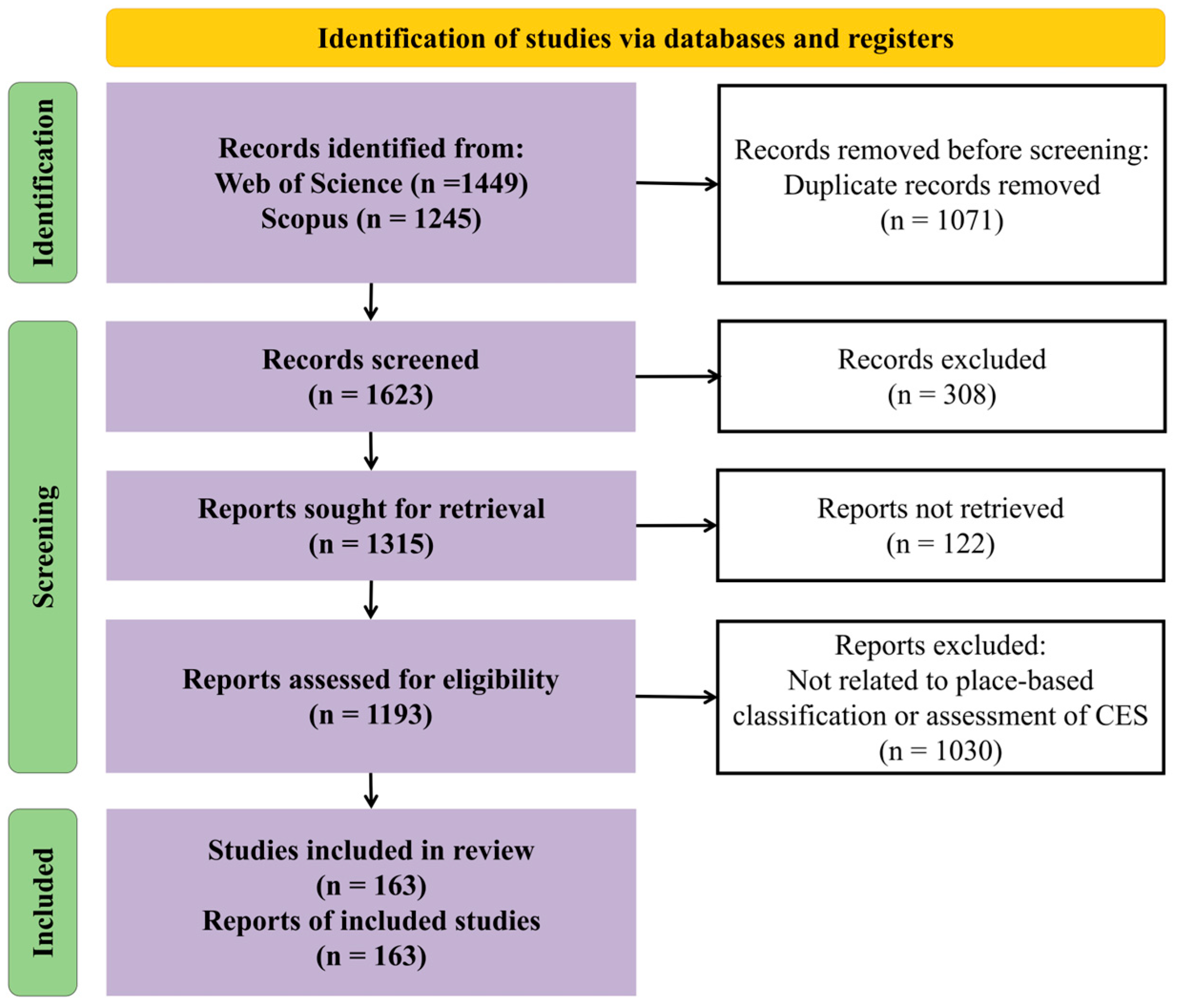
2.2. Data Collection Process and Article Screening
3. Results
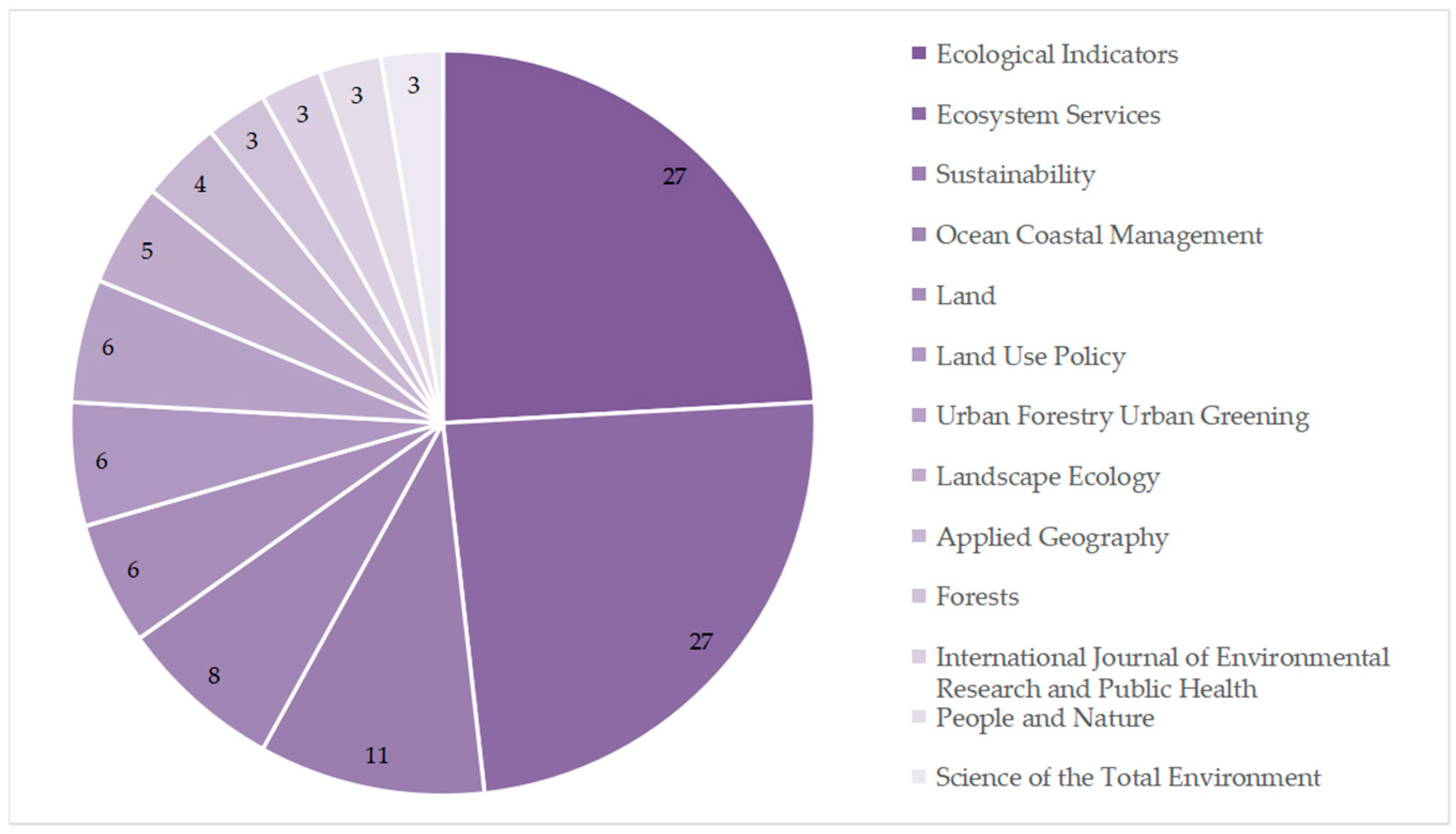
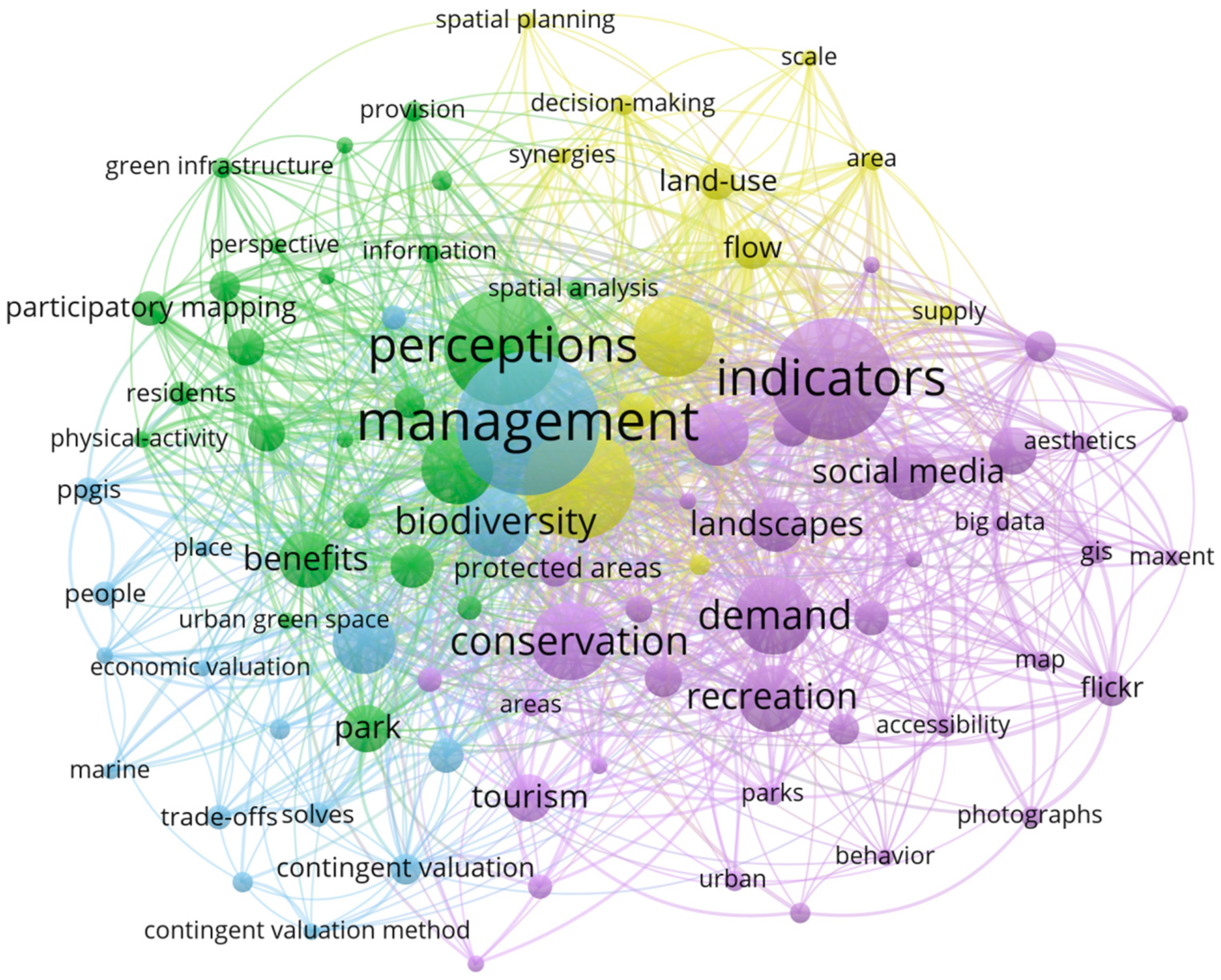
3.1. General Observations
3.2. Regional Distribution and Ecosystem Types of CES Assessment
3.3. CES Categories
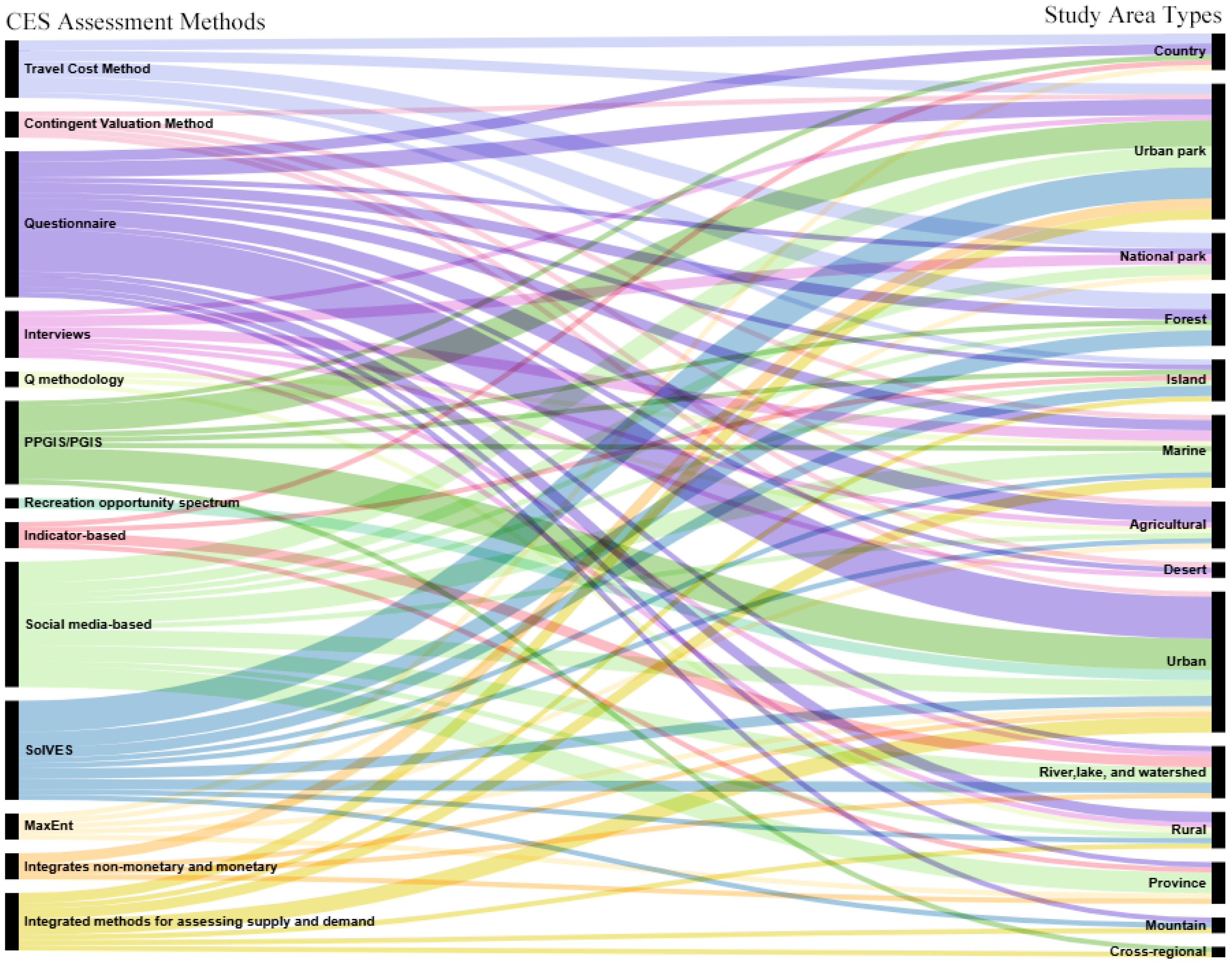
3.4. CES Assessment Methods
4. Discussion
4.1. Systematic Mismatches Between CES Classification and Application
4.2. Reframing CES Through a Place-Based Lens
4.3. Methodological Shifts and Their Implications for Place-Based CES Assessment
4.4. Unresolved Theoretical Tensions and Implications for Policy Uptake
5. Conclusions
- The locations assessed in these articles cover a variety of ecosystem types, with a particular focus on urban areas. However, there is no specialized category or indicator specifically for urban areas. Similarly, there is still a lack of targeted investigation and differentiation when assessing marine, rural, forest, agricultural and other ecosystems. This suggests that the application of CES categories across different ecosystems has not been effectively differentiated or explored. Moreover, the majority of studies assess large-scale regions. While some urban CES studies are already conducted at relatively fine spatial scales, such as parks or neighborhoods, future research should place greater emphasis on the experiential granularity of CES assessments. This includes capturing variations in perception, meaning, and use within places, rather than simply further subdividing spatial units. Because it can translate assessment results into concrete planning and design references, provide clearer guidance for enhancing culturally oriented areas, and contribute to evidence-based management decisions.
- There are 14 main categories for place-based CES evaluations. Of these, 13 can be categorized under the MEA/CICES classification system. They are: (1) Cultural diversity; (2) Spiritual and religious values; (3) Knowledge systems; (4) Educational values; (5) Inspiration; (6) Aesthetic values; (7) Social relations; (8) Sense of place; (9) Cultural heritage; (10) Recreation and ecotourism; (11) Experiential use of plants, animals, and land-/seascapes in different environments; (12) Existence; (13) Bequest. One emerging category is (14) Health value, indicating a growing awareness of the beneficial effects of natural ecosystems on human health and physical recovery. The specific categories to assess should be determined based on the site’s actual conditions and stakeholder surveys. The categories assessed need to be comprehensive, rather than focusing on a single one, and efforts should be made to promote a combination of standardization and localization of the CES classification system. High-quality CES classifications and indicators will aid in planning and decision-making for a given area [7], as they are important indicators for subsequent CES assessments.
- We also conducted an extensive review of assessment methods, which can be categorized into four main types: Monetary assessment methods, non-monetary assessment methods, Model assessment methods, and Integrated methods. We summarized the assessment methods used in each article. The conclusion is that most studies used non-monetary methods to assess place-based CES, often combined with GIS spatial visualization tools. Articles assessing CES supply-demand have become more frequent in recent years. Future assessments of place-based CES will likely combine supply-demand assessment and spatial visualization, providing clearer support for decision-makers and planners. This approach not only provides planners and decision-makers with a practical tool for identifying spatial mismatches and priority intervention areas, thereby supporting a more equitable and culturally responsive allocation of ecological and recreational resources, but also helps translate CES evidence into operational planning guidance by linking public perceptions, environmental characteristics, and management objectives within a single analytical framework, thus promoting more sustainable and environmentally sensitive regional development.
Supplementary Materials
Author Contributions
Funding
Institutional Review Board Statement
Informed Consent Statement
Data Availability Statement
Acknowledgments
Conflicts of Interest
References
- Arslan, E.S.; Orucu, O.K. MaxEnt Modelling of the Potential Distribution Areas of Cultural Ecosystem Services Using Social Media Data and GIS. Environ. Dev. Sustain. 2021, 23, 2655–2667. [Google Scholar] [CrossRef]
- Daily, G.C. Nature’s Services: Societal Dependence on Natural Ecosystems; Island Press: Washington, DC, USA, 1997; ISBN 1-55963-475-8. [Google Scholar]
- Costanza, R.; d’Arge, R.; de Groot, R.; Farber, S.; Grasso, M.; Hannon, B.; Limburg, K.; Naeem, S.; O’Neill, R.V.; Paruelo, J.; et al. The Value of the World’s Ecosystem Services and Natural Capital. Nature 1997, 387, 253–260. [Google Scholar] [CrossRef]
- Alvarez-Codoceo, S.; Cerda, C.; Perez-Quezada, J.F. Mapping the Provision of Cultural Ecosystem Services in Large Cities: The Case of The Andean Piedmont in Santiago, Chile. Urban For. Urban Green. 2021, 66, 127390. [Google Scholar] [CrossRef]
- Westman, W.E. How Much Are Nature’s Services Worth? Science 1977, 197, 960–964. [Google Scholar] [CrossRef] [PubMed]
- Mooney, H.A.; Ehrlich, P.R. Ecosystem Services: A Fragmentary History. In Nature’s Services: Societal Dependence on Natural Ecosystems; Island Press: Washington, DC, USA, 1997; ISBN 978-1-59726-775-5. [Google Scholar]
- La Rosa, D.; Spyra, M.; Inostroza, L. Indicators of Cultural Ecosystem Services for Urban Planning: A Review. Ecol. Indic. 2016, 61, 74–89. [Google Scholar] [CrossRef]
- Millennium Ecosystem Assessment (Ed.) Ecosystems and Human Well-Being: Synthesis; Island Press: Washington, DC, USA, 2005; ISBN 978-1-59726-040-4. [Google Scholar]
- Haines-Young, R.; Potschin, M. Common International Classification of Ecosystem Services (CICES): Consultation on Version 4; Centre for Environmental Management, University of Nottingham: Nottingham, UK, 2012. [Google Scholar]
- Fish, R.; Church, A.; Winter, M. Conceptualising Cultural Ecosystem Services: A Novel Framework for Research and Critical Engagement. Ecosyst. Serv. 2016, 21, 208–217. [Google Scholar] [CrossRef]
- Marcinkeviciute, L.; Pranskuniene, R. Cultural Ecosystem Services: The Case of Coastal-Rural Area (Nemunas Delta and Curonian Lagoon, Lithuania). Sustainability 2021, 13, 123. [Google Scholar] [CrossRef]
- Plieninger, T.; Dijks, S.; Oteros-Rozas, E.; Bieling, C. Assessing, Mapping, and Quantifying Cultural Ecosystem Services at Community Level. Land Use Pol. 2013, 33, 118–129. [Google Scholar] [CrossRef]
- Pleasant, M.M.; Gray, S.A.; Lepczyk, C.; Fernandes, A.; Hunter, N.; Ford, D. Managing Cultural Ecosystem Services. Ecosyst. Serv. 2014, 8, 141–147. [Google Scholar] [CrossRef]
- Csurgo, B.; Smith, M.K. The Value of Cultural Ecosystem Services in a Rural Landscape Context. J. Rural. Stud. 2021, 86, 76–86. [Google Scholar] [CrossRef]
- IPBES. The IPBES Regional Assessment Report on Biodiversity and Ecosystem Services for Europe and Central Asia; Zenodo: Genève, Switzerland, 2018. [Google Scholar]
- Langemeyer, J.; Calcagni, F.; Baro, F. Mapping the Intangible: Using Geolocated Social Media Data to Examine Landscape Aesthetics. Land Use Pol. 2018, 77, 542–552. [Google Scholar] [CrossRef]
- de Groot, R.S.; Wilson, M.A.; Boumans, R.M.J. A Typology for the Classification, Description and Valuation of Ecosystem Functions, Goods and Services. Ecol. Econ. 2002, 41, 393–408. [Google Scholar] [CrossRef]
- Wallace, K.J. Classification of Ecosystem Services: Problems and Solutions. Biol. Conserv. 2007, 139, 235–246. [Google Scholar] [CrossRef]
- Hooftman, D.A.P.; Ridding, L.E.; Redhead, J.W.; Willcock, S. National Scale Mapping of Supply and Demand for Recreational Ecosystem Services. Ecol. Indic. 2023, 154, 110779. [Google Scholar] [CrossRef]
- Lee, J.; Park, H.; Kim, I.; Kwon, H. Analysis of Cultural Ecosystem Services Using Text Mining of Residents’ Opinions. Ecol. Indic. 2020, 115, 106368. [Google Scholar] [CrossRef]
- Fletcher, R.; Baulcomb, C.; Hall, C.; Hussain, S. Revealing Marine Cultural Ecosystem Services in the Black Sea. Mar. Pol. 2014, 50, 151–161. [Google Scholar] [CrossRef]
- Sagie, H.; Morris, A.; Rofè, Y.; Orenstein, D.E.; Groner, E. Cross-Cultural Perceptions of Ecosystem Services: A Social Inquiry on Both Sides of the Israeli–Jordanian Border of the Southern Arava Valley Desert. J. Arid. Environ. 2013, 97, 38–48. [Google Scholar] [CrossRef]
- Hubatova, M.; McGinlay, J.; Parsons, D.J.J.; Morris, J.; Graves, A.R.R. Assessing Preferences for Cultural Ecosystem Services in the English Countryside Using Q Methodology. Land 2023, 12, 331. [Google Scholar] [CrossRef]
- Wang, Y.; Hayashi, K. Methodological Development of Cultural Ecosystem Services Evaluation Using Location Data. J. Clean. Prod. 2023, 396, 136523. [Google Scholar] [CrossRef]
- Maes, J.; Teller, A.; Erhard, M.; Liquete, C.; Braat, L.; Berry, P.; Egoh, B.; Puydarrieux, P.; Fiorina, C.; Santos, F. Mapping and Assessment of Ecosystems and Their Services. In An Analytical Framework for Ecosystem Assessments Under Action; Publications Office of the European Union: Luxembourg, 2013; Volume 5, pp. 1–58. [Google Scholar]
- Schröter, M.; Albert, C.; Marques, A.; Tobon, W.; Lavorel, S.; Maes, J.; Brown, C.; Klotz, S.; Bonn, A. National Ecosystem Assessments in Europe: A Review. BioScience 2016, 66, 813–828. [Google Scholar] [CrossRef]
- Liquete, C.; Kleeschulte, S.; Dige, G.; Maes, J.; Grizzetti, B.; Olah, B.; Zulian, G. Mapping Green Infrastructure Based on Ecosystem Services and Ecological Networks: A Pan-European Case Study. Environ. Sci. Policy 2015, 54, 268–280. [Google Scholar] [CrossRef]
- Kovacs, B.; Marquez-Linares, M.A.; Rodriguez-Espinosa, P.F.; Gutierrez-Yurrita, P.J.; Perez-Verdin, G. Analysis of Cultural Ecosystem Services of Rock Climbing Settings in Mexico City: The Case of Los Dinamos Recreational Park. Ecosyst. People 2021, 17, 370–382. [Google Scholar] [CrossRef]
- Daniel, T.C.; Muhar, A.; Arnberger, A.; Aznar, O.; Boyd, J.W.; Chan, K.M.A.; Costanza, R.; Elmqvist, T.; Flint, C.G.; Gobster, P.H.; et al. Contributions of Cultural Services to the Ecosystem Services Agenda. Proc. Natl. Acad. Sci. USA 2012, 109, 8812–8819. [Google Scholar] [CrossRef]
- Katz-Gerro, T.; Orenstein, D.E. Environmental Tastes, Opinions and Behaviors: Social Sciences in the Service of Cultural Ecosystem Service Assessment. Ecol. Soc. 2015, 20, 28. [Google Scholar] [CrossRef]
- Tajima, Y.; Hashimoto, S.; Dasgupta, R.; Takahashi, Y. Spatial Characterization of Cultural Ecosystem Services in the Ishigaki Island of Japan: A Comparison between Residents and Tourists. Ecosyst. Serv. 2023, 60, 101520. [Google Scholar] [CrossRef]
- Johansson, M.; Pedersen, E.; Weisner, S. Assessing Cultural Ecosystem Services as Individuals’ Place-Based Appraisals. Urban For. Urban Green. 2019, 39, 79–88. [Google Scholar] [CrossRef]
- Ondiek, R.A.; Kitaka, N.; Oduor, S.O. Assessment of Provisioning and Cultural Ecosystem Services in Natural Wetlands and Rice Fields in Kano Floodplain, Kenya. Ecosyst. Serv. 2016, 21, 166–173. [Google Scholar] [CrossRef]
- Zwierzchowska, I.; Hof, A.; Ioja, I.-C.; Mueller, C.; Ponizy, L.; Breuste, J.; Mizgajski, A. Multi-Scale Assessment of Cultural Ecosystem Services of Parks in Central European Cities. Urban For. Urban Green. 2018, 30, 84–97. [Google Scholar] [CrossRef]
- Tekken, V.; Spangenberg, J.H.; Burkhard, B.; Escalada, M.; Stoll-Kleemann, S.; Dao, T.T.; Settele, J. “Things Are Different Now”: Farmer Perceptions of Cultural Ecosystem Services of Traditional Rice Landscapes in Vietnam and the Philippines. Ecosyst. Serv. 2017, 25, 153–166. [Google Scholar] [CrossRef]
- Ncube, S.; Beevers, L.; Momblanch, A. Towards Intangible Freshwater Cultural Ecosystem Services: Informing Sustainable Water Resources Management. Water 2021, 13, 535. [Google Scholar] [CrossRef]
- Winkler, K.J.; Nicholas, K.A. More than Wine: Cultural Ecosystem Services in Vineyard Landscapes in England and California. Ecol. Econ. 2016, 124, 86–98. [Google Scholar] [CrossRef]
- Pike, K.; Wright, P.; Wink, B.; Fletcher, S. The Assessment of Cultural Ecosystem Services in the Marine Environment Using Q Methodology. J. Coast. Conserv. 2015, 19, 667–675. [Google Scholar] [CrossRef]
- Schirpke, U.; Tasser, E.; Ebner, M.; Tappeiner, U. What Can Geotagged Photographs Tell Us about Cultural Ecosystem Services of Lakes? Ecosyst. Serv. 2021, 51, 101354. [Google Scholar] [CrossRef]
- Zapata-Caldas, E.; Calcagni, F.; Baró, F.; Langemeyer, J. Using Crowdsourced Imagery to Assess Cultural Ecosystem Services in Data-Scarce Urban Contexts: The Case of the Metropolitan Area of Cali, Colombia. Ecosyst. Serv. 2022, 56, 101445. [Google Scholar] [CrossRef]
- Azevedo, A. Pull and Push Drivers of Giant-Wave Spectators in Nazare, Portugal: A Cultural Ecosystem Services Assessment Based on Geo-Tagged Photos. Land 2023, 12, 360. [Google Scholar] [CrossRef]
- Oteros-Rozas, E.; Martin-Lopez, B.; Fagerholm, N.; Bieling, C.; Plieninger, T. Using Social Media Photos to Explore the Relation between Cultural Ecosystem Services and Landscape Features across Five European Sites. Ecol. Indic. 2018, 94, 74–86. [Google Scholar] [CrossRef]
- Kobryn, H.T.; Brown, G.; Munro, J.; Moore, S.A. Cultural Ecosystem Values of the Kimberley Coastline: An Empirical Analysis with Implications for Coastal and Marine Policy. Ocean Coast. Manag. 2018, 162, 71–84. [Google Scholar] [CrossRef]
- Koh, Y.F.; Loc, H.H.; Park, E. Towards a “City in Nature”: Evaluating the Cultural Ecosystem Services Approach Using Online Public Participation GIS to Support Urban Green Space Management. Sustainability 2022, 14, 1499. [Google Scholar] [CrossRef]
- Canedoli, C.; Bullock, C.; Collier, M.J.; Joyce, D.; Padoa-Schioppa, E. Public Participatory Mapping of Cultural Ecosystem Services: Citizen Perception and Park Management in the Parco Nord of Milan (Italy). Sustainability 2017, 9, 891. [Google Scholar] [CrossRef]
- Brown, G.; Fagerholm, N. Empirical PPGIS/PGIS Mapping of Ecosystem Services: A Review and Evaluation. Ecosyst. Serv. 2015, 13, 119–133. [Google Scholar] [CrossRef]
- Baumeister, C.F.; Gerstenberg, T.; Plieninger, T.; Schraml, U. Exploring Cultural Ecosystem Service Hotspots: Linking Multiple Urban Forest Features with Public Participation Mapping Data. Urban For. Urban Green. 2020, 48, 126561. [Google Scholar] [CrossRef]
- Beckmann-Wubbelt, A.; Fricke, A.; Sebesvari, Z.; Yakouchenkova, I.A.; Froehlich, K.; Saha, S. High Public Appreciation for the Cultural Ecosystem Services of Urban and Peri-Urban Forests during the COVID-19 Pandemic. Sust. Cities Soc. 2021, 74, 103240. [Google Scholar] [CrossRef]
- Hernández-Morcillo, M.; Plieninger, T.; Bieling, C. An Empirical Review of Cultural Ecosystem Service Indicators. Ecol. Indic. 2013, 29, 434–444. [Google Scholar] [CrossRef]
- Márquez, L.A.M.; Rezende, E.C.N.; Machado, K.B.; Nascimento, E.L.M.d.; Castro, J.D.B.; Nabout, J.C. Trends in Valuation Approaches for Cultural Ecosystem Services: A Systematic Literature Review. Ecosyst. Serv. 2023, 64, 101572. [Google Scholar] [CrossRef]
- Sherrouse, B.C.; Clement, J.M.; Semmens, D.J. A GIS Application for Assessing, Mapping, and Quantifying the Social Values of Ecosystem Services. Appl. Geogr. 2011, 31, 748–760. [Google Scholar] [CrossRef]
- Nahuelhual, L.; Carmona, A.; Laterra, P.; Barrena, J.; Aguayo, M. A Mapping Approach to Assess Intangible Cultural Ecosystem Services: The Case of Agriculture Heritage in Southern Chile. Ecol. Indic. 2014, 40, 90–101. [Google Scholar] [CrossRef]
- Ahtiainen, H.; Liski, E.; Pouta, E.; Soini, K.; Bertram, C.; Rehdanz, K.; Pakalniete, K.; Meyerhof, J. Cultural Ecosystem Services Provided by the Baltic Sea Marine Environment. Ambio 2019, 48, 1350–1361. [Google Scholar] [CrossRef] [PubMed]
- Cheng, X.; Van Damme, S.; Li, L.; Uyttenhove, P. Evaluation of Cultural Ecosystem Services: A Review of Methods. Ecosyst. Serv. 2019, 37, 100925. [Google Scholar] [CrossRef]
- Liberati, A.; Altman, D.G.; Tetzlaff, J.; Mulrow, C.; Gøtzsche, P.C.; Ioannidis, J.P.A.; Clarke, M.; Devereaux, P.J.; Kleijnen, J.; Moher, D. The PRISMA Statement for Reporting Systematic Reviews and Meta-Analyses of Studies That Evaluate Health Care Interventions: Explanation and Elaboration. Ann. Intern. Med. 2009, 151, W65–W94. [Google Scholar] [CrossRef]
- Moher, D.; Liberati, A.; Tetzlaff, J.; Altman, D.G. Preferred Reporting Items for Systematic Reviews and Meta-Analyses: The PRISMA Statement. Int. J. Surg. 2010, 8, 336–341. [Google Scholar] [CrossRef] [PubMed]
- Harris, J.D.; Quatman, C.E.; Manring, M.M.; Siston, R.A.; Flanigan, D.C. How to Write a Systematic Review. Am. J. Sports Med. 2014, 42, 2761–2768. [Google Scholar] [CrossRef]
- Pollock, A.; Berge, E. How to Do a Systematic Review. Int. J. Stroke 2018, 13, 138–156. [Google Scholar] [CrossRef] [PubMed]
- Sauer, P.C.; Seuring, S. How to Conduct Systematic Literature Reviews in Management Research: A Guide in 6 Steps and 14 Decisions. Rev. Manag. Sci. 2023, 17, 1899–1933. [Google Scholar] [CrossRef]
- Riechers, M.; Barkmann, J.; Tscharntke, T. Perceptions of Cultural Ecosystem Services from Urban Green. Ecosyst. Serv. 2016, 17, 33–39. [Google Scholar] [CrossRef]
- Dai, P.; Zhang, S.; Gong, Y.; Zhou, Y.; Hou, H. A Crowd-Sourced Valuation of Recreational Ecosystem Services Using Mobile Signal Data Applied to a Restored Wetland in China. Ecol. Econ. 2022, 192, 107249. [Google Scholar] [CrossRef]
- Hutcheson, W.; Hoagland, P.; Jin, D. Valuing Environmental Education as a Cultural Ecosystem Service at Hudson River Park. Ecosyst. Serv. 2018, 31, 387–394. [Google Scholar] [CrossRef]
- Lamhamedi, H.; Lizin, S.; Witters, N.; Malina, R.; Baguare, A. The Recreational Value of a Peri-Urban Forest in Morocco. Urban For. Urban Green. 2021, 65, 127339. [Google Scholar] [CrossRef]
- Lankia, T.; Kopperoinen, L.; Pouta, E.; Neuvonen, M. Valuing Recreational Ecosystem Service Flow in Finland. J. Outdo. Recreat. Tour. Res. Plan. 2015, 10, 14–28. [Google Scholar] [CrossRef]
- Lankia, T.; Neuvonen, M.; Pouta, E.; Sievanen, T.; Torvelainen, J. Outdoor Recreation in Ecosystem Service Accounting: Pilot Accounts from Finland. Scand. J. For. Res. 2020, 35, 186–197. [Google Scholar] [CrossRef]
- Lingua, F.; Coops, N.C.; Lafond, V.; Gaston, C.; Griess, V.C. Characterizing, Mapping and Valuing the Demand for Forest Recreation Using Crowdsourced Social Media Data. PLoS ONE 2022, 17, e0272406. [Google Scholar] [CrossRef]
- Matthew, N.K.; Shuib, A.; Raja Gopal, N.G.; Zheng, G.I. Economic Value of Recreation as an Ecosystem Service in Ayer Keroh Recreational Forest, Malaysia. Sustainability 2022, 14, 4935. [Google Scholar] [CrossRef]
- Mayer, M.; Woltering, M. Assessing and Valuing the Recreational Ecosystem Services of Germany’s National Parks Using Travel Cost Models. Ecosyst. Serv. 2018, 31, 371–386. [Google Scholar] [CrossRef]
- Nyelele, C.; Keske, C.; Gon Chung, M.; Guo, H.; Egoh, B.N. Using Social Media Data to Estimate Recreational Travel Costs: A Case Study from California. Ecol. Indic. 2023, 154, 110638. [Google Scholar] [CrossRef]
- Saha, N.; Mukul, S.A. Visitor’s Willingness to Pay for Cultural Ecosystem Services in Bangladesh: An Assessment for Lawachara National Park, a Biodiversity Hotspot. Small-Scale For. 2022, 21, 185–201. [Google Scholar] [CrossRef]
- Zhao, N.; Wang, H.; Zhong, J.; Sun, D. Assessment of Recreational and Cultural Ecosystem Services Value of Islands. Land 2022, 11, 205. [Google Scholar] [CrossRef]
- Ahrabous, M.; Allali, K.; Fadlaoui, A.; Arib, F.; Dolores de-Miguel, M.; Alcon, F. Economic Valuation of Cultural Services at the Todgha Oasis, Morocco. J. Nat. Conserv. 2023, 73, 126371. [Google Scholar] [CrossRef]
- Florencio, B.O.G.; da Silva, C.E.M.; Neto, C.C.C. Valuation of Cultural Ecosystem Services in Urban Parks with Different Social Contexts in the City of Recife (PE), Brazil. Rev. Bras. Cienc. Ambient. 2022, 57, 442–450. [Google Scholar] [CrossRef]
- Jobstvogt, N.; Watson, V.; Kenter, J.O. Looking below the Surface: The Cultural Ecosystem Service Values of UK Marine Protected Areas (MPAs). Ecosyst. Serv. 2014, 10, 97–110. [Google Scholar] [CrossRef]
- Lee, D.-K. Analysis of the Potential Value of Cultural Ecosystem Services: A Case Study of Busan City, Republic of Korea. Ecosyst. Serv. 2024, 65, 101596. [Google Scholar] [CrossRef]
- van Berkel, D.B.; Verburg, P.H. Spatial Quantification and Valuation of Cultural Ecosystem Services in an Agricultural Landscape. Ecol. Indic. 2014, 37, 163–174. [Google Scholar] [CrossRef]
- Sander, H.A.; Haight, R.G. Estimating the Economic Value of Cultural Ecosystem Services in an Urbanizing Area Using Hedonic Pricing. J. Environ. Manag. 2012, 113, 194–205. [Google Scholar] [CrossRef]
- Chang, J.; Qu, Z.; Xu, R.; Pan, K.; Xu, B.; Min, Y.; Ren, Y.; Yang, G.; Ge, Y. Assessing the Ecosystem Services Provided by Urban Green Spaces along Urban Center-Edge Gradients. Sci. Rep. 2017, 7, 11226. [Google Scholar] [CrossRef]
- Rewitzer, S.; Huber, R.; Grêt-Regamey, A.; Barkmann, J. Economic Valuation of Cultural Ecosystem Service Changes to a Landscape in the Swiss Alps. Ecosyst. Serv. 2017, 26, 197–208. [Google Scholar] [CrossRef]
- Lingua, F.; Coops, N.C.; Griess, V.C. Valuing Cultural Ecosystem Services Combining Deep Learning and Benefit Transfer Approach. Ecosyst. Serv. 2022, 58, 101487. [Google Scholar] [CrossRef]
- Dai, P.; Zhang, S.; Hou, H.; Yang, Y.; Liu, R. Valuing Sports Services in Urban Parks: A New Model Based on Social Network Data. Ecosyst. Serv. 2019, 36, 100891. [Google Scholar] [CrossRef]
- Wang, Y.; Li, Z.; Deng, X. Assessment of Cultural Ecosystem Services of the Qinghai-Tibetan Plateau: Guarding the Beauty of the Plateau, Co-Creating a Better Future. Ecol. Indic. 2024, 166, 112405. [Google Scholar] [CrossRef]
- Albalawneh, A.; Al-Assaf, A.; Sweity, A.; Abu Hammour, W.; Kloub, K.; Hjazin, A.; Kabariti, R.; Abu Nowar, L.; Tadros, M.J.; Aljaafreh, S.; et al. Mapping Cultural Ecosystem Services in the Hyper Arid Environment of South of Jordan. Front. Environ. Sci. 2022, 10, 866309. [Google Scholar] [CrossRef]
- Bachi, L.; Ribeiro, S.C.; Hermes, J.; Saadi, A. Cultural Ecosystem Services (CES) in Landscapes with a Tourist Vocation: Mapping and Modeling the Physical Landscape Components That Bring Benefits to People in a Mountain Tourist Destination in Southeastern Brazil. Tour. Manag. 2020, 77, 104017. [Google Scholar] [CrossRef]
- Brill, G.C.; Anderson, P.M.L.; O’Farrell, P. Relational Values of Cultural Ecosystem Services in an Urban Conservation Area: The Case of Table Mountain National Park, South Africa. Land 2022, 11, 603. [Google Scholar] [CrossRef]
- Casado-Arzuaga, I.; Onaindia, M.; Madariaga, I.; Verburg, P.H. Mapping Recreation and Aesthetic Value of Ecosystems in the Bilbao Metropolitan Greenbelt (Northern Spain) to Support Landscape Planning. Landsc. Ecol. 2014, 29, 1393–1405. [Google Scholar] [CrossRef]
- Cheng, X.; Sylvie, V.D.; Li, L.; Pieter, U. Taking “Social Relations” as a Cultural Ecosystem Service: A Triangulation Approach. Urban For. Urban Green. 2020, 55, 126790. [Google Scholar] [CrossRef]
- Darvill, R.; Lindo, Z. The Inclusion of Stakeholders and Cultural Ecosystem Services in Land Management Trade-off Decisions Using an Ecosystem Services Approach. Landsc. Ecol. 2016, 31, 533–545. [Google Scholar] [CrossRef]
- Dou, Y.; Zhen, L.; De Groot, R.; Du, B.; Yu, X. Assessing the Importance of Cultural Ecosystem Services in Urban Areas of Beijing Municipality. Ecosyst. Serv. 2017, 24, 79–90. [Google Scholar] [CrossRef]
- Gee, K.; Burkhard, B. Cultural Ecosystem Services in the Context of Offshore Wind Farming: A Case Study from the West Coast of Schleswig-Holstein. Ecol. Complex. 2010, 7, 349–358. [Google Scholar] [CrossRef]
- Giacche, G.; Consales, J.-N.; Grard, B.J.-P.; Daniel, A.-C.; Chenu, C. Toward an Evaluation of Cultural Ecosystem Services Delivered by Urban Micro-Farms. Sustainability 2021, 13, 1716. [Google Scholar] [CrossRef]
- Gould, R.K.; Ardoin, N.M.; Woodside, U.; Satterfield, T.; Hannahs, N.; Daily, G.C. The Forest Has a Story: Cultural Ecosystem Services in Kona, Hawai’i. Ecol. Soc. 2014, 19, 55. [Google Scholar] [CrossRef]
- Kabaya, K.; Hashimoto, S.; Takeuchi, K. Which Cultural Ecosystem Services Is More Important? A Best-Worst Scaling Approach. J. Environ. Econ. Policy 2020, 9, 304–318. [Google Scholar] [CrossRef]
- Kalinauskas, M.; Bogdzevič, K.; Gomes, E.; Inácio, M.; Barcelo, D.; Zhao, W.; Pereira, P. Mapping and Assessment of Recreational Cultural Ecosystem Services Supply and Demand in Vilnius (Lithuania). Sci. Total Environ. 2023, 855, 158590. [Google Scholar] [CrossRef] [PubMed]
- Ko, H.; Son, Y. Perceptions of Cultural Ecosystem Services in Urban Green Spaces: A Case Study in Gwacheon, Republic of Korea. Ecol. Indic. 2018, 91, 299–306. [Google Scholar] [CrossRef]
- Kovács, B.; Uchiyama, Y.; Miyake, Y.; Quevedo, J.M.D.; Kohsaka, R. Capturing Landscape Values in Peri-Urban Satoyama Forests: Diversity of Visitors’ Perceptions and Implications for Future Value Assessments. Trees For. People 2022, 10, 100339. [Google Scholar] [CrossRef]
- Mao, Q.; Wang, L.; Guo, Q.; Li, Y.; Liu, M.; Xu, G. Evaluating Cultural Ecosystem Services of Urban Residential Green Spaces From the Perspective of Residents’ Satisfaction With Green Space. Front. Public Health 2020, 8, 226. [Google Scholar] [CrossRef]
- Nahuelhual, L.; Carmona, A.; Lozada, P.; Jaramillo, A.; Aguayo, M. Mapping Recreation and Ecotourism as a Cultural Ecosystem Service: An Application at the Local Level in Southern Chile. Appl. Geogr. 2013, 40, 71–82. [Google Scholar] [CrossRef]
- Pena, L.; Casado-Arzuaga, I.; Onaindia, M. Mapping Recreation Supply and Demand Using an Ecological and a Social Evaluation Approach. Ecosyst. Serv. 2015, 13, 108–118. [Google Scholar] [CrossRef]
- Riechers, M.; Strack, M.; Barkmann, J.; Tscharntke, T. Cultural Ecosystem Services Provided by Urban Green Change along an Urban-Periurban Gradient. Sustainability 2019, 11, 645. [Google Scholar] [CrossRef]
- Schirpke, U.; Timmermann, F.; Tappeiner, U.; Tasser, E. Cultural Ecosystem Services of Mountain Regions: Modelling the Aesthetic Value. Ecol. Indic. 2016, 69, 78–90. [Google Scholar] [CrossRef]
- Shi, Q.; Chen, H.; Liang, X.; Zhang, H.; Liu, D. Cultural Ecosystem Services Valuation and Its Multilevel Drivers: A Case Study of Gaoqu Township in Shaanxi Province, China. Ecosyst. Serv. 2020, 41, 101052. [Google Scholar] [CrossRef]
- Shi, Q.; Chen, H.; Liu, D.; Zhang, H.; Geng, T.; Zhang, H. Exploring the Linkage between the Supply and Demand of Cultural Ecosystem Services in Loess Plateau, China: A Case Study from Shigou Township. Environ. Sci. Pollut. Res. 2020, 27, 12514–12526. [Google Scholar] [CrossRef]
- Sultana, R.; Selim, S.A. Residents’ Perceptions of the Role and Management of Green Spaces to Provide Cultural Ecosystem Services in Dhaka, Bangladesh. Ecol. Soc. 2021, 26, 5. [Google Scholar] [CrossRef]
- Valença Pinto, L.; Inácio, M.; Bogdzevič, K.; Gomes, E.; Pereira, P. Factors Affecting the Use of Cultural Ecosystem Services in Lithuanian Coastal Area. Ocean Coast. Manag. 2024, 251, 107095. [Google Scholar] [CrossRef]
- Zoderer, B.M.; Tasser, E.; Erb, K.-H.; Stanghellini, P.S.L.; Tappeiner, U. Identifying and Mapping the Tourists’ Perception of Cultural Ecosystem Services: A Case Study from an Alpine Region. Land Use Pol. 2016, 56, 251–261. [Google Scholar] [CrossRef]
- Gajardo, L.J.; Sumeldan, J.; Sajorne, R.; Madarcos, J.R.; Goh, H.C.; Culhane, F.; Langmead, O.; Creencia, L. Cultural Values of Ecosystem Services from Coastal Marine Areas: Case of Taytay Bay, Palawan, Philippines. Environ. Sci. Policy 2023, 142, 12–20. [Google Scholar] [CrossRef]
- Stepniewska, M. The Capacity of Urban Parks for Providing Regulating and Cultural Ecosystem Services versus Their Social Perception. Land Use Pol. 2021, 111, 105778. [Google Scholar] [CrossRef]
- Teff-Seker, Y.; Orenstein, D.E. The “Desert Experience”: Evaluating the Cultural Ecosystem Services of Drylands through Walking and Focusing. People Nat. 2019, 1, 234–248. [Google Scholar] [CrossRef]
- Vieira, F.A.S.; Bragagnolo, C.; Correia, R.A.; Malhado, A.C.M.; Ladle, R.J. A Salience Index for Integrating Multiple User Perspectives in Cultural Ecosystem Service Assessments. Ecosyst. Serv. 2018, 32, 182–192. [Google Scholar] [CrossRef]
- Vrbicanova, G.; Kaisova, D.; Mocka, M.; Petrovic, F.; Mederly, P. Mapping Cultural Ecosystem Services Enables Better Informed Nature Protection and Landscape Management. Sustainability 2020, 12, 2138. [Google Scholar] [CrossRef]
- Arslan, E.S.; Nordstrom, P.; Ijas, A.; Hietala, R.; Fagerholm, N. Spatial Distribution of Perceived Cultural Ecosystem Services in Different Land Cover Infrastructure Types in Urban and Rural Areas—Case Kokemaki Area, Finland. Landsc. Res. 2021, 46, 828–844. [Google Scholar] [CrossRef]
- García-Díez, V.; García-Llorente, M.; González, J.A. Participatory Mapping of Cultural Ecosystem Services in Madrid: Insights for Landscape Planning. Land 2020, 9, 244. [Google Scholar] [CrossRef]
- Grzyb, T. Mapping Cultural Ecosystem Services of the Urban Riverscapes: The Case of the Vistula River in Warsaw, Poland. Ecosyst. Serv. 2024, 65, 101584. [Google Scholar] [CrossRef]
- Jaligot, R.; Kemajou, A.; Chenal, J. Cultural Ecosystem Services Provision in Response to Urbanization in Cameroon. Land Use Pol. 2018, 79, 641–649. [Google Scholar] [CrossRef]
- Jaligot, R.; Hasler, S.; Chenal, J. National Assessment of Cultural Ecosystem Services: Participatory Mapping in Switzerland. Ambio 2019, 48, 1219–1233. [Google Scholar] [CrossRef] [PubMed]
- Jones, L.; Holland, R.A.; Ball, J.; Sykes, T.; Taylor, G.; Ingwall-King, L.; Snaddon, J.L.; Peh, K.S.-H. A Place-Based Participatory Mapping Approach for Assessing Cultural Ecosystem Services in Urban Green Space. People Nat. 2020, 2, 123–137. [Google Scholar] [CrossRef]
- Kirby, M.G.; Scott, A.J.; Walsh, C.L. Translating Policy to Place: Exploring Cultural Ecosystem Services in Areas of Green Belt through Participatory Mapping. Ecosyst. People 2023, 19, 2276752. [Google Scholar] [CrossRef]
- Pinto, L.V.; Inacio, M.; Bogdzevic, K.; Kalinauskas, M.; Gomes, E.; Pereira, P. Factors Affecting Cultural Ecosystem Services Use in Vilnius (Lithuania): A Participatory Mapping Survey Approach. Heliyon 2023, 9, e15384. [Google Scholar] [CrossRef]
- Rall, E.; Bieling, C.; Zytynska, S.; Haase, D. Exploring City-Wide Patterns of Cultural Ecosystem Service Perceptions and Use. Ecol. Indic. 2017, 77, 80–95. [Google Scholar] [CrossRef]
- Ribeiro, F.P.; Ribeiro, K.T. Participative Mapping of Cultural Ecosystem Services in Pedra Branca State Park, Brazil. Nat. Conserv. 2016, 14, 120–127. [Google Scholar] [CrossRef]
- Song, L.; Wu, M.; Wu, Y.; Xu, X.; Xie, C. Research on the Evaluation of Cultural Ecosystem Services in Zhengzhou Urban Parks Based on Public Perceptions. Sustainability 2023, 15, 11964. [Google Scholar] [CrossRef]
- Byczek, C.; Longaretti, P.-Y.; Renaud, J.; Lavorel, S. Benefits of Crowd-Sourced GPS Information for Modelling the Recreation Ecosystem Service. PLoS ONE 2018, 13, e0202645. [Google Scholar] [CrossRef] [PubMed]
- Liu, S.; Shen, P.; Huang, Y.; Jiang, L.; Feng, Y. Spatial Distribution Changes in Nature-Based Recreation Service Supply from 2008 to 2018 in Shanghai, China. Land 2022, 11, 1862. [Google Scholar] [CrossRef]
- Paracchini, M.L.; Zulian, G.; Kopperoinen, L.; Maes, J.; Schaegner, J.P.; Termansen, M.; Zandersen, M.; Perez-Soba, M.; Scholefield, P.A.; Bidoglio, G. Mapping Cultural Ecosystem Services: A Framework to Assess the Potential for Outdoor Recreation across the EU. Ecol. Indic. 2014, 45, 371–385. [Google Scholar] [CrossRef]
- Allan, J.D.; Smith, S.D.P.; McIntyre, P.B.; Joseph, C.A.; Dickinson, C.E.; Marino, A.L.; Biel, R.G.; Olson, J.C.; Doran, P.J.; Rutherford, E.S.; et al. Using Cultural Ecosystem Services to Inform Restoration Priorities in the Laurentian Great Lakes. Front. Ecol. Environ. 2015, 13, 418–424. [Google Scholar] [CrossRef]
- Banela, M.; Kitsiou, D. Mapping Cultural Ecosystem Services: A Case Study in Lesvos Island, Greece. Ocean Coast. Manag. 2023, 246, 106883. [Google Scholar] [CrossRef]
- Ghasemi, M.; Charrahy, Z.; González-García, A. Mapping Cultural Ecosystem Services Provision: An Integrated Model of Recreation and Ecotourism Opportunities. Land Use Policy 2023, 131, 106732. [Google Scholar] [CrossRef]
- Stanik, N.; Aalders, I.; Miller, D. Towards an Indicator-Based Assessment of Cultural Heritage as a Cultural Ecosystem Service—A Case Study of Scottish Landscapes. Ecol. Indic. 2018, 95, 288–297. [Google Scholar] [CrossRef]
- Thiele, J.; Albert, C.; Hermes, J.; von Haaren, C. Assessing and Quantifying Offered Cultural Ecosystem Services of German River Landscapes. Ecosyst. Serv. 2020, 42, 101080. [Google Scholar] [CrossRef]
- Huang, W.; Lu, S.; Guo, Y. Measuring the Perceived Heterogeneity of Cultural Ecosystem Services in National Cultural Parks: Evidence from China. Sustainability 2023, 15, 9428. [Google Scholar] [CrossRef]
- Giedych, R.; Maksymiuk, G. Specific Features of Parks and Their Impact on Regulation and Cultural Ecosystem Services Provision in Warsaw, Poland. Sustainability 2017, 9, 792. [Google Scholar] [CrossRef]
- Bing, Z.; Qiu, Y.; Huang, H.; Chen, T.; Zhong, W.; Jiang, H. Spatial Distribution of Cultural Ecosystem Services Demand and Supply in Urban and Suburban Areas: A Case Study from Shanghai, China. Ecol. Indic. 2021, 127, 107720. [Google Scholar] [CrossRef]
- Cao, H.; Wang, M.; Su, S.; Kang, M. Explicit Quantification of Coastal Cultural Ecosystem Services: A Novel Approach Based on the Content and Sentimental Analysis of Social Media. Ecol. Indic. 2022, 137, 108756. [Google Scholar] [CrossRef]
- Chen, Y.; Hong, C.; Yang, Y.; Li, J.; Wang, Y.; Zheng, T.; Zhang, Y.; Shao, F.; De Meo, I. Mining Social Media Data to Capture Urban Park Visitors’ Perception of Cultural Ecosystem Services and Landscape Factors. Forests 2024, 15, 213. [Google Scholar] [CrossRef]
- Dai, P.; Zhang, S.; Chen, Z.; Gong, Y.; Hou, H. Perceptions of Cultural Ecosystem Services in Urban Parks Based on Social Network Data. Sustainability 2019, 11, 5386. [Google Scholar] [CrossRef]
- Figueroa-Alfaro, R.W.; Tang, Z. Evaluating the Aesthetic Value of Cultural Ecosystem Services by Mapping Geo-Tagged Photographs from Social Media Data on Panoramio and Flickr. J. Environ. Plan. Manag. 2017, 60, 266–281. [Google Scholar] [CrossRef]
- Havinga, I.; Bogaart, P.W.; Hein, L.; Tuia, D. Defining and Spatially Modelling Cultural Ecosystem Services Using Crowdsourced Data. Ecosyst. Serv. 2020, 43, 101091. [Google Scholar] [CrossRef]
- Huai, S.; Chen, F.; Liu, S.; Canters, F.; Van De Voorde, T. Using Social Media Photos and Computer Vision to Assess Cultural Ecosystem Services and Landscape Features in Urban Parks. Ecosyst. Serv. 2022, 57, 101475. [Google Scholar] [CrossRef]
- Kim, J.; Son, Y. Assessing and Mapping Cultural Ecosystem Services of an Urban Forest Based on Narratives from Blog Posts. Ecol. Indic. 2021, 129, 107983. [Google Scholar] [CrossRef]
- Martinez Pastur, G.; Peri, P.L.; Lencinas, M.V.; Garcia-Llorente, M.; Martin-Lopez, B. Spatial Patterns of Cultural Ecosystem Services Provision in Southern Patagonia. Landsc. Ecol. 2016, 31, 383–399. [Google Scholar] [CrossRef]
- Nyelele, C.; Keske, C.; Chung, M.G.; Guo, H.; Egoh, B.N. Using Social Media Data and Machine Learning to Map Recreational Ecosystem Services. Ecol. Indic. 2023, 154, 110606. [Google Scholar] [CrossRef]
- Retka, J.; Jepson, P.; Ladle, R.J.; Malhado, A.C.M.; Vieira, F.A.S.; Normande, I.C.; Souza, C.N.; Bragagnolo, C.; Correia, R.A. Assessing Cultural Ecosystem Services of a Large Marine Protected Area through Social Media Photographs. Ocean Coast. Manag. 2019, 176, 40–48. [Google Scholar] [CrossRef]
- Richards, D.R.; Friess, D.A. A Rapid Indicator of Cultural Ecosystem Service Usage at a Fine Spatial Scale: Content Analysis of Social Media Photographs. Ecol. Indic. 2015, 53, 187–195. [Google Scholar] [CrossRef]
- Santos Vieira, F.A.; Vinhas Santos, D.T.; Bragagnolo, C.; Campos-Silva, J.V.; Henriques Correia, R.A.; Jepson, P.; Mendes Malhado, A.C.; Ladle, R.J. Social Media Data Reveals Multiple Cultural Services along the 8.500 Kilometers of Brazilian Coastline. Ocean Coast. Manag. 2021, 214, 105918. [Google Scholar] [CrossRef]
- Sottini, V.A.; Barbierato, E.; Bernetti, I.; Capecchi, I.; Fabbrizzi, S.; Menghini, S. The Use of Crowdsourced Geographic Information for Spatial Evaluation of Cultural Ecosystem Services in the Agricultural Landscape the Case of Chianti Classico (Italy). New Medit. 2019, 18, 105–118. [Google Scholar] [CrossRef]
- Swetnam, R.D.; Harrison-Curran, S.K.; Smith, G.R. Quantifying Visual Landscape Quality in Rural Wales: A GIS-Enabled Method for Extensive Monitoring of a Valued Cultural Ecosystem Service. Ecosyst. Serv. 2017, 26, 451–464. [Google Scholar] [CrossRef]
- Tulek, B. Investigation of Cultural Ecosystem Services Supply in a River Landscape: A Case Study in the Lower Rhine Area Using Social Media Images. One Ecosyst. 2023, 8, e97259. [Google Scholar] [CrossRef]
- Vidal-Llamas, A.; Nicolas-Ruiz, N.; Alonso, M.L.S.; Gutierrez, M.R.V.-A. Exploring the Cultural Ecosystem Services of Arid Watersheds: A Social Media Analysis. J. Arid. Environ. 2024, 221, 105141. [Google Scholar] [CrossRef]
- Wang, W.; Wu, C.; Fang, Q.; Harrison, O.I. Cultural Ecosystem Services Evaluation in a Coastal City of China Using Social Media Data. Ocean Coast. Manag. 2023, 242, 106693. [Google Scholar] [CrossRef]
- Frank, S.; Fuerst, C.; Koschke, L.; Witt, A.; Makeschin, F. Assessment of Landscape Aesthetics-Validation of a Landscape Metrics-Based Assessment by Visual Estimation of the Scenic Beauty. Ecol. Indic. 2013, 32, 222–231. [Google Scholar] [CrossRef]
- Ancona, Z.H.; Bagstad, K.J.; Le, L.; Semmens, D.J.; Sherrouse, B.C.; Murray, G.; Cook, P.S.; DiDonato, E. Spatial Social Value Distributions for Multiple User Groups in a Coastal National Park. Ocean Coast. Manag. 2022, 222, 106126. [Google Scholar] [CrossRef]
- Bagstad, K.J.; Semmens, D.J.; Ancona, Z.H.; Sherrouse, B.C. Evaluating Alternative Methods for Biophysical and Cultural Ecosystem Services Hotspot Mapping in Natural Resource Planning. Landsc. Ecol. 2017, 32, 77–97. [Google Scholar] [CrossRef]
- Duan, H.; Xu, N. Assessing Social Values for Ecosystem Services in Rural Areas Based on the SolVES Model: A Case Study from Nanjing, China. Forests 2022, 13, 1877. [Google Scholar] [CrossRef]
- Guan, D.; Ran, B.; Zhou, L.; Jin, C.; Yu, X. Assessing and Transferring Social Value of Ecosystem Services in Wetland Parks Based on SolVES Model. Ecol. Indic. 2023, 157, 111300. [Google Scholar] [CrossRef]
- Huang, S.; Tian, T.; Zhai, L.; Deng, L.; Che, Y. Understanding the Dynamic Changes in Wetland Cultural Ecosystem Services: Integrating Annual Social Media Data into the SolVES. Appl. Geogr. 2023, 156, 102992. [Google Scholar] [CrossRef]
- Johnson, D.N.; Van Riper, C.J.; Chu, M.; Winkler-Schor, S. Comparing the Social Values of Ecosystem Services in US and Australian Marine Protected Areas. Ecosyst. Serv. 2019, 37, 100919. [Google Scholar] [CrossRef]
- Meng, S.; Huang, Q.; Zhang, L.; He, C.; Inostroza, L.; Bai, Y.; Yin, D. Matches and Mismatches between the Supply of and Demand for Cultural Ecosystem Services in Rapidly Urbanizing Watersheds: A Case Study in the Guanting Reservoir Basin, China. Ecosyst. Serv. 2020, 45, 101156. [Google Scholar] [CrossRef]
- Pan, J.; Ma, Y.; Cai, S.; Chen, Y.; Chen, Y. Distribution Patterns of Lake-Wetland Cultural Ecosystem Services in Highland. Environ. Dev. 2022, 44, 100754. [Google Scholar] [CrossRef]
- Petway, J.R.; Lin, Y.-P.; Wunderlich, R.F. A Place-Based Approach to Agricultural Nonmaterial Intangible Cultural Ecosystem Service Values. Sustainability 2020, 12, 699. [Google Scholar] [CrossRef]
- Sherrouse, B.C.; Semmens, D.J.; Clement, J.M. An Application of Social Values for Ecosystem Services (SolVES) to Three National Forests in Colorado and Wyoming. Ecol. Indic. 2014, 36, 68–79. [Google Scholar] [CrossRef]
- Sun, F.; Xiang, J.; Tao, Y.; Tong, C.; Che, Y. Mapping the Social Values for Ecosystem Services in Urban Green Spaces: Integrating a Visitor-Employed Photography Method into SolVES. Urban For. Urban Green. 2019, 38, 105–113. [Google Scholar] [CrossRef]
- Tian, T.; Dong, Q.; Zeng, P.; Liu, Y.; Yu, T.; Che, Y. How to Accurately Assess Cultural Ecosystem Services by Spatial Value Transfer? An Answer Based on the Analysis of Urban Parks. Urban For. Urban Green. 2023, 82, 127875. [Google Scholar] [CrossRef]
- van Riper, C.J.; Kyle, G.T.; Sutton, S.G.; Barnes, M.; Sherrouse, B.C. Mapping Outdoor Recreationists’ Perceived Social Values for Ecosystem Services at Hinchinbrook Island National Park, Australia. Appl. Geogr. 2012, 35, 164–173. [Google Scholar] [CrossRef]
- Zhang, Z.; Zhang, H.; Feng, J.; Wang, Y.; Liu, K. Evaluation of Social Values for Ecosystem Services in Urban Riverfront Space Based on the SolVES Model: A Case Study of the Fenghe River, Xi’an, China. Int. J. Environ. Res. Public Health 2021, 18, 2765. [Google Scholar] [CrossRef]
- Zhao, Q.; Li, J.; Liu, J.; Cuan, Y.; Zhang, C. Integrating Supply and Demand in Cultural Ecosystem Services Assessment: A Case Study of Cuihua Mountain (China). Environ. Sci. Pollut. Res. 2019, 26, 6065–6076. [Google Scholar] [CrossRef]
- Zhao, Q.; Li, J.; Cuan, Y.; Zhou, Z. The Evolution Response of Ecosystem Cultural Services under Different Scenarios Based on System Dynamics. Remote. Sens. 2020, 12, 418. [Google Scholar] [CrossRef]
- Zhao, Q.; Chen, Y.; Gone, K.P.; Wells, E.; Margeson, K.; Sherren, K. Modelling Cultural Ecosystem Services in Agricultural Dykelands and Tidal Wetlands to Inform Coastal Infrastructure Decisions: A Social Media Data Approach. Mar. Policy 2023, 150, 105533. [Google Scholar] [CrossRef]
- Zhou, L.; Guan, D.; Huang, X.; Yuan, X.; Zhang, M. Evaluation of the Cultural Ecosystem Services of Wetland Park. Ecol. Indic. 2020, 114, 106286. [Google Scholar] [CrossRef]
- Chen, T.; Zhao, Y.; Yang, H.; Wang, G.; Mi, F. Recreational Services from Green Space in Beijing: Where Supply and Demand Meet? Forests 2021, 12, 1625. [Google Scholar] [CrossRef]
- Clemente, P.; Calvache, M.; Antunes, P.; Santos, R.; Cerdeira, J.O.; Martins, M.J. Combining Social Media Photographs and Species Distribution Models to Map Cultural Ecosystem Services: The Case of a Natural Park in Portugal. Ecol. Indic. 2019, 96, 59–68. [Google Scholar] [CrossRef]
- He, S.; Su, Y.; Shahtahmassebi, A.R.; Huang, L.; Zhou, M.; Gan, M.; Deng, J.; Zhao, G.; Wang, K. Assessing and Mapping Cultural Ecosystem Services Supply, Demand and Flow of Farmlands in the Hangzhou Metropolitan Area, China. Sci. Total Environ. 2019, 692, 756–768. [Google Scholar] [CrossRef] [PubMed]
- Vigl, L.E.; Marsoner, T.; Giombini, V.; Pecher, C.; Simion, H.; Stemle, E.; Tasser, E.; Depellegrin, D. Harnessing Artificial Intelligence Technology and Social Media Data to Support Cultural Ecosystem Service Assessments. People Nat. 2021, 3, 673–685. [Google Scholar] [CrossRef]
- Cunha, J.; Elliott, M.; Ramos, S. Linking Modelling and Empirical Data to Assess Recreation Services Provided by Coastal Habitats: The Case of NW Portugal. Ocean Coast. Manag. 2018, 162, 60–70. [Google Scholar] [CrossRef]
- Mouttaki, I.; Khomalli, Y.; Maanan, M.; Bagdanaviciute, I.; Rhinane, H.; Kuriqi, A.; Pham, Q.B.; Maanan, M. A New Approach to Mapping Cultural Ecosystem Services. Environments 2021, 8, 56. [Google Scholar] [CrossRef]
- Wu, J.; Jin, X.; Wang, H.; Feng, Z. Evaluating the Supply-Demand Balance of Cultural Ecosystem Services with Budget Expectation in Shenzhen, China. Ecol. Indic. 2022, 142, 109165. [Google Scholar] [CrossRef]
- Langemeyer, J.; Baro, F.; Roebeling, P.; Gomez-Baggethun, E. Contrasting Values of Cultural Ecosystem Services in Urban Areas: The Case of Park Montjuic in Barcelona. Ecosyst. Serv. 2015, 12, 178–186. [Google Scholar] [CrossRef]
- Lingua, F.; Coops, N.C.; Griess, V.C. Assessing Forest Recreational Potential from Social Media Data and Remote Sensing Technologies Data. Ecol. Indic. 2023, 149, 110165. [Google Scholar] [CrossRef]
- Su, Y.; Zhu, C.; Lin, L.; Wang, C.; Jin, C.; Cao, J.; Li, T.; Su, C. Assessing the Cultural Ecosystem Services Value of Protected Areas Considering Stakeholders’ Preferences and Trade-Offs-Taking the Xin’an River Landscape Corridor Scenic Area as an Example. Int. J. Environ. Res. Public Health 2022, 19, 13968. [Google Scholar] [CrossRef]
- Ungaro, F.; Häfner, K.; Zasada, I.; Piorr, A. Mapping Cultural Ecosystem Services: Connecting Visual Landscape Quality to Cost Estimations for Enhanced Services Provision. Land Use Policy 2016, 54, 399–412. [Google Scholar] [CrossRef]
- Arnaiz-Schmitz, C.; Herrero-Jauregui, C.; Schmitz, M.F. Recreational and Nature-Based Tourism as a Cultural Ecosystem Service. Assessment and Mapping in a Rural-Urban Gradient of Central Spain. Land 2021, 10, 343. [Google Scholar] [CrossRef]
- Crouzat, E.; De Frutos, A.; Grescho, V.; Carver, S.; Büermann, A.; Carvalho-Santos, C.; Kraemer, R.; Mayor, S.; Pöpperl, F.; Rossi, C.; et al. Potential Supply and Actual Use of Cultural Ecosystem Services in Mountain Protected Areas and Their Surroundings. Ecosyst. Serv. 2022, 53, 101395. [Google Scholar] [CrossRef]
- Dang, H.; Li, J. Supply-Demand Relationship and Spatial Flow of Urban Cultural Ecosystem Services: The Case of Shenzhen, China. J. Clean. Prod. 2023, 423, 138765. [Google Scholar] [CrossRef]
- Inácio, M.; Gomes, E.; Bogdzevič, K.; Kalinauskas, M.; Zhao, W.; Pereira, P. Mapping and Assessing Coastal Recreation Cultural Ecosystem Services Supply, Flow, and Demand in Lithuania. J. Environ. Manag. 2022, 323, 116175. [Google Scholar] [CrossRef]
- Li, C.; Liang, Q.; Lin, B.; Zhai, J. Landscape Management and Planning as a Spatial Organization Method Connecting CES Supply-Demand Assessment and Sustainable Tourism Development. J. Outdoor Recreat. Tour. 2023, 44, 100705. [Google Scholar] [CrossRef]
- Li, T.; Xiang, Z.; Li, Y. POIs-Based Public Preferences Mapping on Imbalanced Supply-Demand of Recreation Services Can Support Sustainable Coastal Beach Management. Front. Mar. Sci. 2024, 11, 1288112. [Google Scholar] [CrossRef]
- Liu, Z.; Huang, Q.; Yang, H. Supply-Demand Spatial Patterns of Park Cultural Services in Megalopolis Area of Shenzhen, China. Ecol. Indic. 2021, 121, 107066. [Google Scholar] [CrossRef]
- Shi, Q.; Chen, H.; Liu, D.; Geng, T.; Zhang, H. Identifying the Spatial Imbalance in the Supply and Demand of Cultural Ecosystem Services. Int. J. Environ. Res. Public Health 2022, 19, 6661. [Google Scholar] [CrossRef]
- Wang, L.; Huang, L.; Cao, W.; Zhai, J.; Fan, J. Assessing Grassland Cultural Ecosystem Services Supply and Demand for Promoting the Sustainable Realization of Grassland Cultural Values. Sci. Total Environ. 2024, 912, 169255. [Google Scholar] [CrossRef]
- Wei, J.; Chen, M.; Chu, C.; Zhao, C.; Xia, X.; Li, Y. Assessing Cultural Ecosystem Services Supply–Demand Balance of Urban Parks in the Context of Old and New Urban Districts. Ecol. Indic. 2024, 159, 111688. [Google Scholar] [CrossRef]
- Yoshimura, N.; Hiura, T. Demand and Supply of Cultural Ecosystem Services: Use of Geotagged Photos to Map the Aesthetic Value of Landscapes in Hokkaido. Ecosyst. Serv. 2017, 24, 68–78. [Google Scholar] [CrossRef]
- Zhang, J.; He, C.; Huang, Q.; Li, J.; Qi, T. Evaluating the Supply and Demand of Cultural Ecosystem Services in the Tibetan Plateau of China. Landsc. Ecol. 2022, 37, 2131–2148. [Google Scholar] [CrossRef]
- Zhao, Y.; You, W.; Lin, X.; He, D. Assessing the Supply and Demand Linkage of Cultural Ecosystem Services in a Typical County-Level City with Protected Areas in China. Ecol. Indic. 2023, 147, 109992. [Google Scholar] [CrossRef]
- Bryce, R.; Irvine, K.N.; Church, A.; Fish, R.; Ranger, S.; Kenter, J.O. Subjective Well-Being Indicators for Large-Scale Assessment of Cultural Ecosystem Services. Ecosyst. Serv. 2016, 21, 258–269. [Google Scholar] [CrossRef]
- Guo, R.-Z.; Lin, L.; Xu, J.-F.; Dai, W.-H.; Song, Y.-B.; Dong, M. Spatio-Temporal Characteristics of Cultural Ecosystem Services and Their Relations to Landscape Factors in Hangzhou Xixi National Wetland Park, China. Ecol. Indic. 2023, 154, 110910. [Google Scholar] [CrossRef]
- Brown, G.; Reed, P. Validation of a Forest Values Typology for Use in National Forest Planning. For. Sci. 2000, 46, 240–247. [Google Scholar] [CrossRef]
- Krellenberg, K.; Artmann, M.; Stanley, C.; Hecht, R. What to Do in, and What to Expect from, Urban Green Spaces—Indicator-Based Approach to Assess Cultural Ecosystem Services. Urban For. Urban Green. 2021, 59, 126986. [Google Scholar] [CrossRef]
- Tengberg, A.; Fredholm, S.; Eliasson, I.; Knez, I.; Saltzman, K.; Wetterberg, O. Cultural Ecosystem Services Provided by Landscapes: Assessment of Heritage Values and Identity. Ecosyst. Serv. 2012, 2, 14–26. [Google Scholar] [CrossRef]
- Pan, Y.; Nik Hashim, N.H.; Goh, H.C. Public Perception of Cultural Ecosystem Services in Historic Districts Based on Biterm Topic Model. Sci. Rep. 2024, 14, 11717. [Google Scholar] [CrossRef] [PubMed]
- Gomez, S.; Patraca, B.; Zoghbi, J.; Ariza, E.; Wilke, M.; Einarsson, N.; Smaradottir, S.; Huijbens, E.; Chambers, C. Exploring Social Media as a Tool for Disentangling Cultural Ecosystem Service Values of Whale-Watching to Inform Environmental Judgements and Ethics: The Case of Húsavík, Iceland. J. Ecotourism 2024, 23, 480–494. [Google Scholar] [CrossRef]
- Page, M.J.; McKenzie, J.E.; Bossuyt, P.M.; Boutron, I.; Hoffmann, T.C.; Mulrow, C.D.; Moher, D. The PRISMA 2020 statement: An updated guideline for reporting systematic reviews. BMJ 2021, 372, n71. [Google Scholar] [CrossRef]



| Search Databases | Search String | Results |
|---|---|---|
| WOS | Topic = “Cultural ecosystem service*” AND (valu* OR evaluat* OR assess* OR estimate*) | 1449 |
| Scopus | TITLE-ABS-KEY = “Cultural ecosystem service*” AND (valu* OR evaluat* OR assess* OR estimat*) | 1245 |
| Search keywords | “Cultural ecosystem services” and “Assessment” | |
| Screening Criteria | Topic Selection Criteria | |
|---|---|---|
| inclusion | Exclusion | The focus of the assessment is on CES rather than other categories of ecosystem service. |
| Journal articles | Duplicate records | Articles involving CES classification and/or assessment are needed. |
| Peer-reviewed | Review Article, Proceeding Paper and Books | Mainly for place-based classification and/or assessment of CES rather than other aspects (only development of assessment frameworks, contributions, connections, motivations, etc.). |
| Published in English | Non-English articles | Relevant to the research aim. |
| Countries/Regions | Count | Countries/Regions | Count | Countries/Regions | Count |
|---|---|---|---|---|---|
| China | 45 | Japan | 5 | Morocco | 3 |
| USA | 12 | Italy | 4 | Turkey | 2 |
| Germany | 10 | South Korea | 4 | Singapore | 2 |
| Spain | 7 | Lithuania | 4 | Switzerland | 2 |
| Europe | 7 | Chile | 3 | France | 2 |
| Brazil | 6 | Netherlands | 3 | Portugal | 2 |
| UK | 6 | Finland | 3 | Bangladesh | 2 |
| Canada | 5 | Poland | 3 |
| Study Area Types | Count | Study Area Types | Count |
|---|---|---|---|
| Europe landscape | 2 | Mountain | 4 |
| Country landscape | 7 | Plateau | 2 |
| province landscape | 9 | Forest | 10 |
| Marine ecosystems | 18 | National park | 10 |
| Island | 8 | Grassland | 1 |
| Urban 4 | 31 | Cross-regional 1 | 3 |
| Rural | 7 | Urban park 2 | 29 |
| River, lake, and watershed | 10 | Agricultural landscape 3 | 9 |
| Desert | 3 |
| Source of CES Categories | Number of Papers Reviewed |
|---|---|
| Based on MEA/CICES (and combined with others) | 54 |
| Based on literature review | 18 |
| Based on survey | 12 |
| Based on “social value types” | 13 |
| Based on crowdsourced data | 4 |
| Based on context | 3 |
| Based on other organizations | 3 |
| Not mentioned (or assess the total CES) | 12 |
| No classification required (Assess a single category) | 44 |
| CES Categories | Equivalent Terms (Conceptually Aligned Based on Definitions and Empirical Use) | No. of Studies |
|---|---|---|
| Categories that can be included in MEA | ||
| (1) Cultural diversity | (1) Ethnic Diversity; (2) Biodiversity; (3) Biological Diversity. | 18 |
| (2) Spiritual and religious values | (1) Spirituality; (2) Religious/spiritual uses; (3) Mental Satisfaction; (4) Spiritual satisfaction/demand/activities/belief; (5) freedom. | 66 |
| (3) Knowledge systems | (1) Cognitive development. | 12 |
| (4) Educational values | (1) Research; (2) Educational excursions; (3) Environmental education; (4) Learning value. | 53 |
| (5) Inspiration | (1) Symbolic meanings/species; (2) Art inspiration; (3) Creativity. | 30 |
| (6) Aesthetic values | (1) Aesthetic experiences/appreciation; (2) Landscape aesthetics/appreciation; (2) Scenic quality; (3) Nature appreciation. | 115 |
| (7) Social relations | (1) Social interaction/inclusion/cohesion/activities; (2) Interpersonal relationship; (3) Inter-generational. | 30 |
| (8) Sense of place | (1) Identification; (2) Special places; (3) Sense of belonging; (4) Environmental character. | 32 |
| (9) Cultural heritage | (1) Heritage; (2) Natural heritage; (3) History and/or culture; (4) Historical monuments. | 80 |
| (10) Recreation and ecotourism | (1) Ecotourism; (2) Leisure/Outdoor/Physical/Experiential activities; (3) Sport services; (4) Entertainment/representation; (5) Infrastructure/amenity. | 134 |
| Categories that can be included in CICES (Other categories overlap with MEA) | ||
| (11) Experiential use of plants, animals and land-/seascapes in different environmental | (1) Physical use of landscapes; (2) Nature observation/experience; (3) Wildlife/Species observation; (4) Interactions with nature; (5) Accessibility; (6) Visual range; (5) Naturalist services. | 13 |
| (12) Existence | (1) Intrinsic value; (2) Habitat; (3) Simple nature value; (4) Landscape features; (5) Natural structures; (6) Physical environment; (7) Wilderness/pristine areas; (8) wild animals/plants/mushrooms; (9) Native Species. | 28 |
| (13) Bequest | (1) Ecological conservation/connectedness; (3) Ecological value; (4) Biological conservation; (5) Environmental concern; (6) Natural awareness; (7) Future. | 22 |
| Emerging themes | ||
| (14) Health value | (1) Therapeutic; (2) (Health) care; (3) Mental and/or physical health. | 29 |
| Assessment Method (Count) | Study Area Types (Count) | References in Reviewed Papers |
|---|---|---|
| Monetary assessment methods | ||
| Travel Cost Method (n = 11) | Country (2); Urban park (2); National park (3); Forest (3); Island | [61,62,63,64,65,66,67,68,69,70,71] |
| Contingent Valuation Method (n = 5) | Marine; Agricultural; Urban park; Desert; Urban | [72,73,74,75,76] |
| Hedonic pricing method (n = 1) | Urban | [77] |
| Land rent method (n = 1) | Urban | [78] |
| Choice experiment method (n = 1) | Mountain | [79] |
| Benefit transfer approach (n = 1) | National park | [80] |
| Mathematical model (n = 1) | Urban park | [81] |
| Two monetary methods (n = 2) | Marine; Plateau | [74,82] |
| Non-monetary assessment methods | ||
| Questionnaire (n = 28) | Marine (2); Forest (2); Agricultural (3); RLW 4; Urban (8); Urban park (3); Country (2); Rural (2); National park; Province; Island; Mountain; Desert | [28,33,34,52,83,84,85,86,87,88,89,90,91,92,93,94,95,96,97,98,99,100,101,102,103,104,105,106] |
| Interviews (n = 9) | Agricultural; RLW; Urban park; National park (2); Rural; Marine (2); Desert | [14,35,36,53,107,108,109,110,111] |
| Q methodology (n = 3) | Marine; Agricultural; Rural | [23,37,38] |
| PPGIS 1 (n = 16) | Urban park (5); Urban (6); Marine; Country; Cross-regional; Forest; Island | [31,43,44,45,48,112,113,114,115,116,117,118,119,120,121,122] |
| Recreation opportunity spectrum (n = 3) | Europe; Urban (2) | [123,124,125] |
| Indicator-based (n = 5) | RLW 4 (2); Country; Province; Island | [126,127,128,129,130] |
| Visitor-employed photography (n = 1) | Urban park | [131] |
| Documents (n = 1) | Urban park | [132] |
| Social media-based (n = 25) | Europe; National park (2); RLW 4 (3); Province (4); Agricultural; Urban park (4); Marine (4); Island; Urban (3); Forest; Rural | [16,20,24,39,40,42,110,133,134,135,136,137,138,139,140,141,142,143,144,145,146,147,148,149,150] |
| Own designed methods (n = 2) | Province; Cross-regional | [4,151] |
| Model assessment methods | ||
| SolVES 2 (n = 19) | Forest (3); Island (2); Mountain; Urban park (6); Marine (1); RLW 4 (2); Urban (2); Agricultural; Rural | [51,152,153,154,155,156,157,158,159,160,161,162,163,164,165,166,167,168,169] |
| MaxEnt 3 (n = 5) | Agricultural; Urban; National park; Province; Country | [1,170,171,172,173] |
| InVEST (n = 2) | Marine (2) | [174,175] |
| Bayesian belief networks (n = 1) | Urban | [176] |
| Integrated methods | ||
| Integrates non-monetary and monetary (n = 5) | Urban park (2); Urban; RLW 4; Province | [89,177,178,179,180] |
| Integrated methods for assessing supply and demand (n = 13) | Island; Mountain; Rural; Plateau; Urban (3); Marine (2); Grassland; Cross-regional; Urban park (2) | [181,182,183,184,185,186,187,188,189,190,191,192,193] |
Disclaimer/Publisher’s Note: The statements, opinions and data contained in all publications are solely those of the individual author(s) and contributor(s) and not of MDPI and/or the editor(s). MDPI and/or the editor(s) disclaim responsibility for any injury to people or property resulting from any ideas, methods, instructions or products referred to in the content. |
© 2026 by the authors. Licensee MDPI, Basel, Switzerland. This article is an open access article distributed under the terms and conditions of the Creative Commons Attribution (CC BY) license.
Share and Cite
Pan, Y.; Hashim, N.H.N.; Goh, H.C. A Systematic Review of Place-Based Cultural Ecosystem Service Assessments: Categories, Methods, and Research Trends. Sustainability 2026, 18, 644. https://doi.org/10.3390/su18020644
Pan Y, Hashim NHN, Goh HC. A Systematic Review of Place-Based Cultural Ecosystem Service Assessments: Categories, Methods, and Research Trends. Sustainability. 2026; 18(2):644. https://doi.org/10.3390/su18020644
Chicago/Turabian StylePan, Ying, Nik Hazwani Nik Hashim, and Hong Ching Goh. 2026. "A Systematic Review of Place-Based Cultural Ecosystem Service Assessments: Categories, Methods, and Research Trends" Sustainability 18, no. 2: 644. https://doi.org/10.3390/su18020644
APA StylePan, Y., Hashim, N. H. N., & Goh, H. C. (2026). A Systematic Review of Place-Based Cultural Ecosystem Service Assessments: Categories, Methods, and Research Trends. Sustainability, 18(2), 644. https://doi.org/10.3390/su18020644