Abstract
In parallel with achieving its 2040 Vision toward establishing smart cities, this study aims to pinpoint promising locations for future urban development in Oman, which reflect the unique physical attributes of the country, its renewable energy resources, and socio-economic conditions. To meet this goal at the national scale, the research relied on the following key factors: topography, diurnal temperature range, relative humidity, dust concentrations, wind speed, solar radiation, and access to electricity. These inputs were derived from remote sensing sources. A multi-layer spatial analysis was carried out within a Geographical Information System (GIS) environment to identify high-priority locations for future and sustainable urban growth. All parameters were assigned equal weights, particularly when applying a standard approach to produce a baseline suitability model at the national scale and to avoid subjective bias in the overall suitability assessment. Results showed that 2.1% of Oman’s land shows strong potential for sustainable urban development. Specifically, three locations stand out with the highest occurring along the southern section of the Arabian Sea between Al Jazir and Ad-Duqum. The other two locations occur at Salalah in the south and Sohar in the north. The promising locations occur proximate to major harbors and can benefit from existing infrastructure, including airports, highways, educational and medical services. Suggested locations also align well with earlier relevant studies. This study demonstrates the capabilities of integrating remotely sensed data with geospatial analysis in urban planning and development. Results are expected to help policymakers and planners to prioritize national-scale urban development.
1. Introduction
Urban planning is a key factor in sustainable development. Advancements in geographical information systems (GISs) and geospatial analysis provide powerful tools for accurate mapping of urban planning [1]. Criteria for selecting suitable locations of urban cities substantially vary from place to place and from one discipline to another. For example, the physical, environmental, and political issues are often considered essential for sustainable city locations [2]. Other climatic factors have also been considered in urban planning, such as landfill site selection [3]. Mansour et al. [4] highlighted several criteria involved in choosing suitable ecotourism sites, including topography, soil, road network, distance from built-up areas, distance from sandy beaches, and more. Suitability analysis using the multicriteria decision-making (MCDM) approach is a process of determining the fitness of land for a definite purpose. It is a multi-layer task, demanding inputs of various criteria to ensure the functionality and suitability for the proposed endeavor [5]. Many previous studies applied this approach to evaluate suitable locations based on environmental, economic, and social factors [6,7,8,9,10].
In some cases, assigning weights to different inputs is important, particularly if some factors matter more than others or some factors have a stronger influence than others [3,11,12]. However, the weighting of factors requires a clear and logical basis for prioritization. The MCDM is obtaining more attention in urban development because urban planning incorporates complex interactions of physical, environmental, and socio-economic considerations. Planners, then, can see the regions after these layers interact rather than looking at them separately. Until now, geospatial analysis has been recognized as the most powerful tool used by municipal managers and planners for the management and planning of resources due to its convenience in handling spatial data throughout the planning process [13]. In particular, GIS overlay analysis, where multiple data layers are combined to produce a composite map, provides insights into spatial patterns and relationships. This sophisticated technique enhances decision-making processes and promotes efficient resource management [14].
Oman is pursuing a pivotal route in its development. A country of growing population and promising economic opportunities, Oman has unique geographical and climatic features. The country’s physiographic diversity, encompassing varied topography and distinctive climatic patterns, adds more complexity to suggest suitable locations for new urban communities. Moreover, Oman faces distinct environmental and urban development challenges, such as water scarcity, extreme summer temperatures and heat stress, high relative humidity, and frequent dust storms. Random urban sprawl is also another challenge synchronized by population growth. These challenges highlight the need for resilient land use planning, given that the country can rely upon its ample natural and renewable resources.
Urban planning has become a central component of the government’s broader development plan, aligning closely with the national vision and allowing for exploring promising regions of high potential for tourism, reliance on renewable energy resources, and regions of blue economy initiatives [15]. The country is located in a strategic geographic position overlooking a wide coastal window along the Arabian Sea, the Sea of Oman, and encompassing the entrance of the Arabian Gulf. The construction sector is one of the most beneficiaries of the oil production and exports [16]. The Omani construction sector has been rising annually by 9.4% [17], demanding extra energy, water, and land resources.
During the recent decades, several new communities, such as Ad-Duqum city along the Arabian Sea, have been constructed. This promising industrial and marine outlet could benefit from the availability of green energy as renewable energy resources [18]. The integration of remote sensing and geospatial analysis has been suggested to improve the understanding and management of urban dynamics in Oman [19]. Nonetheless, there is a need for improved urban planning and mobility strategies, considering the challenges and spatial constraints of the country [20]. Although some previous studies addressed urban planning and development in Oman in terms of their dimensions and forces [19,21], geospatial analysis research in urban studies is still limited. In addition, previous studies were mostly localized at specific regions; for instance, in Muscat, Al-Batinah, and Ibri [22,23,24,25,26]. On the other hand, this study incorporates climate and environmental variables in the assessment of new urban development at the national scale. Therefore, the novelty of this study is to fill the gap of exploring new locations of high sustainability at the countrywide level based on geospatial analysis. Practically, this study aims to identify optimal locations in Oman for establishing new urban communities by considering a wide range of physical, climatic, and environmental criteria, such as topography, diurnal temperature variations, relative humidity, wind speed, solar radiation, as well as other socio-economic factors, such as the level of access to electricity. Findings of this study can support planners and decision-makers to better select future urban expansion that aligns with environmental quality and long-term sustainability.
2. Materials and Methods
2.1. Study Area
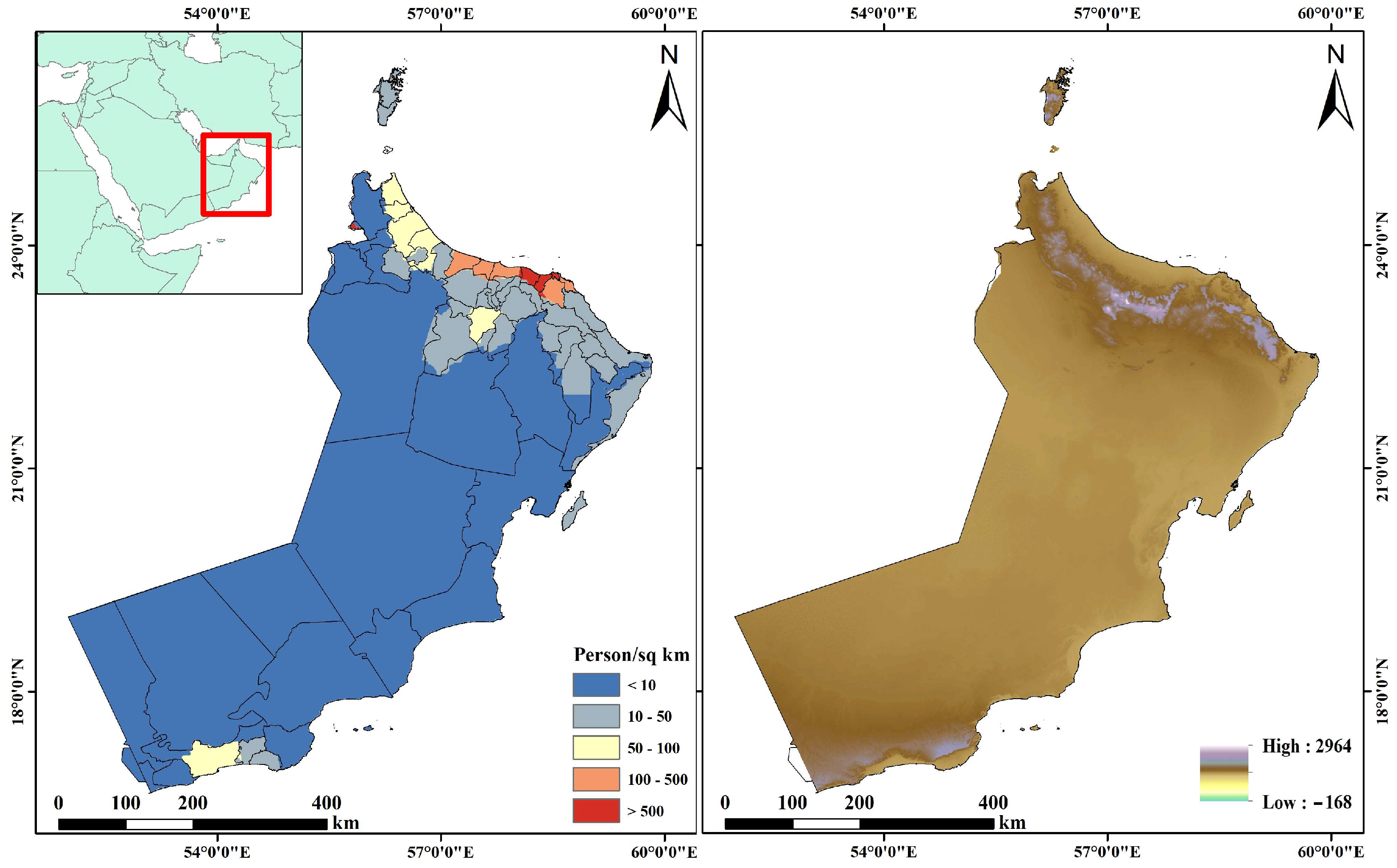
Oman, located at the southeastern corner of the Arabian Peninsula, is a country of rich history and diverse geography. Its area approaches 309,000 km2, overlooking three water bodies: The Arabian Sea in the south and east, the Sea of Oman in the north, and the Arabian Gulf in the northwest (Figure 1). The country occurs within the subtropical zone between latitudes 16° and 28° N and longitudes 52° and 60° E. The northern section of Oman is dominated by the occurrence of rugged mountainous ranges called Al-Hajar Mountains, running parallel to the coast, and bordering a coastal plain known as Al-Batinah Plain. This plain is the most densely populated region of Oman, hosting major urban, economic, and industrial areas. There is another major population settlement occurring in the south at the foothills of the Dhofar Mountains at Salalah.
Figure 1.
The left panel shows the population density of Oman as provided by the Socioeconomic Data and Applications Center of NASA (sedac) (https://www.earthdata.nasa.gov/data/tools/sedac-map-viewer) (accessed on 15 February 2025)). The upper left box shows the location of Oman. The right map shows the topography of the country as extracted from the ASTER Global Digital Elevation Models (GDEMs).
Oman’s climate is generally hot and arid, with temperatures typically ranging from 15 °C in winter to about 40 °C in summer, whereas precipitation is sparse and less than 100 mm/y except for the Dhofar Mountains, which receive precipitation of about 250 mm/y due to the influence of the summer monsoonal winds [15,27]. The coastal zone of Oman experiences high relative humidity records owing to its proximity to major water bodies in the region.
The population of Oman exceeds 5 million, mostly occurring along the northern and southern coasts, while the vast lands of the country are void of population. Administratively, Oman is divided into 11 Governorates, which are further divided into 63 Willayat. Oman has been working toward sustainable urban development synchronized with urban expansion to accommodate the growing population and economic development. Despite these efforts, the vast deserts of the country pose geographic constraints on urban expansion. For example, the occurrence of mountains in the north and south, along with the extensive sand dune fields in the east and west, presents considerable challenges and restricts available space for development. Limited water resources and insufficient infrastructure act as direct obstacles to internal immigration.
Climatic factors, such as high temperatures and relative humidity, adversely influence human comfort and convenience. Moreover, social considerations play a crucial role, acting as significant barriers to movement toward new communities. Residents of Muscat and other major towns often spent their holidays and weekends in their villages with their families and communities, and returning during the weekdays [19]. This pattern contributes to traffic congestion and places pressure on existing services. This situation encourages research endeavors to identify new suitable locations using geospatial analysis and considering the availability and diversity of land and energy resources of the country.
2.2. Materials
The present study relied on different sources of spatial data reflecting the climatic, topographic, and socio-economic attributes of the country. Table 1 summarizes the sources and key attributes of these datasets. Topographic data were acquired from the ASTER Global Digital Elevation Model (GDEM) images, which provide elevation data at 30 m spatial resolution. ASTER GDEM elevation raster data were downloaded from the Application for Extracting and Exploring Analysis Ready Samples (AρρEEARS) (https://appeears.earthdatacloud.nasa.gov (accessed on 15 February 2025)).
Table 1.
Data utilized in the present study, with their characteristics and sources.
Due to the lack of ground meteorological stations throughout the country, particularly for the vast desert regions, temperatures and relative humidity observations were derived by remote sensing. Temperature data were obtained from the MODIS sensor onboard the Aqua satellite. MODIS 8-day composite land surface temperatures (LST) product (MYD11A2), with a spatial resolution of 1000 m, was downloaded from the United States Geological Survey Land Processed Distributed Active Archive Center (https://lpdaac.usgs.gov/ (accessed on 15 February 2025)) for a 20-year period (2004–2023). Daytime (01:30 PM) and nighttime (01:30 AM) LST values were used to calculate the diurnal temperature variations (°C).
Relative humidity (%RH) data were obtained from NASA’s Geospatial Interactive Online Visualization and Analysis Infrastructure (Giovanni) platform (https://giovanni.gsfc.nasa.gov/giovanni/ (accessed on 15 February 2025)). These grid data were acquired by the Atmospheric Infrared Sounder (AIRS) satellite and were provided in 1.0-degree spatial resolution for the period December 2002 to February 2022.
Atmospheric dust and wind speed data were also downloaded from the NASA Giovanni platform. Dust concentrations as seasonal averages of dust column mass density (kg m−2) cover the period from December 1993 to February 2023 are provided at a 0.5 × 0.625-degree spatial resolution. Average monthly surface wind speed (m/s) was provided in raster data with 0.5 × 0.625-degree spatial resolution and covering the period from January 2002 to December 2022. Both wind speed and atmospheric dust concentration data were acquired from the Modern-Era Retrospective Analysis for Research and Applications, Version 2 (MERRA-2), which is the latest atmospheric reanalysis of the modern satellite era produced by NASA.
Solar radiation (kJ m−2 day−1) data were downloaded from the WorldClim Portal, Version 2 (https://www.worldclim.org/data/index.html(accessed on 15 February 2025)), which provides global gridded datasets at 10 min (~18.5 × 18.5 km) spatial resolution. These data represent the monthly average of thirty years (1970–2000) of reanalysis data integrating satellite measurements and ground-based observations [28]. The access to electricity data were obtained from the Socioeconomic Data and Applications Center of NASA (sedac) (https://www.earthdata.nasa.gov/data/tools/sedac-map-viewer (accessed on 15 February 2025)). These vector data estimate the proportion of the population with access to electricity for a given statistical area. They were estimated using the population data occurring within illuminated areas defined by the Visible Imaging Radiometer Suite (VIIRS) Nighttime Lights satellite (V2). These data are available for 206 countries globally and show the population with access to electricity.
Additional vector layers, including major highways and expressways in the country, airport locations, hospital sites, and governmental school locations, were obtained from the Oman National Spatial Data Infrastructure of the National Centre of Information and Statistics (https://www.ncsi.gov.om). All raster and vector datasets used in this study are provided in the Geographic Coordinate System (GCS, WGS1984).
2.3. Methods
The present study employs overlay analysis in a GIS environment. This technique entails systematic procedures that integrate different layers of spatial datasets to achieve a defined objective while considering a wide range of criteria [3,29]. To ensure consistency across all datasets, it is important to have all the data with the same geographical reference system, namely the Geographic Coordinate System (GCS), based on the WGS-1984 datum. ArcMap Software (Version 10.3) was used for displaying, processing, and producing thematic maps. Seven spatial variables (GDEM, LST, %RH, wind speed, atmospheric dust, solar radiation, and access to electricity) were incorporated into this analysis. Table 2 illustrates the categories used for each of these layers.
Table 2.
Ranges and classes of the studied parameters. Topography and diurnal temperature variations were manually classified. Other parameters were classified by the natural breaks classifier.
Several parameters (%RH, wind speed, atmospheric dust, solar radiation, and access to electricity) were automatically classified using the Natural Breaks method in ArcMap. In contrast, topography and diurnal temperature variations were manually classified based on the author’s expert judgment. In all classes, Class 1 represents the highest priority category, and Class 5 represents the lowest. The topography layer was derived from a 30 m spatial resolution digital elevation model, with elevation values manually grouped into five classes at 100 m intervals; regions below 100 m above sea level (asl) were assigned to Class 1. Diurnal temperature variation was computed from the mean daytime and nighttime LST data acquired from the MODIS instrument. The values of diurnal temperature variation were manually sorted into five categories, with the 1st class representing regions of less than 5 °C in diurnal temperature variation. The remaining parameters were classified using the Natural Break classifier in ArcMap. For those parameters: relative humidity, wind speed, atmospheric dust, solar radiation, and access to electricity, the 1st class indicates the highest priority. The access to electricity layer reflects the availability of electricity in the country. This vector dataset was converted to raster and classified into five classes, with the 1st class denotes widespread accessibility to electricity for the largest number of people and Class 5 representing the lowest number. All seven classified layers were then displayed together for subsequent overlay analysis.
A fishnet grid was created using the “Create Fishnet” tool in ArcMap, requesting a 100 × 100 cell network (yielding 10,000 cells). The fishnet layer was clipped to the national boundary of Oman, retaining 3462 cells. The “Extract Multi Values to Points” tool was then applied to assign the attribute values of all seven variables to each cell, producing a comprehensive attribute table. The overall suitability index (OSI) was calculated for each cell as follows:
In this equation, all parameters were given equal weights to avoid introducing subjective bias, especially since no established prioritization framework or stakeholder-driven weighting scheme exists for the studied context. Each cell then received a suitability score derived from the equally weighted sum of the GDEM, diurnal temperature variation, %RH, wind speed, atmospheric dust, solar radiation, and access to electricity values. The resultant number indicates the composite suitability value for each cell. This standardized overlay method is widely used in GIS analysis [30,31,32].
The resulting overall suitability index (OSI) map was prepared using the Inverse Distance Weighted (IDW) interpolation algorithm. This IDW is one of the most common methods operated by geoscientists and geographers for geospatial analysis [33,34]. IDW assumes that spatial similarity decreases with increasing distance between points [35]. The resulting OSI map was classified into four levels using the Natural Break classifier as follows: Highly Suitable, Moderately Suitable, Low Suitable, and Not Suitable. The final maps were produced and overlaid with socioeconomic layers, such as roads, airports, schools, and hospitals, in order to support the interpretation of the suitable locations.
3. Results
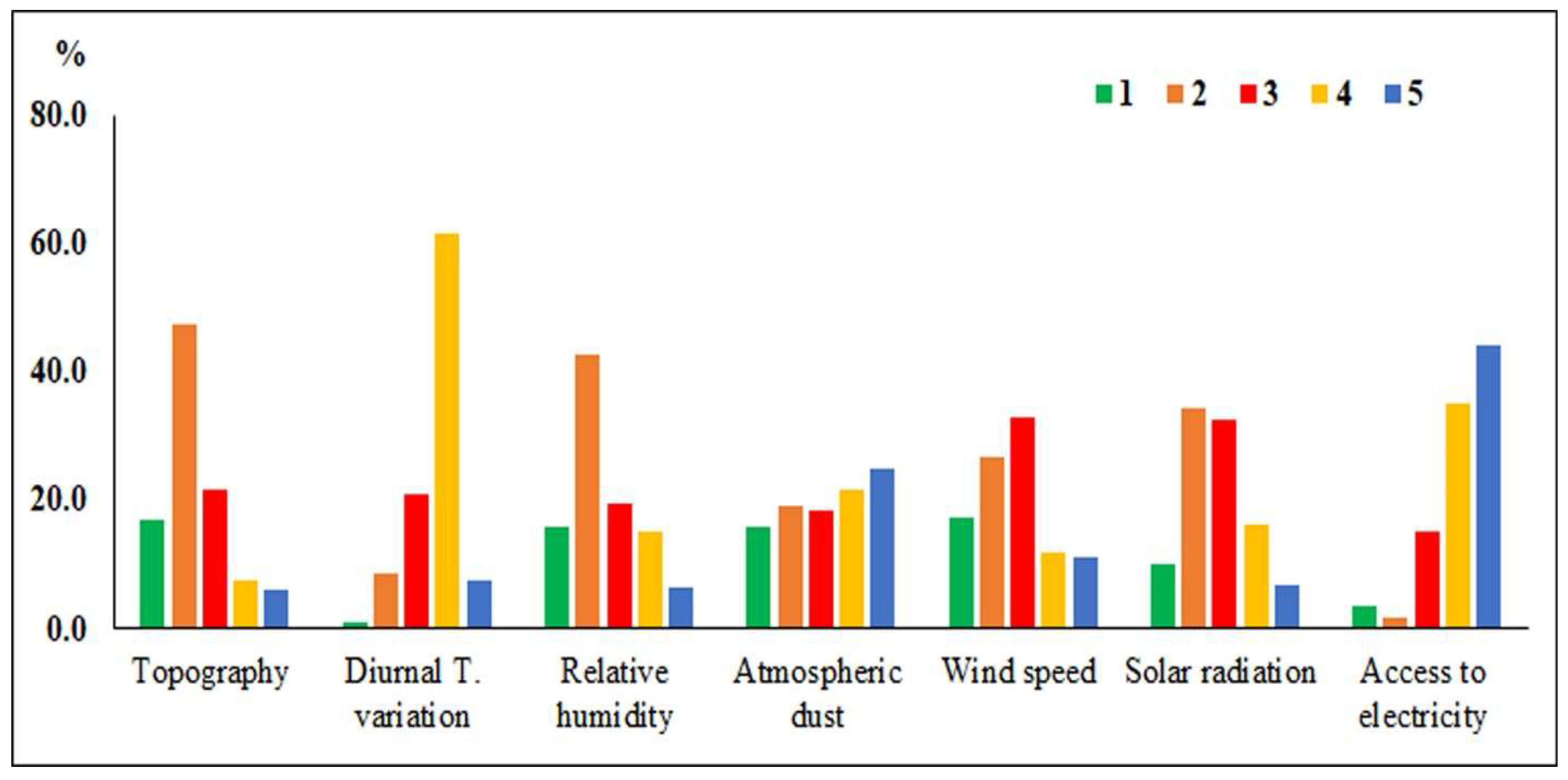
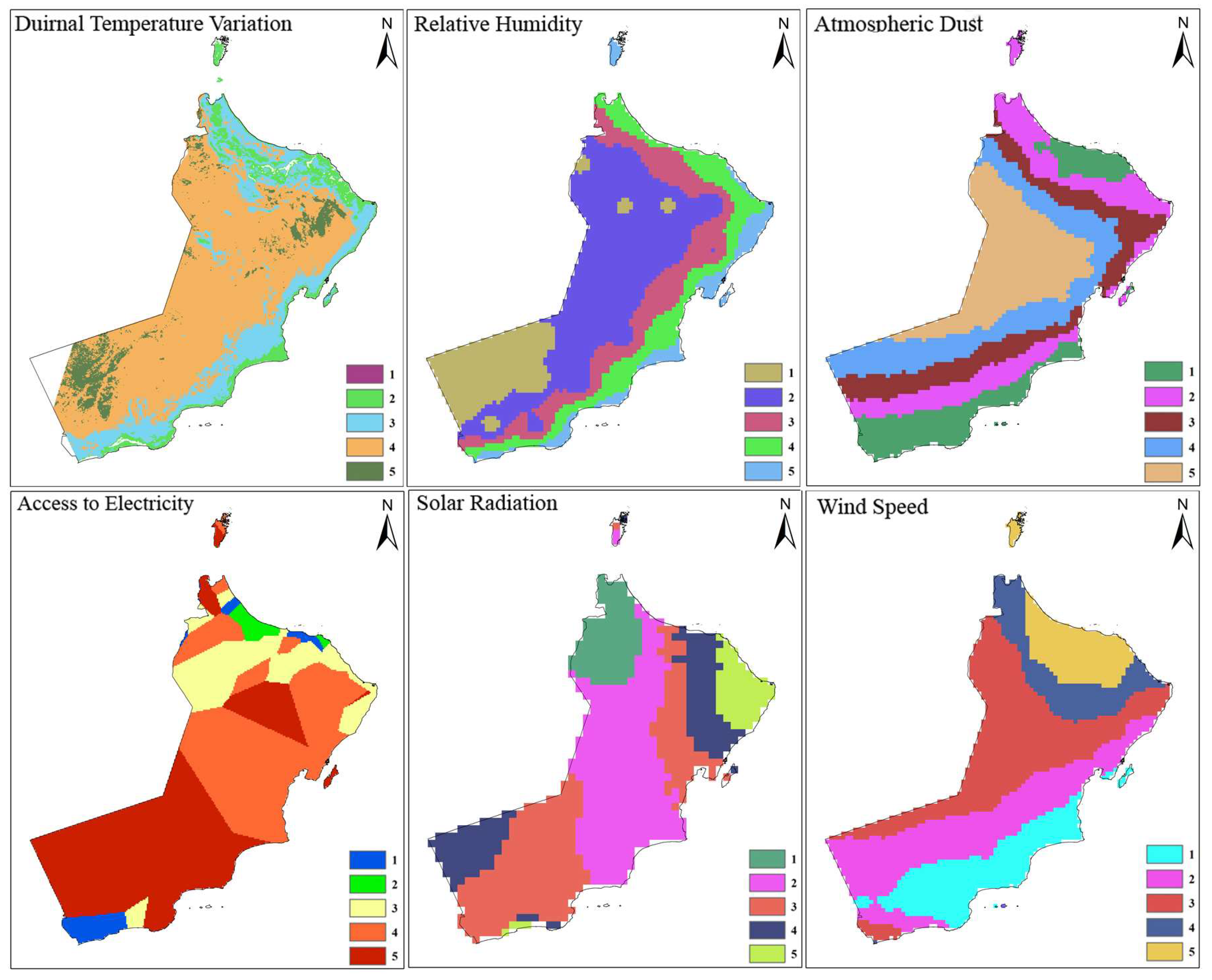
Oman exhibits a remarkable diversity in its physical geography, with landscapes ranging from mountainous regions to deserts and coastal plains (Figure 1). Mountainous landscapes generally occur either along the northern coast overlooking the Sea of Oman or in the southwest part facing the Arabian Sea. The remaining expanses of the country are plateaus and sandy landscapes. This diversity in terrains is accompanied by clear variations in key physical attributes (Figure 2 and Figure 3). It is worth noting that the regions of elevations below 100 m (asl) account only for 17% of the country, while the majority of terrains (47%) has elevation ranging between 100 and 250 m (asl).
Figure 2.
Areas of the classes in each parameter utilized in this study. Number 1 shows regions of the first class (high priority) and 5 shows the least class (low priority).
Figure 3.
Classes of the physical and socio-economic parameters utilized in the present study. Numbers reflect the priority of classes, where 1 shows the regions of the first class, and 5 shows the least priority class.
Notably, the coastal landscapes demonstrate the lowest diurnal temperature variations, typically below 10 °C. Coastal regions with this diurnal temperature variation account for 9.7% of the country, whereas the majority of Oman (62%) has diurnal temperature variation ranging from 15 to 20 °C. Furthermore, coastal regions also exhibit the highest annual relative humidity, exceeding 42%, whereas the other inland desert regions experience the lowest annual relative humidity, generally below 21%. Atmospheric dust increases progressively with distance from the coast: the lowest dust concentration (Class 1) covers 16% of the country, while the most affected dusty regions (Class 5) occur in the western desert (Figure 3 and Table 2).
Renewable energy resources, particularly wind and solar radiation, are considerably abundant in Oman. High wind speed (Class 1) is observed to predominate along the southeastern coast, covering 17% of the country, while the highest regions of solar radiation (Class 1) occur in the northern part, representing 10% of the country. These two factors highlight the country’s high potential for renewable energy resources and explain why regions exhibiting multiple favorable environmental and physical factors tend to produce higher MCDA suitability classes.
Access to electricity is available for major populated regions of the country, either in the capital city or other main urban areas. Therefore, new urban development near these electrically served regions could benefit from electricity. This category (Class 1) accounts for 3.5% of the country, while the least regions in terms of access to electricity or far from electricity- served regions (Class 5) totals 44% of the country, primarily in remote deserts and highlands. Although each criterion contributes equally to the OSI, the spatial distribution of electricity access, however, influences the overall suitability score.
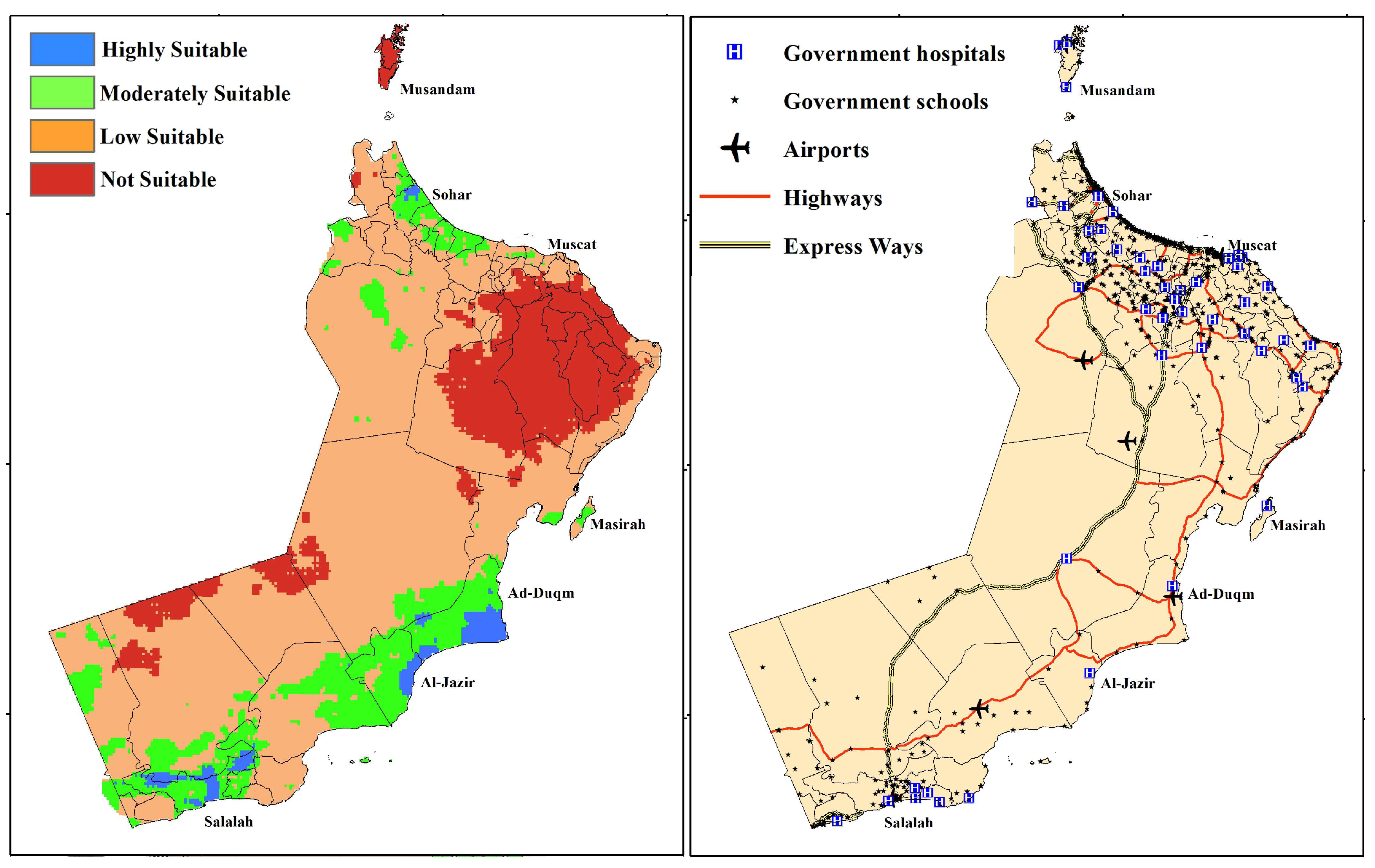
The OSI values range from 2.2 to 3.98, with a mean value of approximately 3.05 and a standard deviation of 0.28. The relatively low standard deviation compared to the overall range of data indicates a stable composite index without dominance of extreme values. This suggests numerical consistency of the OSI. The OSI raster was classified into four suitability priority classes using the Natural Breaks classifier. The overall suitability index map (Figure 4) delineates the spatial distribution of these categories across the country. In terms of surface area, the Highly Suitable, Moderately Suitable, Low Suitable, and Not Suitable regions account for 2.1%, 14.5%, 64.5%, and 18.8% of the study area, respectively. To evaluate the robustness of the suitability classification, the OSI was reclassified using the Equal Interval method. The results show a comparable spatial agreement for most of classes between the two classification methods. Additionally, the spatial locations of the “Highly Suitable” regions from both classifications remain almost the same. The comparison between these two classification methods indicates that highlighting highly priority regions depends primarily on the parameters utilized in the OSI model rather than the classification method used. Promising regions in the Highly Suitable category are identified at the southeastern coast between Al-Jazir and Ad-Duqum along the Arabian Sea coast, as well as around the Salalah region in the south and the Sohar region in the north along the Sea of Oman.
Figure 4.
The overall suitability index (OSI) map (left) shows the locations of the four suitability classes in Oman. The right map shows the locations of major services, such as airports, highways, schools, and hospitals in the country.
Overall, these results illustrate how the integrated MCDA framework consisting of both physical, environmental, and socio-economic conditions produced a balanced suitability assessment without any subjective bias. The concentration of high OSI values along the southeastern coast is strongly influenced by the combined effect of moderate elevations, low diurnal temperature variation, and high wind speed, which collectively enhance the overall suitability within the MCDA framework.
4. Discussion
Over the past several decades, Oman has witnessed remarkable economic and social developments. Although urban growth in Oman is generally more gradual compared to neighboring countries, the process is being implemented with careful planning and strict regulations [19]. One of the priorities of the Oman 2040 Vision is the sustainable use of land with a strong emphasis on establishing smart cities. These future cities aim to provide high living standards while incorporating sustainable urban development and state-of-the-art technology. The dependence upon clean energy to reduce the country’s dependence on oil, the recycling of wastewaters, and the rational exploitation of natural resources are among the top priorities for establishing smart cities. In this context, the present study, through using robust spatial analysis techniques, identified three locations of high priority for future urban development.
The first proposed location, which is the largest in terms of its area, extends across two administrative units: Wilayat Al Jazir and Wilayat Ad-Duqum. This particular location stands out as the most suitable for future urban development in Oman, due to its advantageous physical and socio-economic attributes. Factors, such as the topography, diurnal temperature variations, clarity of the sky, and availability of both renewable energy resources and electricity, make it particularly suitable for new urban development. Hereher and El-Kenawy [15] previously identified this same region as the most suitable in the country for producing energy from wind. Moreover, the presence of nearby local airports further enhances accessibility to this region. Its occurrence along the Arabian Sea near Ad-Duqum Seaport can provide additional benefits to this promising location. This pivotal port is an industrial/commercial hub including a dry dock, which could generate thousands of employment opportunities for the newly urbanized community. Furthermore, the port is pursuing green hydrogen projects powered by renewable clean energy and committing to zero-carbon emissions [36]. Moreover, Ad-Duqum fulfills at least two indicators of the United Nations Sustainable Development Goals (SDG): access to renewable energy and sustainable infrastructure and innovation (indicators 7.2 and 9.2).
The second promising location lies within two administrative units in Dhofar Governorate in southern Oman: Willayat Salalah and Willayat Taqa. Salalah ranks in the top largest urban centers in Oman and is well known for its physiographic setting shaped by topography and monsoonal precipitation during summer. The region’s mountains turn green for several months after the monsoons. Although the region has experienced degradation of vegetation cover by the encroachment of urban masses and climatic factors [37,38], developing a new urban community outside the main vegetation belt could alleviate the pressure on this natural resource. Energy resources in the region, either from renewable sources or from generated electricity, are the most energy-rich in Oman. Both solar radiation and wind speed during monsoons are promising for generating electricity [15,39]. Furthermore, Salalah demonstrates significant progress in achieving the UN SDG (SDG), notably access to electricity (Indicator 7.1.1) in Oman. Additionally, the region is well supported by existing infrastructure, including an international airport, a major seaport on the Arabian Sea, and an extensive network of highways and expressways.
The third high-priority region for future urban development is located in Sohar, in northern Oman, along the Sea of Oman. This region attracts national and international attention due to its proximity to the Strait of Hormuz, the gateway to the Arabian Gulf. The region also holds an international airport, seaport, industrial area, and a free zone. The location of the city near Dubai is also an advantage in terms of commercial and trade activities. Given its strategic location, Khalid and Al-Mamery [40] suggested that Sohar Port could work as a gateway for the Gulf Cooperation Council (GCC) countries. As illustrated in Figure 3, the region can benefit from the occurrence of strong solar radiation as previously confirmed [15]. This also achieves the UN SDG, notably, access to renewable energy (Indicator 7.2.1). Together, these suggested three urban development regions align well with the Oman 2040 Vision, particularly its focus on sustainable urban growth, infrastructure, and smart cities planning.
Considering the relatively high suitability for the three regions at Ad-Duqum, Salalah, and Sohar, it is worth mentioning that Ad-Duqum stands out as the highest priority. As the Oman 2040 Vision emphasizes a sustainable economy that is based on technology, knowledge, and innovation, Ad-Duqum is exceptionally well-positioned to benefit from its strategic location, smart infrastructure, renewable energy integration, international trade lines, and offer thousands of new jobs. Additionally, the extent of the Highly Suitable class along the coast is much larger and pronounced in Ad-Duqum, extending to about 100 km along Ad-Duqum, compared to only about 20 km at both Salalah and Sohar (Figure 4 left). Moreover, as air quality and smart cities are crucial components in the United Nations SDG [41], Ad-Duqum emerges as the most optimal location for new urban development in Oman.
Although certain areas, such as northern Oman, receive stronger solar radiation than the sites identified in this study, these regions also experience extreme heat, leading to thermal discomfort and higher cooling demands. Other locations with lower relative humidity, such as the Al-Hajar Mountains in the north, occur at higher elevations that limit their accessibility. Similarly, some other inland regions exhibit strong wind speed, but they occur in zones of large diurnal temperature range, such as the desert region in the south of Oman, making them less suitable for habitation. Moreover, some locations have high access to electricity, such as Muscat Governorate, but they also face major constraints, such as rugged topography and sloping terrains. Given all these environmental challenges, the MCDA approach applied in this study offers an effective approach to balance the trade-off between the utilized environmental factors.
As three locations stand out with high priority for new urban development in Oman, those classified as having moderate priority are much more extensive and cover 14.5% of the country’s area. These locations occur across different geographic regions from the coastal plain along the Sea of Oman (Al-Batinah plain) in the north to the coastal face along the Arabian Sea in Al-Wusta and Dhofar Governorates in the east and south. Among these, Masirah Island represents a remarkable place with high strategic potential (Figure 4). This small landmass (649 km2) within the Arabian Sea could be reached by a half-hour ferry trip from the mainland. The island holds the necessary elements to become the top destination for ecotourism. Mansour et al. [4] identified 6% of the island’s area as highly suitable for ecotourism. The island could be a candidate location for establishing a future smart city, given its pristine marine and terrestrial environments. However, any proposed development in such an environmentally sensitive region should consider the environmental impacts in order to ensure long-term sustainability. The availability of winds (Figure 3), particularly during the monsoon season, could provide an ample source for clean energy for its sustainable development.
The Gulf Cooperation Council Countries (GCC), including Oman, are among the highest per capita production of Carbon dioxide gas (CO2) in the world [42]. Therefore, searching for green and clean urban communities will not only reduce greenhouse gas emissions but also save energy resources for future generations. Identifying such locations is a direct application for the advancement of geospatial sciences, such as those applied in the present study.
The low or non-suitable regions correspond to mountains and extensive sand dune fields. Also, Oman can benefit from its regional rank (1st) and international rank (17th) for fisheries resources and management [43], where implementing new urban coastal communities could sustain this progress by adding new technologies to support overseas fishing and aquaculture.
Although the spatial pattern of the resulting maps may be influenced by the resolution differences in the utilized dataset, these datasets are well-suited for national-scale and macro-level planning. Maps produced from the present study can guide and provide help for better selection of new urban communities in Oman, considering renewable energy resources, environmental quality, and accessibility as key decision-making criteria for urban planning.
5. Conclusions
Remote sensing and GIS-based spatial analysis proved to be highly effective tools for managing the analysis of environmental data and generating thematic maps that help identify suitable locations for urban development sites in Oman. In this study, seven environmental and socio-economic parameters were integrated in a multi-criteria decision analysis framework in order to determine the most appropriate locations for urban development in Oman. Findings show that 2.1% of Oman’s total area is promising for new urban communities with green development. Potential locations exhibit high wind energy, solar energy, low atmospheric dust, and low diurnal temperature variations. Outcomes of this study align with the Oman 2040 Vision, particularly the development of sustainable cities and high environmental performance. As such, the Ad-Duqum region fits into this vision and coincides with the national vision for sustainable development. The reliability of results is contingent on the accuracy of the dataset utilized in the analysis. The methodology applied in this study could be disseminated toward similar studies not only at the national, but also at the regional scale. Limitations in this study include the variations in spatial resolution of the dataset used in the OSI assessment, the coarse spatial resolution of some parameters, such as %RH, and the time coverage of others, such as solar radiation. In addition, the study relied exclusively on remotely sensed data because the ground meteorological stations are limited and sparse, particularly in deserts and highlands, and finally, the lack of different climate change scenarios. Since this study provides a GIS-based MCDA map for national-scale urban site selection, feasibility studies and pilot projects in the three highly suitable regions should be prioritized. Future work could incorporate finer-scale data, broaden influencing social factors, or employ other MCDA methods like the Analytic Hierarchy Process (AHP) to explore results under different weighting scenarios.
Funding
This research received no external funding.
Institutional Review Board Statement
Not applicable.
Informed Consent Statement
Not applicable.
Data Availability Statement
The original contributions presented in this study are included in the article. Further inquiries can be directed to the corresponding author.
Conflicts of Interest
The author declares no conflicts of interest.
References
- Kilicoglu, C.; Cetin, M.; Aricak, B.; Sevik, H. Site selection by using the multi-criteria technique—A case study of Bafra, Turkey. Environ. Monit. Assess. 2020, 192, 608. [Google Scholar] [CrossRef]
- Hatami, M.; Siahooei, E. Examines Criteria Applicable in the Optimal Location New Cities, with Approach for Sustainable Urban Development. Middle-East J. Sci. Res. 2013, 14, 734–743. [Google Scholar]
- Hereher, M.; Al-Awadhi, T.; Mansour, S.A. Assessment of the optimized sanitary landfill sites in Muscat, Oman. Egypt. J. Remote Sens. Space Sci. 2020, 23, 355–362. [Google Scholar] [CrossRef]
- Mansour Sh Al-Awadhi, T.; Al-Hatrushi, S. Geospatial based multi-criteria analysis for ecotourism land suitability using GIS & AHP: A case study of Masirah Island, Oman. J. Ecotourism 2019, 19, 148–167. [Google Scholar] [CrossRef]
- Sandipan, D.; Anirban, B.; Sagar, M. Study on urban land suitability assessment using remote sensing and GIS: A case study of Khairagarh, in Chhattisgarh. Int. J. Comput. Appl. 2013, 74, 20–26. [Google Scholar] [CrossRef]
- AlFanatseh, A. Land suitability analysis of urban development in the Aqaba area, Jordan, using a GIS-based analytic hierarchy process. GeoJournal 2021, 87, 4143–4159. [Google Scholar] [CrossRef]
- Lourdes, K.T.; Hamel, P.; Gibbins, C.N.; Sanusi, R.; Azhar, B.; Lechner, A.M. Planning for green infrastructure using multiple urban ecosystem service models and multicriteria analysis. Landsc. Urban Plan. 2022, 226, 104500. [Google Scholar] [CrossRef]
- Lambarki, R.; Elmostafa, A.; Maanan, M.; Rhinane, H. Assessing the potential of green roofs in urban areas: A multicriteria Boolean analysis utilizing GIS and remote sensing data in the city of Nador, Morocco. Green Technol. Sustain. 2025, 3, 100171. [Google Scholar] [CrossRef]
- Akyol, E.; Alkan, M.; Kaya, A.; Tasdelen, S.; Aydin, A. Environmental Urbanization Assessment Using GIS and Multicriteria Decision Analysis: A Case Study for Denizli (Turkey) Municipal Area. Adv. Civ. Eng. 2018, 2018, 6915938. [Google Scholar] [CrossRef]
- Majid, M.; Mir, B. Landfill site selection using GIS based multi criteria evaluation technique. A case study of Srinagar city, India. Environ. Chall. 2021, 3, 100031. [Google Scholar] [CrossRef]
- Rahman, M.; Szabó, G. A Geospatial Approach to Measure Social Benefits in Urban Land Use Optimization Problem. Land 2021, 10, 1398. [Google Scholar] [CrossRef]
- Nguyen, T.T.; Verdoodt, A.; Van, Y.N.T.; Delbecque, N.; Tran, T.C.; Van Ranst, E. Design of a GIS and multi-criteria based land evaluation procedure for sustainable land-use planning at the regional level. Agric. Ecosyst. Environ. 2015, 200, 1–11. [Google Scholar] [CrossRef]
- Palacios, R.; Sannwald, E.; Barrios, L.; Paz, F.; Hernández, J.; Mendoza, M. Landscape diversity in a rural territory: Emerging land use mosaics coupled to livelihood diversification. Land Use Policy 2013, 30, 814–824. [Google Scholar] [CrossRef]
- Zhao, K.; Jin, B.; Fan, H.; Song, W.; Zhou, S.; Jiang, Y. High-Performance Overlay Analysis of Massive Geographic Polygons That Considers Shape Complexity in a Cloud Environment. ISPRS Int. J. Geo-Inf. 2019, 8, 290. [Google Scholar] [CrossRef]
- Hereher, M.; El Kenawy, A. Exploring the potential of solar, tidal, and wind energy resources in Oman using an integrated climatic-socioeconomic approach. Renew. Energy 2020, 161, 662–675. [Google Scholar] [CrossRef]
- Saleh, M.S.; Alalouch, C. Towards Sustainable Construction in Oman: Challenges & Opportunities. Procedia Eng. 2015, 118, 177–184. [Google Scholar] [CrossRef]
- Safinia, S.; Al-Hinai, Z.; Yahia, H.; Abushammala, M. Sustainable Construction in Sultanate of Oman: Factors Effecting Materials Utilization. Procedia Eng. 2017, 196, 980–987. [Google Scholar] [CrossRef]
- Al-Badi, A.; Al Wahaibi, A.; Ahshan, R.; Malik, A. Techno-Economic Feasibility of a Solar-Wind-Fuel Cell Energy System in Duqm, Oman. Energies 2022, 15, 5379. [Google Scholar] [CrossRef]
- Benkari, N. Urban development in Oman: An overview. In WIT Transactions on Ecology and the Environment; WIT Press: Southampton, UK, 2017; Volume 9, pp. 143–156. [Google Scholar]
- Mabry, R.; Al Siyabi, H.; Kannan, M.; Al Siyabi, A. Move for health: Addressing the built environment and physical activity in Oman. East. Mediterr. Health J. 2019, 25, 923–927. [Google Scholar] [CrossRef]
- Ansari, T.; Singh, C.; Albawwab, W. Urbanization and its Impact on Land Use and Land Cover in Al Buraimi City, Oman Using Remote Sensing and GIS. J. Landsc. Ecol. 2025, 18, 1–20. [Google Scholar] [CrossRef]
- Al-Awadhi, T.; Ramadan, E.; Charabi, Y. Urban development and landuse change patterns in Muscat city, Oman. Int. J. Geoinform. 2017, 13, 45–55. [Google Scholar]
- Mansour, S.; Alahmadi, M.; Atkinson, P.; Dewan, A. Forecasting of Built-Up Land Expansion in a Desert Urban Environment. Remote Sens. 2022, 14, 2037. [Google Scholar] [CrossRef]
- Al-Awadhi, T. Local Spatial Impacts of Globalization in Developing Countries: The Case of Sohar, Oman. Int. Rev. Spat. Plan. Sustain. Dev. 2017, 5, 25–38. [Google Scholar] [CrossRef] [PubMed]
- Alnejem, M.; Taghipour, M. The Sustainable Development of Urban Planning and Architectural Identity in Barka City—Oman. Int. J. Res. Sci. Innov. 2024, 6, 76–89. [Google Scholar] [CrossRef]
- Sallam, I.; Abdelghani, M. Systemic Approach to Smart Urban Transformations of Cities Case of Muscat- Oman. Int. J. Membr. Sci. Technol. 2023, 10, 630–652. [Google Scholar] [CrossRef]
- Kwarteng, A.Y.; Dorvlo, A.S.; Vijaya, G.T. Analysis of a 27-year rainfall data (1977–2003) in the Sultanate of Oman. Int. J. Climatol. 2009, 29, 605–617. [Google Scholar] [CrossRef]
- Fick, S.E.; Hijmans, R.J. WorldClim 2: New 1-km spatial resolution climate surfaces for global land areas. Int. J. Climatol. 2017, 37, 4302–4315. [Google Scholar] [CrossRef]
- Kamdar, I.; Ali, S.; Bennui, A.; Techato, K.; Jutidamrongphan, W. Municipal solid waste landfill siting using an integrated GIS-AHP approach: A case study from Songkhla, Thailand. Resour. Conserv. Recycl. 2019, 149, 220–235. [Google Scholar] [CrossRef]
- Issa, S.; Shehhi, B. A GIS-based multi-criteria evaluation system for selection of landfill sites: A case study from Abu Dhabi, United Arab Emirates. Int. Arch. Photogramm. Remote Sens. Spat. Inf. Sci. 2012, 39, 133–138. [Google Scholar] [CrossRef]
- Eskandari, M.; Homaee, M.; Mahmoodi, S.; Pazira, E.; Van Genuchten, M.T. Optimizing landfill site selection by using land classification maps. Environ. Sci. Pollut. Res. 2015, 22, 7754–7765. [Google Scholar] [CrossRef]
- Hariz, H.; Dönmez, C.; Sennaroglu, B. Siting of a central healthcare waste incinerator using GIS-based Multi-Criteria Decision Analysis. J. Clean. Prod. 2017, 166, 1031–1042. [Google Scholar] [CrossRef]
- Maleika, W. Inverse distance weighting method optimization in the process of digital terrain model creation based on data collected from a multibeam echosounder. Appl. Geomatics 2020, 12, 397–407. [Google Scholar] [CrossRef]
- Shukla, K.; Kumar, P.; Mann, G.S.; Khare, M. Mapping spatial distribution of particulate matter using Kriging and Inverse Distance Weighting at supersites of megacity Delhi. Sustain. Cities Soc. 2020, 54, 101997. [Google Scholar] [CrossRef]
- Lu, G.Y.; Wong, D.W. An adaptive inverse-distance weighting spatial interpolation technique. Comput. Geosci. 2008, 34, 1044–1055. [Google Scholar] [CrossRef]
- Tian, M.; Zhong, S.; Al Ghassani, M.A.M.; Johanning, L.; Sucala, V.I. Simulation and feasibility assessment of a green hydrogen supply chain: A case study in Oman. Environ. Sci. Pollut. Res. 2024, 32, 13313–13328. [Google Scholar] [CrossRef]
- Al-Mulla, Y.; Al-Ruheili, A.; Al-Lawati, A.; Parimi, K.; Ali, A.; Al-Sadi, N.; Al-Harrasi, F. Assessment of Urban Expansion’s Impact on Changes in Vegetation Patterns in Dhofar, Oman, Using Remote Sensing and GIS Techniques. IEEE Access 2022, 10, 86782–86792. [Google Scholar] [CrossRef]
- Al-Kindi, K.M.; Al Nadhairi, R.; Al Akhzami, S. Dynamic Change in Normalised Vegetation Index (NDVI) from 2015 to 2021 in Dhofar, Southern Oman in Response to the Climate Change. Agriculture 2023, 13, 592. [Google Scholar] [CrossRef]
- Kazem, H. Renewable energy in Oman: Status and future prospects. Renew. Sustain. Energy Rev. 2011, 15, 3465–3469. [Google Scholar] [CrossRef]
- Khalid, A.; Al-Mamery, M. Competitiveness of Arabian gulf ports from shipping lines’ perspectives: Case of Sohar port in Oman. J. Ind. Eng. Manag. 2019, 12, 458–471. [Google Scholar] [CrossRef]
- Rahman, M.; Szabó, G. Sustainable Urban Land-Use Optimization Using GIS-Based Multicriteria Decision-Making (GIS-MCDM) Approach. ISPRS Int. J. Geo-Inf. 2022, 11, 313. [Google Scholar] [CrossRef]
- Hereher, M.E. Climate Change during the Third Millennium—The Gulf Cooperation Council Countries. Sustainability 2022, 14, 14181. [Google Scholar] [CrossRef]
- Block, S.; Emerson, J.W.; Esty, D.C.; de Sherbinin, A.; Wendling, Z.A. 2024 Environmental Performance Index; Yale Center for Environmental Law & Policy: New Haven, CT, USA, 2024. [Google Scholar]
Disclaimer/Publisher’s Note: The statements, opinions and data contained in all publications are solely those of the individual author(s) and contributor(s) and not of MDPI and/or the editor(s). MDPI and/or the editor(s) disclaim responsibility for any injury to people or property resulting from any ideas, methods, instructions or products referred to in the content. |
© 2025 by the author. Licensee MDPI, Basel, Switzerland. This article is an open access article distributed under the terms and conditions of the Creative Commons Attribution (CC BY) license.