Hypothesis

Examining the Impact of Responsible Leadership on Project Social Responsibility Performance in Post-Disaster Reconstruction


School of Economics and Management, Southwest Petroleum University, Chengdu 610500, China
*
Author to whom correspondence should be addressed.
Sustainability 2026, 18(1), 59; https://doi.org/10.3390/su18010059 (registering DOI)
Submission received: 3 November 2025 / Revised: 12 December 2025 / Accepted: 16 December 2025 / Published: 19 December 2025

Abstract

This study focuses on the post-disaster reconstruction scenario, integrates the relational coordination theory and the resource dependence theory, and analyses the impact mechanism of responsible leadership (RL) on project social responsibility performance (PSRP). The study adopts the questionnaire survey method and statistical analysis method to collect 198 questionnaires from managers involved in post-disaster reconstruction projects, and 159 valid questionnaires were obtained after screening. The data were empirically examined through SmartPLS4 software using partial least squares (PLS) and the Bootstrap method. The findings show that (1) RL has a significant positive effect on PSRP; (2) stakeholder communication quality (SCQ) has a mediating effect between RL and PSRP; (3) local government support (LGS) has a positive moderating effect in the relationship between RL and SCQ. This study reveals the internal mechanism of the relationship between RL and PSRP in post-disaster reconstruction scenarios. It provides the theoretical basis and practical guidance for post-disaster reconstruction enterprises in the selection and appointment of leaders, as well as in helping leaders to improve SCQ and obtain LGS.

1. Introduction

In recent years, natural disasters have occurred frequently worldwide, causing substantial economic losses and casualties, especially having a more significant destructive impact on economically underdeveloped developing countries [1]. According to the statistics of natural disasters in the first half of 2024 released by the Emergency Management Department of the People’s Republic of China, 32.381 million people were affected nationwide, 23,000 houses collapsed, 279,000 houses were damaged, and direct economic losses reached 93.16 billion yuan [2]. Post-disaster reconstruction projects are significant in today’s social context as a key support for restoring people’s livelihood, stabilising the regional economy, and promoting social recovery [3]. However, post-disaster reconstruction is a highly complex socio-political process that is not only affected by multiple local social, political, and economic factors [4,5] but also faces challenges such as limited resources, insufficient communication and collaboration, and diverse demands from stakeholders [6]. Especially in a pluralistic society, leaders of post-disaster reconstruction enterprises with social responsibility need to be accountable to an increasing number of stakeholders who hold different values, interests, and expectations, such as promoting the smooth implementation of post-disaster reconstruction projects, creating value for stakeholders, and fulfilling the needs of people in disaster-stricken areas. Therefore, under the above complex challenges, leaders who can actively assume social responsibilities and interact with stakeholders play an indispensable role in post-disaster reconstruction scenarios. They need to coordinate various resources to ensure the project’s efficient advancement and seek a balance among the complex interest relationships to achieve disaster-stricken areas’ comprehensive recovery and long-term development [7,8].
The core value of post-disaster reconstruction projects must be measured through their social responsibility performance. Project social responsibility performance serves as the core metric for assessing whether project implementation aligns with social responsibility standards and public expectations [9], emphasising the project’s overall performance in fulfilling social responsibilities, meeting stakeholder needs, and realising social value. Particularly in the unique context of post-disaster reconstruction, affected populations find themselves in a state of extreme vulnerability, suffering dual psychological and physical trauma [10], while socio-economic systems face collapse risks and social order demands urgent restoration [11]. At this juncture, the level of project social responsibility performance not only directly impacts the success of reconstruction projects but also concerns social stability and the long-term well-being of affected communities. While responsible leadership plays a pivotal role in coordinating multiple stakeholders’ interests [12], research on the mechanisms by which it influences project social responsibility performance remains underdeveloped.
First, in terms of research scope, global disaster studies have centred on nations such as China, Japan, and the United States [13]. Although China has developed a policy research framework originating from the Wenchuan earthquake, most studies focus on macro-level institutional design, with a scarcity of micro-level project-based empirical research. Mechanistic studies examining the relationship between responsible leadership and project social responsibility performance in the context of post-disaster reconstruction—particularly during the livelihood-oriented transition phase in southwestern China—are virtually non-existent. Secondly, in terms of mechanism exploration, leadership studies in crisis contexts predominantly examine trust [14] and legitimacy [15]. However, post-disaster reconstruction project failures frequently stem from inadequate stakeholder interactions [16]. According to relational coordination theory, robust relational bonds and high-quality communication can foster beneficial outcomes among stakeholders [17]. Thus, compared to trust or macro-level legitimacy—which require long-term cultivation—the quality of stakeholder communication may more rapidly adapt to coordination demands during transitional periods. However, this potential mechanism remains unvalidated. Furthermore, resource dependency theory indicates that post-disaster reconstruction heavily relies on external resources [18]. Local government support, as a critical external resource for post-disaster reconstruction, is essential for advancing projects [19]. Existing research predominantly examines the role of local government support in reconstruction, without elucidating the interactive logic through which such support facilitates the transition from responsibility-oriented leadership to communication quality by providing key resources.
Therefore, this study, based on a questionnaire survey conducted from January to June 2025 among managers of post-disaster reconstruction projects in Southwest China, focuses on the transitional phase of livelihood and infrastructure projects in the disaster-affected areas of Southwest China. Integrating relational coordination theory and resource dependency theory, with stakeholder communication quality as the mediating variable, and local government support as the moderating variable. This reveals the black-box mechanism through which responsible leadership influences project social responsibility performance in post-disaster reconstruction contexts, offering fresh perspectives and evidence for both theoretical research and practical management in post-disaster reconstruction.

2. Research Hypothesis

2.1. Responsible Leadership and Project Social Responsibility Performance

Based on the post-disaster reconstruction scenarios, this study proposes a significant positive correlation between RL and PSPR, further elaborated through a resilience lens. Firstly, during post-disaster reconstruction, stakeholders harbour heightened expectations for project transparency, fairness, and accountability amid shocks such as sudden resource shortages and secondary disaster risks [20]—essentially reflecting demands for collaborative resilience. RL effectively shapes stakeholder behaviour through moral exemplification and ethical guidance—such as disclosing resource allocation processes and prioritising livelihood needs [21]. This directs stakeholders like contractors towards a shared objective of prioritising livelihood restoration. This process enhances collaborative resilience among parties, preventing cooperation breakdowns stemming from conflicting interests [22], while significantly improving stakeholders’ work attitudes and motivation [23], thereby encouraging proactive social responsibility implementation. Secondly, RL fosters positive psychological connections with stakeholders through proactive support and care, thereby strengthening psychological contracts [24]. During post-disaster reconstruction, stakeholders face dual pressures—psychological trauma and resource constraints [20]—which severely undermine their psychological resilience for emotional regulation and sustained action under disaster stress [25]. RL alleviates stakeholders’ emergency fatigue and anxiety through emotional support, while reducing their sense of powerlessness via resource provision. This effectively enhances their sense of belonging and commitment [26], making them more willing to contribute to the project and actively fulfil social responsibilities [27]. This ensures continuity in social responsibility actions such as supporting vulnerable groups and constructing temporary infrastructure, preventing project performance disruptions caused by psychological breakdowns among personnel. Finally, RL fosters an ethical atmosphere and cultivates a moral culture, creating a fair, ethical, and inclusive working environment [28]. In post-disaster reconstruction, inequitable resource allocation and social unrest can lead to stakeholder apathy and inadequate fulfilment of social responsibilities [29]. However, the ethical climate fostered by RL guides stakeholders to prioritise organisational and societal needs over personal interests [30]. Examples include enterprises voluntarily reducing profits to lower resettlement housing costs, or government officials streamlining approvals for public welfare projects. This not only minimises internal friction caused by conflicting interests but also enhances the project system’s resilience against negative shocks [31], ensuring sustained focus on core social responsibility objectives such as livelihood protection and environmental restoration. Ultimately, this elevates PSPR. In summary, this paper proposes the following hypotheses:
H1. 
RL positively affects PSRP.

2.2. The Mediating Role of Stakeholder Communication Quality

SCQ refers to the effectiveness and efficiency of information transmission between stakeholders in an organisation’s cooperative relationship and the resulting comprehensive impact on the cooperative relationship, specifically covering the characteristics of information, communication behaviour, and relationship outcomes [32].
High-quality communication is essential for building trust between stakeholders and leaders. Relational coordination theory highlights that shared objectives, knowledge, and respect—combined with effective communication—drive positive outcomes. This is especially crucial in large-scale construction projects, such as post-disaster reconstruction, where resources are limited, stakeholder interests vary, and time is critical. Here, effective communication is vital for project success.
Existing research indicates that responsible leadership can significantly advance project progress in complex, multi-stakeholder environments through effective stakeholder communication and engagement [33]. Within post-disaster reconstruction scenarios characterised by scarce resources, information asymmetry, and diverse interests, responsible leadership fosters mutual benefit relationships by proactively consulting stakeholders and precisely addressing their differentiated demands [34]. This approach unites parties around shared objectives for post-disaster recovery and sustainable development. Such leadership behaviour effectively enhances stakeholder well-being [35] and psychological safety [36], mitigates vulnerability stemming from post-disaster uncertainty and stress [37], and encourages stakeholders to transition from passive compliance to active collaboration. This fosters the proactive articulation of genuine concerns and the sharing of critical information, directly improving communication efficiency and interaction depth. It is worth noting that stakeholders in post-disaster reconstruction not only face immense psychological pressure and resource shortages [1] but also encounter issues such as collapsed trust and buck-passing. High-quality communication among stakeholders can precisely address these challenges by conveying critical information such as project progress and resource allocation. This timely response to stakeholder concerns enhances mutual trust [38,39] and overall satisfaction [40], thereby boosting collaborative willingness both within and outside the organisation [41]. Ultimately, this directly impacts the efficiency and effectiveness of collaboration [42]. In essence, when stakeholders build deep mutual trust based on shared objectives, shared knowledge, and mutual respect, they become more willing to collaborate to advance projects. This reduces internal conflicts and communication costs [43], ensuring project resources are precisely directed towards core social responsibility areas such as livelihood safeguards. Ultimately, this leads to a substantial improvement in the project’s social responsibility performance. In summary, this study proposes the following hypotheses:
H2. 
SCQ mediates the relationship between RL and PSRP.

2.3. The Moderating Role of Local Government Support

LGS refers to a series of policies, measures, and resource inputs formulated by local governments to promote economic development, improve social welfare, and reduce the negative impacts of inadequate institutional infrastructure [44]. According to resource dependence theory, an organisation’s survival and development are highly contingent upon external critical resources. As resource-intensive and highly uncertain specialised organisations, post-disaster reconstruction projects exhibit an inherent and pronounced dependence on scarce resources controlled by local governments [18]. Consequently, the level of local government support not only directly influences leaders’ initiative and enthusiasm in fulfilling social responsibilities but also indirectly impacts the establishment of sound cooperative relationships among stakeholders by regulating this resource dependency [19].
Resource dependency theory emphasises that organisations must manage external resource dependencies to mitigate environmental uncertainty, and that local government support is a crucial means to address resource constraints [45]. When local government support is substantial, it encompasses both tangible resources, such as funding, technology, and policy, and intangible resources, including relational networks and social capital [46,47]. This not only conveys clear signals to responsible leaders that the project possesses high legitimacy and a strong likelihood of success [48], thereby enhancing stakeholders’ willingness to cooperate [49], but also instils confidence in responsible leaders to advance the project. They become more inclined to demonstrate a highly responsible attitude, proactively investigating the demands of government departments, affected communities, construction firms, and other stakeholders. This fosters the establishment of regular communication channels, with the quality of communication strengthened through precise responses to needs. Conversely, when local government support is inadequate, post-disaster reconstruction projects lack the legitimacy that underpins [48], making it difficult for responsible leaders to secure key resources for communication and to persuade stakeholders to trust the project’s value [49]. According to resource dependence theory, when organisations cannot alleviate core dependencies through external support, managers’ decision-making initiative and willingness to act diminish as environmental uncertainty increases. Consequently, resource scarcity and legitimacy challenges suppress the work motivation of responsible leaders, diminishing their sense of duty and willingness to engage with stakeholders, potentially fostering passive-aggressive attitudes [50]. This reduces communication frequency and depth, ultimately impairing information flow and leading to a significant decline in stakeholder communication quality. In summary, this study proposes the following hypotheses:
H3. 
LGS has a positive moderating effect between RL and SCQ.
Figure 1 shows the conceptual model that outlines relationships between RL, PSRP, SCQ and LGS.

3. Research Methodology

3.1. Sample Selection and Data Collection

This study used a questionnaire part method, targeting managers who have participated in post-disaster reconstruction projects as the research subjects, to collect perceptions and evaluations of their superiors’ leadership behaviours. This study employed stratified sampling based on two core dimensions: stakeholder department type and project scale. This ensured the sample’s representativeness across different industries and project sizes, thereby avoiding the bias inherent in single-type sampling. The questionnaire was distributed through a combined online and offline approach across Southwest China (covering Sichuan, Yunnan, and Guizhou provinces): the online channel leveraged the collaborative networks of Southwest Petroleum University with local emergency management departments and construction industry associations to send questionnaires to targeted managers, incorporating IP uniqueness restrictions to prevent duplicate submissions; the offline channel involved distributing and collecting paper questionnaires at post-disaster reconstruction project seminars held in cities such as Chengdu and Guiyang, with incomplete or perfunctory responses immediately excluded. The distribution period spanned from January to June 2025, encompassing natural disasters, including earthquakes, floods, and geological hazards such as mudslides. A total of 302 questionnaires were distributed (187 online + 115 offline), with 198 returned. After screening out 39 questionnaires that failed the attention test twice consecutively or lacked key information, 159 valid responses were obtained, yielding an effective recovery rate of 80.3%. The respondents came from various stakeholder units involved in disaster reconstruction projects, and the reported projects covered various disaster reconstruction projects. The proportions of the various aspects aligned with the practice situation ensured the sample’s representativeness. Conducting the questionnaire survey anonymously in two stages to reduce the impact of common method bias. The first stage mainly collected the respondents’ perceptions and evaluations of their superiors’ leadership behaviours and their perceptions of the LGS. The second stage collected the respondents’ evaluations of SCQ and PSRP. A total of 198 questionnaires were collected, of which 39 were excluded for failing the attention test twice in a row, resulting in a valid sample of 159, with an effective recovery rate of 80.3%. Table 1 (Demographic distribution of the sample (n = 159)) shows the distribution of the valid samples in terms of demographic characteristics such as gender composition, age distribution, education level, and years of working experience.

3.2. Variable Measurement

This study mainly adopts the method of scale measurement to collect the required research data for the managers of post-disaster reconstruction projects, and the scale draws on mature scales from abroad. The answers to the questions in the scale were set into five levels according to the Likert 5-point scale to determine the accuracy of the scale, namely “Strongly Disagree,” “Disagree,” “Not Sure,” “Agree,” “Completely Agree,” representing different data from 1 to 5.
RL. The RL Scale developed by Voegtlin was adopted [12], with five items. The typical item is “My supervisor will show that he/she is aware of the demands of the stakeholders”.
PSRP. The scale developed by Lin et al. [9] with 17 items was used to measure the social responsibility performance of post-disaster reconstruction projects. In this study, Project Social Responsibility Performance (PSRP) was modelled as a first-order reflexive construct rather than a higher-order or formative construct, meaning it was jointly measured by 17 observed items reflecting its core dimensions. The typical item is “The project complies with relevant regulations and industry standards”.
SCQ. The communication scale developed by Brock et al. [32] was used, consisting of five items. The typical item is “We talk openly with stakeholders”.
LGS. This study adopted four items to measure LGS based on the scale developed by Li and Atuahene-Gima [44]. The typical item is “local government implements policies and projects conducive to the project’s advancement”.
Control variables. The control variable in this study is project size [51], Project duration is the most basic and important performance indicator of a construction project [52], so it was also taken as a control variable to avoid the influence of project duration on the conclusion of this study.

4. Analysis of Findings

4.1. Model Fit Goodness-of-Fit

The SRMR was found to be 0.089., which, though slightly above the ideal threshold of 0.080, falls within the marginally acceptable range of 0.08–0.10. According to the results presented in Table 2, the ∆R2 values for both endogenous constructs SCQ and PSPR were below 0.02, indicating no redundant predictor variables in the model and good robustness. Further validation revealed that all HTMT values between core constructs were below 0.90, indicating excellent discriminant validity with clear construct boundaries and no overlap. The Q2 values for PSRP (0.192) and SCQ (0.413) were both above zero, confirming the model’s effective out-of-sample predictive value for core endogenous constructs. Moreover, the f2 effect sizes for all critical paths exceeded zero, confirming substantive significance in the inter-variable influences. Collectively, these multiple assessment metrics corroborate one another, establishing the model’s fit as fundamentally acceptable and capable of providing reliable support for subsequent research conclusions.

4.2. Reliability Testing

This study examines the validity of the measurements from three aspects: reliability, convergent validity, and discriminant validity of the scale. Firstly, this study utilises SmartPLS 4.0 software and takes Cronbach’s alpha coefficient and combined reliability (CR) to test the reliability of each scale. Based on the results in Table 3, both CR and Cronbach’s alpha coefficients are more significant than 0.7, indicating that the internal consistency of the items designed for the scale is good and acceptable. Secondly, convergent validity is assessed by the values of the average variance extracted (AVE) and the factor loadings of each measurement item. Based on the results of Table 3 (Reliability test) and Table 4 (Cross-loading), the AVE values were more significant than 0.5, and the factor loadings of each item on their respective constructs were only approximated by 0.7 for CSRP-Ec2, CSRP-Ec4, CSRP-Po1, and CSRP-Po5. In contrast, the rest of the items were more significant than 0.7. Therefore, the convergent validity of the measurement scale in this study is acceptable. Finally, based on the results of Table 3 (Reliability test), the square root of AVE (diagonal values in the correlation matrix) are all greater than the other correlation coefficients (non-diagonal values) in the same column, which indicates that the measurement scales of the four variables of LGS, PSRP, RL, and SCQ have good discriminant validity.

4.3. Common Method Bias Test

In this study, the variance inflation factor (VIF) values among the latent variables were below 3.3, as shown in the following: the VIF between LGS and SCQ was 1.058, the VIF between RL and PSRP was 1.189, the VIF between RL and SCQ was 1.196, and the VIF between SCQ and PSRP was 1.203. These results indicate that there is no significant multicollinearity problem among the variables in the model of this study and the effect of common method bias has been effectively controlled, further validating the robustness of the model and the reliability of the results.

4.4. Hypothesis Testing and Analysis of Results

A bootstrapping approach with 5000 resamples was used for the hypothesis testing. Table 5 (Results of hypothesis testing) shows the results of the bootstrap-based analysis. The R-square for the dependent variable (PSRP) is 0.349, indicating that most of the variance in the structure can be explained by the research model. The RL-PSRP link (β = 0.131, p = 0.023 < 0.05) is significant, thus supporting the H1 hypothesis of this study. RL-SCQ link (β = 0.201, p = 0.034 < 0.05) and SCQ-PSRP link (β = 0.498, p = 0.000 < 0.05) are all significant. Considering the significant link between RL and PSRP, it can be inferred that SCQ partly mediates the influence of RL on PSRP, so hypothesis 2 of this study is valid. The LGS × RL-SCQ link (β = 0.175, p = 0.037 < 0.05) is significant. At the same time, considering the significant link between RL and SCQ, it can be inferred that the LGS positively moderates the relationship between RL and SCQ, so hypothesis 3 of this study is valid.
To further examine whether LGS mediates the indirect effect of RL on PCSRP via SCQ, we employed the same 5000 resampling-guided method to calculate the specific indirect effect and its 95% bias-corrected confidence interval. Results indicate that the 95% confidence interval for the path ‘LGS × RL→SCQ→PSRP’ is [−0.009, 0.158]. As this interval includes zero, the conditional indirect effect is statistically non-significant. Consequently, the mediating effect of the RL→SCQ→PSRP path (moderated by LGS) is not established.
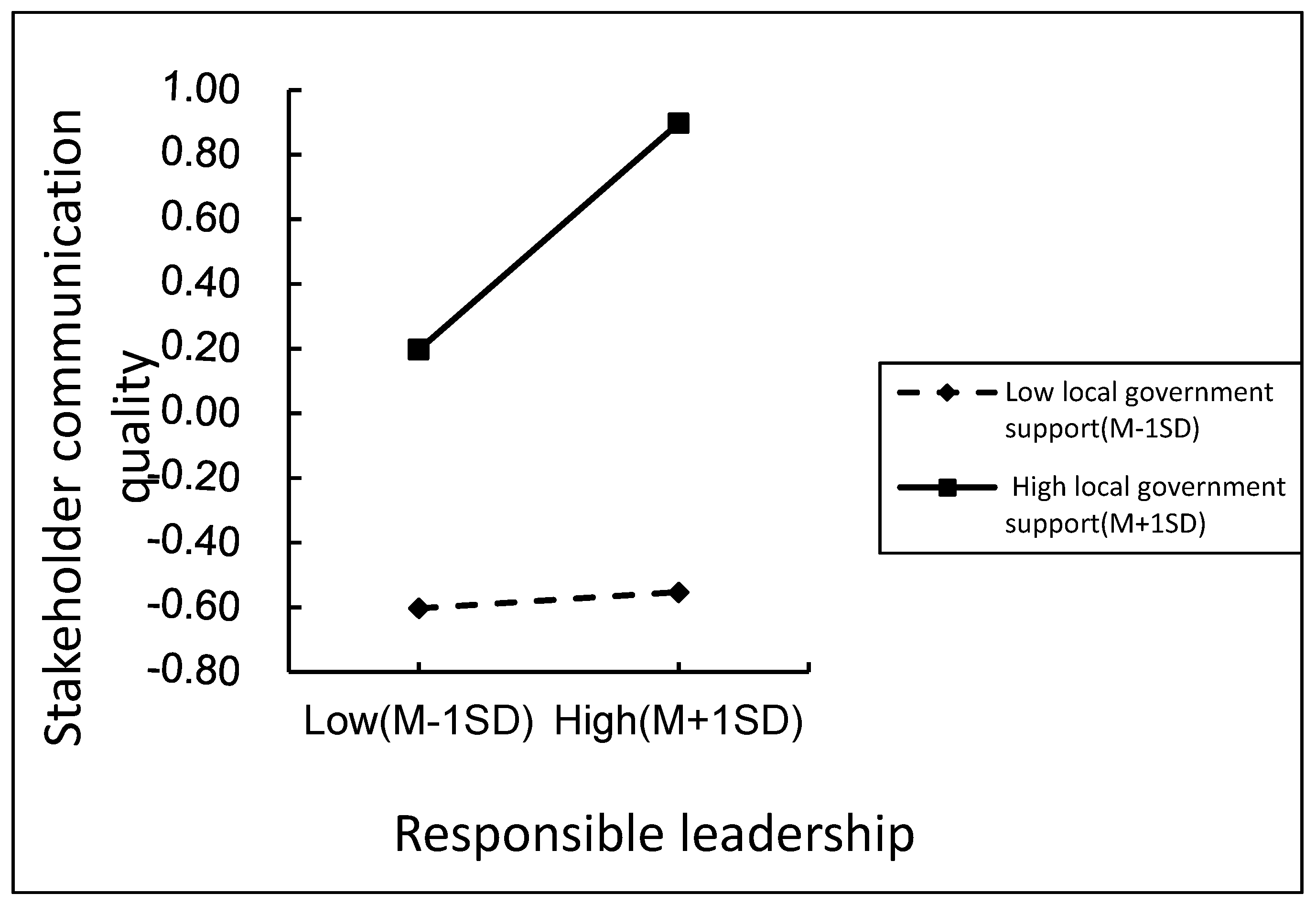
To facilitate interpretation, the significant interaction effect in was plotted in Figure 2 (Moderating role of LG). As shown in Figure 2., the significance of the relationship between RL and SCQ increased when LGS was high.

5. Conclusions and Discussion

5.1. Theoretical Significance

First, this study reveals RL’s “black box mechanism” on PSRP in post-disaster reconstruction scenarios. Existing research on RL focuses mainly on the organisational or social level. Existing RL research suffers from issues of contextual generalisation and excessive abstraction. Pless and Maak’s stakeholder theory-based study focuses on general globalised organisations [53], while Wang Zhao et al.’s exploration, grounded in upper-level theory, remains confined to conventional service organisations [30]. Neither addresses the specific constraints of post-disaster reconstruction—characterised by resource scarcity and multiple stakeholder conflicts—nor approaches crisis scenarios from a project-level perspective. This study focuses on the transition phase of post-disaster reconstruction projects in Southwest China and systematically elucidates, for the first time, the operational logic of RL in high-uncertainty scenarios. This fills a gap in applying RL theory to specialised crisis projects. At the mechanism level, existing crisis research predominantly relies on intermediaries such as trust and legitimacy, which require long-term cultivation. This study establishes stakeholder communication quality as the core intermediary, grounded in relational coordination theory, and validates its superior explanatory power in post-disaster rapid coordination scenarios, thereby filling an explanatory gap in post-disaster project collaboration mechanisms. Regarding boundary conditions, this study integrates resource dependence theory to explicitly identify, for the first time, the moderating effect of local government support. It clarifies the interlinked logic of ‘external resources—leadership behaviour—communication quality’, thereby defining the boundaries of external resources within post-disaster contexts in RL research. Simultaneously, it provides a new paradigm for integrating relational coordination theory and resource dependence theory.
Second, this study achieves an organic integration of relational coordination theory and resource dependence theory, rather than the isolated application of a single theory. Relational coordination theory centres on optimising internal collaborative relationships, focusing on how multiple stakeholders enhance communication quality and collaborative efficiency through “shared goals, shared knowledge, and mutual respect”, and addresses how to achieve performance through internal interactions. Resource dependence theory, conversely, centres on managing external resource dependencies, focusing on how organisations mitigate environmental uncertainty by acquiring critical external resources to address the external conditions required for internal collaboration. Within post-disaster reconstruction contexts, internal collaboration and external resources are mutually predicative: relational coordination without resource support proves unsustainable, while resource investment lacking collaborative mechanisms cannot be efficiently translated into performance. Consequently, this study constructs an integrated cross-theoretical framework—external resource support → enhanced internal coordination → performance improvement—by embedding relational coordination theory within mediation mechanisms and resource dependence theory within moderation mechanisms. This approach overcomes the limitations of previous single-theory explanations for complex scenarios, offering new perspectives for multi-theoretical integration in the study of complex projects such as post-disaster reconstruction.

5.2. Management Insights

This study explores the influence mechanisms of RL on PSRP in a post-disaster reconstruction scenario so that post-disaster reconstruction firms can explore management approaches that can enhance PSRP.
First, improve the selection mechanism for enterprise leaders, prioritising selecting RL to enhance PSRP. This study confirms that responsible leaders directly and positively influence PSPR through ethical exemplification, psychological support, and the cultivation of an ethical atmosphere. Consequently, post-disaster reconstruction enterprises must reinforce the pivotal driving role of responsible leadership within projects, prioritising the selection of such leaders while refining recruitment criteria and development pathways to emphasise resilience-oriented approaches. During the selection phase, alongside assessing professional competence, incorporate indicators for situational adaptability, prior crisis management experience, and resource flexibility. Utilise behavioural event interviews to delve into crisis response details, validate stress resilience through 360-degree feedback, and evaluate candidates’ goal anchoring, resource integration, and decision-making efficiency via scenario simulations. This process identifies leaders possessing both a sense of responsibility and resilience. The development phase features specialised training programmes, including regular courses on psychological support techniques for mountain disaster response and lectures by frontline post-disaster reconstruction managers. And adding a practical crisis resilience module enhances shock response capabilities, reinforces ethical practice and resilience implementation in dynamic scenarios, and ensures leaders can drive continuous improvement in PSPR through their actions.
Second, enterprises should take systematic measures to help RL improve SCQ to promote PSRP. This study confirms that SCQ serves as a key mediator through which RL influences PSPR. It resolves information asymmetry in post-disaster reconstruction and strengthens stakeholder trust. Consequently, corporate leaders should prioritise enhancing stakeholder communication quality by establishing a targeted communication system. Firstly, establish a tiered and categorised communication mechanism. Design differentiated channels based on stakeholder types and geographical characteristics, regularly organise on-site communication meetings, and build an online real-time communication platform for stakeholders to ensure the accuracy and timeliness of information delivery. Secondly, introduce intelligent communication tools to monitor and analyse key communication data in real time, including project funding utilisation, material allocation, and progress milestones, ensuring seamless information transmission. Finally, establish a dynamic evaluation and optimisation mechanism. Collect stakeholder requirements through questionnaires and in-depth interviews, maintaining electronic records. Regularly update stakeholders on the progress of addressing their needs. Employ the PDCA cycle management method to continuously refine communication strategies, ensuring communication outcomes effectively translate into PSPR.
Third, enterprises should assist RL in actively seeking support from local governments to optimise SCQ. This study confirms that high levels of LGS provide resources and legitimacy to enhance SCQ for RL, thereby strengthening coordination between such leaders and stakeholders. Consequently, enterprises should assist RL in proactively securing local government backing. This constitutes both a key factor in optimising SCQ and a vital lever for reducing project costs and aiding recovery in disaster-affected areas. Concrete actions may focus on three areas: firstly, applying to local governments for dedicated post-disaster reconstruction communication resources, such as subsidies for communication personnel or funding for outreach in remote areas; secondly, leveraging governmental credibility to jointly establish a tripartite platform involving government, enterprise, and ethnic villages to efficiently resolve policy adaptation issues; thirdly, translating governmental reconstruction policies into communication priorities, sharing experiences through regional collaboration networks, and having RL organise dedicated personnel to convey these precisely to stakeholders. This closed-loop approach amplifies the regulatory role of LGS, ensuring that responsible leaders’ communication better aligns with the needs of disaster-affected areas.
Fourth, enterprises should assist RL in enhancing the application of digital tools, providing technical support to elevate PSPR in post-disaster reconstruction projects. Data for this study were derived from stratified sampling questionnaires administered to project managers in southwestern China’s reconstruction initiatives. The dynamic application and adaptation of digital tools can offer crucial support for RL to accurately monitor project progress and optimise stakeholder engagement, thereby strengthening SCQ and PSPR. Consequently, enterprises must assist responsible leaders in integrating data and digitalisation throughout the entire post-disaster reconstruction process, focusing on three key actions: Firstly, consolidating multi-stakeholder data resources by leveraging existing questionnaire data to establish a shared repository in collaboration with government bodies, communities, and contractors. This repository should be updated weekly with core information, such as project fund utilisation, to anticipate secondary risks. Secondly, introducing post-disaster-adapted digital tools, such as multi-hazard early warning and dispatch systems, and mini-programmes for collecting livelihood needs. Thirdly, establishing a project progress visualisation platform. Publicly displaying key milestones in infrastructure restoration and ecological remediation facilitates RL in transparently communicating progress to stakeholders, thereby enhancing trust. This closed-loop approach fully leverages the enabling power of data and digitalisation, aligning RL’s management actions more closely with the actual needs of disaster-affected areas and driving continuous optimisation of PSPR.

5.3. Research Limitations and Perspectives

Several limitations of this study are worth addressing in future research. First, this study’s sample is confined to southwestern China, with external validity constrained by geographical limitations. Post-disaster reconstruction exhibits distinct regional characteristics, with significant variations across different areas. Findings may not be directly generalisable to countries or regions with markedly different disaster types, economic foundations, or institutional environments. Consequently, future research could employ stratified sampling to broaden sample coverage, conduct multidimensional comparative analyses, and incorporate context-specific moderator variables. Concurrently, given the model’s relatively high complexity relative to the sample size and the unresolved issues of cultural and institutional biases, subsequent research must ensure the sample is appropriately matched to the model and fully account for boundary conditions such as cultural and institutional biases. Second, this study only included LGS as a moderating variable in the research framework and did not take into account the stakeholders’ characteristics and dynamics. Therefore, future research could adopt a more systematic perspective to build a multidimensional research framework and conduct in-depth research through a combination of quantitative and qualitative analysis. Third, the research design was cross-sectional. The data only describes one point in time and cannot reflect dynamic changes. Future studies should use multiple data sources and a longitudinal research design to ensure the robustness and validation of the findings. Fourthly, certain variables in this study exhibited low marginal factor loadings, whilst the measurement instruments employed lacked explicit adaptation to post-disaster contexts and provided insufficient details regarding translation and cultural validation. Subsequent research must undertake comprehensive validation of all research tools and adjust item rationality to ensure the scales possess cultural appropriateness.

Author Contributions

X.Y. made substantial contributions to the conception and design of the work. Jinmei Wang wrote the main manuscript text and substantively revised it. J.W. and J.Y. were responsible for collecting, analysing, and interpreting the data. J.Y. prepared Figure 1 and Figure 2 and Table 1, Table 2, Table 3, Table 4 and Table 5. All authors reviewed the manuscript. All authors have read and agreed to the published version of the manuscript.

Funding

This research was funded by Sichuan Provincial Philosophy and Social Sciences Foundation (SCJJ25ND095), The Research Center for Systems Science and Enterprise Development (Xq23B07), and Sichuan Applied Psychology Research Center (CSXL-23328).

Institutional Review Board Statement

This study is waived for ethical review as it was conducted solely for academic purposes involving healthy adult participants. Data were collected anonymously, with no intervention and no collection of special categories of personal data (e.g., race, political opinions, or health information) This complies with the General Data Protection Regulation (GDPR, Regulation (EU) 2016/679) by the European Commission’s Ethical Guidelines for Research.

Informed Consent Statement

Informed consent was obtained from all subjects involved in the study.

Data Availability Statement

The data that support the findings of this study are available on request from the corresponding author. The data are not publicly available due to privacy or ethical restrictions.

Acknowledgments

The authors appreciate the editors and anonymous reviewers for their constructive comments.

Conflicts of Interest

The authors declare that the research was conducted in the absence of any commercial or financial relationships that could be construed as a potential conflict of interest.

References

  1. Panwar, V.; Sen, S. Fiscal repercussions of natural disasters: Stylized facts and panel data evidences from India. Nat. Hazards Rev. 2020, 21, 04020011. [Google Scholar] [CrossRef]
  2. Ministry of Emergency Management. The Office of the National Disaster Prevention, Mitigation, and Relief Commission and the Ministry of Emergency Management Released the National Natural Disaster Situation in the First Half of 2024; Ministry of Emergency Management of the People’s Republic of China: Beijing, China, 2024. Available online: https://www.mem.gov.cn/xw/yjglbgzdt/202407/t20240712_494600.shtml (accessed on 22 June 2025).
  3. Zhou, B.; Zhang, H.; Evans, R. Build back better: A framework for sustainable recovery assessment. Int. J. Disaster Risk Reduct. 2022, 76, 102998. [Google Scholar] [CrossRef]
  4. Plat, S.; So, E. Speed or deliberation: A comparison of post-disaster recovery in Japan, Turkey, and Chile. Disasters 2017, 41, 696–727. [Google Scholar] [CrossRef] [PubMed]
  5. Powell, P.J. Post-disaster reconstruction: A current analysis of Gujarat’s response after the 2001 earthquake. In Beyond Shelter After Disaster: Practice, Process and Possibilities; David, S., Jeni, B., Eds.; Routledge: Oxfordshire, UK, 2013; pp. 30–43. [Google Scholar] [CrossRef]
  6. Chang, Y.; Wilkinson, S.; Potangaroa, R.; Seville, E. Managing resources in disaster recovery projects. Eng. Constr. Archit. Manag. 2012, 19, 557–580. [Google Scholar] [CrossRef]
  7. Chang, Y.; Wilkinson, S.; Seville, E.; Potangaroa, R. Resourcing for a resilient post-disaster reconstruction environment. Int. J. Disaster Resil. Built Environ. 2010, 1, 65–83. [Google Scholar] [CrossRef]
  8. Okunola, O.H. Stakeholder engagement in disaster recovery: Insights into roles and power dynamics from the Ahr Valley, Germany. Int. J. Disaster Risk Reduct. 2024, 114, 104960. [Google Scholar] [CrossRef]
  9. Lin, H.; Sui, Y.; Ma, H.; Wang, L.; Zeng, S. CEO narcissism, public concern, and megaproject social responsibility: Moderated mediating examination. J. Manag. Eng. 2018, 34, 04018018. [Google Scholar] [CrossRef]
  10. Gim, J.; Shin, S. Disaster vulnerability and community resilience factors affecting post-disaster wellness: A longitudinal analysis of the Survey on the Change of Life of Disaster Victim. Int. J. Disaster Risk Reduct. 2022, 81, 103273. [Google Scholar] [CrossRef]
  11. Xu, J.; Shao, Y. The role of the state in China’s post-disaster reconstruction planning: Implications for resilience. Urban Stud. 2020, 57, 525–545. [Google Scholar] [CrossRef]
  12. Voegtlin, C. Development of a Scale Measuring Discursive Responsible Leadership; Pless, N.M., Maak, T., Eds.; Springer: Berlin/Heidelberg, Germany, 2011; pp. 57–73. [Google Scholar] [CrossRef]
  13. Iuchi, K.; Johnson, L.A.; Olshansky, R.B. Securing Tohoku’s future: Planning for rebuilding in the first year following the Tohoku-oki earthquake and tsunami. Earthq. Spectra 2013, 29, S479–S499. [Google Scholar] [CrossRef]
  14. Lin, Y.; Kelemen, M.; Kiyomiya, T. The role of community leadership in disaster recovery projects: Tsunami lessons from Japan. Int. J. Proj. Manag. 2017, 35, 913–924. [Google Scholar] [CrossRef]
  15. Witton, F.; Rasheed, E.O.; Rotimi, J.O.B. Does leadership style differ between a post-disaster and non-disaster response project? A study of three major projects in New Zealand. Buildings 2019, 9, 195. [Google Scholar] [CrossRef]
  16. Missonier, S.; Loufrani-Fedida, S. Stakeholder analysis and engagement in projects: From stakeholder relational perspective to stakeholder relational ontology. Int. J. Proj. Manag. 2014, 32, 1108–1122. [Google Scholar] [CrossRef]
  17. Gittell, J.H. Relational coordination: Coordinating work through relationships of shared goals, shared knowledge and mutual respect. In Relational Perspectives in Organizational Studies: A Research Companion; Olympia, K., Mustafa, Ö., Eds.; Edward Elgar Publishing: Cheltenham, UK, 2006; pp. 74–97. [Google Scholar]
  18. Chang, Y.; Wilkinson, S.; Potangaroa, R.; Seville, E. Resourcing challenges for post-disaster housing reconstruction: A comparative analysis. Build. Res. Inf. 2010, 38, 247–264. [Google Scholar] [CrossRef]
  19. Shafique, K.; Warren, C.M. Stakeholders and their significance in post natural disaster reconstruction projects: A systematic review of the literature. Asian Soc. Sci. 2016, 12, 1–17. [Google Scholar] [CrossRef]
  20. Khorshidian, A.; Fayazi, M. Critical factors to succeed in post-earthquake housing reconstruction in Iran. Int. J. Disaster Risk Reduct. 2023, 94, 103786. [Google Scholar] [CrossRef]
  21. Han, Z.; Zhu, Z.; Wang, D.; Wei, W. Responsible leadership and employee ethical voice: Mediating role of ethical efficacy and moderating role of moral identity. Curr. Psychol. 2024, 43, 29516–29527. [Google Scholar] [CrossRef]
  22. Holling, C.S.; Schindler, D.W.; Walker, B.W.; Roughgarden, J. Biodiversity in the functioning of ecosystems: An ecological synthesis. In Biodiveristy Loss: Economic and Ecological Issues; Perrings, C., Maler, K.G., Folke, C., Holling, C.S., Jansson, B.O., Eds.; Cambridge University Press: Cambridge, UK, 1995; pp. 44–83. [Google Scholar]
  23. Voegtlin, C.; Frisch, C.; Walther, A.; Schwab, P. Theoretical development and empirical examination of a three-roles model of responsible leadership. J. Bus. Ethics 2020, 167, 411–431. [Google Scholar] [CrossRef]
  24. Mousa, M. Organizational inclusion and academics’ psychological contract: Can responsible leadership mediate the relationship? Equal. Divers. Incl. Int. J. 2020, 39, 126–144. [Google Scholar] [CrossRef]
  25. Paton, D.; Smith, L.; Violanti, J. Disaster response: Risk, vulnerability and resilience. Disaster Prev. Manag. 2000, 9, 173–180. [Google Scholar] [CrossRef]
  26. Schaubroeck, J.; Lam, S.S.; Peng, A.C. Cognition-based and affect-based trust as mediators of leader behavior influences on team performance. J. Appl. Psychol. 2011, 96, 863. [Google Scholar] [CrossRef]
  27. Zhao, H.A.O.; Wayne, S.J.; Glibkowski, B.C.; Bravo, J. The impact of psychological contract breach on work-related outcomes: A meta-analysis. Pers. Psychol. 2007, 60, 647–680. [Google Scholar] [CrossRef]
  28. Akhtar, M.W.; Garavan, T.; Javed, M.; Huo, C.; Junaid, M.; Hussain, K. Responsible leadership, organizational ethical culture, strategic posture, and green innovation. Serv. Ind. J. 2023, 43, 454–474. [Google Scholar] [CrossRef]
  29. Tennakoon, K.; Serrao-Neumann, S. Role of social belongingness during the post-disaster recovery. In No Poverty. Encyclopedia of the UN Sustainable Development Goals; Leal Filho, W., Azul, A., Brandli, L., Lange Salvia, A., Özuyar, P., Wall, T., Eds.; Springer International Publishing: Cham, Switzerland, 2021; pp. 869–879. [Google Scholar] [CrossRef]
  30. Wang, Z.; Ye, Y.; Liu, X. How CEO responsible leadership shapes corporate social responsibility and organization performance: The roles of organizational climates and CEO founder status. Int. J. Contemp. Hosp. Manag. 2024, 36, 1944–1962. [Google Scholar] [CrossRef]
  31. Cardona, O.D. The Notions of Disaster Risk: Conceptual framework for Integrated Management. In Information and Indicators Program for Disaster Risk Management; InterAmerican Development Bank: Manizales, Colombia, 2003. [Google Scholar]
  32. Smith, J.B.; Barclay, D.W. The effects of organizational differences and trust on the effectiveness of selling partner relationships. J. Mark. 1997, 61, 3–21. [Google Scholar] [CrossRef]
  33. Pless, N.M.; Maak, T.; Stahl, G.K. Developing responsible global leaders through international service-learning programs: The Ulysses experience. Acad. Manag. Learn. Educ. 2011, 10, 237–260. [Google Scholar] [CrossRef]
  34. Doh, J.P.; Quigley, N.R. Responsible leadership and stakeholder management: Influence pathways and organizational outcomes. Acad. Manag. Perspect. 2014, 28, 255–274. [Google Scholar] [CrossRef]
  35. Haque, A.; Fernando, M.; Caputi, P. Responsible leadership and employee outcomes: A systematic literature review, integration and propositions. Asia-Pac. J. Bus. Adm. 2021, 13, 383–408. [Google Scholar] [CrossRef]
  36. Doh, J.P.; Stumpf, S.A.; Tymon, W.G. Responsible leadership helps retain talent in India. J. Bus. Ethics. 2011, 98, 85–100. [Google Scholar] [CrossRef]
  37. McLaren, M.; Loosemore, M. Swift trust formation in multi-national disaster project management teams. Int. J. Proj. Manag. 2019, 37, 979–988. [Google Scholar] [CrossRef]
  38. Welch, M.; Jackson, P.R. Rethinking internal communication: A stakeholder approach. Corp. Commun. 2007, 12, 177–198. [Google Scholar] [CrossRef]
  39. Swift, M.; Littlechild, J. Building trust through communication. J. Financ. Plan. 2015, 28, 28. Available online: https://www.proquest.com/trade-journals/building-trust-through-communication/docview/1730778898/se-2 (accessed on 22 June 2025).
  40. Villena Manzanares, F.; García-Segura, T.; Pellicer, E. Effective communication in BIM as a driver of CSR under the happiness management approach. Manag. Decis. 2024, 62, 685–701. [Google Scholar] [CrossRef]
  41. Emmers-Sommer, T.M. The effect of communication quality and quantity indicators on intimacy and relational satisfaction. J. Soc. Pers. Relatsh. 2004, 21, 399–411. [Google Scholar] [CrossRef]
  42. Fontainha, T.C.; Leiras, A.; Bandeira, R.; Scavarda, L.F. Stakeholder satisfaction in complex relationships during the disaster response: A structured review and a case study perspective. Prod. Plan. Control 2022, 33, 517–538. [Google Scholar] [CrossRef]
  43. John, P.; Falkenberg, L. The role of collaboration in achieving corporate social responsibility objectives. Calif. Manag. Rev. 2009, 51, 95–113. [Google Scholar] [CrossRef]
  44. Li, H.; Atuahene-Gima, K. Product innovation strategy and the performance of new technology ventures in China. Acad. Manag. J. 2001, 44, 1123–1134. [Google Scholar] [CrossRef]
  45. Chang, Y.; Wilkinson, S.; Potangaroa, R.; Seville, E. Resourcing for post-disaster reconstruction: A comparative study of Indonesia and China. Disaster Prev. Manag. 2012, 21, 7–21. [Google Scholar] [CrossRef]
  46. Yang, L.; Wang, Y.; Peng, B. Dynamic Mechanisms of R&D Innovation in Chinese Multinational Corporations: The Impact of Government Support, Market Competition and Entrepreneurial Spirit. Sustainability 2024, 16, 9782. [Google Scholar] [CrossRef]
  47. Ni, X.; Zheng, T.; Gao, F.; Zhao, H. Stimulating Start-up Investment Through Government-Sponsored Venture Capital: Theory and Chinese Evidence. J. Syst. Sci. Complex. 2024, 37, 2021–2053. [Google Scholar] [CrossRef]
  48. Songling, Y.; Ishtiaq, M.; Anwar, M.; Ahmed, H. The role of government support in sustainable competitive position and firm performance. Sustainability 2018, 10, 3495. [Google Scholar] [CrossRef]
  49. Miotto, G.; Del-Castillo-Feito, C.; Blanco-González, A. Reputation and legitimacy: Key factors for Higher Education Institutions’ sustained competitive advantage. J. Bus. Res. 2020, 112, 342–353. [Google Scholar] [CrossRef]
  50. Judge, T.A.; Weiss, H.M.; Kammeyer-Mueller, J.D.; Hulin, C.L. Job attitudes, job satisfaction, and job affect: A century of continuity and of change. J. Appl. Psychol. 2017, 102, 356. [Google Scholar] [CrossRef] [PubMed]
  51. Ayat, M.; Ullah, A.; Kang, C. The unsolicited proposal and performance of private participation infrastructure projects in developing countries. J. Eng. Des. Technol. 2022, 22, 901–925. [Google Scholar] [CrossRef]
  52. Chan, A.P.; Chan, A.P. Key performance indicators for measuring construction success. Benchmarking 2004, 11, 203–221. [Google Scholar] [CrossRef]
  53. Maak, T.; Pless, N.M. Responsible leadership in a stakeholder society–a relational perspective. J. Bus. Ethics 2014, 66, 99–115. [Google Scholar] [CrossRef]
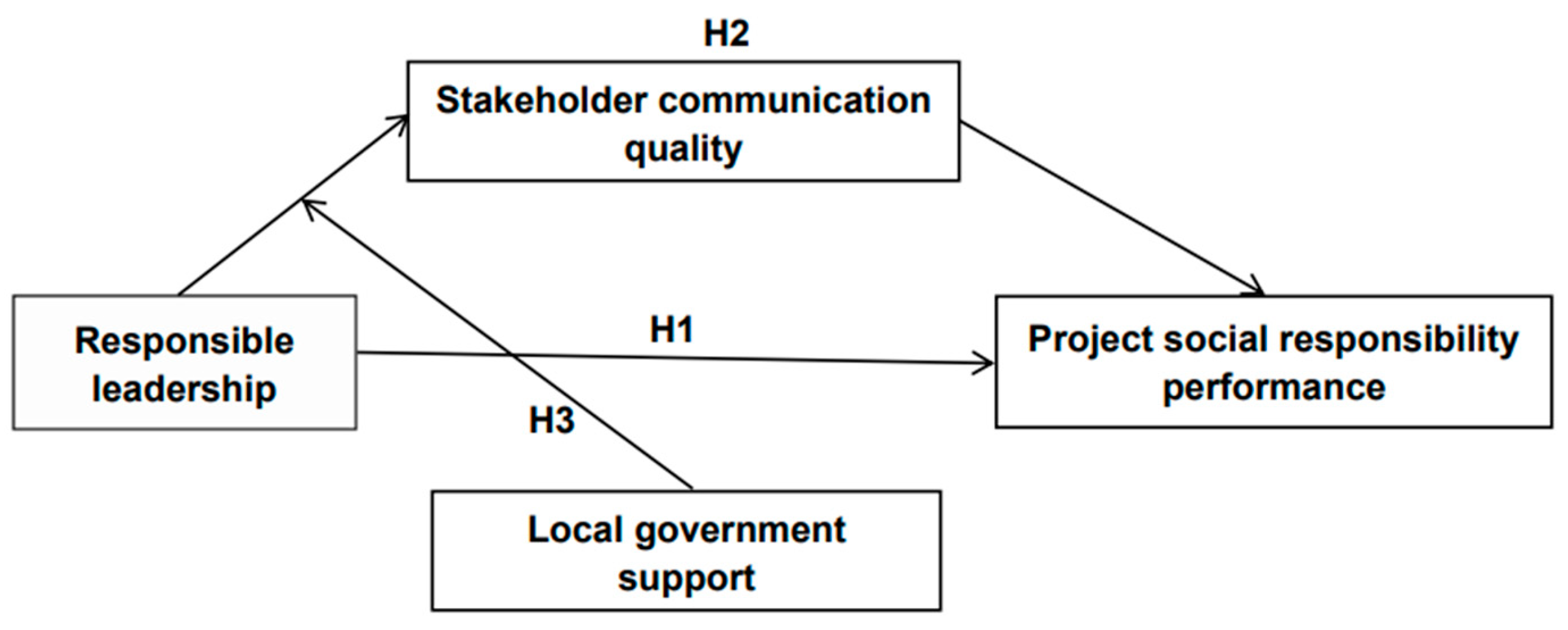
Figure 1. Research model.
Sustainability 18 00059 g001
Figure 2. Moderating role of LGS.
Sustainability 18 00059 g002
Table 1. Demographic distribution of the sample (n = 159).
CategoriesInterviewee
FrequencyPercentage%
Genders
Male9056.6
Female6943.4
Age
Under 31 years5232.7
31–35 years2817.6
36–40 years2817.6
41–45 years2616.4
46–50 years1811.3
Above 50 years74.4
Educational level
Junior high school and below74.4
High School/Junior College2213.8
University College3522.0
Undergraduate7547.2
Postgraduate and above2012.6
Position
Grassroots Management10867.9
Middle Management3823.9
Senior Management138.2
Working experience
1–5 years5232.7
6–10 years3823.9
11–15 years3018.9
16–20 years2213.8
Above 20 years1710.7
Project scale
Less than 5 million yuan4327.0
5–10 million yuan138.2
10–20 million yuan2415.1
20–30 million yuan95.7
30–40 million yuan53.1
Above 40 million yuan6540.9
Project duration
Less than 6 months4930.8
6 months–1 year2918.2
1–2 years3421.4
2–3 years2515.7
More than 3 years2213.8
Project Type
Urban and rural housing construction category5232.7
Infrastructure and public service facilities7849.1
Geological disaster prevention and control138.2
Ecological environment restoration and protection63.8
Scenic restoration and industrial development21.3
Others85.0
Table 2. Goodness of Fit index.
LGSPSPRRLSCQ
LGS
PSPR0.675
RL0.2140.355
SCQ0.6960.5700.426
LGS × RL0.1500.0780.3880.389
R2 0.336 0.538
R2 adjusted 0.349 0.523
∆R2 0.013 0.015
Note: ∆R2 denotes the absolute value of the difference between R2 and adjusted R2.
Table 3. Reliability test.
Correlation Matrix
Research VariablesCronbach’s αCRAVELGSCSRPRLSCQ
LGS0.9070.9090.7810.884
CSRP0.9490.9520.5520.6330.743
RL0.9140.9170.7450.1970.3280.863
SCQ0.9390.9410.8050.6450.5690.3960.897
Note: Bolded values on the diagonal are the square root of the corresponding AVE for each latent variable.
Table 4. Cross-loading.
Measurement ItemLGSCSRPRLSCQ
CSRP-Ec10.4240.7500.2330.351
CSRP-Ec20.4730.6650.1650.485
CSRP-Ec30.4210.7070.2590.432
CSRP-Ec40.4980.6960.1870.510
CSRP-Ec50.4920.7650.2880.438
CSRP-Et10.5750.8190.2550.421
CSRP-Et20.5370.7210.2340.329
CSRP-Et40.5590.7890.2480.377
CSRP-Le10.5130.7790.2910.491
CSRP-Le20.5510.8130.1980.492
CSRP-Le30.5100.7750.3660.488
CSRP-Le40.5400.7910.1780.477
CSRP-Po10.3100.6820.2220.305
CSRP-Po20.3610.7070.2690.346
CSRP-Po30.3900.7420.2080.385
CSRP-Po40.3720.7120.2660.331
CSRP-Po50.3850.6970.2760.395
LGS10.8820.5440.1960.593
LGS20.8880.5820.2250.593
LGS30.8910.5720.1470.572
LGS40.8750.5370.1210.517
RL10.1440.2700.8560.328
RL20.1630.2830.8830.350
RL30.1880.2690.8450.316
RL40.1920.3060.8920.381
RL50.1620.2860.8370.326
SCQ10.5660.5060.3620.882
SCQ20.5200.4930.3860.860
SCQ30.6280.5050.3520.921
SCQ40.6050.5590.3440.926
SCQ50.5720.4870.3330.895
Note: Bolded values indicate the standardised factor loadings of items on their respective structures.
Table 5. Results of hypothesis testing.
PathPath CoefficientStandard DeviationT Statisticsp ValuesF-SquareInference
RL→PSRP0.2310.1012.2720.0230.024Supported
RL→SCQ0.2010.0952.1210.0340.073Supported
SCQ→PSRP0.4980.1234.0400.0000.318Supported
LGS × RL→SCQ0.1750.0842.0900.0370.082Supported
Disclaimer/Publisher’s Note: The statements, opinions and data contained in all publications are solely those of the individual author(s) and contributor(s) and not of MDPI and/or the editor(s). MDPI and/or the editor(s) disclaim responsibility for any injury to people or property resulting from any ideas, methods, instructions or products referred to in the content.