Hazard- and Fairness-Aware Evacuation with Grid-Interactive Energy Management: A Digital-Twin Controller for Life Safety and Sustainability
 , ,
, ,  ,
,  , ,
, ,
Abstract
1. Introduction
- -
- A unified digital-twin controller that couples hazard- and congestion-aware routing with grid-interactive energy management, exposing operator-level knobs for fairness and sustainability.
- -
- An operational fairness mechanism for mixed-ability populations that acts during routing/queuing, not just as a reporting metric, enabling explicit navigation of the equity–efficiency trade-off.
- -
- A co-simulation framework that integrates a physically grounded hazard surrogate, agent-based movement with capacity gating, and device/feeder-constrained energy dispatch, which is compatible with DT data streams and amenable to site calibration.
2. Related Work
2.1. Digital Twins (DT), BIM, and IoT for Fire Safety and Evacuation
2.2. Dynamic Signage and Real-Time Egress Control
2.3. Routing Under Dynamic Hazards: Optimization and Learning
Physics-Based Fire/Smoke Modeling and Coupled Egress
2.4. Agent-Based Evacuation and Social Behavior
2.5. Equity, Vulnerable Populations, and Fairness in Evacuation
2.6. Building–City Coupling and Emergency Vehicle Priority
2.7. Summary of Gaps and Contributions
3. Proposed Method
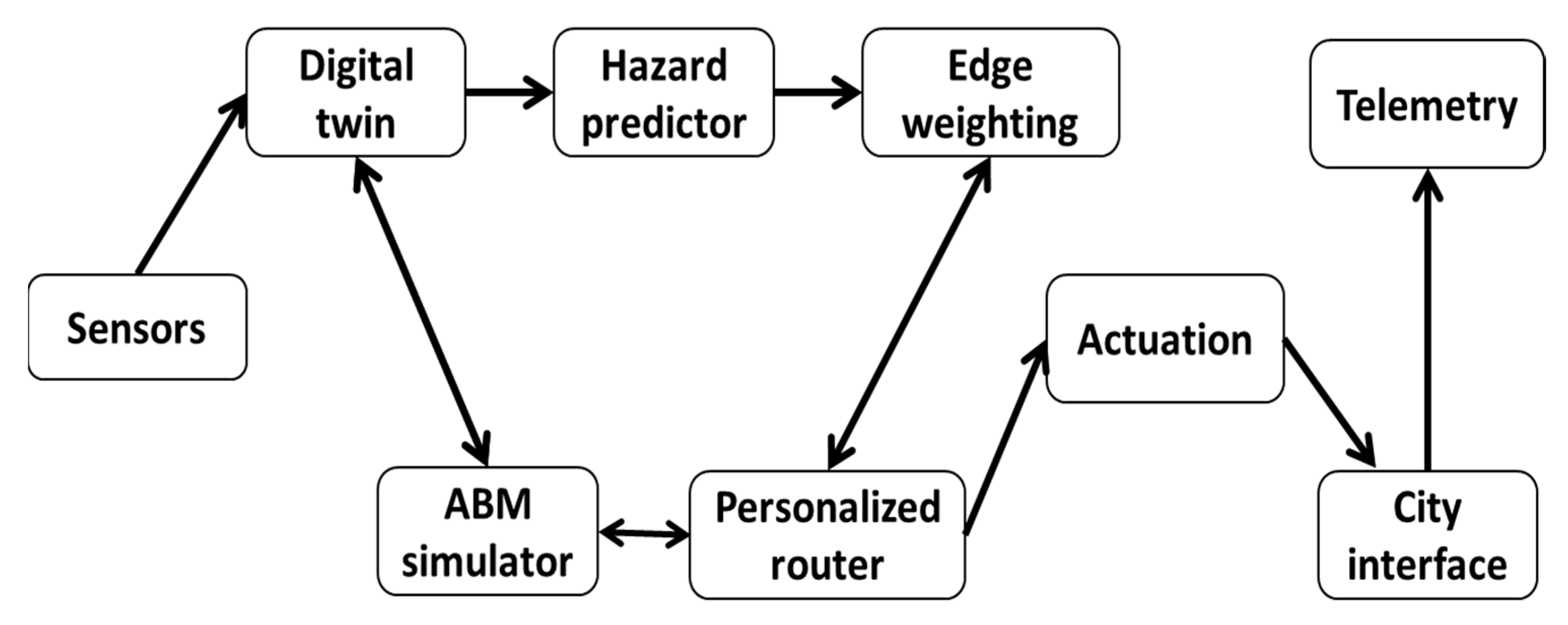
3.1. System Overview and Data Flow
- Sense and predict: Ingest sensors (smoke/CO/temperature/visibility, door/HVAC states, BLE/Wi-Fi occupancy) and predict a short-horizon field
- Update weight: Map and congestion to time-varying edge weights
- Personalize routing: Solve a multi-objective program to compute paths balancing efficiency, safety, and fairness.
- Simulate and actuate: Simulate agents over , update , and actuate dynamic signs/luminaires and city interfaces.
3.2. Formal Optimization Problem
- Decision variables:
- Routing variables
- Energy dispatch variables (GEEM)
- Parameters
- Feasibility constraints
- (1)
- Flow conservation
- (2)
- Edge capacity and queueing
- (3)
- Hazard and accessibility
- (4)
- Exposure constraint
- (5)
- Energy balance and device constraints (GEEM)
- Objective function
- Clearance time term: maxiTi
- Safety term:
- Fairness term (e.g., max–min gap):
- Energy use:Eevent(t) = Pgrid(t)+ − Ppv(t) − Pbat(t)−
- CO2 emissions:CO2(t) = γgrid Pgrid(t)+ + γdiesel Pdiesel(t)
- Unserved critical load:Ucrit(t) = max{0, Lcrit(t) − Psupplied(t)}.
- Solution strategy (two-stage decomposition)
3.3. System Architecture and Routing Graph for Adaptive Evacuation
| Algorithm 1. Closed-loop digital twin evacuation with GEEM (period Δt) |
|
- -
- Step 1 updates the digital twin state using sensor fusion. The hazard map, density map, and energy-system state are refreshed every cycle.
- -
- Step 2 computes per-edge hazard, congestion, and accessibility metrics. These are transformed into dynamic edge weights used by the routing layer.
- -
- Step 3 applies feasibility constraints, ensuring that unsafe or inaccessible passages are excluded before any optimization takes place.
- -
- Step 4 performs the evacuation-routing optimization. Previously condensed, this step is now decomposed into path generation, fairness adjustments, capacity/queue checking, and final multi-objective selection.
- -
- Step 5 solves the GEEM problem using the formal mathematical formulation.
- -
- Step 6 deploys the results to the building (signage, BMS/EMS).
- -
- Step 7 triggers the next control cycle, ensuring real-time operation.
3.4. Grid-Interactive Emergency Energy Management (GEEM)
- Decision Variables
- Parameters
- Constraints
- (1)
- Power balance
- (2)
- PV dispatch limit
- (3)
- Battery dynamics and limits
- (4)
- Grid import/export
- If anti-backfeed protection is required, Pgrid(t) ≥ 0.
- (5)
- Diesel generator
- (6)
- Sustainability metrics at each step
- (7)
- GEEM Objective
3.5. Deployment Pathway on Existing BMS
4. Evaluation
4.1. Objectives and Research Questions
4.2. Endpoints and Metrics
- -
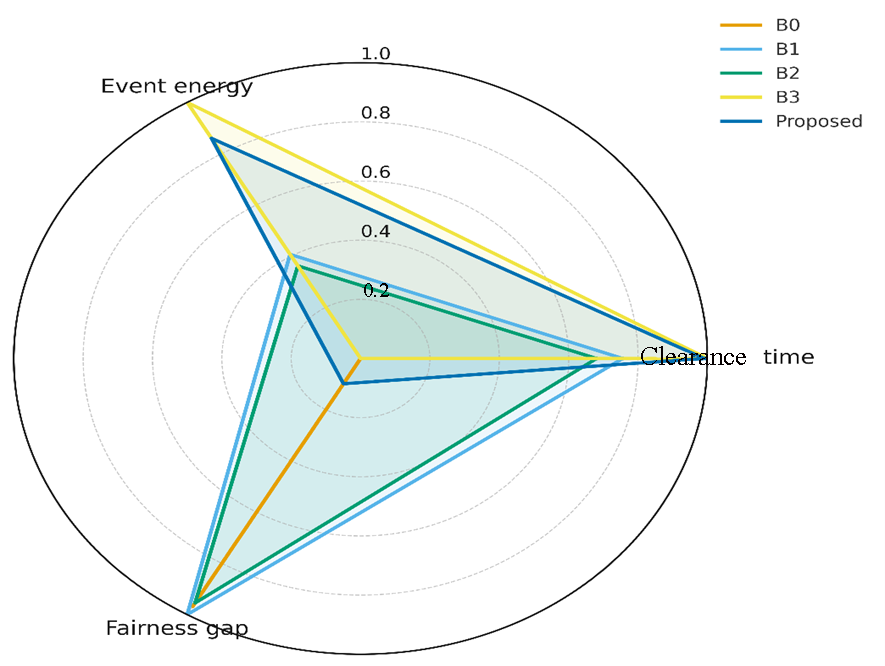
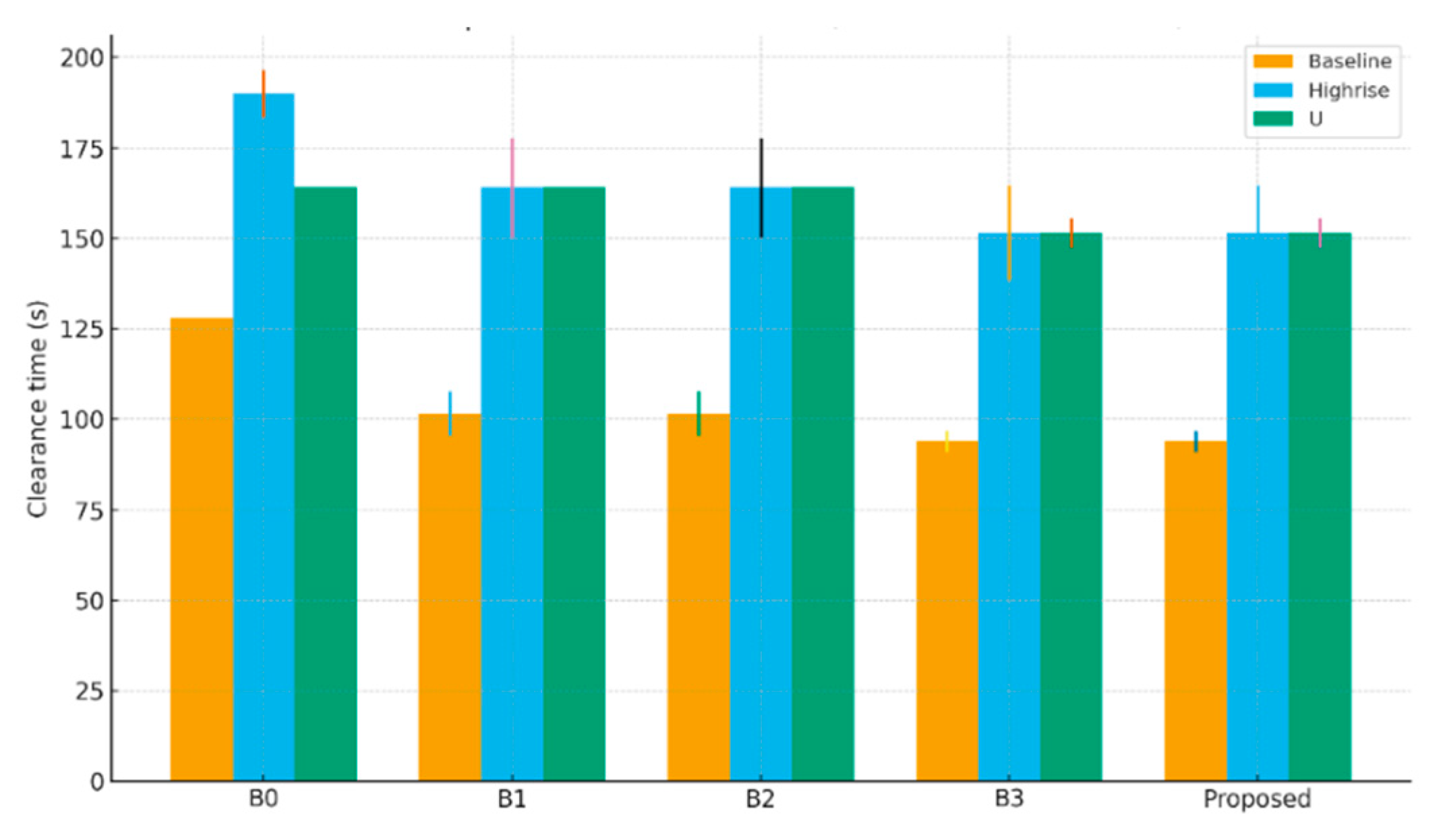
- Clearance time (T_clear): Total evacuation duration (time to last occupant exit). This is the primary efficiency endpoint reported for each scenario and baseline.
- -
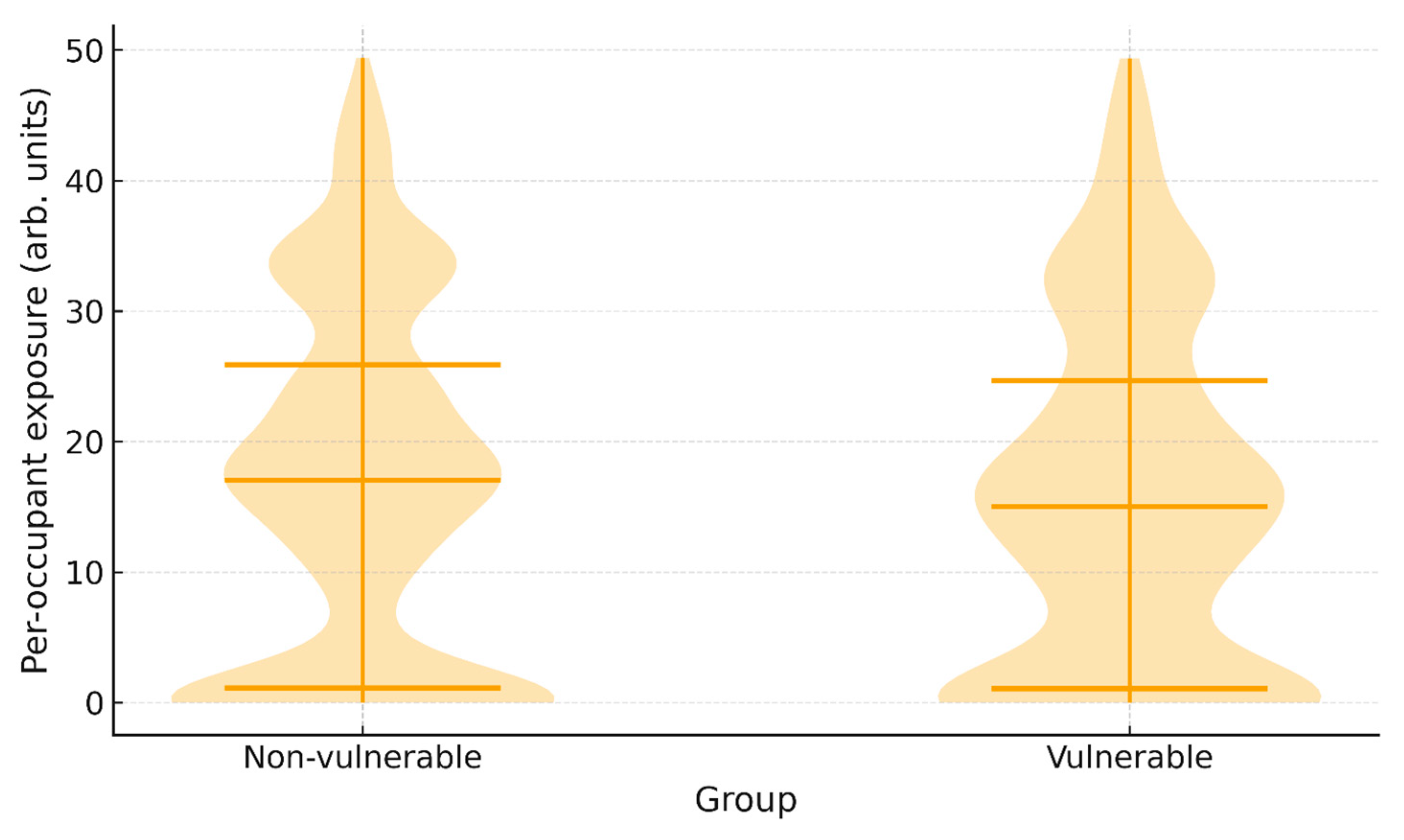
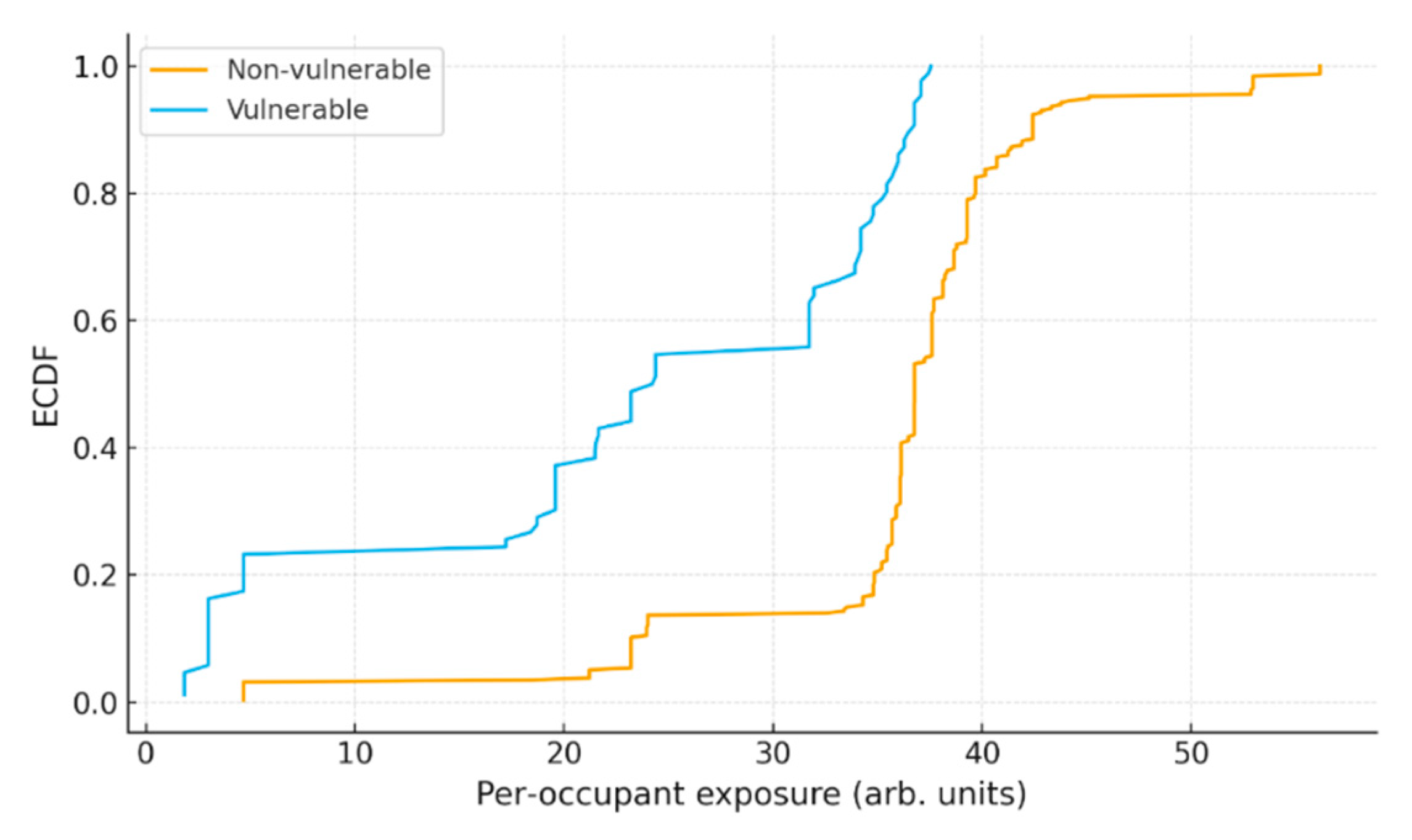
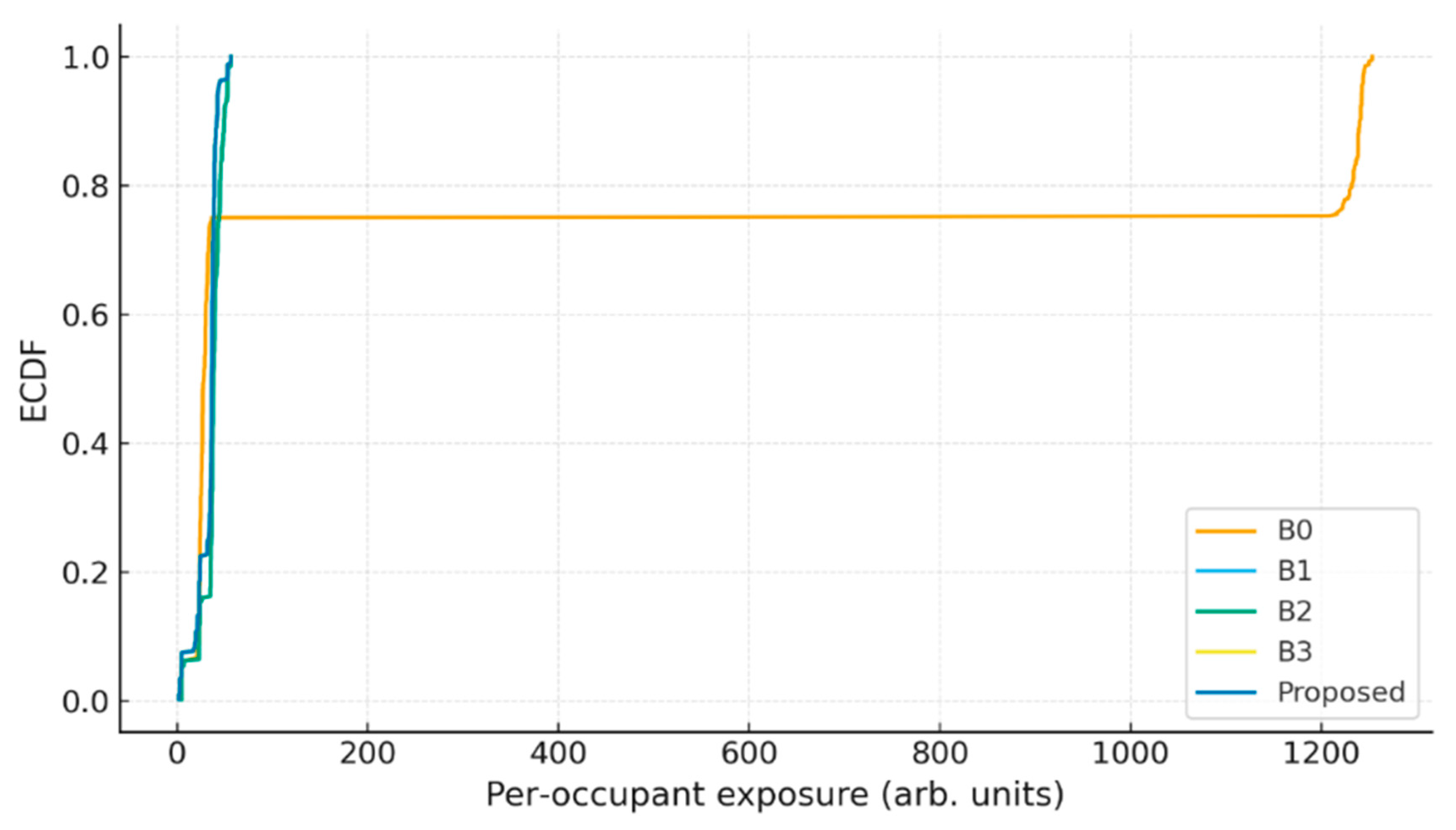
- Per-occupant exposure (E_i): Cumulative exposure computed along realized trajectories; we report distributional summaries (median, IQR) and worst-case exposure across groups.
- -
- Fairness: Primary criterion is the max–min gap in predicted (and realized) egress times across predefined groups (e.g., mobility-limited vs. others), as specified at the end of Section 3.5; we also report group-wise exposure differences to confirm equity gains are not achieved by shifting risk.
- -
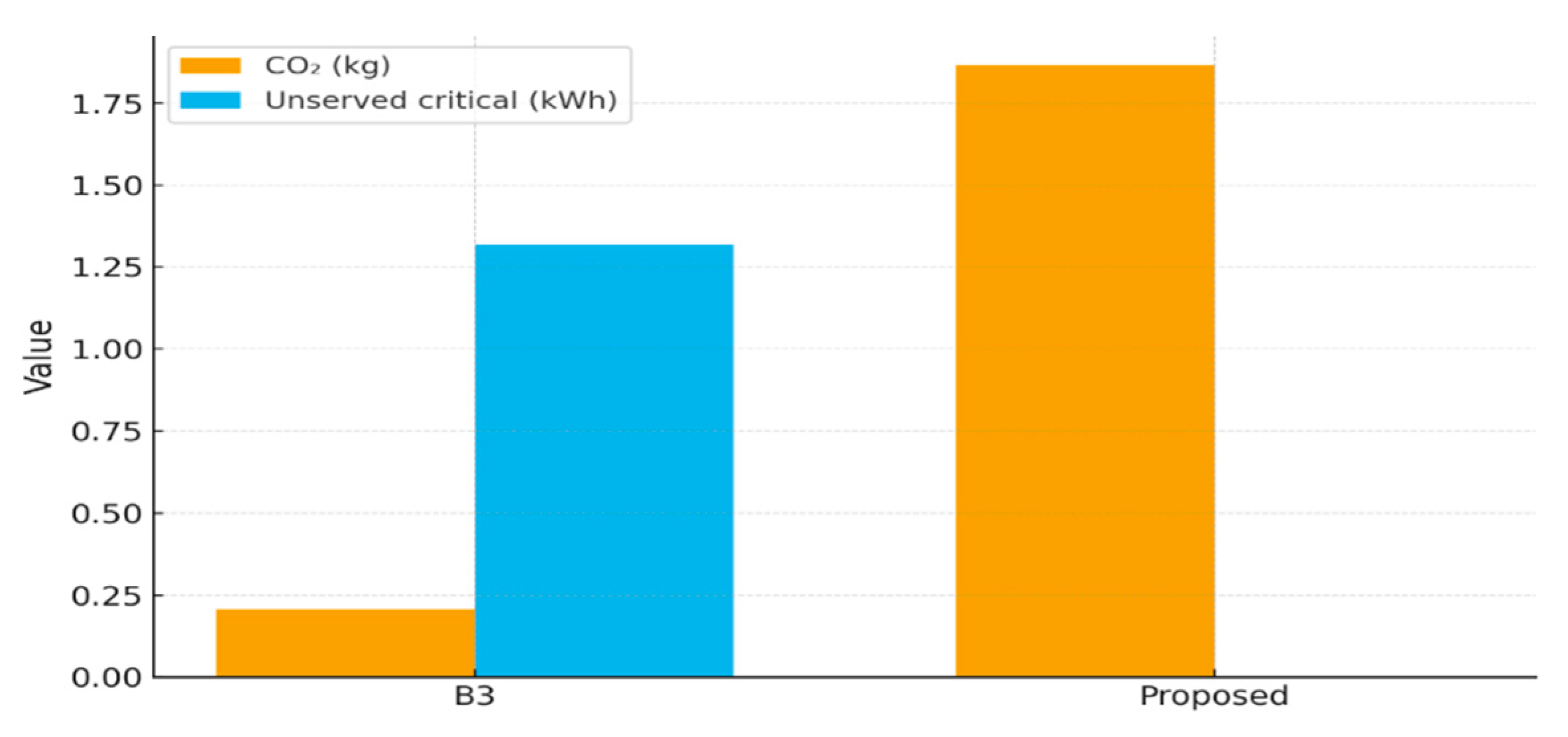
- Event energy (), , unserved critical load (): These metrics are used to assess the sustainability and resilience of the GEEM dispatch under feeder import caps and device limits.
4.3. Experimental Setup and Co-Simulation
- -
- Simulation stack. We evaluate the controller with a co-simulation that couples (i) a graph-based hazard surrogate (advection–diffusion–decay with HVAC-amplified advection and hop-delays from the ignition node), (ii) an agent-based egress simulator with density-dependent speeds and capacity gating, and (iii) the closed-loop controller (Algorithm 1) running in a receding-horizon loop with control period Δt = 2 s.
- -
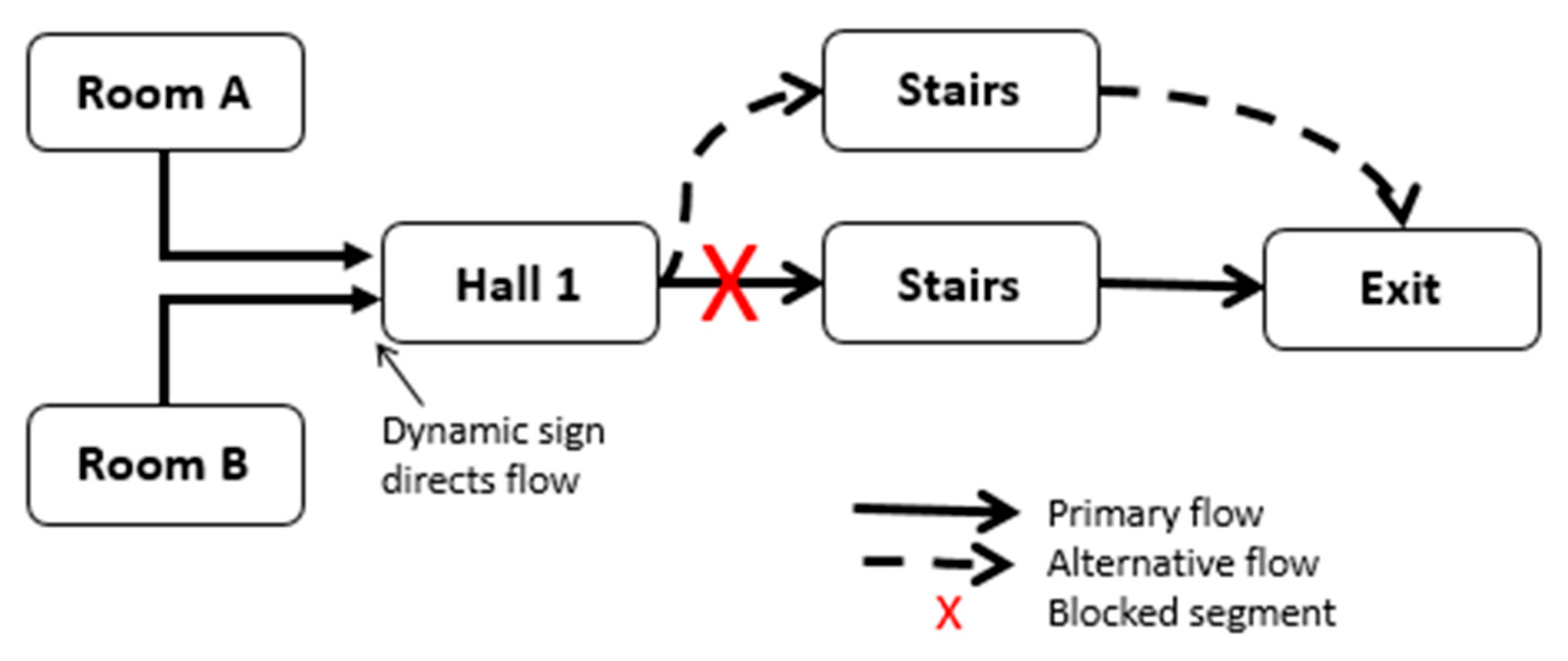
- Building models and scenarios. The testbed is a two-floor layout (rooms → halls → stairs → exits) with vertical connectivity H2↔H1 and one exit per floor (E1, E2). The ignition is fixed at H1, and HVAC is on. Links become inaccessible when the predicted edge hazard reaches a safety threshold (hazard ≥ 1.3), forcing re-routing (e.g., H1 → H2 → S2 → E2 when H1 → S1 deteriorates). We simulate N = 80 occupants with 25% vulnerable, cap the horizon at 900 s, and aggregate over S = 5 random seeds.
- -
- Hazard surrogate. The surrogate updates the edge-level hazard by
- -
- Crowd model and capacities. Pedestrian speeds follow a fundamental diagram on each edge: with = 2.5 persons/m2; equals the edge’s base speed (stairs use a conservative factor). Edge capacity is persons/s. We model FIFO queues at nodes and track per-edge loads so that instantaneous density slows traversal times.
- -
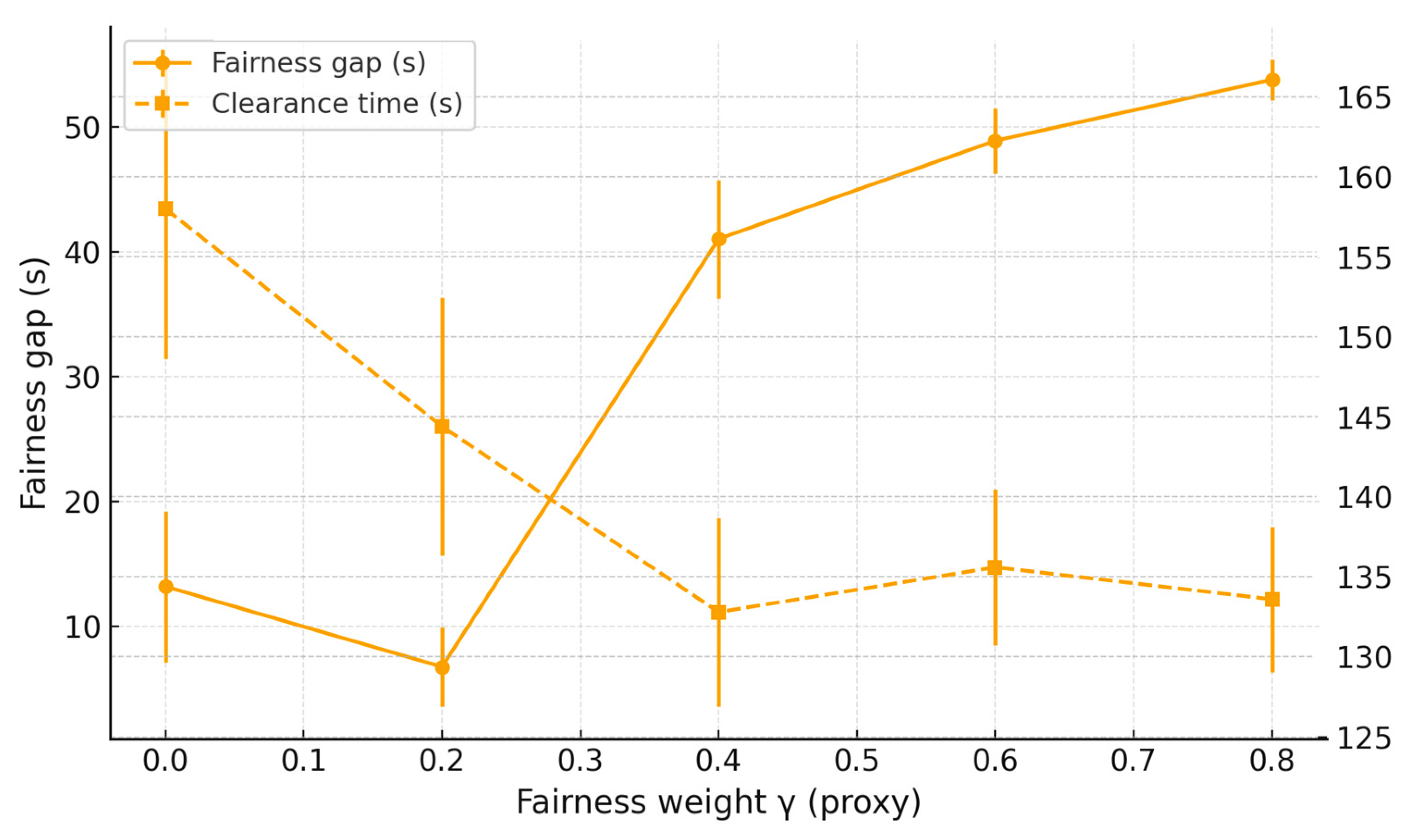
- Routing and controller configuration. Time-varying edge costs combine hazard and congestion terms with weights κ1 = 6 (hazard) and κ2 = 1 (congestion). Fairness is operationalized at runtime via (a) priority ordering, where vulnerable agents are planned/served first each control cycle; (b) a capacity nudge, where effective admission capacity is increased by one person for vulnerable agents when fairness is enabled; and (c) stricter exposure caps for vulnerable users (0.7× of the standard cap). Stairs are marked as inaccessible for wheelchair users. The multi-objective weights in use are α = 1.0 (clearance), β = 0.4 (exposure), γ = 0.4 (fairness), and for energy/CO2/unserved.
- -
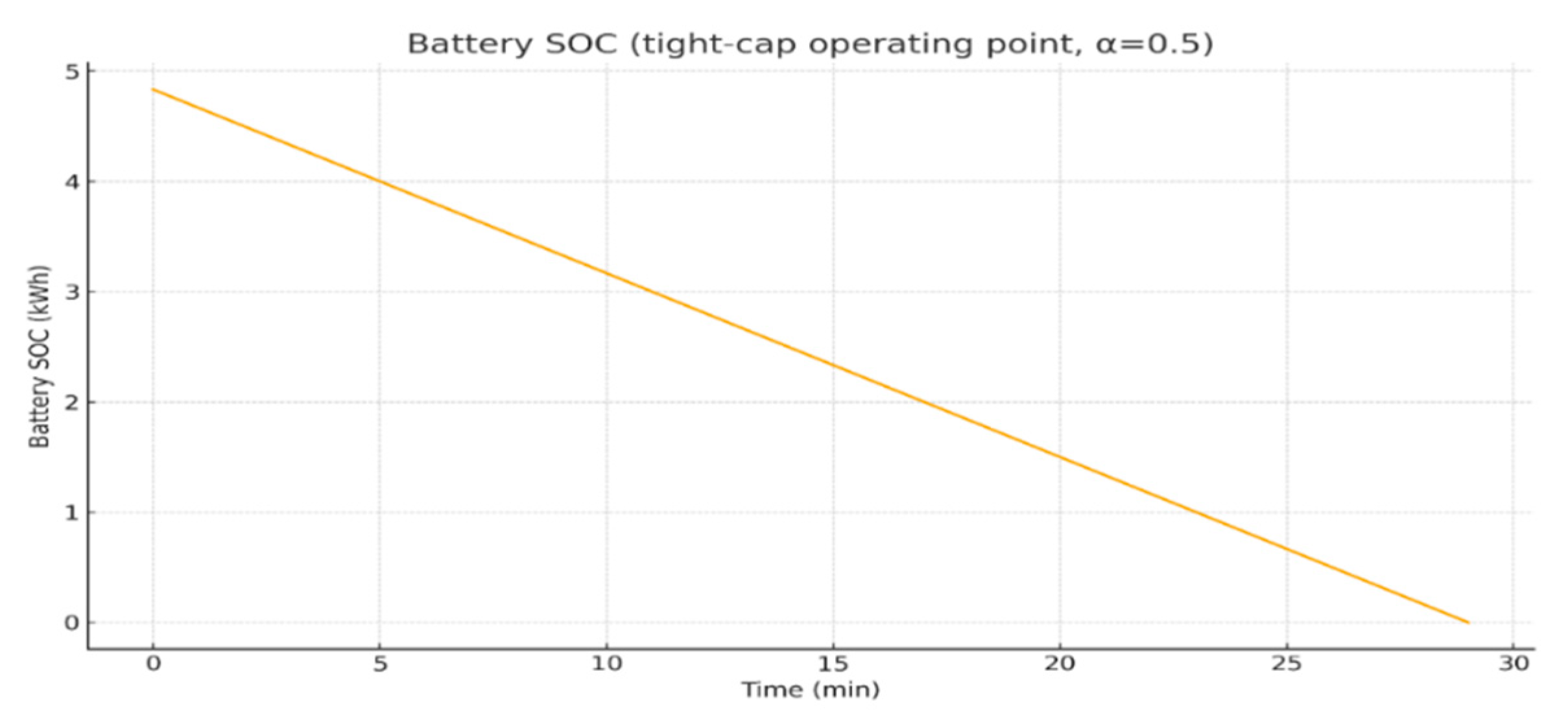
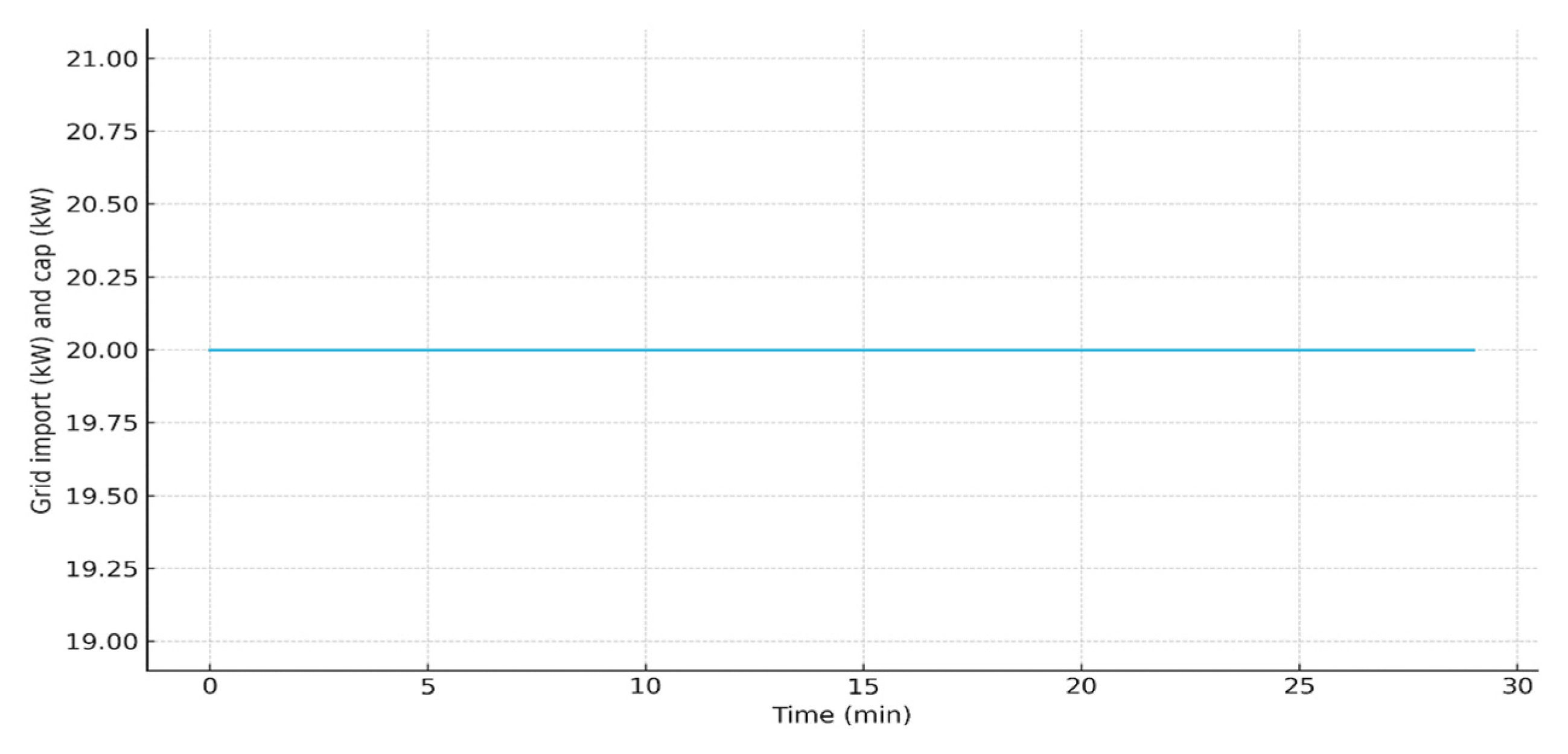
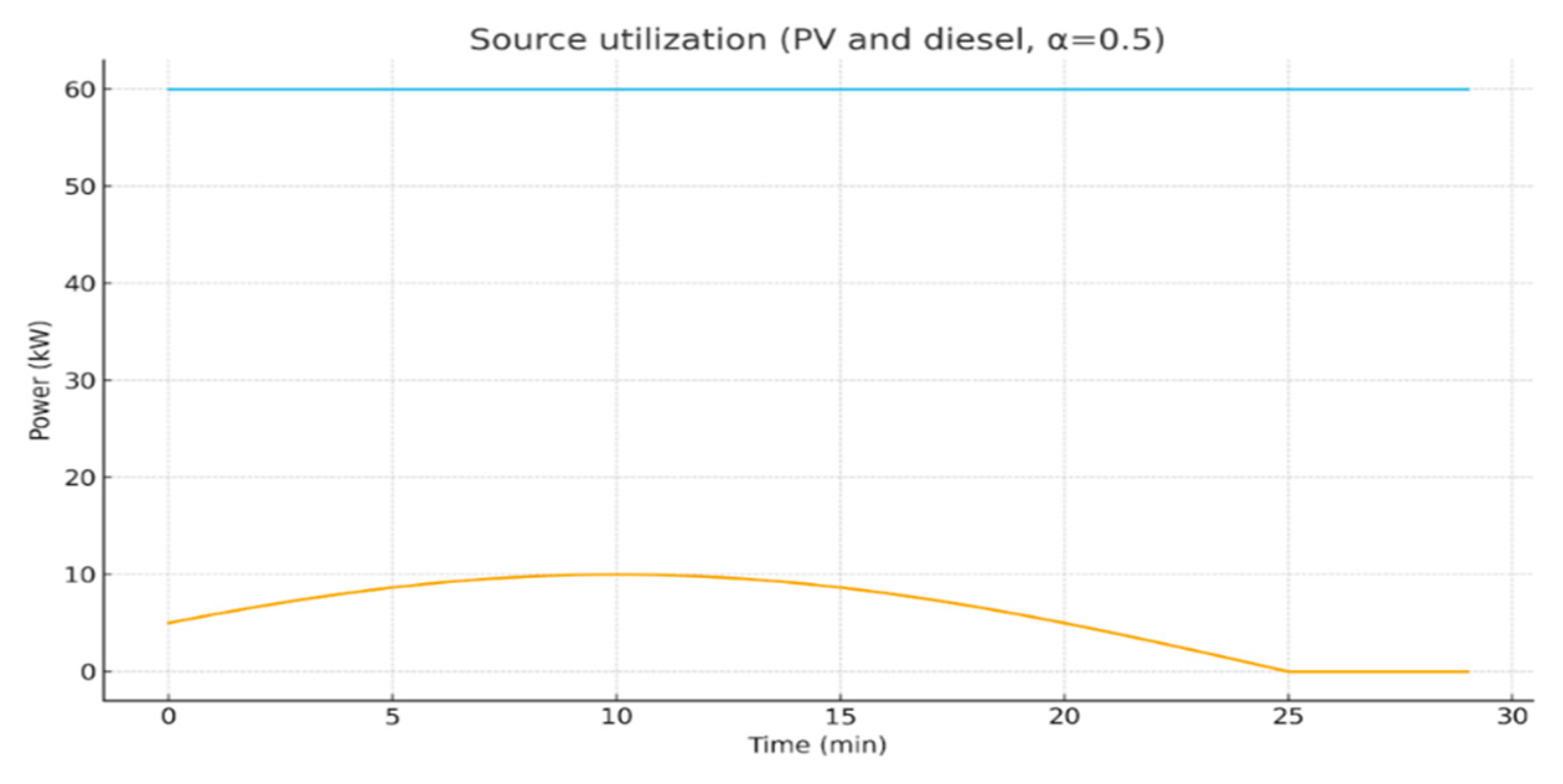
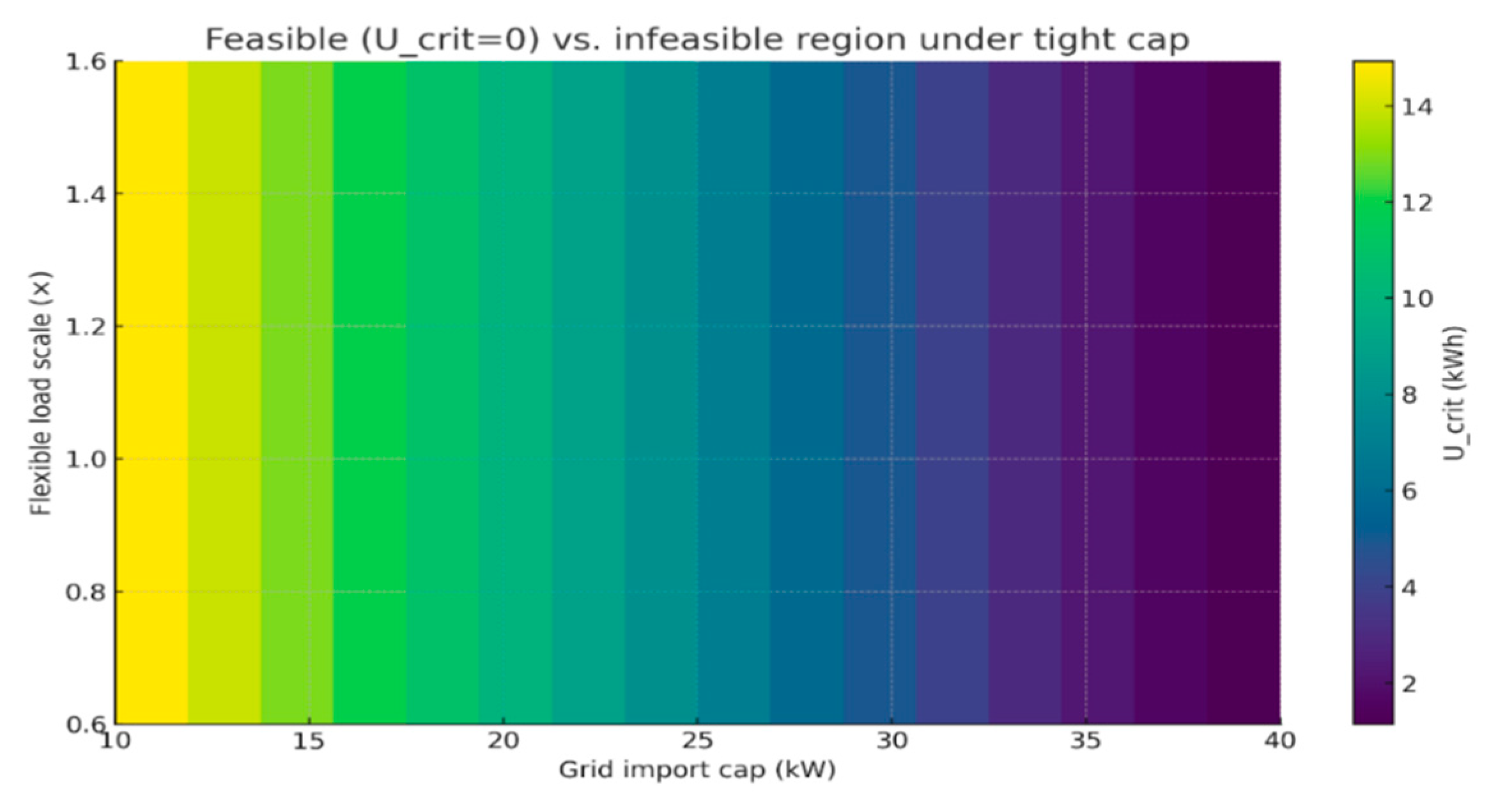
- GEEM and grid limits. The Grid-Interactive Emergency Energy Management (GEEM) layer co-optimizes PV 80 kW, battery 150 kWh (power limit 80 kW; 20% reserve), grid import cap 120 kW, and (for the proposed method only) an optional diesel 100 kW kept off unless required. We compute , , and using emission factors .55 and . To exercise GEEM under stress, a tight-cap variant (grid cap 60 kW, curtailed PV 40 kW during part of the event) is reported in the supplement.
- -
- City-level orchestration (diagnostic metric). We estimate emergency vehicle (EV) travel time along a short urban path with and without preemption; preemption is triggered when DT telemetry predicts extended clearance or high average hazard. This does not affect building-level routing but is reported as an external readiness indicator.
- -
- Runtime and hardware. On a CPU-only workstation, the complete control loop (hazard update, edge re-weighting, routing, and dispatch) meets the 2 s deadline across runs. Per-step timings and configuration files are included in the artifact.
4.4. Baseline Implementations and Ablations
4.4.1. Baselines
- -
- B0: Static signage (shortest paths). Time-invariant routing (no re-planning), no hazard or congestion costs. Edges can still become blocked if the hazard threshold (≥1.3) is crossed, forcing agents who reach a blocked edge to stall and re-queue. Fairness mechanics and GEEM are off.
- -
- B1: Congestion-aware only. Time-dependent routing with congestion term (κ2 = 1); hazard term off (κ1 = 0). Re-plans when the next edge becomes unsafe. Fairness and GEEM are off.
- -
- B2: Hazard-aware + congestion. Time-dependent routing with hazard and congestion (κ1 = 6, κ2 = 1). Re-plans on predicted hazard deterioration. Fairness and GEEM are off.
- -
- B3: Fairness-aware, no GEEM. Same as B2, with runtime fairness mechanics enabled: (i) priority ordering (vulnerable planned first each cycle), (ii) capacity nudge (+1 effective admission on next edge for vulnerable), and (iii) stricter exposure caps (0.7×). GEEM is off.
- -
- Proposed method B3 + GEEM (PV 80 kW, battery 150 kWh with 20% reserve, grid cap 120 kW, diesel 0/100 kW kept off unless required). Sustainability terms are active with .
4.4.2. Shared Components Across Baselines
4.4.3. Implementation Details
- -
- Re-planning triggers: (a) Next edge becomes unsafe; (b) predicted queue exceeds local capacity buffer; (c) exposure nearing cap for vulnerable agents (detour to safer corridors).
- -
- Costing: Edge when hazard-aware.
- -
- Fairness runtime policy (B3/proposed method): Vulnerable agents scheduled first each cycle; +1 admission headroom on contested edges; vulnerable speed when fairness is on (and a 1.25× penalty when fairness is off).
4.4.4. Ablation Studies
4.4.5. Evaluation Protocol
4.5. Datasets and Parameter Values
4.5.1. Scenario Matrix (Building, Hazards, Population)
4.5.2. Controller, Routing, and Safety Parameters
4.5.3. GEEM Assets, Limits, and Emissions Factors
4.5.4. Hardware and Runtime Budget
4.6. Results and Statistical Tests
4.6.1. Results Overview
4.6.2. Statistical Tests
4.6.3. Fairness Note
4.6.4. Runtime/Feasibility
4.7. Cross-Topology Generalization
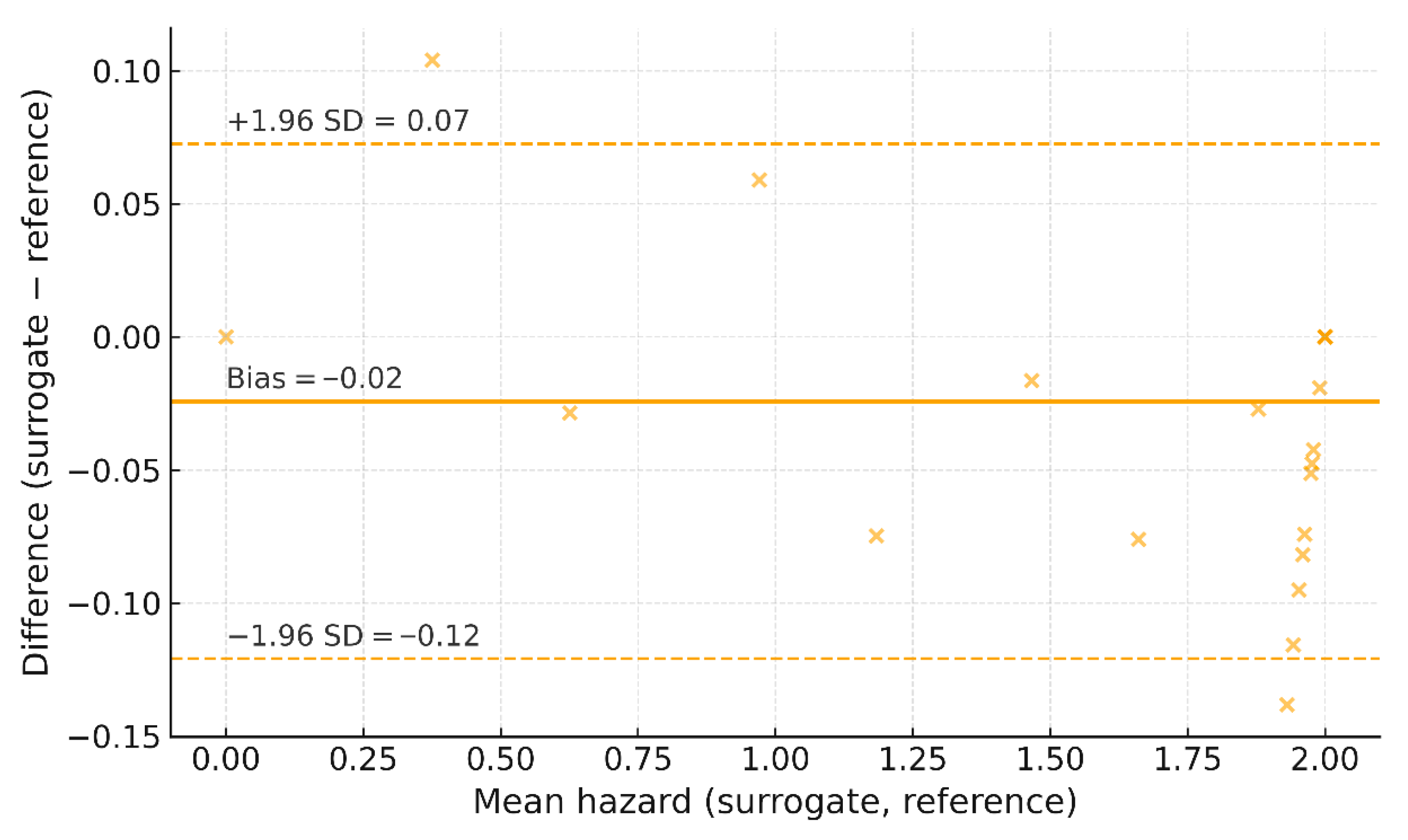
4.8. Surrogate Validation Against High-Fidelity Reference
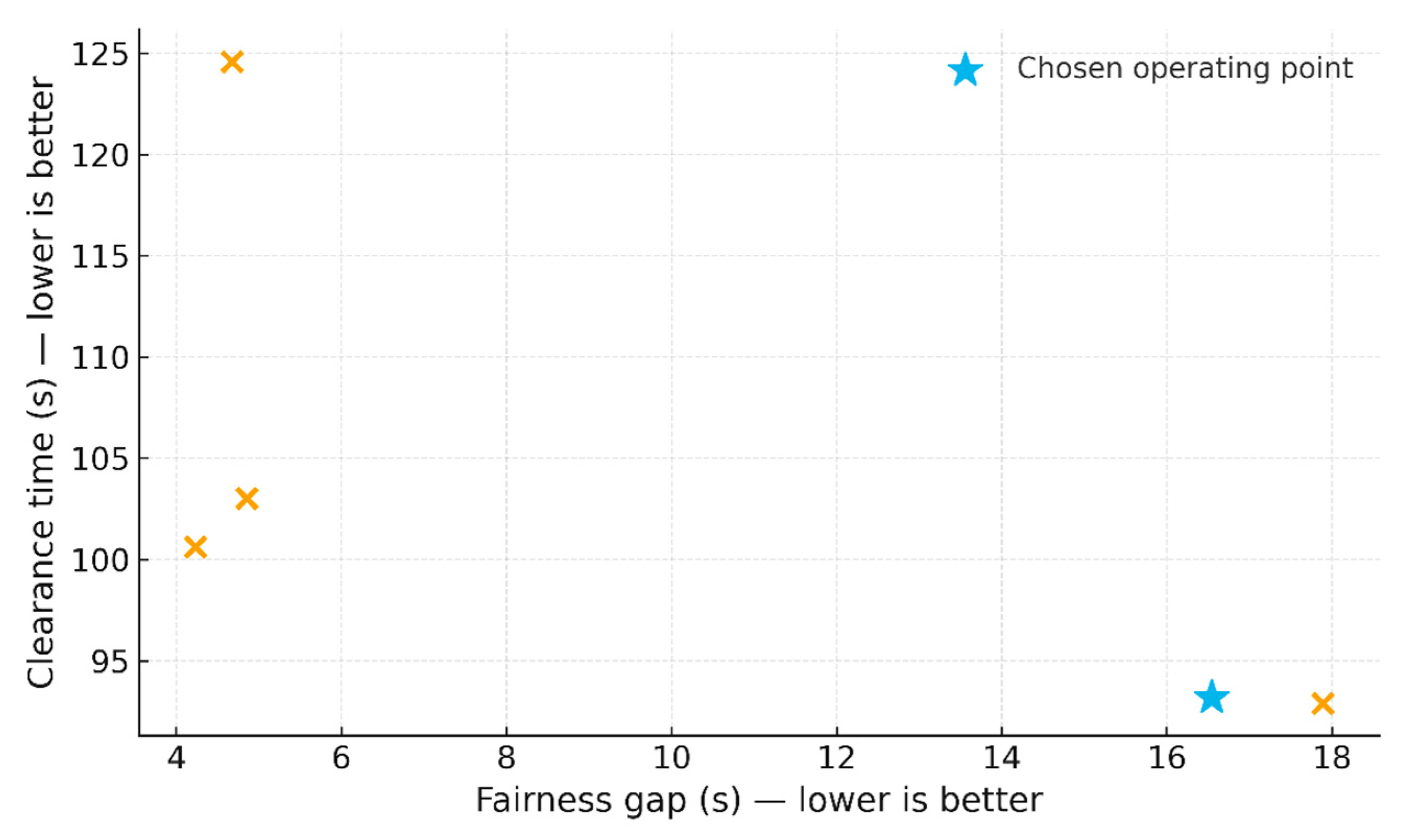
4.9. Fairness Policy Sweep and Operating Point
4.10. Results Format
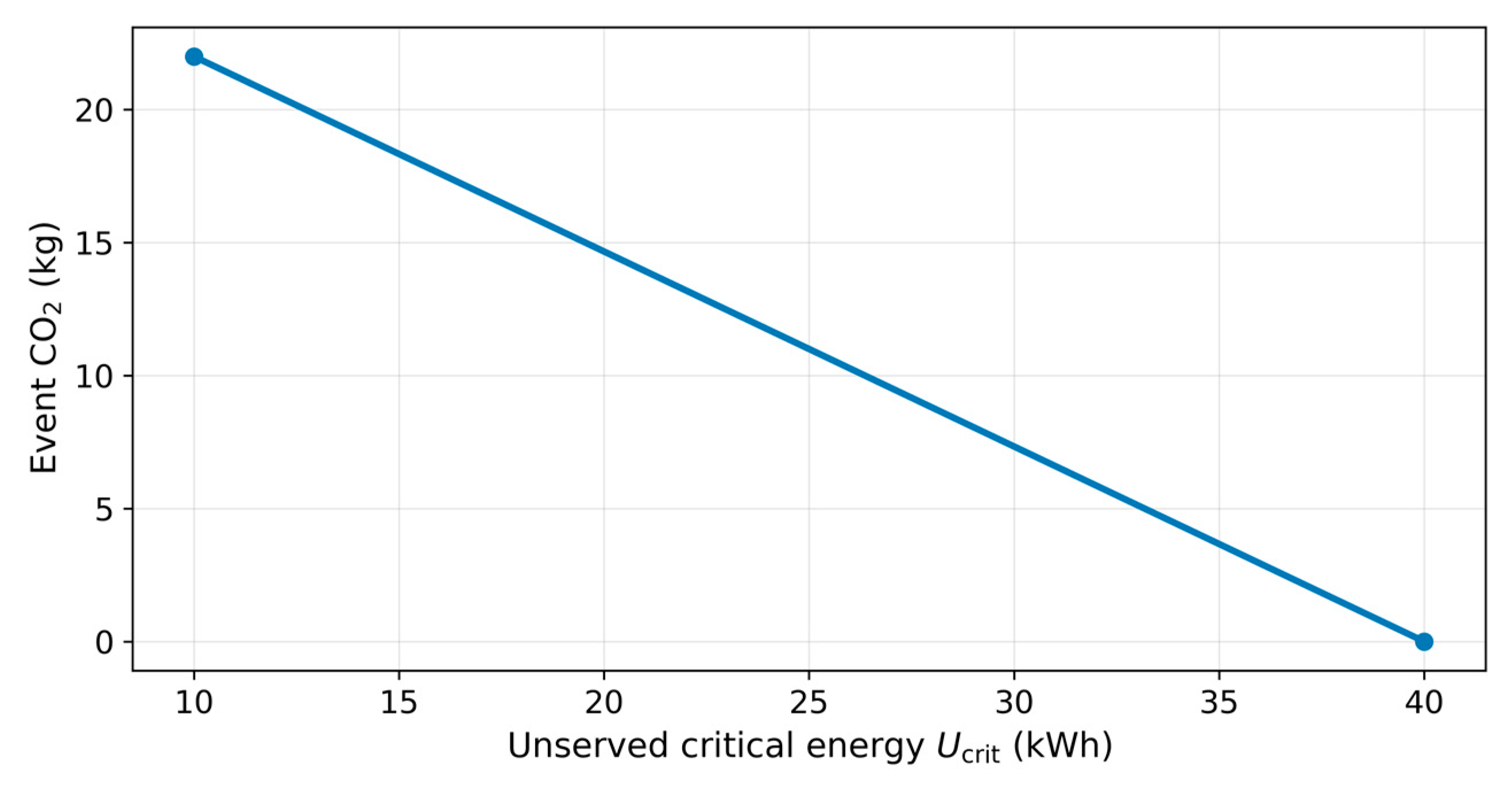
4.11. Tight-Cap Stress Test and Pareto Analysis
5. Discussion
5.1. Safety–Sustainability Trade-Off (Tight-Cap Stress)
5.2. Statistical Robustness
5.3. Limitations and Threats to Validity
- Hazard surrogate realism. The graph advection–diffusion–decay model approximates CFD; absolute exposure magnitudes depend on surrogate calibration and sensor coverage. This is mitigated by focusing on relative performance and by releasing code to re-fit the surrogate to site data.
- Behavioral model. The pedestrian model uses density-dependent speeds and simple queueing; it omits richer behaviors (group cohesion, panic, counter-flow). These factors could affect absolute times but are unlikely to overturn the rank-order differences across methods.
- Single-layout internal validity. Results are demonstrated on a two-floor topology. Generalization to other buildings is limited by connectivity and capacity distributions; nonetheless, the controller and metrics are layout-agnostic, and our artifact supports re-running on other graphs.
- Policy tuning. Our fairness mechanism operationalizes through priority, capacity nudge, and vulnerable assistance. Different institutions may prefer alternative equity constraints (e.g., group-wise maximum egress times). The sensitivity analysis provides a blueprint for selecting a policy point on the efficiency–equity frontier.
- Sustainability factors. Event CO2 depends on grid/diesel emission factors and on whether energy caps bind during the event window. We therefore report both normal and tight-cap cases and provide scripts to vary caps and emissions in the artifact.
5.4. Practical Guidance
5.5. Modular, Decoupled Architecture and Industry 5.0 Resilience
5.6. Generative Scenario Augmentation and Human-in-the-Loop Oversight
5.7. Interoperability in an Industrial-Metaverse Fabric and the Digital Thread
5.8. Scale-Up with Instrumented Testbeds and Bidirectional Energy Flow
6. Conclusions
6.1. Summary of Contributions
6.2. Limitations and Future Research
- -
- The framework is validated on a single multi-storey building. A campus or district-scale DT would need hierarchical routing, multi-building coordination, shared energy resources, and mobile-agent handovers between zones.
- -
- The hazard fields (smoke, visibility, temperature) are modeled using fast surrogate approximations to enable real-time updates. While this allows sub-second optimization cycles, it necessarily simplifies complex fire dynamics, localized turbulence effects, and smoke stratification. Similarly, occupant movement is represented through aggregated crowd-flow models rather than full microscopic behavioral simulation.
- -
- While the controller uses hazard inflation, queue buffers, and reserve SOC margins to handle uncertainty, the framework does not explicitly model epistemic uncertainty or probabilistic hazard propagation. Approaches such as fuzzy uncertainty (e.g., Bakhshian and Martinez-Pastor), Bayesian hazard fields, or distributionally robust optimization could provide more explicit uncertainty quantification.
- -
- Validation uses a high-fidelity DT and controlled hazard scenarios, but does not include full-scale real-building experiments or noisy, multi-hazard conditions (chemical exposure, partial collapse, blocked exits).
- -
- The GEEM model captures battery, PV, diesel backup, and critical-load operation, but assumes known device efficiencies and neglects detailed inverter transient behavior, voltage/thermal limits, and device degradation. Grid-interaction is simplified to active-power constraints.
Author Contributions
Funding
Institutional Review Board Statement
Informed Consent Statement
Data Availability Statement
Conflicts of Interest
References
- Almatared, M.; Nassif, R.; Shahrour, M. Digital-Twin-Based Fire Safety Management Framework for Smart Buildings. Buildings 2023, 14, 4. [Google Scholar] [CrossRef]
- Lin, J.-R.; Chen, K.-Y.; Song, S.-Y.; Cai, Y.-H.; Pan, P.; Deng, Y.-C. Digital Twin of Buildings and Occupants for Emergency Evacuation: Framework, Technologies, Applications, and Trends. Adv. Eng. Inform. 2025, 66, 103419. [Google Scholar] [CrossRef]
- NFPA Fire Protection Research Foundation. A Review of Dynamic Directional Exit Signage: Challenges and Perspectives. 2022. Available online: https://nfpa.org (accessed on 30 August 2025).
- Yen, H.-H.; Lin, C.-H. Intelligent Evacuation Sign Control Mechanism in IoT-Enabled Multi-Floor Multi-Exit Buildings. Sensors 2024, 24, 1115. [Google Scholar] [CrossRef]
- Liu, L.; Zhang, X.; Wang, Y. Real-Time Evacuation Route Optimization in the Fire Scenarios of Cruise Ships. Simul. Model. Pract. Theory 2023, 129, 102843. [Google Scholar] [CrossRef]
- Bi, L.; Deng, W.; Qu, J. Multi-Objective Real-Time Planning of Evacuation Routes in Underground Fires. Appl. Sci. 2024, 14, 7521. [Google Scholar] [CrossRef]
- Wang, H.; Wang, Y.; Wu, X. A Self-Adaptive Escape Route Planning Model Based on an Improved AT-Dijkstra Algorithm. Fire 2024, 7, 459. [Google Scholar] [CrossRef]
- Li, D.; Li, B.; Liu, M. A Reinforcement Learning-Based Routing Algorithm for Large-Scale Evacuation. Int. J. Geogr. Inf. Sci. 2024, 38, 545–569. [Google Scholar] [CrossRef]
- Islam, K.A.; Chen, D.Q.; Marathe, M.; Mortveit, H.; Swarup, S.; Vullikanti, A. Simulation-Assisted Optimization for Large-Scale Evacuation Planning with Congestion-Dependent Delays. In Proceedings of the Thirty-Second International Joint Conference on Artificial Intelligence, Macao, China, 19–25 August 2023. [Google Scholar]
- McGrattan, K.B.; Baum, H.R.; Rehm, R.G.; Hamins, A.; Forney, G.P.; Floyd, J.E.; Hostikka, S.; Prasad, K. Fire Dynamics Simulator, Technical Reference Guide, 6th ed.; Mathematical Model; NIST: Gaithersburg, MD, USA, 2013; Volume 1. [Google Scholar]
- Korhonen, T.; Hostikka, S.; Heliövaara, S.; Ehtamo, H. FDS+Evac: An Agent-Based Fire Evacuation Model. In Pedestrian and Evacuation Dynamics; Springer: Berlin/Heidelberg, Germany, 2009; pp. 971–982. [Google Scholar]
- Cheong, H.; Kim, D.; Park, S. One-Way Coupling of Fire and Egress Modeling for Performance-Based Safety Design. Transp. Res. Rec. 2021, 2675, 1244–1259. [Google Scholar] [CrossRef]
- Tantowi, M.R. A Framework for Two-Way Coupled Fire and Egress Modelling Using BIM. Master’s Thesis, Lund University, Lund, Sweden, 2025. [Google Scholar]
- Senanayake, G.P.D.P.; Kieu, M.; Zou, Y.; Dirks, K. Agent-based simulation for pedestrian evacuation: A systematic literature review. Int. J. Disaster Risk Reduct. 2024, 111, 104705. [Google Scholar] [CrossRef]
- Templeton, A.; Drury, J.; Alnabulsi, A. Agent-Based Models of Social Behaviour and Evacuation. Saf. Sci. 2024, 170, 106362. [Google Scholar]
- Zhang, J.; Li, H.; Zhou, Z. An Improved Social Force Model-Based Crowd Evacuation Simulation in Subway Fires. Geoinformatica 2023, 27, 575–601. [Google Scholar] [CrossRef]
- Park, H.; Liu, D.; Namilae, S. Multi-Agent Reinforcement Learning-Based Pedestrian Dynamics Models for Emergency Evacuation; Final Report CATM-2022-R5-NCAT; North Carolina A&T State University, Transportation Institute, Center for Advanced Transportation Mobility: Greensboro, NC, USA, 2022. Available online: https://rosap.ntl.bts.gov/view/dot/64672 (accessed on 16 September 2025).
- Disabled High-Rise Residents ‘Still at Risk’ Seven Years After Grenfell. The Guardian, 13 June 2024.
- Hostetter, H.; Abad, S. Evacuation Preparedness and Intellectual Disability: Insights from a University Fire Drill. J. Build. Eng. 2024, 93, 109031. [Google Scholar] [CrossRef]
- Lyu, Y.; Lin, B.; Zhang, J. Fire Evacuation for People with Functional Disabilities in High-Rise Buildings: A Systematic Review. Buildings 2025, 15, 634. [Google Scholar] [CrossRef]
- Rismanian, M.; Zarghami, E. Evaluation of crowd evacuation in high-rise residential buildings with mixed-ability population: Combining an architectural solution with management strategies. Int. J. Disaster Risk Reduct. 2022, 77, 103068. [Google Scholar] [CrossRef]
- Gupta, H.S.; Chen, A.; Park, B.J. Fairness-Driven Multi-Objective Optimization for Evacuation Planning in Natural Disasters. Transp. Res. Part D, 2024; preprint. [Google Scholar]
- Wang, D.; Sun, L. Multi-Stage Equitable Bus-Based Hurricane Evacuation Planning. Transp. Res. Rec. 2023, 2677, 831–847. [Google Scholar]
- Bairi, P.; Swain, S.; Bandyopadhyay, A.; Aurangzeb, K.; Alhussein, M.; Mallik, S. Intelligent VANET-Based Traffic Signal Control System for Emergency Vehicle Priority. Egypt. Inform. J. 2025, 30, 100700. [Google Scholar] [CrossRef]
- Galveston Awarded $2M for Traffic Light Integration System That Prioritizes Emergency Vehicles. Houston Chronicle, 10 February 2025.
- U.S. DOT ITS JPO. Simulation Study: Intelligent Traffic Signal Control with Emergency Vehicle Priority; ITS JPO: Washington, DC, USA, 2025.
- Mnasri, S.; Habbash, M. Study of the influence of Arabic mother tongue on the English language using a hybrid artificial intelligence method. Interact. Learn. Environ. 2021, 31, 5568–5581. [Google Scholar] [CrossRef]
- Laddha, S.; Mnasri, S.; Alghamdi, M.; Kumar, V.; Kaur, M.; Alrashidi, M.; Almuhaimeed, A.; Alshehri, A.; Alrowaily, M.A.; Alkhazi, I. COVID-19 Diagnosis and Classification Using Radiological Imaging and Deep Learning Techniques: A Comparative Study. Diagnostics 2022, 12, 1880. [Google Scholar] [CrossRef] [PubMed]
- Hadjidimitriou, N.S.; Lippi, M.; Mamei, M.; Nastro, R.; Picone, M.; D’Andreagiovanni, F. Data-Driven Adaptation of Smart Grids With Hierarchical Digital Twins. IEEE Pervasive Comput. 2025, 24, 10–18. [Google Scholar] [CrossRef]
- Bakhshian, E.; Martinez-Pastor, B. A multi-objective optimization model to minimize the evacuation time during a disaster considering reconstruction activity and uncertainty: A case study of Cork City. Transp. Eng. 2024, 16, 100234. [Google Scholar] [CrossRef]
- European Commission. Industry 5.0: Towards a Sustainable, Human-Centric and Resilient European Industry. European Commission, Directorate-General for Research and Innovation. 2021. Available online: https://research-and-innovation.ec.europa.eu/knowledge-publications-tools-and-data/publications/all-publications/industry-50-towards-sustainable-human-centric-and-resilient-european-industry_en (accessed on 21 September 2025).
- ESIR (European Commission Expert Group). Industry 5.0: A Transformative Vision for Europe—Governing Systemic Transformations Towards a Sustainable Industry; European Commission Expert Group: Brussels, Belgium, 2022. [Google Scholar]
- Leng, J.; Zhou, M.; Xiao, Y.; Zhang, H.; Liu, Q.; Shen, W.; Su, Q.; Li, L. Digital twins-based remote semi-physical commissioning of flow-type smart manufacturing systems. J. Clean. Prod. 2021, 306, 127278. [Google Scholar] [CrossRef] [PubMed]
- Leng, J.; Su, X.; Liu, Z.; Zhou, L.; Chen, C.; Guo, X.; Wang, Y.; Wang, R.; Zhang, C.; Liu, Q.; et al. Diffusion model-driven smart design and manufacturing: Prospects and challenges. J. Manuf. Syst. 2025, 82, 561–577. [Google Scholar] [CrossRef]
- Martini, B.; Bellisario, D.; Coletti, P. Human-centered and sustainable artificial intelligence in industry 5.0: Challenges and perspectives. Sustainability 2024, 16, 5448. [Google Scholar] [CrossRef]
- Mentzas, G.; Hribernik, K.; Stahre, J.; Romero, D.; Soldatos, J. Human-Centered Artificial Intelligence in Industry 5.0. Front. Artif. Intell. 2024, 7, 1429186. [Google Scholar] [CrossRef]
- Guo, J.; Leng, J.; Zhao, J.L.; Zhou, X.; Yuan, Y.; Lu, Y.; Mourtzis, D.; Qi, Q.; Huang, S.; Song, X.; et al. Industrial metaverse towards Industry 5.0: Connotation, architecture, enablers, and challenges. J. Manuf. Syst. 2024, 76, 25–42. [Google Scholar] [CrossRef]
- ETSI ISG CIM. Context Information Management (CIM); NGSI-LD API Specification; ETSI GS CIM 009 V1.5.1. ETSI: Sophia Antipolis, France, 2021. Available online: https://www.etsi.org/deliver/etsi_gs/CIM/001_099/009/01.05.01_60/gs_cim009v010501p.pdf (accessed on 21 September 2025).
- OPC Unified Architecture—Interoperability for Industrie 4.0 and the Internet of Things; Updated Brochure. OPC Foundation: Scottsdale, AZ, USA, 2023. Available online: https://opcfoundation.org/wp-content/uploads/2023/05/OPC-UA-Interoperability-For-Industrie4-and-IoT-EN.pdf (accessed on 21 September 2025).





| Work/Domain | Real-Time? | Hazard-Aware? | Fairness? | DT-Integrated? | Energy Co-Optimization? | Multi-Objective? | Main Limitation |
|---|---|---|---|---|---|---|---|
| Classical evacuation simulators | X | Partial | X | X | X | X | Static, no DT, no sensing |
| Hazard-aware routing | ✓ | ✓ | X | X | X | Partial | No fairness, limited sensing |
| DT-based fire modeling | ✓ | ✓ | X | ✓ | X | X | Simulation only |
| Building energy management | ✓ | X | X | Partial | ✓ | Partial | No evacuation consideration |
| Hierarchical DT [29] | x | Partial | X | ✓ | ✓ | N/A | Not designed for sub-second, life-critical building emergencies |
| Fuzzy evacuation [30] | x | Partial | x | X | X | N/A | Strategic recovery focus, not sub-second emergency control. |
| This work | ✓ | ✓ | ✓ | ✓ | ✓ | ✓ | Integrated, real-time, multi-domain optimization |
| Factor | Levels | Value(s) Actually Used |
|---|---|---|
| Floors/exits per floor | fixed | 2 floors; one exit per floor (E1, E2) |
| Ignition location | fixed | H1 (hall, Floor 1) |
| HVAC state | fixed | On |
| Occupant count NN | fixed | 80 |
| Vulnerable fraction | fixed | 25% |
| Control period Δt\Delta t | fixed | 2 s |
| Runtime budget | fixed | 900 s |
| Seeds per scenario SS | fixed | 5 |
| Edge inaccessibility threshold | fixed | Hazard ≥ 1.3 |
| Parameter | Symbol/Equation | Value | Notes |
|---|---|---|---|
| Hazard weight | κ1/(6) | 6 | Higher penalty for hazardous links |
| Congestion weight | κ2/(6) | 1 | Density-based travel time |
| Inaccessibility penalty | κ3/(6) | Large | Blocks unusable links; stairs inaccessible to wheelchair users |
| Exposure cap (per-agent) | /(3) | group-dependent | Vulnerable = 0.7× standard cap |
| Fairness mechanics (runtime) | — | Priority + capacity nudge + 0.9× speed assist | 1.25× speed penalty for vulnerable when fairness off |
| Control period | Δt | 2s | Meets deadline in all runs |
| Quantity | Symbol | Value | Notes |
|---|---|---|---|
| PV nameplate | 80 kW | Constant in main runs | |
| Battery energy | 150 kWh | Reserve floor 20% SOC | |
| Battery power | 80 kW | Charge/discharge limit | |
| Grid import cap | 120 kW | 60 kW in stress variant (supplement) | |
| Diesel genset | 0 kW (baselines/B3); 100 kW (proposed method, stress only) | Off in the main runs | |
| Grid emission factor | 0.55 kg-CO2e/kWh | Used for | |
| Diesel emission factor | 0.80 kg-CO2e/kWh | Used for |
| Method | (s) | (Exposure Units) | Fairness Gap (s) | (kWh) |
|---|---|---|---|---|
| B0 | 152.4 ± 5.9 | 37.60 [7.15] | 14.54 ± 4.87 | 2.54 ± 0.10 |
| B1 | 158.0 ± 9.4 | 38.13 [8.11] | 13.16 ± 6.06 | 2.63 ± 0.16 |
| B2 | 158.0 ± 9.4 | 38.13 [8.11] | 13.16 ± 6.06 | 2.63 ± 0.16 |
| B3 | 135.6 ± 6.0 | 36.13 [5.72] | 38.93 ± 6.78 | 2.26 ± 0.10 |
| Proposed method | 95.2 ± 2.7 | 20.55 [2.86] | 16.29 ± 4.70 | 3.01 ± 0.13 |
| Method | (s) | (kWh) | (kg) | (kWh) |
|---|---|---|---|---|
| B3 | 135.6 ± 6.0 | 0.94 ± 0.04 | 0.21 ± 0.01 | 1.32 ± 0.06 |
| The proposed method | 135.6 ± 6.0 | 3.01 ± 0.13 | 1.86 ± 0.08 | 0.00 ± 0.00 |
| Topology | Method | (s) | Exposure (Units) | Fairness Gap (s) | (kWh) |
|---|---|---|---|---|---|
| baseline | B0 | 128.0 ± 0.0 | 18.72 [16.52] | 7.94 ± 7.54 | 2.13 ± 0.00 |
| baseline | B1 | 101.6 ± 5.7 | 18.65 [16.02] | 6.26 ± 6.77 | 1.69 ± 0.10 |
| baseline | B2 | 101.6 ± 5.7 | 18.65 [16.02] | 6.26 ± 6.77 | 1.69 ± 0.10 |
| baseline | B3 | 94.0 ± 2.5 | 18.37 [16.42] | 18.31 ± 4.74 | 1.57 ± 0.04 |
| baseline | Proposed method | 94.0 ± 2.5 | 18.37 [16.42] | 18.31 ± 4.74 | 2.09 ± 0.06 |
| high-rise | B0 | 190.0 ± 6.2 | 11.48 [12.87] | 15.71 ± 16.05 | 3.17 ± 0.10 |
| high-rise | B1 | 164.0 ± 13.3 | 10.86 [12.70] | 8.06 ± 8.19 | 2.73 ± 0.22 |
| high-rise | B2 | 164.0 ± 13.3 | 10.86 [12.70] | 8.06 ± 8.19 | 2.73 ± 0.22 |
| high-rise | B3 | 151.6 ± 12.7 | 10.31 [12.50] | 24.39 ± 10.48 | 2.53 ± 0.21 |
| high-rise | Proposed method | 151.6 ± 12.7 | 10.31 [12.50] | 24.39 ± 10.48 | 3.37 ± 0.28 |
| u | B0 | 164.0 ± 0.0 | 3.85 [35.35] | 14.14 ± 6.84 | 2.73 ± 0.00 |
| u | B1 | 164.0 ± 0.0 | 3.85 [35.35] | 14.14 ± 6.84 | 2.73 ± 0.00 |
| u | B2 | 164.0 ± 0.0 | 3.85 [35.35] | 14.14 ± 6.84 | 2.73 ± 0.00 |
| u | B3 | 151.6 ± 3.8 | 3.45 [34.04] | 32.54 ± 3.47 | 2.53 ± 0.06 |
| u | Proposed method | 151.6 ± 3.8 | 3.45 [34.04] | 32.54 ± 3.47 | 3.37 ± 0.08 |
| Topology | Baseline | T_Clear_Mean_Diff | T_Clear_p_Sign | T_Clear_dz | T_Clear_r_rb | Exposure_Median_Mean_Diff | Exposure_Median_p_Sign | Exposure_Median_dz | Exposure_Median_r_rb | Fairness_Gap_Mean_Diff | Fairness_Gap_p_Sign | Fairness_Gap_dz | Fairness_Gap_r_rb |
|---|---|---|---|---|---|---|---|---|---|---|---|---|---|
| baseline | B0 | −34 | 0.25 | −12.02 | −1 | −0.5 | 0.25 | −2.26 | −1 | 10.37 | 1 | 0.75 | 0.6 |
| baseline | B1 | −7.6 | 0.188 | −1.42 | −1 | −0.45 | 0.188 | −1.96 | −1 | 12.05 | 1 | 0.93 | 0.6 |
| baseline | B2 | −7.6 | 0.125 | −1.42 | −1 | −0.45 | 0.125 | −1.96 | −1 | 12.05 | 0.75 | 0.93 | 0.6 |
| baseline | B3 | 0 | 1 | 0 | 0 | 0 | 1 | 0 | 0 | 0 | 1 | 0 | 0 |
| Topology | Comparison | N_Pairs | p(T_max) | Test(T_max) | p(T_95) | Test(T_95) | p(T_mean) | Test(T_mean) | p(Exp_sum) | Test(Exp_sum) | p(Exp_max) | Test(Exp_max) |
|---|---|---|---|---|---|---|---|---|---|---|---|---|
| baseline | B1 vs. B0 | 5 | 0.000182 | paired t | 2.92 × 10⁻⁵ | paired t | 6.44 × 10⁻⁷ | paired t | 6.55 × 10⁻⁸ | paired t | 0.00015222 | paired t |
| baseline | B2 vs. B0 | 5 | 0.000182 | paired t | 2.92 × 10⁻⁵ | paired t | 6.44 × 10⁻⁷ | paired t | 6.55 × 10⁻⁸ | paired t | 0.00015222 | paired t |
| baseline | B3 vs. B0 | 5 | 0.0625 | Wilcoxon | 0.0625 | Wilcoxon | 4.91 × 10⁻⁶ | paired t | 2.99 × 10⁻⁵ | paired t | 0.00986611 | paired t |
| baseline | Proposed vs. B0 | 5 | 6.32 × 10⁻⁵ | paired t | 0.0625 | Wilcoxon | 1.27 × 10⁻⁷ | paired t | 1.85 × 10⁻⁶ | paired t | 0.0625 | Wilcoxon |
| high-rise | B1 vs. B0 | 5 | 0.007435 | paired t | 0.002016 | paired t | 0.0625 | Wilcoxon | 0.0625 | Wilcoxon | 0.00473574 | paired t |
| high-rise | B2 vs. B0 | 5 | 0.010354 | paired t | 0.003943 | paired t | 0.000516823 | paired t | 0.0625 | Wilcoxon | 3.42 × 10⁻⁵ | paired t |
| high-rise | B3 vs. B0 | 5 | 0.0625 | Wilcoxon | 0.000638 | paired t | 0.0625 | Wilcoxon | 8.52 × 10⁻⁵ | paired t | 8.04 × 10⁻⁵ | paired t |
| high-rise | Proposed vs. B0 | 5 | 0.0625 | Wilcoxon | 0.001129 | paired t | 0.0625 | Wilcoxon | 0.0625 | Wilcoxon | 0.000948247 | paired t |
| ushape | B1 vs. B0 | 5 | paired t | paired t | 0.317310508 | Wilcoxon | 0.317310508 | Wilcoxon | 0.317310508 | Wilcoxon | ||
| ushape | B2 vs. B0 | 5 | paired t | paired t | paired t | paired t | paired t | |||||
| ushape | B3 vs. B0 | 5 | 0.0455 | Wilcoxon | 0.0625 | Wilcoxon | 0.00032931 | paired t | 0.0625 | Wilcoxon | 0.089450509 | paired t |
| ushape | Proposed vs. B0 | 5 | 0.0625 | Wilcoxon | 0.0625 | Wilcoxon | 0.000238899 | paired t | 0.000482224 | paired t | 0.089450509 | paired t |
Disclaimer/Publisher’s Note: The statements, opinions and data contained in all publications are solely those of the individual author(s) and contributor(s) and not of MDPI and/or the editor(s). MDPI and/or the editor(s) disclaim responsibility for any injury to people or property resulting from any ideas, methods, instructions or products referred to in the content. |
© 2025 by the authors. Licensee MDPI, Basel, Switzerland. This article is an open access article distributed under the terms and conditions of the Creative Commons Attribution (CC BY) license.
Share and Cite
Alghamdi, M.; Abadleh, A.; Mnasri, S.; Alrashidi, M.; Alkhazi, I.S.; Alghamdi, A.; Albelwi, S. Hazard- and Fairness-Aware Evacuation with Grid-Interactive Energy Management: A Digital-Twin Controller for Life Safety and Sustainability. Sustainability 2026, 18, 133. https://doi.org/10.3390/su18010133
Alghamdi M, Abadleh A, Mnasri S, Alrashidi M, Alkhazi IS, Alghamdi A, Albelwi S. Hazard- and Fairness-Aware Evacuation with Grid-Interactive Energy Management: A Digital-Twin Controller for Life Safety and Sustainability. Sustainability. 2026; 18(1):133. https://doi.org/10.3390/su18010133
Chicago/Turabian StyleAlghamdi, Mansoor, Ahmad Abadleh, Sami Mnasri, Malek Alrashidi, Ibrahim S. Alkhazi, Abdullah Alghamdi, and Saleh Albelwi. 2026. "Hazard- and Fairness-Aware Evacuation with Grid-Interactive Energy Management: A Digital-Twin Controller for Life Safety and Sustainability" Sustainability 18, no. 1: 133. https://doi.org/10.3390/su18010133
APA StyleAlghamdi, M., Abadleh, A., Mnasri, S., Alrashidi, M., Alkhazi, I. S., Alghamdi, A., & Albelwi, S. (2026). Hazard- and Fairness-Aware Evacuation with Grid-Interactive Energy Management: A Digital-Twin Controller for Life Safety and Sustainability. Sustainability, 18(1), 133. https://doi.org/10.3390/su18010133