Article

Sustainable Lipase Immobilization on Eggshell Membrane Carriers: Economic and LCA Insights at Laboratory Scale


1
Faculty of Food Technology Osijek, University of Osijek, Franje Kuhača 18, 31000 Osijek, Croatia
2
School of Chemical Engineering, North Terrace Campus, Adelaide University, Adelaide 5005, Australia
3
GREiA Research Group, Higher Polytechnic Engineering School, University of Lleida, 25001 Lleida, Spain
*
Author to whom correspondence should be addressed.
Sustainability 2026, 18(1), 134; https://doi.org/10.3390/su18010134
Submission received: 29 October 2025 / Revised: 8 December 2025 / Accepted: 19 December 2025 / Published: 22 December 2025

Abstract

This study presents a comprehensive economic and environmental evaluation of immobilized lipases produced on eggshell membrane-based carriers from eggshell waste, based on laboratory-scale experiments. By integrating economic analysis (EA) and life cycle analysis (LCA), the key factors affecting the economic viability and environmental impact of the process were identified, supporting sustainable and circular biorefinery concepts. The EA estimated the total process cost at EUR 25.63 for 15 g of product, while the effective net cost was negative (EUR −14.81) due to the valorization of anhydrous calcium chloride as a valuable by-product. The effective net cost reduction from by-product valorization of the immobilized lipase was estimated at 0.99 EUR/g as the minimum selling price (MSP). When expressed per unit of enzymatic activity, the immobilized lipase on the eggshell waste membrane-based carrier shows a substantially lower cost (EUR/U) compared with representative commercial immobilized lipases, demonstrating clear catalytic cost-efficiency advantages. The cradle-to-gate life cycle assessment, conducted using ReCiPe 2016 quantification methods, highlighted electricity consumption during drying as the primary environmental hotspot, accounting for up to 57% of the global warming potential. Sensitivity and uncertainty analyses showed that energy consumption strongly influences the impact in terms of climate change and fossil resource depletion, while the impact of chemical use was minimal. These results show that energy-efficient process optimization, especially in the drying phase, is crucial for further improving environmental and economic performance. These results indicate that optimizing energy efficiency, especially during the drying phase, is crucial for further improving the production process of immobilized lipases on eggshell membrane-based carriers, both environmentally and economically.

1. Introduction

The rapid advancement of biotechnology, accompanied by the increasing demand for sustainable and cost-effective industrial processes, has intensified interest in the valorization of biowaste. One particularly abundant and underutilized waste stream is eggshell waste, which is generated in millions of tonnes annually, primarily by the food industry [1]. Eggshells are composed mainly of calcium carbonate calcified matrix (~95%) and a protein-rich membrane (~3.3%), both of which have high potential for biotechnological upcycling [2,3].
Recent studies have shown that eggshell membrane (ESM) is an effective, renewable platform for the immobilization of enzymes due to its unique composition and surface functionality [3,4] and represents a cost-effective, renewable alternative to conventional commercial carriers. Enzyme immobilization remains essential for building robust, cost-effective biocatalytic systems in sectors such as food processing, biofuels, and pharmaceuticals [4,5]. Immobilization enhances catalyst reusability, stability, and ease of recovery, which are critical for the development of economically and environmentally viable biocatalytic processes [4]. Lipases, in particular, are widely employed in biotechnological applications such as biodiesel production, food processing, and pharmaceuticals, making their efficient immobilization highly relevant [6,7]. However, most commercial immobilization carriers are costly and often derived from unsustainable sources, posing both economic and environmental concerns. Existing commercial immobilization supports, including synthetic polymer beads and inorganic matrices, are not only expensive (EUR 3–6/g for supports) but are primarily sourced from non-renewable materials. Therefore, the use of low-cost, bio-based carriers aligns strongly with the principles of the circular bioeconomy, where waste is reintroduced into value chains [1,5,8,9]. Enzyme immobilization offers significant cost savings and environmental benefits for biochemical processes by enabling the reuse of enzymes, increasing stability, minimizing waste and reducing resource consumption [10,11].
Immobilized enzymes reduce costs primarily through their longevity and recyclability [12,13,14], while their environmental benefits result from the reduced use of toxic reagents and the reduction in waste in industrial-scale biochemical production [11,15,16].
In the case of eggshells, a holistic utilization approach is possible: the membrane can be used for the immobilization of enzymes, the mineral fraction (calcified matrix) can be recovered as anhydrous calcium chloride, and the proteinaceous components can be used in other high-value biochemical processes [3,17,18]. Such a multi-stream strategy contributes not only to zero-waste process design but also adds economic and environmental value to waste conversion chains, providing value-added outputs aligned with circular economy principles.
Beyond technical feasibility, it is important to assess the environmental and economic sustainability of such novel processes. Life cycle analysis (LCA) provides a systematic methodology to assess potential environmental impacts, while cost-based assessment provides insight into economic viability under laboratory and pre-industrial conditions. Previous studies have shown the importance of incorporating LCA and economic tools early in process development to identify trade-offs, optimize system design and facilitate the transition to industrial scale [19]. Several recent LCA case studies have confirmed the sustainability potential of biowaste-based materials compared to conventional immobilization carriers, especially when waste recycling is integrated into the system [20,21]. In addition, the application of cradle-to-gate LCA helps to identify environmental hotspots, such as steps with high energy or material consumption, which could hinder large-scale application or market competitiveness. At the same time, economic indicators such as minimum selling price (MSP) and effective net cost provide quantitative, scenario-based decision support for process selection, optimization and scale-up paths. The integration of these LCA and economic assessments is now widely recognized as crucial for the development of sustainable industrial biotechnology. It supports both research and industrial stakeholders in aligning new processes with circular economy and sustainability goals [1,22,23]. Recent studies have confirmed that such dual assessments not only help to identify environmental and economic bottlenecks, but also accelerate iterative process improvements, facilitate transparent communication with policy makers and investors, and demonstrate the tangible benefits of biowaste utilization compared to fossil or linear alternatives [22,23,24]. These assessments directly contribute to broader sustainability frameworks and targets for industrial biotechnology [25].
The objective of this study was to evaluate the economic analysis (EA) and life cycle assessment (LCA) of a commercial lipase immobilized on a low-cost carrier derived from the eggshell membrane fraction under laboratory-scale conditions. The process integrates waste utilization, biocatalytic functionality and life cycle thinking aiming to support future scale-up and contribute to the implementation of circular bioeconomy principles in enzyme technology.
Our study addresses three main research gaps:
Integrated economic and environmental assessment: To date, there are few studies that systematically quantify both the process cost and the minimum selling price of immobilized enzymes produced from waste streams, taking into account environmental performance using LCA [20].
Transparent benchmarking with commercial alternatives: Many previous reports aggregate process and sales prices or use idealized (non-market) inputs, obscuring real-world competitiveness.
Process optimization with a focus on hotspots: Although drying in biorefineries is widely considered energy intensive [26], few reports target this step to reduce energy consumption to an appropriate extent.
Accordingly, this study combines life cycle assessment (LCA) and economic analysis (EA) to evaluate the immobilization of a commercial lipase from both environmental and financial perspectives. The LCA is conducted using a cradle-to-gate approach to quantify impacts across categories including climate change, fossil depletion, terrestrial ecotoxicity, land use, ionizing radiation, human toxicity (non-cancer), and freshwater consumption, which were identified as making the most significant contributions to the overall environmental impact. In parallel, the economic assessment estimates the total process cost, effective net cost and minimum selling price (MSP) of the immobilized lipase product based on mass and energy balances derived from optimized laboratory protocols [18]. This dual assessment approach aims to identify critical process steps, quantify trade-offs and demonstrate the potential for upscaling the process towards an industrial application. In addition, a sensitivity analysis is performed to assess the robustness of the results with respect to input variability, focussing on key parameters such as feedstock prices (HCl and lipase) and energy requirements. The novelty of this study lies in the integration of ESM-based immobilization, full utilization of eggshell waste and simultaneous environmental and economic assessment, providing a fact-based framework for sustainable biocatalyst production. This work for the first time transparently quantifies all process costs and distinguishes between the effective net cost and the likely market price. By using both the enzyme carrier and the anhydrous CaCl2 by-product production, we demonstrate best-in-class economic and environmental performance, with potentially negative effective net cost due to full utilization of the waste stream.

2. Methodological Approach

This study combines laboratory-scale experimentation with environmental and economic analyses to assess the feasibility of producing immobilized lipases using eggshell membrane-based carriers (ESMC). A multi-step valorization pathway was developed, encompassing eggshell pre-treatment, membrane separation, carrier preparation, enzyme immobilization, and by-product valorization. The methodological framework integrates Life Cycle Assessment (LCA) and economic evaluation (EA), structured in accordance with ISO 14040:2006 [27] and is supported by a sensitivity analysis to assess process variability.

2.1. Summary of ESMC Preparation, Lipase Immobilization, and Input Performance Parameters

In several previously published studies, the complete valorisation of waste eggshells and the development of eggshell membrane-based carriers for lipase immobilization have been thoroughly investigated by our research group. These studies described the transformation of waste eggshells into an adhesive egg-white layer, the corresponding calcium salts, and the eggshell membrane, which was used as a carrier (Strelec et al., 2023; Strelec et al., 2024 [17,18]). Waste eggshells were treated with different acids (5% hydrochloric, 10% acetic, and 15% o-phosphoric acid), allowing the recovery of both the protein-rich membrane and valuable calcium-based by-products.
The immobilization procedures for Burkholderia cepacia lipases (Amano Lipase PS from Burkholderia cepacia, Sigma-Aldrich, St. Louis, MO, USA, product number 534641), via adsorption as well as through covalent direct and indirect binding onto ESM-based carriers, were comprehensively described by Ostojčić et al. [28]. That study also reported the biochemical characterization of both free and immobilized lipases, including their pH and temperature optima, pH and temperature stability, stability in methanol and ethanol, substrate specificity, reusability, and their functionality in the pretreatment of oil-industry wastewater.
Across these previous investigations, the most favourable performance was consistently observed for lipases immobilized by adsorption onto ESM treated with 5% hydrochloric acid, with anhydrous food-grade calcium chloride generated as a valuable by-product. Strelec et al. [18] provided a detailed description of the treatment of the calcium-rich filtrate remaining after acid decalcification of waste eggshells. Neutralization, evaporation, and spray drying yielded a high-quality CaCl2 product that meets the requirements of the European Union Commission Regulations (EU) [29] and the Food and Agriculture Organization (FAO) [30] for use as a food-grade additive. This confirms CaCl2 as a marketable co-product that enhances the overall efficiency of eggshell waste valorisation.
Table 1 summarizes the key physicochemical properties of the ESM carrier (ESMC) and the catalytic performance parameters of the immobilized lipase, which were used as fixed input data in the present study. For the ESMC, these include membrane particle size (after milling), moisture content (after drying), surface area (BET), and pore volume and size. The catalytic parameters include immobilization yield, enzyme loading, recovered activity, relative specific activity (immobilized versus free lipase), operational stability (half-life), reusability (number of cycles until residual activity decreases to 50%), and storage stability. All values are mean data previously reported in our experimental studies [3,18,28]. These parameters provide the basis for defining the activity-based functional unit and for benchmarking the performance of the ESMC-supported lipase against commercial immobilized enzymes.

2.2. Goal and Scope

The primary goal of this study is to evaluate the environmental and economic performance of a novel enzyme immobilization system based on carriers derived from the membrane fraction of eggshell waste. The immobilized biocatalyst, prepared through a multi-stage laboratory-scale process, is designed to serve as a sustainable and cost-effective alternative to commercially available immobilization systems, which are often expensive and rely on non-renewable resources.
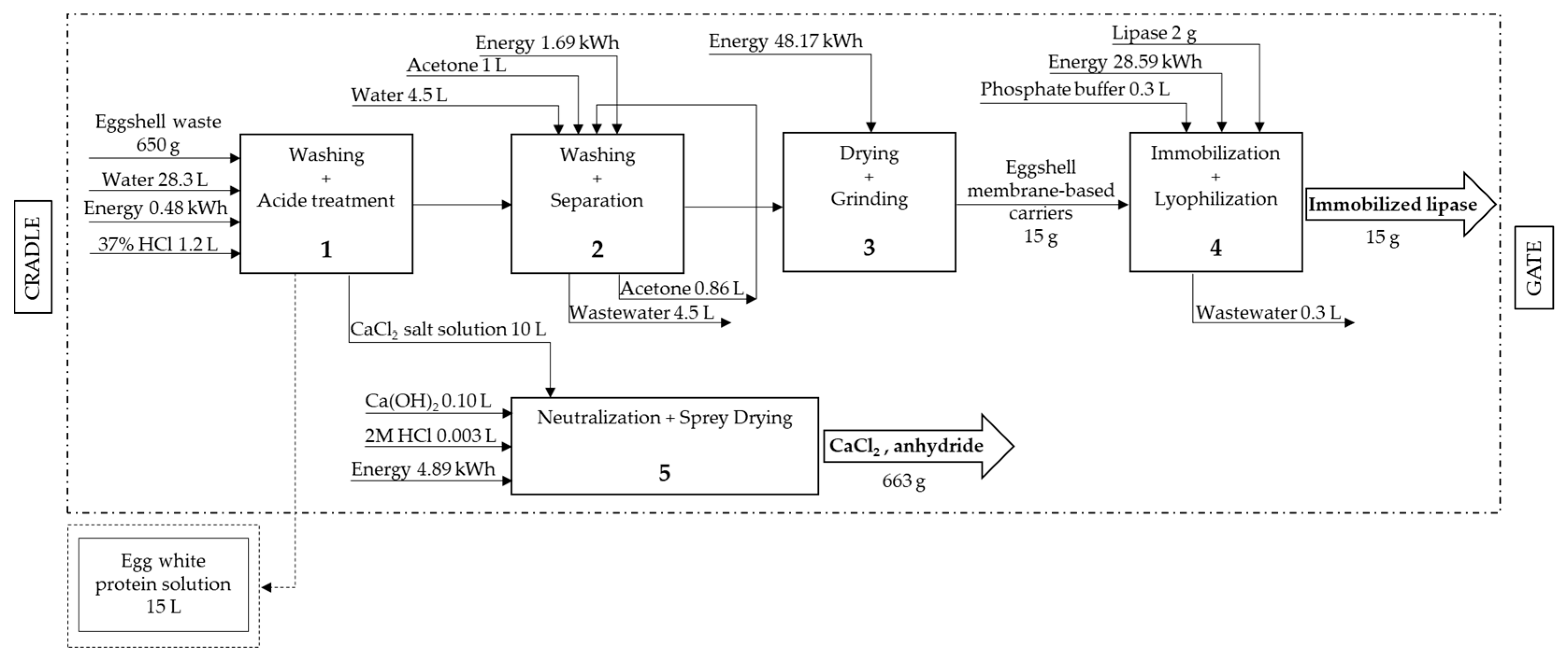
The analysis scope covers the entire cradle-to-gate process, from the input of raw eggshell waste to the production of the immobilized enzyme product. The system boundary was defined using a cradle-to-gate approach and was structured into five sequential process units, each representing a key operational phase. These process units are illustrated in Figure 1, which outlines material and energy inputs and outputs at each stage:
  • Washing and Acid Treatment: Removal of surface contaminants and decalcification of the eggshell using hydrochloric acid (HCl);
  • Washing and Separation: Mechanical separation of the protein-rich membrane from the calcium carbonate matrix;
  • Drying and Grinding: Dehydration and particle size reduction in the membrane to prepare it for the immobilization process;
  • Immobilization and Lyophilization: Adsorptive binding of lipase to the prepared membrane carrier and subsequent enzyme stabilization via lyophilization;
  • By-product Valorization: Recovery and Neutralization of the calcium-rich filtrate with sodium hydroxide (NaOH) to produce anhydrous calcium chloride (CaCl2) via spray drying.
Inputs included within the system boundaries comprise raw materials (HCl, Ca(OH)2, acetone, tap water, and the lipase enzyme solution), electricity consumption for stirring, drying, and lyophilization, and process water. The system outputs include the immobilized enzyme on ESMC as the main product and anhydrous calcium chloride as a valorised by-product.
Proteinaceous residues from egg white separated during washing were excluded from this analysis due to their minor mass contribution and undefined valorization pathway.

2.3. Life Cycle Inventory (LCI)

The life cycle inventory (LCI) for the production of Immobilized lipases on ESMC was compiled based on laboratory-scale experimental data. Table 2 summarizes the key material and energy inputs, along with their associated costs, used in the analysis.
The main cost drivers include:
  • Lipase enzyme (EUR 7.68);
  • Energy for the main process (EUR 11.84);
  • Hydrochloric acid (37% HCl) (EUR 3.12).
In contrast, several components such as eggshell waste (the primary raw material) and recycled acetone are attributed negligible or zero cost, aligning with the waste valorization framework.
The total process cost was calculated at EUR 25.63, which includes all material and energy consumption required to obtain 15 g of immobilized lipase product. However, by valorizing the by-product, anhydrous CaCl2 (663 g, valued at EUR 40.44), the effective net cost becomes EUR −14.81, indicating economic favourability at the laboratory scale. This approach demonstrates how full-stream valorization can significantly offset production costs.
This inventory data also served as the basis for the sensitivity analysis, assessing how fluctuations in the cost of HCl, lipase, and energy (±20%) impact the effective net cost, highlighting the relative economic robustness of the proposed waste-to-value process.
The sensitivity analysis has been performed by considering the electricity consumption in the entire process, the hydrochloric acid consumption as well as lipase consumption. The sensitivity analysis was evaluated by inserting ±20% variation in the above-mentioned input parameters, and the degree of influence of each parameter on the total sum of environmental loads were determined.
Uncertainty analysis was carried out to assess the robustness of the environmental results and to identify critical process variables. The analysis was conducted using Monte Carlo simulation (1000 iterations, 95% confidence interval), as implemented within LCA for experts 10.8 software. This approach accounts for the inherent uncertainty in key inventory parameters and provides statistically reliable intervals for each impact category.
The following input parameters were varied within the simulation: electricity consumption in drying and lyophilization units (±20%), reagent use (HCl ±15%), valorization factor for anhydrous CaCl2 (market credit ±30%).
The uncertainty analysis helped to identify the most influential contributors to environmental impact variability—particularly energy-intensive operations and the efficiency of eggshell membrane recovery.

2.4. Life Cycle Assessment (LCA)

The Life Cycle Assessment (LCA) was conducted using the Sphera LCA for experts 10.9.1.17 software (LCA FE, Sphera Solutions GmbH, Leinfelden-Echterdingen, Germany). The environmental impacts were assessed with ReCiPe 2016 v1.1 Midpoint (H). The goal was to quantify the environmental impacts of the process for immobilizing a commercial lipase on ESMC from cradle-to-gate, focusing on key midpoint categories relevant to biotechnological and chemical production systems.
The system boundaries included all on-site operations, from eggshell waste processing enzyme immobilization and lyophilization, as well as valorization of the calcified by-product into calcium chloride.
The Life Cycle Inventory (LCI) was compiled from primary laboratory data (Table 1), including:
  • Material inputs: quantities of eggshells, tap water, hydrochloric acid, sodium hydroxide, enzyme solution;
  • Energy consumption: measured electricity use per unit operation;
  • Output products: immobilized lipase and anhydrous calcium chloride;
  • Emissions and waste: minor effluent streams and neutralized solutions.
The background data for reagents, electricity, and water were sourced from the Sphera LCA for experts 10.8 software (Sphera Solutions GmbH, Eschborn, Germany), which is consistent with international LCA standards [27].

2.5. Economic Evaluation (EA)

The economic evaluation was conducted in parallel with the life cycle inventory, aiming to determine the total process costs and assess the economic feasibility of immobilized lipase production using eggshell membrane-based carriers. The approach focused on calculating the effective net cost, defined as the total cost of raw materials and energy inputs reduced by the market value of the by-product (CaCl2), following the approach recommended for small-scale process evaluation [31,32]. As the present study was limited to laboratory scale, the economic evaluation was restricted to the operating costs without taking the investment costs into account. A future scale-up of the process to the industrial level will be necessary to allow a complete techno-economic analysis.
The process was segmented into five main unit operations, including: (1) washing and acid treatment, (2) washing and separating, (3) drying and grinding, (4) immobilization and lyophilization, and (5) neutralization and drying of the CaCl2 by-product (Figure 1). For each unit, both material and energy inputs were quantified and optimized based on laboratory scale data [3,18], and prices were assigned based on current market values.
The total process cost was calculated as the sum of all input costs, while the minimum selling price (MSP) of the final product (ESMC immobilized lipase) was determined under the assumption that the net present value (NPV) equals zero, in accordance with simplified cost estimation frameworks proposed for early-stage technologies [33].
In addition, a sensitivity analysis was carried out to explore how variations (±20%) in key cost-driving inputs (hydrochloric acid, (HCl); lipase; and energy) affect the effective net cost. This analysis providing insights into economic robustness and identifying the most influential cost parameters.

2.6. Functional Unit (FU)

In this study, the primary functional unit (FU) was defined as 1 unit (1 U) of enzymatic activity, allowing direct comparison with commercial immobilized biocatalysts, which are typically benchmarked in EUR/U. Based on the experimentally determined recovered activity of 646.02 U/g, a 15 g batch of immobilized lipase provides 9690.3 U, corresponding to a production cost of 0.00265 EUR/U, or −0.00153 EUR/U when accounting for CaCl2 co-product valorization.
Using an activity-based FU avoids misleading mass-based metrics and ensures that enzyme loading, immobilization yield, and catalytic performance are accurately reflected.
As the immobilized lipase retains activity over 46 reuse cycles, a secondary (lifetime) FU was introduced to represent the total catalytic output over its operational lifespan. The resulting lifetime activity amounts to 445,754 U per batch, reducing the effective cost by more than an order of magnitude when allocated across all cycles.
The primary and lifetime FU values, along with the corresponding batch-level economic outcomes, are presented in Table 3.
The table summarizes the calculated primary and lifetime functional units (FU) and the associated batch-level economic outcomes, with and without CaCl2 valorization, illustrating the effect of catalyst reusability and co-product credit on the overall cost-performance.

3. Results and Discussion

The immobilization performance directly influences both the environmental and economic outcomes. Enzyme loading and recovered activity determine the amount of immobilized catalyst required per reaction, which affects upstream energy use, consumables, and therefore the LCA inventory. Additionally, the high reusability (46 cycles) significantly reduces the environmental burden per functional unit.
Economically, the catalytic efficiency determines the cost per unit of activity (EUR/U), enabling a meaningful comparison with commercial immobilized lipases. Without including the immobilization performance, the economic and environmental assessments would be disconnected from the catalyst’s actual functionality.

3.1. Environmental Impact Assessment

Immobilization of lipase enzymes significantly reduces costs and offers major environmental benefits for industrial biochemical processes through improved stability, reusability and cleaner reactions [12,13,14]. Hydrophobic support immobilization is particularly effective for lipases as it stabilizes the open active form of the enzyme and maximizes both catalytic activity and reusability, increasing cost efficiency and sustainability [14,34].
Environmental impact assessment boundaries encompass all relevant process steps. Electricity consumption is modelled using the European grid mix from the Sphera database; tap water supply is based on groundwater data from Sphera. Chemical inputs include hydrochloric acid (37%), dry slaked calcium hydroxide, and acetone (dimethyl ketone), municipal wastewater treatment (mix), as characterized in the Sphera dataset. As mentioned before, the environmental impacts were assessed with ReCiPe 2016 v1.1 Midpoint (H). The list of impact categories with their units are presented in Table 2.
As it is visible from Table 4, the Life Cycle Assessment (LCA) results using the ReCiPe 2016 method provide a comprehensive overview of the environmental impacts associated with the studied system or product. The analysis quantifies impacts across multiple categories, reflecting various dimensions of environmental burden.
The environmental impact assessment identifies climate change and fossil resource depletion as the most significant environmental burdens linked to immobilized lipase production, with results of approximately 28.7 kg CO2 eq. and 13 kg oil eq., respectively. These results align with a study by Nachtergaele et al. [35] conducted a comprehensive Life Cycle Sustainability Assessment (LCSA) of enzymatic versus chemical catalysis and found that climate change (measured as CO2 equivalent emissions) and fossil resource depletion are dominant impact categories in enzymatic processes using immobilized lipases. They identified that the production and purification of the immobilized enzyme (e.g., Novozym® 435) significantly contribute to these burdens. Their sensitivity analysis also showed that the climate change impact could exceed 1.54 kg CO2 eq. per kg product, with fossil resource depletion likewise being a significant contributor. They stressed that the upstream impacts, notably energy-intensive steps like enzyme and feedstock production, are major environmental hotspot.
Greenhouse gas emissions for enzyme-based processes typically range from 15 to 45 kg CO2 eq. per functional unit, varying by production scale and regional energy mix [36]. The fossil depletion impact is also comparable to literature reports on bio-based waste valorization, which generally cite values between 8 and 20 kg oil eq. per kilogram of product [20].
The terrestrial ecotoxicity impact (4.68 kg 1,4-DB eq.) primarily results from chemical inputs used during membrane preparation, notably hydrochloric acid and acetone. Similar contributions from chemical pretreatments have been documented in enzyme immobilization studies [37]. The low values for human toxicity (0.583 kg 1,4-DB eq.) and fine particulate matter formation (0.0116 kg PM2.5 eq.) reflect minimal detrimental health implications, making the process promising for scale-up with appropriate exposure controls.
Land use impacts (2.23 annual crop eq.·y) arise mainly from upstream agricultural activities associated with eggshell sourcing and the electricity grid. This is considerably lower than values reported for protein-based immobilization supports derived from agricultural residues, which range from 5 to 15 annual crop eq.·y per kilogram of product [37]. Negligible impacts on stratospheric ozone depletion and marine eutrophication suggest favourable environmental profiles in these sensitive areas.
In summary, this LCA reveals that climate change, fossil depletion, terrestrial ecotoxicity, and human non-cancer toxicity are the most significant environmental impact categories. These results highlight key areas for potential improvement, such as reducing fossil fuel use and mitigating toxic emissions, to minimize the overall environmental footprint of the product or process under study.
To further clarify the influence of the co-product treatment method, a parallel LCA scenario was performed in which the valorisation credit for CaCl2 was fully excluded. The results, summarized in Table 5, show only minor reductions across all midpoint categories, with impacts decreasing by 1–3% depending on the indicator. For example, climate change decreases from 28.70 to 28.00 kg CO2 eq., fossil depletion from 13.00 to 12.70 kg oil eq., and terrestrial ecotoxicity from 4.68 to 4.57 kg 1,4-DB eq. Similar marginal changes are observed for land use (2.23–2.18 annual crop eq.·y), ionizing radiation (2.11–2.06 kBq Co-60 eq.), and human non-cancer toxicity (0.583–0.571 kg 1,4-DB eq.). All remaining categories exhibit proportionally comparable decreases (generally 1–2%).
These findings demonstrate that CaCl2 valorisation provides a small but measurable environmental credit, yet it does not change the overall impact profile or the identification of environmental hotspots: energy consumption during membrane drying and grinding remains the dominant contributor in both scenarios. Consequently, the environmental conclusions drawn in the baseline assessment are robust to co-product modelling assumptions, and improvements should continue to prioritize energy-efficient drying and reduced electricity demand rather than changes in by-product handling.

3.2. Process Contribution Analysis

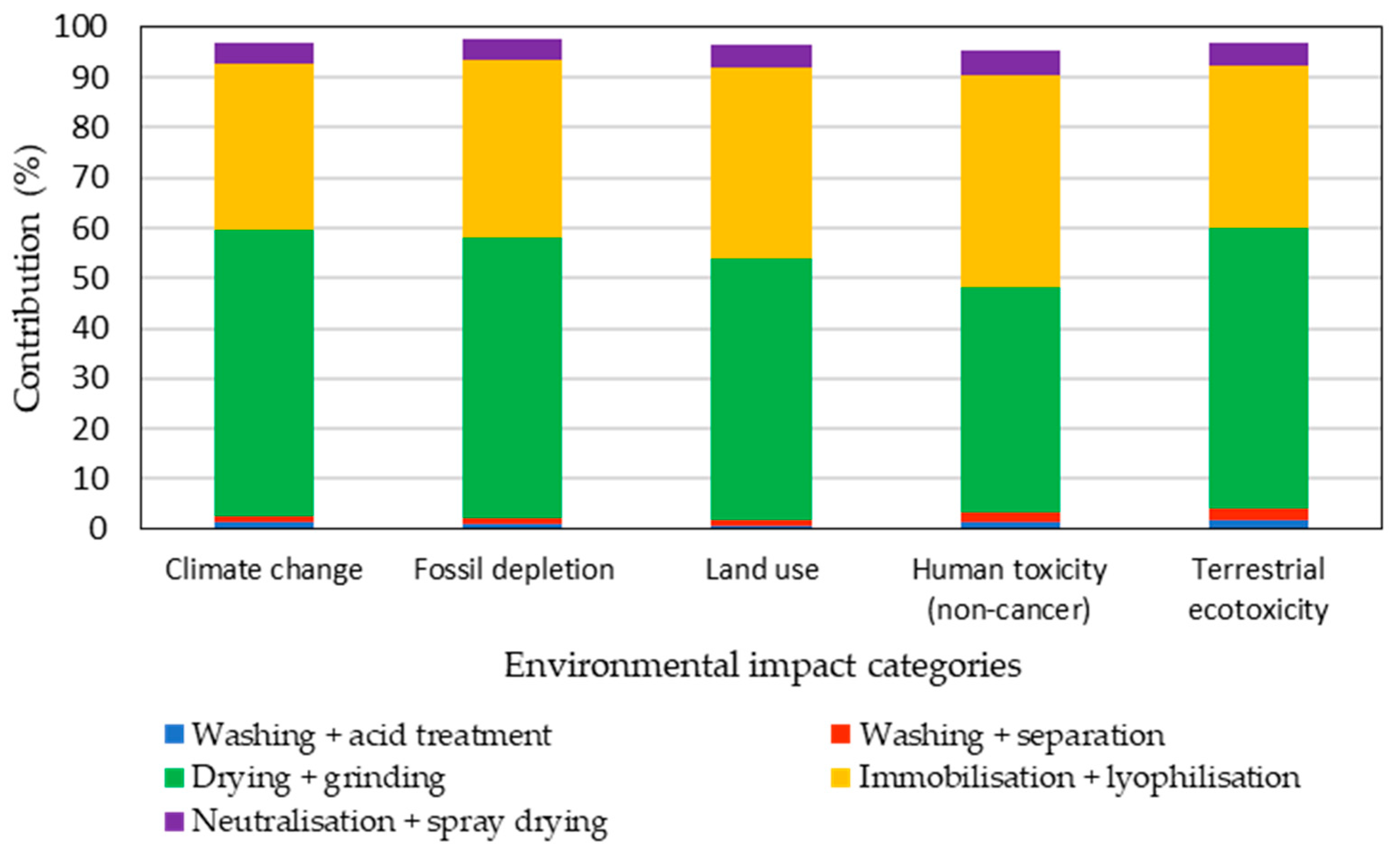
Process contribution analysis (Figure 2) reveals that drying and grinding represent the dominant contributors across all environmental impact categories, accounting for 52–57% of the total impact. This dominance is consistent with prior research describing thermal treatment phases as responsible for 40–70% of overall burdens in similar biowaste processing applications [38]. The proportional contributions of drying to climate change and fossil depletion (approximately 55–57%) correspond well with reported ranges for freeze-drying and hot-air drying technologies in enzyme production LCAs [39]. The immobilization and lyophilization step contribute a significant 32–42%, reflecting the known high energy demand of freeze-drying processes. Chemical pretreatment steps during washing and acid treatment, despite employing reagents such as HCl and acetone, account for only minor fractions (1.3–2.2%), indicating that efforts to reduce environmental impacts should focus primarily on energy efficiency enhancements in the drying and immobilization stages rather than on chemical reductions. Neutralization and spray drying process (by-product recovery), contributes a modest 4.1–5.2% of impacts. This aligns with circular economy principles, where product valorization such as CaCl2 recovery provides economic advantages with relatively low environmental penalties. Overall, this pattern underscores that energy consumption, rather than raw material inputs, is the main driver of environmental impact. This highlights the value in adopting energy-efficient drying technologies (e.g., heat pump and microwave-assisted drying) that can lower impacts across multiple environmental categories simultaneously.

3.3. Sensitivity and Uncertainty Analysis

The sensitivity analysis was conducted to examine how ±20% changes in parameters like electricity usage, chemical consumption, and water intake affect the environmental impacts of the process. The variations on impacts in different impact categories are shown in Table 6. The electricity consumption for drying and grinding has highest influence (±11.3%) in climate change impact and ±11.2% in fossil depletion. The influence on all the other environmental impacts is 0 so only the climate change and fossil depletion were assessed. In addition to these results, the influence of electricity on the immobilization and lyophilization process is ±6.72% for climate change and ±6.66% for fossil depletion. Due to the lack of information on lipases, the enzyme could not be evaluated in this analysis.
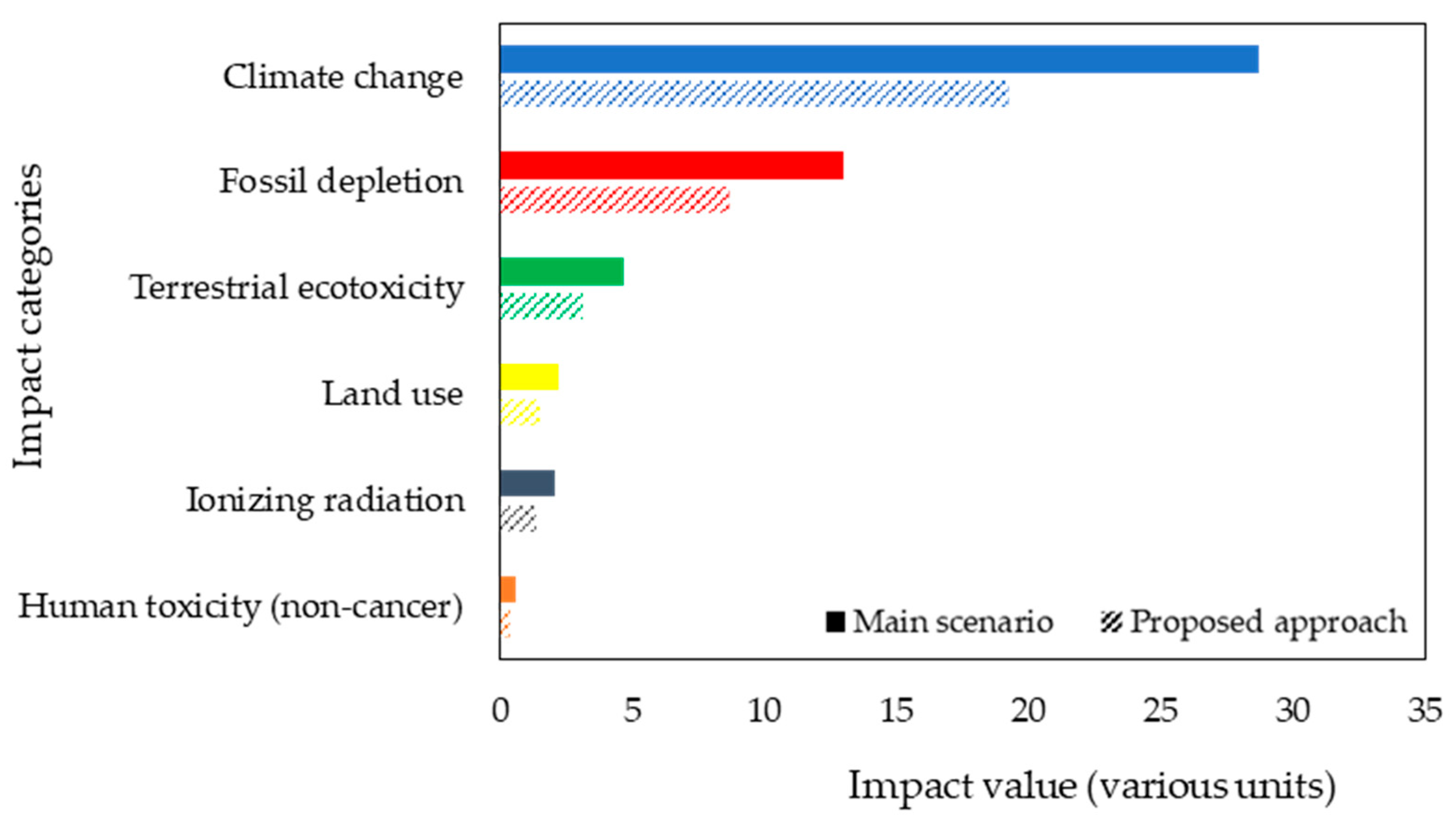
Life cycle assessment results (Table 4 and Figure 2 and Figure 3) highlighted that electricity consumption during the drying of eggshell membrane is the leading contributor to the global warming potential (GWP), accounting for up to 57% of the total impact in the ReCiPe 2016 Midpoint method. This finding aligns with previous studies on biowaste processing, where energy-intensive drying has consistently been identified as an environmental hotspot [40,41]. To mitigate the environmental and economic impact associated with conventional hot-air or convective drying, a suite of innovative drying technologies offers substantial advantages. Vacuum drying can reduce energy consumption by 20–35% and shorten the drying time by 30–50% compared to conventional dryers, due to operation at reduced pressures and lower temperatures, which supports higher-quality products while curbing electricity use [40]. Microwave drying, which utilizes electromagnetic radiation to directly excite water molecules, can cut drying time by up to 80–90%, and reduce energy consumption per kilogram of dried material by 30–50% over standard methods [42]. Similarly, infrared drying targets energy transfer more efficiently, enabling energy savings of 25–40% and time savings up to 50% [41,42]. To address this, recent research highlights the advantages of implementing innovative, low-energy drying platforms [43,44]. Heat pump-assisted dryers offer the greatest energy efficiency, as reviewed extensively by Budžaki et al. [43]. These systems operate by circulating air in a closed loop and recovering latent heat from water vapour, which is then recycled into the drying chamber. Depending on the scale and process conditions, heat pump dryers can reduce total electricity consumption by 50–60% compared to conventional electric resistance based or convective hot-air dryers [45]. Our own laboratory-scale process currently requires approximately 5 kWh per kg of dried eggshell membrane, while literature values for heat pump systems cite reductions to as low as 2 kWh/kg, representing an energy cost saving of up to 60%. In addition to energy savings, heat pump dryers provide gentle, low-temperature operation, which is critical for preserving the structural and functional properties of protein-rich membranes and immobilized enzymes and aligns with our findings regarding enzymatic activity retention post-drying [43,46,47,48]. By integrating heat pump drying into the eggshell membrane immobilization platform reported here, the life cycle GWP, cumulative energy demand, and overall operating costs could be substantially reduced and thereby directly addressing the main process bottleneck identified by our LCA. This technological upgrade would further improve the economic and environmental sustainability of the process and enhance its suitability for upscaling and circular bioeconomy implementation. Implementing heat pump drying technology, therefore, represents a proposed approach to improving environmental impact by significantly reducing energy consumption and translating into marked improvements across multiple environmental impact categories, as demonstrated by the quantitative reductions shown in Figure 2. Climate change impact can be reduced to 19.3 kg CO2 eq. and 8.72 kg oil eq., respectively. Terrestrial ecotoxicity decreases from 4.68 to 3.13 kg 1,4-DB eq., implying reduced harmful effects of toxic substances on terrestrial ecosystems. Land use drops from 2.23 to 1.49 annual crop eq.·y., reflecting a likely reduction in land occupation or transformation, which can be linked to less habitat disruption or better land management practices. Human toxicity reduced from 0.583 to 0.404 kg 1,4-DB eq., indicating decreased exposure to toxic substances that could cause non-cancer health effects among humans. Ionizing radiation declines from 2.11 to 1.4 kg kBq Co-60 eq. to air which benefits air quality and human respiratory health. Freshwater consumption reduced from 0.0321 to 0.222 m3, suggesting a significant decrease in water demand which contributes to lowering the environmental impact related to freshwater resource depletion.
Variations in input parameters and inaccuracies in evaluating material and energy data make it crucial to consider and assess uncertainty in Life Cycle Assessment (LCA) to enhance the credibility, acceptability, and reliability of its results. Unlike single-parameter sensitivity analysis, which examines the influence of one parameter at a time while holding others constant, Monte Carlo uncertainty analysis evaluates the combined effect of simultaneous variations and interactions among multiple parameters on the environmental impact matrix. Since multiple parameters often fluctuate concurrently in real scenarios, Monte Carlo simulation provides a more realistic representation of uncertainty. When input parameters are varied simultaneously by ±20%, it leads to fluctuations in total environmental emissions across all impact categories [19].
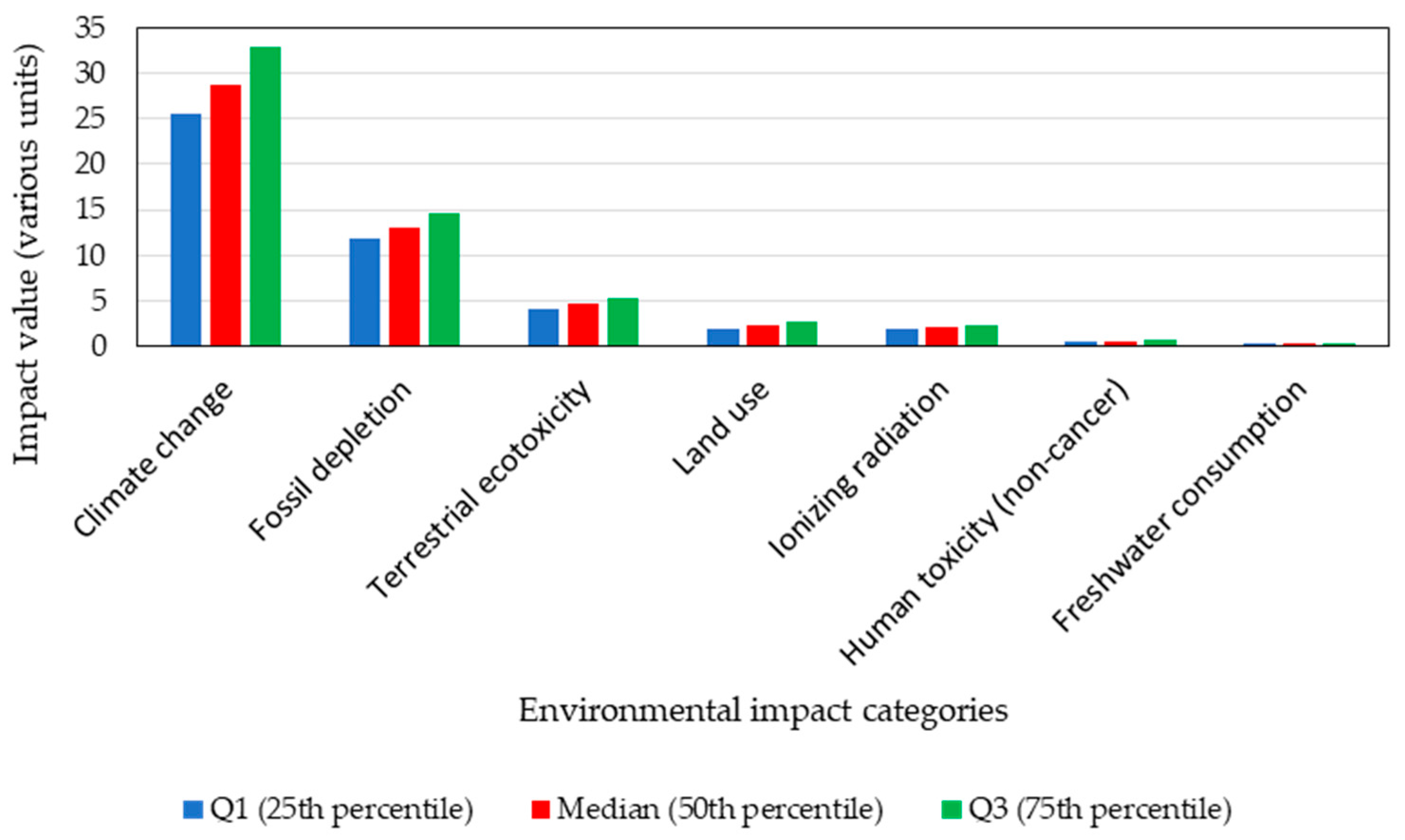
Monte Carlo uncertainty analysis, based on 1000 iterations with ±20% variation in critical parameters, confirms the robustness of impact assessment results (Figure 4). Climate change impacts exhibit moderate variability with an interquartile range near ±15%, and median values now at 28.7 kg CO2 eq., corresponding well with uncertainties typically observed for energy-related impacts in bioprocess LCAs [49]. High-end Monte Carlo iterations (Table 7) can exceed 32.8 kg CO2 eq., spotlighting worst-case scenarios of energy-intensive operation. Fossil depletion shows a comparable uncertainty trend, with a median of 13 kg oil eq. and upper quartile values above 14.5 kg oil eq., reflecting fluctuations tied to electricity grid fossil content and process energy consumption during drying. Terrestrial ecotoxicity displays higher relative uncertainty due to complex chemical interactions and environmental fate variability, with interquartile spreads sometimes exceeding 50%. These ranges are consistent with published uncertainties observed in biomass pretreatment chemical assessments [50]. In summary, energy consumption is the dominant factor influencing both impact levels and their uncertainties, highlighting the priority of energy efficiency improvements and robust energy management for reliable sustainability performance [20,49]. While reducing chemical inputs may yield benefits, their influence on the overall environmental profile is comparatively minor.
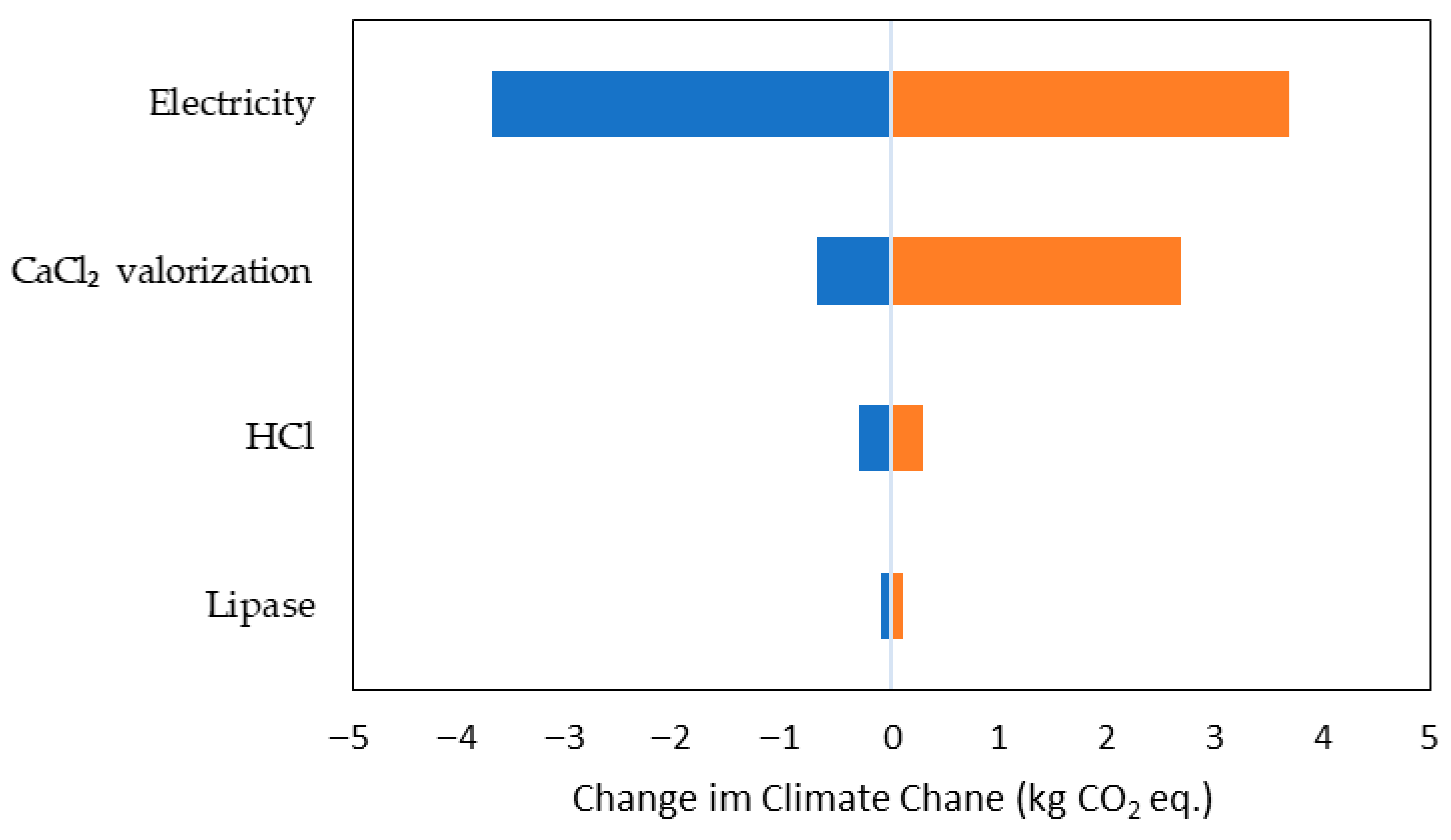
A tornado-style sensitivity analysis (Figure 5) further confirms that electricity use in the drying and immobilization steps is the dominant driver of overall uncertainty, followed by the CaCl2 valorisation factor; variations in HCl have only marginal influence, while lipase input does not materially affect results because it is a commercial enzyme and is not produced within the system boundary. Notably, the CaCl2 valorisation parameter is the only one that meaningfully affects the negative net cost, as removing the credit shifts the economic balance from −€14.81 to −€1.90.

3.4. Economic Evaluation

In this preliminary study, which is based on the production of immobilized lipase from the bacterium Burkholderia cepacia on a laboratory scale, the economic evaluation of the operating units was carried out on the basis of material and energy balances according to the LCA inventory shown in Table 1.
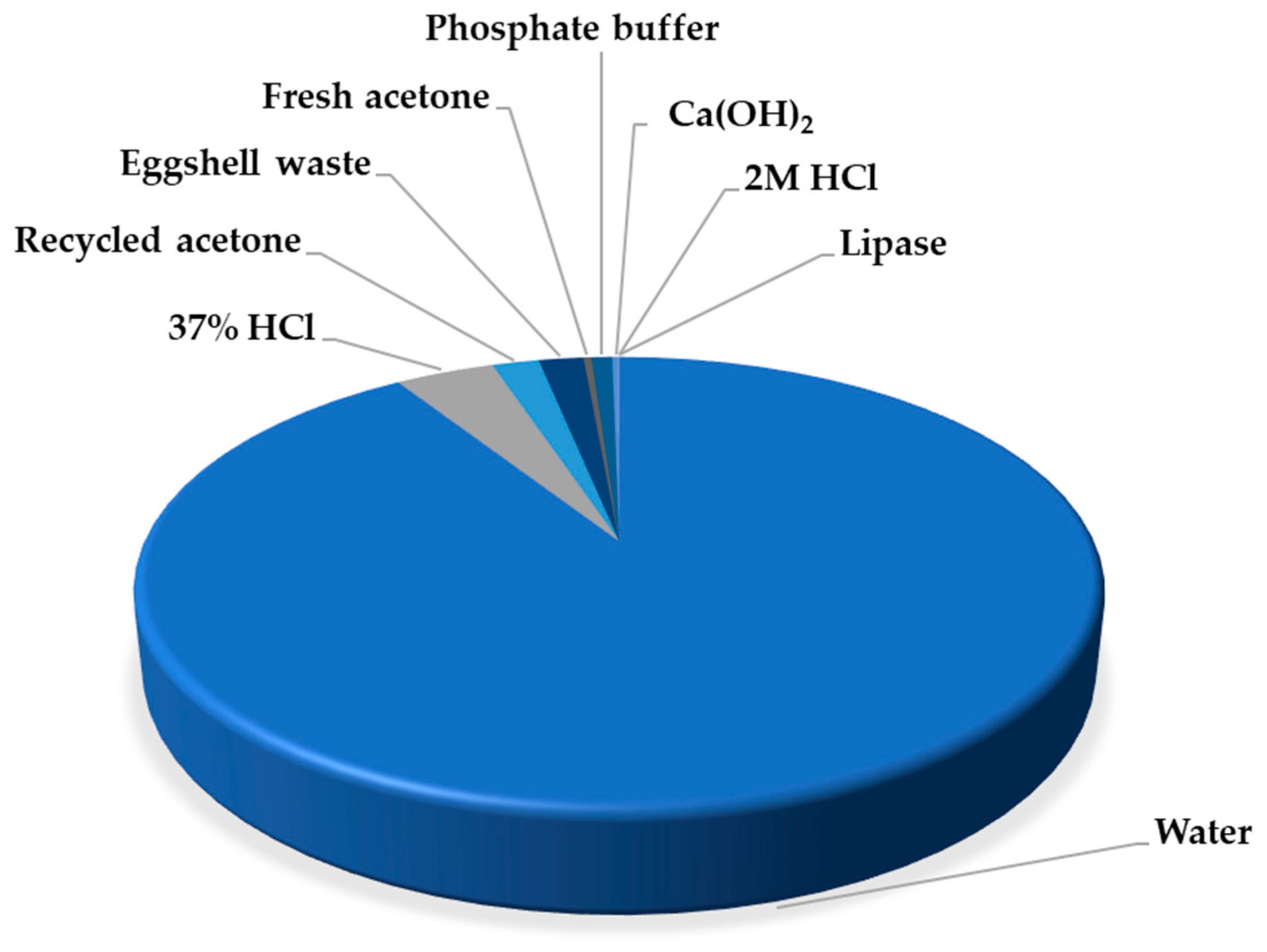
The pie chart (Figure 6) illustrates the mass-based distribution of raw material inputs used in the laboratory scale production of immobilized lipase onto eggshell membrane-based carriers. The most dominant component is water, accounting for 90.933% of the total mass. Despite its large volumetric contribution, water has a very low unit cost and thus only a minimal impact on the total production cost.
Conversely, materials that contribute relatively little by mass, such as lipase (0.006%), 2 M HCl (0.001%), and phosphate buffer (0.831%), have a significantly higher unit price. For example, lipase represents one of the main cost drivers despite its trace mass share, directly influencing the effective net cost and minimum selling price (MSP) of the final product. Similarly, 37% HCl, although representing only 3.959% of the mass input, has an important role in the chemical treatment of eggshells and contributes to the overall cost, as confirmed by the sensitivity analysis.
The presence of recycled acetone (1.884%) also highlights the process’s attempt to lower material costs and environmental burden through solvent recovery and reuse, which contributes positively to the overall economic and sustainability performance.
This mass-based breakdown complements the economic analysis by showing that the economic impact of each material is not directly proportional to its mass contribution. Instead, unit cost, frequency of use, and criticality in the process determine their influence on the total production cost and economic feasibility. Therefore, optimizing high-cost, low-mass inputs such as lipase and HCl, as explored in the sensitivity analysis, is essential for improving cost efficiency and ensuring the viability of the waste-to-value strategy.
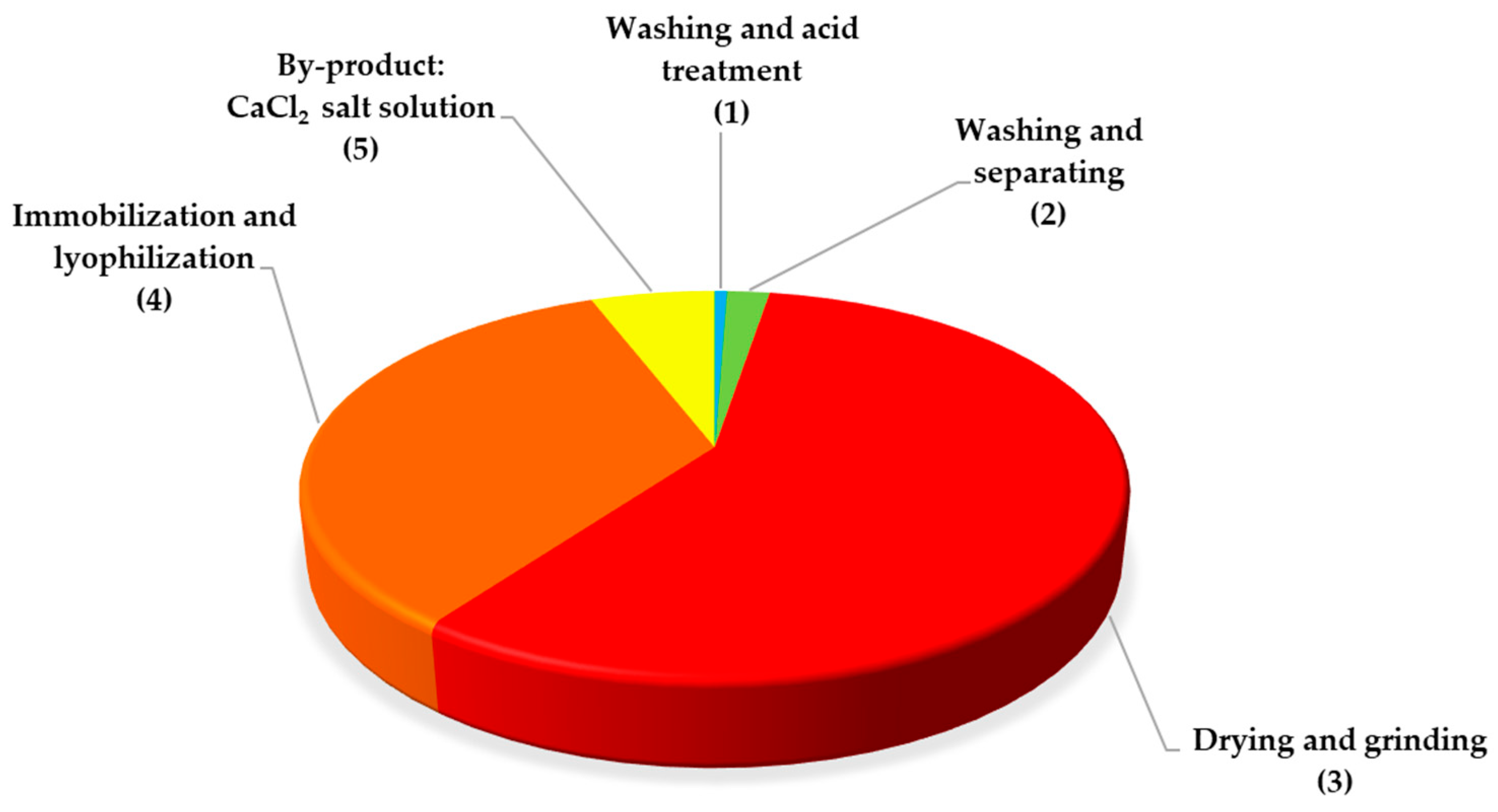
The pie chart (Figure 7) illustrates the distribution of energy consumption among five key process steps involved in the laboratory-scale production of immobilized lipases using eggshell membrane-based carriers. The highest energy demand is associated with drying and grinding (3), which accounts for the majority of total consumption (48.17 kWh), followed by immobilization and lyophilization (4) with 28.59 kWh. Lower energy requirements are noted for washing and separating (2) (1.69 kWh), washing and acid treatment (1) (0.48 kWh), and by-product processing for calcium chloride (5) (4.89 kWh).
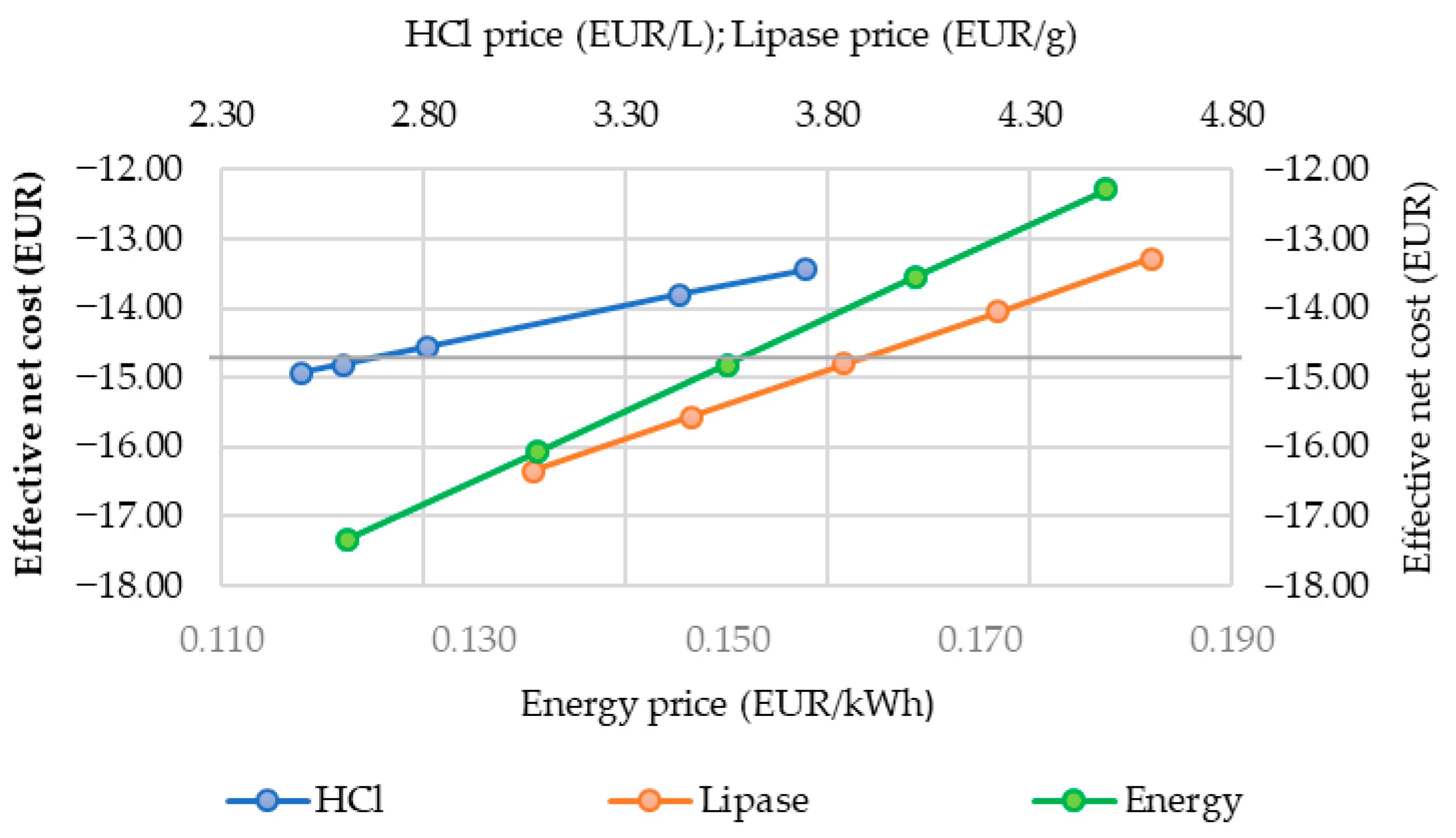
The diagram (Figure 7) reveals that energy-intensive steps, especially drying, grinding, and lyophilization, are major cost contributors in the overall process. This aligns with the sensitivity analysis results, where the effective net cost showed considerable variation with changes in electricity prices (Figure 8). Consequently, any future scale-up should prioritize energy efficiency improvements, particularly in drying and lyophilization stages, to enhance the economic viability of the process. Additionally, the relatively low energy burden of by-product valorization (CaCl2) supports the sustainability of full-stream resource utilization.
A preliminary economic evaluation was conducted to assess the cost-effectiveness of the laboratory-scale process. The total process cost amounted to EUR 25.63, including expenditures for chemicals, raw materials, and electricity. Through the implementation of a full-stream valorization strategy, the by-product anhydrous calcium chloride (CaCl2) was recovered and monetized, significantly offsetting production expenses. As a result, the effective net cost was calculated as EUR −14.81, indicating a net economic gain under current cost assumptions.
Effective net cost reduction due to by-product valorization of the immobilized lipase product was estimated at EUR −0.99 for gram of ESMC immobilized lipase, assuming a net present value (NPV) of zero. This benchmark reflects the minimum theoretical price required for the process to break even, factoring in both production costs and by-product value.
The anhydrous CaCl2 used in this study was obtained as a powder by spray drying the calcium-rich solution produced during the acid treatment of waste eggshells. As reported in our previous work [18], the purity of this product was analytically verified and shown to meet the requirements of both the EU and the FAO specifications for food-grade calcium chloride. Therefore, a laboratory-scale selling price, derived from the institution’s internal cost list, was applied in the present economic analysis. This value reflects the small-scale nature of the experiments and should not be interpreted as representative of industrial market conditions.
However, CaCl2 prices vary considerably in industrial practice, depending on the required purity grade, production volume, and end-use sector. The selling price used in this study thus represents only a conservative laboratory-scale assumption and likely overestimates the potential economic credit that could be achieved in a full industrial setting. To address this uncertainty, future work will include the simulation of an industrial-scale waste eggshell valorisation process and a comprehensive sensitivity analysis examining a wide range of CaCl2 prices. This will include a “zero-credit” scenario, representing the upper bound of total production costs in the absence of co-product valorisation. Such analysis will provide a more robust assessment of the economic feasibility and scalability of the proposed process.
The cost of the developed eggshell membrane-based carrier (0.08 EUR/g) is significantly lower than that of commercial carriers such as Eupergit® C (6 EUR/g) and agarose-based carriers (3.25 EUR/g), which are widely used but often limited by their high production costs and non-renewable origin [51,52]. Table 8 summarizes representative commercially available immobilized lipases. Public data indicate that the prices of commercial immobilized lipases range from 0.009 to 0.2 EUR/U, depending on enzyme activity and packaging. When compared with the ESMC-immobilized lipase developed in this study (1.52 × 10⁻³ EUR/U), it is evident that the latter offers a significantly more cost-effective alternative. This highlights the economic advantage of the proposed immobilization approach.
When expressed per functional unit, the ECMS immobilized lipase exhibited a cost of 0.00265 EUR/U (without co-product credit) and –0.00153 EUR/U when CaCl2 valorisation was included (Table 3). Considering its operational lifetime (46 cycles; 445,754 U), the lifetime-adjusted cost decreased to 5.75 × 10⁻⁵ EUR/U, or −3.32 × 10⁻⁵ EUR/U with CaCl2 credit.
These competitive costs emphasize the economic viability of the proposed system. Furthermore, upgrading eggshell waste to functional biocatalyst carriers not only minimizes the need for energy- and chemical- intensive pretreatment, but also contributes to circular economy strategies by transforming an abundant biowaste into a high-value product. In contrast to other biowaste-derived carriers, such as lignocellulosic residues, which often require extensive processing, eggshell membranes provide a simple, cost-effective and easily accessible platform for the immobilization of enzymes under laboratory conditions [53]. These results underline the potential of eggshell-derived carriers as a sustainable alternative to conventional immobilization materials and offer both economic and environmental benefits.
To examine the robustness of the economic performance, a sensitivity analysis was conducted for three critical cost components: hydrochloric acid (HCl), lipase enzyme, and energy consumption. For each of these inputs, a price variation range of ±20% around the baseline value was applied. The results, shown in Figure 8, demonstrate that energy price had the most significant influence on the effective net cost, followed by lipase cost, while HCl price had a comparatively minor effect. A ±20% change in energy cost resulted in a shift of more than EUR ±2 in the effective net cost, highlighting the process’s sensitivity to energy inputs, especially in heating and drying stages. Similarly, lipase price fluctuations notably impacted the economic balance, given its direct proportionality to enzyme loading. Conversely, HCl cost showed limited influence due to its lower usage volume and unit price within the overall budget.
These findings emphasize the importance of energy efficiency and enzyme sourcing for economic viability, especially in the context of future scale-up scenarios. The analysis supports the process’s economic resilience and aligns with sustainability principles by integrating waste valorization, cost minimization, and resource efficiency.

4. Conclusions and Recommendations

This study reports findings from the production of immobilized lipases on eggshell membrane-based carriers derived from eggshell waste, using laboratory-scale experiments. According to life cycle impact assessment results, midpoint indicators show that the most significant environmental impacts are associated with climate change and fossil depletion. Among the process stages, the drying steps contribute the most to these impacts. The electricity required for drying is the major environmental and economic bottleneck in the production of eggshell membrane-based carriers for lipase immobilization (a finding confirmed by our LCA and sensitivity analyses), with drying responsible for up to 57% of the global warming potential. To counteract this limitation, the integration of low-temperature heat pump drying proves to be a promising strategy for process optimization. This drying technology enables precise temperature and moisture control at significantly lower operating temperatures, which is essential for maintaining the structural and enzymatic integrity of protein-rich substrates. Recent data from literature and industry show that low temperature heat pump systems can reduce power consumption during the drying phase by up to 60% compared to conventional convective or resistance-based dryers. This reduces the energy requirement from about 5 kWh/kg to only 2 kWh/kg of dried product. Such a reduction would not only significantly reduce greenhouse gas emissions per unit of production but also improve the overall cost efficiency of the process, further enhancing the economic and environmental benefits demonstrated for the eggshell membrane-based immobilized lipase platform. Therefore, the introduction of low-temperature heat pump drying should be a priority in future scale-up and industrialization efforts, as it directly supports the circular bioeconomy, reduces the energy intensity of the process and facilitates the sustainable, large-scale production of bio-based enzymes.
Utilizing eggshells as membrane-based carriers eliminates the need for waste treatment. This multi-stream strategy not only supports zero-waste process design but also adds economic and environmental value to waste conversion chains by generating value-added outputs aligned with circular economy principles. This preliminary economic evaluation of laboratory-scale immobilized lipase production using eggshell membrane-based carriers demonstrates promising cost-effectiveness and sustainability potential. Although water constitutes the largest mass input, high-cost materials such as lipase and hydrochloric acid, along with energy-intensive processes like drying and lyophilization, primarily drive production costs. The successful recovery and valorization of by-product calcium chloride further enhance the process’s economic viability, resulting in a net economic gain under current conditions. The immobilized enzyme product is significantly more affordable compared to conventional commercial carriers and enzyme supports, indicating strong competitive potential. Sensitivity analysis highlights that energy costs and enzyme prices critically affect overall economics, underscoring the importance of optimizing energy efficiency and enzyme sourcing for scale-up feasibility.
Overall, the study confirms that integrating waste valorization with efficient process design can create an economically viable and sustainable approach to immobilized enzyme production, with promising applications for industrial biocatalysis. These research results provide an important foundation for future opportunities, particularly considering scaling up this process directly connected to factories processing eggs.

Author Contributions

Conceptualization, S.B. and M.S.; methodology, S.B. and M.S.; validation, S.B. and M.S.; formal analysis, M.O., I.S. and N.V.; investigation, S.B., M.O. and M.S.; resources, S.B.; writing—original draft preparation, M.S., S.B. and M.O.; writing—review and editing, M.S., I.S., N.V., M.O., N.N.T., V.H., M.E.-G. and S.B.; visualization, M.S., M.O. and S.B.; supervision, S.B. and V.H.; project administration, S.B.; funding acquisition, S.B. All authors have read and agreed to the published version of the manuscript.

Funding

This work has been fully supported by the Croatian Science Foundation under the project IP-2020-02-6878.

Institutional Review Board Statement

Not applicable.

Informed Consent Statement

Not applicable.

Data Availability Statement

The raw data supporting the conclusions of this article will be made available by the authors on request.

Conflicts of Interest

The authors declare no conflicts of interest.

References

  1. Budžaki, S.; Velić, N.; Ostojčić, M.; Stjepanović, M.; Rajs, B.B.; Šereš, Z.; Maravić, N.; Stanojev, J.; Hessel, V.; Strelec, I. Waste Management in the Agri-Food Industry: The Conversion of Eggshells, Spent Coffee Grounds, and Brown Onion Skins into Carriers for Lipase Immobilization. Foods 2022, 11, 409. [Google Scholar] [CrossRef] [PubMed]
  2. Nys, Y.; Gautron, J. Structure and Formation of the Eggshell. In Bioactive Egg Compounds; Huopalahti, R., López-Fandiño, R., Anton, M., Schade, R., Eds.; Springer: Berlin/Heidelberg, Germany, 2007; pp. 99–102. ISBN 978-3-540-37885-3. [Google Scholar]
  3. Strelec, I.; Ostojčić, M.; Brekalo, M.; Hajra, S.; Kim, H.-J.; Stanojev, J.; Maravić, N.; Budžaki, S. Transformation of Eggshell Waste to Egg White Protein Solution, Calcium Chloride Dihydrate, and Eggshell Membrane Powder. Green Process. Synth. 2023, 12, 20228151. [Google Scholar] [CrossRef]
  4. Datta, S.; Christena, L.R.; Rajaram, Y.R.S. Enzyme Immobilization: An Overview on Techniques and Support Materials. 3 Biotech 2013, 3, 1–9. [Google Scholar] [CrossRef] [PubMed]
  5. Girelli, A.M.; Astolfi, M.L.; Scuto, F.R. Agro-Industrial Wastes as Potential Carriers for Enzyme Immobilization: A Review. Chemosphere 2020, 244, 125368. [Google Scholar] [CrossRef]
  6. Ostojčić, M.; Budžaki, S.; Flanjak, I.; Bilić Rajs, B.; Barišić, I.; Tran, N.N.; Hessel, V.; Strelec, I. Production of Biodiesel by Burkholderia Cepacia Lipase as a Function of Process Parameters. Biotechnol. Prog. 2021, 37, e3109. [Google Scholar] [CrossRef]
  7. Maghraby, Y.R.; El-Shabasy, R.M.; Ibrahim, A.H.; El-Said Azzazy, H.M. Enzyme Immobilization Technologies and Industrial Applications. ACS Omega 2023, 8, 5184–5196. [Google Scholar] [CrossRef]
  8. Thangaraj, B.; Solomon, P.R. Immobilization of Lipases—A Review. Part I: Enzyme Immobilization. ChemBioEng Rev. 2019, 6, 157–166. [Google Scholar] [CrossRef]
  9. Jesionowski, T.; Zdarta, J.; Krajewska, B. Enzyme Immobilization by Adsorption: A Review. Adsorption 2014, 20, 801–821. [Google Scholar] [CrossRef]
  10. Animashaun, O.H.; Ajayi, O.I.; Olowe, O.O.; Mamora, O.T.; Fapohunda, S.O. Enzyme Immobilization: History and Update. Himal. J. Appl. Med. Sci. Res. 2022, 3, 1–4. [Google Scholar] [CrossRef]
  11. Robescu, M.S.; Bavaro, T. A Comprehensive Guide to Enzyme Immobilization: All You Need to Know. Molecules 2025, 30, 939. [Google Scholar] [CrossRef] [PubMed]
  12. Ismail, A.R.; Baek, K.-H. Lipase Immobilization with Support Materials, Preparation Techniques, and Applications: Present and Future Aspects. Int. J. Biol. Macromol. 2020, 163, 1624–1639. [Google Scholar] [CrossRef]
  13. Chandra, K.; Dong, C.-D.; Chauhan, A.S.; Chen, C.-W.; Patel, A.K.; Singhania, R.R. Advancements in Lipase Immobilization: Enhancing Enzyme Efficiency with Nanomaterials for Industrial Applications. Int. J. Biol. Macromol. 2025, 311, 143754. [Google Scholar] [CrossRef]
  14. Guimarães, J.R.; Oliveira, K.S.G.C.; Gonçalves, M.C.P.; Romanelli, J.P.; Lopes, L.A.; Berenguer-Murcia, Á.; Fernandez-Lafuente, R.; Tardioli, P.W. A Review of Lipase Immobilization on Hydrophobic Supports Incorporating Systematic Mapping Principles. React. Chem. Eng. 2023, 8, 2689–2702. [Google Scholar] [CrossRef]
  15. Basso, A.; Serban, S. Industrial Applications of Immobilized Enzymes—A Review. Mol. Catal. 2019, 479, 110607. [Google Scholar] [CrossRef]
  16. Patti, S.; Magrini Alunno, I.; Pedroni, S.; Riva, S.; Ferrandi, E.E.; Monti, D. Advances and Challenges in the Development of Immobilized Enzymes for Batch and Flow Biocatalyzed Processes. ChemSusChem 2025, 18, e202402007. [Google Scholar] [CrossRef] [PubMed]
  17. Strelec, I.; Tomičić, K.; Zajec, M.; Ostojčić, M.; Budžaki, S. Eggshell-Waste-Derived Calcium Acetate, Calcium Hydrogen Phosphate and Corresponding Eggshell Membranes. Appl. Sci. 2023, 13, 7372. [Google Scholar] [CrossRef]
  18. Strelec, I.; Peranović, K.; Ostojčić, M.; Aladić, K.; Pavlović, H.; Djerdj, I.; Tatar, D.; Maravić, N.; Skoko, Ž.; Budžaki, S. Eggshell Waste Transformation to Calcium Chloride Anhydride as Food-Grade Additive and Eggshell Membranes as Enzyme Immobilization Carrier. Green Process. Synth. 2024, 13, 20230254. [Google Scholar] [CrossRef]
  19. Goyal, H.; Tyagi, T.; Mondal, P. Life Cycle Analysis and Economic Evaluation of Adsorptive Removal of Arsenic from Groundwater Using GAC and GAC-Fe Adsorbents. J. Clean. Prod. 2023, 429, 139557. [Google Scholar] [CrossRef]
  20. de Azevedo, A.; Fornasier, F.; da Silva Szarblewski, M.; de Cassia de Souza Schneider, R.; Hoeltz, M.; de Souza, D. Life Cycle Assessment of Bioethanol Production from Cattle Manure. J. Clean. Prod. 2017, 162, 1021–1030. [Google Scholar] [CrossRef]
  21. Alherbawi, M.; Parthasarathy, P.; Elkhalifa, S.; Al-Ansari, T.; McKay, G. Techno-Economic and Environmental Analyses of the Pyrolysis of Food Waste to Produce Bio-Products. Heliyon 2024, 10, e27713. [Google Scholar] [CrossRef]
  22. Wunderlich, J.; Armstrong, K.; Buchner, G.A.; Styring, P.; Schomäcker, R. Integration of Techno-Economic and Life Cycle Assessment: Defining and Applying Integration Types for Chemical Technology Development. J. Clean. Prod. 2021, 287, 125021. [Google Scholar] [CrossRef]
  23. Fisher, O.J.; Sadhukhan, J.; Daniel, T.; Xuan, J. Techno-Economic Analysis and Process Simulation of Alkoxylated Surfactant Production in a Circular Carbon Economy Framework. Digit. Chem. Eng. 2024, 13, 100199. [Google Scholar] [CrossRef]
  24. Nishimoto, K.; Kimita, K.; Murakami, S.; Long, Y.; Asatani, K.; Sakata, I. Advancement of Circular Economy Through Interdisciplinary Collaboration: A Bibliometric Approach. arXiv 2025, arXiv:2507.04923. [Google Scholar] [CrossRef]
  25. Kim, S.; Jiménez-González, C.; Dale, B.E. Enzymes for Pharmaceutical Applications—A Cradle-to-Gate Life Cycle Assessment. Int. J. Life Cycle Assess. 2009, 14, 392–400. [Google Scholar] [CrossRef]
  26. Beaman, J.J.; Bourell, D.L.; Seepersad, C.C.; Kovar, D. Additive Manufacturing Review: Early Past to Current Practice. J. Manuf. Sci. Eng. 2020, 142, 110812. [Google Scholar] [CrossRef]
  27. HR EN ISO 14040:2006; Environmental Management—Life Cycle Assessment—Principles and Framework. International Organization for Standardization: Geneva, Switzerland, 2006.
  28. Ostojčić, M.; Stjepanović, M.; Strelec, I.; Velić, N.; Brekalo, M.; Šereš, Z.; Maravić, N.; Tran, N.N.; Hessel, V.; Budžaki, S. Eggshell Membranes as Green Carriers for Burkholderia Cepacia Lipase: A Biocatalytic Strategy for Sustainable Wastewater Bioremediation. Green Process. Synth. 2025, 14, 20250099. [Google Scholar] [CrossRef]
  29. European Union Commission Regulation (EU) No 231/2012 of 9 March 2012 Laying down Specifications for Food Additives Listed in Annexes II and III to Regulation (EC) No 1333/2008 of the European Parliament and of the Council (Text with EEA Relevance); Publications Office of the EU: Luxembourg, 2015.
  30. Food and Agriculture Organization of the United Nations Combined Compendium of Food Additive Specification; Food and Agriculutre Organization of the United Nations: Rome, Italy, 2006; Volume 4.
  31. Pawelzik, P.; Carus, M.; Hotchkiss, J.; Narayan, R.; Selke, S.; Wellisch, M.; Weiss, M.; Wicke, B.; Patel, M.K. Critical Aspects in the Life Cycle Assessment (LCA) of Bio-Based Materials—Reviewing Methodologies and Deriving Recommendations. Resour. Conserv. Recycl. 2013, 73, 211–228. [Google Scholar] [CrossRef]
  32. Towler, G.P.; Sinnott, R.K. Chemical Engineering Design: Principles, Practice, and Economics of Plant and Process Design; Elsevier: Amsterdam, The Netherlands, 2013. [Google Scholar]
  33. Vassaux, A.; Meunier, L.; Vandenbol, M.; Baurain, D.; Fickers, P.; Jacques, P.; Leclère, V. Nonribosomal Peptides in Fungal Cell Factories: From Genome Mining to Optimized Heterologous Production. Biotechnol. Adv. 2019, 37, 107449. [Google Scholar] [CrossRef]
  34. Rodrigues, R.C.; Virgen-Ortíz, J.J.; dos Santos, J.C.S.; Berenguer-Murcia, Á.; Alcantara, A.R.; Barbosa, O.; Ortiz, C.; Fernandez-Lafuente, R. Immobilization of Lipases on Hydrophobic Supports: Immobilization Mechanism, Advantages, Problems, and Solutions. Biotechnol. Adv. 2019, 37, 746–770. [Google Scholar] [CrossRef]
  35. Nachtergaele, P.; Kocak, O.; Escobar, Y.R.; Motte, J.; Gabriels, D.; Mottet, L.; Dewulf, J. Does Enzymatic Catalysis Lead to More Sustainable Chemicals Production? A Life Cycle Sustainability Assessment of Isopropyl Palmitate. Green Chem. 2024, 26, 11662–11672. [Google Scholar] [CrossRef]
  36. Ara Begum, Y.; Kumari, S.; Kumar Jain, S.; Chandra Garg, M. A Review on Waste Biomass-to-Energy: Integrated Thermochemical and Biochemical Conversion for Resource Recovery. Environ. Sci. Adv. 2024, 3, 1197–1216. [Google Scholar] [CrossRef]
  37. Rosa, R.; Spinelli, R.; Neri, P.; Pini, M.; Barbi, S.; Montorsi, M.; Maistrello, L.; Marseglia, A.; Caligiani, A.; Ferrari, A.M. Life Cycle Assessment of Chemical vs Enzymatic-Assisted Extraction of Proteins from Black Soldier Fly Prepupae for the Preparation of Biomaterials for Potential Agricultural Use. ACS Sustain. Chem. Eng. 2020, 8, 14752–14764. [Google Scholar] [CrossRef]
  38. Goh, L.J.; Othman, M.Y.; Mat, S.; Ruslan, H.; Sopian, K. Review of Heat Pump Systems for Drying Application. Renew. Sustain. Energy Rev. 2011, 15, 4788–4796. [Google Scholar] [CrossRef]
  39. Prosapio, V.; Norton, I.; De Marco, I. Optimization of Freeze-Drying Using a Life Cycle Assessment Approach: Strawberries’ Case Study. J. Clean. Prod. 2017, 168, 1171–1179. [Google Scholar] [CrossRef]
  40. Xiao, Y.; Zhou, J.; Xing, S.; Zhu, X. Research on Assembly Sequence Optimization Classification Method of Remanufacturing Parts Based on Different Precision Levels. Processes 2023, 11, 383. [Google Scholar] [CrossRef]
  41. Wang, F.; Zhan, C.; Zou, L. Risk of Crop Yield Reduction in China under 1.5 °C and 2 °C Global Warming from CMIP6 Models. Foods 2023, 12, 413. [Google Scholar] [CrossRef]
  42. Saltik, B. Effects of Microwave and Infrared Microwave Drying of Wood Materials on Energy Consumption, Water Absorption, and Mechanical Properties. BioResources 2025, 20, 282–294. [Google Scholar] [CrossRef]
  43. Budžaki, S.; Leko, J.; Jovanović, K.; Viszmeg, J.; Koški, I. Air Source Heat Pump Assisted Drying for Food Applications: A Mini Review. Croat. J. Food Sci. Technol. 2019, 11, 122–130. [Google Scholar] [CrossRef]
  44. Chojnacka, K.; Mikula, K.; Izydorczyk, G.; Skrzypczak, D.; Witek-Krowiak, A.; Moustakas, K.; Ludwig, W.; Kułażyński, M. Improvements in Drying Technologies—Efficient Solutions for Cleaner Production with Higher Energy Efficiency and Reduced Emission. J. Clean. Prod. 2021, 320, 128706. [Google Scholar] [CrossRef]
  45. Deymi-Dashtebayaz, M.; Mostafa, A.; Asadi, M.; Hosseinzadeh, D.; Khutornaya, J.; Sergienko, O. Recent Developments in Heat Pump Dryers Focusing on Methods of Supplying and Reducing Their Energy Consumption. J. Therm. Anal. Calorim. 2024, 149, 9751–9775. [Google Scholar] [CrossRef]
  46. Salehi, F. Recent Applications of Heat Pump Dryer for Drying of Fruit Crops: A Review. Int. J. Fruit Sci. 2021, 21, 546–555. [Google Scholar] [CrossRef]
  47. Loemba, A.B.T.; Kichonge, B.; Kivevele, T. Comprehensive Assessment of Heat Pump Dryers for Drying Agricultural Products. Energy Sci. Eng. 2023, 11, 2985–3014. [Google Scholar] [CrossRef]
  48. Fayose, F.; Huan, Z. Heat Pump Drying of Fruits and Vegetables: Principles and Potentials for Sub-Saharan Africa. Int. J. Food Sci. 2016, 2016, 9673029. [Google Scholar] [CrossRef] [PubMed]
  49. Chen, X.; Matthews, H.S.; Griffin, W.M. Uncertainty Caused by Life Cycle Impact Assessment Methods: Case Studies in Process-Based LCI Databases. Resour. Conserv. Recycl. 2021, 172, 105678. [Google Scholar] [CrossRef]
  50. Raina, N.; Boonmee, R.; Kirdponpattara, S.; Narasingha, M.; Sriariyanun, M.; Phitsuwan, P.; Chuetor, S. Process Performance Evaluation of Different Chemical Pretreatments of Lignocellulosic Biomass for Bioethanol Production. Ind. Crops Prod. 2024, 211, 118207. [Google Scholar] [CrossRef]
  51. Zdarta, J.; Meyer, A.; Jesionowski, T.; Pinelo, M. A General Overview of Support Materials for Enzyme Immobilization: Characteristics, Properties, Practical Utility. Catalysts 2018, 8, 92. [Google Scholar] [CrossRef]
  52. El-Ezabi, A.E. Novel Carriers Based on Agriculture Wastes for Immobilization of Biomolecules. WO/2014/000748, 3 January 2014. [Google Scholar]
  53. Budžaki, S.; Miljić, G.; Sundaram, S.; Tišma, M.; Hessel, V. Cost Analysis of Enzymatic Biodiesel Production in Small-Scaled Packed-Bed Reactors. Appl. Energy 2018, 210, 268–278. [Google Scholar] [CrossRef]
Figure 1. Overview of the laboratory-scale process for the production of immobilized lipase on eggshell membrane-based carriers, including valorization of by-products. Schematic representation of the laboratory-scale process for the production of immobilized lipase using eggshell membrane-based carriers. The process comprises five main units: (1) washing and acid treatment of raw eggshells, (2) washing and separation of the membrane from the calcified matrix, (3) drying and grinding of the isolated membrane, (4) enzyme immobilization and lyophilization, and (5) neutralization and spray drying of the calcium-rich by-product into calcium chloride. The process enables the valorization of both membrane and mineral fractions of eggshell waste, contributing to a circular bioeconomy approach. Mass flows (g) and energy inputs (kWh) are included to illustrate the system boundaries and to provide a clearer understanding of the material and energy requirements across the five processing steps.
Sustainability 18 00134 g001
Figure 2. Contribution of individual process steps to selected environmental impact categories. Values represent percentage contribution to total impact per category.
Sustainability 18 00134 g002
Figure 3. Environmental impact assessment of lipase immobilization on eggshell membrane carriers using ReCiPe 2016 method and the proposed approach. Impact categories are normalized and presented as relative contributions to total environmental burden.
Sustainability 18 00134 g003
Figure 4. Monte Carlo uncertainty analysis for selected environmental impact categories based on 1000 iterations. Box plots show median, quartiles, and outliers for each impact category.
Sustainability 18 00134 g004
Figure 5. Tornado diagram—a sensitivity analysis for climate change.
Sustainability 18 00134 g005
Figure 6. Distribution of raw materials in the production of immobilized lipases on eggshell membrane-based carriers. (Water—90.933%; Eggshell waste—1.802%; 37% HCl—3.959%; Fresh acetone—0.307%; Recycled acetone—1.884%; Lipase 0.006%; Phosphate buffer 0.831%; Ca(OH)2—0.277%; 2 M HCl—0.001%).
Sustainability 18 00134 g006
Figure 7. Distribution of energy consumption across process steps in the production of immobilized lipases on eggshell membrane-based carriers. (1) Washing and acid treatment—0.48 kWh; (2) Washing and separating—1.69 kWh; (3) Drying and grinding—48.17 kWh; (4) Immobilization and lyophilization -28.59 kWh; (5) Calcium chloride, anhydrous—4.89 kWh.
Sustainability 18 00134 g007
Figure 8. Sensitivity of effective net cost to ±20% variations in the price of HCl (EUR/L), lipase (EUR/g), and energy (EUR/kWh).
Sustainability 18 00134 g008
Table 1. Physicochemical properties of ESMC and catalytic properties of immobilized lipases.
ParameterValueNotes
ESMCMembrane particle size100–300 µmAfter milling
Moisture content7.83 ± 0.39%After drying
Surface area (BET)2987–3906 m2/gBrunauer–Emmett–Teller method for determining the specific surface area of solid material
Pore volume0006 cm3/g
Pore size3851 nm
Immobilized lipasesImmobilization yield69.27 ± 0.40%Percentage of bound activity
Enzyme loading106.14 ± 3.22 U/gActivity immobilized per gram of ESMC
Recovered activity646.02 U/gActivity of the immobilized enzyme normalized to the mass of the carrier.
Relative specific activity111.25%Relative to free lipase (baseline = 100%)
Operational stability
(half-life)
3.8 hMeasured under hydrolytic conditions using p-nitrophenyl palmitate (pNPP).
Reusability46 cyclesNumber of cycles until activity < 50%
Storage stability100%
6 months at +4 °C
No activity loss under refrigerated storage
Table 2. Life cycle inventory for the production of immobilized lipases on eggshell membrane-based carriers (prices are based on the institution internal cost list, reflecting the laboratory-scale nature of the analysis).
Process StepsUnitQuantityUnit Price (EUR)Total Price (EUR)
INPUTWashing and acid treatment (1)
Eggshell wasteg650.000.000.00
WaterL28.302.780.08
37% HClL1.202.603.12
EnergykWh0.480.150.07
Washing and separation (2)
Acetone *L0.143.610.51
WaterL4.502.780.01
Recycled acetone *L0.860.150.11
EnergykWh1.690.150.25
Drying and grinding (3)
EnergykWh48.170.157.23
Immobilization and lyophilization (4)
Phosphate bufferL0.301.710.51
Lipase from Burkholderia cepaciag2.003.847.68
EnergykWh28.590.154.30
Neutralization and spray drying (5)
CaCl2 salt solutionL10.00--
Ca(OH)2kg0.1010.001.00
2 M HClL3 × 10−313.870.04
EnergykWh4.890.150.73
OUTPUTWashing and acid treatment (1)
Egg white protein solution **L15.00--
Washing and separation (2)
WastewaterL4.501.3 × 10−35.9 × 10⁻³
Drying and grinding (3)
Eggshell
membrane-based
carriers
g15.007.7 × 10−211.51
Immobilization and lyophilization (4)
Immobilized lipaseg15.001.7125.63
WastewaterL0.301.3 × 10−33.9 × 10⁻⁵
Neutralization and spray drying (5)
CaCl2, anhydrous ***g663.000.0640.44
* Required amount of acetone includes a minor portion of fresh solvent and a major portion of recycled solvent recovered from the same process. ** Chemical suppliers: HCl (Carlo Erba, Emmendingen, Germany), acetone (LabExpert, Ljubljana, Slovenia), Ca(OH)2 (Acros Organics (Las Rozas, Spain), phosphate buffer (NaH2PO4 and Na2HPO4, Sigma-Aldrich, Darmstadt, Germany), Burkholderia cepacia lipase (BCL) (Sigma-Aldrich product number: 534641, Saint Louis, MO, USA). *** By-product in this study. The egg white protein solution was not included in this study because, apart from the basic analysis to determine the composition, it was not further processed into the end product (isolation/purification of different proteins). This table provides a detailed breakdown of all key unit operations in the laboratory-scale process from eggshell membrane preparation to lipase immobilization and co-product recovery including quantities, unit prices, and total costs (in EUR).
Table 3. Functional unit (FU) results and batch-level economic comparison for the immobilized lipase with and without CaCl2 credit.
Metric UnitWithout CaCl2 CreditWith CaCl2 Credit
EUR/U (primary FU)2.65 × 10−31.52 × 10−3
EUR/U (lifetime FU)5.75 × 10⁻⁵−3.32 × 10⁻⁵
U (lifetime output)445,754445,754
EUR/batch25.63−14.81
Table 4. Environmental impacts by ReCiPe 2016 method.
Impact CategoryUnitQuantities
Climate change, default, excl. biogenic carbonkg CO2 eq.28.70
Climate change, incl. biogenic carbonkg CO2 eq.28.70
Fine Particulate Matter Formationkg PM2.5 eq.1.16 × 10−2
Fossil depletionkg oil eq.13.00
Freshwater Consumptionm30.32
Freshwater ecotoxicitykg 1,4 DB eq.3.69 × 10−3
Freshwater Eutrophicationkg P eq.6.67 × 10−5
Human toxicity, cancerkg 1,4-DB eq.0.05
Human toxicity, non-cancerkg 1,4-DB eq.0.58
Ionizing RadiationkBq Co-60 eq. to air2.11
Land useAnnual crop eq.·y2.23
Marine ecotoxicitykg 1,4-DB eq.6.66 × 10−3
Marine Eutrophicationkg N eq.9.52 × 10−4
Metal depletionkg Cu eq.0.0475
Photochemical Ozone Formation, Ecosystemskg NOx eq.0.03
Photochemical Ozone Formation, Human Healthkg NOx eq.0.03
Stratospheric Ozone Depletionkg CFC-11 eq.1.14 × 10−5
Terrestrial Acidificationkg SO2 eq.0.04
Terrestrial ecotoxicitykg 1,4-DB eq.4.68
Table 5. Key LCA results with and without CaCl2 valorization.
Impact CategoryUnitWith CaCl2
Valorization
Without CaCl2
Valorization
Climate change, incl. biogenic carbonkg CO2 eq.28.7028.00
Fossil depletionkg oil eq.13.0012.70
Terrestrial ecotoxicitykg 1,4-DB eq.4.684.57
Land useAnnual crop eq.·y2.232.18
Human toxicity, non-cancerkg 1,4-DB eq.0.580.57
Table 6. Results of the sensitivity analysis for the immobilization of lipase on eggshell membrane carrier process.
ProcessParameterClimate ChangeFossil Depletion
Washing and acid treatment (1)Electricity
HCl
Water
−0.11%
−0.15%
−3.65 × 10⁻⁷%
0.11%
0.15%
3.65 × 10⁻⁷%
−0.11%
−0.22%
−1.27 × 10⁻⁶%
0.11%
0.22%
1.27 × 10⁻⁶%
Washing and separation (2)Electricity−0.40%0.40%−0.39%0.39%
Drying and grinding (3)Electricity−11.30%11.30%−11.20%11.20%
Immobilization and
lyophilization (4)
Electricity−6.72%6.72%−6.66%6.66%
Neutralization and spray drying (5)Electricity−1.15%1.15%−1.14%1.14%
Analyzed parameters were electricity, HCl, water and lipases.
Table 7. Monte Carlo 95% confidence intervals for environmental impact categories.
Impact CategoryUnitMedianLower CI (95%)Upper CI (95%)
Climate change, incl. biogenic carbonkg CO2 eq.28.7024.0032.80
Fossil depletionkg oil eq.13.0011.0014.80
Terrestrial ecotoxicitykg 1,4-DB eq.4.683.105.80
Land useAnnual crop eq.·y2.231.852.61
Human toxicity, non-cancerkg 1,4-DB eq.0.580.450.71
Table 8. Benchmark of commercial immobilized lipases (EUR/U).
Immobilized LipasePackage/Price
(Currency)
Declared Activity
U/g
EUR/gEUR/U
Lipase B (Candida antarctica lipase B, immobilized on Immobead 150); (MilliporeSigma)10 g = EUR 156.00≥180015.6≈0.009
Lipase, immobilized on Immobead 150 from Thermomyces lanuginosus lipase; (https://www.scientificlabs.com)50 g = USD 730.37≥3000≈12.0–15.0≈0.004–0.005
Lipase, immobilized on Immobead 150 from Rhizomucor miehei lipase; (https://www.scientificlabs.com)10 g = USD 150.80≥300≈13.0–17.0≈0.043–0.056
Lipase, immobilized on Immobead 150 from Pseudomonas cepacia lipase; (https://www.scientificlabs.com)10 g = GBP 94.10≥900≈10.0–13.0≈0.011–0.0140
Lipase, immobilized on Immobead 150 from Candida rugosa lipase; (https://www.scientificlabs.com)10 g = USD 191.84≥100≈17.0–20.0 €/g≈0.170–0.200
Disclaimer/Publisher’s Note: The statements, opinions and data contained in all publications are solely those of the individual author(s) and contributor(s) and not of MDPI and/or the editor(s). MDPI and/or the editor(s) disclaim responsibility for any injury to people or property resulting from any ideas, methods, instructions or products referred to in the content.