





Environmental Stewardship Education in Tuvalu, Part 1: The Role of Policy Alignment

 ,
,  ,
,  ,
, 
Abstract
1. Introduction
Research Questions
- RQ1: What formal policies shape Environmental Stewardship Education (ESE) in Tuvalu?
- RQ2: Are national educational and environmental policies mutually consistent?
- RQ3: Are these national policies consistent with regional and global policies?
- RQ4: What challenges hinder the implementation of Environmental Stewardship Education in Tuvalu?
2. Theoretical and Policy Insights
2.1. Environmental Stewardship Education: Theoretical Insights
2.2. Policy Analysis Methodology
3. National, Regional, and International Policies and Frameworks
3.1. National Policies
3.2. International and Regional Frameworks
4. Materials and Methods
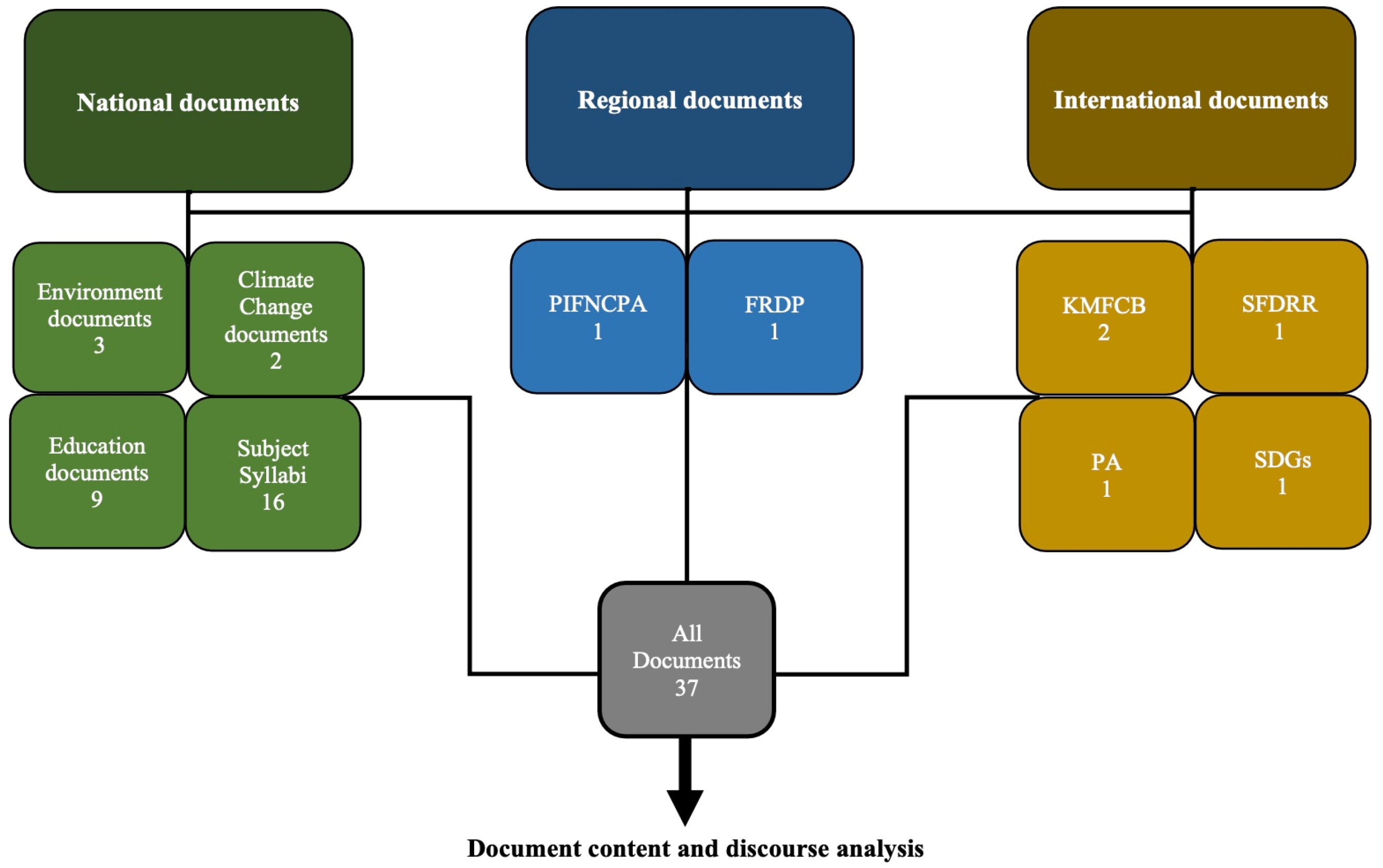
4.1. Collection of Key Documents
4.2. National Policies and Frameworks
4.3. Regional and International Policies
4.4. Document Content and Discourse Analysis of the Policy Documents
5. Results
5.1. Formal National Policies Shaping ESE in Tuvalu

| Year | Document—Author | ES | Sus | Env | BD | CC | DRR |
|---|---|---|---|---|---|---|---|
| 2007 | Early-Childhood Care and Education Policy 2007—Government of Tuvalu | 0 | 0 | 8 | 0 | 0 | 0 |
| 2009 | National Education Policy—Government of Tuvalu | 0 | 1 | 1 | 0 | 0 | 0 |
| 2011 | Tuvalu Education Sector Plan II (TESP II) 2011–2015—Government of Tuvalu | 0 | 2 | 5 | 0 | 0 | 0 |
| 2013 | Tuvalu National Curriculum Policy Framework (TNCPF 2013): Quality Education for sustainable living for all—Government of Tuvalu | 0 | 31 | 28 | 0 | 0 | 0 |
| 2013 | Tuvalu MDG Acceleration Framework: Improving Quality Education—Government of Tuvalu | 0 | 43 | 8 | 0 | 2 | 0 |
| 2015 | Education for All 2015 National Review Report: Tuvalu—Government of Tuvalu | 0 | 21 | 20 | 0 | 3 | 0 |
| 2016 | Tuvalu Education Sector Plan III (TESP III) 2016–2020—Government of Tuvalu | 0 | 25 | 7 | 0 | 17 | 8 |
| 2017 | Tuvalu Education Sector Situational Analysis—Government of Tuvalu | 0 | 9 | 5 | 0 | 2 | 3 |
| 2019 | Tuvalu National Curriculum Policy Framework (TNCPF 2019): Quality Education for sustainable living for all—Government of Tuvalu | 0 | 29 | 26 | 0 | 5 | 0 |
5.2. Inconsistencies Between Educational and Environmental Policies in Implementing ESE
5.3. Alignment of National and Global Environmental Stewardship Frameworks
5.4. Challenges Regarding Policy Implementation
| Policy/Framework | Aspect of Capacity-Building | Reference |
|---|---|---|
| Tuvalu National Biodiversity Strategy and Action Plan (NBSAP) 2012–2016 | Formulate training modules as well as relevant curricula streams; the latter is for the incorporation of the teaching of biodiversity at all levels of schooling in the country, while the former is for national and community training workshops. Streamline biodiversity into primary and secondary curricula. | Cross-Cutting Issue 1: Capacity Building, Education, Training, Awareness, and Understanding, p. 24. Cross-Cutting Issue 1: Capacity Building, Education, Training, Awareness, and Understanding, Objectives 3, Actions 2, p. 27. [28] (p. 24, 27) |
| Integrated Environment and Natural Resources Policy 2020–2022 | Increase citizenry conservation through responsible waste management behaviour and participate in activities while complying with the applicable laws through awareness and education. Include waste management and pollution control subjects in the school curriculum and public awareness and radio programs. | Objective 3, Strategies bullet point 1, p. 11. Objective 3, Strategies bullet point 4, p. 11. [29] (p. 11) |
| Tuvalu National Environmental Management Strategy 2022–2026 | Train communities trained through formal and informal education in waste management and pollution control. Integrate traditional environmental knowledge and cultural practices into the Tuvalu education curriculum. | Section 3.8 Theme 8, NEMS Actions 8.1.1, p. 34 Section 3.8 Theme 8, NEMS Actions 8.2.3, p. 34 [30] (p. 34) |
| Pacific Island Framework for Nature Conservation and Protected Areas (PIFNCPA) 2021–2025 | |||
|---|---|---|---|
| Strategic Objectives | Priority Actions | Best Practice | Page No. |
| 1. Empower our people to take action for nature conservation based on our understanding of nature’s importance for our cultures, economies, and communities | Change behaviour around nature conservation through identity, traditional knowledge, education, heritage, and cultural expressions. | Education-for-conservation and art-for-conservation initiatives must value and celebrate Pacific cultural expressions by cultivating partnerships with our elders, educators, artists, athletes, and community role models, as well as with our youth, women’s, faith-based, and cultural organisations. Existing traditional schools of learning should be supported by conservation partners as well as newer forms of education. | 18 |
| Framework for Resilient Development in the Pacific (FRDP) 2017–2030 | |||
| Goal | Stakeholders | Priority Actions | Page No. |
| 1. Strengthen integrated adaptation and risk reduction to enhance resilience to climate change and disasters | National and subnational governments and administrations | (q) Increase knowledge regarding the causes and local impacts of and responses to climate change, hazards, and disasters and build capacity for local adaptation and other risk management measures through formal and non-formal education systems, including for loss and damage. (r) Improve understanding and applications of successful strategies to increase resilience by documenting traditional, contemporary, and scientific knowledge and lessons learned to develop and utilise appropriate awareness, communication, education, and information materials for communities, media, schools, training providers, and universities. | 15 16 |
| Regional organisations and other development partners | (n) Work in close collaboration with member countries and other stakeholders to develop and deliver relevant capacity-building programmes, including emerging priorities such as loss and damage as a result of climate change. | 17 | |
| 2. Increase low-carbon development | Civil society and communities | (b) Lead and contribute to awareness campaigns and capacity-building in schools and communities to promote and facilitate energy and ecosystem conservation and the increased use of renewable energy through changes in attitudes and behaviour. | 20 |
| 3. Strengthen disaster preparedness, response, and recovery | National and subnational governments and administrations | (f) Support existing and additional capacity building and awareness raising for governments and communities (including churches and schools) to improve their disaster preparedness, response, and recovery capabilities, as they are often the first responders in the event of a disaster. | 23 |
| Section/Subsection | Code | Objectives | Page No. |
|---|---|---|---|
| Strategic Plan for Biodiversity 2011–2020 | |||
| E. Enhancing implementation through participatory planning, knowledge management, and capacity building | ABT 19 | By 2020, ensure knowledge of and the science base and technologies relating to biodiversity, its value functioning, status and trends, and the consequences of its loss, are improved, widely shared and transferred, and applied. | n.p. |
| Kunming–Montreal Global Biodiversity Framework (KMGBF) 2022–2030 | |||
| C. Making considerations for the implementation of the framework | 22 | Implementation of the framework requires transformative, innovative, and transdisciplinary education, both formal and informal, at all levels, including via science–policy interface studies and lifelong learning processes, recognising the diverse world views, values, and knowledge systems of indigenous peoples and local communities. | 7 |
| K. Communication, education, awareness, and uptake | 40 (f) | Integrating transformative education regarding biodiversity into formal, non-formal, and informal educational programmes; promoting curricula on biodiversity conservation and sustainable use in educational institutions; and promoting knowledge, attitudes, values, behaviours, and lifestyles that are consistent with living in harmony with nature. | 14 |
| Sendai Framework for Disaster Risk Reduction (SFDRR) 2015–2030 | |||
| II. Expected outcome and goal | 17 | Reduce disaster risks and prevent new ones from developing through the implementation of integrated and inclusive economic, structural, legal, social, health, cultural, educational, environmental, technological, political, and institutional measures that prevent and reduce hazard exposure and vulnerability to disasters and increase preparedness for response and recovery, thus strengthening resilience. | 12 |
| IV. Priority 1: Understanding disaster risk at national and local levels | 24 (l) 24 (m) | Promote the incorporation of disaster risk knowledge, including disaster prevention, mitigation, preparedness, response, recovery, and rehabilitation, in formal and non-formal education, in civic education at all levels, and in professional education and training. Promote national strategies for strengthening public education and awareness regarding disaster risk reduction, including disaster risk information and knowledge, through campaigns, social media, and community mobilisation, taking into account specific audiences and their needs. | 15 |
| V. Role of stakeholders | 36 (a) (ii) | Children and youth are agents of change and should be given the space and modalities required to contribute to disaster risk reduction, in accordance with legislation, national practice, and educational curricula. | 23 |
6. Discussion
7. Conclusions
- ▪
- Biodiversity, Disaster Risk Reduction, and Climate Resilience in the Curriculum: National policies must prioritise the inclusion of biodiversity, disaster risk reduction, and climate resilience within the national curriculum to align with international frameworks.
- ▪
- Horizontal and Vertical Policy Integration: Government departments must work cohesively to align educational policies with national, regional, and international policies. This will ensure consistent implementation of ESE across the formal education system.
- ▪
- Long-Term Funding Mechanism: Securing long-term funding for ESE integration is essential. Tuvalu must strengthen its relationships with international donors and development partners to secure sustainable funding for educational development.
- ▪
- Capacity-Building Initiatives: Teachers and educational institutions should receive targeted training in ESE to ensure the effective delivery of content. Curriculum development and implementation are long processes that require sustained investment.
Author Contributions
Funding
Institutional Review Board Statement
Informed Consent Statement
Data Availability Statement
Acknowledgments
Conflicts of Interest
References
- Government of Tuvalu. Te Kete: Tuvalu National Strategy for Sustainable Development 2021–2030; Ministry of Finance: Funafuti, Tuvalu, 2020.
- Kattumuri, R. The Commonwealth Universal Vulnerability Index: For a Global Consensus on the Definition and Measurement of Vulnerability. 2021. Available online: https://thecommonwealth.org/sites/default/files/inline/Universal%20Vulnerability%20Index%20Report.pdf (accessed on 11 January 2022).
- Aleksandrova, M.; Balasko, S.; Kaltenborn, M.; Malerba, D.; Mucke, P.; Neuschäfer, O.; Radtke, K.; Prütz, R.; Strupat, C.; Weller, D.; et al. World Risk Report: Social Protection. 2021. Available online: https://www.preventionweb.net/publication/world-risk-report-2021-focus-social-protection (accessed on 3 March 2022).
- World Population Review. World Population by Country 2024 (Live). Available online: https://worldpopulationreview.com/ (accessed on 1 June 2024).
- Central Statistics Division of the Government of Tuvalu. Tuvalu 2012: Population and Housing Census Volume 1 Analytical Report; Central Statistics Division: Funafuti, Tuvalu, 2013.
- Government of Tuvalu. Tuvalu NAPA II Project: Effective and Responsive Island-Level Governance to Secure and Diversify Climate Resilient Marine-Based Coastal Livelihoods and Enahnce Climate Hazard Response Capacity; Department of Environment: Funafuti, Tuvalu, 2013.
- Chapin, F.S., III; Carpenter, S.R.; Kofinas, G.P.; Folke, C.; Abel, N.; Clark, W.C.; Olsson, P.; Smith, D.M.S.; Walker, B.; Young, O.R.; et al. Ecosystem stewardship: Sustainability strategies for a rapidly changing planet. Trends Ecol. Evol. 2010, 25, 241–249. [Google Scholar] [CrossRef] [PubMed]
- Bennett, N.J.; Whitty, T.S.; Finkbeiner, E.; Pittman, J.; Bassett, H.; Gelcich, S.; Allison, E.H. Environmental Stewardship: A Conceptual Review and Analytical Framework. Environ. Manag. 2018, 61, 597–614. [Google Scholar] [CrossRef] [PubMed]
- Maher, M. Environmental Stewardship: “Where There’s a Will, Is There a Way?”. Aust. J. Environ. Educ. 1986, 2, 7–9. Available online: https://www.jstor.org/stable/45239480 (accessed on 19 January 2022). [CrossRef]
- Rogayan, D.J.V. I Heart Nature: Perspectives of University Students on Environmental Stewardship. Int. J. Eng. Sci. Technol. 2019, 1, 10–16. Available online: https://www.researchgate.net/profile/Danilo-Rogayan-Jr/publication/316698512_I_heart_nature_perspectives_of_university_students_on_environmental_stewardship/links/5c87cf89a6fdcc88c39d5e0a/I-heart-nature-perspectives-of-university-students-on-environmental-stewardship.pdf (accessed on 12 January 2021).
- Association of Fish & Wildlife Agencies-Conservation Education Strategy Committee. Stewardship Education: Best Practices Planning Guide; Association of Fish and Wildlife Agencies: Washington, DC, USA, 2008. Available online: https://www.fishwildlife.org/application/files/5215/1373/1274/ConEd-Stewardship-Education-Best-Practices-Guide.pdf (accessed on 19 January 2022).
- Thorne, M.; Whitehouse, H. Environmental Stewardship Education in the Anthropocene (Part Two): A Learning for Environmental Stewardship Conceptual Framework. Soc. Educ. 2018, 36, 17–28. Available online: https://search.informit.org/doi/abs/10.3316/aeipt.219844 (accessed on 13 October 2022).
- McGuire, N.M. Environmental Education and Behavioral Change: An Identity-Based Environmental Education Model. Int. J. Environ. Sci. Educ. 2015, 10, 695–715. Available online: https://eric.ed.gov/?id=EJ1081842 (accessed on 21 November 2022).
- Gallay, E.; Marckini-Polk, L.; Schroeder, B.; Flanagan, C. Place-Based Stewardship Education: Nurturing Aspirations to Protect the Rural Commons. Peabody J. Educ. 2016, 91, 155–175. [Google Scholar] [CrossRef]
- Smith, G.A.; Sobel, D. Place-and Community-Based Education in Schools; Spring, J., Ed.; Routledge: New York, NY, USA, 2010; Available online: http://ebookcentral.proquest.com/lib/ulinc/detail.action?docID=481055 (accessed on 19 January 2022).
- Pacific Community. Kiwa Initiative Capacity Needs Assessment for Implementing Nature-Based Solutions for Climate Change Adaptation; Pacific Community (SPC): Noumea, New Caledonia, 2023; Available online: https://library.sprep.org/content/kiwa-initiative-capacity-needs-assessment-implementing-nature-based-solutions-climate (accessed on 17 April 2024).
- Pierce, C.; Hemstock, S. Resilience in Formal School Education in Vanuatu: A Mismatch with National, Regional and International Policies. J. Educ. Sustain. Dev. 2021, 15, 206–233. [Google Scholar] [CrossRef]
- Siemer, W.F. Best Practices for Curriculum, Teaching, and Evaluation Components of Aquatic Stewardship Education; ERIC: Alexandria, VA, USA, 2001. Available online: https://eric.ed.gov/?id=ED463935 (accessed on 15 November 2022).
- Thorne, M. Learning for Environmental Stewardship in the Anthropocene: A Study with Young Adolescents in the Wet Tropics. Ph.D. Thesis, College of Arts, Society and Education, James Cook University, Townsville, Australia, 2017. [Google Scholar] [CrossRef]
- Thorne, M.; Whitehouse, H. Environmental Stewardship Education in the Anthropocene: What Have We Learned from Recent Research in North Queensland Schools Adjacent to the Wet Tropics? Soc. Educ. 2017, 35, 17–27. Available online: https://search.informit.org/doi/epdf/10.3316/aeipt.216997 (accessed on 13 January 2025).
- Benavot, A. Education for Sustainable Development in Primary and Secondary Education; University at Albany-State University of New York: New York, NY, USA, 2014; Available online: https://www.researchgate.net/publication/282342116_Education_for_Sustainable_Development_in_Primary_and_Secondary_Education (accessed on 14 February 2023).
- Borhan, M.T.; Ismail, Z. Promoting Environmental Stewardship through Project-Based Learning (PBL). Int. J. Humanit. Sci. 2011, 1, 180–186. Available online: www.ijhssnet.com (accessed on 31 January 2022).
- Kedrayate, A. Non-Formal Education: Is It Relevant or Obsolete. Int. J. Bus. Humanit. Technol. 2012, 2, 11–15. Available online: http://ijbhtnet.com/journals/Vol_2_No_4_June_2012/2.pdf (accessed on 7 January 2023).
- Fafioye, O.O.; Sangodapo, M.O.; Aluko, O.O. Is Formal Education and Environmental Education a False Dichotomy. J. Res. Environ. Sci. Toxicol. 2013, 2, 150–153. Available online: https://www.interesjournals.org/articles/is-formal-education-and-environmental-education-a-false-dichotomy.pdf (accessed on 11 March 2022).
- Hoffmann, R.; Muttarak, R. Greening through schooling: Understanding the link between education and pro-environmental behavior in the Philippines. Environ. Res. Lett. 2020, 15, 014009. [Google Scholar] [CrossRef]
- Sun, L.; Yang, S.; Li, S.; Zhang, Y. Does education level affect individuals’ environmentally conscious behavior? Evidence from Mainland China. Soc. Behav. Personal. 2020, 48, 1–12. [Google Scholar] [CrossRef]
- Aikens, K.; McKenzie, M.; Vaughter, P. Environmental and sustainability education policy research: A systematic review of methodological and thematic trends. Environ. Educ. Res. 2016, 22, 333–359. [Google Scholar] [CrossRef]
- Government of Tuvalu. Tuvalu National Biodiversity Strategy and Action Plan 2012–2016; Department of Environment: Funafuti, Tuvalu, 2012. Available online: https://tuvalu-data.sprep.org/dataset/national-biodiversity-strategy-and-action-plan-2012-2016 (accessed on 20 November 2021).
- Government of Tuvalu. Integrated Environment and Natural Resources Policy 2020–2022; Department of Environment: Funafuti, Tuvalu, 2019.
- Secretariat of the Pacific Regional Environment Programme. Tuvalu National Environment Management Strategy (NEMS) 2022–2026; Secretariat of the Pacific Regional Environment Programme: Apia, Samoa, 2022; Available online: https://www.sprep.org/news/tuvalu-launches-state-of-environment-report-and-national-environment-management-strategy (accessed on 25 November 2022).
- UNFCCC. Paris Agreement; UNFCCC: Bonn, Germany, 2015; Available online: https://unfccc.int/sites/default/files/english_paris_agreement.pdf (accessed on 26 December 2022).
- Convention on Biological Diversity. Kunming-Montreal Global Biodiversity Framework 2022–2030: Draft Decision Submitted by the President. In Proceedings of the Conference of the Parties to the Convention on Biological Diversity Fifteenth Meeting (COP), Montreal, QC, Canada, 7–19 December 2022; Available online: https://www.cbd.int/conferences/2021-2022/cop-15/documents (accessed on 26 December 2022).
- UNDRR. Sendai Framework for Disaster Risk Reduction 2015–2030. 2015. Available online: https://www.undrr.org/publication/sendai-framework-disaster-risk-reduction-2015-2030 (accessed on 19 December 2022).
- UNCBD. Strategic Plan for Biodiversity 2011–2020, Including Aichi Biodiversity Targets. 2011. Available online: https://www.cbd.int/sp/ (accessed on 19 December 2022).
- SPREP. Pacific Islands Framework for Nature Conservation and Protected Areas 2021–2025; Pacific Regional Environment Programme: Apia, Samoa, 2021; Available online: https://www.sprep.org/pirt/framework-for-nature-conservation-and-protected-areas-in-the-pacific-islands-region-2021-2025 (accessed on 24 December 2022).
- Pacific Community; Secretariat of the Pacific Regional Environment Programme; Pacific Islands Forum Secretariat; United Nations Development Programme; United Nations Office for Disaster Risk Reduction; University of the South Pacific. Framework for Resilient Development in the Pacific: An Integrated Approach to Address Climate Change and Disaster Risk Management (FRDP) 2017–2030; Pacific Community: Suva, Fiji, 2016; Available online: https://www.resilientpacific.org/en/framework-resilient-development-pacific (accessed on 29 January 2022).
- Government of Tuvalu. Te Vaka Fenua o Tuvalu: National Climate Change Policy 2021–2030; Department of Climate Change: Funafuti, Tuvalu, 2021.
- UNDESA. Transforming Our World: The 2030 Agenda for Sustainable Development; United Nations: New York, NY, USA, 2015. Available online: https://sdgs.un.org/publications/transforming-our-world-2030-agenda-sustainable-development-17981 (accessed on 19 December 2022).
- Cardno, C. Policy Document Analysis: A Practical Educational Leadership Tool and a Qualitative Research Method. Kuram Ve Uygulamada Eğitim Yönetimi 2018, 24, 623–640. [Google Scholar] [CrossRef]
- Perryman, J. Discourse analysis. In Research Methods in Educational Leadership and Management, 3rd ed.; Ann, B., Marianne, C., Marlene, M., Eds.; SAGE: Thousand Oaks, CA, USA, 2012; pp. 309–322. [Google Scholar]
- Tinilau, S.S. An Examination of Formal, Non-Formal, and Informal Environmental Stewardship Education in Tuvalu. Ph.D. Thesis, University of Lincoln, Lincoln, UK, 2024. Available online: https://repository.lincoln.ac.uk/articles/thesis/An_Examination_of_Formal_Non-formal_and_Informal_Environmental_Stewardship_Education_in_Tuvalu/27018520/1 (accessed on 12 December 2024).
- Government of Tuvalu. Tuvalu Education Sector Plan III (TESP III) 2016–2020; Ministry of Education Youth and Sports: Funafuti, Tuvalu, 2016. Available online: https://meys.gov.tv/publication (accessed on 24 November 2021).
- Government of Tuvalu. Tuvalu National Curriculum Policy Framework; Ministry of Education, Youth and Sports: Funafuti, Tuvalu, 2019.
- Schneiderhan-Opel, J.; Bogner, F.X. FutureForest: Promoting Biodiversity Literacy by Implementing Citizen Science in the Classroom. Am. Biol. Teach. 2020, 82, 234–240. [Google Scholar] [CrossRef]
- Amri, A.; Lassa, J.A.; Tebe, Y.; Hanifa, N.R.; Kumar, J.; Sagala, S. Pathways to Disaster Risk Reduction Education integration in schools: Insights from SPAB evaluation in Indonesia. Int. J. Disaster Risk Reduct. 2022, 73, 102860. [Google Scholar] [CrossRef]
- Prasad, R.R.; Mkumbachi, R.L. University students’ perceptions of climate change: The case study of the University of the South Pacific-Fiji Islands. Int. J. Clim. Change Strateg. Manag. 2021, 13, 416–434. [Google Scholar] [CrossRef]
- Government of Tuvalu. Te Kaniva: Tuvalu Climate Change Policy 2012; Ministry of Foreign Affairs, Trade, Tourism, Environment, and Labour: Funafuti, Tuvalu, 2012.
- Bennett, D.C.; Cornwell, G.H.; Al-Lail, H.J.; Schenck, C. An Education for the Twenty-First Century: Stewardship of the Global Commons. Lib. Educ. 2012, 98, 34–41. Available online: https://gustavus.edu/kendallcenter/teaching-programs-and-resources/documents/2013PDFAnEducationfortheTwenty-FirstCentury.pdf (accessed on 23 May 2023).
- Potter, G. Environmental Education for the 21st Century: Where Do We Go Now? J. Environ. Educ. 2009, 41, 22–33. [Google Scholar] [CrossRef]
| Tuvalu National Biodiversity Strategy and Action Plan (NBSAP) 2012–2016 | Te Vaka Fenua o Tuvalu: Climate Change Policy 2021–2030 | Te Kete: Tuvalu National Strategy for Sustainable Development 2021–2030 |
|---|---|---|
Broad goals of the NBSAP shall be:
| Overall Goal: To protect Tuvalu from the impacts of climate change through bold and decisive actions that strengthen the resilience of our people and natural ecosystems to climate risks by 2030. | Strategic Priority Area 1: Enabling Environment—Goal: The required institutional, policy and regulatory enablers are imperative platforms which facilitate the effective achievements of our national vision and are rated priority in the overall execution of Te Kete. |
| Strategic Goals (SG) SG1: Build resilience of biodiversity to manage, control and reduce the risks and impacts of climate change and natural disasters. SG2: Increase the use of traditional knowledge and practice in the conservation and management of biodiversity in Tuvalu as well as the equitable sharing of benefits. SG3: Protect and conserve biological diversity of ecosystems, species, and genetic resources. SG4: Enhance capacities of all islands (Falekaupule and NGOss) to empower them take the lead in the implementation of biodiversity strategy and action plan. SG5: Improve the sustainable management and use of existing conservation areas and establish more conversation areas throughout the nation. SG6: Revive the production and consumption of local food. SG7: Integrating key biodiversity conservation criteria into existing and new management policies, strategies and plans. SG8: Manage and eradicate invasive species and enforce biosecurity to protect and conserve biodiversity of Tuvalu. | Policy Objectives (PO) PO1.1: To enhance government, private sector and civil society access to climate finance. PO1.2: To lead and galvanise global and regional partnerships on climate action. PO2.1: To fully coordinate and integrate climate and disaster risks and adaptation actions into legislation, policies and decision-making processes at all levels. PO2.2: To enhance household food security and climate-resilient agricultural practices. PO2.3: To protect marine biodiversity and to sustainably manage ocean resources. PO2.4: To strengthen local community participation in water and sanitation management. PO2.5: To strengthen and improve existing health sector planning and response to climate-induced health risks. PO2.6: To promote and protect coastal environments from rising sea levels and the impacts of climate change. PO2.7: To embed climate and disaster risks into land use management and infrastructure planning. PO2.8: To strive for energy security from a sustainable mix of renewable energy sources. PO3.1: To protect the rights of Tuvaluan people and ensure their safe movement. PO3.2: To safeguard Tuvalu’s identity, cultural heritage and territorial sovereignty. | Key Strategic Actions (KSA) Climate Change and Disaster Resilience Increased KSA 1.4.1 Develop long-term national adaptation strategy, including a staged land reclamation programme, that takes into account a worse-case scenario of sea level in Tuvalu rising by one meter by year 2100. KSA 1.4. 2 Secure increased funding from global climate financing facilities. KSA 1.4.3 Strengthen access to labour mobility schemes. KSA 1.4.4 Develop effective frameworks for disaster risk and resilience management. KSA 1.4.5 Implement a land rehabilitation and reclamation framework that is resilient to sea level rise and climate change impacts. Environment, Meteorology, Land and Waste Management Strengthened KSA 1.5.1 Enforce application and management of Environmental and Social Impact Assessments. KSA 1.5. 2 Improve Meteorology services capacity to respond to climate change, disaster resilience and adaptive capacity. KSA 1.5.3 Develop the capacity to implement Multi-Hazard Early Warning Systems (MHEWS). KSA 1.5.4 Develop and improved waste management strategies with local communities and the private sector. KSA 1.5.5 Adopt and implement a Geospatial Information Framework to measure, monitor, quantify and manage Tuvalu’s natural environment. |
| Policy | Tuvalu’s National Policies Overall Goals | Reference |
|---|---|---|
| Tuvalu National Biodiversity Strategy and Action Plan (NBSAP) 2012–2016 | Broad goals for the NBSAP are as follows:
| [28] (p. 22) |
| Integrated Environment and Natural Resources Policy 2020–2022 | The goals fall under the three sustainability pillars—community, economy, and environment. Goal 1—Community: To create vibrant, healthy ecosystems to secure/safeguard the well-being of communities. Goal 2—Economy: To facilitate sustainable resource use to safeguard a resilient and prosperous Tuvalu. Goal 3—Environment: To value local, traditional ecological knowledge and best practices that promote management and sustainable use of Tuvalu’s natural resources. | [29] (p. 8) |
| Tuvalu National Environmental Management Strategy (NEMS) 2022–2026 | To strengthen the national, regional, and international coordination of the government’s efforts to cope with the nation’s complex environmental issues. | [30] (p. 14) |
| Te Vaka Fenua o Tuvalu: National Climate Change Policy 2021–2030 | To protect Tuvalu from the impacts of climate change through bold and decisive actions that strengthen the resilience of our people and natural ecosystems to climate risks by 2030. | [37] (p. 3) |
| Te Kete: Tuvalu National Strategy for Sustainable Development 2021–2030 | Tuvalu’s goals to achieve ‘A Peaceful Resilient and Prosperous Tuvalu’ fall under five pillars—enabling environment, economic development, social development, island and cultural development, and infrastructure development. Goal Strategic Area 1: Enabling Environment Protection: The required institutional, policy, and regulatory enablers are imperative agents who facilitate the effective achievements of our national vision and prioritised in the overall execution of Te Kete. | [1] (p. 3) |
| Regional Policies—Pacific Region | ||
| Pacific Islands Framework for Nature Conservation and Protected Areas (PIFNCPA) 2021–2025 | The goals are given under the three pillars of sustainability—society, economy, and environment. Goal 1—Society: Ensure Pacific Peoples lead activities concerning the conservation and sustainable use of natural resources and the preservation of cultural heritage for the benefit of present and future generations. Goal 2—Economy: Ensure nature conservation and sustainable resource use are the foundations of all island economies. Goal 3—Environment: Ensure the biodiversity and natural environment of the Pacific are conserved in perpetuity. | [35] (p. 8) |
| Framework for Resilient Development in the Pacific (FRDP) 2017–2030 | Goal 1: Strengthen integrated adaptation and risk reduction to enhance resilience to climate change and disasters. Goal 2: Facilitate low-carbon development. Goal 3: Strengthen disaster preparedness, response, and recovery. | [36] (p. 3) |
| International Policies | ||
| Strategic Plan for Biodiversity 2011–2020 | Goal A: Address the underlying causes of biodiversity loss by mainstreaming biodiversity across government and society. Goal B: Reduce the direct pressure on biodiversity and promote sustainable use. Goal C: Improve the status of biodiversity by safeguarding ecosystems, species, and genetic diversity. Goal D: Enhance the benefits for all from biodiversity and ecosystem services. Goal E: Enhance implementation through participatory planning, knowledge management, and capacity building. | [34] (p. 2) |
| Kunming–Montreal Global Goals for 2050 | Goal A: Ensure the integrity, connectivity, and resilience of all ecosystems are maintained, enhanced, or restored to substantially increase the area of natural ecosystems by 2050; ensure that human-induced extinction of known threatened species is halted and that, by 2050, extinction rates and risks for all species are reduced tenfold and the abundance of native wild species is increased to healthy and resilient levels; ensure the genetic diversity within populations of wild and domesticated species is maintained to safeguard their adaptive potential. Goal B: Ensure biodiversity is sustainably used and managed and nature’s contributions to people, including ecosystem functions and services, are valued, maintained, and enhanced, with those currently in decline being restored, supporting the achievement of sustainable development for the benefit of present and future generations by 2050. Goal C: Ensure the monetary and non-monetary benefits from the utilization of genetic resources, as well as digital sequence information on genetic resources and traditional knowledge associated with genetic resources, as applicable, are shared fairly and equitably, including, as appropriate, with indigenous peoples and local communities, and substantially increased by 2050, while ensuring traditional knowledge associated with genetic resources is appropriately protected, thereby contributing to the conservation and sustainable use of biodiversity in accordance with internationally agreed on access and benefit-sharing instruments. Goal D: Ensuring adequate means of implementation, including financial resources, capacity-building, technical and scientific cooperation, and access to and transfer of technology to fully implement the Kunming–Montreal global biodiversity framework, are secured and equitably accessible to all parties, especially developing countries, in particular the least-developed countries and small-island developing states, as well as countries with economies in transition, thus progressively closing the biodiversity finance gap of USD 700 billion per year and aligning financial flows with the Kunming–Montreal Global Biodiversity Framework and the 2050 Vision for Biodiversity. | [32] (p. 8) CBD/COP/15/L.25 |
| Paris Agreement (COP 21) | Here, the goal is to limit global warming to well below 2 degrees Celsius, preferably to 1.5 degrees Celsius, compared to pre-industrial levels. Article 82 calls upon all parties to ensure that education, training, and public awareness, as reflected in Article 6 of the Convention and in Article 12 of the Agreement, are adequately considered in their contribution to capacity-building. The Paris Committee on Capacity-building (PCCB) aims to address current and emerging gaps and needs in implementing and further enhancing capacity- building in developing countries. | [31] (p. 12) |
| Sendai Framework for Disaster Risk Reduction (SFDRR) 2015–2030 | Prevent new disaster risks and reduce existing ones through the implementation of integrated and inclusive economic, structural, legal, social, health, cultural, educational, environmental, technological, political, and institutional measures that prevent and reduce hazard exposure and vulnerability to disasters and increase preparedness for response and recovery, thus strengthening resilience. | [33] (p. 12) |
| Sustainable Development Goals SDG 13 (Climate Action), SDG 14 (Life Below Water), and SDG 15 (Life on Land) | SDG 13 aims to ‘take urgent action to combat climate change and its impacts’. It includes 13.3: Improve education, awareness-raising, and human and institutional capacity for climate change mitigation, adaptation, impact reduction, and early warning. SDG 14’s aim is to ‘conserve and sustainably use the oceans, seas and marine resources for sustainable development’. It includes 14.a: Increase scientific knowledge, develop research capacity, and transfer marine technology, taking into account the Intergovernmental Oceanographic Commission Criteria and Guidelines on the Transfer of Marine Technology, in order to improve ocean health and enhance the contribution of marine biodiversity to the development of developing countries, in particular SIDS and LDCs. SDG 15’s aim is to ‘protect, restore and promote sustainable use of terrestrial ecosystems, sustainably manage forests, combat desertification, and halt and reverse land degradation and biodiversity loss’. It includes 15.9: By 2020, integrate ecosystem and biodiversity values into national and local planning, development processes, poverty reduction strategies, and accounts. | [38] (pp. 25–27) |
Disclaimer/Publisher’s Note: The statements, opinions and data contained in all publications are solely those of the individual author(s) and contributor(s) and not of MDPI and/or the editor(s). MDPI and/or the editor(s) disclaim responsibility for any injury to people or property resulting from any ideas, methods, instructions or products referred to in the content. |
© 2025 by the authors. Licensee MDPI, Basel, Switzerland. This article is an open access article distributed under the terms and conditions of the Creative Commons Attribution (CC BY) license (https://creativecommons.org/licenses/by/4.0/).
Share and Cite
Tinilau, S.S.; Hemstock, S.L.; Mercer, T.G.; Hannaford, M.; Kythreotis, A.P. Environmental Stewardship Education in Tuvalu, Part 1: The Role of Policy Alignment. Sustainability 2025, 17, 872. https://doi.org/10.3390/su17030872
Tinilau SS, Hemstock SL, Mercer TG, Hannaford M, Kythreotis AP. Environmental Stewardship Education in Tuvalu, Part 1: The Role of Policy Alignment. Sustainability. 2025; 17(3):872. https://doi.org/10.3390/su17030872
Chicago/Turabian StyleTinilau, Soseala S., Sarah L. Hemstock, Theresa G. Mercer, Matthew Hannaford, and Andrew P. Kythreotis. 2025. "Environmental Stewardship Education in Tuvalu, Part 1: The Role of Policy Alignment" Sustainability 17, no. 3: 872. https://doi.org/10.3390/su17030872
APA StyleTinilau, S. S., Hemstock, S. L., Mercer, T. G., Hannaford, M., & Kythreotis, A. P. (2025). Environmental Stewardship Education in Tuvalu, Part 1: The Role of Policy Alignment. Sustainability, 17(3), 872. https://doi.org/10.3390/su17030872

