Abstract
With the dramatic development of 5G technology, Internet of Things (IoT), and other technologies, the traditional offline market has been gradually altered with applying technologies to improve their efficient or cost-performance. The unmanned stores have been one of the significant and popular forms. To maintain the sustainable development of this retail form, it is essential to know what factors to foster and the mechanism of the formation of customers’ loyalty. Thus, the present study was performed to explore what the selection attributes of unmanned stores are and examine how these attributes impact on the formation of customers’ loyalty through their perceived value and satisfaction. Structural equation modeling was applied with a valid sample of 350 respondents to testify the casual relationship among research variables. As results, it was found that practicality (β = 0.229, t = 3.164, p < 0.01) and convenience (β = 0.152, t = 2.044, p < 0.05) of unmanned stores have positive influence on their perceived value. Moreover, practicality (β = 0.164, t = 2.392, p < 0.05), cleanliness (β = 0.198, t = 3.595, p < 0.001), and pleasantness (β = 0.337, t = 4.722, p < 0.001) could positively impact on their satisfaction. Both perceived value (β = 0.151, t = 2.366, p < 0.05) and satisfaction (β = 0.123, t = 2.023, p < 0.05) could contribute to the formation of their loyalty to unmanned stores. Finally, the moderating effect of social risk has been examined. Consequently, the casual relationships confirmed among research variables could provide insights for the service improvement of unmanned stores from the perspectives of the selection attributes of unmanned stores and customers perceived value.
1. Introduction
It has been noticed that retail stores increasingly use cutting edge-technologies to enhance their profitability and customers’ shopping experience [1,2,3]. Among diverse technology applications in the retail realm, unmanned stores have been one of the focusing points which has transformed the traditional retail service model by enabling customers to avoid the hassles associated with salespeople and checkout queues [3,4]. Currently, the unmanned convenience stores and large discount stores in the United States, Japan, China, South Korea, and other countries are showing a growing trend, and accordingly, self-service has become an inevitable trend [5,6]. Therefore, the research and discussion of unmanned stores have also become a major topic in society and academia from different perspectives like customers’ experience [7,8], preference [9], or the impact of technology characteristics of unmanned stores on customers’ behavior [3].
Although it has been reported that approximately 70% of retailers have a plan to expand their unmanned store operation, the market is witnessing sluggish growth in this sector [10]. Thus, understanding customers’ loyalty is imperative for the sustainable development of unmanned stores. With the adoption of relevant technologies, the attributes provided by unmanned stores are different from traditional stores. That is, the newly added attributes by technologies to unmanned stores are supposed to further to be explored and identified [11,12,13]. While at present, limited studies have been conducted to reveal and validate the selection attributes of unmanned stores. More importantly, store-related attributes have been well investigated in retail business because it can be equated as the stimulating factors which subsequently, affect customers’ perceptions and values towards certain business model [12,13]. Thus, it is essential to uncover what selection attributes of unmanned stores contribute to the formation of customers’ satisfaction and perceived value and finally, their loyalty to these unmanned stores. That is, the potential relationship among selection attributes of unmanned stores, consumers’ perceived value, satisfaction and their final loyalty to unmanned stores would be empirically investigated by the present study to flourish the research pertinent to unmanned stores. Furthermore, users perceived risk has been well investigated in the field of technology acceptance because users perceived risk refers to the potential for loss in the pursuit of the desired outcome of using a technology which this risk could be considered as a deterrent to using certain technology as they may fear to lose money, time, comfort, or information [14,15,16,17]. Thus, the moderating effect of users perceived risk on the hypothesized relationships would be investigated as well.
To address these research gaps, a cross-sectional research method has been performed to explore the selection attributes of unmanned stores by customers and the influence of these attributes on the formation of customers perceived value, satisfaction and loyalty. More importantly, the moderating effect of social risk perceived by customers was examined as well to investigate the trade-off of perceived value and risks of customers to the unmanned stores. Collectively, the present study explores the following research questions.
- (1)
- What are the selection attributes of customers to unmanned stores?
- (2)
- Do selection attributes positively influence the formation of customers perceived value and satisfaction?
- (3)
- What is the psychological mechanism of the formation of customers’ loyalty to unmanned stores?
- (4)
- Do customers perceive moderate risk of the hypothesized relationship among research variables?
Overall, by exploring the formation of customers’ loyalty to unmanned stores from the realm of selection attributes of unmanned stores, customers perceived value and satisfaction, this study could contribute to the improvement of the knowledge in terms of consumers’ behavior in the business of retail stores with the application of technologies. More importantly, the significant predictors to customers’ loyalty to unmanned stores verified by this study could be applied to other domains of technology-based retailing services academically. They could build research frameworks based on the findings derived from the present study, Furthermore, the significant selection attributes testified by this study could provide service enhancement directions for the sustainable development of the industry.
2. Literature Review and Hypotheses Development
2.1. Selection Attributes of Unmanned Store
Unmanned stores are a new industrial model that has emerged with the development of digital information technology to meet the convenience of customer shopping experience, improve payment convenience, and increase utilization rate [6]. Different from the traditional business mode, unmanned stores refer to a consumption culture in which consumers directly create value through digital devices or technologies that do not require interaction between people, that is, contactless information provision and commodity transactions [5,6]. In the meantime, with the unstaffed operation system, the application of unmanned stores could be a direction for the industry sustainable development by optimizing resources, lowering the labor footprint, etc. Apparently, there are discrepancies between the selection attributes or preferences of unmanned stores customers and customers of traditional stores [9,18].
Specifically in the realm of unmanned stores, Nam et al. have empirically confirmed that not only the technology-related attributes, but also store-related attributes influence customers’ preferences for the unmanned stores [9]. Moreover, the study by Wu et al. explored the influence of service innovation and experiential relationship on the formation of customers’ word-of-mouth and patronage intentions to the unmanned stores based on the data from China [19]. More specifically, their study has examined the detailed dimensions of the service innovation which covers product, process, marketing and organizational innovation, and experiential relationship quality which consists of experiential value, experiential satisfaction, trust, and commitment. Furthermore, Xu et al. applied the situational theory and the technology readiness index to examine the driving factors for the formation of customers’ behavioral intention to unmanned stores, and it was found that the social surroundings containing ease of interaction, perceived task completion, and speed of shopping could positively impact on customers’ behavioral intention [18]. Collectively, there are diverse dimensions of factors contributing to customers’ selection or preferences to the unmanned stores. This section can be divided by subheadings. It should provide a concise and precise description of the experimental results, and their interpretation, as well as the experimental conclusions that can be drawn.
2.2. Perceived Value
Generally, there are two types of nature of consumer value, that is, the uni-dimensional and multi-dimensional [18]. Typically, in the realm of service marketing, multi-dimensional perceived value has been substantially applied [20,21,22]. In line with this vein, perceived value was defined as the interactive relativistic preference [23,24]. Sheth et al. has, on the basis of the understanding of perceived value, postulated the theory of consumption value [25]. Based on their study, the multifaceted consumer choice to buy or not to buy, and to choose one type of product or service over another, entails a variety of forms of value which are functional, social, emotional, epistemic, and conditional value. In practice, based on the methodology applied and the transient nature of the epistemic and conditional value, the other three values have been commonly applied to investigate the perceived value of consumers to a certain product, brand, or service [25,26,27,28].
Moreover, Si et al. have explored the influence of characteristics of unmanned stores on consumers’ perceived value and their visit intention, indicating the significance of consumers’ perceived value [29]. In addition, in the context of online shopping, scholars have investigated the influence of consumers’ accuracy experience, insight experience, and interactive experience on their perceived utility value and hedonic value which, subsequently, impact on consumers’ purchase intention [29].
2.3. Customer Satisfaction
Satisfaction refers to the psychological evaluation of the products or services purchased by consumers, and consumers measure whether the experience of the products or services they purchase meets their psychological expectations [30]. Satisfaction not only has a significant impact on maintaining the relationship between businesses and consumers, but it is also a positive response from consumers towards the products or services they use [31]. Customers’ satisfaction is reflected in various industries, including tourism, accommodation, and transportation, all of which can reflect customers’ satisfaction levels. For instance, research on aviation experience satisfaction is analyzed from six dimensions, that is, seat comfort, staff, catering, entertainment, ground services, and understanding customer experience and satisfaction through the material value of online reviews from airline passengers [32].
The impact of the service of unmanned stores on consumer satisfaction is reflected in multiple aspects. Some scholars, when studying the impact of service risk avoidance in unmanned stores on consumers, argue that practical value and pleasure value have a positive effect on satisfaction [33]. Research by other scholars indicates that the different dimensions of convenience, namely “ease of operation” and “technology support convenience”, have a significant positive impact on customer satisfaction in unmanned stores [34]. Moreover, some scholars also realize that the success of unmanned stores relies not only on the technology itself but also on other aspects such as the brand trust of the unmanned store, the design dimensions of the shopping experience inside the unmanned store, and the marketing strategy dimensions. These factors all affect customer satisfaction and the intention to repurchase [7].
2.4. Customer Loyalty
Customer loyalty is the sustained behavioral tendency and relationship maintenance state demonstrated by customers based on their deep emotional identification and ongoing satisfaction with a specific company’s products or services, which manifests as repeated purchases, recommendations to others, and resistance to the temptations of competitors over the long term [3]. The core characteristics of customer loyalty include repeat purchases in behavior, future consumption intentions in awareness, and a high level of dependency and trust in emotions [35]. The psychological satisfaction formed by customers after consuming new products, if it can meet or exceed their expected psychological value, will significantly enhance customer trust, thereby strengthening their intention to repurchase [36]. Although there are varying degrees of this mechanism across different industries, it constitutes the core pathway for the formation and maintenance of customer loyalty [37].
Loyalty refers to the consumer attitude of customers who continuously purchase and use specific enterprises, goods, products, etc. Customers with high loyalty are unlikely to switch to other products or services even if new services appear [38]. The formation and maintenance of customer loyalty is a dynamic process driven by multiple factors, involving various levels such as corporate strategy, customer psychology, and behavior [39]. Other scholars argue that while ensuring loyal customers, companies need to continuously generate profits and quickly recover from incidents, which helps enhance consumer experience [40].
2.5. Hypotheses Development
2.5.1. Selection Attributes, Perceived Value, and Satisfaction
The Model “Cognitive-Affective-Conative” suggests that there are close interactions among the three psychological elements of cognition, affect, and conation [41]. Cognition refers to an individual’s perception of society, information, systems, and other entities, affect refers to the subjective feelings generated based on cognition, and conation refers to the behavioral tendencies formed under the influence of affect. Through the processing of the nervous system, individuals convert acquired knowledge and information into internal psychological activities, generate corresponding emotional experiences, and, on this basis, consciously and purposefully regulate their own behaviors. This model is widely applied in studying the formation of individual attitudes and behaviors [42,43]. As such, the selection of attributes of unmanned stores perceived by consumers was the cognitive factors of consumers. Furthermore, their perceived value of unmanned stores could be interpreted as their affection and finally, consumers’ satisfaction and loyalty, as the major content of behavioral intentions, were their conative response to unmanned stores. This theory serves as the theoretical foundation of the research framework. Combining the prior studies with the investigation of unmanned stores’ development in Republic of Korea, practicality, convenience, cleanliness, and pleasantness were selected as the selection attributes of unmanned stores [9,18,19]. Generally, the characteristics or attributes of one product or service are the forcing factors of consumers’ perceived value [44,45]. Moreover, these factors could contribute to the consumers’ satisfaction. Thus, based on the above discussion, the following hypotheses were developed.
H1-1.
Practicality positively affects consumer perceived value to unmanned stores.
H1-2.
Practicality positively affects consumers’ satisfaction with unmanned stores.
H2-1.
Convenience positively affects consumer perceived value to unmanned stores.
H2-2.
Convenience positively affects consumers’ satisfaction with unmanned stores.
H3-1.
Cleanliness positively affects consumer perceived value to unmanned stores.
H3-2.
Cleanliness positively affects consumers’ satisfaction with unmanned stores.
H4-1.
Pleasantness positively affects consumer perceived value to unmanned stores.
H4-2.
Pleasantness positively affects consumers’ satisfaction with unmanned stores.
2.5.2. Perceived Value, Satisfaction, and Loyalty
Perceived value has its root in equity theory, and it refers to the ratio of the consumers’ outcome/income to that of the service provider’s outcome/input [45]. Consumer perceived value is the fundamental basis for all marketing activity, and it has been argued that in order to obtain the social and economic value, the service providers considered the consumer value as the superordinate goal and consumers’ loyalty as their subordinate goal because it belongs to a part of behavioral intention [46]. That is, with the higher level of consumers’ perceived value from the unmanned stores, they tend to be more loyal to the unmanned stores. Moreover, customers satisfaction is the overall positive or negative feeling about the net value of services received from a supplier [47]. That is, perceived value presents consumers’ cognition of the nature of relational exchange with the product or service suppliers and satisfaction reflects their overall feeling derived from their perceived value [48]. Collectively, the correlation among perceived value, satisfaction, and loyalty was hypothesized as follows.
H5.
Consumer perceived value positively affects their satisfaction with unmanned stores.
H6.
Consumer perceived value positively affects their loyalty to unmanned stores.
H7.
Consumers’ satisfaction positively affects their loyalty to unmanned stores.
2.5.3. The Moderating Effect of Perceived Risk
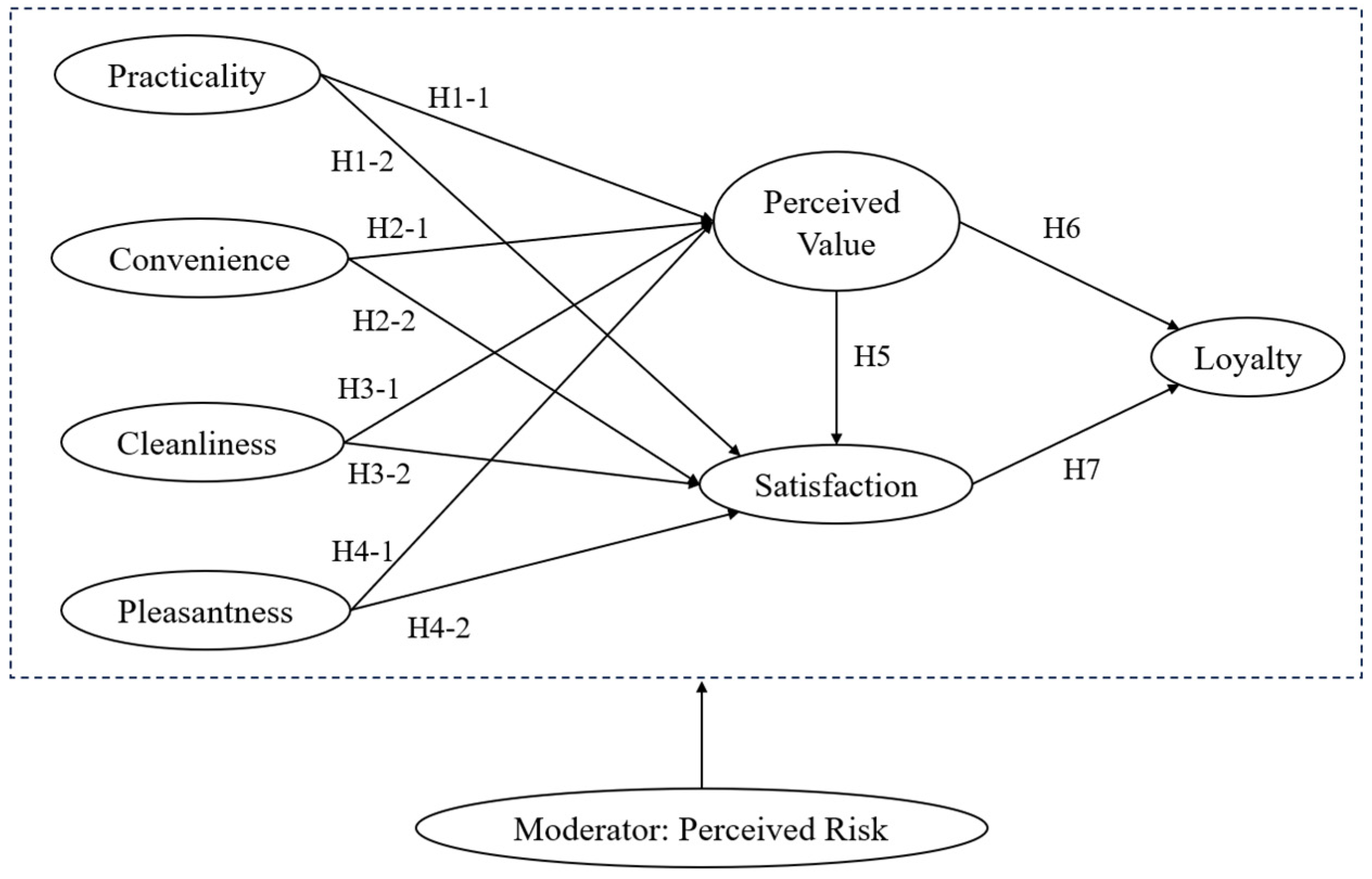
With the technology acceptance and adoption in the present era, the importance of risk perception is evident when dealing with technology and online transaction [11]. As such, consumers’ perception of risk could influence their cognition of the selection attributes and, subsequently, impact on their level of satisfaction or loyalty to the unmanned stores [49]. Thus, in a high-risk situation, consumers will be more prone to evaluate the attributes provided by unmanned stores and the better these attributes perform, their concern of risk would be eliminated, and consumers could tend to be more satisfied. On the contrary, when they perceive the low level of risk, their perception of value, satisfaction, and loyalty could be less impacted by the attributes provided by unmanned stores. Thus, the following hypothesis could be postulated. Collectively, the research framework was established based on the above discussion, and it is indicated in Figure 1.
Figure 1.
Research framework.
H8.
Consumers’ perceived risk could moderate the relations between variables.
3. Methodology
3.1. Research Design
The quantitative research method was applied to answer the research questions and achieve research objectives. Specifically, the causal relationship among research variables contained in the proposed research framework would be testified by structural equation modeling (SEM) analysis. Both measurement models to verify reliability and validity and the structural model to examine the relationship among research variables were assessed by a relative statistical program with the collected valid sample.
3.2. Research Sampling and Data Collection
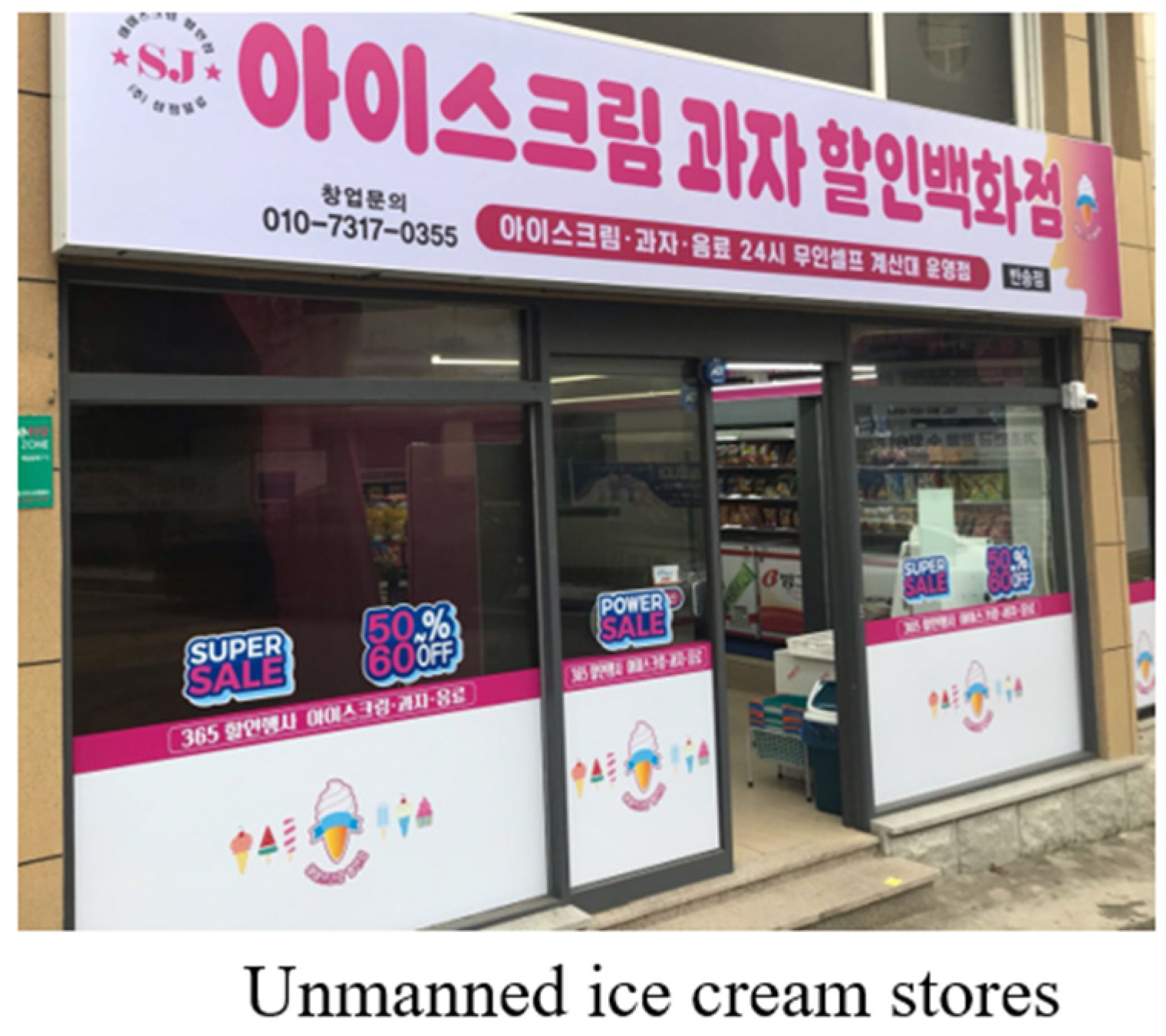
The unmanned stores investigated in this research concentrate on four typical types of unmanned stores which are the unmanned ice cream shops, unmanned printer stores, unmanned laundries, and unmanned ramen shops in Republic of Korea, because based on the data provided by Statistics Korea, these four types of unmanned stores are the most common and popular unmanned stores in the South Korean market. Meanwhile, these stores share similar characteristics of compact space (for each store of 20 Pyeong, approximately 66 square meters), low investment threshold, and the absence of manual supervision during daily operations, reflecting features of high automation and cost optimization. Figure 2 indicates the examples of Korean unmanned stores.
Figure 2.
Examples of unmanned stores in Korea of Republic.
Typically, research populations focus on Chinese people residing in the Republic of Korea since Chinese people form the largest foreign national group in the Republic of Korea. The data collection period for the questionnaires lasted from May 2022 to May 2023, approximately a year, targeting Chinese individuals who have used unmanned stores in South Korea. The questionnaire developed in this study has been coded in https://www.wenjuan.com/ which is a popular platform in China to vote, answer questionnaire surveys, or examine them. Afterwards, a unique URL link and QR code were generated for potential respondents to access the questionnaire. The URL link and QR code were distributed online in the community of Chinese people in Korea. As results, 400 samples were collected initially. After deleting samples with missing information or very limited answering time, 350 samples with a valid rate of 87.5% were used for further data analysis.
3.3. Research Instrument
The questionnaire consists of three major sections. At the very beginning, the greeting letter was notified to ensure that respondents clearly know the research purposes and informed consent was obtained if they agreed to continue with the survey. Afterwards, questions concerning socio-demographic characteristics were asked. At last, the main section concerning the measuring items of each construct contained in the research framework was available. Specifically, four measurements were used to measure practicality of unmanned stores based on the studies of Ozturk et al. and Ashraf et al. [44,45]. Based on the studies of Hightower, Lockwood, and Pyun, four measuring items were performed to measure the variable of convenience, four items were adapted to measure cleanliness, and four items were applied to assess the variable of pleasantness [17,50,51]. In terms of consumers’ perceived value, four items were used on the basis of the study of Kim from the perspective of monetary, efficiency, ease of use, and emotion items [52]. As for satisfaction, five items were applied which are adopted from previous studies [53,54]. The loyalty was measured by five items derived from the studies by Castañeda and McColl-Kennedy et al. [55,56]. Finally, consumers’ perceived risk was measured by five measuring items derived from the study of Cerda and García [57]. The corresponding revisions have been made to fit in the current research context. The designed questionnaire has been approved by three experts in the field of service and business. Minor revisions have been performed to ensure the accuracy and appropriateness of the items. The final agreement has been made among experts and authors. All the measuring items have been examined by a Five-Point Likert Scale with 1 presenting “strongly disagree” to 5 standing for “strongly agree”. At last, because the research population is Chinese, the originally designed questionnaire is in Chinese. Afterwards, the Chinese version of the questionnaire was translated into English by a Chinese–English bilingual. The English version of the questionnaire has been confirmed by authors as well.
3.4. Data Analysis
After sorting the collected data, SPSS 27.0 and AMOS 28.0 were employed to perform data analysis. Specifically, SPSS 27.0 was used for descriptive statistics analysis and correlation analysis among research variables. As for the structural equation modeling (SEM) which consists of a measurement model and structural model, AMOS 28.0 was applied to testify the validity, reliability, and model fit of research variables and the developed model as well as the hypothesized correlation. Moreover, the moderating effect of consumers’ perceived value would be examined by multi-group analysis.
4. Results
4.1. Data Analysis
By performing frequency analysis, it was examined that among 350 valid samples, 184 respondents were male, accounting for 52.6% of the sample, while 166 were female, comprising 47.4% of the total sample. This suggests a relatively balanced gender distribution among users of unmanned stores, with no significant disparity between male and female proportions. An analysis of the age distribution reveals that 34 respondents (9.7%) were under 20 years old, 157 respondents (44.9%) were between 21 and 30 years old, and 136 respondents (38.9%) were between 31 and 40 years old. Those aged 41 to 50 accounted for 16 respondents (4.6%), followed by 5 respondents (1.4%) aged 51 to 60, and 2 respondents (0.6%) over 61 years old. The data demonstrates that the primary user group of unmanned stores is concentrated among young adults, specifically individuals between 21 and 40 years old, who collectively constitute 83.8% of the total sample. This demographic is typically characterized by a higher propensity to accept and adapt to new technologies and innovative retail formats. Moreover, 177 respondents were married (50.6%), while 173 were unmarried (49.4%), indicating a nearly equal proportion between the two marital statuses. In terms of family structure, the data clearly reveals a predominant trend towards smaller household sizes. Single-person households accounted for a significant portion, with 173 households (49.4%), followed by two-person households with 93 households (26.6%). This means that single-person and two-person households combined constitute 76% of the total sample, forming the absolute majority of the surveyed group.
Moreover, the primary user base is predominantly composed of students, who represent the largest single group at 26.9% (94 individuals). This is followed by individuals in managerial positions, accounting for 21.1% (74 individuals), and those employed in service and sales roles, constituting 19.1% (67 individuals). Other occupational groups show comparatively lower representation: professionals (8.9%), production and skilled workers (10%), self-employed individuals (8%), homemakers (2.6%), public officials (2.3%), and other occupations (1.1%). This distribution suggests that the core patrons of unmanned stores are students, corporate managers, and service/sales personnel. The high adoption rate among students likely reflects a greater openness to new technologies and self-service models, coupled with frequent and flexible consumption patterns. Managers may be drawn to the high efficiency and convenience of unmanned stores due to their demanding work schedules and time constraints. For service and sales workers, whose working hours are often irregular, unmanned stores may serve as a vital supplementary shopping channel. This occupational structure offers crucial empirical evidence for refining marketing strategies, optimizing services, and guiding innovation within the unmanned store format.
4.2. The Visit Frequency of Unmanned Stores
The visit pattern of unmanned store consumers was scrutinized in Table 1. As indicated in the table, the monthly visit frequency of customers to the four types of unmanned stores shows significant differences, reflecting the distinct consumption characteristics and usage patterns of each format. For the unmanned ramen shop, the customer visit pattern is predominantly low frequency, with the highest proportion of customers visiting 1–2 times per month, accounting for 54.4% (189 people). The proportion of medium-frequency visits (3–4 times per month) are 11.4% (40 people), while the relatively high-frequency customer group (5–6 times per month) constitutes 23.1% (81 people). High-frequency customers visiting 7–8 times per month represent only 3.7% (13 people). This distribution indicates that unmanned ramen shops primarily cater to occasional dining needs. The customer visit frequency distribution for the unmanned ice cream shop is relatively balanced. Customers visiting 1–2 times per month account for 34.3% (120 people), which is identical to the proportion of customers visiting 5–6 times per month (34.3%, 120 people). Medium-frequency customers (3–4 times per month) comprise 9.7% (34 people), while the proportion of high-frequency customers visiting 7–8 times per month reaches 15.4% (54 people). This bimodal distribution feature likely reflects the dual attributes of seasonal consumption and leisure consumption. The visit frequency for the unmanned laundromat is highly concentrated, with customers visiting 1–2 times per month occupying an absolutely dominant position at 71.7% (251 people). The proportions of customers visiting 3–4 times and 5–6 times per month are 5.7% (20 people) and 6.6% (23 people), respectively. This distribution aligns with the characteristic of laundry services as a low-frequency, essential consumption.
Table 1.
Visit frequency to unmanned stores (multiple responses) (n = 350).
The customer visit frequency for the unmanned printing shop is also primarily low frequency, with customers visiting 1–2 times per month accounting for 39.7% (139 people). Medium-frequency visitors (3–4 times per month) constitute 5.7% (20 people), while the proportions of customers visiting 5–6 times and 7–8 times per month are relatively low, at 2.3% (8 people) and 1.4% (5 people), respectively. This suggests that printing services mainly fulfill temporary, project-based demands. In summary, the different unmanned store formats exhibit visits with frequency patterns that correspond to their specific service characteristics, providing important empirical evidence for understanding user behavior in the unmanned retail sector.
4.3. Results of Measurement Model
Confirmatory Factor Analysis was conducted to examine the reliability and validity of research constructs and relevant indicators. Standardized factor loadings, Cronbach’s alpha (CA), composite reliability (CR), and average extracted variance (AVE) with certain criteria were applied to testify the reliability and validity of the proposed research model as well as contained constructs. Meanwhile, the model fit indices would be generated as well to verify whether the goodness-of-fit of the proposed model fits [57].
Table 2 scrutinizes the results. It was seen that all values of CA range from 0.850 to 0.913 which are all greater than the threshold value of 0.7, indicating the confirmation of internal consistency of the research constructs [58]. Furthermore, the CR values were examined as the supplementary parameters to indicate the reliability with which all values varying from 0.809 to 0.916 are greater than the cut-off value of 0.8 [59]. Thirdly, the values of AVE are all higher than the ideal value of 0.5, varying from 0.515 to 0.733. In the meantime, all factor loadings are examined to be higher than 0.7. Collectively, the reliability and convergent validity have been confirmed. As for the indices to show the model fit, it was examined that χ2 = 783.417, DF = 278, PCMIN/DF = 2.818, GFI = 0.849, TLI = 0.914, NFI = 0.871, and CFI = 0.912 which are all falling within a reasonable range, indicating the acceptable of goodness-of-fit.
Table 2.
Results of reliability and convergent validity.
Table 3 indicates the results of discriminant validity. As suggested, if the absolute value of the correlation coefficient is between 0.1 and 0.3, it is considered a weak correlation; if the absolute value of the correlation coefficient is between 0.3 and 0.5, it is considered a moderate correlation; when the absolute value of the correlation coefficient is greater than 0.5, there is a strong correlation [60]. In this case, the correlation values of the seven variables are mostly above 0.3, indicating that the variables are fairly closely related, and some values are above 0.5, indicating a high degree of correlation between those variables. More importantly, the square-rooted AVEs in the diagonal are all greater than the correlation coefficients among variables, indicating the confirmation of discriminant validity [59].
Table 3.
Results of discriminant validity.
4.4. Results of Structural Model
This study tested the structural relationships between the constituent concepts and research hypotheses. Based on preliminary tests of deterministic factor analysis and correlation analysis, the measurement model was established, and the structural equation model was tested. The 11 hypothesized paths in the research model were evaluated through structural equation modeling analysis. Table 4 presents the results. The model fit indices of the structural model were calculated as χ2 = 785.750, DF = 279, CMIN/DF = 2.816, GFI = 0.854, IFI = 0.913, TLI = 0.901, CFI = 0.912, and RMSEA = 0.072 which are all within the threshold value, indicating the guarantee of model fit. Specifically, among 11 hypotheses, three hypotheses concerning the impact of convenience on satisfaction (β = −0.067, t = −0.965, p > 0.05), the influence of cleanliness on perceived value (β = −0.063, t = −1.083, p > 0.05), and the influence of pleasantness on perceived value (β = 0.111, t = 1.508, p > 0.05) were not supported with the significant level of p over 0.05, indicating the rejection of H2-2, H3-1, and H4-1.
Table 4.
Results of hypothesized relationships.
All of the other eight hypotheses have been confirmed. In detail, the influence of practicality of unmanned stores has a significant and positive effect on consumers’ perceived value (β = 0.229, t = 3.164, p < 0.01) and satisfaction (β = 0.164, t = 2.392, p < 0.05), confirmed H1-1 and H1-2. Furthermore, convenience could positively impact on consumer perceived value (β = 0.152, t = 2.044, p < 0.05), supporting H2-1. Consumers’ satisfaction could be both positively influenced by the cleanliness (β = 0.198, t = 3.595, p < 0.001) and pleasantness (β = 0.337, t = 4.722, p < 0.001), suggesting the confirmation of H3-2 and H4-2. Finally, the perceived value could positively impact on consumers’ satisfaction (β = 0.224, t = 3.940, p < 0.001) and their loyalty (β = 0.151, t = 2.366, p < 0.05), and consumers’ satisfaction could positively impact on their loyalty (β = 0.224, t = 3.940, p < 0.001), confirming H5, H6, and H7.
4.5. Results of Moderating Effect
The multi-group analysis by AMOS was applied to testify the moderating effect of perceived risk on the hypothesized correlation among select attributes of unmanned stores, perceived value, satisfaction, and loyalty with a Chi-square difference test [61]. The perceived value was measured by Five-Point Likert Scale from 1 to 5. Thus, the sample was split into two groups based on the mean scores. As result, the sample with perceived risk lower than the mean score was defined as the low-risk group (N = 86) and the sample higher than the mean score was grouped as the high-risk group (N = 264). As suggested by Jöreskog and Sörbom, the unconstrained model which allowed all coefficients to differ between the two groups was compared to the constrained model where the hypothesized path coefficients were set to equal to the two groups [62]. Table 5 demonstrates the results of moderating effect of perceived risk.
Table 5.
Results of moderating effect of perceived risk.
As results, consumers’ perceived risk could moderate the correlation between practicality and satisfaction (∆χ2 = 6.416, df = 1, p < 0.05), cleanliness and perceived value (∆χ2 = 4.584, df = 1, p < 0.05), and pleasantness and perceived value (∆χ2 = 5.250, df = 1, p < 0.05), as well as pleasantness and satisfaction (∆χ2 = 8.598, df = 1, p < 0.01). More specifically, the effect of practicality for high-risk group has a more significant effect on their perceived value (β high = 0.266, t = 3.009, p < 0.01). This is similar to the path from pleasantness to satisfaction (β high = 0.214, t = 3.022, p < 0.01). As for the moderating effect of perceived risk on the correlation between pleasantness and satisfaction, the satisfaction of the low-risk group (β high = 0.913, t = 3.843, p < 0.001) sample tended to be more impacted by the pleasantness of the unmanned store compared to the group of high-risk (β high = 0.279, t = 3.303, p < 0.001).
5. Discussion
This study investigates the influence of unmanned store selection attributes (practicality, convenience, cleanliness, and pleasantness) on perceived value, customer satisfaction, and loyalty with 350 empirical data derived from four typical types of unmanned stores which are unmanned ice cream shops, unmanned printer stores, unmanned laundries, and unmanned ramen shops. After performing the data analysis, it has been determined that consumers’ perceived value to unmanned stores could be predicted by the practicality and convenience of unmanned stores. Surprisingly, the cleanliness and pleasantness of unmanned stores were examined to be insignificantly associated with consumers’ perceived value, suggesting that consumers’ perceived value to unmanned stores cannot be influenced by the cleanliness and the pleasantness they obtained from using unmanned stores. On the contrary, Jöreskog et al. have verified that the cleanliness which belongs to the store attributes has a positive effect on consumers’ perceived value of the traditional retail stores which is inconsistent with the findings of the present study [63]. Probably, when consumers use unmanned stores, they have the consciousness that the store is different from staffed stores. Their perception of value to unmanned stores can only be affected by the convenience and practicality. This notion is very in line with the application of technology in a diverse service industry where convenience and practicality are the major issues [64]. Similar to this, the importance of self-service technologies has been well discussed and confirmed [65,66]. As for their satisfaction, except the convenience, all other factors of practicality, cleanliness, and pleasantness were found to be significant drivers. The results indicate that for consumer usage behavior regarding unmanned stores, practicality serves as the foundation with the significance both in perceived value and satisfaction. That is, consumers first rationally evaluate whether the products and services in unmanned stores are practical and efficient, which directly determines their level of perceived value and subsequently influences their satisfaction [6,7]. However, it is very surprising that the convenience of unmanned stores has insignificant impact on consumers’ satisfaction. Combining with the significant and positive relationship between convenience and perceived value, it could infer that convenience has become a baseline expectation rather than a satisfaction driver in terms of the unmanned stores. In terms of the emotional and experiential factors such as clean environment and a pleasant atmosphere, it was found to be crucial for enhancing consumer satisfaction with unmanned stores. Subsequently, positive emotional experiences ultimately determine success and are more likely to increase consumer loyalty.
As for the moderating effect of perceived risk, it amplifies the importance of practical utility and pleasantness on value and satisfaction for high-risk perceivers. Notably, while a pleasant experience is a key driver of satisfaction for all consumers, its impact is substantially stronger for those who perceive low risk, suggesting that a positive atmosphere is most effective once initial risk concerns are alleviated. Moreover, for consumers with high perceived risk, their assessments become more utilitarian with which the functional aspect of practicality becomes a more critical determinant of perceived value, and the emotional aspect of pleasantness becomes a more crucial driver for their satisfaction. This indicates that high-risk perceivers need tangible, functional benefits and clear emotional rewards to justify their perceived risk of the practice of unmanned stores. Similar findings have been verified by the study of Galdolage et al. in the context of website usability [67].
On the contrary, for the low-risk group, the experience of pleasantness exerts an overwhelmingly strong influence on satisfaction. This suggests that once the barrier of risk is lowered, marketing can shift focus from building trust and justifying functionality to maximizing the enjoyability and emotional appeal of the retail environment to foster strong customer loyalty.
6. Conclusions
6.1. Research Implications
Based on the research findings, this study is expected to contribute to both academic research on unmanned stores and the development of the industry. Given its academic significance, this study targeted Chinese residents in South Korea, conducting a questionnaire survey among those who have used unmanned stores there. A total of 350 valid questionnaires were collected, providing new research data for the study of unmanned stores. The analysis results indicate that the utility value of unmanned stores forms the foundation, while the emotional experience (cleanliness and pleasantness) ultimately determines the success of unmanned stores which could provide empirical evidence for future research to investigate the practice of unmanned stores. Furthermore, the diverse aspects of unmanned selection attributes have been empirically testified which could be served as a research paradigm for the future research to explore the specific dimensions of unmanned stores [2,3,68]. Thirdly, the research results show a high proportion of unmarried individuals and single-person households. This suggests that when studying emerging consumption models like unmanned stores, it is particularly important to pay attention to the demand characteristics of the single economy and smaller household units, as they may have unique preferences regarding shopping convenience, product specifications, and consumption experiences. Thus, socio-demographic characteristics such as gender, family types, and even generational discrepancy could be investigated in future research. Finally, confirmation of the moderating effect of consumers’ perceived value suggests that the external surroundings altered by the technology could influence consumers’ perception of risk which could be a research concentration for the future study.
In terms of the practical implications, descriptive analysis concerning consumers’ consumption frequency indicates that students, corporate managers, and service/sales personnel constitute the core customer base with the highest consumption potential for unmanned stores. These customer segments typically prioritize shopping efficiency and convenience. The data also suggests that middle-level managers hold significant value due to their similar emphasis on high efficiency and convenience. These analytical findings provide a crucial basis for the site selection of unmanned stores. It is recommended to establish outlets near university campuses, office building clusters, large shopping malls, or transportation hubs to effectively target and serve these key consumer groups. Furthermore, on the basis of practicality, enhancing the emotional experience through environmental details is crucial. It is primary to maintain a shopping space that is clean, tidy, and bright. Thus, attention should be paid to details such as lighting, temperature, and background music to enhance consumers’ satisfaction and subsequently loyalty to the unmanned stores, which is the major issue of the sustainable development of business modes. Naturally, soft lighting, a comfortable temperature, and relaxing, pleasant music can create a comfortable atmosphere, thereby enhancing the enjoyment of the shopping process [9,69,70]. More importantly, it was suggested that even in an unmanned store, it is important for managers or operators to provide effective assistance. This includes designing clear operation guides and equipping the stores with virtual customer service or convenient remote human-assisted channels to mitigate the impersonal feeling that unmanned stores might convey. Thus, on one hand, technology could assist in establishing a new mode of service. On the other hand, the necessity of human work could not be underestimated. The balance of technology application and human work in the realm of service to maintain sustainable and generative development should be brought to attention.
6.2. Limitations and Future Research Directions
Although this study has been completed, it has limitations in terms of the diversity of retail formats covered in the research sample. This study primarily selected four types of operations which are unmanned ice cream shops, unmanned printer shops, unmanned laundry shops, and unmanned ramen shops, respectively. While they are typical models in the current market, they do not comprehensively cover the entire spectrum of unmanned retail formats. To enhance the generalizability of the research findings, subsequent studies could validate the results by incorporating a wider variety of unmanned retail formats. Thus, future research could control these variables or include a larger range of store types to understand consumers’ behavioral intention to unmanned stores from a more comprehensive perspective. A more robust and explanatory theoretical model could be developed. Moreover, the sample selected in the present study mainly concentrates on the Chinese population residing in the Republic of Korea while the language or cultural context barrier or difference was neglected which may, to some extent, impact on consumers’ perception or evaluation to the service provided by unmanned stores. Thus, for future research, the potential influence of these factors should be examined, or a comparative study could be conducted with the potential influence of cultural background.
Author Contributions
Conceptualization, J.Y. and J.W.; methodology, J.Y. and S.T.; writing—original draft preparation, J.Y.; writing—review and editing, J.W.; supervision, H.-S.K. All authors have read and agreed to the published version of the manuscript.
Funding
This research was funded by Huangshan University, grant number 2023xskq011 and WLSYS202402.
Institutional Review Board Statement
Ethical review and approval were waived for this study due to this study strictly adheres to Article 39 of the “Measures for Ethical Review of Biomedical Research Involving Human Subjects” (Order No. 11 of the National Health and Family Planning Commission, 2016). This provision explicitly lists circumstances exempt from ethical review, including “(1) Research utilizing publicly available data obtained legally, or data generated through observation without interfering with public activities”; “(2) Research conducted using anonymized information data”.
Informed Consent Statement
Informed consent was obtained from all subjects involved in the study.
Data Availability Statement
The raw data supporting the conclusions of this article will be made available by the authors on request.
Conflicts of Interest
The authors declare no conflicts of interest.
References
- Adapa, S.; Fazal-e-Hasan, S.M.; Makam, S.B.; Azeem, M.M.; Mortimer, G. Examining the antecedents and consequences of perceived shopping value through smart retail technology. J. Retail. Consum. Serv. 2020, 52, 101901. [Google Scholar] [CrossRef]
- Roy, S.K.; Shekhar, V.; Lassar, W.M.; Chen, T. Customer engagement behaviors: The role of service convenience, fairness and quality. J. Retail. Consum. Serv. 2018, 44, 293–304. [Google Scholar] [CrossRef]
- Park, H.J.; Zhang, Y. Technology readiness and technology paradox of unmanned convenience store users. J. Retail. Consum. Serv. 2022, 65, 102523. [Google Scholar] [CrossRef]
- Sahai, A.K.; Rath, N. Artificial intelligence and the 4th industrial revolution. In Artificial Intelligence and Machine Learning in Business Management; CRC Press: Boca Raton, FL, USA, 2021; pp. 127–143. [Google Scholar]
- Shankar, V.; Kalyanam, K.; Setia, P.; Golmohammadi, A.; Tirunillai, S.; Douglass, T.; Hennessey, J.; Bull, J.S.; Waddoups, R. How technology is changing retail. J. Retail. 2021, 97, 13–27. [Google Scholar] [CrossRef]
- Denuwara, N.; Maijala, J.; Hakovirta, M. The impact of unmanned stores’ business models on sustainability. SN Bus. Econ. 2021, 1, 143. [Google Scholar] [CrossRef]
- Lo, C.H.; Wang, Y.W. Constructing an evaluation model for user experience in an unmanned store. Sustainability 2019, 11, 4965. [Google Scholar] [CrossRef]
- Kim, J.; Jung, Y. The influence of the environmental characteristics of unmanned convenience stores and the personal characteristics of customers on emotional experience, affectively based satisfaction, and loyalty. J. Channel Retail. 2021, 26, 83–113. [Google Scholar] [CrossRef]
- Nam, Y.; Lee, S.; Lee, H. Consumer preferences for unmanned stores: A choice experiment study. J. Retail. Consum. Serv. 2025, 82, 104061. [Google Scholar] [CrossRef]
- Incisiv. 2023 Connected Retail Experience Study: Operational Efficiency Is the New Imperative. Available online: https://www.incisiv.com/report-2023-connected-retail-experience-study-operational-efficiency-is-the-new-imperative#download-ebook (accessed on 18 November 2025).
- Wang, I.C.; Liao, C.W.; Lin, K.P.; Wang, C.H.; Tsai, C.L. Evaluate the consumer acceptance of AIoT-based unmanned convenience stores based on perceived risks and technological acceptance models. Math. Probl. Eng. 2021, 2021, 4416270. [Google Scholar] [CrossRef]
- Purushottam, N. Store attributes preference in selecting a store: A study of large scale retail stores in South Africa. J. Bus. Behav. Sci. 2021, 23, 66–81. [Google Scholar]
- Desai, D.; Phadtare, M. Attributes influencing retail store choice decision of shoppers: A case of Pune City. Vision 2017, 21, 436–448. [Google Scholar] [CrossRef]
- Dabija, D.C.; Băbuț, R. Enhancing apparel store patronage through retailers’ attributes and sustainability. A generational approach. Sustainability 2019, 11, 4532. [Google Scholar] [CrossRef]
- Dabija, D.C.; Câmpian, V.; Pop, A.R.; Băbuț, R. Generating loyalty towards fast fashion stores: A cross-generational approach based on store attributes and socio-environmental responsibility. Oecon. Copernic. 2022, 13, 891–934. [Google Scholar] [CrossRef]
- Im, I.; Kim, Y.; Han, H.J. The effects of perceived risk and technology type on users’ acceptance of technologies. Inf. Manag. 2008, 45, 1–9. [Google Scholar] [CrossRef]
- Khaksar, S.M.S.; Khosla, R.; Singaraju, S.; Slade, B. Carer’s perception on social assistive technology acceptance and adoption: Moderating effects of perceived risks. Behav. Inf. Technol. 2021, 40, 337–360. [Google Scholar] [CrossRef]
- Xu, N.; Hsu, P.Y.; Chang, Y.W.; Kan, B.L. Determinants of Unmanned Store Usage Intention Based on Situational Theory and the Technology Readiness Index. 2021. Available online: https://ssrn.com/abstract=3929828 (accessed on 18 November 2025).
- Wu, H.C.; Xu, H.; Wu, T.P. Service innovation, experiential relationship quality and shopping outcomes in a smart unmanned store. J. Mark. Commun. 2024, 30, 344–367. [Google Scholar] [CrossRef]
- Sánchez-Fernández, R.; Iniesta-Bonillo, M.Á. The concept of perceived value: A systematic review of the research. Mark. Theory 2007, 7, 427–451. [Google Scholar] [CrossRef]
- Danaher, P.J.; Mattsson, J. Customer satisfaction during the service delivery process. Eur. J. Mark. 1994, 28, 5–16. [Google Scholar] [CrossRef]
- Lemmink, J.; Schuijf, A.; Streukens, S. The role of corporate image and company employment image in explaining application intentions. J. Econ. Psychol. 2023, 24, 1–15. [Google Scholar] [CrossRef]
- Hartman, R.S. The Measurement of Value; Robert S. Hartman Institute: Knoxville, TN, USA, 1973. [Google Scholar]
- Holbrook, M.B. Consumer Value: A Framework for Analysis and Research; Routledge: London, UK, 1999; pp. 5–14. [Google Scholar]
- Sheth, J.N.; Newman, B.I.; Gross, B.L. Why we buy what we buy: A theory of consumption values. J. Bus. Res. 1991, 22, 159–170. [Google Scholar] [CrossRef]
- Wells, J.; Tan, C.S. Examining the influence of functional value, social value and emotional value on purchase intention for tires in Japan. J. Asia Bus. Stud. 2024, 18, 593–608. [Google Scholar] [CrossRef]
- Rasoolimanesh, S.M.; Iranmanesh, M.; Amin, M.; Hussain, K.; Jaafar, M.; Ataeishad, H. Are functional, emotional and social values interrelated? A study of traditional guesthouses in Iran. Int. J. Contemp. Hosp. Manag. 2020, 32, 2857–2880. [Google Scholar] [CrossRef]
- Kato, T. Functional value vs emotional value: A comparative study of the values that contribute to a preference for a corporate brand. Int. J. Inf. Manag. Data Insights 2021, 1, 100024. [Google Scholar] [CrossRef]
- Si, M.; Park, J.E.; Kim, T. The Effects of Characteristics of Unmanned Store on Consumers’ Perceived Value and Visit Intention. J. Channel Retail. 2024, 29, 49–79. [Google Scholar] [CrossRef]
- Yin, J.; Qiu, X. AI technology and online purchase intention: Structural equation model based on perceived value. Sustainability 2021, 13, 5671. [Google Scholar] [CrossRef]
- Yi, Y. A critical review of consumer satisfaction. Rev. Mark. 1990, 4, 68–123. [Google Scholar]
- Dam, S.M.; Dam, T.C. Relationships between service quality, brand image, customer satisfaction, and customer loyalty. J. Asian Financ. Econ. Bus. 2021, 8, 585–593. [Google Scholar]
- Ban, H.J.; Kim, H.S. Understanding customer experience and satisfaction through airline passengers’ online review. Sustainability 2019, 11, 4066. [Google Scholar] [CrossRef]
- Wang, W.; Cao, D.; Ameen, N. Understanding customer satisfaction of augmented reality in retail: A human value orientation and consumption value perspective. Inf. Technol. People 2023, 36, 2211–2233. [Google Scholar] [CrossRef]
- Singh, V.; Sharma, M.P.; Jayapriya, K.; Kumar, B.K.; Chander, M.A.R.N.; Kumar, B.R. Service quality, customer satisfaction and customer loyalty: A comprehensive literature review. J. Surv. Fish. Sci. 2023, 10, 3457–3464. [Google Scholar]
- Jimenez, N.; San-Martin, S.; Azuela, J.I. Trust and satisfaction: The keys to client loyalty in mobile commerce. Acad. Rev. Latinoam. Adm. 2016, 29, 486–510. [Google Scholar] [CrossRef]
- Chauke, D.X.; Duh, H.I. Marketing and socio-psychological factors influencing organic food purchase and post-purchase outcomes. J. Food Prod. Mark. 2019, 25, 896–920. [Google Scholar] [CrossRef]
- Siebert, A.; Gopaldas, A.; Lindridge, A.; Simões, C. Customer experience journeys: Loyalty loops versus involvement spirals. J. Mark. 2020, 84, 45–66. [Google Scholar] [CrossRef]
- Lina, R. Improving product quality and satisfaction as fundamental strategies in strengthening customer loyalty. Akad. J. Mhs. Ekon. Bisnis 2022, 2, 19–26. [Google Scholar] [CrossRef]
- Yadav, M.; Rahman, Z. The influence of social media marketing activities on customer loyalty: A study of e-commerce industry. Benchmarking Int. J. 2018, 25, 3882–3905. [Google Scholar] [CrossRef]
- Aripin, Z.; Pynatih, N.M.N.; Aristanto, E. Nurturing marketing relationships: The role of loyalty tendencies beyond relationship dynamics. J. Econ. Account. Bus. Manag. Eng. Soc. 2024, 1, 67–81. [Google Scholar]
- Hilgard, E.R. The trilogy of mind: Cognition, affection, and conation. J. Hist. Behav. Sci. 1980, 16, 107–117. [Google Scholar] [CrossRef]
- Hsiao, C.C. Understanding content sharing on the internet: Test of a cognitive-affective-conative model. Online Inf. Rev. 2020, 44, 1289–1306. [Google Scholar] [CrossRef]
- Lim, S.H.; Kim, D.J. Does emotional intelligence of online shoppers affect their shopping behavior? From a cognitive-affective-conative framework perspective. Int. J. Hum.–Comput. Interact. 2020, 36, 1304–1313. [Google Scholar] [CrossRef]
- Ashraf, R.U.; Hou, F.; Ahmad, W. Understanding continuance intention to use social media in China: The roles of personality drivers, hedonic value, and utilitarian value. Int. J. Hum.-Comput. Interact. 2019, 35, 1216–1228. [Google Scholar] [CrossRef]
- Ozturk, A.B.; Nusair, K.; Okumus, F.; Hua, N. The role of utilitarian and hedonic values on users’ continued usage intention in a mobile hotel booking environment. Int. J. Hosp. Manag. 2016, 57, 106–115. [Google Scholar] [CrossRef]
- Oliver, R.L.; DeSarbo, W.S. Response determinants in satisfaction judgments. J. Consum. Res. 1988, 14, 495–507. [Google Scholar] [CrossRef]
- Sirdeshmukh, D.; Singh, J.; Sabol, B. Consumer trust, value, and loyalty in relational exchanges. J. Mark. 2002, 66, 15–37. [Google Scholar] [CrossRef]
- Woodruff, R.B. Customer value: The next source for competitive advantage. J. Acad. Mark. Sci. 1997, 25, 139–153. [Google Scholar] [CrossRef]
- Yang, Z.; Peterson, R.T. Customer perceived value, satisfaction, and loyalty: The role of switching costs. Psychol. Mark. 2004, 21, 799–822. [Google Scholar] [CrossRef]
- Hightower, R. Investigating the green Leadership in Energy and Environmental Design (LEED) servicescape scale in Brazil. Constr. Innov. 2013, 13, 242–265. [Google Scholar] [CrossRef]
- Lockwood, A.; Pyun, K. How do customers respond to the hotel servicescape? Int. J. Hosp. Manag. 2019, 82, 231–241. [Google Scholar] [CrossRef]
- Kim, H.W.; Chan, H.C.; Gupta, S. Value-based adoption of mobile internet: An empirical investigation. Decis. Support Syst. 2007, 43, 111–126. [Google Scholar] [CrossRef]
- Saad Andaleeb, S.; Conway, C. Customer satisfaction in the restaurant industry: An examination of the transaction-specific model. J. Serv. Mark. 2006, 20, 3–11. [Google Scholar] [CrossRef]
- McColl-Kennedy, J.; Schneider, U. Measuring customer satisfaction: Why, what and how. Total Qual. Manag. 2000, 11, 883–896. [Google Scholar] [CrossRef]
- Castañeda, J.A. Relationship between customer satisfaction and loyalty on the internet. J. Bus. Psychol. 2011, 26, 371–383. [Google Scholar] [CrossRef]
- Sharma, A.; Gupta, J.; Gera, L.; Sati, M.; Sharma, S. Relationship between customer satisfaction and loyalty. Soc. Sci. Res. Netw. 2020. [Google Scholar] [CrossRef]
- Cerda, A.A.; García, L.Y. Hesitation and refusal factors in individuals’ decision-making processes regarding a coronavirus disease 2019 vaccination. Front. Public Health 2021, 9, 626852. [Google Scholar] [CrossRef]
- Hair, J.F., Jr.; Matthews, L.M.; Matthews, R.L.; Sarstedt, M. PLS-SEM or CB-SEM: Updated guidelines on which method to use. Int. J. Multivar. Data Anal. 2017, 1, 107–123. [Google Scholar] [CrossRef]
- Cheung, G.W.; Cooper-Thomas, H.D.; Lau, R.S.; Wang, L.C. Reporting reliability, convergent and discriminant validity with structural equation modeling: A review and best-practice recommendations. Asia Pac. J. Manag. 2024, 41, 745–783. [Google Scholar] [CrossRef]
- Rönkkö, M.; Cho, E. An updated guideline for assessing discriminant validity. Organ. Res. Methods 2022, 25, 6–14. [Google Scholar] [CrossRef]
- Fornell, C.; Larcker, D.F. Evaluating structural equation models with unobservable variables and measurement error. J. Mark. Res. 1981, 18, 39–50. [Google Scholar] [CrossRef]
- Jöreskog, K.G.; Sörbom, D. LISREL 8: Structural Equation Modeling with the SIMPLIS Command Language; Scientific Software International: Hillsdale, NJ, USA, 1993. [Google Scholar]
- Nikhashemi, S.R.; Tarofder, A.K.; Gaur, S.S.; Haque, A. The effect of customers’ perceived value of retail store on relationship between store attribute and customer brand loyalty: Some insights from Malaysia. Procedia Econ. Financ. 2016, 37, 432–438. [Google Scholar] [CrossRef]
- Chen, K.H.; Chang, F.H.; Chen, Y.L.; Chen, P.M. The relationships between corporate credibility, service convenience, and consumers’ use intentions: Toward ticketing apps for low-cost carriers. Sustainability 2019, 11, 810. [Google Scholar] [CrossRef]
- Collier, J.E.; Kimes, S.E. Only if it is convenient: Understanding how convenience influences self-service technology evaluation. J. Serv. Res. 2013, 16, 39–51. [Google Scholar] [CrossRef]
- Galdolage, B.S. Interplay between performance and convenience in customer choice of self-service technologies. Curr. J. Appl. Sci. Technol. 2021, 40, 80–91. [Google Scholar] [CrossRef]
- Belanche, D.; Casaló, L.V.; Guinalíu, M. Website usability, consumer satisfaction and the intention to use a website: The moderating effect of perceived risk. J. Retail. Consum. Serv. 2012, 19, 124–132. [Google Scholar] [CrossRef]
- Yuan, M.; Jotikasthira, N. Factors Affecting the Acceptance Intentions of Consuming at Unmanned Stores in Chengdu, China. RICE J. Creat. Entrep. Manag. 2024, 5, 19–37. [Google Scholar]
- Meng, D.; Tho-ard, M.; Yang, H. The effect of pleasantness of store music on customers’ engagement and trust. Soc. Behav. Personal. Int. J. 2023, 51, 1–7. [Google Scholar] [CrossRef]
Disclaimer/Publisher’s Note: The statements, opinions and data contained in all publications are solely those of the individual author(s) and contributor(s) and not of MDPI and/or the editor(s). MDPI and/or the editor(s) disclaim responsibility for any injury to people or property resulting from any ideas, methods, instructions or products referred to in the content. |
© 2025 by the authors. Licensee MDPI, Basel, Switzerland. This article is an open access article distributed under the terms and conditions of the Creative Commons Attribution (CC BY) license (https://creativecommons.org/licenses/by/4.0/).