Research on Unified Information Modeling and Cross-Protocol Real-Time Interaction Mechanisms for Multi-Energy Supply Systems in Green Buildings


Abstract
1. Introduction
- (1)
- A unified multi-energy information model based on extended IEC 61850 logical nodes and standardized data objects that cover electrical, thermal, and hydrogen devices under a single semantic and unit system.
- (2)
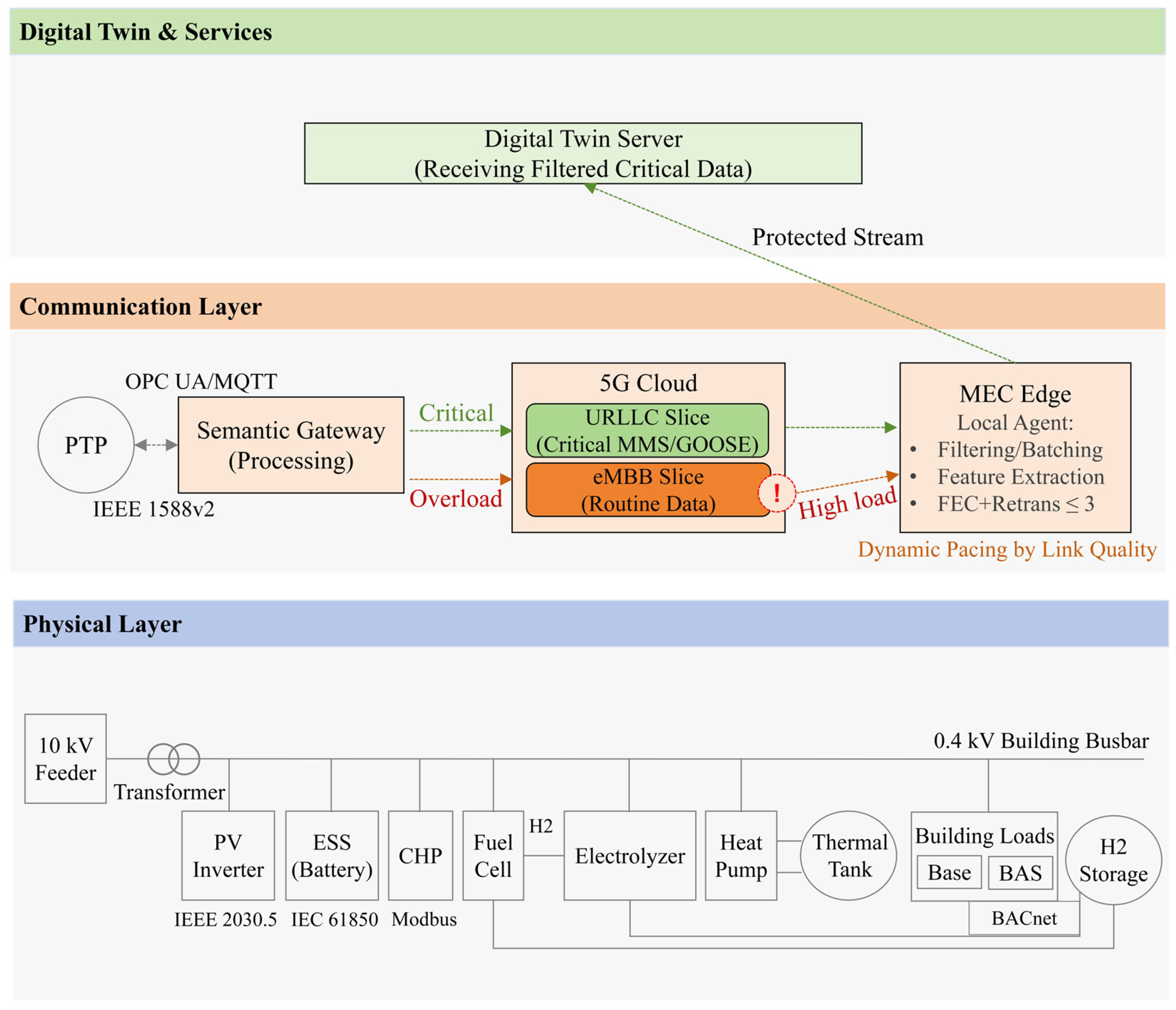
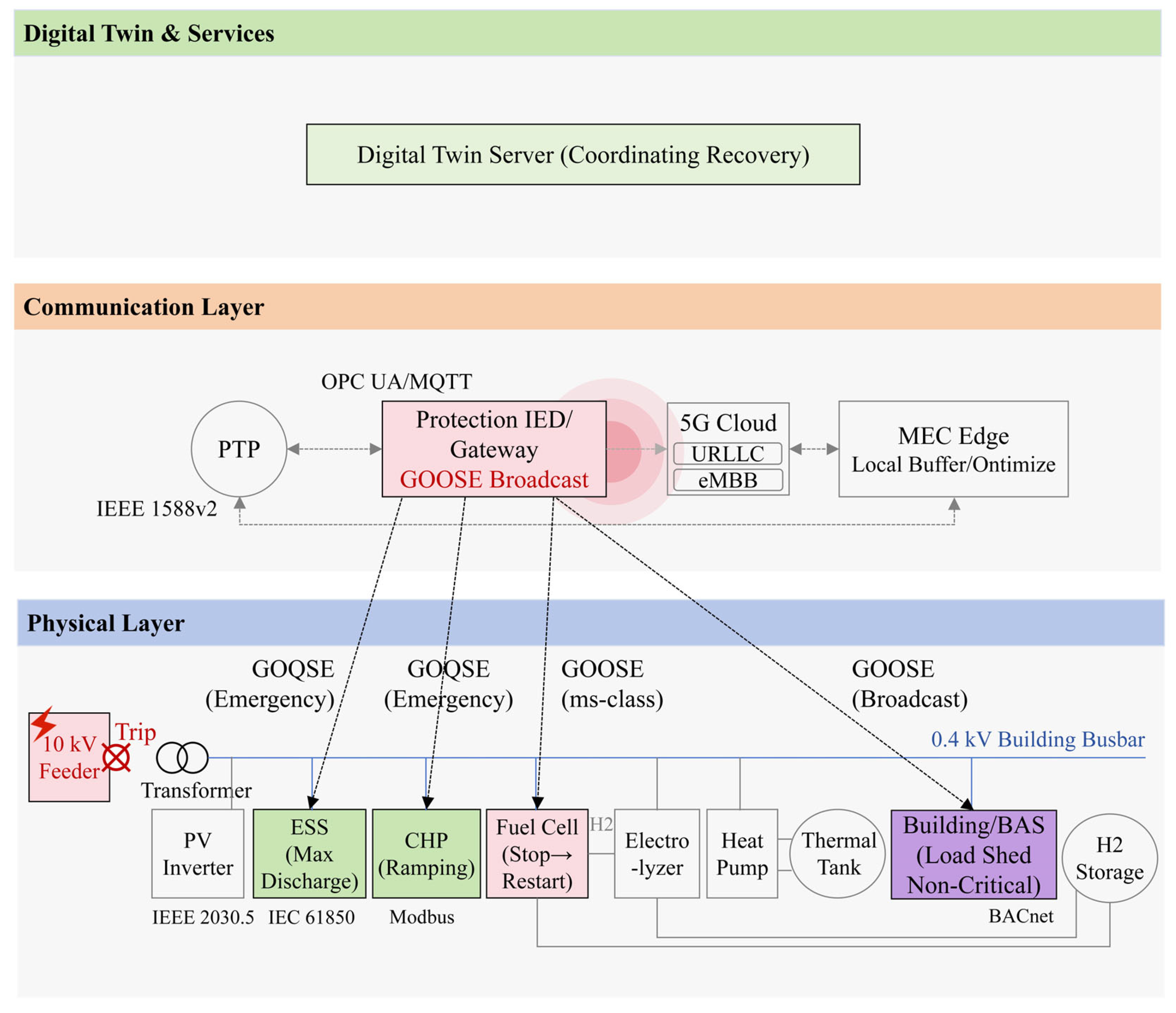
- A cross-protocol real-time interaction mechanism that combines semantic gateways, GOOSE-based fast event distribution, and 5G/edge-assisted MMS optimization to support deterministic low-latency control over heterogeneous networks.
- (3)
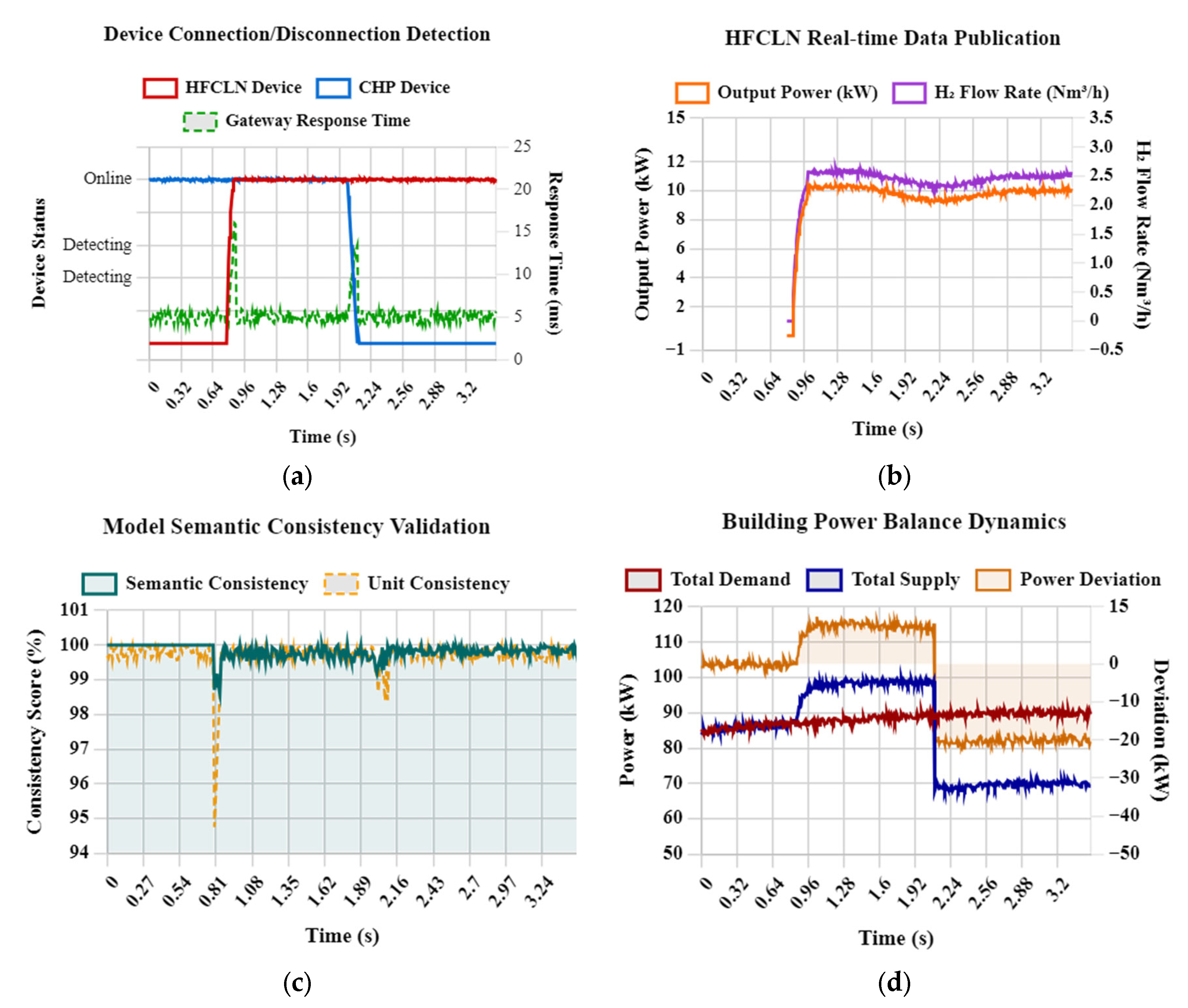
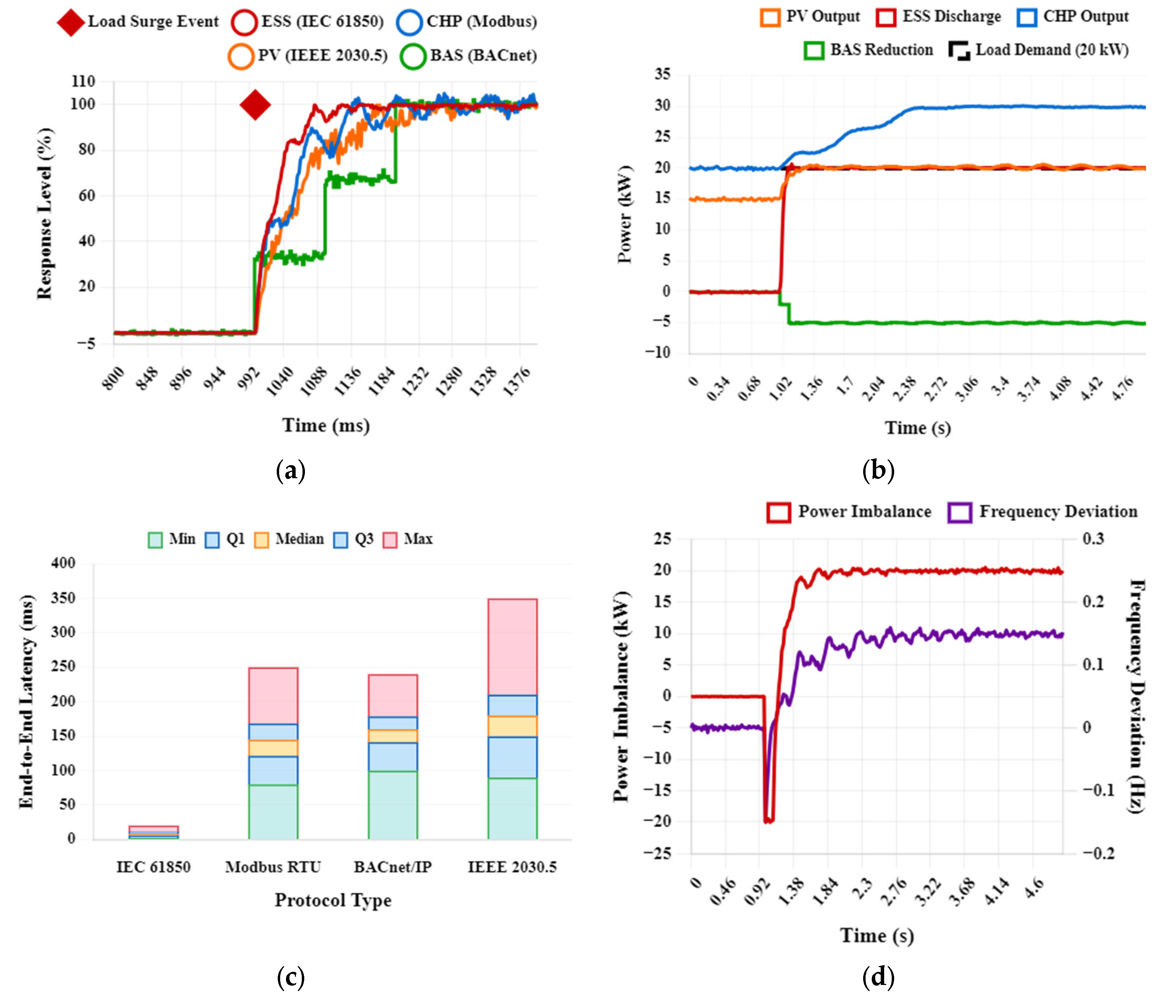
- A digital-twin-based evaluation framework that quantifies plug-and-play capability, cross-protocol latency, robustness under extreme communication conditions, and resilience improvements under grid faults in a representative green-building multi-energy system. The following sections present the design and implementation of the proposed models and mechanisms and evaluate their performance using digital twin simulation.
2. Methods
2.1. Multi-Energy Unified Information Model Design
2.1.1. IEC 61850 and IEC 61970 Model Mechanisms
2.1.2. Device Modeling with Extended IEC 61850 Logical Nodes
2.1.3. Cross-Energy Semantic Unification and Data Object Standardization
2.1.4. Ontology Representation and Comparison with CIM and Energy Ontologies
2.2. Cross-Protocol Real-Time Information Interaction Mechanism
2.2.1. Multi-Protocol Semantic Mapping and Adaptive Gateway
2.2.2. Cross-Domain Fast Communication Strategy Integrating GOOSE
2.2.3. MMS Communication Optimization Based on 5G and Edge Computing
3. Simulation Platform and Test Scheme
3.1. Simulation Platform Construction
3.2. Test Scheme Design and Implementation
3.2.1. Test 1: Device Plug-and-Play and Semantic Consistency Testing
3.2.2. Test 2: Cross-Protocol Coordinated Control Effect Testing
3.2.3. Test 3: Extreme Communication Condition Robustness Testing
3.2.4. Test 4: Grid Fault Condition Resilience Testing
3.3. Conceptual Multi-Building Extension Scenario
4. Simulation Results and Discussion
4.1. Test 1 Results
4.2. Test 2 Results
4.3. Test 3 Results
4.4. Test 4 Results
4.5. Limitations and Future Work
5. Conclusions
Author Contributions
Funding
Institutional Review Board Statement
Informed Consent Statement
Data Availability Statement
Conflicts of Interest
Appendix A. SCL Fragment Example (For Direct Embedding or Reference)
Appendix A.1. Extended Logical Node Definition for Hydrogen Fuel Cell (HFCLN)
Appendix A.2. Cross-Energy Coupling Efficiency Logical Node (ECLN)
Appendix A.3. GOOSE High-Speed Event Broadcasting Configuration
References
- Reddy, V.J.; Hariram, N.P.; Ghazali, M.F.; Kumarasamy, S. Pathway to Sustainability: An Overview of Renewable Energy Integration in Building Systems. Sustainability 2024, 16, 638. [Google Scholar] [CrossRef]
- Gao, Z.; Zoldak, P.; Beaudry-Losique, J.; Mannarino, T.; Mansinger, J.; Molana, M.; Zhang, M.; Cheekatamarla, P.; Abuheiba, A.; Li, H.; et al. Development of a Micro-Combined Heat and Power Powered by an Opposed-Piston Engine in Building Applications. Nat. Commun. 2024, 15, 4404. [Google Scholar] [CrossRef]
- Wu, P.; Liu, Y. Impact of Urban Form at the Block Scale on Renewable Energy Application and Building Energy Efficiency. Sustainability 2023, 15, 11062. [Google Scholar] [CrossRef]
- Trinko, D.; Horesh, N.; Porter, E.; Dunckley, J.; Miller, E.; Bradley, T. Transportation and electricity systems integration via electric vehicle charging-as-a-service: A review of techno-economic and societal benefits. Renew. Sustain. Energy Rev. 2023, 175, 113180. [Google Scholar] [CrossRef]
- Chen, Y.; Yang, C.; Pan, X.; Yan, D. Design and operation optimization of multi-chiller plants based on energy performance simulation. Energy Build. 2020, 222, 110100. [Google Scholar] [CrossRef]
- Kumar, S.; Abu-Siada, A.; Das, N.; Islam, S. Review of the Legacy and Future of IEC 61850 Protocols Encompassing Substation Automation System. Electronics 2023, 12, 3345. [Google Scholar] [CrossRef]
- Ayello, M.; Lopes, Y. Interoperability Based on IEC 61850 Standard: Systematic Literature Review, Certification Method Proposal, and Case Study. Electr. Power Syst. Res. 2023, 220, 109355. [Google Scholar] [CrossRef]
- Chen, L.; Li, H.; Charton, T.; Zhang, R. Virtual Digital Substation Test System and Interoperability Assessments. Energies 2021, 14, 2337. [Google Scholar] [CrossRef]
- Alaerjan, A.; Kim, D.K.; Ming, H.; Malik, K. Using DDS Based on Unified Data Model to Improve Interoperability of Smart Grids. In Proceedings of the 2018 IEEE International Conference on Smart Energy Grid Engineering (SEGE), Oshawa, ON, Canada, 12–15 August 2018; pp. 110–114. [Google Scholar] [CrossRef]
- Evins, R.; Pointer, P.; Vaidyanathan, R.; Burgess, S. A case study exploring regulated energy use in domestic buildings using design-of-experiments and multi-objective optimisation. Build. Environ. 2012, 54, 126–136. [Google Scholar] [CrossRef]
- Lork, C.; Choudhary, V.; Hassan, N.U.; Tushar, W.; Yuen, C.; Ng, B.K.K.; Wang, X.; Liu, X. An Ontology-Based Framework for Building Energy Management with IoT. Electronics 2019, 8, 485. [Google Scholar] [CrossRef]
- Li, H.; Hong, T. A Semantic Ontology for Representing and Quantifying Energy Flexibility of Buildings. Adv. Appl. Energy 2022, 8, 100113. [Google Scholar] [CrossRef]
- Zhu, Y.; Wang, X.; Zheng, G. Blessing or Curse? The Impact of Digital Technologies on Carbon Efficiency in the Agricultural Sector of China. Sustainability 2023, 15, 15613. [Google Scholar] [CrossRef]
- Ge, H.; Xu, B.; Zhang, X.; Bi, Y.; Zhao, Z. Feeder Topology Configuration and Application Based on IEC 61850. Energies 2021, 14, 4230. [Google Scholar] [CrossRef]
- Cavalieri, S. Semantic Interoperability between IEC 61850 and oneM2M for IoT-Enabled Smart Grids. Sensors 2021, 21, 2571. [Google Scholar] [CrossRef]
- Reda, H.T.; Ray, B.; Peidaee, P.; Anwar, A.; Mahmood, A.; Kalam, A.; Islam, N. Vulnerability and Impact Analysis of the IEC 61850 GOOSE Protocol in the Smart Grid. Sensors 2021, 21, 1554. [Google Scholar] [CrossRef]
- Santos, G.L.; Guimarães, V.T.; da Cunha Rodrigues, G.; Granville, L.Z.; Tarouco, L.M.R. Infrastructure for Integration of Legacy Electrical Equipment into a Smart-Grid Using Wireless Sensor Networks. Sensors 2018, 18, 1312. [Google Scholar] [CrossRef] [PubMed]
- Odgaard, P.F.; Stoustrup, J. Gear-box fault detection using time-frequency based methods. Annu. Rev. Control 2015, 40, 50–58. [Google Scholar] [CrossRef]
- Huang, J.; Wang, H.; Qian, Y. Smart grid communications in challenging environments. In Proceedings of the 2012 IEEE Third International Conference on Smart Grid Communications (SmartGridComm), Tainan, 5–8 November 2012; pp. 552–557. [Google Scholar] [CrossRef]
- Blair, S.M.; Booth, C.D.; Burt, G.M. Current–Time Characteristics of Resistive Superconducting Fault Current Limiters. IEEE Trans. Appl. Supercond. 2012, 22, 5600205. [Google Scholar] [CrossRef]
- Santos, G.; Morais, H.; Pinto, T.; Corchado, J.M.; Vale, Z. Intelligent Energy Systems Ontology to Support Markets and Power Systems Co-Simulation Interoperability. Energy Convers. Manag. X 2023, 20, 100495. [Google Scholar] [CrossRef]
- Booshehri, M.; Emele, L.; Flügel, S.; Förster, H.; Frey, J.; Frey, U.; Glauer, M.; Hastings, J.; Hofmann, C.; Hoyer-Klick, C.; et al. Introducing the Open Energy Ontology: Enhancing Data Interpretation and Interfacing in Energy Systems Analysis. Energy AI 2021, 5, 100074. [Google Scholar] [CrossRef]
- Santodomingo, R.; Rohjans, S.; Uslar, M.; Rodríguez-Mondéjar, J.A.; Sanz-Bobi, M.A. Facilitating the Automatic Mapping of IEC 61850 Signals and CIM Measurements. IEEE Trans. Power Syst. 2013, 28, 4348–4355. [Google Scholar] [CrossRef]
- Naumann, A.; Bielchev, I.; Voropai, N.; Styczynski, Z. Smart Grid Automation Using IEC 61850 and CIM Standards. Control Eng. Pract. 2014, 25, 102–111. [Google Scholar] [CrossRef]
- Fan, H.; Wang, C.; Liu, L.; Li, X. Review of Uncertainty Modeling for Optimal Operation of Integrated Energy System. Front. Energy Res. 2021, 9, 641337. [Google Scholar] [CrossRef]
- Liu, Y.; Yang, C.; Jiang, L.; Xie, S.; Zhang, Y. Intelligent Edge Computing for IoT-Based Energy Management in Smart Cities. IEEE Netw. 2019, 33, 111–117. [Google Scholar] [CrossRef]
- Moghadam, M.N.; Abapour, M. IoT-Based Office Buildings Energy Management with Distributed Edge Computing Capability. In Proceedings of the 2023 8th International Conference on Technology and Energy Management (ICTEM), Babol, Iran, 8–9 February 2023; pp. 1–5. [Google Scholar] [CrossRef]
- Zhang, Q.; Lin, X.; Hao, Y.; Cao, J. Energy-Aware Scheduling in Edge Computing Based on Energy Internet. IEEE Access 2020, 8, 229052–229065. [Google Scholar] [CrossRef]
- Hong, Q.; Catterson, V.M.; Blair, S.M.; Dysko, A.; Booth, C.D.; Rahman, T. Improving IEC 61850 Interoperability and Simplifying IED Configuration through the Standardisation of Protection Settings. In Proceedings of the CIGRÉ Session 2014, Paris, France, 24–29 August 2014. [Google Scholar]
- Huang, J.; Zhou, S.; Li, G.; Shen, Q. Real-Time Monitoring and Optimization Methods for User-Side Energy Management Based on Edge Computing. Sci. Rep. 2025, 15, 24890. [Google Scholar] [CrossRef]
- Mohammadi, M.; Al-Fuqaha, A.; Sorour, S.; Guizani, M. Deep Learning for IoT Big Data and Streaming Analytics: A Survey. IEEE Commun. Surv. Tutor. 2018, 20, 2923–2960. [Google Scholar] [CrossRef]
- Cespedes-Cubides, A.S.; Jradi, M. A Review of Building Digital Twins to Improve Energy Efficiency in the Building Operational Stage. Energy Inform. 2024, 7, 11. [Google Scholar] [CrossRef]
- Clausen, A.; Arendt, K.; Johansen, A.; Sangogboye, F.C.; Kjærgaard, M.B.; Veje, C.T.; Jørgensen, B.N. A Digital Twin Framework for Improving Energy Efficiency and Occupant Comfort in Public and Commercial Buildings. Energy Inform. 2021, 4, 40. [Google Scholar] [CrossRef]
- Hosamo, H.H.; Svennevig, P.R.; Svidt, K.; Han, D.; Nielsen, H.K. A Digital Twin Predictive Maintenance Framework of Air Handling Units Based on Automatic Fault Detection and Diagnostics. Energy Build. 2022, 261, 111988. [Google Scholar] [CrossRef]
- Staffell, I.; Scamman, D.; Velazquez Abad, A.; Balcombe, P.; Dodds, P.E.; Ekins, P.; Shah, N.; Ward, K.R. The Role of Hydrogen and Fuel Cells in the Global Energy System. Energy Environ. Sci. 2019, 12, 463–491. [Google Scholar] [CrossRef]
- Zhou, Y.; Cao, S.; Kosonen, R.; Hamdy, M. Multi-Objective Optimisation of an Interactive Buildings-Vehicles Energy Sharing Network with High Energy Flexibility Using the Pareto Archive NSGA-II Algorithm. Energy Convers. Manag. 2020, 218, 113017. [Google Scholar] [CrossRef]
- Lin, Y.H.; Lin, M.D.; Tsai, K.T.; Deng, M.J.; Ishii, H. Multi-objective optimization design of green building envelopes and air conditioning systems for energy conservation and CO2 emission reduction. Sustain. Cities Soc. 2021, 64, 102555. [Google Scholar] [CrossRef]
- Jung, Y.; Heo, Y.; Cho, H.; Kang, Y.T.; Kim, Y.; Lee, H. A plan to build a net zero energy building in hydrogen and electricity-based energy scenario in South Korea. J. Clean. Prod. 2023, 397, 136537. [Google Scholar] [CrossRef]
- Gao, B.; Zhou, Y. Multi-Objective Optimization and Posteriori Multi-Criteria Decision Making on an Integrative Solid Oxide Fuel Cell Cooling, Heating and Power System with Semi-Empirical Model-Driven Co-Simulation. Energy Convers. Manag. 2025, 325, 119371. [Google Scholar] [CrossRef]
- Li, X.; Wang, S. A Review on Energy Management, Operation Control and Application Methods for Grid Battery Energy Storage Systems. CSEE J. Power Energy Syst. 2021, 7, 1026–1040. [Google Scholar] [CrossRef]
- Zhang, K.; Troitzsch, S.; Hanif, S.; Hamacher, T. Coordinated Market Design for Peer-to-Peer Energy Trade and Ancillary Services in Distribution Grids. IEEE Trans. Smart Grid 2020, 11, 2929–2941. [Google Scholar] [CrossRef]
- Tan, J.C.; Green, V.; Ciufo, J. Testing IEC 61850 Based Multi-Vendor Substation Automation Systems for Interoperability. In Proceedings of the 2009 IEEE/PES Power Systems Conference and Exposition, Seattle, WA, USA, 15–18 March 2009; pp. 1–5. [Google Scholar] [CrossRef]
- Song, E.Y.; Lee, K.B.; FitzPatrick, G.J.; Zhang, Y. Interoperability Test for IEC 61850-9-2 Standard-Based Merging Units. In Proceedings of the 2017 IEEE Power & Energy Society Innovative Smart Grid Technologies Conference (ISGT), Washington, DC, USA, 23–26 April 2017; pp. 1–6. [Google Scholar] [CrossRef]
- Keppler, G.; Bonetti, A.; Canbolat, S.; Mumrez, A.; Hagenmeyer, V.; Elbez, G. Interoperability Assessment of IEC 61850 Devices in a Multivendor Digital Substation. In Proceedings of the 2024 6th Global Power, Energy and Communication Conference (GPECOM), Budapest, Hungary, 4–7 June 2024; pp. 635–640. [Google Scholar] [CrossRef]
- Apostolov, A. Efficient Maintenance Testing in Digital Substations Based on IEC 61850 Edition 2. Prot. Control Mod. Power Syst. 2017, 2, 37. [Google Scholar] [CrossRef]
- Brand, K.P. IEC 61850 as Backbone for Smart PAC Systems. CSEE J. Power Energy Syst. 2016, 2, 15–22. [Google Scholar] [CrossRef]
- Brunner, C. IEC 61850 for Power System Communication. In Proceedings of the 2008 IEEE/PES Transmission and Distribution Conference and Exposition, Chicago, IL, USA, 21–24 April 2008; pp. 1–6. [Google Scholar] [CrossRef]
- Shin, I.J.; Song, B.K.; Eom, D.S. Auto-Mapping and Configuration Method of IEC 61850 Information Model Based on OPC UA. Energies 2016, 9, 901. [Google Scholar] [CrossRef]
- Ioana, A.; Korodi, A. DDS and OPC UA Protocol Coexistence Solution in Real-Time and Industry 4.0 Context Using Non-Ideal Infrastructure. Sensors 2021, 21, 7760. [Google Scholar] [CrossRef] [PubMed]
- IEC TR 61850-90-27:2023; Communication Networks and Systems for Power Utility Automation—Part 90–27: Using IEC 61850 for Thermal Systems Connected to Electric Power Networks. International Electrotechnical Commission: Geneva, Switzerland, 2023.



| Logical Node | Core Function | Key Data Objects (DOs) | CDC Type | Typical Application Scenario | Function and Definition Details |
|---|---|---|---|---|---|
| HFCLN | Hydrogen Fuel Cell Operation Monitoring | OutPwr (Output Power), FuelRte (Fuel Rate), EmgStop (Emergency Stop), etc. | MV/SPC | Distributed Power Generation Management | Cross-energy coupling: Supports power interaction with the grid through Elec2H2_Efficiency (electricity-to-hydrogen efficiency). |
| CHPLN | Integrated Control of Combined Cooling, Heating, and Power Systems | OutHeat (Heat Output), OutCool (Cooling Output), TotEfc (Total Efficiency), etc. | MV/ENG | Multi-energy Collaborative Optimization | Multi-energy coupling: TotEfc comprehensively calculates electricity, heat, and cooling output efficiency. Mode switching: CHPOpMod enumeration defines heat/electricity priority strategies. |
| ESSLN | Energy Storage System State Management | Voltage (Terminal Voltage), SoC (State of Charge), BatTemp (Temperature), etc. | MV/ASG | Energy Storage Charging/Discharging Strategies | Health monitoring: BatTemp combined with SoC evaluates battery health state. Charge/discharge direction: current positive/negative convention (discharge positive, charge negative) must align with converter logic. |
| ECLN | Cross-Energy Coupling Efficiency Modeling and Dynamic Interaction | InPwr (Input Power), OutPwr (Output Power), Efficiency (Conversion Efficiency) | MV/ASG/MX | Multi-energy Collaborative Scheduling | Dynamic coupling: Defines multi-directional conversion efficiency models (e.g., electricity-to-hydrogen, electricity-to-heat, heat-to-electricity), supporting real-time efficiency calibration and optimization. |
| DO Name | Description | Unit | CDC Type | Value Range/Enumeration |
|---|---|---|---|---|
| InPwr | Input power rate (multi-source type) | kW/kW_th/kg | MV | ≥0 (supports electricity, heat, and hydrogen flow input) |
| OutPwr | Output power rate (multi-source type) | kW/kW_th/kg | MV | ≥0 (supports electricity, heat, and hydrogen flow input) |
| Efficiency | Dynamic conversion efficiency | % | MX | 0–100 (real-time calibrated value) |
| OpMode | Operating mode in multi-source coupling scenarios | — | ENG | {Hydrogen production mode, Power generation mode, Heat priority mode} |
| InputType | Identifier of input energy source type | — | SPS | {Electricity, Hydrogen, Heat} |
| OutputType | Identifier of output energy source type | — | SPS | {Electricity, Hydrogen, Heat} |
| Calibration Time | Timestamp for efficiency calibration | — | TSG | Timestamp (e.g., “2025-01-01 08:00:00”) |
| Object Name | Unified Identifier | Semantic Definition (Unified Interpretation) | Unified Unit | Applicable Energy Domain | Typical CDC Type | Typical Mapping/Example DO (Including Extensions) |
|---|---|---|---|---|---|---|
| Voltage | Volt | Instantaneous or average measurement of phase/line voltage | V | Electrical | MV/MX | MMXU.PhV (phase voltages) |
| Current | Cur | Instantaneous or average measurement of phase currents | A | Electrical | MV/MX | MMXU.A (phase currents) |
| Active Power | P | Electrical active power (source/load) | kW | Electrical (including hydrogen-side electrical output) | MV/MX | MMXU.TotW; HFCLN.OutPwr; CHPLN.OutElec |
| Energy | Energy | Accumulated energy measurement (electrical/thermal) | kWh (recommended)/MJ (optional) | Electrical/Thermal | MV/MX | Meter accumulation TotWh; ThermalEnergy (extended) |
| Temperature | Temp | Medium or ambient temperature | °C | Thermal/Hydrogen | MV/MX | CHPLN.TempOut; TempBack (extended) |
| Pressure | Pres | Pipeline or tank pressure | MPa | Hydrogen/Thermal | MV/MX | HFCLN.TankPres (extended); PipePres (extended) |
| Flow (Liquid) | FlowL | Liquid medium volumetric flow rate | m3/h | Thermal | MV/MX | CHPLN.Flow (extended) |
| Flow (Gas, Standard State) | FlowG | Gas volumetric flow rate (at standard state) | Nm3/h | Hydrogen | MV/MX | HFCLN.H2Flow (extended); Electrolyzer.H2ProdRate (extended) |
| Valve Position | ValvePos | Position percentage of control valves/dampers and actuators | % | Thermal/Hydrogen | MV (measurement)/DCS (control) | CHPLN.ValvePos (extended); BAS.Valve.Pos |
| Status Switch | Status | Binary equipment/circuit status (open/close, fault, etc.) | 0/1 (Boolean) | All domains | SPS (status)/SPC (control) | XSWI.Pos.stVal (circuit breaker); HFCLN.EmgStop |
| Rule Category | Rule Content (Example) | Trigger Condition | Disposal Strategy |
|---|---|---|---|
| Unit Consistency | Measurement points must adopt unified units: P → kW; Temp → °C; Pres → MPa; FlowG → Nm3/h | Unit missing or inconsistent with semantic anchor | Issue alarm; perform automatic unit conversion and re-labeling |
| Range Verification | Values must remain within engineering-reasonable ranges: Temp ∈ [−40, 120] °C; Pres ∈ [0, 25] MPa | Out of bounds or sudden change exceeding threshold | Issue alarm; apply limiting rules or activate backup sensors |
| Type Matching | Data type must be consistent with CDC definition: MV/MX for measurements, SPS/SPC for binary status/control | Type mismatch | Reject the item; generate log record |
| Semantic Anchoring | Measurement point semantics must correspond to ontology nodes (e.g., CHPLN.OutHeat ∈ Thermal Power) | Semantic conflict | Issue alarm; trigger mapping rule review/correction |
| Time Synchronization | Complete timestamps must satisfy error ≤ 1 μs (PTP standard) | Missing timestamp or exceeding tolerance | Issue alarm; request resend or enforce time alignment |
| Composite Object | Included Attributes (Unified Identifiers) | Unified Units | Bound CDC/DO Types (Examples) | DataSet Packaging Example |
|---|---|---|---|---|
| ThermalStatus | OutHeat, TempOut, TempBack, Flow | kW_th, °C, °C, m3/h | MV: CHPLN.OutHeat; MV: CHPLN.TempOut; MV: CHPLN.TempBack; MV: CHPLN.Flow | DS_ThermalStatus = {OutHeat, TempOut, TempBack, Flow} |
| HydrogenStorage | TankPres, TankTemp, H2Level (%) | MPa, °C, % | MV: HFCLN.TankPres; MV: HFCLN.TankTemp; MX: HFCLN.H2Level | DS_H2Storage = {TankPres, TankTemp, H2Level} |
| Protocol/Interface | Typical Equipment/Scenario | Source Data Points (Examples) | IEC 61850 Target LN.DO (Unified Semantics) | Direction | Service/Call Method | Notes (Units/Time Sync) |
|---|---|---|---|---|---|---|
| IEC 61850 MMS | IED/Protection/Monitoring/Meters | MMXU.TotW, MMXU.PhV, XSWI.Pos | MMXU.TotW → P (kW); MMXU.PhV → Volt (V); XSWI.Pos → Status | Bidirectional | MMS Report/Read-Write Control | Native timestamp; PTP/IRIG-B alignment |
| BACnet/IP | BAS/HVAC | AnalogInput: ZoneTemperature, BinaryOutput: ValveOpen | CHPLN.TempOut → Temp (°C); CHPLN.ValvePos → ValvePos (%) | Bidirectional | ReadProperty/WriteProperty | Temperature unit unified to °C; valve position ratio linearization |
| Modbus TCP/RTU | Sensors/Actuators/CHP Controllers | Register 40001 = Active Power, 30005 = Temperature | CHPLN.OutElec → P (kW); CHPLN.TempOut → Temp (°C) | Bidirectional | Read/Write Holding Registers | Register mapping template; scale/offset conversion |
| IEEE 2030.5 (SEP2.0) | PV Inverters/Charging Stations/DER | DERStatus.ActivePower, Storage.SOC | PV.OutPwr → P (kW); ESS.SOC → SoC (%) | Bidirectional | DERControl/Resource REST | CIM semantics approximation, consistency check before storage |
| MQTT/REST | IoT Terminals/Vendor Cloud | JSON: {“p”:500, “t”:25, “ts”:…} | Map → P (kW), Temp (°C), ts → Timestamp | Bidirectional | Topic Subscribe/HTTP POST | Requires units and UTC timestamp |
| OPC UA (Publishing) | Gateway → Upper Digital Twin/EMS | Unified model data nodes | —(Semantic unification completed at gateway) | Uplink | UA Subscription/MonitoredItem | Unified publishing point; data caching/batch push |
| GOOSE | Emergency Events/Interlocking/Fast Action | EmgStop, Trip, EID | HFCLN.EmgStop → Status; Event EID → Enumeration | Up/Down | Publish-Subscribe | Millisecond level; URLLC slice optional guarantee |
| Rule ID | Rule Type | Source Example | Target LN.DO (CDC) | Conversion/Verification Logic | Notes |
|---|---|---|---|---|---|
| R-001 | Unit Conversion | BACnet. ZoneTemperature (°F) | CHPLN.TempOut (MV) | Temp (°C) = (°F − 32) × 5/9; Label unit | Threshold [−40, 120] °C out-of-range alarm |
| R-002 | Scale/Offset | Modbus 40001 (0.1 kW) | MMXU.TotW (MV) | P (kW) = RegValue × 0.1 | Negative value anomaly blocking |
| R-003 | Enumeration Mapping | DERControl. Mode = 2 | CHPLN.OpMode (ENG) | 2 → HeatFirst; Other mappings see Enum_OpMode | Unknown enumerations to blacklist |
| R-004 | Boolean Inversion | BinaryOutput: ValveOpen (1 = Closed) | CHPLN. ValvePos (DCS/MV) | Pos (%) = (1 − raw) × 100 | Vendor difference guidance confirmation |
| R-005 | Bit Field Parsing | Modbus 30010 (bit3 = Trip) | XSWI.Pos.stVal (SPS) | Trip = (Reg >> 3) & 1 | Record trigger timestamp |
| R-006 | Time Alignment | MQTT JSON ts (local time) | Any measurement point (t) | Convert to UTC uniformly; Reject if missing and request resend | PTP drift > 1 μs alarm |
| R-007 | Semantic Anchoring | 2030.5 Storage.SOC | ESS.SOC (MV) | Value range [0, 100]%; CDC consistency check | Out-of-range correction/alarm |
| Step | Trigger/Input | System Operation (Automatic/Semi-Automatic/Manual) | Matching Rules/Heuristics | Output/Product | Target KPI (Typical) |
|---|---|---|---|---|---|
| 1. Device Identification | New device online (message/scan) | Automatic identification of protocol and basic model (SCL/BACnet objects/register range) | Protocol fingerprint; SCL parsing; Object browsing | Initial device profile | ≤100 ms for protocol identification |
| 2. Rule Matching | Device metadata, point list | Automatic matching with unified model mapping rule library | Name similarity, units/dimensions, context (device type) | Candidate mapping scheme | ≤300 ms to generate mapping suggestions |
| 3. Semantic Verification | Candidate mapping | Automatic consistency check (units, types, ranges) | Semantic anchoring/unit conversion/CDC consistency check | Verification results and alerts | ≤200 ms to complete verification |
| 4. Wizard Confirmation | Unknown/conflicting entries | Manual selection of target DO or creation of extended DO (one-time) | Template-guided/blacklist/whitelist | Final mapping rules | 3–5 min (only for few new device types) |
| 5. Activation and Publishing | Mapping rule solidification | Hot loading and start data publishing/command translation | Seamless switching/no interruption | Unified model data flow | <1 s to go online |
| 6. Iterative Refinement | Actual operation data | Automatic recording and rule optimization (learning common mappings) | Closed-loop learning/statistical analysis | Rule library evolution | Weekly/monthly version updates |
Disclaimer/Publisher’s Note: The statements, opinions and data contained in all publications are solely those of the individual author(s) and contributor(s) and not of MDPI and/or the editor(s). MDPI and/or the editor(s) disclaim responsibility for any injury to people or property resulting from any ideas, methods, instructions or products referred to in the content. |
© 2025 by the authors. Licensee MDPI, Basel, Switzerland. This article is an open access article distributed under the terms and conditions of the Creative Commons Attribution (CC BY) license (https://creativecommons.org/licenses/by/4.0/).
Share and Cite
Li, X.; Ge, H.; Huang, B. Research on Unified Information Modeling and Cross-Protocol Real-Time Interaction Mechanisms for Multi-Energy Supply Systems in Green Buildings. Sustainability 2025, 17, 11230. https://doi.org/10.3390/su172411230
Li X, Ge H, Huang B. Research on Unified Information Modeling and Cross-Protocol Real-Time Interaction Mechanisms for Multi-Energy Supply Systems in Green Buildings. Sustainability. 2025; 17(24):11230. https://doi.org/10.3390/su172411230
Chicago/Turabian StyleLi, Xue, Haotian Ge, and Bining Huang. 2025. "Research on Unified Information Modeling and Cross-Protocol Real-Time Interaction Mechanisms for Multi-Energy Supply Systems in Green Buildings" Sustainability 17, no. 24: 11230. https://doi.org/10.3390/su172411230
APA StyleLi, X., Ge, H., & Huang, B. (2025). Research on Unified Information Modeling and Cross-Protocol Real-Time Interaction Mechanisms for Multi-Energy Supply Systems in Green Buildings. Sustainability, 17(24), 11230. https://doi.org/10.3390/su172411230