1. Introduction
Corporate green innovation has become increasingly important amid severe global challenges such as climate change, environmental pollution, and resource scarcity. Enterprises are not only key drivers of green innovation but also major sources of pollution emissions. Their ability to innovate in green technologies, therefore, influences both their own competitiveness and the broader progress toward global sustainable development and environmental governance goals [
1,
2,
3]. In recent years, regional integration has emerged as a key strategy for industrial upgrading, driving more efficient resource allocation and fostering sustainable regional development. It refers to the gradual removal of administrative and market barriers within a given geographical area through institutional arrangements, policy coordination, and economic cooperation, thereby facilitating the free flow of factors such as capital, labor, technology, and goods, and enabling more optimal resource allocation [
4]. Traditional patterns of administrative fragmentation have often hindered efficient factor mobility and the integration of innovation resources. By contrast, recent studies show that regional integration can simultaneously advance economic growth and sustainable green development [
5]. By breaking down barriers to factor flows, accelerating the diffusion of green technology, and promoting institutional coordination, regional integration creates new opportunities for enterprises to pursue sustainable green innovation capabilities. At the same time, green innovation is increasingly influenced not only by firms’ internal capabilities but also by broader institutional forces. This highlights the importance of examining institutional drivers such as regional integration. Yet important questions remain: Does regional integration effectively promote corporate green innovation, and if so, through what mechanisms? Addressing these questions is of great practical relevance for countries seeking to design regional development strategies and to accelerate their sustainable transition.
In recent years, the impact of regional integration on economic and social development has become an important research focus. At the macro level, the existing literature has produced a wealth of findings [
6,
7]. Scholars generally contend that regional integration significantly fosters regional economic growth, improves employment levels, and enhances environmental quality and sustainability [
7,
8,
9]. For example, Murphy [
10] found that EU integration, driven by trade creation effects, has led to wage growth and employment optimization among member states. In the Chinese context, the expansion of the Yangtze River Delta urban agglomeration has effectively reduced regional market segmentation, stimulated the development vitality of newly incorporated cities, and, to some extent, lowered pollution emission intensity while promoting regional sustainable development [
11]. At the micro level, research has increasingly focused on the implications of regional integration for corporate innovation behavior. Some studies suggest that regional integration improves external conditions for green innovation by optimizing the sustainable business environment and lowering institutional costs [
11]. At the same time, the market expansion effect increases the potential demand for green products [
12], thereby raising firms’ expected returns from engaging in green innovation. Moreover, regional integration strengthens competitive pressures within the region. Under the combined influence of “innovator profits” and “escape competition effects,” enterprises are more inclined to seek differentiated advantages through green innovation [
13]. Further studies underscore that regional integration also facilitates institutional coordination by improving intellectual property protection and innovation intermediation services, thereby reducing information asymmetries and enhancing the efficiency of green innovation outcomes, thereby strengthening enterprises’ sustainable competitive advantages [
14]. However, these studies often focus on isolated effects and fail to construct a coherent conceptual framework. In particular, there is a lack of integrated theorization that links regional institutional changes to firm-level green innovation behavior. This gap prevents the development of a cumulative body of theory on how macro-institutional arrangements reshape micro-level innovation incentives and capabilities. This theoretical gap is what the present study aims to address.
However, the mechanisms by which regional integration influences corporate green innovation remain underexplored. Existing research on the determinants of corporate green innovation mainly concentrates on two levels. From the internal perspective, studies examine the role of ownership structure, managerial characteristics, and R&D investment in shaping firms’ green innovation activities [
15,
16,
17]. From an external perspective, attention has been devoted to the driving effects of environmental regulation [
18], tax policies [
19], market competition [
20], and green finance [
21], among others. While these studies provide valuable insights into the determinants of corporate green innovation, they largely overlook the role of macro-institutional environments as structural enablers or constraints on green innovation. In particular, the potential of regional integration as a systemic institutional arrangement to influence innovation dynamics has not been systematically theorized. As an important institutional arrangement, regional integration is theoretically expected to foster a more favorable environment for green innovation by breaking down administrative barriers, promoting factor mobility, and strengthening institutional coordination. In doing so, it can optimize the allocation of sustainable innovation resources and accelerate the diffusion of green technologies [
22,
23,
24]. Yet, some scholars caution that regional integration may also give rise to a “siphon effect,” whereby green innovation resources become excessively concentrated in core cities, thereby weakening the green innovation capabilities of enterprises located in peripheral regions [
25]. To further clarify the positioning of this study within the existing literature, a summary table of representative studies is provided in
Appendix A.
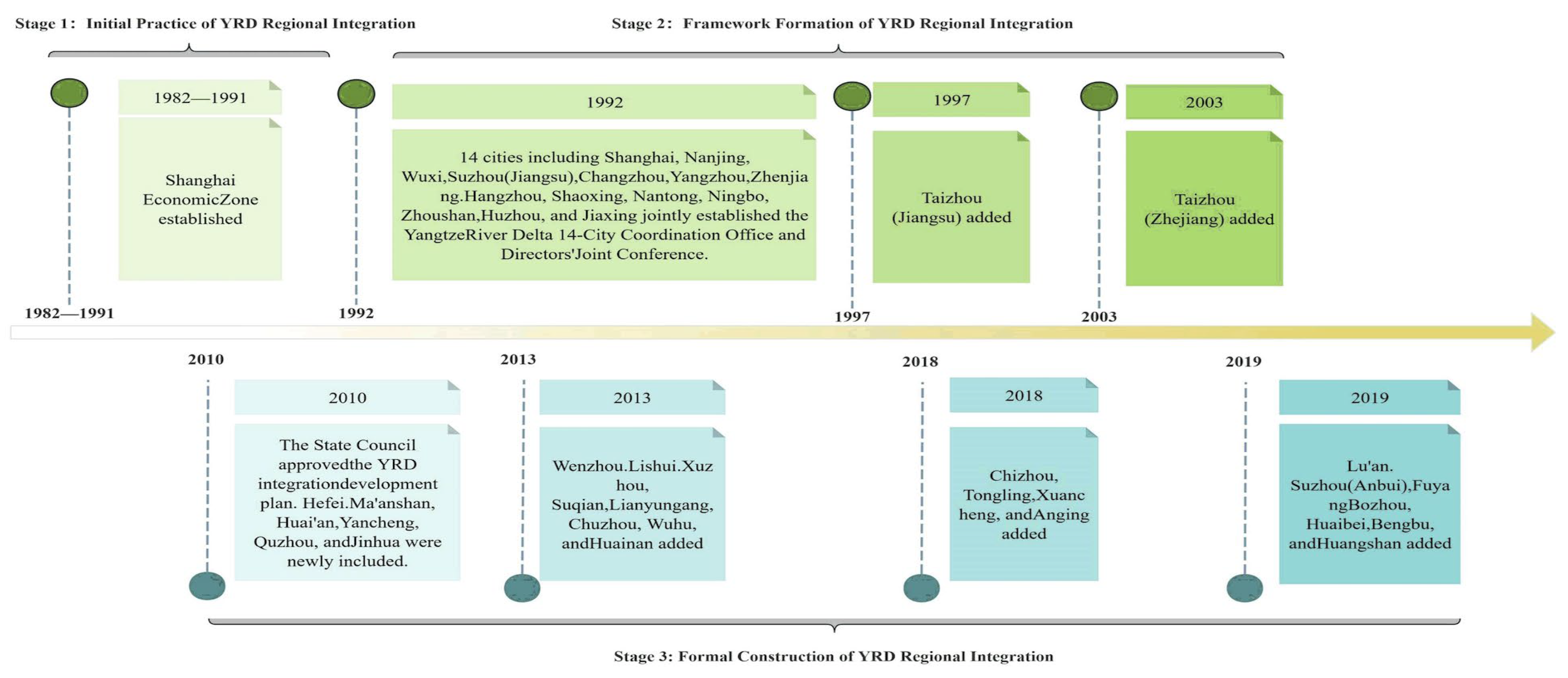
Given the limited understanding of how regional integration affects firm-level green innovation, this paper investigates the impact of regional integration on corporate green innovation, framing the analysis around three core questions: whether it is effective, why it is effective, and for whom it is more effective. Specifically, we employ data on Chinese listed companies from 2003 to 2022, treat the expansion of the Yangtze River Delta integration as a quasi-natural experiment, and adopt a multi-period difference-in-differences (DID) model. This empirical strategy allows us to control for regional heterogeneity and time trends, mitigate potential endogeneity bias, and thereby improve the robustness of the results. Regarding the underlying mechanisms, prior studies have primarily highlighted cost reduction and market expansion as the dominant explanatory pathways [
26,
27]. By contrast, this paper emphasizes the perspective of capital allocation, examining how regional integration supports corporate green innovation through two key channels: alleviating financing constraints and attracting foreign direct investment (FDI). In addition, we conduct multidimensional heterogeneity analyses to capture the differentiated impacts across firm ownership types, firm size, and location characteristics, which provide insights for targeted sustainability policies.
Taken together, this study contributes to the literature in three ways. First, it examines regional integration as a macro-level institutional arrangement that reshapes regional factor flows and institutional environments, rather than merely an economic cooperation framework. Regional integration reduces market fragmentation and coordinates regional policies. Through these mechanisms, it systematically improves the external conditions for innovation, a dimension that prior green innovation research has overlooked. Second, the study identifies capital allocation mechanisms as the key pathway linking institutional integration to firm-level innovation. Specifically, we show that regional integration alleviates financing constraints and attracts FDI, thereby facilitating corporate green innovation. This explanation draws on insights from institutional theory and international business research, highlighting capital allocation as a distinct institutional mechanism beyond conventional market or cost-based interpretations. Third, we employ a quasi-natural experiment combined with a multi-period difference-in-differences approach to establish robust causal relationships. This methodological rigor provides stronger theoretical support for understanding how institutional reforms influence firms’ green transition behaviors. Overall, our findings offer both theoretical insights and practical guidance for policymakers designing regionally coordinated sustainability initiatives.
The remainder of this paper is organized as follows.
Section 2 provides the policy background and theoretical analysis.
Section 3 outlines the model specification, variable definitions, and data sources.
Section 4 presents the benchmark regression analysis, robustness tests, and heterogeneity analysis.
Section 5 presents the mechanism analysis. Finally,
Section 6 draws conclusions and offers policy implications.
5. Further Analysis: Mechanism Testing
The benchmark regression results demonstrate that regional integration significantly improves corporate green innovation levels. To examine how regional integration influences capital allocation and to identify the mechanisms through which institutional integration shapes corporate innovation, we introduce two mediating variables: financing constraints and foreign direct investment intensity. These two variables reflect distinct transmission pathways. The first captures improvements in firms’ access to capital, while the second reflects increased inflows of foreign investment. Regional integration supports financial liberalization and expands market access, both of which help reduce financing barriers and attract external capital. These two effects are direct and measurable, making them important channels through which institutional reforms influence firm-level green innovation. Building on this framework, the study adopts the two-step approach to mechanism analysis proposed by Jiang [
52] and constructs the following model:
In the model, M denotes the mediating variable, covering two transmission channels: financing constraints and foreign investment. We measure financing constraints using the KZ index proposed by Kaplan [
53], and measure FDI following Dong et al. [
54] by employing the number of foreign-invested enterprises as a proxy indicator.
Table 8 presents the detailed test results for the mechanism corresponding to these variables.
Column (1) of
Table 8 presents the regression for the financing constraint mechanism. The YRD integration policy significantly reduces enterprise financing constraints, with the coefficient significant at the 1% level. This finding supports Hypothesis 2, indicating that the policy effectively alleviates financing difficulties. Specifically, the coefficient of –0.047 suggests that firms in integrated regions have, on average, 4.7% lower SA index values compared to those outside the policy area. This finding indicates a meaningful reduction in financing constraints and highlights the economic relevance of the policy effect. This effect may operate through several channels. Regional integration expands market scale and strengthens regional synergies, thereby improving capital allocation efficiency and attracting multiple funding sources, including bank loans, government subsidies, and private investment. Moreover, policy implementation facilitates technological cooperation and knowledge sharing among enterprises, optimizing information environments and creditworthiness, which boosts financing accessibility. The reduction in financing barriers enables firms to access vital capital, which supports continuous investment in the development and implementation of green technologies.
Column (2) presents the regression for the FDI mechanism. As shown in
Table 8, the coefficient of the YRD expansion policy on foreign investment is 0.7892 and is significant at the 1% level. This finding supports Hypothesis 3, indicating that regional integration policies significantly increase the presence of foreign-invested enterprises in the region. Specifically, the coefficient suggests that the proportion of foreign firms in integrated cities is, on average, 78.9% higher than in non-integrated cities, holding other factors constant. This effect may operate through two channels. First, advanced green technologies, managerial practices, and operational models introduced by foreign-invested enterprises enhance the green innovation capabilities of local firms through demonstration effects and knowledge spillovers. Second, competitive pressure from foreign-invested enterprises compels local firms to accelerate green technology R&D to maintain or improve their market competitiveness. Together, these channels contribute to overall improvements in the region’s green innovation capacity.
6. Conclusions and Limitations
6.1. Conclusions
Against the backdrop of China’s “dual carbon” goals, corporate green innovation has emerged as a crucial driver for achieving a green and low-carbon transformation and fostering sustainable development. To shed light on the role of regional integration in advancing green innovation, this study takes the expansion of the YRD region as the empirical context. Using panel data on Shanghai and Shenzhen A-share listed companies from 2003 to 2022, we apply a multi-period DID method to examine the policy effects and underlying mechanisms. These insights contribute to the broader discourse on how regional policy coordination can advance corporate sustainability and support global environmental goals. The main findings are as follows. First, regional integration significantly facilitates corporate green innovation, and this result remains robust across multiple robustness checks. Second, regional integration reinforces corporate green innovation through two channels: easing financing constraints and attracting foreign investment. Third, heterogeneity analysis shows that the positive effect varies by firm and city characteristics, with stronger impacts observed in non-state-owned enterprises, large enterprises, non-corridor cities, and large cities. These findings provide valuable insights for designing sustainable regional development strategies and supporting corporate green transformation. Moreover, by emphasizing the institutional nature of regional integration and revealing its capital allocation mechanisms, this study enriches the theoretical understanding of how macro-level reforms shape firm-level green innovation.
The findings of this study provide several policy recommendations for advancing sustainable regional integration and fostering corporate green innovation. Specifically, our evidence identifies three critical pathways through which regional integration can guide policy design and corporate strategy. For Regional Sustainability Policies: Governments should establish cross-regional technology markets to support the transfer and diffusion of green technologies, advanced equipment, and management models from core cities to surrounding areas. Large-scale scientific research infrastructure, major green research facilities, environmental monitoring instruments, and carbon emissions data should become openly accessible through shared platforms. This approach reduces the fixed costs and technical risks of corporate green innovation. It also improves overall regional innovation efficiency and supports sustainable development goals. These findings emphasize that institutional coordination across cities is essential, not supplementary, for achieving environmental and innovation synergies. Policymakers must make cross-city mechanisms a core pillar of regional sustainability strategies. For Corporate Strategic Responses: Foreign investment should be integrated into regional technology circulation systems. Local firms can collaborate with foreign-invested enterprises to acquire advanced green production equipment and adopt improved management practices. They should also leverage technological spillover effects to accelerate green technology adoption and strengthen their local green innovation capacity. Our results show that enterprises, particularly large firms and non-state-owned companies, should actively engage with integration opportunities. They can do this by forming partnerships with leading firms, accessing shared infrastructure, and joining cross-regional talent networks. Such actions serve to enhance both green innovation performance and long-term strategic positioning. Given that regional integration generates pronounced benefits for non-state-owned and large enterprises, establishing an institutional framework for cross-regional mobility of high-level green technology talent is essential. This framework could include unified talent qualification systems, cross-regional talent databases, and industry-academia-research collaboration platforms. Such measures remove administrative barriers, optimize talent allocation, and bolster human capital investment in green innovation. The G60 Science and Technology Innovation Corridor demonstrates how regional coordination translates policy goals into concrete green innovation outcomes. The corridor serves as a strategic platform for deepening cooperation in green technology R&D and ecological industrial chain development. Through innovation diffusion and technology spillovers, it can raise the sustainable green development level of non-corridor cities, reduce innovation gaps, and boost the Yangtze River Delta’s overall competitiveness in green innovation. Core cities, including Shanghai, Hangzhou, and Hefei, can leverage their research resources, industrial capacity, and talent concentration to extend innovative resources to surrounding cities. A coordinated approach to technology transfer, industrial linkages, and policy alignment can foster a green innovation architecture characterized by core-city leadership, peripheral city synergy, and collective regional progress. Collectively, these policy measures advance China’s sustainable development agenda. They also provide a replicable model for emerging economies seeking to balance regional integration with environmental sustainability.
6.2. Limitations and Future Research
Despite its contributions, this study has several limitations. First, it measures green innovation using patent applications. While this metric ensures comparability, it does not fully capture innovation quality or practical outcomes. Second, the mechanism analysis mainly examines capital-related channels, such as easing financing constraints and increasing foreign direct investment. It does not consider other potential pathways, such as labor mobility of green-skilled professionals or cross-regional knowledge networks that reduce search and coordination costs. Third, the sample focuses on listed companies, which may limit representativeness. The findings may not readily apply to small and medium-sized enterprises or non-listed firms. Future research could incorporate more comprehensive indicators, such as patent citations or commercialization rates, explore alternative mechanisms, and include a wider range of firms to improve explanatory depth and external validity.