Abstract
Achieving the UN sustainable development goals is most effectively realized through the participation of each country and each individual region. Within the framework of regional governance, this requires aligning the social needs, economic feasibility, and environmental constraints of each region. Kazakhstan’s regions vary significantly in their levels of socio-economic progress, based on the differences in resources, infrastructure, population, and industry specialization. Currently, there is no clear system for assessing the feasibility of achieving the sustainable development goals in the country’s regions. This hinders the development of systemic measures to implement the SDGs and achieve the accepted commitments. This study aims to develop a methodology for rating regional development sustainability based on existing assessment methods and approaches. A study of leading global research and expert assessments served as the basis for the National Rating of Sustainable Development of Regions (NRSD), which was tested using empirical data from Kazakhstan. The results of the analysis of the economic and social development of regions confirmed the need to use environmental, social, and economic indicators as key criteria for the NRSD. The paper identifies the main limitations encountered during the research process, provides ways to mitigate them, and suggests paths to expand opportunities. The main emphasis is placed on recommendations for updating the methodology for collecting sustainable data at the regional level.
1. Introduction
Within Central Asia, Kazakhstan is among the most advanced countries in terms of its commitment to demonstrating progress towards the SDGs. In July 2025, the third Voluntary National Review (hereafter, VNR) was presented, which contained the country’s report on its strengths and weaknesses [1]. At the same time, the regional level of development of the Kazakhstani regions differs significantly, both in terms of socio-economic and sustainable development. Insufficient adherence to ESG principles, noticeable both among Kazakhstani companies and regional authorities, is expressed in the limited amount of information on environmental, social, and governance activities. It should be noted that in Kazakhstan, the Voluntary Local Review (hereafter, VLR) was presented for Almaty alone in 2023 [2]. Considering that within the framework of the Nationally Determined Contribution (hereafter, NDC), each country independently chooses obligations for the SDG indicators to be achieved, only the VNR is actually a declaration of the fulfillment of the assumed obligations. Taking into account significant differences in the development of Kazakhstan’s regions (due to natural conditions, population size, and production capabilities), there is currently no scientifically based approach to assess the achievability of the SDGs in a particular region within the country. Taking into account existing corporate ratings, the presence of a regional rating that reveals the achievement of certain indicators would make it possible to assess the level of regional development not only from the standpoint of the SDGs, but also relative to social stability and business conditions. The applicability of the regional rating is possible at the level of both state and regional governance, as well as satisfying the interests of all stakeholders.
Four regions of Kazakhstan were selected as the objects of this study. The main selection criteria were location, area size, and GRP per capita. Thus, these regions territorially represent the west, east, south, and central parts of the country (their characteristic trends and factors generally reflect the overall picture of sustainable development in Kazakhstan). The large area of the region indicates the peculiarities in the development of logistics and the wealth of minerals and water resources, and, as a result, determines the advantages and disadvantages in development.
The key arguments explaining the selection of regions are the following. The location of the data reflects the geopolitical differences in regional development. In particular, this includes different access to transport corridors, intercountry trade, and business relations due to internal or external borders. In addition, this determines the results based on the factors of a particular region, as well as an analytical profile of regional production and business. In OECD expert studies, the indicator of the typical area of a region is a proxy for the spatial capacity and density of business activity. Quite often, this indicator is used as a criterion for determining the environmental burden in the region and the manageability of natural resources’ spatial sustainability. Ref. [3] GRP per capita was chosen as the regional selection criterion, since this is the main indicator for assessing changes in SDGs 8, 9, and 11 according to UN recommendations [4]. Therefore, being a synthetic principle, it serves, in our opinion, as the best ESG criterion for responsible regional management in terms of social responsibility, which meets the objectives set within the framework of this study.
In terms of GRP per capita, the Kyzylorda region is comparable to Kyrgyzstan (USD 6732), Karaganda to Indonesia (USD 14,890), East Kazakhstan to the Philippines (USD 13,411), and West Kazakhstan to Uzbekistan (USD 15,911) (World Bank, 2023) [5]. Well-known global manufacturers belonging to the HPE—Highly Polluting Enterprises—category operate on the territory of these regions. All this justifies the researchers’ attention to these regions.
Within the framework of this study, the goal is based on known and existing approaches to assessing the level of sustainable development of a country/region in order to develop a methodology for rating the sustainable development of a region.
Within the framework of this study, a hypothesis (H1) was put forward: linking regional sustainable development ratings to the national SDG indicators of a particular country ensures greater adaptability and applicability in strategic regional management.
The Research Methodology
The research methodology is based on a comprehensive analysis of representative material characterizing the current state of knowledge of issues related to establishing the achieved level of sustainable development by individual regions within the country, assessing the significance of factors, logical conclusions, and practical recommendations. The methodology for implementing this study is based on solving the following tasks, for which the following stages have been defined:
- -
- A review of studies reflecting the main approaches to assessing the level of achievability of the SDGs by certain countries has been conducted.
- -
- The main results of the study of indicators demonstrating the levels of economic and sustainable development of regions have been presented.
- -
- Econometric modeling in the R program was used to identify the relationships between GRP per capita (as an indicator expressing the results of regional development) and the environmental, social, and economic factors that determine it, taking into account the specifics of the development of Kazakhstan’s regions. Based on a reasoned presentation of the choice of dependent and independent variables, the following actions were performed:
- a
- A correlation analysis of the dependence of indicators was carried out, and significant indicators were determined based on the PCA, AIC, and Lasso methods;
- b
- Regression models of factorial sustainable regional development for each region were built;
- c
- Based on the constructed model, a forecast of GRP per capita was made for all four regions to determine the prospects for applying the findings obtained in the study.
- -
- Based on the conducted econometric study, the main indicators recommended by the authors for inclusion in the regional rating were determined. The rationale behind the philosophy of the methodology of this rating is presented, and it was tested on the metadata of the regions.
The use of statistical methods and econometric tools guarantees the impartiality of the study and makes it possible to detect stable patterns. Comparison of different approaches makes it possible to determine how realistic it is for regions to achieve the set goals of sustainable development and to formulate reasoned proposals.
The main idea of the study is to develop a methodology that allows substantiating a set of indicators of sustainable development that regions/countries can use in strategic sustainable planning and monitoring.
The research was based on data on the socio-economic development and environmental status of Kazakhstan’s regions, taken from the official statistical agency, the Bureau of National Statistics, responsible for the formation, collection, and presentation of data on sustainable development in Kazakhstan for the period 2010–2024 [6].
During the research, the authors encountered some limitations related to data collection. Thus, not all data reflecting sustainable development are presented by region; data for the country as a whole are presented. It should be noted that the proxy substitution method was not used in this study to mitigate these limitations. This is because existing research on the “noise” effect of this method [7] precludes its use in this study and requires separate research. The studied interval covers the period of administrative-territorial transformations in the regional structure of Kazakhstan, which led to deviations in the dynamics that are not related to the effectiveness of sustainable management in the country. A certain limitation for forming the information base was that the indicators are formed only based on annual values (there is no information by quarter), which does not allow us to expand the coverage of observations.
2. Theoretical Framework (Literature Review)
The review of studies (current and relevant to the goals and objectives set in this research paper) is divided into two steps. First, we present the scientific research results. In the second stage, methodological recommendations and analytical studies of international organizations devoted to various systems of indicative assessment of the level of countries’ sustainable development are studied. The study shows that a large number of studies are devoted to the problem of sustainable development indicators (according to Clarivate Analytics, 8814 studies/August 2025). At the same time, over the past five years, on average, about 1000 works per year have been devoted to this topic (Figure 1).
Figure 1.
Bibliometric map of publications in the subject area “Indicators of Sustainable Development of Regions” by country. Note: Compiled by authors, based on Clarivate Analytics data using VOSviewer (version 1.6.20) (method: co-authorship/countries/network).
As the data show, 32.8% of the works are devoted to problems studied using materials from China, 11.4% from Russia, and the United States closes the top three with 7.4%. The high level of attention paid by researchers to these countries is explained by the large area of these countries and the importance of studying sustainable development issues based on regional differences within countries. Special attention in the work is given to studies that made it possible to focus on works studying sustainable development indicators, which were taken as a basis in the methodology of the national rating and econometric modeling. Visualizing the literature review findings in a table allowed us to focus researchers’ attention on specific scientific papers, applying current trends in scientific data visualization [8,9,10,11]. Furthermore, the selection of these papers was justified by the fact that they addressed similar issues through the examination of relevant independent variables. This allowed us to justify their selection not only through modeling results but also to create a theoretical basis for modeling based on leading research.
The results of the literature review are presented in Table 1.
Table 1.
Results of the literature review of studies devoted to the problems of sustainable development indicators of regions.
Based on the literature review data, conclusions on their systematization, and the data in Table 1, the following can be defined. Researchers from different countries pay attention to the innovativeness of approaches to the selection of indicators of regional development, based on the specifics of their regional development. At the same time, they all agree that it is necessary to apply special methods/tools/indicators that reveal stakeholders’ understanding of the level of changes occurring in this direction. Many studies were based on indicators measuring the socio-economic conditions and the environmental level of transformation in developing regions. Most researchers identify a group of indicators that reflect the level of investment in environmental education and research aimed at protecting the environment and developing clean eco-technologies.
The next step was a review of international methodological developments and various analytical studies of international organizations. Since the 1990s, programs have been actively developed dedicated to the creation of such indicators. The United Nations Conference on Environment and Development stressed the need to develop indicators of sustainable development to provide a reliable basis for decision-making and to promote self-regulation of ecological and developing systems [19]. Almost all major organizations (UN, World Bank, OECD, European Union, and others), as well as many developed countries, have their own official systems of SDGs’ indicators. Within the framework of this study, the task was to develop a rating that could be applied at the level of Kazakhstani regions and monitor the sustainable development of regions.
Currently, two main directions are underway in the development of indicators: the creation of a complex, integrated indicator and the development of a new system of indicators to reflect individual aspects of development [20]. For example, the World Development Indicators (World Development Indicators) of the World Bank allow us to assess the achievement of the UN goals for economic growth and poverty reduction. A report is published annually, analyzing 214 countries across 550 indicators grouped into the following sections: general, population, environment, economy, state, and markets. Since the dynamic’s indicators have been tracked since 1960, it is possible to study the analysis of long-term factors [21].
In addition, there are various country rankings, starting with the ranking of the main holder of the UN [22]. The most common aggregate indicators include the Living Planet Index developed by the World Wildlife Fund [23]; Ecological Footprint [24]; the Environmental Sustainability Index and the Environmental Performance Index, proposed as recommendations by scientists from Columbia and Yale Universities [25,26]; Genuine Progress Indicators [27]; the Sustainable Economic Well-being Index [28]; and the Real Savings Index by D. Pearce and J. Atkinson [29]. The peculiarity of data indices is that they are aggregated and easy to use, providing one effective indicator for decision-making. At the same time, the general view of our scarce aggregate indicators is that they address various characteristics of the problems they describe.
Professor S. N. Bobylev, in his textbook “Economics of Sustainable Development” provides a typology of approaches that allows one to assess the “embeddedness”/integration of the region’s environmental interests into the country’s economic policy [30]. This is the “topic/problem–indicator” approach based on a group of economic, social, and environmental indicators. He calls the “goals–tasks–indicators” formula a hierarchical approach, when the goals and tasks are only formulated and do not have a quantitative expression. He sees this method in the implementation of the UN Millennium Development Goals. He also highlights an approach based on a system of key (basic) indicators that reflect priority problems and the specifics of a region. The “topic–subtopic–indicator” approach has been applied, in his opinion, by the UN Commission on Sustainable Development (CSD) [19]. Along with this, he notes that the UN CSD and the OECD are characterized by the use of the “impact–state–response” model. With their help, cause-and-effect relationships between economic activity and socio-environmental conditions are established in order to take managerial actions to solve emerging problems. The “goal–principle–indicator” approach, unlike other approaches classified by Professor S.N. Bobylev, demonstrates the connection between the sustainable development goals and their country-specific indicators (as criteria for countries) with ESG principles (focused on businesses operating in a given region and having an impact on it) and the indicators selected for regional development ratings. Therefore, this approach is recognized as the most acceptable.
Within the framework of this study, the “goal–principle–indicator” approach proposed in this paper were applied due to a number of conditions. First of all, the methodology for selecting indicators is based on the sustainable development indicators adopted by Kazakhstan for achievement and declared in the NDC. Secondly, the implementation of the data availability and comparability principle by time coverage was taken into account. Thirdly, indicators that would reflect the specifics of regional development were selected as objects of study. Fourthly, the “goal–principle–indicator” allows linking country SDGs with the thematic direction of ESG principles, expressing this connection through an indicator.
3. Results
In studying the characteristics of economic development of the regions of Kazakhstan, it is important to focus on the following issues. Undoubtedly, the first step of regional sustainable transformation is to identify significant topics of sustainable development: environmental and social issues that the region should focus on in its work and in its strategy. Earlier, two or three years ago, the main emphasis in sustainable development was on climate change; now, more and more often participants in the process are expected to be able to monitor and manage a wide range of environmental, social, and managerial risks. But before taking this step, it is important to assess the potential and regional opportunities for further development.
Each of the regions has its own differences in natural and climate conditions, which aggravate and might mitigate at some point the environmental consequences of the industrial enterprises functioning in the region. At the same time, developed and developing production and business activities deplete natural resources and leave a significant environmental footprint. The presence of external borders and developed logistics infrastructure determines the nature of the export–import orientation of a particular region. The presence of energy resources, such as oil, gas, and ferrous and non-ferrous metals, determines the investment attractiveness of regions and the presence of global business and production in the region, which determines the features of management and business. In such regions, as a rule, the level of ESG-committed enterprises is higher, as well as the environmental culture of business and population. The study showed that the peculiarity of natural climate conditions is a difficulty for some regions (KZR), and an advantage for others (WKR), and the task of regional governments is to identify ways to adapt these opportunities and limitations for sustainable development.
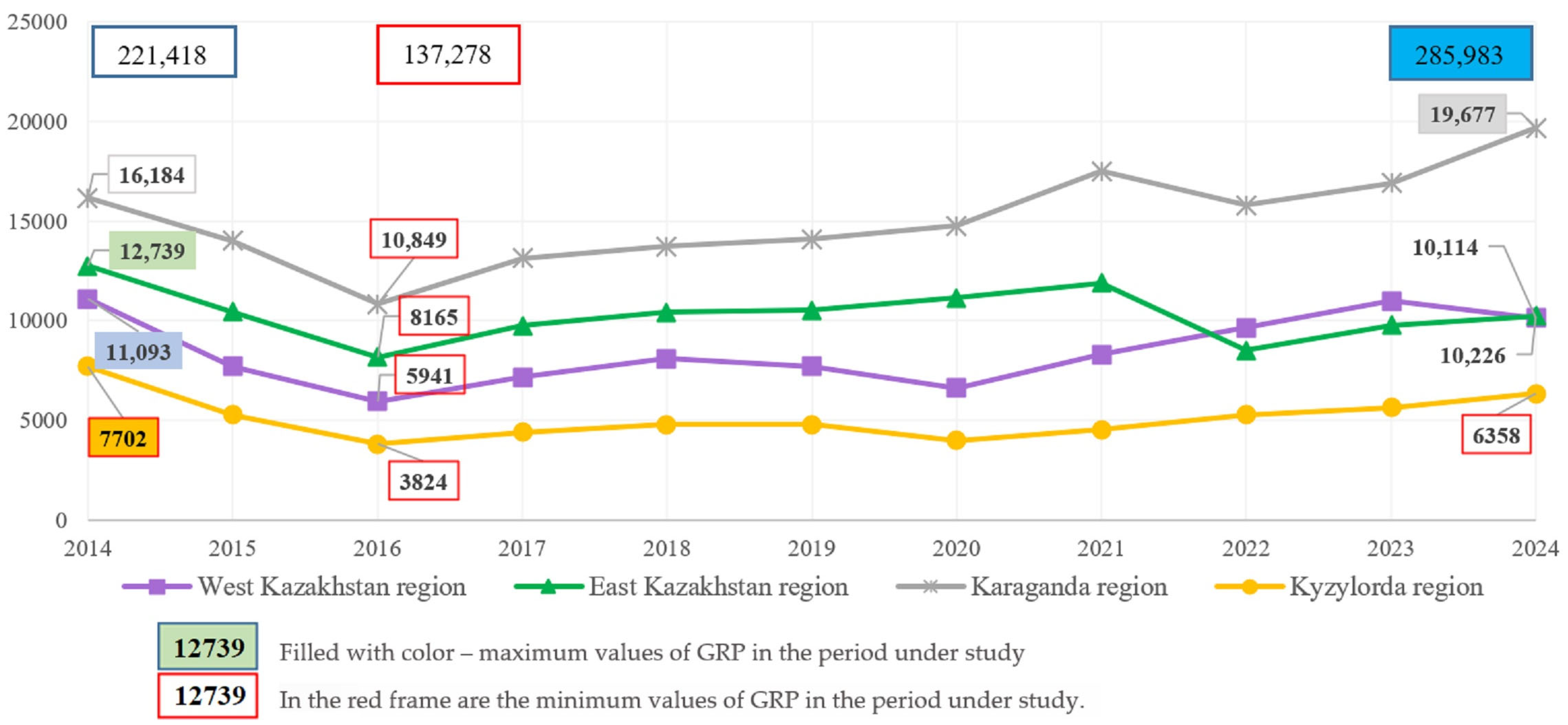
A review of data from official statistical bodies of the Republic of Kazakhstan made it possible to systematize data by region and conduct an analysis that enabled us to obtain the following conclusions (Figure 2).
Figure 2.
GRP by region, million USD. Note: Compiled by authors, based on data from the Bureau of National Statistics of the Republic of Kazakhstan [31].
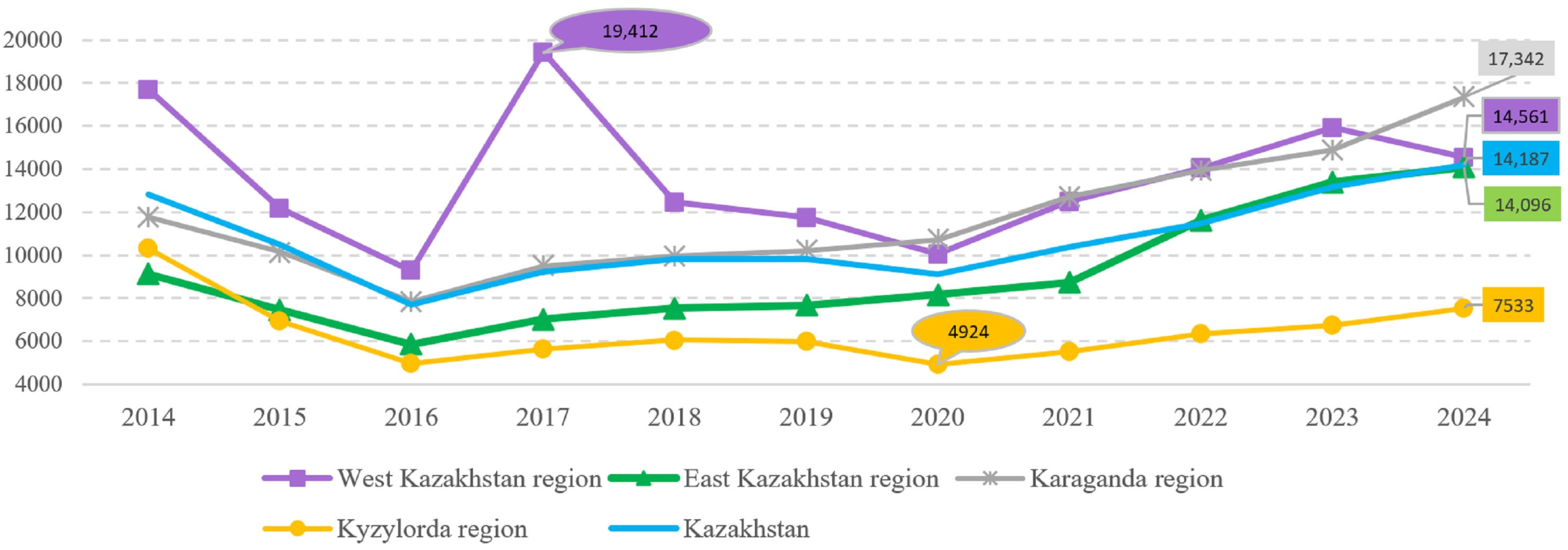
The analysis of the GRP of the regions showed that the dynamics of the regions are identical to the general Kazakhstani trends only in two regions—West Kazakhstan and Kyzylorda. At the same time, the Kyzylorda region, having lost almost half of its GRP between 2014 and 2016, later developed in a relatively stable manner, although it still did not reach the 2014 level by 2024 (17% lower). For the Karaganda and East Kazakhstan regions, 2022 is marked by a significant decrease associated with the administrative-territorial changes carried out in Kazakhstan during that period. Both regions were divided into two parts with the formation of two new regions. However, despite this, unlike the other three regions, the Karaganda region was able to reach and exceed the 2014 level by 22%. According to the criterion of GRP per capita, the leader is the KRG with a volume of USD 17,342, although the highest value of this indicator was in 2017, equaling USD 19,412 (Figure 3).
Figure 3.
GRP per capita by region, USD. Note: Compiled by authors, based on data from the Bureau of National Statistics of the Republic of Kazakhstan [31].
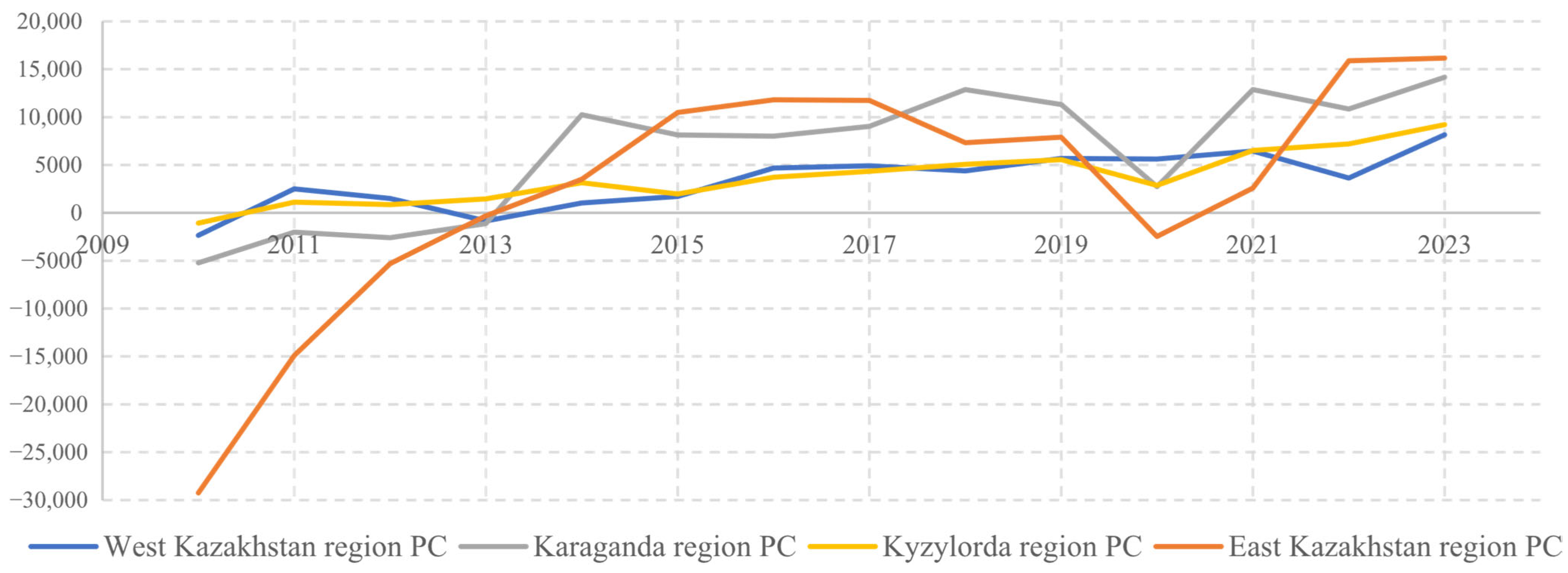
The Karaganda and East Kazakhstan regions demonstrate relatively similar dynamics of the indicator change in the study period. At the same time, WKR and EKR have approximately the same level of GRP as the national value: USD 14,561 and USD 14,096, respectively. The gap with the national value (USD 14,187) in the Kyzylorda region is almost twofold—USD 6654. And this gap is negative. The lowest value for this criterion was found in Kyzylorda in dollar terms in 2020—USD 4924. At the same time, after overlaying the graphs for the dynamics of GRP and GRP per capita by region onto each other, we obtained the following conclusions. For KRG and KZR, the graphs are approximately the same: this means that economic growth in the study period is not associated with demographic changes, but is due to the growth of production in the region. In the East Kazakhstan region, the GRP and GRP per capita graphs do not match in terms of dynamics after 2021: GRP decreases but GRP per capita grows, which is possible with a decrease in population (occurring as a result of outflow and/or demographic decline).
Within the studied regions, the main contribution to the development of the national economy is made by the Karaganda region, which also ranks fourth in the national ranking after Almaty (21%), Atyrau region (12.7%), and Astana (10.8%). In general, it should be noted that three regions—Karaganda, West Kazakhstan, and East Kazakhstan—are included in the category of developed regions. Although the total contribution of all four regions decreased by 5%, this is explained by changes in the administrative-territorial structure of Kazakhstan in 2022. An analysis of the production structure showed that the volume of industrial production in the Karaganda region has increased significantly, almost 2.4 times. In the Kyzylorda region, the volume of production remained practically at the level of 2014—an increase of only 4% over 10 years, or 0.4% per year. In the East Kazakhstan region, the volume of industrial production increased in the observed period by 2.0 times, in the West Kazakhstan region by 1.9 times. In general, Kazakhstan’s volume of production increased by 2.5 times, which indicates that in three regions the trend corresponds to the national dynamics.
Assessment of the foreign trade results allowed us to understand the integration of regions into the Eurasian market. It was established that in the context of regions, the statistical authorities of the Republic of Kazakhstan generate data only for the EAEU countries. It was taken into account that the main products of the mining, metallurgical, oil, and gas industries produced in the regions, which are mostly exported to non-CIS countries, were not included in the database for analysis. On the other hand, within the current study, the state of foreign trade and the structure of trade turnover, presented in this form, allow us to assess the real internal potential of the region without reference to mineral resources. It was found that throughout the entire study period, the leader in the export of goods and products to the EAEU countries was the Karaganda region (the main share of exports is coal). In general, the contribution of the East Kazakhstan region to the increase in exports can also be noted. However, if in 2014 the gap between the export volumes of these regions was 3.2 times, then in 2023 the exports of the Karaganda region exceeded the export volume of the East Kazakhstan region by 6 times. At the same time, the gap with WKR is 17 times and with KZR it is 26 times. An assessment of the level of import dependence of the regions of Kazakhstan showed that the lowest level was in the Karaganda region. For WKR, the data show that with the EAEU countries, the volume of imports still exceeds exports by almost 3.0 times, and for the East Kazakhstan region by 1.7 times, while the Karaganda region and KZR were able to achieve a coefficient value of less than 1–0.3 and 0.4, respectively. It should be noted that these values for these regions are better than the national indicators—0.8 at the end of 2023 (Appendix A).
The results of calculating the trade balance of individual regions showed that only the Karaganda region had a positive balance throughout the entire study period, with the exception of 2015, when it was negative. The trade balance of the Karaganda region until 2021 was negative, although it should be emphasized that the balance of the Karaganda region in 2020 was 53.3-times less than the negative balance of the West Kazakhstan region, and 101-times less than that of the East Kazakhstan region. At the same time, the balance changed cyclically in both the East Kazakhstan region and the West Kazakhstan region throughout the study period, although compared to 2014, it decreased by 2.8 times in the East Kazakhstan region, and by only 30% in the West Kazakhstan region.
A review of the indicators of regions’ economic development showed that in the study period, 2016 was the most difficult year for the entire country and its regions. The level of GRP and total GDP decreased from 33% to 50%. World Bank experts cite several reasons [32]:
- (1)
- A drop in world prices for Brent crude oil to USD 44.08 in 2015 against USD 107.95 in 2014 (a reduction in tax revenues to the budget from the oil sector, on which the dependence of Kazakhstan’s budget is about 20%);
- (2)
- The transition to a floating exchange rate and currency depreciation (the rate increased from 182 to 342 KZT per USD during 2015–2016) [33];
- (3)
- Weakening external demand for Kazakhstani products from Russia as a result of economic sanctions (after the annexation of Crimea in 2014);
- (4)
- Structural dependence on raw material exports and weak diversification of the economy (the predominance of extractive industries in the GRP structure).
Based on the above, by the end of 2024 only the Karaganda region was able to reach and exceed the 2014 GRP level. When assessing the GRP per capita, it was found that this macro indicator indicates that economic growth in most regions is not associated with demographic changes. The main contribution to the development of the national economy is made by the Karaganda region (8.6%) with a 2.4-fold increase in production. The Kyzylorda region practically does not demonstrate significant growth in industrial production throughout the entire study period. The assessment of the export–import potential showed a limited information base for analysis—information is not generated for all exporting and importing countries by region (except for the EAEU). The analysis showed that the Karaganda region is significantly ahead of other regions in terms of export volumes, which indicates the need to concentrate the efforts of regional authorities and regional businesses in other regions on expanding integration ties. For WKR, import dependence on Russia remains high and requires comprehensive solutions for the development of import substitution.
As part of the assessment of sustainable transformation trends in the regions of Kazakhstan, we analyzed data on the areas of activity presented on the official portal “Electronic Government of Kazakhstan” for the selected regions. The main focus was on achieving the targets of SDG 8 (Decent Work and Economic Growth) and 10 (Reduced Inequality). The main criteria were relevance, meaningfulness, and consistency. An analysis of data from the official websites of regional governments (regional councils) showed that they present reports on key areas such as the economy, social sphere, and industry [34]. However, despite the volume of data, the structure of the reports is not always convenient for analysis, and some data may not be updated. For example, in the Kyzylorda region, there is also a low level of data updating. Most of the reports relate to 2021–2022 [35]. Also, to improve reporting, it is recommended to divide voluminous reports into separate, structured sections in order to facilitate their analysis and speed up the adoption of corrective management decisions at the regional level. It should also be noted that despite the centralized approach to the formation of regional authorities’ reports, their content may differ from one another. Some regions disclose individual issues in greater depth and detail (for example, the sections “Employment” and “Social Protection” in the East Kazakhstan Region) [36], while others disclose only general information which sometimes does not allow us to identify patterns and features of development (KZR). It should be noted that although regional authorities disclose various data on their activities—forms and volumes of public–private partnerships, volumes of attracted extrabudgetary financing, and problems in the implementation of strategic plans for regional development—these reports are in no way associated with the SDGs (or their indicators). Along with this, the structure of some sections on the official website is not always logical. For example, the areas of “Industry and Tourism” for the Karaganda region are combined into one section, which complicates the analysis, since these are different sectors of the economy [37]. The current analysis of the attainability of the SDG indicators adopted for implementation in Kazakhstan is not carried out by the regions themselves. General assessment, analysis, and research are carried out by the Institute of Economic Research of the Ministry of National Economy of the Republic of Kazakhstan, scientists, and analysts. As already noted in the context of regions, the only region that has issued a VLR is Almaty. However, preparing such a review is a labor-intensive process in terms of time, effort, and data. This paper presents the results of a study on the development of a methodology for the National/Regional Rating of Sustainable Development of Regions. To substantiate this methodology, at the next stage of the study, an overview of individual indicators of sustainable development of regions is presented.
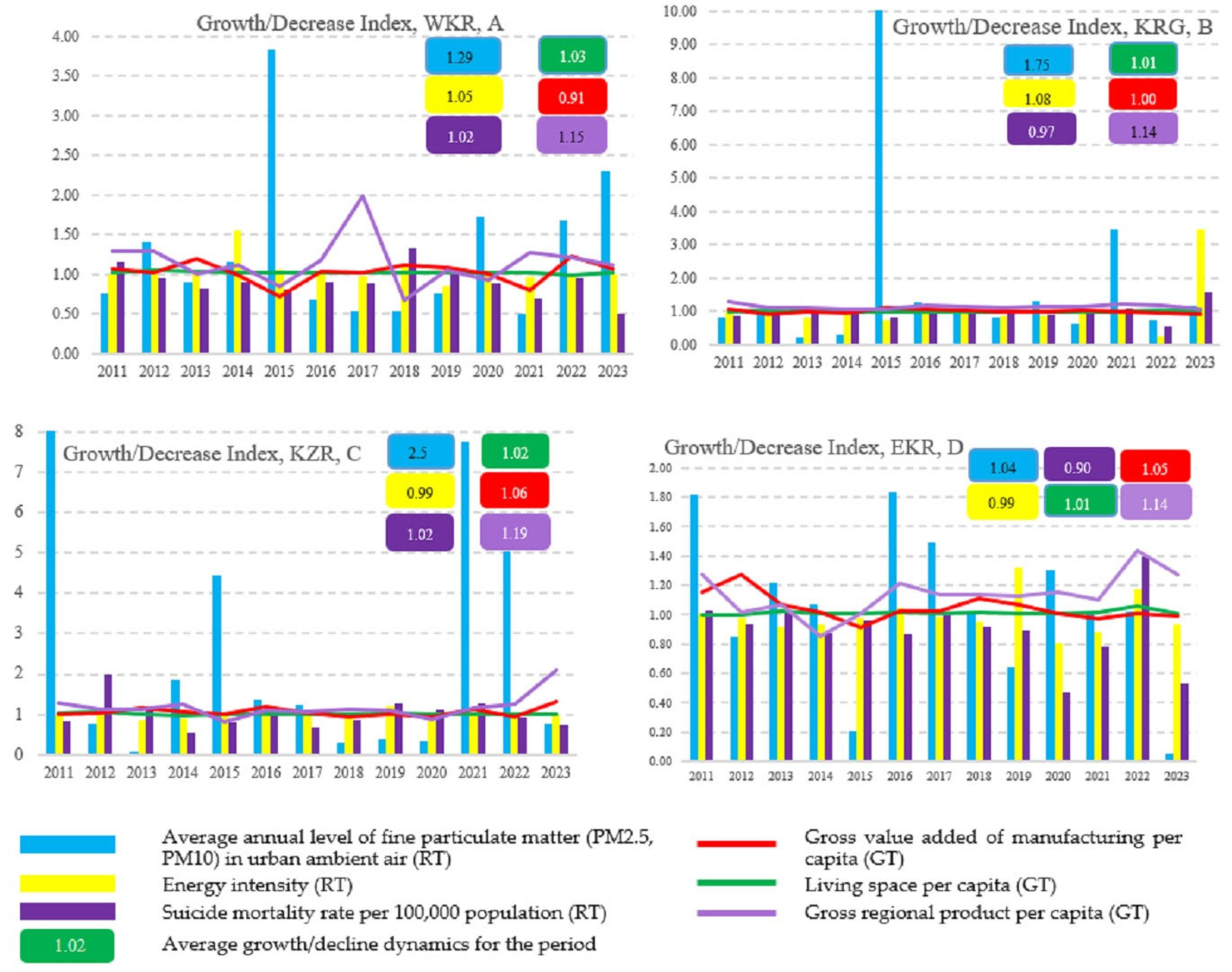
To assess the level of sustainable development of Kazakhstan’s regions on an independent basis, a set of indicators was determined. These were selected based on the objectives set in the study and the compliance of these indicators with modern approaches to ESG and TBL (Triple Bottom Line). In addition, when selecting indicators, the criterion of availability and efficiency of data collection was taken into account. The review of these indicators was conducted for the period 2010–2023, as the period for which information on selected indicators for the longest period in duration is compiled in Kazakhstan. To systematize the conclusions, the work presents calculations for the annual level of the growth/decrease index of indicators (Figure 4) by region. This approach is applied based on the general concept of the SDGs—achieving the levels of commitments undertaken. In particular, if we are guided by SDG 13—fighting climate change—this means achieving a reduction in the level of pollution. The lower the level of reduction (closer to 0), the closer the region is to achieving the target indicators (for indicators with a downward vector/reduction targets (RT): indicators to be reduced). The higher the level of growth (more than 1), the closer the region is to achieving the target indicators (for indicators with an upward vector/growth targets (GT): indicators to be increased).
Figure 4.
Growth/decrease index of sustainable development indicators in the regions of West Kazakhstan (A), Karaganda (B), Kyzylorda (C), and East Kazakhstan (D). Note: Compiled by authors, based on data from source [6].
The analysis of the presented data shows that KZR and WKR form the worst reduction dynamics at the fine particulate matter level in the atmosphere of the regions. However, in the studied period, the highest absolute values for the level of air pollution are in the Karaganda region (the difference between the regions is up to 10 times). This might be the reason for the more stable dynamics of the pollution level reduction (the higher the level of pollution, the more noticeable the dynamics of reduction). Among the indicators with an upward target, the GVA of the manufacturing industry per capita has the weakest growth dynamics in all four regions. This complements the previously obtained conclusions that the industrial structure in Kazakhstan is poorly diversified, and the manufacturing industry lags far behind the mining, oil, and gas industries. In general, the review of the data presented in Figure 4 allows us to note that in terms of sustainable development indicators, the studied regions demonstrate a relatively low level of SDG achievability. None of the upward indicators (GT) grow particularly strongly from year to year (the most stable growth is in GRP per capita in KZT; when converted to USD, this indicator demonstrates even slower growth). All of the downward indicators (RT) demonstrate quite weak rates of decline.
The main conclusion in this section is that it is necessary to organize systematic data collection and the formation of quarterly changes by region. Not all of the indicators by which the responsible body (Bureau of National Statistics) generates data on the country’s sustainable development indicators have the same time coverage, which does not allow expansion of the list of analyzed data. This, in turn, indicates the generation of some doubts about the objectivity of the findings. As key recommendations, it is proposed to ensure the systematic updating of already published data. Regional executive bodies should include such indicators that are clearly linked to the SDGs in order to show the contribution of the regions to the achievement of national goals. Guided by the example of the city of Almaty, regional authorities should prepare and publish Voluntary Local Reviews, which will improve the effectiveness of the measures implemented for the sustainable development of the region. This, in turn, will facilitate the creation of strategies and initiatives aimed at reducing income gaps and supporting economic development in the regions.
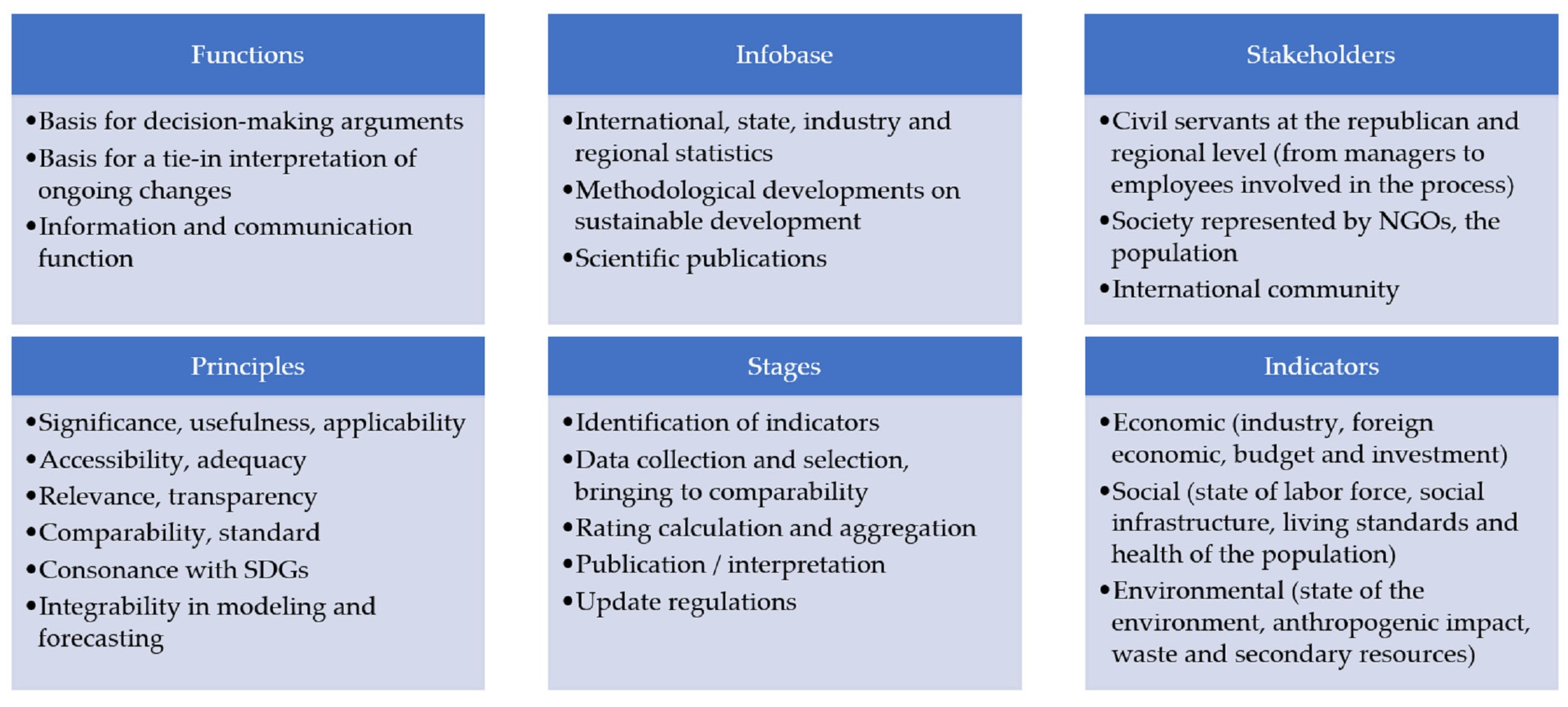
Within the framework of this study, the National Rating of Sustainable Development of Regions (NRSD) is based on a comparable and transparent assessment of economic, social, and environmental aspects of regional development. In order for the development of a region to be recognized as sustainable, it is important that the achieved economic growth is ensured in the context of preventing the deterioration of the environment of the region as a whole. The NRSD methodology is a set of components that determine its application in the process of assessing the level of sustainable development of a region. The components include the functions of the NRSD, the information base, the range of stakeholders, the principles of data selection, stages (rating processes), indicators, and rating calculation (Figure 5).
Figure 5.
Methodology of the NRSD—component representation. Note: Compiled by authors, based on data from sources [25,30].
In our view, the NRSD can be used to justify the correctness of the management decision made by regional authorities using the assessment method and to assist in the correct (triune) interpretation of the changes taking place. In fact, the NRSD will become a tool for the information and communication function. Thanks to this function, the national rating informs the public and draws attention to specific environmental and social issues. This will motivate people to take the necessary measures and decisions independently. When developing a system of sustainable development indicators, the main task is to determine the circle of stakeholders who need these indicators. Developing the NRSD is a fairly complex procedure that requires a large amount of information. When selecting NRSD indicators, the main emphasis is on the compliance of these indicators with the specified principles (Figure 4). For example, the indicator should be transparent: simple and easy to explain, capable of reflecting dynamics over time, with clarity of formulas, data, and weights. At the same time, the collected data should be regularly updated and have adequate costs for resources for their receipt. It should be noted that the above principles describe the “ideal” indicator. The selected NRSD indicators should meet at least several criteria. Given that the indicators are mostly compiled regionally only on an annual basis, it is recommended that official statistical agencies establish a process for collecting and reporting data on a quarterly basis. At the same time, given the labor-intensive nature of this process, the authors propose automating the calculation of the NRSD in the subsequent stages of the methodology’s implementation.
The creation of consolidated indicators reflecting socio-economic changes is due to the very essence of the Sustainable Development Report. Moreover, in the context of the consistent and positive impact of non-financial factors, such indicators help to ensure that the interests of all stakeholders—both private and public—are met. The data should inspire confidence among market representatives and the general public.
According to the study, based on the results of the literature review and the SDG indicators selected by Kazakhstan (by decision of the Coordination Council on Sustainable Development Goals) for the sustainable development of the country, the basic set included 15 indicators (Table 2). The indicators were selected taking into account the approach proposed by Professor Bobylev’s “topic/problem–indicator”.
Table 2.
Indicators of sustainable development of regions of Kazakhstan.
For the individual indicators given in Table 2, individual comments should be taken into account. In particular, for GRP per capita, it is important to take into account that when calculating the rating, it is used in KZT in order to neutralize the impact of currency fluctuations and reflect internal trends. Individual indicators demonstrate weak dynamics in their development. At the same time, indicators x1, x4, x6–x9, and x13 require reduction to comparable values when calculating. Before determining the composition of indicators of regions’ sustainable development, the work tested the sensitivity of indicators to each other. In the process of constructing a model of GRP per capita factors in the context of regions, indicators of sustainable development were analyzed (Table 2). The following variables were excluded from the final model:
x1 (environmental indicator);
x2 (forest area);
x4 (damage from emergencies);
x7 (maternal mortality);
x8 (suicides);
x9 (infant mortality);
x10 (housing)—these indicators did not show a statistically significant or sustainable impact on GRP, and their relationship with the economic dynamics of the regions is indirect;
x11 (labor productivity in agriculture) was excluded due to a high correlation with the industrial indicator (x12), and indicator x14 (total population with incomes below the subsistence minimum) was excluded due to a high correlation with x13 (unemployed youth), to prevent multicollinearity and improve the interpretability of the model.
The final composition of factors includes only the most significant and economically justified indicators, which allows us to increase the reliability and correctness of the model. Using stepwise regression by the AIC criterion, the final set of significant factors includes only two factors—x5 and x6. Lasso regression showed that four variables are significant for forecasting for the WKR and EKR: x3, x5, x6, and x13. Both methods (AIC and Lasso) identified x5 and x6 as key predictors. Lasso regression additionally included the variables x3 and x13. Thus, all methods demonstrated stable inclusion of the variables x5 and x6; we will also include x3 and x13. The initial model will be built using four predictors for the WKR and six predictors for the EKR.
| According to East Kazakhstan region | According to West Kazakhstan region | ||||||||||
| Result | Result | ||||||||||
| lm(formula = y; ~ x3 + x5 + x6 + x13, data = df) | lm(formula = y; ~ x1 + x3 + x5 + x6 + x13, data = df) | ||||||||||
| Residuals: | Residuals: | ||||||||||
| Min | 1Q | Median | 3Q | Max | Min | 1Q | Median | 3Q | Max | ||
| −1383.33 | −787.45 | −68.38 | 753.21 | 1749.22 | −1020.1 | −165.6 | −103.6 | 460.1 | 714.6 | ||
| Coefficients: | Coefficients: | ||||||||||
| Estimate | Std. Error | t value | Pr(>|t|) | Estimate | Std. Error | t value | Pr(>|t|) | ||||
| (Intercept) | 1.592 × 10³ | 2.889 × 10³ | 0.551 | 0.5952 | (Intercept) | −1.126 × 10⁴ | 6.028 × 10³ | −1.868 | 0.09870 | ||
| x3 | −5.218 × 10⁻¹ | 3.306 × 100 | −0.158 | 0.8781 | x1 | −3.671 × 10³ | 3.233 × 10³ | −1.135 | 0.28907 | ||
| x5 | 9.637 × 10² | 4.533 × 10² | 2.126 | 0.0624. | x3 | 1.912 × 101 | 6.551 × 100 | 2.919 | 0.01933 * | ||
| x6 | −8.095 × 10⁻³ | 3.885 × 10⁻³ | −2.083 | 0.0669 | x5 | 7.367 × 10³ | 3.025 × 10³ | 2.435 | 0.04086 * | ||
| x13 | −2.331 × 10⁻¹ | 1.790 × 10⁻¹ | −1.303 | 0.2251 | x6 | −2.427 × 10⁻³ | 5.467 × 10⁻⁴ | −4.440 | 0.00217 ** | ||
| x13 | −1.251 × 10⁻¹ | 3.016 × 10⁻² | −4.149 | 0.00321 ** | |||||||
| Signif. codes: 0 ‘***’ 0.001 ‘**’ 0.01 ‘*’ 0.05 ‘.’ 0.1 ‘ ’ 1 | Signif. codes: 0 ‘***’ 0.001 ‘**’ 0.01 ‘*’ 0.05 ‘.’ 0.1 ‘ ’ 1 | ||||||||||
| Residual standard error: 1118 on 9 degrees of freedom | Residual standard error: 661.9 on 8 degrees of freedom | ||||||||||
| Multiple R-squared: 0.7047, Adjusted R-squared: 0.5734 | Multiple R-squared: 0.8909, Adjusted R-squared: 0.8226 | ||||||||||
| F-statistic: 5.369 on 4 and 9 DF, p-value: 0.01724 | F-statistic: 13.06 on 5 and 8 DF, p-value: 0.001117 | ||||||||||
| yWKR = 2897.28 − 1.52·x3 + 489.23·x5 − 0.10·x13 Note: *** – highest level of variable significance; ** – high level of variable significance; * – significant variable; . - marginal statistical significance, p–value greater than 0.1 Prepared by using R–Studio (Version 2.09.2025) | y;EKR = −11,260 + 19.12⋅x3 + 7367⋅x5 − 0.00243⋅x6 − 0.125⋅x13 Note: *** – highest level of variable significance; ** – high level of variable significance; * – significant variable; . - marginal statistical significance, p–value greater than 0.1 Prepared by using R–Studio (Version 2.09.2025) | ||||||||||
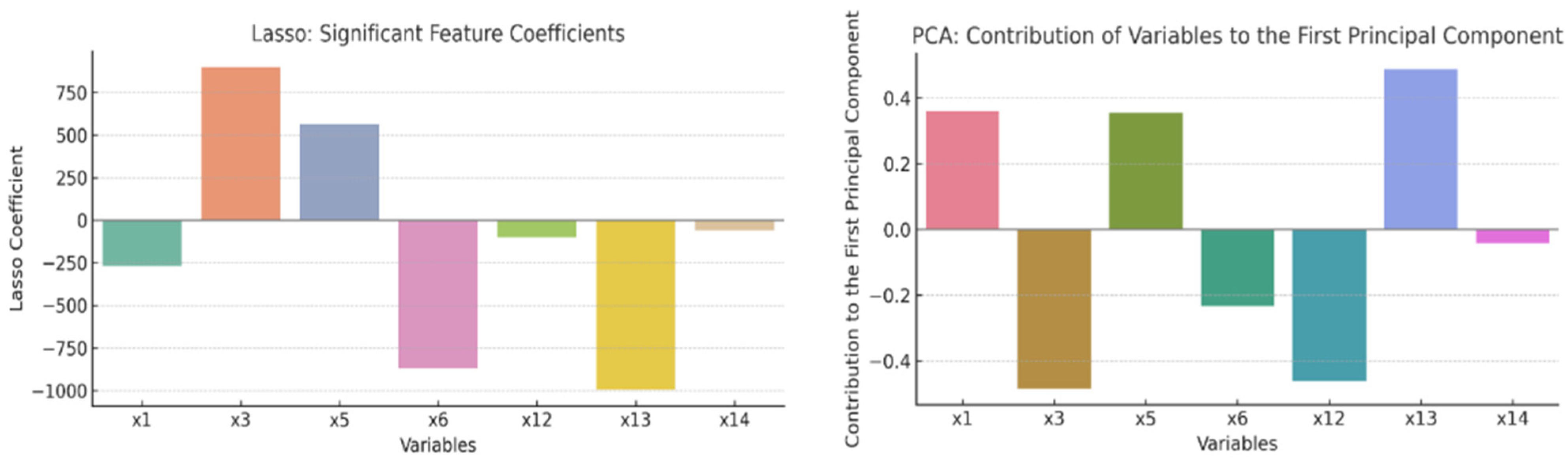
Additionally, visualization of the Lasso regression coefficients (Figure 6) revealed a coincidence: the variables x1, x3, x5, x6, and x13 received the highest weights, indicating their leading role in explaining the variation in the dependent variable. Thus, cross-validation of three independent methods confirms that these factors are the key determinants of the socio-economic development of the East Kazakhstan region.
Figure 6.
Contribution of variables to the first principal component (PCA analysis) and significant coefficients of features in the Lasso regression model for EKR. Note: Compiled by authors.
According to the results of all three selection methods (PCA, stepwise regression by AIC, and Lasso) for the Karaganda region, energy intensity (x5) turned out to be the most stable and significant factor determining the level of gross regional product per capita. Also, the variables x1, x6, x12, and x14 demonstrated significance in the Lasso regression and a significant contribution to the variance according to the PCA results, especially x6 and x1. The x13 indicator was important only for the factor analysis, which is probably due to its multicollinearity with other variables and a decrease in predictive value in regression approaches. But when constructing the model itself with the inclusion of all factors for the Karaganda region, x5 and x6 were still significant.
| For the Karaganda region | For the Kyzylorda region | ||||||||||
| Result | Result | ||||||||||
| lm(formula = y; ~ x5 + x6 + x12, data = df) | |||||||||||
| Residuals: | Residuals: | ||||||||||
| Min | 1Q | Median | 3Q | Max | Min | 1Q | Median | 3Q | Max | ||
| −936.2 | −253.6 | −106.1 | 338.3 | 873.8 | −683.27 | −407.48 | −16.81 | 238.54 | 828.51 | ||
| Coefficients: | Coefficients: | ||||||||||
| Estimate | Std. Error | t value | Pr(>|t|) | Estimate | Std. Error | t value | Pr(>|t|) | ||||
| (Intercept) | 2.139 × 10³ | 3.069 × 10³ | 0.697 | 0.50161 | (Intercept) | −7.083 × 10³ | 3.375 × 10³ | −2.099 | 0.065275 | ||
| x5 | −1.04 × 10³ | 1.761 × 10² | 5.907 | 0.00015 *** | x3 | 3.465 × 101 | 5.946 × 100 | 5.827 | 0.000251 *** | ||
| x6 | −1.619 × 10⁻³ | 6.644 × 10⁻⁴ | −2.437 | 0.03504 * | x5 | 1.144 × 10³ | 4.658 × 10² | 2.457 | 0.036360 * | ||
| x12 | 10324 × 100 | 8.091 × 10⁻¹ | 1.636 | 0.13290 | x6 | 1.319 × 10⁻³ | 2.271 × 10⁻³ | 0.581 | −0.575703 | ||
| x13 | −1.228 × 10⁻¹ | 3.748 × 10⁻² | −3.277 | 0.009580 ** | |||||||
| Signif. codes: 0 ‘***’ 0.001 ‘**’ 0.01 ‘*’ 0.05 ‘.’ 0.1 ‘ ’ 1 | Signif. codes: 0 ‘***’ 0.001 ‘**’ 0.01 ‘*’ 0.05 ‘.’ 0.1 ‘ ’ 1 | ||||||||||
| Residual standard error: 556.7 on 10 degrees of freedom | Residual standard error: 575.5 on 9 degrees of freedom | ||||||||||
| Multiple R-squared: 0.8949, Adjusted R-squared: 0.8634 | Multiple R-squared: 0.8574, Adjusted R-squared: 0.7941 | ||||||||||
| F-statistic: 28.39 on 3 and 10 DF, p-value: 3.312 × 10⁻⁵ | F-statistic: 13.53 on 4 and 9 DF, p-value: 0.0007578 | ||||||||||
| YKRG = 2139.0 − 1040.0 × x5 – 0.001619 × x6 Note: *** – highest level of variable significance; ** – high level of variable significance; * – significant variable; . - marginal statistical significance, p–value greater than 0.1 Prepared by using R–Studio (Version 2.09.2025) | YKZR = −7.083 + 3.465 × x3 + 1.144 × x5 – 1.228 × x13 Note: *** – highest level of variable significance; ** – high level of variable significance; * – significant variable; . - marginal statistical significance, p–value greater than 0.1 Prepared by using R–Studio (Version 2.09.2025) | ||||||||||
The conducted modeling of regional development allowed us to establish the relationship between the dependent variable GRP per capita and the independent factors.
Thus, according to the conducted study, based on the SDG indicators selected by Kazakhstan (by decision of the Coordination Council on Sustainable Development Goals) for the sustainable development of the country [6], the NRSD within the framework of the project includes eight indicators. These include the dependent variable itself—GRP per capita; four indicators recognized as significant independent variables based on the results of econometric analysis—x3, x5, x6, and x13; and three indicators demonstrating a strong influence on other criteria, but significant for the rating—x11, x12, and x14. Moreover, if we use the indicators for the reporting period (2023), the indicators will look as follows (Table 3).
Table 3.
Sustainable development indicators of Kazakhstan, according to the decision of the Coordination Council on Sustainable Development Goals, by region.
In accordance with the applied practice of bringing differently weighted indicators to a single calculation system—the method of normalization of indicators (unification) [38]—we develop the following formula:
The formula of the national rating (1) is based on the Additive Index Method, which is the basis of many ratings [39]. For example, this is the European Regional Sustainable Development Index (EU RSDI, 2012) [40], the Environmental Sustainability Index [41], and RAEX-Analytics (Russia) [42]. This method involves summing up the normalized values of the indicators and allows calculation of the integrated rating value (Table 4).
Table 4.
Presented values of sustainable development indicators by regions of Kazakhstan and NRSD (according to Formula (1)).
The reduction method (normalized data method) was used to ensure comparability of the calculated values. Along with this, the methodology of the National Sustainable Development Rating also used the method of rounding values to an integer due to the spread of methods for calculating the values of the indicators.
In general, a review of the data presented in Table 4 showed that the East Kazakhstan region formed the highest value of the Integrated Sustainable Development Indicator by the end of 2023. At the same time, the main influence was exerted by the following: low values of energy intensity; the number of young people (aged 15 to 35) who do not study, work, or acquire professional skills; and the number of people with incomes below the subsistence level. At the same time, significantly high values of labor productivity in agriculture, GVA of the manufacturing industry per capita, and GRP per capita also influenced the primacy in the rating. Despite the fact that WKR is the leader in terms of GRP per capita, the region is inferior to other regions in terms of other indicators in this sample.
According to the developed methodology, the ratings of these regions were calculated for the entire study period to conduct a comparative analysis of the dynamics of this criterion of sustainable development (Figure 7).
Figure 7.
Change in the NRSD by region for the period under study (2010–2023). Note: Compiled by authors, based on data from [6].
The results of the dynamics review of the National Sustainable Development Rating by region allowed us to note the breakthrough development achieved by the East Kazakhstan region in the period under study. Considering that the rating level of the East Kazakhstan region in 2010 was 10-times lower than that of the West Kazakhstan region, by 2023 the rating level of the East Kazakhstan region finally exceeded that of the West Kazakhstan region by almost 2 times.
The NRSD methodology presented in the paper allows us to conclude that for the Kazakhstani regions’ current stage of development, the key indicator of the achievability of sustainable development in the region can be the GRP per capita indicator, which forms the basis of the rating. The choice of indicators of labor productivity in agriculture and GVA of the manufacturing industry per capita as components of the NRSD is intended to achieve the goals of economic diversification, the use of natural potential in the development of regions to expand the agricultural sector, and a reduction in the level of dependence on raw materials industries in favor of the manufacturing industry. The importance of social responsibility of business and regional authorities and the role of human capital in the development of the regional economy is expressed by the inclusion of the following indicators: the number of researchers, the number of unemployed and disengaged youth, and the number of people with incomes below the subsistence minimum. The degree of environmental responsibility in the region is expressed in the rating by energy intensity indicators (energy spent on the production of a unit of GRP) as an indirect indicator of decarbonization and R&D costs in the region (mainly including the costs of new green technologies). This rating does not include the indicator of CO2 emissions into the atmosphere, even though this is the most common environmental indicator of the sustainable development of regions. This is because the Bureau of National Statistics of Kazakhstan (the body responsible for sustainable data and reporting) does not generate information on this indicator within the framework of the system of indicators for monitoring the sustainable development goals of Kazakhstan. In our opinion, this discrepancy requires special attention from both this specific government agency and the relevant ministry responsible for this function.
As further directions for research, the possibility of bringing the national rating system to letter values is considered. To implement this task, it will be necessary to calculate the reference values for the highest rating level in the achievability of the sustainable development goals for the regions of Kazakhstan. At this stage of the study, we considered it sufficient to establish a rating within the designated sample. From one point of view, the regions are compared with each other by the level of sustainable development (there are no external standards, only the best of what there is). On the other hand, the use of a letter rating creates the possibility of the existence of a best-of-the-best region, the level of which is difficult for other regions to reach in the near future which reduces their interest. Along with this, a numerically expressed rating allows researchers to clearly trace the dynamics, assess the position occupied, and compare regions with each other using simple methods.
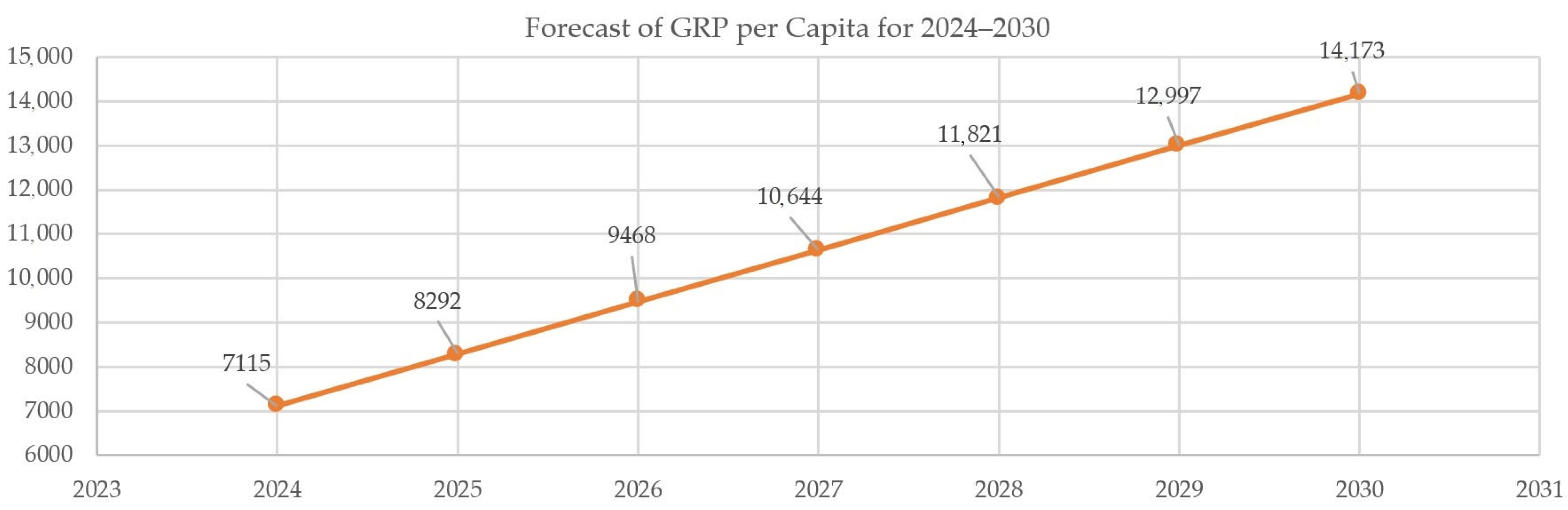
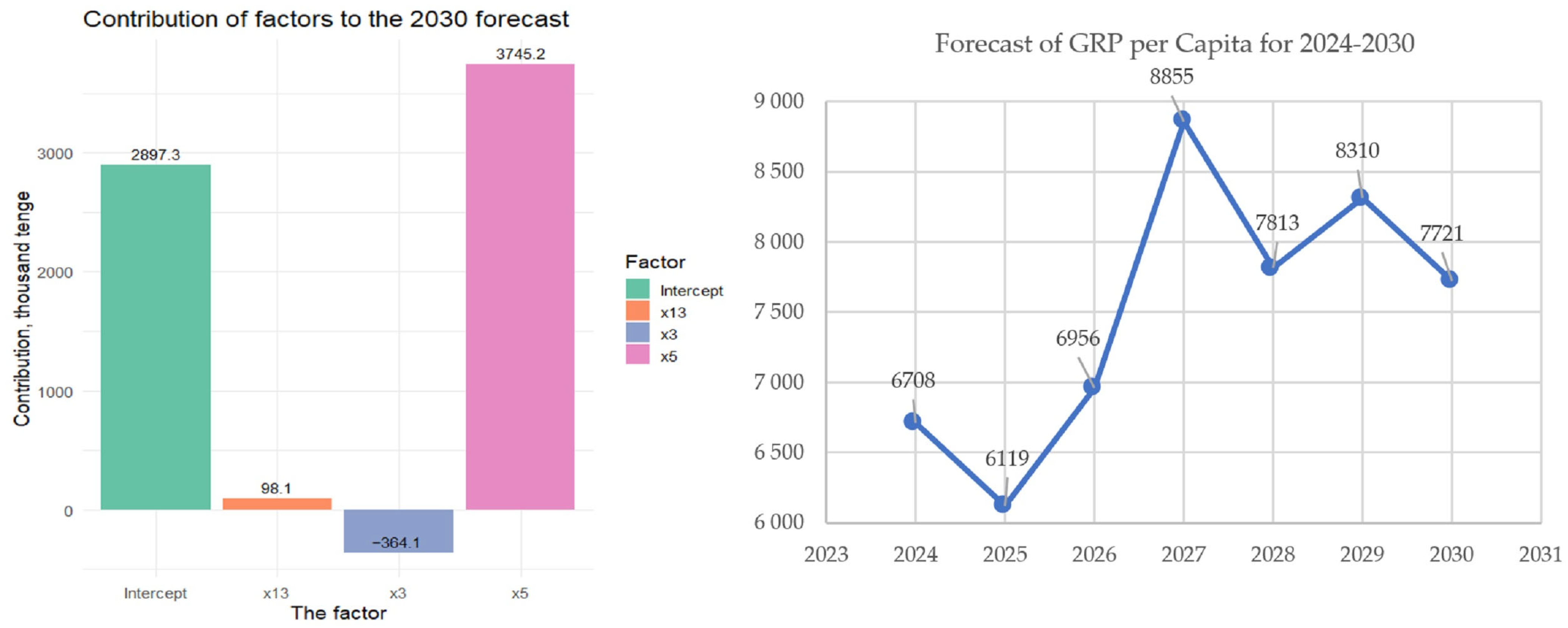
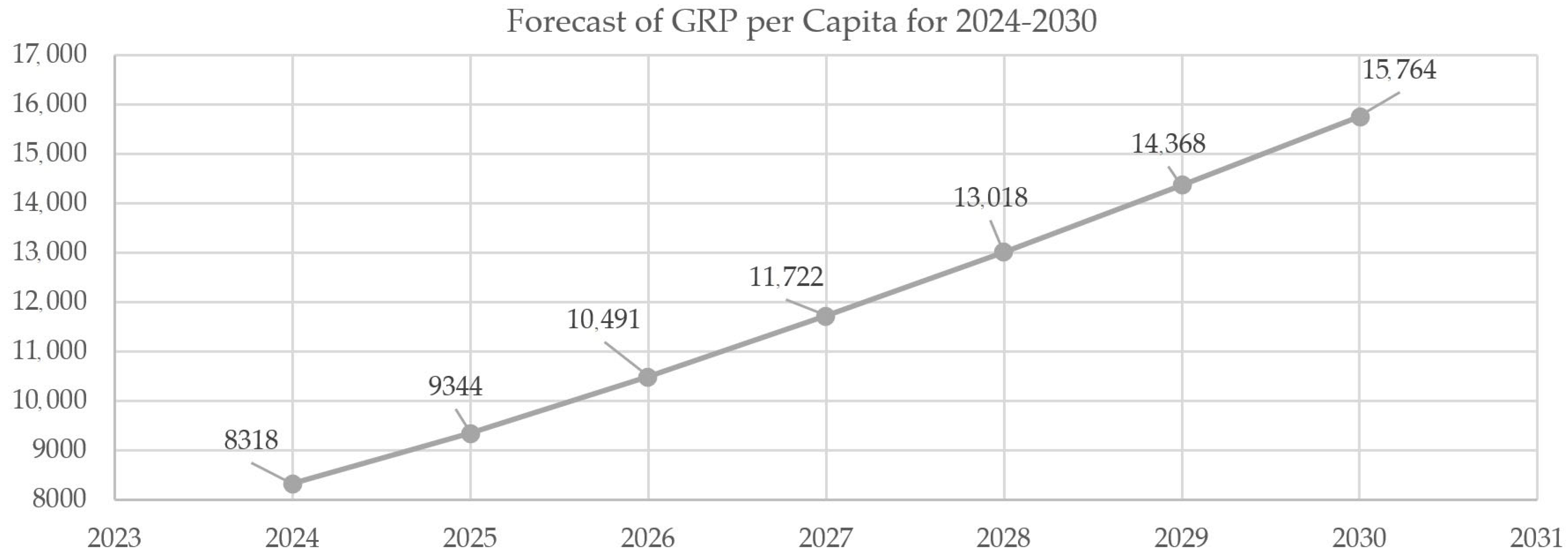
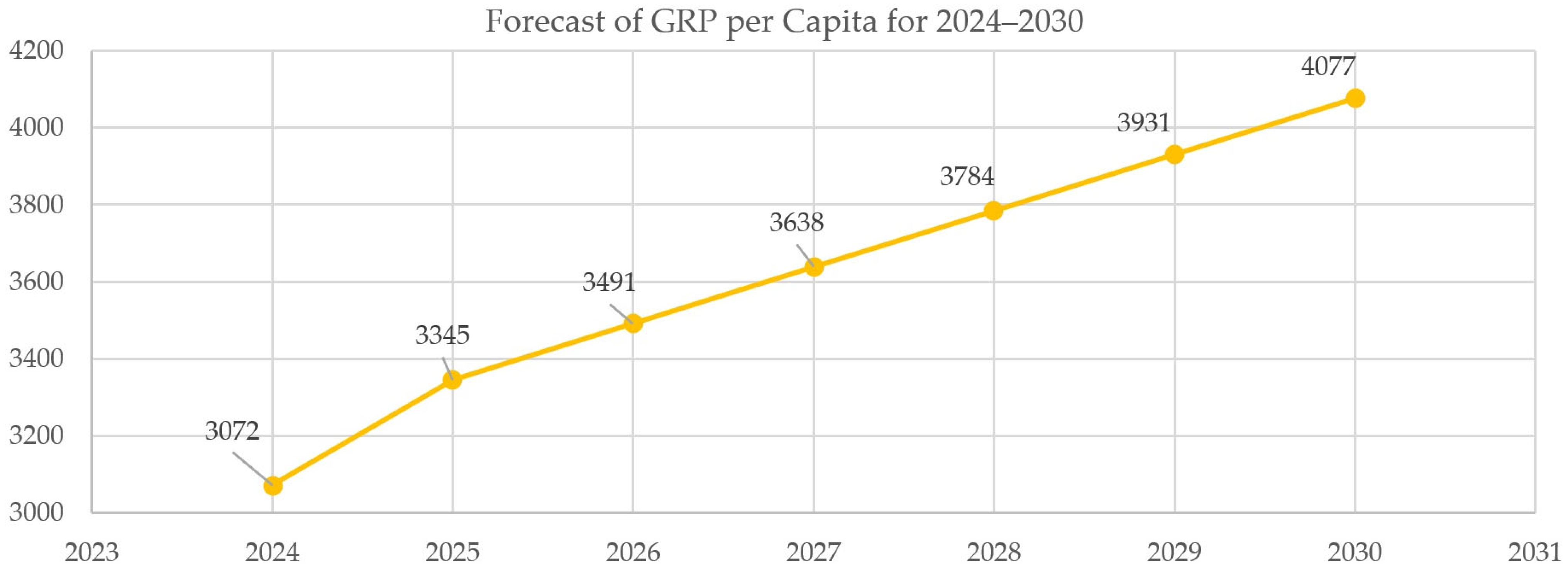
As part of solving the following problem, a forecast of the dependent variable was carried out—the main indicator of sustainable development of GRP per capita. This will allow us to link the previously obtained conclusions, based on both the results of the identified significant indicators of sustainable development and the national rating. To make the forecast, coefficients obtained as a result of applying Lasso (or Ridge) regression were used. The predicted values were calculated as a linear combination of the factors remaining in the model, with the corresponding weights determined in the regularization process in the context of the studied regions of Kazakhstan (Figure 7, Figure 8, Figure 9 and Figure 10). Analysis of the forecasting results for the East Kazakhstan region showed that four factors were statistically significant in this regional model: x3, x5, x6, and x13. It should be noted that the direct use of the constructed regression model for building a long-term forecast for the East Kazakhstan region is associated with certain limitations. The main difficulty is associated with a relatively small number of observations, which makes it difficult to ensure the sustainability and high accuracy of forecasted estimations. In such conditions, time series models such as ARIMA have an advantage: they allow for a more correct consideration of dynamic dependencies and seasonal fluctuations inherent in regional economic indicators and, as a rule, provide more reliable and valid forecasts with a limited amount of data. Nevertheless, the developed regression model plays an important role in understanding the structural features of the regional economy. It allows us to identify and quantify the influence of individual factors on the dynamics of GRP per capita, which is valuable for the formation of effective strategies for socio-economic development and making management decisions at the regional level. To build the forecast, we used the ARIMA (0,2,0) model, the parameters of which were selected taking into account the time structure of the original series. The reliability of the obtained forecast was comprehensively tested using standard statistical tests and metrics. The Ljung–Box test (Q * = 1.42, p-value = 0.69) showed the absence of autocorrelation of the residuals, which indicates the correctness of the model and the absence of unaccounted-for patterns. This indicates that the model adequately reflects the internal dynamics of the series, and forecast errors have the properties of “white noise”.
Figure 8.
Results of forecasting GRP per capita in the East Kazakhstan region, in thousands of KZT. Note: Compiled by authors, based on modeling data in R, MWin.
Figure 9.
Results of forecasting GRP per capita for the West Kazakhstan region, in thousands of KZT. Note: Compiled by authors, based on modeling data in R, MWin.
Figure 10.
Results of forecasting GRP per capita for the Karaganda region, in thousands of KZT. Note: Compiled by authors, based on modeling data in R, MWin.
The diagnostics of the residuals of the ARIMA (0,2,0) model for the dynamics of GRP per capita in the East Kazakhstan region showed the absence of autocorrelated errors and signs of non-stationarity. The values of the autocorrelation function for all lags fit into the confidence interval, which indicates a correct specification of the model. The histogram of the distribution of residuals demonstrates proximity to a normal distribution with a center near zero. Thus, the ARIMA (0,2,0) model can be considered as adequate for forecasting on the medium-term horizon. As part of the validation of the constructed ARIMA (0,2,0) model, a forecast was made for the 7 years (Figure 8).
The forecast of the values for GRP per capita in the East Kazakhstan region showed some predicted excess of the growth rate of this value according to the forecasts for 2025. The forecast for 2024 was overstated by the level of the actual value at the end of the year (deviation of 7.5%) according to the optimistic forecast. The presented data indicate their consistency and can serve as a basis for balanced decision-making by regional authorities when forming sustainable development plans. A similar approach was used for the remaining regions. The difference between the regions in the forecast was the inclusion of three indicators in some regions, and four in others, as significant.
Based on the coefficients obtained by Lasso regression, the final forecast model for the West Kazakhstan region included the three most significant factors: x3, x5, and x13 (involvement in science, energy intensity, and unemployed youth). The forecast of GRP per capita for the western region of the Republic of Kazakhstan for the period 2024–2030 was formed exclusively taking into account the dynamics of these predictors (Figure 9).
The forecast of values for the Karaganda region GRP per capita showed some predicted decrease in the growth rate of this value according to forecasts for 2025. The value for 2024 practically coincided with the actual value for the year (deviation of 2%) according to the optimistic forecast. This conclusion speaks to the validity of the findings and their applicability in the process of making management decisions by regional authorities when planning the strategic development of the region.
The forecast of GRP per capita values in the Kyzylorda region showed some predicted decrease in the growth rate of this value according to the forecasts for 2025–2026. The value for 2024 deviated slightly from the actual value at the end of the year (deviation of 13%) according to the optimistic forecast. According to Armstrong J.S. (2001) [43], this deviation is considered acceptable (10–20% deviation is a good forecast result). The obtained results confirm their reliability and can be used by regional authorities for informed planning of territorial development strategic tasks (Figure 11).
Figure 11.
Results of forecasting GRP per capita in the Kyzylorda region, in thousands of KZT. Note: Compiled by authors, based on modeling data in R, MWin.
4. Discussion
During the study, the set goal was achieved, both hypotheses were confirmed, and individual results were obtained, the discussion of which allows us to emphasize their scientific background and prospects for further research.
In particular, the results of the literature review revealed a high level of scientific attractiveness of the problem of substantiating the choice of sustainable development indicators in the context of regions and countries. It showed that despite the presence of designated development indicators for each SDG on a global scale, there are country differences, in terms of the indicators by which countries present both NDCs and VNRs. It also showed the differences between the indicator systems used in assessing country achievements between theoretical studies (scientific publications) and applied studies (analytical studies of international organizations and consulting agencies). Thus, if researchers study the influence and role of various TBL indicators on regional development, then applied studies are often aimed at assessing the status of a certain global problem (mostly environmental). This conclusion showed that the possibilities of a literature review as a research method have great prospects and, in combination with the synthesis method, make it possible to explore new research areas.
The study of various scientific papers on the problem under study made it possible to substantiate the argumentation of the sustainable development indicators. Econometric substantiation of the significance of the final indicators included in the developed National Sustainable Development Rating made it possible to consolidate the rationale for the methodology presented in the work. This methodology allows stakeholders, and above all regional authorities, to apply this approach as a basis for making strategic management decisions to obtain an objective assessment of the sustainable transformations taking place in a region.
The results of the study can be recommended for the development of national projects and programs for the development of regions in the direction of achieving the sustainable development goals when substantiating adjustments to the accepted commitments under the NDC and drawing up the VNR and VLR. This work implements the main idea of the study to develop an approach that would help to determine a set of key parameters—sustainable development indicators used by regions or states for strategic planning and control in the field of sustainable development. It was important for this study to substantiate the approach itself, which means that for different countries and stages of their development the set of indicators may differ. This makes it possible to develop and expand the range of scientific and applied research on this issue.
5. Conclusions
The conducted research allowed us to draw the following conclusions.
- This research, for the first time, provides an opportunity to assess and compare the level of sustainable development of individual regions on the scale of a given country—Kazakhstan. Despite the fact that Kazakhstan is making efforts to achieve the sustainable development goals and fulfill its obligations, compared to developed countries the issue of introducing sustainable development indicators into strategic planning and management of regional development is still underdeveloped.
- A review of the indicators of regional economic development showed that regional development is significantly affected by the volatility of world oil prices, due to raw material dependence, which is especially strongly felt at the regional level (reduction in tax revenues to the budget from the oil sector and dependence of regions on central transfers). In addition, currency fluctuations increase the vulnerability of the regional economy, which reduces the investment attractiveness of not only the region but also businesses operating within it. The weakening of external demand for Kazakhstani products from Russia as a result of economic sanctions and geopolitical risks in general has a particularly acute effect on regions whose economies are integrated with other countries. In addition, structural dependence on raw material exports and weak diversification of the economy remains an important problem for all regions. The analysis showed that the Karaganda region is significantly ahead of other regions in terms of export volumes, which indicates the need to concentrate the efforts of regional authorities and regional businesses in other regions on expanding integration ties. For WKR, import dependence on Russia remains high, which requires comprehensive solutions for the development of import substitution.
- In regional development management, the availability of timely, comparable, and adequate information is an important condition for making timely, primarily preventive, management decisions, especially when it comes to managing environmental risks, mitigating social tensions, and public trust in the authorities. The study showed significant lags in information data. It is necessary to organize systematic data collection and formation by regions, taking into account quarterly changes. Not all sustainable development indicators of the country, which are generated on the data provided by the responsible body (Bureau of National Statistics), have the same time coverage, which does not allow expansion of the list of analyzed data. This, in turn, indicates the generation of some doubts about the objectivity of the findings. In addition, regional executive bodies should include indicators that are clearly linked to the SDGs in order to show the contribution of the regions to achieving the national goals. The release of the Voluntary Local Review will improve the effectiveness of the measures implemented for the sustainable development of the region. This, in turn, will contribute to the creation of strategies and initiatives aimed at reducing the income gap and supporting economic development in the regions.
- The study showed the need to expand the theory of sustainable development and include the “goal–principle–indicator” approach when developing indicators for various systems for assessing/rating the level of regional development in the context of the SDGs. Conceptually, the approach explains the inclusion of indicators adopted by a particular country to achieve the stated commitments in the NDC. Along with this, the approach allows linking country SDGs with the thematic area of ESG principles, expressing this connection through an indicator.
- The paper presents a rationale for the NRSD methodology, which includes components that comprehensively determine its application in the process of assessing the level of sustainable development of a region. The components include the functions of the NRSD, the information base, the range of stakeholders, the principles of data selection, stages (rating processes), indicators, and rating calculation. The possibility of applying the methodology to assess the level of sustainable development in different countries is justified by its flexibility and consistency. The use of correlation and regression analysis allows us to mathematically justify the inclusion of certain environmental, social, and economic indicators, ensuring their structural balance in accordance with the trends in the current development of a particular region. This technique allows us to obtain reference criteria not just for sustainable development (as it should be), but also, based on the principle of “how it is possible to be”. Indicators help to measure, monitor, evaluate, and analyze the pace and effectiveness of movement towards achieving the goals of sustainable development of the region. Along with this, they allow us to adjust the political vector so that development goes in the right direction, ensuring its sustainability. This factor helps to establish the possibility of transferring responsibility for achieving specific personal targets to certain departments, offices, and agencies. In addition, it helps to perform a partial assessment of the effectiveness of the regional management in implementing certain goals and objectives of the policy.
- The hypothesis put forward in the work was tested and partially proven. On the one hand, the study showed that linking regional sustainable development ratings to the national SDG indicators of a particular country provides greater adaptability and applicability in strategic regional management. Thus, Kazakhstan’s choice of the set of indicators given in the work, its presentation of statistical data on them, and the study of reports of regional authorities reflecting their achievement showed that a certain degree of integration has been achieved. However, the limitations of the information itself, the discrepancy in the time coverage of individual indicators, and the lack of information on significant environmental indicators of regional development indicate that the strategic management of regional development in Kazakhstan does not fully take into account the commitments made under the NDC.
The insufficiency of the information base for analysis was the main limitation in this study, in particular the assessment of the export–import potential of regions when information is not generated for all exporting and importing countries by region (except for the EAEU). Along with this, it should be noted that the aggregated index method was used in the development of the NRSD. The advantage of such indices is their generalized nature, which makes them practical and allows the use of a single indicator to justify decisions. However, in our opinion, a significant limitation of aggregated indicators is that they collapse various characteristics of the problem they are intended to describe. In addition, it should be noted that this rating did not take into account the volume of carbon dioxide emissions, although this parameter is a common indicator of the environmental sustainability of regions. The reason is that the Bureau of National Statistics of Kazakhstan, responsible for collecting and publishing data on sustainable development, does not provide information on this indicator as part of the tracking progress in achieving the sustainable development goals in the country. In our opinion, this situation requires close attention from both the bureau itself and the ministry responsible for sustainable development.
As further areas for research, the possibility of moving the national rating system to letter values is being considered. To implement this task, it will be necessary to calculate reference values for the highest rating level in the achievability of the sustainable development goals for the regions of Kazakhstan. At this stage of the study, we considered it sufficient to establish a rating within the designated sample. On one hand, the regions are compared with each other by the level of sustainable development (there are no external standards, only the best of what there is). On the other hand, the use of a letter rating suggests the possibility of the existence of a best-of-the-best region, the level of which is difficult for other regions to reach in the near future which reduces their interest. Along with this, a numerically expressed rating allows researchers to clearly trace the dynamics, assess the position occupied, and compare regions with each other using simple methods.
To overcome the existing limitations of Kazakhstan’s sustainability database, we consider the need for continued research based on the proxy substitution method. This will contribute to the development of scientific research to resolve the debate among scholars regarding the significance of the “noise” effect of this method [7]. This will also allow for further research into the practical potential of the NRSD based on the results of a comparative analysis of the obtained proxy data and existing sustainable development data.
The administrative-territorial reform carried out in Kazakhstan affected individual regions, two of which were selected as the study objects. A study of the impact of this reform on the quality and content of regional data was not included in this study. In particular, the relationship between pre-split regional data and new post-split regional data was not addressed. However, this aspect deserves special attention from researchers and may be considered promising for both assessing the effectiveness of the reforms themselves and for assessing their impact on the effectiveness of sustainable regional transformation.
Author Contributions
A.A. (Ainagul Adambekova) conceived and designed the research, provided theoretical guidance; N.A., A.A. (Almas Appazov) and Z.A. interpreted and discussed the data; A.A. (Ainagul Adambekova) and A.A. (Almas Appazov) analyzed the quantitative data; A.A. (Ainagul Adambekova) and N.A. wrote the paper; A.I. and M.K. conducted the econometric modeling. All authors have read and agreed to the published version of the manuscript.
Funding
This study was implemented within the framework of the grant funding project of the Ministry of Education and Science of the Republic of Kazakhstan for 2023–2025, AP19678012 “The Triune Concept of Sustainable Development (ESG): business interests in the context of balanced regional development”.
Institutional Review Board Statement
Not applicable.
Informed Consent Statement
Not applicable.
Data Availability Statement
The original data presented in the study are openly available in the Mendeley Data Repository at DOI: 10.17632/5wkc9k6mgy.1. It can also be found using the following link: https://data.mendeley.com/datasets/5wkc9k6mgy/1 (accessed on 19 September 2025).
Conflicts of Interest
The authors declare no conflicts of interest.
Abbreviations
The following abbreviations are used in this manuscript:
| AIC | Akaike Information Criterion |
| ARIMA | Autoregressive Integrated Moving Average |
| CIS | Commonwealth of Independent States |
| CSD | UN Commission on Sustainable Development |
| EAEU | Eurasian Economic Union |
| EKR | East Kazakhstan Region |
| ESG | Environmental, Social, and Governance |
| EU RSDI | European Regional Sustainable Development Index |
| GDP | Gross Domestic Product |
| GRP | Gross Regional Product |
| GT | Growth Targets |
| GVA | Gross Value Added |
| KZR | Kyzylorda Region |
| KRG | Karaganda Region |
| NDC | Nationally Determined Contribution |
| NRSD | National Rating of Sustainable Development of Regions |
| OECD | The Organization for Economic Co-operation and Development |
| PCA | Principal Component Analysis |
| R&D | Research and Development |
| RT | Reduction Target |
| SDG | Sustainable Development Goal |
| TBL | Triple Bottom Line |
| UN | United Nations |
| USD | United States Dollars |
| VLR | Voluntary Local Review |
| VNR | Voluntary National Review |
Appendix A
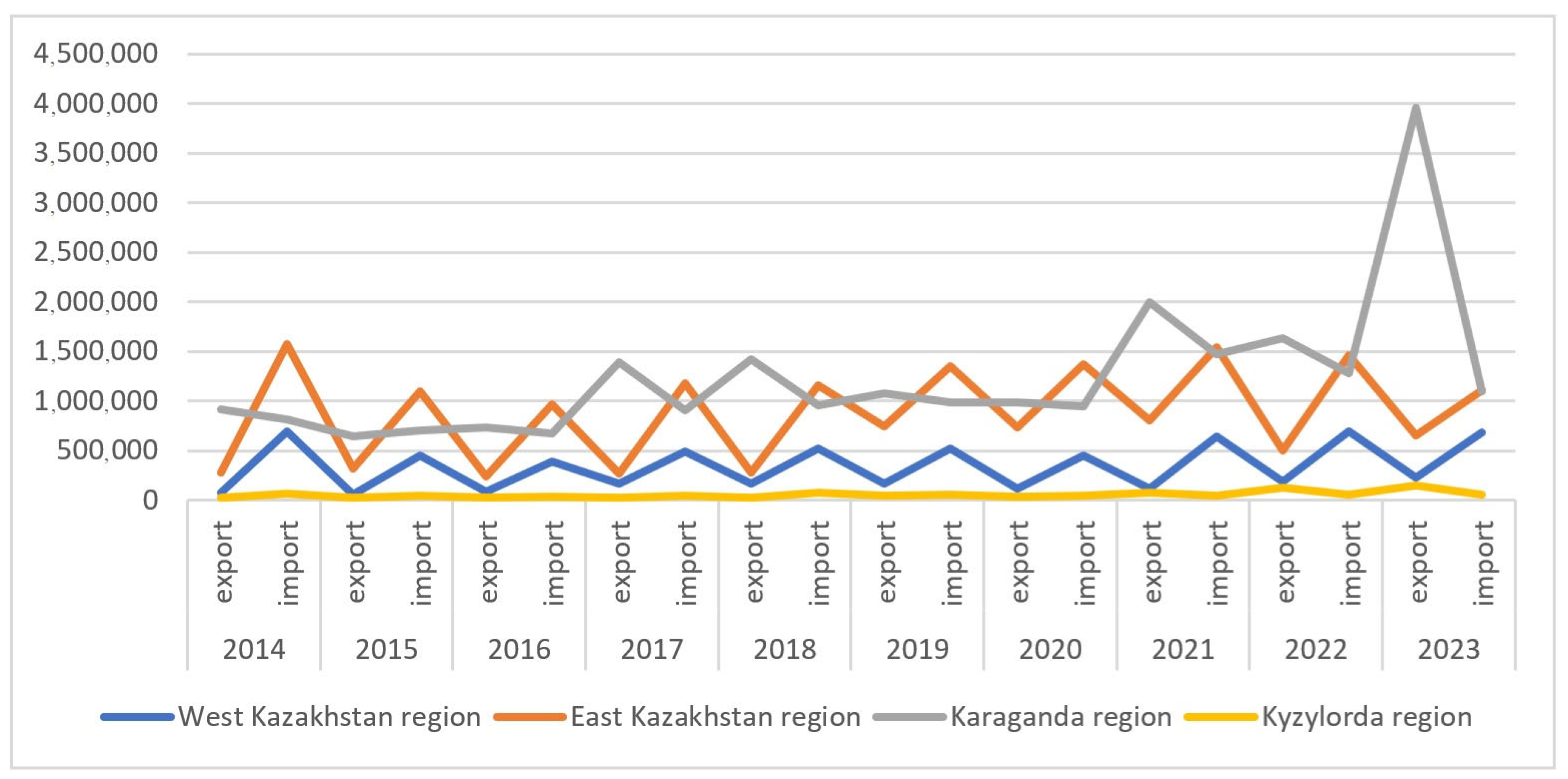
Figure A1.
Import and export by regions of Kazakhstan. Note: Compiled by authors, based on data from source [31].
References
- Institute of Economic Research of the Republic of Kazakhstan. Voluntary National Review of Kazakhstan. Institute of Economic Research of the Republic of Kazakhstan. Available online: https://eri.kz/ru/Celi_ustojchivogo_razvitija/Nacionalnyj_otchet/ (accessed on 15 September 2025). (In Russian).
- Almaty Development Center. Voluntary Local Review of Almaty. Available online: https://almatydc.kz/press/news/almaty-usilit-svoi-pozicii-na-mezhdunarodnom-urovne (accessed on 15 September 2025). (In Russian).
- OECD. Regional Outlook 2023. Available online: https://www.oecd.org/en/publications/oecd-regional-outlook-2023_92cd40a0-en.html (accessed on 31 October 2025).
- United Nations. Human Development Report 2021-22. 2022. Available online: https://hdr.undp.org/content/human-development-report-2021-22 (accessed on 29 October 2025).
- World Bank Group. World Development Indicators (for 2023). Available online: https://databank.worldbank.org/source/world-development-indicators (accessed on 15 September 2025).
- Bureau of National Statistics of the Republic of Kazakhstan. Monitoring of the Sustainable Development Goals Until 2030 by the Bureau of National Statistics of the Republic of Kazakhstan. Available online: https://stat.gov.kz/en/sustainable-development-goals/goal/1/ (accessed on 15 September 2025).
- Lavers Westin, A.; Rosado, L.; Kalmykova, Y.; Patrício, J. Methods for Downscaling National Material Consumption Data to the Regional and Municipal Levels. Sustainability 2020, 12, 8336. [Google Scholar] [CrossRef]
- Ferreira, H.; Marques, C.S.; Farinha, L. Regional Smart Specialisation Strategies: A Systematic Literature Review. J. Knowl. Econ. 2025. [Google Scholar] [CrossRef]
- Hilgart, J.; Miles, C.; Jo-Ana, C. How to Present an Informative Summary of Findings Table for Systematic Reviews of Interventions: A Tutorial. Cochrane Evid. Synth. Methods 2024, 2, e12093. [Google Scholar] [CrossRef]
- Iqbal Khan, K.; Mahmood, S.; Khalid, A. Transforming Manufacturing Sector: Bibliometric Insight on ESG Performance for Green Revolution. Discov. Sustain. 2024, 5, 359. [Google Scholar] [CrossRef]
- Rimidis, M.; Butkus, M. From Adversity to Advantage: A Systematic Literature Review on Regional Economic Resilience. Urban Sci. 2025, 9, 118. [Google Scholar] [CrossRef]
- Florizone, R.; Gerasimchuk, I. In Ensuring a Resilient Recovery, Will Canada Lead, Follow, or Be Left Behind? International Institute for Sustainable Development. Available online: https://www.iisd.org/articles/insight/ensuring-resilient-recovery-will-canada-lead-follow-or-be-left-behind (accessed on 15 September 2025).
- Lapatinas, A.; Litina, A.; Poulios, K. Economic Complexity of Cities and Its Role for Resilience. PLoS ONE 2022, 17, e0269797. [Google Scholar] [CrossRef]
- Sutton, J.; Arcidiacono, A.; Torrisi, G.; Arku, R.N. Regional Economic Resilience: A Scoping Review. Prog. Hum. Geogr. 2023, 47, 500–532. [Google Scholar] [CrossRef]
- O’Callaghan, B.; Yau, N.; Hepburn, C. How Stimulating Is a Green Stimulus? The Economic Attributes of Green Fiscal Spending. Annu. Rev. Environ. Resour. 2022, 47, 697–723. [Google Scholar] [CrossRef]
- Li, R.; Cao, F. The Impact of Sustainable Public Procurement on Corporate ESG Performance—The Chinese Evidence. PLoS ONE 2023, 18, e0292286. [Google Scholar] [CrossRef]
- Li, P.; Lin, Z.; Peng, B.; Du, H. Do CEOs’ Social Networks Affect Carbon Emissions in China? The Moderating Role of CEO Reputation. Int. Rev. Econ. Finance 2023, 88, 1122–1137. [Google Scholar] [CrossRef]
- Malkina, M.; Balakin, R. Risks of Regional Tax Systems and Their Portfolio Decomposition: The Case of Modern Russia. Acta Univ. Agric. Silvic. Mendel. Brun. 2020, 68, 995–1009. [Google Scholar] [CrossRef]
- United Nations. Indicators of Sustainable Development: Guidelines and Methodologies, 3rd ed.; United Nations: New York, NY, USA, 2007. [Google Scholar]
- Strizhakova, Y.; Strizhakov, D. Indicators of Sustainable Economic Development: Methods and Algorithms of Use. In European Research Forum; 2021. (In Russian). Available online: https://www.sciencen.org/assets/DOI/KOF-285-Strizhakova-Strizhakov.pdf (accessed on 15 September 2025).
- World Bank Group. Release of World Development Indicators 2015; The World Bank: Washington, DC, USA, 2016; p. 20433. Available online: https://blogs.worldbank.org/en/opendata/release-world-development-indicators015 (accessed on 15 September 2025).
- Sustainable Development Report 2025: The SDG Index and Dashboards. Available online: https://dashboards.sdgindex.org/ (accessed on 15 September 2025).
- Living Planet Index. Available online: https://www.livingplanetindex.org/latest_results (accessed on 15 September 2025).
- Shvarts, E.; Boev, P.; Knizhnikov, A.; Voropaev, A.; Postnova, A.; Mattoon, S.; Wackernagel, M.; Zokai, G.; Iha, K.; Borucke, M.; et al. Ecological Footprint of the Russian Regions; WWF-Russia: Moscow, Russia, 2014. [Google Scholar] [CrossRef]
- Environmental Performance Index. Available online: https://epi.yale.edu/ (accessed on 6 November 2025).
- Environmental Performance Index—The Environmental Performance Index|23° Grale. Available online: https://global-reports.23degrees.eu/epi/root (accessed on 6 November 2025).
- Lawn, P.A. A Theoretical Foundation to Support the Index of Sustainable Economic Welfare (ISEW), Genuine Progress Indicator (GPI), and Other Related Indexes. Ecol. Econ. 2003, 44, 105–118. [Google Scholar] [CrossRef]
- United Nations Department of Economic and Social Affairs. The Sustainable Development Goals Report 2023: Special Edition; The Sustainable Development Goals Report; United Nations: New York, NY, USA, 2023. [Google Scholar] [CrossRef]
- World Bank. A More Accurate Pulse on Sustainability. Available online: https://www.worldbank.org/en/news/feature/2013/06/05/accurate-pulse-sustainability (accessed on 15 September 2025).
- Bobylev, S. Economics of Sustainable Development: Textbook (Online Library Open Access); Knorus: Ulbroka, Latvia, 2021. (In Russian) [Google Scholar]
- Statistics of National Accounts—Agency for Strategic Planning and Reforms of the Republic of Kazakhstan Bureau of National statistics. Available online: https://stat.gov.kz/en/industries/economy/national-accounts/ (accessed on 15 September 2025).
- Madani, D.H.; Sarsenov, I.; World Bank. A long Road to Recovery. Available online: https://documents.worldbank.org/en/publication/documents-reports/documentdetail/161971468948927405 (accessed on 15 September 2025). (In Russian).
- National Bank of Kazakhstan. Daily Official (Market) Foreign Exchange Rates. Available online: https://nationalbank.kz/en/exchangerates/ezhednevnye-oficialnye-rynochnye-kursy-valyut (accessed on 15 September 2025).
- Akimat of West-Kazakhstan Region. Available online: https://www.gov.kz/memleket/entities/bko (accessed on 16 September 2025).
- Akimat of Kyzylorda Region. Available online: https://www.gov.kz/memleket/entities/kyzylorda (accessed on 15 September 2025).
- Mayor Office of East Kazakhstan Region. Available online: https://www.gov.kz/memleket/entities/akimvko (accessed on 15 September 2025).
- Akimat of Karaganda Region. Available online: https://www.gov.kz/memleket/entities/karaganda (accessed on 15 September 2025).
- Mazziotta, M.; Pareto, A. Methods for Constructing Composite Indices: One for all or all for one? Riv. Ital. Econ. Demogr. E Stat. 2013, 67, 67–80. [Google Scholar]
- Ziemba, P.; Becker, A.; Becker, J. Models and Indices of Sustainability Assessment in the Energy Context. Energies 2022, 15, 9465. [Google Scholar] [CrossRef]
- Pinter, L.; Hardi, P.; Bartelmus, P. Sustainable Development Indicators: Proposals for the Way Forward. ResearchGate. Available online: https://www.researchgate.net/publication/288969144_Sustainable_development_indicators_Proposals_for_the_way_forward (accessed on 15 September 2025).
- 2005 Environmental Sustainability Index. Available online: https://www.earth.columbia.edu/news/2005/images/ESI2005_policysummary.pdf (accessed on 15 September 2025).
- RAEX-Analytics. Rating of Sustainable Development of Russian Regions. Available online: https://raex-rr.com/ESG/ESG_regions/ESG_rating_regions/2021/ (accessed on 15 September 2025). (In Russian).
- Armstrong, J.S. Selecting Forecasting Methods. SSRN Electron. J. 2009. [Google Scholar] [CrossRef]
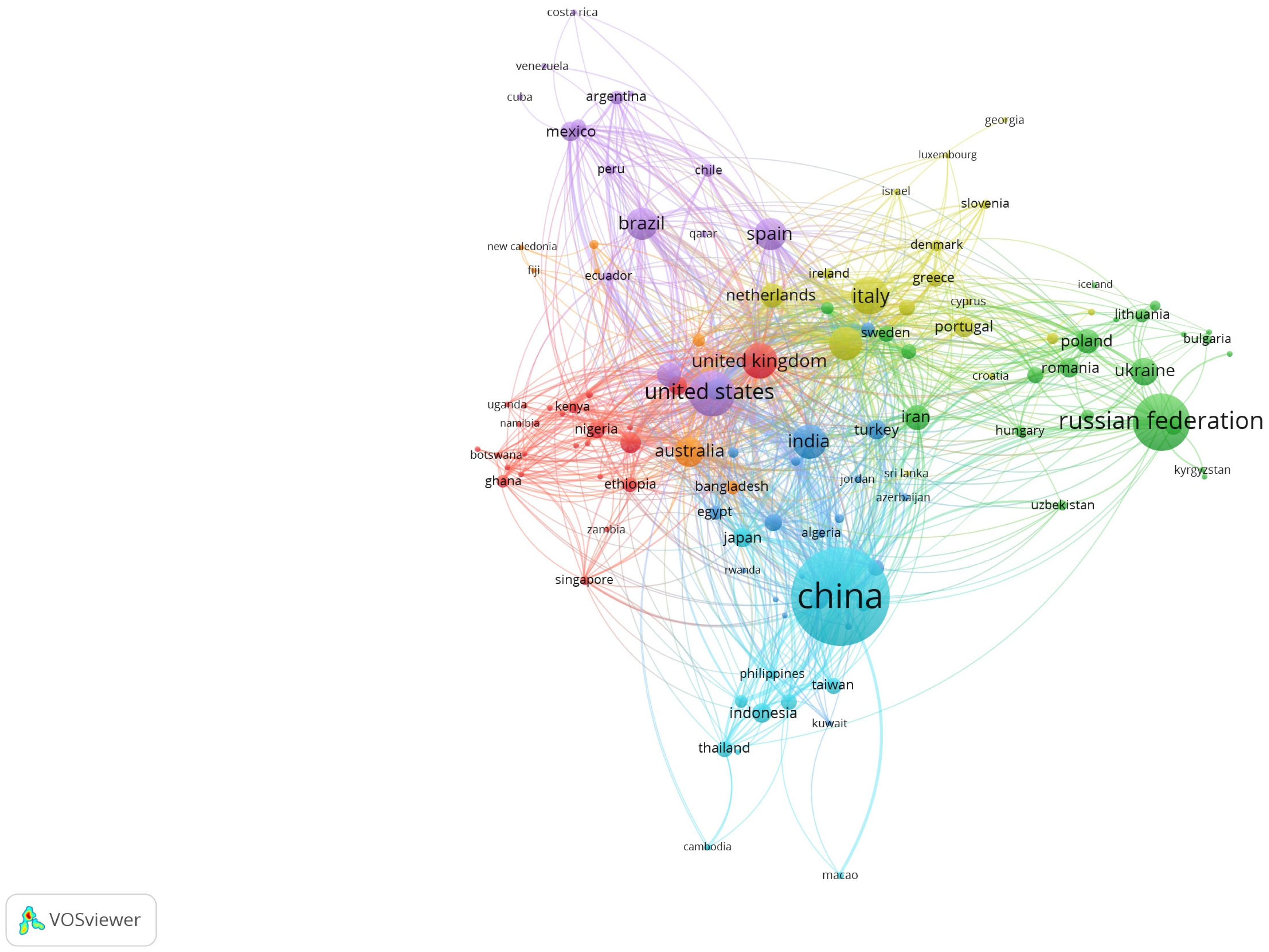
Disclaimer/Publisher’s Note: The statements, opinions and data contained in all publications are solely those of the individual author(s) and contributor(s) and not of MDPI and/or the editor(s). MDPI and/or the editor(s) disclaim responsibility for any injury to people or property resulting from any ideas, methods, instructions or products referred to in the content. |
© 2025 by the authors. Licensee MDPI, Basel, Switzerland. This article is an open access article distributed under the terms and conditions of the Creative Commons Attribution (CC BY) license (https://creativecommons.org/licenses/by/4.0/).