


Abstract
In recent years, studies in humanitarian logistics have increased due to the frequency, dimensions and losses caused by disasters. It is possible to be prepared for the negative situations that may occur before disasters occur and to take necessary precautions with an effective disaster management strategy. Making plans by evaluating the dynamic structure of humanitarian logistics processes in disasters plays an important role before and after the disaster. In addition, the failure to analyze and consider the risks in these processes makes it challenging to manage them effectively and efficiently. Although various approaches have been proposed to improve efficiency, there is still a need for a comprehensive literature review that classifies studies according to their methods, decisions, and risk considerations. In this study, a literature review was carried out to provide a risk-oriented decision-making framework for studies on humanitarian logistics. The studies are categorized according to their methods, the decisions, and the risks they address.
1. Introduction
Disaster management is a multidisciplinary dynamic process that covers the management of activities needed to reduce the effects of natural or human-induced events and prepare for all adverse situations that may occur [1]. Disasters are life-threatening for all living beings and cause many physical, social and economic losses. To minimize or eliminate all these losses and negatives, it is necessary to establish an effective disaster management system.
Disaster management involves two main phases: pre-disaster and post-disaster. The pre-disaster phase involves planning, organizing resources, and determining response strategies. It also involves preventive measures like risk analysis, contingency plans, training programs, infrastructure strengthening, and early warning systems. The goal is to minimize damage during a disaster, protect communities, and accelerate recovery in affected areas. Pre-disaster strategies are crucial to ensure sustainable resilience and recovery, making them a critical part of disaster management.
The post-disaster phase is the period after the disaster and involves providing basic needs, damage assessment, emergency relief, temporary shelter, and long-term rehabilitation. This phase requires coordinated efforts to meet the needs of victims, provide health services, repair infrastructure, and rebuild communities. The aim is to manage the long-term effects of disasters and make communities more resilient. Post-disaster recovery supports victims and strengthens communities so they can return to everyday life.
Delivering the necessary aid and materials to the disaster victims at the right time and in the right way is one of the most challenging issues of disaster management practices. In this regard, humanitarian logistics is of great importance for delivering the necessary aid and meeting the basic needs of disaster victims [2]. Its operations involve many decisions such as facility layout, routing, network design, supplier selection, transportation, inventory management, storage, logistics and forecasting. It also supports coordination between aid agencies, governments and civil society organizations to manage these operations. This coordination and cooperation combine resources, and aid is distributed more effectively. In addition, humanitarian logistics activities support the reconstruction of disaster-affected societies by successfully distributing aid according to the dynamics of disasters. Thus, it helps to eliminate all the negativity caused by disasters. Therefore, humanitarian logistics is critical, especially in disaster management [3].
Disaster management aims to prepare for disasters and minimize possible impacts by taking necessary measures. To this aim, a risk-oriented perspective is fundamental for disaster management. When disaster management activities are risk-oriented, the damages caused by disasters can be reduced, and necessary measures can be taken [2].
In humanitarian logistics, many factors such as geographical location, meteorological characteristics, infrastructure conditions, technology and communication are crucial for identifying and managing risks. Therefore, an effective risk analysis and assessment process should be carried out using humanitarian logistics. In this way, necessary precautions can be taken against the impacts caused by disasters and more resilient societies can be formed against disasters. Raising awareness of societies against disasters and taking individual and social precautions become more possible by analyzing risks before disasters occur. Societies that know what risks they may face before, during and after disasters prepare and form emergency plans accordingly.
It is important to analyze the research in humanitarian logistics and to keep these reviews up to date to observe new developments, identify current risks in the field, and contribute to more effective decision-making. Studies in this area contribute to the planning, management and effective implementation of humanitarian logistics processes at times of need and encourage continuous improvement of practices. Therefore, this study reviews and systematically groups and tabulates these studies. This section comprehensively examines studies on humanitarian logistics published in the last five years. Firstly, qualitative studies in this field are presented.
Syamsuddin et al. [4] aim to establish the most appropriate humanitarian logistics distribution model to combat natural disasters in Pasigala. They conduct a qualitative study based on the phenomenological paradigm by interviewing and collecting data from disaster survivors and employees in disaster management institutions. The authors defend the importance of delivering the right service to buyers and places at the right time and quality. Accordingly, they suggest that the model should be developed by evaluating the obstacles in the existing humanitarian logistics distribution model.
Renteria et al. [5] design a multidimensional vulnerability assessment model for disaster risks and resilience. They conducted a survey in Pueblo Rico with the participation of 27,218 people. This survey gathers information about landslide, flood, and collapse disaster risks. They make a multidimensional assessment of disasters by adopting a cross-entropy-based approach with the information they obtain. They discuss how risk reduction policies can affect disaster preparedness processes.
Garzón-Garnica et al. [6] propose a network of rapid response centers for disasters occurring in Mexico. They propose a database that can solve the facility location problem, considering various risk factors. They use data mining to collect and standardize existing information and obtain sufficient information.
Mota-Santiago et al. [7] create various scenarios for the earthquake in Mexico City. For each scenario, they propose a procedure for estimating the amount and location of aid requests and planning emergency response. Data from the Atlas of Natural Disasters and Risks is used while creating the procedure. Accordingly, scenario sets are created, and demand forecasts are made.
Allen et al. [8] aim to determine education and training needs by evaluating the work sharing and task distribution in humanitarian aid logistics and they conduct a survey study.
Mora-Ochomogo et al. [9] argue that an effective inventory management strategy should be determined to meet the needs of people affected by a disaster. They categorize the inventory management strategies and aim to identify the deficiencies in this area.
Shafiq and Soratana [10] mention the strategies that humanitarian aid organizations should implement to use their funds efficiently. They examine previous studies and identify the deficiencies that are not considered. As a result of their work, they advocate the integration and standardization of lean management with the logistics and supply chain operations of humanitarian organizations.
The remainder of this paper is structured as follows: Section 2 explains the scope and research methodology of the study. Section 3 discusses the importance of a risk-oriented perspective for humanitarian logistics studies and reviews risk-oriented studies in this field. Finally, Section 4 presents concluding remarks.
2. The Scope and Research Methodology
2.1. The Scope
In the Annotated Glossary of Disaster Management Terms published by AFAD [1], disasters are defined as “natural, technological, or human-induced events that cause physical, economic, and social losses in society as a whole or in certain segments, halting or interrupting normal life and human activities, and situations in which the affected society’s coping capacity is inadequate”. This definition considers disasters as momentary events and complex processes that can affect the social and economic order and have cascading consequences in various areas.
In line with this perspective, this study emphasizes that accurately identifying and effectively managing risks encountered in humanitarian logistics operations is critical in reducing the loss of life and property caused by disasters and minimizing disruptions to daily life. This study systematically examines academic studies in these areas and presents a detailed literature review. Examining methods, approaches, and findings from existing literature highlights the need for strategies to accelerate post-disaster recovery and make humanitarian supply chains more resilient, flexible, and effective. Furthermore, the reviewed studies identify remaining gaps in the literature and areas of need that could guide future research.
2.2. The Research Methodology
This study examines the humanitarian logistics literature from a risk-focused perspective using a structured classification framework supported by six comprehensive tables. These tables provide a multidimensional understanding of the field by summarizing the reviewed studies’ decision types, risk categories, case studies and methodological characteristics. Accordingly, the review is based on four main research questions designed to align with this framework:
What are the most frequently addressed decision problems in humanitarian logistics studies, and how do these decisions relate to different disaster phases and regional contexts?
What risk categories, including facility disruptions, demand uncertainty, and transportation or capacity failures, are most frequently analyzed, and how do these risks influence the modeling approaches adopted in the literature?
How do optimization objectives, solution techniques, and model constraints differ across studies, and what do these methodological choices reveal about the research priorities and assumptions underlying risk-focused humanitarian logistics models?
Based on the comparative analysis of these dimensions, what methodological trends and research gaps can be identified to guide future studies toward more comprehensive, adaptable, and risk-aware humanitarian logistics frameworks?
Through these research questions, the study aims to synthesize existing knowledge, highlight the interaction between risk factors and methodological approaches, and identify opportunities for future research to contribute to developing more resilient and equitable humanitarian logistics systems.
The next step in the analysis uses a bibliographic mapping method to show the intellectual structure of the field, building on this structured framework. This map helps us understand better how different research themes, methods, and risk factors are linked in the literature on humanitarian logistics. The bibliographic map shows how frequently cited studies, keywords, and research clusters are related. This gives a different view than the table analysis. It not only shows where most academic work is being done, but it also shows where there are unexplored connections that could lead to new research opportunities.
This research examines recent studies on humanitarian logistics, focusing on those published between 2018 and 2024 with a risk-oriented perspective. The analysis was conducted using the Web of Science database, where the keywords “humanitarian logistics,” “humanitarian supply chain,” “disaster logistics,” and “relief logistics” were used to identify relevant publications. The selected studies provide a comprehensive overview of current trends and methodological approaches in the field.
Figure 1 illustrates the bibliographic map of humanitarian logistics research.
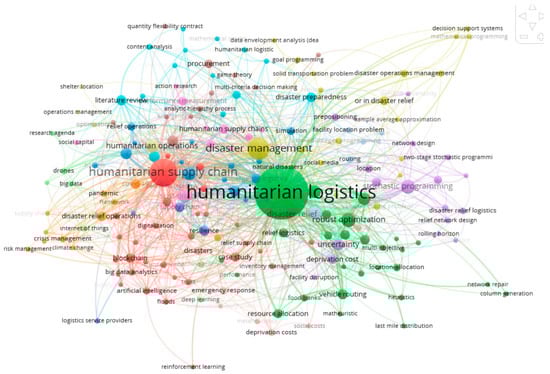
Figure 1.
Bibliographic map of humanitarian logistics research.
The bibliographic map illustrates research trends, thematic connections, and clusters of frequently used concepts within humanitarian logistics. Humanitarian logistics is positioned at the center of the map and serves as the primary concept, with closely related subthemes. The strongest clusters include the humanitarian supply chain, disaster management, and disaster relief operations. These clusters indicate that most research emphasizes operational planning, disaster management, and the efficiency of aid delivery systems.
The green and purple clusters on the map represent methodological approaches, and terms such as “stochastic programming,” “robust optimization,” and “multiobjective programming” are closely linked. This demonstrates the widespread use of decision-making under uncertainty and optimization models in research. In contrast, the red and orange regions represent emerging research trends, including risk, resilience, digitalization, artificial intelligence, blockchain, and big data. The increasing prominence of these clusters in recent years highlights the expanding influence of digital technologies in humanitarian logistics.
The map indicates that humanitarian logistics is advancing in operational and methodological dimensions. However, the integration of digital technologies and the pursuit of long-term resilience remain developing areas within the field.
A cluster-based bibliographic analysis was integrated into the study to increase its relevance and depth. VOSviewer version 1.6.20 software was used to classify 125 keywords into 11 distinct clusters, each corresponding to a thematic domain within humanitarian logistics research. This method facilitated the identification of major research trends and thematic concentrations, including optimization and resource allocation, artificial intelligence and digital transformation, blockchain and transparency, and risk and crisis management.
The clustering results showed that humanitarian logistics research has a well-organized thematic distribution. Cluster 1 discusses optimization-oriented methods, like multiobjective, robust, and stochastic optimization for distributing relief and allocating resources. Cluster 2 is about digitalization and artificial intelligence. It includes big data, deep learning, and applications that focus on resilience. Cluster 3 looks at blockchain-based ways to build trust and transparency. Clusters 4 and 5 look at technological and methodological frameworks, like drones, the Internet of Things, and how to measure performance in humanitarian supply chains. Cluster 6 looks at random and pre-positioning strategies for getting ready. Clusters 7 and 8 deal with decision support and multi-criteria evaluation methods that take fairness into account. Clusters 9 to 11 address risk and crisis management, including deprivation cost modeling, emergency response, and resilience-based disaster operations.
The implementation of the cluster approach substantially enhanced the study’s methodological framework by offering an extensive visualization of conceptual relationships and thematic connections among the examined publications. This structure brings together existing research patterns and points out new and less-studied areas like sustainability, resilience, and data-driven decision-making. This gives us a systematic and forward-looking view of the humanitarian logistics research landscape.
Following an initial review based on article titles, keywords and abstracts, the contents of the selected articles were examined in detail. At this stage, information was gathered on the research methodologies used in each study, the types of disasters examined, the areas studied, and the full stages of disaster management addressed. This technique helped us identify common areas of work in literature and determine where new research could be helpful.
3. A Risk-Oriented Perspective for the Humanitarian Logistics Studies
Humanitarian logistics has emerged as a critical research domain due to disasters’ increasing frequency, scale, and complexity. The effective and equitable distribution of relief supplies under uncertain and dynamic conditions requires operational efficiency and a thorough assessment of risks at each process stage. This section reviews the literature on humanitarian logistics from several analytical perspectives to present a comprehensive summary of recent research developments. Studies are categorized by primary decision domains, risk types, disaster contexts, and the objective functions, constraints, and solution methods used in optimization-based analyses.
This multidimensional classification facilitates analysis of the evolution of humanitarian logistics research across distinct analytical dimensions. Differentiating studies by decision focus, risk orientation, disaster context, and methodological approach enables the identification of prevailing themes, common limitations, and research gaps. Structured categorization improves comparative clarity and informs the development of a risk-oriented framework that accurately represents humanitarian logistics systems’ dynamic and interconnected characteristics.
Research in humanitarian logistics encompasses a wide range of decision-making domains. While specific investigations address individual types of decisions in isolation, others adopt a more holistic approach by analyzing multiple decision categories concurrently, thereby reflecting the intricate nature of post-disaster logistics. The principal domains explored include facility location, routing, allocation, network design, supplier selection, and transportation. Table 1 summarizes studies from the past five years, organized by the specific decision-making areas they investigate.

Table 1.
Decisions involved in the studies on humanitarian logistics.
Examining Table 1 reveals that facility location has emerged as the most extensively studied topic in recent scholarship. This finding highlights the critical importance of facility location in ensuring aid distribution and emergency response effectiveness, which are at the heart of disaster management. Choosing the right places for facilities helps teams reach affected areas faster, reduces logistics costs, and supports better capacity planning. In situations where every minute matters, a well-planned network of facilities can make a real difference by speeding up and improving the overall performance of humanitarian operations.
In addition, several studies have focused on integrated decision-making, particularly combining facility location with routing decisions. This combination is essential for improving the coordination and performance of relief networks. Such integrated approaches highlight that logistical decisions in humanitarian contexts are rarely independent, but rather interconnected elements of the same system.
When recent trends are examined, network design and allocation decisions have gained more attention over the last five years, which indicates a growing interest in optimizing complex humanitarian logistics systems. On the other hand, studies focusing on supplier selection and transportation are still quite limited. These topics have not received as much attention as other decision areas, showing room for improvement and further research.
Overall, the decisions made in humanitarian logistics are not isolated; they are strongly connected and often affect one another. Future work linking these decisions in a single framework could lead to more practical and adaptable logistics systems. Such integrated approaches would help improve the coordination of disaster management activities and overall efficiency.
As humanitarian logistics decisions become increasingly interconnected, managing the risks that emerge across these processes also gains importance. Risk management is crucial in all humanitarian logistics operations, particularly during disasters. It enables organizations to anticipate and prepare for potential security issues, natural hazards, supply chain disruptions, and health-related risks. Implementing appropriate risk management strategies improves the reliability and effectiveness of humanitarian logistics operations, ensuring faster and more coordinated aid delivery. This proactive approach allows humanitarian organizations to act more effectively in crises and respond quickly to urgent needs.
Adopting a risk-oriented approach has become increasingly relevant in humanitarian logistics, as it better captures the’ dynamic and uncertain nature of disaster environments. Traditional decision-making models often assume stable conditions, yet real humanitarian operations are rarely predictable. Interruptions, limited capacities, and fluctuating demands mark them. For this reason, this study also reviews risk-oriented research in humanitarian logistics to understand better and interpret the main disruption factors that influence logistics performance.
As presented in Table 2, most of the reviewed studies concentrate on facility and supply chain disruptions. These risks include warehouse or facility failures, interruptions in logistics providers, and stock-outs caused by supply breakdowns. Their prominence in the literature shows that maintaining logistics infrastructure continuity is essential for effective disaster response. Even small facility problems can delay relief operations, which explains why many researchers have focused on this topic.
Table 2.
The studies on risk-oriented humanitarian logistics.
Another central theme involves demand and supply uncertainty, reflecting the unpredictable nature of humanitarian operations. Changes in disaster magnitude or affected population size often lead to imbalances between supply and demand. Many studies, therefore, use uncertainty-based or stochastic models to improve allocation and responsiveness. Storage and capacity risks are also frequently addressed, often concerning limited warehouse space or reduced supplier capacity, highlighting the need for pre-positioned inventories and contingency planning.
Although research on transportation and system performance risks is relatively limited, these studies still provide valuable insights into how disruptions in transport networks or system reliability can affect the overall efficiency of relief operations. This trend reflects the evolving nature of research priorities in humanitarian logistics, where early works concentrated on structural risks and more recent studies have begun to explore dynamic and interdependent factors. As the field continues to develop, combining these perspectives within comprehensive modeling frameworks will help strengthen the understanding of risk interconnections and contribute to building more resilient humanitarian logistics systems.
Studies in the literature are categorized into two groups based on their approach. Some studies directly locate real-life problems, producing solutions for a specific event or region, while others develop models and methods that can be adapted to different scenarios with a more theoretical and general approach. Table 3 presents selected examples of humanitarian logistics studies conducted on past disasters. These studies vary in terms of disaster types, geographic regions, and different phases of the disaster. Research focusing on earthquakes, floods, hurricanes, and landslides has been conducted during the pre-disaster preparation and post-disaster response and recovery phases. Some studies offer solutions specific to the needs and conditions of a specific region, while others develop more general approaches applicable to different regions. This diversity reveals that humanitarian logistics studies are addressed at different scales, both locally and globally. Such a study is important for determining which disaster types and regions the literature focuses on, identifying understudied areas, and establishing focal points for future studies. It can also guide policymakers and practitioners by showing which types of interventions are prominent in different phases of the disaster.
Table 3.
The case studies on humanitarian logistics based on past disasters.
Table 3 reveals some distinct trends regarding the types of disasters covered by the studies, their geographic regions, and the stages of disaster management they focus on. While most of the research focuses on earthquakes, the number of studies on other disaster types, such as floods, landslides, and hurricanes, is quite limited. Geographically, Turkey, Iran, and the United States are among the most prominent countries, but various countries from different continents are also included in the studies. Regarding disaster phases, some studies examine preparedness before a disaster and response and recovery afterward, while others focus exclusively on one of these stages. These trends suggest that humanitarian logistics research is moving toward a more integrated view of disaster management, even as notable gaps in disaster type coverage and regional diversity persist.
The findings indicate that humanitarian logistics research is moving toward a broader understanding of disaster management. While most existing studies concentrate on a few disaster types and specific regions, there is a steady increase in research exploring different hazards and geographic settings. Expanding this diversity and linking multiple disaster phases within the same analytical framework would make future studies more relevant and applicable to global humanitarian operations.
Another important classification criterion considered in this literature review is to examine studies under the headings of objective functions, constraints, and solution techniques/approaches. This classification provides a more straightforward overview of the methodological framework of the reviewed studies and facilitates a systematic comparison of their similarities and differences.
The objective functions, constraints, and solution techniques/approaches identified in the reviewed papers are summarized in Table 4, Table 5 and Table 6, respectively. This methodological classification reveals how the field of humanitarian logistics has evolved in terms of analytical orientation and research priorities. By distinguishing objectives, constraints, and solution techniques, it becomes possible to trace which optimization goals have dominated the literature, what types of limitations are most frequently modeled, and which methodological tools researchers tend to rely on. This perspective also helps uncover existing research gaps and provides valuable insights for future studies to build more comprehensive and realistic humanitarian logistics models.
Table 4.
Objective Categories Considered in Humanitarian Logistics Studies.
Table 5.
Solution Techniques Applied in Humanitarian Logistics Studies.
Table 6.
Constraints Used in Humanitarian Logistics Models.
As shown in Table 4, a significant portion of the reviewed studies focuses on cost and efficiency optimization, reflecting the field’s strong interest in improving resource utilization and operational efficiency in humanitarian logistics. At the same time, many studies focus on equity and accessibility optimization, reflecting the growing interest in equity and inclusiveness in humanitarian aid delivery. Research showing reliability and risk-aware optimization has also gained prominence, particularly in studies aimed at managing uncertainty and enhancing system resilience. Coverage and responsiveness optimization objectives are also included in several studies emphasizing timely response and adequate service access during disaster operations. These findings demonstrate a balanced yet evolving research landscape in which efficiency remains a central objective and social and resilience-focused objectives are increasingly being incorporated into humanitarian logistics models.
Table 5 presents the solution techniques and approaches identified in the reviewed studies. Among these, stochastic and mixed-integer programming appear most frequently, illustrating how researchers address decision-making challenges in uncertain environments and multiple operational constraints. Because humanitarian operations are inherently dynamic and unpredictable, such methods are well-suited to model variations in demand, potential facility disruptions, and supply fluctuations. In several studies, robust optimization is applied to uncertainty by emphasizing the stability of solutions rather than relying solely on probabilistic assumptions, showing a growing concern for reliability in decision-making. In addition, multiobjective programming has been used to balance competing goals, such as minimizing cost while maintaining fairness and responsiveness. These methodological preferences show that humanitarian logistics research increasingly combines different optimization approaches to reflect better disaster operations’ complex, uncertain, and rapidly changing realities.
Table 6 summarizes the main constraints commonly used in humanitarian logistics models. Capacity constraints are the most frequently applied, as they represent the physical limits of transportation, storage, and personnel resources that directly affect the efficiency of relief operations. Budget constraints highlight the financial boundaries that humanitarian organizations face, where limited funding requires careful prioritization and allocation of resources. Equity constraints ensure fairness in aid distribution and help address social and ethical considerations in decision-making. Together, these constraints illustrate that humanitarian logistics models aim to capture operational efficiency and the financial and ethical realities of real-world disaster response.
This review approaches the existing literature from a risk-oriented perspective, examining the types of disasters and regional contexts addressed and the main objectives pursued within humanitarian logistics models. These objectives typically include reducing unmet demand, shortening service and waiting times, and enhancing overall operational performance. The analysis further reveals a rich methodological diversity across the reviewed studies. Some adopt scenario-based stochastic programming to capture uncertainty, while others employ robust optimization to improve model stability under changing conditions. In addition, several works combine capacity planning with equity-based constraints, reflecting an effort to integrate operational efficiency and social considerations into humanitarian decision-making.
A comparative assessment of the reviewed works shows that how risk is incorporated into the models directly influences the model structure and the selected solution techniques. In some cases, rapid response and operational efficiency are prioritized, whereas equity in resource distribution is the central concern in others. These differences indicate that a single criterion cannot define success in humanitarian logistics; rather, it depends on balancing efficiency, equity, and adaptability. It is also observed that studies focusing on the emergency response phase are far more common than those addressing long-term recovery planning. This suggests an important area for further research in developing comprehensive and resilience-oriented frameworks.
4. Conclusions
Humanitarian logistics is of critical importance in disaster management. Its activities include many processes such as conducting search and rescue operations, meeting basic needs, and reconstructing the society affected by the disaster. One of the main objectives of humanitarian logistics is to minimize the effects caused by the disaster by delivering the necessary teams and materials to the disaster area in the fastest and most effective way. Delivery of many basic needs to the disaster area at the right time and in the right amount can only be ensured by effective humanitarian logistics work.
A risk-oriented perspective is fundamental for disaster and humanitarian logistics operations management. When disaster management activities are risk-oriented, the damage caused by disasters can be reduced, and necessary measures can be taken. In humanitarian logistics, many factors such as geographical location, meteorological characteristics, infrastructure conditions, technology and communication are crucial for identifying and managing risks. Therefore, an effective risk analysis and assessment process should be carried out using humanitarian logistics. In this way, necessary precautions can be taken against the impacts caused by disasters, and more resilient societies can be formed against disasters.
It is important to analyze the research in humanitarian logistics and keep these reviews up to date to observe new developments, identify current risks in the field, and contribute to more effective decision-making. In this regard, the importance of a risk-oriented perspective for humanitarian logistics studies is discussed, and a review of risk-oriented studies in this field in the last five years is presented in this study. The type of disaster they study, the type of risk they consider, and the methods they apply are examined.
In addition to the literature review, the study was guided by clearly defined research questions and supported by a bibliographic map and a cluster-based analysis conducted using data from the Web of Science database. Combining these methods provided a more comprehensive view of the humanitarian logistics research landscape and helped identify emerging themes and underexplored risk areas.
Facility location decision is a critical element in humanitarian logistics. In line with this fact, many of the studies reviewed focus on facility location problems. It has been observed that facility location, routing, allocation, network design, supplier selection, and transportation are other commonly used decisions. Studies on risk-oriented humanitarian logistics have shown that the risks of facility disruptions and supply disruptions are at the forefront.
When the literature is examined comprehensively, it is seen that the most frequently studied disaster types are earthquake, flood, hurricane, landslide, snowstorm, typhoon and tsunami. In addition, many case studies on humanitarian logistics exist based on past disasters. It should be emphasized that capacity, budget, and equity constraints are the main constraints used in these studies. Relatively few studies include demand, response time, and distance constraints. When the objective functions are examined, it is seen that studies have been carried out for many different purposes. However, it has been observed that cost minimization is the primary objective function in most studies.
The bibliographic mapping and cluster-based analysis reinforced these findings by visually and thematically categorizing the principal research trajectories in the field. VOSviewer identified eleven clusters that showed how different areas are connected, such as optimization, digital transformation, blockchain applications, and risk management. These results not only confirmed the trends found in the literature review but also showed how important it is to use technology-driven solutions and risk-oriented decision frameworks in humanitarian logistics.
The research enhances the current body of knowledge by creating a systematic and evidence-based understanding of humanitarian logistics research. By integrating review methodologies with bibliographic and cluster-based techniques, the study offers both a theoretical synthesis and practical insights. Theoretically, it emphasizes the importance of incorporating risk-oriented frameworks into logistics modeling. In practice, it gives policymakers and professionals practical advice on improving readiness, making the best use of resources, and making the supply chain more resilient in the face of uncertainty.
A risk-oriented approach in humanitarian logistics is closely related to the principles of sustainability, in addition to its operational benefits. This method helps the environment and the economy by making it easier to use resources, cutting down on waste, and stopping last-minute fixes. Furthermore, prompt mitigation of disruptions and equitable distribution of relief resources enhance social sustainability by safeguarding vulnerable populations and guaranteeing equitable access to humanitarian aid. So, moving humanitarian logistics forward from a risk-driven and technology-enabled point of view is not only good for operations, but it is also a strategic way to achieve long-term sustainable development in areas that are prone to disasters.
A risk-oriented perspective is believed to guide the development of more holistic approaches to humanitarian logistics operations in disaster management.
The limitation of this study is that it only deals with studies using quantitative techniques in humanitarian logistics.
Future research in humanitarian logistics should move toward building frameworks that are not only broader in scope but also flexible enough to capture how different risk factors overlap and influence each other during disaster operations. Many studies have treated these risks, such as facility disruptions, fluctuating demand, or transport interruptions, as isolated problems. In actual disaster environments, risks seldom emerge in isolation. One problem often leads to another, creating a chain of events that magnifies the overall disruption. Understanding how these linkages develop and interact is vital for analyzing cascading failures and building logistics systems that maintain functionality even under stress. Methods such as system dynamics, resilience assessment, and scenario analysis offer valuable ways to examine how interconnected risks evolve across different disaster scales and under different resource constraints.
In humanitarian logistics, the ability to conduct effective pre-disaster planning is crucial for minimizing disruption and ensuring rapid response once a crisis occurs. In this context early warning systems serve as a vital enabler by allowing decision-makers to anticipate emerging threats and mobilize resources before the disaster fully unfolds. By integrating real-time monitoring tools, predictive analytics and sensor-based alert mechanisms, such systems help identify evolving risk, forecast demand surges, and enhance the pre-positioning of relief supplies. Rather than responding reactively after the damage has already occurred, early warning mechanisms provide a time-sensitive advantage that improves responsiveness, reduces unmet demand, and prevents capacity failures. Therefore, the adoption of technologically enabled early warning systems is essential for establishing a more anticipatory, risk-informed, and resilient humanitarian logistics infrastructure.
At the same time, the increasing availability of digital tools and real-time data offers new opportunities for improving humanitarian logistics. Artificial intelligence, machine learning, and simulation models can be used to anticipate how risks might spread and to support quicker and better-informed decisions in the field. Future studies should also broaden their perspective by considering long-term and climate-induced risks and the growing importance of collaboration among multiple agencies in a digitally connected world. Advancing research along these lines will help build humanitarian logistics systems that are both resilient and adaptable to the unpredictable nature of modern disasters.
In conclusion, this study integrates a risk-oriented perspective with bibliographic and cluster-based insights, thus synthesizing existing knowledge and laying the groundwork for comprehensive, interdisciplinary research in humanitarian logistics. The findings offer a thorough framework for future research to develop more flexible humanitarian logistics systems.
Funding
This research received no external funding.
Institutional Review Board Statement
Not applicable.
Informed Consent Statement
Not applicable.
Data Availability Statement
No new data were created or analyzed in this study.
Conflicts of Interest
The authors declare no conflict of interest.
References
- AFAD. 2023. Available online: https://www.afad.gov.tr (accessed on 6 January 2023).
- Yang, Y.; Yin, Y.; Wang, D.; Ignatius, J.; Cheng, T.C.E.; Dhamotharan, L. Distributionally robust multi-period location-allocation with multiple resources and capacity levels in humanitarian logistics. Eur. J. Oper. Res. 2023, 305, 1042–1062. [Google Scholar] [CrossRef]
- Kovács, G.; Spens, K.M. Humanitarian logistics in disaster relief operations. Int. J. Phys. Distrib. Logist. Manag. 2007, 37, 99–114. [Google Scholar] [CrossRef]
- Syamsuddin, S.; Miru, S.; Kaseng, S.; Fatlina, Z.; Asngadi, A.; Rohmawati, S. Humanitarian Logistics Distribution in Natural Disaster Risk Mitigation in Central Sulawesi. J. Res. Soc. Sci. Econ. Manag. 2022, 2, 260–272. [Google Scholar] [CrossRef]
- Renteria, R.; Chong, M.; de Brito Junior, I.; Luna, A.; Quiliche, R. An entropy-based approach for disaster risk assessment and humanitarian logistics operations planning in Colombia. J. Humanit. Logist. Supply Chain. Manag. 2021, 11, 428–456. [Google Scholar] [CrossRef]
- Garzón-Garnica, E.A.; Cano-Olivos, P.; Sánchez-Partida, D.; Martínez-Flores, J.L. Data Mining/Mediation to Evaluate Risk of a Humanitarian Logistics Network in Mexico. Tech. Tools Methodol. Appl. Glob. Supply Chain. Ecosyst. 2020, 166, 359–381. [Google Scholar]
- Mota-Santiago, L.R.; Lozano, A.; Ortiz-Valera, A.E. Determination of disaster scenarios for estimating relief demand to develop an early response to an earthquake disaster in urban areas of developing countries. Int. J. Disaster Risk Reduct. 2023, 87, 103570. [Google Scholar] [CrossRef]
- Allen, A.M.; Kovács, G.; Masini, A.; Vaillancourt, A.; Van Wassenhove, L. Exploring the link between the humanitarian logistician and training needs. J. Humanit. Logist. Supply Chain. Manag. 2013, 3, 129–148. [Google Scholar] [CrossRef]
- Mora-Ochomogo, E.I.; Mora-Vargas, J.; Serrato, M. A qualitative analysis of inventory management strategies in humanitarian logistics operations. Int. J. Comb. Optim. Probl. Inform. 2016, 7, 40–53. [Google Scholar]
- Shafiq, M.; Soratana, K. Humanitarian logistics and supply chain management-a qualitative study. LogForum 2019, 15, 19–38. [Google Scholar] [CrossRef]
- Rodríguez-Espíndola, O.; Albores, P.; Brewster, C. Disaster preparedness in humanitarian logistics: A collaborative approach for resource management in floods. Eur. J. Oper. Res. 2018, 264, 978–993. [Google Scholar] [CrossRef]
- Vahdani, B.; Veysmoradi, D.; Noori, F.; Mansour, F. Two-stage multiobjective location-routing-inventory model for humanitarian logistics network design under uncertainty. Int. J. Disaster Risk Reduct. 2018, 27, 290–306. [Google Scholar] [CrossRef]
- Rahmani, D.; Zandi, A.; Peyghaleh, E.; Siamakmanesh, N. A robust model for a humanitarian relief network with backup covering under disruptions: A real world application. Int. J. Disaster Risk Reduct. 2018, 28, 56–68. [Google Scholar] [CrossRef]
- Moreno, A.; Alem, D.; Ferreira, D.; Clark, A. An effective two-stage stochastic multi-trip location-transportation model with social concerns in relief supply chains. Eur. J. Oper. Res. 2018, 269, 1050–1071. [Google Scholar] [CrossRef]
- Torabi, S.A.; Shokr, I.; Tofighi, S.; Heydari, J. Integrated relief pre-positioning and procurement planning in humanitarian supply chains. Transp. Res. Part E Logist. Transp. Rev. 2018, 113, 123–146. [Google Scholar] [CrossRef]
- Chapman, A.G.; Mitchell, J.E. A fair division approach to humanitarian logistics inspired by conditional value-at-risk. Ann. Oper. Res. 2018, 262, 133–151. [Google Scholar] [CrossRef]
- Elçi, Ö.; Noyan, N. A chance-constrained two-stage stochastic programming model for humanitarian relief network design. Transp. Res. Part B Methodol. 2018, 108, 55–83. [Google Scholar] [CrossRef]
- Loree, N.; Aros-Vera, F. Points of distribution location and inventory management model for Post-Disaster Humanitarian Logistics. Transp. Res. Part E Logist. Transp. Rev. 2018, 116, 1–24. [Google Scholar] [CrossRef]
- Tavana, M.; Abtahi, A.R.; Di Caprio, D.; Hashemi, R.; Yousefi-Zenouz, R. An integrated location-inventory-routing humanitarian supply chain network with pre-and post-disaster management considerations. Socio-Econ. Plan. Sci. 2018, 64, 21–37. [Google Scholar] [CrossRef]
- Noyan, N.; Kahvecioğlu, G. Stochastic last mile relief network design with resource reallocation. OR Spectr. 2018, 40, 187–231. [Google Scholar] [CrossRef]
- Kınay, Ö.B.; Kara, B.Y.; Saldanha-da-Gama, F.; Correia, I. Modeling the shelter site location problem using chance constraints: A case study for Istanbul. Eur. J. Oper. Res. 2018, 270, 132–145. [Google Scholar] [CrossRef]
- Aghajani, M.; Torabi, S.A.; Heydari, J. A novel option contract integrated with supplier selection and inventory prepositioning for humanitarian relief supply chains. Socio-Econ. Plan. Sci. 2020, 71, 100780. [Google Scholar] [CrossRef]
- Ndolo, J.; Janjane, A.I. Influence of Supply Risk Assessment of Third Party Logistics Providers on Performance of Humanitarian Supply Chains: A Case of International Red Cross, Somalia. IRA-Int. J. Manag. Soc. Sci. 2020, 16, 105–112. [Google Scholar]
- Dönmez, Z.; Kara, B.Y.; Karsu, Ö.; Saldanha-da-Gama, F. Humanitarian facility location under uncertainty: Critical review and future prospects. Omega 2021, 102, 102393. [Google Scholar] [CrossRef]
- Mohammadi, S.; Avakh Darestani, S.; Vahdani, B.; Alinezhad, A. Multiobjective Optimization Model for Designing a Humanitarian Logistics Network under Service Sharing and Accident Risk Concerns under Uncertainty. J. Qual. Eng. Prod. Optim. 2021, 6, 105–126. [Google Scholar]
- Kian, R.; Erdoğan, G.; de Leeuw, S.; Salman, F.S.; Sabet, E.; Kara, B.Y.; Demir, M.H. Logistics planning of cash transfer to Syrian refugees in Turkey. Eur. J. Oper. Res. 2022, 296, 1007–1024. [Google Scholar] [CrossRef]
- Noyan, N.; Meraklı, M.; Küçükyavuz, S. Two-stage stochastic programming under multivariate risk constraints with an application to humanitarian relief network design. Math. Program. 2022, 191, 7–45. [Google Scholar] [CrossRef]
- Sun, H.; Li, J.; Wang, T.; Xue, Y. A novel scenario-based robust bi-objective optimization model for humanitarian logistics network under risk of disruptions. Transp. Res. Part E Logist. Transp. Rev. 2022, 157, 102578. [Google Scholar] [CrossRef]
- Modarresi, S.A.; Maleki, M.R. Integrating pre and post-disaster activities for designing an equitable humanitarian relief supply chain. Comput. Ind. Eng. 2023, 181, 109342. [Google Scholar] [CrossRef]
- Aghajani, M.; Torabi, S.A.; Altay, N. Resilient relief supply planning using an integrated procurement-warehousing model under supply disruption. Omega 2023, 118, 102871. [Google Scholar] [CrossRef]
- Kawase, R.; Iryo, T. Optimal stochastic inventory-distribution strategy for damaged multi-echelon humanitarian logistics network. Eur. J. Oper. Res. 2023, 309, 616–633. [Google Scholar] [CrossRef]
- Wang, Z.; Leng, L.; Ding, J.; Zhao, Y. Study on location-allocation problem and algorithm for emergency supplies considering timeliness and fairness. Comput. Ind. Eng. 2023, 177, 109078. [Google Scholar] [CrossRef]
- Pouraliakbari-Mamaghani, M.; Saif, A.; Kamal, N. Reliable design of a congested disaster relief network: A two-stage stochastic-robust optimization approach. Socio-Econ. Plan. Sci. 2023, 86, 101498. [Google Scholar] [CrossRef]
- Sheikholeslami, M.; Zarrinpoor, N. Designing an integrated humanitarian logistics network for the preparedness and response phases under uncertainty. Socio-Econ. Plan. Sci. 2023, 86, 101496. [Google Scholar] [CrossRef]
- Dukkanci, O.; Koberstein, A.; Kara, B.Y. Drones for relief logistics under uncertainty after an earthquake. Eur. J. Oper. Res. 2023, 310, 117–132. [Google Scholar] [CrossRef]
- Zhang, G.; Jia, N.; Zhu, N.; Adulyasak, Y.; Ma, S. Robust drone selective routing in humanitarian transportation network assessment. Eur. J. Oper. Res. 2023, 305, 400–428. [Google Scholar] [CrossRef]
- Ghahremani-Nahr, J.; Nozari, H.; Szmelter-Jarosz, A. Designing a humanitarian relief logistics network considering the cost of deprivation using a robust-fuzzy-probabilistic planning method. J. Int. Humanit. Action 2024, 9, 19. [Google Scholar]
- Yin, Y.; Wang, J.; Chu, F.; Wang, D. Distributionally robust multi-period humanitarian relief network design integrating facility location, supply inventory and allocation, and evacuation planning. Int. J. Prod. Res. 2024, 62, 45–70. [Google Scholar] [CrossRef]
- Wang, Z.; Liu, K.; You, K.; Wang, Z. Wasserstein distributionally robust facility location and capacity planning for disaster relief. Expert Syst. Appl. 2025, 272, 126647. [Google Scholar] [CrossRef]
- Khalili-Fard, A.; Hashemi, M.; Bakhshi, A.; Yazdani, M.; Jolai, F.; Aghsami, A. Integrated relief pre-positioning and procurement planning considering non-governmental organizations support and perishable relief items in a humanitarian supply chain network. Omega 2024, 127, 103111. [Google Scholar] [CrossRef]
- Beiki Ashkezari, A.; Zokaee, M.; Rabbani, E.; Rabbani, M.; Aghsami, A. A scenario-based game theory integrating with a location-allocation-routing problem in a pre-and post-disaster humanitarian logistics network under uncertainty. J. Model. Manag. 2024, 19, 1686–1718. [Google Scholar]
- Masoomi, B.; Aghajani, H.; Jafarnejad, A.; Movahedi, M.M. A multiobjective mathematical model for optimization design of humanitarian logistics network using meta-heuristic algorithm: A model to enhance actors’ coordination. J. Decis. Oper. Res. 2024, 9, 42–63. [Google Scholar]
- Xue, Y.; Li, M.; Arabnejad, H.; Suleimenova, D.; Jahani, A.; Geiger, B.C.; Boesjes, F.; Anagnostou, A.; Taylor, S.J.E.; Liu, X.; et al. Many-Objective Simulation Optimization for Camp Location Problems in Humanitarian Logistics. Int. J. Netw. Dyn. Intell. 2024, 3, 100017. [Google Scholar] [CrossRef]
- Rodríguez-Espíndola, O.; Ahmadi, H.; Gastélum-Chavira, D.; Ahumada-Valenzuela, O.; Chowdhury, S.; Dey, P.K.; Albores, P. Humanitarian logistics optimization models: An investigation of decision-maker involvement and directions to promote implementation. Socio-Econ. Plan. Sci. 2023, 89, 101669. [Google Scholar] [CrossRef]
- Liu, T.; Li, J.; Wang, X. Enhancing the cost performance in regular humanitarian logistics: Location-routing and delivery frequency optimization. Flex. Serv. Manuf. J. 2023, 36, 1157–1185. [Google Scholar] [CrossRef]
- Cao, J.; Han, H.; Wang, Y.J.; Han, T.C. Optimal logistics scheduling with dynamic information in emergency response: Case studies for humanitarian objectives. Adv. Prod. Eng. Manag. 2023, 18, 381–395. [Google Scholar] [CrossRef]
- Oruc, B.E.; Kara, B.Y. Post-disaster assessment routing problem. Transp. Res. Part B Methodol. 2018, 116, 76–102. [Google Scholar] [CrossRef]
- Yin, Y.; Yang, Y.; Yu, Y.; Wang, D.; Cheng, T.C.E. Robust vehicle routing with drones under uncertain demands and truck travel times in humanitarian logistics. Transp. Res. Part B Methodol. 2023, 174, 102781. [Google Scholar] [CrossRef]
- Faiz, T.I.; Vogiatzis, C.; Liu, J.; Noor-E-Alam, M. A robust optimization framework for two-echelon vehicle and UAV routing for post-disaster humanitarian logistics operations. Networks 2024, 84, 200–219. [Google Scholar] [CrossRef]
- Romero-Mancilla, M.S.; Hernandez-Ruiz, K.E.; Huerta-Muñoz, D.L. A multiobjective mathematical model for a humanitarian logistics multimodal transportation problem. J. Humanit. Logist. Supply Chain. Manag. 2024, 14, 247–261. [Google Scholar] [CrossRef]
- Avishan, F.; Elyasi, M.; Yanıkoğlu, İ.; Ekici, A.; Özener, O.Ö. Humanitarian relief distribution problem: An adjustable robust optimization approach. Transp. Sci. 2023, 57, 1096–1114. [Google Scholar] [CrossRef]
- Aliakbari, A.; Rashidi Komijan, A.; Tavakkoli-Moghaddam, R.; Najafi, E. A new robust optimization model for relief logistics planning under uncertainty: A real-case study. Soft Comput. A Fusion Found. Methodol. Appl. 2022, 26, 3883–3901. [Google Scholar] [CrossRef]
- Ershadi, M.M.; Shemirani, H.S. A multi-objective optimization model for logistic planning in the crisis response phase. J. Humanit. Logist. Supply Chain. Manag. 2022, 12, 30–53. [Google Scholar] [CrossRef]
- Ismail, I. A possibilistic mathematical programming model to control the flow of relief commodities in humanitarian supply chains. Comput. Ind. Eng. 2021, 157, 107305. [Google Scholar] [CrossRef]
- Abazari, S.R.; Aghsami, A.; Rabbani, M. Prepositioning and distributing relief items in humanitarian logistics with uncertain parameters. Socio-Econ. Plan. Sci. 2021, 74, 100933. [Google Scholar] [CrossRef]
- Wang, S.L.; Sun, B.Q. Model of multi-period emergency material allocation for large-scale sudden natural disasters in humanitarian logistics: Efficiency, effectiveness and equity. Int. J. Disaster Risk Reduct. 2023, 85, 103530. [Google Scholar] [CrossRef]
- Ogazón, E.; Smith, N.R.; Ruiz, A. Assessing Different Two-Stage Stochastic Models for Optimizing Food Bank Networks’ Operations During Natural Disasters. Mathematics 2024, 12, 3238. [Google Scholar] [CrossRef]
- Elçi, Ö.; Noyan, N.; Bülbül, K. Chance-constrained stochastic programming under variable reliability levels with an application to humanitarian relief network design. Comput. Oper. Res. 2018, 96, 91–107. [Google Scholar] [CrossRef]
- Klibi, W.; Ichoua, S.; Martel, A. Prepositioning emergency supplies to support disaster relief: A case study using stochastic programming. INFOR: Inf. Syst. Oper. Res. 2018, 56, 50–81. [Google Scholar] [CrossRef]
- Noham, R.; Tzur, M. Designing humanitarian supply chains by incorporating actual post-disaster decisions. Eur. J. Oper. Res. 2018, 265, 1064–1077. [Google Scholar] [CrossRef]
- Zhang, P.; Liu, Y.; Yang, G.; Zhang, G. A multiobjective distributionally robust model for sustainable last mile relief network design problem. Ann. Oper. Res. 2022, 309, 689–730. [Google Scholar] [CrossRef]
- Ransikarbum, K.; Mason, S.J. A bi-objective optimisation of post-disaster relief distribution and short-term network restoration using hybrid NSGA-II algorithm. Int. J. Prod. Res. 2022, 60, 5769–5793. [Google Scholar] [CrossRef]
- Mamashli, Z.; Nayeri, S.; Tavakkoli-Moghaddam, R.; Sazvar, Z.; Javadian, N. Designing a sustainable–resilient disaster waste management system under hybrid uncertainty: A case study. Eng. Appl. Artif. Intell. 2021, 106, 104459. [Google Scholar] [CrossRef]
- Reusken, M.; Cruijssen, F.; Fleuren, H. A food bank supply chain model: Optimizing investments to maximize food assistance. Int. J. Prod. Econ. 2023, 261, 108886. [Google Scholar] [CrossRef]
- Van Steenbergen, R.M.; Lalla-Ruiz, E.; van Heeswijk, W.; Mes, M. The Heterogeneous Fleet Risk-Constrained Vehicle Routing Problem in Humanitarian Logistics. In Proceedings of the Computational Logistics: 14th International Conference, ICCL 2023, Berlin, Germany, 6–8 September 2023; Springer Nature: Berlin/Heidelberg, Germany, 2023; Volume 14239, p. 276. [Google Scholar]
- Hu, S.; Dong, Z.S. Supplier selection and pre-positioning strategy in humanitarian relief. Omega 2019, 83, 287–298. [Google Scholar] [CrossRef]
- Yahyaei, M.; Bozorgi-Amiri, A. Robust reliable humanitarian relief network design: An integration of shelter and supply facility location. Ann. Oper. Res. 2019, 283, 897–916. [Google Scholar] [CrossRef]
- Ghorbani, M.; Ramezanian, R. Integration of carrier selection and supplier selection problem in humanitarian logistics. Comput. Ind. Eng. 2020, 144, 106473. [Google Scholar] [CrossRef]
- Aghajani, M.; Torabi, S.A. A mixed procurement model for humanitarian relief chains. J. Humanit. Logist. Supply Chain. Manag. 2020, 10, 45–74. [Google Scholar] [CrossRef]
- Yenice, Z.D.; Samanlioglu, F. A multiobjective stochastic model for an earthquake relief network. J. Adv. Transp. 2020, 2020, 1–15. [Google Scholar] [CrossRef]
- Olanrewaju, O.G.; Dong, Z.S.; Hu, S. Supplier selection decision making in disaster response. Comput. Ind. Eng. 2020, 143, 106412. [Google Scholar] [CrossRef]
- Shokr, I.; Jolai, F.; Bozorgi-Amiri, A. A novel humanitarian and private sector relief chain network design model for disaster response. Int. J. Disaster Risk Reduct. 2021, 65, 102522. [Google Scholar] [CrossRef]
- Khan, M.; Parvaiz, G.S.; Ali, A.; Jehangir, M.; Hassan, N.; Bae, J. A model for understanding the mediating association of transparency between emerging technologies and humanitarian logistics sustainability. Sustainability 2022, 14, 6917. [Google Scholar] [CrossRef]
- Balcik, B.; Yanıkoğlu, İ. A robust optimization approach for humanitarian needs assessment planning under travel time uncertainty. Eur. J. Oper. Res. 2020, 282, 40–57. [Google Scholar] [CrossRef]
- Shavarani, S.M. Multi-level facility location-allocation problem for post-disaster humanitarian relief distribution: A case study. J. Humanit. Logist. Supply Chain. Manag. 2019, 9, 70–81. [Google Scholar] [CrossRef]
- Ni, W.; Shu, J.; Song, M. Location and emergency inventory pre-positioning for disaster response operations: Min-max robust model and a case study of Yushu earthquake. Prod. Oper. Manag. 2018, 27, 160–183. [Google Scholar] [CrossRef]
- Edrisi, A.; Askari, M. Probabilistic budget allocation for improving efficiency of transportation networks in pre-and post-disaster phases. Int. J. Disaster Risk Reduct. 2019, 39, 101113. [Google Scholar] [CrossRef]
- Paul, J.A.; Wang, X.J. Robust location-allocation network design for earthquake preparedness. Transp. Res. Part B Methodol. 2019, 119, 139–155. [Google Scholar] [CrossRef]
- Yu, W. Reachability guarantee based model for pre-positioning of emergency facilities under uncertain disaster damages. Int. J. Disaster Risk Reduct. 2020, 42, 101335. [Google Scholar] [CrossRef]
- Boonmee, C.; Kasemset, C. The multiobjective fuzzy mathematical programming model for humanitarian relief logistics. Ind. Eng. Manag. Syst. 2020, 19, 197–210. [Google Scholar] [CrossRef]
- Tumamao-Guittap, G.S.; Castro, J.T. Hydro-meteorological Risk Assessment-Guided Demand Forecasting in Humanitarian Logistics Management: The Case of Tacloban City, Philippines. In Urban and Transit Planning: A Culmination of Selected Research Papers from IEREK Conferences on Urban Planning, Architecture and Green Urbanism, Italy and Netherlands (2017); Springer International Publishing: Berlin/Heidelberg, Germany, 2019; pp. 477–492. [Google Scholar]
- Yang, H.; Zhang, P.; Zhang, P.; Zhang, C.; Yan, X. Optimization of a two-stage emergency logistics system considering public psychological risk perception under earthquake disaster. Sci. Rep. 2024, 14, 31983. [Google Scholar] [CrossRef]
Disclaimer/Publisher’s Note: The statements, opinions and data contained in all publications are solely those of the individual author(s) and contributor(s) and not of MDPI and/or the editor(s). MDPI and/or the editor(s) disclaim responsibility for any injury to people or property resulting from any ideas, methods, instructions or products referred to in the content. |
© 2025 by the authors. Licensee MDPI, Basel, Switzerland. This article is an open access article distributed under the terms and conditions of the Creative Commons Attribution (CC BY) license (https://creativecommons.org/licenses/by/4.0/).