


Overcoming Barriers to Circular Economy in Plastic Packaging: Enablers and Integrated Strategies in Multinational Companies


Abstract
1. Introduction
2. Methodology
2.1. Case Study
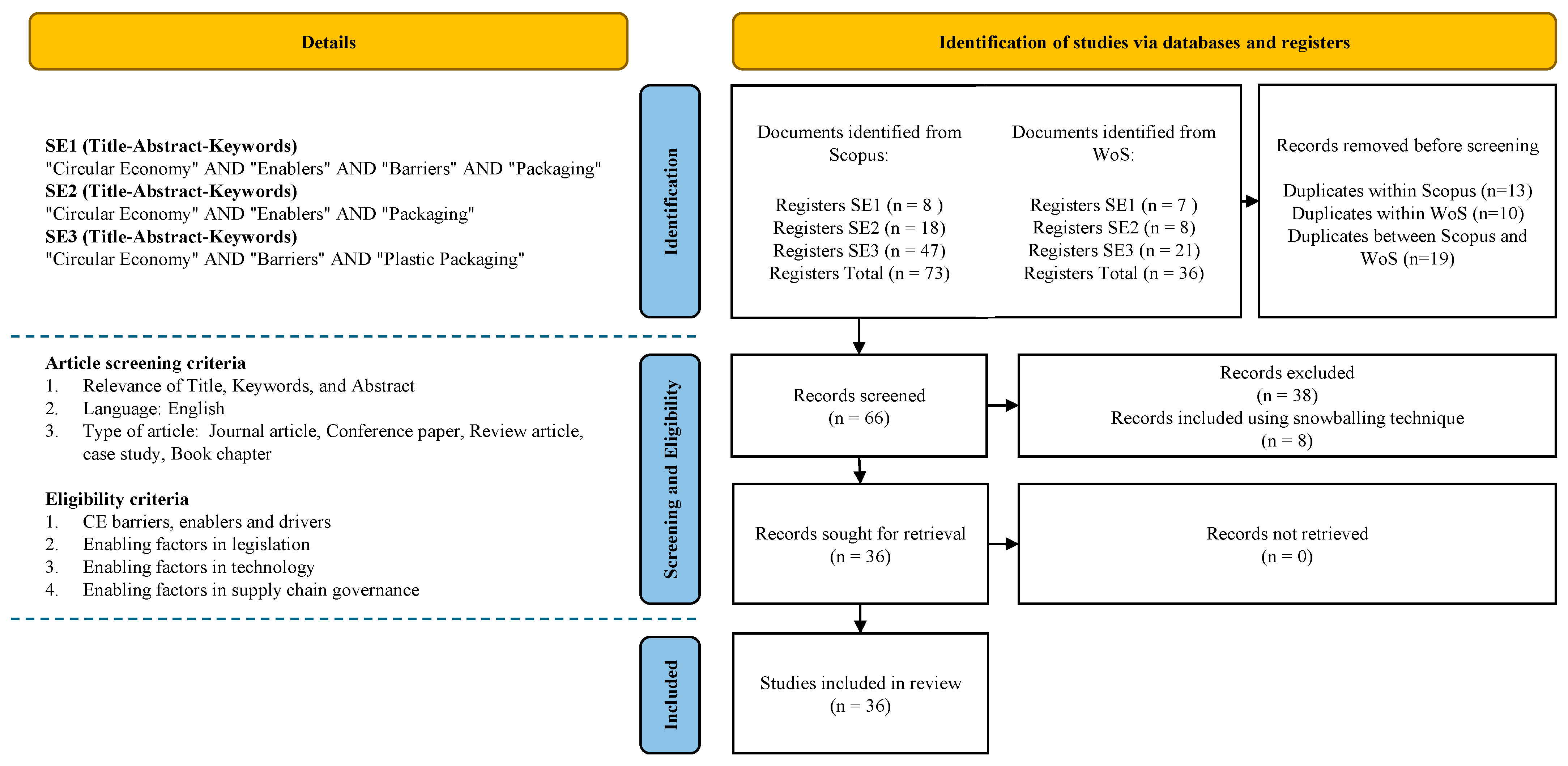
2.2. Systematic Literature Review (PRISMA)
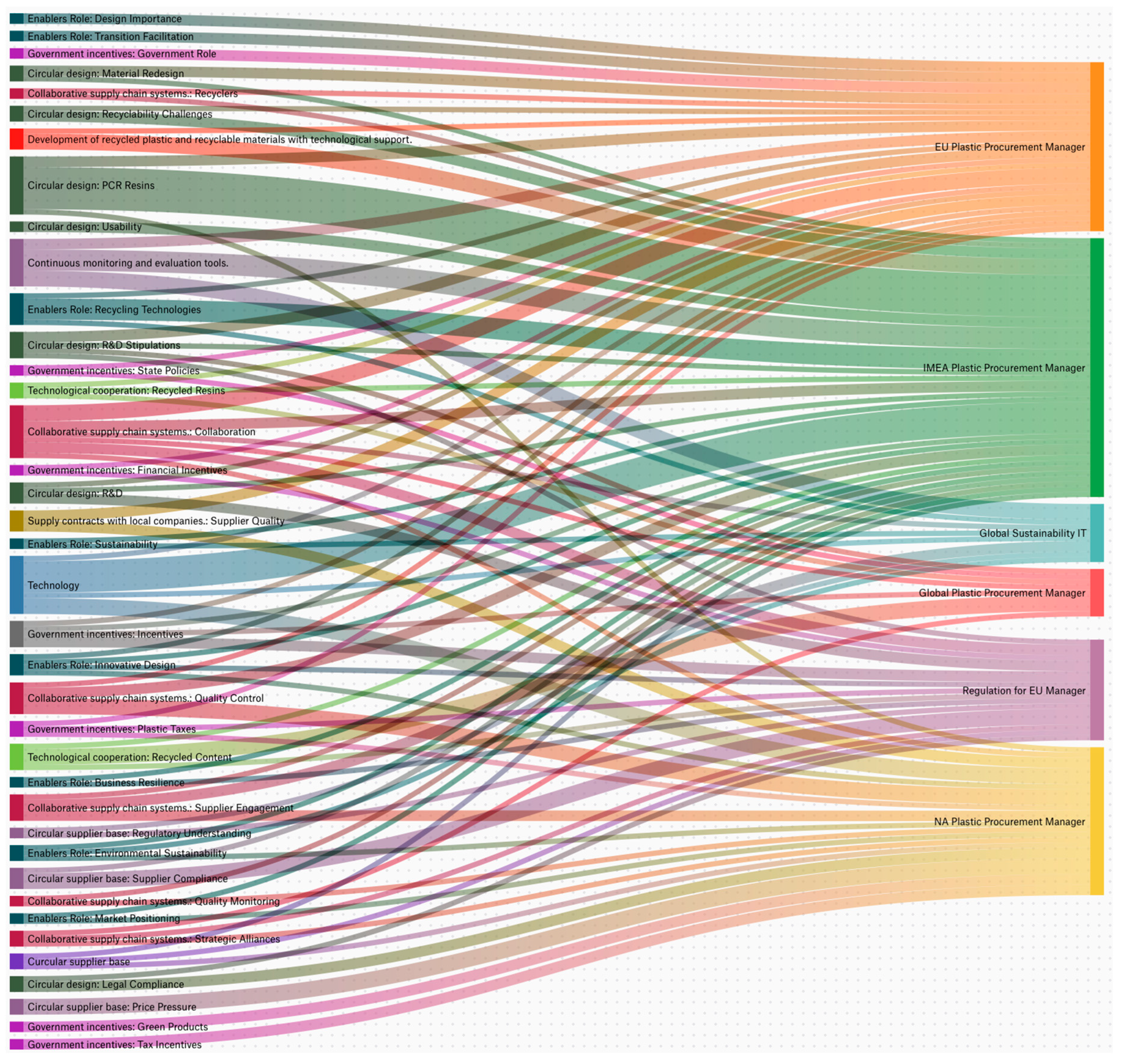
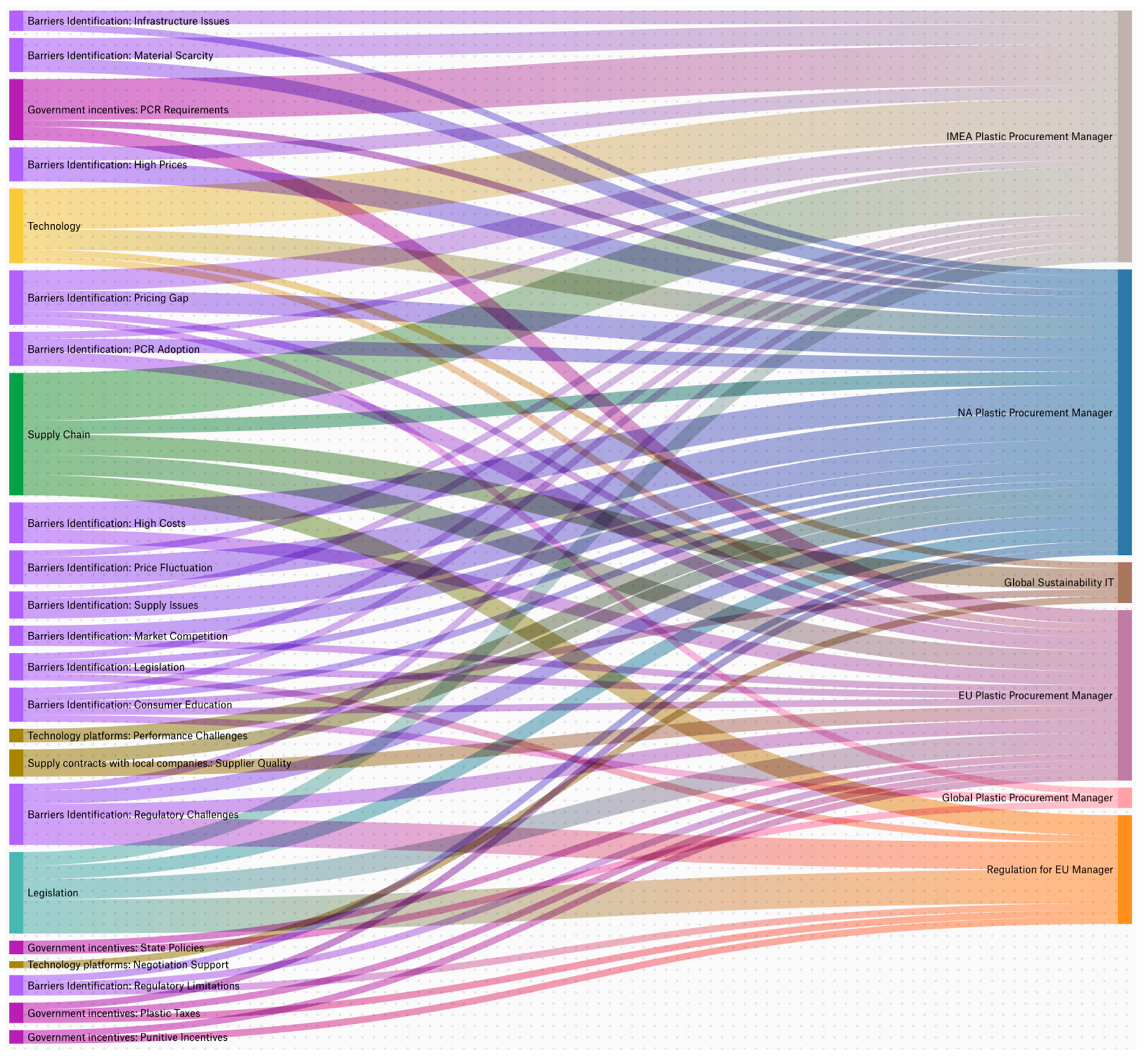
2.3. Semi-Structured Interviews and Data Coding
2.4. Data Triangulation
- Regulatory enablers are effective only when temporally synchronized with technological and infrastructural capacities.
- Technological innovations require supportive supply chain collaboration to scale effectively.
- Integrated governance mechanisms that align enablers across domains generate more sustainable outcomes than isolated interventions.
3. Barriers and Enablers for the CE in Plastic Packaging
3.1. Barriers to CE in Plastic Packaging
3.2. Enablers of CE in Plastic Packaging
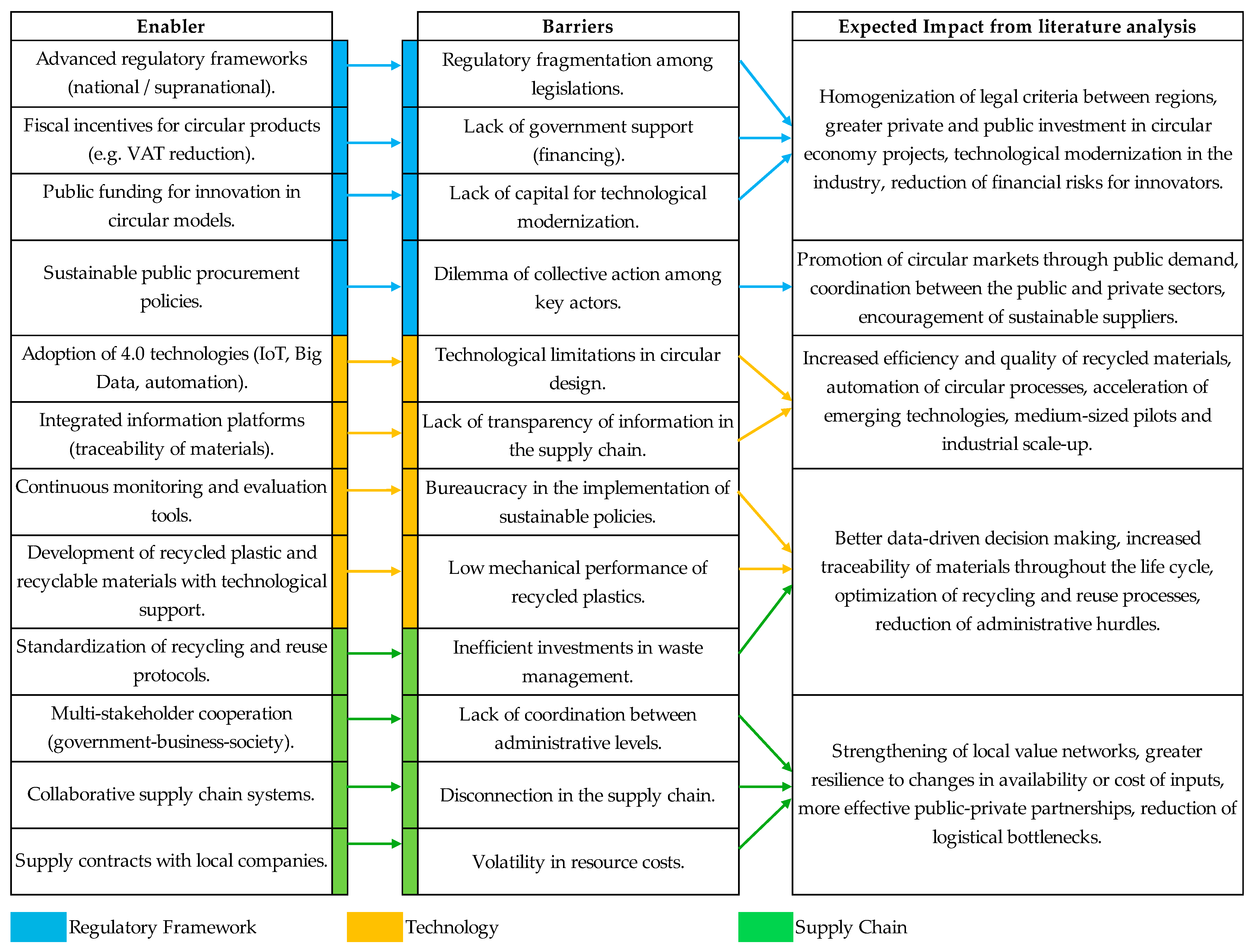
3.3. Interaction Between Barriers and Enablers
4. Case-Based Findings
4.1. Regulatory Dynamics
4.2. Technological Dynamics
4.3. Supply Chain Dynamics
4.4. Persistent Barriers
5. Discussion
6. Conclusions
Author Contributions
Funding
Institutional Review Board Statement
Informed Consent Statement
Data Availability Statement
Conflicts of Interest
Abbreviations
| AI | Artificial Intelligence |
| CE | Circular Economy |
| EMF | Ellen MacArthur Foundation |
| EPR | Extended Producer Responsibility |
| EU | European Union |
| IoT | Internet of Things |
| PCR | Post-consumer Recycled Material |
| PET | Polyethylene Terephthalate |
| PRISMA | Preferred Reporting Items for Systematic Reviews and Meta-Analyses |
| WBCSD | World Business Council for Sustainable Development |
Appendix A

| Category | Variable | Enabler | Barrier | Expected Impact | Questions | Intention of the Question |
|---|---|---|---|---|---|---|
| Regulatory framework | Divergent regulatory frameworks | Advanced regulatory frameworks (national/supranational). | Regulatory fragmentation among legislations. | Homogenization of legal criteria between regions, greater private and public investment in CE projects, technological modernization in the industry, and reduction in financial risks for innovators. | In what concrete ways does executive leadership support implementing circular criteria manifest itself, and how does this impact on their ability to overcome local or global regulatory barriers? | Identify internal governance mechanisms and their alignment with external regulatory frameworks. |
| Government incentives | Fiscal incentives for circular products (e.g., VAT reduction). | Lack of government support (financing). | What public policies and public incentives (e.g., REPs, virgin plastic taxes) have been key to accelerating your circularity goals, and how could they be improved to be more effective, and which of these public policies are geared towards technological transformation? | Detect opportunities for regulatory advocacy and public–private collaboration. | ||
| Public funding for innovation in circular models. | Lack of capital for technological modernization. | |||||
| Procurement policies | Sustainable public procurement policies. | Dilemma of collective action among key actors. | Promotion of circular markets through public demand, coordination between the public and private sectors, encouragement of sustainable suppliers. | What tools or methodologies do you use to assess the circular performance of suppliers in environments with divergent regulations (e.g., EU vs. APAC), and how do you adapt your criteria? | Explore strategies to harmonize standards in global chains. | |
| Technology | Circular design | Adoption of 4.0 technologies (IoT, Big Data, automation). | Technological limitations in circular design. | Increased efficiency and quality of recycled materials, automation of circular processes, acceleration of emerging technologies, medium- sized pilots and industrial scale- up. | How are you integrating 4.0 technologies, such as IoT for material traceability, Big Data to optimize resource use and automation in key processes, into the circular design of your plastic packaging? What specific technical constraints (e.g., material compatibility, lack of standards for recyclability) have hindered the implementation of these systems to ensure 100% circular and scalable designs? | Map technology adoption and implementation gaps. |
| Technology platforms | Integrated information platforms (traceability of materials). | Lack of transparency of information in the supply chain. | What platforms with specific metrics (e.g., % recycled content, reuse rate) do you use to demonstrate the value of circular purchasing to customers and investors, and how do you communicate them? | Identify persuasive technologies and KPIs to gain internal/external support. | ||
| Continuous monitoring and evaluation tools. | Bureaucracy in the implementation of sustainable policies. | Better data-driven decision making, increased traceability of materials throughout the life cycle, optimization of recycling and reuse processes, reduction in administrative hurdles. | ||||
| Technological cooperation | Development of recycled plastic and recyclable materials with technological support. | Low mechanical performance of recycled plastics. | What incentives and technical support do you offer suppliers to adopt recyclable materials or circular processes to ensure more efficient waste management and how do you measure their impact on the value chain? | Identify models of technological cooperation with suppliers. | ||
| Supply Chain | Standardization of recycling and reuse protocols. | Inefficient investments in waste management. | ||||
| Collaboration models and systems | Multi-stakeholder cooperation (government- business-society). | Lack of coordination between administrative levels. | Strengthening of local value networks, greater resilience to changes in availability or cost of inputs, more effective public- private partnerships, and reduction in logistical bottlenecks. | What strategic alliances (e.g., consortia, long-term contracts) have you established with suppliers or recyclers to ensure stable flows of recycled materials, and what challenges remain? | Analyze successful collaboration models and residual obstacles. | |
| Collaborative supply chain systems. | Disconnection in the supply chain. | |||||
| Circular supplier base | Supply contracts with local companies. | Volatility in resource costs. | How do you address the limited supply of suppliers with circular criteria? Have you developed training or incentive programs to transform traditional suppliers? | Explore strategies to scale the circular supplier base. |
Appendix B
Semi-Structured Interview Guide
“The circular economy is a system where materials never become waste and nature is regenerated. In a circular economy, products and materials are kept in circulation through processes like maintenance, reuse, refurbishment, remanufacture, recycling, and composting. The circular economy tackles climate change and other global challenges, like biodiversity loss, waste, and pollution, by decoupling economic activity from the consumption of finite resources.”–Ellen McArthur Foundation.
- Opening Questions
- Can you briefly describe your role at the multinational company and explain how it relates to the company’s circular economic initiatives?
- What does circularity mean for the company, and how is it integrated into its strategy?
- How would you describe the main internal and external drivers pushing the company toward circular packaging?
- Thematic Areas and Questions
- In what ways do various global regulations hinder the organization from achieving its circular goals? What internal governance mechanisms does the organization have in place to align with different regulatory frameworks?
- Which public policies and incentives (e.g., extended producer responsibility (EPR) and virgin plastic taxes) have been key to accelerating your circularity goals, and how could they be improved for greater effectiveness? Which of these policies aim to transform technology?
- What tools or methodologies do you use to assess the circular performance of suppliers in regions with different regulations (e.g., the EU versus APAC), and how do you adapt your criteria?
- How are you integrating Industry 4.0 technologies, such as the Internet of Things (IoT) for material traceability, big data to optimize resource use, and automation in key processes, into the circular design of your plastic packaging?
- What specific technical limitations (e.g., material compatibility, lack of recyclability standards) have hindered the implementation of these systems to ensure 100% circular and scalable designs?
- What platforms with concrete metrics (e.g., percentage of recycled content, reuse rate) do you use to demonstrate the value of circular purchases to clients and investors, and how do you communicate these metrics?
- What incentives and technical support do you offer suppliers to encourage the adoption of recyclable materials and circular processes for more efficient waste management? How do you measure their impact on the value chain? How do you address the limited number of suppliers that meet circular criteria? Have you developed training programs or incentives to encourage traditional suppliers to adopt circular practices?
- What strategic partnerships have you established with suppliers or recyclers to ensure a stable flow of recycled materials? For example, have you formed consortia or long-term contracts? What challenges persist?
- End-of-Interview Questions
- In your opinion, what has been the most impactful enabler or initiative in advancing circular packaging at the multinational company?
- Is there anything else you think is important for understanding the company’s journey toward circular packaging that we haven’t discussed?
References
- WBCSD. Vision 2050: Time to Tansform; The World Business Council For Sustainable Development: Geneva, Switzerland, 2021. [Google Scholar]
- WEF. The Global Risks Report 2023, 18th ed.; Insight Report; The World Economic Forum: Geneva, Switzerland, 2023. [Google Scholar]
- MahmoumGonbadi, A.; Genovese, A.; Sgalambro, A. Closed-loop supply chain design for the transition towards a circular economy: A systematic literature review of methods, applications and current gaps. J. Clean. Prod. 2021, 323, 129101. [Google Scholar] [CrossRef]
- Victoria, F.; Ananthanarayanan, A.; Brandon, A.; Baechler, B.; Cecchini, E.; Baziuk, J.; Hegdahl, R.; Mallos, N. An opportunity to end plastic pollution: A global international legally binding instrument. Perspectives 2023, 44, 1–11. [Google Scholar]
- Di Foggia, G.; Beccarello, M. An overview of packaging waste models in some european countries. Recycling 2022, 7, 38. [Google Scholar] [CrossRef]
- Fogt Jacobsen, L.; Pedersen, S.; Thøgersen, J. Drivers of and barriers to consumers’ plastic packaging waste avoidance and recycling—A systematic literature review. Waste Manag. 2022, 141, 63–78. [Google Scholar] [CrossRef] [PubMed]
- Statista FMCG Company Plastic Packaging Volumes. Available online: https://www.statista.com/statistics/1167204/volume-plastic-packaging-used-select-companies-globally/ (accessed on 12 June 2025).
- Farooque, M.; Zhang, A.; Liu, Y.; Hartley, J.L. Circular supply chain management: Performance outcomes and the role of eco-industrial parks in China. Transp. Res. Part E Logist. Transp. Rev. 2022, 157, 102596. [Google Scholar] [CrossRef]
- Jambeck, J.R.; Geyer, R.; Wilcox, C.; Siegler, T.R.; Perryman, M.; Andrady, A.; Narayan, R.; Law, K.L. Plastic waste inputs from land into the ocean. Science 2015, 347, 768–771. [Google Scholar] [CrossRef]
- Betts, K.; Gutierrez-Franco, E.; Ponce-Cueto, E. Key metrics to measure the performance and impact of reusable packaging in circular supply chains. Front. Sustain. 2022, 3, 910215. [Google Scholar] [CrossRef]
- EMF. The Rise of Single-Use Plastic Packaging Avoiders. Available online: https://www.ellenmacarthurfoundation.org/articles/the-rise-of-single-use-plastic-packaging-avoiders (accessed on 18 March 2025).
- Allison, A.L.; Lorencatto, F.; Michie, S.; Miodownik, M. Barriers and enablers to buying biodegradable and compostable plastic packaging. Sustainability 2021, 13, 1463. [Google Scholar] [CrossRef]
- Xanthos, D.; Walker, T.R. International policies to reduce plastic marine pollution from single-use plastics (plastic bags and microbeads): A review. Mar. Pollut. Bull. 2017, 118, 17–26. [Google Scholar] [CrossRef]
- European Comission European Comission—Plastics. Available online: https://environment.ec.europa.eu/topics/plastics_en (accessed on 23 May 2025).
- European Parliament Regulation (EU) 2025/40 of the European Parliament and of the Council of 19 December 2024 on Packaging and Packaging Waste. 2024. Volume 40. Available online: https://eur-lex.europa.eu/eli/reg/2025/40/oj/eng (accessed on 18 March 2025).
- WBCSD. Circular Economy and Environmental Priorities for Business; The World Business Council For Sustainable Development: Geneva, Switzerland, 2017. [Google Scholar]
- WBCSD. Circular Transition Indicators V4.0: Metrics for Business, by Business; The World Business Council For Sustainable Development: Geneva, Switzerland, 2023. [Google Scholar]
- EMF. The Business Opportunity of a Circular Economy; Springer: Singapore, 2020; ISBN 978-981158510-4/978-981158509-8. [Google Scholar]
- EMF. Circulytics: Weighting and Scoring Approach; The World Economic Forum: Geneva, Switzerland, 2022. [Google Scholar]
- Howard, M.; Yan, X.; Mustafee, N.; Charnley, F.; Böhm, S.; Pascucci, S. Going beyond waste reduction: Exploring tools and methods for circular economy adoption in small-medium enterprises. Resour. Conserv. Recycl. 2022, 182, 106345. [Google Scholar] [CrossRef]
- Schulz-Mönninghoff, M.; Neidhardt, M.; Niero, M. What is the contribution of different business processes to material circularity at company-level? A case study for electric vehicle batteries. J. Clean. Prod. 2023, 382, 135232. [Google Scholar] [CrossRef]
- Primadasa, R.; Tauhida, D.; Christata, B.R.; Rozaq, I.A.; Alfarisi, S.; Masudin, I. An investigation of the interrelationship among circular supply chain management indicators in small and medium enterprises. Supply Chain Anal. 2024, 7, 100068. [Google Scholar] [CrossRef]
- Carissimi, M.C.; Creazza, A.; Pisa, M.F.; Urbinati, A. Circular economy practices enabling circular supply chains: An empirical analysis of 100 SMEs in Italy. Resour. Conserv. Recycl. 2023, 198, 107126. [Google Scholar] [CrossRef]
- da Costa Fernandes, S.; Rozenfeld, H. Business model innovation through the design of circular product-service system value propositions: A method proposal. Bus. Strateg. Environ. 2024, 33, 5325–5345. [Google Scholar] [CrossRef]
- Eurostat Persons Employed in Circular Economy Sectors. Available online: https://ec.europa.eu/eurostat/databrowser/view/cei_cie011/default/table?lang=en (accessed on 20 April 2025).
- WWF. What is the Circular Economy of Plastic? Available online: https://www.wwf.org.co/?375812/En-que-consiste-la-economia-circular-del-plastico (accessed on 9 May 2025).
- EMF. Towards the Circular Economy Vol. 3: Accelerating the Scale-Up Across Global Supply Chains; The World Economic Forum: Geneva, Switzerland, 2014. [Google Scholar]
- Dev, N.K.; Shankar, R.; Qaiser, F.H. Industry 4.0 and circular economy: Operational excellence for sustainable reverse supply chain performance. Resour. Conserv. Recycl. 2020, 153, 104583. [Google Scholar] [CrossRef]
- Taddei, E.; Sassanelli, C.; Rosa, P.; Terzi, S. Circular supply chains theoretical gaps and practical barriers: A model to support approaching firms in the era of industry 4.0. Comput. Ind. Eng. 2024, 190, 110049. [Google Scholar] [CrossRef]
- Taddei, E.; Sassanelli, C.; Rosa, P.; Terzi, S. Circular supply chains in the era of industry 4.0: A systematic literature review. Comput. Ind. Eng. 2022, 170, 108268. [Google Scholar] [CrossRef]
- Paletta, A.; Leal Filho, W.; Balogun, A.L.; Foschi, E.; Bonoli, A. Barriers and challenges to plastics valorisation in the context of a circular economy: Case studies from Italy. J. Clean. Prod. 2019, 241, 118149. [Google Scholar] [CrossRef]
- Mura, M.; Longo, M.; Zanni, S. Circular economy in Italian SMEs: A multi-method study. J. Clean. Prod. 2020, 245, 118821. [Google Scholar] [CrossRef]
- Kirchherr, J.; Piscicelli, L.; Bour, R.; Kostense-Smit, E.; Muller, J.; Huibrechtse-Truijens, A.; Hekkert, M. Barriers to the circular economy: Evidence from the European Union (EU). Ecol. Econ. 2018, 150, 264–272. [Google Scholar] [CrossRef]
- Maione, C.; Lapko, Y.; Trucco, P. Towards a circular economy for the plastic packaging sector: Insights from the Italian case. Sustain. Prod. Consum. 2022, 34, 78–89. [Google Scholar] [CrossRef]
- Rizos, V.; Behrens, A.; van der Gaast, W.; Hofman, E.; Ioannou, A.; Kafyeke, T.; Flamos, A.; Rinaldi, R.; Papadelis, S.; Hirschnitz-Garbers, M.; et al. Implementation of circular economy business models by small and medium-sized enterprises (SMEs): Barriers and enablers. Sustainability 2016, 8, 1212. [Google Scholar] [CrossRef]
- de Jesus, A.; Mendonça, S. Lost in transition? Drivers and barriers in the eco-innovation road to the circular economy. Ecol. Econ. 2018, 145, 75–89. [Google Scholar] [CrossRef]
- Del Vecchio, P.D.; Urbinati, A.; Kirchherr, J. Enablers of managerial practices for circular business model design: An empirical investigation of an agro-energy company in a rural area. IEEE Trans. Eng. Manag. 2024, 71, 873–887. [Google Scholar] [CrossRef]
- Kirchherr, J.; Reike, D.; Hekkert, M. Conceptualizing the circular economy: An analysis of 114 definitions. Resour. Conserv. Recycl. 2017, 127, 221–232. [Google Scholar] [CrossRef]
- Bressanelli, G.; Adrodegari, F.; Perona, M.; Saccani, N. The role of digital technologies to overcome Circular Economy challenges in PSS Business Models: An exploratory case study. Procedia CIRP 2018, 73, 216–221. [Google Scholar] [CrossRef]
- Cimpan, C.; Iacovidou, E.; Rigamonti, L.; Thoden van Velzen, E.U. Keep circularity meaningful, inclusive and practical: A view into the plastics value chain. Waste Manag. 2023, 166, 115–121. [Google Scholar] [CrossRef]
- Bułkowska, K.; Zielinska, M.; Bułkowski, M. Blockchain-Based Management of Recyclable Plastic Waste. Energies 2024, 17, 2937. [Google Scholar] [CrossRef]
- Ogutu, M.O.; Akor, J.; Mulindwa, M.S.; Heshima, O.; Nsengimana, C. Implementing circular economy and sustainability policies in Rwanda: Experiences of Rwandan manufacturers with the plastic ban policy. Front. Sustain. 2023, 4, 1092107. [Google Scholar] [CrossRef]
- Alshemari, A.; Breen, L.; Quinn, G.; Sivarajah, U. Towards a Sustainable solution: The barriers and enablers in adopting circular economy principles for medicines waste management in UK and Kuwaiti hospitals. Circ. Econ. Sustain. 2025, 5, 2495–2525. [Google Scholar] [CrossRef]
- Weinrich, R.; Mielinger, E.; Krauter, V.; Arranz, E.; Camara Hurtado, R.M.; Marcos, B.; Poças, F.; de Maya, S.R.; Herbes, C. Decision-making processes on sustainable packaging options in the European food sector. J. Clean. Prod. 2024, 434, 139918. [Google Scholar] [CrossRef]
- Mulindwa, M.S.; Akor, J.; Auta, M.; Nijman-Ross, E.; Ogutu, M.O. Assessing the circularity status of waste management among manufacturing, waste management, and recycling companies in Kigali, Rwanda. Front. Sustain. 2023, 4, 1215554. [Google Scholar] [CrossRef]
- Venugopal, E.; Patil, S.J.; Naidu, S.B.K. Textile waste: Management, sustainability and recycling technologies. In Solid Waste Management: A Roadmap for Sustainable Environmental Practices and Circular Economy; Springer Nature: Berlin/Heidelberg, Germany; Department of Biotechnology, Kongunadu Arts and Science College: Coimbatore, Tamil Nadu, India, 2025; pp. 237–261. ISBN 978-303178420-0/978-303178419-4. [Google Scholar]
- Beccarello, M.; Di Foggia, G. Economic analysis of EU strengthened packaging waste recycling targets. J. Adv. Res. Law Econ. 2016, 7, 1930–1941. [Google Scholar]
- Turunen, T.; Mateo, E.R.; Alaranta, J. Regulatory catalysts for the circular economy. In The Routledge Handbook of Catalysts for a Sustainable Circular Economy; Lehtimäki, H., Aarikka-Stenroos, L., Ari Jokinen, P.J., Eds.; Taylor and Francis: Abington, UK, 2023; pp. 169–186. ISBN 978-100097141-5/978-103221244-9. [Google Scholar]
- AlJaber, A.; Martinez-Vazquez, P.; Baniotopoulos, C. Barriers and enablers to the adoption of circular economy concept in the building sector: A systematic literature review. Buildings 2023, 13, 2778. [Google Scholar] [CrossRef]
- WEF. Gen Z Cares About Sustainability More Than Anyone Else—And Is Starting to Make Others Feel the Same Way. Available online: https://www.weforum.org/stories/2022/03/generation-z-sustainability-lifestyle-buying-decisions/ (accessed on 23 April 2025).
- De Waal, I.M. The legal transition towards a more circular plastic packaging chain: A case study of the Netherlands. Eur. Energy Environ. Law Rev. 2023, 32, 226–247. [Google Scholar] [CrossRef]
- Yin, R.K. Case Study Research, 5th ed.; SAGE Publications: Los Angeles, CA, USA, 2014. [Google Scholar]
- Hardwick, S.W. Case study approach. In International Encyclopedia of Geography; Wiley: Hoboken, NJ, USA, 2017; pp. 1–6. ISBN 9781118786352. [Google Scholar]
- Mishra, J.L.; Chiwenga, K.D.; Ali, K. Collaboration as an enabler for circular economy: A case study of a developing country. Manag. Decis. 2019, 59, 1784–1800. [Google Scholar] [CrossRef]
- Page, M.J.; Mckenzie, J.E.; Bossuyt, P.M.; Boutron, I.; Hoffmann, C.; Mulrow, C.D.; Shamseer, L.; Tetzlaff, J.M.; Akl, E.A.; Brennan, S.E.; et al. The PRISMA 2020 statement: An updated guideline for reporting systematic reviews Systematic reviews and Meta-Analyses. BMJ 2021, 372, n71. [Google Scholar] [CrossRef]
- Woolley, E.; Nahar, S.; Simeone, A.; Lee, K.; Wilson, G.T. A circular economy for reusable plastic packaging: Digital assessment for cleaning assurance. Procedia CIRP 2024, 122, 348–353. [Google Scholar] [CrossRef]
- Mariotti, N.; Ascione, G.S.; Cottafava, D.; Cuomo, F. Critical barriers for plastic recycling. A cc case-study in turin. Procedia Environ. Sci. Eng. Manag. 2019, 6, 169–180. [Google Scholar]
- Rumetshofer, T.; Fischer, J. Enhancement in post-consumer mechanical recycling of plastics: Role of design for recycling, specifications, and efficient sorting of packaging material. Polymers 2025, 17, 1177. [Google Scholar] [CrossRef]
- Pfoser, S.; Herman, K.; Massimiani, A.; Brandtner, P.; Schauer, O. From linear to circular packaging: Enablers and challenges in the fashion industry. In Proceedings of the 8th International Conference LDIC, Bremen, Germany, 23–25 February 2022; Springer: Berlin/Heidelberg, Germany, 2022; pp. 435–445. [Google Scholar] [CrossRef]
- Rumetshofer, T.; Straka, K.; Fischer, J. How the digital product passport can lead the plastics industry towards a circular economy—A case study from bottle caps to frisbees. Polymers 2024, 16, 1420. [Google Scholar] [CrossRef]
- Sträter, K.F.; Rhein, S. Plastic packaging: Are German retailers on the way towards a circular economy? Companies’ strategies and perspectives on consumers. GAIA-Ecol. Perspect. Sci. Soc. 2023, 32, 241–248. [Google Scholar] [CrossRef]
- Gasde, J.; Woidasky, J.; Moesslein, J.; Lang-Koetz, C. Plastics recycling with tracer-based-sorting: Challenges of a potential radical technology. Sustainability 2021, 13, 258. [Google Scholar] [CrossRef]
- Seier, M.; Archodoulaki, V.-M.; Koch, T.; Duscher, B.; Gahleitner, M. Prospects for recyclable multilayer packaging: A case study. Polymers 2023, 15, 2966. [Google Scholar] [CrossRef] [PubMed]
- Soares, C.T.D.M.; Ek, M.; Östmark, E.; Gällstedt, M.; Karlsson, S. Recycling of multi-material multilayer plastic packaging: Current trends and future scenarios. Resour. Conserv. Recycl. 2022, 176, 105905. [Google Scholar] [CrossRef]
- Franz, R.; Welle, F. Recycling of post-consumer packaging materials into new food packaging applications—Critical review of the european approach and future perspectives. Sustainability 2022, 14, 824. [Google Scholar] [CrossRef]
- Antonopoulos, I.; Faraca, G.; Tonini, D. Recycling of post-consumer plastic packaging waste in EU: Process efficiencies, material flows, and barriers. Waste Manag. 2021, 126, 694–705. [Google Scholar] [CrossRef]
- Farrell, R.; Cortese, Y.J.; Devine, D.M.; Gately, N.; Rueda, M.; Rodriguez, L.; Pezzoli, R. The function and properties of common food packaging materials and their suitability for reusable packaging: The transition from a linear to circular economy. Curr. Res. Green Sustain. Chem. 2024, 9, 100429. [Google Scholar] [CrossRef]
- Horn, S.; Silvennoinen, K. Traceability as an enabler of circular economy in the plastics packaging value chain. Circ. Econ. Sustain. 2025. [Google Scholar] [CrossRef]
- Poças, F.; do Céu Selbourne, M. Drivers, advances, and significance of measures for effective circular food packaging. Front. Sustain. Food Syst. 2023, 7, 1140295. [Google Scholar] [CrossRef]
- Nielsen, I.B.; Hakala, H. External enablers for the circular economy: A case study of the food packaging industry. J. Clean. Prod. 2023, 417, 137915. [Google Scholar] [CrossRef]
- Clark, N.; Trimingham, R.; Wilson, G.T. Incorporating consumer insights into the UK food packaging supply chain in the transition to a circular economy. Sustainability 2020, 12, 6106. [Google Scholar] [CrossRef]
- Mielinger, E.; Weinrich, R. Insights into plastic food packaging waste sorting behaviour: A focus group study among consumers in Germany. Waste Manag. 2024, 178, 362–370. [Google Scholar] [CrossRef] [PubMed]
- Ndoka, E.; Alimehmeti, G.; Shulla, K.; Voigt, B.-F. Transitioning to circular business models in developing countries: A systematic literature review of barriers, enablers, and future directions. Discov. Sustain. 2025, 6, 605. [Google Scholar] [CrossRef]
- Iacovidou, E.; Hahladakis, J.N.; Purnell, P. A systems thinking approach to understanding the challenges of achieving the circular economy. Environ. Sci. Pollut. Res. 2021, 28, 24785–24806. [Google Scholar] [CrossRef] [PubMed]
- Scrioșteanu, A.; Criveanu, M.M. Green and reserve logistics of packaging and plastic packaging waste under the conditions of circular economy at the level of the European Union member states. Energies 2024, 17, 3015. [Google Scholar] [CrossRef]
- Zepa, I.; Grudde, V.Z.; Bening, C.R. Legitimising technologies for a circular economy: Contested discourses on innovation for plastics recycling in Europe. Environ. Innov. Soc. Transit. 2025, 50, 100811. [Google Scholar] [CrossRef]
- Bressanelli, G.; Pigosso, D.C.A.; Saccani, N.; Perona, M. Enablers, levers and benefits of circular economy in the electrical and electronic equipment supply chain: A literature review. J. Clean. Prod. 2021, 298, 126819. [Google Scholar] [CrossRef]
- Cruz-Rios, F.; Grau, D.; Bilec, M. Barriers and enablers to circular building design in the US: An empirical study. J. Constr. Eng. Manag. 2021, 147, 4021117. [Google Scholar] [CrossRef]
- EMF. The New Plastics Economy: Rethinking the Future of Plastics; The World Economic Forum: Geneva, Switzerland, 2016. [Google Scholar]
- WBCSD. Circular Economy Action Plan (CEAP) 2020 Summary for Business: Implications and Next Steps; The World Business Council For Sustainable Development: Geneva, Switzerland, 2020. [Google Scholar]
- WEF. Towards the Circular Economy: Accelerating the Scale-Up Across Global Supply Chains; The World Economic Forum: Geneva, Switzerland, 2014. [Google Scholar]
- WEF. Plastics, the Circular Economy and Global Trade; The World Economic Forum: Geneva, Switzerland, 2020. [Google Scholar]
- Eurostat. Recycling Rate of Packaging Waste by Type of Packaging. Available online: https://ec.europa.eu/eurostat/databrowser/product/page/CEI_WM020 (accessed on 20 April 2025).
- Eurostat. Generation of Plastic Packaging Waste per capita. Available online: https://ec.europa.eu/eurostat/databrowser/view/cei_pc050/default/table?lang=en (accessed on 14 November 2024).
- Eurostat. Private Investment and Gross Added Value Related to Circular Economy Sectors. Available online: https://ec.europa.eu/eurostat/databrowser/product/view/cei_cie012?lang=en (accessed on 14 November 2024).
- Qu, S.Q.; Dumay, J. The qualitative research interview. Qual. Res. Account. Manag. 2011, 8, 238–264. [Google Scholar] [CrossRef]
- Miassi, Y.E.; Gélinas, N.; Dossa, K.F. Determinants of the use of circular economy strategies by stakeholders in the wood–forestry sector in Benin. Environments 2025, 12, 101. [Google Scholar] [CrossRef]
- Boon, E.K.; Gross, T.K.F.; Oppong-Boateng, R.; Karintseva, O. Circular water management solutions for optimising irrigated agricultural production in Ghana: The relevance of nanotechnology. Int. J. Environ. Sustain. Dev. 2025, 24, 115–144. [Google Scholar] [CrossRef]
- Kumarasinghe, K.A.G.G.K.; Sylva, K.K.K. Resource management in irrigation projects of Sri Lanka using principles of circular economy. In Proceedings of the 14th International Conference on Sustainable Built Environment, Kandy, Sri Lanka, 15–17 December 2023; Dissanayake, R., Mendis, P., De Silva, S., Fernando, S., Konthesingha, C., Attanayake, U., Gajanayake, P., Eds.; Springer Nature: Singapore, 2024; pp. 397–406. [Google Scholar]
- Hsieh, H.-F.; Shannon, S.E. Three approaches to qualitative content analysis. Qual. Health Res. 2005, 15, 1277–1288. [Google Scholar] [CrossRef] [PubMed]
- Naeem, M.; Ozuem, W.; Howell, K.; Ranfagni, S. A step-by-step process of thematic analysis to develop a conceptual model in qualitative research. Int. J. Qual. Methods 2023, 22, 16094069231205789. [Google Scholar] [CrossRef]
- Roy, T.; Garza-Reyes, J.A.; Kumar, V.; Kumar, A.; Agrawal, R. Redesigning traditional linear supply chains into circular supply chains–A study into its challenges. Sustain. Prod. Consum. 2022, 31, 113–126. [Google Scholar] [CrossRef]
- Nasr, N. Remanufacturing in the Circular Economy: Operations, Engineering and Logistics; Wiley: Abington, UK, 2019; ISBN 978-111966438-3. [Google Scholar]
- Mondello, A.; Salomone, R.; Mondello, G. Exploring circular economy in the cosmetic industry: Insights from a literature review. Environ. Impact Assess. Rev. 2024, 105, 107443. [Google Scholar] [CrossRef]
- EMF. Circular Economy in India: Rethinking Growth for Long-Term Prosperity; The World Economic Forum: Geneva, Switzerland, 2016. [Google Scholar]
- Veloso, V.; Santos, A.; Carvalho, A.; Barbosa-Póvoa, A. A comprehensive framework for assessing circular economy strategies in agri-food supply chains. Environ. Dev. Sustain. 2025. [Google Scholar] [CrossRef]
- European Environment Agency. Plastics, the Circular Economy and Europe′s Environment—A Priority for Action; European Environment Agency: Copenhagen, Denmark, 2020. [Google Scholar]
- Coelho, P.M.; Corona, B.; ten Klooster, R.; Worrell, E. Sustainability of reusable packaging—Current situation and trends. Resour. Conserv. Recycl. X 2020, 6, 100037. [Google Scholar] [CrossRef]
- Nikiema, J.; Asiedu, Z. A review of the cost and effectiveness of solutions to address plastic pollution. Environ. Sci. Pollut. Res. 2022, 29, 24547–24573. [Google Scholar] [CrossRef]
- Pedroso, M.F.; Tavares, V. Circular economy supporting policies and regulations: The Portuguese case. In Creating a Roadmap Towards Circularity in the Built Environment; Springer: Cham, Switzerland, 2024; Part F1844; pp. 277–290. [Google Scholar] [CrossRef]
- Farooque, M.; Zhang, A. Barriers to circular food supply chains in China. Supply Chain Manag. An Int. J. 2019, 5, 677–696. [Google Scholar] [CrossRef]
- Takacs, F.; Brunner, D.; Frankenberger, K. Barriers to a circular economy in small- and medium-sized enterprises and their integration in a sustainable strategic management framework. J. Clean. Prod. 2022, 362, 132227. [Google Scholar] [CrossRef]
- Kharayat, T.S.; Gupta, H. A multi-criteria assessment of barriers to low-carbon technology adoption for sustainable circular supply chain management: A pathway to sustainability achievement in the carbon trading era. J. Clean. Prod. 2025, 490, 144722. [Google Scholar] [CrossRef]
- Neri, A.; Negri, M.; Cagno, E.; Franzò, S.; Kumar, V.; Lampertico, T.; Bassani, C.A. The role of digital technologies in supporting the implementation of circular economy practices by industrial small and medium enterprises. Bus. Strateg. Environ. 2023, 32, 4693–4718. [Google Scholar] [CrossRef]
- Pinheiro, M.F.; Ferreira, L.M.D.F.; Azevedo, S.G.; Magalhães, V.S.M. Barriers to the circular economy in the plastics industry: A systematic literature review. In Proceedings of the FAIM, Porto, Portugal, 18–22 June 2023; Springer: Berlin/Heidelberg, Germany, 2024; pp. 850–858. [Google Scholar] [CrossRef]
- Shaikh, A.R.; Qazi, A.A.; Appolloni, A. Identification and evaluation of the contextual relationship among barriers to the circular supply chain in the Pakistani context–an interpretive structural modelling approach. Prod. Plan. Control 2024, 35, 1148–1163. [Google Scholar] [CrossRef]
- Shang, C.; Saeidi, P.; Goh, C.F. Evaluation of circular supply chains barriers in the era of Industry 4.0 transition using an extended decision-making approach. J. Enterp. Inf. Manag. 2022, 35, 1100–1128. [Google Scholar] [CrossRef]
- Ritzén, S.; Sandström, G.Ö. Barriers to the circular economy—Integration of perspectives and domains. Procedia CIRP 2017, 64, 7–12. [Google Scholar] [CrossRef]
- Domenech, T.; Bleischwitz, R.; Doranova, A.; Panayotopoulos, D.; Roman, L. Mapping industrial symbiosis development in Europe_ typologies of networks, characteristics, performance and contribution to the circular economy. Resour. Conserv. Recycl. 2019, 141, 76–98. [Google Scholar] [CrossRef]
- Ozbiltekin-Pala, M.; Koçak, A.; Kazancoglu, Y. A proposed circular-SCOR model for supply chain performance measurement in manufacturing industry during COVID-19. Int. J. Qual. Reliab. Manag. 2023, 40, 1203–1232. [Google Scholar] [CrossRef]
- Chen, W.-K.; Nalluri, V.; Hung, H.-C.; Chang, M.-C.; Lin, C.-T. Apply dematel to analyzing key barriers to implementing the circular economy: An application for the textile sector. Appl. Sci. 2021, 11, 3335. [Google Scholar] [CrossRef]
- Charnley, F.; Knecht, F.; Muenkel, H.; Pletosu, D.; Rickard, V.; Sambonet, C.; Schneider, M.; Zhang, C. Can digital technologies increase consumer acceptance of circular business models? The case of second hand fashion. Sustainability 2022, 14, 4589. [Google Scholar] [CrossRef]
- Mangla, S.K.; Luthra, S.; Mishra, N.; Singh, A.; Rana, N.P.; Dora, M.; Dwivedi, Y. Barriers to effective circular supply chain management in a developing country context. Prod. Plan. Control 2018, 29, 551–569. [Google Scholar] [CrossRef]
- Flygansvær, B.; Dahlstrom, R. Enhancing circular supply chains via ecological packaging: An empirical investigation of an extended producer responsibility network. J. Clean. Prod. 2024, 468, 142948. [Google Scholar] [CrossRef]
- Ren, Q.; Albrecht, J. Toward circular economy: The impact of policy instruments on circular economy innovation for European small medium enterprises. Ecol. Econ. 2023, 207, 107761. [Google Scholar] [CrossRef]
- Karayılan, S.; Yılmaz, Ö.; Uysal, Ç.; Naneci, S. Prospective evaluation of circular economy practices within plastic packaging value chain through optimization of life cycle impacts and circularity. Resour. Conserv. Recycl. 2021, 173, 105691. [Google Scholar] [CrossRef]
- European Parliament Directive 2008/98/EC of the European Parliament and of the Council of 19 November 2008 on Waste and Repealing Certain Directives. 2018. Available online: https://eur-lex.europa.eu/eli/dir/2008/98/oj/eng (accessed on 18 March 2025).
- Lopes, R.; Santos, R.; Videira, N.; Antunes, P. Co-creating a vision and roadmap for circular economy in the food and beverages packaging sector. Circ. Econ. Sustain. 2021, 1, 873–893. [Google Scholar] [CrossRef]
- Belhadi, A.; Kamble, S.S.; Chiappetta Jabbour, C.J.; Mani, V.; Khan, S.A.R.; Touriki, F.E. A self-assessment tool for evaluating the integration of circular economy and industry 4.0 principles in closed-loop supply chains. Int. J. Prod. Econ. 2022, 245, 108372. [Google Scholar] [CrossRef]
- Hsu, W.; Domenech, T.; Mcdowall, W. Closing the loop on plastics in Europe: The role of data, information and knowledge. Sustain. Prod. Consum. 2022, 33, 942–951. [Google Scholar] [CrossRef]
- Cheng, T.C.E.; Kamble, S.S.; Belhadi, A.; Ndubisi, N.O.; Lai, K.H.; Kharat, M.G. Linkages between big data analytics, circular economy, sustainable supply chain flexibility, and sustainable performance in manufacturing firms. Int. J. Prod. Res. 2022, 60, 6908–6922. [Google Scholar] [CrossRef]
- Sudusinghe, J.I.; Seuring, S. Supply chain collaboration and sustainability performance in circular economy: A systematic literature review. Int. J. Prod. Econ. 2022, 245, 108402. [Google Scholar] [CrossRef]
- Kazancoglu, Y.; Kazancoglu, I.; Sagnak, M. A new holistic conceptual framework for green supply chain management performance assessment based on circular economy. J. Clean. Prod. 2018, 195, 1282–1299. [Google Scholar] [CrossRef]
- Govindan, K.; Popiuc, M.N.; Diabat, A. Overview of coordination contracts within forward and reverse supply chains. J. Clean. Prod. 2013, 47, 319–334. [Google Scholar] [CrossRef]
- Zheng, B.; Wang, H.; Golmohammadi, A.-M.; Goli, A. Impacts of logistics service quality and energy service of Business to Consumer (B2C) online retailing on customer loyalty in a circular economy. Sustain. Energy Technol. Assess. 2022, 52, 102333. [Google Scholar] [CrossRef]
- Plastics Europe. The Plastics Transition; Plastics Europe: Brussels, Belgium, 2024. [Google Scholar]
- Ababio, B.K.; Lu, W. Barriers and enablers of circular economy in construction: A multi-system perspective towards the development of a practical framework. Constr. Manag. Econ. 2023, 41, 3–21. [Google Scholar] [CrossRef]
- Qazi, A.A.; Appolloni, A. A systematic review on barriers and enablers toward circular procurement management. Sustain. Prod. Consum. 2022, 33, 343–359. [Google Scholar] [CrossRef]
- Lahane, S.; Kant, R. Evaluating the barriers of circular supply chain implementation using pythagorean fuzzy DEMATEL method. In Recent Advances in Manufacturing Modelling and Optimization; Lecture Notes in Mechanical Engineering; Kumar, S., Ramkumar, J., Kyratsis, P., Eds.; Springer: Singapore, 2022. [Google Scholar]
- Munaro, M.R.; Tavares, S.F. A review on barriers, drivers, and stakeholders towards the circular economy: The construction sector perspective. Clean. Responsible Consum. 2023, 8, 100107. [Google Scholar] [CrossRef]
- Giorgi, S.; Lavagna, M.; Wang, K.; Osmani, M.; Liu, G.; Campioli, A. Drivers and barriers towards circular economy in the building sector: Stakeholder interviews and analysis of five european countries policies and practices. J. Clean. Prod. 2022, 336, 130395. [Google Scholar] [CrossRef]
- Mishra, A.; Dutta, P.; Jayasankar, S.; Jain, P.; Mathiyazhagan, K. A review of reverse logistics and closed-loop supply chains in the perspective of circular economy. Benchmarking 2023, 30, 975–1020. [Google Scholar] [CrossRef]
- Almelhem, M.; Buics, L.; Süle, E. Comparison of sustainability and circularity indicators: Downstream vs. upstream supply chain strategies. Discov. Sustain. 2025, 6, 302. [Google Scholar] [CrossRef]
- Camacho-Otero, J.; Pettersen, I.N.; Boks, C. Consumer engagement in the circular economy: Exploring clothes swapping in emerging economies from a social practice perspective. Sustain. Dev. 2020, 28, 279–293. [Google Scholar] [CrossRef]
| Database/Source | Documents | Authors |
|---|---|---|
| Scopus | 15 | [43,51,56,57,58,59,60,61,62,63,64,65,66,67,68] |
| Scopus and WoS | 10 | [6,12,32,34,37,69,70,71,72,73] |
| WoS | 3 | [74,75,76] |
| Snowballing | 8 | [5,31,33,35,42,44,77,78] |
| Institution | Main Objective | Principal Focus | Documents Consulted |
|---|---|---|---|
| Ellen MacArthur Foundation (EMF) | Promote the CE, an economic model designed to eliminate waste and pollution, keep products and materials in use, and regenerate natural systems. | Collaborate with businesses, governments, and academics to redesign production and consumption systems | [11,27,79] |
| World Business Council for Sustianable Development (WBCSD) | Accelerating the transition to a sustainable world through business leadership. | Mobilize businesses to adopt sustainable practices in areas such as climate, energy, and the CE. | [16,80] |
| World Economic Forum (WEF) | Improving the state of the world through public–private cooperation on economic, social, and environmental issues. | Promote agendas such as the Green New Deal, decarbonization, and the Fourth Industrial Revolution with sustainable criteria. | [2,81,82] |
| Eurostat | Providing reliable statistical data to support public policies in the EU. | Monitor indicators of sustainable development, the CE, CO2 emissions, and progress toward the SDGs. | [25,83,84,85] |
Disclaimer/Publisher’s Note: The statements, opinions and data contained in all publications are solely those of the individual author(s) and contributor(s) and not of MDPI and/or the editor(s). MDPI and/or the editor(s) disclaim responsibility for any injury to people or property resulting from any ideas, methods, instructions or products referred to in the content. |
© 2025 by the authors. Licensee MDPI, Basel, Switzerland. This article is an open access article distributed under the terms and conditions of the Creative Commons Attribution (CC BY) license (https://creativecommons.org/licenses/by/4.0/).
Share and Cite
Bustamante, D.; Londoño-Pineda, A.; Cano, J.A.; Weyers, S. Overcoming Barriers to Circular Economy in Plastic Packaging: Enablers and Integrated Strategies in Multinational Companies. Sustainability 2025, 17, 9757. https://doi.org/10.3390/su17219757
Bustamante D, Londoño-Pineda A, Cano JA, Weyers S. Overcoming Barriers to Circular Economy in Plastic Packaging: Enablers and Integrated Strategies in Multinational Companies. Sustainability. 2025; 17(21):9757. https://doi.org/10.3390/su17219757
Chicago/Turabian StyleBustamante, Daniela, Abraham Londoño-Pineda, Jose Alejandro Cano, and Stephan Weyers. 2025. "Overcoming Barriers to Circular Economy in Plastic Packaging: Enablers and Integrated Strategies in Multinational Companies" Sustainability 17, no. 21: 9757. https://doi.org/10.3390/su17219757
APA StyleBustamante, D., Londoño-Pineda, A., Cano, J. A., & Weyers, S. (2025). Overcoming Barriers to Circular Economy in Plastic Packaging: Enablers and Integrated Strategies in Multinational Companies. Sustainability, 17(21), 9757. https://doi.org/10.3390/su17219757

