A Review of Vacuum-Enhanced Solar Stills for Improved Desalination Performance

 ,
,  and
and
Abstract
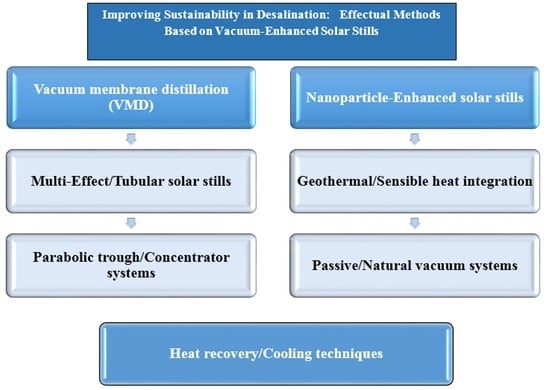
1. Introduction
2. Review Method
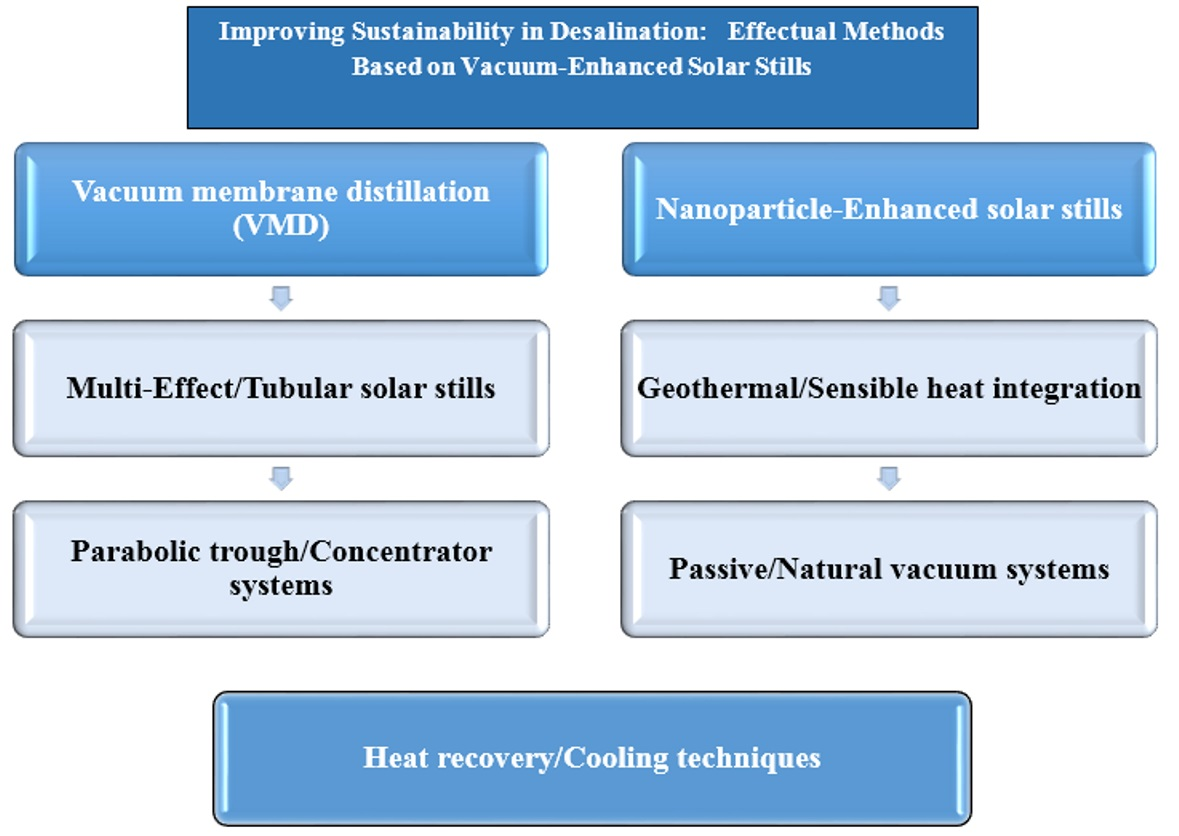
2.1. Vacuum Membrane Distillation (VMD)
2.2. Nanoparticle-Enhanced Solar Stills
2.3. Multi-Effect/Tubular Solar Stills
2.4. Geothermal/Sensible Heat Integration
2.5. Parabolic Trough/Concentrator Systems
2.6. Passive/Natural Vacuum Systems
2.7. Heat Recovery/Cooling Techniques
2.8. CFD/Modeling and Simulation
3. Comparative Study
4. Influence of Vacuum Technologies on Solar Still Performance: A Critical Analysis
5. Conclusions
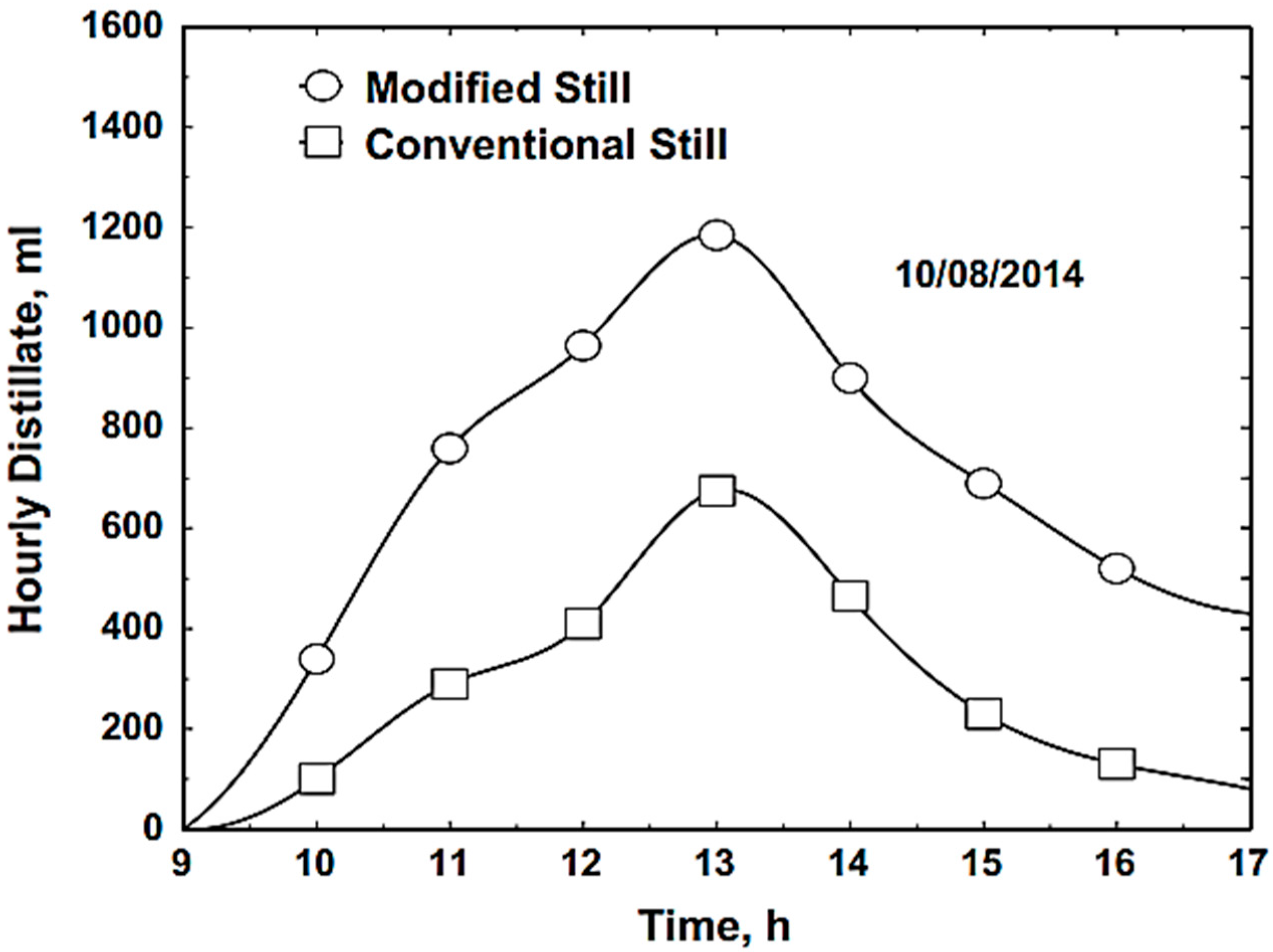
- Vacuum-assisted solar stills exhibit a 30–305% increase in the production of freshwater as per conventional systems, mainly because of the lowered boiling points and the inhibition of convective heat dissipation.
- The permeate flux of vacuum membrane distillation is 5.9–11.1 kg/m2 h, which, however, has membrane fouling and consumption control as a major obstacle.
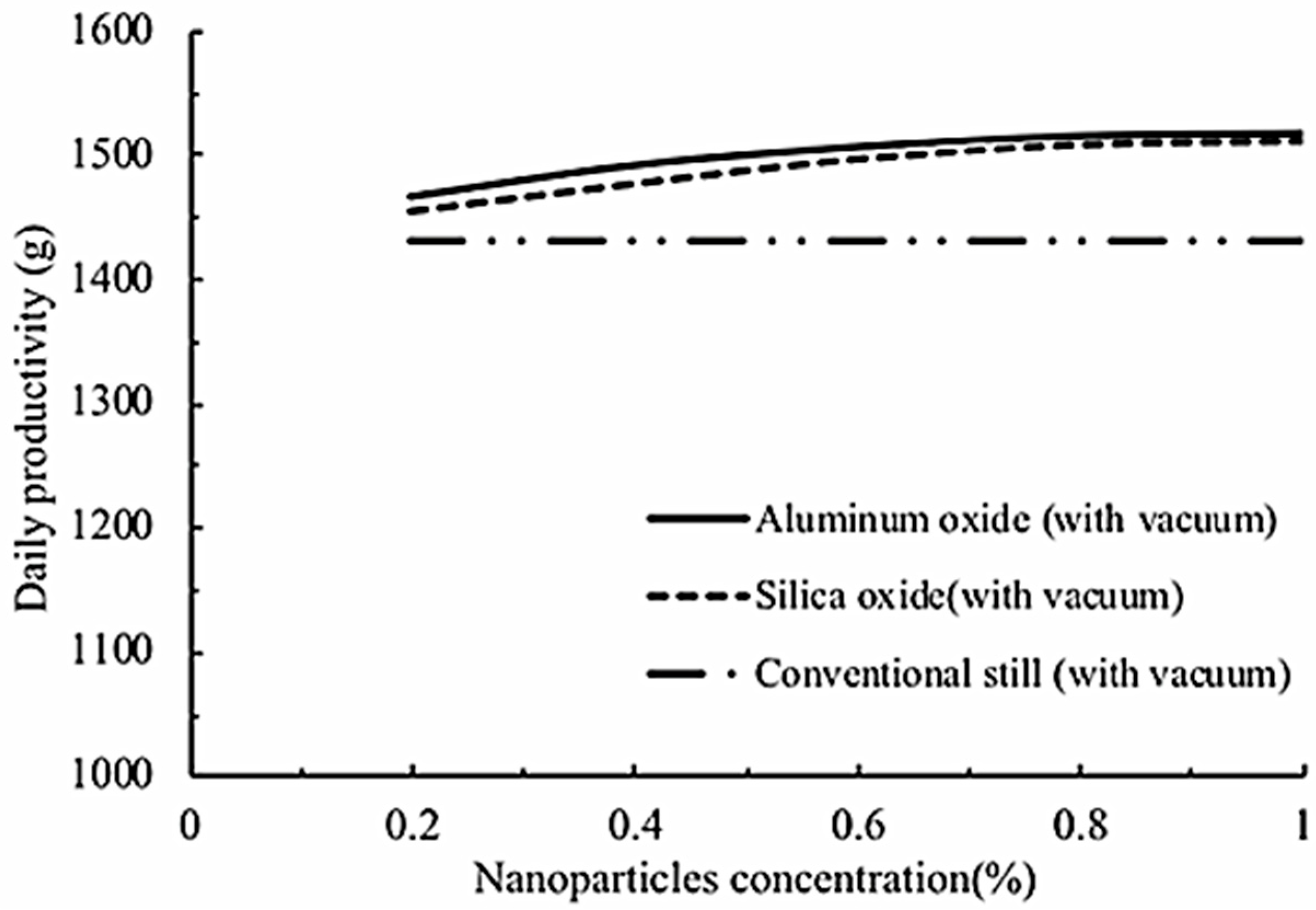
- The deposition of nanoparticles (e.g., Cu2O, Al2O3) under vacuum conditions offered a 133.6% evaporation increase, in addition to the improvement in thermal conductivity and radiative absorption.
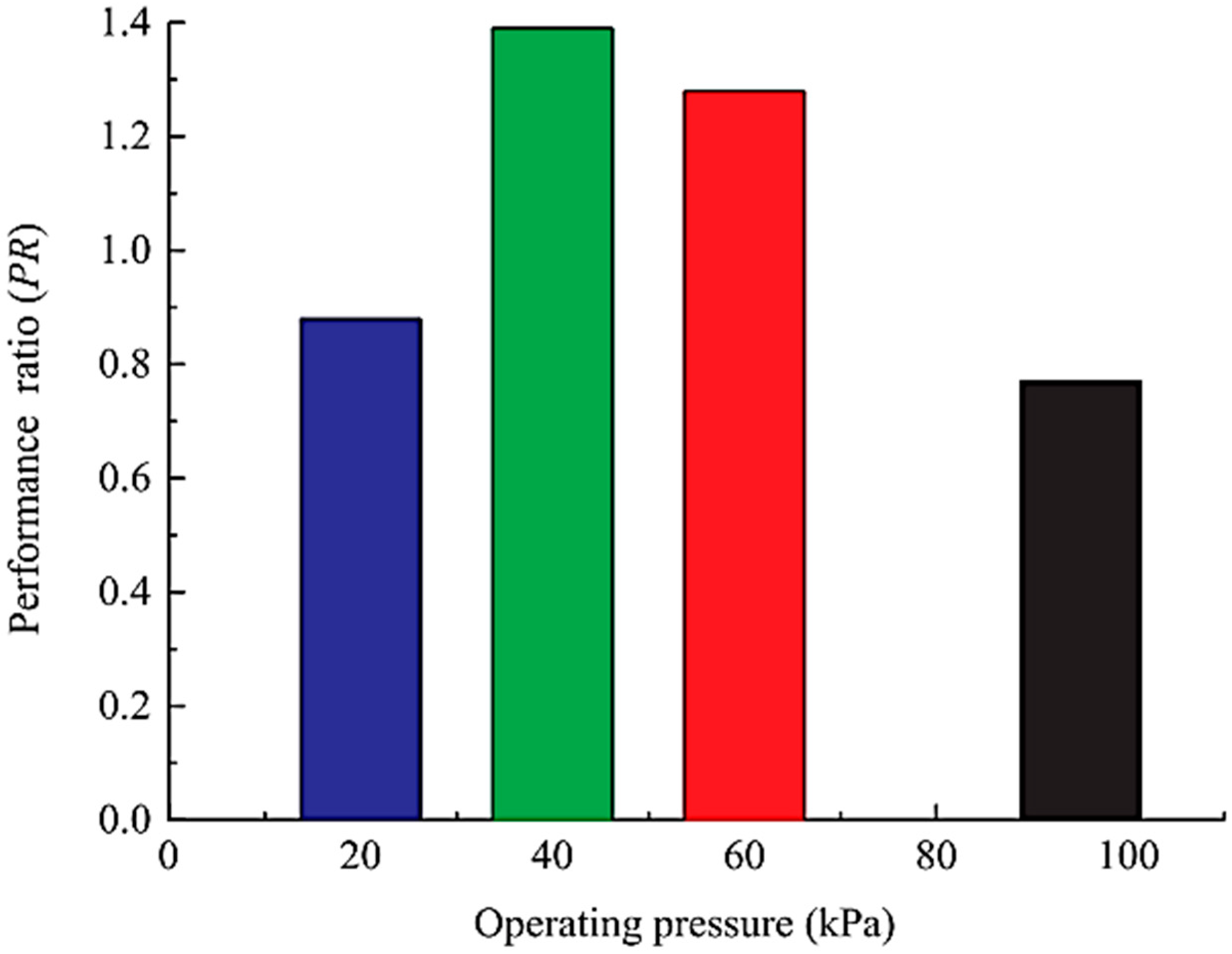
- The multi-effect vacuum solar stills of staged evaporation introduced 2-times the freshwater production of 7.15 kg/m2 at optimum pressure 40 kpa to 60 kPa.
- Referring to the geothermal-integrated vacuum stills, a 305% increase in freshwater productivity was observed since the condensation temperatures can be stabilized.
- Despite the issue of scalability, natural vacuum systems have fewer energy requirements, with a 1.46 kg/m2 h yield at a reduced water production cost of USD 0.0113/kg.
- The performance ratios (GOR = 3.24) are enhanced by internal heat exchangers and recirculation of brine and, thus, limit the waste of thermal power.
- Vapor flow simulations (CFD) under vacuum confirm flow behavior, which supports the enhancement in the design of 50% efficiency tubular stills.
- Although it improves performance, large-scale adoption is undermined by high initial costs, maintenance of membranes and durability.
6. Further Enhancements and Accompanying Challenges
- The overall energy efficiency can be upgraded by using PVT collectors to produce both power and heat.
- Geothermal cooling or wind-driven vacuum pumps coupled with vacuum solar stills can keep the still running all the time, as solar is a non-base-load energy source.
- The materials have better thermal conductivity and non-fouling capabilities that have the potential to increase the evaporation rates by 20–30% compared to conventional nanoparticles.
- Combining PCMs and vacuum insulation would allow thermal fluctuations to be stabilized, which would continue to extend productive time during non-sunlight hours.
- To achieve a better yield, the vacuum (e.g., 20–60 kPa) is dynamically controlled by AI sensors according to the sun intensity and feed water salinity.
- Predictive-based algorithms can help schedule the cleaning of membranes in advance.
- Modular, compact stills configured with common vacuum chambers have the potential to reduce costs, without sacrificing large throughput (e g., 10–15 kg/m2 d).
- Vacuum stills deployed on still water (water bodies, oceans and lakes) can use natural hydrostatic pressure to transmit the vacuum passively.
- By using the latent heat of discharged brines, efficiency gains of the resource between 15 and 25% could be achieved.
- It can be more economically viable by being integrated with sources of industrial waste heat (e.g., power plants).
- Vacuum mechanical pumps use up to 30% of the energy of the whole plant and cancel out efficiency improvements. Passive vacuum designs (e.g., hydrostatic, venturi-based) have low pressure ranges (<50 kPa).
- The main drawbacks to the vacuum membrane distillation systems include salt scaling and organic fouling that lower permeate flux to 20–40% over time. Specifically, the overall costs can be increased due to cleaning and replacement practices.
- The use of high-tech nanomaterials (e.g., graphene) and corrosive-resistant alloys expands capital costs by 30–50%. In this regard, their stability in a vacuum and at high temperatures has not been demonstrated yet.
- Multi-effect and hybrid systems involve tight control of pressure, temperatures, and flow rates; thus, a high grade of operation is required.
- Field-scale tests showed 50% to 100% yields lower than those noted in the lab because of ideal conditions. Large-scale deployments are subject to variable solar exposure and feed water.
- The levelized costs of water (USD 0.01–0.05/L) are too high compared to traditional forms of desalination (e.g., reverse osmosis at USD 0.002–0.01/L), which discourages investment.
- Discharge of brine in high-recovery processes poses a threat to the ecosystem.
- Leaching of nanoparticles into a distillate is a safety concern.
Author Contributions
Funding
Institutional Review Board Statement
Informed Consent Statement
Data Availability Statement
Acknowledgments
Conflicts of Interest
Nomenclatures
| Symbol | Definition |
| CFD | Computational Fluid Dynamics |
| CSS | conventional solar still |
| Cu2O | Cuprous Oxide |
| DCMD | Direct Contact Membrane Distillation |
| Dw | Water Depth |
| ETC | Evacuated Tube Collector |
| FPC | Flat-Plate Collector |
| GOR | Gained Output Ratio |
| Gr | Grashoff Number |
| HE | Photo-Thermal Conversion Efficiency |
| HRR | Heat Recovery Rate |
| LDAC | Liquid Desiccant Air Conditioning |
| LPM | Liters Per Minute |
| MEDS | Multiple-Effect Diffusion Solar Still |
| MFR | Membrane Flux Rate |
| MSSV | Multi-Stage Tubular Solar Still under Vacuum |
| PCM | Phase Change Material |
| PR | Performance Ratio |
| RaT | Thermal Rayleigh Number |
| REJ | Rejection Capacity |
| RR | Recovery Ratio |
| P-SVTD | Passive Solar Vacuum Tube Distiller |
| PVT | Photovoltaic-Thermal |
| SHC | Solar Heat Collection |
| SiO2 | Silicon Dioxide |
| SNVD | Solar Natural Vacuum Desalination |
| STEC | Specific Thermal Energy Consumption |
| S-VMD | Submerged Vacuum Membrane Distillation |
| TSS | Tubular Solar Still |
| Tw | Wall Temperature |
| vavg | Average Vapor Flow Velocity |
| VMD | Vacuum Membrane Distillation |
| ZnO | Zinc Oxide |
References
- Hussein, A.K.; Rashid, F.L.; Abed, A.M.; Al-Khaleel, M.; Togun, H.; Ali, B.; Akkurt, N.; Malekshah, E.H.; Biswal, U.; Al-Obaidi, M.A.; et al. Inverted solar stills: A comprehensive review of designs, mathematical models, performance, and modern combinations. Sustainability 2022, 14, 13766. [Google Scholar] [CrossRef]
- Rashid, F.L.; Al-Obaidi, M.A.; Hammoodi, K.A.; Mahdi, A.J.; Kadhim, S.A.; Chaichan, M.T.; Parveen, R.; Eisapour, M.; Kouki, M.; Nazari, S.; et al. Innovations and ongoing advancements of the wick type solar still: A review. Results Eng. 2024, 24, 103049. [Google Scholar] [CrossRef]
- Shareef, A.S.; Rashid, F.L.; Junedy, Z.R. A Review of Recent Advances in Enhancing the Performance of Solar Still Energy Systems and Guidelines for Future Prospects. Libr. Prog.-Libr. Sci. Inf. Technol. Comput. 2024, 44, 812–827. [Google Scholar]
- Khalaf, M.O.; Özdemir, M.R.; Sultan, H.S. A Comprehensive Review of Solar Still Technologies and Cost: Innovations in Materials, Design, and Techniques for Enhanced Water Desalination Efficiency. Water 2025, 17, 1515. [Google Scholar] [CrossRef]
- Rashid, F.L.; Kaood, A.; Al-Obaidi, M.A.; Mohammed, H.I.; Alsarayreh, A.A.; Al-Muhsen, N.F.; Abbas, A.S.; Zubo, R.H.; Mohammad, A.T.; Alsadaie, S.; et al. A review of the configurations, capabilities, and cutting-edge options for multistage solar stills in water desalination. Designs 2023, 7, 67. [Google Scholar] [CrossRef]
- Agrawal, A.; Rana, R.S.; Srivastava, K. Heat transfer coefficients and productivity of a single slope single basin solar still in Indian climatic condition: Experimental and theoretical comparison. Resour.-Effic. Technol. 2017, 3, 466–482. [Google Scholar] [CrossRef]
- Welepe, H.J.; Günerhan, H.; Bilir, L. Humidifying solar collector for improving the performance of direct solar desalination systems: A theoretical approach. Appl. Therm. Eng. 2022, 216, 119043. [Google Scholar] [CrossRef]
- Hussein, A.K.; Rashid, F.L.; Rasul, M.K.; Basem, A.; Younis, O.; Homod, R.Z.; Attia, M.E.H.; Al-Obaidi, M.A.; Hamida, M.B.B.; Ali, B.; et al. A review of the application of hybrid nanofluids in solar still energy systems and guidelines for future prospects. Sol. Energy 2024, 272, 112485. [Google Scholar] [CrossRef]
- Kabeel, A.E.; El-Samadony, Y.A.F.; El-Maghlany, W.M. Comparative study on the solar still performance utilizing different PCM. Desalination 2018, 432, 89–96. [Google Scholar] [CrossRef]
- Sahota, L.; Tiwari, G.N. Effect of Al2O3 nanoparticles on the performance of passive double slope solar still. Sol. Energy 2016, 130, 260–272. [Google Scholar] [CrossRef]
- Elango, T.; Kannan, A.; Murugavel, K.K. Performance study on single basin single slope solar still with different water nanofluids. Desalination 2015, 360, 45–51. [Google Scholar] [CrossRef]
- Almuhanna, E.A. Evaluation of single slop solar still integrated with evaporative cooling system for brackish water desalination. J. Agric. Sci. 2014, 6, 48. [Google Scholar] [CrossRef]
- Al-Garni, A.Z. Enhancing the solar still using immersion type water heater productivity and the effect of external cooling fan in winter. Appl. Sol. Energy 2012, 48, 193–200. [Google Scholar] [CrossRef]
- Rajamanickam, M.R.; Ragupathy, A. Influence of water depth on internal heat and mass transfer in a double slope solar still. Energy Procedia 2012, 14, 1701–1708. [Google Scholar] [CrossRef]
- Choi, S.H. Thermal type seawater desalination with barometric vacuum and solar energy. Energy 2017, 141, 1332–1349. [Google Scholar] [CrossRef]
- Bhardwaj, R.; Ten Kortenaar, M.V.; Mudde, R.F. Maximized production of water by increasing area of condensation surface for solar distillation. Appl. Energy 2015, 154, 480–490. [Google Scholar] [CrossRef]
- Kabeel, A.E.; Omara, Z.M.; Essa, F.A.; Abdullah, A.S.; Arunkumar, T.; Sathyamurthy, R. Augmentation of a solar still distillate yield via absorber plate coated with black nanoparticles. Alex. Eng. J. 2017, 56, 433–438. [Google Scholar] [CrossRef]
- Wei, M.; Zhong, C.; Liu, J.; Xu, H.; Chen, J.; Xiang, J.; Wang, K.; Zheng, H. Productivity and economy prediction for a solar-powered natural vacuum desalination system via water-filling and air-releasing in Asia. Energy Convers. Manag. 2022, 260, 115570. [Google Scholar] [CrossRef]
- Nazari, S.; Safarzadeh, H.; Bahiraei, M. Performance improvement of a single slope solar still by employing thermoelectric cooling channel and copper oxide nanofluid: An experimental study. J. Clean. Prod. 2019, 208, 1041–1052. [Google Scholar] [CrossRef]
- Abdelal, N.; Taamneh, Y. Enhancement of pyramid solar still productivity using absorber plates made of carbon fiber/CNT-modified epoxy composites. Desalination 2017, 419, 117–124. [Google Scholar] [CrossRef]
- Alam, J.; Daoud, O.A.; Shukla, A.K.; Ali, F.A.A.; Alhoshan, M. Simulation of a solar-powered reverse osmosis system integrated with vacuum membrane distillation for desalination brine treatment. Arab. J. Sci. Eng. 2023, 48, 16343–16357. [Google Scholar] [CrossRef]
- Gupta, B.; Kumar, A.; Baredar, V. Experimental investigation on modified solar still using nanoparticles and water sprinkler attachment. Front. Mater. 2017, 4, 23. [Google Scholar] [CrossRef]
- Hilo, A.; Nfawa, S.R.; Sultan, M.T.H.; Hamid, M.F.A.; Bheekhun, M.N. Heat transfer and thermal conductivity enhancement using graphene nanofluid: A review. J. Adv. Res. Fluid Mech. Therm. Sci. 2019, 55, 74–87. [Google Scholar]
- Saha, S.; Sarker, M.R.I.; Kader, M.A.; Ahmed, M.M.; Tuly, S.S.; Mustafi, N.N. Development of a vacuum double-slope solar still for enhanced freshwater productivity. Sol. Energy 2024, 270, 112385. [Google Scholar] [CrossRef]
- Rashid, A.; Ayhan, T.; Abbas, A. Natural vacuum distillation for seawater desalination—A review. Desalination Water Treat. 2016, 57, 26943–26953. [Google Scholar] [CrossRef]
- Hussein, A.A.; Jassim, N.A. Experimental investigation of solar still with separate condenser coupled. Mater. Today: Proc. 2022, 60, 1611–1622. [Google Scholar] [CrossRef]
- Kensara, M.; Dayem, A.M.A.; Nasr, A. Reverse Osmosis Desalination Plant Driven by Solar Photovoltaic System-Case Study. Int. J. Heat Technol. 2021, 39, 1153–1163. [Google Scholar] [CrossRef]
- Hidouri, K.; Togun, H.; Rashid, F.L.; Abed, A.M.; Hussein, A.K.; Ali, B.; Rout, S.; Hamida, M.B.B.; Biswal, U. Environmental studies for various simple and hybrid solar still configurations: A comprehensive review. J. Therm. Eng. 2021, 10, 1698–1714. [Google Scholar] [CrossRef]
- Rahul, P.; Ramanathan, S.; Dhivagar, R.; Karthi, P.; Manivel, M. A review on solar desalination techniques using vacuum technology. Proc. Inst. Mech. Eng. Part C J. Mech. Eng. Sci. 2023, 237, 3086–3102. [Google Scholar] [CrossRef]
- Jitsuno, T.; Hamabe, K. Vacuum distillation system aiming to use solar-heat for desalination. J. Arid Land Stud. 2012, 22, 153–155. [Google Scholar]
- Ahmed, M.S.; Mohamed, A.S.A.; Mohamed, H.A.; Abdelaal, M.R.; Abbady, H. A review of vacuum solar desalination powered by renewable energy: Recent trends. J. Clean. Prod. 2023, 428, 139244. [Google Scholar] [CrossRef]
- Mohamed, A.S.A.; Shahdy, A.G.; Mohamed, H.A.; Ahmed, M.S. A comprehensive review of the vacuum solar still systems. Renew. Sustain. Energy Rev. 2023, 184, 113572. [Google Scholar] [CrossRef]
- Gabsi, S.; Chehbouni, A. Solar vacuum membrane distillation for seawater desalination. In Proceedings of the 2013 International Renewable and Sustainable Energy Conference (IRSEC), Ouarzazate, Morocco, 7–9 March 2013; IEEE: New York City, NY, USA; pp. 182–185. [Google Scholar] [CrossRef]
- Wang, Y.; Xu, Z.; Lior, N.; Zeng, H. An experimental study of solar thermal vacuum membrane distillation desalination. Desalination Water Treat. 2015, 53, 887–897. [Google Scholar] [CrossRef]
- Triki, Z.; Bouaziz, M.N.; Boumaza, M. Performance and cost evaluation of an autonomous solar vacuum membrane distillation desalination plant. Desalination Water Treat. 2017, 73, 107–120. [Google Scholar] [CrossRef]
- Zhou, J.; Zhang, X.; Sun, B.; Su, W. Performance analysis of solar vacuum membrane distillation regeneration. Appl. Therm. Eng. 2018, 144, 571–582. [Google Scholar] [CrossRef]
- Bamasag, A.; Alqahtani, T.; Sinha, S.; Ghaffour, N.; Phelan, P. Solar-heated submerged vacuum membrane distillation system with agitation techniques for desalination. Sep. Purif. Technol. 2021, 256, 117855. [Google Scholar] [CrossRef]
- Chang, Y.S.; Ahmad, A.L.; Leo, C.; Derek, C.J.C.; Ooi, B.S. Air bubbling assisted solar-driven submerged vacuum membrane distillation for aquaculture seawater desalination. J. Environ. Chem. Eng. 2022, 10, 107088. [Google Scholar] [CrossRef]
- ElKasaby, M.M.; Hassan, M.A.; Khalil, A. Energy and economic performance assessment of a solar-assisted regenerative vacuum membrane desalination system. Appl. Therm. Eng. 2023, 225, 120181. [Google Scholar] [CrossRef]
- Hammad, F.A.; Shalaby, S.M.; Zayed, M.E. Innovative design of a dome-shaped solar distiller enhanced with a multi-tray conical absorber basin and fountain feeding supply: Experimental study with energy, exergy, and enviro-economic analyses. Sol. Energy 2023, 266, 112183. [Google Scholar] [CrossRef]
- Kabeel, A.E.; Omara, Z.M.; Essa, F.A. Improving the performance of solar still by using nanofluids and providing vacuum. Energy Convers. Manag. 2014, 86, 268–274. [Google Scholar] [CrossRef]
- Omara, Z.M.; Kabeel, A.E.; Essa, F.A. Effect of using nanofluids and providing vacuum on the yield of corrugated wick solar still. Energy Convers. Manag. 2015, 103, 965–972. [Google Scholar] [CrossRef]
- Bataineh, K.M.; Abbas, M.A. Improving the performance of solar still by using nanofluids, vacuuming, and optimal basin water thickness. Desalination Water Treat. 2020, 173, 105–116. [Google Scholar] [CrossRef]
- Naveenkumar, R.; Shanmugam, S.; Veerappan, A. Performance and exergy analysis of solar-operated vacuum fan and external condenser integrated double-slope solar still using various nanofluids. Environ. Sci. Pollut. Res. 2023, 30, 12883–12902. [Google Scholar] [CrossRef]
- Hammad, F.A.; Zayed, M.E.; El-Bialy, E.; Irshad, K.; Lu, Z.; Shalaby, S.M. Performance assessment of a novel solar distiller with a fountain-shaped basin design embedded with phase change materials enriched with copper oxide nano-additives: A detailed experimental investigation. J. Energy Storage 2024, 82, 110555. [Google Scholar] [CrossRef]
- Chong, T.L.; Huang, B.J.; Wu, H.; Kao, Y.C. Multiple-effect diffusion solar still coupled with a vacuum-tube collector and heat pipe. Desalination 2014, 347, 66–76. [Google Scholar] [CrossRef]
- Xie, G.; Sun, L.; Yan, T.; Tang, J.; Bao, J.; Du, M. Model development and experimental verification for tubular solar still operating under vacuum condition. Energy 2018, 157, 115–130. [Google Scholar] [CrossRef]
- Yan, T.; Xie, G.; Sun, L.; Du, M.; Liu, H. Experimental investigation on a two-effect tubular solar still operating under vacuum conditions. Desalination 2019, 468, 114057. [Google Scholar] [CrossRef]
- Xie, G.; Chen, W.; Yan, T.; Tang, J.; Liu, H.; Cao, S. Three-effect tubular solar desalination system with vacuum operation under actual weather conditions. Energy Convers. Manag. 2020, 205, 112371. [Google Scholar] [CrossRef]
- Yan, T.; Xie, G.; Chen, W.; Wu, Z.; Xu, J.; Liu, Y. Experimental study on three-effect tubular solar still under vacuum and immersion cooling. Desalination 2021, 515, 115211. [Google Scholar] [CrossRef]
- Chen, W.L.; Xie, G. Performance of multi-stage tubular solar still operating under vacuum. Renew. Energy 2022, 201, 34–46. [Google Scholar] [CrossRef]
- Wei, X.; Liu, Y.; Xie, G.; Chen, W.; Jiang, Z. A visualization study of vacuum enhancement on vapor flow and yield in tubular solar still. Sol. Energy 2023, 252, 145–155. [Google Scholar] [CrossRef]
- Panchal, H.N.; Shah, K. Enhancement of distillate output of double basin solar still with vacuum tubes. Front. Energy 2014, 8, 101–109. [Google Scholar] [CrossRef]
- Panchal, H.N. Enhancement of distillate output of double basin solar still with vacuum tubes. J. King Saud Univ.-Eng. Sci. 2015, 27, 170–175. [Google Scholar] [CrossRef]
- Danish, S.N.; El-Leathy, A.; Alata, M.; Al-Ansary, H. Enhancing solar still performance using vacuum pump and geothermal energy. Energies 2019, 12, 539. [Google Scholar] [CrossRef]
- Wang, L.; Zheng, H.; Zhao, Y.; Ma, X. Solar-driven natural vacuum desalination system with inner condenser. Appl. Therm. Eng. 2021, 196, 117320. [Google Scholar] [CrossRef]
- Wei, M.; Xiang, J.; Ye, H.; Zheng, H.; Wang, K.; Chen, J. Using water-filling and air-releasing to design a natural vacuum solar desalination system. Sol. Energy 2021, 220, 598–607. [Google Scholar] [CrossRef]
- Dayem, A.M.A. Innovative solar natural vacuum desalination system. Case Stud. Therm. Eng. 2023, 44, 102881. [Google Scholar] [CrossRef]
- Minaei, M.; Faghiri, S.; Kermani, J.R.; Riahi, A.; Shafii, M.B. A novel solar-driven vacuum desalination unit: Simultaneously venturi-induced self-evaporation and self-condensation with fresh water cycle. Sol. Energy 2024, 282, 112889. [Google Scholar] [CrossRef]
- Hosseini, A.; Banakar, A.; Gorjian, S. Development and performance evaluation of an active solar distillation system integrated with a vacuum-type heat exchanger. Desalination 2018, 435, 45–59. [Google Scholar] [CrossRef]
- Guo, X.; Wang, H.; Tian, R. Heat recovery capacity and water desalination performance of passive solar vacuum tube distiller. Sol. Energy 2022, 244, 155–167. [Google Scholar] [CrossRef]
- Aghakhani, H.; Ayatollahi, S.M.; Hajmohammadi, M.R. Proposing novel approaches for solar still performance enhancement by basin water heating, glass cooling, and vacuum creation. Desalination 2023, 567, 117011. [Google Scholar] [CrossRef]
- Ben Hamida, M.B. Numerical analysis of tubular solar still with rectangular and cylindrical troughs for water production under vacuum. J. Taibah Univ. Sci. 2023, 17, 2159172. [Google Scholar] [CrossRef]
- Abdollahi, S.A.; Amin, S.S.; Amin, N.S.; Sofiani, S.M.; Ranjbar, S.F. An Experimental Study on a Novel Solar Basin Distiller System Coupling with a Vacuum Tube and Parabolic Trough Solar Collector. Results Eng. 2025, 27, 105838. [Google Scholar] [CrossRef]
- Mohsenzadeh, M.; Aye, L.; Christopher, P. Development and experimental analysis of an innovative self-cleaning low vacuum hemispherical floating solar still for low-cost desalination. Energy Convers. Manag. 2022, 251, 114902. [Google Scholar] [CrossRef]
- Sun, W.; Liu, Z.; Liu, Y.; Wang, Z. Enhancing freshwater production with a high-performance solar interface evaporator and in low-vacuum environment: A solar-driven low-vacuum interfacial distillation system. Desalination 2023, 568, 117014. [Google Scholar] [CrossRef]
- Srivastava, R.; Chandrashekara, M.; Yadav, A. Water generation through desiccant using novel-designed solar still coupled with heat pipe vacuum tube collector: An experimental observation. Heat Transf. 2024, 53, 1770–1789. [Google Scholar] [CrossRef]
- Yan, T.; Xie, G.; Liu, H.; Wu, Z.; Sun, L. CFD investigation of vapor transportation in a tubular solar still operating under vacuum. Int. J. Heat Mass Transf. 2020, 156, 119917. [Google Scholar] [CrossRef]
- Ma, Q.; Xu, Z.; Wang, R.; Poredoš, P. Distributed vacuum membrane distillation driven by direct-solar heating at ultra-low temperature. Energy 2022, 239, 121891. [Google Scholar] [CrossRef]
- Ma, Q.; Ahmadi, A.; Cabassud, C. Comparative study of small-scale flat-plate direct contact membrane distillation and vacuum membrane distillation modules with integrated direct solar heating. Desalination 2022, 529, 115633. [Google Scholar] [CrossRef]
- Reda, S.A. Numerical analysis of vapor condensation process in a condensation dome of a patent-based solar-vacuum desalination plant. Results Eng. 2023, 20, 101626. [Google Scholar] [CrossRef]
- Ihnayyish, I.L.; Ahmed, A.Q.; Mohammad, A.T.; Al-Syyab, A.K.S. Numerical study to investigate the performance of U-shaped flat plate solar collector using phase change materials (PCMs). J. Tech. 2023, 5, 74–80. [Google Scholar] [CrossRef]
- Santosa, I.; Wibowo, A.; Wilis, G.R.; Sidik, M.F. Heat transfer analysis single slope solar still with vacuum type. In AIP Conference Proceedings; AIP Publishing LLC: Melville, NY, USA, 2024; Volume 2952, p. 080002. [Google Scholar] [CrossRef]
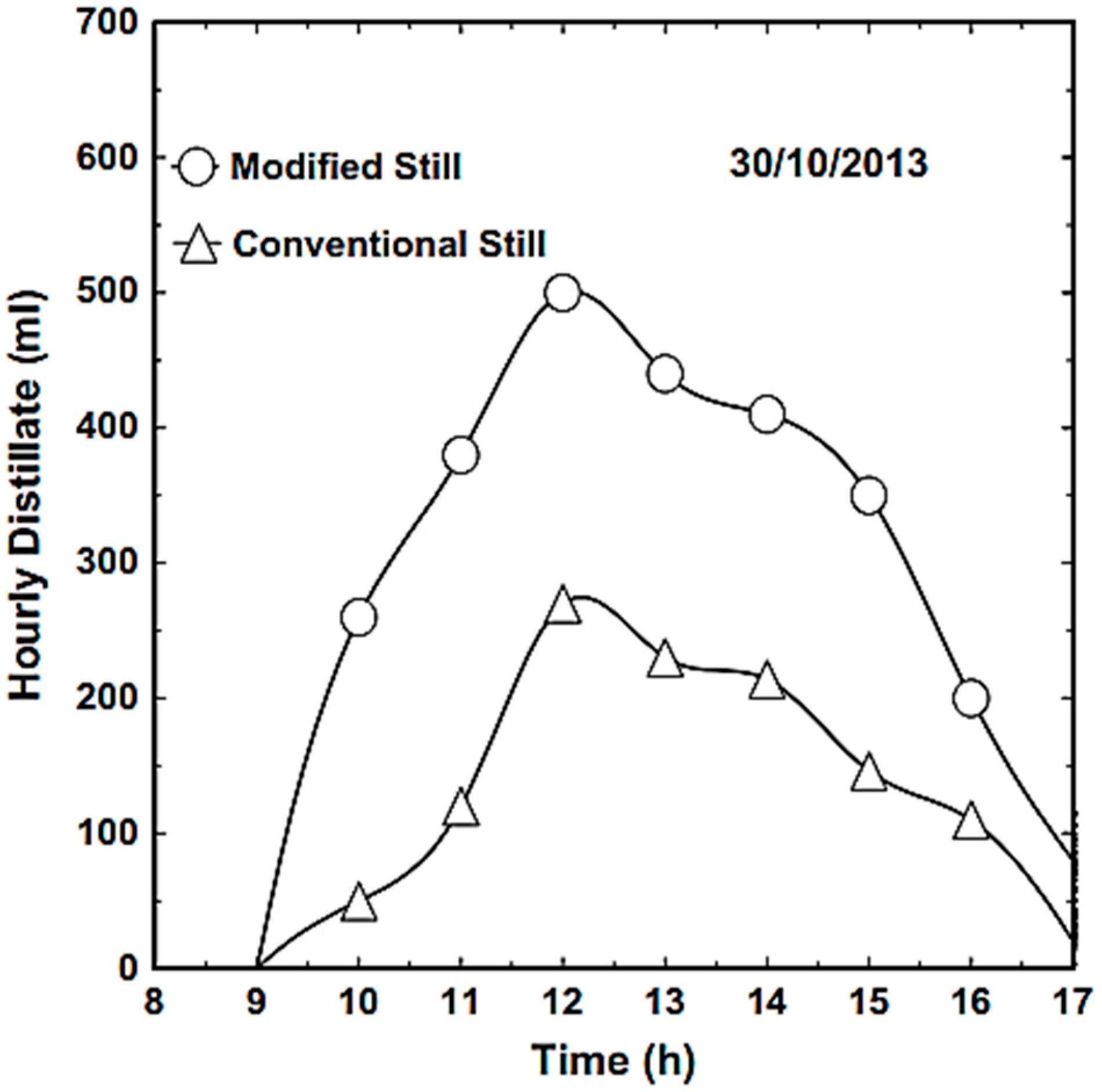

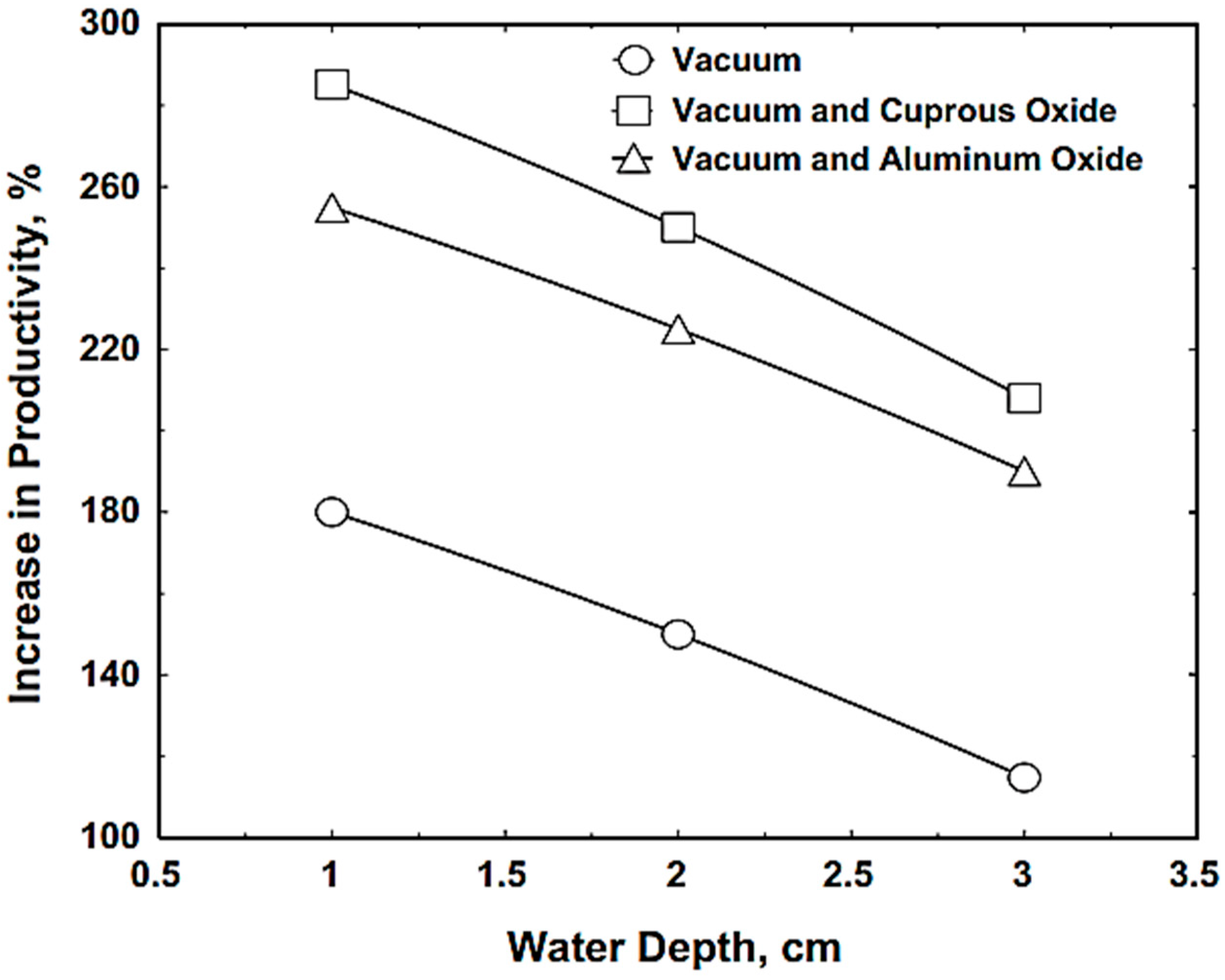
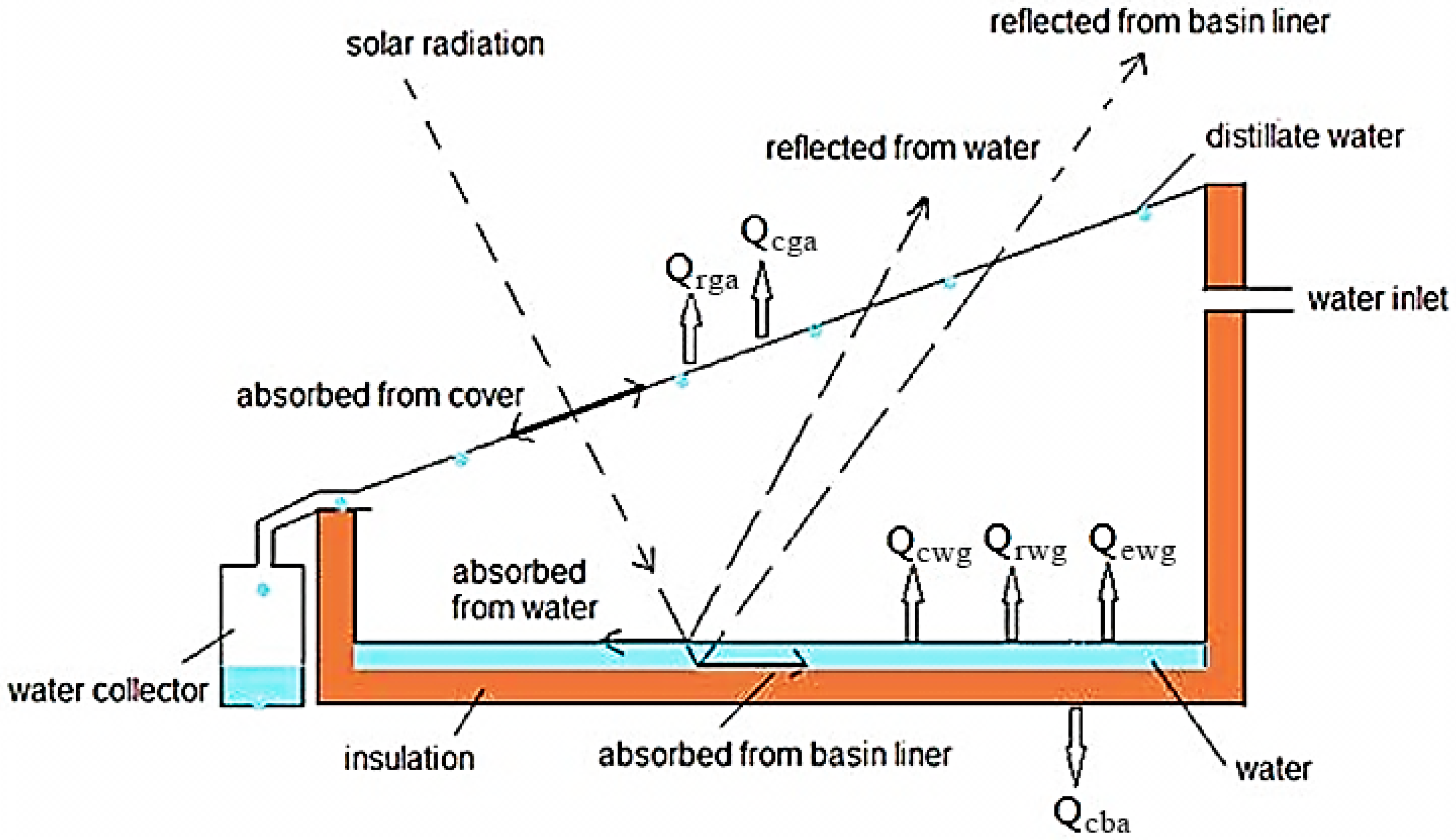






| Authors (Year) [Reference] | Type of Solar Still | Operating Conditions | Key Performance Metrics | Results and Remarks |
|---|---|---|---|---|
| Vacuum Membrane Distillation (VMD) | ||||
| Gabsi and Chehbouni (2013) [33] | Membrane-based desalination | Solar VMD | Distillate flow, daily productivity | Autonomous system with 0.5 m3/day capacity; uses flat plate collector and EUFRAT model. |
| Wang et al. (2015) [34] | VMD | Solar heat collection (SHC) | Trans-membrane flux, specific heat consumption | Average flux: 4 kg/(m2 h); specific heat: 750 kWh/m3. |
| Triki et al. (2017) [35] | Autonomous solar VMD plant | Seawater desalination | MFR, GOR, PR, RR, STEC | Max MFR: 14 L/h m2; min STEC: 290 kWh/m3. |
| Zhou et al. (2018) [36] | Solar VMD regeneration | Liquid desiccant air conditioning (LDAC) | Outlet concentration, energy savings | 10–37% energy savings vs. thermal regeneration. |
| Bamasag et al. (2021) [37] | S-VMD | Solar-heated, agitation techniques | Permeate flux | Flux: 5.9–11.1 kg/m2 h; 22% enhancement with circulation. |
| Chang et al. (2022) [38] | Submerged VMD for aquaculture | Solar- powered, air bubbling | Permeate flux | Flux: 2.1–5.2 kg/m2 h; improved fouling resistance. |
| ElKasaby et al. (2023) [39] | Solar-assisted VMD | TRNSYS simulation | GOR, specific thermal energy consumption | GOR: 2.51; water cost: 14.7 USD/m3. |
| Nanoparticles-Enhanced Solar Stills | ||||
| Kabeel et al. (2014) [41] | Modified conventional solar still | Nanoparticles (Cu2O, Al2O3) with/without vacuum | Productivity enhancement | 133.64% increase with Cu2O Nanoparticles and vacuum fan. |
| Omara et al. (2015) [42] | Corrugated wick solar still (CrWSS) | Vacuum, Nanoparticles, reflectors | Productivity increase | 180% higher yield with vacuum; 285.10% with Cu2O Nanoparticles. |
| Bataineh and Abbas (2020) [43] | Single-slope solar still | Nanoparticles (Al2O3, SiO2), vacuum | Productivity enhancement | 13% increase with Al2O3 Nanoparticles and vacuum. |
| Naveenkumar et al. (2023) [44] | Double-slope solar still | Vacuum fan, Nano fluids | Energy/exergy efficiency, production | 64.29% production increase; 78.60% exergy efficiency. |
| Multi-Effect/Tubular Solar Stills | ||||
| Chong et al. (2014) [46] | Multiple-effect diffusion solar still (MEDS) | Vacuum-tube collector, heat pipe | Daily production per unit area (M_cov, M_sol) | 29% higher productivity than basin-type MEDS. |
| Xie et al. (2018) [47] | Tubular solar still (TSS) | Vacuum operation | Freshwater yield, mass transfer coefficient | Model deviation: −3% to 11%. |
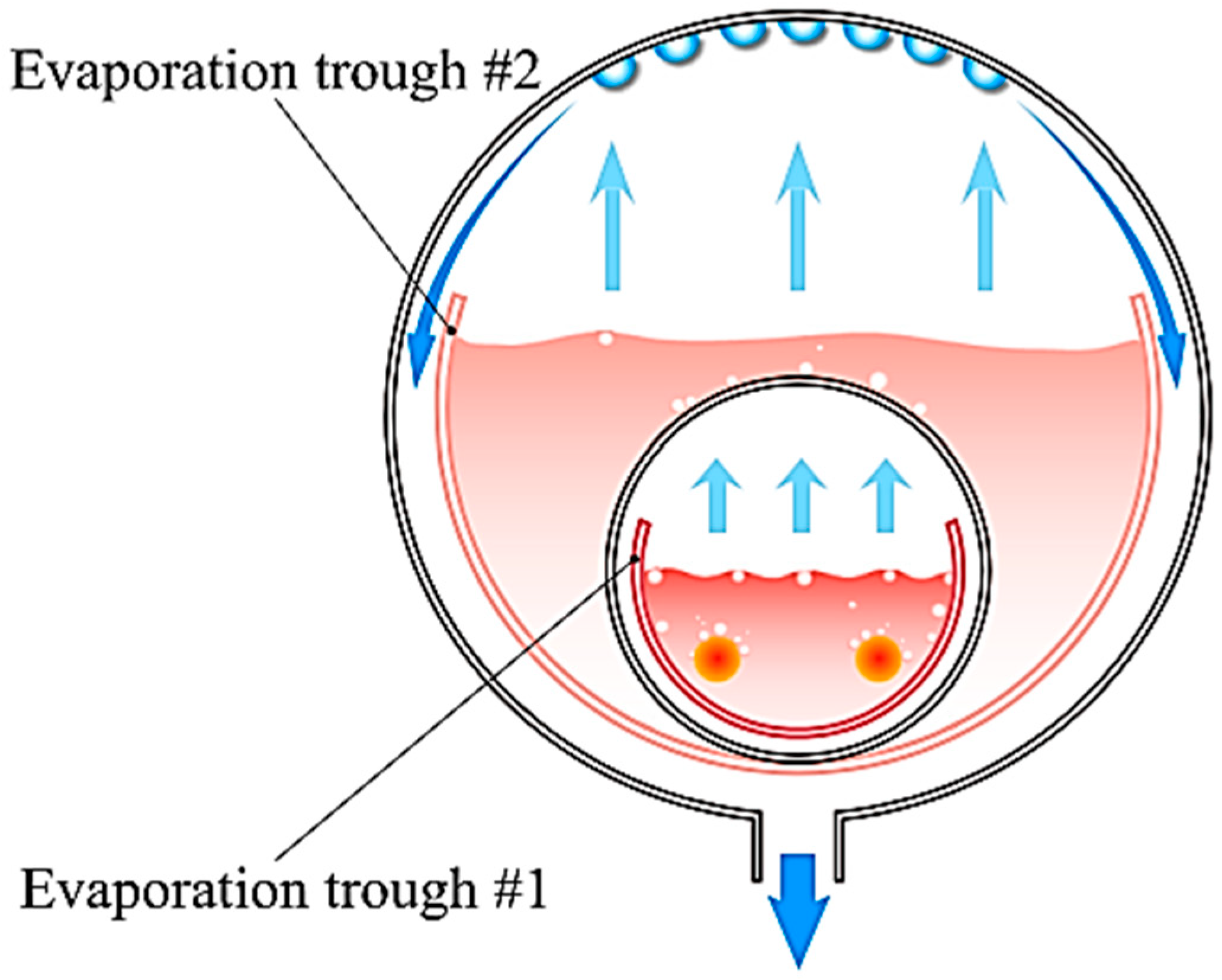
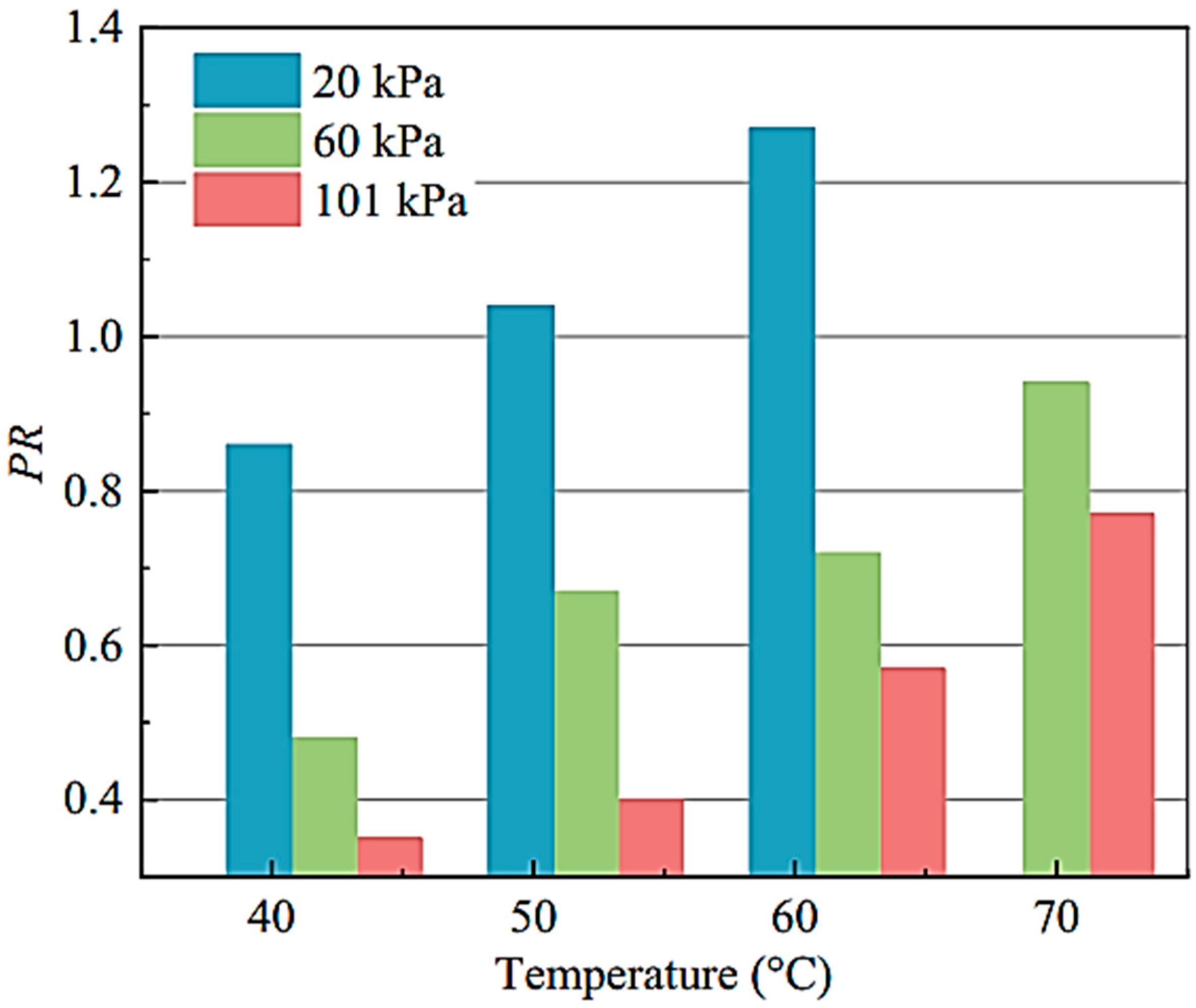
| Yan et al. (2019) [48] | Two-effect tubular solar still | Vacuum (20–101 kPa) | Performance ratio (PR), yield rate | PR: 1.27 at 20 kPa; twice yield increase at 20 kPa. |
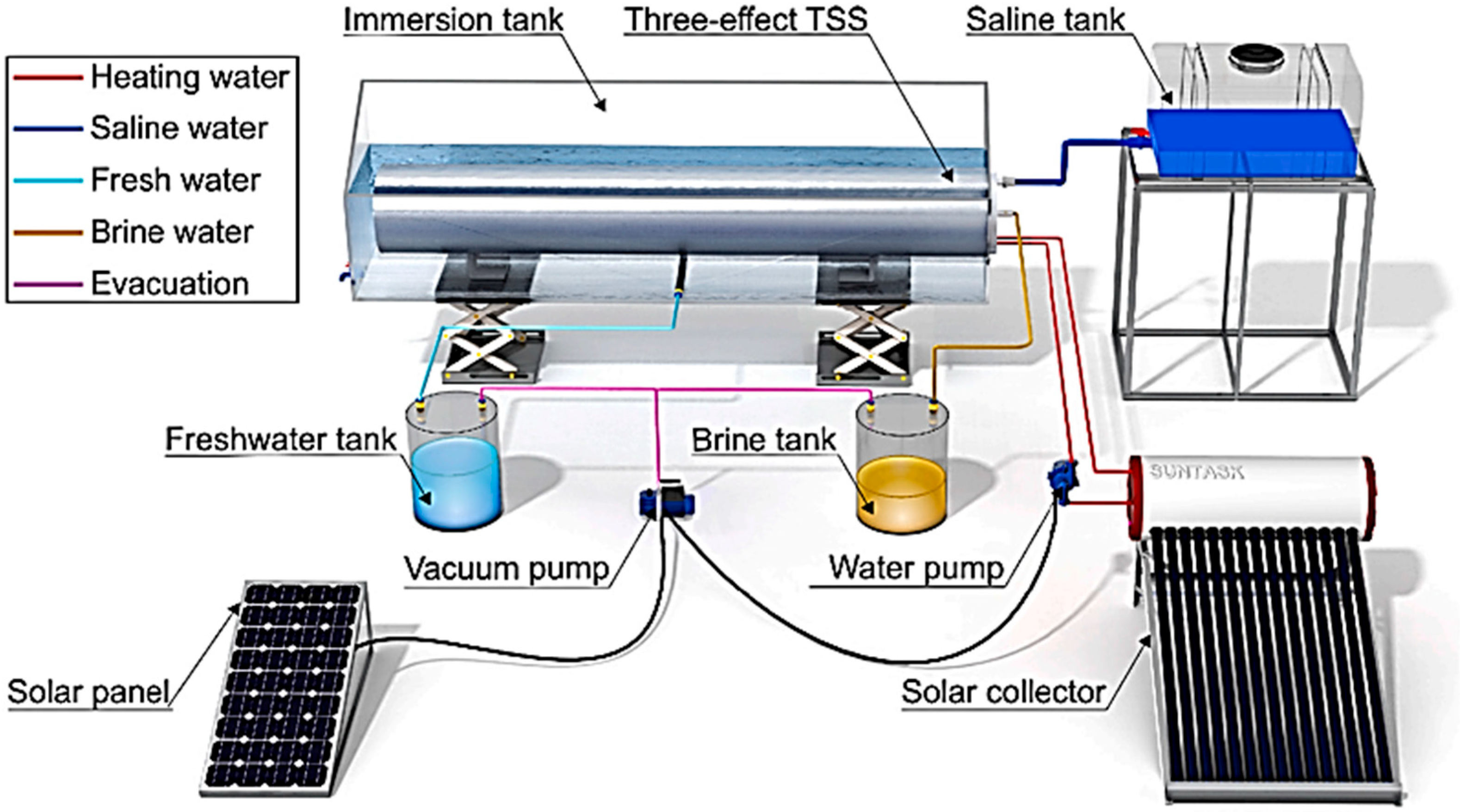
| Xie et al. (2020) [49] | Three-effect tubular solar still | Vacuum (20–95 kPa) | Freshwater yield, energy efficiency | Best performance at 40 kPa (7.056 kg/d). |
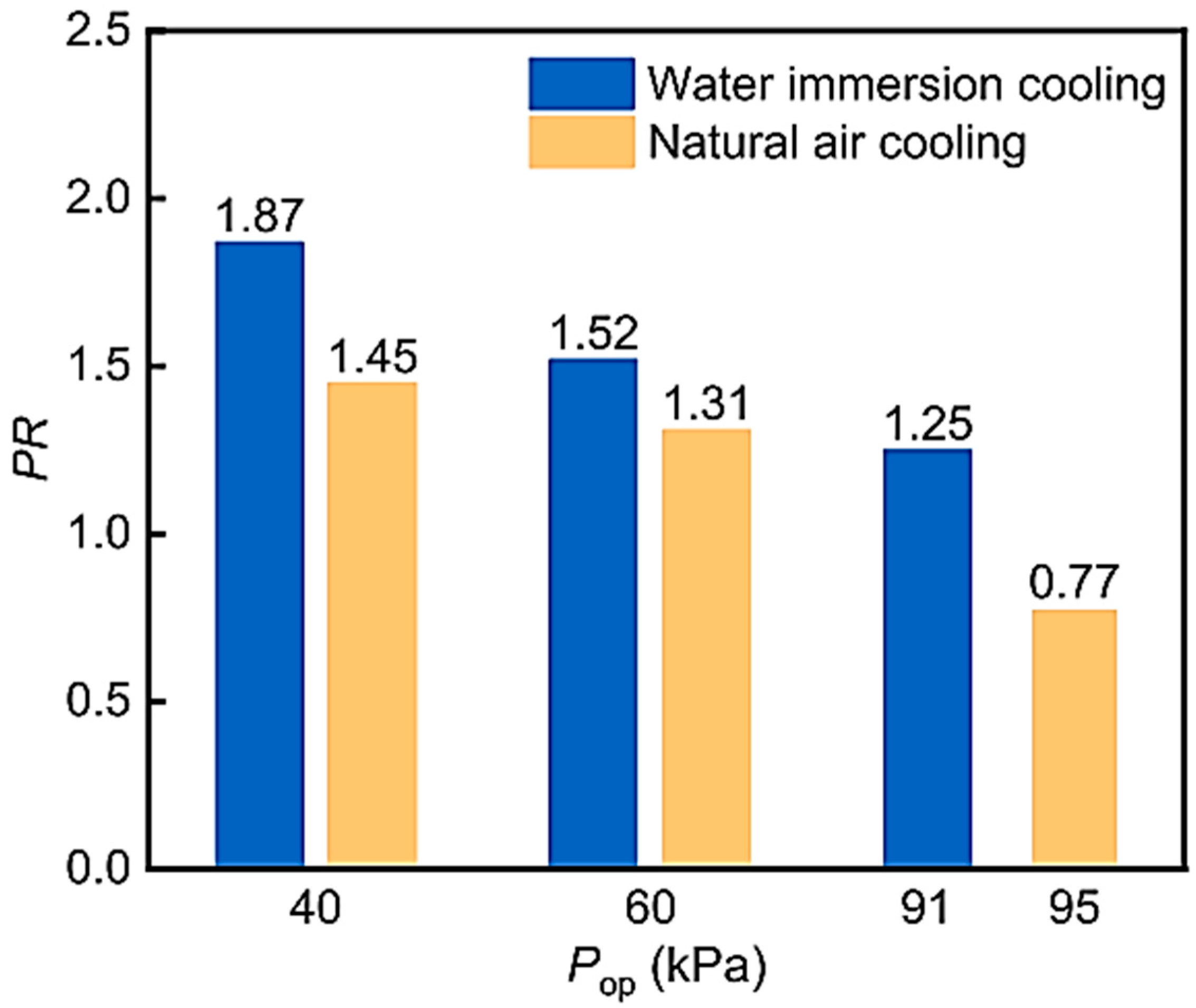
| Yan et al. (2021) [50] | Three-effect tubular solar still | Periodic pressure control, immersion cooling | Specific electricity consumption, PR | PR: 1.87 at 40 kPa; 187% thermal efficiency. |
| Chen and Xie (2022) [51] | Multi-stage tubular solar still (MSSV) | Vacuum (48 kPa optimal) | Water yield, solar intensity impact | Max yield: 7.15 kg/m2 at 48 kPa. |
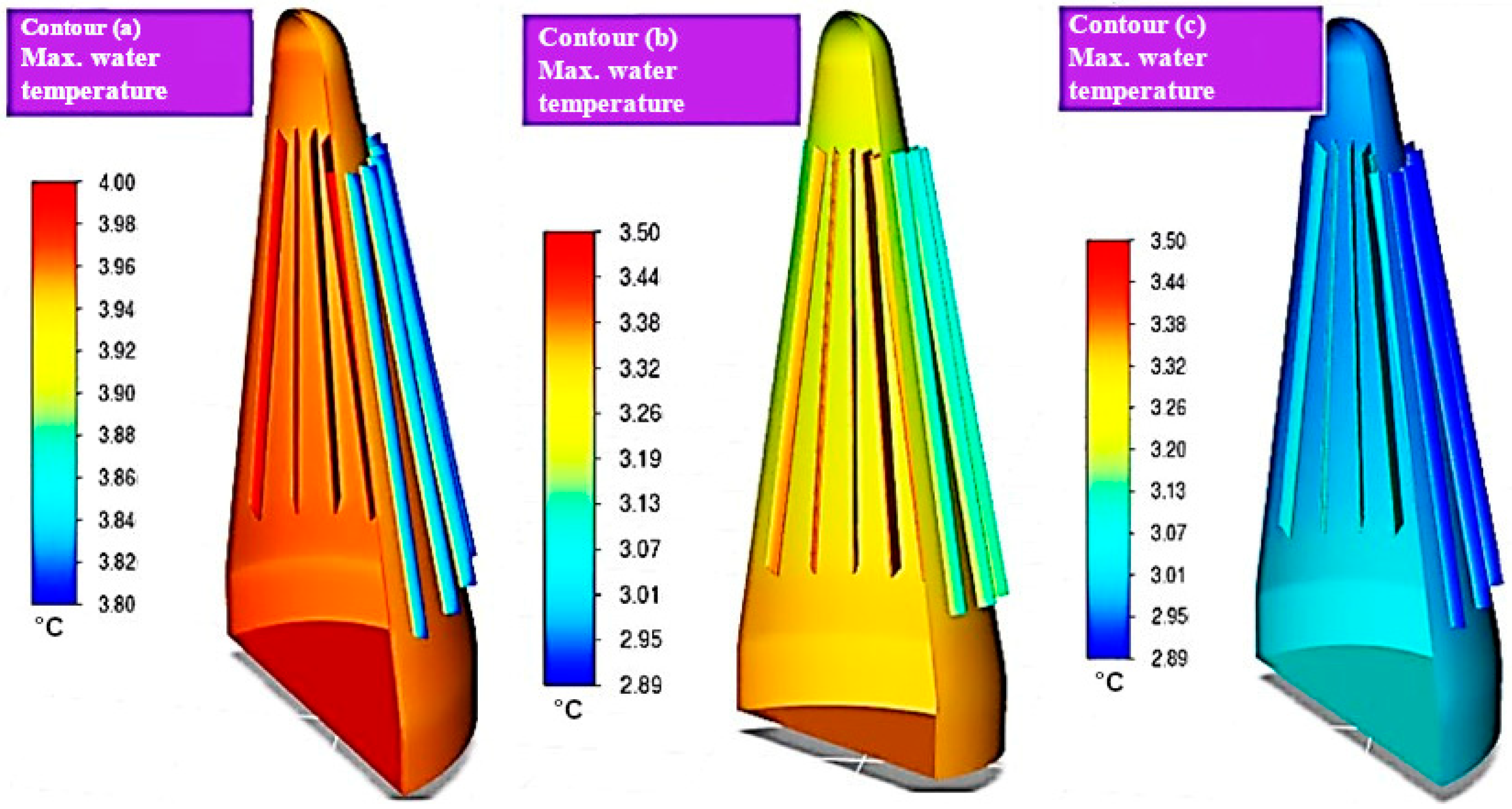
| Wei et al. (2023) [52] | Tubular solar still (visualization study) | Vacuum (40–95 kPa) | Vapor flow velocity, empirical correlation | 153% velocity increase at 40 kPa vs. 95 kPa |
| Geothermal/Sensible Heat Integration | ||||
| Panchal and Shah (2014) [53] | Double basin solar still with vacuum tubes | Sensible energy storage materials | Distillate output | 74% increase with calcium stones and vacuum tubes. |
| Panchal et al. (2015) [54] | Double basin solar still | Vacuum tubes, black granite gravel | Daily distillate output | 65% increase with vacuum tubes and gravel. |
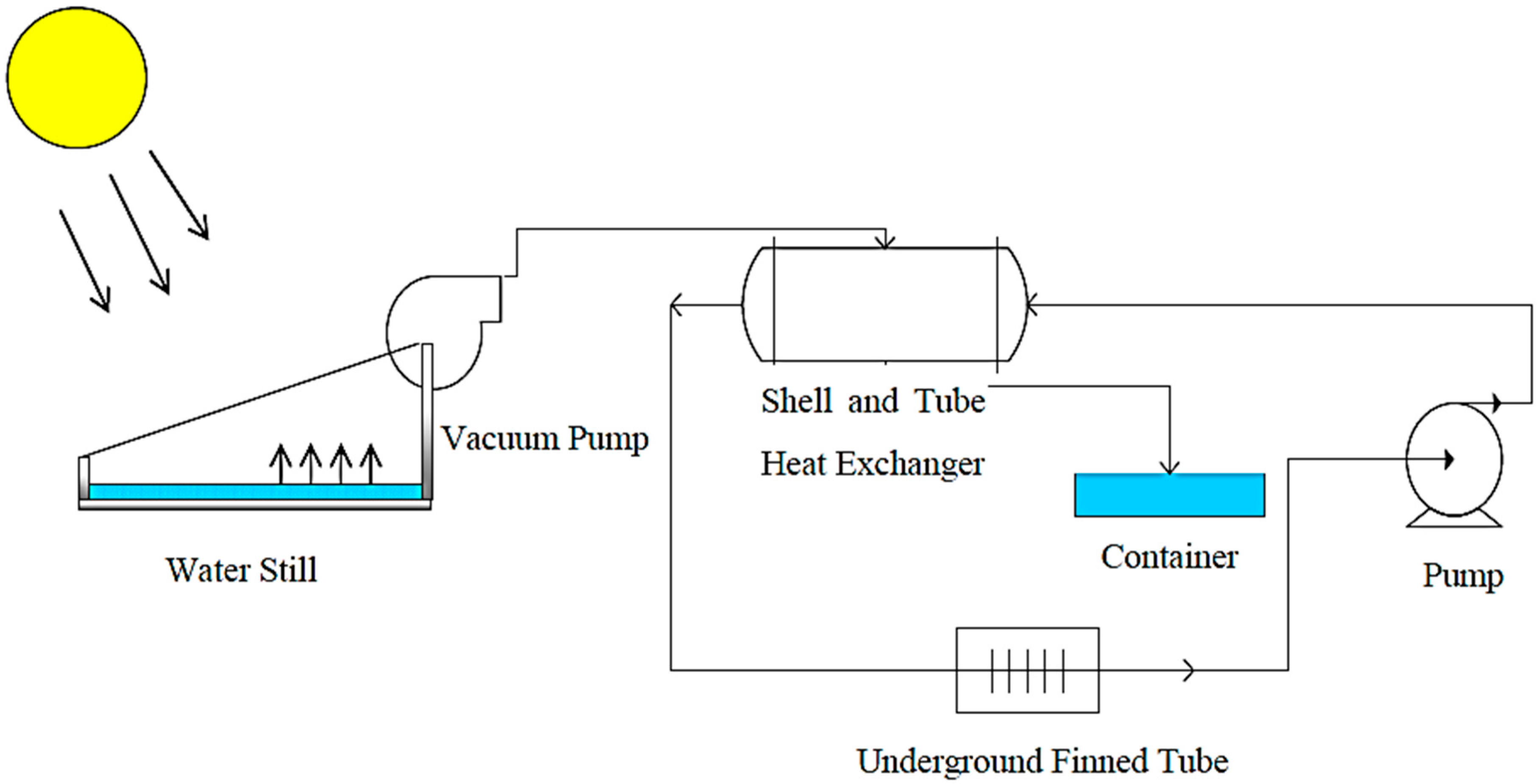
| Danish et al. (2019) [55] | Solar still with geothermal cooling | Vacuum pump, underground cooling | Daily productivity increase | 305% productivity increase. |
| Wang et al. (2021) [56] | Natural vacuum desalination | Solar-driven, inner condenser | Performance ratio, hourly yield | Daily yield: 154.14 kg; PR: 1.36. |
| Wei et al. (2021) [57] | Natural vacuum desalination | Water-filling and air-releasing | Efficiency, recovery ratio | Efficiency: 87.821%; recovery ratio: 3.858%. |
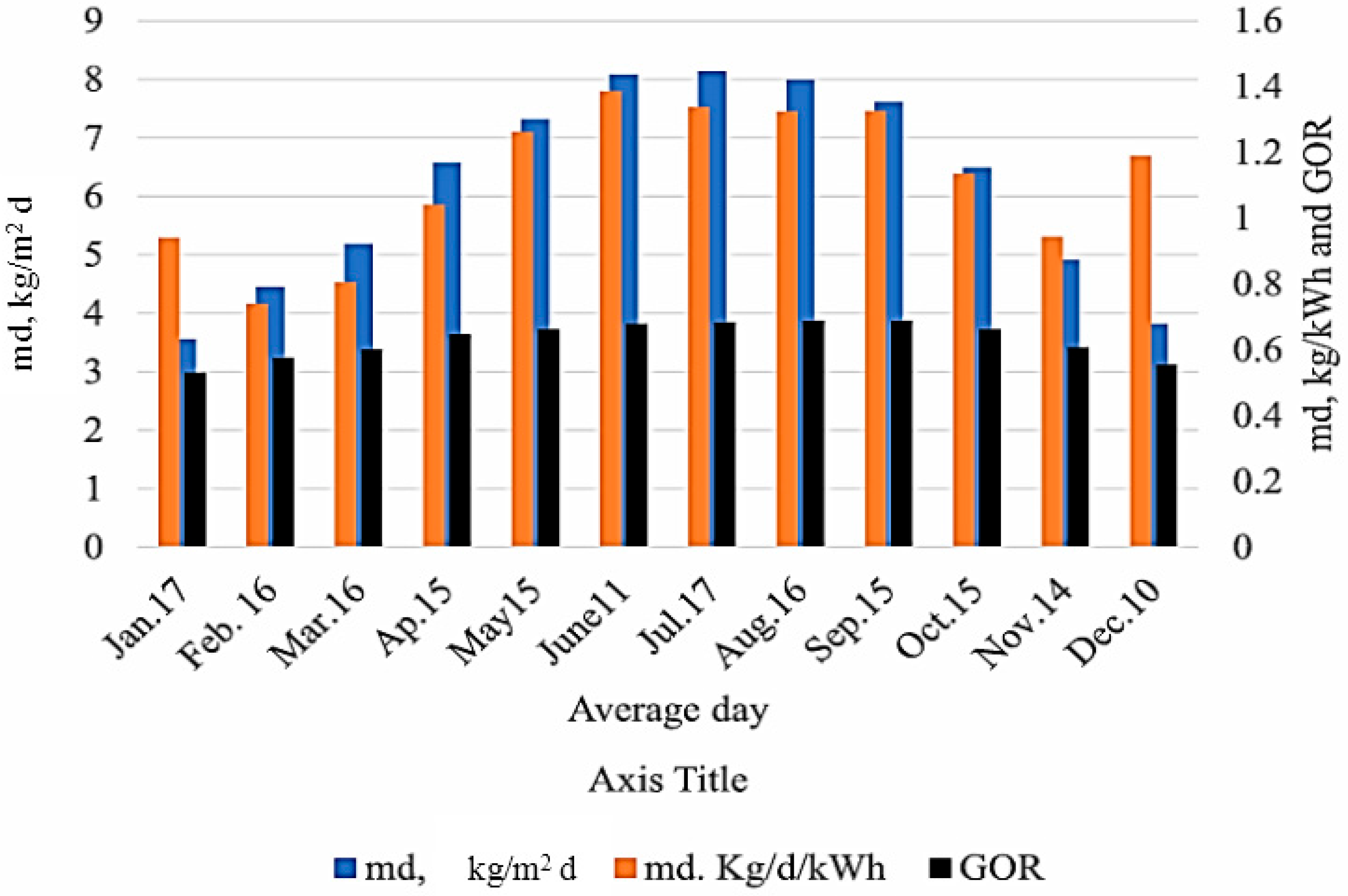
| Dayem (2023) [58] | Solar natural vacuum desalination (SNVD) | Waste heat utilisation | Daily production, GOR | 6.2 L/m2 day; GOR: 0.63. |
| Minaei et al. (2024) [59] | Venturi-integrated vacuum desalination | Evacuated tube collector (ETC) | Water production, efficiency | 9.02 kg/m2 at 75 LPM; 40.87% efficiency. |
| Parabolic Trough/Concentrator Systems | ||||
| Hosseini et al. (2018) [60] | Solar distillation with parabolic trough | Vacuum heat exchanger | Daily productivity, solar radiation impact | Max production: 1.5 kg/m2 d at 0.5 bar vacuum. |
| Guo et al. (2022) [61] | Passive solar vacuum tube distiller (P-SVTD) | Heat recovery | Water yield (m_sh), heat recovery rate (HRR) | HRR: 28.68%; HE: 87.43%. |
| Aghakhani et al. (2023) [62] | Single-slope solar still | Vacuum (60–120 kPa), heating/cooling | Performance enhancement | 152.69% improvement with simultaneous heating/cooling. |
| Hamida (2023) [63] | Tubular solar still | Cylindrical vs. rectangular troughs | Water productivity | Cylindrical trough outperforms rectangular in middle placement. |
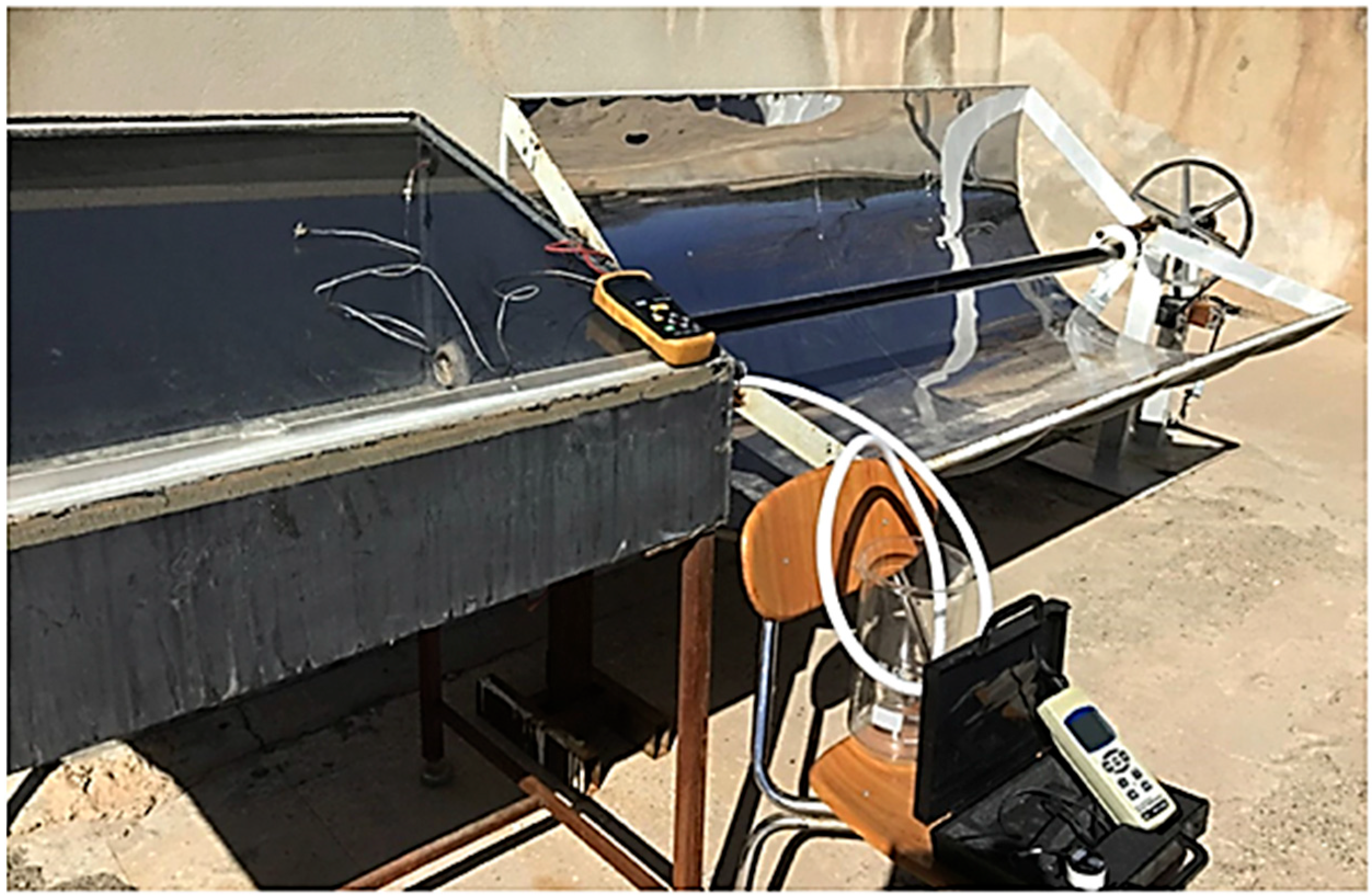
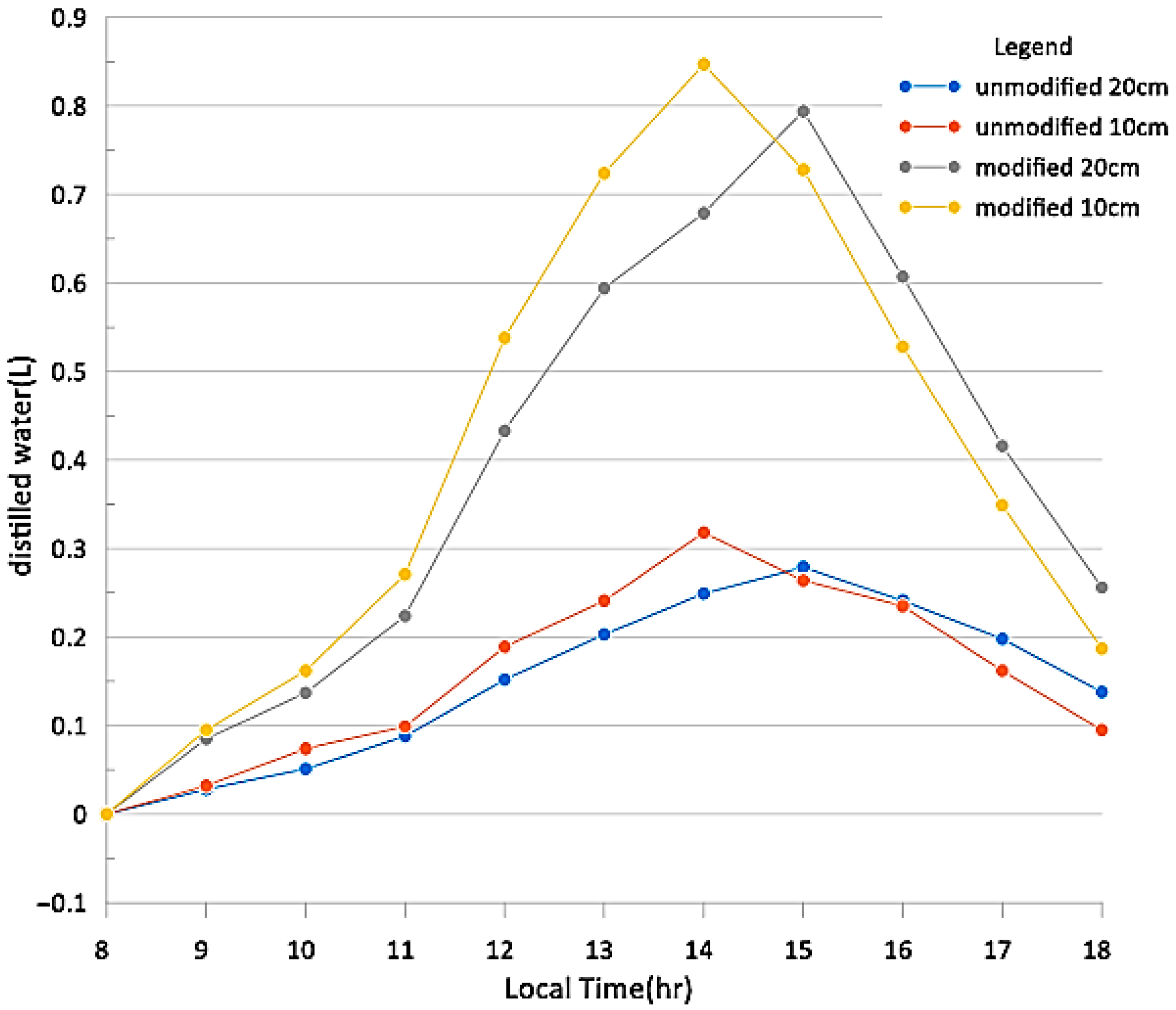
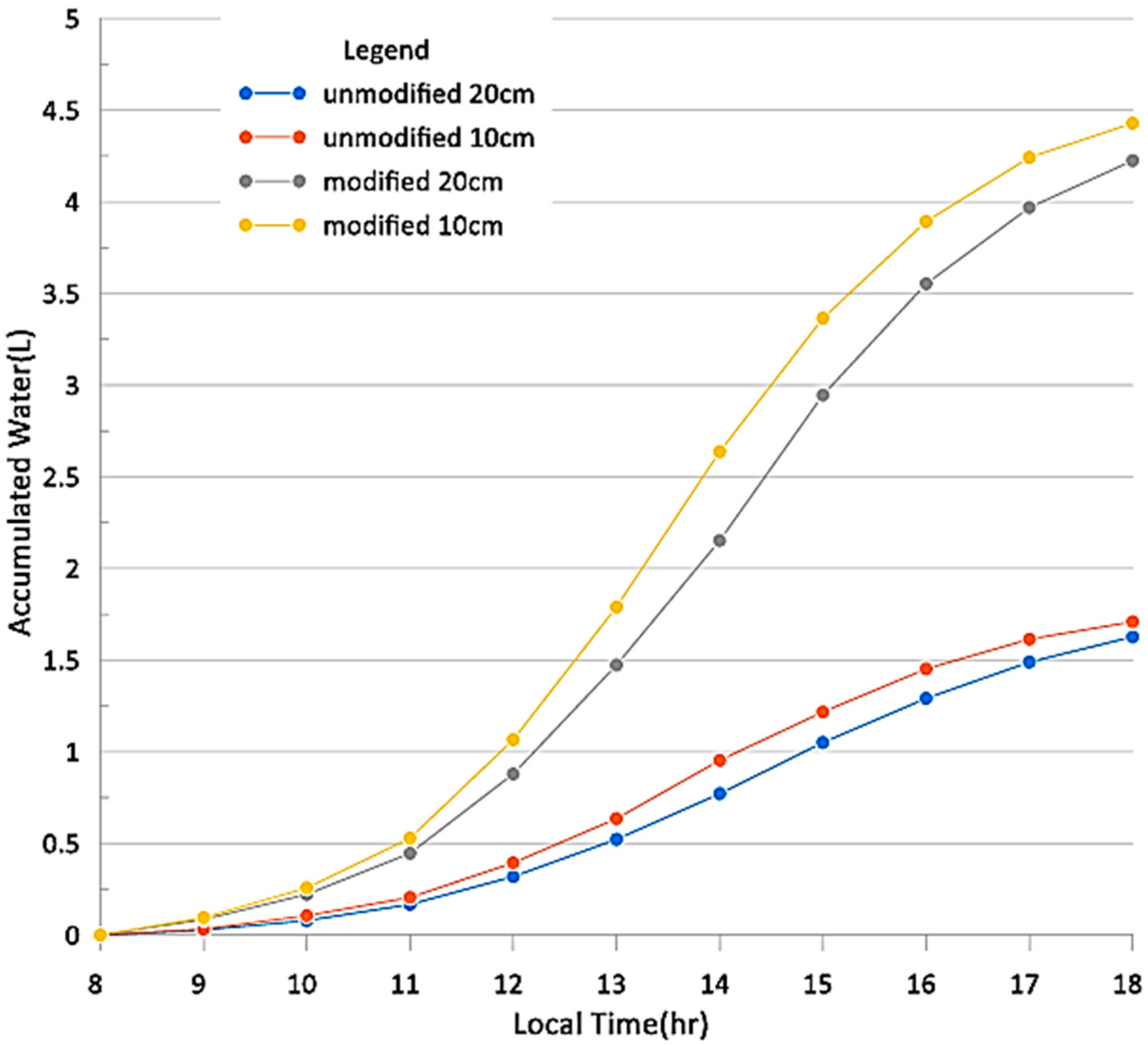
| Abdollahi et al. (2025) [64] | Parabolic trough with vacuum tubes | Two water depths (10 cm, 20 cm) | Water output increase | 159.6% (10 cm) and 206.8% (20 cm) output increase. |
| Passive/Natural Vacuum Systems | ||||
| Mohsenzadeh et al. (2022) [65] | Floating hemispherical solar still | Low vacuum, capillary circulation | Daily rate, distillation efficiency | 4.3 L/m2 d; efficiency: 35.6%. |
| Wei et al. (2022) [18] | Natural vacuum desalination | Water-filling, air-releasing | Annual freshwater yield, cost | Max yield: 30.86 t/year; min cost: 5.31 $/t (Jizan). |
| Sun et al. (2023) [66] | Solar-driven low-vacuum distillation (SLIDS) | Polyvinyl alcohol/ carbon black hydrogel | Evaporation rate, condensate yield | Yield rate: 1.46 kg/m2 h (2.2 times traditional). |
| Srivastava et al. (2024) [67] | Heat pipe vacuum tube collector | Desiccant regeneration | Water production, efficiency | Max efficiency: 4.9%; 175 mL water produced. |
| Heat Recovery/Cooling Techniques | ||||
| Yan et al. (2020) [68] | Tubular solar still (CFD study) | Vacuum pressure < 60 kPa) | Vapor flow velocity, yield rate | 50% yield increase at vacuum pressure < 60 kPa. |
| Ma et al. (2022) [69] | Vacuum MD with photothermal membrane (VMD-PM) | Direct solar heating | Distillate production | 7.14 L/m2; 4.1% higher than VMD-FPC. |
| Ma et al. (2022) [70] | Integrated MD and solar flat-plate collector | Small-scale desalination | Water production, electricity consumption | VMD-FPC recommended for small-scale applications. |
| Reda (2023) [71] | Vacuum desalination plant | Condensation dome with fins | Condensation rate | 62% increase with internal/external fins. |
| Saha et al. (2024) [24] | Vacuum double-slope solar still | PCM (paraffin wax) | Productivity, distillation efficiency | 63% daily productivity increase; 28.72% efficiency boost. |
| CFD/Modeling and Simulation | ||||
| Santosa et al. (2024) [73] | Single slope solar still (vacuum) | Comparative heat transfer analysis | Condensation rate | Higher productivity with vacuum. |
| Technology | Productivity Enhancement | Key Advantages | Challenges |
|---|---|---|---|
| Multi-effect Tubular Stills | 2-times yield (7.15 kg/m2) | High efficiency, staged evaporation | Complex design, leakage risks |
| Nanoparticle-enhanced Stills | Up to 133.6% increase | Improved thermal conductivity | Long-term stability, material costs |
| VMD | 5.9–11.1 kg/m2 h | High flux rates | Membrane fouling, energy-intensive |
| Passive Vacuum Systems | $0.0113/kg cost | Low energy demand | Limited scalability |
| Geothermal Integration | 305% productivity boost | Stable condensation temperatures | High hybridization complexity |
Disclaimer/Publisher’s Note: The statements, opinions and data contained in all publications are solely those of the individual author(s) and contributor(s) and not of MDPI and/or the editor(s). MDPI and/or the editor(s) disclaim responsibility for any injury to people or property resulting from any ideas, methods, instructions or products referred to in the content. |
© 2025 by the authors. Licensee MDPI, Basel, Switzerland. This article is an open access article distributed under the terms and conditions of the Creative Commons Attribution (CC BY) license (https://creativecommons.org/licenses/by/4.0/).
Share and Cite
Al-Obaidi, M.A.; Rashid, F.L.; Abdulhadi, H.A.; Al-Musawi, S.S.; Saif, M. A Review of Vacuum-Enhanced Solar Stills for Improved Desalination Performance. Sustainability 2025, 17, 9535. https://doi.org/10.3390/su17219535
Al-Obaidi MA, Rashid FL, Abdulhadi HA, Al-Musawi SS, Saif M. A Review of Vacuum-Enhanced Solar Stills for Improved Desalination Performance. Sustainability. 2025; 17(21):9535. https://doi.org/10.3390/su17219535
Chicago/Turabian StyleAl-Obaidi, Mudhar A., Farhan Lafta Rashid, Hassan A. Abdulhadi, Sura S. Al-Musawi, and Mujeeb Saif. 2025. "A Review of Vacuum-Enhanced Solar Stills for Improved Desalination Performance" Sustainability 17, no. 21: 9535. https://doi.org/10.3390/su17219535
APA StyleAl-Obaidi, M. A., Rashid, F. L., Abdulhadi, H. A., Al-Musawi, S. S., & Saif, M. (2025). A Review of Vacuum-Enhanced Solar Stills for Improved Desalination Performance. Sustainability, 17(21), 9535. https://doi.org/10.3390/su17219535