Abstract
In the context of global sustainable development strategies and the rise of intelligent construction, it has become increasingly urgent for universities to adapt construction management curricula to meet the demands of this new era. However, prior education-reform-based studies rarely offer a systematic, educator-centered prioritization of knowledge areas, limiting actionable guidance for course sequencing and credit-hour allocation. To address this gap, this study identifies eight essential knowledge categories for construction management education through a comprehensive literature review and a survey of faculty members with strong theoretical and practical experience. An improved Analytic Hierarchy Process (AHP) model, weighted by the Consistency Ratio (CR), is applied to prioritize these areas. Results show that Fundamentals of Construction (18.50%), BIM (18.08%), and AI and Big Data (17.07%) received the highest importance values. These findings emphasize the need for curriculum reorientation to align with intelligent construction. This study contributes to modernizing construction management education and offers practical insights for curriculum development, ensuring alignment with industry trends and technological advancements.
1. Introduction
Against the backdrop of a growing global emphasis on sustainable development, the construction industry is grappling with unprecedented challenges in balancing economic growth, environmental protection, and efficient resource use [1,2]. As a core discipline in this effort, construction management plays a central role in integrating sustainability into built environment projects [3,4]. Strategic initiatives such as carbon-neutral building certifications, circular economy implementation, and green infrastructure development increasingly rely on sophisticated management tools and methodologies. Today’s construction management practices increasingly employ digital technologies—including Building Information Modeling (BIM), the Internet of Things (IoT), and Artificial Intelligence (AI)-powered project analytics—to improve resource allocation, increase energy efficiency, and minimize ecological impact across project lifecycles [2,5,6]. These technologies facilitate real-time monitoring of construction activities, data-informed decision making, and sustainability performance assessments, providing essential support for meeting the Sustainable Development Goals [7]. Educating a new generation of construction management professionals—equipped with both sustainability literacy and technical proficiency—has become crucial to advancing sustainable development in the sector. These demands call for an evolution in university construction management programs, requiring curricula that are intelligent, application oriented, and responsive to emerging industry trends.
Intelligent construction, driven by digital technology, represents a progressive concept within the industry [8,9]. As it evolves, the demand for professionals skilled in digital construction management will intensify, necessitating changes in education and practice to meet the needs of technological and industry development [10,11]. Consequently, a growing body of research focuses on intelligent construction-driven reforms in construction management education. Jiun et al. [12] surveyed construction educators across multiple countries to evaluate their perceptions of AI–curriculum integration and to summarize its implementation status in higher education. Javier et al. [13] explore the impact of generative AI on engineering education, proposing a framework to integrate sustainability skills and AI systems into the curriculum. Wen and Wang et al. [14,15] proposed integrating engineering and intelligent construction programs to create an experimental system that enhances students’ practical and innovative abilities. Sepasgozar [16] highlighted the use of digital twins and mixed reality in architecture, expanding the knowledge base and introducing new technologies for digital pedagogy. Quintero et al. [17] identify the competencies required of engineers in Industry 4.0 in order to propose a new competency-based vocational education process for engineering. Cui [18] defined training objectives for construction management informatization talents from a knowledge integration perspective and proposed a corresponding talent development model. Additionally, Zhang et al. [19] suggested using virtual reality as a safety training tool to improve student engagement and learning outcomes in architecture, engineering, and construction. Zhang et al. [20] addressed challenges in current talent development by incorporating industry practices in intelligent construction to propose new talent training models. While these studies focus on training methods, they offer limited insight into reforming the content of the knowledge system for talent development, particularly the training curriculum system. Our study aims to explore changes in the knowledge system for construction management professionals in the context of intelligent construction.
Intelligent construction encompasses a wide range of knowledge domains, including BIM [21,22], digital twins [23,24], prefabricated construction [25], IoT [26], big data analytics [23], and AI [27,28], among others. This diversity complicates the design of undergraduate training in construction management under tight credit hours, where rigor must be balanced against rapidly evolving technologies. However, prior education-reform-related studies seldom provide an educator-centered, systematic prioritization of the knowledge content across these domains, limiting actionable guidance for course sequencing and credit-hour allocation. To address this need, we assess and rank the relative importance of these domains from the perspective of educators well-versed in fundamentals, emerging theories, and industry practice. The resulting evidence-based priorities are then used to refine and improve the curriculum.
To mitigate biases arising from variations in academic backgrounds and teaching experiences in understanding intelligent construction, this study employs an improved Analytic Hierarchy Process (AHP), weighted by the Consistency Ratio (CR). This method enhances the reliability of the analysis by explicitly addressing the inconsistencies inherent in traditional AHP. Traditional AHP can be affected by subjective differences in expert judgment, but by using CR weighting, we reduce the influence of these inconsistencies, thereby producing more reliable and consistent results. In doing so, this method helps to ensure more robust prioritization of the knowledge areas, providing a clearer foundation for decision-making in educational contexts.
This study aims to establish an updated knowledge system adapted to the context of intelligent construction, thereby better cultivating a new generation of construction management professionals. The research contributes to building a theoretical framework for construction management education and offers practical guidance for curriculum development. Furthermore, it helps ensure that educational programs remain aligned with evolving industry demands and technological advancements, ultimately preparing undergraduate construction management students to meet the challenges of the intelligent construction era.
2. Methodology
2.1. The Traditional AHP
Saaty [29] first introduced the AHP, a quantitative decision-analysis tool designed to address complex multi-criteria decision-making problems. AHP is particularly useful for evaluating scenarios with multiple objectives and subjective judgments. The method breaks down complex problems into a hierarchical model, allowing for the assessment of each factor’s relative weight. By comparing factors pairwise, AHP transforms subjective judgments into quantitative data, providing objective and systematic support for decision-making.
In this study, university professors who have a solid grounding in construction management theory as well as practical industry cognition participated in the investigation, involved in teaching construction management disciplines were invited to conduct a hierarchical analysis. The importance of each knowledge area, as perceived by the teachers, was assessed within the context of the rapid development of intelligent construction for the training of construction management professionals. A judgment matrix was created to capture the comparison of relative weights, as shown below:
where aij denotes the element at the intersection of the i-th row and j-th column in the judgment matrix, and .
To help participants assess the importance of each knowledge area in construction management training, this analysis will use Saaty’s 9-point scale (see Table 1) [30]. This will help prioritize areas given the limited hours in undergraduate education. By comparing the importance of these areas quantitatively, the analysis will provide systematic guidance for training construction management professionals. It will ensure that students develop a scientifically sound knowledge structure to address future challenges.
Table 1.
Evaluation degree standard.
2.2. Consistency Check
The AHP consistency test was conducted on the data collected from the questionnaire to ensure the reliability of the results provided by the research participants. The consistency of the data was evaluated using the Consistency Indicator (CI) and CR. The calculation process for this test followed these steps:
1. The following equation is used to determine :
The product Mi of the elements in each row of the judgment matrix A is calculated using Equation (2), where Mi represents the product of the elements in the i-th row of the judgment matrix. Next, the n-th root of Mi is obtained using Equation (3), where n denotes the order of the judgment matrix. Equation (4) is used to normalize the vector . Finally, Equation (5) is employed to calculate the largest characteristic root , which corresponds to the eigenvector W.
2. The following equation is used to determine CI:
where represents the largest eigenvalue obtained from Equation (5) and n denotes the order of the judgment matrix.
3. The following equation is used to determine CR:
In this equation, RI refers to a random consistency index, which is positively correlated with the dimensions of the judgment matrix. The value of RI varies with the order of the judgment matrix, as shown in Table 2.
Table 2.
Table of randomized consistency indicator RI values.
4. Judgment for consistency testing:
When the CR is close to or below a pre-set threshold, commonly set at 0.1, it indicates that the consistency of the judgment matrix is acceptable. This threshold is based on Saaty’s original research on the AHP and the consistency theory, which suggests that a CR value below 0.1 signifies that the expert’s judgments are consistent within a reasonable range. If the CR exceeds this threshold, it suggests that the expert’s hierarchical judgment may exhibit significant inconsistencies, thus requiring adjustments to the judgment matrix for further re-evaluation. This adjustment ensures the reliability of the analysis and guarantees that the final results are based on consistent and valid judgments.
2.3. CR-Weighted Improved AHP
Given the significant disparities in initial findings due to various random errors in the analysis outcomes from different respondents, simple generalization cannot effectively capture the commonalities across the conclusions. Traditional AHP assumes equal weighting of all respondents’ inputs, yet the quality of judgments may vary considerably among participants. To address this issue, the study introduces a refined approach to the traditional AHP by proposing the CR-weighted improved AHP consistency test. This method introduces a weighting mechanism based on the CR, allowing for a more nuanced and reliable evaluation of the results. By applying weights according to the CR, the method mitigates the influence of inconsistent or unreliable judgments, particularly when substantial disparities exist in the importance values assigned to the indicators.
In comparison to traditional AHP, which treats all responses equally, the CR-weighted method effectively reduces bias caused by inconsistent judgments, thereby enhancing the overall consistency of the analysis. This method’s ability to address inconsistencies and account for variability across respondents improves the reliability of the analysis, better reflecting diverse perspectives. As demonstrated in previous studies, the CR-weighted method significantly improves result accuracy and consistency, especially when dealing with divergent judgments. Consequently, this approach ensures that the final results are more representative and robust.
It is worth noting that there are many other widely used MCDM methods, such as ANP/DEMATEL, BWM, and TOPSIS, but these methods are designed for other different objectives and contexts. ANP/DEMATEL focuses on modeling the interdependencies between criteria, which is unnecessary in this case, as we are ranking independent knowledge areas. While BWM reduces the number of comparisons, it requires selecting the “best” and “worst” criteria, which could introduce subjectivity, especially with eight significantly different knowledge areas. TOPSIS is more suitable for ranking alternatives with fixed weights, rather than for ranking criteria or handling judgment inconsistencies, which CR-weighted AHP addresses.
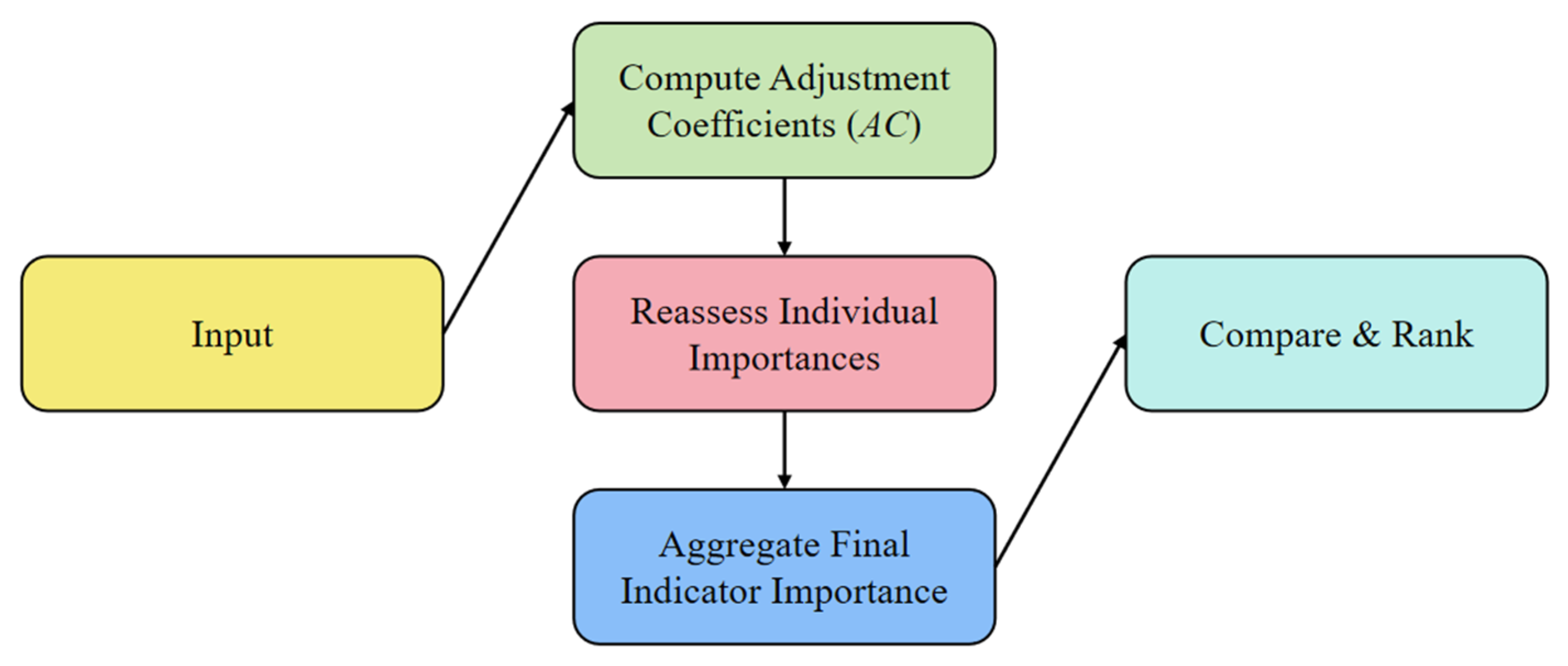
Ultimately, the CR-weighted improved AHP consistency test provides a stronger foundation for informed decision-making and future research. Figure 1 below shows the CR-weighted improved AHP flowchart.
Figure 1.
CR-Weighted Improved AHP Flowchart.
The following steps describe the enhanced process for analyzing the preliminary results of hierarchical analysis using CR.
The first step is to calculate the Adjustment Coefficient (AC). In the context of the AHP analysis, different participants may have varying levels of expertise and perspectives, which can result in differing assessments of the importance of indicators. To address this, the AC helps adjust for these discrepancies by weighting each research subject’s contribution based on their CR. Let N represent the number of research subjects and m denote the number of analyzed indicators:
where ACp denotes the adjustment coefficient for the p-th participant, and k is the adjustment degree factor, which is bounded by the range defined in Equation (8). The term 1/N, used as the basis for the calculation, represents the initial proportional share allocated to each research subject. In the calculation of the AC, the original value is retained without rounding to ensure that the sum of all importance values equal 1.
In the second step, the importance values derived from the hierarchical analysis results of each research participant are reassessed using AC to calculate the adjusted importance, denoted as W. Specifically:
where Wpq represents the importance value of the p-th research subject in the q-th analyzed indicator, and Wpq′ denotes the adjusted importance value for the same research subject and indicator.
In the third step of data processing, hierarchical analysis is performed on each research subject to determine the importance values corresponding to the different analyzed indicators. These values are then utilized to classify the collected data. The final importance values of the indicators are subsequently calculated by summing the importance values across all research subjects:
where Wq represents the importance value of the q-th analyzed indicator.
By adjusting the initial analysis results through the three steps outlined above and subsequently comparing the final importance values of each analyzed indicator, a more accurate hierarchy of indicator importance can be derived.
3. Data Collection
3.1. Summarizing the Knowledge System
The rapid development of intelligent construction has significantly altered the talent requirements in the field of construction management. In this constantly evolving industry, the undergraduate phase of talent development has become crucial [31], as it must adapt to and meet the diverse needs for construction management professionals in the context of intelligent construction. To address this shift, it is essential to equip students with knowledge specific to the field of intelligent construction. By analyzing the curriculum design of intelligent construction and construction management majors at several universities, conducting a clustering analysis of a large body of relevant literature, and consulting senior faculty members, this study summarizes the knowledge system for the training of construction management professionals. This system primarily includes the following: construction fundamentals, traditional construction management knowledge, BIM knowledge, traditional information technology knowledge, AI and big data knowledge, machinery and automation knowledge, IoT knowledge, and factory production management knowledge. Table 3 summarizes the literature supporting the inclusion of these eight knowledge categories as core components of the knowledge system.
Table 3.
The knowledge system of construction management talent cultivation in the context of intelligent construction.
With the continuous advancement of technology and the transformation of the construction industry, construction management undergraduates can develop comprehensive skills that enable them to adapt to the dynamic construction environment and emerging technological trends through this knowledge. Therefore, in this study, the eight knowledge categories mentioned above will be used as indicator factors for analysis. These factors represent the essential knowledge that construction management students must acquire in the context of intelligent construction and are critical for analyzing the training needs of construction management students in light of the rapid advancements in intelligent construction.
3.2. Questionnaire Design and Survey
To gain a deeper understanding of the distribution of importance among the eight knowledge indicators within the proposed knowledge system, 18 university professors with extensive teaching experience in construction management were selected as respondents for the questionnaire survey. Their basic information statistics are shown in Table 4. Teachers, rather than professionals from the construction industry, were chosen because of their comprehensive understanding of the curriculum and educational requirements for construction management students. Their experience in shaping the educational framework and knowledge delivery makes them well-positioned to provide insights into the key knowledge areas necessary for future professionals in intelligent construction.
Table 4.
Basic Information Statistics of Research Subjects.
To ensure the reliability and transparency of the survey, the specific process is arranged as follows. First, participants were provided with an informed consent form, which outlined the purpose of the study and the use of the data. The questionnaires were then distributed during a scheduled group meeting with faculty members from the Department of Construction Management. Detailed instructions and examples were provided to assist participants in completing the survey, and they were encouraged to ask questions at any time. Afterward, the completed questionnaires were collected and reviewed, and the data was subjected to Consistency Testing.
However, it is important to note that the sample size in this study is relatively small, with only 11 valid responses out of the 18 distributed questionnaires, resulting in a valid response rate of 61.11%. While this sample size is adequate for an initial analysis, it may limit the generalizability of the findings. To address potential biases arising from the small sample, the study applied the CR-weighted improved AHP method, which helps mitigate the effects of inconsistent judgments and reduces potential errors in the analysis. Despite this, future research should aim to expand the sample size to enhance the robustness of the findings and further validate the results.
This survey employed hierarchical analysis, with the detailed questionnaire content provided in Table A1 and Table A2 of Appendix A. Based on this survey, the following section analyzes the results to further explore the significance of the eight knowledge indicators within the field of construction management, offering valuable insights for future talent development and education.
4. Data Analysis and Results
4.1. Consistency Testing
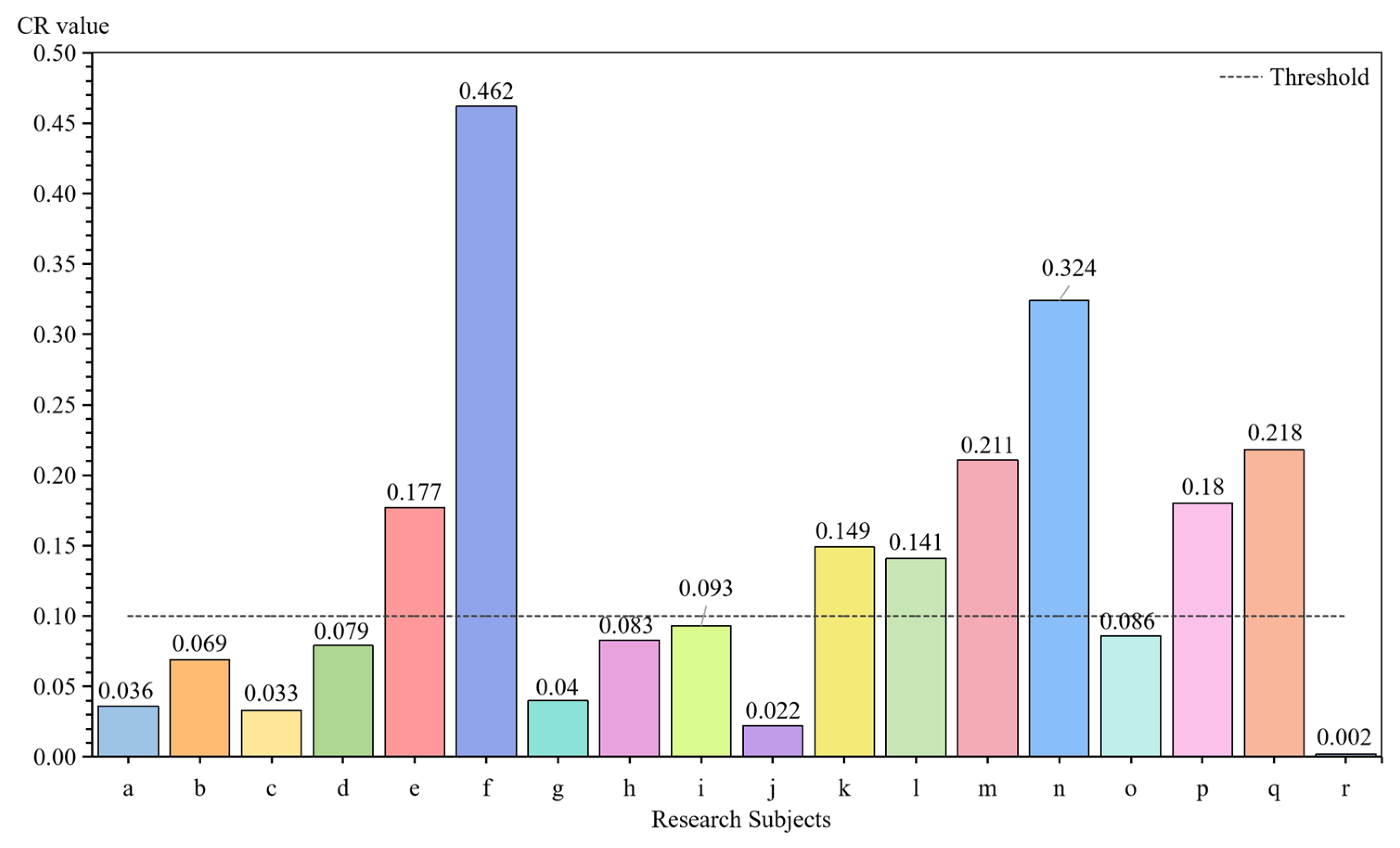
By applying the consistency test method described above, the hierarchical analysis module of the SPSSAU online platform was used to sequentially perform consistency tests on the judgment matrices derived from the 18 research subjects, producing the corresponding results (see Figure 2).
Figure 2.
Results of CR values for 18 research subjects.
The results of the consistency test indicate that 11 teachers successfully passed, reflecting clear and coherent judgments regarding the analyzed indicators in this study. Conversely, the judgment matrices of the seven teachers who failed the test demonstrated greater inconsistencies in their hierarchical analyses. Therefore, the results from the 11 consistent hierarchical analyses will be utilized in the subsequent analysis of this research. While the small retained sample (N = 11) limits generalizability, AHP surveys are substantially more demanding than standard questionnaires, which constrained recruitment. Nonetheless, the strict consistency screening (CR < 0.1) ensures that each included response is internally reliable.
4.2. Requirement Analysis
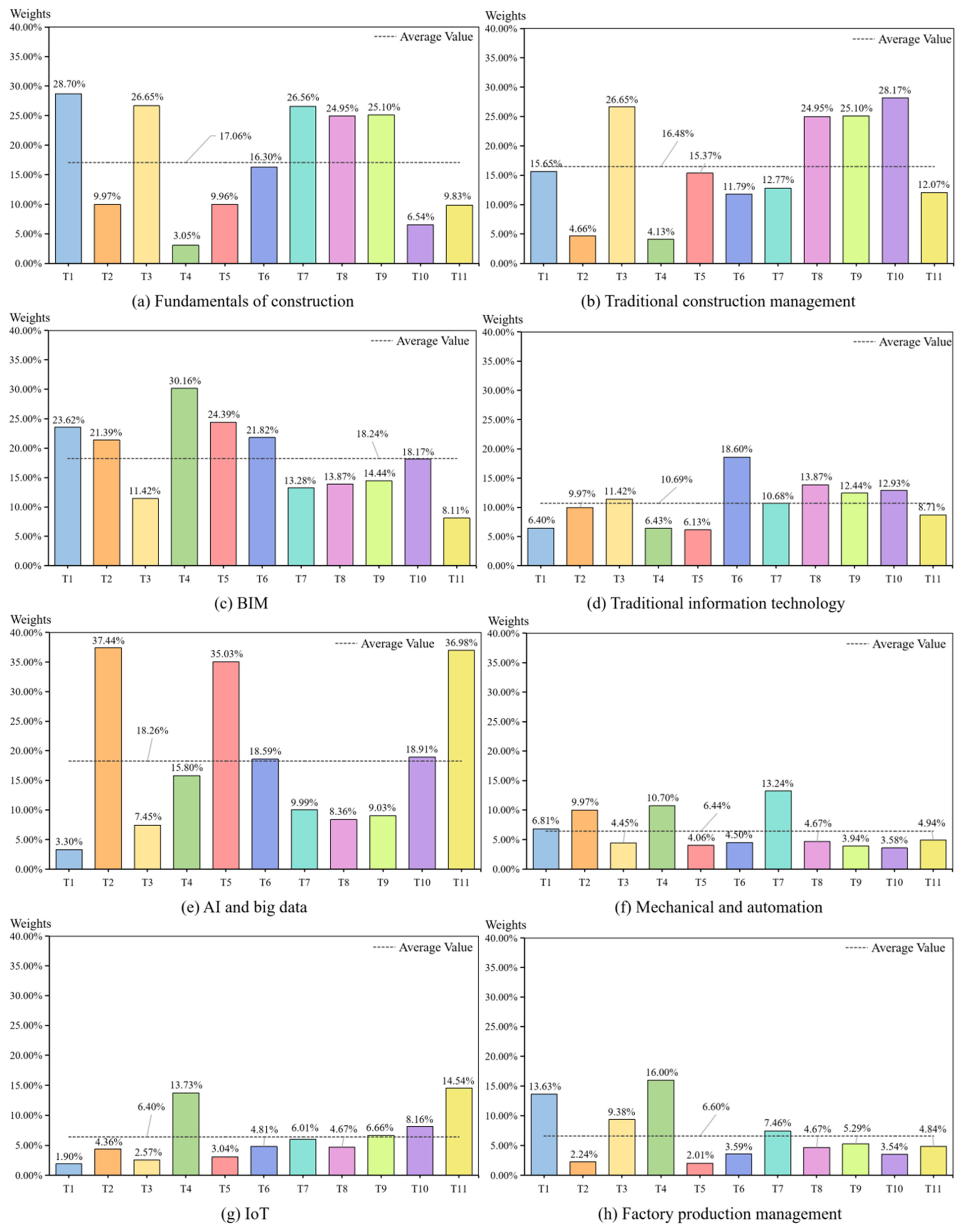
In this study, the importance values obtained through the hierarchical analyses conducted by the 11 teachers were categorized according to the eight knowledge indicators. Statistical bar charts were created for each knowledge indicator, with the 11 research participants relabeled as subjects T1 to T11 (see Figure 3). In these charts, the X-axis represents the research participants, the Y-axis indicates the specific importance values, and each bar depicts the importance value assigned to the respective knowledge indicator by each participant. Additionally, the dotted line in each chart represents the average importance value of the corresponding knowledge indicator.
Figure 3.
Results of AHP for eight knowledge.
At a time when intelligent construction technology is evolving rapidly, the construction industry as a whole is moving toward intelligence at an unprecedented pace. However, an examination of the statistical graphs derived from the questionnaire survey clearly reveals significant disparities in the teachers’ evaluations concerning the importance of each knowledge category, which is inconsistent with initial expectations. In addition to random errors, these variations might reflect differing levels of awareness and understanding among educators regarding emerging technologies, despite the rapid advancement in the intelligent construction field.
In this AHP questionnaire survey, statistical analysis was conducted on several key knowledge indicators. The analysis of mean values indicates a distinct two-tier distribution among the eight knowledge categories. Specifically, mechanical and automation knowledge, IoT knowledge, and factory production management knowledge exhibited relatively lower average importance values around 6.00%, whereas the other knowledge categories exhibited importance levels exceeding 10.00%. Such differentiation implies that within the existing educational system and professional perspectives, certain emerging technological domains (e.g., IoT and factory production management) might be comparatively underestimated.
Additionally, notable disparities were identified within individual indicator evaluations. For instance, AI and big data knowledge exhibited the most substantial variation of 34.14% between the highest and lowest values, followed by fundamentals of construction knowledge with a variance of 25.65%. In contrast, mechanical and automation knowledge presented the smallest variance of 9.66%. These substantial differences indicate not merely statistical fluctuation but likely represent deeper issues, including varying familiarity with these rapidly evolving technologies, differences in educational backgrounds among faculty, and possibly an inconsistency between current curricula and actual industry demands.
This observed phenomenon highlights an important potential issue: despite the industry’s rapid progression toward intelligent construction, a unified, systematic understanding and prioritization of knowledge areas among educators remain incomplete. This inconsistency could adversely impact the effectiveness of talent training, hindering students’ preparation for real-world industry demands and technological advancements. Therefore, to systematically reconcile these disparities, the present study will utilize the CR-weighted improved AHP method, further analyzing the survey’s consistency. This approach will provide a more robust and reliable hierarchy of knowledge importance, guiding educators in aligning curricula more closely with emerging industry trends and demands. Consequently, based on these deeper insights, specific recommendations for curriculum reform and talent development within undergraduate construction management programs will be formulated.
4.3. Priority Assessment
First, the CR values of the 11 hierarchical analysis results that passed the consistency test were aggregated (see Table 5).
Table 5.
CRs successfully passing the consistency test.
Using Equation (9), the AC values for the 11 teachers, labeled T1 to T11, were calculated. The adjustment coefficient k, with a value range determined by Equation (8) (ranging from 0 to 2.5), was set to 1 for the convenience of the calculations in this study. The results were rounded to two decimal places (see Table 6).
Table 6.
The adjustment coefficient values for eight teachers.
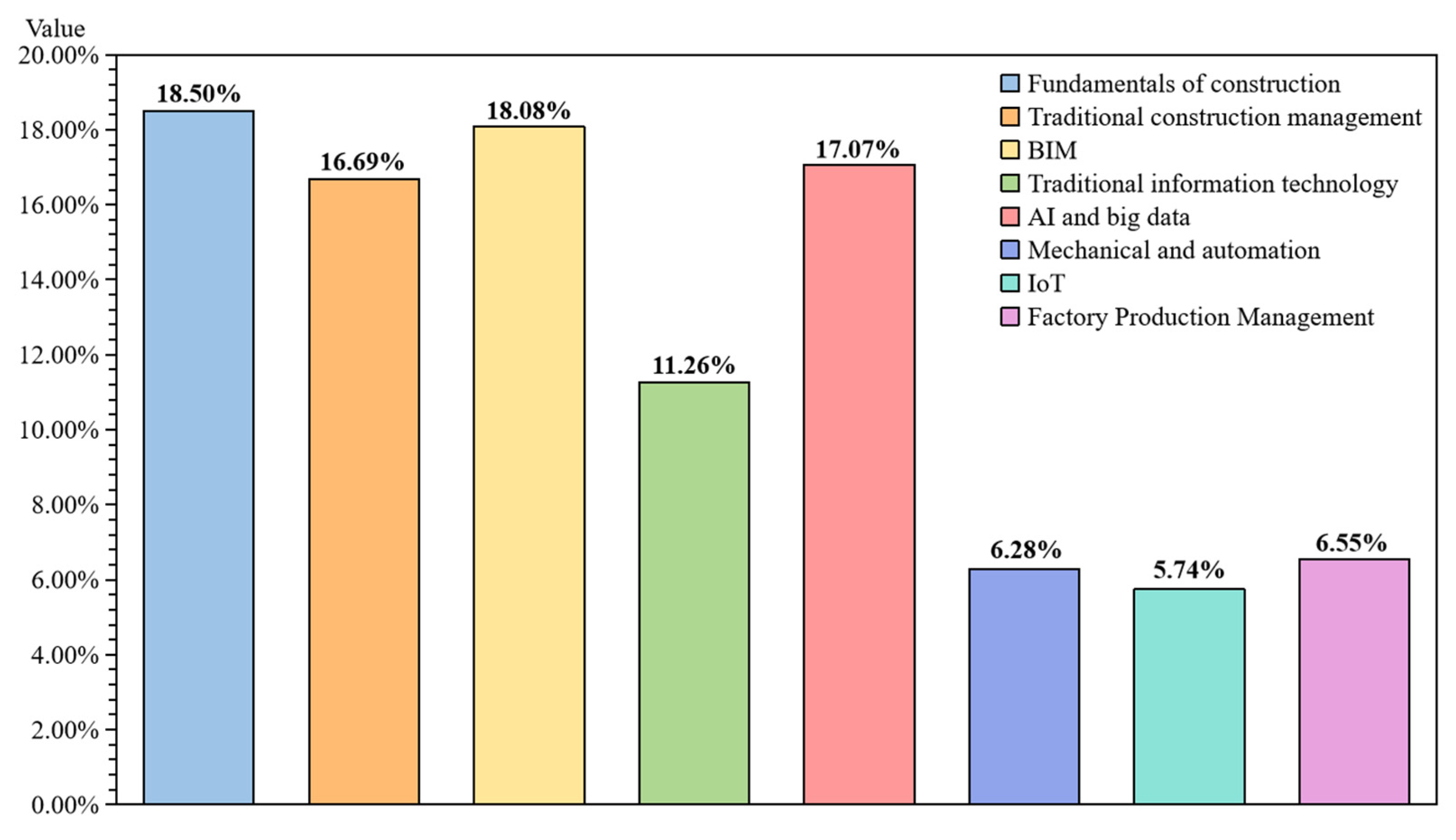
Using the calculated AC values, Equations (5) and (6) are applied to the importance values to obtain the final importance values for each knowledge category (see Figure 4).
Figure 4.
Final importance values for each knowledge item.
5. Findings and Discussion
5.1. Summary of Findings
By comparing the magnitude of the final importance values, we determine the ranking of the eight knowledge categories to be included in the knowledge system for construction management talent cultivation, as proposed in this study and aligned with the rapid development of intelligent construction. The ranking is as follows: fundamentals of construction, BIM knowledge, AI and big data knowledge, traditional construction management knowledge, traditional information technology knowledge, factory production management knowledge, machinery and automation knowledge, and IoT knowledge. Based on these findings, this study proposes the following recommendations for addressing the challenge of updating the knowledge system for the construction management profession in the context of intelligent construction.
The emphasis on cultivating fundamentals of construction and BIM knowledge should be strengthened in talent training programs. With these two categories accounting for 18.50% and 18.08% of the importance in intelligent construction, they are crucial for shaping the competencies of construction management professionals. The ranking of fundamentals of construction reflects the continued, and perhaps growing, demand for strong construction expertise, as the increasing complexity of projects due to advancements in intelligent construction technologies necessitates a solid understanding of traditional construction practices. These foundational skills ensure effective project management, focusing on safety, quality, and efficiency. Therefore, universities should integrate these courses into curricula, combining theoretical learning with practical BIM applications. Collaborating with industry partners to provide real-world BIM scenarios through internships or joint projects would further enhance students’ readiness to meet the evolving demands of the intelligent construction industry.
In the revised training program, it is crucial to emphasize the acquisition of AI and big data knowledge, which holds an importance value of 17.07%, and traditional construction management knowledge, which accounts for 16.69%. The significance of AI and big data in today’s construction industry cannot be overstated. These areas are integral to the ongoing evolution of intelligent construction and provide students with the tools to analyze complex data, optimize construction processes, and innovate within the sector. Simultaneously, traditional construction management knowledge remains foundational and indispensable, ensuring that students possess a comprehensive understanding of core construction practices, management strategies, and project execution techniques. Consequently, the continued emphasis on these areas in the training program is vital to ensure that future professionals have a well-rounded skill set.
For other knowledge categories, such as traditional information technology, factory production management, mechanical and automation, and IoT knowledge, while they may not exceed the average importance value of 12.52%, these areas should still be comprehensively developed. The significance of these fields, though lower, is crucial for students to build interdisciplinary capabilities. These fields play an increasingly vital role as intelligent construction expands across various domains. Introducing cross-disciplinary training opportunities will allow students to integrate knowledge from multiple areas, thereby enhancing their versatility and adaptability in the evolving construction landscape. By incorporating such interdisciplinary courses into the curriculum, students will be better equipped to meet the diverse and dynamic needs of the industry.
5.2. Implications
The study identifies and categorizes eight essential knowledge areas for the intelligent construction era and prioritizes them using an improved AHP method. This method is weighted by the Consistency Ratio (CR) to reduce subjective biases and improve result consistency through an emphasis on shared priorities. The approach addresses inconsistencies in traditional AHP and increases the reliability of the results. The updated knowledge system aligns with advances in intelligent construction and supports the theoretical framework of construction management education. It also provides a foundation for future research and curriculum development.
From a practical perspective, this study offers valuable guidance to curriculum developers and educators. It helps align programs with industry needs and technological trends. By focusing on the highest-priority knowledge areas, educational institutions can use limited instructional time and resources more efficiently. This improves undergraduate training for the intelligent construction era. By prioritizing these knowledge areas in the curriculum, we can better equip the intelligent construction industry with the skilled talent it needs. This approach supports sustainability goals in construction by enabling data-driven decisions that reduce rework, waste, and lifecycle impacts, ultimately fostering more sustainable practices in the industry.
6. Conclusions
This study not only contributes to the theoretical framework of construction management education but also offers practical guidance for curriculum developers and educators. To optimize training within limited teaching time, educators should prioritize the highest-ranked knowledge categories, namely “Fundamentals of Construction” (18.50%), “BIM” (18.08%), and “AI and Big Data” (17.07%). These three areas are essential for shaping future professionals in intelligent construction. The study identifies and categorizes eight critical knowledge areas using a CR-weighted improved AHP method, which overcomes limitations of traditional AHP by enhancing consistency and reducing bias, thus improving the reliability of importance rankings. This updated knowledge system aligns with intelligent construction advancements and establishes a foundation for future curriculum development and research.
In summary, the new talent training program for construction management should balance the integration of emerging technologies—particularly BIM, AI, and big data—with continued emphasis on traditional construction knowledge. This approach supports the development of a comprehensive curriculum that equips students to contribute effectively to the rapidly advancing intelligent construction industry. By cultivating both specialized and foundational competencies, the program ensures graduates are prepared to address the challenges and opportunities of this evolving field.
The target respondents are faculty members involved in undergraduate teaching. Although variations in academic background and teaching experience may influence individual assessments, the CR-weighted method mitigates such discrepancies by addressing response inconsistencies, resulting in more objective and representative rankings. Being ranked lower speaks to prioritization within an educator framework, not to the domains’ inherent value. Future studies could further strengthen these findings by: (1) conducting sensitivity analysis or cross-validation using alternative multi-criteria decision-making methods; and (2) expanding the participant pool to survey construction industry professionals. This approach would not only increase the sample size but also compensate for the current limitation of relying exclusively on data from educators, thus providing validation from a critical industry perspective.
Author Contributions
Conceptualization, D.L. and Y.H. (Yao Huang); methodology, Y.Z. and W.L.; validation, D.L. and Y.Z.; investigation, Y.Z. and Y.H. (Yao Huang); writing—original draft preparation, Y.Z.; writing—review and editing, D.L., Y.H. (Yunfei Hou) and W.L.; funding acquisition, D.L. and Y.H. (Yao Huang). All authors have read and agreed to the published version of the manuscript.
Funding
This research was funded by the Research Project on Teaching Reform in Colleges and Universities of Hunan Province (Nos. HNJG-2022-0597, HNJG-2023-0379 and 202401000607), the Degree and Graduate Education Teaching Reform Project of Changsha University of Science & Technology (No. CLYJSJG25007), and the Research Achievements of Hunan Provincial Education Science Planning Projects (No. XJK23QGD003).
Data Availability Statement
The data presented in this study are available upon request from the corresponding author.
Conflicts of Interest
The authors declare no conflicts of interest.
Appendix A
Filling judgment matrix.
respectively, represent two pieces of knowledge to be compared. Here, we present two examples to aid in the understanding of the filling rules:
Example 1: If you think that traditional construction management knowledge () is significantly more important than fundamentals of construction knowledge (), fill in 5 in the form.
Example 2: If you consider fundamentals of construction knowledge () to be extremely important over BIM knowledge (Building Information Modeling) (), fill in 1/9 in the form.
Table A1.
Evaluation scale description.
Table A1.
Evaluation scale description.
| Numerical Value | Linguistic Definition |
|---|---|
| 1 | Equal importance |
| 3 | Weak importance of one over another |
| 5 | Essential or strong importance |
| 7 | Demonstrated importance |
| 9 | Absolute importance |
| 2, 4, 6, 8 | Intermediate judgments between two adjacent judgments |
Table A2.
Hierarchical analysis questionnaire form.
Table A2.
Hierarchical analysis questionnaire form.
| Fundamentals of Construction Knowledge | Traditional Construction Management Knowledge | BIM Knowledge | Traditional Information Technology Knowledge | Artificial Intelligence and Big Data Knowledge | Mechanical and Automation Knowledge | Internet of Things Knowledge | Factory Production Management Knowledge | ||
|---|---|---|---|---|---|---|---|---|---|
| Fundamentals of construction knowledge | 1 | —— | —— | —— | —— | —— | —— | —— | |
| Traditional construction management knowledge | 1 | —— | —— | —— | —— | —— | —— | ||
| BIM knowledge | 1 | —— | —— | —— | —— | —— | |||
| Traditional information technology knowledge | 1 | —— | —— | —— | —— | ||||
| Artificial intelligence and big data knowledge | 1 | —— | —— | —— | |||||
| Mechanical and automation knowledge | 1 | —— | —— | ||||||
| Internet of Things knowledge | 1 | —— | |||||||
| Factory production management knowledge | 1 | ||||||||
References
- Lai, J.; Wan, R.; Chong, H.-Y.; Liao, X. Digital Intelligence in Building Lifecycle Management: A Mixed-Methods Approach. Sustainability 2025, 17, 5121. [Google Scholar] [CrossRef]
- de Almeida Barbosa Franco, J.; Domingues, A.M.; de Almeida Africano, N.; Deus, R.M.; Battistelle, R.A.G. Sustainability in the civil construction sector supported by industry 4.0 technologies: Challenges and opportunities. Infrastructures 2022, 7, 43. [Google Scholar] [CrossRef]
- Gunduz, M.; Almuajebh, M. Critical success factors for sustainable construction project management. Sustainability 2020, 12, 1990. [Google Scholar] [CrossRef]
- Nikmehr, B.; Hosseini, M.R.; Martek, I.; Zavadskas, E.K.; Antucheviciene, J. Digitalization as a strategic means of achieving sustainable efficiencies in construction management: A critical review. Sustainability 2021, 13, 5040. [Google Scholar] [CrossRef]
- Chen, Y.; Huang, D.; Liu, Z.; Osmani, M.; Demian, P. Construction 4.0, Industry 4.0, and Building Information Modeling (BIM) for sustainable building development within the smart city. Sustainability 2022, 14, 10028. [Google Scholar] [CrossRef]
- Li, J.; Liu, Z.; Han, G.; Demian, P.; Osmani, M. The relationship between Artificial Intelligence (AI) and Building Information Modeling (BIM) technologies for sustainable building in the context of smart cities. Sustainability 2024, 16, 10848. [Google Scholar] [CrossRef]
- Dagou, H.H.; Gurgun, A.P.; Koc, K.; Budayan, C. The Future of Construction: Integrating Innovative Technologies for Smarter Project Management. Sustainability 2025, 17, 4537. [Google Scholar] [CrossRef]
- Wang, X.; Wang, S.; Song, X.; Han, Y. IoT-based intelligent construction system for prefabricated buildings: Study of operating mechanism and implementation in China. Appl. Sci. 2020, 10, 6311. [Google Scholar] [CrossRef]
- Eid, A.E.; Hayder, G.; Alhussian, H. Applications of Intelligent Models in Processes in the Construction Industry: Systematic Literature Review. Processes 2025, 13, 2866. [Google Scholar] [CrossRef]
- Jaiswal, A.; Arun, C.J.; Varma, A. Rebooting employees: Upskilling for artificial intelligence in multinational corporations. Artif. Intell. Int. HRM. 2022, 33, 1179–1208. [Google Scholar] [CrossRef]
- Lu, C.; Liu, J.; Liu, Y.; Liu, Y. Intelligent construction technology of railway engineering in China. Front. Eng. Manag. 2019, 6, 503–516. [Google Scholar] [CrossRef]
- Cheng, J.-Y.; Devkota, A.; Gheisari, M.; Jeelani, I.; Franz, B.W. AI Integration in Construction Education: A Survey on Awareness, Attitudes, and Implementation of AI among US and International Faculties. J. Civ. Eng. Educ. 2025, 151, 04025009. [Google Scholar] [CrossRef]
- Cañavate, J.; Martínez-Marroquín, E.; Colom, X. Engineering a Sustainable Future Through the Integration of Generative AI in Engineering Education. Sustainability 2025, 17, 3201. [Google Scholar] [CrossRef]
- Wen, Y. Research on the intelligent construction of prefabricated building and personnel training based on BIM5D. J. Intell. Fuzzy Syst. 2021, 40, 8033–8041. [Google Scholar] [CrossRef]
- Wang, S.; Meng, J.; Xie, Y.; Jiang, L.; Ding, H.; Shao, X. Reference training system for intelligent manufacturing talent education: Platform construction and curriculum development. J. Intell. Manuf. 2023, 34, 1125–1164. [Google Scholar] [CrossRef]
- Sepasgozar, S.M. Digital twin and web-based virtual gaming technologies for online education: A case of construction management and engineering. Appl. Sci. 2020, 10, 4678. [Google Scholar] [CrossRef]
- Quintero, W.R.; Maldonado, J.E.N. Competencies of the engineer in industry 4.0 context: A systematic literature review. Production 2024, 34, e20230051. [Google Scholar] [CrossRef]
- Cui, M. Discussion on the Cultivation of Architectural Talents in Applied Universities in Digital Transformation. Ind. Eng. Innov. Manag. 2022, 5, 45–49. [Google Scholar] [CrossRef]
- Zhang, M.; Shu, L.; Luo, X.; Yuan, M.; Zheng, X. Virtual reality technology in construction safety training: Extended technology acceptance model. Autom. Constr. 2022, 135, 104113. [Google Scholar] [CrossRef]
- Zhang, X.; Zhang, Y.; Lv, Y.; Zhang, H. Innovative application of electrical and intelligent personnel training mode in the construction industry under the background of artificial intelligent technology. J. Phys. Conf. Ser. 2021, 1915, 042026. [Google Scholar] [CrossRef]
- Chong, H.-Y.; Lee, C.-Y.; Wang, X. A mixed review of the adoption of Building Information Modelling (BIM) for sustainability. J. Clean. Prod. 2017, 142, 4114–4126. [Google Scholar] [CrossRef]
- Xu, J.; Yu, J.; Shi, Q.; Zhang, L.; Wang, J. Evaluation of the Development of Intelligent-Construction Pilot Cities in China Based on the Entropy Method and TOPSIS. Buildings 2024, 14, 2914. [Google Scholar] [CrossRef]
- Huang, Y.; Shi, Q.; Zuo, J.; Pena-Mora, F.; Chen, J. Research Status and Challenges of Data-Driven Construction Project Management in the Big Data Context. Adv. Civ. Eng. 2021, 2021, 6674980. [Google Scholar] [CrossRef]
- Ghansah, F.A.; Lu, W. Major opportunities of digital twins for smart buildings: A scientometric and content analysis. Smart Sustain. Built Environ. 2024, 13, 63–84. [Google Scholar] [CrossRef]
- An, H.; Jiang, L.; Chen, X.; Gao, Y.; Wang, Q. Cloud Model-Based Intelligent Construction Management Level Assessment of Prefabricated Building Projects. Buildings 2024, 14, 3242. [Google Scholar] [CrossRef]
- Khan, A.M.; Alrasheed, K.A.; Waqar, A.; Almujibah, H.; Benjeddou, O. Internet of things (IoT) for safety and efficiency in construction building site operations. Sci. Rep. 2024, 14, 28914. [Google Scholar] [CrossRef] [PubMed]
- Anumba, C.; Khallaf, R. Use of Artificial Intelligence to Improve Knowledge Management in Construction. IOP Conf. Ser. Earth Environ. Sci. 2022, 1101, 032004. [Google Scholar] [CrossRef]
- Johnson, M.; Jain, R.; Brennan-Tonetta, P.; Swartz, E.; Silver, D.; Paolini, J.; Mamonov, S.; Hill, C. Impact of big data and artificial intelligence on industry: Developing a workforce roadmap for a data driven economy. Glob. J. Flex. Syst. Manag. 2021, 22, 197–217. [Google Scholar] [CrossRef]
- Saaty, T.L. How to make a decision: The analytic hierarchy process. Eur. J. Oper. Res. 1990, 48, 9–26. [Google Scholar] [CrossRef]
- Lin, C.-C.; Wang, W.-C.; Yu, W.-D. Improving AHP for construction with an adaptive AHP approach (A3). Autom. Constr. 2008, 17, 180–187. [Google Scholar] [CrossRef]
- Bai, H.; Yu, H.; Bantsimba N, R.; Luo, L. How college experiences impact student learning outcomes: Insights from Chinese undergraduate students. Front. Psychol. 2022, 13, 1021591. [Google Scholar] [CrossRef]
- Zhang, Q.; Yang, S.; Liao, P.-C.; Chen, W. Influence mechanisms of factors on project management capability. J. Manag. Eng. 2020, 36, 04020045. [Google Scholar] [CrossRef]
- Rajput, B.; Kore, S.; Agarwal, A. Competencies of civil engineering graduates: Indian construction professionals’ perspective. Int. J. Constr. Manag. 2024, 24, 1240–1248. [Google Scholar] [CrossRef]
- Ottaviani, F.M.; Zenezini, G.; Saba, F.; De Marco, A.; Gavinelli, L. System-Level Critical Success Factors for BIM Implementation in Construction Management: An AHP Approach. Systems 2025, 13, 94. [Google Scholar] [CrossRef]
- Parsamehr, M.; Perera, U.S.; Dodanwala, T.C.; Perera, P.; Ruparathna, R. A review of construction management challenges and BIM-based solutions: Perspectives from the schedule, cost, quality, and safety management. Asian J. Civ. Eng. 2023, 24, 353–389. [Google Scholar] [CrossRef]
- Wang, T.; Chen, H.-M. Integration of building information modeling and project management in construction project life cycle. Autom. Constr. 2023, 150, 104832. [Google Scholar] [CrossRef]
- Froese, T.M. The impact of emerging information technology on project management for construction. Autom. Constr. 2010, 19, 531–538. [Google Scholar] [CrossRef]
- Munawar, H.S.; Ullah, F.; Qayyum, S.; Shahzad, D. Big Data in Construction: Current Applications and Future Opportunities. Big Data Cogn. Comput. 2022, 6, 18. [Google Scholar] [CrossRef]
- You, K.; Zhou, C.; Ding, L. Deep learning technology for construction machinery and robotics. Autom. Constr. 2023, 150, 104852. [Google Scholar] [CrossRef]
- Wan, J.; Li, X.; Dai, H.-N.; Kusiak, A.; Martinez-Garcia, M.; Li, D. Artificial-intelligence-driven customized manufacturing factory: Key technologies, applications, and challenges. Proc. IEEE 2020, 109, 377–398. [Google Scholar] [CrossRef]
- Chen, Y.; Wang, X.; Liu, Z.; Cui, J.; Osmani, M.; Demian, P. Exploring building information modeling (bim) and internet of things (iot) integration for sustainable building. Buildings 2023, 13, 288. [Google Scholar] [CrossRef]
- Khorasani, M.; Loy, J.; Ghasemi, A.H.; Sharabian, E.; Leary, M.; Mirafzal, H.; Cochrane, P.; Rolfe, B.; Gibson, I. A review of Industry 4.0 and additive manufacturing synergy. Rapid Prototyp. J. 2022, 28, 1462–1475. [Google Scholar] [CrossRef]
- Jiang, D. The construction of smart city information system based on the Internet of Things and cloud computing. Comput. Commun. 2020, 150, 158–166. [Google Scholar] [CrossRef]
- Zhai, Y.; Sun, Y.; Li, Y.; Tang, S. Design for assembly in construction system: Three iterative upgrades of a panelized system. Archit. Eng. Des. Manag. 2024, 21, 1–20. [Google Scholar] [CrossRef]
- Yuan, Z.; Wang, H.; Yang, Y.; Yi, C.; Huang, D.; Yu, D. Improving the construction accuracy of precast components in prefabricated buildings by analyzing relevant factors from the perspective of supply chain: A system dynamics model. Archit. Eng. Des. Manag. 2024, 20, 230–248. [Google Scholar] [CrossRef]
- Zhou, Z.; Syamsunur, D.; Wang, L.; Nugraheni, F. Identification of Impeding Factors in Utilising Prefabrication during Lifecycle of Construction Projects: An Extensive Literature Review. Buildings 2024, 14, 1764. [Google Scholar] [CrossRef]
Disclaimer/Publisher’s Note: The statements, opinions and data contained in all publications are solely those of the individual author(s) and contributor(s) and not of MDPI and/or the editor(s). MDPI and/or the editor(s) disclaim responsibility for any injury to people or property resulting from any ideas, methods, instructions or products referred to in the content. |
© 2025 by the authors. Licensee MDPI, Basel, Switzerland. This article is an open access article distributed under the terms and conditions of the Creative Commons Attribution (CC BY) license (https://creativecommons.org/licenses/by/4.0/).