Abstract
The Yellow River (YR) has the highest suspended sediment concentration in the world, with its water and sediment exerting a significant influence on nutrient transport and transformation processes. The periodic regulation of water and sediment by the Xiaolangdi Dam, has significantly altered downstream water and sediment transport. This study examined the impact of the Xiaolangdi Dam’s 2023 water-sediment regulation on nitrogen dynamics in the lower Yellow River (LYR). Surface water, suspended sediment, and deposited sediment samples were collected at seven downstream stations to analyze changes in nitrogen concentration, sources, and transformation processes. As the water regulation stage progresses, the (total nitrogen) TN concentration in the water phase decreased, while that of NO3--N increased slightly. Concurrently, the inorganic nitrogen concentration in the suspended phase also declined. As the sediment regulation stage progresses, the TN and NO3−-N concentrations in the water phase continued to decrease, while the inorganic nitrogen concentration in the suspended phase showed an initial increase followed by a decrease. As the early stage of sediment regulation progresses, ammonia concentrations decreased, while nitrate concentrations increased and δ18O-NO3− value decreased indicated nitrification occurred. As the late stage of sediment regulation progresses, nitrate concentrations decreased and the δ15N-NO3− value increased, indicated denitrification occurred. The TN flux during water-sediment regulation reaches 41.5 kt (14.6% of the annual flux). During the water-sediment regulation stage, the main nitrate sources were manure and sewage. This contribution peaked at 54.2% during the sediment regulation stage. The research results provide a scientific basis for the relationship between water and sediment changes and nitrogen output changes in the LYR.
1. Introduction
As the important carriers and delivers of nutrients in the rivers [1], water and sediment in the river system have been modified by the construction of large dams and reservoirs [2]. These alterations impact the downstream transport and fates of in-river nutrients by altering hydrodynamic conditions, including the deposition and resuspension of sediments [3,4,5,6,7]. Furthermore, such modifications influence biogeochemical processes, such as the coupled nitrification–denitrification of nitrogen. Nitrogen is an essential nutrient for aquatic organisms, but its excess discharge into rivers and further transport to oceans due to the over-application of artificial fertilizer in agriculture and industry has led to a series of environmental problems such as eutrophication [8,9]. It should be noted that not all of anthropogenic nitrogen reaching rivers is discharged into oceans, and some is transformed into nitrous oxide and dinitrogen gas, which is related to global warming [10]. Therefore, the issue of nitrogen pollution has sparked increasing concern globally.
It is well known that nitrogen in the aquatic systems mainly comes from atmospheric deposition, soil erosion, agricultural activities, industrial and municipal wastewater, animal feedlots and other waste disposal sites. Globally, it is reported that 187 Tg every year results from anthropogenic addition imported into rivers, of which 70% remains reactive [11]. Upon entering aquatic systems, nitrogen in both inorganic and organic forms becomes distributed among three phases: water, suspended sediments and deposited sediments, through a range of complex physicochemical and biological processes. Usually, the primary forms of nitrogen in the overlying water in large rivers are ammonia, ammonium and nitrate because of the oxic environment, while excess N concentrated in the suspended particulate matter (SPM) due to plankton debris is easily deposited on the sediment with SPM [12,13,14]. Sediment plays important roles in the N cycle by releasing ammonium N into the overlying water through diffusion, sediment resuspension and bioturbation. Therefore, the complexity of nitrogen fate is increased with significantly changing water and sediment of downstream rivers [7,15].
Recently, laboratory incubation experiments have demonstrated that nitrogen removal processes (e.g., denitrification, coupled nitrification–denitrification, and anaerobic ammonium oxidation (anammox)) can occur not only in anaerobic sediment but also in the oxic overlying water of rivers in the presence of SPS. This is largely because the water–sediment interface could create oxic–anoxic environment, which can provide simultaneous oxidation and reduction processes of aquatic nitrogen. Notably, nitrogen transformation rates increase with the increase in SPS concentrations and the decrease in SPS particle size [12,16,17,18,19]. Additionally, Alexander J et al. [20] conducted a study on 72 small streams in the United States and found that the nitrogen removal rate in the water bodies was higher than that in the deposited sediments.
As is well known, the YR with the highest suspended sediment concentration in the world, the second largest river in China and the sixth largest river in the world, accounted for approximately 6% of the global river sediment load [21]. Especially, LYR is characterized by “overhanging river” and sedimentation because a large amount of the suspended sediment is deposited in these reaches due to its wide and flat terrain and small slope [22,23]. A large amount of sand inevitably is deposited in the Xiaolangdi (XLD) Reservoir, the last gorge in the YR, to block sand to the downstream. To improve the capacity of the reservoir before the rainy season and alleviate sedimentation in the LYR, the water and sediment regulation (WSR) that jointly schedules the XLD Reservoir and its upstream Sanmenxia and Wanjiazhai reservoirs has been implemented from 2002. WSR includes the flood and sediment states and lasts for only 2–3 weeks. During the flood stage, clean water and fine sand in the XLD Reservoir is discharged to scour the downstream river channel. During the sediment stage, medium and coarse sand with gravity flows is discharged to the downstream river channel. Approximately half of the total annual sediment and water along with terrestrial nutrients are discharged into the LYR during 3–4 weeks. WSR evidently changes the hydrological processes and physicochemical characteristics of the downstream reaches and further alters nitrogen fate [6,24].
Previous studies mainly focused on the changes of nitrogen fluxes in the water phase in the LYR during WSR [6,12,23,25], while few studies have followed on nitrogen distribution and transformation between water, suspended sediments and deposited sediment phases [19,26,27]. The nitrogen fluxes transferred by water and suspended sediments to the ocean and transformation between water-suspended sediments remain unknown. The aims of this study are as follows: (1) to explain the nitrogen migration into the sea in response to changes in water and sediment conditions; (2) to analyze the impact of changes in water and sediment conditions on different forms of nitrogen; (3) to determine nitrogen transformation by the changes of nitrogen concentrations and nitrate isotopes; (4) to quantitatively identify the impact of water and sediment changes on the source of nitrate in the lower reaches of the YR. This study provides critical data support for the development of nitrogen pollution control strategies and the reduction of nitrogen flux into the sea in the LYR. The findings contribute to promoting the stability of aquatic ecosystems and supporting the sustainable utilization of water resources in the basin.
2. Material and Methods
2.1. Study Area
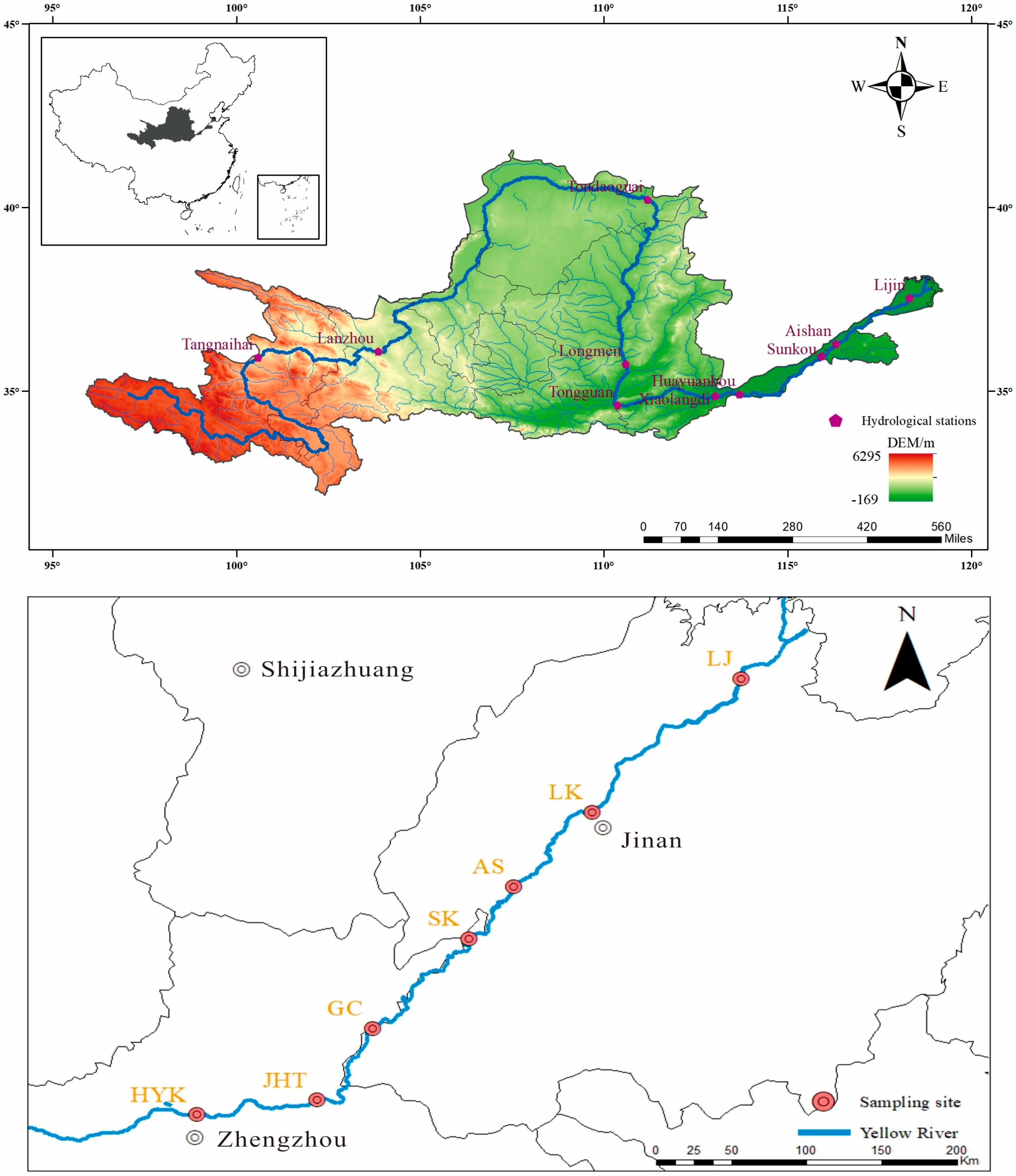
The YR originates from the Qinghai-Tibet Plateau, with a length of 5464 km and an area of 752,443 km2 (Figure 1) [28,29]. The suspended sediment of the YR mainly originates from the Loess Plateau which is in the middle reaches of the YR [30]. A large amount of sediments are deposited in the lower reaches which are known as “hanging rivers on the ground” because of the flat terrain. The XLD Reservoir, the last dam of the YR, is located in the upstream of the “hanging rivers on the ground”, with a storage capacity of 126.5 × 10⁸ m3 [31,32]. During 2023, the average annual temperature and precipitation were 12.4–14.3 °C and 616 mm, respectively [30,33]. The XLD Reservoir controls 91.5% of the total water volume and 98% of the total deposited sediments of the YR [34,35]. WSR in XLD started from 2002 in order to alleviate the severe sedimentation in the lower reaches of the YR [29].
Figure 1.
Yellow River basin map and sampling stations (Zhengzhou and Jinan are indicated as representative geographic reference points for the Henan and Shandong river sections, respectively).
2.2. Sampling and Pretreatment
2.2.1. Sample Collection
Samples of surface water, suspended sediments, and deposited sediments were collected at the HYK, JHT, GC, SK, AS, LK, and LJ stations (Table 1, Figure 1) which are located downstream of the XLD, on 12–15 June 2024 (before water and sediment regulation), 25–28 June (water regulation stage), 7–11 July (the first stage of sediment regulation), 11–14 July (the second stage of sediment regulation), and 1–3 September (after water and sediment regulation) in 2023. Surface water and suspended sediment samples were collected using a boat at each sampling station. Sampling was conducted across the left, middle, and right sections of the river channel. The samples from these three sections were blended to form a composite sample, which was stored in a 1 L polyethylene plastic bottle. Finally, deposited sediment samples were collected from the riverbed using a grab sampler at the hydrological station and stored in polyethylene plastic bags. They were refrigerated (at 4 °C) and transported to the laboratory for analysis.
Table 1.
Locations of 7 hydrological stations downstream of XLD Reservoir.
2.2.2. Field Measurement Parameters and Sample Pre-Treatment
Water temperature, pH, dissolved oxygen (DO), and electrical conductivity (EC) were measured by a multi-probe (Shanghai Sanxin, China) on the site and river flows were obtained from the hydrologic stations. The concentrations of nitrate nitrogen (NO3−-N) and ammonia nitrogen (NH4+-N), along with the nitrate isotopes, were measured for the surface water samples after filtering through a 0.22 μm acetate membrane within 12 h. The unfiltered water samples were retained for the determination of TN concentration. In addition, to determine suspended sediment concentrations (SSC) and their sizes, NO3−-N and NH4+-N concentrations and nitrate isotopes for the suspended sediment samples, mixed water samples were filtered by a 0.45 μm acetate filter membrane on site. These collected membranes were wrapped in tinfoil and transported in darkness under refrigeration (4 °C) to the laboratory for analysis. The extraction of nitrogen from suspended sediments and deposited sediments involves mixing the samples with pure water in ionized tubes, ultrasonication for 30 min, then shaking it on an oscillator at a speed of 220 rpm for 48 h. After shaking, the samples are centrifuged for 15 min at 4500 rpm, followed by filtration through a 22 μm filter membrane and storing under refrigeration (4 °C) for analysis.
2.3. Experimental Analysis
Determination of sediment concentrations: In the laboratory, the mass of pre-dried acetate fiber membranes was measured using an analytical balance with a precision of 0.0001 g. The filtered membranes were dried at 60 °C and weighed again to determine the mass of the membranes containing particulates. The concentrations of suspended sediments in the samples (mg·L−1) were calculated based on the differences in mass between the empty membrane and the membrane after filtration, as well as the volume of the water sample filtered.
Median particle size determination (D50-S and D50-D) for suspended and deposited sediments: a small portion of the sample (approximately 0.5 g) was mixed with 5 mL of 30% hydrogen peroxide and then reacted at 60 °C for 12 h to remove organic matter. Subsequently, 5 mL of 10% hydrochloric acid was added, and the mixture was allowed to react for another 12 h to remove inorganic carbon. After the reaction, the sample was washed three times with ultrapure water through centrifugation to remove excess acid and prevent damage to the measuring instrument. Before measurement, 10 mL of 0.05 mol·L−1 sodium hexametaphosphate was added, and the sample was dispersed by ultrasonic vibration. The particle size distribution was then measured using a laser particle size analyzer, with a test range of 0.02–2000 µm. Each sample was measured at least twice, with a relative deviation of less than 5% considered acceptable.
NH4+-N was measured by nano reagent spectrophotometry. TN was measured by spectrophotometry after oxidation by alkaline potassium persulfate. Cl− and NO3− concentrations were analyzed by ionic chromatography (ICS-1000), and the detection limits were 0.007 and 0.016 mg·L−1, respectively. During the determination of the TN, NO3−-N, and NH4+-N concentrations, a blank experiment was conducted simultaneously to eliminate background interference. Three parallel samples were inserted among the 10 samples, namely the blank sample, the quality control sample and the calibration sample. The error of the parallel samples should not exceed 10%. The linear correlation coefficients (R2) of the standard curves for all indicators exceeded 0.99.
δ15N-NO3− and δ18O-NO3− values were determined at the Geochemical Isotope Laboratory of the Shanghai Ocean University. NO3− was first converted to NO2− using cadmium particles, then NO2− was converted to N2O using sodium azide in a weakly acidic buffer. Finally, the reaction was terminated by NaOH. Nitrogen and oxygen isotopes of N2O in headspace bottle were determined using an isotope mass spectrometer (ThermoMAT253, Thermo Fisher Scientific, Waltham, MA, USA). The ratios of δ15N-NO3− and δ18O-NO3− are expressed in per mil (‰) relative to atmospheric N and Vienna Standard Mean Ocean Water (V-SMOW), respectively. Samples were corrected using international references (USGS32 and USGS34). The analytical precisions of δ15N-NO3− and δ18O-NO3− were ±0.3‰ and ±0.5‰, respectively. The measured nitrogen–oxygen isotope ratios are expressed by the symbol “δ” in parts per thousand (‰). The calculation formula for δ is shown in Equation (1).
where Rsample and Rstandard represent the δ15N/δ14N and δ18O/δ16O values of the sample and standard, respectively.
2.4. Calculation of Nitrogen Flux of the Yellow River
The nitrogen flux into the Bohai Sea was calculated using nitrogen concentrations and flow volumes measured at the LJ Station, which represents the final hydrological monitoring point on the YR before it discharges into the sea. The calculation formula for the annual nitrogen flux of the YR (FT) is shown in Equation (2).
where FD, FB, and FA represent the nitrogen flux during, before, and after water-sediment regulation, respectively. The 25-day FD can be estimated using Equation (3):
where Cwi and Cspsi represent the concentrations of nitrogen in the water and suspended stage on the ith day, respectively, and Qwi and Qspsi from http://www.yrcc.gov.cn/ accessed on 1 September 2023 represent the volumes of water and sediment entering the sea on the ith day, respectively. In this study, nitrogen concentration from 25 June to 28 June, from 7 July to 11 July and from 11 July to 14 July was used to represent the daily average of the water regulation stage, the first stage of sediment regulation and the second stage of sediment regulation, respectively.
The calculation methods for FB and FA are as shown in Equations (4) and (5).
where Cwb and Cwa represent the nitrogen concentrations in the surface water before and after water-sediment regulation, respectively; Cspsb and Cspsa represent the nitrogen concentrations in the suspended phase before and after regulation, respectively; Dwb and Dwa represent volumes of flow before and after regulation, respectively; and Dspsb and Dspsa represent the sediment discharges before and after regulation, respectively. Here, nitrogen concentration from 12 June to 15 June and from 1 September to 3 September was used to represent the daily average of before and after water-sediment regulation, respectively. The nitrogen content at each station was calculated using the same method.
2.5. SIAR Model
The SIAR model (v3.1.12), developed by Parnell et al. (2010), is a statistical software package implemented in the R programming environment [36]. In this study, the SIAR model was employed to identify nitrate sources and quantify the proportional contributions of different pollution sources across various periods in the LYR. The model utilizes a Dirichlet distribution as the prior distribution for source contributions. Following the incorporation of observational data, Bayesian methods were applied to analyze the posterior distribution of contamination source contributions. This approach, which adheres to a Bayesian framework, has been widely used for quantifying nitrate source apportionment in surface waters [34,35,37,38]. The formula of the SIAR model is as shown in Equations (6)–(9).
where Xij represents the isotope value j of the mixture i (i = 1, 2, 3, …, N; j = 1, 2, 3, …, J); Sjk denotes the source value k of isotope j (k = 1, 2, 3, …, K), which is normally distributed with mean μ and standard deviation ω; Pk is proportional contribution of source k, Cjk represents the fractionation factor of isotope j on source k, which is normally distributed with mean λ and standard deviation τ; and ξij represents the residual error of the isotope value j of the mixture i which is normally distributed with mean 0 and standard deviation σ.
3. Results
3.1. Hydrological Characteristics of the Lower Yellow River During Different Stages of Water-Sediment Regulation
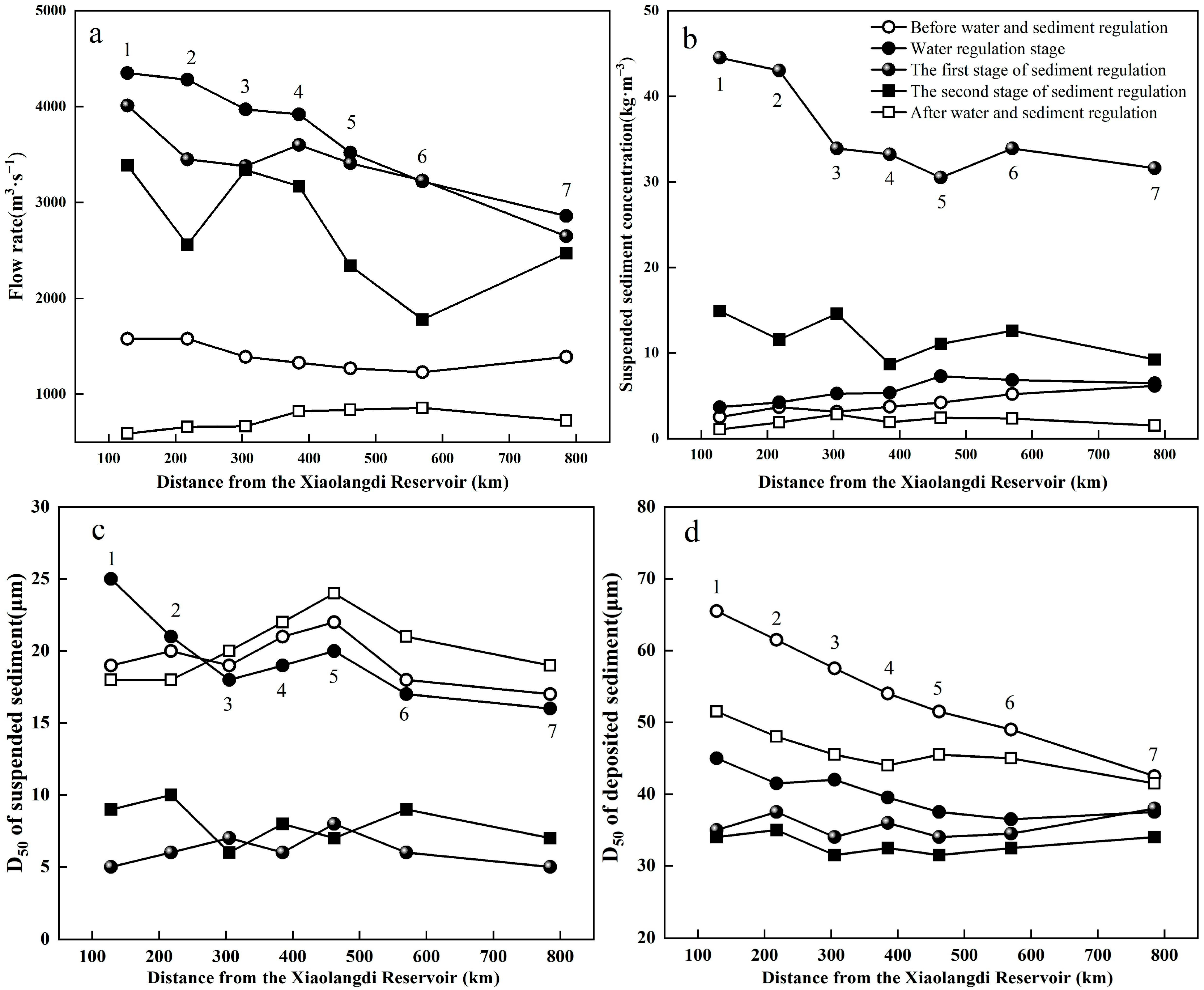
The water-sediment regulation stage began on 21 June 2023, and lasted for 25 days. During the water regulation stage, the flow rate of the LYR ranged from 2860 to 4350 m3/s, surpassing the flow rate during the sediment regulation stage (ranging from 1780 to 4010 m3/s). The highest flow rate during the regulation stage was recorded at HYK Station, where it reached 4350 m3/s. The flow rate gradually decreased along the flow direction (Figure 2a). The first stage of sediment regulation exhibited the highest concentration of suspended sediment (ranging from 30.5 to 44.6 kg/m3), followed by the second stage of sediment regulation (ranging from 8.7 to 14.6 kg/m3). The suspended sediment concentrations during the other stages remained below 10 kg/m3 (Figure 2b). The maximum concentration of suspended sediment was observed at HYK Station, reaching 44.6 kg/m3, and showed a decreasing trend along the flow direction. The median particle size (D50-S) of the suspended sediment in the LYR ranged from 5 to 25 µm (Figure 2c), with the lowest D50-S occurring during the sediment regulation stage, followed by the water regulation stage. The before and after water sediment regulation stage exhibited the highest D50-S. The median particle size (D50-D) of the deposited sediment ranged from 32 to 66 µm (Figure 2d), significantly exceeding that of the suspended sediment. Similar to D50-S, D50-D was lowest during the sediment regulation stage and decreased along the flow direction.
Figure 2.
Flow rate, suspended sediment concentration, and D50 of the suspended and deposited sediments in the LYR ((a). Flow rate; (b). suspended sediment concentration; (c). D50 of suspended sediment; (d). D50 of deposited sediment).
3.2. Changes in Nitrogen Concentrations in Water, Suspended, and Deposited Phases During Different Stages of Water-Sediment Regulation
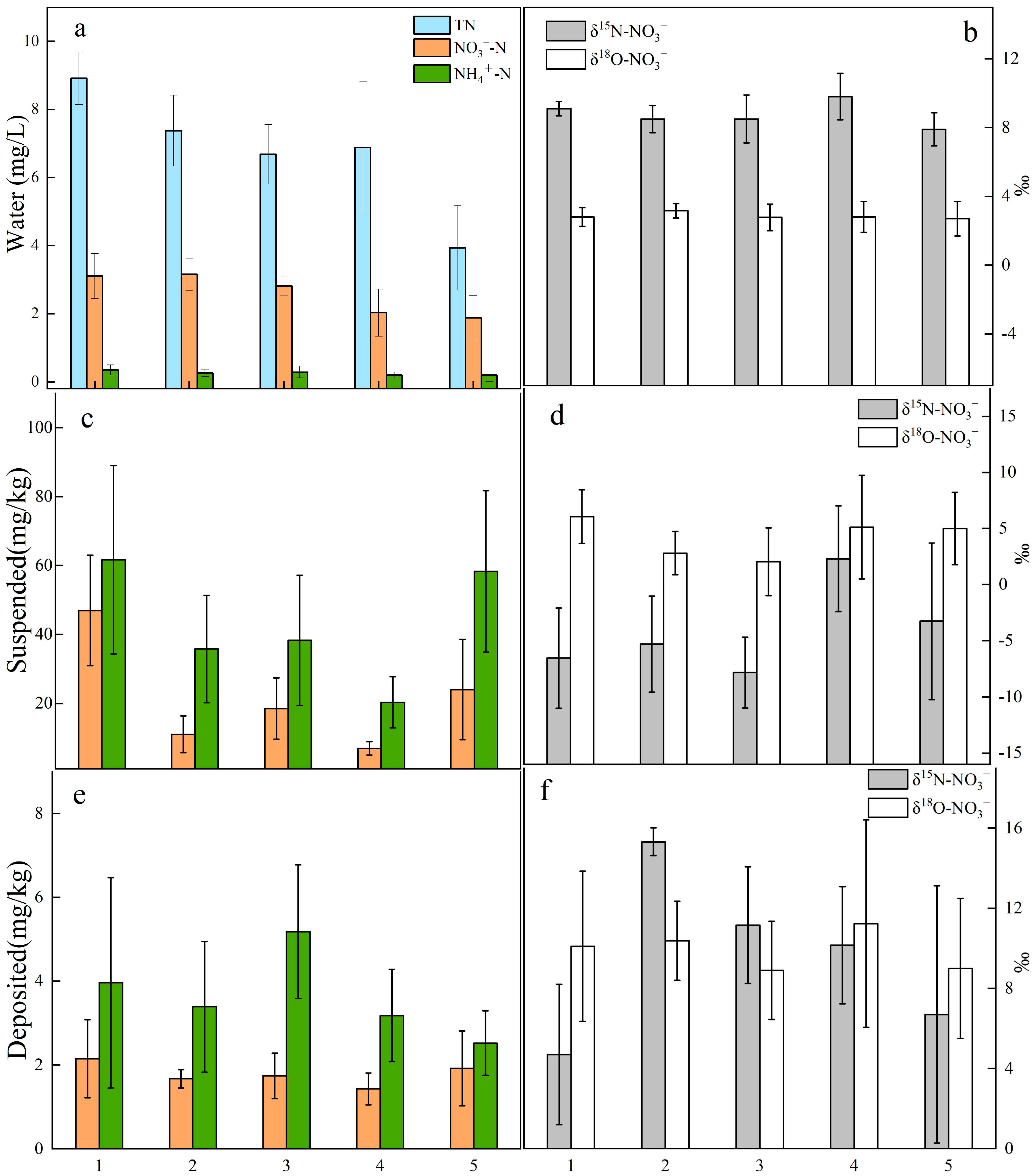
The TN concentration in the water phase ranged from 2.55 to 10.22 mg/L (mean 6.76 ± 2.01 mg/L), with nitrate nitrogen (NO3−-N) ranging from 0.81 to 4.40 mg/L (mean 2.60 ± 0.77 mg/L) and ammonium nitrogen (NH4+-N) ranging from 0.07 to 0.66 mg/L (mean 0.26 ± 0.15 mg/L) (Figure 3a). Notably, the NO3−-N concentrations were significantly greater than the NH4+-N concentrations. Prior to the implementation of the water-sediment regulation, the TN (mean 8.91 ± 0.84 mg/L) and NH4+-N (mean 0.35 ± 0.15 mg/L) concentrations were the highest. However, the NO3−-N concentration (mean 3.16 ± 0.47 mg/L) during the water regulation stage was slightly greater than that during the pre-regulation stage (mean 3.11 ± 0.66 mg/L). During the course of regulation, the NO3−-N concentration in the water phase initially showed a slight increase before eventually decreasing. Moreover, the TN concentration in the water phase gradually decreased, and the NH4+-N concentration in the water phase exhibited minimal change. In the suspended phase, the NO3−-N concentrations ranged from 4.33 to 64.88 mg/kg (mean 21.47 ± 17.46 mg/kg), while the NH4+-N concentrations ranged from 9.42 to 98.43 mg/kg (mean 42.79 ± 24.20 mg/kg) (Figure 3c). Unsimilar to those in the water phase, the NH4+-N concentrations were significantly greater than the NO3−-N concentrations. The highest concentrations of both NO3−-N (mean of 46.93 ± 16.03 mg/kg) and NH4+-N (mean of 61.63 ± 27.37 mg/kg) were detected before regulation, the lowest concentrations were found in the second stage of sediment regulation (6.92 ± 1.95 mg/kg for NO3−-N and 20.27 ± 7.40 mg/kg for NH4+-N). Throughout the regulation process, the NO3−-N concentration was higher in the first stage of sediment regulation than that in the water and second sediment regulation stages, and showed a progressive increase along the flow direction. Conversely, the NH4+-N concentration displayed a decreasing trend along the flow direction. In the second stage of sediment regulation, the NO3−-N concentration exhibited a fluctuating decreasing trend along the flow direction.
Figure 3.
Changes in average nitrogen concentrations and average nitrate isotope values in water, suspended, and deposited phases at different stages. 1: Before regulation; 2: water regulation; 3: first stage of sediment regulation; 4: second stage of sediment regulation; and 5: after regulation. The complete dataset is provided in Appendix A. ((a). average nitrogen concentrations in water phase; (b). average nitrate isotope in water phase; (c). average nitrogen concentrations in suspended phase; (d). average nitrate isotope in suspended phase; (e). average nitrogen concentrations in deposited phase; (f). average nitrate isotope in deposited phase).
In the deposition phase, the NO3−-N concentration ranged from 0.84 to 4.24 mg/kg (mean 1.78 ± 0.66 mg/kg), while the NH4+-N concentration ranged from 1.06 to 9.18 mg/kg (mean 3.50 ± 1.66 mg/kg) (Figure 3e). Notably, there were no significant differences in the NO3−-N concentration across the different stages, whereas the NH4+-N concentration during the first stage of sediment regulation (mean 5.18 ± 2.03 mg/kg) was higher than that during other stages.
3.3. Changes in Nitrate Isotope Characteristics in Water, Suspended, and Deposited Phases During Different Stages of Water-Sediment Regulation
In the water phase, the δ15N-NO3− values ranged from +6.4‰ to +11.0‰ (mean +8.8 ± 1.07‰), and the δ18O-NO3− values ranged from +1.6‰ to +4.6‰ (mean +2.8 ± 0.73‰) (Figure 3b). The highest δ15N-NO3− values were observed in the second stage of sediment regulation, ranging from +8.7‰ to +11.0‰ (mean +9.8 ± 0.79‰), with no significant differences in the δ15N-NO3− values during the other stages. In the suspended phase, the δ15N-NO3− values ranged from −12.3‰ to +8.8‰ (mean −4.1 ± 5.83‰), and the δ18O-NO3− values ranged from −3.0‰ to +11.9‰ (mean +4.2 ± 3.35‰) (Figure 3d). The δ15N-NO3− values during the second stage of sediment regulation (mean +2.3 ± 4.71‰) were significantly greater than those in the other stages. During the first stage of sediment regulation, the δ15N-NO3− and δ18O-NO3− values showed a fluctuating decreasing trend along the flow direction, whereas in the second stage, these values exhibited a fluctuating increasing trend along the flow direction. In the deposition phase, the δ15N-NO3− values ranged from −3.8‰ to +16.3‰ (mean +8.8 ± 5.43‰), and the δ18O-NO3− values ranged from +3.4‰ to +12.8‰ (mean +9.4 ± 2.78‰) (Figure 3f).
4. Discussion
4.1. Changes in Nitrogen Migration into the Sea During Water and Sediment Regulation
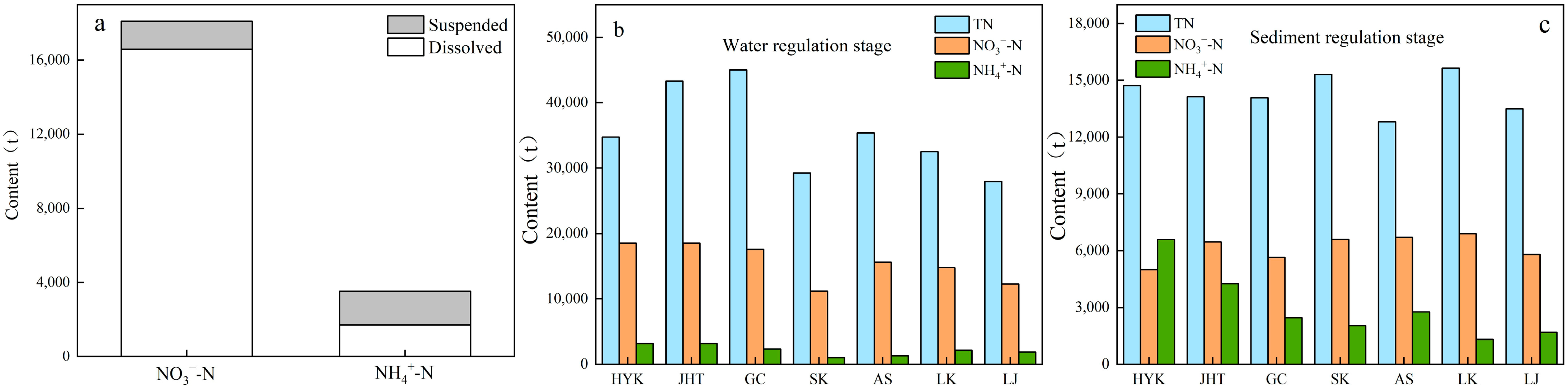
During the water and sediment regulation stage, the water and sediment in LYR undergo dynamic changes. Consequently, the changes in nitrogen caused by these variations are also dynamic. Although the research is limited and does not support fully dynamic monitoring of all stations in LYR, this study selects to sample during the decline in flow and the peaks and declines in sediment concentration during the water and sediment regulation stage. These three representative samplings can reflect the influence of changes in flow and sediment concentration on the changes in nitrogen in the water, suspended and sediment phase, minimizing the uncertainty in the calculation of nitrogen. Previous related studies have shown that the nitrogen concentration differences in LYR during before and after water and sediment regulation stage are not significant [25,39,40]. Therefore, in this study, the uncertainty of the nitrogen flux data obtained during the non-water and sediment regulation period due to the small sample size is ignored. In 2023, the total discharge of the YR reached 22.63 billion m3, with the discharge during the water and sediment regulation stage comprising 26% of the yearly total (the data is sourced from the Yellow River Conservancy Commission). This study utilizes data from 13 June to 1 September to represent the pre- and post-regulation stages. Based on these data, the estimated annual influx of TN into the sea from the YR in 2023 was 283,700 tons. During the water and sediment regulation stage, the TN influx into the sea amounted to 41,500 tons, accounting for 14.6% of the annual influx. Moreover, the annual influx of NO3−-N was 98,800 tons, with 18,100 tons (18.3%) entering the sea during the regulation stage. The annual influx of NH4+-N equated to 17,800 tons, while during the regulation stage, the influx was 3500 tons (19.9%) (Figure 4a). Despite comprising only 7% of the year, the regulation stage significantly facilitated the migration of nitrogen into the sea, resulting in increased TN, NO3−-N, and NH4+-N influxes. During the water regulation stage, the influxes of TN, NO3−-N, and NH4+-N from the LYR to the sea were 28,000 tons, 12,300 tons, and 1900 tons, respectively (Figure 4b). In contrast, during the sediment regulation stage, these influxes decreased to 13,500 tons, 5800 tons, and 1700 tons, respectively (Figure 4c). This demonstrates that the nitrogen influx into the sea was greater during the water regulation stage than during the sediment regulation stage.
Figure 4.
(a) Fluxes of nitrate and ammonium nitrogen entering the sea (at Lijin station) during water and sediment regulation; (b) nitrogen concentrations at various stations during the water regulation stage; (c) nitrogen concentrations during the sediment regulation stage.
In the Henan section of the LYR, the TN concentration increased downstream during the water regulation stage. However, the NO3−-N and NH4+-N concentrations did not exhibit the same trend. This implies that soil erosion along the riverbanks, caused by clear water from the XLD Reservoir, brought terrestrial nitrogen into the water, thereby elevating the overall organic nitrogen content [39]. Conversely, in the Shandong section, the TN concentration was lower than that in Henan section due to reduced flow during the water regulation stage (Figure 2a). During the sediment regulation stage, the ammonium nitrogen concentration gradually decreases along the flow direction. This is because the concentration of suspended sediment gradually decreases along the flow direction during the sand-lowering stage (Figure 2b). The LJ station, situated more than 800 km from the XLD Dam, experiences floodwater approximately four days after the reservoir’s release. Surprisingly, during the water and sediment regulation stage, the TN at the LJ station (41,500 tons) was lower than that at the HYK station (49,500 tons), indicating nitrogen loss during the transportation of floodwater to the LJ station [5].
4.2. Effects of Water and Sediment Regulation on Different Forms of Nitrogen
The regulation of water and sediment in 2023 was conducted in two stages: water regulation (21 June–7 July) and sediment regulation (7 July–15 July). During the water regulation stage, the XLD Reservoir released a significant volume of water, resulting in the resuspension of previously deposited sediments in downstream river channels. This also led to the inundation of riverbeds and mudflats, which are usually exposed during stages of low flow [41]. Consequently, the TN concentration (Figure 3a) decreased during this stage, primarily due to the dilution effect of the floodwater. Additionally, the slight increase in the NO3−-N concentration (Figure 3a) can be attributed to the influx of terrestrial nitrogen into the river as a result of the scouring effect caused by the clear water released from the XLD Reservoir [42]. The introduction of terrestrial nitrogen into the water may have facilitated the processes of mineralization and nitrification [25]. Similar studies by Zhang et al. [42] and Li et al. [25] on the fluctuations in nitrogen concentration during the water and sediment regulation stages in 2020 and 2014 for the XLD Reservoir and its downstream also reported an increase in the NO3−-N concentration during the water regulation stage, which is consistent with the findings of this study. These studies attributed this increase to the dilution effect of large volumes of clear water on river nitrogen during the water regulation stage. During the sediment regulation process, the heterogeneity and strong flow of the XLD Reservoir caused the mixing of reducing bottom water with the upper water, thereby altering the water environment from oxidative to reductive. This change promoted denitrification, leading to a reduction in the NO3−-N concentration in both the XLD Reservoir and the downstream surface water of the YR [25]. This study also revealed that the changes in NH4+-N concentration in the water phase were minimal, which is consistent with the findings of Zhang et al. [42].
During the initial stage of sediment regulation, there was a noticeable peak in the suspended sediment concentration (Figure 2b) as well as the smallest particle size of the suspended sediments (Figure 2c). Research conducted by Lu et al. [43] and Chen et al. [28] on changes in suspended sediment particle size during the water and sediment regulation stages of 2018 and 2019 revealed the presence of extremely small particle sizes during the sediment regulation stage, all below 20 μm, corroborating the findings of this study. In general, the first phase of sediment regulation involved an increase in the inorganic nitrogen content in the suspended phase (Figure 3c), with the greatest increase in the NH4+-N concentration observed at the HYK station (Table 2). This can be attributed to the fact that HYK is the closest hydrological station to the XLD Dam, where sediment has been exposed to an oxygen-deficient environment for an extended stage, resulting in the predominance of inorganic nitrogen in the form of ammonium nitrogen [15]. This ammonium nitrogen is then released into the downstream river and subsequently redeposited along the riverbed, leading to an increase in the NH4+-N concentration in both the suspended and sediment phases. The increase in NH4+-N concentration in the sediment phase at the HYK station, from 3.07 mg/kg to 8.30 mg/kg (Table A1), provides further support for this hypothesis. While the concentration of NH4+-N in the suspended phase in the first phase of sediment regulation decreased at the LK and LJ stations compared to that in the water regulation stage, the concentration of NO3−-N significantly increased (Table 2). Additionally, the first phase of sediment regulation exhibited a fluctuating decrease in the NH4+-N concentration along the flow direction, accompanied by a fluctuating increase in the NO3−-N concentration (Figure 5c). Concurrently, the δ15N-NO3− and δ18O-NO3− values fluctuating decrease along the flow direction (Figure 5d), indicating the occurrence of nitrification during the transport of suspended nitrogen in the first phase of sediment regulation. Previous studies have shown that the oxic/anoxic interface on suspended sediments can create redox conditions suitable for both nitrification and denitrification, leading to coupled nitrification–-denitrification processes [12,17]. The high concentration of NH4+-N in the suspended phase during the initial stage of sediment regulation provided ample substrate for nitrification, while the increased concentration of suspended sediment facilitated nitrification. In the second phase of sediment regulation, there was a decrease in the concentration of inorganic nitrogen in the suspended phase (Figure 3, Table 2), an increase in δ15N-NO3− values, a fluctuating decreasing trend in the NO3−-N concentration and a fluctuating increasing trend in the δ15N-NO3− values along the flow direction (Figure 5f). These findings suggest that denitrification likely occurred during the transport of suspended nitrogen in the second phase of sediment regulation. The accumulation of nitrate during the first phase provided ample substrate for denitrification. Previous research has shown that the abundance of denitrifying bacteria in aerobic water bodies increases with the concentration of suspended sediment [44]. In aerobic water bodies, denitrifying bacteria are unable to survive, indicating that denitrification may occur on the microenvironment surface of suspended sediments [18]. By utilizing the 15N isotope tracer method, Xia et al. [12] investigated the impact of suspended sediments on the coupled nitrification-denitrification process. Their studies revealed that as the particle size of suspended sediments (<50 μm) decreased, the rate of coupled nitrification–denitrification increased, and smaller particle sizes resulted in faster nitrate accumulation, highlighting the significant influence of NO3− on denitrification. During the sediment regulation stage, the D50 of the suspended sediments was less than 10 μm, and the average sediment concentration was 25.59 kg/m3, which accelerated the rate of the coupled nitrification–denitrification process.
Table 2.
NO3−-N, NH4+-N concentrations and δ15N and δ18O values of NO3− in the suspended phase during water–sand regulation. (a: Water regulation, b: first stage of sediment regulation, c: second stage of sediment regulation).
Figure 5.
Changes in nitrogen concentration and nitrate isotope values in the suspended stage downstream of the Yellow River during water and sediment regulation. ((a). nitrogen concentration in the suspended phase during the water regulation; (b). nitrate isotope values in the suspended phase during the water regulation; (c). nitrogen concentration in the suspended phase during the first stage of sediment regulation; (d). nitrate isotope values in the suspended phase during the first stage of sediment regulation; (e). nitrogen concentration in the suspended phase during the second stage of sediment regulation; (f). nitrate isotope values in the suspended phase during the second stage of sediment regulation).
4.3. Effects of Water and Sediment Regulation on Nitrate Sources in the Lower Yellow River
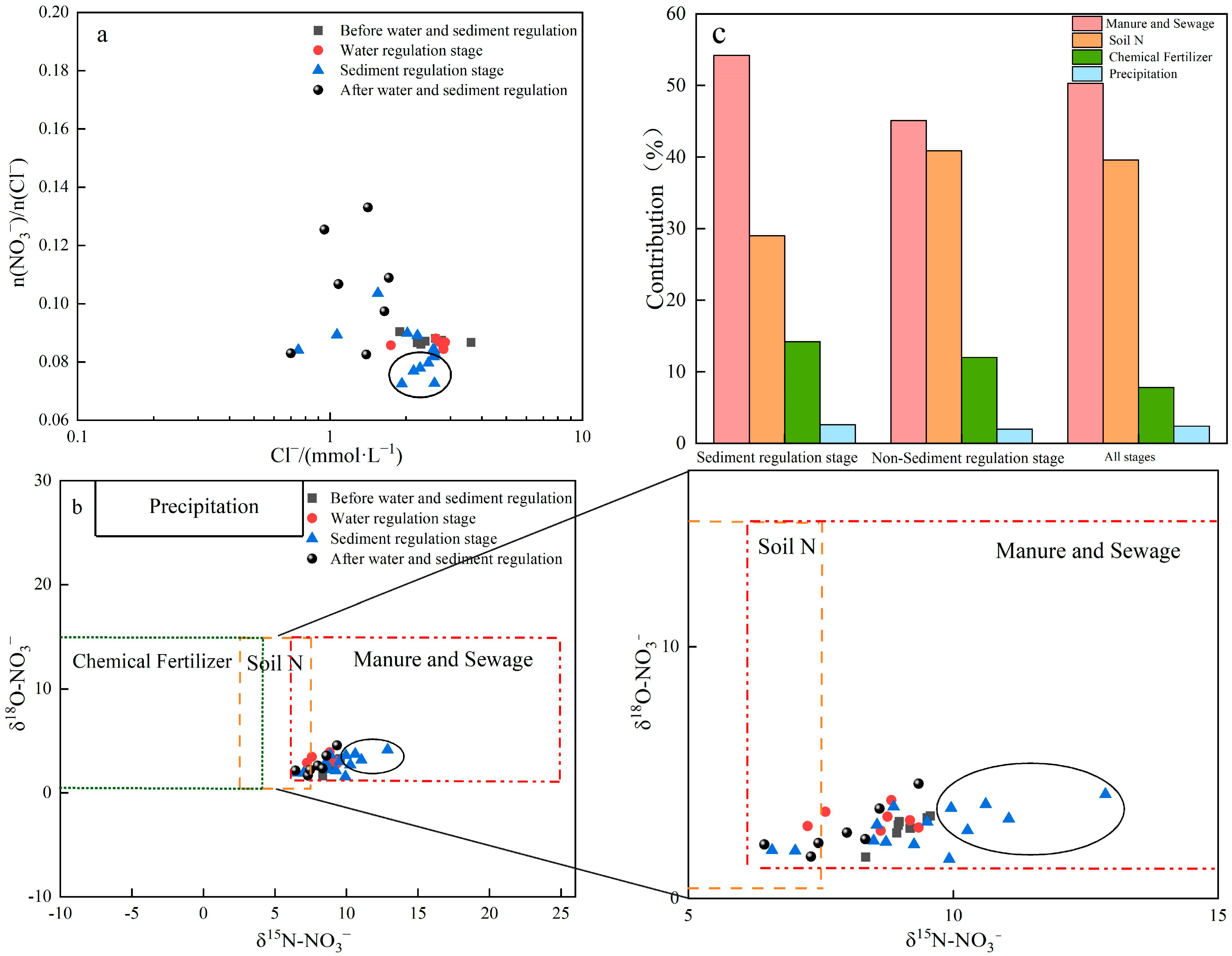
Based on previous studies on the main tributaries of the YR Basin, this study considered four potential sources of nitrate: manure and sewage, soil nitrogen (N), fertilizer, and atmospheric N deposition. The average values and standard deviations of δ15N-NO3− and δ18O-NO3− for these sources were 16.3 ± 5.7‰ and 7 ± 2.7‰, 5 ± 1.4‰ and 3 ± 1.7‰, 0.9 ± 2.0‰ and 3 ± 1.7‰, and 3.2 ± 2.4‰ and 44 ± 9.1‰, respectively [39,45]. High mole concentrations of chlorine (n(Cl−)) (mean 2.12 mmol·L−1) and low n(NO3−)/n(Cl−) ratios (mean 0.09) were found in the LYR. Most δ15N-NO3− and δ18O-NO3− values fell within the range for manure and sewage (Figure 6a,b), with some samples indicating soil nitrogen. These findings suggest that soil nitrogen and manure/sewage are the primary sources of nitrogen pollution in the LYR [16,46]. Mu et al. [39] studied the sources of nitrate in the XLD Reservoir and downstream YR and found that manure and sewage were the primary sources, contributing 53% of the nitrate in the XLD Reservoir and 47% of the nitrate in the LYR, which is consistent with the findings of this study. During the sediment regulation stage, most n(NO3−)/n(Cl−) values were extremely low (<0.08), with elevated δ15N values of nitrate (Figure 6). However, these values did not show significant changes during the water regulation stage compared to pre-regulation, indicating that inflow from Sanmenxia Reservoir during sediment regulation may have increased the contribution of sewage in the LYR. Using the SIAR model to quantify the contributions of nitrate sources in the LYR, the results showed that soil nitrogen and manure/sewage contributed 39.6% and 50.3%, respectively. As the sediment regulation stage progresses, the contribution of sewage increased from 45.1% to 54.2% (Figure 6c), supporting the study’s hypothesis. The unique elevated riverbed of the LYR prevents pollutants from water and suspended sediments from entering the main stream via tributaries or sewage channels [47]. Therefore, a significant portion of nitrogen pollutants in the LYR originate from the middle and upper reaches [5].
Figure 6.
(a) Relationship between n(NO3−)/n(Cl−) and n(Cl−). (b) Scatter plot of δ15N-NO3− and δ18O-NO3−. (c) Contribution rates of nitrate sources.
5. Conclusions
This study focused on the effects of the XLD Reservoir’s water and sediment regulation on nitrogen concentration, sources, and migration/transformation in the LYR. There were differences in nitrogen concentrations in the water and suspended phases during different regulation stages, with minimal changes in the sediment phase. Compared to before the regulation stage, the TN concentrations decreased while NO3−-N concentrations increased in the water phase duing the water regulation stage. The influx of substantial water discharge introduced external nitrogen into water, where subsequent mineralization and nitrification processes led to an increase of the NO3−-N concentration in the water phase. As the sediment regulation stage progresses, the TN concentrations in the water phase exhibited a fluctuating decrease, while the NO3−-N concentrations showed a increase followed by a decrease. The sharp increase in the suspended sediment concentration and smaller particle size during sediment regulation triggered a coupled nitrification–denitrification process at the water–sediment interface. The annual fluxes of TN, NO3−-N, and NH4+-N entering the sea from the YR in 2023 were estimated to be 283,700 tons, 98,800 tons, and 17,800 tons, respectively. The water and sediment regulation significantly enhances nitrogen migration into the sea. During the water-sediment regulation stage, the main nitrate sources were manure and sewage. This contribution peaked at 54.2% during the sediment regulation stage. In order to provide a more comprehensive explanation of the transformation of nitrogen in the three phases, the study of organic carbon can be incorporated into future research. Additionally, a higher monitoring frequency would improve the precision of nitrogen flux calculations.
Author Contributions
Y.L.: Conceptualization, data curation, writing—original draft; K.G.: formal analysis, data curation, writing—original draft; L.C.: creative idea, supervision, investigation, experimental analysis; S.R.: methodology, experimental analysis. All authors have read and agreed to the published version of the manuscript.
Funding
This research was funded by the Open Fund of State Key Laboratory of Water Resources and Hydropower Engineering Science Foundation (No. 2022WG01) and the Henan Provincial Science and Technology Research Project (No. 232102320141).
Institutional Review Board Statement
Not applicable.
Informed Consent Statement
Not applicable.
Data Availability Statement
The raw data supporting the conclusions of this article will be made available by the authors on request.
Acknowledgments
The author appreciates the efforts made by the editor and the reviewers for this article.
Conflicts of Interest
The authors declare no conflicts of interest.
Abbreviations
The following abbreviations are used in this manuscript:
| AS | Aishan |
| DO | dissolved oxygen |
| EC | electrical conductivity |
| GC | Gaocun |
| HYK | Huayuankou |
| JTH | Jiahetan |
| LJ | Lijin |
| LK | Luokou |
| LYR | lower Yellow River |
| NO3−-N | nitrate nitrogen |
| NH4+-N | ammonium nitrogen |
| SIAR | Stable Isotope Analysis in R |
| SK | Sunkou |
| SPS | suspended particle sediments |
| SPM | suspended particulate matter |
| SSC | suspended sediment concentrations |
| TN | total nitrogen |
| WSR | the water and sediment regulation |
| XLD | Xiaolangdi |
| YR | Yellow River |
Appendix A

Table A1.
NO3−-N, NH4+-N concentrations and δ15N and δ18O values of NO3− in the deposited phase (1: Before Water and Sediment Regulation, 2: Water Regulation, 3: First Stage of Sediment Regulation, 4: Second Stage of Sediment Regulation, 5: After Water and Sediment Regulation).
Table A1.
NO3−-N, NH4+-N concentrations and δ15N and δ18O values of NO3− in the deposited phase (1: Before Water and Sediment Regulation, 2: Water Regulation, 3: First Stage of Sediment Regulation, 4: Second Stage of Sediment Regulation, 5: After Water and Sediment Regulation).
| Sampling Site | Stage | NO3−-N(mg/kg) | NH4+-N(mg/kg) | δ15N-NO3− (‰) | δ18O-NO3− (‰) |
|---|---|---|---|---|---|
| HYK | 1 | 4.24 | 2.99 | 10.8 | 11.9 |
| 2 | 1.70 | 3.07 | 15.6 | 7.9 | |
| 3 | 2.89 | 8.30 | 14.8 | 7.7 | |
| 4 | 1.61 | 2.40 | 7.6 | 8.9 | |
| 5 | 1.70 | 2.74 | 3.8 | 3.4 | |
| JHT | 1 | 2.00 | 2.02 | 7.1 | 17.5 |
| 2 | 1.28 | 1.18 | 15.1 | 10.9 | |
| 3 | 1.70 | 6.89 | 8.5 | 4.0 | |
| 4 | 1.41 | 2.10 | 5.2 | 6.2 | |
| 5 | 1.54 | 1.06 | 6.7 | 6.0 | |
| GC | 1 | 1.84 | 9.18 | 0.5 | 7.6 |
| 2 | 1.62 | 3.53 | 16.3 | 12.4 | |
| 3 | 1.37 | 6.59 | 7.3 | 9.8 | |
| 4 | 1.44 | 4.29 | 7.7 | 8.8 | |
| 5 | 1.65 | 2.56 | 8.0 | 11.0 | |
| SK | 1 | 1.69 | 2.71 | 3.4 | 6.7 |
| 2 | 1.78 | 5.28 | 15.4 | 10.6 | |
| 3 | 1.35 | 4.00 | 8.7 | 9.9 | |
| 4 | 1.89 | 1.96 | 6.3 | 11.7 | |
| 5 | 1.96 | 3.65 | 13.0 | 12.8 | |
| AS | 1 | 1.83 | 3.87 | 5.6 | 10.8 |
| 2 | 1.80 | 5.54 | 14.5 | 12.0 | |
| 3 | 1.67 | 3.50 | 12.8 | 11.6 | |
| 4 | 0.84 | 4.13 | 6.0 | 8.2 | |
| 5 | 1.49 | 2.33 | 3.0 | 7.3 | |
| LK | 1 | 1.73 | 2.11 | 1.4 | 7.5 |
| 2 | 1.95 | 2.45 | 14.5 | 7.4 | |
| 3 | 1.37 | 3.57 | 13.1 | 9.7 | |
| 4 | 1.79 | 4.51 | 6.2 | 10.0 | |
| 5 | 3.87 | 2.80 | 14.8 | 11.6 | |
| LJ | 1 | 1.74 | 4.87 | 4.1 | 8.9 |
| 2 | 1.55 | 2.65 | 15.9 | 11.5 | |
| 3 | 1.79 | 3.39 | 13.0 | 9.6 | |
| 4 | 1.05 | 2.88 | 4.1 | 5.5 | |
| 5 | 1.24 | 2.52 | 11.2 | 11.1 |
References
- Tang, X.; Wu, M.; Li, R. Distribution, sedimentation, and bioavailability of particulate phosphorus in the mainstream of the Three Gorges Reservoir. Water Res. 2018, 140, 44–55. [Google Scholar] [CrossRef]
- Wang, D.; Tang, X.; Li, R.; Yang, W. Spatial distribution patterns of nitrogen and phosphorus in water and bed sediment of the Three Gorges Reservoir. J. Clean. Prod. 2021, 322, 129026. [Google Scholar] [CrossRef]
- Hu, M.; Yao, M.; Wang, Y.; Pan, Z.; Wu, K.; Jiao, X.; Chen, D. Influence of nitrogen inputs, dam construction and landscape patterns on riverine nitrogen exports in the Yangtze River basin during 1980–2015. J. Hydrol. 2023, 617, 129109. [Google Scholar] [CrossRef]
- Xu, C.; Xu, Z.; Cai, Y.; Zhu, Z.; Tan, Q. Impact of reservoir operation policies on nitrogen cycling processes and water quality dynamics in a large water supply reservoir. J. Clean. Prod. 2023, 416, 137975. [Google Scholar] [CrossRef]
- Xue, S.; Jian, H.; Yang, F.; Liu, Q.; Yao, Q. Impact of water-sediment regulation on the concentration and transport of dissolved heavy metals in the middle and lower reaches of the Yellow River. Sci. Total Environ. 2022, 806, 150535. [Google Scholar] [CrossRef]
- Hou, C.; Yi, Y.; Song, J.; Zhou, Y. Effect of water-sediment regulation operation on sediment grain size and nutrient content in the lower Yellow River. J. Clean. Prod. 2021, 279, 123533. [Google Scholar] [CrossRef]
- Tang, X.; Li, R.; Wang, D.; Jing, Z.; Zhang, W. Reservoir flood regulation affects nutrient transport through altering water and sediment conditions. Water Res. 2023, 233, 119728. [Google Scholar] [CrossRef] [PubMed]
- Liu, C.; Hou, L.; Liu, M.; Zheng, Y.; Yin, G.; Han, P.; Dong, H.; Gao, J.; Gao, D.; Chang, Y.; et al. Coupling of denitrification and anaerobic ammonium oxidation with nitrification in sediments of the Yangtze Estuary: Importance and controlling factors. Estuar. Coast. Shelf Sci. 2019, 220, 64–72. [Google Scholar] [CrossRef]
- Yao, X.; Zhang, L.; Zhang, Y.; Xu, H.; Jiang, X. Denitrification occurring on suspended sediment in a large, shallow, subtropical lake (Poyang Lake, China). Environ. Pollut. 2016, 219, 501–511. [Google Scholar] [CrossRef] [PubMed]
- Senbati, Y.; Lu, L.; Min, D.; Kang, S.; Fengchang, W. Effect and microbial mechanism of suspended sediments particle size on nitrous oxide emission in eutrophic lakes. Environ. Pollut. 2023, 334, 122180. [Google Scholar]
- Gilles, B.; Josette, G.; Luis, L. The nitrogen cascade from agricultural soils to the sea: Modelling nitrogen transfers at regional watershed and global scales. Philos. Trans. R. Soc. London. Ser. B Biol. Sci. 2013, 368, 20130123. [Google Scholar]
- Xia, X.; Jia, Z.; Liu, T.; Zhang, S.; Zhang, L. Coupled Nitrification-Denitrification Caused by Suspended Sediment (SPS) in Rivers: Importance of SPS Size and Composition. Environ. Sci. Technol. 2017, 51, 212–221. [Google Scholar] [CrossRef] [PubMed]
- Wang, W.; Sheng, Y.; Li, Z.; Xu, H.; Liu, Q.; Kong, X.; Hu, N.; Xu, M.; Yang, H. Evidences of the sources of suspended sediments and ecological processes in the Yellow River Basin. Sci. Total Environ. 2024, 957, 177624. [Google Scholar] [CrossRef] [PubMed]
- Yue, F.J.; Li, S.L.; Liu, C.Q.; Zhao, Z.Q.; Ding, H. Tracing nitrate sources with dual isotopes and long term monitoring of nitrogen species in the Yellow River, China. Sci. Rep. 2017, 7, 8537. [Google Scholar] [CrossRef]
- Zhu, Y.; Jin, X.; Tang, W.; Meng, X.; Shan, B. Comprehensive analysis of nitrogen distributions and ammonia nitrogen release fluxes in the sediments of Baiyangdian Lake, China. J. Environ. Sci. 2018, 76, 319–328. [Google Scholar] [CrossRef]
- Li, H.; Li, X.; Xu, Z.; Liang, S.; Ding, Y.; Song, D.; Guo, H. Nutrient budgets for the Bohai Sea: Implication for ratio imbalance of nitrogen to phosphorus input under intense human activities. Mar. Pollut. Bull. 2022, 179, 113665. [Google Scholar] [CrossRef]
- Xia, X.; Zhang, L.; Wang, G.; Wang, J.; Zhang, L.; Zhang, S.; Li, Z. Nitrogen loss from a turbid river network based on N2 and N2O fluxes: Importance of suspended sediment. Sci. Total Environ. 2021, 757, 143918. [Google Scholar] [CrossRef]
- Jia, Z.; Liu, T.; Xia, X.; Xia, N. Effect of particle size and composition of suspended sediment on denitrification in river water. Sci. Total Environ. 2016, 541, 934–940. [Google Scholar] [CrossRef] [PubMed]
- Xia, X.; Li, Z.; Zhang, S.; Zhang, L.; Zhang, L.; Wang, G. Occurrence of anammox on suspended sediment (SPS) in oxic river water: Effect of the SPS particle size. Chemosphere 2019, 235, 40–48. [Google Scholar] [CrossRef]
- Beaulieu, J.J.; Tank, J.L.; Hamilton, S.K.; Wollheim, W.M.; Hall, R.O.; Mulholland, P.J.; Peterson, B.J.; Ashkenas, L.R.; Cooper, L.W.; Dahm, C.N.; et al. Nitrous oxide emission from denitrification in stream and river networks. Proc. Natl. Acad. Sci. USA 2011, 108, 214–219. [Google Scholar] [CrossRef]
- Wang, H.; Yang, Z.; Saito, Y.; Liu, J.P.; Sun, X.; Wang, Y. Stepwise decreases of the Huanghe (Yellow River) sediment load (1950–2005): Impacts of climate change and human activities. Global Planet. Change 2007, 57, 331–354. [Google Scholar] [CrossRef]
- Kong, D.; Latrubesse, E.M.; Miao, C.; Zhou, R. Morphological response of the Lower Yellow River to the operation of Xiaolangdi Dam, China. Geomorphology 2020, 350, 106931. [Google Scholar] [CrossRef]
- Zhao, Q.; Ding, S.; Ji, X.; Hong, Z.; Lu, M.; Wang, P. Relative Contribution of the Xiaolangdi Dam to Runoff Changes in the Lower Yellow River. Land 2021, 10, 521. [Google Scholar] [CrossRef]
- Lu, M.; Zhao, Q.; Ding, S.; Wang, S.; Hong, Z.; Jing, Y.; Wang, A. Hydro-geomorphological characteristics in response to the water-sediment regulation scheme of the Xiaolangdi Dam in the lower Yellow River. J. Clean. Prod. 2022, 335, 130324. [Google Scholar] [CrossRef]
- Li, X.; Chen, H.; Jiang, X.; Yu, Z.; Yao, Q. Impacts of human activities on nutrient transport in the Yellow River: The role of the Water-Sediment Regulation Scheme. Sci. Total Environ. 2017, 592, 161–170. [Google Scholar] [CrossRef]
- Cieśla, M.; Rokosz, R.G. Implications of suspended sediment in the migration of nutrients at the water-sediment interface in retention reservoirs. Sci. Rep. 2024, 14, 24924. [Google Scholar] [CrossRef] [PubMed]
- Jiang, C.; Zhang, S.; Wang, J.; Xia, X. The inhibitory effects of sunlight on nitrogen removal in riverine overlying water with suspended particles. Chemosphere 2022, 295, 133941. [Google Scholar] [CrossRef] [PubMed]
- Chen, J.; Liu, M.; Bi, N.; Yang, Y.; Wu, X.; Fan, D.; Wang, H. Variability of heavy metal transport during the water-sediment regulation period of the Yellow River in 2018. Sci. Total Environ. 2021, 798, 149061. [Google Scholar] [CrossRef]
- Wang, H.; Wu, X.; Bi, N.; Li, S.; Yuan, P.; Wang, A.; Syvitski, J.P.M.; Saito, Y.; Yang, Z.; Liu, S.; et al. Impacts of the dam-orientated water-sediment regulation scheme on the lower reaches and delta of the Yellow River (Huanghe): A review. Global Planet. Change 2017, 157, 93–113. [Google Scholar] [CrossRef]
- Zhao, Q.; Hong, Z.; Jing, Y.; Lu, M.; Geng, Z.; Qiu, P.; Wang, P.; Lu, X.; Ding, S. Spatial and temporal changes in nutrients associated with dam regulation of the Yellow River. Catena 2022, 217, 106425. [Google Scholar] [CrossRef]
- Bi, N.; Sun, Z.; Wang, H.; Wu, X.; Fan, Y.; Xu, C.; Yang, Z. Response of channel scouring and deposition to the regulation of large reservoirs: A case study of the lower reaches of the Yellow River (Huanghe). J. Hydrol. 2019, 568, 972–984. [Google Scholar] [CrossRef]
- Kong, D.; Miao, C.; Duan, Q.; Li, J.; Zheng, H.; Gou, J. Xiaolangdi Dam: A valve for streamflow extremes on the lower Yellow River. J. Hydrol. 2022, 606, 127426. [Google Scholar] [CrossRef]
- Wu, X.; Bi, N.; Syvitski, J.; Saito, Y.; Xu, J.; Nittrouer, J.A.; Bianchi, T.S.; Yang, Z.; Wang, H. Can Reservoir Regulation Along the Yellow River Be a Sustainable Way to Save a Sinking Delta? Earth’s Future 2020, 8, e2020EF001587. [Google Scholar] [CrossRef]
- Yu, F.; Li, Y.; Chen, Y.; Li, X.; Ren, S. Spatial and temporal distribution and source of nitrogen in the lower reaches of Qin River based on nitrogen and oxygen isotope techniques. Acta Sci. Circumst. 2025, 45, 178–189. [Google Scholar]
- Li, Y.; Li, X.; Tao, L.; Zhang, X.; Wang, M. Tracking the origins and oxidation pathways of nitrate in wet deposition using nitrogen and oxygen isotopes. Res. Environ. Sci. 2024, 37, 336–345. [Google Scholar]
- Parnell, A.C.; Inger, R.; Bearhop, S.; Jackson, A.L. Source partitioning using stable isotopes: Coping with too much variation. PLoS ONE 2010, 5, e9672. [Google Scholar] [CrossRef]
- Chen, H.; Han, Z.; Yan, X.; Bai, Z.; Li, Q.; Wu, P. Impacts of land use on phosphorus and identification of phosphate sources in groundwater and surface water of karst watersheds. J. Environ. Manage 2024, 366, 121919. [Google Scholar] [CrossRef] [PubMed]
- Ji, X.; Shu, L.; Li, J.; Zhao, C.; Chen, W.; Chen, Z.; Shang, X.; Dahlgren, R.A.; Yang, Y.; Zhang, M. Tracing nitrate sources and transformations using △17O, δ15N, and δ18O-NO3− in a coastal plain river network of eastern China. J. Hydrol. 2022, 610, 127829. [Google Scholar] [CrossRef]
- Mu, J.; Ding, S.; Liu, S.M.; Song, G.; Ning, X.; Zhang, X.; Xu, W.; Zhang, H. Multiple isotopes decipher the nitrogen cycle in the cascade reservoirs and downstream in the middle and lower Yellow River: Insight for reservoir drainage period. Sci. Total Environ. 2024, 918, 170625. [Google Scholar] [CrossRef]
- Chen, X.; Feng, Z.; Xu, Q.; Xia, R.; Ma, C.; Xia, X. Decadal dynamics of nitrate content, source variations and influencing factorsin the middle and lower reaches of the Yellow River. Acta Sci. Circumst. 2025, 45, 241–250. [Google Scholar]
- Yang, F.; Yu, Z.; Bouwman, A.F.; Chen, H.; Jian, H.; Beusen, A.H.W.; Liu, X.; Yao, Q. Human-driven long-term disconnect of nutrient inputs to the Yellow River basin and river export to the Bohai Sea. J. Hydrol. 2023, 618, 129279. [Google Scholar] [CrossRef]
- Zhang, Y.; Wu, M.; Yang, F.; Yao, Q. Effect of natural flood and water-sediment regulation processes on nutrient concentration and transport in the Yellow River. Appl. Geochem. 2023, 159, 105853. [Google Scholar] [CrossRef]
- Lu, T.; Wang, H.; Hu, L.; Wu, X.; Bi, N.; Dang, Y.; Assavapanuvat, P.; Bianchi, T.S. Dynamic transport of particulate organic carbon in the Yellow River during dam-orientated Water-Sediment Regulation. Mar. Geol. 2023, 460, 107054. [Google Scholar] [CrossRef]
- Liu, T.; Xia, X.; Liu, S.; Mou, X.; Qiu, Y. Acceleration of Denitrification in Turbid Rivers Due to Denitrification Occurring on Suspended Sediment in Oxic Waters. Environ. Sci. Technol. 2013, 47, 4053–4061. [Google Scholar] [CrossRef] [PubMed]
- Zhang, Q.; Wang, H.; Liu, L.; Zhai, T.; Zhang, X. Multiple isotopes reveal the driving mechanism of high NO3—level and key processes of nitrogen cycling in the lower reaches of Yellow River. J. Environ. Sci. 2024, 138, 597–606. [Google Scholar] [CrossRef] [PubMed]
- Shang, X.; Huang, H.; Mei, K.; Xia, F.; Chen, Z.; Yang, Y.; Dahlgren, R.A.; Zhang, M.; Ji, X. Riverine nitrate source apportionment using dual stable isotopes in a drinking water source watershed of southeast China. Sci. Total Environ. 2020, 724, 137975. [Google Scholar] [CrossRef]
- Bi, N.; Yang, Z.; Wang, H.; Xu, C.; Guo, Z. Impact of artificial water and sediment discharge regulation in the Huanghe (Yellow River) on the transport of particulate heavy metals to the sea. Catena 2014, 121, 232–240. [Google Scholar] [CrossRef]
Disclaimer/Publisher’s Note: The statements, opinions and data contained in all publications are solely those of the individual author(s) and contributor(s) and not of MDPI and/or the editor(s). MDPI and/or the editor(s) disclaim responsibility for any injury to people or property resulting from any ideas, methods, instructions or products referred to in the content. |
© 2025 by the authors. Licensee MDPI, Basel, Switzerland. This article is an open access article distributed under the terms and conditions of the Creative Commons Attribution (CC BY) license (https://creativecommons.org/licenses/by/4.0/).