Abstract
The maritime defence settlements of the Ming Dynasty are a key component of China’s military cultural heritage. This study examines the three coastal defence sectors of Fujian by establishing a three-tier evaluation framework utilising GIS spatial analysis and the Analytic Hierarchy Process (AHP) for quantitative assessment. The findings reveal that the synergy between military outposts significantly enhances overall defence effectiveness, while the independent defence capability of each stronghold is crucial for withstanding external threats. A comprehensive evaluation further indicates that the Fujian central coastal defence sector, characterized by its robust economy and densely distributed fortifications, demonstrates the highest level of defensive performance. By systematically quantifying the defensive performance of Fujian’s maritime defence settlements, this study develops an evaluation model that provides a scientific basis and decision support for value assessment, sustainable conservation, and adaptive reuse of this category of military cultural heritage.
1. Introduction
China’s ancient coastal defence system is a key component of world cultural heritage, reflecting both strategic innovation and early concepts of sustainability. The Ming dynasty coastal defence network stands out for its systematic planning, integrated resource allocation, and dynamic adjustment mechanisms, which provide valuable insights for contemporary sustainable development approaches.
During the Hongwu reign, Emperor Hongwu implemented the maritime prohibition policy and introduced a “land–sea joint defence” strategy [1]. By constructing Wei citadels, Suo citadels, military inspection stations (Xunjiansi), and naval fortresses (Shuizhai), a preliminary nationwide maritime defence network was established, spanning seven northern and southern regions [2]. Despite resource limitations, this system achieved considerable defensive effectiveness, embodying spatial planning concepts that align with modern sustainability principles. During the subsequent Yongle and Xuande reigns, defence strategies were further reinforced through the approval of maritime trade, adjustments to the military farming system, and the enhancement of fortress infrastructure. However, after the Zhengtong reign, the Wei-Suo system began to decline due to issues such as the deterioration of military farming, corruption, and the rise of private trade. Following the outbreak of the “Great Wokou Crisis” in the mid-to-late Jiajing period, the Ming government abolished hereditary military service and transitioned to a mercenary system. Under the leadership of Generals Qi Jiguang and Yu Dayou, a revitalized land–sea joint defence system was reestablished, bringing stability back to the southeast by 1566. [3]
Fujian’s coastline, with an indentation ratio of 0.18 (1:5.7), is the most deeply indented in China. This complex terrain provided opportunities for pirate concealment and landing, while regions such as the Min River estuary, lacking natural barriers, were particularly vulnerable. In response to these challenges, the Ming court implemented the “Five Naval Fortresses (Shuizhai) System,” which significantly enhanced regional security. In 1388 (the 21st year of the Hongwu reign), Zhou Dexing was appointed to oversee Fujian’s defences, adhering to the guiding principles of “defending the seas, fortifying the coasts, strengthening city defences, and maintaining vigilant lookouts” [4]. His efforts resulted in the construction of 11 Wei citadels, 14 Suo citadels, 67 inspection stations, and five naval fortresses, forming a multi-layered, in-depth defensive network (Figure 1). This system integrated naval patrols, beacon stations (Fenghou), and Ming Dynasty Relay Posts (Yizhan), surpassing the traditional single-layer defence model and achieving coordinated land–sea defence.
Figure 1.
Diagram of the land–sea joint defence mechanism.
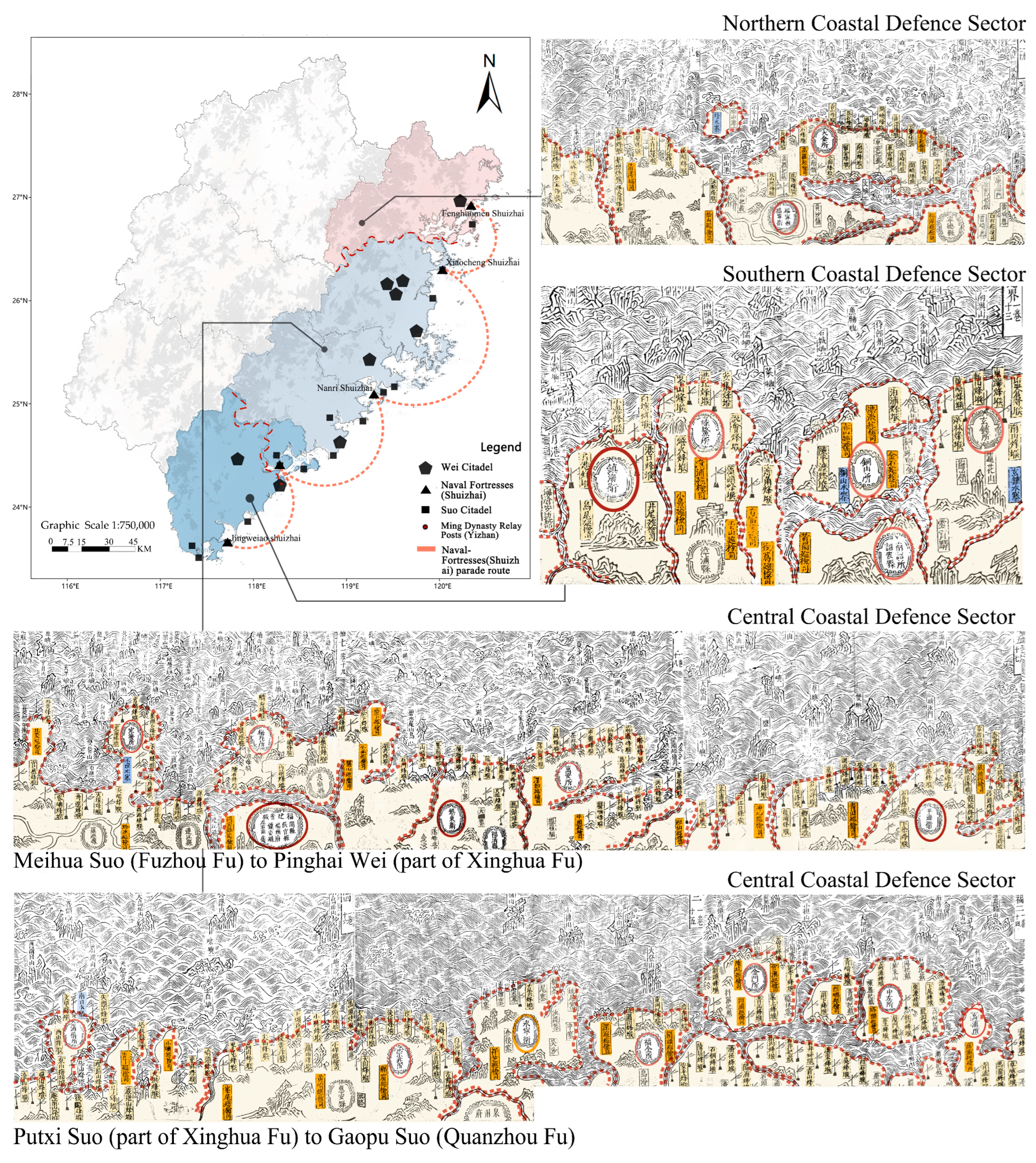
In the late Jiajing period, the Ming court reorganized Fujian’s defences by dividing the coastline into three distinct coastal defence sectors: the northern coastal defence sector, the central coastal defence sector, and the southern coastal defence sector, each overseen by deputy general-level commanders. In 1563, Provincial Commissioner Tan Lun further restructured the five naval fortresses, assigning specific patrol zones to each, which gradually evolved into a comprehensive combat system under the command of the commander-in-chief, characterized by “Three Routes, Five Fortresses, and Three Patrol Fleets” [5]. Zheng Ruozeng’s Chouhai Tubian (Figure 2) visually documented the distribution and coordination of the Wei-Suo, Shuizhai, Fenghou, and Xunjiansi, marking the shift from “point defence” to a “systematic defence” approach. This map not only provides crucial geographic data for GIS-based spatial analysis but also establishes a foundation for evaluating regional differences in defensive effectiveness. As the first nationwide, systematically planned coastal defence scheme, it integrated diverse resources into a depth-oriented design, exemplifying the advanced concepts of “land–sea coordination” and “multi-layered defence.”
Figure 2.
Coastal Shansha Map of Fujian. Source: Zheng Ruozeng and Shao Fangtu (compilers), Hu Zongxian (chief editor), China Military Classics Compilation Committee (ed.), China Military Classics Collection (Vols. 15–16): Compilation of Naval Strategy Maps, PLA Press and Liaoshen Publishing House, 1990, pp. 33–41.
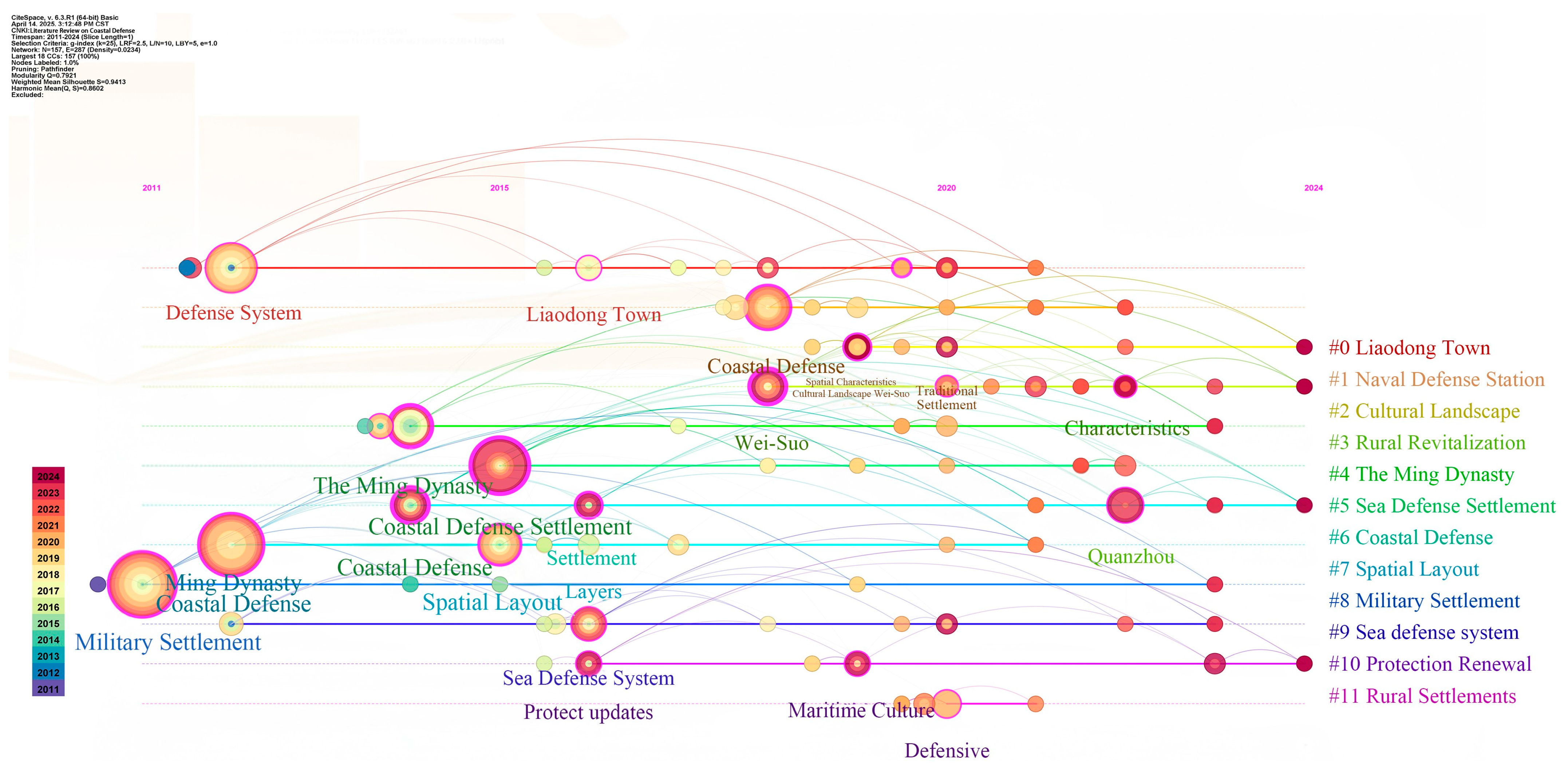
This study employed a systematic literature review and analysis approach, focusing on ancient military heritage. Using Citespace software, we analysed keywords appearing in the abstracts of relevant literature from 2000 to 2024, extracting key terms such as “coastal defence system,” “military settlement,” “spatial layout,” and “defence system” (Figure 3). Additionally, we included keywords such as research on the history of coastal defence in the Ming Dynasty and Chinese military history in our analysis. A comprehensive search of databases, including CNKI, Web of Science, Scopus, and Clarivate, identified over 100 representative academic studies, thereby establishing a robust research knowledge framework. The results indicate that research in this field can be divided into three main areas: methodology, single-disciplinary research, and multidisciplinary research.
Figure 3.
Literature timeline map.
At the methodological level, the research is primarily divided into qualitative and quantitative analyses. Qualitative research includes analyses based on landscape ecology theory [6], the spatial evolution of ancient defence engineering relics [7], and the spatial morphological characteristics of defence structures [8], or it may focus on single-unit studies that explore the characteristics of specific fortresses [9]. For example, Tan Lifeng’s team used the Puzhuang Institute in Zhejiang to demonstrate how wall height and moat layout influence firepower coverage and defence effectiveness. They proposed a range of architectural parameters that balance both economic and protective functions [10]. This type of research emphasizes the spatial form and architectural characteristics of military settlements at specific historical periods or within local areas after the establishment of defence structures [11,12,13,14,15]. Quantitative analysis, on the other hand, primarily investigates the mechanisms of influence from external factors such as topography, troop deployment, and other related elements [16,17].
At the disciplinary level, a variety of perspectives are commonly presented. In his book Japanese Pirates: A Maritime History, Takeo Tanaka provides a detailed account of the relationship between Japanese pirate invasions and maritime prohibition policies from the 14th to the 16th centuries, focusing on the political dimension [18]. He also explores the development of the coastal defence system and its impact on the social and economic structure from an economic standpoint [19,20]. Additionally, there are comprehensive studies that employ a multidisciplinary framework, conducting diachronic analyses of the settlement patterns and spatial forms of large cities, incorporating factors such as changes in the maritime defence system, social development, and economic trade [21]. Archaeologists and heritage scholars concentrate on analysing the construction techniques of settlements and the methods of cultural relic protection [22,23]. With the advancement of geographic information system (GIS) technology in recent years, it has also been applied to cultural heritage preservation, offering more precise spatial analysis techniques [24,25,26]. For instance, in the study of the spatiotemporal evolution of the Zhejiang coastal defence system during the Ming Dynasty, a GIS-based analysis revealed how the system evolved from a dispersed to a concentrated configuration under the pressure of Japanese pirate invasions, ultimately forming a “four-six defence” model [27]. Military experts have integrated modern coastal defence theories to construct a model, using methods such as Minimum Cumulative Resistance (MCR) [28], Principal Component Analysis (PCA) [29], Voronoi-Entropy [30], and dynamic AHP [31,32,33] to conduct comprehensive assessments of the defence effectiveness of traditional military settlements and their system integration.
In the realm of multidisciplinary integration research, significant advancements have been made through the cross-fertilization of various technologies. For instance, the intersection of architecture and geography has been utilized to explore the inherent principles of settlement site selection. Lin Zhisen’s team, from a strategic perspective of controlling the waterway, analysed the spatial structural characteristics of “garrisons and residents coexisting” at Meihua Suo, linking hydrological elements [34]. Another study quantitatively examined the influence of military function and the natural environment on the site selection of Zhejiang coastal defence castles by establishing a hydrological overlay model and conducting geographic spatial analysis [35,36]. Furthermore, multidisciplinary integration has yielded notable results in the sustainable protection of cultural heritage. For example, integrating environmental, economic, and social factors within the framework of adaptive reuse has facilitated the functional transformation and upgrading of architectural heritage. This approach reduces resource consumption while preserving cultural authenticity and historical value [37]. From the urban planning and sociology perspectives, deep community involvement is crucial for enhancing the sustainability of projects. Such participation not only improves social acceptance and cultural continuity but also mitigates the risk of local practices deviating from their original objectives due to excessive administrative intervention [38,39]. Advancements in virtual reality and immersive technology within computer science have introduced novel approaches to cultural heritage preservation. These digital technologies not only improve heritage dissemination and deepen public understanding but also provide a scientific basis for informed decision-making [40]. To propose sustainable protection strategies, it is essential to combine urban and rural planning disciplines with regional planning, focusing on the dynamic balance between cultural heritage and material space protection. This approach promotes the formation of interdisciplinary collaboration mechanisms and comprehensive planning systems [41].
In recent years, research on ancient military heritage has increasingly moved toward interdisciplinary integration, with the paradigm shifting from traditional qualitative descriptions to quantitative analysis and value assessment. Although some progress has been made in historical research and spatial morphology studies of Fujian Province’s coastal defence cultural heritage, systematic quantitative analysis of the operational mechanisms of the defence system remains insufficient. Inconsistent data standards, challenges in data integration, and a lack of spatial information hinder the establishment of deep connections and effective utilization of such data. This fragmented data impedes the evaluation of coastal defence effectiveness, making it difficult to accurately quantify its relationship with economic conditions, population, and troop deployment as well as to simulate the processes and impacts of the Ming Dynasty coastal defence system. This situation not only limits the understanding of military strategies and response mechanisms but also hinders the potential for transforming historical insights into modern strategies for cultural heritage preservation and sustainable development. To address these limitations, this paper focuses on the Fujian coastal defence garrison system from the Ming Dynasty. By employing quantitative methods, it explores the defensive characteristics of the system and constructs a three-tier evaluation framework. Through the integration of historical documents and geographic information system (GIS) data, 14 key factors are identified and analysed. The study systematically evaluates the defensive effectiveness of the garrisons in the three coastal defence sectors of Fujian to analyse historical defence strategies and provide a theoretical basis for the scientific conservation of regional cultural heritage and sustainable development strategies.
2. Materials and Methods
2.1. Study Area
Fujian is located in southeastern China (Figure 4), bordered by Zhejiang to the north, Guangdong to the south, Jiangxi to the west, and facing Taiwan across the Taiwan Strait to the east. With a mainland coastline of approximately 3751.5 km—the second longest in China after Guangdong—and more than 1500 islands along its coast, Fujian occupies a strategic position at the maritime crossroads of the East and South China Seas. Historically, it served as a crucial node on the Maritime Silk Road, the departure point for Zheng He’s voyages, and a major centre of maritime trade.
Figure 4.
Study area.
The origins of Fujian’s maritime defence can be traced back to the Qin and Han dynasties, with significant developments occurring during the Ming dynasty. In response to Wokou piracy, to enforce maritime prohibitions, and to regulate trade, the founding emperor Zhu Yuanzhang appointed Zhou Dexing, Marquis of Jiangxia, to oversee coastal defence. At key coastal positions, Zhou established five Wei citadels, thirteen Suo citadels, and sixty-seven military inspection stations (Xunjiansi), alongside five naval fortresses (Shuizhai) on offshore islands, thus creating an integrated land–sea defence system. Given Fujian’s unique geography, rich maritime defence history, and the extensive Ming garrison network, this study selects Ming-era Fujian maritime defence garrison settlements as representative samples to conduct an in-depth analysis of their defensive characteristics.
2.2. Study Object
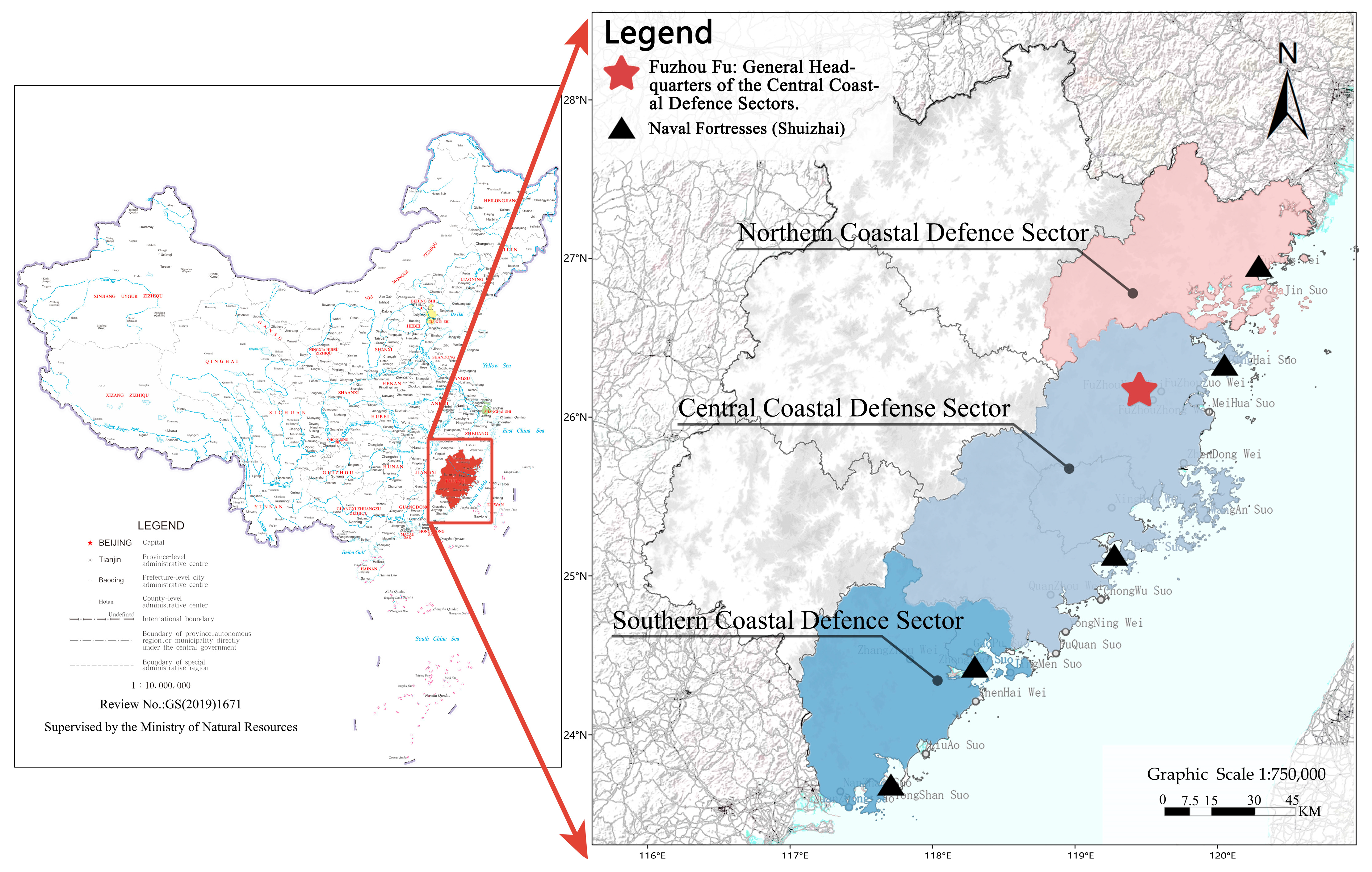
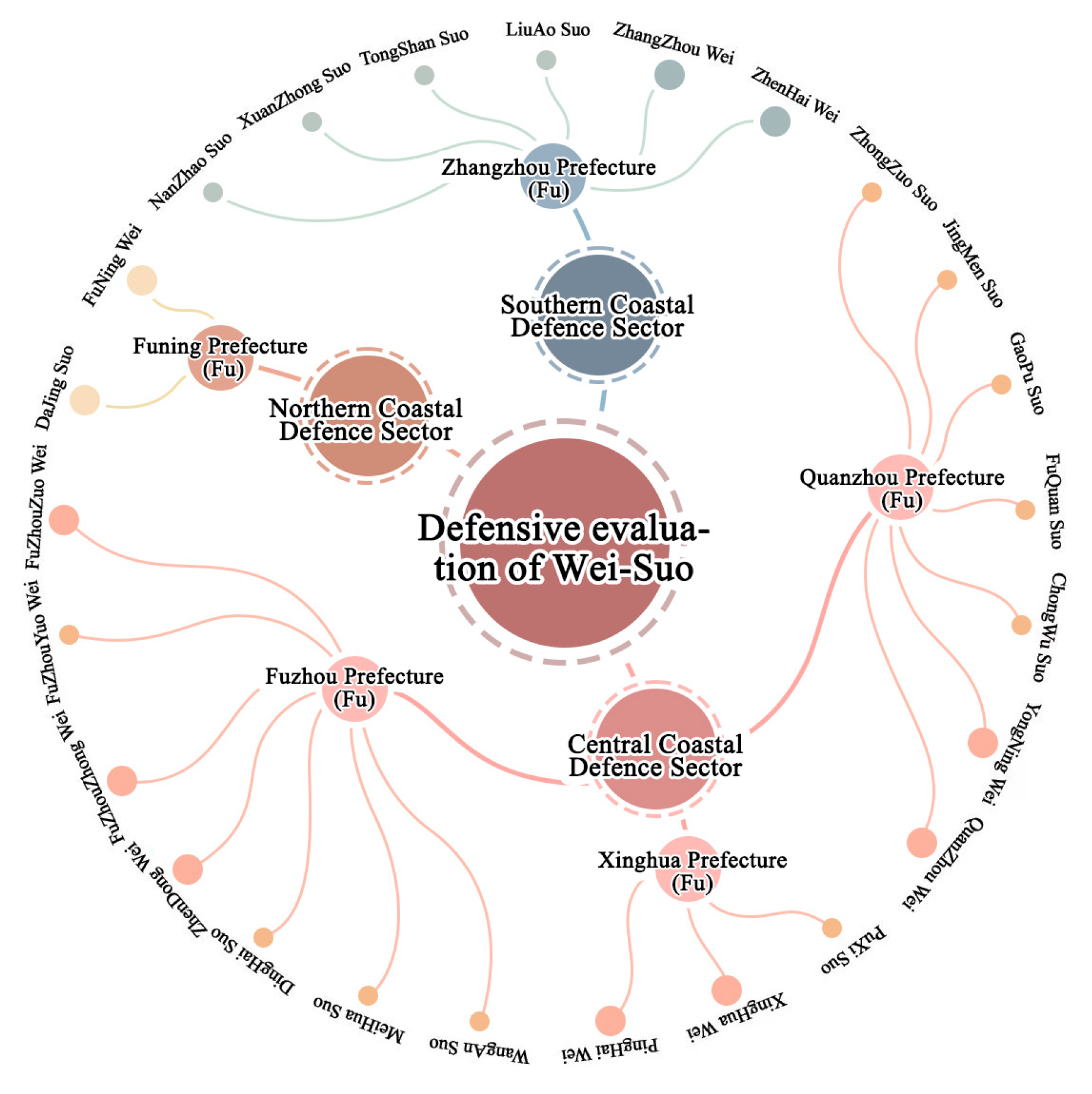
Zhu Yuanzhang introduced the strategic concept of “combined maritime and land defence,” establishing a coastal defence system centred around the Wei-Suo institution. Although this system was initially highly effective, its overall defensive performance declined over time. In response, the Ming court implemented zoned management to strengthen coastal defence: for example, Guangdong was divided into the western coastal defence sector, central coastal defence sector, and eastern coastal defence sectors, while Fujian was divided into the northern coastal defence sector, central coastal defence sector, and southern coastal defence sector based on geographical conditions [4].
Administratively, Fujian was divided from north to south into Funing Prefecture (Zhou), Fuzhou Prefecture (Fu), Xinghua Prefecture (Fu), Quanzhou Prefecture (Fu), and Zhangzhou Prefecture (Fu). The sectoral divisions were as follows: Funing in the northern coastal defence sector; Fuzhou, Xinghua, and Quanzhou in the central coastal defence sector; and Zhangzhou in the southern coastal defence sector (Figure 5). The coastline exhibits significant spatial heterogeneity: some Wei-Suo are located on plains (e.g., Quanzhou Wei), while others are positioned in mountainous coastal terrain (e.g., Funing Wei). These environmental variations had a profound impact on defensive planning and functional roles, making terrain adaptability a critical dimension in evaluating defence effectiveness.
Figure 5.
Jurisdiction of the three coastal defence sectors of Fujian.
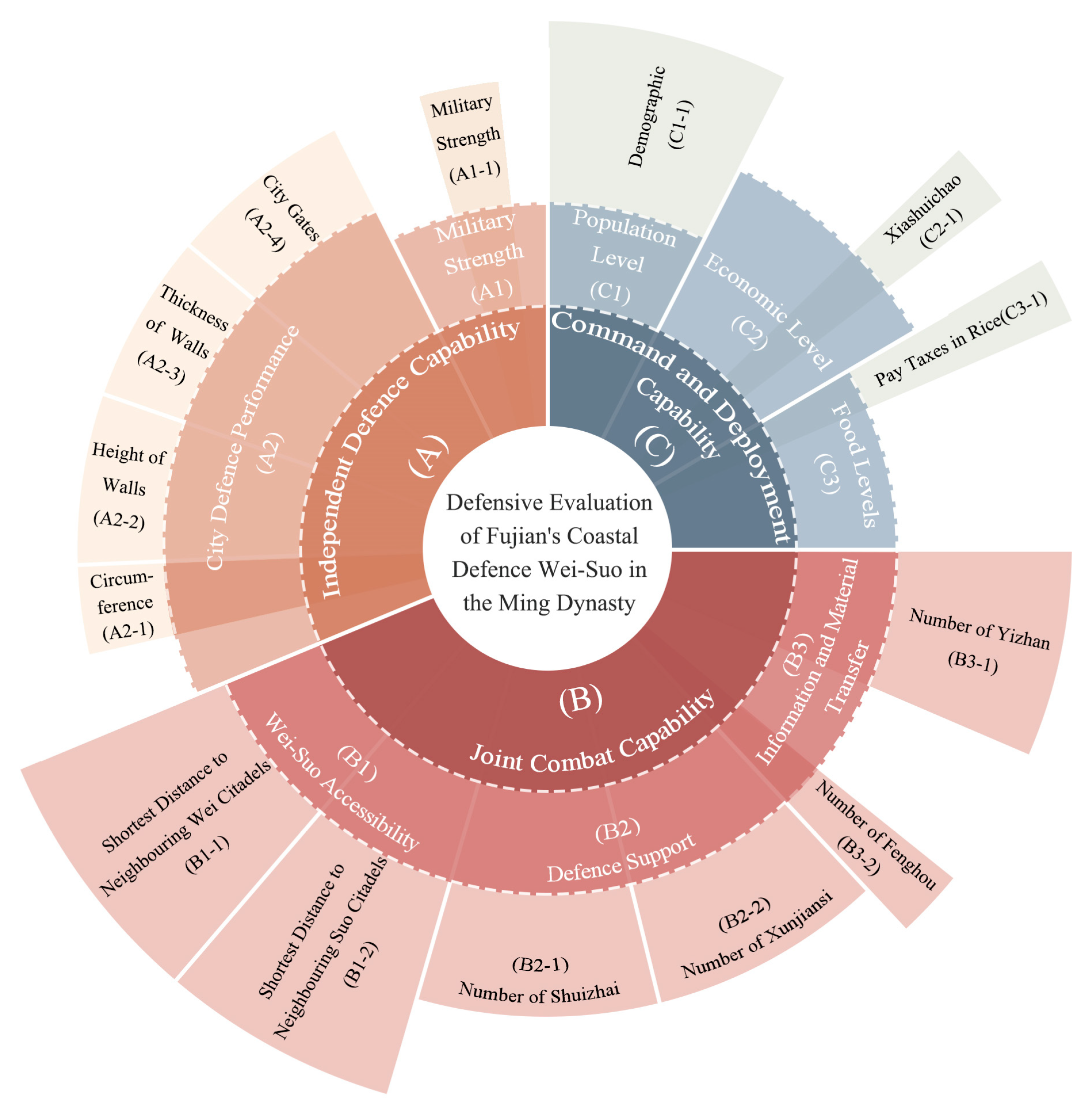
This study applies the Analytic Hierarchy Process (AHP) to quantify the defensive mechanisms of Ming-era Fujian Wei-Suo. Guided by the principles of purposefulness, parsimony, and completeness, we constructed a three-tier indicator framework (Figure 6). Independent defence capability (A) includes garrison strength and fortification characteristics (e.g., perimeter, wall height, wall thickness, and number of gates). Joint combat capability (B) considers inter-settlement accessibility, defensive support, and the transmission of information and materials. Command and deployment capability (C) reflects regional resource capacity, encompassing demographics, economic conditions, and grain reserves.
Figure 6.
Defensive evaluation factors for Ming Fujian Wei-Suo settlements.
The framework incorporates 14 evaluative factors distributed across eight dimensions. Independent defence capability evaluates the self-defence capacity of individual Wei-Suo; joint combat capability emphasizes the coordination and information exchange among settlements; and command and deployment capability captures the logistics and governance support available. Terrain adaptability is indirectly represented by variables such as “distance to the nearest Wei-Suo” and “number of Shuizhai,” which reflect differences in response speed and intelligence transmission between mountainous and plains settings. Unlike traditional approaches, this study embeds Wei citadels within the broader Ming maritime defence network, conceptualized as a system of points, lines, and planes. This model preserves key elements (e.g., walls, troop deployment) while incorporating joint defence mechanisms and resource allocation strategies. AHP is subsequently used for dimensionality reduction to eliminate redundancy and provide a reliable basis for quantifying defensive effectiveness under varying topographic conditions.
2.3. Methods
2.3.1. GIS Cost Path Analysis
To assess the operational efficiency of the Wei-Suo cooperative defence mechanism, this study employs GIS-based least cost path (LCP) analysis. Utilizing high-resolution digital elevation models (DEMs) and the spatial distribution of Wei-Suo sites, we constructed a regional accessibility model within ArcMap 10.5. This model calculates the least-cost routes between settlements by integrating slope and travel time factors, applying a minimum cumulative cost algorithm. The rationale for this approach aligns with historical context: infantry units typically covered approximately 30–50 km per day. Consequently, the efficacy of cooperative responses was significantly influenced by the inter-settlement distances. By modelling these routes, we quantified key performance indicators of the fortifications and developed a graded classification system for their defensive capacities.
2.3.2. AHP Hierarchical Analysis
The Analytic Hierarchy Process (AHP) decomposes complex problems into hierarchical structures and quantifies the relative importance of various factors. In this study, the core evaluation objective is the defensive effectiveness of the Wei-Suo settlements. A three-level, eight-dimensional framework was established, comprising 14 indicators (Figure 6) covering independent defence capability, command and deployment capability, and joint combat capability.
AHP follows three primary steps: hierarchical structuring, pairwise comparison, and consistency testing [42]. The consistency index (C.I.) measures the deviation from perfect consistency. A C.I. value of 0 indicates complete consistency, while smaller values represent higher consistency [43]. To ensure objectivity in factor weighting, structured expert consultations were conducted. A total of 20 experts participated in this process: 14 experts in defensive architecture, settlement planning, or heritage conservation and 6 experts in Ming-Qing military history, maritime defence history, or strategic geography (comprising eight PhDs, nine masters, and three bachelors). A unified set of criteria and a structured discussion framework were implemented to mitigate disciplinary biases.
Experts conducted pairwise comparisons of the 14 indicators using Saaty’s 1–9 scale. The judgments were aggregated into a normalized matrix, and matrix operations, along with consistency tests (where the consistency ratio (CR) < 0.1), were performed using Python 3.7.0. The process produced global weights, yielding a robust, quantitative model for evaluating the defence effectiveness of Fujian’s Wei-Suo settlements [44].
A unified weighting scheme was adopted across the entire Ming period rather than distinguishing between different sub-periods (e.g., the Jiajing reign). This decision is justified by the continuity of the Wei-Suo institution as the cornerstone of Ming coastal defence. Additionally, the use of sub-periods would reduce the sample size, thereby undermining the consistency and statistical robustness of AHP. Adopting unified weights ensures logical coherence and facilitates macro-level analysis of spatial patterns and the development of Fujian’s maritime defence system.
2.3.3. Sensitivity Analysis
A sensitivity analysis evaluates how the output of an assessment model responds to changes in the input variables. By systematically perturbing certain parameters, the impact on the target variable is compared to identify the key driving factors. In this study, a sensitivity analysis is employed, focusing on the factor with the largest weight (B1-2) and its impact on the overall defence effectiveness score. To ensure that the weight distribution adheres to the constraints, the weight of this factor is adjusted by ±10% while maintaining the condition that the sum of all weights equals 1. The specific adjustment formula is as follows.
Let the initial weight of the factor to be adjusted, B1-2, be denoted as Wk and the new weight after adjustment as Wk′. The new weights of the remaining factors, Wi′, can be derived using the following formula:
Once the weights are optimized, the reliability of the defence effectiveness scores for each garrison must be reassessed. Spearman’s rank correlation coefficient (Spearman’s ρ) is used to test the correlation between the rankings of scores before and after optimization. This method is suitable for ordinal data or continuous variables that do not follow a normal distribution and can accurately reflect the consistency of rankings across multiple evaluations. A higher value, closer to 1, indicates greater stability and reliability of the model. The specific calculation formula is as follows:
* N is the number of ranks, and D represents the difference in ranks between paired variables.
3. Results
3.1. Military Strength of the Wei-Suo
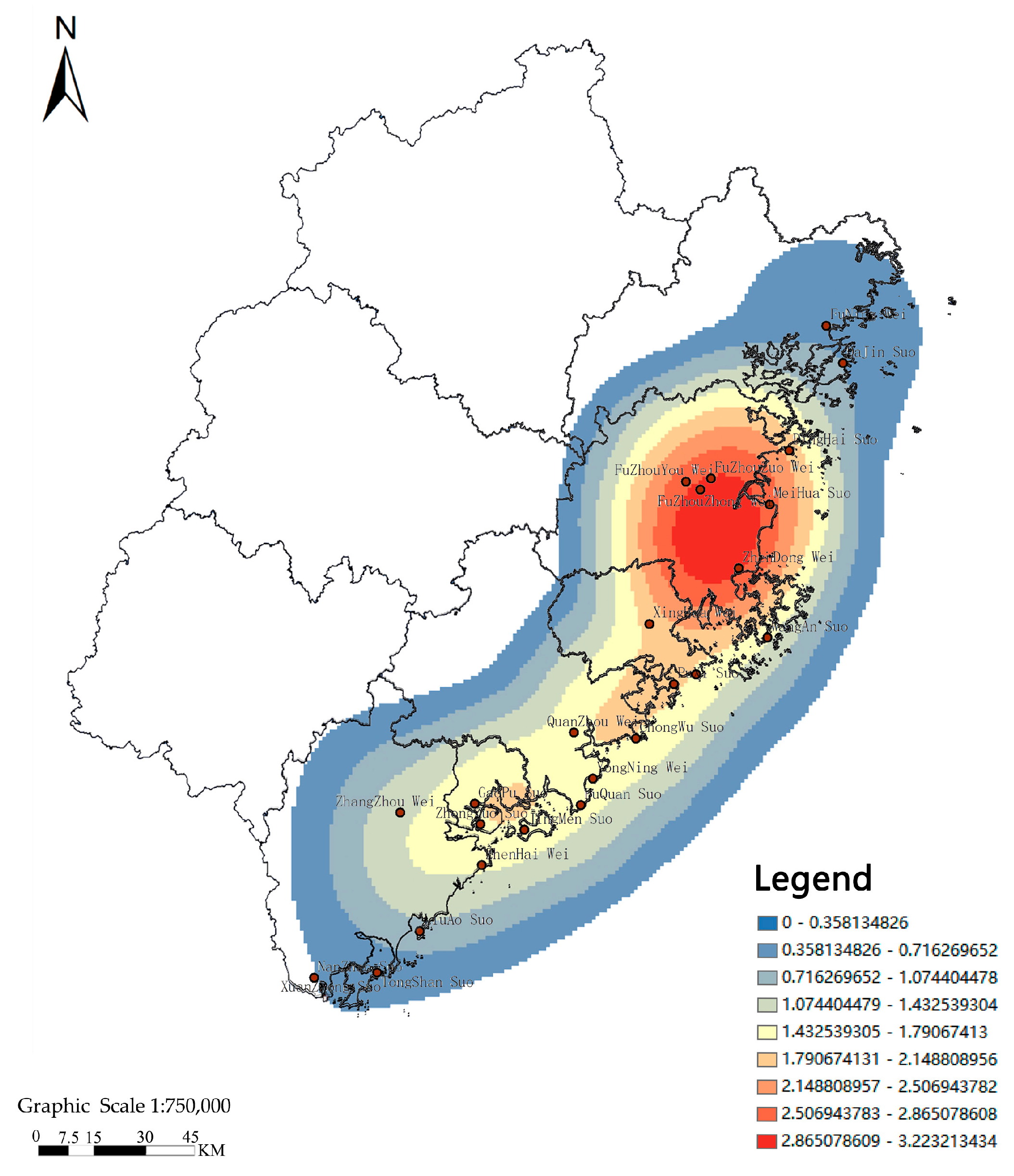
While the Wei-Suo system nominally prescribed 5600 troops per Wei, actual garrison sizes varied across both time and geography. Early Hongwu-era records indicate that the coastal Wei citadels in Fujian typically stationed around 6200 troops, whereas the Suo citadels averaged approximately 1250. The region encompassing southern Fuzhou Prefecture (including Changle and Fuqing), the entirety of Xinghua Prefecture, and northern Quanzhou Prefecture (notably Hui’an County) became the most densely garrisoned area. This concentration of military forces reflected the region’s dual role as both a key economic hub of central Fujian and its frequent exposure to Wokou pirate incursions; notably, Xinghua Prefecture suffered significant devastation in 1562 (Jiajing 41). Following this event, substantial reinforcements were deployed, resulting in the development of a regionally coordinated defence posture with highly concentrated forces. Overall, troop distribution followed a “dense-centre, sparse-periphery” pattern (Figure 7). As political and economic centres along the coast, the three coastal prefectures leveraged their maritime positions, serving as critical forward coastal defence outposts.
Figure 7.
Distribution of garrison forces in Ming-era Fujian.
3.2. Fortification Performance of Wei Citadels
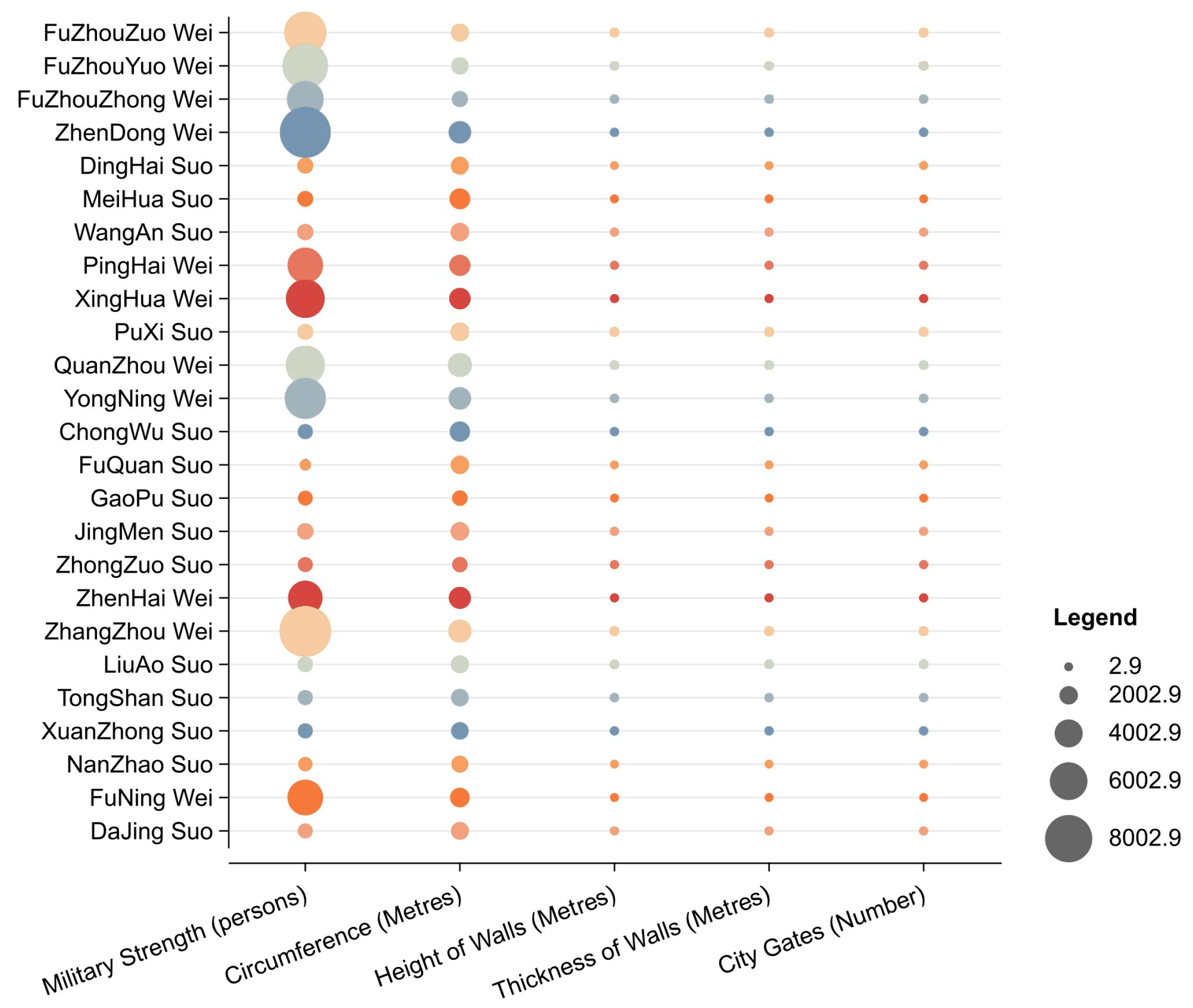
Defensive parameters, such as perimeter, wall height, wall thickness, and the number of gates, recorded in historical sources, were converted to metric units and standardized for comparative analysis across the Wei citadels (Figure 8; detailed data in Appendix Table A1). This standardization creates a consistent, quantitative baseline for subsequent evaluations and comparisons.
Figure 8.
Summary of single-site fortification attributes for Fujian Wei-Suo. Source: Huang Zhongzhao, General Gazetteer of Fujian (Fujian People’s Publishing House, 1989). Note: Based on Wu Chengluo, History of Chinese Weights and Measures (Commercial Press, 1993): 1 zhang ≈ 3.11 m; 1 li ≈ 559.8 m; 1 chi/foot ≈ 0.32 m.
3.3. Joint Combat Capability of the Wei-Suo
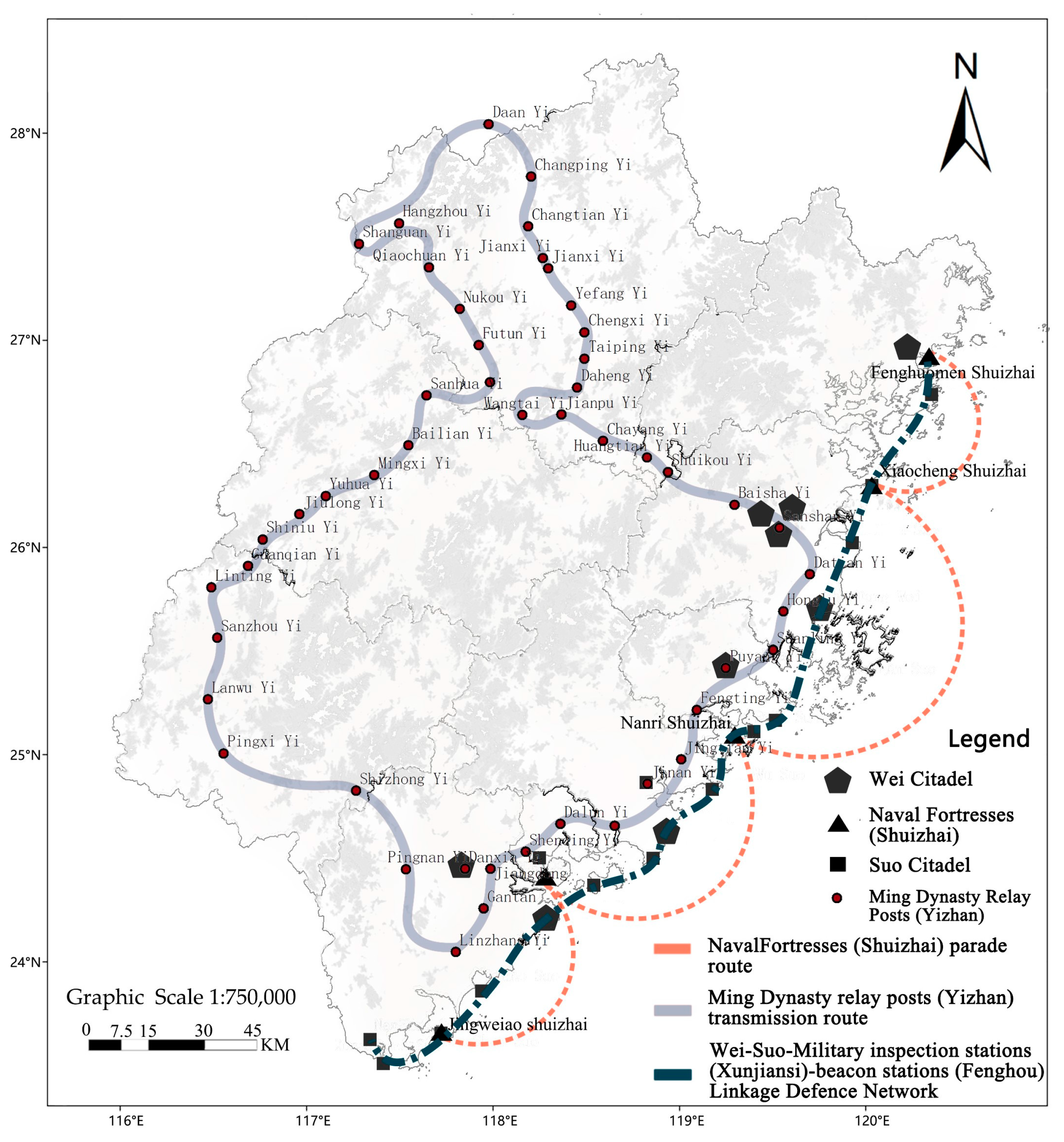
The Ming maritime defence strategy, as outlined in Chouhai Tubian, adhered to the principle of “controlling the seas, securing the coasts, and strengthening city defences,” forming a multi-tiered system through (i) beacon-naval fortress early-warning linkages, (ii) tiered deployment of Wei-Suo and outworks, and (iii) reinforced city fortifications. Therefore, the evaluation of Wei citadels should extend beyond single-site attributes, embedding each node within the collaborative coastal defence network and assessing its strategic significance within this framework.
The system displayed remarkable integration: Wei-Suo, military inspection stations (Xunjiansi), and Ming Dynasty Relay Posts (Yizhan) achieved spatial coordination through functional synergy (Figure 9). This synergy enhanced resource allocation and optimized deployments, thus improving overall effectiveness. As core components of the network, Wei citadels must be evaluated based on their joint response speed and accuracy, logistics efficiency, and their strategic role within the broader maritime defence system.
Figure 9.
Collaborative linkage network of the Ming Fujian maritime defence system.
3.3.1. Accessibility of Wei-Suo Settlement
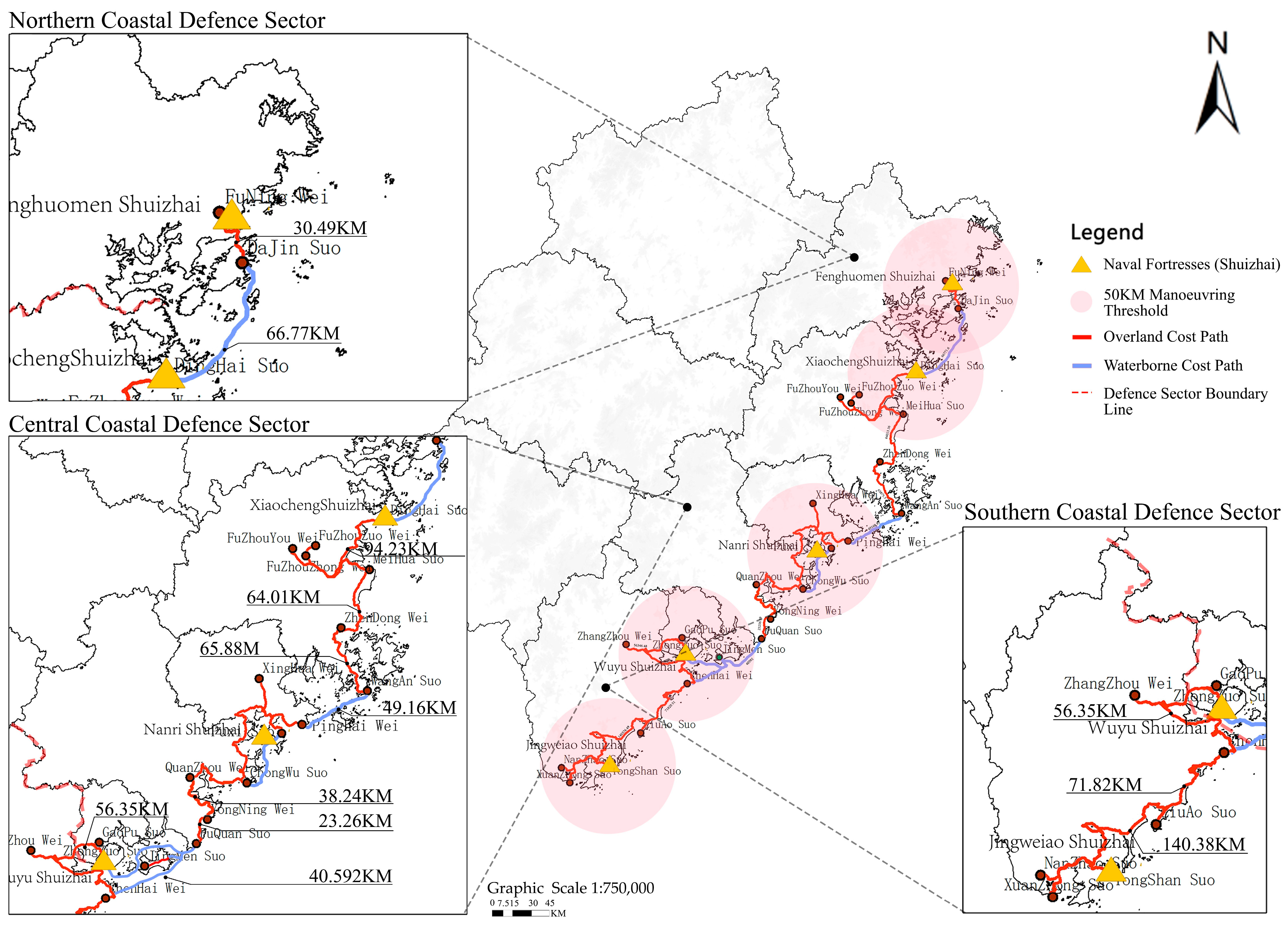
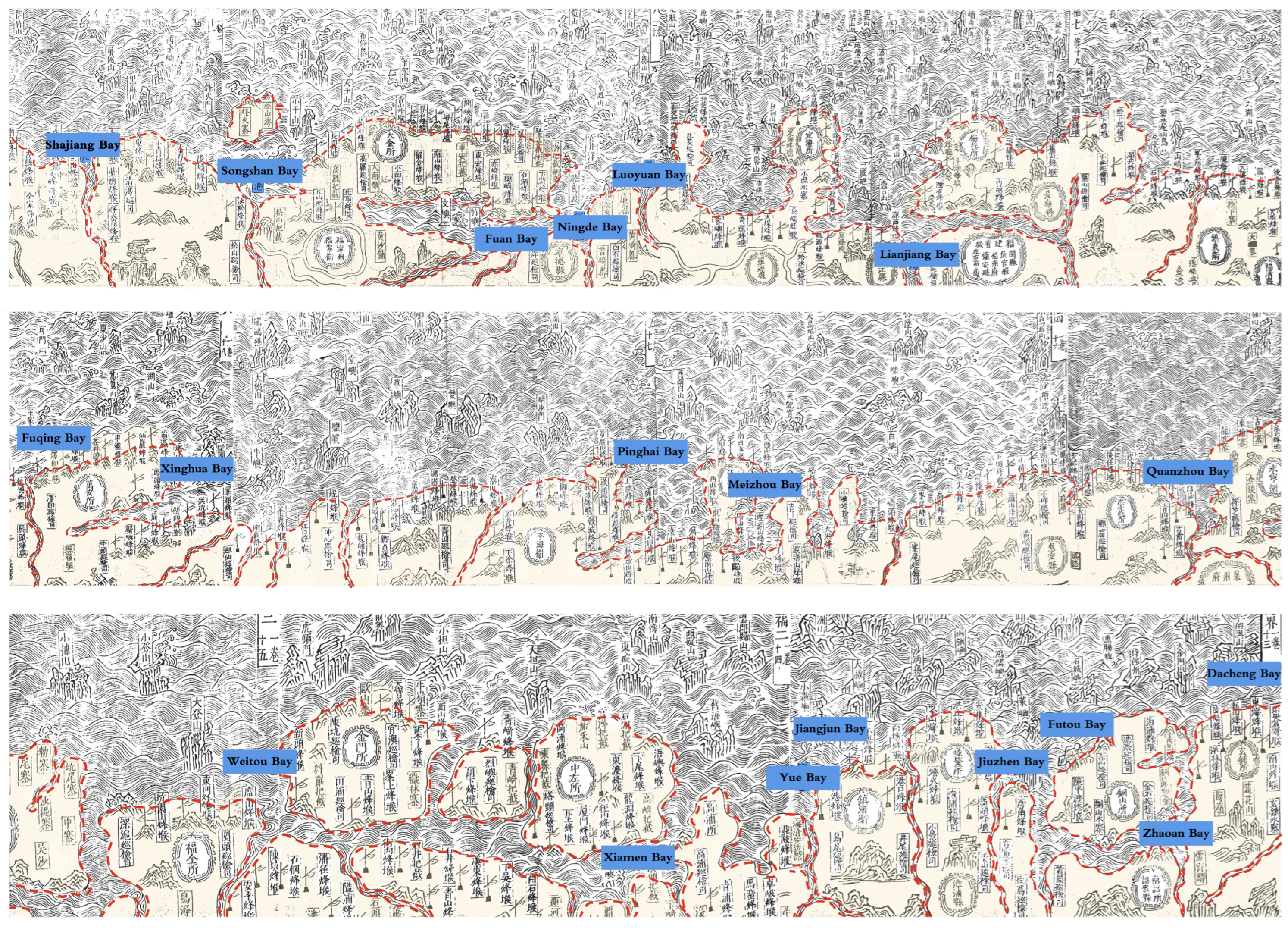
To evaluate wartime joint defence accessibility, we employed GIS-based least cost path (LCP) analysis, integrating both maritime and overland routes to compute the minimum travel cost distances between neighbouring sites (Figure 10; Appendix Table A2). Maritime support routes were derived from historical sailing records. The Illustrated Map of Coastal Defence Against Wokou during the Jiajing Reign highlights key patrol sectors for the Ming fleet, such as the Min River Estuary–Xinghua Bay and Quanzhou Bay–Xiamen Bay. Chouhai Tubian also mentions that naval fortresses (Shuizhai) “occupied strategic chokepoints and mutually supported one another,” underscoring the dependence on sea lanes for joint defence (Figure 11). Using these recorded routes and port nodes, we integrated coastline morphology and bathymetry in ArcMap 10.5 to construct a cost raster and spatialize traditional maritime support corridors for Fujian’s coastal Wei-Suo.
Figure 10.
Inter-site spacing among Fujian coastal defence stations.
Figure 11.
Coastal Shansha map of Fujian (baysection). Source: Zheng Ruozeng and Shao Fangtu (comps.), Hu Zongxian (chief ed.), China Military Classics Collection (Vols. 15–16): Chouhai Tubian, PLA Press and Liaoshen Publishing House, 1990, pp. 33–41.
In contrast, inland support relied on the overland Yizhan networks, including relay stations, transport depots, and express posts. Major trunk routes (e.g., Fuzhou–Jianning, Quanzhou–Zhangzhou) were pivotal for local joint defence. GIS-based slope/distance quantification, along with cost path optimization, reveals a sea–land linkage pattern that aligns with historical records, demonstrating the integration of geographic constraints and strategic needs into an effective, coordinated response system.
3.3.2. Defence Coordination of the Wei-Suo
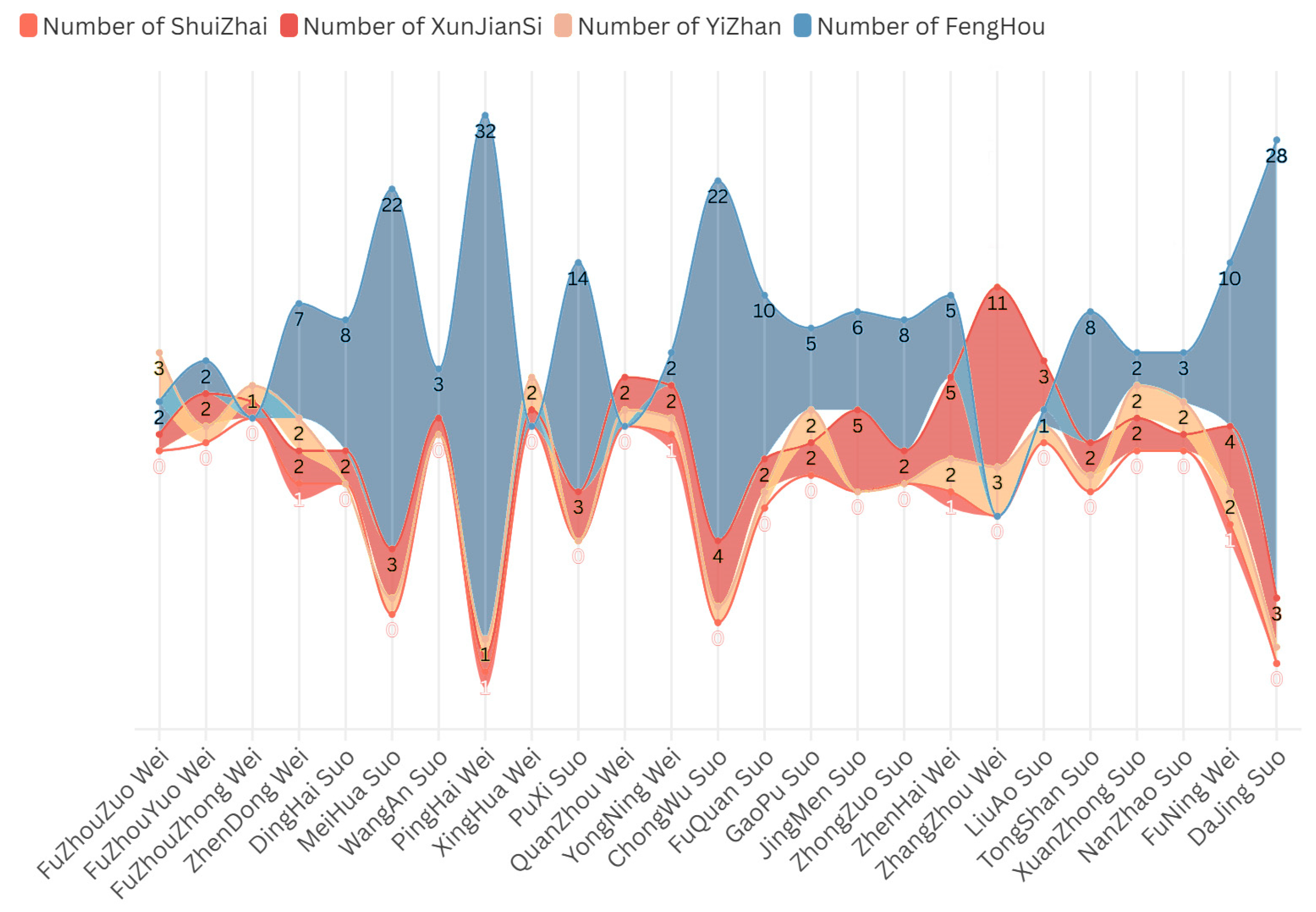
To enhance coastal defence, the Ming court established military inspection stations (Xunjiansi) at strategic coastal and island locations, coordinating these stations with Wei-Suo to accelerate response to raids. As secondary units, Xunjiansi conducted patrols and surveillance, while Shuizhai supported Wei-Suo in repelling Wokou and pirate incursions. This coordination formed the foundation for regional stability. Fujian established five Shuizhai, each responsible for a distinct sea area with overlapping coverage. Together with patrol craft from Guangdong and Zhejiang, they formed a continuous maritime defence line. Upon detecting incursions, rapid alerts mobilized adjacent Shuizhai for joint action. In this manner, Fujian maintained an integrated land–sea defence system, overseen by the Commander-in-Chief, with the three coastal defence sectors of Fujian coordinating with the five Shuizhai (Figure 12; Appendix Table A3).
Figure 12.
Numbers of Shuizhai, Xunjiansi, Yizhan, and beacon stations (Fenghou) associated with Fujian Wei-Suo. Source: Huang Zhongzhao, General Gazetteer of Fujian (1989), pp. 851–909; Shen Dingjun, Gazetteer of Zhangzhou Prefecture (Guangxu 3, 1877), pp. 691–759.
3.4. Command and Deployment Capability of Wei Citadels
The establishment of Ming maritime defence settlements was not solely for military defence but also aimed at safeguarding coastal livelihoods and economic security. The population size and economic strength of Wei-Suo settlements were closely linked to their defensive capabilities. Areas with higher levels of population and economic development typically exhibited stronger defence demands, resulting in more comprehensive fortifications and advanced military equipment. Additionally, wealthier regions had the human and material resources to construct stronger city defences. Therefore, when assessing the defensive system of Wei citadels, population scale and economic strength should be considered as core indicators, as they reflect both the intensity of defence needs and the feasibility of construction, thus forming a general pattern where “greater fiscal capacity correlates with stronger defence.”
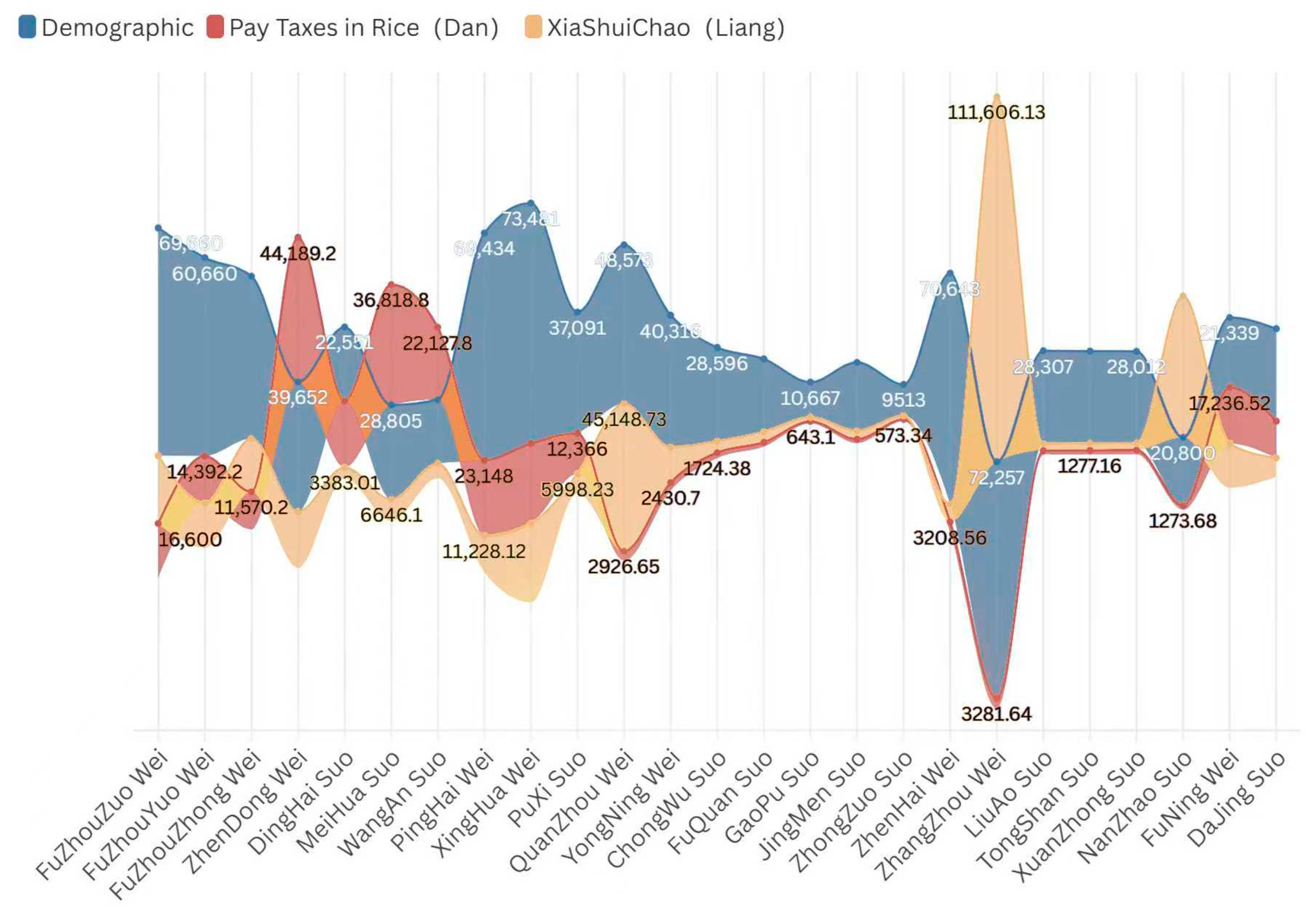
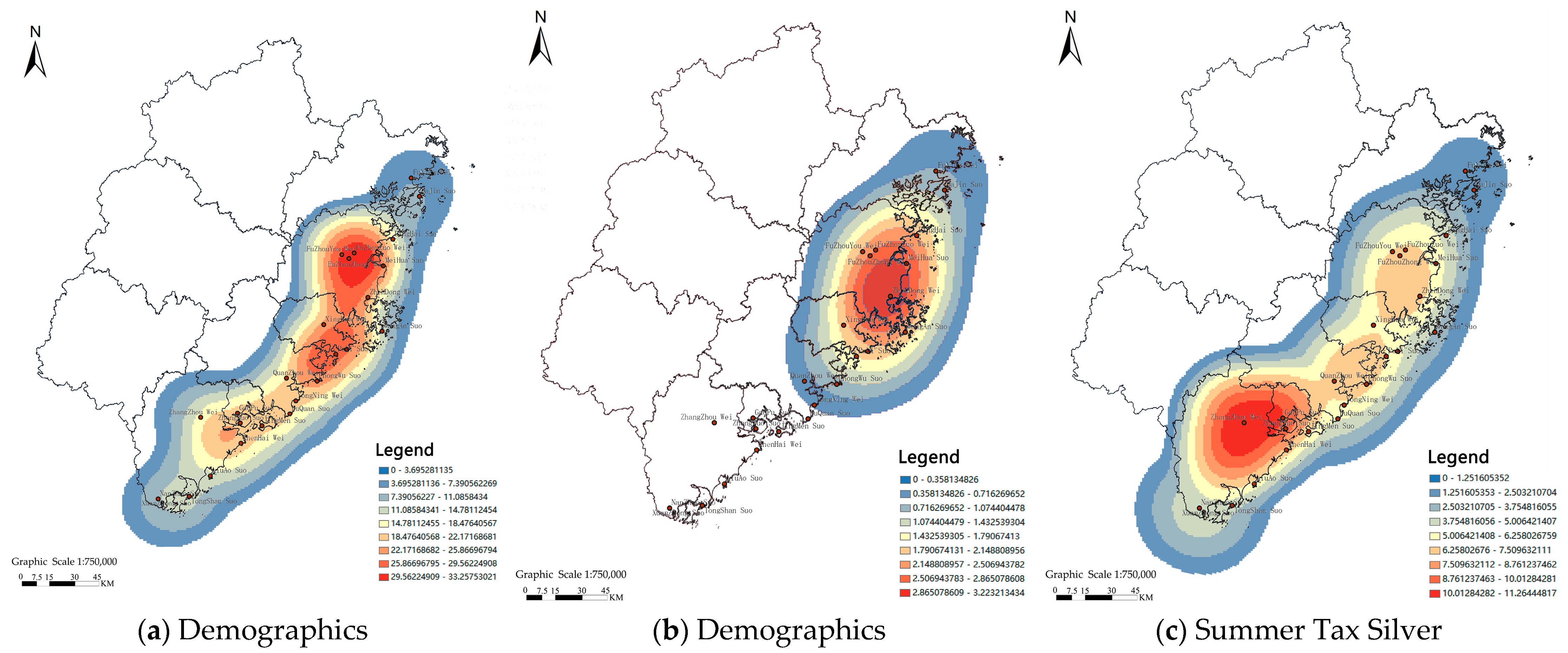
As illustrated in Figure 13 and Figure 14 (Appendix Table A4), significant regional patterns in population and taxation are observed within the Fujian Wei-Suo system. (i) Troop distribution was relatively balanced across the three coastal defence sectors, with Wei citadels bearing significantly higher troop loads compared to Suo citadels, which aligns with the institutional scale of Wei citadels. (ii) Economically, Zhangzhou Wei in the southern coastal defence sector stands out, with the highest proportion of Summer Tax Silver (tael). This reflects Yuegang’s role as the only legally sanctioned civilian foreign-trade port in the Ming Dynasty, positioning it as a key national trade hub. (iii) In terms of Rice Tax (Dan), the central coastal defence sector enjoyed the greatest advantages due to its stronger administrative system and favourable geographical and fiscal conditions. In contrast, the northern and southern coastal defence sectors faced challenges, including fragmented farmland resulting from mountainous terrain, which led to inefficient tax and grain collection systems. As a result, these areas lagged behind the central coastal defence sector in terms of overall administrative and fiscal efficiency.
Figure 13.
Population and economic data for Fujian Wei-Suo. Select the time period: Ming Dynasty HongZhi SiYou (1489). Sources: Chen Jingsheng, A Study on Fujian’s Population Through the Ages (1991), pp. 173–237; Liang Fangzhong, Statistics on China’s Household Registers, Farmland, and Land Tax Throughout History (2008), pp. 321–543; Huang Zhongzhao, General Gazetteer of Fujian, vol. 1 (1989), pp. 411–421. Note: 1 Sheng = 0.1 Dou = 0.01 Dan; 1 Dou = 0.1 Dan; 1 ingot = 50 taels; 1 kan = 1 tael; 1 wen = 0.001 tael. See He Shijin, Ministry of Public Works Factory Library Instructions (Ming), and General Gazetteer of Fujian (re: local practice of casting fifty-tael ingots for tax payments).
Figure 14.
Kernel density of (a) demographics, (b) Rice Tax (Dan), and (c) Summer Tax Silver (tael) at the Wei-Suo level.
3.5. Data Standardization
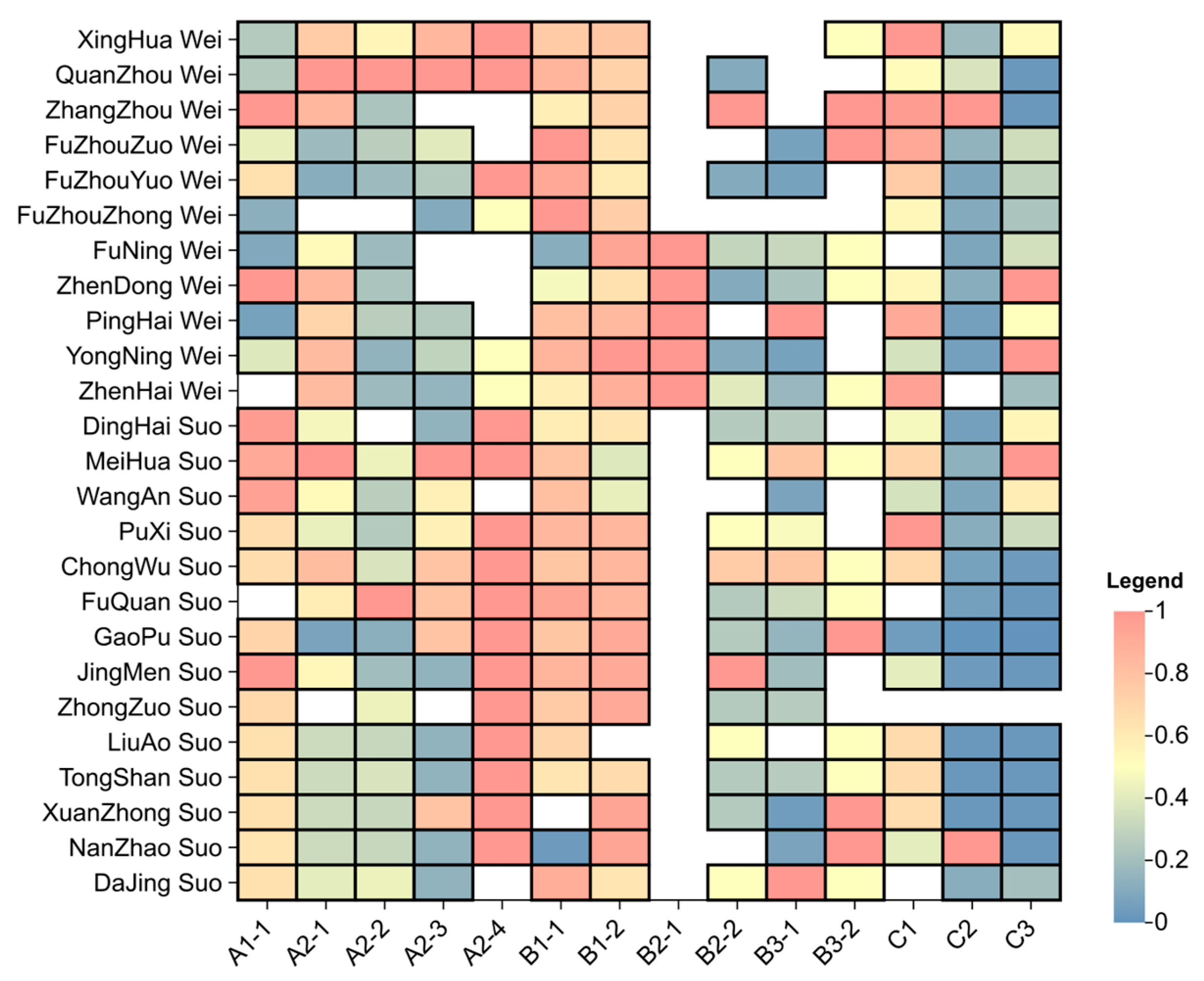
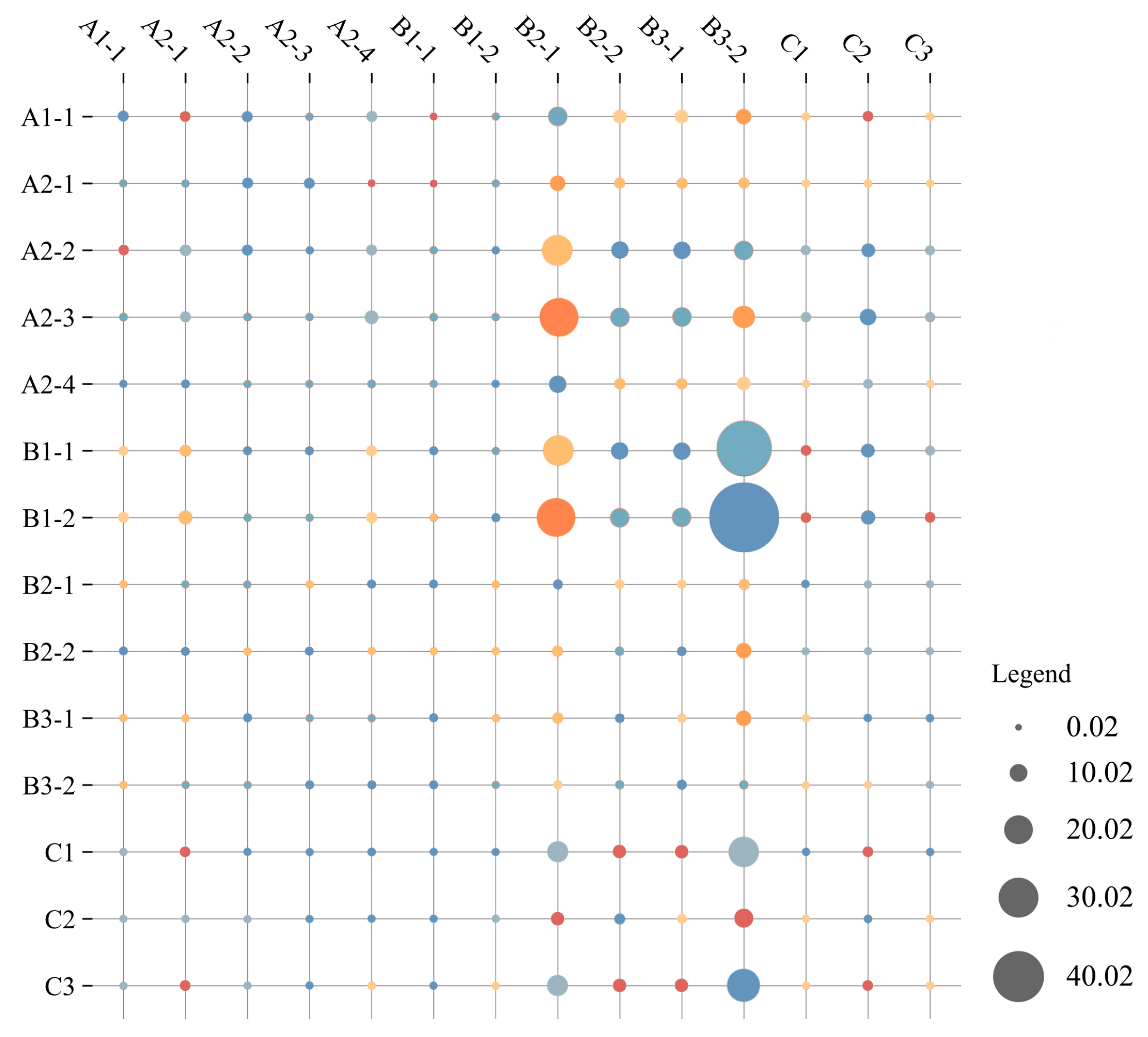
When analysing the defensive evaluation factors of the Wei citadels, it is essential to preprocess the raw data using range normalization. For positively oriented indicators, linear normalization was applied, meaning the higher the value of the relevant evaluation factor, the stronger the citadel’s defensive capability. Conversely, for negatively oriented indicators, a directional transformation was performed: the larger the value, the weaker the joint combat capability. This method eliminates dimensional differences across multi-dimensional indicators, compressing the values of all evaluation factors into a standardized range of [0, 1]. Additionally, through polarity adjustment, all indicators were aligned such that larger values consistently correspond to stronger defence capabilities. This normalization process provides a bias-free data foundation for subsequent Analytic Hierarchy Process (AHP) analyses. For further details, see Figure 15 (detailed data in Appendix Table A5).
Figure 15.
Standardized evaluation factors for Wei-Suo’s defensive capacity.
3.6. Consistency Analysis
- Based on expert surveys, a pairwise comparison judgment matrix was constructed (Figure 16, with detailed data in Appendix Table A6). The consistency of this matrix was then tested. The maximum eigenvalue of the matrix, λ_max = 14.5073126, resulted in a consistency index (C.I.) of 0.039024. Given that this study involves a 14-order matrix, the average random consistency index (R.I.) is 1.58. Substituting this value into the formula, the consistency ratio (C.R.) was calculated as 0.06165792, which is below the threshold of 0.1, indicating that the judgment matrix passed the consistency test [45].
Figure 16. Judgment matrix for defensive evaluation of Fujian Wei-Suo.
- Based on Python calculations, the weight factors for the criteria layer and goal layer are summarized in Table 1. The formula used for this calculation is as follows:C.I. = (λmax − n)/(n − 1)C.R. = C.I./R.I.
Table 1. Weighting factors for defensive evaluation of Fujian Wei-Suo.
3.7. Composite Defensiveness Scores of Fujian Wei-Suo
The defensive score (Wi) of Fujian’s Wei-Suo is calculated using the following formula:
- In this formula, Ai represents the weight coefficient of each evaluation indicator, and Yi is the standardized value corresponding to each indicator. According to the model definition, the comprehensive defensive score of a Wei citadel should be directly proportional to the calculated value, meaning that the higher the score, the stronger the overall defence capability. To ensure clarity and comparability between the different Wei citadels, which may result in numerous decimal places and make interpretation difficult, this study employs a conversion strategy to a percentage scale. Specifically, the final defensive scores are multiplied by 100 to facilitate quantitative comparative analysis between the various citadels (Table 2).
Table 2. Defensive performance evaluation score of Fujian Wei-Suo.
- To verify the scientific validity and reliability of the aforementioned defensive evaluation scores and weight factors, a sensitivity analysis was conducted. The results indicate that when the weight of the core variable B1-2 fluctuates by ±10%, the Spearman’s rank correlation coefficient remains greater than 0.95, and the stability of the ranking of the Wei-Suo is highly significant (Table 2). This confirms that the conclusions drawn from the AHP weight assignment model are both reasonable and stable.
4. Discussion
Based on the defence effectiveness evaluation results, this study proposes targeted conservation strategies from a sustainable development perspective. The spatial logic of the Ming coastal defence system, characterized by the principle of “controlling the sea from the land,” its resource optimization strategies, and its adaptive system-wide characteristics, provides valuable theoretical insights and practical guidance for contemporary cultural heritage conservation efforts.
4.1. Spatial Differentiation of Defence Efficacy and Zone Adaptation
The coastal defence system of Fujian during the Ming period exhibited significant spatial differentiation. The deployment of troops, arrangement of Wei-Suo sites, and overall defensive effectiveness varied considerably across regions, closely reflecting natural geography, economic distribution, and the prevailing threat environment. In terms of troop deployment, the coastal region centred around Fuzhou Prefecture (33,093 troops) adopted a relatively dense defensive posture, prioritizing the development of maritime defence infrastructure. In contrast, Zhangzhou Prefecture, located inland, employed a “land–sea dual focus” strategy, dispersing forces across Zhaoan, Zhangpu, and Haicheng to create a multilayered coastal defence system.
The Three Guards of Fuzhou (Fuzhou San Wei) achieved robust joint operational capabilities through optimized spatial coordination with neighbouring Wei-Suo sites. Short-range nodes, such as Yongning Wei (23.26 km) and Gaopu Suo (32.35 km), enabled rapid reinforcement. In contrast, more distant nodes, including Xuanzhong Suo (212.36 km), Nanzhao Suo (205.99 km), and Funing Wei (190.78 km), became weak links due to their separation exceeding the Ming infantry’s daily marching limit of 50 km.
GIS spatial analysis reveals a clear, stepwise decline in defence efficacy as accessibility decreases, confirming that the Wei-Suo layout closely aligns with the real-time coordination requirements of joint operations. In combination with the beacon stations (Fenghou), which were spaced on average at 2.5 km, and the multi-tiered information network of Ming Dynasty Relay Posts (Yizhan), which included relay stations, transport depots, and express posts [4], these facilities not only strengthened the physical defence system but also helped mitigate security risks resulting from geographic disparities. Together, these components formed a cohesive regional protection network.
Building on these findings, a tiered conservation system can be proposed. For core regions such as Quanzhou Wei and Xinghua Wei, emphasis should be placed on preventive conservation and further exploration of their historical significance. For sites where military functions have diminished, but the structures remain intact, a sustainable reuse approach can be adopted. This might involve integrating eco-tourism and community services to strike a dynamic balance between preservation and utilization.
As indicated in Table 1 (weights), within the accessibility dimension, the indicators “distance to the nearest Wei citadel” (0.146) and “distance to the nearest Suo citadel” (0.182) have the highest weight values, far surpassing indicators like the “number of naval fortresses (Shuizhai)” (0.007) and “number of beacon stations (Fenghou)” (0.006). This underscores the importance of spatial accessibility as a primary factor driving defence effectiveness. As the economic centre, the central coastal defence sector in Fujian, which was frequently targeted by Wokou pirates, exhibited distinct independent defence characteristics. Consequently, its Wei-Suo, such as Quanzhou Wei (70.23) and Meihua Suo (70.84), recorded significantly higher defence scores compared to other regions.
To systematically reveal spatial patterns in defence efficacy, we aggregate site-level scores and sectoral means across the three coastal defence sectors of Fujian (Table 3). Identifying outliers is crucial to ensuring the scientific validity of the evaluation. Using SPSS version 27 for descriptive statistics (Table 4), and applying the ±3σ rule under the assumption of normality, the normal range is identified as [18.63, 81.59]. All Wei-Suo scores fall within this range, indicating that no statistical anomalies were found in the evaluation.
Table 3.
Summary of comprehensive evaluation of defence effectiveness for Ming Dynasty coastal defence settlements in Fujian.
Table 4.
Descriptive statistics of defensive scores for Ming Dynasty coastal defence settlements in Fujian.
The results demonstrate pronounced differences in defence efficacy across the Wei-Suo sites. Meihua Suo (70.84) and Quanzhou Wei (70.23) stand out due to their strong defensive performance. Despite fielding only mid-to-high troop levels (6147), Quanzhou Wei excelled in physical defence parameters, such as city perimeter, wall thickness, and the number of gates, reflecting its robust independent defence capacity. As a Suo citadel, Meihua Suo had a city scale second only to Pinghai Wei and, with its numerous naval fortresses (Shuizhai) and beacon stations (Fenghou), it maintained efficient early-warning and intelligence systems. Furthermore, its demographic and economic indicators ranked among the top within the Suo citadel system, yielding strong command and support capabilities. Both sites were situated approximately 30 km from the nearest supporting nodes—well within the Ming infantry’s daily mobility threshold—thus ensuring timely joint defence responses.
In contrast, Fuzhou Zhong Wei (38.64) and Funing Wei (28.42) demonstrated significantly weaker defence performance. Fuzhou Zhong Wei was located 190.78 km from the nearest Wei citadel, far exceeding the maximum distance a Ming infantryman could march in one day, hindering the ability to mobilize rapid reinforcements. Funing Wei, although located 54.04 km from the nearest Suo citadel, was small in scale and lacked key auxiliary units, such as military inspection stations (Xunjiansi) and naval fortresses (Shuizhai), thereby weakening its coordination and regional control.
When comparing the sectoral averages, the central coastal defence sector (53.98) clearly outperformed the southern coastal defence sector (43.85) and northern coastal defence sector (36.03). This concentration of resources reflects the Ming strategy of prioritizing the central region over the north and south.
A significant challenge lies in the misalignment between the Ming’s northern/central/southern coastal defence sectors and the current administrative divisions (Fuzhou, Putian, Quanzhou, Zhangzhou, Ningde), which limits the ability to implement a system-wide conservation strategy for maritime defence heritage. Historical sources place Fuzhou Wei, Meihua Suo (now Fuzhou), Xinghua Wei, Pinghai Wei (now Putian), Quanzhou Wei, and Chongwu Suo (now Quanzhou) in the central coastal defence sector; Zhangzhou Wei, Zhenhai Wei (now Zhangzhou), and Zhongzuo Suo (now Xiamen) in the southern coastal defence sector; and Funing Wei and Dajin Suo (now Ningde) in the northern coastal defence sector. Current conservation efforts are fragmented across various municipal and county institutions, hindering the adoption of unified standards and guidelines. Moreover, funding levels are more robust in Fuzhou and Quanzhou, while certain areas, such as Putian and Ningde, face fiscal limitations. Activation strategies also vary significantly. For instance, Fuzhou emphasizes the interpretation of maritime defence, while Quanzhou focuses on military-site tourism, which diminishes the ability to convey the historical value of the Ming-integrated point–line–area defence system.
To address these challenges, we recommend establishing a long-term, cross-regional governance mechanism. This could take the form of a “Cross-Regional Joint Working Group for the Protection of Ming-Dynasty Fujian Maritime Defence Heritage,” led by the provincial heritage authority and involving coastal city cultural and tourism bureaus, heritage units, and county governments. The working group should define several “heritage-protection collaboration zones” based on the historical divisions of the Ming coastal defence sectors. Each zone should set core protection targets, allocate responsibilities, and specify operational strategies. Key actions should include prioritizing cross-regional archaeology, integrated deterioration management, and issuing a “Unified Technical Specification for the Conservation of Ming-Dynasty Fujian Maritime Defence Military Settlements.” This specification should standardize pathology criteria, restoration procedures, and environmental controls for Wei citadel walls, beacon stations (Fenghou), and relay posts (Yizhan), ensuring both historical authenticity and operational coordination. Dedicated teams should oversee legal reviews of protection plans.
Additionally, a Fujian Maritime Defence Cultural Heritage Information-Sharing Platform should be established. This platform would integrate foundational records, GIS data layers, and the AHP results from this study, enabling better inter-agency collaboration, improved resource allocation, and the development of joint research and education programs. Such efforts would significantly enhance both the integrated utilization and interpretative quality of Fujian’s maritime defence heritage.
4.2. Core Drivers of Defence Effectiveness Differentiation
From the perspective of defence effectiveness, Fujian’s coastal defence Wei-Suo system exhibits a clear emphasis on independent defence capability, with a weight of 0.448, significantly higher than the joint combat capability (0.377) and command and deployment capability (0.175). This conclusion contrasts with the viewpoint proposed by Zhang Yukun’s team (2020) [46], which emphasized joint combat capability as the core of their Zhejiang case study. The fundamental reason for this discrepancy lies in the differing pressures and threat intensities faced by Fujian and Zhejiang from Wokou incursions.
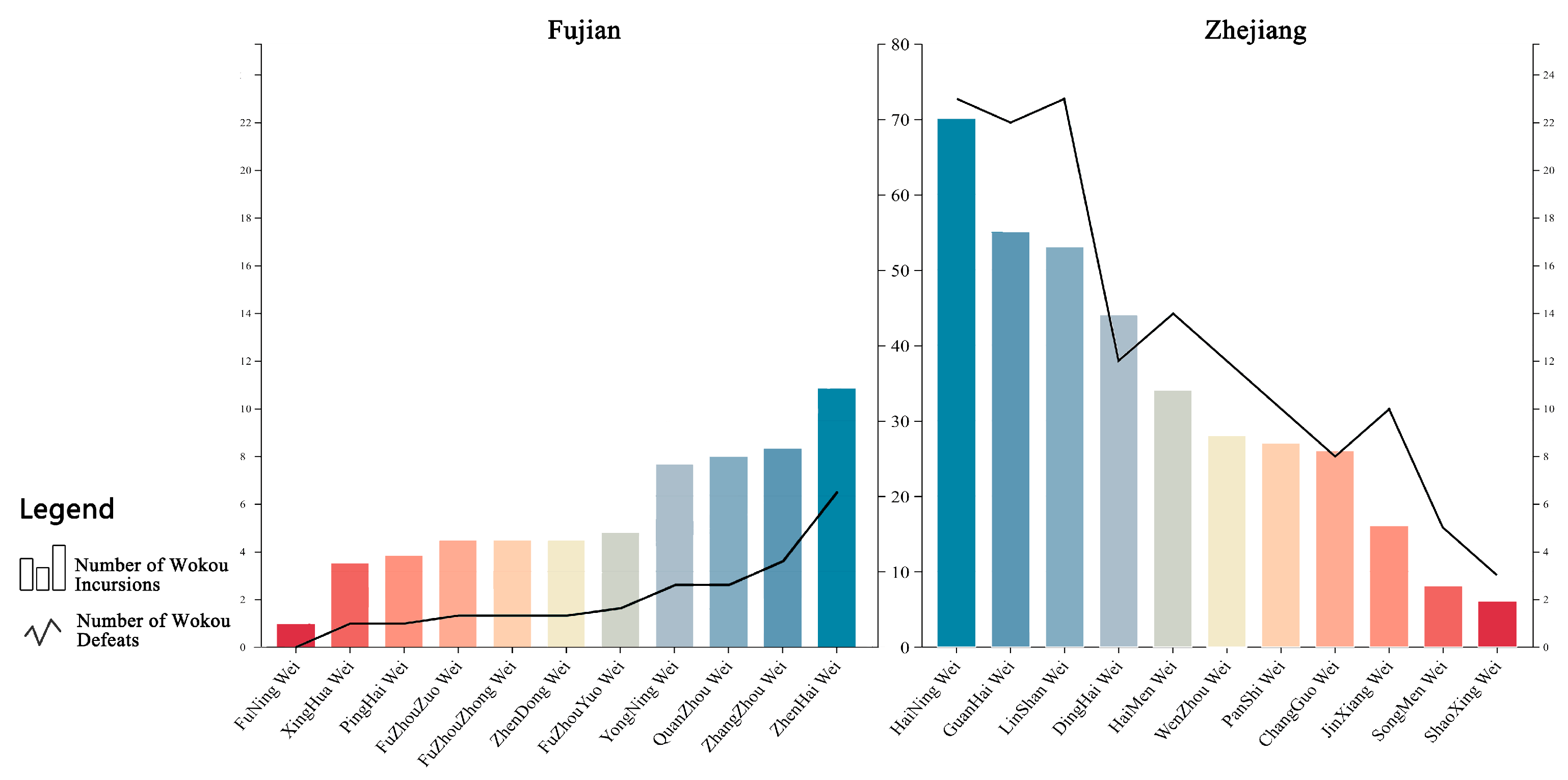
According to historical records of Wokou attacks, Zhejiang, particularly during the Jiajing period, experienced frequent raids, with an average of 16.7 incursions per year, far surpassing the frequency observed in Fujian (Figure 17). In response to such intense and continuous attacks, Zhejiang gradually developed a regional defensive system centred around the “four Canjiang and six Bazong,” which reduced the frequency of Wokou raids to an average of 0.62 incursions per year [24]. It was under these extreme conditions that coordinated defence proved to be an irreplaceable strategic value. In contrast, outside the Jiajing period, Wokou incursions in Fujian were relatively infrequent, with an average of fewer than one raid per year. During normal periods, the threat was low, leading Wei-Suo to rely more on their own defensive structures and stationed troops for effective resistance. This made independent defence a more efficient and economical choice in Fujian.
Figure 17.
Comparison of Wokou invasion frequencies between Zhejiang and Fujian.
The Ming Dynasty’s maritime defence policy displayed notable dynamic adjustments. When faced with major security threats, greater emphasis was placed on regional cooperation and the establishment of joint defence mechanisms. In areas with lower threat frequencies, however, the focus shifted toward strengthening individual combat capabilities. Fujian prioritized the “Wei-Suo independent defence” model, while Zhejiang focused on developing a “regional joint defence” system. Although the strategies differed, both approaches embodied the core principle of the Ming maritime defence system: spatial resource allocation strategies were adapted based on the actual threat landscape and the geographical and economic distribution, thereby maximizing overall defence effectiveness.
4.3. Concentration and Adaptability of the Coastal Defence System
The clustered distribution of high-scoring Wei-Suo (≥50) in the central coastal defence sector of Fujian closely resembles that of the Ningbo-Shaoxing area in Zhejiang. Both regions are situated within core economic zones and major Wokou-affected areas, highlighting the system’s adaptive capacity to scale its defence strategies according to the intensity of external threats. Due to Fujian’s distinctive topography, characterized by a long coastline and numerous islands (see Figure 2), the Ming court implemented a naval fortress system (Shuizhai) to strengthen patrol and early warning capabilities, compensating for the region’s relatively weaker natural defences. Notably, the majority of high-scoring Wei-Suo are located along the coast, controlling critical ports or strategic nodes, such as Meihua Suo and Wanan Suo. Of the 12 sites with a score of ≥50, nine are coastal, supporting the principle of “prioritizing key prefectures/towns and ports for defence upgrades,” which ensures rapid response to both sea and land threats.
Core military strongholds, such as Quanzhou Wei and Xinghua Wei, exhibit “military–civil integration,” where the Wei citadel served both as a military command centre and a local administrative hub. This integrated governance model enabled the efficient consolidation and coordination of subordinate resources, such as military inspection stations (Xunjiansi) and naval fortresses (Shuizhai). Although individual facility weights are relatively low in the AHP model, the synergistic effects of administrative integration significantly enhanced the overall defence performance of the region.
For modern-day heritage activation, it is crucial to align the functional uses of these sites with their historical and cultural significance: core Wei-Suo can be repurposed for cultural displays and educational purposes; eco-tourism can be developed around secondary sites such as Xunjiansi and beacon stations (Fenghou); and selected Shuizhai can be reconstructed to support the transmission of maritime cultural heritage. This approach allows for a dynamic balance, providing both conservation benefits and contributions to regional socio-economic development.
4.4. Universality and Management Application of the Evaluation System
The three-dimensional evaluation system developed in this study, encompassing military deployment, spatial planning, and resource allocation, demonstrates significant generalizability and practical value. It provides a unified theoretical foundation for the protection and management of coastal defence military settlements in provinces such as Zhejiang, Guangdong, and Shandong. Rooted in the Ming Wei-Suo system and its coordination of military, spatial, and resource elements, this framework allows for regional customization by adjusting key weights, refining evaluation criteria, and integrating local characteristics.
The hypothesis that increased distance between Wei-Suo reduces defence effectiveness can be validated using GIS cost path analysis in Zhejiang’s Ningbo-Shaoxing area. Additionally, the inference that independent defence dominates in regions with low-frequency Wokou incursions can be corroborated through historical materials on Dengzhou Wei (Shandong) and its defence capability model. The framework enables cross-regional comparability of metrics, mitigating the risk of skewed protection priorities due to inconsistent standards. Moreover, it emphasizes the long-term role of jurisdictional guarantees in ensuring the sustainable development of heritage.
This evaluation framework can be directly integrated into heritage-management platforms. By using a modular architecture, it aggregates factors into three key dimensions: “Heritage Entity Health,” “Integrity of the Joint Defence Network,” and “Regional Sustainability Support.” The indicators dynamically update and can interface with cultural tourism and statistics systems. For instance: Heritage Entity Health monitors wall preservation rates and restoration progress for military facilities, issuing alerts when thresholds are not met. The Integrity of the Joint Defence Network is evaluated by assessing the rationality of the layout, utilizing heatmaps to identify coordination gaps, and informing cross-regional plans. Regional Sustainability Support tracks investment in cultural tourism and community participation, helping to optimize resource allocation.
With standardized data workflows and robust weighting, the framework is portable: regions only need to provide local base data for efficient assessments, thus reducing decision-making costs and promoting a conservation model based on “standardized norms with differentiated approaches.”
5. Conclusions, Limitations, and Future Work
This study systematically quantifies the defensive characteristics of Ming Dynasty coastal military settlements in Fujian using a three-tier evaluation system—independent defence effectiveness, joint combat capability, and command and deployment capability—by integrating GIS spatial analysis with the Analytic Hierarchy Process (AHP). The results show that higher Wei-Suo density correlates with lower overall defensive effectiveness, further validating the scientific rationale and feasibility of the traditional layout of “beacon stations (Fenghou) every five li, garrisons every seventy li” [47]. Independent defence capacity emerged as the critical foundation for the entire system. Regions with strong economic bases and densely populated Wei-Suo areas, particularly the central coastal defence sector of Fujian, exhibited significantly higher comprehensive defensive effectiveness than other areas. This research provides an in-depth analysis of the defensive mechanisms and resource allocation strategies employed by Ming coastal defence settlements, offering practical case evidence for the contemporary conservation and sustainable utilization of maritime defence cultural heritage. It demonstrates both theoretical innovation and practical relevance.
However, this study has certain limitations. First, due to challenges in acquiring complete historical data, some defensive elements, such as the density of beacon stations (Fenghou) and the efficiency of information transmission, could not be precisely quantified. This limitation made it difficult for the model to capture the complexities of coordinated governance among Wei-Suo fully. While the study employed the principle of geographical proximity to assign facility affiliations, thereby enhancing data operability, this approach may have reduced the actual influence of Ming administrative divisions and military command structures on joint defence performance, potentially leading to discrepancies between quantitative results and historical realities. Second, the Ming coastal defence system spanned a long historical period, during which tactical deployments and strategic planning underwent multiple adjustments, such as the strengthening of joint defence mechanisms during the Jiajing era. While the unified weighting system used in this study ensured horizontal comparability, it could not fully capture the dynamic evolution of tactical arrangements across different periods, thus simplifying the historical trajectory of the defence system to some extent.
Future research can proceed in several directions. First, case studies could focus on two representative periods—the Hongwu to Yongle era and the Jiajing to Wanli era—employing dynamic weighting or stage-specific variables to comprehensively analyse the relationship between tactical evolution and geographical adaptation. Second, integrating the Ming Dynasty Relay Posts (Yizhan) system and official road networks into the analysis would improve accuracy. Historical records on the history of Ming, concerning facilities such as relay depots and express courier posts, offer valuable references. In spatial models of maritime defence support routes, applying differential travel costs can yield more precise accessibility assessments, effectively restoring wartime joint defence coordination routes and efficiencies. Third, a cross-regional comparative perspective should be broadened. Comparative studies of defensive layouts, spatial distributions, and management systems in regions such as Zhejiang and Guangdong would enhance the theoretical framework and practical methodologies for evaluating the cultural heritage value of Ming and Qing maritime defences.
Author Contributions
Conceptualization, J.X., K.C. and X.W.; methodology, J.X., X.W. and K.C.; software, J.X.; validation, J.X., K.C. and X.W.; formal analysis, J.X. and X.W.; investigation, J.X., K.C. and M.X.; resources, J.X., C.K. and M.X.; data curation, C.K., K.C. and X.W.; writing, original draft preparation, J.X. and K.C.; writing, review and editing, J.X., K.C. and M.X.; visualization, M.X. and X.W.; supervision, K.C. and X.W.; project administration, M.X., K.C. and J.X.; funding acquisition, J.X., C.K. and K.C. All authors have read and agreed to the published version of the manuscript.
Funding
This research was funded by the Social Science Foundation of Fujian Province (FJ2024C119), the Social Science Foundation of Fujian Province (FJ2024C127), the Social Science Foundation of Fujian Province (FJ2024C162), and the Fujian Province Education Science Planning Program (111423025).
Institutional Review Board Statement
Not applicable.
Informed Consent Statement
Not applicable.
Data Availability Statement
All data generated or analysed during this study are included in this published article.
Conflicts of Interest
The funders had no role in the design of the study; in the collection, analyses, or interpretation of data; in the writing of the manuscript; or in the decision to publish the results.
Appendix A
Table A1.
Summary of single-site fortification attributes for Fujian Wei-Suo.
Table A1.
Summary of single-site fortification attributes for Fujian Wei-Suo.
| Serial Number | Three Coastal Defence Sectors | Prefectural Seat | Wei-Suo | Military Strength (Persons) | Circumference (Metres) | Height of Walls (Metres) | Thickness of Walls (Metres) | City Gates (Number) |
|---|---|---|---|---|---|---|---|---|
| 1 | Central coastal defence sector | Fuzhou Prefecture (Fu) | Fuzhouzuo Wei | 6720 | 1679.4 | 7.46 | 5.59 | 4 |
| 2 | Fuzhouyuo Wei | 7491 | 1567.44 | 6.84 | 4.66 | 6 | ||
| 3 | Fuzhouzhong Wei | 5718 | 1399.5 | 5.59 | 3.73 | 5 | ||
| 4 | Zhendong Wei | 8687 | 2746.13 | 7.15 | 3.11 | 4 | ||
| 5 | Dinghai Suo | 1520 | 1866 | 4.67 | 3.11 | 4 | ||
| 6 | Meihua Suo | 1458 | 2506.66 | 5.6 | 4.35 | 4 | ||
| 7 | Wangan Suo | 1499 | 1946.86 | 6 | 3.73 | 3 | ||
| 8 | Xinghua Prefecture (Fu) | Pinghai Wei | 5516 | 2509.77 | 7.46 | 4.67 | 4 | |
| 9 | Xinghua Wei | 6189 | 2581.3 | 9.33 | 8.4 | 6 | ||
| 10 | Puxi Suo | 1221 | 1834.9 | 5.91 | 3.73 | 4 | ||
| 11 | Quanzhou Prefecture (Fu) | Quanzhou Wei | 6147 | 2985.6 | 12.44 | 9.33 | 6 | |
| 12 | Yongning Wei | 6635 | 2721.25 | 6.53 | 4.9 | 5 | ||
| 13 | Chongwu Suo | 1221 | 2292.07 | 6.53 | 4.04 | 4 | ||
| 14 | Fuquan Suo | 575 | 2021.5 | 9.64 | 4.04 | 4 | ||
| 15 | Gaopu Suo | 1258 | 1399.5 | 5.29 | 4.04 | 4 | ||
| 16 | Jingmen Suo | 1535 | 1959.3 | 5.59 | 3.11 | 4 | ||
| 17 | Zhongzuo Suo | 1240 | 1321.75 | 6.84 | 2.9 | 4 | ||
| 18 | Southern coastal defence sector | Zhangzhou Prefecture (Fu) | Zhenhai Wei | 5300 | 2715.03 | 6.84 | 4.04 | 5 |
| 19 | Zhangzhou Wei | 8687 | 2746.13 | 7.15 | 3.11 | 4 | ||
| 20 | Liuao Suo | 1200 | 1718.64 | 6.22 | 3.11 | 4 | ||
| 21 | Tongshan Suo | 1200 | 1713.61 | 6.53 | 3.11 | 4 | ||
| 22 | Xuanzhong Suo | 1200 | 1710.5 | 6.22 | 4.04 | 4 | ||
| 23 | Nanzhao Suo | 1180 | 1710.5 | 6.22 | 3.11 | 4 | ||
| 24 | Northern coastal defence sector | Funing Prefecture (Zhou) | Funing Wei | 5600 | 2239.2 | 6.84 | 3.11 | 4 |
| 25 | Dajing Suo | 1200 | 1810.02 | 6.84 | 3.11 | 3 |
Table A2.
Inter-site spacing among Fujian coastal defence stations.
Table A2.
Inter-site spacing among Fujian coastal defence stations.
| Serial Number | Three Coastal Defence Sectors | Prefectural Seat | Wei-Suo | Shortest Distance to Neighbouring Wei Citadels (km) | Shortest Distance to Neighbouring Suo Citadels (km) |
|---|---|---|---|---|---|
| 1 | Central coastal defence sector | Fuzhou Prefecture (Fu) | Fuzhouzuo Wei | 11.27 | 65.31 |
| 2 | Fuzhouyuo Wei | 25.59 | 70.34 | ||
| 3 | Fuzhouzhong Wei | 11.27 | 54.04 | ||
| 4 | Zhendong Wei | 118.05 | 64.01 | ||
| 5 | Dinghai Suo | 93.52 | 66.77 | ||
| 6 | Meihua Suo | 54.04 | 94.23 | ||
| 7 | Wangan Suo | 49.17 | 91.36 | ||
| 8 | Xinghua Prefecture (Fu) | Pinghai Wei | 49.17 | 42.19 | |
| 9 | Xinghua Wei | 59.12 | 49.05 | ||
| 10 | Puxi Suo | 42.19 | 41.06 | ||
| 11 | Quanzhou Prefecture (Fu) | Quanzhou Wei | 38.24 | 56.09 | |
| 12 | Yongning Wei | 38.24 | 23.26 | ||
| 13 | Chongwu Suo | 56.09 | 41.06 | ||
| 14 | Fuquan Suo | 23.26 | 40.59 | ||
| 15 | Gaopu Suo | 56.35 | 32.35 | ||
| 16 | Jingmen Suo | 36.64 | 32.68 | ||
| 17 | Zhongzuo Suo | 59.15 | 32.68 | ||
| 18 | Southern coastal defence sector | Zhangzhou Prefecture (Fu) | Zhenhai Wei | 95.89 | 36.64 |
| 19 | Zhangzhou Wei | 95.89 | 56.35 | ||
| 20 | Liuao Suo | 71.82 | 140.38 | ||
| 21 | Tongshan Suo | 85.86 | 60.73 | ||
| 22 | Xuanzhong Suo | 212.36 | 30.06 | ||
| 23 | Nanzhao Suo | 205.99 | 30.06 | ||
| 24 | Northern coastal defence sector | Funing Prefecture (Zhou) | Funing Wei | 190.78 | 30.49 |
| 25 | Dajing Suo | 30.49 | 66.77 |
Table A3.
Numbers of Shuizhai, Xunjiansi, Yizhan, and beacon stations (Fenghou) associated with Fujian Wei-Suo.
Table A3.
Numbers of Shuizhai, Xunjiansi, Yizhan, and beacon stations (Fenghou) associated with Fujian Wei-Suo.
| Serial Number | Three Coastal Defence Sectors | Prefectural Seat | Wei-Suo | Number of ShuiZhai | Number of XunJianSi | Number of YiZhan | Number of FengHou |
|---|---|---|---|---|---|---|---|
| 1 | Central coastal defence sector | Fuzhou Prefecture (Fu) | Fuzhouzuo Wei | 0 | 1 | 3 | 2 |
| 2 | Fuzhouyuo Wei | 0 | 2 | 1 | 2 | ||
| 3 | Fuzhouzhong Wei | 0 | 1 | 1 | 0 | ||
| 4 | Zhendong Wei | 1 | 2 | 2 | 7 | ||
| 5 | Dinghai Suo | 0 | 2 | 0 | 8 | ||
| 6 | Meihua Suo | 0 | 3 | 1 | 22 | ||
| 7 | Wangan Suo | 0 | 1 | 0 | 3 | ||
| 8 | Xinghua Prefecture (Fu) | Pinghai Wei | 1 | 1 | 1 | 32 | |
| 9 | Xinghua Wei | 0 | 1 | 2 | 0 | ||
| 10 | Puxi Suo | 0 | 3 | 0 | 14 | ||
| 11 | Quanzhou Prefecture (Fu) | Quanzhou Wei | 0 | 2 | 1 | 0 | |
| 12 | Yongning Wei | 1 | 2 | 1 | 2 | ||
| 13 | Chongwu Suo | 0 | 4 | 1 | 22 | ||
| 14 | Fuquan Suo | 0 | 2 | 1 | 10 | ||
| 15 | Gaopu Suo | 0 | 2 | 2 | 5 | ||
| 16 | Jingmen Suo | 0 | 5 | 0 | 6 | ||
| 17 | Zhongzuo Suo | 0 | 2 | 0 | 8 | ||
| 18 | Southern coastal defence sector | Zhangzhou Prefecture (Fu) | Zhenhai Wei | 1 | 5 | 2 | 5 |
| 19 | Zhangzhou Wei | 0 | 11 | 3 | 0 | ||
| 20 | Liuao Suo | 0 | 3 | 1 | 1 | ||
| 21 | Tongshan Suo | 0 | 2 | 1 | 8 | ||
| 22 | Xuanzhong Suo | 0 | 2 | 2 | 2 | ||
| 23 | Nanzhao Suo | 0 | 1 | 2 | 3 | ||
| 24 | Northern coastal defence sector | Funing Prefecture (Zhou) | Funing Wei | 1 | 4 | 2 | 10 |
| 25 | Dajing Suo | 0 | 3 | 1 | 28 |
Table A4.
Population and economic data for Fujian Wei-Suo.
Table A4.
Population and economic data for Fujian Wei-Suo.
| Serial Number | Three Coastal Defence Sectors | Prefectural Seat | Wei-Suo | Demographic | Rice Tax (Dan) | Summer Tax Silver (Tael) |
|---|---|---|---|---|---|---|
| 1 | Central coastal defence sector | Fuzhou Prefecture (Fu) | Fuzhouzuo Wei | 69,660 | 16,600 | 20,702.424 |
| 2 | Fuzhouyuo Wei | 60,660 | 14,392.2 | 13,696.531 | ||
| 3 | Fuzhouzhong Wei | 49,680 | 11,570.2 | 16,240.337 | ||
| 4 | Zhendong Wei | 39,652 | 44,189.2 | 17,317.214 | ||
| 5 | Dinghai Suo | 22,551 | 20,401.4 | 3383.013 | ||
| 6 | Meihua Suo | 28,805 | 36,818.8 | 6646.099 | ||
| 7 | Wangan Suo | 19,575 | 22,127.8 | 4519.878 | ||
| 8 | Xinghua Prefecture (Fu) | Pinghai Wei | 69,434 | 23,148 | 11,228.119 | |
| 9 | Xinghua Wei | 73,481 | 24,486 | 24,180.422 | ||
| 10 | Puxi Suo | 37,091 | 12,366 | 5998.226 | ||
| 11 | Quanzhou Prefecture (Fu) | Quanzhou Wei | 48,573 | 2926.65 | 45,148.73 | |
| 12 | Yongning Wei | 40,316 | 2430.7 | 10,797.07 | ||
| 13 | Chongwu Suo | 28,596 | 1724.38 | 3502.19 | ||
| 14 | Fuquan Suo | 22,248 | 1341.79 | 3255.12 | ||
| 15 | Gaopu Suo | 10,667 | 643.1 | 1296.43 | ||
| 16 | Jingmen Suo | 20,900 | 1259.04 | 2542.85 | ||
| 17 | Zhongzuo Suo | 9513 | 573.34 | 1156.62 | ||
| 18 | Southern coastal defence sector | Zhangzhou Prefecture (Fu) | Zhenhai Wei | 70,643 | 3208.56 | 5467.43 |
| 19 | Zhangzhou Wei | 72,257 | 3281.64 | 111,606.13 | ||
| 20 | Liuao Suo | 28,307 | 1285.28 | 2190.078 | ||
| 21 | Tongshan Suo | 28,148 | 1277.16 | 2176.278 | ||
| 22 | Xuanzhong Suo | 28,012 | 1273.68 | 2169.678 | ||
| 23 | Nanzhao Suo | 20,800 | 1273.68 | 43,318.479 | ||
| 24 | Northern coastal defence sector | Funing Prefecture (Zhou) | Funing Wei | 21,339 | 17,236.515 | 13,565.701 |
| 25 | Dajing Suo | 28,259 | 11,263.485 | 5792.615 |
Table A5.
Standardized evaluation factors for Wei-Suo’s defensive capacity.
Table A5.
Standardized evaluation factors for Wei-Suo’s defensive capacity.
| Wei-Suo | A1-1 | A2-1 | A2-2 | A2-3 | A2-4 | B1-1 | B1-2 | B2-1 | B2-2 | B3-1 | B3-2 | C1 | C2 | C3 |
|---|---|---|---|---|---|---|---|---|---|---|---|---|---|---|
| Xinghua Wei | 0.25 | 0.75 | 0.55 | 0.85 | 1 | 0.76 | 0.78 | 0 | 0 | 0 | 0.5 | 1 | 0.18 | 0.53 |
| Quanzhou Wei | 0.25 | 1 | 1 | 1 | 1 | 0.87 | 0.72 | 0 | 0.1 | 0 | 0 | 0.52 | 0.37 | 0.02 |
| Zhangzhou Wei | 1 | 0.85 | 0.22 | 0 | 0 | 0.58 | 0.72 | 0 | 1 | 0 | 1 | 0.98 | 1 | 0.02 |
| Fuzhouzuo Wei | 0.42 | 0.18 | 0.27 | 0.4 | 0 | 1.00 | 0.64 | 0 | 0 | 0.06 | 1 | 0.93 | 0.14 | 0.34 |
| Fuzhouyuo Wei | 0.65 | 0.11 | 0.18 | 0.25 | 1 | 0.93 | 0.60 | 0 | 0.1 | 0.06 | 0 | 0.75 | 0.08 | 0.29 |
| Fuzhouzhong Wei | 0.12 | 0 | 0 | 0.1 | 0.5 | 1.00 | 0.74 | 0 | 0 | 0 | 0 | 0.54 | 0.1 | 0.22 |
| Funing Wei | 0.09 | 0.53 | 0.18 | 0 | 0 | 0.11 | 0.94 | 1 | 0.3 | 0.31 | 0.5 | 0 | 0.08 | 0.35 |
| Zhendong Wei | 1 | 0.85 | 0.22 | 0 | 0 | 0.47 | 0.65 | 1 | 0.1 | 0.22 | 0.5 | 0.54 | 0.11 | 1 |
| Pinghai Wei | 0.06 | 0.7 | 0.27 | 0.25 | 0 | 0.81 | 0.84 | 1 | 0 | 1 | 0 | 0.92 | 0.05 | 0.5 |
| Yongning Wei | 0.39 | 0.83 | 0.14 | 0.29 | 0.5 | 0.87 | 1.00 | 1 | 0.1 | 0.06 | 0 | 0.36 | 0.05 | 1 |
| Zhenhai Wei | 0 | 0.83 | 0.18 | 0.15 | 0.5 | 0.58 | 0.89 | 1 | 0.4 | 0.16 | 0.5 | 0.95 | 0 | 0.19 |
| Dinghai Suo | 0.98 | 0.46 | 0 | 0.14 | 1 | 0.59 | 0.63 | 0 | 0.25 | 0.26 | 0 | 0.47 | 0.05 | 0.55 |
| Meihua Suo | 0.92 | 1 | 0.44 | 1 | 1 | 0.79 | 0.39 | 0 | 0.5 | 0.78 | 0.5 | 0.7 | 0.13 | 1 |
| Wangan Suo | 0.96 | 0.53 | 0.27 | 0.57 | 0 | 0.81 | 0.42 | 0 | 0 | 0.07 | 0 | 0.36 | 0.08 | 0.59 |
| Puxi Suo | 0.67 | 0.43 | 0.25 | 0.57 | 1 | 0.85 | 0.85 | 0 | 0.5 | 0.48 | 0 | 1 | 0.11 | 0.33 |
| Chongwu Suo | 0.67 | 0.82 | 0.37 | 0.79 | 1 | 0.78 | 0.85 | 0 | 0.75 | 0.78 | 0.5 | 0.69 | 0.06 | 0.03 |
| Fuquan Suo | 0 | 0.59 | 1 | 0.79 | 1 | 0.94 | 0.85 | 0 | 0.25 | 0.33 | 0.5 | 0 | 0.05 | 0.02 |
| Gaopu Suo | 0.71 | 0.07 | 0.12 | 0.79 | 1 | 0.78 | 0.92 | 0 | 0.25 | 0.15 | 1 | 0.04 | 0.003 | 0.002 |
| Jingmen Suo | 1 | 0.54 | 0.19 | 0.14 | 1 | 0.87 | 0.92 | 0 | 1 | 0.19 | 0 | 0.41 | 0.03 | 0.02 |
| Zhongzuo Suo | 0.69 | 0 | 0.44 | 0 | 1 | 0.76 | 0.92 | 0 | 0.25 | 0.26 | 0 | 0 | 0 | 0 |
| Liuao Suo | 0.65 | 0.33 | 0.31 | 0.14 | 1 | 0.70 | 0.00 | 0 | 0.5 | 0 | 0.5 | 0.68 | 0.02 | 0.02 |
| Tongshan Suo | 0.65 | 0.33 | 0.37 | 0.14 | 1 | 0.63 | 0.68 | 0 | 0.25 | 0.26 | 0.5 | 0.68 | 0.02 | 0.02 |
| Xuanzhong Suo | 0.65 | 0.33 | 0.31 | 0.79 | 1 | 0.00 | 0.94 | 0 | 0.25 | 0.04 | 1 | 0.67 | 0.02 | 0.02 |
| Nanzhao Suo | 0.63 | 0.33 | 0.31 | 0.14 | 1 | 0.03 | 0.94 | 0 | 0 | 0.07 | 1 | 0.41 | 1 | 0.02 |
| Dajing Suo | 0.65 | 0.41 | 0.44 | 0.14 | 0 | 0.90 | 0.63 | 0 | 0.5 | 1 | 0.5 | 0 | 0.11 | 0.2 |
Table A6.
Judgment matrix for defensive evaluation of Fujian Wei-Suo.
Table A6.
Judgment matrix for defensive evaluation of Fujian Wei-Suo.
| A1-1 | A2-1 | A2-2 | A2-3 | A2-4 | B1-1 | B1-2 | B2-1 | B2-2 | B3-1 | B3-2 | C1 | C2 | C3 | |
|---|---|---|---|---|---|---|---|---|---|---|---|---|---|---|
| A1-1 | 1 | 2 | 1/2 | 2/3 | 3 | 1/2 | 2/5 | 10 | 4 | 4 | 5 | 1 | 5/2 | 1 |
| A2-1 | 1/2 | 1 | 1/4 | 1/3 | 2/3 | 1/4 | 1/5 | 5 | 2 | 2 | 5/2 | 1/2 | 5/4 | 1/2 |
| A2-2 | 2 | 4 | 1 | 3/4 | 8/3 | 1 | 4/5 | 20 | 8 | 8 | 10 | 2 | 5 | 2 |
| A2-3 | 3/2 | 3 | 4/3 | 1 | 32/9 | 4/3 | 16/15 | 80/3 | 32/3 | 32/3 | 40/3 | 8/3 | 20/3 | 8/3 |
| A2-4 | 1/3 | 3/2 | 3/8 | 9/32 | 1 | 3/8 | 3/10 | 15/2 | 3 | 3 | 15/4 | 3/4 | 15/8 | 3/4 |
| B1-1 | 2 | 4 | 1 | 3/4 | 8/3 | 1 | 4/5 | 20 | 8 | 8 | 40 | 2 | 5 | 2 |
| B1-2 | 5/2 | 5 | 5/4 | 15/16 | 10/3 | 5/4 | 1 | 25 | 10 | 10 | 50 | 5/2 | 25/4 | 5/2 |
| B2-1 | 1/10 | 1/5 | 1/20 | 3/80 | 2/15 | 1/20 | 1/25 | 1 | 2/5 | 2/5 | 2 | 1/10 | 1/4 | 1/10 |
| B2-2 | 1/4 | 1/2 | 1/8 | 3/32 | 1/3 | 1/8 | 1/10 | 5/2 | 1 | 1 | 5 | 1/4 | 5/8 | 1/4 |
| B3-1 | 1/4 | 1/2 | 1/8 | 3/32 | 1/3 | 1/8 | 1/10 | 5/2 | 1 | 1 | 5 | 1/4 | 5/8 | 1/4 |
| B3-2 | 1/5 | 2/5 | 1/10 | 3/40 | 4/15 | 1/40 | 1/50 | 1/2 | 1/5 | 1/5 | 1 | 1/20 | 1/8 | 1/20 |
| C1 | 1 | 2 | 1/2 | 3/8 | 4/3 | 1/2 | 2/5 | 10 | 4 | 4 | 20 | 1 | 5/2 | 1 |
| C2 | 2/5 | 4/5 | 1/5 | 3/20 | 8/15 | 1/5 | 4/25 | 4 | 8/5 | 8/5 | 8 | 2/5 | 1 | 2/5 |
| C3 | 1 | 2 | 1/2 | 3/8 | 4/3 | 1/2 | 2/5 | 10 | 4 | 4 | 20 | 1 | 5/2 | 1 |
References
- Dar, K.; Seong, G. Zheng He Hanghai Tu (Nautical Chart of Zheng He): A reappraisal. Geogr. Malays. J. Soc. Space 2021, 17, 1–11. [Google Scholar] [CrossRef]
- Liu, J.C.; He, N.E. A supplementary study on Tang He’s “coastal wall construction”. J. Chin. Hist. Geogr. 2015, 30, 139–147. (In Chinese) [Google Scholar]
- Chae, K. The Advent of ‘New wokou’ at the End of the Jiajing Era and the Change of the Coastal defence Policy of the Ming. J. Asian Hist. Stud. 2019, 149, 111–146. [Google Scholar] [CrossRef]
- Swope, K.M. The Military Collapse of China’s Ming Dynasty, 1618–1644; Routledge: Abingdon, UK, 2013; p. 230. ISBN 9780415457272. [Google Scholar]
- Lin, Z.S.; Li, M.T. “Culture-landscape” spatial structure and formation mechanism of Fujian’s Ming coastal defence settlements. Mod. Urban Res. 2024, 11, 67–68. (In Chinese) [Google Scholar] [CrossRef]
- Yan, R.; Zhang, L.; Yan, L.; Zhao, M. Analysis on site determination and spatial layout of ancient house, fortress-village, town and city in China based on landsenses ecology: A case study of Yu County, Hebei Province, China. Int. J. Sustain. Dev. World Ecol. 2020, 27, 284–291. [Google Scholar] [CrossRef]
- Zhang, Y.; Wu, B.; Tan, L.; Liu, J. Quantitative research on the efficiency of ancient information transmission system: A case study of Wenzhou in the Ming Dynasty. PLoS ONE 2021, 16, e0250622. [Google Scholar] [CrossRef]
- Jiang, B.; Huang, Y.; Chen, Y.; Lu, J.; Yang, T. The Distribution Pattern and Spatial Morphological Characteristics of Military Settlements Along the Ming Great Wall in the Hexi Corridor Region. Buildings 2025, 15, 1136. [Google Scholar] [CrossRef]
- Du, Y.; Chen, W.; Cui, K.; Guo, Z.; Wu, G.; Ren, X. An exploration of the military defence system of the Ming Great Wall in Qinghai Province from the perspective of castle-based military settlements. Archaeol. Anthropol. Sci. 2021, 13, 1–18. [Google Scholar] [CrossRef]
- Shen, S.; Tan, L.; Wang, C.; Zhao, P.; Liu, H.; Zhou, J.; Wang, Y.; Yuan, H. Quantitative study on the three-dimensional defence of Puzhuang Suo-Fort ancient wall and the moat. PLoS ONE 2023, 18, e0282537. [Google Scholar] [CrossRef]
- Hen, W.; Du, Y.; Cui, K.; Fu, X.; Gong, S. Architectural forms and distribution characteristics of beacon towers of the Ming Great Wall in Qinghai Province. J. Asian Archit. Build. Eng. 2017, 16, 503–510. [Google Scholar] [CrossRef]
- Du, Y.; Chen, W.; Cui, K.; Zhang, K. Study on Damage Assessment of Earthen Sites of the Ming Great Wall in Qinghai Province Based on Fuzzy-AHP and AHP-TOPSIS. Int. J. Archit. Herit. 2019, 14, 903–916. [Google Scholar] [CrossRef]
- Yin, Z.K. Studies on the Coastal Defence Forts System of the Ming Dynasty. Ph.D. Thesis, Tianjin University, Tianjin, China, 2015. (In Chinese). [Google Scholar]
- Schottenhammer, A. The “China Seas” in world history: A general outline of the role of Chinese and East Asian maritime space from its origins to c. 1800. J. Mar. Isl. Cult. 2012, 1, 63–86. [Google Scholar] [CrossRef]
- Wang, C.; Ducruet, C. Regional Resilience and Spatial Cycles: Long-Term Evolution of the Chinese Port System (221bc–2010ad). Tijdschr. Econ. Soc. Geogr. 2013, 104, 521–538. [Google Scholar] [CrossRef]
- Cao, Y.; Zhang, Y. Efficient space and resource planning strategies: Treelike fractal traffic networks of the Ming Great Wall Military Defence System. Ann. GIS 2018, 24, 47–58. [Google Scholar] [CrossRef]
- Tan, L.; Zhou, J.; Zhang, Y.; Liu, J.; Liu, H. Correlation between the Construction of Zhejiang Coastal Military Settlements in the Ming Dynasty and the Natural Terrain. J. Coast. Res. 2020, 106, 381. [Google Scholar] [CrossRef]
- Tanaka, T. Pirates: Maritime History; Yang, H.Q., Translator; Social Sciences Academic Press: Beijing, China, 2015; ISBN 9787509767788. [Google Scholar]
- Conrad, B.; Dollard, R. The Maritime Defence of China; Springer Nature: Singapore, 2017; ISBN 9789811055346. [Google Scholar]
- Elleman, B.A. The Chinese People’s Liberation Army Navy and the History of Coastal Defence. In Navies and Soft Power; Elleman, B.A., Ed.; Springer Nature: Singapore, 2017; pp. 105–127. ISBN 9789811030039. [Google Scholar]
- Chen, D.; Zhong, Z.Y.; Chen, Y.; Lin, H.; Zhu, X. The evolutionary characteristics and driving factors of Chinese coastal defence settlements—A case study of Dacheng Suo Citadel. J. Asian Archit. Build. Eng. 2024, 1–19. [Google Scholar] [CrossRef]
- Xu, H.; Chen, F.; Zhou, W. A comparative case study of MTInSAR approaches for deformation monitoring of the cultural landscape of the Shanhaiguan section of the Great Wall. Herit. Sci. 2021, 9, 71. [Google Scholar] [CrossRef]
- Zhang, Y.; Li, S.; Tan, L.; Zhou, J. Distribution and integration of military settlements’ cultural heritage in the large pass city of the great wall in the Ming dynasty: A case study of Juyong pass defence area. Sustainability 2021, 13, 7166. [Google Scholar] [CrossRef]
- Bachagha, N.; Wang, X.; Luo, L.; Li, L.; Khatteli, H.; Lasaponara, R. Remote sensing and GIS techniques for reconstructing the military fort system on the Roman boundary (Tunisian section) and identifying archaeological sites. Remote Sens. Environ. 2020, 236, 111418. [Google Scholar] [CrossRef]
- d’Urso, M.G.; Corsi, E.; Nemeti, S.; Germani, M. From excavations to web: A GIS for archaeology. Int. Arch. Photogramm. Remote Sens. Spat. Inf. Sci. 2017, 42, 219–226. [Google Scholar] [CrossRef]
- Zohar, M.; Erickson-Gini, T. The ‘Incense Road’ from Petra to Gaza: An analysis using GIS and Cost functions. Int. J. Geogr. Inf. Sci. 2019, 33, 292–310. [Google Scholar] [CrossRef]
- Liu, H.J.; Wang, Y.G.; Tan, L.F.; Zhang, R.; Zhang, F. Analysis of the spatial evolution of coastal defence patterns in Ming Dynasty based on long-time-series Wokou invasions (Zhejiang). Herit. Sci. 2024, 12, 263. [Google Scholar] [CrossRef]
- Lin, F.; Zhang, X.; Ma, Z.; Zhang, Y. Spatial structure and corridor construction of intangible cultural heritage: A case study of the Ming Great Wall. Land 2022, 11, 1478. [Google Scholar] [CrossRef]
- Zhou, J.; Jiang, Y.; Liu, J.; Tan, L.; Meng, L. Evaluation of Chinese traditional military settlements’ defensive capabilities via principal component analysis (PCA): A case study of coastal Wei forts in the Ming dynasty. Herit. Sci. 2024, 12, 100. [Google Scholar] [CrossRef]
- Wang, Y.G.; Tan, L.F.; Zhang, Z.; Liu, H.; Liu, J.; Zhang, Y.; Mu, M. A quantitative evaluation model of ancient military defence efficiency based on spatial strength—Take Zhejiang of the Ming Dynasty as an example. Herit. Sci. 2023, 11, 246. [Google Scholar] [CrossRef]
- Meng, L.; Yang, Z.; Tan, L.; Yan, S.; Zhang, Y.; Wang, X. Research on the Dynamic Defensive Efficiency of Traditional Military Settlements in the Ming Dynasty: A Case Study of Ningbo Coastal defence, China. Buildings 2025, 15, 1077. [Google Scholar] [CrossRef]
- Zhang, Y.; Wu, B.; Tan, L.; Liu, J. Information visualization analysis based on historical data. Multimed. Tools Appl. 2021, 81, 4735–4751. [Google Scholar] [CrossRef]
- Fan, X.; Wang, Z.; Li, S. Value evaluation model (VEM) of ancient Chinese military settlement heritage: A case study of Liaoxi Corridor in the Ming Dynasty. Herit. Sci. 2024, 12, 97. [Google Scholar] [CrossRef]
- Lin, Z.S.; Zheng, W.; Hu, J.Z.; Hu, Z.L. Spatial characteristics of coastal defence settlements in Minjiang Estuary during Ming Dynasty. Fuzhou Univ. Philos. Soc. Sci. 2017, 4, 12–16. (In Chinese) [Google Scholar]
- Fu, Y.R.; Lin, Z.S.; Li, L.X.; Shen, Y. Spatial construction of Meihua Suo coastal defence settlement in Ming Fujian under water environment. Landsc. Archit. 2024, 4, 133–139. (In Chinese) [Google Scholar]
- Tan, L.; Liu, H.; Liu, J.; Zhou, J.; Zhao, P.; Zhang, Y.; Zhao, S.; Shen, S.; Li, T.; Wang, Y.; et al. Influence of Environmental factors on the site selection and layout of Ancient Military Towns (Zhejiang Region). Sustainability 2022, 14, 2572. [Google Scholar] [CrossRef]
- Durukan, A.; Ertaş Beşir, Ş.; Koç Altuntaş, S.; Açıkel, M. Evaluation of Sustainability Principles in Adaptable Re-Functioning: Traditional Residences in Demirel Complex. Sustainability 2021, 13, 2514. [Google Scholar] [CrossRef]
- Aldossary, M.J.; Alqahtany, A.M.; Alshammari, M.S. Cultural Heritage as a Catalyst for Sustainable Urban Regeneration: The Case of Tarout Island, Saudi Arabia. Sustainability 2025, 17, 4431. [Google Scholar] [CrossRef]
- Sirror, H. Lessons Learned from the Past: Tracing Sustainable Strategies in the Architecture of Al-Ula Heritage Village. Sustainability 2024, 16, 5463. [Google Scholar] [CrossRef]
- Ambrosio Arias, A.G.; Moreno Escobar, J.J.; Tejeida Padilla, R.; Morales Matamoros, O. Historical-Cultural Sustainability Model for Archaeological Sites in Mexico Using Virtual Technologies. Sustainability 2020, 12, 7337. [Google Scholar] [CrossRef]
- Di Fazio, S.; Modica, G. Historic Rural Landscapes: Sustainable Planning Strategies and Action Criteria. The Italian Experience in the Global and European Context. Sustainability 2018, 10, 3834. [Google Scholar] [CrossRef]
- Yan, W.; Chen, C.H.; Chen, Y. Study on the critical value of consistency index in analytic hierarchy process. J. Appl. Stat. Manag. 2011, 30, 414–423. (In Chinese) [Google Scholar]
- Saaty, T.L. Axiomatic foundation of the analytic hierarchy process. Manag. Sci. 1986, 32, 841–855. [Google Scholar] [CrossRef]
- Ishizaka, A.; Labib, A. Review of the main developments in the analytic hierarchy process. Expert Syst. Appl. 2011, 38, 14336–14345. [Google Scholar] [CrossRef]
- Sendelj, R.; Ognjanovic, I. Personalized recommendation strategies for elearning: An AHP approach. Appl. Technol. Innov. 2014, 10, 147–153. [Google Scholar] [CrossRef]
- Jiang, Y.L. A Study on the Defensive Characteristics of the Wei City of the Coastal Defence Fortress in the Ming Dynasty. Master’s Thesis, Tianjin University, Tianjin, China, 2020. (In Chinese). [Google Scholar]
- Tan, L.; Liu, H.; Zhou, J.; Zhang, Y.; Liu, J.; Shen, S.; Li, T.; Wang, C.; Lin, W. A GIS-based modeling approach for determining the efficiency of the traffic system between ancient military castles. Discrete Dyn. Nat. Soc. 2021, 2021, 6329935. [Google Scholar] [CrossRef]
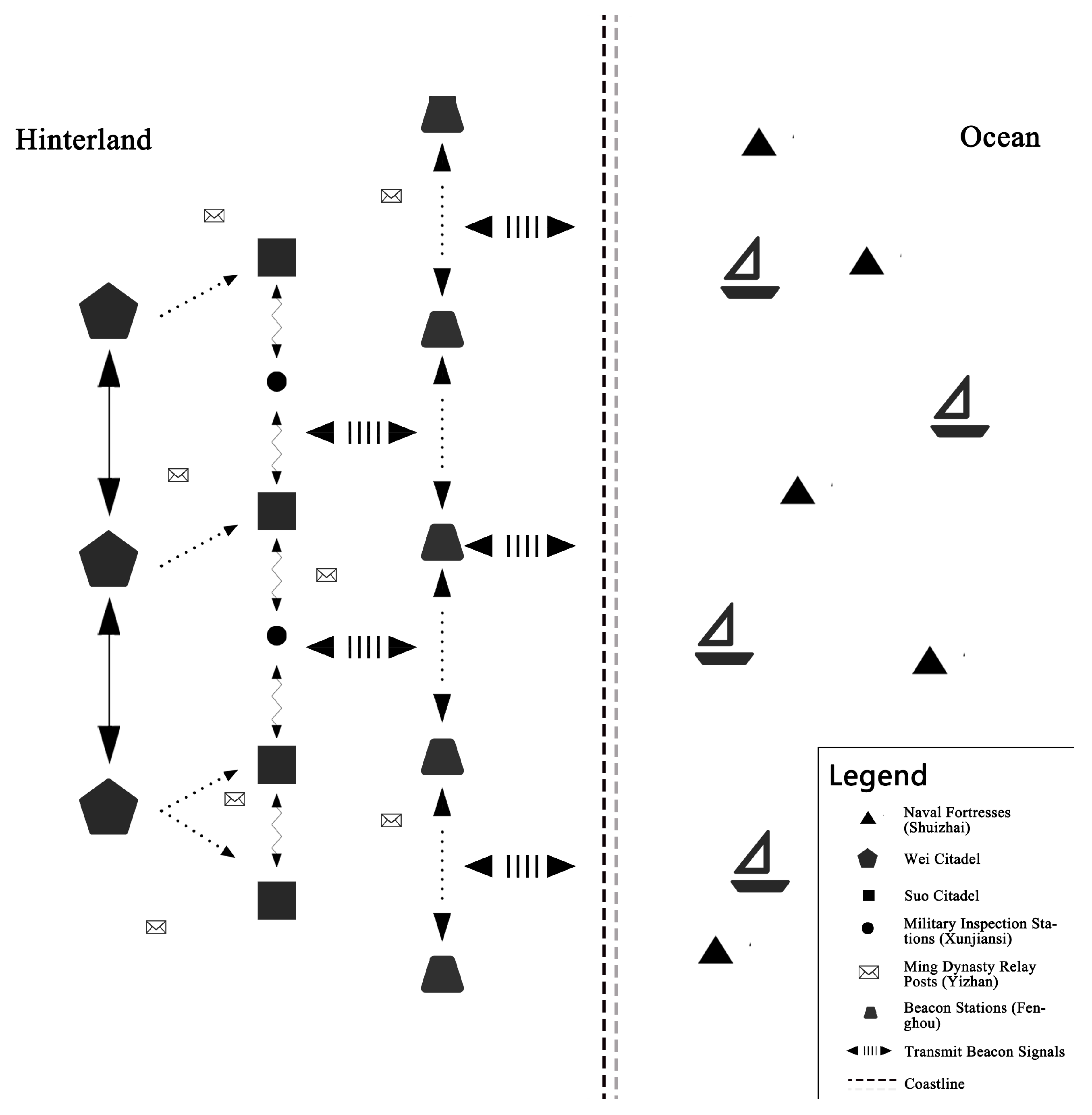
Disclaimer/Publisher’s Note: The statements, opinions and data contained in all publications are solely those of the individual author(s) and contributor(s) and not of MDPI and/or the editor(s). MDPI and/or the editor(s) disclaim responsibility for any injury to people or property resulting from any ideas, methods, instructions or products referred to in the content. |
© 2025 by the authors. Licensee MDPI, Basel, Switzerland. This article is an open access article distributed under the terms and conditions of the Creative Commons Attribution (CC BY) license (https://creativecommons.org/licenses/by/4.0/).