

Triple Impact of Green Technology, Globalization, and Democracy on Ecological Footprint: A Method of Moment Quantile Regression Analysis in G7 Economies
Abstract
1. Introduction
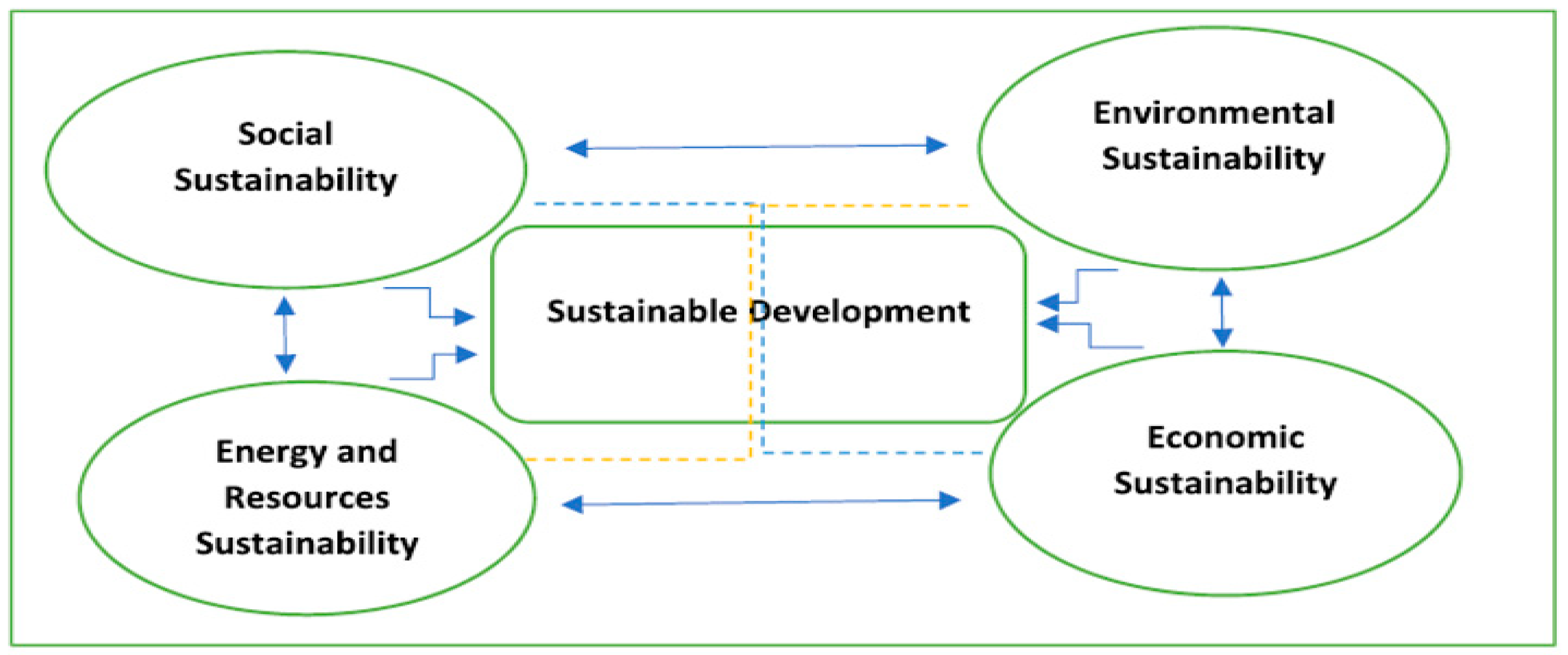
2. Theoretical and Conceptual Framework
3. Literature Review
3.1. Ecological Footprint, Globalization, and Democracy
3.2. Ecological Footprint, Green Technology, Energy Consumption, and GDP
4. Methodology
4.1. Slope Homogeneity and Cross-Section Dependence Tests
4.2. Unit Root Test
4.3. Westerlund Panel Cointegration Test
4.4. FMOLS and DOLS
4.5. MMQRTest
4.6. Dumitrescu-Hurlin Panel Causality Test
5. Data and Analysis Results
6. Conclusions and Policy Implications
Author Contributions
Funding
Data Availability Statement
Conflicts of Interest
References
- IPCC. Global warming of 1.5 °C. In An IPCC Special Report on the Impacts of Global Warming of 1.5 °C Above Pre-Industrial Levels and Related Global Greenhouse Gas Emission Pathways, in the Context of Strengthening the Global Response to the Threat of Climate Change, Sustainable Devel-Opment, and Efforts to Eradicate Poverty; Cambridge University Press: Cambridge, UK, 2018. [Google Scholar] [CrossRef] [Scilit]
- United Nations. Climate Change and the Sustainable Development Goals Report; United Nations Publications: New York, NY, USA, 2023; Available online: https://www.un.org/sustainabledevelopment/climate-change/ (accessed on 20 February 2024).
- IEA. Germany 2022: Energy Policy Review; International Energy Agency: Paris, France, 2022. [Google Scholar]
- UNFCCC. The Paris Agreement: Summary and Analysis; United Nations Framework Convention on Climate Change: Bonn, Germany, 2016. [Google Scholar]
- OECD. Towards a Green Transition: The Role of G7 Economies in Achieving Global Sustainability; OECD: Paris, France, 2021. [Google Scholar]
- Aliani, K.; Borgi, H.; Alessa, N.; Hamza, F.; Albitar, K. The impact of green innovation and renewable energy on CO2 emissions in G7 nations. Heliyon 2024, 10, e31142. [Google Scholar] [CrossRef] [Scilit]
- Shahbaz, M.; Topcu, B.; Sümerli, S.; Vinh, V.X. The effect of financial development on renewable energy demand: The case of developing countries. Renew. Energy 2021, 178, 1370–1380. [Google Scholar] [CrossRef] [Scilit]
- Bashir, M.F.; Rao, A.; Sharif, A.; Gosh, S.; Pan, Y. How Do Policies, Energy Consumption and Environmental stringency impact energy transition in the G7 economies: Policy implications for the COP28. J. Clean. Prod. 2024, 434, 140367. [Google Scholar] [CrossRef] [Scilit]
- Hossain, M.R.; Rao, A.; Sharma, G.D.; Dev, D.; Kharbanda, A. Empowering energy transition: Green innovation, digital finance, and the path to sustainable prosperity through green finance initiatives. Energy Econ. 2024, 136, 107736. [Google Scholar] [CrossRef] [Scilit]
- Sibt-E-Ali, M.; Xiqiang, X.; Javed, K.; Javaid, M.Q.; Vasa, L. Greening the future: Assessing the influence of technological innovation, energy transition and financial globalization on ecological footprint in selected emerging countries. Environ. Dev. Sustain. 2024, 26, 1–27. [Google Scholar] [CrossRef] [Scilit]
- Uzar, U. The critical role of green innovation technologies and democracy in the transition to sustainability: A study on leading emerging market economies. Technol. Soc. 2024, 78, 102622. [Google Scholar] [CrossRef] [Scilit]
- Söderholm, P. The green economy transition: The challenges of technological change for sustainability. Sustain. Earth 2020, 3, 6. [Google Scholar] [CrossRef] [Scilit]
- Barbier, E.B. Is green growth relevant for poor economies? Resour. Energy Econ. 2016, 45, 178–191. [Google Scholar] [CrossRef] [Scilit]
- Dercon, S. Is green growth good for the poor? World Bank Res. Obs. 2014, 29, 163–185. [Google Scholar] [CrossRef] [Scilit]
- Ozkan, O.; Eweade, B.S.; Usman, O. Assessing the impact of resource efficiency, renewable energy R&D spending, and green technologies on environmental sustainability in Germany: Evidence from a Wavelet Quantile-on-Quantile Regression. J. Clean. Prod. 2024, 450, 141992. [Google Scholar] [CrossRef] [Scilit]
- Hardin, G. The Tragedy of the Commons. Science 1968, 162, 1243–1248. [Google Scholar] [CrossRef] [Scilit]
- Axelrod, R. The Evolution of Cooperation; Basic Books: New York, NY, USA, 1984. [Google Scholar]
- Geels, F.W. The multi-level perspective on sustainability transitions: Responses to seven criticisms. Environ. Innov. Soc. Transit. 2011, 1, 24–40. [Google Scholar] [CrossRef] [Scilit]
- Güngör, H.; Olanipekun, I.O.; Usman, O. Testing the environmental Kuznets curve hypothesis: The role of energy consumption and democratic accountability. Environ. Sci. Pollut. Res. 2021, 28, 1464–1478. [Google Scholar] [CrossRef] [Scilit]
- Ahmed, Z.; Ahmad, M.; Rjoub, H.; Kalugina, O.A.; Hussain, N. Economic growth, renewable energy consumption, and ecological footprint: Exploring the role of environmental regulations and democracy in sustainable development. Sustain. Dev. 2021, 30, 595–605. [Google Scholar] [CrossRef] [Scilit]
- Fotis, P.; Polemis, M. Sustainable development, environmental policy and renewable energy use: A dynamic panel data approach. Sustain. Dev. 2018, 26, 726–740. [Google Scholar] [CrossRef] [Scilit]
- Zhao, J.; Jiang, Q.; Dong, X.; Dong, K. Would environmental regulation improve the greenhouse gas benefits of natural gas use? A Chinese case study. Energy Econ. 2020, 87, 104712. [Google Scholar] [CrossRef] [Scilit]
- Sun, H.; Liu, Z.; Chen, Y. Foreign direct investment and manufacturing pollution emissions: A perspective from heterogeneous environmental regulation. Sustain. Dev. 2020, 28, 1376–1387. [Google Scholar] [CrossRef] [Scilit]
- Roberts, J.T.; Parks, B.C. A climate of injustice: Global inequality, north-south politics, and climate policy. Ethics Int. Aff. 2008, 22, 229–230. [Google Scholar] [CrossRef] [Scilit]
- Akalin, G.; Erdogan, S. Does democracy help reduce environmental degradation? Environ. Sci. Pollut. Res. 2021, 28, 7226–7235. [Google Scholar] [CrossRef] [Scilit]
- Usman, O.; Iorember, P.T.; Olanipekun, I.O. Revisiting the environmental kuznets curve (EKC) hypothesis in India: The effects of energy consumption and democracy. Environ. Sci. Pollut. Res. 2019, 26, 13390–13400. [Google Scholar] [CrossRef] [Scilit]
- Farooq, S.; Ozturk, I.; Majeed, M.T.; Akram, R. Globalization and CO2 emissions in the presence of EKC: A global panel data analysis. Gondwana Res. 2022, 106, 367–378. [Google Scholar] [CrossRef] [Scilit]
- Sharif, A.; Bashir, U.; Mehmood, S.; Cheong, C.W.; Bashir, M.F. Exploring the impact of green technology, renewable energy and globalization towards environmental sustainability in the top ecological impacted countries. Geosci. Front. 2024, 15, 101895. [Google Scholar] [CrossRef] [Scilit]
- Li, Q.; Zhang, S. Impact of globalization and industrialization on ecological footprint: Do institutional quality and renewable energy matter? Front. Environ. Sci. 2025, 13, 1535638. [Google Scholar] [CrossRef] [Scilit]
- Obobisa, E.S.; Chen, H.; Mensah, I.A. The impact of green technological innovation and institutional quality on CO2 emissions in African countries. Technol. Forecast. Soc. Change 2022, 180, 121670. [Google Scholar] [CrossRef] [Scilit]
- Stefani, G.; Biggeri, M.; Ferrone, L. Sustainable transitions narratives: An analysis of the literature through topic modelling. Sustainability 2022, 14, 2085. [Google Scholar] [CrossRef] [Scilit]
- Rogge, K.S.; Reichardt, K. Policy mixes for sustainability transitions: An extended concept and framework for analysis. Res. Policy 2016, 45, 1620–1635. [Google Scholar] [CrossRef] [Scilit]
- Shove, E.; Walker, G. CAUTION! Transitions ahead: Politics, practice, and sustainable transition management. Environ. Plan. A Econ. Space 2007, 39, 763–770. [Google Scholar] [CrossRef] [Scilit]
- Smith, A.; Stirling, A.; Berkhout, F. The governance of sustainable socio-technical transitions. Res. Policy 2005, 34, 1491–1510. [Google Scholar] [CrossRef] [Scilit]
- Del Río González, P. The empirical analysis of the determinants for environmental technological change: A research agenda. Ecol. Econ. 2009, 68, 861–878. [Google Scholar] [CrossRef] [Scilit]
- Weber, K.M.; Rohracher, H. Legitimizing research, technology and innovation policies for transformative change: Combining insights from innovation systems and multi-level perspective in a comprehensive ‘failures’ framework. Res. Policy 2012, 41, 1037–1047. [Google Scholar] [CrossRef] [Scilit]
- Dincer, I.; Rosen, M.A. Thermodynamic aspects of renewables and sustainable development. Renew. Sustain. Energy Rev. 2005, 9, 169–189. [Google Scholar] [CrossRef] [Scilit]
- Abbasi, K.R.; Zhang, Q.; Alotaibi, B.S.; Abuhussain, M.A.; Alvarado, R. Toward sustainable development goals 7 and 13: A comprehensive policy framework to combat climate change. Environ. Impact Assess. Rev. 2024, 105, 107415. [Google Scholar] [CrossRef] [Scilit]
- Boz, A.; Ünalan, G.; Çaşkurlu, E. The Effectiveness of Redistribution in Carbon Inequality: What about the Top 1%? Sustainability 2025, 17, 4960. [Google Scholar] [CrossRef] [Scilit]
- Agan, B. Sustainable development through green transition in EU countries: New evidence from panel quantile regression. J. Environ. Manag. 2024, 365, 121545. [Google Scholar] [CrossRef] [Scilit] [PubMed]
- Adams, S.; Acheampong, A.O. Reducing carbon emissions: The role of renewable energy and democracy. J. Clean. Prod. 2019, 240, 118245. [Google Scholar] [CrossRef] [Scilit]
- Agbede, E.A.; Bani, Y.; Naseem, N.A.M.; Azman-Saini, W.N.W. The impact of democracy and income on CO2 emissions in MINT countries: Evidence from quantile regression model. Environ. Sci. Pollut. Res. 2023, 30, 52762–52783. [Google Scholar] [CrossRef] [Scilit]
- Ahmad, M.; Pata, U.K.; Ahmed, Z.; Zhao, R. Fintech, natural resources management, green energy transition, and ecological footprint: Empirical insights from EU countries. Resour. Policy 2024, 92, 104972. [Google Scholar] [CrossRef] [Scilit]
- Ahmed, Z. Assessing the interplay between political globalization, social globalization, democracy, militarization, and sustainable development: Evidence from G-7 economies. Environ. Sci. Pollut. Res. 2024, 31, 11261–11275. [Google Scholar] [CrossRef] [Scilit]
- Ahmed, Z.; Caglar, A.E.; Murshed, M. A path towards environmental sustainability: The role of clean energy and democracy in ecological footprint of Pakistan. J. Clean. Prod. 2024, 358, 132007. [Google Scholar] [CrossRef] [Scilit]
- Chou, L.-C.; Zhang, W.-H.; Wang, M.-Y.; Yang, F.-M. The influence of democracy on emissions and energy efficiency in America: New evidence from quantile regression analysis. Energy Environ. 2020, 31, 1318–1334. [Google Scholar] [CrossRef] [Scilit]
- Han, F.; Ibrahim, R.L.; Al-Mulali, U.; Al-Faryan, M.A.S. Tracking the roadmaps to sustainability: What do the symmetric effects of eco-digitalization, green technology, green finance, and renewable energy portend for China? Environ. Dev. Sustain. 2024, 26, 13895–13919. [Google Scholar] [CrossRef] [Scilit]
- Haseeb, M.; Azam, M. Dynamic nexus among tourism, corruption, democracy and environmental degradation: A panel data investigation. Environ. Dev. Sustain. 2021, 23, 5557–5575. [Google Scholar] [CrossRef] [Scilit]
- Islam, M.; Khan, M.K.; Tareque, M.; Jehan, N.; Dagar, V. Impact of globalization, foreign direct investment, and energy consumption on CO2 emissions in Bangladesh: Does institutional quality matter? Environ. Sci. Pollut. Res. 2021, 28, 48851–48871. [Google Scholar] [CrossRef] [Scilit]
- Jahanger, A.; Usman, M.; Balsalobre-Lorente, D. Autocracy, democracy, globalization, and environmental pollution in developing world: Fresh evidence from STIRPAT model. J. Public Aff. 2022, 22, e2753. [Google Scholar] [CrossRef] [Scilit]
- Liu, Y.; Lei, P.; He, D. Endogenous green technology progress, green transition and carbon emissions. Int. Rev. Econ. Finance 2024, 91, 69–82. [Google Scholar] [CrossRef] [Scilit]
- Lv, Z. The effect of democracy on CO2 emissions in emerging countries: Does the level of income matter? Renew. Sustain. Energy Rev. 2017, 72, 900–906. [Google Scholar] [CrossRef] [Scilit]
- Rudolph, A.; Figge, L. Determinants of ecological footprints: What is the role of globalization? Ecol. Indic. 2017, 81, 348–361. [Google Scholar] [CrossRef] [Scilit]
- Song, A.; Rasool, Z.; Nazar, R.; Anser, M.K. Towards a greener future: How green technology innovation and energy efficiency are transforming sustainability. Energy 2024, 290, 129891. [Google Scholar] [CrossRef] [Scilit]
- Soto, G.H. The role of foreign direct investment and green technologies in facilitating the transition toward green economies in Latin America. Energy 2024, 288, 129933. [Google Scholar] [CrossRef] [Scilit]
- Sultana, T.; Hossain, S.; Voumik, L.C.; Raihan, A. Democracy, green energy, trade, and environmental progress in South Asia: Advanced quantile regression perspective. Heliyon 2023, 9, e20488. [Google Scholar] [CrossRef] [Scilit]
- Usman, O.; Akadiri, S.S.; Adeshola, I. Role of renewable energy and globalization on ecological footprint in the USA: Implications for environmental sustainability. Environ. Sci. Pollut. Res. 2020, 27, 30681–30693. [Google Scholar] [CrossRef] [Scilit]
- Wang, Q.; Wang, L. Renewable energy consumption and economic growth in OECD countries: A nonlinear panel data analysis. Energy 2020, 207, 118200. [Google Scholar] [CrossRef] [Scilit]
- Zhang, L.; Khan, Z.; Abbas, S.; Ahamed, H. The roles of renewable energy, globalization, population expansion and deliberative democracy on Sustainable Development in South Asia. Environ. Sci. Pollut. Res. 2023, 30, 88775–88788. [Google Scholar] [CrossRef] [Scilit]
- Nikzad, R.; Sedigh, G. Greenhouse gas emissions and green technologies in Canada. Environ. Dev. 2017, 24, 99–108. [Google Scholar] [CrossRef] [Scilit]
- Weina, D.; Gilli, M.; Mazzanti, M.; Nicolli, F. Green inventions and greenhouse gas emission dynamics: A close examination of provincial Italian data. Environ. Econ. Policy Stud. 2016, 18, 247–263. [Google Scholar] [CrossRef] [Scilit]
- Bauer, N.; Baumstark, L.; Leimbach, M. The REMIND-R model: The role of renewables in the low-carbon transformation—First-best vs. second-best worlds. Clim. Change 2012, 114, 145–168. [Google Scholar] [CrossRef] [Scilit]
- Röpke, L. The development of renewable energies and supply security: A trade-off analysis. Energy Policy 2013, 61, 1011–1021. [Google Scholar] [CrossRef] [Scilit]
- Xing, L.; Xue, M.; Hu, M. Dynamic simulation and assessment of the coupling coordination degree of the economy–resource–environment system: Case of Wuhan City in China. J. Environ. Manag. 2019, 230, 474–487. [Google Scholar] [CrossRef] [Scilit]
- Oyebanji, M.O.; Kirikkaleli, D. Green technology, green electricity, and environmental sustainability in Western European countries. Environ. Sci. Pollut. Res. 2023, 30, 38525–38534. [Google Scholar] [CrossRef] [Scilit]
- Zhu, H.; Chen, Z.; Zhang, S.; Zhao, W. The role of government innovation support in the process of urban green sustainable development: A spatial difference-in-difference analysis based on China’s innovative city pilot policy. Int. J. Environ. Res. Public Health 2022, 19, 7860. [Google Scholar] [CrossRef] [Scilit]
- Anwar, A.; Sinha, A.; Sharif, A.; Siddique, M.; Irshad, S.; Anwar, W.; Malik, S. The nexus between urbanization, renewable energy consumption, financial development, and CO2 emissions: Evidence from selected Asian countries. Environ. Dev. Sustain. 2022, 24, 6556–6576. [Google Scholar] [CrossRef] [Scilit]
- Amin, N.; Shabbir, M.S.; Song, H.; Farrukh, M.U.; Iqbal, S.; Abbass, K. A step towards environmental mitigation: Do green technological innovation and institutional quality make a difference? Technol. Forecast. Soc. Change 2023, 190, 122413. [Google Scholar] [CrossRef] [Scilit]
- Meng, Y.; Wu, H.; Wang, Y.; Duan, Y. International trade diversification, green innovation, and consumption-based carbon emissions: The role of renewable energy for sustainable development in BRICST countries. Renew. Energy 2022, 198, 1243–1253. [Google Scholar] [CrossRef] [Scilit]
- Xu, B.; Lin, B. Can expanding natural gas consumption reduce China’s CO2 emissions? Energy Econ. 2019, 81, 393–407. [Google Scholar] [CrossRef] [Scilit]
- Wang, Y.; Zhou, T.; Chen, H.; Rong, Z. Environmental homogenization or heterogenization? The effects of globalization on carbon dioxide emissions, 1970–2014. Sustainability 2019, 11, 2752. [Google Scholar] [CrossRef] [Scilit]
- Braungardt, S.; Elsland, R.; Eichhammer, W. The environmental impact of eco-innovations: The case of EU residential electricity use. Environ. Econ. Policy Stud. 2016, 18, 213–228. [Google Scholar] [CrossRef] [Scilit]
- Lin, B.; Ma, R. Green technology innovations, urban innovation environment and CO2 emission reduction in China: Fresh evidence from a partially linear functional-coefficient panel model. Technol. Forecast. Soc. Change 2022, 176, 121434. [Google Scholar] [CrossRef] [Scilit]
- Ibrahim, R.L.; Al-Mulali, U.; Ozturk, I.; Bello, A.K.; Raimi, L. On the criticality of renewable energy to sustainable development: Do green financial development, technological innovation, and economic complexity matter for China? Renew. Energy 2022, 199, 262–277. [Google Scholar] [CrossRef] [Scilit]
- Razzaq, A.; Fatima, T.; Murshed, M. Asymmetric effects of tourism development and green innovation on economic growth and carbon emissions in top 10 GDP countries. J. Environ. Plan. Manag. 2023, 66, 471–500. [Google Scholar] [CrossRef] [Scilit]
- Udeagha, M.C.; Ngepah, N. Towards climate action and UN sustainable development goals in BRICS economies: Do export diversification, fiscal decentralisation and environmental innovation matter? Int. J. Urban Sustain. Dev. 2023, 15, 172–200. [Google Scholar] [CrossRef] [Scilit]
- Eweade, B.S.; Akadiri, A.C.; Olusoga, K.O.; Bamidele, R.O. The symbiotic effects of energy consumption, globalization, and combustible renewables and waste on ecological footprint in the United Kingdom. Nat. Resour. Forum 2024, 48, 274–291. [Google Scholar] [CrossRef] [Scilit]
- Shah, W.U.H.; Hao, G.; Yan, H.; Zhu, N.; Yasmeen, R.; Dincă, G. Role of renewable, non-renewable energy consumption and carbon emission in energy efficiency and productivity change: Evidence from G20 economies. Geosci. Front. 2023, 15, 101631. [Google Scholar] [CrossRef] [Scilit]
- Jiang, Y.; Hossain, M.R.; Khan, Z.; Chen, J.; Badeeb, R.A. Revisiting research and development expenditures and trade adjusted emissions: Green innovation and renewable energy R&D ROLE for developed countries. J. Knowl. Econ. 2023, 15, 2156–2191. [Google Scholar] [CrossRef] [Scilit]
- Jianguo, D.; Ali, K.; Alnori, F.; Ullah, S. The nexus of financial development, technological innovation, institutional quality, and environmental quality: Evidence from OECD economies. Environ. Sci. Pollut. Res. 2022, 29, 58179–58200. [Google Scholar] [CrossRef] [Scilit]
- Destek, M.A.; Hossain, M.R.; Khan, Z. Premature deindustrialization and environmental degradation. Gondwana Res. 2023, 127, 199–210. [Google Scholar] [CrossRef] [Scilit]
- Machado, J.A.; Silva, J.S. Quantiles via moments. J. Econ. 2019, 213, 145–173. [Google Scholar] [CrossRef] [Scilit]
- Pesaran, M.H. General diagnostic tests for cross section dependence in panels. In Cambridge Working Papers in Economics 0435; Faculty of Economics, University of Cambridge: Cambridge, UK, 2004. [Google Scholar] [CrossRef] [Scilit]
- Pesaran, M.H.; Ullah, A.; Yamagata, T. A bias-adjusted LM test of error cross-section independence. Econ. J. 2008, 11, 105–127. [Google Scholar] [CrossRef] [Scilit]
- Pesaran, M.H.; Yamagata, T. Testing slope homogeneity in large panels. J. Econ. 2008, 142, 50–93. [Google Scholar] [CrossRef] [Scilit]
- Pesaran, M.H. A simple panel unit root test in the presence of cross-section dependence. J. Appl. Econ. 2007, 22, 265–312. [Google Scholar] [CrossRef] [Scilit]
- Westerlund, J. Testing for error correction in panel data*. Oxf. Bull. Econ. Stat. 2007, 69, 709–748. [Google Scholar] [CrossRef] [Scilit]
- Pedroni, P. Fully Modified OLS for Heterogeneous Cointegrated Panels. In Nonstationary Panels, Panel Cointegration, and Dynamic Panels; Advances in Econometrics; Baltagi, B.H., Fomby, T.B., Hill, R.C., Eds.; Emerald Group Publishing Limited: Bingley, UK, 2001; Volume 15, pp. 93–130. [Google Scholar] [CrossRef] [Scilit]
- Koenker, R. Quantile regression for longitudinal data. J. Multivar. Anal. 2004, 91, 74–89. [Google Scholar] [CrossRef] [Scilit]
- Onwe, J.C.; Bandyopadhyay, A.; Hamid, I.; Rej, S.; Hossain, M.E. Environment sustainability through energy transition and globalization in G7 countries: What role does environmental tax play? Renew. Energy 2023, 218, 119302. [Google Scholar] [CrossRef] [Scilit]
- Dumitrescu, E.-I.; Hurlin, C. Testing for Granger non-causality in heterogeneous panels. Econ. Model. 2012, 29, 1450–1460. [Google Scholar] [CrossRef] [Scilit]
- Shahbaz, M.; Loganathan, N.; Zeshan, M.; Zaman, K. Does renewable energy consumption add in economic growth? Renew. Sustain. Energy Rev. 2015, 44, 576–585. [Google Scholar] [CrossRef] [Scilit]
- Farzin, Y.H.; Bond, C.A. Democracy and environmental quality. J. Dev. Econ. 2006, 81, 213–235. [Google Scholar] [CrossRef] [Scilit]
- Dreher, A. Does globalization affect growth? Appl. Econ. 2006, 38, 1091–1110. [Google Scholar] [CrossRef] [Scilit]
- Paramati, S.R.; Mo, D.; Huang, R. The role of green investments in environmental sustainability. Environ. Sci. Pollut. Res. 2017, 24, 27953–27962. [Google Scholar] [CrossRef] [Scilit]
- Government of Canada. Pan-Canadian Framework on Clean Growth and Climate Change: Canada’s Plan to Address Climate Change and Grow the Economy. Government of Canada Publications. 2021. Available online: https://publications.gc.ca/site/eng/9.828774/publication.html (accessed on 14 February 2025).


| Title | Time Coverage | Cross-Section Coverage | Method | Finding |
|---|---|---|---|---|
| Abbasi et al. (2024) [38] | 1980–2020 | United States | ARDL Frequency Domain Causality | ET→ (+) EF Eco-complexity→ (+) EF |
| Adams and Acheampong (2019) [41] | 1980–2015 | Sub-Saharan Countries | GMM | DEMO→ (−) CO2 GDP→ (−) CO2 |
| Agan (2024) [40] | 2000–2021 | 25 EU Countries | Panel Quantile | GE↔ (−) CO2 |
| Agbede et al. (2023) [42] | 1971–2016 | MINT | Quantile-GLS | GDP→ (+) CO2 Trade→ (+) CO2 DEMO→ (+) CO2 |
| Ahmad et al. (2024) [43] | 1990–2020 | European Union | FMOLS | Fintech→ (+) GE Growth→ (−) GE Glob→ (+) GE |
| Ahmed (2024) [44] | 1990–2019 | G-7 | Method of Moments Quantile Regression | Political Glob→ (+) SD Social Glob→ (−) SD DEMO, GDP→ (−) SD |
| Ahmed et al. (2022) [20] | 1985–2017 | G-7 | DSUR, FMOLS, DOLS | GDP→ (+) EF DEMO→ (−) EF |
| Ahmed et al. (2024) [45] | 1984–2017 | Pakistan | ARDL | DEMO→ (−) EF |
| Akalın and Erdoğan (2021) [24] | 1990–2015 | 26 OECD Countries | AMG | DEMO→ (−) EQ GDP→ (−) EQ |
| Chou et al. (2019) [46] | 1990–2013 | 26 American Countries | Quantile Regression | DEMO→ (+) EE DEMO→ (−) CO2 |
| Farooq et al. (2022) [27] | 1980–2016 | 180 Countries | Quantile Regression | Political Glob→ (−) ED Economic Glob→ (+) ED |
| Geels (2011) [18] | - | - | Literature Review | MLP → (+) SD |
| Han et al. (2024) [47] | 1995–2019 | China | ARDL-FMOLS-DOLS | GT, RE→ (+) SD |
| Haseeb and Azam (2021) [48] | 1995–2015 | High Upper-Middle, Low, and Lower-Middle Income Countries | FMOLS | DEMO→ (−) CO2 |
| Hossein et al. (2024) [9] | 2003–2020 | Developed-Developing 15 Countries | Quantile Regression Dynamic Panel | Digital Finance→ (+) GT Econ. Growth→ (−) GT |
| Islam et al. (2021) [49] | 1972–2016 | Bangladesh | ARDL | Glob→ (−) CO2 EU, GDP→ (+) CO2 |
| Jahanger et al. (2020) [50] | 1990–2016 | 74 Developing Countries | GMM-SYS | Glob→ (−) CO2 EU, GDP→ (+) CO2 |
| Liu et al. (2024) [51] | 1990–2020 | China | Theoretical Model | GT→ (−) CO2 |
| Lv (2017) [52] | 1997–2010 | 19 Emerging Countries | Quantile Regression | DEMO→ (−) CO2 |
| Ozkan et al. (2024) [15] | 1974–2019 | Germany | Wavelet Quantile on Quantile Regression | RE, R&D, GT→ (−) CI |
| Rogge and Reichardt (2016) [32] | Literature Review | Policy mix→ (+) TS | ||
| Rudolph and Figge (2017) [53] | 1981–2009 | 146 Countries | Extreme Bounds Analysis | Glob→ (+) CO2 |
| Sibt-E-Ali et al. (2024) [10] | 1990–2021 | 11 Emerging Countries | FMOLS-DOLS | RE→ (+) SD |
| Song et al. (2024) [54] | 1996–2020 | 10 Most Developed Countries | Quantile on Quantile | GIT→ (+) EE |
| Soto et al. (2024) [55] | 1990–2022 | Latin America | FMOLS | FDI→ (+) RE Income→ (+) TS |
| Söderholm (2020) [12] | - | - | Literature Review | Environmental challenges → (+) Creative destruction |
| Sultana et al. (2023) [56] | 1990–2019 | South Asian Countries | Panel Quantile | GDP→ (+) CO2 Trade→ (+) CO2 DEMO→ (−) CO2 |
| Usman et al. (2020) [57] | 1985–2014 | USA | ARDL | Glob→ (+) EF EU, GDP→ (−) EF |
| Uzar (2024) [11] | 1990–2018 | Emerging Nations | AMG | Glob→ (−) EF Democracy→ (−) EF |
| Wang and Wang (2020) [58] | 1970–2014 | 137 Countries | FE, Pooled OLS | Glob→ (−) EF for DC Glob→ (+) EF for GC |
| Zhang et al. (2023) [59] | 1990–2020 | South Asia countries | CEE, AMG, GMM | RE→ (−) EF DEMO→ (−) EF Glob→ (+) EF |
| Variables | Symbols | Units | Source |
|---|---|---|---|
| Ecological Footprint | EF | Ecological footprint total per capita | Global Footprint Network |
| Gross Domestic Product | GDP | GDP per capita (constant 2015 USD) | World Bank |
| Energy Consumption | EC | Primary energy consumption per capita | Energy Institute |
| Globalization | GLB | KOF Globalization Index | Swiss Economic Institute |
| Green Technology | GT | Environmental technology (inventions per person) | OECD |
| Democracy | DM | Participatory Democracy Index | VDEM |
| EF | GDP | EC | GLB | GT | DM | |
|---|---|---|---|---|---|---|
| Mean | 1.823593 | 10.54912 | 5.274334 | 4.393220 | 2.998094 | 6.428773 |
| Median | 1.753538 | 10.50191 | 5.152347 | 4.404226 | 2.998388 | 6.449680 |
| Maximum | 2.407846 | 11.02403 | 6.061389 | 4.493778 | 4.419856 | 6.536692 |
| Minimum | 1.316408 | 10.28415 | 4.604667 | 4.061884 | 1.117302 | 6.272877 |
| Std. Dev. | 0.262708 | 0.177003 | 0.412875 | 0.077000 | 0.753736 | 0.069949 |
| Skewness | 0.615558 | 0.697176 | 0.684777 | −1.344008 | −0.034203 | −0.589550 |
| Kurtosis | 2.334536 | 2.751179 | 2.211596 | 5.438624 | 2.426017 | 2.096015 |
| Jarque-Bera | 14.85188 | 15.21315 | 18.93754 | 99.89008 | 2.533862 | 16.73994 |
| Probability | 0.000596 | 0.000497 | 0.000077 | 0.000000 | 0.281695 | 0.000232 |
| Observation (n) | 182 | 182 | 182 | 182 | 182 | 182 |
| Correlation Matrix | EF | GDP | EC | GL | GT | PDM |
| EF | 1.000000 | |||||
| GDP | 0.563669 | 1.000000 | ||||
| EC | 0.902371 | 0.508449 | 1.000000 | |||
| GLB | −0.097348 | 0.367969 | −0.104713 | 1.000000 | ||
| GT | −0.221377 | 0.173305 | 0.014679 | −0.063298 | 1.000000 | |
| DM | −0.065415 | −0.026098 | −0.301338 | 0.484025 | −0.387240 | 1.000000 |
| Variable | Breusch-Pagan LM | Pesaran Scaled LM | Bias-Corrected Scaled LM | Pesaran CD |
|---|---|---|---|---|
| EF | 369.8799 * (0.000) | 53.83334 * (0.000) | 53.69334 * (0.000) | 19.08090 * (0.000) |
| GDP | 356.7641 * (0.000) | 51.80952 * (0.000) | 51.66952 * (0.000) | 17.05467 * (0.000) |
| EC | 455.9700 * (0.000) | 67.11734 * (0.000) | 66.97734 * (0.000) | 21.32392 * (0.000) |
| GLB | 503.9010 * (0.000) | 74.51325 * (0.000) | 74.37325 * (0.000) | 22.44249 * (0.000) |
| GT | 509.1102 * (0.000) | 75.31704 * (0.000) | 75.17704 * (0.000) | 22.56185 * (0.000) |
| DM | 132.7804 * (0.000) | 17.24809 * (0.000) | 17.10809 * (0.000) | 0.377762 (0.7056) |
| EF = GDP, EC, GL, GT, PDM | ||||
| Statistics | Test value (p-value) | |||
| Delta tilde | 7.226 * (0.000) | |||
| Delta tilde Adjusted | 8.453 * (0.000) | |||
| Variables | Second-Generation CIPS | |
|---|---|---|
| Level | Differences | |
| EF | −1.139 (0.127) | −3.944 * (0.000) |
| GDP | −1.206 (0.114) | −2.020 ** (0.022) |
| EC | −2.045 (0.020) ** | −6.075 * (0.000) |
| GLB | −0.419 (0.338) | −2.540 *** (0.006) |
| GT | −1.012 (0.156) | −3.919 * (0.000) |
| DM | −1.655 (0.049) ** | −3.106 * (0.001) |
| Statistics | Value | p-Value | Robust p-Value |
|---|---|---|---|
| EF = GDP, EC, GLB, GT, DM | |||
| Gt | −2.581 | 0.160 | 0.000 * |
| Ga | −9.384 | 0.190 | 0.000 * |
| Pt | −9.365 | 0.039 | 0.000 * |
| Pa | −9.026 | 0.275 | 0.000 * |
| Variables | FMOLS | DOLS |
|---|---|---|
| GDP | 0.419 (0.000) * | 0.877 (0.000) * |
| EC | 0.511 (0.000) * | 0.598 (0.000) * |
| GLB | −0.805 (0.004) * | −0.353 (0.072) *** |
| GT | −0.075 (0.000) * | −0.055 (0.079) *** |
| DM | 0.807 (0.000) * | 0.319 (0.087) *** |
| R2 | 0.8730 | 0.8460 |
| Dependent Variable = EF | |||||||||||
|---|---|---|---|---|---|---|---|---|---|---|---|
| Variables | Local | Scale | 0.1 | 0.2 | 0.3 | 0.4 | 0.5 | 0.6 | 0.7 | 0.8 | 0.9 |
| GDP | 0.426 (0.000) | 0.096 (0.000) | 0.277 (0.000) | 0.325 (0.000) | 0.356 (0.000) | 0.386 (0.000) | 0.427 (0.000) | 0.482 (0.000) | 0.499 (0.000) | 0.527 (0.000) | 0.556 (0.000) |
| EC | 0.508 (0.000) | −0.017 (0.042) | 0.535 (0.000) | 0.526 (0.000) | 0.521 (0.000) | 0.515 (0.000) | 0.508 (0.000) | 0.498 (0.000) | 0.495 (0.000) | 0.490 (0.000) | 0.485 (0.000) |
| GLB | −0.807 (0.000) | −0.029 (0.524) | −0.762 (0.000) | −0.776 (0.000) | −0.786 (0.000) | −0.795 (0.000) | −0.807 (0.000) | −0.824 (0.000) | −0.829 (0.000) | −0.837 (0.000) | −0.846 (0.000) |
| GT | −0.074 (0.000) | −0.010 (0.009) | −0.059 (0.000) | −0.064 (0.000) | −0.067 (0.000) | −0.070 (0.000) | −0.075 (0.000) | −0.080 (0.000) | −0.082 (0.000) | −0.085 (0.000) | −0.088 (0.000) |
| DM | 0.804 (0.000) | −0.025 (0.621) | 0.844 (0.000) | 0.831 (0.000) | 0.823 (0.000) | 0.815 (0.000) | 0.804 (0.000) | 0.789 (0.000) | 0.784 (0.000) | 0.777 (0.000) | 0.769 (0.000) |
| Const. | −6.757 (0.000) | −0.544 (0.089) | −5.911 (0.000) | −6.185 (0.000) | −6.360 (0.000) | −6.532 (0.000) | −6.766 (0.000) | −7.077 (0.000) | −7.173 (0.000) | −7.330 (0.000) | −7.497 (0.000) |
| Pair | Null Hypothesis: No Causality | Statistics | Decision | ||
|---|---|---|---|---|---|
| W-Bar | Z-Bar | Z-Bar Tilde | |||
| 1 | EF and GDP GDP and EF | 7.1426 1.6481 | 11.4918 * (0.000) 1.2125 (0.225) | 9.5146 * (0.000) 0.8630 (0.388) | Unidirectional |
| 2 | EF and EC EC and EF | 3.5955 0.8116 | 4.8558 * (0.000) −0.3525 (0.724) | 3.9295 * (0.001) −0.454 (0.649) | Unidirectional |
| 3 | EF and GLB GLB and EF | 3.8259 0.5889 | 5.2868 * (0.000) −0.7691 (0.441) | 4.2922 * (0.000) −0.8048 (0.420) | Unidirectional |
| 4 | EF and GT GT and EF | 2.6765 1.7435 | 3.1364 * (0.001) 1.3910 (0.164) | 2.482 ** (0.013) 1.0133 (0.310) | Unidirectional |
| 5 | EF and DM DM and EF | 1.8877 2.4249 | 1.6607 *** (0.096) 2.665 * (0.007) | 1.2403 (0.214) 2.0861 ** (0.037) | Unidirectional |
Disclaimer/Publisher’s Note: The statements, opinions and data contained in all publications are solely those of the individual author(s) and contributor(s) and not of MDPI and/or the editor(s). MDPI and/or the editor(s) disclaim responsibility for any injury to people or property resulting from any ideas, methods, instructions or products referred to in the content. |
© 2025 by the authors. Licensee MDPI, Basel, Switzerland. This article is an open access article distributed under the terms and conditions of the Creative Commons Attribution (CC BY) license (https://creativecommons.org/licenses/by/4.0/).
Share and Cite
Yağlıkara, A.; Tekiner, İ. Triple Impact of Green Technology, Globalization, and Democracy on Ecological Footprint: A Method of Moment Quantile Regression Analysis in G7 Economies. Sustainability 2025, 17, 8300. https://doi.org/10.3390/su17188300
Yağlıkara A, Tekiner İ. Triple Impact of Green Technology, Globalization, and Democracy on Ecological Footprint: A Method of Moment Quantile Regression Analysis in G7 Economies. Sustainability. 2025; 17(18):8300. https://doi.org/10.3390/su17188300
Chicago/Turabian StyleYağlıkara, Aykut, and İbrahim Tekiner. 2025. "Triple Impact of Green Technology, Globalization, and Democracy on Ecological Footprint: A Method of Moment Quantile Regression Analysis in G7 Economies" Sustainability 17, no. 18: 8300. https://doi.org/10.3390/su17188300
APA StyleYağlıkara, A., & Tekiner, İ. (2025). Triple Impact of Green Technology, Globalization, and Democracy on Ecological Footprint: A Method of Moment Quantile Regression Analysis in G7 Economies. Sustainability, 17(18), 8300. https://doi.org/10.3390/su17188300