


Abstract
At present, the intelligent control technology of highway tunnel lighting mainly includes two types, graded dimming and stepless dimming, both of which have certain energy-saving effects. Tunnel lighting energy saving and consumption reduction, traffic safety, and the security degree are important indicators used to measure the efficient operation of a tunnel. By adding variable correlated color temperature (CCT) control based on stepless dimming, the adjustment of a lamp’s CCT according to changes in the external tunnel environment can be achieved. This not only serves the dual purpose of secondary energy saving and providing comfortable lighting, but also plays a significant role in reducing the reaction time and ensuring tunnel traffic safety. This paper mainly discusses the research achievements and applications of the main intelligent control technologies for highway tunnel lighting. Combining on-site investigations, operating and energy-saving effects achieved are evaluated, and the future development direction of intelligent control technology for highway tunnel lighting is summarized. Furthermore, this paper proposes an optimization model of a stepless dimming control system and intelligent control technology in the tunnel’s variable CCT based on stepless dimming. The results of this review can provide useful technical support for the design, operation and management of intelligent lighting control in highway tunnels.
1. Introduction
Tunnel lighting is an important part of highway tunnel construction and serves as the main guarantee for safe operation and management. Meanwhile, lighting control technology plays a crucial role in the performance of lighting engineering. Advanced, scientific, reliable and economic lighting control technology will have a direct impact on traffic safety, operation and management, energy saving and environmental protection, as well as emergency rescue in highway tunnels, which is an important basis for the realization of intelligent tunnel lighting construction [1,2,3].
In this aspect, the earliest effort was made in Europe. In 1960, the Mont Blanc tunnel between Italy and France began to be dimmable in response to changes in traffic volume. From the 1970s to the beginning of the 21st century, with the advancement of research on the energy-efficient control of tunnel lighting in Europe and the United States, more authoritative specification standards were gradually formed, such as the CIE (Commission Internationale de l’Eclairage) “CIE Guide to Lighting for Road Tunnels and Underpasses”, which is still the guide and standard for highway tunnel lighting design worldwide [4,5]. In 2006, T Huang [6] established a fuzzy control model for highway tunnel lighting based on the luminance criteria of the CIE specification for different lighting sections of highway tunnels. In 2011, Yang C [7] not only designed a fuzzy control model of the tunnel lighting control system, but also established the change curves of luminance outside the tunnel and demand luminance inside the tunnel during sunny days based on experimental data.
Research on tunnel lighting control in China started relatively late. In 2005, the Chongqing Traffic Research and Design Institute first proposed a theoretical control model of tunnel lighting based on ambient luminance outside the tunnel, the driving speed and the traffic volume [8]. In the same year, Ye [9] designed a tunnel lighting control system, which can output the power of a high-pressure sodium lamp according to the traffic flow and luminance outside the tunnel so as to adjust luminance inside the tunnel. In 2008, Huang [10] designed an energy-saving dimming system for tunnel lighting based on PLC, which can be controlled manually and automatically at the same time. In 2009, Guo [11] designed a tunnel lighting system combining manual control, segmented timing control and automatic control and installed seven categories of lamps in different locations of the tunnel and lit the different categories of lamps according to different real-time situations. In 2014, the Detailed Rules for the Design of Highway Tunnel Lighting issued by China clearly stated that tunnel lighting should be divided into four levels according to the seasonal meteorological conditions, namely, sunny in summer, sunny in the other seasons or cloudy in summer, cloudy in the other seasons or overcast in summer, and overcast in the other seasons or heavily overcast in summer [12].
This paper presents the characteristics and applications of two intelligent control technologies for tunnel lighting: graded dimming and stepless dimming. An optimized model of stepless dimming is proposed based on the BP neural network. Furthermore, variable CCT control is added to stepless dimming, enabling the adjustment of a lamp’s CCT according to changes in the tunnel environment. With its dual function of secondary energy saving and comfort lighting, this approach holds great significance in reducing the reaction time and ensuring tunnel traffic safety.
2. Analysis of the Current Status of Tunnel Lighting and Its Intelligent Control Technology
2.1. Current Status of Tunnel Lighting
In recent years, China has witnessed rapid development in highway construction. According to the statistics, the number of highway tunnels in China reached 21,316 in 2020, with a total length of 21.999 million meters. With the increasing number of highway tunnels, the issues of energy saving and safety in tunnel lighting have become more prominent. To ensure driving safety within the tunnels, it is essential to provide sufficient luminance that meets the visual adaptation requirements of drivers [13,14]
2.1.1. Tunnel Lighting Energy Consumption Statistics
The energy consumption of highway tunnel lighting systems is huge [15,16]. Some of the Chinese tunnels consume the following energy for lighting: In 2010, the actual power consumption per unit mile (total electromechanical system power consumption) of the tunnel complex in the Qinling section of the Xihan Expressway was 599 kW·h/m [17]. In 2012, the actual power consumption per unit mile for the Zhongliang Mountain Tunnel of the Chengdu–Chongqing Expressway was 1461.2 kW·h/m [18]. In 2018, the electricity consumption per square meter of the Jinliwen Expressway, Zhuyong Expressway and Hangxinjing Expressway tunnels in Zhejiang Province changed greatly, and the short tunnel used high-pressure sodium lamps, and the average electricity consumption was 1450 kW·h/m. The long tunnel uses an LED light source and a high-pressure sodium light source, and the electricity consumption per line meter is 249 kW·h/m and 466 kW·h/m, respectively. The extra-long Xixiangling tunnel uses an LED light source, and the power consumption per line meter is 188 kW·h/m [19]. At the same time, the huge lighting system also causes a large amount of carbon emission. According to the Zhejiang Provincial Institute of Transportation Science, the electricity consumption of thousands of road tunnels in Zhejiang Province is as high as 230 million degrees per year, which is equivalent to the consumption of 83,000 tons of standard coal, and the emission of CO is nearly 220,000 tons. In addition, if calculated according to the current annual per capita electricity consumption of 3000 degrees, it is equivalent to the electricity consumption of a medium-sized town with a population of 40,000 people for a year.
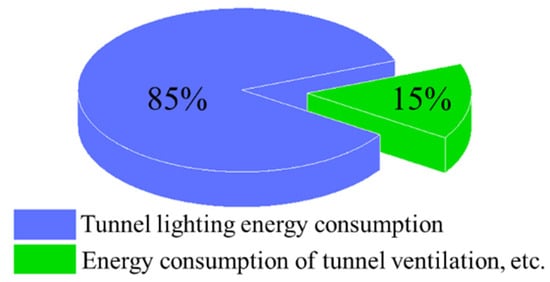
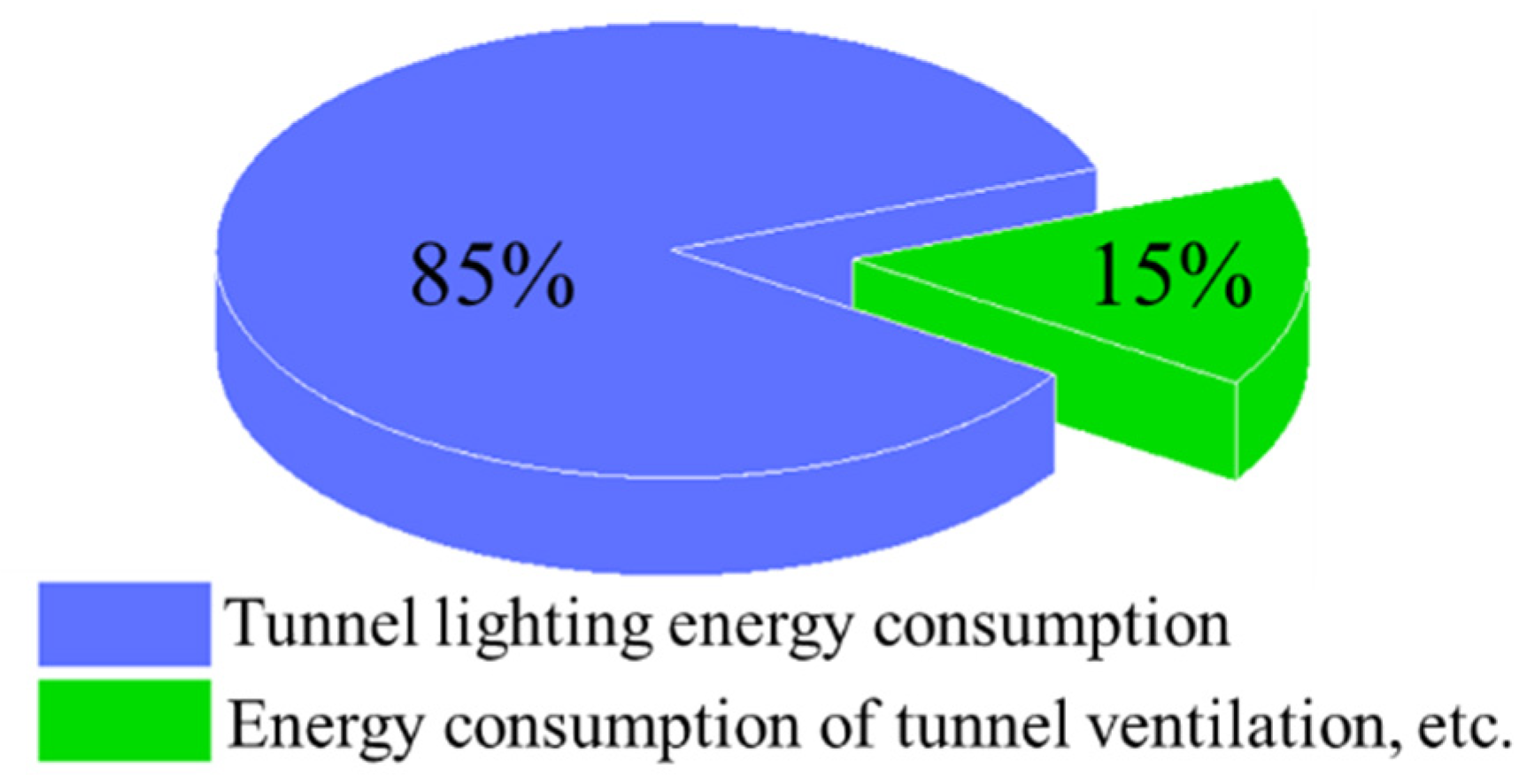
In addition to the above examples of tunnel lighting energy consumption, most of the road tunnels operating in China have varying degrees of energy consumption. Research shows that the energy consumption of tunnel lighting accounts for a relatively high proportion of the total energy consumption of tunnel operation. In 2016, the cost of lighting in China’s highway tunnels was as high as CNY 5.62 billion, and the energy consumption of tunnel lighting accounted for 85% of the total energy consumption of highway operation (Figure 1) [20].
Figure 1.
Percentage of energy consumption for tunnel operations.
In the face of the pressure to save energy and reduce emissions, tunnel lighting must adopt a scientific and rational design method for creating a favorable visual environment in order to ensure the safety and reliability of drivers in tunnels.
2.1.2. Tunnel Accident Statistics
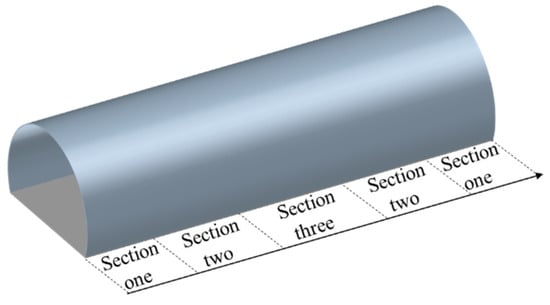
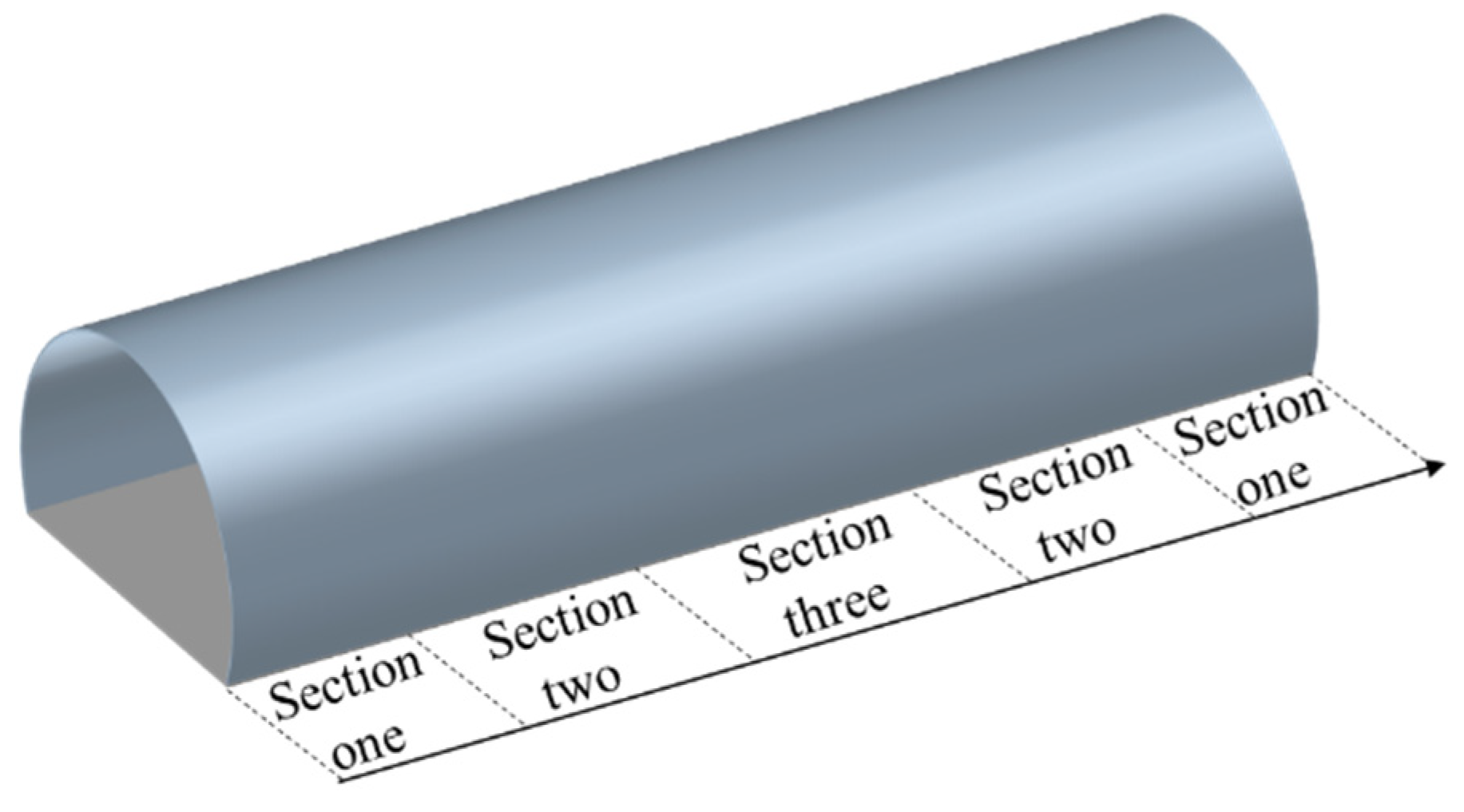
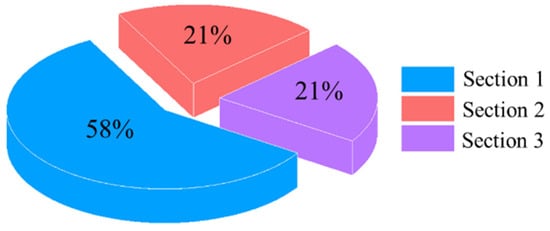
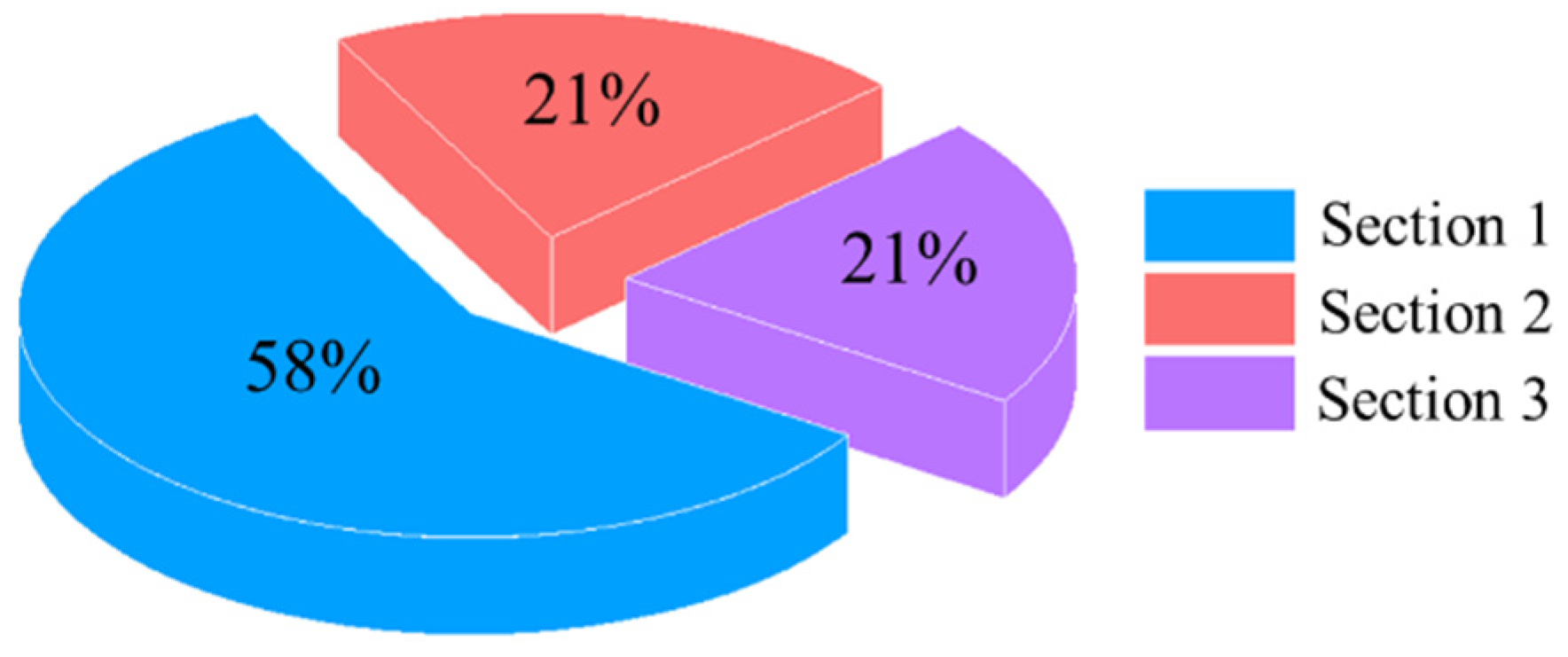
A highway tunnel is a special traffic structure, which has the characteristics of a limited width and a long vertical depth, forming a relatively closed space environment. The interior of a tunnel is unable to benefit from natural lighting due to environmental restrictions, leading to a range of visual issues for drivers and causing heightened anxiety, ultimately posing a serious threat to driving safety [21,22]. Lai [23] partitioned a tunnel into multiple sections in accordance with the Lighting Rules of Highway Tunnels and conducted the statistical analysis of traffic accidents occurring in each section. The spatial division of the tunnel is illustrated in Figure 2, while the distribution of traffic accidents across different sections is presented in Figure 3.
Figure 2.
Tunnel space division.
Figure 3.
The distribution of accidents in different sections of the tunnel.
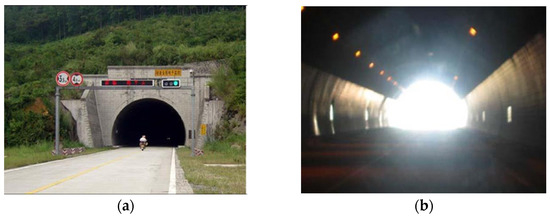
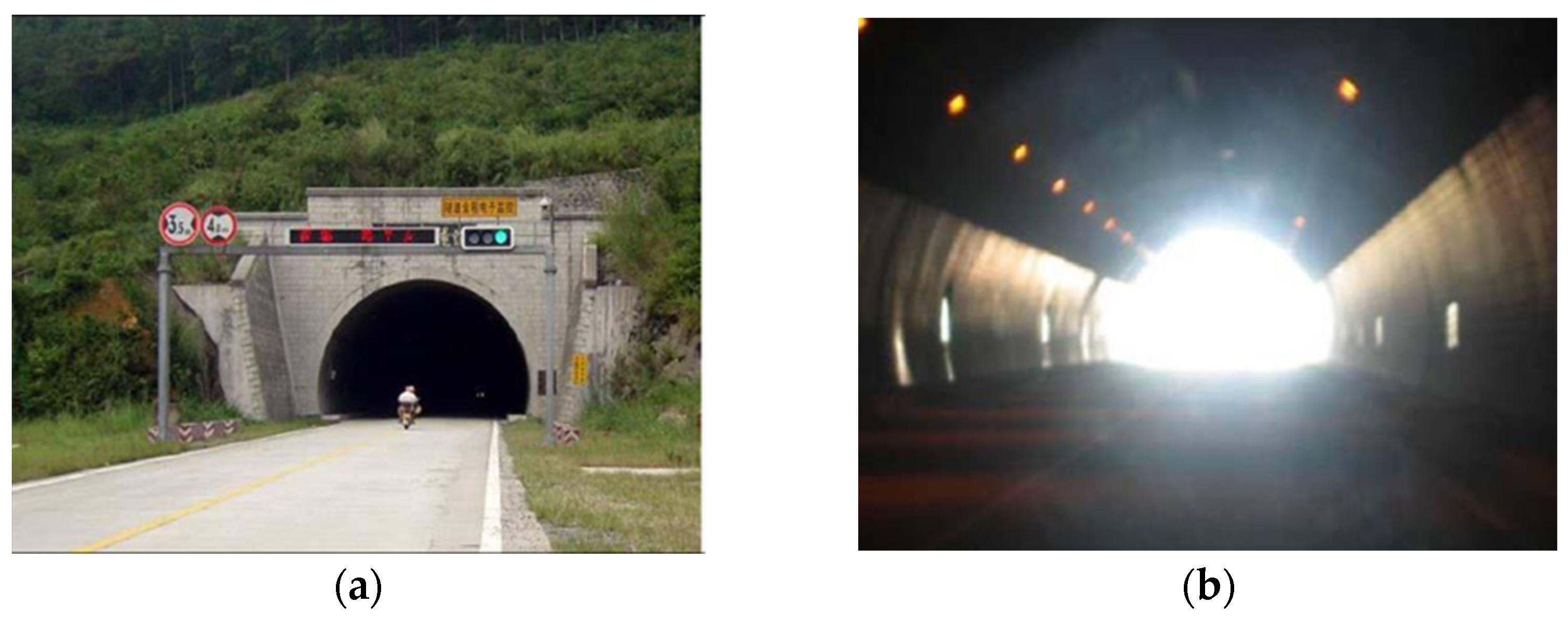
The accident rate at the entrance and exit of the tunnel is 58%, which represents the highest probability of accidents among the various compartments in the tunnel. This phenomenon is closely associated with the environmental characteristics of the tunnel, particularly under daylight conditions. Drivers may experience significant visual changes at the tunnel entrance, commonly referred to as the “black hole effect” and the “white hole effect” (as shown in Figure 4 [24,25]). These effects result in a reduced visual distance for drivers and a prolonged reaction time, ultimately leading to an increased incidence of accidents.
Figure 4.
Visual effects of drivers at tunnel entrances and exits: (a) black hole effect; (b) white hole effect.
The conflict between energy conservation and traffic safety in tunnel lighting has emerged as the central concern of tunnel lighting [26]. Therefore, how to create a safe, efficient, energy-saving and environmentally friendly highway tunnel lighting control system has become a very important focus in construction, with significant economic and social benefits.
2.2. Major Intelligent Control Technologies for Tunnel Lighting
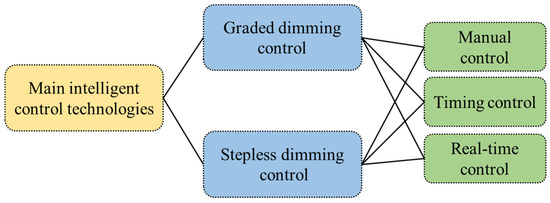
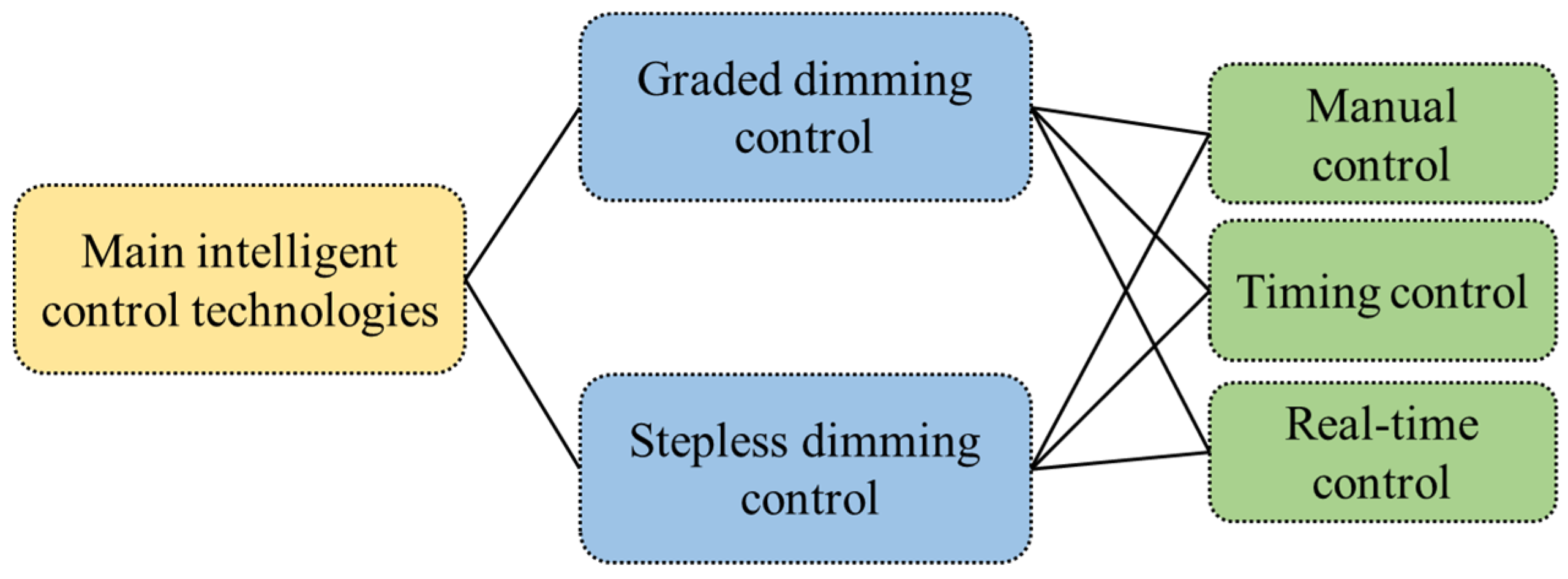
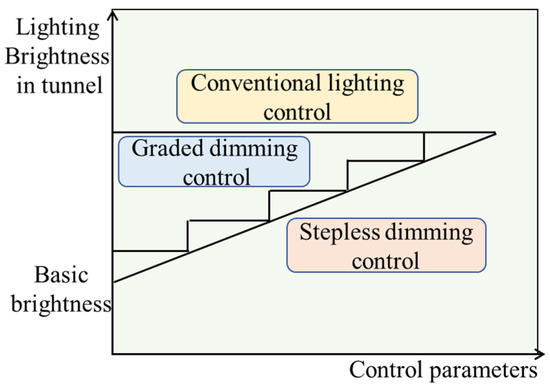
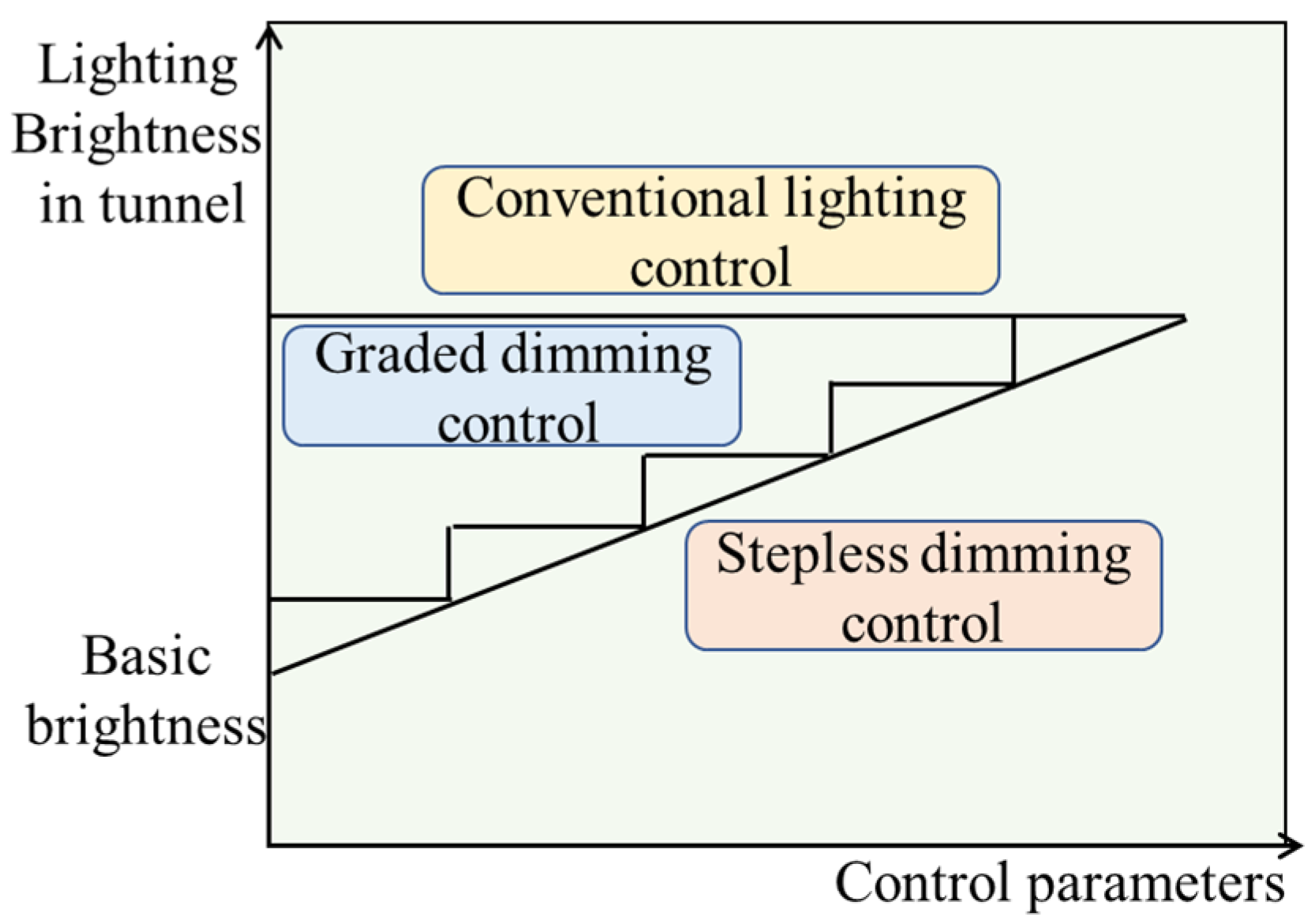
As the core of lighting engineering construction, intelligent control technology should be considered first to solve the energy consumption problem of tunnel lighting. At present, the intelligent control technology of tunnel lighting is mainly divided into graded dimming and stepless dimming (Figure 5) [27]. Some of China’s highway tunnel lighting control technologies are shown in Table 1.
Figure 5.
Intelligent control technology for tunnel main lighting.
Table 1.
Lighting control scheme for some highway tunnels in China.
Grading dimming technology refers to controlling the power supply circuit of the entrance section, strengthening section, basic section and exit section of the tunnel, and then turning the lighting on and off of each circuit to meet the lighting luminance requirements under different tunnel environments [28]. The tunnel lighting is controlled via a time sequence. According to the weather and seasonal changes, different circuits are used to control the lighting. The circuit is automatically opened or closed for graded dimming control. The control method is simple and reliable in practical application.
Stepless dimming technology for tunnel lighting is based on the fact that the lamps inside the tunnel can be dimmable without steps. The stepless dimming of a lamp refers to controlling the lamp’s signal so that it can be lit freely within a luminance range from 0% to 100% according to the needs. With this technology, different lighting levels in the tunnel are achieved not by controlling the circuit power supply, but by controlling the signal level of the lamp. The stepless dimming method can respond quickly, track the lighting demand curve, achieve the optimal control effect, and fulfill the purpose of energy saving, known as “on-demand lighting”.
The control of both graded dimming and stepless dimming can be further categorized into manual control, timing control and real-time control. Manual control is performed by the tunnel manager through either a lighting monitoring computer or a lighting control distribution box. The manual control method is easy to implement and has high effectiveness. However, this method relies heavily on tunnel management personnel and cannot achieve effective management. The real-time control of lighting is determined by parameters such as external luminance, the traffic volume and the average vehicle speed. It dynamically adjusts the luminance of tunnel lighting to correspond with external luminance, the traffic volume and the average speed. This ensures that drivers can adapt to the differences in luminance between inside and outside of the tunnel. Timing control involves measuring regular or different time periods (daily, weekly, monthly and yearly) of the lighting control program using a lighting monitoring computer to regulate the luminance of tunnel lighting. The dimming control priority is shown in Table 2.
Table 2.
Dimming control priority.
Several other intelligent control technologies have been proposed to tackle the problem of substantial electricity wastage in tunnel lighting. Wang [29] proposed an intelligent control system for highway tunnel lighting that can monitor the movement of vehicles to provide lighting. This system is based on Air Lamp lighting technology and wide-area fusion Internet of Things (WF-IoT) to realize the group control of LED lights. The tunnel lighting is divided into several lighting segments through the group control of LED lights. When the surveillance camera detects a vehicle, the corresponding LED group is adjusted to the required brightness according to the environmental conditions and traffic information. The results show that this control technology can effectively reduce the power consumption of lighting and meet the lighting requirements of the tunnel.
Li [30] proposed a “vehicle entry light variable; the vehicle pulls out, the light dims” intelligent control system. This system also considers the influence of external environment brightness, the traffic volume and the speed change. The incremental PID method is used to monitor the road brightness and vehicles inside the tunnel in real time using a camera to ensure that the road brightness can meet the lighting requirements when there are vehicles in the tunnel, and the lamps are adjusted to the minimum brightness when there are no vehicles in the tunnel. It is worth noting that this system has been applied to practical projects, and the test results show that this control method has remarkable energy-saving effect in ensuring traffic safety.
Additionally, there are many non-smart ways to reduce lighting energy waste. For example, A. Pena-Garcia and D. Gomez-Lorente [31] reduced the energy consumption and operating costs of a tunnel by installing solar panels at the entrance; L.M. Gil-Martin et al. [32] introduced sunlight into a tunnel using tubes and established a model for testing. The results showed that introducing sunlight into the tunnel using tubes could significantly reduce the amount of artificial lighting systems required at the entrance of the tunnel. Moreover, the tube system does not require additional elements to be installed at the entrance of the tunnel. LED lighting has the advantages of a long life, high luminous efficiency, a short start-up time, low power consumption, and a constant color temperature, and replacing traditional light sources with LED lighting in tunnels can also achieve the goal of reducing energy consumption. At the same time, planting trees on specific road surfaces can also reduce the energy consumption of tunnels. It is worth emphasizing that all these energy-saving methods are usually compatible with each other [33,34,35].
3. Research on the Application of Major Intelligent Control Technologies for Tunnel Lighting
3.1. Graded Dimming
3.1.1. Technical Overview
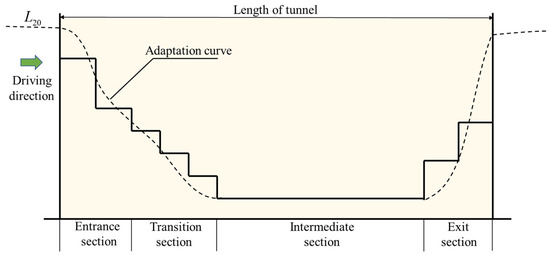
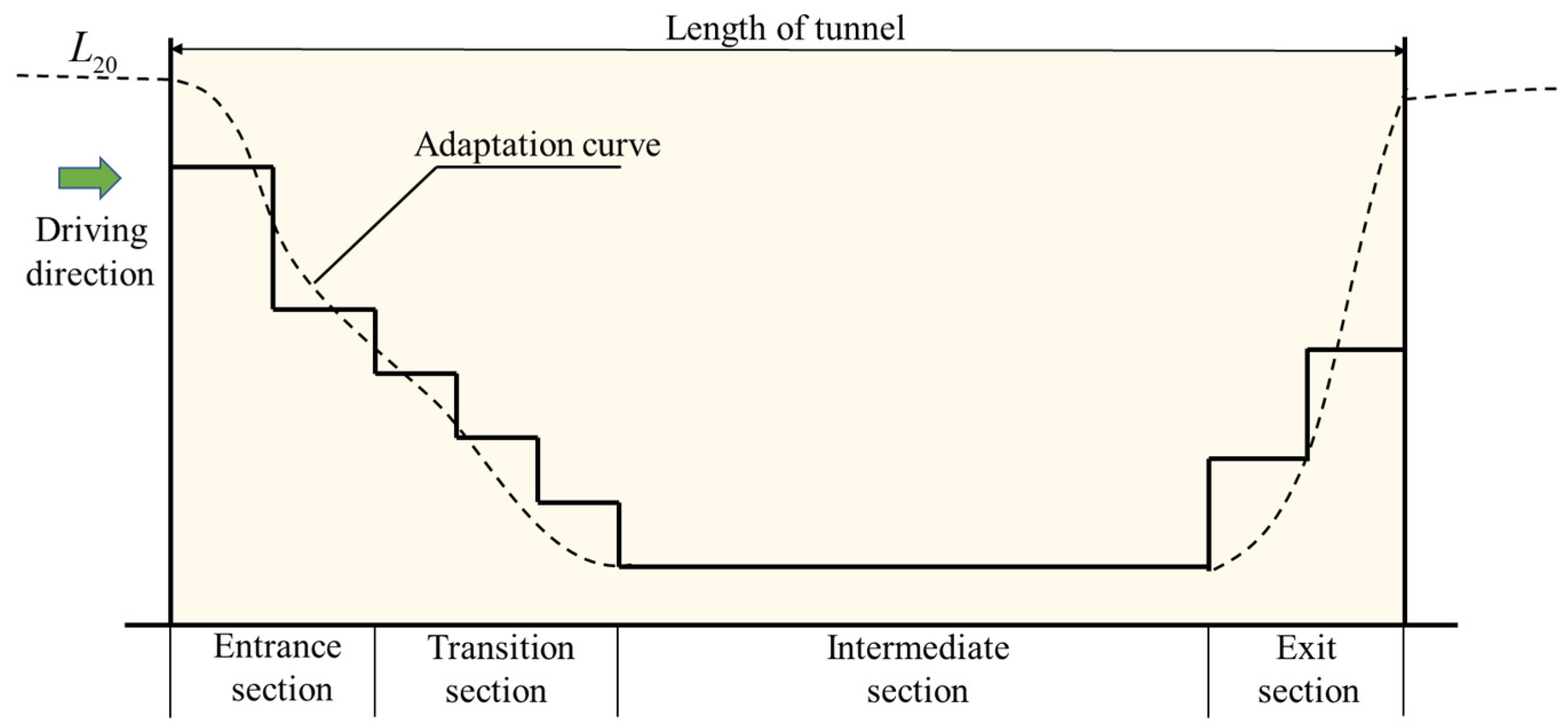
The basic principle of graded dimming control is to control the basic lighting in two separate circuits, i.e., two levels of control (a high traffic volume and a low traffic volume) [36,37,38], because the key determinant of the average luminance demand value of basic lighting is the traffic flow. Enhanced lighting is divided into four independent circuit control groups, i.e., four levels of control (sunny days, cloudy days, overcast days and heavily overcast days), because the average luminance demand value of enhanced lighting mainly depends on luminance outside the tunnel. The number of independent circuits for enhanced lighting should match the number of control levels, allowing for different levels of luminance in the tunnel to be achieved by opening or closing the corresponding lighting circuits. China’s current standard “Highway Tunnel Lighting Design Rules” divides the entrance and the intermediate section of the tunnel into a total of five lighting sections, entrance section 1, entrance section 2, transition section 1, transition section 2, and transition section 3, as shown in Figure 6. The actual demand function of luminance corresponding to each lighting section is shown as follows:
where Dth is the total length of the entrance section; Dtr1, Dtr2 and Dtr3 are the length of transition section 1, transition section 2 and transition section 3; x is the distance of the car in the tunnel from the tunnel entrance; Lth is the luminance of the tunnel entrance section 1, Lth = kL20, where L20 is luminance outside the tunnel; k is the reduction factor for luminance in the entrance section.
Figure 6.
Tunnel lighting section division schematic.
Graded dimming control has different design requirements for day and night [39]. During the day, the tunnel lighting dims according to the different seasons, weather conditions and traffic changes in order to adjust the luminance levels of the tunnel entrance section, transition section and exit section. This strengthen the lighting luminance in the tunnel to adapt to the changes in luminance outside the tunnel; tunnel lighting is scientific and reasonable and achieves the energy-saving effect. The grading is shown in Table 3. Enhanced lighting at the entrance section, transition section and exit section of the tunnel aims to eliminate the “black hole effect” and “visual adaptation lag” visual phenomena caused by the great difference in luminance between the inside and outside of the tunnel when the driver approaches and passes through the tunnel. Therefore, all the enhanced lighting fixtures should be turned off at night.
Table 3.
Enhanced lighting dimming grading during the day.
3.1.2. Analysis of Energy Saving Effect
Dawanshan Tunnel is located in the section of Jingle Fengrun–Xingxian Heiyukou Expressway Project, with a speed limit of 80 km/h. It is a separated, double-hole, one-way traffic tunnel, with the left having a total length of 10,373 m and the right tunnel having a total length of 10,490 m.
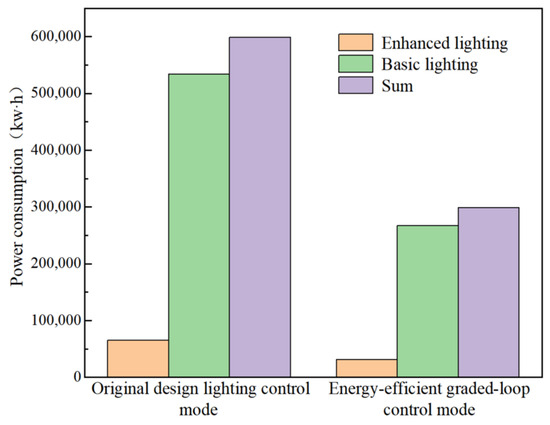
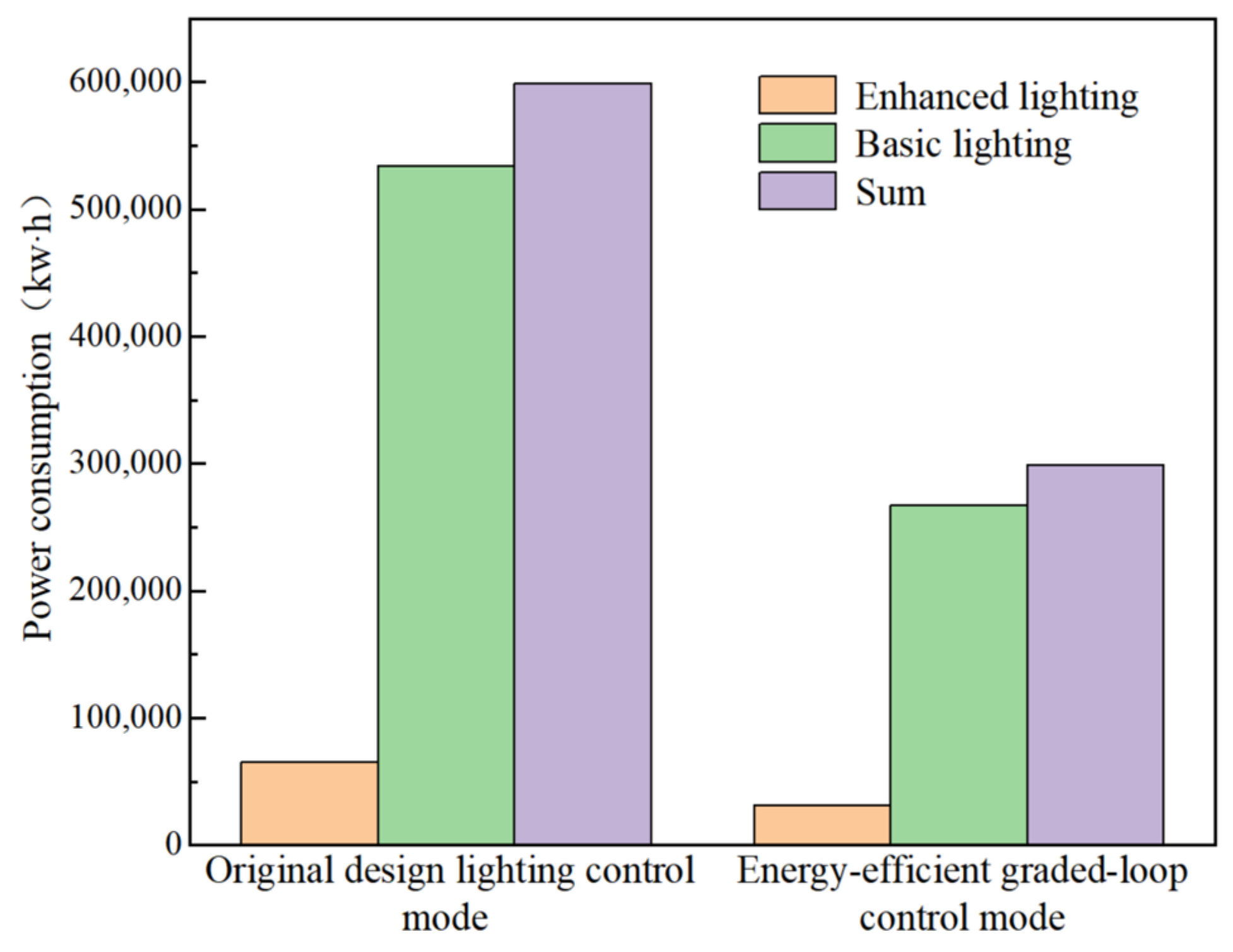
The original design of lighting control for the Dawanshan Tunnel is shown in Table 4. The energy-efficient graded circuit control adds time-of-day lighting control to the original design and achieves lighting luminance control through six circuits. In conjunction with the actual project of the Dawanshan extra-long highway tunnel, separate calculations were conducted for energy consumption using both the original design lighting control method and the energy efficient graded circuit control method. Comparative analysis of the energy-saving benefits was then performed, as shown in Figure 7. The Dawanshan Tunnel is a separated, double-hole, one-way tunnel, and the right lane tunnel was selected for the energy consumption calculations.
Table 4.
Original design of lighting control.
Figure 7.
Comparison of annual energy consumption using two control methods.
From the calculation results, it can be observed that the energy consumption of enhanced lighting in the Dawanshan extra-long highway tunnel accounts for approximately 11% of the total lighting energy consumption, while basic lighting energy consumption accounts for 89%. This indicates that basic lighting energy consumption in the extra-long highway tunnel is significantly higher than that of enhanced lighting. Compared to the original design lighting control method, energy-efficient graded circuit control can reduce energy consumption by 51.4% for enhanced lighting and 50% for basic lighting. The total energy consumption is reduced by 50.2%. The right lane of the Dawanshan Tunnel required RMB 479,300 a year for lighting electricity under the original design lighting control and RMB 238,900 under energy-efficient graded circuit control, which represents a saving of RMB 240,400. As the Dawanshan Tunnel is a separated, double-hole, one-way tunnel, the overall energy consumption can be considered as twice as high as that of a single line, thus saving RMB 480,800 a year on lighting electricity alone.
Dahuashan Tunnel is located between the exit of Guangwu Expressway and the Shuangfeng section. The speed limit is 80 km/h. The length of the left tunnel is 1162.58 m, and the length of the right tunnel is 1165.42 m. The net height of the tunnel is 5 m, and the net width of the tunnel side pavement is 7.5 m. The lighting system settings are shown in Table 5.
Table 5.
Lighting system settings.
The lighting scheme for Dahuashan Tunnel consists of six levels, including sunny, cloudy, overcast, heavily overcast, nighttime and late night conditions. Lighting control is achieved through different lighting wiring circuits and lighting control systems using on-site manual control in the tunnel power supply and distribution room, remote manual control in the monitoring center, and automatic control. On sunny days, 400 W, 250 W and 150 W high-pressure sodium lamps used to provide lighting at the entrance and exit of the tunnel are fully turned on; on cloudy days, their intervals are halved; on overcast days, their intervals are further halved. On heavily overcast days, only 1/8 of the entrance section is turned on (the rest is fully turned off), and these lamps are all turned off at night. The 100 W high-pressure sodium lamp used for basic lighting in the strengthened lighting section as well as the 100 W high-pressure sodium lamp in the middle lighting section only turn on for either left or right sides in the late night hours; they remain fully turned on at other times. The emergency lighting fixtures always stay on, while the horizontal channel lighting fixtures normally remain closed. The street lights outside of the tunnel are fully turned on during nighttime hours, but switched off at all other times. The approaching road outside of the tunnel has timed controlled lighting. Clear standard day traffic data were selected for comparative calculations using several schemes (standard day data; see Table 6).
Table 6.
Existing lighting control scheme table.
The energy consumption situation of the target system was compared and calculated using the same sunny standard day data source with the existing control methods. Table 7 shows the equivalent replacement of lamps based on an LED dynamic dimming control scheme.
Table 7.
LED replacement table.
The energy consumption comparison table for the three control system schemes during a standard day is shown in Table 8.
Table 8.
Energy consumption comparison table.
3.1.3. Analysis of Limitations in Application
The method of graded dimming control, achieved by simply opening or closing the lighting circuit, inevitably results in unevenness in road surface luminance. This approach does not align with the evaluation criteria for the total and longitudinal uniformity of road luminance as outlined in the tunnel lighting regulations. Furthermore, it is not feasible to implement adaptive control across the entire tunnel lighting system at the macro level based on real-time external luminance, the traffic volume and speed. As a result, maximum energy savings cannot be realized, while ensuring driving safety.
3.2. Stepless Dimming
3.2.1. Technical Overview
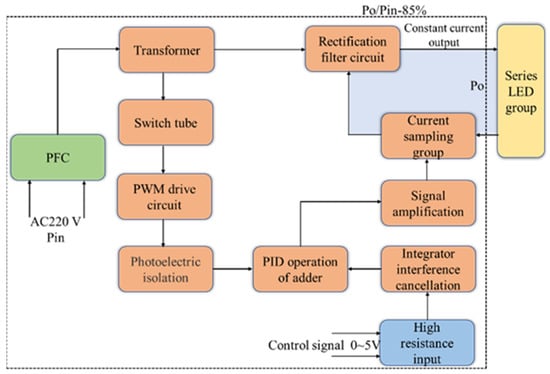
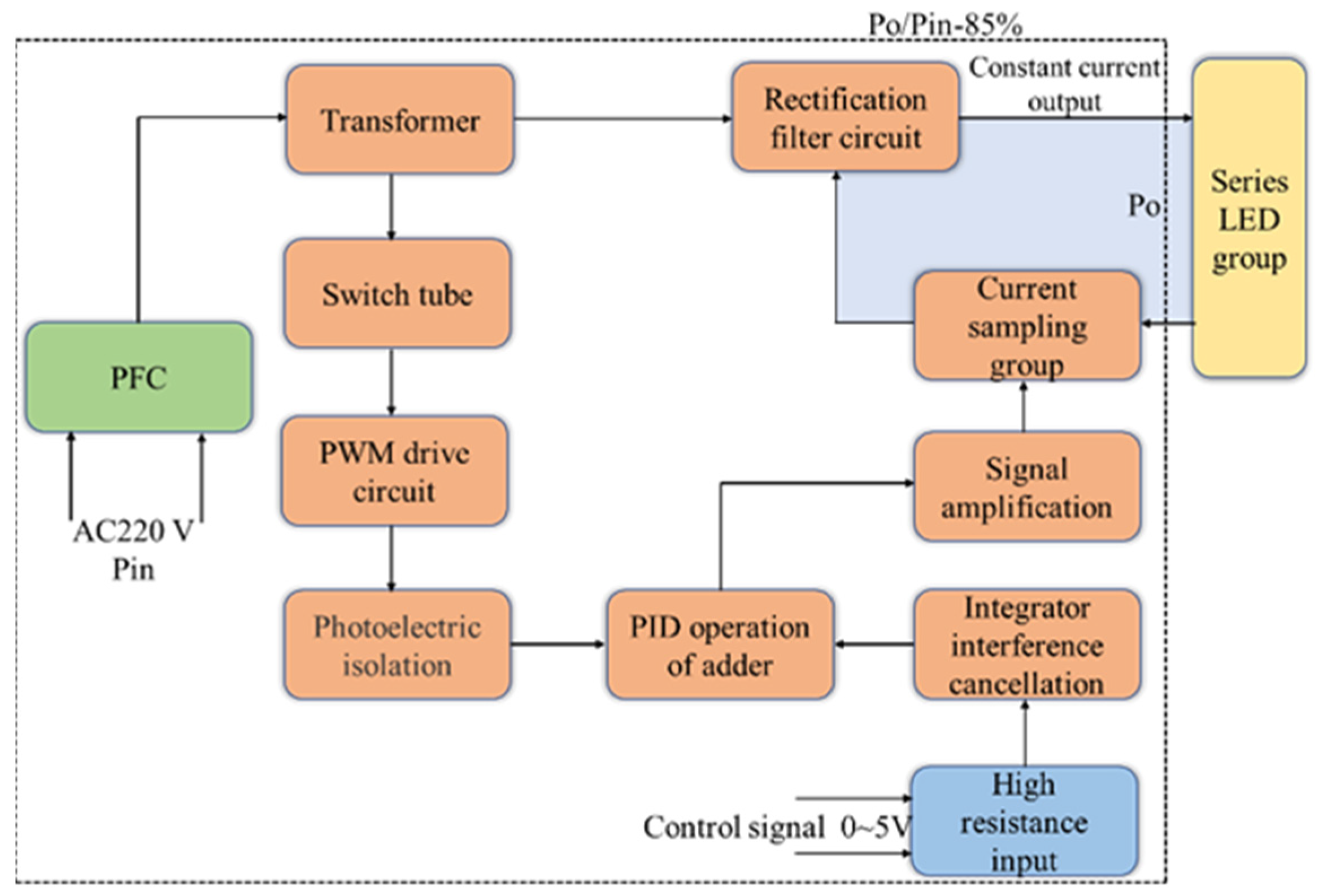
The stepless dimming control is a voltage-controlled current source (VCCS) luminance control method [40]. As shown in Figure 8, the control method directly samples the current signal, and then isolates it to amplify the duty factor of the primary switching tube of the control power supply. The isolation transformer isolates the electrical energy with different duty factors and converts it into a DC pulse current, which is filtered by a low-pass filter and converted into a DC current whose size varies with the control signal, thus controlling the output current of the power supply. The efficiency of this type of power supply with controlled output current is relatively high; with the addition of the Power Factor Correction (PFC) circuit, the general efficiency is about 85%.
Figure 8.
Principle of controlled constant current source with primary constant current.
The stepless dimming control signal of a highway tunnel can use a DC 0~5 V analog voltage signal, which has the advantages of a simple control line and the long transmission distance of the control signal. In order to ensure that the DC 0~5 V analog voltage control signal has a sufficient transmission distance, when designing the LED lamp driver power supply, the output current can be controlled by designing it into the form of a voltage control current source. The control input is of high-input impedance to ensure the long-distance transmission of the control signal. The use of DC 0~5 V analogue voltage signals to control the output current of the LED lamps is fully capable of achieving the demand for the stepless dimming control of lighting in long highway tunnels. Stepless dimming control relies on dimmable lamps, communication interfaces and other hardware support, and the current dimmable LED lamp performance is more stable and reliable, which has been fully able to support the implementation of the system. The characteristics of this system are shown in Table 9.
Table 9.
Characteristics of the stepless dimmable control system.
The selection of a driver for the control system and LED light source plays a crucial role in dimming and controlling tunnel lighting. In general, the common control systems and driver types include dimming control within the ranges of 0–5 V and 0–10 V [41]. The control system comprises hardware and software components utilized for the management of lighting systems, offering monitoring, adjustment and control functionalities. It is capable of automatically adjusting the luminance and operating mode of the lighting based on sensor inputs (such as light sensors, motion sensors, etc.) or manual settings. This facilitates functions such as optimizing energy consumption, dynamic adjustment, and adaptation to environmental changes.
A driver is an electronic device used to control the operation of LED light sources. It converts the power supply voltage into the current and voltage required for the LED, ensuring a constant current supply. The common types of drivers include constant current drivers and constant current/voltage drivers [42]. Constant current drivers are essential for ensuring the stable operation, improved lighting quality and reliability of LED light sources by driving them with a consistent current output that automatically adjusts to the voltage characteristics of the LEDs. Constant current constant voltage drivers combine both the driving methods, offering greater flexibility and compatibility by adapting to different voltage requirements, while maintaining a constant current supply. It is worth noting that although the 0–5 V range is commonly used for infinite dimming, opting for a controller in the 0–10 V range is also feasible. The selection of control systems and drivers should be based on the specific lighting system requirements, available equipment and relevant specifications to achieve the dimming, adjustment and control of tunnel lighting according to diverse needs, while saving energy and enhancing visibility and driving safety.
Stepless dimming controllers can be used for the enhanced lighting to be switched on in the morning and off in the evening, as well as for the adjustment of luminance after the lamp has been switched on based on their technical advantages [43,44]. The control system adjusts the output power of LED lights based on external luminance detection data and subsequent calculation and analysis. This lighting method, which automatically tracks external luminance to regulate internal luminance, not only effectively avoids over-illumination and achieves on-demand lighting, but also maximizes the energy savings. The different control methods for luminance adjustment are shown in Figure 9. Compared to graded dimming, the control method of stepless dimming enables lamps to emit light energy at different luminance levels, effectively overcoming the uneven illumination and flickering caused by graded control and improving the lighting quality.
Figure 9.
Comparison of different control methods for luminance adjustment.
3.2.2. Analysis of Energy Saving Effect
Longquansi Tunnel is 3847 m long, and it is the only long mountain tunnel on the Beijing–Shijiazhuang Railway Passenger Line. The design parameters of Longquansi Tunnel are as follows: a speed limit of 80 km/h, a road width of 8.75 m, a forecasted traffic volume of 6331 pcu/d, an outside tunnel luminance of 3500 cd/m2, and a reduction factor of 0.03.
The traditional tunnel lighting system utilizes logic switches to regulate the graded circuits, enabling dimming control through the manipulation of different circuits via the logic switches. Typically, it is segmented into multiple independent circuits based on the traffic flow and weather conditions, with the corresponding circuits being activated or deactivated in response to the actual demand for dimming.
The fine-molecule circuit stepless dimming subdivides each lighting section into smaller sections, which are adjusted based on their luminance requirements. The finer division of control circuits for each lighting section reduces the number of lamps per stage and eliminates the need for individual circuit dimming for each lamp. This dimming method controls the real-time power of the tunnel’s various circuits for enhanced lighting based on the real-time luminance outside the tunnel, the real-time traffic flow, the real-time vehicle speed, and the available luminous flux from optical fiber lighting at the current solar altitude angles.
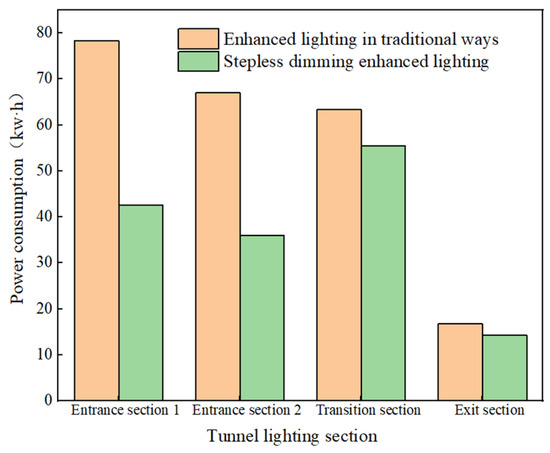
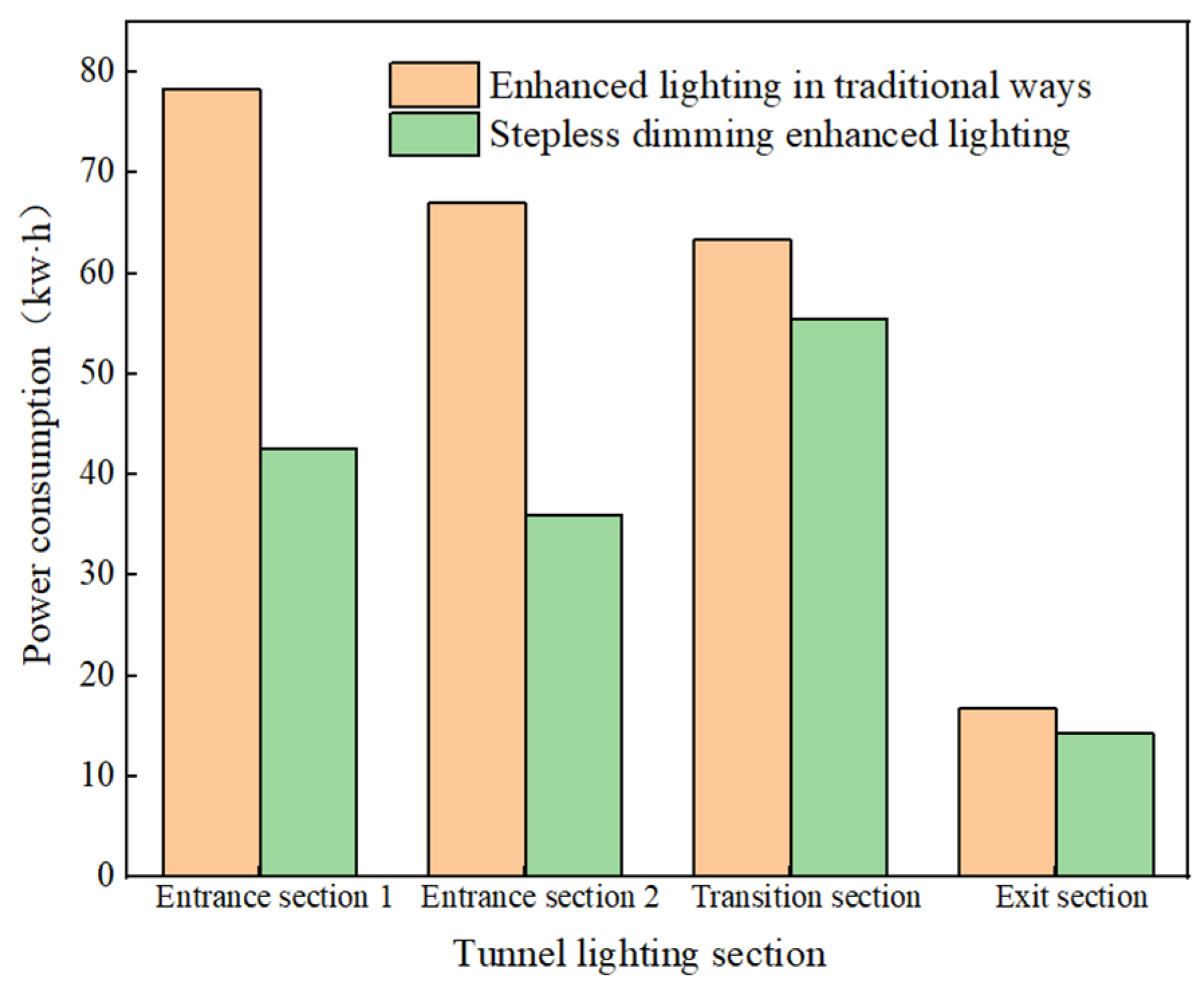
The comparison of enhanced lighting power consumption between the two lighting methods is shown in Figure 10. The calculation results indicate that the total power consumption of traditional enhanced lighting is 225.28 kW·h, while the total power consumption of sub-loop stepless dimming enhanced lighting is 148.29 kW·h. Energy consumption was reduced by 34.17%.
Figure 10.
Comparison of power consumption.
The Jiudingshan Extra-Long Tunnel has a total length of 3200 m, with dual tunnels and dual lanes for one-way traffic. In the second half of 2014, energy-saving renovations were carried out on the lighting system of the tunnel. The project required enhanced lighting that could be dimmable based on traffic flow and luminance outside the tunnel. Basic lighting could be dimmed according to the traffic volume and time period, and it was also required to be able to detect the luminance inside the tunnel and automatically adjust the luminance inside the tunnel based on the detection results.
The renovation of the Jiudingshan Extra-Long Tunnel lighting system adopted an LED infinite dimming lighting system, which consists of an external luminance detector, a traffic flow detector, an internal luminance detector, an LED luminance intelligent stepless control device (a tunnel intelligent lighting system controller, which is the same), a luminance controllable LED tunnel light, a communication system, an upper computer, and tunnel lighting monitoring and management software. The system first collects luminance and traffic flow information outside the tunnel, and then processes the data and calculates them based on the timing information and various parameters and outputs a DC 0–5 V analog signal to control the luminance of the LED tunnel lights. The luminance meter located at the entrance and middle sections of the tunnel collects road luminance information at corresponding positions, and after data processing, compares it with the standard value. If it meets the standard requirements, the program continues to run; if it does not meet the standard requirements, it readjusts the output.
The energy-saving renovation project of Jiudingshan Tunnel was fully completed. Relevant units have measured the lighting energy consumption of the tunnel using two dimming methods: infinite dimming and graded dimming. The lighting energy consumption is shown in Table 10. Each dimming method operates for two cycles (48 h), and it is found that stepless dimming on the upstream line saves 36% energy compared to graded dimming (7%), and downstream stepless dimming saves 28.4% energy compared to graded dimming. The main reason for the lower energy-saving range of the down line is that the road surface is asphalt, which requires a high level of illumination. The test was conducted under sunny conditions, and in the case of cloudy or cloudy weather, energy efficiency was further increased.
Table 10.
Comparison and contrast between LED stepless dimming system and LED stepped dimming system used in Jiudingshan Tunnel in terms of energy conservation.
3.2.3. Optimization Model Based on BP Neural Network
The luminance of the entrance section 1 and the intermediate section 1 of the highway tunnel is the key to the lighting design, and the luminance of all the other lighting sections can be converted according to the proportional relationship with the luminance of these two sections [45]. Among them, the luminance of the entrance section 1 is calculated by looking up the reduction coefficient k according to the vehicle speed and traffic volume, and then calculated by combining it with luminance outside the tunnel. The luminance of the intermediate section 1 only needs to be studied according to the vehicle speed and traffic volume. The internal conversion formulas are very complicated, and there is no precise formula for controlling the variable of vehicle speed. There is currently no linear mapping between tunnel luminance and vehicle speed, traffic volume and luminance outside the tunnel. A mathematical theory has shown that neural networks can implement any complex non-linear mapping, so neural networks can be used to solve algorithmic problems for tunnel lighting dimming [46,47,48].
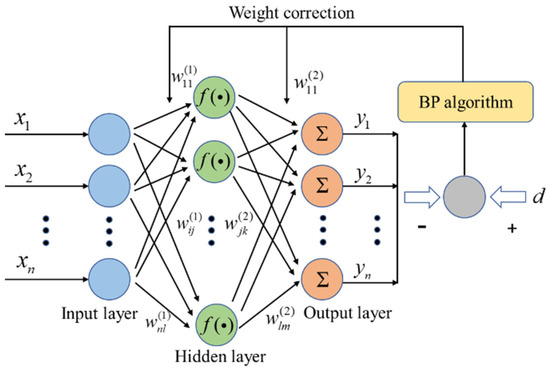
Neural network algorithms do not require a specific mathematical model for the internal processes, but only need to collect enough input and output sample data to ensure a better ability to predict the results [49,50,51]. Among them, the BP neural network is by far the most widely used neural network, mainly applied to function fitting and pattern classification for the intelligent dimming of tunnel lighting. The BP neural network uses an error backpropagation training algorithm and has a total of three or more layers, namely the input layer, the hidden layer (middle layer) and the output layer. The corresponding structural diagram is shown in Figure 11. When the actual output does not match the expected output, the output error will be transmitted back layer-by-layer through the hidden layer in some form to the input layer, and the connection weights will be constantly corrected. With the forward propagation of the signal and the reverse propagation of the error cycle, the connection weights are constantly adjusted to reduce the error of the network output to an acceptable degree.
Figure 11.
Principle of BP neural network structure [45].
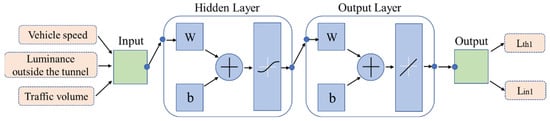
In highway tunnel lighting, the luminance of both entrance section 1 and middle section 1 determines the overall luminance of the entire tunnel. Specifically, the lighting luminance of entrance section 1 is determined by factors such as speed, the traffic volume and external luminance. On the other hand, the luminance of middle section 1 is solely influenced by the speed and traffic volume. A neural network model for highway tunnel lighting was established using MATLAB programming software, with the input variables including speed, the traffic volume and external luminance outside the tunnel. The output variables are the luminance of entrance section 1 and middle section 1, as shown in the Figure 12. The proposed neural network consists of a two-layer feedforward network with sigmoid hidden neurons and linear output neurons. By ensuring data consistency and an adequate number of hidden neurons, this multidimensional mapping problem can be effectively addressed [52].
Figure 12.
Neural network model for highway tunnel lighting.
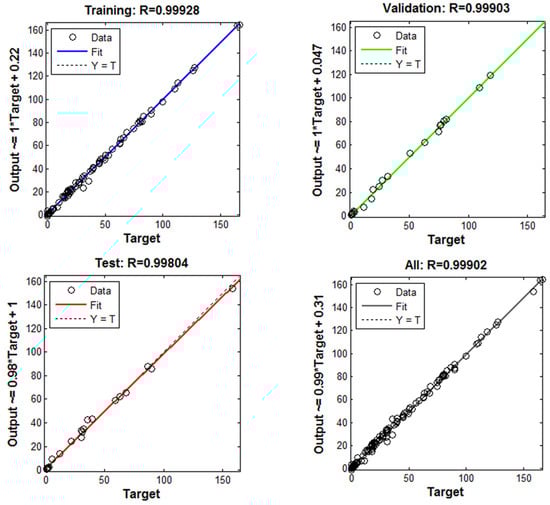
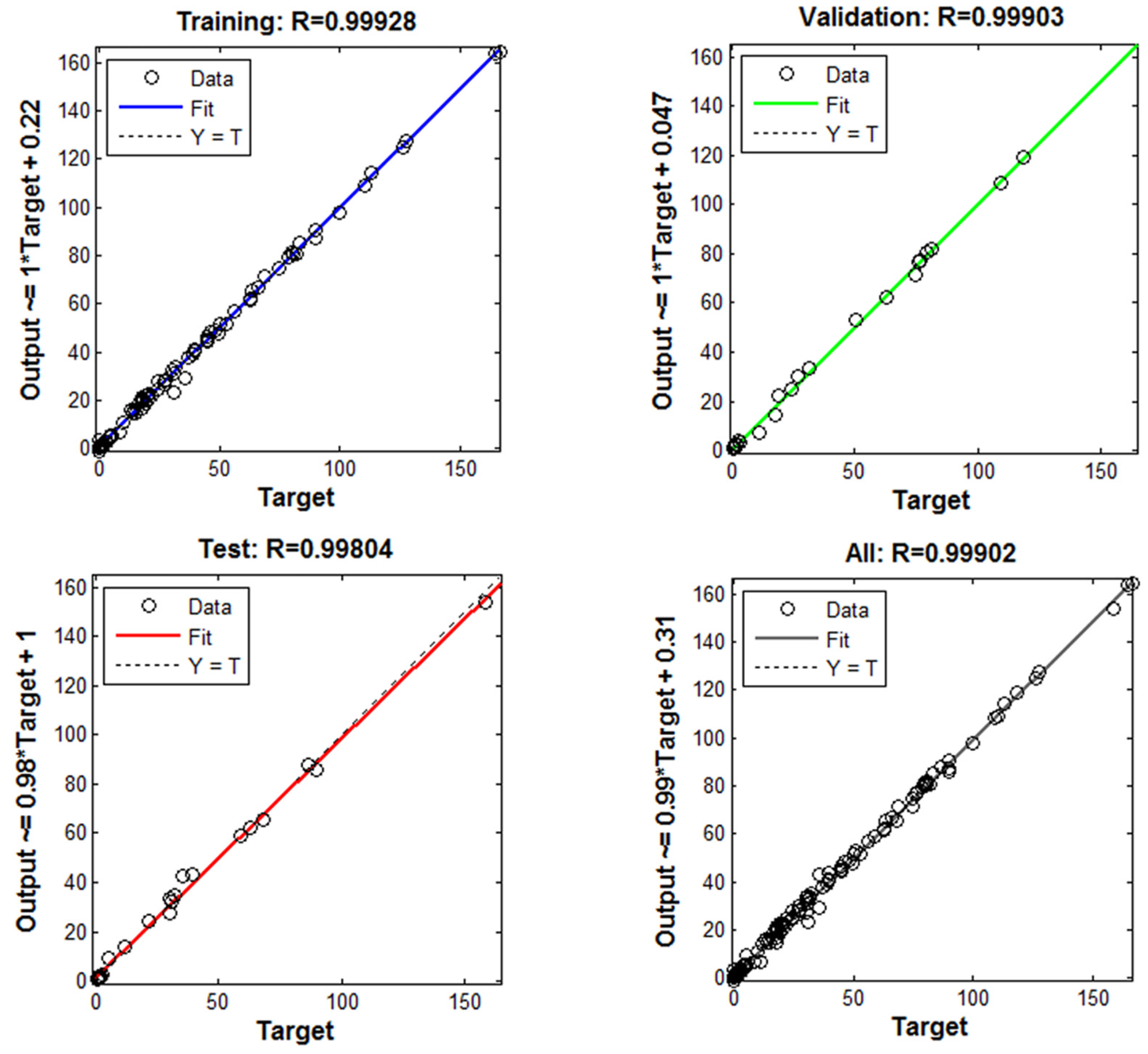
Neural networks have a drawback of overfitting, which is that they blindly pursue the minimum error during the training process, resulting in a decrease in generalization ability, and ultimately deviating from other untrained data. Therefore, a total of 244 sets of input and output sample data were collected, involving various ranges of changes for the three input variables. To prevent overfitting, 70% of the samples was used for training, 15% was used for the validation data, and 15% was used for the testing results. Figure 13 show regression diagrams of the learning results for four aspects: the training, validation, testing and overall performance of the entrance segment neural network. From Figure 13, it can be seen that the correlation coefficients R for training, validation, testing and overall are all greater than 0.99. The curves of the four graphs are almost all on the diagonal line, and the data are basically distributed next to the curves. The closer the correlation coefficient R is to one, the higher the correlation of the model is, and its actual output is almost equal to the expected output. Therefore, it can be considered that the neural network model not only has good fitting performance, but also has a good generalization ability [53].
Figure 13.
Regression diagram of learning results of neural network in the entrance segment.
Research on neural networks mainly focuses on intelligent lighting control systems. They take external luminance, the climate and the traffic intensity as inputs and construct an intelligent adaptive tunnel lighting system [54,55]. Based on luminous flux estimation, a genetic algorithm and a fuzzy neural network algorithm, the required luminance for tunnel lighting can be obtained. This adjusts the luminous flux of the lighting system based on the real-time conditions of the tunnel, avoiding overly bright lights and achieving energy saving in tunnel lighting. This method has significant energy-saving effects [56,57].
In addition, Lu [58] designed a control system based on IoT and the fuzzy control theory. The major factors, such as brightness, the traffic volume and speed outside the tunnel, are monitored in real time. The inputs of fuzzy control are the brightness of the environment outside the tunnel, the traffic flow, the vehicle speed and the fuzzy output is the brightness inside the tunnel. This system has been applied to the actual project; the daily power consumption of the controlled lamp is about 1.9 kW h, and the energy consumption is reduced by 53.0%. After practical application to the tunnel entrance section, the electricity cost can be reduced by about USD 600,000 per year.
Some scholars have studied the intelligent control algorithm of highway tunnel lighting based on long- and short-term memory and developed a tunnel lighting simulation environment to verify the lighting results. The time series matrix of the vehicle speed, the traffic volume and outdoor brightness were taken as input parameters of the computational complexity of the model. The luminance simulation results before and after using the intelligent control algorithm were compared and analyzed, and the effectiveness of the intelligent control algorithm for tunnel lighting was verified via experiments. The results show that compared with the traditional tunnel lighting intelligent control algorithm, the energy saving of tunnel lighting can be 23.61% under sunny conditions and 31.40% under cloudy conditions [59,60,61].
5. Conclusions
With the rapid development of highway construction, tunnel construction, highway tunnel lighting energy saving, and lighting safety issues are becoming more and more prominent. Lighting control technology is the core and key link of lighting engineering construction. This paper describes and reviews the development and application of lighting intelligent control technologies, as well as their corresponding use and operational effects. Through the above summary and the actual application situation, the following conclusions and observations can be discussed.
- (1)
- Although graded dimming control is simple and easy to operate, it cannot effectively curb the tunnel lighting power waste and cannot achieve the smooth transition of lighting in each section of the tunnel. It is only applicable to a lighting control system with the little grades of luminance adjustment.
- (2)
- The application of an LED lamp stepless dimming control system cannot only effectively curb the phenomenon of “excessive lighting” of highway tunnel, but also simplify the design of lighting distribution, saving a lot of cable investment, wiring construction, and operation and management costs, with good economic and social benefits, which can be promoted and applied in China.
- (3)
- The variable CCT highway tunnel lighting system improves the traditional tunnel lighting defects and gives a specific luminance and CCT adjustment scheme, which can be infinitely adjusted to lamps according to the environmental parameters outside the tunnel and the speed limit of the tunnel. The system is simple and economical, stable and reliable and has a good real-time performance. It has a certain promotional value in reducing tunnel safety hazards and reducing drivers’ reaction time.
Funding
This research was supported by the National Natural Science Foundation of China (No. 52078421), the Innovation Capability Support Program of Shaanxi (Program No. 2023-CX-TD-35), and the Key Research and Development Program of Shanxi (Program No. 2023KXJ-159).
Conflicts of Interest
Authors Qiang Wang and Yunteng Chen were employed by the company CCCC Second Highway Engineering Co., Ltd. and Shaoxing Communications Investment Group Co., Ltd., respectively. The remaining authors declare that the research was conducted in the absence of any commercial or financial relationships that could be construed as a potential conflict of interest.
References
- Hong, K.R.; Feng, H.H. Development trends and views of highway tunnels in China over the past decade. China J. Highw. Transp. 2020, 33, 62–76. [Google Scholar]
- Feng, L. Research on energy saving technology for highway tunnel lighting. Highway 2015, 60, 301–304. [Google Scholar]
- Tu, Y.; Wang, S.; Zhang, Q.; Deng, X.; Chen, J.; Li, K.; Zhao, Q.; Wu, X. Strategy for illumination energy-saving of highway tunnels under the condition of “low-carbon economy”. Mod. Tunneling Technol. 2011, 48, 14–21. [Google Scholar]
- Tunnel Entrance Lighting: A Survey of Fundamentals for Determining the Luminance in the Threshold Zone; CIE Technical Report: 61-1984; Commission Internationale de l’Éclairage: Paris, France, 1984.
- Guide for the Lighting of Road Tunnels and Underpasses; CIE Technical Report: 88-2004; CIE Central Bureau: Vienna, Austria, 2004.
- Huang, T.; Luo, F.; Zhang, K. Application of fuzzy control to a road tunnel lighting system. In Proceedings of the 2006 6th International Conference on ITS Telecommunications, Chengdu, China, 21–23 June 2006; pp. 136–139. [Google Scholar]
- Yang, C.; Fan, S.; Wang, Z.; Li, W. Application of fuzzy control method in a tunnel lighting system. Math. Comput. Model. 2011, 54, 931–937. [Google Scholar] [CrossRef] [Scilit]
- Guan, S.M. Research on Monitoring Technology for Qinling Zhongnanshan Extra Long Highway Tunnel Passed Appraisal and Acceptance. Technol. Highw. Transp. 2005, 68–69. [Google Scholar]
- Ye, P.Q. Study on energy saving intelligent lighting system of tunnel groups on Shantou-Meizhou expressway. Technol. Highw. Transp. 2005, 04, 173–174. [Google Scholar]
- Huang, F.W.; Chen, Y.; Xiao, H.; Li, F.H.; Cheng, D.; Cui, F.X. Research and realization tunnel illumination energy-saving control system. Highw. Eng. 2008, 33, 111–114. [Google Scholar]
- Guo, L.Y.; Liang, B.; Zhang, S.R. A hovel control strategy of tunnel illumination system. J. Northwest Univ. (Nat. Sci. Ed.) 2009, 39, 571–574. [Google Scholar]
- Ministry of Transport of the People’s Republic of China. Guidelines for Design of Lighting of Highway Tunnels; China Communications Press: Beijing, China, 2014.
- Hong, K.R. State-of-art and prospect of tunnels and underground works in China. Tunn. Constr. 2015, 35, 95–107. [Google Scholar]
- Luo, G. Statistics of super-long highway tunnels with length over 10 km in Chinese mainland. Tunn. Constr. 2019, 39, 1380–1383. [Google Scholar]
- Zheng, G.P.; Ren, Z.D.; Wan, F. Study of energy consumption estimation methods for highway tunnel lighting systems. Highway 2021, 66, 391–394. [Google Scholar]
- Wang, S.F.; Tu, Y.; Deng, X. Countermeasures for energy-saving and emission reduction of highway tunnel. J. Railw. Eng. Soc. 2011, 28, 71–75, 114. [Google Scholar]
- Tu, Y.; Wang, S.F.; Zhang, Q.; Deng, X.; Chen, J.Z.; Li, K. Evaluation of tunnel lighting system of Xi-Han highway. China Illum. Eng. J. 2010, 21, 15–21, 36. [Google Scholar]
- Wang, S.F.; Tu, Y. Development and innovation of highway tunnel lighting technology in China. Tunn. Constr. 2010, 30, 199–205. [Google Scholar]
- Yang, C.; Li, M.; Yang, X.X.; Li, L.F. Development of energy-saving technology of highway tunnel lighting system. J. East China Jiao Tong Univ. 2018, 35, 73–79. [Google Scholar]
- Chen, Z.L. On the program of energy-saving control and safety monitoring of tunnel lighting. Mod. Tunneling Technol. 2009, 46, 105–111. [Google Scholar]
- Amundsen, F.H.; Ranes, G. Studies on traffic accidents in Norwegian road tunnels. Tunn. Undergr. Space Technol. 2000, 15, 3–11. [Google Scholar] [CrossRef] [Scilit]
- Yu, L.; Luo, X.; Wang, S.; Zhang, C.Y.; Xia, P.X. Correction of lighting adaptation curve in highway tunnel based on eye comfort. Mod. Tunneling Technol. 2021, 58, 73–80. [Google Scholar]
- Lai, J.; Zhang, P.; Zhou, H.; Cheng, F.; Qin, H. Study of rules of traffic accidents in expressway tunnels. Tunn. Constr. 2017, 37, 37–42. [Google Scholar]
- Zhang, S.R.; Ma, Z.L.; Xu, J.C. Traffic accidents distribution law in freeway tunnel. J. Chang. Univ. (Nat. Sci. Ed.) 2008, 4, 74–78. [Google Scholar]
- Hu, J.B.; Ma, W.Q. Threshold zone light environment of tunnel based on driving visual demand. J. Shanghai Jiao Tong Univ. 2015, 49, 464–469. [Google Scholar]
- Wang, S.F.; Tu, Y.; Deng, X.; Zhang, Q.; Chen, J.Z.; Li, K. Situation and countermeasures of energy-saving in road tunnels lighting. Chin. J. Undergr. Space Eng. 2012, 8, 1539–1544, 1604. [Google Scholar]
- Wang, S.F.; Deng, X.; Wu, X.L. Overview of lighting control techniques in expressway tunnels. Technol. Highw. Transp. 2010, 42, 3132–138, 146. [Google Scholar]
- Wang, X.; Li, X.; Han, M.; Bie, C.; Wang, Y. Energy saving control of on-demand lighting in highway tunnel. China Illum. Eng. J. 2020, 31, 113–118. [Google Scholar]
- Wang, Y.; Cui, Y.; Chen, F.; Ren, R. An “Illumination Moving with the Vehicle” Intelligent Control System of Road Tunnel Lighting. Sustainability 2020, 12, 7314. [Google Scholar] [CrossRef] [Scilit]
- Qin, L.; Dong, L.; Xu, W.; Zhang, L.; Yan, Q.; Chen, X. A “vehicle in, light brightens; vehicle out, light darkens” energy-saving control system of highway tunnel lighting. Tunn. Undergr. Space Technol. 2017, 66, 147–156. [Google Scholar] [CrossRef] [Scilit]
- Peña-García, A.; Gómez-Lorente, D. Installation of solar panels in the surroundings of tunnel portals: A double-targeted strategy to decrease lighting requirements and consumption. Tunn. Undergr. Space Technol. 2020, 97, 103251. [Google Scholar] [CrossRef] [Scilit]
- Gil-Martín, L.M.; Peña-García, A.; Jiménez, A.; Hernández-Montes, E. Study of light-pipes for the use of sunlight in road tunnels: From a scale model to real tunnels. Tunn. Undergr. Space Technol. 2014, 41, 82–87. [Google Scholar] [CrossRef] [Scilit]
- Moretti, L.; Cantisani, G.; Di Mascio, P. Management of road tunnels: Construction, maintenance and lighting costs. Tunn. Undergr. Space Technol. 2016, 51, 84–89. [Google Scholar] [CrossRef] [Scilit]
- López, J.C.; Grindlay, A.L.; Carpio, M.C.; Peña-García, A. Strategies for the optimization of binomial energy saving landscape integration in road tunnels. WIT Trans. Ecol. Environ. 2014, 190, 511–520. [Google Scholar]
- Peña-García, A.; Gil-Martín, L.M.; Hernández-Montes, E. Use of sunlight in road tunnels: An approach to the improvement of light-pipes’ efficacy through heliostats. Tunn. Undergr. Space Technol. 2016, 60, 135–140. [Google Scholar] [CrossRef] [Scilit]
- Zhao, Y.; Dong, L.-L.; Qin, G.; Qin, L. The effect of segmented lighting on tunnel lighting energy-saving. IOP Conf. Ser. Earth Environ. Sci. 2018, 189, 042009. [Google Scholar] [CrossRef] [Scilit]
- Shen, X.; Liu, Q.; Deng, A. Research on Highway Tunnel Entrance Lighting System Based on Intelligent Control. J. Logist. Eng. Univ. 2012, 28, 12–15. [Google Scholar]
- Wang, Y.; Zhang, Y.; Xing, S. Research on Intelligent Energy-saving Control Technology for Entrance Lighting of Mountain Road Tunnel. Energy Conserv. Environ. Prot. Transp. 2019, 15, 99–101. [Google Scholar]
- Liang, B.; Niu, J.; Li, S.; Yang, Y.; Xiao, J.; Zhang, X.J. Dynamic optimization and intelligent control of highway tunnel lighting considering visibility effects. Control Theory Appl. 2023, 40, 1783–1792. [Google Scholar]
- Guo, J.K. Study on lighting accurate detection and intelligent control system in highway tunnel. Tunn. Constr. 2020, 40, 76–81. [Google Scholar]
- Musa, M.S.; Nallagownden, P.; Chiu, K.W.; Sarwar, M.B. Design and development of intelligent adaptive tunnel lighting system. In Proceedings of the 2015 IEEE Conference on Energy Conversion (CENCON), Johor Bahru, Malaysia, 19–20 October 2015; pp. 289–292. [Google Scholar] [CrossRef] [Scilit]
- Spor, A.; Kiyak, I.; Solak, G. Artificial Intelligence Supported Tunnel Lighting System. In Proceedings of the 2019 International Conference on Applied Automation and Industrial Diagnostics (ICAAID), Elazig, Turkey, 25–27 September 2019; pp. 1–5. [Google Scholar] [CrossRef] [Scilit]
- Jia, N.; Guo, S. The Development of LED Intelligent Illumination Control System for Tunnel Lighting. Bull. Sci. Technol. 2014, 5, 121–124. [Google Scholar]
- Yang, C.; Yu, B.; Hu, G.; Shi, H.; Zhao, Y.; Wang, S. New ideas on lighting energy-saving of road tunnels in mountainous areas. Highway 2018, 63, 166–169. [Google Scholar]
- Bai, X.; Li, J.; Lu, Y.; Wang, J. Research on Automatic Lighting Control Equipment of Tunnel Entrance. In Proceedings of the 2020 International Conference on Computer Network, Electronic and Automation (ICCNEA), Xi’an, China, 25–27 September 2020. [Google Scholar]
- Zhang, L.; Li, Q.; Jiang, H.T.; Dong, L. Design and Implementation of Intelligent Monitoring Software System for Tunnel Lighting. J. Highw. Transp. Res. Dev. 2017, 34, 92–99, 107. [Google Scholar]
- Qin, H.; Guo, Y.; Luo, R. Study of illumination control system of highway tunnel based on fuzzy neural network. Tunn. Constr. 2017, 37, 115–120. [Google Scholar]
- Li, H.; Yang, Y.; Chen, D.; Feng, Z.; Wang, L.; Tang, W. Lighting control method and system for highway tunnel based on microphone array vehicle detection. Tunn. Constr. 2019, 39, 1957–1964. [Google Scholar]
- Li, N.; Wang, X.; Wu, J.; Huang, G.; Shao, Z. Using of genetic algorithms in highway tunnel lighting intelligent optimization. J. Cent. South Univ. (Sci. Technol.) 2013, 44, 342–345. [Google Scholar] [CrossRef] [Scilit]
- Zhao, J.; Feng, Y.; Yang, C. Intelligent control and energy saving evaluation of highway tunnel lighting: Based on three-dimensional simulation and long short-term memory optimization algorithm. Tunn. Undergr. Space Technol. 2021, 109, 103768. [Google Scholar] [CrossRef] [Scilit]
- Hu, Y.; Qin, H. Design of Closed-loop Feedback Intelligent Lighting Control System for Tunnel. Technol. IoT AI 2018, 1, 28–32. [Google Scholar]
- Yu, Q.; Zhu, D. The Prediction and Analysis of the Road Tunnel Traffic Flow. Highw. Eng. 2007, 53–56. [Google Scholar]
- Zhu, L. Research on Optimization Layout and Intelligent Dimming Energy Saving of Lighting Fixtures in Extra Long Highway Tunnels. Master’s Thesis, Southwest Jiaotong University, Chengdu, China, 2022. [Google Scholar] [CrossRef]
- Carnì, D.L.; Grimaldi, D.; Lamonaca, F.; Martirano, L.; Parise, G. A smart control to operate the lighting system in the road tunnels. In Proceedings of the IDAACS2013: 2013 IEEE 7th International Conference on Intelligent Data Acquisition and Advanced Computing Systems, Berlin, Germany, 12–14 September 2013; Volume 2, pp. 786–790. [Google Scholar]
- Yoshimura, Y. Technical trends of lighting theory for traffic tunnel entrance. J. Illum. Eng. Inst. Jpn. 1987, 71, 194–200. [Google Scholar]
- Garcia, J.; Dalla-Costa, M.A.; Cardesin, J.; Alonso, J.M.; Rico-Secades, M. Dimming of high-Luminance LEDs by means of luminous flux thermal estimation. J. IEEE Trans. Power Electron. 2019, 24, 1107–1114. [Google Scholar] [CrossRef] [Scilit]
- Xuan, K.; Liu, Z. Application of genetic algorithm and neural network in lighting system. J. Light Source Light 2007, 2, 34–37. [Google Scholar]
- Shi, Q. Research on the Influence of Correlated Color Temperature of Highway Tunnel Lighting on Driving Safety. Master’s Thesis, Chang’an University, Xi’an, China, 2020. [Google Scholar]
- Lu, Y.; Wang, J.; Bai, X.; Wang, H. Design and implementation of LED lighting intelligent control system for expressway tunnel entrance based on Internet of things and fuzzy control. Int. J. Distrib. Sens. Netw. 2020, 165, 1550147720925742. [Google Scholar] [CrossRef] [Scilit]
- Liu, S.; Jiao, C.; Zhu, C. Tunnel Lighting Intelligent Control System Based on Ambient Light Ratio. Phys. Conf. Ser. 2021, 1865, 022019. [Google Scholar] [CrossRef] [Scilit]
- Zhang, Z.; Song, Z.; Lai, J.; Qiu, J.; Cheng, Y.; Zhang, J. Critical slowing down precursor information for the acoustic emission response characteristics of defective tuffs. Theor. Appl. Fract. Mech. 2024, 129, 104220. [Google Scholar] [CrossRef] [Scilit]
- Zhong, H.; Li, T.; Feng, S.; Shen, Y.; Gao, W.; Wu, W. Analysis on the selection of correlated color temperature of lamps in different zones of urban tunnel. Mod. Tunneling Technol. 2020, 57, 277–284. [Google Scholar]
- Cui, L.; Chen, Z.; Yin, Y. Study on tunnel safety lighting and color of light source. China Illum. Eng. J. 2009, 20, 24–29. [Google Scholar]
- Chai, Y.; Sun, Y.; Lin, Y. Non-visual biological effects of different color light under low luminance conditions. China Illum. Eng. J. 2012, 23, 18–22, 77. [Google Scholar]
- Liu, Y.; Zhang, Q.; Hu, Y. Effects of correlated color temperature of LED Light source on tunnel lighting. China Illum. Eng. J. 2013, 24, 30–34. [Google Scholar]
- Liu, Y.; Weng, J.; Chen, J.; Chen, Z. Influence of light sources color on tunnel lighting. J. Civ. Archit. Environ. Eng. 2013, 35, 162–166. [Google Scholar]
- Zhang, M.; Ma, J.; Chen, C. Design study of intelligent control technology for variable correlated color temperature of intelligent highway tunnel lighting. Highway 2021, 66, 349–351. [Google Scholar]
- Gao, X.B. Discussion on intelligent highway tunnel lighting control technology. Highway 2020, 65, 360–364. [Google Scholar]
- Li, D.; Jiang, L.; Shuai, W. Research on Highway Tunnel Lighting Energy Saving. J. Henan Sci. Technol. 2015, 122–125. [Google Scholar]
- Zan, W.; Lai, J.; Zhang, W.; Yang, Q.; Qin, Y.; Su, X. Experimental and applied research on similar materials to granular mixtures for the solid-liquid coupling model test of an underwater tunnel. Constr. Build. Mater. 2024, 416, 135170. [Google Scholar] [CrossRef] [Scilit]
- Qin, Y.; Chen, Y.; Lai, J.; Qiu, J.; Wang, Z.; Liu, T.; Zan, W. Failures in Loess Slope-Tunnel System: An overview of trigging sources, acting mechanism and mitigation strategies. Eng. Fail. Anal. 2024, 158, 107996. [Google Scholar] [CrossRef] [Scilit]
- Li, L.; Lu, Q.; Li, Z. Study on Feature Information Extraction and Application of Tunnel Vehicle Image. In Proceedings of the 14th COTA International Conference of Transportation Professionals (CICTP 2014), Changsha, China, 4–7 July 2014; pp. 556–557. [Google Scholar]
- Xu, L.; Zhou, Y.; Huang, Y. Design of Highway Tunnel LED Lighting Control System. In Proceedings of the 14th COTA International Conference of Transportation Professionals, Changsha, China, 4–7 July 2014; pp. 406–412. [Google Scholar]
- Yuan, P.; Zhang, B.; Yang, Y.; Jiang, T.; Li, J.; Qiu, J.; He, H. Application of polymer cement repair mortar in underground engineering: A review. Case Stud. Constr. Mater. 2023, 19, e02555. [Google Scholar] [CrossRef] [Scilit]
- Zhao, Z.; Sun, H.; Zhang, N.; Xing, T.; Cui, G.; Lai, J.; Liu, T.; Bai, Y.; He, H. Application of unmanned aerial vehicle tilt photography technology in geological hazard investigation in China. Nat. Hazards 2024. [Google Scholar] [CrossRef] [Scilit]
- Liu, Y.; Qian, X.; Qiu, J.; Chen, Y.; Liu, T.; Zhao, K.; Sun, H.; Liu, D. Disaster Analysis and Protection Measures of Coal and Gas Outburst for Coal Measures Strata Gas Tunnel in China. KSCE J. Civ. Eng. 2024. [Google Scholar]
- Wang, Z.; Zhang, X.; Wei, J.; Qiu, D.; Zhang, B. A safe and energy saving method for laying out road tunnel lighting lamps. Chin. J. Undergr. Space Eng. 2021, 17, 762–770. [Google Scholar]
- Lai, J.; Qiu, J.; Chen, J.; Wang, Y.; Fan, H. Application of wireless intelligent control system for HPS lamps and LEDs combined illumination in road tunnel. Comput. Intell. Neurosci. 2014, 2014, 429657. [Google Scholar] [CrossRef] [Scilit]
- Bao, X.; Lv, X.; Xia, Q.; Shi, L. Application of Dimming System Based on Vehicle Amount and Luminance Inside/Outside Tunnel: A case study on Jiudingshan extra-long tunnel on Chuxiong-Dali expressway. Tunn. Constr. 2016, 36, 143–149. [Google Scholar]
- Dong, L.; Shang, X.; Zhao, Y.; Qin, L.; Xu, W. The Impact of LED Light Color on the Dark Adaptation of Human Vision in Tunnel Entrances. IEEE Photonics J. 2018, 10, 8201311. [Google Scholar] [CrossRef] [Scilit]
- Zhao, E.; Dong, L.; Chen, Y.; Lou, Q.; Xu, W. The impact of LED color rendering on the dark adaptation of human eyes at tunnel entrances. Int. J. Environ. Res. Public Health 2020, 17, 1566. [Google Scholar] [CrossRef] [Scilit] [PubMed]
- Qiu, J.; Liu, D.; Zhao, K.; Lai, J.; Wang, X.; Wang, Z.; Liu, T. Influence spatial behavior of surface cracks and prospects for prevention methods in shallow loess tunnels in China. Tunn. Undergr. Space Technol. 2024, 143, 105453. [Google Scholar] [CrossRef] [Scilit]
- Qiu, J.; Liu, Y.; Qian, X.; Ma, C.; Liu, J.; Liu, T.; Han, H.; Ma, P. Guarantee rate statistics and Product-moment Correlation Analysis of the Optimal Deformation Allowance for Loess Tunnel in China. Environ. Earth Sci. 2024, 83, 11263. [Google Scholar]
- Tang, K.; Liu, D.; Xie, S.; Qiu, J.; Lai, J.; Liu, T.; Fang, Y. Analysis of loess water migration regularity and failure response of tunnel structure under rainfall environment. Bull. Eng. Geol. Environ. 2024, 83, 251. [Google Scholar] [CrossRef] [Scilit]
- Yu, Y.; Zhang, Y.; Wang, S.; Guo, Z.; Ni, Z.; Xue, P. Spatiotemporal Variation of Correlated Color Temperature in the Tunnel Access Zone. Sustainability 2024, 16, 4838. [Google Scholar] [CrossRef] [Scilit]
- Liu, Y.; Chen, J.; Zhang, Q.; Weng, J. Influence of Light Source Color Temperature on Traffic Safety at Tunnel Entrance Based on Reaction Time. Highw. Transp. Res. Dev. Chin. Ed. 2015, 32, 114–118. [Google Scholar]
- Liang, B.; He, S.; Tähkämö, L.; Tetri, E.; Cui, L.; Dangol, R.; Halonen, L. Lighting for road tunnels: The influence of CCT of light sources on reaction time. Displays 2020, 61, 101931. [Google Scholar] [CrossRef] [Scilit]
- Li, X.; Ling, J.; Shen, Y.; Lu, T.; Feng, S.; Zhu, H. The impact of CCT on driving safety in the normal and accident situation: A VR-based experimental study. Adv. Eng. Inform. 2021, 50, 101379. [Google Scholar] [CrossRef] [Scilit]
- He, S.; Liang, B.; Pan, G.; Wang, F.; Cui, L. Influence of dynamic highway tunnel lighting environment on driving safety based on eye movement parameters of the driver. Tunn. Undergr. Space Technol. 2017, 67, 52–60. [Google Scholar] [CrossRef] [Scilit]
- Niu, F.; Liu, Y.; Xue, F. Ultra-high performance concrete: A review of its material properties and usage in shield tunnel segment. Case Stud. Constr. Mater. 2024; in press.
- Li, Z.; Ma, E.; Lai, J.; Su, X. Tunnel deformation prediction during construction: An explainable hybrid model considering temporal and static factors. Comput. Struct. 2024, 294, 107276. [Google Scholar] [CrossRef] [Scilit]
- Li, Z.Q.; Lai, J.X.; Wang, M.; Qiu, J.L.; Zan, W.B. Collapse mechanism and treatments of a deep tunnel in the weathered granite fault zone. Tunn. Undergr. Space Technol. 2024, 152, 105891. [Google Scholar] [CrossRef] [Scilit]



Disclaimer/Publisher’s Note: The statements, opinions and data contained in all publications are solely those of the individual author(s) and contributor(s) and not of MDPI and/or the editor(s). MDPI and/or the editor(s) disclaim responsibility for any injury to people or property resulting from any ideas, methods, instructions or products referred to in the content. |
© 2024 by the authors. Licensee MDPI, Basel, Switzerland. This article is an open access article distributed under the terms and conditions of the Creative Commons Attribution (CC BY) license (https://creativecommons.org/licenses/by/4.0/).