


Abstract
The competitiveness of small modular reactors (SMRs) has been planned based on design simplification, short construction time, passive safety systems, and enabling self-financing by ramp-up construction. Due to the global energy challenges, SMRs have received pervasive attention from a wide range of researchers, designers, developers, stakeholders, and customers. Besides the many advantages related to the design of SMRs, there are challenges ahead of these reactors. SMR licensing is one of the most critical challenges in the front deployment of these reactors. This challenge stems from innovations in SMR designs and systems, such as modularity or deployment for desalination, energy storage, hydrogen production, process heat, and district heating. Due to the lack of experimental data and technical knowledge, the licensing challenges for non-water coolant SMRs are more complicated. Nearly all previous generation reactor licenses were based on conservative analysis while the decision-making methods based on best-estimate and realistic approaches have received more attention in recent years. Thus, the method known as the best estimate plus uncertainty (BEPU) approach is selected for licensing in some cases. At this time, using the BEPU approach in licensing for conventional NPPs is a mature technology and ready for industrial application. Nevertheless, because most previous reactors were licensed based on conservative methods, developers and even regulatory bodies resist re-assessments based on the BEPU approach, while using the choice of conventional conservative methods is a type of roll-back for next-generation SMRs. Thus, this work reviews the BEPU approach and clarifies the possibility of using this approach in the licensing process of SMRs. The lack of experimental data and tight coupling of phenomena along with uncertainty quantification are the main challenges ahead of using BEPU in the licensing process of SMRs.
1. Introduction
Humanity and the environment should be protected from any harmful ionizing radiation, which is the basis for establishing the licensing process of nuclear power plants (NPPs). The licensing process in a nuclear power plant includes some general safety considerations as well as detailed requirements that must be taken into account from the time of the decision to build a new plant to its decommissioning. According to IAEA safety standards, the main goal of licensing is a demonstration of the capability of safety systems “to protect individuals, society, and the environment from harm by establishing and maintaining in nuclear installations effective defenses against radiological hazards” [1,2]. In order to fulfill IAEA requirements, all nuclear technology-holder countries have their own licensing processes. Therefore, it is necessary for independent licenses to be issued by the national authorities of each country. The route for obtaining these permits in each country is separate and legal. The licensing process generally includes pre-site, site selection, design, construction, pre-operation, and operation [3,4]. Table 1 compares some countries’ steps in licensing process [5,6]. Moreover, the completeness of a new-build nuclear power plant relies upon regulatory organization approval and licensing steps according to national conditions. Regulatory bodies assess the technical features of the plant design, the procedures of the operators, nuclear site suitability, and the interactions between these aspects [7,8].

Table 1.
Licensing process approval steps in several countries.
The U.S. Nuclear Regulatory Commission (NRC) licensing process of NPPs is one form of completed guidance that is provided in the framework of the Standard Review Plan (SRP) [9]. Generally, NUREG-0800 has a two-step process that is summarized in 10 CFR parts 50 and 52 documents for the licensing process. Part 50 includes guidelines related to construction permits or operating licenses. In addition, Part 52 includes applications for early site permits, design certifications, combined licenses, standard design approvals, and manufacturing licenses.
Small modular reactors (SMRs) are light water or non-light water designs with an electrical generation capacity of 300 MWe or less per module [10]. Although the licensing process for current large-scale commercial reactors has a defined framework, this framework has not yet been adequately formed for all types of SMRs. The NRC has different strategies against licensing light water and non-light water SMRs. The NRC has proposed using NUREG-0800 guidelines for light water SMRs and other documents for advanced SMRs. Accordingly, there is an accessible situation for light water SMRs despite some issues such as integrated design, full-natural operating, modularization, and their utilizations in specific applications. Hence, the licensing process of SMRs is accompanied by more challenges to achieve a specific framework that will affect SMRs’ construction in innovative SMRs. SMR features could be reframed as modularization, reduced megaproject risk, and shorter construction schedules [11]. As shown in Figure 1, the pervasive interest in SMRs could even be demonstrated by the thirty-fold growth of research and publications in this field over the past decade. Neutronic, thermal-hydraulic, safety, socioeconomic, and multi-purpose application analysis have been the main research areas of SMRs [12,13,14,15,16].
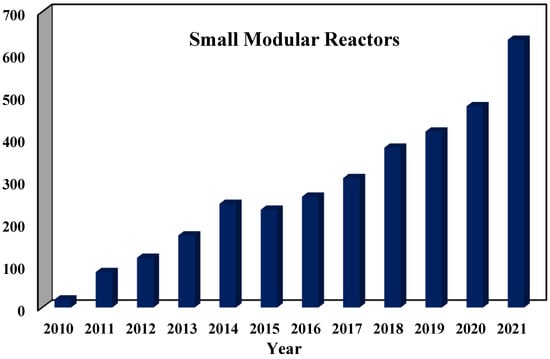
Figure 1.
Growth of published research papers on SMRs during past decay.
SMR main components are fabricated off-site and these modules are transported to be installed on the main site. This modularization process allows labor and fabrication that otherwise would have been performed on-site to take place within a standardized factory environment at a lower cost. This standardization also serves to readily facilitate learning from first-of-a-kind (FOAK) to Nth-of-a-kind (NOAK) plants, decrease on-site construction times, and in doing so mitigate the economic risk associated with delayed construction schedules. Integral components, such as steam generators and pressurizers integrated directly within pressure vessels, and passive safety systems eliminate the need for piping, pumps, and other superfluous equipment [17,18]. Carelli et al., provide an overview of the economic advantages of SMRs, in which they argue that the cost increases from economies of scale can be counterbalanced [19,20]. The leading SMR technologies included as a part of III+ and Gen IV reactors could be categorized as shown in Figure 2 [21]. The Korean SMART reactor design developed by KAERI is the first ever Standard Design Approval, and most other designs have not been analyzed by regulators. The status of the design, construction, and deployment of SMRs around the world has been presented by the IAEA Advanced Reactors Information System (ARIS) [21].
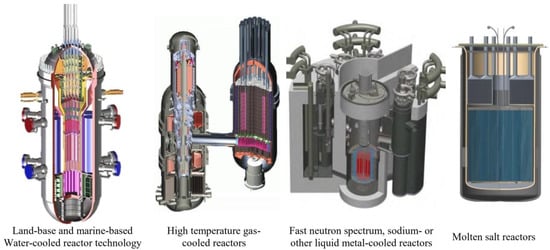
Figure 2.
Small modular reactor technologies.
As mentioned, the current regulations have been mainly established based on light water reactors; thus, the licensing process should be adopted for the advanced style of SMRs. To avoid unrealistic conservatism and the necessity of achieving optimal design and operation for NPPs, the NRC, in 1989, modified the conservative approach and authorized developers to use realistic methods with quantified uncertainties [22]. It was the beginning of the best estimate pus uncertainty (BEPU) approach, which is defined by applying best-estimate (BE) codes with BE boundary and initial conditions to simulate different scenarios [23]. At present, although most regulatory bodies around the world allow the use of best estimate codes to be applied in the licensing process [24,25,26], there is no requirement for BEPU application in the licensing process. Permissions to use best-estimate (BE) codes in some countries have been shown in Table 2.
Table 2.
Permissions to use BE codes in different countries.
The advances in BEPU methodology in recent years show that this approach has reached proper maturity and this strategy also could be considered an efficient approach for SMRs’ licensing process. Accordingly, this study reviews the licensing challenges for SMRs and investigates the replacement roadmap of the BEPU approach for the licensing process of Generation III+ and Generation IV SMRs. Despite the fact that the BEPU approach implementation could be a serious confrontation, this approach has reached complete maturity in current years. Since 2010, works and research on the licensing of SMRs have accelerated and, as shown in Figure 3a, the published research on SMR licensing shows a 20-fold growth in research in this field. Therefore, now is the best time to enforce the BEPU approach for SMR’s licensing process to define an infrastructural licensing framework for new-generation reactors. As shown in Figure 3b, studies on the application of BEPU for NPPs has been underway since 1980 and during the past 40 years interest in research in this field has drastically increased. Over the past two decades, several applications of BEPU have been completed. Nearly all BEPU applications are concerned with chapter 15 DSA scenarios and particularly with large break loss of coolant accidents (LB-LOCA).
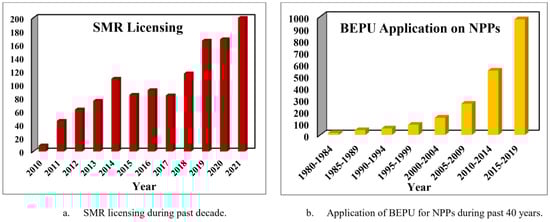
Figure 3.
Growth of published research on SMR licensing and BEPU for NPPs.
In the second section, the challenges facing SMRs, particularly the licensing process, have been reviewed. Moreover, the BEPU concept and experiences and their applications regarding SMRs have been reviewed and are presented in Section 3. Finally, applications of the BEPU approach to the SMR licensing process and the roadmap for SMR licensing are discussed in the last section.
2. Licensing Process Challenges for SMRs
The licensing process by national regulatory bodies is one of the many challenges facing SMRs’ development projects besides the numerous potential advantages. The many SMR designs have innovative features that have not been applied commercially thus far. These features can be largely unfamiliar to regulatory bodies. This issue is more complicated for SMRs that have not yet been commercially operated. As a result, regulatory procedures do have not sufficient available provisions for analyzing and certifying these novel features. Trauger (1988) proposed basic guidelines as “Licensing revision and reform” for the licensing of small and medium power reactors [27]. It is mentioned that LWR regulatory rules cannot generate profit for the licensing of new small-sized reactors, especially for non-light water SMRs. As mentioned, these SMR designs adopt both mature technologies, such as LWR, less mature technologies such as sodium fast reactors (SFRs), and never commercially operated technologies such as molten salt reactors (MSRs). Despite the expected advantages of SMRs concerning large reactors, investments in SMR construction have been extremely limited. The unknown future of SMRs has caused some countries to pursue a wait-and-see policy. In essence, the licensing and regulation process during SMR construction projects is known as one of the main hindrances to these plants’ development. Likewise, Mignacca et al. (2020) identified and scored the general elements hindering and the licensing and regulatory elements hindering SMR construction that are illustrated in Figure 4 [28]. The licensing and regulatory constraints are identified and ranked by experts as seven hindrances in SMR project development and the detailed cases related to the licensing hindering of SMRs are ranked also in Figure 4. Generally, the licensing process’s time, cost, and risk are critical elements for SMR projects [28]. Full description of SMRs and their advantages and disadvantages of SMRs can be found in the IAEA published report on “SMRs developing status” [21].
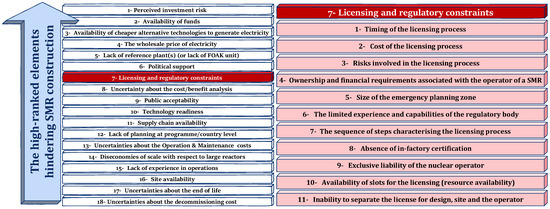
Figure 4.
The ranking of general elements hindering SMR construction as scored by experts [28].
Moreover, one of the most important parameters which affects SMR time and effort to license is technology readiness level (TRL). TRL is an assessment that shows how mature a technology is by using the timescale for commercial deployment, investment needs, and technological failure risk. There are nine different TRL levels, of which 1 shows the lowest maturity and 9 indicates a system that has achieved the greatest maturity. According to the generic feasibility assessment by UK Nuclear Innovation and Research Office (NIRO), the TRL and accordingly the degree of challenge related to the time and effort to license the four types of SMR technologies (Figure 2) have been presented in Figure 5.
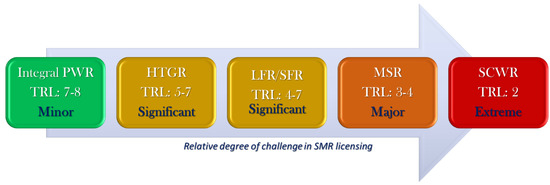
Figure 5.
The relative degree of challenge for licensing different SMR technologies based on TRL.
Sainati et al. (2015) categorized and considered SMR licensing challenges into five main topics, including a typology of licensing approach, licensing process duration and predictability, regulatory harmonization and international certification, manufacturing license, and ad hoc legal and regulatory frameworks [29]. The diversity of many innovative SMRs mostly increases the licensing issues and procedures of these reactors. However, it should be noted that different countries continue their own procedures to license new reactor designs. In general, licensing procedures have significant differences in regulations from country to country. International cooperation between national authorities to make procedures in near scope technologies of SMRs is one of the most important activities in limiting the timing of the licensing process. For example, the Japan Atomic Energy Agency (JAEA) began to develop an international safety standard for HTGR licensing based on gained experience through the licensing of construction and operation of HTGR test plans. Sato et al. (2020) established a roadmap of safety standards for the HTGR cogeneration system. It should be noted that the standard of SMR safety features cannot be fully developed due to the lack of operational experience [30]. Also, even the standards for coupling heat-application systems to a nuclear reactor were not established. The safety requirements for the proposed HTGR are based on specific safety requirements for LWRs [31]. Sato’s research summary concentrates on safety requirements, the basic concept of safety guides, safety standard applications, and international standardization activities for HTGRs [30]. As illustrated in Figure 5, MSR and SCWR are in the lowest stage of TRL and therefore a lack of details about the design is inevitable. However, Betzler et al. (2019) identified and prioritized the most critical components of MSRs in the modeling and simulation components that are important to licensing. The research emphasized to dependencies related to complexity and multi-physics nature of MSRs that needs to develop validation steps for modeling the core and safety systems [32]. Based on existing challenges in the licensing process, it is necessary to update licensing procedures for SMRs. Ramana et al. (2013) reviewed the licensing process activities of SMRs in different countries, including the United States, Russia, China, India, and South Korea. The countries’ studies and exercises are briefly summarized in Table 3 based on Ramana et al.’s (2013) study [33].
Table 3.
Summaries of countries’ activities in the SMR licensing process.
The activity of different countries in the SMR licensing process has been reviewed which shows that the modularity of the design and the possibility of manufacturing large parts off-site instead of at the site of SMRs should be kept in mind based on independent safety systems for each module. The licensing process approval steps have been proposed as shown in Figure 6.
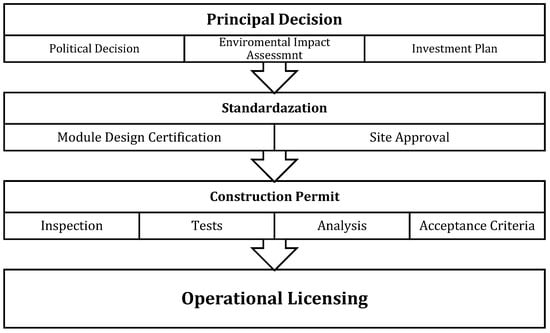
Figure 6.
Proposed licensing process approval steps for SMRs.
3. BEPU Approach and Application Status
3.1. BEPU Concept
The methodology of best estimate plus uncertainty (BEPU) refers to the set of analyses that implies the “realistic” or “best-estimate” computational tools such as codes and software with uncertainty quantification. In the licensing process, the results of safety analysis are documented in the safety analysis report (SAR). The final version of the SAR is known as the FSAR. All of the computational analyses are typically collected in the FSAR. The standard format and content of SAR chapters are defined by IAEA requirements [34]. The FSAR normally includes 19 chapters which are a part of the licensing procedure. As mentioned, the USNRC also has similar guidelines in the framework of NUREG-0800 for the preparation of FSAR chapters. The result of thermal-hydraulic assessments during unexpected special events are documented in chapter 15 of the FSAR. This chapter is of great importance in safety analysis for the fulfillment of results compared with acceptance criteria that were previously set by national regulators. Thus, the BEPU methodology is mostly known as a deterministic safety analysis option for nuclear power plants (NPPs). However, the BEPU concept can go beyond this [35]. In general, the conservative and best-estimate methods can be employed in deterministic safety analysis (DSA) in chapter 15. The two methods are applied as four options, as shown in Table 4 [36,37].
Table 4.
Options For Performing Deterministic Safety Analysis.
Thus, the attribute of other design-related calculations with the implementation of DSA can be performed as possibilities shown in the following options [38]:
1- Adopting a conservative code, conservative boundary, and initial condition (BIC) values and conservative consideration for engineered safety features (ESF) such as emergency core cooling systems (ECCS).
2- Adopting a best-estimate code, conservative BIC values, and conservative consideration for ESFs.
3- Adopting a best-estimate code, realistic BIC values, and conservative consideration for ESFs. This case is known as the BEPU methodology and uncertainty analysis is needed in this option.
4- All of option 3’s characteristics, plus the removal of the conservative consideration for ESFs. In this case, devoted PSA analyses bring a “risk-informed” calculation.
The simplified key elements of comprehensive BEPU methodology for physical parameter analysis during normal or abnormal operating conditions of NPPs are depicted in Figure 7. These elements are particularly related to DSA as the main section of the safety assessments in the licensing process. The BEPU methodology uses qualified computer codes and software (such as systematic thermal hydraulic codes) to simulate complex coolant flows and heat transfer in NPPs. As seen in Figure 7, the verification and validation (V&V) and uncertainty quantification (UQ) of computational tools are major steps of the BEPU approach in achieving confidence in performed assessments. The UQ results indicate the level of conservation in the safety assessment calculation. Thus, the UQ in BEPU methodology provides precise insight regarding reactor safety margins. The UQ includes the identification and characterization of sensitive input parameters to quantify the total influence of a combination of these uncertainties in the final results.
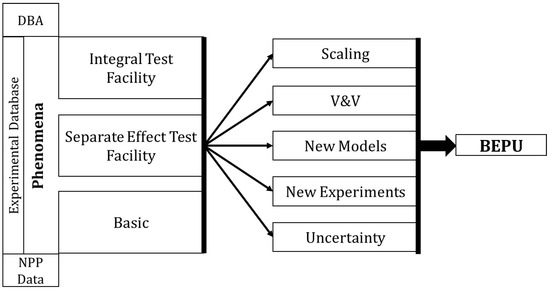
Figure 7.
The key elements of the BEPU approach activity framework.
3.2. BEPU Application Experiences
The BEPU approach links licensors and licensees during the licensing process [35]. The various outlines of BEPU application experiences during different NPPs’ safety assessments are summarized in Table 5.
Table 5.
Summaries of the past BEPU application experiences.
The probability density function of uncertain parameters is determined using empirical and experimental data. However, if there is a lack of experimental data to represent a phenomenon as in SMRs, a uniform distribution could be used [39]. Considering Table 3 and all successive applications of the BEPU approach for licensing purposes, it is proposed to extend the implementation area of BEPU covering possibly all the FSAR, where the analytical techniques are required [40]. In some new research papers it is afforded to utilize the best-estimate approach or quantifying uncertainties during case studies that are topics related to SMR technology as minor implications of BEPU [17,41,42,43].
4. Discussion and Final Remarks
The challenge of resistance from developers and regulatory bodies is related to the issue that previous-generation NPPs are licensed based on conservative approaches. However, it should be clarified that scientifically, the BEPU approach as a new strategy has reached a mature point during the last decades. On the other hand, to positively affect social and public acceptance of nuclear energy (which should be addressed in another comprehensive research), some strategies could be implemented such as: education and transparency; collaboration with local communities; investing in new technologies to improve safety, efficiency and sustainability of nuclear energy; addressing waste issues; involvement of independent experts and etc.
As mentioned in the previous section, the BEPU methodology has been used during several scenarios in different reactors. Also, researchers tried to develop this method for computational tools in entire FSAR chapters. Advances in BEPU methodology show that this strategy has reached proper maturity. Therefore, the BEPU methodology can be considered an efficient approach to the licensing process of under-construction plants, in which it has provided more accurate results than the acceptance criteria. Due to most of the operating power plants being licensed using conservative methods, there is resistance to replacing the BEPU methodology as an efficient substitute licensing strategy for new construction reactors. However, today, the SMR reactor industry is developing rapidly compared to the high power generation of previous reactors. Therefore, in the coming decades, these reactors are expected to become the most important alternative to the nuclear energy portfolio in developed and developing countries. This requires that the challenges related to these SMRs be resolved. Thus, it is necessary to perform the licensing process of SMRs (which is mostly in the design stage) with the application of BEPU due to the simultaneous maturity of SMR technology along with the BEPU methodology. However, due to the challenges mentioned in Section 2, the BEPU licensing process can add new challenges. For example, this method can be more costly due to the time-consuming licensing process and the need for adequate scaling programs of newer SMR technologies and so on. Moreover, the use of formerly conservative methods in SMR licensing is a step backward, which deviates from accurate estimates of acceptable standards. Thus, due to the appropriate development of BEPU methods in recent years, it is expected that these challenges can be largely addressed. The replacement of the BEPU method is a fundamental change in the field of licensing for SMRs. The regulatory bodies of all countries that manufacture and purchase SMR technology must seriously follow the BEPU licensing process.
The first step toward using the BEPU methodology for SMRs is to achieve BE codes. The current BE codes for existing NPPs use many questionable models and assumptions but they predict the reactor behavior well. The reason that makes these first-order codes applicable for current reactors is that these BE codes have been tuned based on the availability of large amounts of experimental data sets for validation and qualification steps for BE code development.
These features and tuning methodology compensate for the error and made the current BE codes applicable for current reactors but simultaneously it limits the applicability of these codes for new SMRs’ requirements and designs. SMRs don’t have a large experimental database site which contains LWR large-scale integral experiments from several decades ago. For example, the existing codes use CFL (Courant Friedricks and Lewy) stability limit which limits their time step by stability instead of accuracy and make them slow running which is a weakness, for example, when applying this model for long-lasting transient of SFR resulting from passive safety systems. Also, the phenomena like what happens in MSR or LFR are tightly coupled together and again the use of current simulation tools with a loosely coupled approach is doubtful. Thus, tightly coupled multi-physics simulation with a High-Fidelity approach could be required for most of the SMRs [44].
On the other hand, using high-fidelity codes with better physical models and high spatial and temporal accuracy presents a better prediction of NPP’s behavior, especially in the cases like SMRs where an experimental database doesn’t exist. The rapid growth of high-performance computers with high speed and memory at an affordable price and the growing cost of experiments on the other side have made high-fidelity simulation extremely important. It should be noticed that V&V is a necessary process and using a high-fidelity approach doesn’t remove the need for experiments but it may reduce it. Due to the impossibility or the huge cost of NPPs full-scale experiments, the scaling experiments for V&V are used. For the NPP licensing based on the BEPU approach scaling is mandatory [45]. Thus, adequate scaling experiments should be extend for phenomena investigation in SMRs.
The next step is uncertainty quantification for these high-fidelity multi-physic codes. Practical implementation of uncertainty quantification for these codes is very time-consuming including long and exhausting preparation of data, a high number of calculations, etc. [46]. Using high-fidelity multi-physics codes is computationally very expensive by itself and implementing BEPU may make exhausting, especially for long transients. In this case, Reduced Order Model (ROM) could be used as a catalyzer solution. ROM applications to support the assessment of NPP complex behavior using high-fidelity simulation have developed increasingly in the past few years [47,48,49,50,51]. Reduction in ROM means, using any computational tools to reduce simulation cost, especially for repeated executions in multi-query applications [51] like the BEPU process [52]. Finally, by considering all issues and discussions presented in the current section, the application of the BEPU approach to SMR’s licensing process could be concluded and proposed as shown in Figure 8.
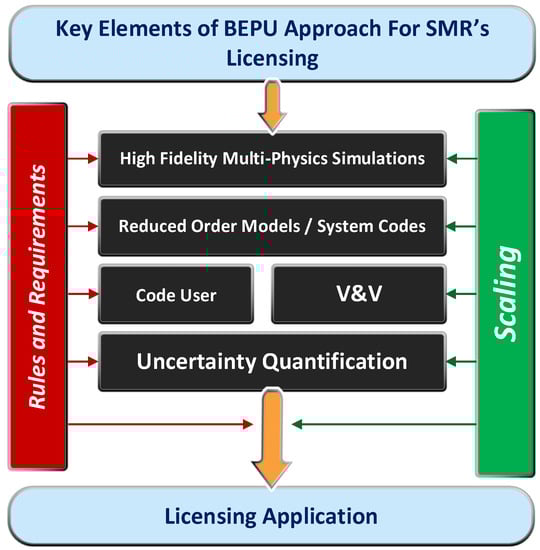
Figure 8.
Application of BEPU approach into SMR’s licensing.
Implementation of the BEPU approach in the licensing process is an open issue in several countries but the most of previous licensing was based on a conservative approach, thus, there are resistances to replacing the BEPU methodology as an efficient substitute licensing strategy for new construction reactors. In the present paper, the practical implementation of BEPU on licensing for several reactors such as Angra-2 PWR, Kozloduy-3 VVER-440, Smolensk-3 RBMK, Atucha-II PHWR, Balakovo-3 VVER-1000, and Peach Bottom-2 BWR were reviewed and their outcomes have been presented. Advances in the BEPU approach show that this methodology has reached a proper maturity for the current reactor and it is proposed to establish the pathway of using this approach for SMRs which are mostly in the design stage. SMR technology along with the BEPU methodology could reach maturity simultaneously in the next years. Due to the thigh coupling and lack of an experiment database, using ROM high-fidelity multi-physics codes is proposed for the application of the BEPU approach in the licensing process.
According to a review of several types of research, licensing has been detected as one of the elements hindering SMR construction. The degree of challenge related to the time and effort to licensing SMR technologies has been surveyed and respectively LWR, HTGR, LFR/SFR, MSR, and SCWR SMRs from the minor to extreme challenge have been weighted.
Currently, BEPU is not mandatory in any country, but for instance, recently the BEPU report has been accepted by regulations in Argentina for Atucha-II nuclear reactor. It’s obvious that the detail level of licensing for future SMRs could not be concluded right now because it’s connected to the detail design and even for light water SMRs some aspects such as reliability of natural circulation and reliability of passive safety system require more investigations. But as a general recommendation due to the maturity of BEPU, the possibility of using this approach could be considered in the roadmap of SMR deployment in upcoming years.
Author Contributions
Conceptualization, S.A.H. and R.A.; Methodology S.A.H.; formal analysis, S.A.H. and R.A.; Investigation, S.A.H. and R.A.; writing—original draft preparation S.A.H. and R.A.; writing—review and editing, R.A., A.S.S. and F.D.; Supervision A.S.S. and F.D. All authors have read and agreed to the published version of the manuscript.
Funding
This research received no external funding.
Institutional Review Board Statement
Not applicable.
Informed Consent Statement
Not applicable.
Data Availability Statement
Not applicable.
Conflicts of Interest
The authors declare no conflict of interest.
References
- IAEA. Installations, Nuclear. In Safety Standards Series No. 110; International Atomic Energy Agency: Vienna, Austria, 1993. [Google Scholar]
- IAEA. Principles, Fundamental Safety. In IAEA Safety Standards Series No. SF-1; International Atomic Energy Agency: Vienna, Austria, 2006; Volume 2. [Google Scholar]
- INSAG-22; IAEA; International Nuclear Safety Group. Nuclear Safety Infrastructure for a National Nuclear Power Programme Supported by the IAEA Fundamental Safety Principles; International Nuclear Safety Group: Vienna, Austria, 2008. [Google Scholar]
- IAEA. Licensing the First Nuclear Power Plant, INSAG-26; International Atomic Energy Agency: Vienna, Austria, 2012. [Google Scholar]
- Bredimas, A.; Nuttall, W.J. An international comparison of regulatory organizations and licensing procedures for new nuclear power plants. Energy Policy 2008, 36, 1344–1354. [Google Scholar] [CrossRef]
- Söderholm, K.; Tuunanen, J.; Amaba, B.; Bergqvist, S.; Lusardi, P. Licensing process characteristics of Small Modular Reactors and spent nuclear fuel repository. Nucl. Eng. Des. 2014, 276, 1–8. [Google Scholar] [CrossRef]
- IAEA. Handbook on Nuclear Law: Implementing Legislation; International Atomic Energy Agency: Vienna, Austria, 2010. [Google Scholar]
- IAEA. Licensing Process for Nuclear Installations. In IAEA Safety Standards Series No. SSG-12; International Atomic Energy Agency: Vienna, Austria, 2010. [Google Scholar]
- NUREG-0800; Standard Review Plan for the Review of Safety Analysis Reports for Nuclear Power Plants. US Nuclear Regulatory Commission: North Bethesda, MD, USA, 1987.
- Wald, F. Small and Medium Power Reactors in developing countries—Present status. Nucl. Eng. Des. 1988, 109, 343–347. [Google Scholar] [CrossRef]
- Wrigley, P.A.; Wood, P.; O’Neill, S.; Hall, R.; Robertson, D. Off-site modular construction and design in nuclear power: A systematic literature review. Prog. Nucl. Energy 2021, 134, 103664. [Google Scholar] [CrossRef]
- Ricotti, M.E.; Fomin, R.V. Small Modular Reactors. Nuclear Reactor Technology Development and Utilization; Woodhead Publishing: Sawston, UK, 2020; pp. 187–211. [Google Scholar]
- Halimi, A.; Shirvan, K. Impact of core power density on economics of a small integral PWR. Nucl. Eng. Des. 2021, 385, 111488. [Google Scholar] [CrossRef]
- Akbari, R.; Ochbelagh, D.R.; Gharib, A.; Maiorino, J.R.; D’Auria, F. Small modular reactor full scope core optimization using Cuckoo Optimization Algorithm. Prog. Nucl. Energy 2020, 122, 103271. [Google Scholar] [CrossRef]
- Akbari-Jeyhouni, R.; Ochbelagh, D.R.; Maiorino, J.R.; D’Auria, F.; de Stefani, G.L. The utilization of thorium in small modular reactors–Part I: Neutronic assessment. Ann. Nucl. Energy 2018, 120, 422–430. [Google Scholar] [CrossRef]
- Michaelson, D.; Jiang, J. Review of integration of small modular reactors in renewable energy microgrids. Renew. Sustain. Energy Rev. 2021, 152, 111638. [Google Scholar] [CrossRef]
- Hosseini, S.A.; Akbari, R.; Shirani, A.S.; D’Auria, F. Analysis of the natural circulation flow map uncertainties in an integral small modular reactor. Nucl. Eng. Des. 2021, 378, 111156. [Google Scholar] [CrossRef]
- Akbari-Jeyhouni, R.; Ochbelagh, D.R.; Gharib, A. Assessment of an integral small modular reactor during rod ejection accident by using DRAGON/PARCS codes. Prog. Nucl. Energy 2018, 108, 136–143. [Google Scholar] [CrossRef]
- Carelli, M.; Garrone, P.; Locatelli, G.; Mancini, M.; Mycoff, C.; Trucco, P.; Ricotti, M. Economic features of integral, modular, small-to-medium size reactors. Prog. Nucl. Energy 2010, 52, 403–414. [Google Scholar] [CrossRef]
- Carelli, M.; Mycoff, C.W.; Garrone, P.; Locatelli, G.; Mancini, M.; Ricotti, M.E.; Trianni, A.; Trucco, P. Competitiveness of Small-Medium, New Generation Reactors: A Comparative Study on Capital and O&M Costs. In Proceedings of the 16th International Conference on Nuclear Engineering, Orlando, FL, USA, 11–15 May 2008. [Google Scholar]
- IAEA; Subki, H. Advances in Small Modular Reactor Technology Developments; International Atomic Energy Agency: Vienna, Austria, 2020. [Google Scholar]
- USNRC. 10 Code of Federal Regulations Part 20 §20.1003–Definitions. 2014. Available online: http://www.nrc.gov/reading-rm/doc-collections/cfr/part020/part020-1003.html (accessed on 20 February 2023).
- D’Auria, F.; Camargo, C.; Mazzantini, O. The Best Estimate Plus Uncertainty (BEPU) approach in licensing of current nuclear reactors. Nucl. Eng. Des. 2012, 248, 317–328. [Google Scholar] [CrossRef]
- Menzel, F.; Sabundjian, G.; D’Auria, F. BEPU-FSAR: A new paradigm in Nuclear Reactor Safety. In Proceedings of the ENS TOPSAFE 2017, Vienna, Austria, 12–16 February 2017; ENS (European Nuclear Society): Brussels, Belgium, 2017. [Google Scholar]
- Menzel, F.; Sabundjian, G.; D’Auria, F.; Madeira, A.A. Proposal for systematic application of BEPU in the licensing process of nuclear power plants. Int. J. Nucl. Energy Sci. Technol. 2016, 10, 323–337. [Google Scholar] [CrossRef]
- Prosek, A.; Mavko, B. Review of best estimate plus uncertainty methods of thermal-hydraulic safety analysis. In Proceedings of the International Conference Nuclear Energy for Central Europe 2003, Portorož, Slovenia, 8–11 September 2003. [Google Scholar]
- Trauger, D.B. Safety and licensing for small and medium power reactors. Nucl. Eng. Des. 1988, 109, 267–271. [Google Scholar] [CrossRef]
- Mignacca, B.; Locatelli, G.; Sainati, T. Deeds not words: Barriers and remedies for Small Modular nuclear Reactors. Energy 2020, 206, 118137. [Google Scholar] [CrossRef]
- Sainati, T.; Locatelli, G.; Brookes, N. Small Modular Reactors: Licensing constraints and the way forward. Energy 2015, 82, 1092–1095. [Google Scholar] [CrossRef]
- Sato, H.; Aoki, T.; Ohashi, H.; Yan, X.L. Research and development for safety and licensing of HTGR cogeneration system. Nucl. Eng. Des. 2020, 360, 110493. [Google Scholar] [CrossRef]
- IAEA. Safety of Nuclear Power Plants: Design. In IAEA Safety Standards Series No. SSR-2/1; International Atomic Energy Agency: Vienna, Austria, 2012. [Google Scholar]
- Betzler, B.R.; Heidet, F.; Feng, B.; Rabiti, C.; Sofu, T.; Brown, N.R. Modeling and simulation functional needs for molten salt reactor licensing. Nucl. Eng. Des. 2019, 355, 110308. [Google Scholar] [CrossRef]
- Ramana, M.V.; Hopkins, L.B.; Glaser, A. Licensing small modular reactors. Energy 2013, 61, 555–564. [Google Scholar] [CrossRef]
- IAEA. Format and Content of the Safety Analysis Report for Nuclear Power Plants; International Atomic Energy Agency: Vienna, Austria, 2004. [Google Scholar]
- D’Auria, F. Best Estimate Plus Uncertainty (BEPU): Status and perspectives. Nucl. Eng. Des. 2019, 352, 110190. [Google Scholar] [CrossRef]
- IAEA. Best Estimate Safety Analysis for Nuclear Power Plants: Uncertainty Evaluation. In Safety Reports Series No. 52; International Atomic Energy Agency: Vienna, Austria, 2008. [Google Scholar]
- IAEA. Deterministic Safety Analysis for Nuclear Power Plants. In IAEA Safety Standards Series No. SSG-2 (Rev.1); International Atomic Energy Agency: Vienna, Austria, 2019. [Google Scholar]
- D’Auria, F. Best-Estimate Plus Uncertainty (BEPU) approach for accident analysis. In Thermal-Hydraulics of Water Cooled Nuclear Reactors; Woodhead Publishing: Sawston, UK, 2017; pp. 905–950. [Google Scholar]
- Bocanegra, M.R. Towards a Bepu Methodology for Containment Safety Analyses. Ph.D. Thesis, Technical University of Madrid, Madrid, Spain, 2019. [Google Scholar]
- D’Auria, F.; Galassi, G.M.; Mazzantini, O. The best estimate plus uncertainty approach in licensing of Atucha II. In Pressurized Heavy Water Reactors; Elsevier: Amsterdam, The Netherlands, 2022; pp. 51–204. [Google Scholar]
- Miao, H.; Lind, M.; Zhang, X.; Wu, J. Quantifying performance of passive systems in an integrated small modular reactor under uncertainties using multilevel flow modelling and stochastic collocation method. Prog. Nucl. Energy 2022, 149, 104279. [Google Scholar]
- Kumar, D.; Alam, S.B.; Ridwan, T.; Goodwin, C.S. Quantitative risk assessment of a high power density small modular reactor (SMR) core using uncertainty and sensitivity analyses. Energy 2021, 227, 120400. [Google Scholar] [CrossRef]
- Alcaro, F.; Bersano, A.; Bertani, C.; Mascari, F. BEPU analysis of a passive decay heat removal system with RELAP5/MOD3. 3 and RELAP5-3D. Prog. Nucl. Energy 2021, 136, 103724. [Google Scholar] [CrossRef]
- Zhang, H.; Mousseau, V.; Zhao, H. Development of a High Fidelity System Analysis Code for Generation IV Reactors; No. INL/CON-07-13363; Idaho National Lab. (INL): Idaho Falls, ID, USA, 2008. [Google Scholar]
- D’auria, F.; Lanfredini, M.; Muellner, N. Scaling analysis in BEPU licensing of LWR. Nucl. Eng. Technol. 2012, 44, 611–622. [Google Scholar] [CrossRef]
- Bucalossi, A.; Petruzzi, A.; Kristof, M.; D’Auria, F. Comparison between Best-Estimate–Plus–Uncertainty Methods and Conservative Tools for Nuclear Power Plant Licensing. Nucl. Technol. 2010, 172, 29–47. [Google Scholar] [CrossRef]
- Sartori, A.; Cammi, A.; Luzzi, L.; Rozza, G. A multi-physics reduced order model for the analysis of Lead Fast Reactor single channel. Ann. Nucl. Energy 2016, 87, 198–208. [Google Scholar] [CrossRef]
- Alsayyari, F.; Tiberga, M.; Perkó, Z.; Lathouwers, D.; Kloosterman, J.L. A nonintrusive adaptive reduced order modeling approach for a molten salt reactor system. Ann. Nucl. Energy 2020, 141, 107321. [Google Scholar] [CrossRef]
- Santanoceto, M.; Tiberga, M.; Perkó, Z.; Dulla, S.; Lathouwers, D. Preliminary uncertainty and sensitivity analysis of the Molten Salt Fast Reactor steady-state using a Polynomial Chaos Expansion method. Ann. Nucl. Energy 2021, 159, 108311. [Google Scholar] [CrossRef]
- Vergari, L.; Cammi, A.; Lorenzi, S. Reduced order modeling for coupled thermal-hydraulics and reactor physics problems. Prog. Nucl. Energy 2021, 140, 103899. [Google Scholar] [CrossRef]
- German, P.; Tano, M.; Fiorina, C.; Ragusa, J.C. GeN-ROM—An OpenFOAM®-based multiphysics reduced-order modeling framework for the analysis of Molten Salt Reactors. Prog. Nucl. Energy 2022, 146, 104148. [Google Scholar] [CrossRef]
- Huang, D.; Abdel-Khalik, H.; Rabiti, C.; Gleicher, F. Dimensionality reducibility for multi-physics reduced order modeling. Ann. Nucl. Energy 2017, 110, 526–540. [Google Scholar] [CrossRef]


Disclaimer/Publisher’s Note: The statements, opinions and data contained in all publications are solely those of the individual author(s) and contributor(s) and not of MDPI and/or the editor(s). MDPI and/or the editor(s) disclaim responsibility for any injury to people or property resulting from any ideas, methods, instructions or products referred to in the content. |
© 2023 by the authors. Licensee MDPI, Basel, Switzerland. This article is an open access article distributed under the terms and conditions of the Creative Commons Attribution (CC BY) license (https://creativecommons.org/licenses/by/4.0/).