


Abstract
In the contemporary era of global and sustainable information management, blockchain has made a cutting-edge transformation in online learning. To apprehend this new trajectory, this current systematic review with bibliographic visualization aims to identify the thematic clusters of underlying aspects concerning the sustainable nexus of blockchain and online learning. Using the updated guidelines of the PRISMA flowchart, a total of 434 scholarly research papers from the mainstream research databases, i.e., Web of Science, Scopus, IEEE Xplore, and ScienceDirect, were inspected to be categorized into 15 relevant publications. Bibliographic data were assembled and analyzed accordingly to construct network visualization maps, such as co-authorship, citation, co-citation, bibliographic coupling, and term co-occurrence using VOSviewer 1.6.18. Significant terms were reported and later cross-mapped with those identified by critically reviewing the applicable 15 papers. Standardized scholarship, behavior pattern, and digital badging have been found and derived as themes from the connected clusters. Therefore, current research findings reveal these three broad clutches of themes concerning the sustainable nexus of blockchain and online learning.
Keywords:
Blockchain; online learning; qualitative; systematic review; bibliographic; PRISMA; VOSviewer 1. Introduction
Blockchain is the newest buzzword in digital transformation technologies. This trailblazing technology is so versatile that it has the potential to disrupt practically every industry. Since the peer-to-peer electronic monetary transaction “bitcoin” [1] was first introduced, its underlying technology, “Blockchain,” has attracted much attention from both business and academic domains. Blockchain technology is an irrevocable, decentralized database using a chain of “blocks” to record data, such as transaction dates, timings, amounts, and/or participants [2,3,4]. Different industries are exhibiting more significant interest in the underlying blockchain technology, including business, banking, healthcare, security, government, and education (including online education), and several of these industries have already adopted the technology in some ways. Nevertheless, this technology can advance in numerous ways and places [5].
Online learning has expanded dramatically during the past two decades [3,6]. According to the [7], E-learning/online learning continues to have the fastest growth in the industry, with an average annual growth rate of 20%. By 2027, it is predicted that the market for mobile learning will be worth $80.1 billion worldwide [7,8]. China is considered the second leading economy globally, and is expected to have a market of US$18.8 billion by 2027 [9]. Japan and Canada also have potential markets, which are expected to increase by 15.7% and 18.3%, respectively, between 2020 and 2027 [7]. Moreover, blockchain technology has great potential for use in online education and can yield excellent results [10,11].
This online education, commonly referred to as distance education or virtual learning [12,13], is a web-based teaching approach for quick learning and content distribution. With the advent of Web 3.0 and the internet as the platform, online instruction has surpassed restrictions of geographic location, setting, time, and academics and provides students with top-notch learning opportunities whenever and wherever they are [8]. Furthermore, blockchain and online learning are a potent combo because of Web 3.0 [14]. Blockchain technology enables decentralized learning environments. These platforms are handled by consensus rather than by a single body. This vibrant technology enables a peer-to-peer learning environment. Additionally, instructors may utilize the blockchain to check transcripts and report cards [15], create digital agreements, and assist students with debt repayment [16,17,18]. As a result, blockchain can help education by boosting transparency, strengthening accountability [19,20], and rewarding learning through smart contracts [21,22]. It also fosters consistency across educational institutions.
As a result, much emphasis has been paid to the rapid transition to online education and learning through blockchain. Moreover, COVID-19 has accelerated the transition from traditional classroom settings to online learning environments [5,23,24]. Online learning is becoming increasingly important in today’s world, where in-person instruction may be limited, especially for students from low socioeconomic backgrounds, for whom the cost of tutoring can occasionally be a significant factor [25,26]. Online education can be broken down into early childhood education, occupational training, examination and certification training, personal skill development, and language education [27,28]. Massive open online courses (MOOCs) have received media interest recently. MOOCs were first created in the US by eminent content providers, including Coursera, Udacity, and edX. [29,30]. Popular American colleges have been creating online learning environments and providing open courses since 2012 [31,32].
In light of a more open and digital internet, the current models and frameworks for online education have numerous flaws, despite their enormous popularity [33,34]. For instance, the student’s privacy is in jeopardy [35], since the courses and safety of information exclusively rest on the integrated online education platform [36], the students’ intellectual property cannot be effectively maintained because of the open access to internet and data [10], and there is no established cross-platform course sharing mechanism to wholly share the teaching materials [37].
Blockchain technology can address and solve online education issues, such as inadequate accreditation, a lack of acceptance, and data security [38,39]. Additionally, the preliminary use of blockchain technology in the sphere of education has been initiated [40]. The MIT Media Lab created a digital learning certificate system combining blockchain technology and Mozilla’s open badge [41]. Additionally, the industrial sector has utilized blockchain technology for designing equipment related to educational settings. In order to realize the fairness and digitization of education, Sony Global Education [42], a blockchain technology infrastructure platform run by Sony Corporation of Japan, allows users to share learning courses and data openly and safely without disclosing them to the education management authority [10].
According to [43], the nexus of online learning and blockchain technology is going to be a significant agenda. According to [44], the potential benefits of using blockchain in online education include empowering students (self-sovereignty), improving security, and increasing efficiency for corporations and educational institutions.
There has been a range of research on utilizing blockchain technology for online learning in general, but not enough has been done to identify the thematic clusters of underlying aspects concerning the nexus of blockchain and online learning [45,46]. Numerous previous studies [10,20,47] have focused on teaching strategies, credentials, payments, and record keeping; however, there is essentially no thorough or in-depth research on the underlying aspects concerning the nexus of blockchain technology and online learning. Therefore, to bridge the existing research gap and add new knowledge, [48,49,50,51] have called for further investigation into this specific domain. Thus, the present research will probe the following research question.
RQ: What are the thematic clusters of underlying aspects concerning the nexus of blockchain and online learning?
Hence, this current research systematically reviews existing literature with bibliographic visualization to identify the thematic clusters of underlying aspects concerning the nexus of blockchain and online learning.
2. Research Methods and Procedures
Four rudimentary and progressive steps, i.e., searching, assessing, synthesizing, and analyzing [52,53] have been followed by the authors, as accessibility to formerly published appropriate research must be clear and unambiguous as a prerequisite for a systematic review and bibliographic enquiry [54,55]. Several filters and conditions have been fixed and applied to search the relevant literature using multiple steps [56,57].
2.1. Literature Search
To sort out appropriate documents for this study, a thorough search process consisting of multiple steps was utilized. The search process was limited to four well-known and acknowledged databases. They are Web of Science, Scopus, ScienceDirect, and IEEE Xplore, and they were chosen due to these databases’ progressive search and analysis options. The Web of Science database has been selected because its journals’ quality and indexing are beyond question and consistent enough [58,59], whereas Scopus provides access to a wide variety of peer-reviewed documents from almost all research fields [59,60,61]. ScienceDirect includes interdisciplinary documents such as Scopus, with a substantial emphasis on IT [62,63], which makes this database compatible with this study. IEEE Xplore was also picked since it offers a universe of information from numerous new and emerging technologies to enhance or uncover the next breakthroughs.
Literature published from 2015 to 2022 has been considered for searching databases, with 2015 as the starting point, given that all of the chosen databases exhibited outcomes from 2015 for review. Table 1 presents the database searching proprieties for this study.

Table 1.
Proprieties and procedures for searching.
434 scholarly research publications were found in those databases, as is shown in Table 1.
2.2. Literature Assessment Process
The pertinent literature for this study has been assessed by applying a data flow diagram simply known as PRISMA [64], which is elaborated as preferred reporting items for systematic reviews and meta-analysis. Relevant documents applicable for reporting were classified utilizing the new and updated guidelines of PRISMA 2020 (Supplementary Materials).
The strategies for tracking the appropriate number of publications are depicted in Figure 1. In the end, 15 papers were traced.
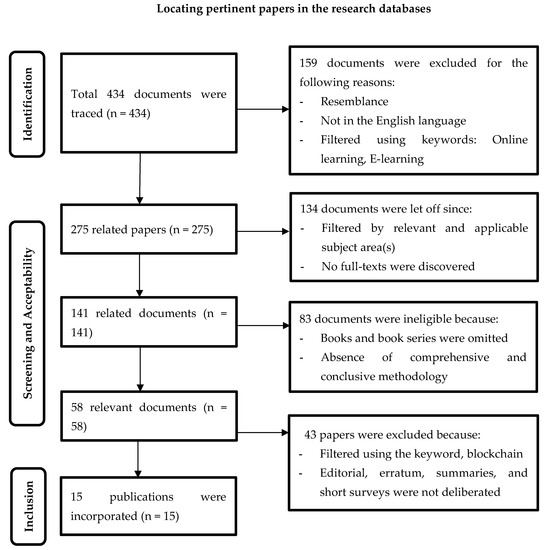
Figure 1.
Updated PRISMA flow diagram.
2.3. Literature Synthesis
Fifteen relevant publications were sorted out for reporting bibliographic information from them and presented systematically in a table. Since wide-ranging bibliographic information is essential for investigating research inclinations [53], the bibliographic evidence of the chosen documents was exported as CSV and RIS files for additional exploration to be conducted.
2.4. Analysis and Reporting Procedure
Several figures were created using bibliographic information from the previous literature published from 2015 to 2022 for assessment and the summary of outcomes and inclinations of current studies. VOSviewer 1.6.18 was adopted to generate bibliographic maps and networks for data presentation [65].
Finally, broad categories of themes connecting blockchain and online learning were developed.
3. Results
Figure 2 denotes documents published by countries on blockchain and online learning from 2015 to 2022. China is the leader in published documents in this field, which reflects its ongoing concerns about implementing blockchain in online learning. India produced 50 documents, while the United States published 36 papers. Italy, Indonesia, and Australia had the same contribution in this area, each having nine published papers.
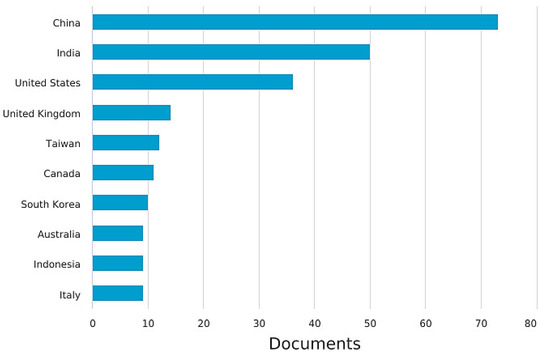
Figure 2.
Publications by country (2015 to 2022).
Figure 3 compares the documents articulated by different authors from 2015 to 2022. During the period, Aini reported the highest number of documents, five, whereas Altinay produced the lowest number of documents, two. Byun and Shahbazi produced four documents each, while the rest of the six authors contributed equally with three documents each.
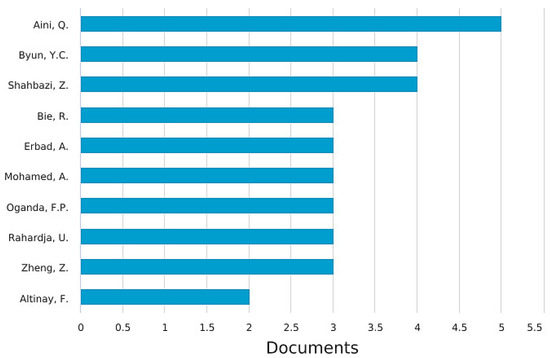
Figure 3.
Documents by author (2015 to 2022).
Figure 4 shows the countries’ co-authorship network based on total link strength. In this map, every node stands for a country, and the thickness of the line connecting every two countries demonstrates the strength of collaboration between the counties. From the network graph, it is evident that the USA has the strongest co-authorship network, as it has the most central nodes, and the co-authorship networks of the USA consist of Taiwan, Japan, Italy, Bangladesh, Singapore, and Saudi Arabia. India and Taiwan have slightly smaller co-authorship networks than the USA. On the other hand, Portugal is the most minor in this network. Taiwan and the USA have the thickest link representing the most robust collaboration between these two countries.
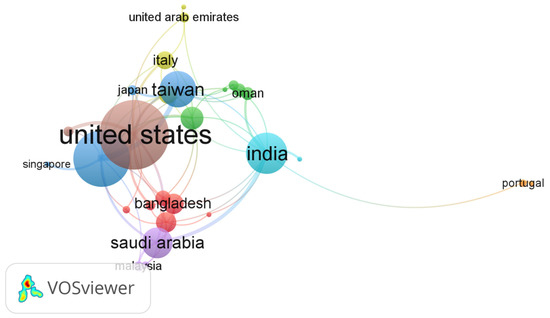
Figure 4.
Countries’ co-authorship networks based on total link strength.
Figure 5 demonstrates a co-authorship network of authors where each node represents different authors. Li had the highest collaboration and collaborated with all other authors, while Dai had the least. Guo had somewhat lower collaboration than Li, but it was higher than Sun, Zhang, Wang, Bie, An, Chen, and Dai. Regarding the intensity of collaboration, Li and Guo have the most significant association.
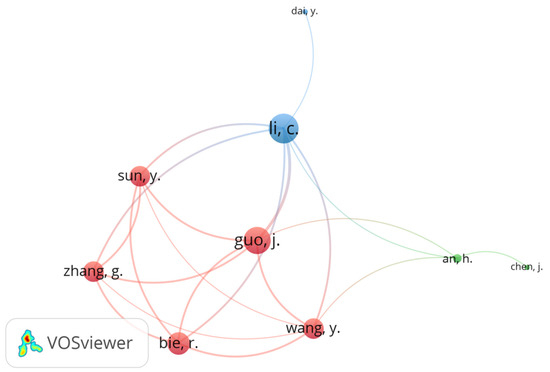
Figure 5.
Co-authorship network of authors.
A total of 35.7 percent of all documents were published as conference reviews, as is shown in Figure 6. Conference papers and articles accounted for 31.1 percent and 26.3 percent, respectively. Only 4.4 percent of documents were produced as book chapters, whereas 2.3 percent and 0.2 percent were reported as reviews and editorials, respectively. Aggregately, conference reviews and conference papers constituted 66.8 percent of documents.
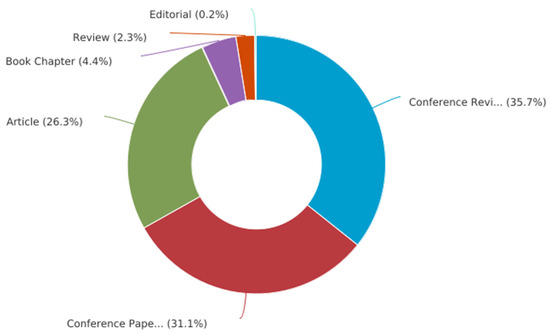
Figure 6.
Publications by type (2015 to 2022).
Figure 7 exhibits documents published in various fields regarding blockchain and online learning. From the figure, it is notable that scholars from diversified fields produced documents regarding the stated topics. Computer science was the leading field for blockchain and online learning, and this field constituted 37.9% of documents, while material science had the lowest concern for these topics. Engineering, mathematics, decision science, and social science accounted for 16.6%, 13%, 9.6%, and 7%, respectively.
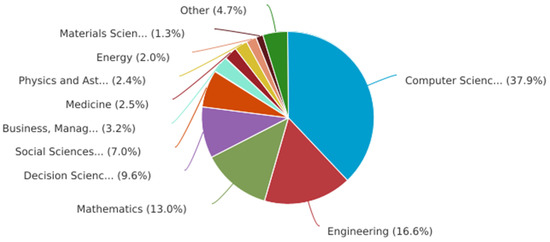
Figure 7.
Publications by subject areas (2015 to 2022).
The number of documents produced from 2015 to 2022 is denoted in Figure 8. In 2015, there was only one published document. There was a slight increase in the next year, which remained the same in 2017. After 2017, there was a substantial surge in document production as this field received significant attention from many more researchers. In 2021, 141 publications were published. Despite the fact that, before the end of 2022, 114 publications were produced, by the end of the year, the number of documents may exceed the number reported in the previous year.
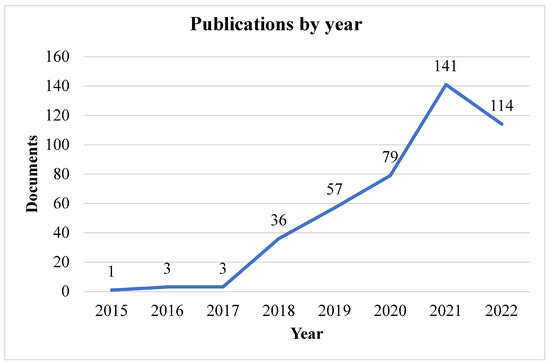
Figure 8.
Publications by year (2015 to 2022).
The number of publications by the top ten affiliated organizations is depicted in Figure 9. Universitas Raharja produced the highest (six publications) number of documents. Beijing Normal University and Jeju National University reported the second highest number, each with five publications, while the other seven organizations had three publications each in blockchain and online learning domains.
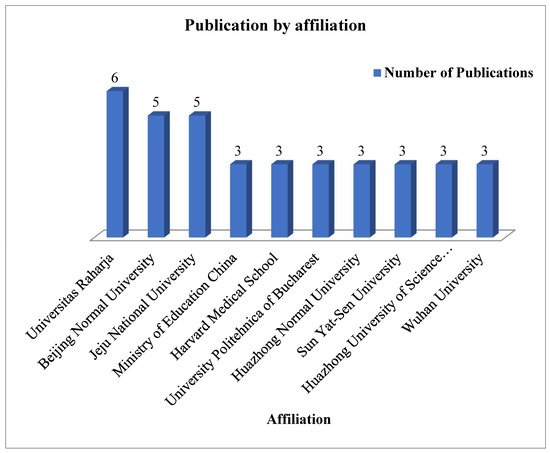
Figure 9.
Publication by affiliation.
Figure 10 illustrates documents by the top five funding sponsors. Among the top five sponsors, the majority are from China. The National Natural Science Foundation of China reported the highest (22) documents, and the National Key Research and Development Program of China had the second highest (9) documents. The Horizon 2020 Framework Program funded only four documents, which was the lowest number among the top five sponsors.
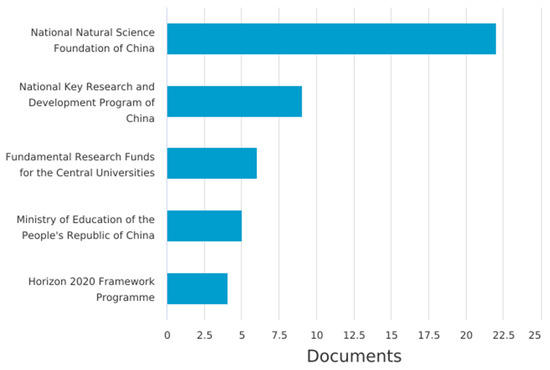
Figure 10.
Documents by top five funding sponsors.
The citation network of authors is symbolized in Figure 11. Oganda and Aini have mainly intensified citation networks and associations with three other authors, while Li, Bie, and Guo each have a small network.
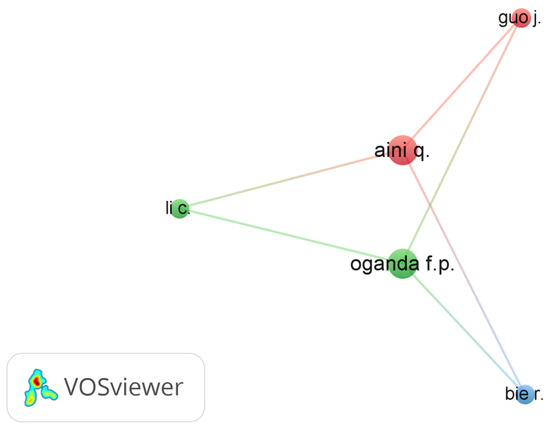
Figure 11.
Citation network of authors.
The citation network of countries in Figure 12 exhibits that China has the most robust network, followed by the USA. Although the citation network of China is connected to the networks of the USA, India, Romania, Saudi Arabia, Indonesia, Turkey, and Italy, there is no link with the network of Australia. However, the intensification between the networks of China and the USA is very strong, which reveals that the authors of these two countries frequently cited the scholarly works of one another.
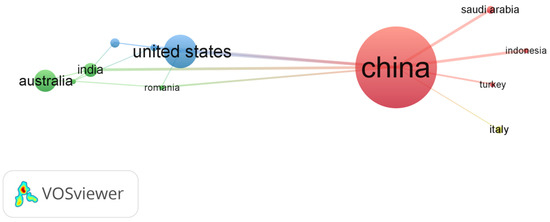
Figure 12.
Citation network of countries.
Co-citation happens when two particular documents are cited together in another document. The co-citation network of cited authors provides an overall idea of connection among the authors in a particular field. Figure 13 embodies the co-citation network of cited authors. From the diagram, it is marked that Zhang and Zheng received the most citations from Meybodi and Rahardja and a few from Kumar. Meybodi had a strong co-citation network with Zhang, Kumar, and Zheng, whereas Zhang and Zheng frequently cited Rahardja’s works.
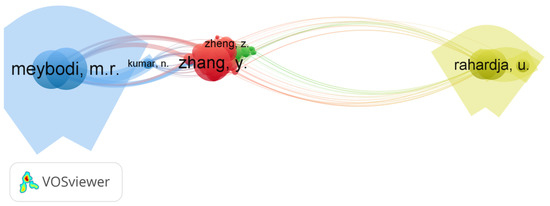
Figure 13.
Co-citation network of cited authors.
Figure 14 exhibits a co-citation network, which represents a network of references that have been co-cited by a number of publications. The clusters are allocated to publications based on the dispersion of their references. Therefore, from the figure, we can infer that the potential of blockchain in education may go beyond bitcoin.
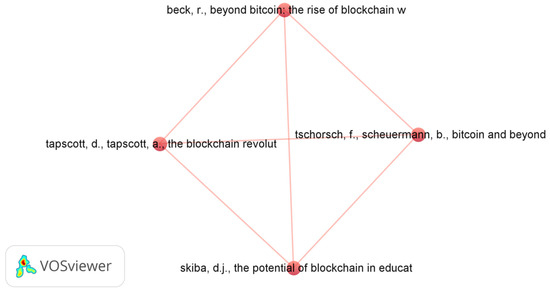
Figure 14.
Co-citation network of cited references.
Bibliographic coupling of countries states that countries in the same bunch usually cite the documents of one another, which is demonstrated in Figure 15. There are six groups of countries represented by blue, green, red, sky, purple, and yellow, respectively. China is at the center of the network, followed by the USA and India. China’s network includes the USA, Denmark, and Germany, while India, Taiwan, South Korea, Turkey, and Spain formed a separate group with citations of common documents. China has more bibliographically coupled documents with the USA than with Denmark.
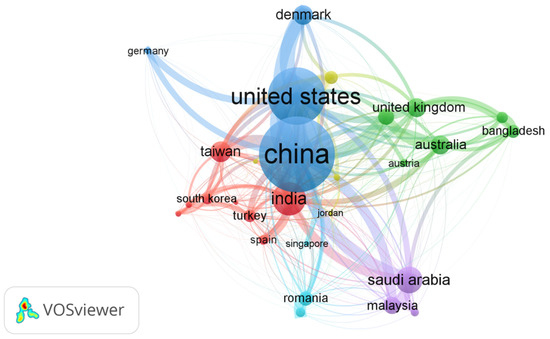
Figure 15.
Bibliographic coupling of countries.
Figure 16 accounts for the bibliographic coupling of documents used to assess the similarity between documents. The bibliographic coupling of documents arises when two individual documents commonly cite another document. There are eight bibliographically coupled document clusters, with [66] as the top most bibliographically coupled document, followed by [67].
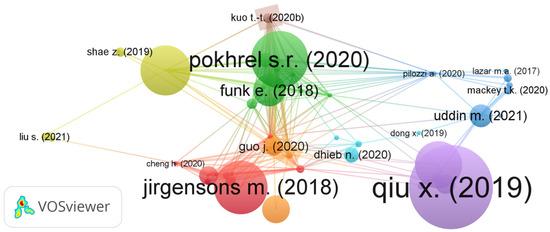
Figure 16.
Bibliographic coupling of documents.
A bibliographic data-driven network map was constructed based on the keywords from the respective publications, as is shown in Figure 17. The map signifies a web of repeated and remarkable terms, with blockchain as the center of the map, which is linked to other terms in the map. Although there are 30 related terms, blockchain, smart contract, security, privacy, artificial intelligence, human, students, online education, education, and authentication are the top ten central identified themes.
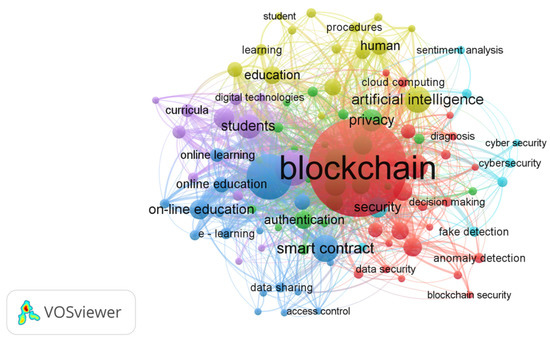
Figure 17.
Bibliographic data-driven network map.
Figure 18 was developed using titles and abstracts of the chosen papers to determine the term co-occurrence. The bubble size for each term denotes the frequency of its usage, while terms of the same color typically confirm terms used together. The network map shows that, among a total of fourteen terms, knowledge, record, online education, online course, and anomaly detection were the most frequently used terms. On the contrary, sentiment analysis, shield chain, educational resource, and digital transformation were insignificantly used terms.
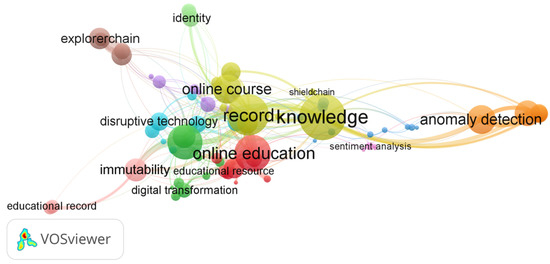
Figure 18.
Text data-based term co-occurrence map.
4. Detailing the 15 Full-Text Documents
In Table 2, the authors have reported previously acknowledged publications relevant to the underlying aspects of the blockchain online learning nexus. In this sense, we adhered to the reporting standards, requirements, and suggestions recognized by [68].
Table 2.
Reporting the identified documents.
As the application of blockchain in online learning is still in its inception phase in many countries across the globe, most previous studies have been conducted using qualitative methods. In contrast, a scanty number of empirical research has been conducted, as the framework(s) is (are) yet to be fully introduced. Therefore, the current body of knowledge concerning this domain still attempts to develop hypotheses instead of testing them.
Most researchers analyzed roughly 12–15 studies found by PRISMA methods for systematic reviews [81]. However, for a systematic literature review search, it is recommended that more than two databases be explored [82]. This research reported on 15 studies discovered using PRISMA 2020 methods. Furthermore, the researchers made use of four databases. As a result, in both cases, the authors have followed and maintained the thresholds.
5. The Development of Concomitant Clusters and Themes
Table 3 contains connected clusters that have been used to develop different themes.
Table 3.
Development of themes.
6. Discussion on Themes and Conclusions
This study identified three themes concerning the nexus of blockchain and online learning, which were developed by filtering the key terms of bibliographic visualization and text of 15 systematically identified papers. The broad themes were standardized scholarship, behavior pattern, and digital badging.
The application of blockchain in online education has the potential to guarantee improved standards in online learning and education through the decentralization of educational resources and relevant information across the cloud, which is managed by a decentralized body, rather than a central authority. Decentralization frees the learning platform from the ownership of a single instructor, causing calibration in blockchain-based online learning systems, which boosts peer-to-peer learning [48,83]. In peer-to-peer learning, one student can directly learn from another [5,48].
Thus, blockchain can shift learning ownership from instructors to students [84]. Learning ownership by instructors refers to a learning environment in which instructors take an active role, whereas student ownership of learning represents students’ active participation in learning, in which instructors serve as guides [85]. Besides, blockchain in online education empowers students to manage their data with a promise of easy and flexible access to data stored in blocks that ensures fairness and transparency in every aspect of learning. Furthermore, blockchain decentralizes the learning process, which allows students to learn from home and save time, costs, and energy for movement. This technology also contributes to introducing calibration in online learning systems by ensuring the authenticity of online education providers and maintaining the privacy and security of students’ credentials [48,86]. Consequently, blockchain reduces adverse impacts on the environment, as it focuses on achieving the goal of decarbonization, digitalization, and decentralization [87,88]. It also improves the quality of education by supplementing traditional educational resources with disruptive technologies [21,89]. Therefore, blockchain and online learning are strongly associated, as blockchain results in standardization in online education.
The second theme of this research is a behavioral pattern, which designates the persistent methods of doing a task or interacting with an object or circumstance. Blockchain addresses several problems of the traditional online learning system, particularly emphasizing self-monitoring and self-regulation in learning [70]. Embracing blockchain in online education permits students to monitor their progress and evaluate themselves on their own, which is a rudimental key to the advancement of learning outcomes [80]. In addition, analysis of the attitudes and sentiments of students facilitates instructors and scholars to determine the effectiveness of particular learning methods and resources to, therefore, find ways to improve methods and resources, which consequently contribute to students’ satisfaction and to the effectiveness of methods and materials. Furthermore, blockchain promises to provide real-time interaction between students and mentors, while facilitating collaboration between teams and students’ interactivity and engagement in digital resource sharing. Once gained, sharing digital resources reduces the need for paper-based resources, i.e., books and papers, which reduces costs and adverse environmental impacts [90]. Above all, artificial intelligence and machine learning assesses the behaviors and detects anomalies in the behaviors of students by learning from students’ past data; therefore, concerned authorities can gauge the future outcomes in the present and adopt a proactive approach to situational improvement.
Digital badging and immutable credentials are the vivacious advantages of blockchain in education, for which practitioners, educators, and scholars are highly enthusiastic about implementing blockchain in the online education system. The blockchain serves both students and teachers in maintaining and validating the digital identities of entities with a secure way of data sharing. In blockchain-based online learning systems, students can own their data, i.e., certificates and transcripts, and employers can quickly validate the candidates’ authenticity. In contrast, institutions can easily and instantaneously share students’ credentials, such as marks and evaluation scores, in soft forms, instead of using vast amounts of paper-based documentation, which drops the pressure on using paper. Moreover, blockchain supports respective entities to track and trace students’ records effectively and efficiently, as it eliminates the obligation to keep bulks of paper for students’ records, which is environment friendly as well [82,90]. Therefore, the stakeholders of blockchain reap substantial benefits from its application.
Thematically, blockchain and online learning are extensively associated, which is reflected by their popularity in online education or e-learning environments. Along with solving the significant challenges of conventional education arrangements, blockchain will bring immense success to online learning. Besides, it achieves environmental sustainability by saving fuels used for transportation by students and papers used for documents (educational resources and certificates). Therefore, theme, such as digital badging, can be predicted to become one of the vibrant agendas for future research opportunities. Hence, system developers, regulatory bodies, governments, and professionals in the education sector are encouraging the implementation and use of blockchain in online learning. However, in order for this to happen, a set of tailored strategies needs to be undertaken to make the bridge between blockchain and online learning. The set of strategies should be universal.
This study adds momentous findings to the blockchain and online learning field, but the findings are based on four databases. As a result, other databases, i.e., EBSCO, ProQuest, and JSTOR, can be considered for further study in this field to supplement the findings of this study. Another notable limitation of this study is that it is only based on published documents. Therefore, future studies can combine insights from primary data to contribute to current study outcomes.
Supplementary Materials
The following are available online at https://www.mdpi.com/article/10.3390/su15021470/s1, Checklist for PRISMA 2020.
Author Contributions
Conceptualization, M.Z., W.L., A.N.M.S. and B.W.; Methodology, M.Z., A.N.M.S. and R.A.R.; Software, A.N.M.S., B.W. and S.M.M.R.; Validation, W.L., K.M.A.I., N.H., R.M. and M.A.R.; Formal Analysis, W.L. and A.N.M.S.; Investigation, R.A.R., K.M.A.I., S.M.M.R. and M.A.R.; Resources, B.W., K.M.A.I., N.H. and R.M.; Writing—Original Draft Preparation, M.Z., W.L., A.N.M.S. and B.W.; Writing—Review & Editing, R.A.R., K.M.A.I., S.M.M.R., N.H., R.M. and M.A.R.; Visualization, M.Z., W.L., A.N.M.S., K.M.A.I. and S.M.M.R.; Supervision, M.Z., B.W. and M.A.R.; Project Administration, M.Z., W.L. and A.N.M.S. All authors have read and agreed to the published version of the manuscript.
Funding
This research received no external funding.
Institutional Review Board Statement
Not applicable.
Informed Consent Statement
Not applicable.
Data Availability Statement
This research examined publicly available datasets from Scopus, Web of Science, IEEE Xplore, and ScienceDirect. Data may be accessed using the identical search query that was used in this study.
Acknowledgments
The authors appreciate the managing editor’s remarks and those of the anonymous reviewers, who have provided valuable suggestions.
Conflicts of Interest
The authors declare no conflict of interest.
References
- Nakamoto, S. Bitcoin: A peer-to-peer electronic cash system. Decentralized Bus. Rev. 2008, 6, 21260. [Google Scholar]
- Niranjanamurthy, M.; Nithya, B.N.; Jagannatha, S.J.C.C. Analysis of Blockchain technology: Pros, cons and SWOT. Clust. Comput. 2019, 22, 14743–14757. [Google Scholar] [CrossRef]
- Zheng, B.; Lin, C.H.; Kwon, J.B. The impact of learner-, instructor-, and course-level factors on online learning. Comput. Educ. 2020, 150, 103851. [Google Scholar] [CrossRef]
- Saif, A.N.M.; Islam, K.A.; Haque, A.; Akhter, H.; Rahman, S.M.; Jafrin, N.; Rupa, R.A.; Mostafa, R. Blockchain Implementation Challenges in Developing Countries: An evidence-based systematic review and bibliometric analysis. Technol. Innov. Manag. Rev. 2022, 12, 22010202. [Google Scholar]
- Miah, M. Blockchain technology in peer-to-peer elearning: Opportunities and challenges. In Proceedings of the EDSIG Conference ISSN, Virtual, 2020; Volume 2473, p. 4901. [Google Scholar]
- Al-Balas, M.; Al-Balas, H.I.; Jaber, H.M.; Obeidat, K.; Al-Balas, H.; Aborajooh, E.A.; Al-Taher, R.; Al-Balas, B. Distance learning in clinical medical education amid COVID-19 pandemic in Jordan: Current situation, challenges, and perspectives. BMC Med. Educ. 2020, 20, 341. [Google Scholar]
- GlobeNewswire. Global Mobile Learning Industry. 2020. Available online: https://www.globenewswire.com/news-release/2020/08/18/2080347/0/en/Global-Mobile-Learning-Industry.html (accessed on 11 September 2022).
- eLearning Industry. The Impact of Blockchain Technology on the eLearning Industry. 2021. Available online: https://elearningindustry.com/impact-of-blockchain-technology-on-the-elearning-industry (accessed on 21 September 2022).
- ReportLinker. Global Mobile Learning Industry. 2022. Available online: https://www.reportlinker.com/p05864358/Global-Mobile-Learning-Industry.html (accessed on 14 August 2022).
- Alam, A. Platform Utilising Blockchain Technology for eLearning and Online Education for Open Sharing of Academic Proficiency and Progress Records. In Smart Data Intelligence; Springer: Singapore, 2022; pp. 307–320. [Google Scholar]
- Dave, D.; Parikh, S.; Patel, R.; Doshi, N. A survey on blockchain technology and its proposed solutions. Procedia Comput. Sci. 2019, 160, 740–745. [Google Scholar] [CrossRef]
- Gourlay, L. There is no’virtual learning’: The materiality of digital education. J. New Approaches Educ. Res. 2021, 10, 57–66. [Google Scholar] [CrossRef]
- Clark, J.T. Distance education. In Clinical Engineering Handbook; Academic Press: Cambridge, MA, USA, 2020; pp. 410–415. [Google Scholar]
- Forbes. Blockchain And Online Learning Are a Powerful Combination. 2020. Available online: https://www.forbes.com/sites/seansteinsmith/2020/08/31/blockchain-and-online-learning-are-a-powerful-combination/?sh=21fcf246718d (accessed on 10 September 2022).
- Bjelobaba, G.; Paunovic, M.; Savic, A.; Stefanovic, H.; Doganjic, J.; Miladinovic Bogavac, Z. Blockchain Technologies and Digitalization in Function of Student Work Evaluation. Sustainability 2022, 14, 5333. [Google Scholar] [CrossRef]
- Alam, S. A blockchain-based framework for secure educational credentials. Turk. J. Comput. Math. Educ. (TURCOMAT) 2021, 12, 5157–5167. [Google Scholar]
- Deenmahomed, H.A.; Didier, M.M.; Sungkur, R.K. The future of university education: Examination, transcript, and certificate system using blockchain. Comput. Appl. Eng. Educ. 2021, 29, 1234–1256. [Google Scholar] [CrossRef]
- Chivu, R.G.; Popa, I.C.; Orzan, M.C.; Marinescu, C.; Florescu, M.S.; Orzan, A.O. The role of blockchain technologies in the sustainable development of students’ learning process. Sustainability 2022, 14, 1406. [Google Scholar] [CrossRef]
- Aisyah, E.S.N.; Haryani, H.; Budiarto, M.; Prihastiwi, W.Y.; Santoso, N.P.L.; Hayadi, B.H. Blockchain iLearning Platform in Education. In Proceedings of the 2022 International Conference on Science and Technology (ICOSTECH), Batam City, Indonesia, 3–4 February 2022; pp. 1–8. [Google Scholar]
- Loukil, F.; Abed, M.; Boukadi, K. Blockchain adoption in education: A systematic literature review. Educ. Inf. Technol. 2021, 26, 5779–5797. [Google Scholar] [CrossRef]
- Kuleto, V.; Bucea-Manea-Țoniş, R.; Bucea-Manea-Țoniş, R.; Ilić, M.P.; Martins, O.M.; Ranković, M.; Coelho, A.S. The potential of blockchain technology in higher education as perceived by students in Serbia, Romania, and Portugal. Sustainability 2022, 14, 749. [Google Scholar] [CrossRef]
- Garg, A.; Kumar, P.; Madhukar, M.; Loyola-González, O.; Kumar, M. Blockchain-based online education content ranking. Educ. Inf. Technol. 2022, 27, 4793–4815. [Google Scholar] [CrossRef] [PubMed]
- Akhter, H.; Abdul Rahman, A.A.; Jafrin, N.; Mohammad Saif, A.N.; Esha, B.H.; Mostafa, R. Investigating the barriers that intensify undergraduates’ unwillingness to online learning during COVID-19: A study on public universities in a developing country. Cogent Educ. 2022, 9, 2028342. [Google Scholar] [CrossRef]
- Maini, R.; Sehgal, S.; Agrawal, G. Todays’ digital natives: An exploratory study on students’ engagement and satisfaction towards virtual classes amid COVID-19 pandemic. Int. J. Inf. Learn. Technol. 2021, 38, 454–472. [Google Scholar] [CrossRef]
- Akhter, M. Perceptions of Secondary Level Students and Teachers Taking Private Tutoring in English Online in Bangladesh. Ph.D. Thesis, Brac University, Dhaka, Bangladesh, 2022. [Google Scholar]
- Bakar, A.; Shah, K.; Xu, Q. The effect of communication barriers on distance learners achievements. Rev. Argent. De Clínica Psicológica 2020, 29, 248. [Google Scholar]
- Simamora, R.M. The Challenges of online learning during the COVID-19 pandemic: An essay analysis of performing arts education students. Stud. Learn. Teach. 2020, 1, 86–103. [Google Scholar] [CrossRef]
- Belaya, V. The Use of e-Learning in Vocational Education and Training (VET): Systematization of Existing Theoretical Approaches. J. Educ. Learn. 2018, 7, 92–101. [Google Scholar] [CrossRef]
- Duggal, S.; Dahiya, A. An Investigation into Research Trends of Massive Open Online Courses (MOOCs). Int. J. Hosp. Tour. Syst. 2020, 13, 17–28. [Google Scholar]
- Li, Y. The Impact of Massive Open Online Courses Globalization on the Educational Equity. In Proceedings of the 2021 2nd International Conference on Education, Knowledge and Information Management (ICEKIM), Xiamen, China, 29–31 January 2021; pp. 248–251. [Google Scholar]
- Adarkwah, M.A. “I’m not against online teaching, but what about us?”: ICT in Ghana post COVID-19. Educ. Inf. Technol. 2021, 26, 1665–1685. [Google Scholar] [CrossRef] [PubMed]
- Adedoyin, O.B.; Soykan, E. COVID-19 pandemic and online learning: The challenges and opportunities. Interact. Learn. Environ. 2020, 1–13. [Google Scholar] [CrossRef]
- Selvaraj, A.; Radhin, V.; Nithin, K.A.; Benson, N.; Mathew, A.J. Effect of pandemic based online education on teaching and learning system. Int. J. Educ. Dev. 2021, 85, 102444. [Google Scholar] [CrossRef] [PubMed]
- Park, K.; So, H.J.; Cha, H. Digital equity and accessible MOOCs: Accessibility evaluations of mobile MOOCs for learners with visual impairments. Australas. J. Educ. Technol. 2019, 35, 48–63. [Google Scholar] [CrossRef]
- Zhai, X.; Wang, M.; Ghani, U. The SOR (stimulus-organism-response) paradigm in online learning: An empirical study of students’ knowledge hiding perceptions. Interact. Learn. Environ. 2020, 28, 586–601. [Google Scholar] [CrossRef]
- Yin, B.; Yin, H.; Wu, Y.; Jiang, Z. FDC: A secure federated deep learning mechanism for data collaborations in the Internet of Things. IEEE Internet Things J. 2020, 7, 6348–6359. [Google Scholar] [CrossRef]
- Krause, T.; Gösling, H.; Digel, S.; Biel, C.; Kolvenbach, S.; Thomas, O. Adaptive Cross-Platform Learning for Teachers in Adult and Continuing Education. In International Conference on Artificial Intelligence in Education; Springer: Cham, Switzerland, 2022; pp. 138–143. [Google Scholar]
- Guo, J.; Li, C.; Zhang, G.; Sun, Y.; Bie, R. Blockchain-enabled digital rights management for multimedia resources of online education. Multimed. Tools Appl. 2020, 79, 9735–9755. [Google Scholar] [CrossRef]
- Singh, A.; Sisodia, A. The Implementation of Blockchain Technology to Enhance Online Education: A Modern Strategy. In Convergence of Blockchain Technology and E-Business; CRC Press: Boca Raton, FL, USA, 2021; pp. 253–276. [Google Scholar]
- She, J. Research on File Management Based on Block Chain Technology. In Proceedings of the 2021 4th International Conference on Information Systems and Computer Aided Education, Dalian, China, 24–26 September 2021; pp. 2099–2105. [Google Scholar]
- Redman, J. MIT Media Lab Uses the Bitcoin Blockchain for Digital Certificates. 2020. Available online: https://gadgetsmalta.com/news/what-is-blockchain-and-why-do-we-need-it/attachment/mit-media-lab-uses-the-bitcoin-blockchain-for-digital-certificates/ (accessed on 18 December 2022).
- Fedorova, E.P.; Skobleva, E.I. Application of blockchain technology in higher education. Eur. J. Contemp. Educ. 2020, 9, 552–571. [Google Scholar]
- Son-Turan, S. The blockchain–sustainability nexus: Can this new technology enhance social, environmental and economic sustainability? In Blockchain Economics and Financial Market Innovation; Springer: Cham, Switzerland, 2019; pp. 83–99. [Google Scholar]
- Steiu, M.F. Blockchain in education: Opportunities, applications, and challenges. First Monday 2020, 25. [Google Scholar] [CrossRef]
- Dalal, N.; Pauleen, D.J. The wisdom nexus: Guiding information systems research, practice, and education. Inf. Syst. J. 2019, 29, 224–244. [Google Scholar] [CrossRef]
- Kosmarski, A. Blockchain adoption in academia: Promises and challenges. J. Open Innov. Technol. Mark. Complex. 2020, 6, 117. [Google Scholar] [CrossRef]
- Mackey, T.K.; Cuomo, R.E. An interdisciplinary review of digital technologies to facilitate anti-corruption, transparency and accountability in medicines procurement. Glob. Health Action 2020, 13 (Suppl. 1), 1695241. [Google Scholar] [CrossRef] [PubMed]
- Lam, T.Y.; Dongol, B. A blockchain-enabled e-learning platform. Interact. Learn. Environ. 2020, 30, 1229–1251. [Google Scholar] [CrossRef]
- Rahardja, U.; Aini, Q.; Khairunisa, A.; Millah, S. Implementation of Blockchain Technology in Learning Management System (LMS). APTISI Trans. Manag. (ATM) 2022, 6, 112–120. [Google Scholar] [CrossRef]
- Sun, X.; Zou, J.; Li, L.; Luo, M. A blockchain-based online language learning system. Telecommun. Syst. 2021, 76, 155–166. [Google Scholar] [CrossRef]
- Ocheja, P.; Flanagan, B.; Ueda, H.; Ogata, H. Managing lifelong learning records through blockchain. Res. Pract. Technol. Enhanc. Learn. 2019, 14, 4. [Google Scholar] [CrossRef]
- Vicente-Saez, R.; Martinez-Fuentes, C. Open Science now: A systematic literature review for an integrated definition. J. Bus. Res. 2018, 88, 428–436. [Google Scholar] [CrossRef]
- Mishra, D.; Gunasekaran, A.; Papadopoulos, T.; Childe, S.J. Big Data and supply chain management: A review and bibliometric analysis. Ann. Oper. Res. 2018, 270, 313–336. [Google Scholar] [CrossRef]
- Hernández-Torrano, D.; Ibrayeva, L. Creativity and education: A bibliometric mapping of the research literature (1975–2019). Think. Ski. Creat. 2020, 35, 100625. [Google Scholar] [CrossRef]
- Linnenluecke, M.K.; Marrone, M.; Singh, A.K. Conducting systematic literature reviews and bibliometric analyses. Aust. J. Manag. 2020, 45, 175–194. [Google Scholar] [CrossRef]
- McCoy, A.; Melendez-Torres, G.J.; Gardner, F. Parenting interventions to prevent violence against children in low-and middle-income countries in East and Southeast Asia: A systematic review and multi-level meta-analysis. Child Abus. Negl. 2020, 103, 104444. [Google Scholar] [CrossRef] [PubMed]
- Nguyen, N.H.; Singh, S. A primer on systematic reviews and meta-analyses. Semin. Liver Dis. 2018, 38, 103–111. [Google Scholar] [CrossRef]
- Gonzalez-Correa, C.A.; Tapasco-Tapasco, L.O.; Gomez-Buitrago, P.A. A Method for a Literature Search on Microbiota and Obesity for PhD Biomedical Research Using the Web of Science (WoS) and the Tree of Science (ToS). Issues Sci. Technol. Librariansh. 2021, 99. [Google Scholar] [CrossRef]
- Harzing, A.W.; Alakangas, S. Google Scholar, Scopus and the Web of Science: A longitudinal and cross-disciplinary comparison. Scientometrics 2016, 106, 787–804. [Google Scholar] [CrossRef]
- Al Ryalat, S.A.; Malkawi, L.W.; Momani, S.M. Comparing bibliometric analysis using PubMed, Scopus, and Web of Science databases. JoVE (J. Vis. Exp.) 2019, 152, e58494. [Google Scholar]
- Pranckutė, R. Web of Science (WoS) and Scopus: The titans of bibliographic information in today’s academic world. Publications 2021, 9, 12. [Google Scholar] [CrossRef]
- Rochman, Y.A.; Herliansyah, M.K.; Sudiarso, A. Lean Implementation Framework for Small and Medium Enterprises Based on Sciencedirect Database: A Systematic Literature Review. In Conference on Broad Exposure to Science and Technology 2021 (BEST 2021); Atlantis Press: Amsterdam, The Netherlands, 2022; pp. 302–306. [Google Scholar]
- Li, X.T.; Abdullah, A.R.; Liu, W.; Saif, A.N.M. Blockchain adoption barriers in food supply chain: A systematic review and bibliometric synthesis. Int. J. Bus. Innov. Res. 2021, in press. [Google Scholar] [CrossRef]
- Page, M.J.; McKenzie, J.E.; Bossuyt, P.M.; Boutron, I.; Hoffmann, T.C.; Mulrow, C.D.; Shamseer, L.; Tetzlaff, J.M.; Akl, E.A.; Brennan, S.E.; et al. The PRISMA 2020 statement: An updated guideline for reporting systematic reviews. Syst. Rev. 2021, 10, 1. [Google Scholar] [CrossRef] [PubMed]
- Van Eck, N.J.; Waltman, L. Citation-based clustering of publications using CitNetExplorer and VOSviewer. Scientometrics 2017, 111, 1053–1070. [Google Scholar] [CrossRef] [PubMed]
- Qiu, X.; Liu, L.; Chen, W.; Hong, Z.; Zheng, Z. Online deep reinforcement learning for computation offloading in blockchain-empowered mobile edge computing. IEEE Trans. Veh. Technol. 2019, 68, 8050–8062. [Google Scholar] [CrossRef]
- Pokhrel, S.R. WITHDRAWN: Towards efficient and reliable federated learning using blockchain for autonomous vehicles. Comput. Netw. 2020, 107431. [Google Scholar] [CrossRef]
- Saif, A.N.M.; Islam, M.A. Blockchain in human resource management: A systematic review and bibliometric analysis. Technol. Anal. Strateg. Manag. 2022, 1–16. [Google Scholar] [CrossRef]
- Chen, C.L.; Wang, T.; Tsaur, W.J.; Weng, W.; Deng, Y.Y.; Cui, J. Based on Consortium Blockchain to Design a Credit Verifiable Cross University Course Learning System. Secur. Commun. Netw. 2021, 2021, 8241801. [Google Scholar] [CrossRef]
- Saadati, Z.; Zeki, C.P.; Vatankhah Barenji, R. On the development of blockchain-based learning management system as a metacognitive tool to support self-regulation learning in online higher education. Interact. Learn. Environ. 2021, 1–24. [Google Scholar] [CrossRef]
- Mikroyannidis, A.; Third, A.; Domingue, J. A case study on the decentralisation of lifelong learning using blockchain technology. J. Interact. Media Educ. 2020, 2020, 23. [Google Scholar] [CrossRef]
- Ullah, N.; Mugahed Al-Rahmi, W.; Alzahrani, A.I.; Alfarraj, O.; Alblehai, F.M. Blockchain technology adoption in smart learning environments. Sustainability 2021, 13, 1801. [Google Scholar] [CrossRef]
- Choi, E.; Choi, Y.; Park, N. Development of Blockchain Learning Game-Themed Education Program Targeting Elementary Students Based on ASSURE Model. Sustainability 2022, 14, 3771. [Google Scholar] [CrossRef]
- An, H.; Chen, J. ElearnChain: A privacy-preserving consortium blockchain system for e-learning educational records. J. Inf. Secur. Appl. 2021, 63, 103013. [Google Scholar] [CrossRef]
- Cheriguene, A.; Kabache, T.; Kerrache, C.A.; Calafate, C.T.; Cano, J.C. NOTA: A novel online teaching and assessment scheme using Blockchain for emergency cases. Educ. Inf. Technol. 2022, 27, 115–132. [Google Scholar] [CrossRef]
- Min, L.; Bin, G. Online teaching research in universities based on blockchain. Educ. Inf. Technol. 2022, 27, 6459–6482. [Google Scholar] [CrossRef]
- Zhu, X.; Cao, C. Secure Online Examination with Biometric Authentication and Blockchain-Based Framework. Math. Probl. Eng. 2021, 2021, 5058780. [Google Scholar] [CrossRef]
- Xiao, J.; Jiao, Y.; Li, Y.; Jiang, Z. Towards a Trusted and Unified Consortium-Blockchain-Based Data Sharing Infrastructure for Open Learning—TolFob Architecture and Implementation. Sustainability 2021, 13, 14069. [Google Scholar] [CrossRef]
- Bucea-Manea-Țoniş, R.; Martins, O.M.; Bucea-Manea-Țoniş, R.; Gheorghiță, C.; Kuleto, V.; Ilić, M.P.; Simion, V.E. Blockchain Technology Enhances Sustainable Higher Education. Sustainability 2021, 13, 12347. [Google Scholar] [CrossRef]
- Tsai, C.T.; Wu, J.L.; Lin, Y.T.; Yeh, M.K.C. Design and development of a Blockchain-based secure scoring mechanism for online learning. Educ. Technol. Soc. 2022, 25, 105–121. [Google Scholar]
- Gray, R. Why do all systematic reviews have fifteen studies? Nurse Author Ed. 2020, 30, 27–29. [Google Scholar] [CrossRef]
- Charrois, T.L. Systematic reviews: What do you need to know to get started? Can. J. Hosp. Pharm. 2015, 68, 144. [Google Scholar] [CrossRef]
- Liu, L.T.; Ma, R.; Gao, F. Design of Online Education Resource Sharing Model Based on Blockchain Technology. In International Conference on E-Learning, E-Education, and Online Training; Springer: Cham, Switzerland, 2021; pp. 205–217. [Google Scholar]
- Gupta, T.; Burke, K.A.; Greenbowe, T.J. Shifting the ownership of learning from instructor to students through student-led instructor-facilitated guided-inquiry learning. In Teaching Innovation in University Education: Case Studies and Main Practices; IGI Global: Hershey, PA, USA, 2022; pp. 69–98. [Google Scholar]
- Wiley, J. Student Ownership of Learning: An Analysis; University of Hawai’i at Manoa: Honolulu, HI, USA, 2009. [Google Scholar]
- Lo, S.K.; Liu, Y.; Lu, Q.; Wang, C.; Xu, X.; Paik, H.Y.; Zhu, L. Towards trustworthy ai: Blockchain-based architecture design for accountability and fairness of federated learning systems. IEEE Internet Things J. 2022. [Google Scholar] [CrossRef]
- Borkovcová, A.; Černá, M.; Sokolová, M. Blockchain in the Energy Sector—Systematic Review. Sustainability 2022, 14, 14793. [Google Scholar] [CrossRef]
- Bai, C.A.; Cordeiro, J.; Sarkis, J. Blockchain technology: Business, strategy, the environment, and sustainability. Bus. Strategy Environ. 2020, 29, 321–322. [Google Scholar] [CrossRef]
- Maulani, G.; Gunawan, G.; Leli, L.; Nabila, E.A.; Sari, W.Y. Digital Certificate Authority with Blockchain Cybersecurity in Education. Int. J. Cyber IT Serv. Manag. 2021, 1, 136–150. [Google Scholar] [CrossRef]
- Parmentola, A.; Petrillo, A.; Tutore, I.; De Felice, F. Is blockchain able to enhance environmental sustainability? A systematic review and research agenda from the perspective of Sustainable Development Goals (SDGs). Bus. Strategy Environ. 2022, 31, 194–217. [Google Scholar] [CrossRef]
Disclaimer/Publisher’s Note: The statements, opinions and data contained in all publications are solely those of the individual author(s) and contributor(s) and not of MDPI and/or the editor(s). MDPI and/or the editor(s) disclaim responsibility for any injury to people or property resulting from any ideas, methods, instructions or products referred to in the content. |
© 2023 by the authors. Licensee MDPI, Basel, Switzerland. This article is an open access article distributed under the terms and conditions of the Creative Commons Attribution (CC BY) license (https://creativecommons.org/licenses/by/4.0/).