


Abstract
Mobile Learning (M-Learning), driven by technological digital advancement, is one of the essential formats of online learning, providing flexibility to learners. Cloud-based mobile learning (CBML) provides value additions by providing an economic alternative to E-learning. Revolutionary changes in smartphone design and features have enhanced the user experience, thus encouraging mobile learning. During the COVID-19 pandemic, E-Learning and M-Learning allowed continuing education to occur. These methods continue to offer more opportunities to learners than constrained face-to-face classroom learning. There are many main critical success factors (CSFs) and subfactors that play an influential role in sustainable M-Learning success. The current study focuses on the assessment and ranking of various main factors and subfactors of CBML. Analytic hierarchy process-group decision-making (AHP-GDM)- and fuzzy analytic hierarchy process (FAHP)-based methodologies were used to evaluate and model the main factors and subfactors of CBML in crisp and fuzzy environments. Higher education institutes must strive to address these main factors and subfactors if they are to fulfill their vision and mission in the teaching–learning system while adopting sustainable M-Learning.
1. Introduction
Changing technology helps students gain instant access to knowledge and rapid learning methods, while also providing fun opportunities to put what they have learned into practice. Additionally, technology enables students to learn about new topics and gain a better understanding of complex topics [1]. Mobile learning (M-Learning) is an increasing trend in education institutions, thanks to advances in mobile technology that have enabled schooling, training, and learning on the go. In today’s dynamic environment, universities and colleges that want to compete must keep coming up with new ways to outperform their peers. It would not be sufficient to focus solely on the efficiency of educational facilities. Institutions have thus been attempting to maximize their effects on students to gain a strategic competitive advantage over rivals and peers. M-Learning, as a novel technology, can have a significant impact, especially for huge universities [2]. Mobile technology has improved the efficacy of online learning and made it possible to use technology to help the learning process at universities and college campuses. Although the use of mobile devices is growing, many researchers and practitioners have integrated mobile learning into education systems. M-Learning is a cutting-edge method of mobile device-assisted teaching and learning that uses user-friendly software platforms, text and video-based learning, and instructor-led or virtual instructor-based learning [3]. M-Learning allows students to engage in customized, blended learning on their smartphones. In recent years, we’ve seen a slew of new mobile services integrate sustainable mobile technology into university teaching practices, resulting in higher course completion rates and graduation rates for university students [4,5].
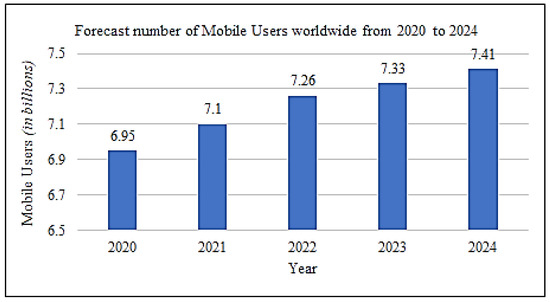
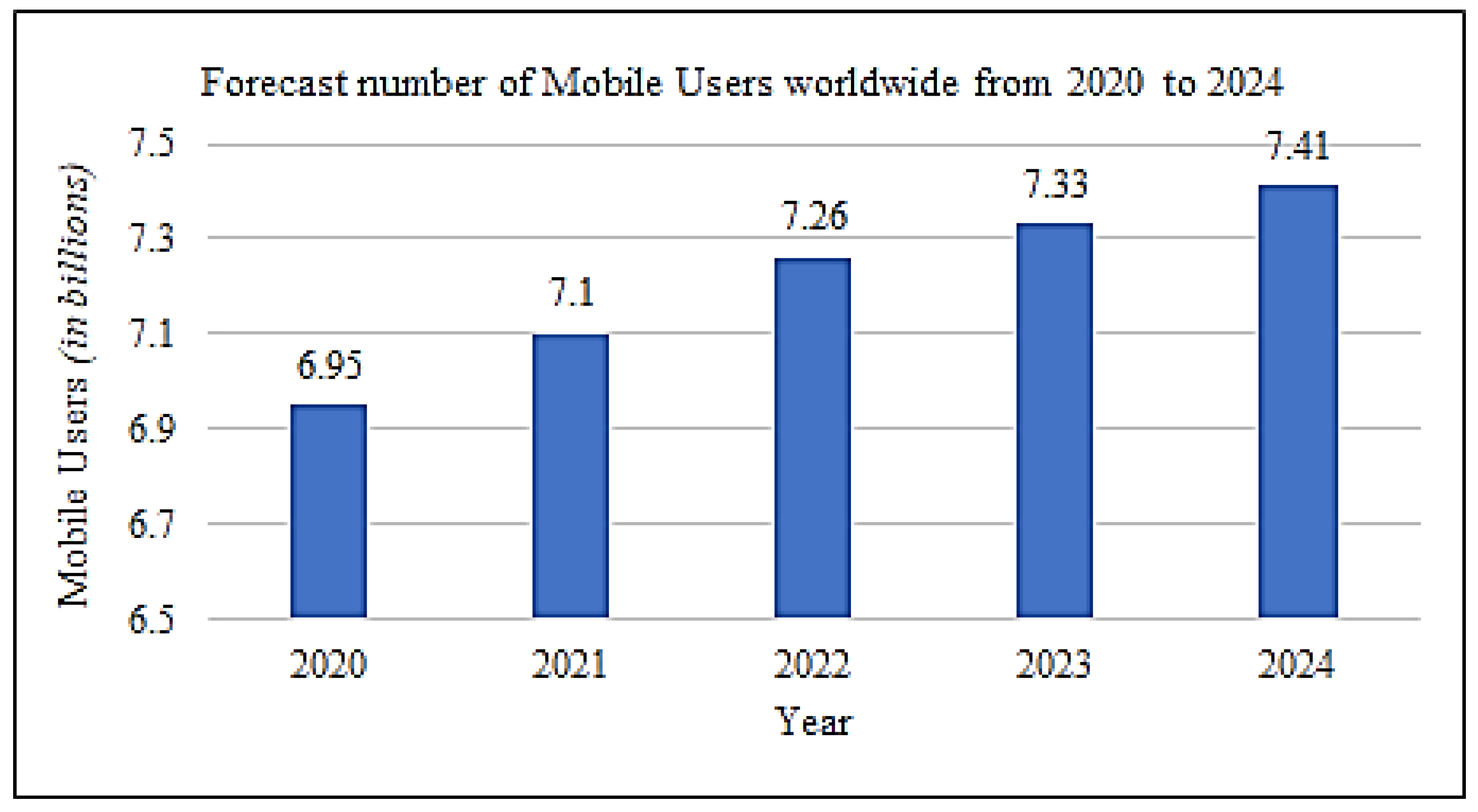
Mobile phones have become an important part of many people’s daily lives around the globe. According to Statista, the number of individuals using cell phones has surpassed 6.5 billion, and this figure is expected to rise rapidly. Figure 1 shows projected global mobile phone users from 2020 to 2024 [6]. M-Learning is rapidly gaining traction, particularly in the post-COVID period. Many recent studies have provided insights into the growing M-Learning industry.
Figure 1.
Worldwide projected mobile phone users, 2020–2024 [6].
Cloud computing has expanded rapidly and has had a major impact on human lifestyles as a result of information technology (IT). To survive the present economic depression, many firms have turned to cloud computing. Without requiring significant resources to be allocated to a physical data center, cloud computing can provide a range of IT services, including data center services. These services can be obtained at a reduced overall cost, in comparison to physical resources, giving users a competitive advantage and reduced operating expenses [7]. Cloud-based ICT infrastructure contributes to sustainability by facilitating on-demand flexible expansion, cost savings, and new solutions [8]. Cloud computing is described as “a model for allowing appropriate access to IT resources such as (e.g., servers, storage, services, networks resources, and software) which could begin functioning with minimal intervention from the service supplier and administration”. Cloud mobile computing is an environment that enables various kinds of mobile devices to access computer resources from anywhere, at any time. The combination of cloud computing and a mobile environment is known as cloud mobile computing. It describes a system in which data are processed and stored away from mobile devices [9]. The cloud-based M-Learning (CBML) system became indispensable during the COVID-19 pandemic. Hence, in order to maximize its beneficial potential, it needed be studied further.
The present study aimed:
- to identify the importance CSFs CBML system by analyzing the literature;
- to prepare a model for the evaluation and prioritization of sustainable CBML CSFs using the analytic hierarchy process group decision-making (AHP-GDM) and fuzzy AHP (FAHP).
The paper is organized as follows: Section 2 shows the CSFs identification framework for CBML, Section 3 provides a detailed description of the AHP-GDM and FAHP methodologies, while Section 4 provides a case illustration and application. Section 5 shows the results and discussions on the evaluation ranking of CSFs of CBML. Section 6 provides the discussion and limitations on the CSFs of CBML, followed by our conclusions.
2. Related Works
Several studies were found on CBML system selection in the literature. This section was categorized as the multi-criteria decision-making (MCDM) and CSFs identification framework for CBML.
2.1. MCDM Methodologies
An in-depth review of the literature was carried out on success factors in CBML, and an MCDM model was developed. Different researchers have used MCDM in a variety of applications; it has been used for sorting, ranking, and identifying the best potential factors of a given set. One popular MCDM technique, employed for prioritizing and ranking various elements, is AHP [10].
Adem [11] conducted a study to analyze and assess online education platforms based on human-computer interaction factors. Using MCDM methodologies, they determined the best and most appropriate distant learning platform for classroom instructions for both teachers and learners.
Celikbilek [12] used fuzzy DEMATEL and ANP to investigate the relationships between the various factors of E-Learning systems and subsequent ranking for the stakeholders. This helped users understand the causal relations between the different E-Learning components. The study analyzed 19 E-Learning system components, which were organized into three main domains: E-Learning, Education, and Technology. Tang [13] employed MCDM and evaluated interactions among the critical factors related to marketing-oriented strategic alliances during different stages in the telecommunications industry. The study showed different relationships and determined whether sustainable collaboration in different stages was possible. They used different usability factors to find and rank academic websites. Fuzzy AHP was found to be a useful method and was used to set up a framework for usability evaluation [14]. Various aspects of academic integrity were analyzed while using E-Learning in Saudi Arabian universities. They discovered 12 attributes, associated with the E-Learning environment and academic integrity awareness, using a comprehensive literature analysis and the Delphi technique. These factors were then prioritized using the AHP technique [15].
Murat [16] developed an intelligent software program for evaluating and selecting questions. Named the “Intelligent question evaluation and selection software (I-QUESS)”, the proposed hybrid system was utilized to develop a digital test sheet that allowed users to select questions based on their preferences using a hybrid of FAHP and genetic algorithms (GA) [16]. Quadri [17] identified different success factors and their dimensions for cloud-based E-Learning. Furthermore, they employed MCDM to evaluate and rank each factor to find the influence of each factor on others.
2.2. Framework for The Identification of Factors in CBML
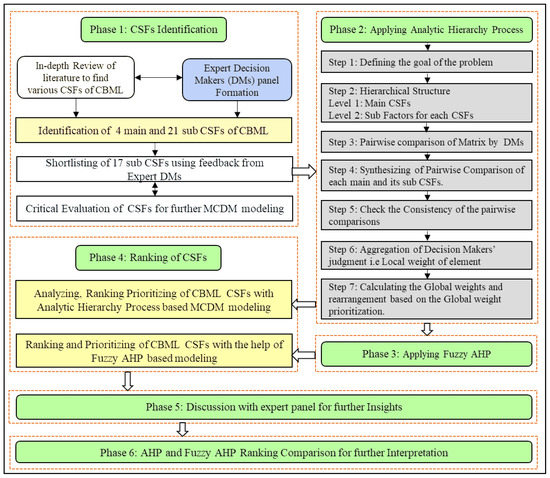
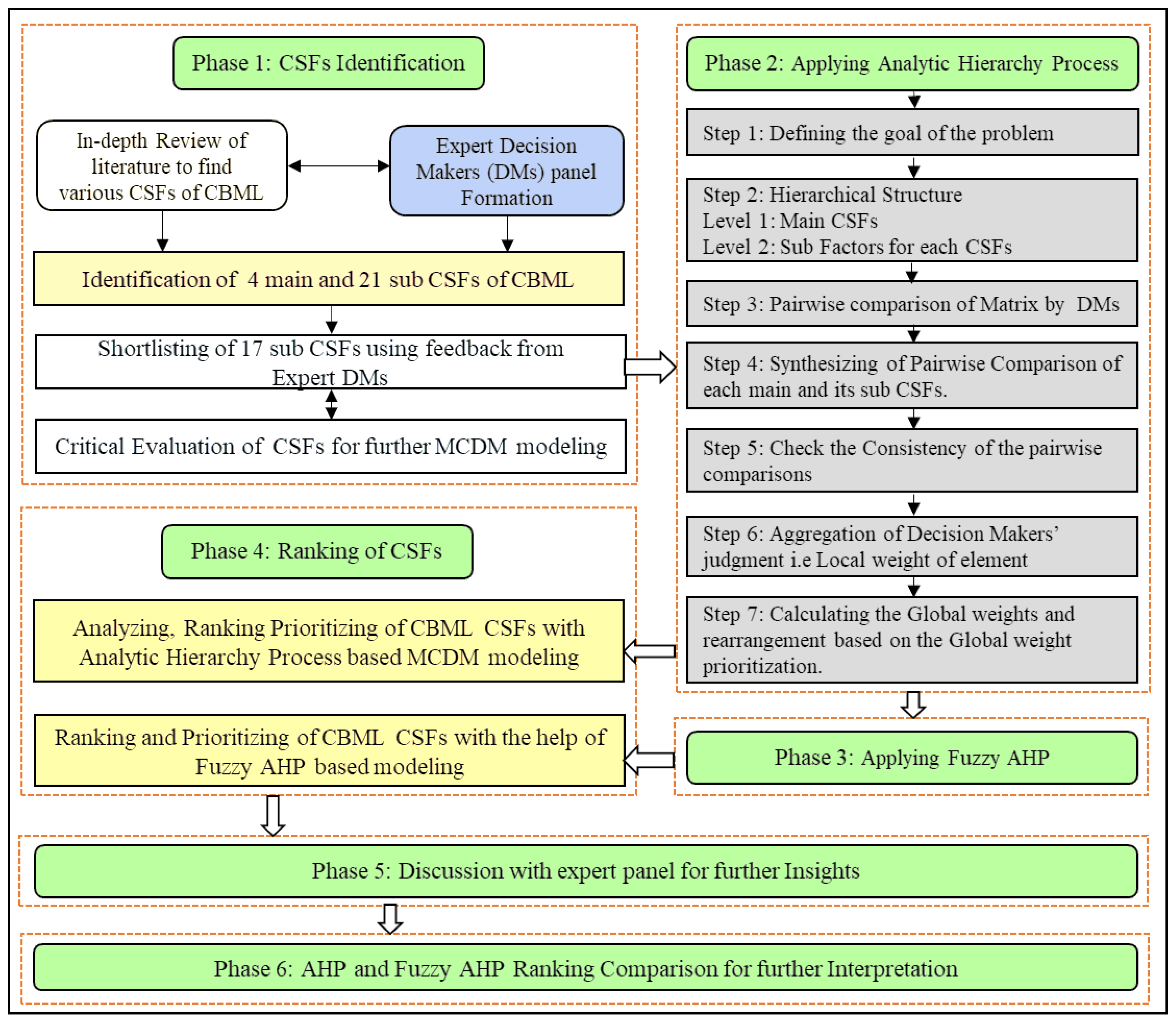
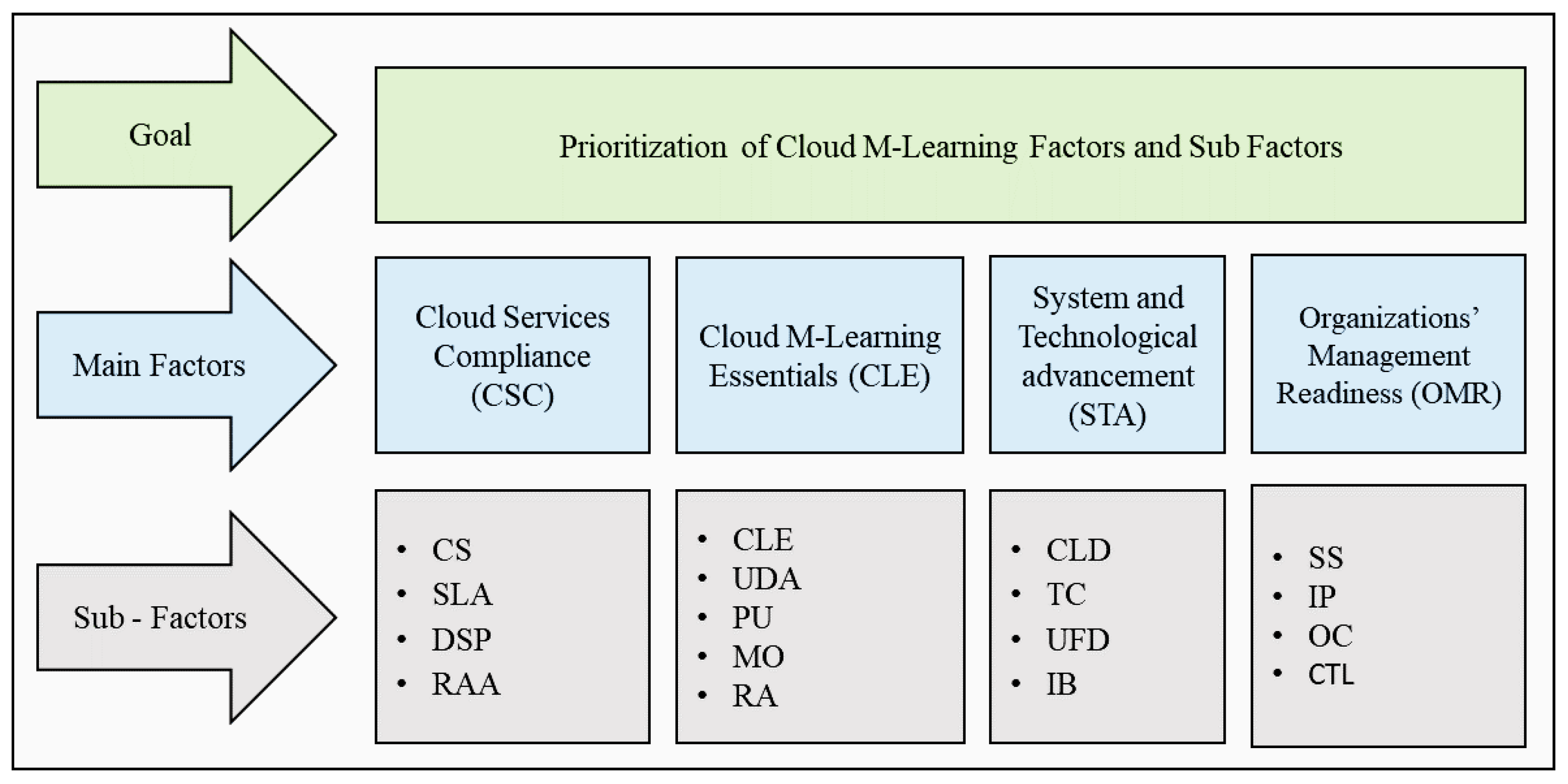
The factors that must be measured in each stage of planning, development, and operation are known as CSFs [17]. They can assist in discovering, regulating, and monitoring the success of a high-quality cloud-based M-Learning system. CSFs play a significant role in CBLL as they directly or indirectly influence the success of CBLM. While carrying out the literature review, it is observed that several studies determined lead identification of CSFs of CBML. Based on such studies, various CSFs, suggested by several researchers, were critically examined—as it is difficult to model CSFs to identify their importance in the success of CBLM. To ensure all the significant CSFs were covered in the present study, the systematic framework leading to the whole process was derived. Figure 2 shows the CSF selection framework for CBML. Using the expert knowledge of decision-makers (DMs), 21 CSFs were shortlisted. DMs were quite careful while choosing CSFs from the identified CSFs of 25. For several reasons (for instance, redundancy, not applicable to CBML, etc.), four CSFs were dropped. Thus, DMs ensured the influence of the selected CSFs of CBML that were potentially responsible for CBML’s involvement in the teaching–learning system. As per the feedback from DMs, 17 CSFs were shortlisted and grouped into four main CSFs, i.e., Cloud Services Compliance (CSC), Cloud M-Learning Essentials (CLE), System and Technological Advancement (STA), and Organizations’ Management Readiness (OMR). Later on, AHP-GDM and FAHP-based modeling were carried out following the framework. The various main factors and subfactors of CBML chosen are discussed below:
Figure 2.
The framework for shortlisting CSFs for CBML.
2.3. CSFs of CBML
Although cloud-based learning systems are still in their infancy, it has been shown that they are beneficial when used in higher education. However, learning via mobile devices is constrained in terms of processing and computation capacity, memory space, and infrastructure for some software applications [18]. There are many significant advantages to using cloud computing and mobile technology together. It is important to note that IT has aided in users’ extensive adoption and utilization of ICT in education. For the present study, literature was reviewed in the areas of E-Learning, mobile learning, and CBML uptake in institutions from various research databases, including Web of Science, Scopus, and Google Scholar. The literature review was targeted with various keywords, e.g., critical success factors, main factors, and enablers of mobile learning or cloud mobile learning or CBML from 2014 to the present. Finally, CSFs related to CBML were compiled and categorized into four domains, as discussed below.
2.4. Cloud Services Compliance Factor
The term cloud services describe several environments and services made available to businesses and consumers over the internet upon request. These services are designed to provide easy, affordable access to apps and virtual infrastructure without the need for internal hardware or infrastructure [18]. Other subfactors associated with this factor include a cloud service-level agreement which acts as a contract that ensures a specific quality of service between organizations that provide cloud services and educational institutions [8,19]. Cloud computing’s use of data privacy makes it possible to gather, store, transmit, and disseminate knowledge without endangering the privacy of individual users’ data [9]. There have been some challenges associated with security and privacy during the execution of cloud-based M-Learning [20] in universities. These need to be addressed of by providers and users of cloud services in order to ensure that the whole system is reliable and always available for students, instructors, and other users [21].
2.5. Cloud M-Learning Essentials Factor
This factor focuses on the elements required to complete the ecological cycle of successful cloud-based mobile learning. A supportive and collaborative environment is the primary reason to move on [18,22]. Similarly, user’s digital literacy and attitude [4] help in the system’s perceived utility becoming successful. There is also the subjective perception of those who think that utilizing particular technology will increase their productivity, and the desire to use CBML as a crucial component in finishing difficult assignments [23,24,25]. Last but not least, there needs to be some acceptance that the degree to which a new product outperforms an older one is a perceivable relative benefit of CBML [9].
2.6. System and Technological Advancement
To take advantage of all of the benefits of CBML, institutions must have adequate systems and technological infrastructure [26]. Good configuration of cloud learning devices [24] with institutions’ compatible mobile learning applications is crucial and can be used as a starting point for educational materials. User-friendly design [22] and good quality internet bandwidth [20,21] are necessary for the successful implementation of CBML. Of course, the speed and quality of broadband connections are affected by several things. These could include the transfer technique, user locality, the number of individuals with whom users share the link, and the device used. There are additional distinctions between mobile and fixed networks.
2.7. Organizations’ Management Readiness
Top management support is critical for any significant IT deployment, and this is equally true for CBML. The link between employees, procedures, technologies, and performance measurement is referred to as organizational preparedness and readiness. There can be no effective execution without collaboration among all the stakeholders of the organization. Service support [24], Increased Productivity [27], and Organizational Culture and Commitment toward M-Learning [28] are the important subfactors of this dimension. Table 1 provides the list of factors and subfactors, along with their references.
Table 1.
CSFS and subfactors related to CBML.
3. Overview of the AHP and FAHP
The present section provides the research methodologies based on MCDM. The AHP-GDM is employed as systematic group decision-making to remove DM’s bias while solving complex problems consisting of multiple conflicting criteria. FAHP is preferred over AHP as it enables higher accuracy during decision-making by removing vagueness that persists in decision-making. In this study, we used FAHP, along with basic fuzzy set theory and extension principles.
3.1. AHP Methodology
AHP is a systematic decision-support method put forward by T.L. Saaty and used by many researchers in problem-solving involving simple to complex hierarchies. The AHP procedure may resolve simple or complex problems consisting of conflicting criteria with different levels of hierarchy and structural complexity. The application of AHP may be found in various types of research and in various applications [15,17,56,57,58,59].
The DMs judgment is derived through a pairwise ca scale, as shown in Table 2. DMs play a significant role in pairwise comparison. The pairwise comparison calls for expertise from DMs; however, bias can occur if a single DM is involved in decision-making, rendering a decision misleading and/or unusable. The most robust decision-making and accuracy may be accomplished by increasing the number of decision-makers in the panel DM. The GDM process may employ more DMs to resolve the given problem based on their availability.
Table 2.
AHP scale [58].
The detailed AHP-GDM process is further explained below:
- Step 1. The various shortlisted CSFs of CBML are structured to form a single hierarchy. Later on, these are converted to form a comparison matrix or a decision matrix ‘D’. A pairwise matrix may be formulated as ‘D’ matrix. The element, dmn of the ‘D’ matrix, may be compared with the mth element with that of the nth in terms of its importance level.
- Step 2. The ‘D’ is formulated based on the participation of DMs. Further geometric means may be calculated for each pairwise decision matrix. On conversion of the matrix using GM, a priority vector (PV) may be derived.
- Step 3. In the decision matrix ‘D’, all the entries are according to their pairwise formulations values. Thus, an overall summation of the sum-product of each vector column for both the matrices with the PV values of each row is calculated. Later on, the principal eigenvalue (λmax) may be calculated using Equation (2).
Here, represents the summation of each column vector.
- Step 4. In AHP, the consistency index (CI) of decision-making is crucial for its acceptance in further calculation. An inconsistent decision is rejected and DM is asked to provide a new pairwise decision. Thus, the accuracy is maintained in AHP by keeping watch on the consistency of decision-making, obtained by Equation (3).
Here, n is the matrix order.
- Step 5. The random index (RI) may be calculated using Equation (4). The RI may be directly obtained from Table 3 based on the matrix size.Table 3. RI table.
- Step 6. The critical value of CR is less than 10%. Hence, any pairwise matrix not meeting this significance value may be rejected and revised again. The value is calculated from the ratio of CI and RI.
- Step 7. The various pairwise matrix may be combined into a single matrix using geometric mean to obtain a single decision.
3.2. FAHP Methodology
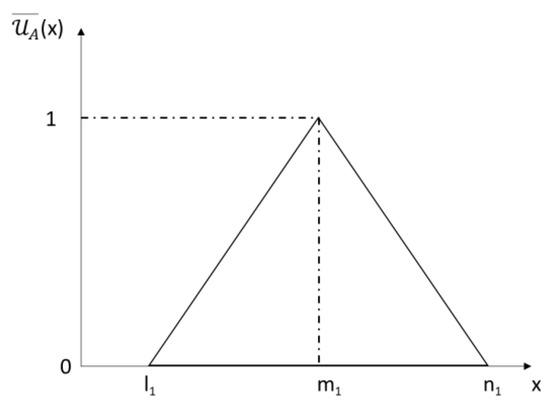
The use of fuzzy numbers can provide more accurate decision-making in FAHP as compared to AHP. The fuzzy set theory, along with various rules, may render itself useful by employing triangular fuzzy numbers (TFNs). A typical TFN depicted in Figure 2 may be used in deriving the pairwise comparison. The extension principle can be useful while finding the intersections of such TFNs. The use of TFN also helps in reducing biases [60]. The fuzzy set theory, along with extension principles, is briefed in Figure 3.
Figure 3.
Triangular fuzzy number (P).
3.2.1. Basic Fuzzy Set Theory
The fuzzy set theory provides good and efficient decision-making. Fuzzy set theory-based rules also provide flexibility to DM. Thus, in a fuzzy environment, using fuzzy set theory and the fuzzy extension principle can help make good decisions.
The triangular fuzzy numbers (TFN) (a_1, a_2, a_3) or trapezoidal numbers (TrFN) (a_1, a_2, a_3, a_4) can be used in pairwise decision-making [61,62,63] as shown in Figure 3.
The fuzzy set theory uses TFNs for various arithmetic operations [60]. TFNs may be represented by D1 and D2 as (k1, m1, n1) and (k2, m2, n2), respectively.
Two TFNs can be used to perform arithmetic operations such as subtraction, addition, division, and multiplication. Such arithmetic operations can be represented by the following Equations (5)–(9):
3.2.2. Extent Analysis in MCDM in Fuzzy Environments
Using the extent principle, two triangular fuzzy numbers (TFNs) can be compared [17]. Two sets may be considered as a set of priorities and a set of targets, i.e., and , respectively. Furthermore, this objective is accomplished using the extent principle to achieve each objective. As a consequence, the values obtained are:
Here, are TFNs and represented as . The method is explained below, based on the extent analysis as described by [61].
- Step 1: Preparation of hierarchical structure for the objective.
The CBML framework is divided into many categories, including main factors and subfactors. Framing the hierarchical system for ranking in the MCDM problem is an important task. The hierarchy is prepared in consultation with DMs.
- Step 2: Carrying out the pairwise comparison for dimension and CSFs of M-Learning using TFNs.
The main factors and subfactors of CBML can be evaluated using the DMs’ feedback. The pairwise comparison of the main factors and subfactors of CBML is accomplished using TFN.
- Step 3: Calculating the value of fuzzy synthetic extent.
Using fuzzy summation of TFNs, m extent analysis values, may be obtained as:
and, gives the fuzzy summation of values are calculated as:
The inverse of the vector may be obtained as:
- Step 4: Obtaining the degree of possibility of supremacy for two TFNs i.e.,
The equation can be represented as:
The GDM may involve several DMs; for example, K DMs may be participating, thus the subsequent pairwise comparisons yield n elements. A set of K matrices,, where represents an element’s relative importance i to j, as derived by DM k. Later, Equation (19) could be used to perform the aggregation.
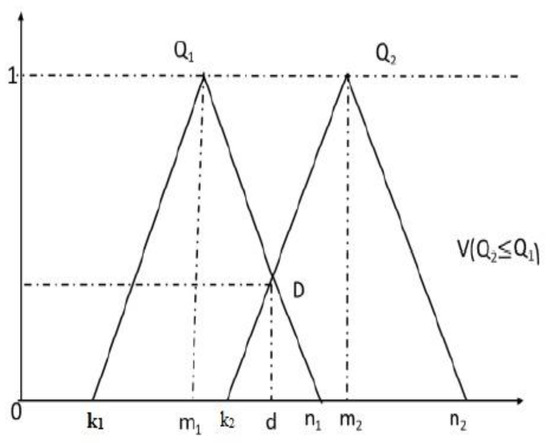
The intersection of two TFNs, i.e., and , is shown in Figure 4. The intersection is shown as ordinate d, representing the highest possible fuzzy numbers intersection and . Furthermore, and, may be determined using the values of V ( ≥ ) and V ( ≥ ).
Figure 4.
The intersection of TFNs [15].
- Step 5: Establish the degree of possibility of convex fuzzy number so that it is greater than k convex Fuzzy number may be derived as:
Considering,
The weight vector may be obtained as
Such that has n elements
- Step 6: Calculate the normalized weight vectors.
The normalized weight vector may be obtained using Equation (23)
where C denotes a crisp number after defuzzification.
- Step 7: Obtaining the total score of each dimension of CSFs and its prioritization factors.
The local weight and global weight products will represent the total priority weights of each main factor and subfactor of CBML. To achieve higher-order priorities, the main factors and subfactors of CBML may be ranked as per the required order.
4. Application of AHP-GDM and FAHP in CBML
MCDM methodologies like AHP and FAHP are preferred because of their simple and effective decision-making while carrying out the prioritization and ranking of criteria under a simple and complex hierarchy. AHP-GDM may be useful in synthesizing the opinion of several DMs, whereas FAHP further removes biases from decision-making. Generally, DMs play a vital role in qualitative analysis. In the present study, a team of three DMs with commendable experience in CBML was approached to help in the decision-making for an educational cause, to which they agreed readily. The team also included two reviewers to review the pairwise judgment and help in the overall assessment. The team of DMs and reviewers gave their unconditional consent for the use of data for further analysis. The profiles of the DMs and reviewers are shown in Table 4.
Table 4.
DM and reviewer profiles.
For the identification of CBML factors, a systematic framework was followed as discussed earlier. The in-depth analysis of the literature was considered to identify 4 main and 17 subfactors of CBML, as shown in Figure 5.
Figure 5.
Hierarchy of main factors and subfactors of CBML.
The help of DMs was sought during the shortlisting of the main factors and subfactors of CBML. As per the AHP-GDM and FAHP steps discussed in the previous section, they were carried out to obtain various matrixes, tabulated in Table 5, Table 6 and Table 7. Table 8 shows the weight of the value after synthesizing all the values of the three decision matrices using the geometric mean. Local weights were obtained to provide the priority of subcriteria, whereas global weights provided the overall priority of main CSFs of CBML. Furthermore, a pairwise comparison of different main factors and subfactors was also carried out. The composite weight of all main factors and subfactors of CBML was obtained through the AHP-GDM, as shown in Table 9.
Table 5.
Comparison of main CSFs Of CBML by DM1.
Table 6.
Comparison of main CSFs of CBML by DM2.
Table 7.
Comparison of main CSFs of CBML by DM3.
Table 8.
Synthesized results (DM1 to DM3).
Table 9.
Synthesized weight and rank of CBML main factors and subfactors Using AHP-GDM.
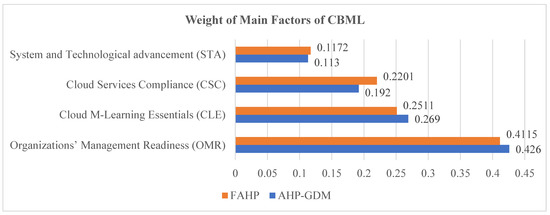
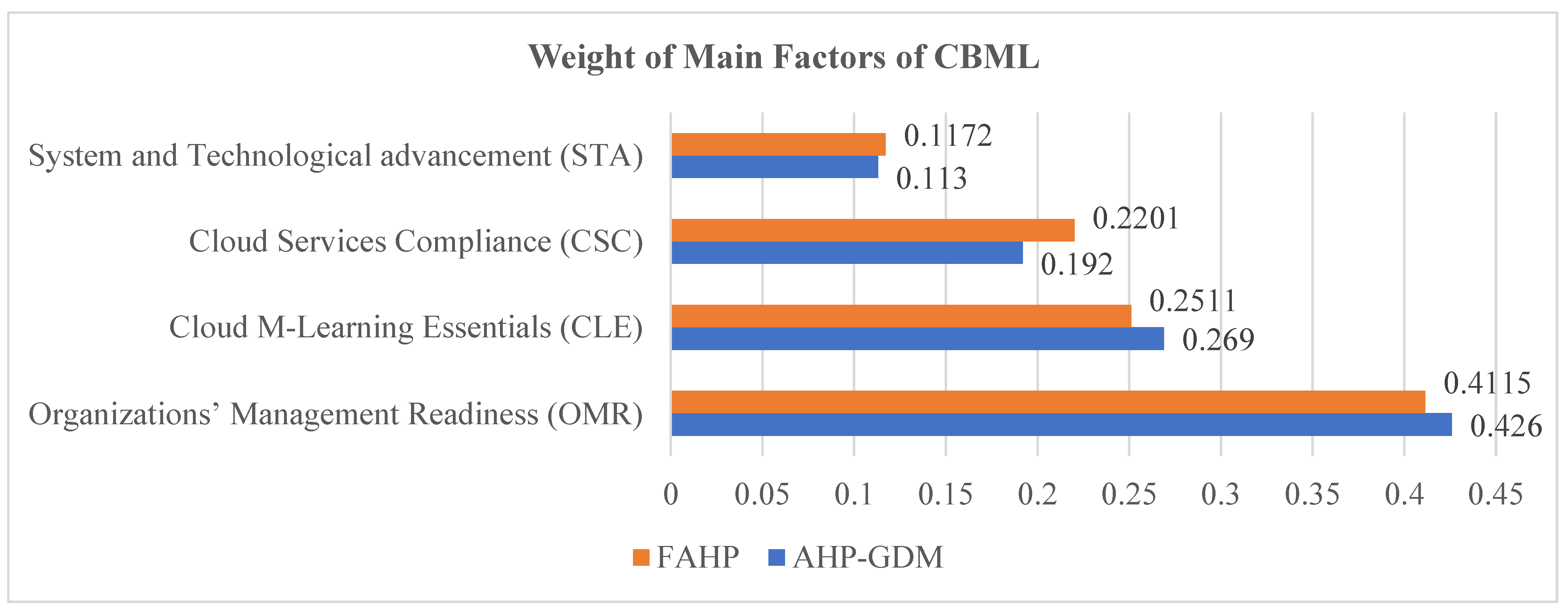
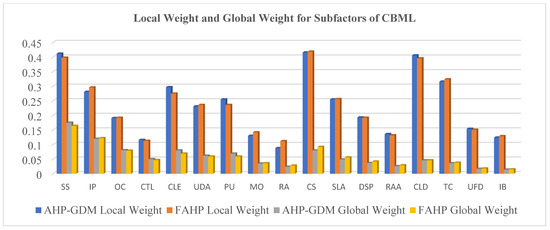
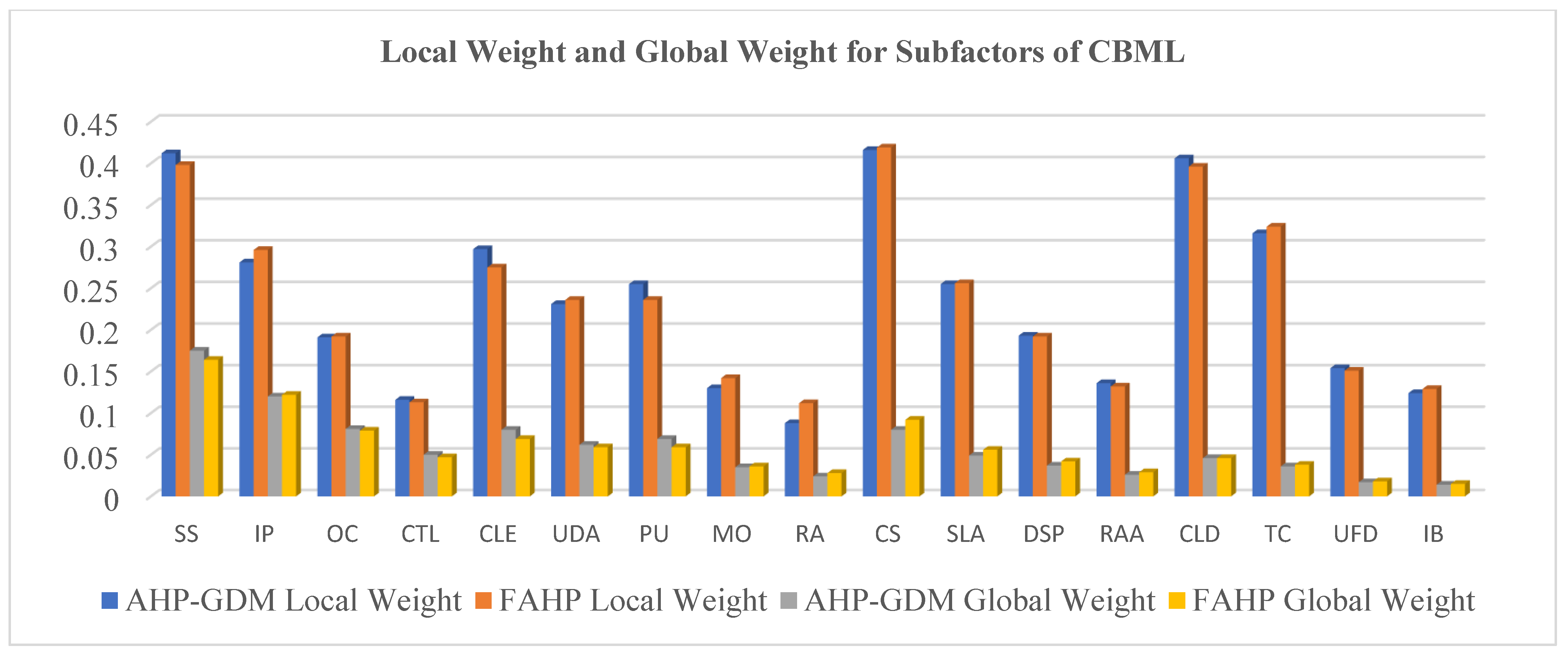
FAHP was also used to determine the relative weights of the CBML main criteria and subcriteria. A fuzzy scale employing TFN and reciprocal values of TFN was employed. Table 10 indicates the fuzzy scale based on TFN. When determining the weight of the main factors and subfactors of CBML, the fuzzy scale was utilized. The various steps involved, as discussed in the earlier section, were followed to obtain the weights. Table 11 shows one such pairwise comparison. Table 12 demonstrates CBML’s main factors and subfactors composite weights and rankings. It was possible to compare the priority obtained using AHP-GDM and FAHP, as shown in Table 13. The result obtained using the AHP-GDM process for prioritization of CSFS of CBML was compared using FAHP. FAHP ensures accuracy in decision-making while making pairwise comparisons. The vagueness in decision-making was removed using TFN. It also helped to remove biased decision-making. Furthermore, the weights of the main CSFs CBML were presented in Figure 6, whereas Figure 7 demonstrated the local and global weights for CBML subfactors. The local weights were obtained to provide the priority of subcriteria, whereas global weights provided the overall priority of main CSFs of CBML
Table 10.
TFN Scale.
Table 11.
Pairwise comparison of the main CSF of CBML using FAHP.
Table 12.
Composite rank and weight of main factors and subfactors of CBML Using FAHP.
Table 13.
Comparison of composite weights and ranking of CBML factors And subfactors using AHP-GDM and FAHP.
Figure 6.
Weights of main factors of CBML.
Figure 7.
Local weight and global weight for subcriteria of CBML.
5. Results and Discussions
Apart from M-Learning, CBML also plays a vital role in the teaching–learning system. Smartphones with greater capabilities have made it possible to break the barriers of constrained classroom teaching. The internet revolution has increased the dissemination of knowledge through cloud-based mobile learning. Based on AHP-GDM and FAHP modeling, the weights of various main factors and subfactors of CBML were obtained. The weights obtained for the main CSFs of CBML through AHP-GDM and FAHP modeling were: OMR , whereas for FAHP, the weights obtained were: OMR STA, where indicates the preference over other as shown in Figure 8.
Figure 8.
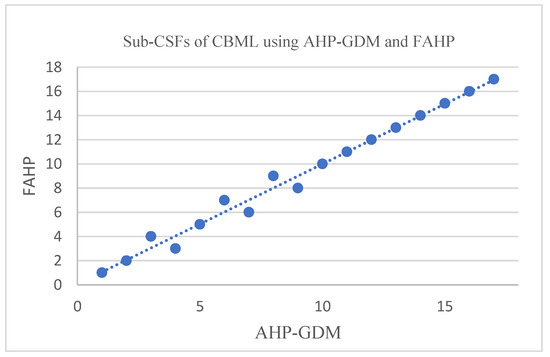
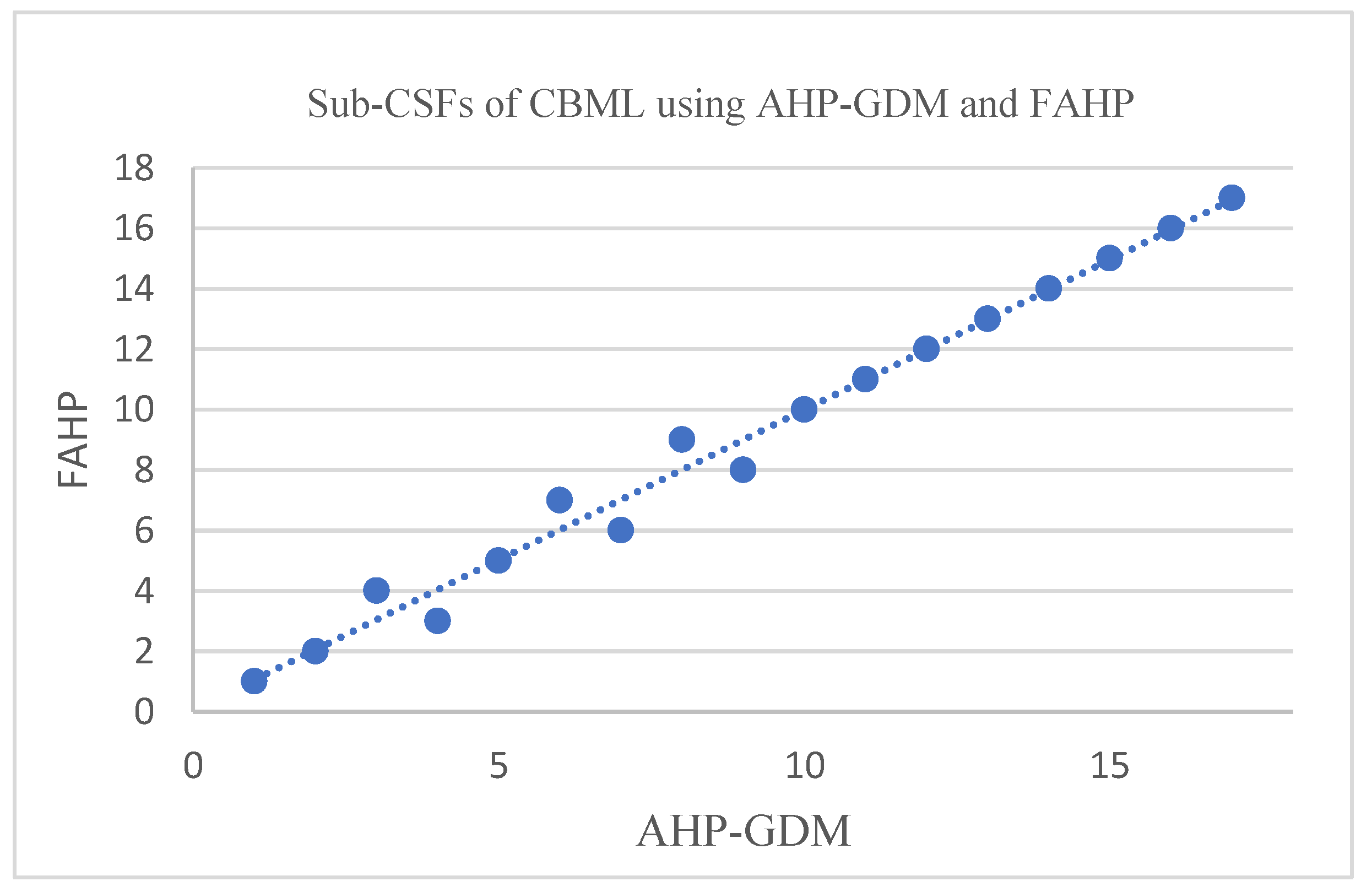
The Spearman global rank coefficient for subcriteria of CBML.
Organizations management readiness (OMR) plays a significant role in initiating CBML in the teaching–learning system. Cloud M-Learning Essentials (CLE) form the essential component in realizing a CBML system. Cloud services compliance (CSC) makes it possible to adhere completely to cloud services for continuity and sustainability. System and technological advancement (STA) help in keeping pace with technological changes.
Decision makers for CBML administrative readiness or stakeholders may use the present analysis for understanding CSF and their roles in successful CBML implementations. The ranking obtained through AHP-GDM and FAHP could enable university authorities to understand the critical role being played by each CSF in successful CBML implementations. Further analysis carried out in the present research direction will also help stakeholders to identify and control strategies for effective usage. The ranks obtained by AHP-GDM and FAHP were compared using the Spearman global rank coefficient, which was obtained as 0.992647. The Spearman global rank coefficient is shown in Figure 7. Values closer to 1 demonstrate a more perfect association between the ranks. The rankings of subcriteria of CBML using AHP-GDM and FAHP were nearly the same, indicating consistency in decision making. Thus, it showed nearly perfect positive connotation of ranks.
6. Limitations and Scope for Future Work
The success of CBML is greatly influenced by its main factors and subfactors. A flawless and effective implementation of a CBML system may be accomplished by adhering to the main factors and subfactors of CBML. The main factors and subfactors of CBML’s achieved priorities and rankings can be generalized, albeit with some exceptions. The current study used a small number of main factors and subfactors of CBM and a limited number of DMs for AHP-GDM and FAHP. A comprehensive group of main- and sub-CSFs of CBML, together with a broad group of DMs, could be used in future studies to generalize results and meet the expectations of a larger group of higher educational institutes. The weight and rank of the main factors and subfactors of CBML could also be assessed utilizing additional MCDM techniques in a crisp and fuzzy environment. The success of CBML demands a proactive strategic approach for its success; hence, further study could lead to the development of suitable strategies depending upon the CBML SCFs.
7. Conclusions
The rapid changes in internet technology and mobile technology could help in achieving sustainable CBML implementation and effective usage in teaching–learning. The teaching–learning process through CBML will enhance the quality of education with an enhanced user-friendly environment and a shift away from face-to-face classroom teaching. Utilizing E-Learning and M-Learning in higher educational institutes is a strategic decision that university managers must consider under different circumstances. Face-to-face teaching–learning was hampered due to the COVID-19 pandemic and universities were compelled to switch to E-learning in many countries. Sustainable M-Learning is one of the available alternatives to E-Learning for enhancing user-friendliness in the teaching–learning process. The selection of E-Learning and M-Learning in future teaching–learning strategies is a crucial decision for higher educational institutes. The present research will help to make such a decision under varying conditions. The evaluation of the main factors and subfactors of sustainable CBML will help in decision-making processes with rapidly changing technological development and its acceptance in teaching–learning methodologies to satisfy all the stakeholders. MCDM offers a simple and organized methodological approach to evaluating various teaching–learning options, such as M-learning and E-learning, to see if they will meet a system’s future educational needs. In the future, CBML will help move toward a new, ubiquitous learning paradigm and the pervasive extension of E-Learning technologies, thus necessitating strategic approaches.
Author Contributions
Conceptualization, Q.N.N., M.R.N.Q., N.A. and M.A.A.R.; Methodology, Q.N.N. and M.R.N.Q.; Software, M.A.A.R.; Validation, Q.N.N.; Formal analysis, Q.N.N. and M.R.N.Q.; Investigation, N.A. and M.A.; Resources, A.I.Q.; Writing—original draft, Q.N.N.; Writing—review & editing, A.I.Q., M.R.N.Q., N.A., M.A.A.R. and M.A.; Visualization, Q.N.N.; Project administration, A.I.Q. and M.A.; Funding acquisition, A.I.Q. All authors have read and agreed to the published version of the manuscript.
Funding
Deanship of Scientific Research at King Khalid University under Research grant award number RGP. 2/252/43.
Institutional Review Board Statement
Informed consent was obtained from all subjects involved in the study.
Informed Consent Statement
Not applicable.
Acknowledgments
The authors extend their appreciation to the Deanship of Scientific Research at King Khalid University for funding & support for this work through Large Groups Project under Research grant award number RGP. 2/252/43.
Conflicts of Interest
The authors declare no conflict of interest.
References
- Criollo-C, S.; Guerrero-Arias, A.; Jaramillo-Alcázar, Á.; Luján-Mora, S. Mobile Learning Technologies for Education: Benefits and Pending Issues. Appl. Sci. 2021, 11, 4111. [Google Scholar] [CrossRef] [Scilit]
- Hamidi, H.; Jahanshaheefard, M. Essential factors for the application of education information system using mobile learning: A case study of students of the university of technology. Telemat. Inform. 2019, 38, 207–224. [Google Scholar] [CrossRef] [Scilit]
- Naveed, Q.N.; Alam, M.M.; Tairan, N. Structural Equation Modeling for Mobile Learning Acceptance by University Students: An Empirical Study. Sustainability 2020, 12, 8618. [Google Scholar] [CrossRef] [Scilit]
- Ananto, P.; Ningsih, S. Incorporation of Smartphones and Social Media to Promote Mobile Learning in an Indonesian Vocational Higher Education Setting. Int. J. Interact. Mob. Technol. 2020, 14, 66–81. [Google Scholar] [CrossRef] [Scilit]
- Moya, S.; Camacho, M. Analyzing Mobile Learning key Success Factors in Catalonia. In Proceedings of the 8th International Conferences on Mobile Learning and Educational Technologies, Rome, Italy, 21–23 April 2016. [Google Scholar]
- Number of Smartphone Users. Number of Smartphone Users from 2016 to 2025 (in Billions). 2020. Available online: https://www.statista.com/statistics/218984/number-of-global-mobile-users-since-2010/ (accessed on 18 May 2022).
- Naveed, N.A.N. Critical Success Factors (CSFs) for Cloud-Based e-Learning. Int. J. Emerg. Technol. Learn. 2019, 14, 140–149. [Google Scholar] [CrossRef] [Scilit]
- Ahmad, N.; Hoda, N.; Alahmari, F. Developing a Cloud-Based Mobile Learning Adoption Model to Promote Sustainable Education. Sustainability 2020, 12, 3126. [Google Scholar] [CrossRef] [Scilit]
- Almaiah, M.A.; Al-Khasawneh, A. Investigating the main determinants of mobile cloud computing adoption in university campus. Educ. Inf. Technol. 2020, 25, 3087–3107. [Google Scholar] [CrossRef] [Scilit]
- Naveed, Q.N.; Aseere, A.M.; Muhammad, A.; Islam, S.; Qureshi, M.R.N.; Siddique, A.; Hussain, M.R.; Shahwar, S. Evaluating and ranking mobile learning factors using a multi-criterion decision-making (MCDM) approach. Intell. Autom. SOFT Comput. 2021, 29, 111–129. [Google Scholar] [CrossRef] [Scilit]
- Adem, A.; Cakit, E.; Dagdeviren, M. Selection of suitable distance education platforms based on human-computer interaction criteria under fuzzy environment. Neural Comput. Appl. 2022, 34, 7919–7931. [Google Scholar] [CrossRef] [Scilit]
- Celikbilek, Y.; Adiguzel Tuylu, A.N. Prioritizing the components of e-learning systems by using fuzzy DEMATEL and ANP. Interact. Learn. Environ. 2022, 30, 322–343. [Google Scholar] [CrossRef] [Scilit]
- Tang, J.-W.; Chen, C.-J.; Tsai, P.-H. Development of hybrid fuzzy multi-criteria decision approach to evaluate key factors for marketing strategic alliance formation based on multiple theories. Manag. Decis. Econ. 2022, 43, 241–261. [Google Scholar] [CrossRef] [Scilit]
- Muhammad, A.; Siddique, A.; Naveed, Q.N.; Khaliq, U.; Aseere, A.M.; Hasan, M.A.; Qureshi, M.R.N.; Shahzad, B. Evaluating Usability of Academic Websites through a Fuzzy Analytical Hierarchical Process. Sustainability 2021, 13, 2040. [Google Scholar] [CrossRef] [Scilit]
- Muhammad, A.; Shaikh, A.; Naveed, Q.N.; Qureshi, M.R.N. Factors Affecting Academic Integrity in E-Learning of Saudi Arabian Universities. An Investigation Using Delphi and AHP. IEEE Access 2020, 8, 16259–16268. [Google Scholar] [CrossRef] [Scilit]
- Ince, M.; Yiugit, T.; Icsik, A.H. A novel hybrid fuzzy AHP-GA method for test sheet question selection. Int. J. Inf. Technol. Decis. Mak. 2020, 19, 629–647. [Google Scholar] [CrossRef] [Scilit]
- Naveed, Q.N.; Qureshi, M.N.; Shaikh, A.; Alsayed, A.O.; Sanober, S.; Mohiuddin, K. Evaluating and Ranking Cloud-based E-Learning Critical Success Factors (CSFs) using Combinatorial Approach. IEEE Access 2019, 7, 157145–157157. [Google Scholar] [CrossRef] [Scilit]
- Sandu, N.; Gide, E. Analysis of the Main Factors Affecting the Adoption of Cloud based Interactive Mobile Learning in the Australian Higher Education Sector. Int. J. Interact. Mob. Technol. 2018, 12, 43–58. [Google Scholar] [CrossRef] [Scilit]
- Alharthi, A.; Alassafi, M.O.; Walters, R.J.; Wills, G.B. An exploratory study for investigating the critical success factors for cloud migration in the Saudi Arabian higher education context. Telemat. Inform. 2017, 34, 664–678. [Google Scholar] [CrossRef] [Scilit]
- AlAhmad, A.S.; Kahtan, H.; Alzoubi, Y.I.; Ali, O.; Jaradat, A. Mobile cloud computing models security issues: A systematic review. J. Netw. Comput. Appl. 2021, 190, 103152. [Google Scholar] [CrossRef] [Scilit]
- Alghazi, S.S.; Kamsin, A.; Almaiah, M.A.; Wong, S.Y.; Shuib, L. For Sustainable Application of Mobile Learning: An Extended UTAUT Model to Examine the Effect of Technical Factors on the Usage of Mobile Devices as a Learning Tool. Sustainability 2021, 13, 1856. [Google Scholar] [CrossRef] [Scilit]
- Alrasheedi, M.; Capretz, L.F.; Raza, A. A systematic review of the critical factors for success of mobile learning in higher education (university students’ perspective). J. Educ. Comput. Res. 2015, 52, 257–276. [Google Scholar] [CrossRef] [Scilit]
- Huang, R.-T.; Jabor, M.K.; Tang, T.-W.; Chang, S.-C. Examine the moderating role of mobile technology anxiety in mobile learning: A modified model of goal-directed behavior. Asia Pacific Educ. Rev. 2021, 23, 101–113. [Google Scholar] [CrossRef] [Scilit]
- Sophonhiranrak, S. Features, barriers, and influencing factors of mobile learning in higher education: A systematic review. Heliyon 2021, 7, e06696. [Google Scholar] [CrossRef] [Scilit] [PubMed]
- Sarrab, M.; al Shibli, I.; Badursha, N. An empirical study of factors driving the adoption of mobile learning in Omani higher education. Int. Rev. Res. Open Distrib. Learn. 2016, 17. [Google Scholar] [CrossRef] [Scilit]
- Noor, T.H.; Zeadally, S.; Alfazi, A.; Sheng, Q.Z. Mobile cloud computing: Challenges and future research directions. J. Netw. Comput. Appl. 2018, 115, 70–85. [Google Scholar] [CrossRef] [Scilit]
- Toperesu, B.; Van Belle, J.-P. Mobile Learning Considerations in Higher Education: Potential Benefits and Challenges for Students and Institutions. Int. Assoc. Dev. Inf. Soc. 2018, 31–38. [Google Scholar]
- Kang, H.; Turi, J.A.; Bashir, S.; Alam, M.N.; Shah, S.A. Moderating role of information system and mobile technology with learning and forgetting factors on organizational learning effectiveness. Learn. Motiv. 2021, 76, 101757. [Google Scholar] [CrossRef] [Scilit]
- Liu, L.; Ma, Y.; Dong, T.; Duan, W. Research on Campus M-Learning Based on Cloud Computing. In Proceedings of the International Conference on Information Engineering and Applications (IEA), Chongqing, China, 26–28 October 2012; pp. 383–390. [Google Scholar]
- Aziz, M.N.A.; Noor, R.M.; Khamis, N. Cloud-Based Mobile Learning Adaptation in Nonformal Learning: A Review. In Proceedings of the Regional Conference on Science, Technology and Social Sciences (RCSTSS 2014); Universiti Teknologi MARA Pahang: Pahang, Malaysia, 2016; pp. 403–414. [Google Scholar]
- Alshwaier, A.; Youssef, A.; Emam, A. A new trend for e-learning in KSA using educational clouds. Adv. Comput. 2012, 3, 81. [Google Scholar] [CrossRef] [Scilit]
- Mitra, S.; Gupta, S. Mobile learning under personal cloud with a virtualization framework for outcome based education. Educ. Inf. Technol. 2020, 25, 2129–2156. [Google Scholar] [CrossRef] [Scilit]
- Okai-Ugbaje, S.; Ardzejewska, K.; Imran, A.; Yakubu, A.; Yakubu, M. Cloud-Based M-Learning: A Pedagogical Tool to Manage Infrastructural Limitations and Enhance Learning. Int. J. Educ. Dev. Using Inf. Commun. Technol. 2020, 16, 48–67. [Google Scholar]
- Li, F.; Lu, H.; Hou, M.; Cui, K.; Darbandi, M. Customer satisfaction with bank services: The role of cloud services, security, e-learning and service quality. Technol. Soc. 2021, 64, 101487. [Google Scholar] [CrossRef] [Scilit]
- al Tayeb, A.; Alghatani, K.; El-Seoud, S.; El-Sofany, H. The impact of cloud computing technologies in e-learning. Int. J. Emerg. Technol. Learn. 2013, 8, 37–43. [Google Scholar]
- Odeh, M.; Garcia-Perez, A.; Warwick, K. Cloud computing adoption at higher education institutions in developing countries: A qualitative investigation of main enablers and barriers. Int. J. Inf. Educ. Technol. 2017, 7, 921–927. [Google Scholar] [CrossRef] [Scilit]
- Akin, O.C.; Matthew, F.; Comfort, D. The impact and challenges of cloud computing adoption on public universities in Southwestern Nigeria. Int. J. Adv. Comput. Sci. Appl. 2014, 5, 13–19. [Google Scholar]
- Fabito, B.S. Exploring Critical Success Factors of Mobile Learning as Perceived by Students of the College of Computer Studies--National University. In Proceedings of the 2017 International Conference on Soft Computing, Intelligent System and Information Technology (ICSIIT), Denpasar, Indonesia, 26–29 September 2017; pp. 220–226. [Google Scholar]
- Bettayeb, H.; Alshurideh, M.T.; al Kurdi, B. The effectiveness of mobile learning in UAE universities: A systematic review of motivation, self-efficacy, usability and usefulness. Int. J. Control Autom. 2020, 13, 1558–1579. [Google Scholar]
- Sultana, J. Determining the factors that affect the uses of Mobile Cloud Learning (MCL) platform Blackboard-a modification of the UTAUT model. Educ. Inf. Technol. 2020, 25, 223–238. [Google Scholar] [CrossRef] [Scilit]
- Qureshi, M.I.; Khan, N.; Gillani, S.M.A.H.; Raza, H. A Systematic Review of Past Decade of Mobile Learning: What we Learned and Where to Go. Int. J. Interact. Mob. Technol. 2020, 14, 67–81. [Google Scholar] [CrossRef] [Scilit]
- Zaguia, A.; Ameyed, D.; Daadaa, Y. Integrating Modalities into Context Aware eLearning System Using Cloud Computing. In Proceedings of the 2021 International Conference of Women in Data Science at Taif University (WiDSTaif), Taif, Saudi Arabia, 30–31 March 2021; pp. 1–6. [Google Scholar]
- Cai, P. Thinking skills development in mobile learning: The case of elementary school students studying environmental studies. Think. Ski. Creat. 2021, 42, 100922. [Google Scholar] [CrossRef] [Scilit]
- Hamzah, A.; Hidayatullah, A.; Persada, A. Discovering trends of mobile learning research using topic modelling approach. Int. J. Interact. Mob. Technol. 2020, 14, 4–14. [Google Scholar] [CrossRef] [Scilit]
- Alotaibi, M.B. Exploring Users’ Attitudes and Intentions toward the Adoption of Cloud Computing in Saudi Arabia: An Empirical Investigation. J. Comput. Sci. 2014, 10, 2315–2329. [Google Scholar] [CrossRef] [Scilit]
- Marzouki, O.F.; Idrissi, M.K.; Bennani, S. Effects of social constructivist mobile learning environments on knowledge acquisition: A meta-analysis. Int. J. Interact. Mob. Technol. 2017, 11, 18–39. [Google Scholar] [CrossRef] [Scilit]
- Moya, S.; Camacho, M. Identifying the key success factors for the adoption of mobile learning. Educ. Inf. Technol. 2021, 26, 3917–3945. [Google Scholar] [CrossRef] [Scilit]
- Maritasari, D.B.; Setyosari, P.; Kuswandi, D.; Praherdhiono, H. The Effect of Project Based Learning Assisted by Mobile Learning Applications and Learning Motivation on the Competence and Performance of Teachers. Turkish J. Comput. Math. Educ. 2021, 12, 3488–3498. [Google Scholar] [CrossRef] [Scilit]
- Qashou, A. Influencing factors in M-learning adoption in higher education. Educ. Inf. Technol. 2021, 26, 1755–1785. [Google Scholar] [CrossRef] [Scilit]
- Al-Emran, M.; Mezhuyev, V.; Kamaludin, A. Towards a conceptual model for examining the impact of knowledge management factors on mobile learning acceptance. Technol. Soc. 2020, 61, 101247. [Google Scholar] [CrossRef] [Scilit]
- Behrend, T.S.; Wiebe, E.N.; London, J.E.; Johnson, E.C. Cloud computing adoption and usage in community colleges. Behav. Inf. Technol. 2011, 30, 231–240. [Google Scholar] [CrossRef] [Scilit]
- Kaliisa, R.; Palmer, E.; Miller, J. Mobile learning in higher education: A comparative analysis of developed and developing country contexts. Br. J. Educ. Technol. 2019, 50, 546–561. [Google Scholar] [CrossRef] [Scilit]
- Kuzmina, J. Selecting a Blended Learning Model for teaching English theoretical grammar at tertiary level. In Proceedings of the 12th International Conference of Education, Research and Innovation (ICERI2019), Seville, Spain, 11–13 November 2019; pp. 8728–8732. [Google Scholar]
- Alrasheedi, M.; Capretz, L.F.; Raza, A. Management’s perspective on critical success factors affecting mobile learning in higher education institutions—An empirical study. J. Educ. Comput. Res. 2016, 54, 253–274. [Google Scholar] [CrossRef] [Scilit]
- Gopinath, R. Job involvement and Organizational Commitment of Academic Leaders in Tamil Nadu Universities--A relationship study with structural equation modeling. J. Crit. Rev. 2020, 7, 1857–1864. [Google Scholar]
- Mohammed, H.J.; Kasim, M.M.; Shaharanee, I.N. Evaluation of E-Learning Approaches Using AHP-TOPSIS Technique. J. Telecommun. Electron. Comput. Eng. 2018, 10, 7–10. [Google Scholar]
- Yigit, T.; Isik, A.H.; Ince, M. Web-based learning object selection software using analytical hierarchy process. IET Softw. 2014, 8, 174–183. [Google Scholar] [CrossRef] [Scilit]
- Nayak, S.C.; Tripathy, C. Deadline sensitive lease scheduling in cloud computing environment using AHP. J. King Saud Univ. Inf. Sci. 2018, 30, 152–163. [Google Scholar] [CrossRef] [Scilit]
- Vincent, F.Y.; Kao, H.-C. Equipment procurement for printed circuit boards using the analytic hierarchy process. J. King Saud Univ. Sci. 2022. [Google Scholar] [CrossRef] [Scilit]
- Kannchen, M.; Ziemba, P. Use of the PVM Method Computed in Vector Space of Increments in Decision Aiding Related to Urban Development. Symmetry 2019, 11, 446. [Google Scholar] [CrossRef] [Scilit]
- Qureshi, M.N.; Kumar, P.; Kumar, D. Framework for benchmarking logistics performance using fuzzy AHP. Int. J. Bus. Perform. Supply Chain. Model 2009, 1, 82–98. [Google Scholar] [CrossRef] [Scilit]
- Suha, S.A.; Akhtaruzzaman, M.; Sanam, T.F. A fuzzy model for predicting burn patients’ intravenous fluid resuscitation rate. Healthc. Anal. 2022, 2, 100070. [Google Scholar] [CrossRef] [Scilit]
- Akhtaruzzaman, M.; Hossain, M.A.; Rahman, M.M.; Hasan, M.K. Automated reasoning of vehicle brake-force: A fuzzy inference system model. Int. J. Reason.-Based Intell. Syst. 2022, 14, 104–113. [Google Scholar] [CrossRef] [Scilit]

Disclaimer/Publisher’s Note: The statements, opinions and data contained in all publications are solely those of the individual author(s) and contributor(s) and not of MDPI and/or the editor(s). MDPI and/or the editor(s) disclaim responsibility for any injury to people or property resulting from any ideas, methods, instructions or products referred to in the content. |
© 2023 by the authors. Licensee MDPI, Basel, Switzerland. This article is an open access article distributed under the terms and conditions of the Creative Commons Attribution (CC BY) license (https://creativecommons.org/licenses/by/4.0/).