Identification of the Most Important Events to the Occurrence of a Disaster Using Maritime Examples



Abstract
1. Introduction
2. Materials and Methods
2.1. Object of Analysis
2.2. Method of Analysis
2.3. Modelling and Analysis of the Course of Disasters
2.4. Determination of the Importance of Basic Events in the Phases of the Course of Disasters
3. An Example Analysis of a Selected Disaster
4. Results and Discussion
5. Conclusions
Author Contributions
Funding
Institutional Review Board Statement
Informed Consent Statement
Data Availability Statement
Conflicts of Interest
Appendix A

| Event Class | Class Characteristics | Abbreviation |
|---|---|---|
| Operational error | Inefficient or inappropriate use or preparation of equipment; inducing the effect of free liquid surfaces; improper decisions regarding the use of equipment; carelessness when using equipment; improper ballasting of the unit. | BE |
| Structural error | Watertight bulkheads too low; multifunctional piping; leaky deck design; location of equipment out of sight of the operator; dependence of facility power supply on extracted or transported product; inadequate bow gate design for loading process; bow gate design not designed for wave action; poorly located vent line; lack of shut-off valves on vent lines; placement of portholes low above the waterline; too few ballast tanks; improper location of ballast tanks; the adverse impact of poorly located equipment on adjacent spaces. | BK |
| Navigation error | Too late or improper navigational manoeuvres; arbitrarily changing course contrary to accepted rules of navigation; entering shallow or shoal waters; misjudging the distance from an obstacle; erroneous course correction. | BN |
| Procedural error | Failure to apply or violation of procedures; procedures that do not meet quality standards; inadequate fire protection of equipment; inadequate training of crews; poor signage; poor location or poor quality of life-saving equipment; contractual disputes; lack of survey certificates/safety certificates or forged certificates; lack of licences; lack of qualified crews on board; inadequate crew size; lack of inspection activities or supervision; dangerous work being performed by adjacent facilities; lack of (consistency of) documents; lack of proper communication between crew/employees; improper lashing of cargo or failure to lash cargo at all; carelessness in ship management; the refusal of shelter or assistance by the port; illegal transport of passengers or unauthorised cargo. | BP |
| Workmanship/production error | Failure to follow or ignore design guidelines. | BW |
| Man overboard | Passengers and crew fall into the water; passengers are forced to jump into the water due to the situation. | CB |
| Negative physical factors | Excessive rise in the level of liquid, pressure or gas; lack of counter-pressure at the desired time; strong impact caused by wind or force of the water; intense rocking of the ship due to water movement and wind force; water pressure; dead wave action; (transmitted) vibration; sudden deterioration of the weather; evaporation of liquid; smoke; fumes of flammable gas; sudden rise in temperature; melting of equipment due to high temperature; escape of gas; gas intrusion. | CF |
| Psychological factor | Exerting pressures of various types (psychological, time, financial, etc.); risk homeostasis; panic; avoidance of confronting facts; delay relative to the accepted schedule; psychological inertia; failure of the lower-level crew to question erroneous decisions made by the higher-level crew; prevailing organisational chaos. | CP |
| Object drift | Pushing of the ship by strong winds against the manoeuvres undertaken. | DS |
| Explosion | Physicochemical agent; flammable charge; secondary explosions; explosion caused by misoperation of equipment; explosion caused by (released) gas. | EX |
| Contact with the seabed | Sailing into the reef. | KD |
| Collision/contact with another object | Brushing against another object; hitting the side of another object; hitting a rock; impact with an underwater navigation obstacle. | KO |
| Unsuccessful repair/renovation | Failure to repair hydraulic system; failure to repair scrubber; inadequate or incorrect repair of equipment. | NO |
| Ineffective modification of the structure | Modification of the ballast system; relocation of equipment to another location; increase in the weight of the vessel; secondary increase in the vessel’s cargo capacity; secondary adaptation of the facility to perform functions other than those originally designed; improper or adverse relocation of equipment or compartments; replacement of portions of the hull; adverse effects of modifications to escape routes. | NK |
| Excessive speed | Maintaining or developing a speed unsuitable for the prevailing conditions. | NM |
| Ineffective navigation manoeuvre | Properly undertaken manoeuvre that does not produce results. | NN |
| Unexpected navigational obstacle | Another vessel or object in the way of a manoeuvre or course; unexpected heavy ship traffic; crowding in the port channel. | NP |
| Ineffective rescue/emergency procedure | Evacuation alarm activated too late; rescue action or emergency procedure taken too late, not taken at all, or performed incompetently; improper use of preventive measures or use of improper measures; firefighting action is unsuccessful; continuing rescue action despite its unreasonableness; inability to carry out rescue action or apply rescue measures; ineffective transfer of liquid cargo; lack of human influence on automatic emergency procedure. | NR |
| Inefficient equipment | The parameters of either the device or the entire facility are unsuitable for (current) needs; the device does not work, malfunctions, or performs multiple functions and is damaged. | NU |
| Inappropriate equipment | Lack of sufficient number of lifeboats, rafts, or life-saving equipment; inadequate or insufficient life-saving equipment; lack of an alarm system; lack of radio communication and locating equipment; hull design unsuitable for the cargo carried. | NW |
| Weakening of the mechanical structure | Damage to watertight bulkheads, weakening of the structure due to fire, explosion, or corrosion; lack of fire resistance due to modification; deformation or rupture of bulkheads due to (increasing) pressure | OK |
| Reduced psychomotor efficiency of the operator | Effects of alcohol or psychoactive substances; fatigue; illness; falling asleep due to fatigue. | OP |
| Object overloading with cargo/passengers | The number of passengers or the quantity/volume/weight of cargo exceeds the permissible limit. | PJ |
| Hull breaking | Breaking across or along the ship. | PK |
| Movement of cargo | Loosening of cargo fastenings and movement/spillage of cargo; cargo falling overboard; movement of cargo due to external forces; shifting and tipping of cargo due to impact of the unit with another object. | PL |
| Fire | Friction causing sparks; sparks from the air-conditioning unit operating continuously at full capacity; ignition of compartment or deck due to physical and chemical agents; spontaneous combustion; spread of fire (to compartments or entire unit); oil fire (on water); ignition due to contact with hot engine room components; ignition caused by an explosion; ignition of gas. | PO |
| Object heel/list | Overturning caused by improper mustering of passengers; continuation of mustering during the effects of swirling liquid surfaces; flooding of the craft with water, the pressure of waves or gas on the craft; displacement of cargo; change of stability characteristics; sudden change of course; contact with another object. | PS |
| Rupture of/damage to hull plating | Destruction of the forepeak; ripping of the ship’s hull plating; cutting or puncturing of the tank; cutting or tearing of the hull; destruction of fire bulkheads; destruction of windows or doors; unsealing of windows and doors; cracking of the deck or the hull. | RP |
| Damage to the on-board power plant | Loss of power supply due to flooding or fire in the generator room. | UE |
| Damage to the main propulsion | Inadequacy caused by damage, poor operation, material errors, fatigue wear, or as a result of being hit by another object; shutdown of the engine by the security system. | UG |
| People trapped below deck/inside the hull | Trapping of passengers or crew on the lower decks of a ship, below deck, or in a fireproof platform module. | UL |
| Loss of manoeuvrability | Ship is not responsible for its movements; ship is difficult to steer as a result of previous events of various types. | UM |
| Damage to auxiliary equipment | Loss of anchor; damage to (hydraulic system of) steering gear; rope breakage; mooring winch breakage; cable, pipeline breakage; damaged explosion-proof head; damage to firefighting equipment; non-functioning of radio equipment due to lack of power; compressor interruption due to prior errors of operators of other equipment; damaged or broken gate; unsealed ramp; non-functioning life-saving equipment; corroded ballast tanks; bulkhead damage; damage to (pipe, drainage) mains; tank deformation; door damage (seal, closure device); damage to hydrostatic lifeboat release system; unfit drainage pumps; unobstructed discharge scuppers. | UP |
| Loss of life | Death of passengers and/or crew; injuries. | UZ |
| Extreme hydro-meteorological conditions | Low water/surface temperature; track icing; fog; poor visibility; darkness; storm; high waves; strong wind; heavy rain; typhoon, eye of typhoon; sudden collapse of the weather. | WH |
| Material defect | Brittle rivets, mixing cement with gaseous nitrogen to accelerate cement setting. | WM |
| Incomplete knowledge/no knowledge | Lack of or incomplete knowledge of the crew about the modification made to the vessel or equipment; lack of or incomplete knowledge of the captain about the location of passengers, the condition of the equipment, or the failure of the crew to perform their duties; lack of or incomplete knowledge of the hydro-meteorological forecasts for the route taken; lack of knowledge of the crew about being on a collision course; lack of or incomplete knowledge of the crew about the operation of the equipment. | WN |
| Leakage of dangerous substances | Overturning of containers (containers and drums); release of substances due to an explosion or hull breakage/splitting of the hull by another object; leakage through piping systems; leakage from an unfit engine; leakage due to inadequate preventive measures; leakage from the wreckage. | WS |
| Capsizing | Ship/platform turns upside down. | US |
| Change in stability characteristics | Increased or insufficient draft limit of the vessel; change in metacentric height of the vessel; influence on stability characteristics through the movement of the crew, passengers, cargo, structural modification or hydro-meteorological conditions; overballasting or improper ballasting of the object. | ZC |
| Compartment flooding | Compartment flooding (engine room, propeller room and generator room); ship/platform/platform column flooding; deck flooding (passenger, car, and rail); hull flooding. | ZP |
| Object sinking | Ship or part of it (bow or stern) sinks; production platform collapses. | ZS |
| Ship trim/change in trim | Increase in draft at the bow due to flooding of the object with water; increase in trim (for cargo purposes, as a result of overballasting); trim of the ship due to inoperability of the ballast system. | ZT |
| Ignoring the threat | Ignoring of warning messages by the crew; carelessness of the crew; willful disobedience of instructions from the supervisor’s or shipowner’s procedures (ISM); ignoring defects in the vessel or equipment by its controllers, manager, shipowner, destination port administration, refuge or crew; concealing the poor condition of equipment or failure to control the vessel. | ZZ |
References
- Allianz Global Corporate & Specialty. Safety and Shipping Review 2022; Allianz Global Corporate & Specialty: Munich, Germany, 2022. [Google Scholar]
- Allianz Global Corporate & Specialty. Safety and Shipping 1912–2012. From Titanic to Costa Concordia; Allianz Global Corporate & Specialty: Munich, Germany, 2012. [Google Scholar]
- The Department for Transport. Technology and Innovation in UK Maritime: The Case of Autonomy. A Maritime 2050 Route Map; The Department for Transport: London, UK, 2019.
- Xu, H.; Liu, Y.; Shu, C.-M.; Bai, M.; Motalifu, M.; He, Z.; Wu, S.; Zhou, P.; Li, B. Cause analysis of hot work accidents based on text mining and deep learning. J. Loss Prev. Process Ind. 2022, 76, 104747. [Google Scholar] [CrossRef]
- Turner, B.A. Man-Made Disasters; Wykeham Publications: London, UK, 1978. [Google Scholar]
- Shrivastava, S.; Sonpar, K.; Pazzaglia, F. Normal Accident Theory versus High Reliability Theory: A resolution and call for an open systems view of accidents. Hum. Relat. 2009, 62, 1357–1390. [Google Scholar] [CrossRef]
- Karahalios, H. The severity of shipboard communication failures in maritime emergencies: A risk management approach. Int. J. Disaster Risk Reduct. 2018, 28, 1–9. [Google Scholar] [CrossRef]
- UNCTAD. Review of Maritime Transport; United Nations: Geneva, Switzerland, 2022.
- Casareale, C.; Marincioni, F.; Kendra, J. Smoothing the corners of hierarchy: Integrating shared leadership to mitigate maritime disasters. Int. J. Disaster Risk Reduct. 2021, 64, 102471. [Google Scholar] [CrossRef]
- Bonisławski, M.; Hołub, M.; Borkowski, T.; Kowalak, P. A Novel Telemetry System for Real Time, Ship Main Propulsion Power Measurement. Sensors 2019, 19, 4771. [Google Scholar] [CrossRef]
- Borkowski, T.; Kowalak, P.; Myśków, J. Vessel main propulsion engine performance evaluation. J. KONES 2012, 19, 53–60. [Google Scholar] [CrossRef]
- Szczepanek, M. Biofuels as an alternative fuel for West Pomeranian fishing fleet. J. Phys. Conf. Ser. 2019, 1172, 012074. [Google Scholar] [CrossRef]
- Sawicka, M.; Szczepanek, M. Legal conditions regarding the energy efficiency of fishing vessels. Zesz. Nauk. Akad. Mor. W Szczec. 2013, 36, 170–174. [Google Scholar]
- European Commission. Green Retrofitting through Improved Propulsion. Available online: https://cordis.europa.eu/project/id/284905/reporting (accessed on 7 December 2020).
- Nozdrzykowski, K.; Grządziel, Z.; Grzejda, R.; Warzecha, M.; Stępień, M. An Analysis of Reaction Forces in Crankshaft Support Systems. Lubricants 2022, 10, 151. [Google Scholar] [CrossRef]
- Garforth, A.A.; Ali, S.; Hernández-Martínez, J.; Akah, A. Feedstock recycling of polymer wastes. Curr. Opin. Solid State Mater. Sci. 2004, 8, 419–425. [Google Scholar] [CrossRef]
- Yang, Y.; Boom, R.; Irion, B.; van Heerden, D.J.; Kuiper, P.; de Wit, H. Recycling of composite materials. Chem. Eng. Process. Process Intensif. 2012, 51, 53–68. [Google Scholar] [CrossRef]
- Ikada, Y.; Tsuji, H. Biodegradable polyesters for medical and ecological applications. Macromol. Rapid Commun. 2000, 21, 117–132. [Google Scholar] [CrossRef]
- Kim, E.; Park, H. Two-stage approach to quantify the resilience of maritime hazardous and noxious substance spill accidents. Int. J. Disaster Risk Reduct. 2018, 28, 595–601. [Google Scholar] [CrossRef]
- Chybowska, D. Modelowanie Przyczynowo-Skutkowe Procesu Przebiegu Katastrof z Zastosowaniem Drzew Niezdatności i Niezawodności Systemów Wielofazowych na Przykładzie Zdarzeń Morskich. Doctoral Thesis, Instytut Techniczny Wojsk Lotniczych, Warszawa, Poland, 2022. [Google Scholar]
- Ding, A.; Qin, Y.; Wang, B.; Jia, L.; Cheng, X. Lightweight Multiscale Convolutional Networks With Adaptive Pruning for Intelligent Fault Diagnosis of Train Bogie Bearings in Edge Computing Scenarios. IEEE Trans. Instrum. Meas. 2023, 72, 1–13. [Google Scholar] [CrossRef]
- Chen, J.; Bian, W.; Wan, Z.; Wang, S.; Zheng, H.; Cheng, C. Factor assessment of marine casualties caused by total loss. Int. J. Disaster Risk Reduct. 2020, 47, 101560. [Google Scholar] [CrossRef]
- Chybowski, L.; Myśków, J.; Kowalak, P. Analysis of fuel properties in the context of the causes of three marine auxiliary engines failure– a case study. Eng. Fail. Anal. 2023, 150, 107362. [Google Scholar] [CrossRef]
- Bjørn, J.V.; Rojf, S.; Asun, L.S.C. Remote-Controlled and Autonomous Ships in the Maritime Industry. DNV-GL: Hamburg, Germany, 2018. [Google Scholar]
- Marczyk, J.; Deshpande, B. Measuring and Tracking Complexity in Science. In Unifying Themes in Complex Systems; Springer: Berlin/Heidelberg, Germany, 2010; pp. 27–33. [Google Scholar]
- Łosiewicz, Z. Bezpieczeństwo pracy na morzu—Weryfikacja kompetencji załóg w realnych warunkach zagrożenia pożarowego statku. Autobusy 2016, 6, 260–263. [Google Scholar]
- Wróbel, K.; Montewka, J.; Kujala, P. Towards the development of a system-theoretic model for safety assessment of autonomous merchant vessels. Reliab. Eng. Syst. Saf. 2018, 178, 209–224. [Google Scholar] [CrossRef]
- Heinrich, H. Industrial Accident Prevention; McGraw Hill: New York, NY, USA, 1941. [Google Scholar]
- Wang, H.; Liu, Z.; Wang, X.; Graham, T.; Wang, J. An analysis of factors affecting the severity of marine accidents. Reliab. Eng. Syst. Saf. 2021, 210, 107513. [Google Scholar] [CrossRef]
- Bogalecka, M. Consequences of Maritime Critical Infrastructure Accidents; Elsevier: Amsterdam, The Netherlands, 2020; ISBN 9780128196755. [Google Scholar]
- Chybowska, D.; Chybowski, L.; Guze, S.; Wilczyński, P. A method for determining critical events during large disasters of production platforms. J. Loss Prev. Process Ind. 2021, 72, 104528. [Google Scholar] [CrossRef]
- Chybowska, D.; Guze, S. A Multiphase Process Approach to the Analysis of the Reliability and Safety in Maritime Transport Systems. TransNav, Int. J. Mar. Navig. Saf. Sea Transp. 2020, 14, 985–990. [Google Scholar] [CrossRef]
- Chen, J.; Bian, W.; Wan, Z.; Yang, Z.; Zheng, H.; Wang, P. Identifying factors influencing total-loss marine accidents in the world: Analysis and evaluation based on ship types and sea regions. Ocean Eng. 2019, 191, 1–9. [Google Scholar] [CrossRef]
- Mąka, H. Tajemnice Wielkich Katastrof Morskich. Od “Santa Marii” do “Costa Concordii”; Bellona: Warszawa, Poland, 2014. [Google Scholar]
- Committee on Commerce United States Senate. “Titanic Disaster” Report of the Committee on Commerce United States Senate; Committee on Commerce United States Senate: Washington, DC, USA, 1912.
- Stettler, J.W.; Thomas, B.S. Flooding and structural forensic analysis of the sinking of the RMS Titanic. Ships Offshore Struct. 2013, 8, 346–366. [Google Scholar] [CrossRef]
- Labib, A. Titanic, the Unsinkable Ship That Sank. In Learning from Failures; Elsevier: Amsterdam, The Netherlands, 2014; pp. 197–204. [Google Scholar]
- Håvold, J. The RMS Titanic disaster seen in the light of risk and safety theories and models. In Safety, Reliability and Risk Analysis; CRC Press: Boca Raton, FL, USA, 2013; pp. 475–482. [Google Scholar]
- Collection Canada. Investigating the Empress of Ireland. Investigating the Noronic. Available online: https://www.collectionscanada.gc.ca/sos/shipwrecks/002031-4100-e.html (accessed on 24 July 2020).
- Wreck Commissioner’s Inquiry. Report of Commission of Inquiry into the Casualty to the British Steamship “Empress of Ireland”. Available online: https://www.titanicinquiry.org/eoi/eoirep01.php (accessed on 9 February 2020).
- Lacko, D. The Eastland Steamer. Available online: http://eastlanddisaster.production.1wr.com/educproj20010330.pdf (accessed on 10 January 2020).
- NASA. Kiloton Killer The Collision of the SS Mont-Blanc and the Halifax Explosion; NASA: Washington, DC, USA, 2013; Volume 7.
- Cheng, F.; Hirdaris, S. Improvement of Ship Safety through Stability Research and Innovations. In Proceedings of the 11th International Conference on the Stability of Ships and Ocean Vehicles, Athens, Greece, 23–28 September 2012. [Google Scholar]
- Kashacha Khadak (Gull Island) disaster Site. Available online: http://wikimapia.org/1149933/Kashacha-Khadak-Gull-Island (accessed on 26 February 2020).
- Australian Associated Press 669 Die in Ship Disaster. Available online: https://trove.nla.gov.au/newspaper/article/26402001 (accessed on 26 February 2020).
- Lettens, J. Toya Maru (+1954). Available online: https://www.wrecksite.eu/wreck.aspx?140946 (accessed on 20 February 2020).
- Simpson, A.C. The Torrey Canyon Disaster and Fisheries; Ministry of Agriculture, Fisheries and Food: Burnham on Crouch, UK, 1968.
- Hess, W.N. The AMOCO CADIZ Oil Spill; EPA A Preliminary Scientific Report. NOAA/EPA. 1978. Available online: https://repository.library.noaa.gov/view/noaa/14640 (accessed on 1 July 2023).
- Flashback in Maritime History: AMOCO CADIZ oil spill 16 March 1978, 2023. Available online: https://maritimecyprus.com/2023/03/11/flashback-in-maritime-history-amoco-cadiz-oil-spill-16-march-1978-6/ (accessed on 1 July 2023).
- Jernelöv, A.; Lindén, O. Ixtoc I: A Case Study of the World’s Largest Oil Spill. Ambio 1981, 10, 299–306. [Google Scholar]
- Horn, S.A.; Neal, P. The Atlantic Empress sinking—A large spill without environmental disaster. In International Oil Spill Conference Proceedings; American Petroleum Institute: Washington, DC, USA, 1981; pp. 429–435. [Google Scholar]
- Matanasi, P. Tenggelamnya Tampomas, Kapal Bekas yang Dibeli Lewat Jalur Culas. 2018. Available online: https://tirto.id/tenggelamnya-tampomas-kapal-bekas-yang-dibeli-lewat-jalur-culas-cefH (accessed on 1 July 2023).
- Perez, A.R.; Antonio, C.A.T.; Consunji, R.J. The Sinking of the MV Doña Paz—I. An analysis of the event. Acta Med. Philipp. 2011, 45, 28–32. [Google Scholar]
- Mv Herald of Free Enterprise. Report of Commission No. 8074. Formal Investigation; Mv Herald of Free Enterprise: London, UK, 1987. [Google Scholar]
- Goulielmos, A.M.; Goulielmos, M.A. The accident of m/v Herald of Free Enterprise. Disaster Prev. Manag. An Int. J. 2005, 14, 479–492. [Google Scholar] [CrossRef]
- The Public Inquiry into the Piper Alpha Disaster; HSE: London, UK, 1990.
- Cawthorne, N. Wraki Morskie. Tragedie i Katastrofy; Bellona: Warszawa, Poland, 2009. [Google Scholar]
- Marine Accident Report. Grounding of the U.S. Tankship Exxon Valdez on Blight Reef, Prince William Sound Near Valdez, Alaska March 24, 1989; National Transportation Safety Board: Washington, DC, USA, 1989.
- Best Divers Tragedy of Salem Express. Available online: https://www.bestdivers.pl/fotorelacje/https://www.bestdivers.pl/fotorelacje/wraki/salem-express-egipt/tragedy-of-salem-express/ (accessed on 21 February 2020).
- Szozda, Z. Application of the Tripod Method for Human Factor Analysis On the Example of m/f Jan Heweliusz Capsizing. In Proceedings of the Materiały Konferencyjne: 10th International Conference on Stability of Ships and Ocean Vehicles, ICSSOV, St. Petersburg, Russia, 22–26 June 2009; pp. 493–502. [Google Scholar]
- Baird, N. Fatal Ferry Accidents, Their Causes, and How to Prevent Them; University of Wollongong: Wollongong, Australia, 2018. [Google Scholar]
- Final Report on the Capsizing on 28 September 1994 in the Baltic Sea of the Ro-Ro Passenger Vessel Mv Estonia; Helsinki, Finland. 1997. Available online: https://repository.tudelft.nl/islandora/object/uuid%3Ab237bbbe-e147-4586-994e-bd39bd823eba (accessed on 1 July 2023).
- Permanent Commission of enquiry into accidents at sea (CPEM) Report of the Enquiry into the Sinking of the Erika off the Coasts of Brittany on 12 December 1999. Available online: http://www.bea-mer.developpement-durable.gouv.fr/IMG/pdf/RET_ERIKA_En_Site.pdf (accessed on 16 February 2020).
- Report on Maritime Accidents. 2016. Available online: https://pkbwm.gov.pl/wp-content/uploads/images/sampledata/analizy/Annual_analysis_2016.pdf (accessed on 1 July 2023).
- ANP, Analysis of the Accident with the Platform P-36—Report of the ANP/DPC; Comission of Investigation, Ministério de Minas e Energia, 2001, Brasil, Brasil. Available online: http://www.anp.gov.br/?dw=23387 (accessed on 4 July 2001).
- Commission of the European. Communities Commission Staff Working Paper. Report on the Loss of the Tanker Prestige. Available online: http://www.europarl.europa.eu/RegData/docs_autres_institutions/commission_europeenne/sec/2003/0351/COM_SEC(2003)0351_EN.pdf (accessed on 19 January 2020).
- Report of the Investigation into the Loss of the Bahamian Registered Tanker “Prestige” off the Northwest Coast of Spain on 19th November 2002; Bahamas Maritime Authority: London, UK, 2004.
- Commission D’enquete Technique Sur Les Causes Du Naufrage Du “Joola” (2002). Rapport D’enquete. 2002. Available online: https://shs.hal.science/halshs-00088595/document (accessed on 1 July 2023).
- Brynildsen, I. TRICOLOR—The Collision, Sinking and Wreck Removal. Available online: http://www.gard.no/web/updates/content/51625/tricolor-the-collision-sinking-and-wreck-remova (accessed on 29 January 2020).
- Supplementary Report to the Inquiry into the Collision between the Car Carrier TRICOLOR and the Container Vessel KARIBA; Bureau d’Enquêtes sur les Événements de Mer: La Défense, France, 2002.
- Kerckhof, F.; Roose, P.; Haelters, J. The Tricolor Incident: From Collision To Environmental Disaster. Atl. Seabirds 2004, 6, 85–94. [Google Scholar]
- Soliman, H. The sinking of the Al-Salam Boccaccio 98 ferry in the Red Sea: The integration of disaster support system models and emergency management experience. Int. J. Disaster Risk Reduct. 2013, 4, 44–51. [Google Scholar] [CrossRef]
- Preliminary Investigation Report on the Sinking of m/v Salam Boccaccio 98; Panama Maritime Authority, General Directorate of Merchant Marine, Casualty Investigation Branch: Panama, Panama; New York, NY, USA, 2006.
- Headed for Disaster: The last Voyage of m/v Princess of the Stars. Available online: https://www.rappler.com/move-ph/issues/disasters/97429-disaster-mv-princess-stars-sulpicio-lines (accessed on 16 February 2020).
- Deepwater Horizon—Lessons Learnt for National Preparedness and Response Strategies Based on Findings from the Disaster and Remedial Action Taken. Available online: https://www.havariekommando.de/SharedDocs/Downloads/DE/UEGStellungenahmen/DeepwaterHorizonEnglisch.pdf?__blob=publicationFile&v=1 (accessed on 24 July 2020).
- Parker, A.M.; Finucane, M.L.; Ayer, L.; Ramchand, R.; Parks, V.; Clancy, N. Persistent Risk-Related Worry as a Function of Recalled Exposure to the Deepwater Horizon Oil Spill and Prior Trauma. Risk Anal. 2020, 40, 624–637. [Google Scholar] [CrossRef]
- Transport Accident Investigation Commission Final Report. Marine Inquiry 11-204 Container Ship MV Rena Grounding on Astrolabe Reef; Scoop: Wellington City, New Zealand, 2014.
- Schiel, D.; Ross, P.; Battershill, C. Environmental effects of the MV Rena shipwreck: Cross-disciplinary investigations of oil and debris impacts on a coastal ecosystem. N. Z. J. Mar. Freshw. Res. 2016, 50, 1–9. [Google Scholar] [CrossRef]
- Jung, K.; Song, M.; Park, H.W. Filling the gap between bureaucratic and adaptive approaches to crisis management: Lessons from the Sewol Ferry sinking in South Korea. Qual. Quant. 2018, 52, 277–294. [Google Scholar] [CrossRef]
- Sewol Sinking: South Korea’s Ferry Disaster. Available online: https://safety4sea.com/cm-sewol-sinking-south-koreas-ferry-disaster/ (accessed on 22 February 2020).
- Loeffler, J. France Tries to Contain Oil Spill as 2000 Cars, Freighter Sink Off Coast. Available online: https://interestingengineering.com/france-tries-to-contain-oil-spill-as-2000-cars-freighter-sink-off-coast (accessed on 1 March 2020).
- Patil, P.; Zavarsky, P.; Lindskog, D.; Ruhl, R. Fault Tree Analysis of Accidental Insider Security Events. In Proceedings of the 2012 International Conference on Cyber Security, Alexandria, VA, USA, 14–16 December 2012; pp. 113–118. [Google Scholar]
- Vesely, W.E.; Goldberg, F.F.; Roberts, N.H.; Haasl, D.F. NUREG–0492—Fault Tree Handbook; US Nuclear Regulatory Commission: Washington, DC, USA, 1981.
- Warner, F. Quality Risk and Safety, Successful Management for Safety, Institute of Mechanical Engineers papers; Mechanical Engineering Publications Limited: London, UK, 1993. [Google Scholar]
- Kuo, W.; Zhu, X. Importance Measures in Reliability, Risk and Optimization. Principles and Applications; John Wiley & Sons, Ltd.: Hoboken, NJ, USA, 2012. [Google Scholar]
- Vesely, W.; Stamatelatos, M.; Dugan, J.; Fragola, J.; Minarick, J.I.; Railsback, J. Fault Tree Handbook with Aerospace Applications; NASA: Washington, DC, USA, 2002.
- Barlow, R.; Proschan, F. Statistical Theory of Reliability and Life Testing: Probability Models; Holt, Rinehart and Winston: New York, NY, USA, 1974. [Google Scholar]
- ReliaSoft Corporation. System Analysis Reference. Reliability, Availability & Optimization; ReliaSoft Corporation: Tucson, AZ, USA, 2007. [Google Scholar]
- ReliaSoft Corporation Accelerated Life Testing Reference; ReliaSoft Corporation: Tucson, AZ, USA, 2015.
- Karpiński, J.; Korczak, E. Metody Oceny Niezawodności Dwustanowych Systemów Technicznych; Omnitech Press, Instytut Badań Systemowych PAN: Warszawa, Poland, 1990. [Google Scholar]

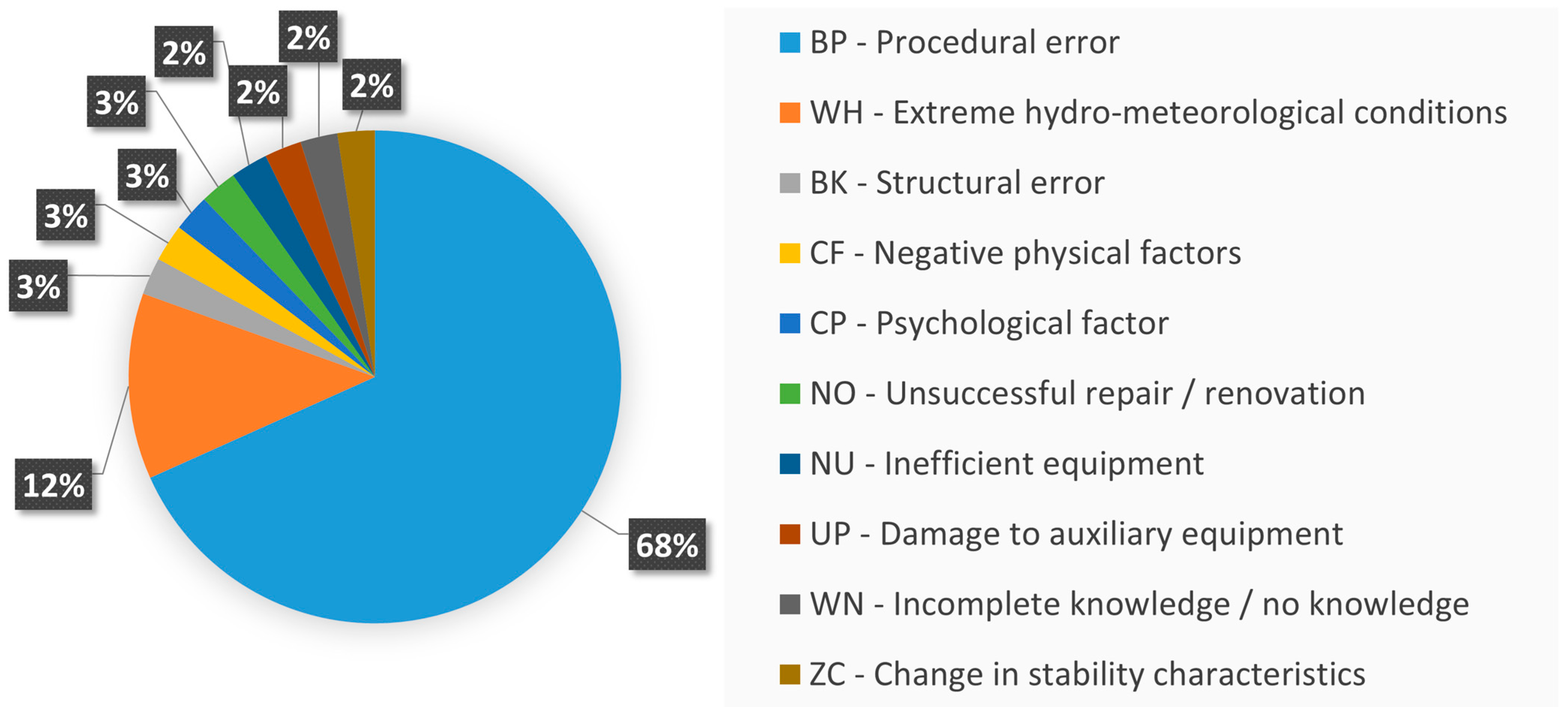
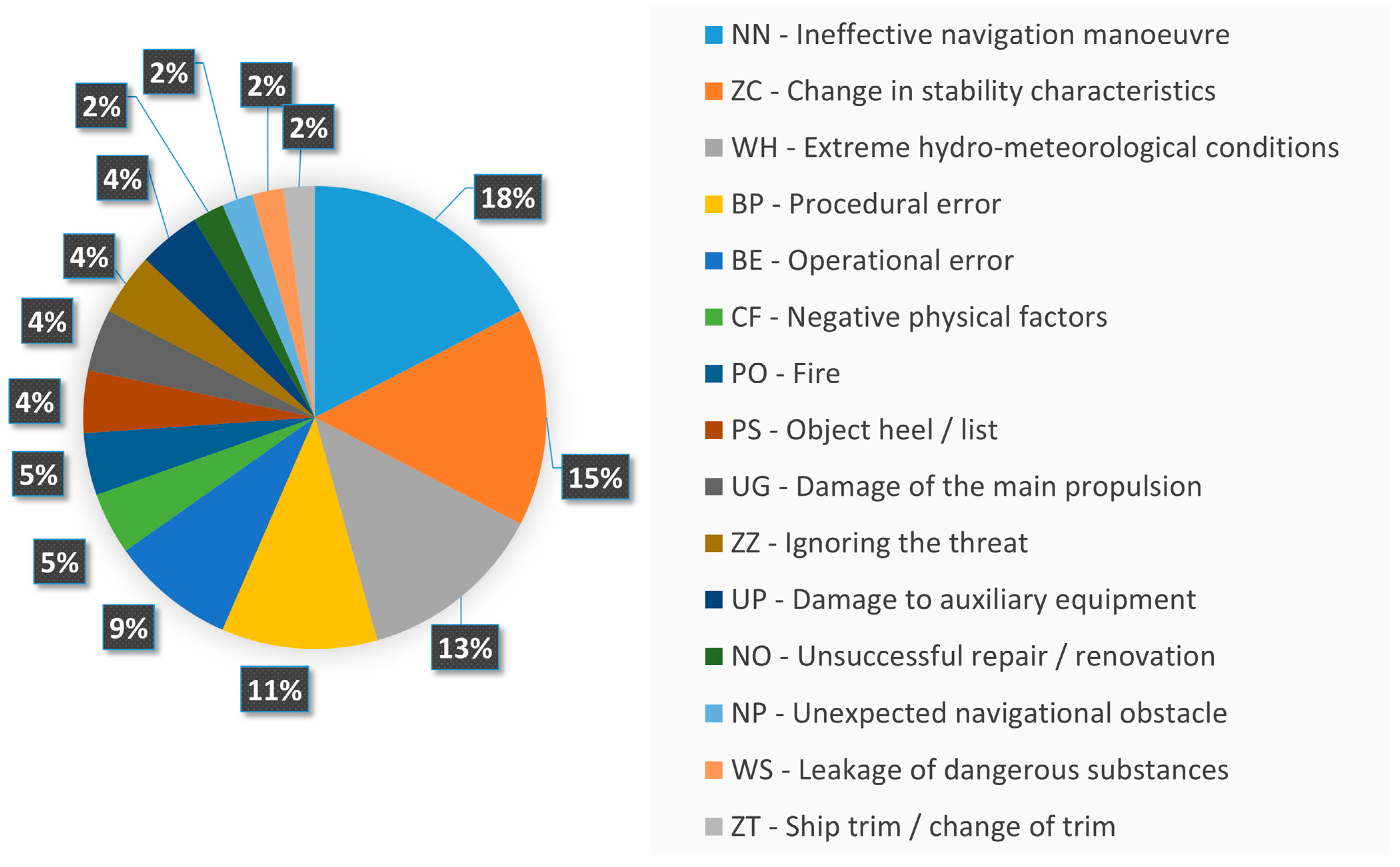
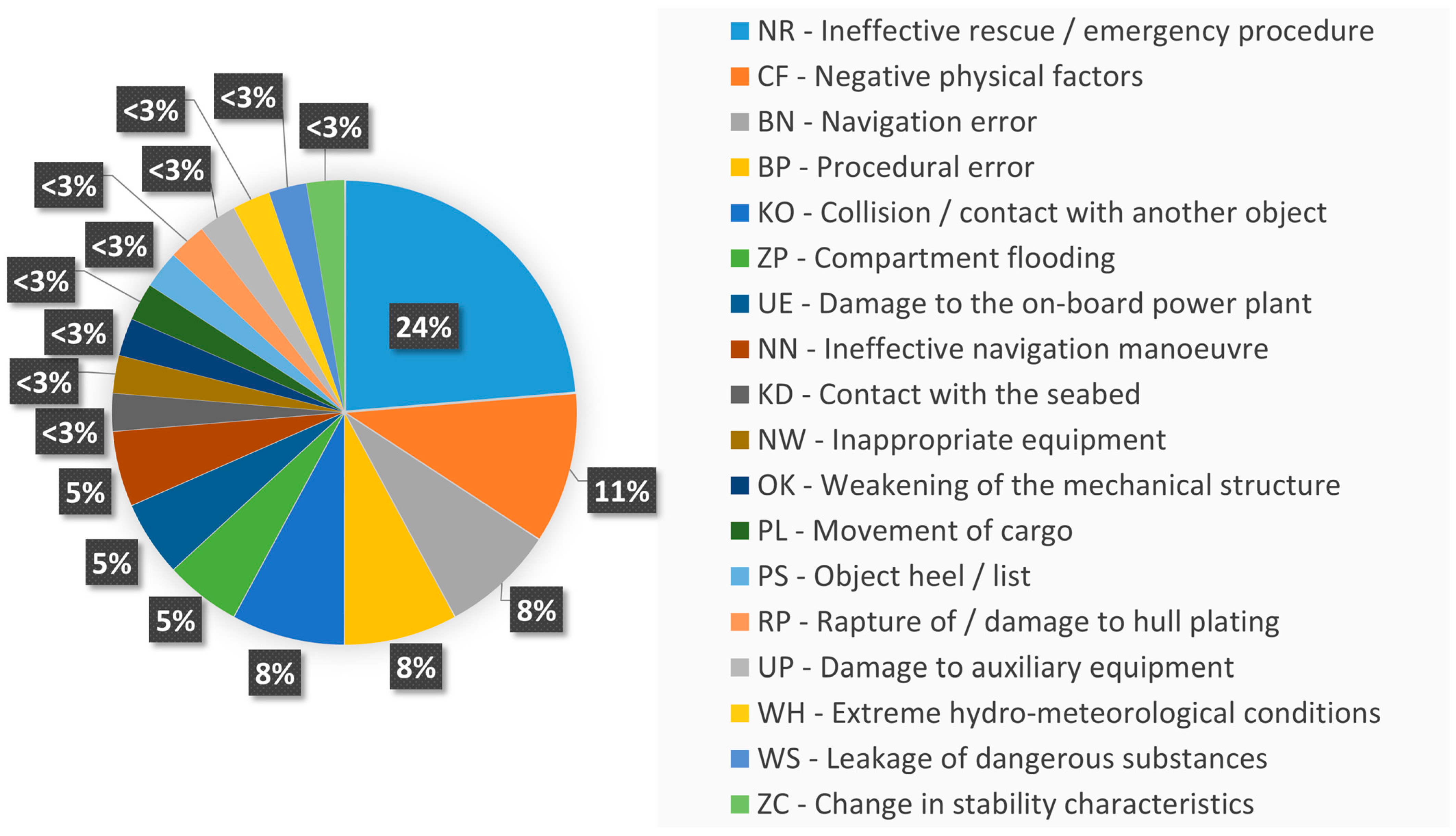

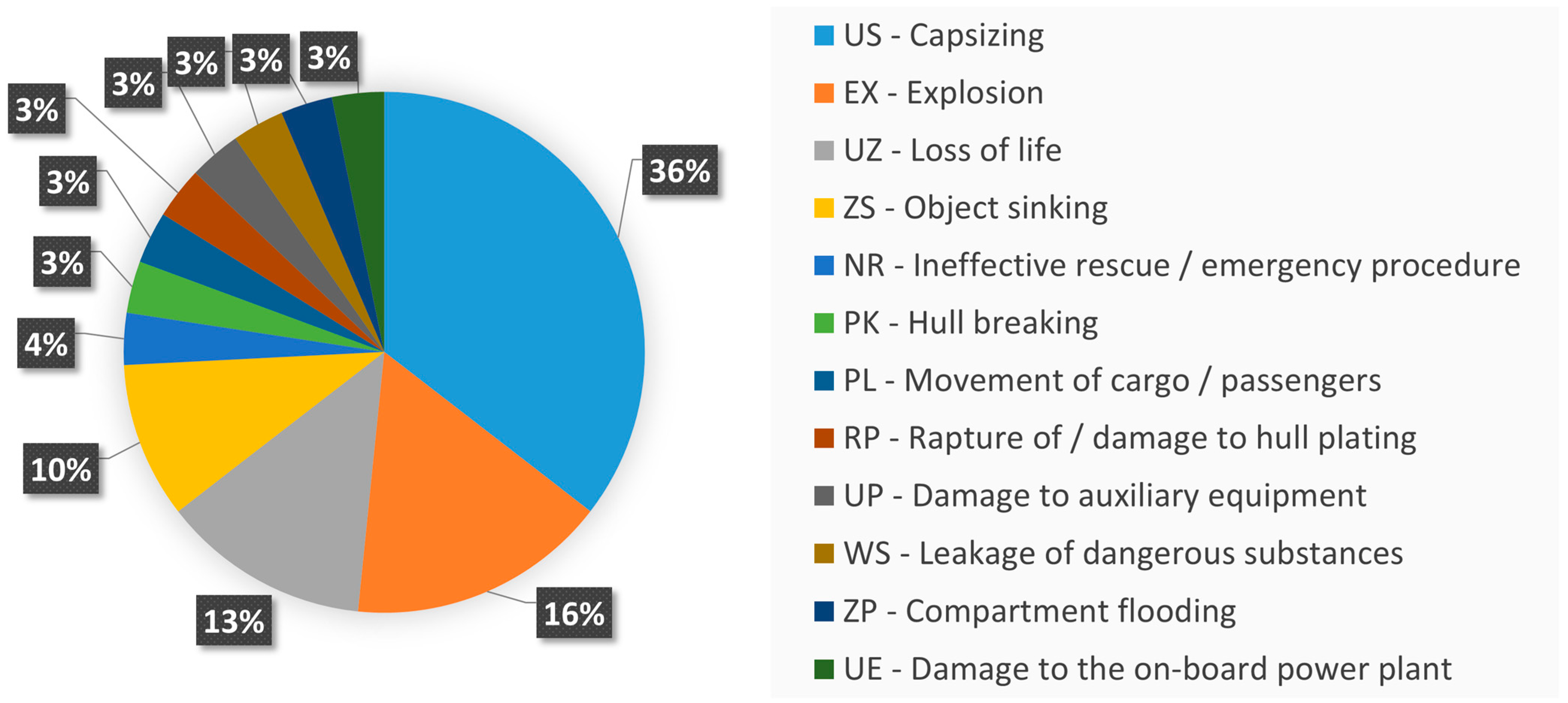
| Year | Unit Name | The Impact of the Disaster |
|---|---|---|
| 1912 | RMS Titanic | Ship capsizes and sinks, 1517 people die [34,35,36,37,38]. |
| 1914 | RMS Empress of Ireland and SS Storsted | Shipwreck, death of 1012 people [39,40]. |
| 1915 | SV Eastland | Ship capsizes, 844 people die [41]. |
| 1917 | SV Mont Blanc and SS Imo | Loss of ships, deaths of about 2000 people, about 9000 injured, destruction of a city district [42,43]. |
| 1947 | SV Ramdas | Ship capsizes and sinks, 669 people die [44,45]. |
| 1954 | SF Tōya Maru | Ship capsizes and sinks, death of about 1170 people [46]. |
| 1967 | SV Torrey Canyon | Hull breach, oil spills into the sea, ship bombed [47]. |
| 1978 | MT Amoco Cadiz | Rupture of the hull plating, breakage of the hull, oil spills into the sea, destruction of the ship with deep-sea charges [48,49]. |
| 1979 | Ixtoc I production platform | Oil spills into the sea, platform collapses [50]. |
| 1979 | ST Atlantic Empress and ST Aegean Captain | Oil spills into the sea, death of 27 people, sinking of the Atlantic Empress [51]. |
| 1981 | MV Tampomas II | Ship capsizes and sinks, 666 people die [52]. |
| 1986 | MV Doña Paz and MT Vector | Sinking of both ships, death of about 4300 people [53]. |
| 1987 | MF Herald of Free Enterprise | Ship capsizes, 193 people die [54,55]. |
| 1988 | Piper Alpha production platform | Platform collapses, 167 people die [56]. |
| 1989 | MT Exxon Valdez | Rupture of plating, oil spills into the sea [57,58]. |
| 1991 | MV Salem Express | Shipwreck, deaths of around 470 people [59]. |
| 1993 | MF Jan Hevelius | Ship capsizes and sinks, 55 people die [60]. |
| 1993 | MF Neptune | Ship capsizes, death of about 1700 people [61]. |
| 1994 | MF Estonia | Ship sinking, death of around 852 people [62]. |
| 1999 | MV Erika | Hull breakage, ship sinks, leakage of hazardous substances into the sea [63,64]. |
| 2001 | Petrobras 36 production platform | Sinking of a platform, death of 11 people, leakage of hazardous substances into the sea [65]. |
| 2002 | MT Prestige | Hull breach, ship sinks, oil spills into the sea [66,67]. |
| 2002 | MV Le Joola | Ship capsizes, deaths of about 1220 people [68]. |
| 2002 | MV Tricolor and MV Kariba, MV Nikola, MV Vicky | Ship capsizes, loss of cargo, leakage of hazardous substances into the sea, sinking of the Tricolor [69,70,71]. |
| 2006 | MV Al-Salam Boccaccio 98 | Ship capsizes and sinks, 1161 people die [72,73]. |
| 2008 | MV Princess of the Stars | Ship capsizes and sinks, death of about 814 people [74]. |
| 2010 | Deepwater Horizon production platform | Platform capsizes and sinks, 11 people die, oil spills into the sea [75,76]. |
| 2011 | MV Rena | Hull breakage, fuel leakage into the sea, loss of cargo [77,78]. |
| 2014 | MF Sewol | Ship capsizes, 304 people die [79,80]. |
| 2019 | MV Grande America | Ship capsizes and sinks, loss of cargo, fuel spills into the sea [81]. |
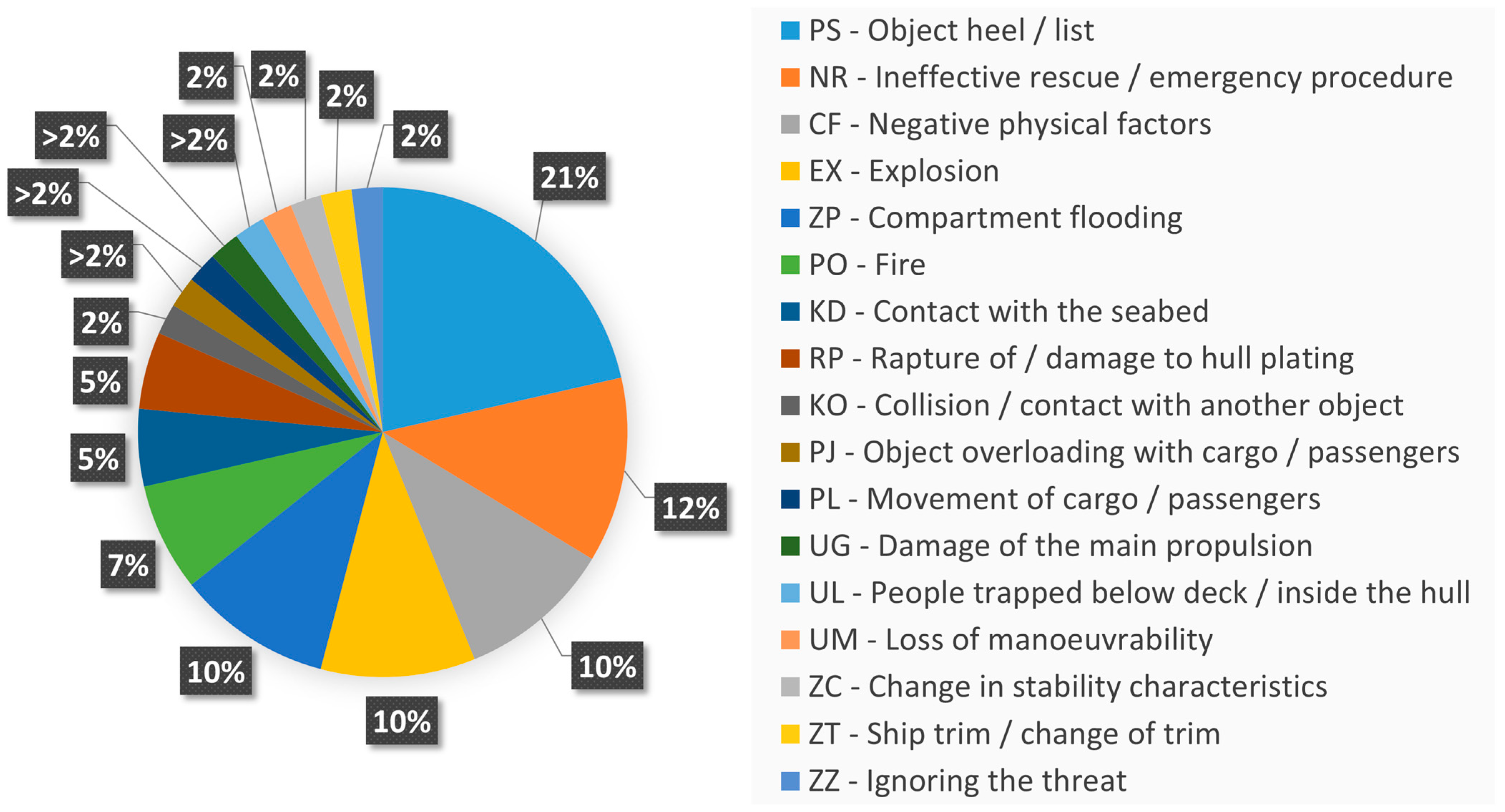
| Event Class | Number of Occurrences of Basic Event in the Analysed Population | Probability of Basic Event |
|---|---|---|
| BE—Operational error | 19 | 0.0313 |
| BK—Structural error | 13 | 0.0214 |
| BN—Navigation error | 15 | 0.0247 |
| BP—Procedural error | 42 | 0.0691 |
| BW—Workmanship/production error | 1 | 0.0016 |
| CB—Man overboard | 2 | 0.0033 |
| CF—Negative physical factors | 27 | 0.0444 |
| CP—Psychological factor | 22 | 0.0362 |
| DS—Object drift | 4 | 0.0066 |
| EX—Explosion | 12 | 0.0197 |
| KD—Contact with the seabed | 3 | 0.0049 |
| KO—Collision/contact with another object | 11 | 0.0181 |
| NO—Unsuccessful repair/renovation | 4 | 0.0066 |
| NK—Ineffective modification of the structure | 10 | 0.0164 |
| NM—Excessive speed | 6 | 0.0099 |
| NN—Ineffective navigation manoeuvre | 18 | 0.0296 |
| NP—Unexpected navigational obstacle | 5 | 0.0082 |
| NR—Ineffective rescue/emergency procedure | 47 | 0.0773 |
| NU—Inefficient equipment | 18 | 0.0296 |
| NW—Inappropriate equipment | 7 | 0.0115 |
| OK—Weakening of the mechanical structure | 7 | 0.0115 |
| OP—Reduced psychomotor performance of the operator | 7 | 0.0115 |
| PJ—Object overloading with cargo/passengers | 7 | 0.0115 |
| PK—Hull breaking | 5 | 0.0082 |
| PL—Movement of cargo/passengers | 5 | 0.0082 |
| PO—Fire | 22 | 0.0362 |
| PS—Object heel | 31 | 0.0510 |
| RP—Rupture of/damage to hull plating | 14 | 0.0230 |
| UE—Damage to the on-board power plant | 4 | 0.0066 |
| UG—Damage to the main propulsion | 5 | 0.0082 |
| UL—People trapped below deck/inside the hull | 3 | 0.0049 |
| UM—Loss of manoeuvrability | 4 | 0.0066 |
| UP—Damage to auxiliary equipment | 25 | 0.0411 |
| US—Capsizing | 11 | 0.0181 |
| UZ—Loss of life | 20 | 0.0329 |
| WH—Extreme hydro-meteorological conditions | 32 | 0.0526 |
| WM—Material defect | 2 | 0.0033 |
| WN—Incomplete knowledge/no knowledge | 9 | 0.0148 |
| WS—Leakage of dangerous substances | 16 | 0.0263 |
| ZC—Change in stability characteristics | 22 | 0.0362 |
| ZP—Compartment flooding | 29 | 0.0477 |
| ZS—Object sinking | 19 | 0.0313 |
| ZT—Ship trim/change of trim | 5 | 0.0082 |
| ZZ—Ignoring the threat | 16 | 0.0263 |
| SUM: | 608 | 1.0000 |
| Measure of Importance | Interpretation of the Measure in Relation to Analysis of the Structure of the Object (System) | Interpretation of the Measure in Relation to Process Flow Analysis |
|---|---|---|
| IB | Measure indicates the increase in reliability for which the component contributes most to the reliability of the system. | Measure indicates the escalation of the probability of occurrence that the basic event contributes most to the occurrence of a given disaster phase. |
| IBS | Interpretation analogous to IB, except all components are assumed to have the same reliability of 0.5. | Interpretation analogous to IB, except all basic events are assumed to occur with the same probability of 0.5. |
| IP | Interpretation analogous to IB, except the reliability of the element is also taken into account. | Interpretation analogous to IB, except the probability of a basic event is also taken into account. |
| IV-F | Measure indicates which element is most likely to contribute to system damage (the minimum cross-section containing the element). | Measure indicates which basic event with the highest probability contributes to the occurrence of a given phase of the disaster (the minimum path containing the basic event). |
| IC | Measure indicates the probability that failure of a component results in system failure. | Measure indicates the probability that the occurrence of a given basic event results in the occurrence of a given disaster phase. |
| Phase | Description | Event Class | Denotation of Basic Event |
|---|---|---|---|
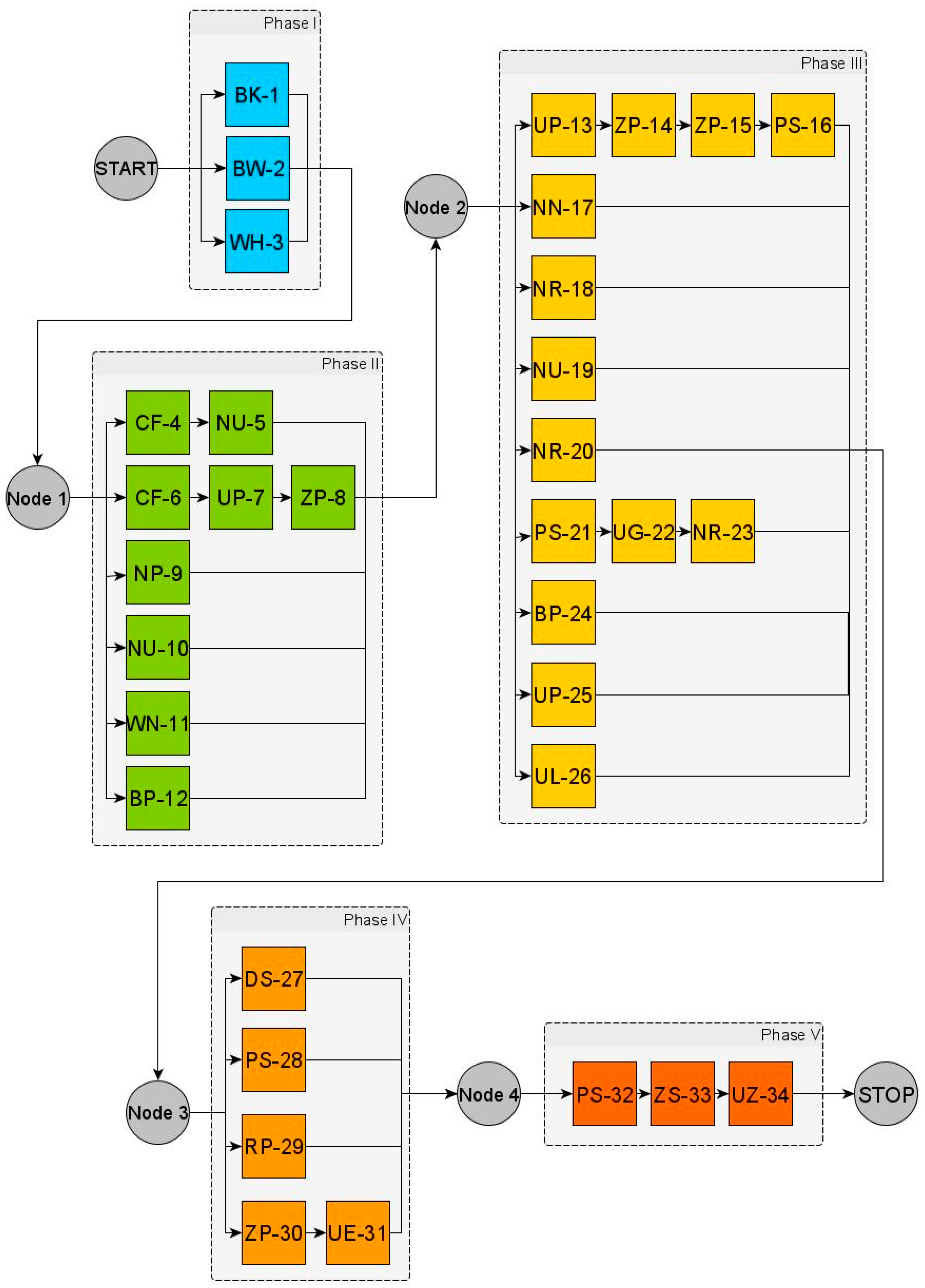
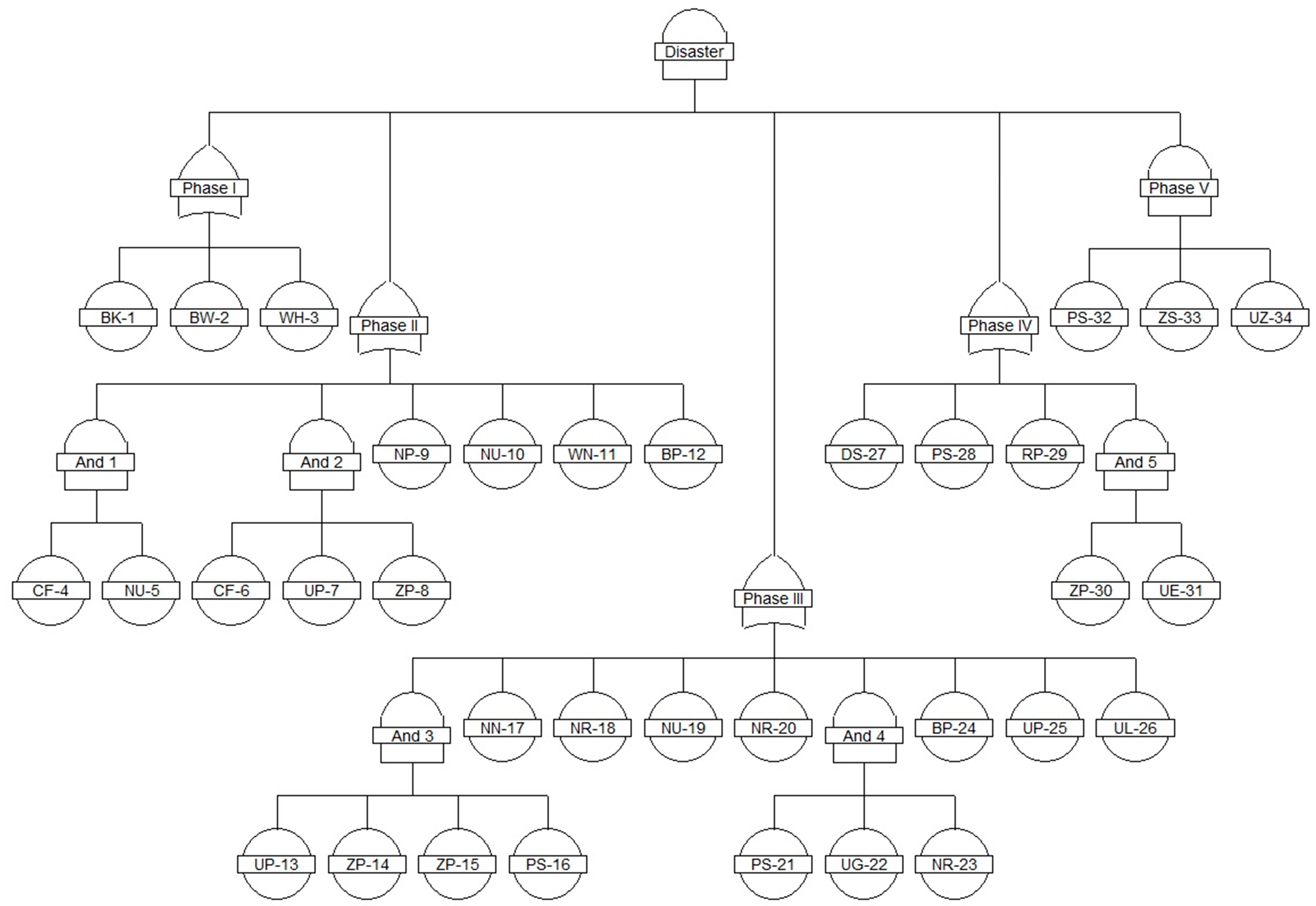
| Latent | The bow port gate has a design flaw (the design load on the bow port canopy and the assumed load distribution at the joints do not reflect the actual impact of sea waves). | BK | BK-1 |
| Canopy interlocks are not made as designed. | BW | BW-2 | |
| On the day of the disaster, the wind was 18 m/s and the waves reached about 4 m high. | WH | WH-3 | |
| Initiating | Seawater pressure during the storm causes the deformation of the hinges and locks of the bow port canopy. | CF | CF-4 |
| The hinges and locking mechanism of the bow gate canopy are unable to hold the gate in the closed position. | NU | NU-5 | |
| External forces are pushing on the canopy. | CF | CF-6 | |
| The pressure of the canopy under the external forces causes the ramp to partially unseal, which relates to its design flaw. | UP | UP-7 | |
| Water flows onto the car deck through the unsealed ramp. | ZP | ZP-8 | |
| Ship maintains full speed. | NP | NP-9 | |
| Signalling indicators show the closed status for the bow port canopy and the ramp located on the bridge does not indicate unsealing. | NU | NU-10 | |
| The canopy is not visible from the navigation bridge. | WN | WN-11 | |
| The unsealed port is visible on the CCTV system monitors on the engine room’s manoeuvring and control panel, but the engine room crew does not report the problem to the bridge. | BP | BP-12 | |
| Escalating | Under the water pressure, the gate breaks and falls into the sea. | UP | UP-13 |
| Water flows in through the ramp. | ZP | ZP-14 | |
| Under the influence of an enormous amount of water, the car deck is flooded. | ZP | ZP-15 | |
| The ship has a heel of about 15 degrees to starboard, which continues to increase. | PS | PS-16 | |
| Watch officers reduce the ship’s speed and make a turn to the port side. | NN | NN-17 | |
| Officers instruct the mechanics to compensate for the heel by using the ballast system. | NR | NR-18 | |
| Ballast system does not work due to air intake by the pumps. | NU | NU-19 | |
| Watch officers close the watertight bulkheads. | NR | NR-20 | |
| The ship now has an approximate 30-degree heel to the starboard. | PS | PS-21 | |
| Both main engines, one after the other, stop due to a drop in the lubricating oil pressure, which is associated with the excessive tilt. | UG | UG-22 | |
| The crew on the bridge broadcasts an SOS signal and declares a lifeboat alert, but an organised rescue operation is not underway. | BP | BP-24 | |
| In many cases, rescue equipment does not work. | UP | UP-25 | |
| Ship’s lifeboats cannot be lowered due to the heeling. | NR | NR-23 | |
| Many passengers are trapped below deck. | UL | UL-26 | |
| Critical | Ship drifts starboard toward incoming sea waves. | DS | DS-27 |
| Ship now has a heel of more than 40 degrees. | PS | PS-28 | |
| The windows and doors of the stern superstructure on the starboard side are destroyed. | RP | RP-29 | |
| Unsealed windows and doors cause the rooms to sink. | ZP | ZP-30 | |
| Ship’s power plant is flooded and stops operating. | EU | EU-31 | |
| Energy release | The ship’s tilt continues to increase. | PS | PS-32 |
| Due to the heeling, the Estonia begins to sink (starting with the stern); within a few minutes, the ship has a heel of about 80 degrees, after which it sinks. | ZS | ZS-33 | |
| 852 people die. | UZ | UZ-34 |
| Phase | IB | IBs | IVF | ICR | IIP |
|---|---|---|---|---|---|
| Latent | WH-3; BK-1; BW-2 | WH-3, BK-1, BW-2 | WH-3; BK-1; BW-2 | WH-3; BK-1; BW-2 | WH-3; BK-1; BW-2 |
| Initiating | BP-12; NU-10; NP-9; WN-11; NU-5; CF-4; UP-7; CF-6; ZP-8 | BP-12, NU-10, NP-9, WN-11; NU-5, CF-4; UP-7, CF-6, ZP-8 | BP-12; NU-10; NP-9; WN-11; NU-5, CF-4; UP-7, CF-6, ZP-8 | BP-12; NU-10; NP-9; WN-11; NU-5, CF-4; UP-7, CF-6, ZP-8 | BP-12; NU-10; NP-9; WN-11; NU-5, CF-4; UP-7, CF-6, ZP-8 |
| Escalating | NR-18, NR-20; BP-24; UP-25; NN-17; NU-19; UL-26; UG-22; PS-21; NR-23; UP-13, PS-16, ZP-14, ZP-15 | NR-18, NR-20, BP-24, UP-25, NN-17, NU-19, UL-26; UG-22, PS-21, NR-23; UP-13, PS-16, ZP-14, ZP-15 | NR-18, NR-20; BP-24; UP-25; NN-17; NU-19; UL-26; UG-22, PS-21, NR-23; UP-13, PS-16, ZP-14, ZP-15 | NR-18, NR-20; BP-24; UP-25; NN-17; NU-19; UL-26; UG-22, PS-21, NR-23; UP-13, PS-16, ZP-14, ZP-15 | NR-18, NR-20; BP-24; UP-25; NN-17; NU-19; UL-26; UG-22, PS-21, NR-23; UP-13, PS-16, ZP-14, ZP-15 |
| Critical | PS-28; RP-29; DS-27; EU-31; ZP-30 | PS-28, RP-29, DS-27; EU-31, ZP-30 | PS-28; RP-29; DS-27; EU-31, ZP-30 | PS-28; RP-29; DS-27; EU-31, ZP-30 | PS-28; RP-29; DS-27; EU-31, ZP-30 |
| Energy release | ZS-33; UZ-34; PS-32 | ZS-33, UZ-34, PS-32 | ZS-33, UZ-34, PS-32 | ZS-33, UZ-34, PS-32 | ZS-33, UZ-34, PS-32 |
Disclaimer/Publisher’s Note: The statements, opinions and data contained in all publications are solely those of the individual author(s) and contributor(s) and not of MDPI and/or the editor(s). MDPI and/or the editor(s) disclaim responsibility for any injury to people or property resulting from any ideas, methods, instructions or products referred to in the content. |
© 2023 by the authors. Licensee MDPI, Basel, Switzerland. This article is an open access article distributed under the terms and conditions of the Creative Commons Attribution (CC BY) license (https://creativecommons.org/licenses/by/4.0/).
Share and Cite
Chybowska, D.; Chybowski, L.; Myśków, J.; Manerowski, J. Identification of the Most Important Events to the Occurrence of a Disaster Using Maritime Examples. Sustainability 2023, 15, 10613. https://doi.org/10.3390/su151310613
Chybowska D, Chybowski L, Myśków J, Manerowski J. Identification of the Most Important Events to the Occurrence of a Disaster Using Maritime Examples. Sustainability. 2023; 15(13):10613. https://doi.org/10.3390/su151310613
Chicago/Turabian StyleChybowska, Dorota, Leszek Chybowski, Jarosław Myśków, and Jerzy Manerowski. 2023. "Identification of the Most Important Events to the Occurrence of a Disaster Using Maritime Examples" Sustainability 15, no. 13: 10613. https://doi.org/10.3390/su151310613
APA StyleChybowska, D., Chybowski, L., Myśków, J., & Manerowski, J. (2023). Identification of the Most Important Events to the Occurrence of a Disaster Using Maritime Examples. Sustainability, 15(13), 10613. https://doi.org/10.3390/su151310613