


Abstract
The impacts of perceived risk (PR) and perceived severity (PS) on personal well-being (WB) during the COVID-19 epidemic have often been overlooked, especially in the context of China’s post-1990 generation. Therefore, this research intends to explore how members of the post-1990 generation obtain personal benefits through PR through the Attention Restoration Theory (ART). A total of 276 online questionnaires were collected by snowball sampling and analyzed in SPSS 21.0. This research found that PR, NC, and the ART are mediating variables which affect WB. The higher the PR, the more likely it is that the post-1990 generation will engage in nature tourism. These discoveries undoubtedly demonstrate a breakthrough in the theoretical gap, and provide a proposal for the sustainable development of China’s tourism industry.
1. Introduction
The sudden arrival of COVID-19 sounded an alarm for human society, impacting all walks of life through the physical and mental challenges it initiated. This sudden outbreak was equivalent to a “frost” that shrouded the domestic tourism market in darkness. In such an environment, would you be tempted to try nature tourism?
Nowadays, some members of the post-1990 generation have reached the age of 30 and are under multiple pressures from study, work, and family. For them, tourism is an indispensable way to relax in life [1]. Compared with the post-1985 and post-2000 generations, the post-1990 generation has a lower well-being (WB) index and a higher stress index. Housing, employment, and health are the stumbling blocks for Chinese youth trying to improve their WB [2]. Unavoidable external stressors cause the daily lives of those in the post-1990 generation to be significantly disturbed physically and mentally [3]; thus, the psyche of China’s post-1990 generation has been greatly affected by the epidemic. For China’s post-1990 generation of young people, their happiness averages are already low [4]. In the fight against the epidemic, attention can be chronically exhausted, and psychological pain can quickly deteriorate into mental stress. If young people continue to be affected by physical health problems, they suffer more significantly from anxiety, depression, and lower rates of WB [5]. To summarize, it is necessary to minimize the psychological burden and prevent mental stress during a health crisis [6].
During COVID-19, some people have preferred to avoid travel, whereas others have turned to nature tourism in moderation. However, predicting these behaviors depends on the different situational factors of individuals, including health problems, perceived risk (PR), and personal beliefs [7,8,9]. Therefore, will tourists of the post-1990 generation still have an interest in natural contact (NC) under the uncertain situation of the epidemic? Answering this question is the first purpose of this research.
Travel may generate risks and uncertainties [10,11]. Health risks are also a part of travel risks, especially in the context of COVID-19, and these affect travel behavior [12]. The Health Belief Model (HBM) is a widely used theoretical framework for explaining health-related changes in perception and behavior [9,13]. The COVID-19 outbreak poses a threat of infection to people. In the HBM [14,15,16], the effectiveness of taking action includes perceived benefits and perceived barriers. Perceived benefits are the behavioral effects of effective threat reduction, and perceived barriers include differences in expected costs and negative consequences. Both perceived benefits and PR influence engagement behavior. Therefore, if the perceived severity (PS) of the COVID-19 epidemic is higher for the post-1990 generation, will their demand for engagement in nature-based tourism increase or decrease? Furthermore, how will it affect the WB of the post-1990 generation when engaging in nature-based tourism?
Most studies focus on safety risks and their impact on tourists and the tourism industry [17]. There are few studies on the intention to travel in a pandemic risk environment [18]. Chen et al. [19] analyzed the contents of 115 articles related to tourism disease risk and found that tourism scholars did not value tourism risk. Additionally, a search on the Web of Science showed that only 105 studies have used the HBM in the tourism industry. Few previous studies have used the HBM to identify individual decision-making processes related to preventive travel behaviors from a personal perspective [9], how health-related travel behaviors respond to the epidemic, and how nature travel affects an individual’s WB. Previous research on post-epidemic tourism behavior has not placed the post-1990 generation in a vital position for separate discussion, and this is a research gap that deserves attention. Because this generation plays a crucial role in household consumption decision-making, they have become the backbone of consumption in China’s tourism market. Finally, the fact that the post-1990 generation has been gradually occupying the right to speak on major media platforms cannot be overlooked. As long as the tourism industry captures this generation of consumers, it will also occupy a part of the Chinese tourism market [1]. Focusing on this concept also allows for the preparation of the sustainable development of the post-epidemic tourism industry in advance. Therefore, this research seeks to understand what benefits the engagement of the post-1990 generation in nature-based tourism will bring them in the context of COVID-19, and what role PR plays in improving WB.
This research intends to apply the Attention Restoration Theory to fill the gaps between theory and practice. Kaplan and Kaplan [20] mentioned that in the ART, the natural environment has a curative effect on human attention recovery. The natural environment that people come into contact with may not be spectacular; even a tiny piece of open land or a part of a forest can have the effect of restoring attention [21,22]. Townsend [23] pointed out that interacting with nature benefits humans and that much psychological and physical pain is caused by losing contact with nature. The issue of tourism WB should be taken seriously, as humans often seek social interaction to improve the quality of their lives and enhance WB [24]. Therefore, the final purpose of this research is to explore the PS, PR, and attention recovery of the post-1990 generation, and to determine whether their WB and attention recovery can be improved when engaging in nature-based tourism.
This research intends to integrate the above theories into a single conceptual framework to fill these gaps and highlight the influential relationships between each variable in these theories in a comprehensive model. This research proposes seven hypotheses in response to the purposes found through the literature review. This research conducts a quantitative questionnaire survey, and SPSS 21.0 is used as an analysis tool to verify the causal relationship between variables.
2. Literature Review and Hypotheses
2.1. NC, ART, and WB
Kaplan and Kaplan [20] put forward the “ART”, which mainly explains the concept of reducing mental fatigue and restoring direct attention. Direct attention is dominated by the autonomous consciousness and selectively concentrates on something. If humans use direct attention for a long time, this excessive mental attention would lead to direct attention fatigue [25]. This direct attention fatigue is also known as “mental fatigue”. Mental fatigue often results in reduced attention and problem-solving abilities, and increased irritability, mistakes, or accidents [26]. Attention fatigue may occur when a particular stimulus or task needs to be concentrated on [21]. The four characteristics of attention recovery are “being away,” “extent,” “fascination,” and “compatibility” [20]. Seeing green through a window can enhance WB, promoting mental recovery [27]; in this way, humans can recover from stressful events [28]. Oswald et al. [29] found that exposure to nature when under a COVID-19 lockdown brings young people a sense of “escape” from reality.
Reduced natural exposure causes young people to be almost twice as stressed, whereas 51% of young people with increased natural exposure can achieve the effect of attention recovery [29]. Restorative perception is an essential intermediary variable for NC affecting WB [30,31]. Lee et al. [32] defined forest therapy as engaging in healing activities by visiting a forest environment to improve an individual’s physical and mental health, which is similar to enhancing WB. Furthermore, the frequency of visits to the natural environment positively impacts the sense of recovery in nature, and restorative perception positively affects emotional WB [30,33]. Based on the above analyses, this research deduces the following hypotheses:
Hypotheses 1:
Natural resources (NR) have a positive and significant impact on NC during the epidemic.
Hypotheses 2:
NC has a significant positive effect on attention recovery during the epidemic.
Hypotheses 3:
Attention restoration has a positive and significant effect on WB during the epidemic.
2.2. PR, NC, and WB
Due to the global pandemic, travel decisions involve risk perception as tourists encounter uncertain conditions at the destination, affecting their decision-making with regard to relevant potential negative results [34]. In other words, travelers’ concerns about health risks or the possibility of infection influence their behavior [35]. Fuchs and Reichel [36] defined risk perception as potential hazards related to travel; if the risk exceeds the acceptable level, this situation may influence the travel decision. This research defines PR as the degree of potential loss perceived by the post-1990 generation to travel in contact with nature, which stems from the adverse consequences of travel caused by the global pandemic due to COVID-19.
PR is a central consideration in the decision-making process of travelers or tourists [37]; it even changes rational decisions about travel or destination selection [38]. A higher PS causes a threat to health and a higher protective behavior of the population [39]. However, when facing the PR of traveling, will the post-1990--generation tourists still act the same as in previous research results? Based on the above analysis, this research speculates the following hypothesis:
Hypotheses 4:
The PR of the epidemic has a significant negative impact on NC.
NC can enhance physical health and mental pleasure, enhancing personal WB [40]. Bradburn and Caplovitz [41] proposed that WB is the sum of positive and negative emotions that equals the quality of life. Kuykendall et al. [42] found that the benefits of engaging in natural leisure activities are predictors of WB; NC can increase the WB of professionals. A high PR can lead to traumatic travel crises due to the reason that tourists and travel agencies fear their vacation packages and products would adversely affect them. Natural exposure can reduce the risk of infectious diseases by alienating people in the natural environment [43]. Therefore, this research proposes the following research hypothesis:
Hypotheses 5:
NC has a positive and significant impact on WB during the epidemic.
2.3. PS, PR, and WB
Due to the intangible nature of the tourism industry and the highly participatory nature of tourism services, tourists’ PR may increase [44]. An individual’s perception of risk in the activity is subjective [45]. PR is a process of cognitive severity and assessment based on an individual’s prior experience, acquired information, and psychological responses. Prasetyo et al. [46] noted that when people know that they are in a community with a healthy lifestyle environment, it increases the feeling of safety of not being infected with COVID-19. Janz and Becker [47] mentioned that health perceptions might enhance the motivation for self-protection. People’s awareness of the outbreak’s severity increases the PR of COVID-19, strengthening health perceptions and enhancing self-protection. Huang et al. [48] analyzed the impact of health beliefs on the health risk aversion behavior and travel satisfaction of tourists. The research reported that PS positively affected the attitude of health risk aversion behavior; the higher humans’ perceived severity, the more risk averse they will be. The potential hazards and risks associated with health in travel and tourism activities are harmful to the health and WB of tourists [49]. Therefore, the following hypotheses are put forward:
Hypotheses 6:
The PS of the epidemic has a positive and significant impact on PR.
Hypotheses 7:
The PR of the epidemic has a significant negative impact on WB.
3. Research Methodology
3.1. Questionnaire Design
In this research, the questionnaire survey method was the primary survey method. The “back translation” method was used as the translation conversion test method of the questionnaire. The original questionnaire of this research was based on a reference to English journals. We sorted out the questions, translated them into Chinese, and then asked three relevant professional teachers with English educational backgrounds to help confirm the meaning of the English translation. Next, the question was translated into English again, and the three teachers were asked to verify whether the back translation was consistent with the original English meaning. After repeating the revision and confirmation in this way, a Chinese questionnaire was designed and distributed.
The questionnaire consists of seven parts: NR, NC, attention restoration, PS, PR, and WB. Demographic variables include four categories, such as gender, marital status, occupation, and place of residence, measured on a category scale. Except for demographic variables measured on category scales, the remaining variables were measured on the Likert seven-point scale, ranging from 1 = extremely disagree to 7 = extremely agree.
3.2. Sample’s Criteria
The subjects of this research were post-1990-generation Chinese who took a nature trip during COVID-19. In the questionnaire design, the first question is: “whether you participated in nature-based tourism during the epidemic,”. The respondents can only enter the questionnaire when choosing “YES.” After meeting these two conditions, a respondent became a part of the sample of this research.
3.3. Data Collection
This research used the formula to estimate the sample size. Since this sample uses a 7-point Likert scale where m = 4, the sample variance is S = 1.5, and the confidence level is 95%, then, e = 5% × 4 = 0.2, and the calculated result is 216. In other words, the number of questionnaires in this research needs to be at least 216.
The survey links were distributed at different times (morning, middle, evening, and midnight), and the respondents could only answer once for each link. After completing the questionnaire, respondents were rewarded an average of RMB 4 (USD 0.65) as compensation. The research was conducted from 13 January 2021 to 15 March 2021 using a snowball sampling method to consider the impact of the COVID-19 outbreak. Therefore, 296 questionnaires were distributed, and 276 (more than 216) valid questionnaires were received using online questionnaires.
3.4. Data Analysis
This research utilized SPSS 21.0 as an analysis tool. For the data collected in the questionnaire, the research used a descriptive statistical analysis of the basic data cognition of tourists. A project analysis was used for testing each question to understand the discrimination and homogeneity; a factor analysis was carried out to extract the main factor facets of each variable and examine the validity of each variable. Finally, a regression analysis verified the influence of the relationship between the variables from the proposed research hypotheses.
3.5. Item Analysis
The primary purpose of this research is to measure the difference between the subjects in each topic comparison or homogeneity test, to test whether the topics can identify the degree of response of different subjects. The correlation between the revised question and item-to-total must be more than 0.3. The CR value reached a significant level (p < 0.05). Therefore, a total of 37 questions were reserved in this research, as shown in Table 1.

Table 1.
Questionnaire item analysis.
4. Analysis of Results
4.1. Descriptive Statistical Analysis
The results of the demographic characteristics from respondents showed that “male” accounted for 34.8%, and “female” accounted for 64.9%. Marital status was dominated by “unmarried,” accounting for 75.9%, whereas “married” accounted for 24.3%; the number of unmarried people was higher than the number of married people. Education level was dominated by “university,” accounting for 44.6%, followed by “research institute and higher,” accounting for 35.1%. For “Average monthly income”, those making 3000 yuan was the largest group, accounting for 28.3%, whereas 13.8% of respondents have an income of more than 10,000 yuan. For occupations, “students” was the largest group, accounting for 31.9%, followed by “service,” accounting for 22.8%.
The average of each dimension is shown in Table 2. The facets can be concluded as follows: “Engagement in nature-based tourism makes me happy” is the highest for NR (m = 3.710). “I will increase the number of engagements in nature-based tourism” is the lowest for NR (m = 2.580). “I feel that COVID-19 will have a serious impact on health” is the highest for PS (m = 5.812). “I feel the possibility of COVID-19 infection is increasingly likely” is the lowest for PS (m = 4.533). “When I travel, I worry about being infected with COVID-19 when I come into contact with people” is the highest for PR (m = 5.576). “When I travel, I feel anxious about COVID-19” is the lowest for PR (m = 4.935). “I love nature deeply” is the highest for NC (m = 5.768). “My ideal vacation place is the natural environment of the remote wilderness” is the lowest for NC (m = 5.493). “Contact with nature can help me relax my tense mood” is the highest for ART (m = 5.790). “I can do my favorite activities in such an environment” is the lowest for ART (m = 5.667). “The natural environment makes my physical and mental health better” is the highest for WB (m = 5.775). “My relationships are good” is the lowest for WB (m = 5.536).
Table 2.
The confirmatory factor analysis.
4.2. Reliability and Validity Analysis
This research used a confirmatory factor analysis to analyze the six dimensions, and the results are demonstrated in Table 2. The KMO values are 0.811, 0.698, 0.781, 0.932, 0.945, and 0.897, and the values of Bartlett’s test are 883.147, 323.655, 864.017, 4259.725, 2915.148, and 3053.128; the significance for all is 0.000. As shown in Table 2, the factor loadings are all above 0.7, and the values of average variance extracted (AVE) are greater than 0.7. The composite reliability (CR) values are greater than 0.8, which reveals having high convergence validities. Table 3 shows that the square roots of the AVE are all greater than the correlation coefficients among the variables, which means the scale had high discriminant validity. The AVE square roots of each concept in this research are more significant than the correlation coefficient with different concepts, as shown in Table 3.
Table 3.
Discriminant validity of the constructs.
4.3. Hypotheses Test
The regression analysis results are shown in Table 4. The DW (Durbin–Watson) statistics are close to 2, meaning the independence test is in line with them. The VIFs are less than 10, and no collinear situation occurs.
Table 4.
Regression analysis.
- Model 1: Self-variable for NR and PR; the dependent variable is NC; F value = 15.257; p = 0.000; R2 = 0.094; DW = 2.036; VIF = 1.038.
- Model 2: Self-variable for PS; the dependent variable is PR; F = 167.802; p = 0.000; R2 = 0.378; DW = 2.058; VIF = 1.000.
- Model 3: Self-variable for NC; the dependent variable is attention recovery; F = 1183.650; p = 0.000; R2 = 0.811; DW = 2.118; VIF = 1.000.
- Model 4: Self-variables for PR, NC, and attention recovery; the dependent variable is WB; F value = 578.724; p = 0.000, up to a significant level; R2 = 0.863; DW (Durbin–Watson) = 1.846; VIFs = 5.334, 5.354, and 1.086.
The path diagram of relationships between the above variables is displayed in Figure 1. The impact of NR on the WB of China’s post-1990-generation tourists was NR→NC→AR→WB, with an effect of 0.139; the impact of epidemic perceived severity on WB was PS→PR→NC→AR→WB, with an effect of 0.155. This means that the impact of the PS of the COVID-19 outbreak on the WB of post-1990-generation tourists is more significant than the effect of NR.
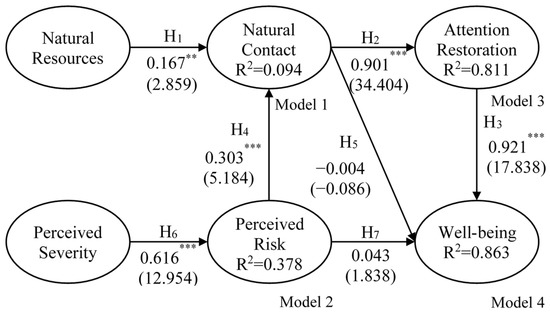
Figure 1.
Path diagram of relationships among variables. Note: *** p < 0.001, ** p < 0.01.
5. Discussion
Table 5 shows that H1, H2, and H3 are accepted. NC and attention recovery are the central intermediary variables of NR on WB. That is, post-1990-generation Chinese tourists believe that NR has a healing effect on both the body and mind, such as being close to nature, interacting with nature, and enjoying everything in nature during COVID-19. Natural interactions produce positive emotions and are also suitable for good health. Soga et al. [57] mentioned that when people live in the same space as nature, people perceive stimuli from nature, and thus, interact with nature. This natural interaction is a driver of the benefits to travelers’ physical and mental health. The natural environment’s charm provides travelers with better physical and psychological health and an optimistically happy attitude to life during COVID-19. Benfield et al. [58] noted that the natural environment positively relates to restoring stress and improving mental health. Through the psychological effects on people, the WB from viewing natural landscapes is more profound and lasting than the positive effects of being directly in a wild space. This research also found that PR, NC, and attention recovery are the central intermediary variables in the PS of the epidemic on WB. Maas et al. [59] indicated that the natural green environment provides opportunities for social interaction, acting as an intermediary to reduce loneliness and enhance WB.
Table 5.
Hypotheses test.
The establishment of H6 displays that perceiving the epidemic’s severity would make tourists perceive the risk of the epidemic. As Prasetyo, Castillo, Salonga, Sia, and Seneta [46] mentioned, when people are in an unhealthy environment, the thought of being infected with the epidemic increases. However, this does not mean the PR would affect travel without NC. Previous studies have shown the higher the PR, the lower the willingness to travel [35,36,39]. However, H4 in this research is different from previous studies. This research found that the higher the PR, the higher the post-1990 generation’s willingness to do nature tourism. We speculate that this research finding may be due to the following reasons: 1. The personality of the post-1990 generation is more enthusiastic and yearning for travel. Therefore, even knowing about the existence of the epidemic, wanting to protect themselves would not affect their desire to travel. 2. Even perceiving the epidemic’s severity, the post-1990 generation is unwilling to avoid NC. For a better explanation, natural travel is their way to release pressure and NC is important to the post-1990 generation [1]. 3. In the post-epidemic period, people still need to connect with nature. NC tourism plays a vital role in relaxing people’s bodies and minds [60]. Under China’s “clearance” policy, perhaps appropriate NC travel is also spiritual “good medicine.”
H5 and H7 are rejected. This means PR does not affect WB through NC, and attention restoration is a mediating variable of NC and WB. During the epidemic, despite having unique feelings for nature and the enjoying nature, anxiety is caused by contact with people during travel under COVID-19. Tseng and Wang [61] indicated that tourists with low PR participate more actively in the journey than those with high PR. Risk perception is an essential influencing factor affecting travelers on their way to their destinations. Rittichainuwat et al. [62] mentioned in their analysis that PR is necessary when considering tourists’ travel behavior, especially in a disaster environment. PR has a direct impact on the willingness to travel. The young generation faces a greater risk of unemployment, which means that fluctuations in the social and economic environment significantly impact young people [63]. In addition to the epidemic’s direct impact on health, PR among young populations is influenced by frequent media exposure [64]. Benfield, Taff, Newman, and Smyth [58] reported that the natural environment significantly affects physical and mental WB through attention restoration compared to direct contact with nature. This viewpoint can further verify the crucial mediating role of the ART.
6. Implication
6.1. Theoretical Implication
This research makes a significant theoretical contribution to understanding how the post-1990-generation tourists’ attention can recover through contact with nature and how this can affect WB. This research combines the perceived epidemic risk with NC, ART, and WB to establish an integrated model which can more comprehensively analyze tourism behavior in the post-epidemic environment. Through such integrated analyses, this research discusses the impact of the epidemic environment on tourism under the PS and PR and understands the post-1990-generation tourists’ attitude towards nature tourism in the epidemic environment.
From the perspective of post-1990-generation tourists, this research understands the antecedents and indicators of post-1990-generation travel to improve WB through NR, NC, attention recovery, PS, and PR. This research discusses whether post-1990-generation groups would recover their attention through tourism and further understands the impact on their WB to fill in the gaps in previous studies. In addition, by inserting PR into the comprehensive framework of this research, a different conclusion was found compared to the previous study. That is, the higher the PR of H4, the more willing a person is to participate in nature tourism, which highlights the theoretical contribution of this research framework to tourism behavior in the post-epidemic era.
This research verifies that these drivers produce a comprehensive model of post-epidemic emotional awareness on improving WB. When NR, NC, attention recovery, PS, and PR are combined into the same model, it reasonably explains how to affect the post-1990 generation’s WB through perception and attention recovery. Furthermore, another important finding is that NC does not directly affect WB, but requires enough time of being in contact with nature to produce internal attention recovery. Therefore, this research confirmed the mediating effect and critical role of attention recovery on WB.
6.2. Industrial Implications
Although post-1990-generation tourists perceive the tourism risk and the severity of the epidemic, it does not mean this affects their willingness to be in contact with nature through their ways and habits to improve their WB. On the contrary, the higher the PR, the more likely the post-1990 generation is to travel naturally. These findings are undoubtedly a breakthrough in past theoretical gaps. However, from a practical point of view, only by understanding the characteristics of tourism for consumers and establishing stakeholders in the industry can we propose sustainable development suggestions for recovering China’s tourism industry during the post-COVID-19. Therefore, this research combines the research findings and offers the following industry implications.
6.2.1. Opportunities to Create Immersive Experiences for Attention Recovery
Improving the use of a green environment helps people reduce the pressure of the environmental epidemic [65]. The natural environment can be combined with immersive experiences to create interactions with the natural environment, such as forest meditation, outdoor yoga, etc. According to the personality characteristics of the post-1990 generation mentioned above, it is suggested that relevant departments increase forest activities that can promote growth and self-breakthrough to relieve stress, restore confidence, and achieve self-realization.
The natural environment and green buildings help people have healthy emotions, for example, by viewing wilderness and natural vegetation [66]. Hotels or restaurants are advised to use transparent glass windows to increase the visibility of the natural outdoor environment and create a sense of integration with nature for travelers.
Secondly, interior architectural design can add a natural landscape (plant wall, vertical garden, or green roof) to create an atmosphere immersed in the green environment. Consequently, destinations should have transformative advertising to attract tourists.
Thirdly, for the post-1990 generation who have just entered society, cost-effective and personalized restaurants and B & B may be their first choice. Especially under the epidemic’s impact, this group of people who do not have much savings would still have a particular sensitivity to prices [1].
Finally, most post-1990-generation tourists, before or after travel, trust the comments and recommendations on tourism social media [1]. Therefore, this research suggests that restaurants or B&Bs around the scenic spot can create more online celebrity designs and give souvenirs or discount codes to tourists that actively share online to cultivate post-1990-generation tourists’ travel habits as a publicity method.
6.2.2. Strengthen Tourism Environment’s Risk Control
From a risk control perspective, this research recommends using intelligent contactless services to reduce the frequency of contact with people based on digital public services, such as health code applications. In addition, the research suggests that disinfection should be strengthened to control the safe contact distance.
Technology enables the PR reduction of tourism destinations through the use of tourism services, implementing reservation systems, passenger flow management, time-sharing admission, and other measures. In the off-season, B&Bs or hotels combine tickets with package discounts to divert travelers, avoiding crowds caused by retaliatory consumption during the peak season, and avoiding an increase in the risk of contact with people. Promoting travel around short-term nature tourism encourages the expansion of the travel radius for sparsely populated borders and fields, and encourages self-driving tourism to disperse the tourists and reduce the risk of group contact.
7. Limitation and Future Research
This research provides targeted suggestions for follow-up studies of future travel in China after the epidemic. Firstly, in terms of sample selection, the sample area of this research is a low-risk area. Accordingly, future research should be undertaken on samples from high-risk, medium-risk, and low-risk regions. Secondly, the object of this research is mainly post-1990-generation travelers from China. Although this group significantly impacts China’s economic development, the sample results cannot represent other groups under China’s epidemic. Therefore, this research suggests that future researchers choose different age groups and races for exploration and verification. Finally, this research recommends specifying the PR, for example, the effect of health, equipment, psychological, financial, social, and time risk on NC.
8. Conclusions
This research is the first to apply the perceived epidemic severity and risk using the HBM model to explore how to influence WB through perception of natural travel. A comprehensive model was used to examine the benefits of nature-based tourism in the post-1990 generation. “The higher the PR of the post-1990 generation, the more willing to engage in nature-based tourism.” This research’s findings differ from the previous study’s conclusions. This discovery is undoubtedly a breakthrough in the past theoretical gap and a proposal for the sustainable development of China’s tourism industry during the post-epidemic.
Author Contributions
Conceptualization, C.-C.S. and D.W.; methodology, C.-C.S.; software, C.-C.S.; validation, C.-C.S.; formal analysis, D.W.; investigation, D.W.; resources, D.W.; data curation, D.W.; writing—original draft preparation, D.W.; writing—review and editing, C.-C.S. and H.-L.L.; visualization, H.-L.L.; supervision, H.-L.L.; project administration, C.-C.S. and H.-L.L.; funding acquisition, C.-C.S. All authors have read and agreed to the published version of the manuscript.
Funding
This research received no external funding.
Institutional Review Board Statement
Not applicable.
Informed Consent Statement
Not applicable.
Data Availability Statement
Not applicable.
Conflicts of Interest
The authors declare no conflict of interest.
References
- Ning, T. Analysis of “post-90s” tourism behavior under the background of self-media. Tour. Today 2020, 8, 64–66. [Google Scholar]
- Shanghai Observer. Shanghai Youth Survey: The post-90s have a lower happiness index and a higher stress index than the post-85s and post-00s. Shanghai Obs. 2021. Available online: https://read01.com/GmzQL22.html (accessed on 30 March 2022).
- Chen, B.; Sun, J.; Feng, Y. How have COVID-19 isolation policies affected young people’s mental health?—Evidence from Chinese college students. Front. Psychol. 2020, 11, 1529. [Google Scholar] [CrossRef]
- Yang, H.; Ma, J. How an epidemic outbreak impacts happiness: Factors that worsen (vs. protect) emotional well-being during the coronavirus pandemic. Psychiatry Res. 2020, 289, 113045. [Google Scholar] [CrossRef] [PubMed]
- Serafini, G.; Parmigiani, B.; Amerio, A.; Aguglia, A.; Sher, L.; Amore, M. The psychological impact of COVID-19 on the mental health in the general population. QJM Int. J. Med. 2020, 113, 531–537. [Google Scholar] [CrossRef] [PubMed]
- Casagrande, M.; Favieri, F.; Tambelli, R.; Forte, G. The enemy who sealed the world: Effects quarantine due to the COVID-19 on sleep quality, anxiety, and psychological distress in the Italian population. Sleep Med. 2020, 75, 12–20. [Google Scholar] [CrossRef] [PubMed]
- Bae, S.Y.; Chang, P.-J. The effect of coronavirus disease-19 (COVID-19) risk perception on behavioural intention towards ‘untact’tourism in South Korea during the first wave of the pandemic (March 2020). Curr. Issues Tour. 2021, 24, 1017–1035. [Google Scholar] [CrossRef]
- Han, H.; Lee, S.; Kim, J.J.; Ryu, H.B. Coronavirus disease (COVID-19), traveler behaviors, and international tourism businesses: Impact of the corporate social responsibility (CSR), knowledge, psychological distress, attitude, and ascribed responsibility. Sustainability 2020, 12, 8639. [Google Scholar] [CrossRef]
- Kim, N.; Lee, S.; Lee, C.-K.; Suess, C. Predicting preventive travel behaviors under the COVID-19 pandemic through an integration of Health Belief Model and Value-Belief-Norm. Tour. Manag. Perspect. 2022, 43, 100981. [Google Scholar] [CrossRef]
- Fuchs, G. Low versus high sensation-seeking tourists: A study of backpackers’ experience risk perception. Int. J. Tour. Res. 2013, 15, 81–92. [Google Scholar] [CrossRef]
- Williams, A.M.; Baláž, V. Tourism risk and uncertainty: Theoretical reflections. J. Travel Res. 2015, 54, 271–287. [Google Scholar] [CrossRef]
- Jonas, A.; Mansfeld, Y.; Paz, S.; Potasman, I. Determinants of health risk perception among low-risk-taking tourists traveling to developing countries. J. Travel Res. 2011, 50, 87–99. [Google Scholar] [CrossRef]
- Abraham, C.; Clift, S.; Grabowski, P. Cognitive predictors of adherence to malaria prophylaxis regimens on return from a malarious region: A prospective study. Soc. Sci. Med. 1999, 48, 1641–1654. [Google Scholar] [CrossRef]
- Hochbaum, G.M. Public Participation in Medical Screening Programs: A Socio-Psychological Study; US Department of Health, Education, and Welfare, Public Health Service: Washington, DC, USA, 1958. [Google Scholar]
- Rosenstock, I.M. Why People Use Health Services. Milbank Mem Fund Q. 1966, 4, 94–127. [Google Scholar] [CrossRef]
- Sharma, M. Theoretical Foundations of Health Education and Health Promotion; Jones & Bartlett Learning: Boston, MA, USA, 2021. [Google Scholar]
- Pizam, A.; Mansfeld, Y. Toward a theory of tourism security. In Tourism, Security and Safety; Routledge: London, UK, 2006; pp. 15–41. [Google Scholar]
- Wen, J.; Kozak, M.; Yang, S.; Liu, F. COVID-19: Potential effects on Chinese citizens’ lifestyle and travel. Tour. Rev. 2020, 76, 74–87. [Google Scholar] [CrossRef]
- Chen, S.; Law, R.; Zhang, M. Review of research on tourism-related diseases. Asia Pac. J. Tour. Res. 2021, 26, 44–58. [Google Scholar] [CrossRef]
- Kaplan, R.; Kaplan, S. The Experience of Nature: A Psychological Perspective; Cambridge University Press: Cambridge, UK, 1989. [Google Scholar]
- Kaplan, S. The restorative benefits of nature: Toward an integrative framework. J. Environ. Psychol. 1995, 15, 169–182. [Google Scholar] [CrossRef]
- Berman, M.G.; Jonides, J.; Kaplan, S. The cognitive benefits of interacting with nature. Psychol. Sci. 2008, 19, 1207–1212. [Google Scholar] [CrossRef]
- Townsend, M. Feel blue? Touch green! Participation in forest/woodland management as a treatment for depression. Urban For. Urban Green. 2006, 5, 111–120. [Google Scholar] [CrossRef]
- Loureiro, S.M.C.; Breazeale, M.; Radic, A. Happiness with rural experience: Exploring the role of tourist mindfulness as a moderator. J. Vacat. Mark. 2019, 25, 279–300. [Google Scholar] [CrossRef]
- Kaplan, S.; Bardwell, L.V.; Slakter, D.B. The museum as a restorative environment. Environ. Behav. 1993, 25, 725–742. [Google Scholar] [CrossRef]
- Hartig, T.; Mang, M.; Evans, G.W. Restorative effects of natural environment experiences. Environ. Behav. 1991, 23, 3–26. [Google Scholar] [CrossRef]
- Jo, H.; Song, C.; Miyazaki, Y. Physiological benefits of viewing nature: A systematic review of indoor experiments. Int. J. Environ. Res. Public Health 2019, 16, 4739. [Google Scholar] [CrossRef]
- Li, D.; Sullivan, W.C. Impact of views to school landscapes on recovery from stress and mental fatigue. Landsc. Urban Plan. 2016, 148, 149–158. [Google Scholar] [CrossRef]
- Oswald, T.K.; Rumbold, A.R.; Kedzior, S.G.; Kohler, M.; Moore, V.M. Mental health of young australians during the COVID-19 pandemic: Exploring the roles of employment precarity, screen time, and contact with nature. Int. J. Environ. Res. Public Health 2021, 18, 5630. [Google Scholar] [CrossRef]
- Korpela, K.; Borodulin, K.; Neuvonen, M.; Paronen, O.; Tyrväinen, L. Analyzing the mediators between nature-based outdoor recreation and emotional well-being. J. Environ. Psychol. 2014, 37, 1–7. [Google Scholar] [CrossRef]
- McAllister, E.; Bhullar, N.; Schutte, N.S. Into the woods or a stroll in the park: How virtual contact with nature impacts positive and negative affect. Int. J. Environ. Res. Public Health 2017, 14, 786. [Google Scholar] [CrossRef]
- Lee, S.-H.; Kuo, C.-J.; Chang, C.-H.; Hsieh, C.-H. The Study of Relationship between Recreation Experience and Perceived Restoration in Nei-tung National Forest Recreation Area. J. Outdoor Recreat. Study 2010, 23, 1–24. [Google Scholar] [CrossRef]
- Pasanen, T.P.; Tyrväinen, L.; Korpela, K.M. The relationship between perceived health and physical activity indoors, outdoors in built environments, and outdoors in nature. Appl. Psychol. Health Well-Being 2014, 6, 324–346. [Google Scholar] [CrossRef]
- Chang, S.Y. Australians’ Holiday Decisions in China: A Study Combining Novelty-Seeking and Risk-Perception Behaviors. J. China Tour. Res. 2009, 5, 364–387. [Google Scholar] [CrossRef]
- Chinazzi, M.; Davis, J.T.; Ajelli, M.; Gioannini, C.; Litvinova, M.; Merler, S.; Pastore y Piontti, A.; Mu, K.; Rossi, L.; Sun, K. The effect of travel restrictions on the spread of the 2019 novel coronavirus (COVID-19) outbreak. Science 2020, 368, 395–400. [Google Scholar] [CrossRef] [PubMed]
- Fuchs, G.; Reichel, A. Tourist destination risk perception: The case of Israel. J. Hosp. Leis. Mark. 2006, 14, 83–108. [Google Scholar] [CrossRef]
- Kozak, M.; Crotts, J.C.; Law, R. The impact of the perception of risk on international travellers. Int. J. Tour. Res. 2007, 9, 233–242. [Google Scholar] [CrossRef]
- Sönmez, S.F.; Graefe, A.R. Determining future travel behavior from past travel experience and perceptions of risk and safety. J. Travel Res. 1998, 37, 171–177. [Google Scholar] [CrossRef]
- Kim, S.; Kim, S. Analysis of the impact of health beliefs and resource factors on preventive behaviors against the COVID-19 pandemic. Int. J. Environ. Res. Public Health 2020, 17, 8666. [Google Scholar] [CrossRef]
- Pressman, S.D.; Matthews, K.A.; Cohen, S.; Martire, L.M.; Scheier, M.; Baum, A.; Schulz, R. Association of enjoyable leisure activities with psychological and physical well-being. Psychosom. Med. 2009, 71, 725. [Google Scholar] [CrossRef] [PubMed]
- Bradburn, N.M.; Caplovitz, D. Reports on Happiness: A Pilot Study of Behavior Related to Mental Health; Aldine Publishing Company: London, UK, 1965. [Google Scholar]
- Kuykendall, L.; Boemerman, L.; Zhu, Z. The importance of leisure for subjective well-being. In Handbook of Well-Being; Diener, E., Oishi, S., Tay, L., Eds.; DEF Publishers: Salt Lake City, UT, USA, 2018. [Google Scholar]
- Cavlek, N. Tour operators and destination safety. Ann. Tour. Res. 2002, 29, 478–496. [Google Scholar] [CrossRef]
- Yi, J.; Yuan, G.; Yoo, C. The effect of the perceived risk on the adoption of the sharing economy in the tourism industry: The case of Airbnb. Inf. Process. Manag. 2020, 57, 102–108. [Google Scholar] [CrossRef]
- Dowling, G.R. Perceived risk: The concept and its measurement. Psychol. Mark. 1986, 3, 193–210. [Google Scholar] [CrossRef]
- Prasetyo, Y.T.; Castillo, A.M.; Salonga, L.J.; Sia, J.A.; Seneta, J.A. Factors affecting perceived effectiveness of COVID-19 prevention measures among Filipinos during enhanced community quarantine in Luzon, Philippines: Integrating Protection Motivation Theory and extended Theory of Planned Behavior. Int. J. Infect. Dis. 2020, 99, 312–323. [Google Scholar] [CrossRef]
- Janz, N.K.; Becker, M.H. The health belief model: A decade later. Health Educ. Q. 1984, 11, 1–47. [Google Scholar] [CrossRef] [PubMed]
- Huang, X.; Dai, S.; Xu, H. Predicting tourists’ health risk preventative behaviour and travelling satisfaction in Tibet: Combining the theory of planned behaviour and health belief model. Tour. Manag. Perspect. 2020, 33, 100589. [Google Scholar] [CrossRef]
- Olya, H.G.; Al-ansi, A. Risk assessment of halal products and services: Implication for tourism industry. Tour. Manag. 2018, 65, 279–291. [Google Scholar] [CrossRef]
- Nisbet, E.K.; Zelenski, J.M.; Murphy, S.A. Happiness is in our nature: Exploring nature relatedness as a contributor to subjective well-being. J. Happiness Stud. 2011, 12, 303–322. [Google Scholar] [CrossRef]
- Biedenweg, K.; Scott, R.P.; Scott, T.A. How does engaging with nature relate to life satisfaction? Demonstrating the link between environment-specific social experiences and life satisfaction. J. Environ. Psychol. 2017, 50, 112–124. [Google Scholar] [CrossRef]
- Jones, C.L.; Jensen, J.D.; Scherr, C.L.; Brown, N.R.; Christy, K.; Weaver, J. The health belief model as an explanatory framework in communication research: Exploring parallel, serial, and moderated mediation. Health Commun. 2015, 30, 566–576. [Google Scholar] [CrossRef]
- Zhu, H.; Deng, F. How to influence rural tourism intention by risk knowledge during COVID-19 containment in China: Mediating role of risk perception and attitude. Int. J. Environ. Res. Public Health 2020, 17, 3514. [Google Scholar] [CrossRef]
- Basu, M.; Hashimoto, S.; Dasgupta, R. The mediating role of place attachment between nature connectedness and human well-being: Perspectives from Japan. Sustain. Sci. 2020, 15, 849–862. [Google Scholar] [CrossRef]
- Hartig, T.; Kaiser, F.G.; Bowler, P.A. Further Development of a Measure of Perceived Environmental Restorativeness; Institutet för Bostads-Och Urbanforskning: Uppsala, Sweden, 1997. [Google Scholar]
- Laumann, K.; Gärling, T.; Stormark, K.M. Rating scale measures of restorative components of environments. J. Environ. Psychol. 2001, 21, 31–44. [Google Scholar] [CrossRef]
- Soga, M.; Evans, M.J.; Tsuchiya, K.; Fukano, Y. A room with a green view: The importance of nearby nature for mental health during the COVID-19 pandemic. Ecol. Appl. 2021, 31, e2248. [Google Scholar] [CrossRef]
- Benfield, J.A.; Taff, B.D.; Newman, P.; Smyth, J. Natural sound facilitates mood recovery. Ecopsychology 2014, 6, 183–188. [Google Scholar]
- Maas, J.; Van Dillen, S.M.; Verheij, R.A.; Groenewegen, P.P. Social contacts as a possible mechanism behind the relation between green space and health. Health Place 2009, 15, 586–595. [Google Scholar] [CrossRef] [PubMed]
- Morse, J.W.; Gladkikh, T.M.; Hackenburg, D.M.; Gould, R.K. COVID-19 and human-nature relationships: Vermonters’ activities in nature and associated nonmaterial values during the pandemic. PLoS ONE 2020, 15, e0243697. [Google Scholar] [CrossRef]
- Tseng, S.-Y.; Wang, C.-N. Perceived risk influence on dual-route information adoption processes on travel websites. J. Bus. Res. 2016, 69, 2289–2296. [Google Scholar] [CrossRef]
- Rittichainuwat, B.; Nelson, R.; Rahmafitria, F. Applying the perceived probability of risk and bias toward optimism: Implications for travel decisions in the face of natural disasters. Tour. Manag. 2018, 66, 221–232. [Google Scholar] [CrossRef]
- Lisitsa, E.; Benjamin, K.S.; Chun, S.K.; Skalisky, J.; Hammond, L.E.; Mezulis, A.H. Loneliness among young adults during COVID-19 pandemic: The mediational roles of social media use and social support seeking. J. Soc. Clin. Psychol. 2020, 39, 708–726. [Google Scholar] [CrossRef]
- Huckins, J.F.; Wang, W.; Hedlund, E.; Rogers, C.; Nepal, S.K.; Wu, J.; Obuchi, M.; Murphy, E.I.; Meyer, M.L.; Wagner, D.D. Mental health and behavior of college students during the early phases of the COVID-19 pandemic: Longitudinal smartphone and ecological momentary assessment study. J. Med. Internet Res. 2020, 22, e20185. [Google Scholar] [CrossRef]
- Xie, J.; Luo, S.; Furuya, K.; Sun, D. Urban parks as green buffers during the COVID-19 pandemic. Sustainability 2020, 12, 6751. [Google Scholar] [CrossRef]
- Liang, H.-H.; Chen, C.-P.; Hwang, R.-L.; Shih, W.-M.; Lo, S.-C.; Liao, H.-Y. Satisfaction of occupants toward indoor environment quality of certified green office buildings in Taiwan. Build. Environ. 2014, 72, 232–242. [Google Scholar] [CrossRef]
Publisher’s Note: MDPI stays neutral with regard to jurisdictional claims in published maps and institutional affiliations. |
© 2022 by the authors. Licensee MDPI, Basel, Switzerland. This article is an open access article distributed under the terms and conditions of the Creative Commons Attribution (CC BY) license (https://creativecommons.org/licenses/by/4.0/).