


Abstract
Mining of the extensive, steeply dipping ore deposit takes several decades. An open-pit mining method is more often used in the early years of such a mining enterprise (ME). The management of the enterprise is faced with the problem of changing the mining method as the depth of the quarry increases. Untimely solution of this issue or the choice of the wrong strategy for the development of ME leads to a decrease in profitability, and the emergence of environmental and social difficulties. We studied the functioning of one hundred and seven MEs from different countries and substantiated four main sustainable development strategies for ME and its main system—the open-pit mining and technical system (MTS): adjustment of the current stage of mining indicators, transition to a new stage of mining, transition to a combined open–underground mining, and mine closure. The result of our research is an original methodology for selecting a strategy for MTS sustainable development. Our methodology is based on a new system of parameters and indicators for evaluating the sustainability of the opening-up of an opencast system (OOS). This assessment system includes twenty-three indicators that characterize the technical, technological, economic, social, and environmental factors of sustainable development. We propose to select a strategy for MTS sustainable development using combined fuzzy AHP-MARCOS multicriteria decision method (MCDM). The result of our case study for the Malyi Kuibas ore deposit was the choice of a mine closure strategy. The reliability of the obtained result is confirmed by a multilateral sensitivity assessment using nine other known MCDMs, while changing the criteria weights and composition of strategies. The results of the study prove the need for a timely decision to change the MTS development strategy as the depth of production increases. In addition, we have shown the effectiveness of the selection methodology based on the multicriteria assessment of the OOS sustainability.
1. Introduction
The duration of the mining extensive steeply dipping ore deposits process is, as a rule, several decades. Deposits of this type can be developed by open-pit, underground, or combined methods at different stages of this process. The essence of the development strategy of a mining enterprise (ME) is to choose the best method for each stage and moments of transition to another mining method.
The depth of the orebody or the depth of development is the most important parameter that determines both the choice of one or another mining method and the feasibility of mining in general.
Researchers and practitioners now agree that deposits can be effectively mined by open-pit mining to a depth of 150–200 m [1,2,3]. Open-pit, underground, or combined methods can be used when increasing the depth of the orebody from 200 to 800–1000 m. Some researchers [4,5] believe that in the future, open-pit mines will be able to reach depths of up to 1000 m. Ore is mined exclusively by the underground method at depths exceeding 1000 m.
The increase in the depth of open pits complicates the provision of access to the deposit, as it becomes more difficult to place opening workings within the open pit. This leads to an increase in the cost of transporting the rock mass, which constitutes the bulk of the cost of ore mining. The total cost of ore mining increases with the depth of mining operations. At the same time, the working conditions of people are deteriorating, equipment wear is accelerating due to difficult operating conditions, and the negative impact on the environment is increasing.
The authors of article [6] presented the results of studying the problems of opening and transporting the rock mass. We propose to consider the “opening-up of an opencast system” (OOS), which accounts for a large share of the costs of the mining and technical system (MTS) and determines the efficiency of the development of the entire deposit.
MTS, in turn, is the main system in the ME, since it is a combination of minerals, overburden, mine workings, mining structures, mining, and transport machines [7]. Therefore, the development strategy of the MTS largely determines the sustainability of the development of the ME as a whole [6]. The chosen development strategy should ensure an uninterrupted flow of ore from the ME during the transition to a new stage of development, as well as the achievement of the design, technical, and economic performance indicators in a timely manner. The period during which the MTS switches to a new method of deposit development is a transitional period [8]. The possibility of implementing a specific mining development strategy, in turn, depends on the parameters and indicators of the OOS [6,9].
The ME’s owners and the MTS’s designers base the choice of the method of developing the deposit on the assessment of the value of the developed ore, the current depth of open mining, economic indicators of the development of the deposit, and environmental restrictions [1,2]. The presence of many indicators for assessing the MTS and its subsystems makes it expedient to use multicriteria decision methods (MCDM) to select the method of developing an ore deposit at different stages of the ME’s life cycle [6].
The ME’s owners evaluate the prospects for its development as the workings deepen. Untimely or incorrect decision-making on choosing the best alternative for the development of ME is the reason for the incorrect distribution of the volume of mining between mining methods and the decrease in the efficiency of each method. The extraction of the remaining reserves in any way may ultimately be worthwhile [1].
The purpose and contribution of our study are as follows: (1) to prove the need to change the mining method with an increase in the depth of the open pit to ensure the sustainable development of the mining enterprise; (2) to determine the factors of sustainability for MTS and its main subsystem—OOS; (3) to develop a methodology for multicriteria strategy selection sustainable development of MTS during the periods of deep horizons of ore deposits mining; (4) to prove the effectiveness of the developed methodology by case study and sensitivity assessment of the results.
The remainder of this paper is organized as follows. Section 2 contains a literature review consisting of three subsections. The authors consistently analyze the methods (alternatives) of the sustainable development of the MTS; the factors of sustainable development of the MTS; and finally, the MCDM used in the mining industry. Section 3 describes in detail the alternatives for the sustainable development of the MTS and the factors influencing the choice of the alternative. In this section, we present a new approach to the choice of alternatives for the development of an MTS. The proposed approach includes a system of parameters and indicators of the sustainable development of the MTS, as well as a multicriteria model for selection of an alternative mining method based on the combined fuzzy AHP–MARCOS. A case study of the sustainable development strategy for the mining system of the Malyi Kuibas open pit (Russia) is presented in Section 4. In the conclusion, we discuss the main results and future research.
2. Materials and Methods
The choice of strategy and its implementation is an important decision for a mining enterprise that determines the sustainability of its operation for several decades to come. The authors performed a literature review to identify possible strategies and methods for the development of a mining enterprise. The complexity of making strategic decisions motivated the authors to identify various factors and criteria for choosing alternatives. Finally, we justified the need to use a multicriteria approach to select the open-pit mining and technical system’s sustainable development alternatives. The importance of considering many factors and conflicting criteria is mainly due to the global trend towards a shift in economic priorities towards environmental and social aspects. The transformation of management in accordance with the principles of ESG (Environmental, Social, and Governance) is especially relevant for the mining and metallurgical industry due to its significant environmental footprint [10].
2.1. Open-Pit Mining and Technical System’s Sustainable Development Alternatives
Sustainable mining practices are essential to the long-term health of the industry as they enable mining operations to bring finished products to market in the most socially, economically, and environmentally responsible manner [11]. The strategy for MTS development involves the choice of the sequence and duration of the stages of implementation of various mining methods, as well as options for technical and technological solutions at each stage.
Steeply dipping deposits can be mined for 20–50 years or more [12]. During this period, several stages of open-pit mining, a combination of open-pit and underground mining, as well as an underground mining method can be implemented, all succeeding at the deposit. The duration of each individual stage can be 10–20 years.
Technological solutions may change during each stage. As a rule, new solutions are due to changes in the process of transporting the rock mass from deep horizons of the open pit [6,13]. The transition to a new type of transport can take a long time and involves changing the opening workings’ parameters and transport communications [6].
The strategy of transition to a new stage of open-pit mining involves changing the parameters of the open pit at the end of mining. The main parameter that is changed is the final depth of the open pit. An increase in depth requires the expansion of the boundaries of open pit along the surface. Thus, the implementation of transition to a new stage requires changing the parameters of the working and nonworking sides of the open pit [14], the parameters of the opening workings, and the operation of the transport [15].
Most researchers involved in choosing the optimal strategy for the development of deep deposits agree that open-pit mining is preferable for the upper part of the deposit, while they recommend using the underground method for the lower part. Scientists and mining engineers recommend an exclusively underground method for deposits that lie under a thick layer of overburden [16].
Within the framework of the chosen strategy, a mineral deposit can be developed by alternative methods sequentially or in parallel, and in various combinations [17]. The choice of mining method depends primarily on the capabilities of the ME and the external economic situation [18]. The management of mining enterprises currently uses economic criteria for selecting a method, mainly Net Present Value [19].
In article [20], the effectiveness of the strategy for the consistent use of open-pit and underground methods of developing an ore deposit is discussed. The effect of this strategy is to reduce the construction time of the mine by 1–3 years and the possibility of generating additional income in the amount of 7–9% compared with the income received by using only one method of mine construction.
Studies [2,3] substantiate the optimal depth of transition from open to underground mining, which is 150–200 m, depending on the type of mineral and mining conditions. The practice of using combined open and underground mining at some mining enterprises [1] also shows the effectiveness of the transition from open to underground mining when the open pits reach depths of 100–150 m. However, study [21] notes that the transition to a combination of open and underground mining can be effective at an open-pit depth of 1100 m.
The authors of article [5] prove that the maximum depth of the transition to the underground method, depending on the value of the mineral, can exceed 830 m. The effect of tenor of ore and thickness of deposit on the depth of open-pit mining is studied in [22]. In [23], the authors also suggest selecting mining method based on the tenor of ore and mining intensity.
The impact of various external and internal factors of ME, mainly the reduction of mineral reserves or the decrease in the profitability of its extraction, is the reason for choosing the mine closure strategy. The formed open-pit space in this case can be reclaimed in various ways [24] and used for industrial waste disposal [25]. This strategy has low economic efficiency, but at the same time, provides the best environmental performance.
The choice of the MTS development strategy is associated with the need to consider a variety of constraints and factors that have a direct and indirect impact on the economic and technical feasibility of a project [26].
The management of the ME must ensure the continued production of ore during the period of transition from one strategy to another. Stopping ore mining can have a negative impact on the economic performance of the enterprise, up to its closure [27].
Recently, environmental factors have been increasingly influencing decision-making when choosing a strategy for the development of MTS. In [28], the authors note that the issues of environmental sustainability in mining are of paramount importance for certain regions, where it is necessary to find a balance between economic environmental and social problems. Several researchers believe that one of the most promising areas in the mining industry is green mining [11] and climate-smart mining [29]. The article [30] analyzes the integration of sustainable development in the mining life cycle. In [31], an assessment of the effectiveness of strategic planning in mining regions is proposed, considering social, environmental, and economic consequences.
Regional features also influence the choice of strategy. The work [32] notes that the ratio of open and underground works is different in different countries. For example, in the USA, open-pit mining prevails, while in Sweden, underground mining. The details of the appraisal studies for a mining project depend mainly on the life cycle stage of the mine and the prevailing regulatory requirements in the region [26].
The authors of [33] pointed out that the development of a complete model for solving the problem of changing the mining strategy remains a challenge. They also believe that feasibility studies and preparations for changing the way ore is mined should begin early in the life of a mine and not be delayed into the final years of the mine. This is due to the long planning and implementation of such solutions, taking up to 20 years to complete.
An analysis of research in the field of changing the mining methods during the ME life cycle allowed us to assert the need to move from the choice of mining methods to the choice of sustainable development strategies for MTS.
The problem of ensuring the sustainable development of a ME can be solved by timely selection of the most appropriate method of mining. Choosing a mining method and determining the moment of transition to a new method is a rather difficult task. The effectiveness of solving this issue for the sustainable development of a ME depends on the quality of accounting for many external and internal factors.
2.2. Factors for the Mining and Technical System’s Sustainable Development
Mining enterprises are complex sociotechnical systems that have a significant impact on the social and economic development of the regions where they are located. At the same time, their activities have a significant negative impact on the environment.
The MTS of a ME is highly influential in changing external and internal factors that can positively or negatively affect the sustainability of its functioning and development. The traditional approach to ensuring the sustainability of ME is based on the management of the technical and technological parameters of the mining system to ensure a given productivity and achieve the required economic goals. In this case, the management of the enterprise makes decisions based on the accounting and analysis of mainly technical, technological, and economic factors.
Ensuring the sustainable development of the ME in accordance with the goals of the UN concept [34] and on the principles of ESG requires managers to be more attentive to social and environmental factors [9,35,36].
The authors in this section tried to systematize a wide range of factors affecting the sustainability of the functioning and development of a MTS.
The model proposed in [11] includes safety factors, efficiency, and environmental impact, which are assessed using 9 criteria and 35 indicators. The authors in [37] substantiate the following five groups of factors—economic, social, technical, operational, environmental, and apply these factors in assessing the risks of implementing projects in the gold mining industry. The factors of the reputation of the mining industry from a stakeholder perspective are presented in [38]. The authors of the study [26] found that environmental and visual concerns prevail over economic concerns. A three-level mining clean production system consisting of training, planning and design, and mining and mineral processing levels is presented in [39].
A study of the life cycle of a ME, including postmining land use issues, is presented in [30]. The authors identify the following “influencing factors” associated with mine design that may change the existing social and economic components of the environment: premining land values, postmining land values, resource efficiency, education and mining image, consistency with local development plans, job opportunities, current contamination, future possible contamination, and ecosystem disturbance.
According to the authors of [40], the selection of a ME development strategy is influenced by such factors as the progressiveness of technology, the stability of management decisions to the impact of external and internal factors, and economic attractiveness. In studies [41,42], the authors use SWOT analysis to assess 14 factors influencing the choice of strategy for a ME.
The selection of a development strategy in [43] is proposed to be based on an assessment of the so-called Modifying Factors—that is, considerations used to convert Mineral Resources to Mineral Reserves; this mainly involves its mining, processing, metallurgical, infrastructure, economic, marketing, legal, environmental, social, and government factors.
The authors in [26] explore the need to consider the following factors in selection strategy: size, shape, and depth of the deposit; geological formation and geomechanical conditions; production capacity and equipment capacity; availability of skilled labor; requirements for capital and operating costs; recovery and revenue from ore processing; safety and injury; environmental impacts during and after mining; reclamation and restoration requirements and costs; social and cultural needs.
Factors for choosing between open-pit and underground mining methods are proposed in [26]: the size, shape, and depth of the deposit; rocks; production capacities and machine capacities; capital and operating expenses, discount rate, investment, and depreciation; ore extraction and revenues; safety and injury; environmental aspects. In addition to these factors, Ref. [44] proposes considering energy efficiency, psychological factors, ore loss and dilution, production potential, and productivity increase.
The duration of the implementation of a particular strategy depends on, according to [45], the type of mineral, economic efficiency, payback period of investments, provision of the enterprise with reserves, production capacity of the enterprise, and technical and technological capabilities of the enterprise. In addition, it is necessary to consider the forecast of market conditions, the service life of the main backgrounds, the raw material dependence of the enterprise, social aspects, and risks. According to the authors of [33], the decision to resume mining after it has been stopped should be based on the following factors: depth, remainder reserve, grade, number of by-products, production rate, social issues and human factors, environmental impacts, hydrology and groundwater conditions, and properties of rock and economy.
The energy efficiency of production is one of the most significant factors in the choice and implementation of a sustainable development strategy for enterprises. Transportation of rock mass is the most energy-consuming process of mining. The energy consumption of this process exceeds the next largest energy consumption blasting process by more than four times [46]. Different authors offer various ways to improve the energy efficiency of mining such as rational planning of dump trucks [47], changing the type of energy consumed by dump trucks [48], changing the mode of transport [49], and using robotic transport systems [50].
Factors of environmental and social sustainability of the territories where mining enterprises are located are considered in studies [24,51]. In particular, the authors of these studies consider the issues of conversion of industries to greener fuels and mined-land reclamation.
We systematized the considered factors into five groups—technical, technological, economic, social, and environmental (Table 1). We substantiate the selection of technological and technical factors by the significant influence of the MTS functioning on the factors of sustainable development. Moreover, the consideration and management of these factors are both influenced by economic, social, and environmental requirements, and have an impact on the factors of sustainable development.

Table 1.
Systematization of factors for the MTS’s sustainable development selection strategy.
We used the groups of factors identified by us to systematize the parameters and indicators of sustainable development of the MTS. The systematization results are presented in Section 3.2. In addition, the presence of a variety of factors makes it expedient to use multicriteria decision methods for selecting a strategy for sustainable operation and development of the MTS.
2.3. Overview of Decision-Making Methods
Nowadays, Multicriteria Decision Methods (MCDM) are widely used in the mining industry to solve various problems associated not only with the extraction of minerals, but also with their concentration and transportation using a variety of MCDMs [6].
The paper [53] presents an analysis of the use of classical MCDMs (AHP, ANP, TOPSIS, PROMETHEE, and ELECTRE) in mining and mineral processing in four main areas: mining equipment selection, mining method selection, mining technology selection, and mining site selection. As a result of the analysis, it was found that the most common MCDM is AHP, and the scope of MCDM is the problem of mining method selection. The review [54] identifies five main areas of MCDM use in mine supply chain management: capacity planning, logistics, inventory control, network design, and economic issues. The main MCDMs are AHP, ISM, DEMATEL, DEA, as well as game theory methods, mathematical programming, and metaheuristic algorithms.
The article [55] presents the results of comparing the efficiency of ten MCDMs (TOPSIS, TODIM, VIKOR, GRA, PROMETHEE, OCRA, ARAS, COPRAS, SAW, CP) for mining method selection.
Article [56] presents a mobile application for selecting an underground mining method for a mine using various MCDMs (TOPSIS, VIKOR, ELECTRE, FMADM, and PROMETHEE).
Several studies are devoted to the use of MCDM to assess the barriers to the implementation of the Circular Economy model in the mining industry. The AHP method in [57] and the combined ISM-DEMATEL method in [58] was used for barrier analysis. The authors of [59] applied game theory to analyze and improve environmental management in the mining industry. A multicriteria approach is recommended for the payoff functions of players.
Article [60] presents an integrated the community-centric aspect of design thinking and analytical multicriteria assessment of MCDA. The authors of [61] study the driving forces behind the introduction of corporate social responsibility for the sustainable development of the mining industry using MCDM.
We performed a systematization of studies that used various MCDMs when choosing strategies for the development of an MTS, as well as for solving various problems in the mining industry (Table 2). The authors grouped MCDM by subsystems of the MTS. We first presented the rationale for these subsystems in [6].
Table 2.
Systematization of the application of MCDM in MTS subsystems.
The results of the literature review allow us to draw the following preliminary conclusions.
First, the depth of an open pit plays a decisive role in deciding whether to change the mining method. However, the choice of the moment of transition to another mining method is rather chaotic and does not ensure the sustainable development of a ME in all cases.
Secondly, the strategies for the development of individual subsystems of a ME are designed separately. At the same time, the management of ME considers economic, technical, and technological aspects as the main criteria. When developing a strategy, environmental and social factors are considered only at the level of the entire ME or MTS [6]. In this case, these factors have little effect on decision-making at the level of individual subsystems of the mining and technical system—for example, the opening-up of an opencast system. We have not identified any studies of the opening-up of an opencast system sustainable development strategy.
Finally, we consider it rational to use MCDM to select a strategy for the sustainable development of the MTS. This is due to the presence of many influencing factors, as well as the need for systematic accounting of these factors in all MTS’s subsystems.
We have found from the analysis of the application of MCDM in mining that the combination of AHP (FAHP) or ANP with TOPSIS (FTOPSIS), PROMETHEE, VIKOR, and COPRAS methods is most often used. The AHP, FAHP, and ANP methods are used to weight the indicators of MTS in such combined MCDM models, whereas TOPSIS (FTOPSIS), PROMETHEE, VIKOR, and COPRAS are used for ranking alternatives. The identified methods are widely used in various fields, and allow operating with both quantitative and qualitative evaluation criteria. These methods are relatively easy to use and are also implemented in a variety of software.
We chose the FAHP method to calculate the criteria weights [6]. Our choice is justified by the fact that the use of FAHP makes it possible to eliminate the imbalance in the scale of judgments, the uncertainty, and subjectivity of expert assessment. Moreover, the accuracy of ranking criteria using the FAHP is higher than with the AHP method [71].
We used the next generation MCDM method—MARCOS (Measurement of Alternatives and Ranking according to COmpromise Solution)—to select alternatives in our study.This method was proposed by Ž. Stević, D. Pamučar [72]. The main advantage of this method is the ability to consider a large set of criteria and alternatives while maintaining the stability of the method. This possibility of the method is based on the idea of considering anti-ideal and ideal solutions at the very beginning of the formation of the initial matrix. In addition, this method allows us to determine whether the degree of utility relates accurately to both solutions.
Nevertheless, to assess the sensitivity of the MARCOS method, we compared the results of ranking alternatives by this method with the results obtained using both classical MCDM and new generation methods—SAW [73], TOPSIS [74], COPRAS [75], MOORA [76], ARAS [77], WASPAS [78], MAIRCA [79], EDAS [80], MABAC [81] (Table 3).
Table 3.
Characteristics of the used multicriteria decision-making methods.
3. Models and Methods
3.1. Features of the Mining and Technical System’s Strategies
As shown in the literature review, the depth of mining operations is one of the determining factors in choosing a strategy for the MTS. Therefore, we analyzed 107 mining enterprises around the world (Appendix A) to identify the strategies used at various depths of the mining of steeply dipping deposits by open-pit, underground, and combined open–underground mining (Figure 1). The analysis results are presented in Table 4.
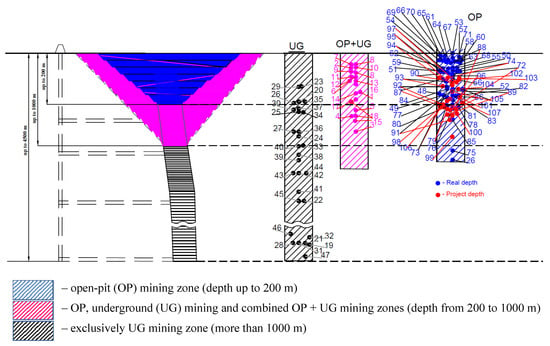
Figure 1.
Depth distribution of mining methods for various mining enterprises.
Table 4.
Distribution of ME by mining depth.
The task of selecting a mining method with a development depth of up to 200 m is not difficult. Most mining enterprises select open mining. Only a small part of enterprises at such a depth select an open–underground method. Geological conditions are the main factor determining the selection of mining method at such a depth.
The selection of mining method at a depth of more than 1000 m is practically uncontested. At such a depth, in most cases, only underground mining is possible. However, two of the analyzed enterprises continue to use the open method at such depths. As can be seen from Table 4, none of the analyzed enterprises are currently using the combined open–underground method at depths of more than 1000 m. According to the authors, this is due, among other things, to the lack of methods for substantiating the need and the moment of switching to such technology.
The zone in the depth range from 200 to 1000 m is the most numerous regarding the number of MEs operating at such a depth. At this depth, any of the known extraction methods can be selected. Nevertheless, most MEs select the open method.
In the study [82], such a zone is called a transition zone. A transitional zone is a range of mineral extraction depths at which it is effective to organize mining both by open and underground methods. As a criterion of efficiency, as a rule, only the economic criterion is used.
Most MEs currently mining at depths of up to 200 m will face the challenge of selecting whether to maintain or change their mining method as they approach the transition zone. The choice of one or another solution will determine the sustainability of the development of ME for the next decades.
The complexity of a mining method selection task is due to three main points. First, within each zone (Figure 1), production can be carried out in stages. The main characteristics of the stages are a certain depth and period of extraction, productivity in terms of ore and overburden, a set of equipment used, technological solutions for opening a deposit, and its mining [14].
Secondly, mining enterprises work with natural resources and cannot objectively affect their initial quality, volume of reserves, and other properties.
Finally, mining enterprises operate in a competitive environment and must consider fluctuations in prices for finished products.
Under such conditions, it is difficult to ensure the sustainable development of a mining enterprise only based on choosing a certain mining method for specific conditions. It is necessary to consider the development strategies of the enterprise over a long period or the entire life cycle of the enterprise. In the list of sustainable development strategies for a mining enterprise and its main subsystem—the MTS, we propose to include not only mining methods. It is necessary to evaluate the need for adjustment of the current-stage parameters of MEs, as well as the solution for ME closure.
Thus, we propose to single out the following strategies for the sustainable development of the MTS (Table 5):
Table 5.
Features of strategies for the MTS’s sustainable development.
- Adjustment of the current stage mining indicators.
- Transition to a new stage of mining.
- Transition to a combined open–underground mining.
- Mine closure.
We substantiated the factors that determine the selection of sustainable development strategy in Section 2.2 and used them to assess the consequences of implementing one or another strategy for the development of the MTS (Table 6).
Table 6.
Systematization of the MTS sustainable development strategies consequences.
The selection and implementation of this or that strategy of the MTS has a significant impact on all factors of sustainable development. A quantitative assessment of the mutual influence of strategies and factors is based on considering a variety of the MTS indicators. Thus, to choose a strategy, it is necessary to evaluate many parameters and indicators that determine the factors of sustainable development of the MTS.
3.2. System of Parameters and Indicators of the MTS’s Sustainable Development
Of decisive importance for the sustainable development of the MTS in the implementation of each strategy is the creation of transport access to resources and the organization of the process of transporting the rock mass. This process is the costliest. It accounts for up to 70% of operating costs and up to 50% of capital expenditures. Up to 50% of the working personnel of the mining enterprise and more than 50% of the open-pit equipment fleet are involved in this process. Moreover, the process of transportation and the creation of conditions for it have the greatest impact on the environment. Therefore, the creation of an opening scheme and the organization of the transportation process are combined by one system—the opening-up of an opencast system (OOS) [6]. The parameters and performance indicators of an opening-up of an opencast system have the greatest impact on the stability of the MTS.
We systematized the parameters and indicators of OOS based on an analysis of the practice of operating and reconstructing this system at existing MEs, as well as an analysis of the research in the field of mine development. Systematization is based on an extended set of sustainable development factors proposed in this study. We suggest a two-level hierarchical assessment of these factors using 8 groups of parameters and 23 parameters and indicators (Table 7) [6]. The first level of the hierarchy considers the parameters for evaluating the OOS when it interacts with the MTS and the environment. The second level of the hierarchy includes specific parameters and performance indicators of the OOS.
Table 7.
System of parameters and indicators for evaluating the opening-up of an opencast system.
We propose to use the presented system of parameters and indicators for a comprehensive assessment of the stripping system, considering the requirements of the concept of sustainable development and ensuring the design indicators of the functioning of the MTS.
The presence of many parameters and indicators for assessing the MTS and its subsystems makes it expedient to use multicriteria decision-making methods to select a rational strategy for the sustainable development of the MTS.
3.3. Methodology for Selecting a Strategy for MTS Sustainable Development Using MCDM
We developed a universal methodology for choosing a strategy for the sustainable development of the mining and technical system in the transition period. The main stages of the methodology are as follows:
- Stage 1. Analysis of the factors of sustainable functioning and development of the MTS.
- Stage 2. Decomposition of the MTS and assessment of the significance of the OOS for the MTS. We propose to make this assessment by the share of capital and operating costs of the OOS, the number of employees and equipment, and the volume of pollutant emissions and waste generation in this system.
- Stage 3. Substantiation of the parameters and indicators for assessing the MTS and the OOS.
- Stage 4. Formation of a list of possible strategies for the sustainable development of the MTS for specific conditions.
- Stage 5. Calculation of the weights of these parameters and indicators based on the fuzzy method of the analytical hierarchical process (fuzzy AHP).
- Stage 6. Evaluation and selection of a strategy for sustainable development of the MTS using MCDM MARCOS. Sensitivity analysis of the multiobjective fuzzy AHP–MARCOS model.
- Stage 7. Calculation of economic, budgetary, social, and environmental efficiency indicators of the selected strategy implementation.
- Stage 8. Implementation of the selected strategy with justified parameters if it is effective.
The flowchart of the methodology for the MTS sustainable development strategy selection is shown in Figure 2.
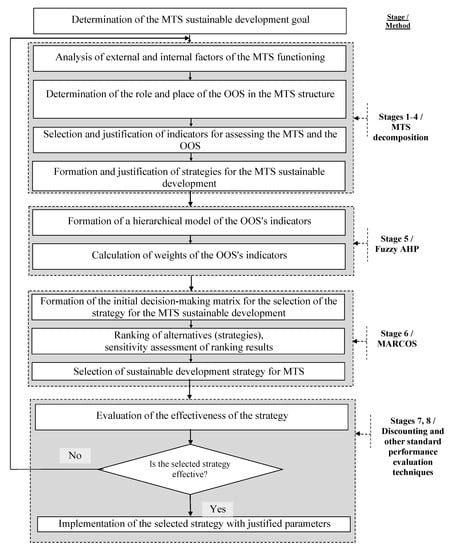
Figure 2.
Methodology for the selection of the MTS sustainable development strategy based on fuzzy AHP–MARCOS combined method.
The order of implementation of stages 1–4 is presented in Section 3.1 and Section 3.2. Presented strategies, as well as indicators of the MTS and the OOS, are universal for various mining enterprises. However, in each specific case, their composition may change, considering the characteristics of a particular enterprise; the economic, social, environmental situation; and the requirements of state authorities.
The methodology and implementation examples for stages 5 and 6 are presented in Section 4. Finally, stages 7 and 8 are implemented using ESG investment evaluation techniques.
We adapted the MARCOS method [72] (Stage 6, Figure 2) as applied to the problem of choosing strategies for sustainable development of MTS. The main steps of the MARCOS method are as follows.
- Step 1. Designing of an initial decision-making matrix.
- Step 2. Designing of an extended initial matrix, performed by defining the anti-ideal (SAI) and ideal (SI) strategy.
- Step 3. Normalization of an extended initial matrix X.
- Step 4. Determination of the weighted matrix V.
- Step 5. Computation of the utility degree Ki of strategies.
- Step 6. Determination of the strategies utility function f(Ki).
- Step 7. Strategies ranging.
The ranking of alternatives is based on the final values of the utility functions f(Ki). The best alternative is the one with the maximum value of the utility function.
4. Case Study
4.1. Initial Data
We chose the Malyi Kuibas iron ore open pit for the case study. Our choice is due to the following considerations. Firstly, the depth of the open pit has approached the mark of 190 m, which makes the option of switching to an open underground method effective. In addition, the stripping ratio increased by 2.2 times, which reduced the efficiency of the open pit due to the high cost of transporting rock mass by road. Finally, this open pit provides up to 15% of the needs for ore raw materials of one of the world’s largest metallurgical enterprises—the Magnitogorsk Iron and Steel Works [83]. The Malyi Kuibas deposit began to be developed by open-pit mining in 1973 after the mine closure of the nearby Magnitnaya Gora deposit.
Various researchers have proposed different strategies for the development of this open pit’s MTS [84,85]. We found that all the strategies we suggested (Table 6) were considered at different times. In addition, we found that for all the strategies under consideration, one of the most complex and multivariate tasks is the selection of an OOS. Thus, in this study, we evaluated all four possible strategies for the sustainable development of the mining and technical system of the Malyi Kuibas open pit. We used the system of OOS parameters and indicators (Table 7) to carry out the assessment.
The quantitative values of the indicators C2.2, C3.1, C3.2, C3.3, C4.1, C4.2, C4.3, C5.1, C5.2, C5.3, C6.1, C6.2, C7.1 were calculated using known methods [84,85]. Qualitative indicators C1.1, C1.2, C2.3, C2.4, C7.2, C7.3, C8.1, C8.2 were evaluated by a group of experts using a five-point scale [6]. The best value of the wound indicator is 5 points; the worst is 1 point; and 2, 3, 4 are intermediate results.
The expert group included 10 academician experts with a weighted average of 25.4 years and 9 mining industry representatives with a weighted average of 9.5 years (Table 8).
Table 8.
Information about experts.
The results of calculations and assessments of the indicators of the Malyi Kuibas open pit’s MTS for each strategy are presented in Table 9.
Table 9.
Indicators of the MTS development strategies for the Malyi Kuibas open pit *.
We adopted the weight of parameters and indicators of sustainable development of the MTS based on our previous study [6]. Weighting coefficients of indicators C1.1–C8.2 were calculated separately for academician experts, mining industry experts (Table 8), and in general (Table 10).
Table 10.
Weight coefficients of indicators [6].
4.2. Strategy Selection Results
The multicriteria model for selecting a strategy for the MTS’s sustainable development in the case study includes 23 criteria (C1.1–C8.2, Table 10) and four alternative strategies (S1–S4, Table 6). To select a strategy in accordance with the MARCOS methodology (Section 3.3), it is first necessary to form an extended initial decision matrix (Figure 2, Stage 6). Variable SI values show ideal solutions, and SAI values show anti-ideal solutions (Table 11).
Table 11.
Extended initial decision matrix.
The results of the decision matrix normalization are presented in Table 12.
Table 12.
Normalized decision matrix.
The weighted normalized decision matrix (Table 13) is the result of multiplying the normalized matrix by the criteria weights calculated using the fuzzy AHP method (Table 10).
Table 13.
Weighted normalized decision matrix (average weight of criteria).
The results of calculating the values of the utility function f(K) and ranking alternatives (strategies) are presented in Table 14. The values of the utility function, in accordance with the MARCOS method (Section 3.3), are calculated based on the assessment of the utility of each i-th alternative relative to the anti-ideal solution () and to the ideal solution ().
Table 14.
Results of MARCOS method.
The results of the MARCOS method showed the similarity of opinions of academician experts and mining industry experts. All experts for the existing conditions preferred strategy S4—mine closure. We adopted this strategy as a preliminary one and assessed the sensitivity of the result obtained.
We did not accurately evaluate the effectiveness of the selected strategy (Stages 7 and 8, Figure 2) in this study. Nevertheless, we explain the result by the influence of the following most significant factors. Firstly, the Malyi Kuibas iron ore open pit provides raw materials to no more than 15% of the nearest consumer needs—iron and steel works. The rest of the demand is provided by supplies from other mining enterprises located more than 300 km away. Secondly, the profitability of mining is constantly decreasing with deepening of the open pit and the deterioration of mining and geological conditions. On the other hand, the value of the open-pit space increases for the placement of metallurgical waste in it and the improvement in environmental performance. Thus, we explain the selection of strategy S4—mine closure by the strong combined influence of economic criteria (Operating cost, C6.2 = 0.0374; Total income, C6.3 = 0.1958) and environmental criteria (Air pollution, C8.1 = 0.0338; Quantity of waste, C8.2 = 0.0189).
4.3. Sensitivity Analysis
We performed sensitivity analysis of the obtained results in three ways. We evaluated the following values.
- Consistency with the results of various MCDM methods by Spearman’s rank correlation coefficient (SCC). We used nine known MCDM methods: SAW [73], TOPSIS [74], COPRAS [75], MOORA [76], ARAS [77], WASPAS [78], MAIRCA [79], EDAS [80], MABAC [81].
- Deviations from the results of the scenarios in which the weights of the criteria were changed. We created new scenarios by excluding criteria with the highest and lowest weights.
- Deviations from the results of scenarios in which the set of alternatives was changed by gradually eliminating the worst alternatives.
The results of a comparative analysis of the MARCOS method with other MCDMs are presented in Figure 3.
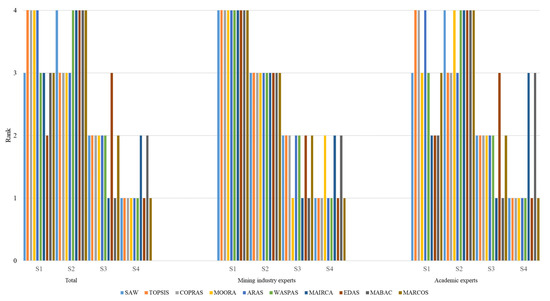
Figure 3.
Comparison of the MARCOS method with other MCDMs.
We explain the slight discrepancy in the rank in the S1-S4 strategies by the difference in algorithms and methods for normalizing the original decision matrix and data aggregation in different MCDMs. We assessed the significance of these deviations by Spearman’s rank correlation coefficient.
The calculation and analysis of SCC showed a strong consistency between the results of ranking the studied strategies by various MCDMs (Table 15). The average correlation coefficient was 0.996 for averaged weights, 0.988 for academician experts, and 0.997 for mining industry experts.
Table 15.
Statistical correlation of ranks calculated using SCC.
We identified the following scenarios to evaluate the impact of changing criteria weights on ranking results.
In the first scenario, Scen_1, the weight of all criteria is the same and equals 0.04348.
We excluded the criteria with the lowest weight and proportionally changed the weights of the remaining criteria in scenarios Scen_2–Scen_4. The excluded criterion for the total criteria weights is C1.1 = 0.00085 (Scen_2), for mining industry experts—C2.3 = 0.00038 (Scen_3), and for academician experts—C1.1 = 0.00475 (Scen_4).
We excluded the criteria with the highest weight and proportionally changed the weights of the remaining criteria in scenarios Scen_5–Scen_7. The criterion C6.3 = 0.1958 has the highest weight for all groups of experts.
The results of the sensitivity assessment for scenarios Scen_1–Scen_7 are shown in Figure 4.
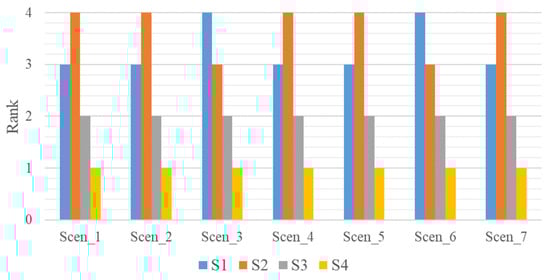
Figure 4.
Results of ranking strategies by the MARCOS method, considering the change in the weight of the criteria.
We then assessed the sensitivity of the results by gradually decreasing by 10% the value of the criterion with the highest weight C6.3. The results of the analysis of scenarios Sc0–Sc11 formed in this way are presented in Figure 5.
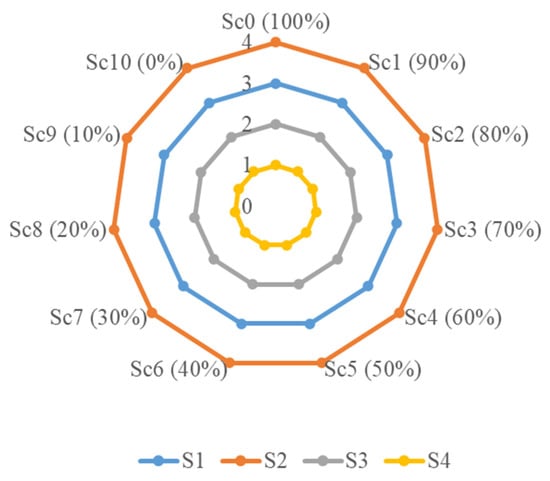
Figure 5.
Results of ranking strategies by the MARCOS method, considering the gradual decrease in the weight of criterion C6.3.
The results of the sensitivity analysis show that alternatives S4 and S3 are the most stable. In all scenarios, their ranks are 1 and 2, respectively. The ranks of the alternatives S2 and S1 are the least stable. In scenarios Scen_3 and Scen_6, their ranks were reversed.
Finally, we evaluated the sensitivity of the constructed multicriteria model by constructing dynamic decision matrices [72], obtained as a result of gradually excluding the worst alternatives from the model and ranking the remaining alternatives. Thus, we formed four scenarios (Scenario 1—Scenario 4) by gradually eliminating strategies in the following order, S2 → S1 → S3. The results of the ranking of strategies by the MARCOS method with a gradual exclusion from consideration of the worst scenarios are shown in Figure 6.
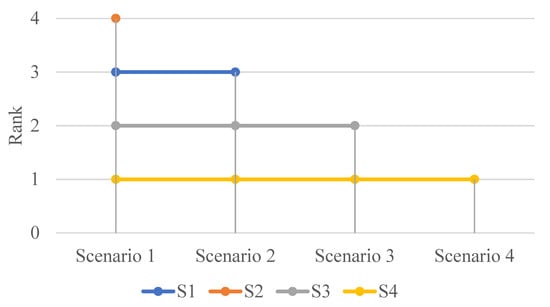
Figure 6.
Effects of dynamic decision matrices in MARCOS method.
As seen in Figure 6, excluding the worst-ranked strategy does not affect either the rank of the best strategy or the ranks of the remaining strategies in each reordered matrix.
The results of the sensitivity analysis of the constructed multicriteria fuzzy AHP–MARCOS model prove the stability of the ranks of the studied MTS’s sustainable development strategies in various conditions. This confirms the reliability and accuracy of the ranking of the selected strategies. The S4—mine closure strategy remains the best in all scenarios considered.
5. Conclusions
The problem of choosing or changing the development strategy arises for the management of mining enterprises developing steeply dipping deposits as the depth of production increases. Almost 60% of the 107 enterprises we analyzed are mining at depths of 200 m to 1000 m, which exacerbates the issue of selecting a mining method. Currently, more than 36% of such enterprises use the open mining method. Nevertheless, depending on the specific conditions, the management of the mining enterprise decides to switch to underground or combined open–underground methods. Practice shows that the result of the decision is not the sustainable development of the mining enterprise in all cases. The reason for this is the neglect of numerous factors that influence and determine the stability of a complex mining and technical system and its main subsystem—the opening-up of an opencast system.
We found that the opening-up of opencast system indicators have the greatest impact on the performance of the mining and technical system. This is explained by the fact that the costs of creating transport access to resources and transporting rock mass account for up to 70% of operating costs and up to half of capital costs. In addition, up to half of the number of working personnel and quarry equipment are involved in ensuring the functioning of the opening-up of an opencast system. Finally, this process has the greatest impact on the environment.
We proposed to assess the impact of opening-up of an opencast system on the sustainable development of the mining and technical system and the mining enterprise using a three-level system of factors and indicators. The first level of the hierarchy is focused on an enlarged assessment of the interaction of the opening-up of an opencast system with the external environment and includes five groups of sustainable development factors—technical, technological, economic, social, and environmental. The second level of the hierarchy is a system of criteria for assessing the sustainable development of the opening-up of an opencast system and contains eight criteria. Finally, the third level of the hierarchy is formed by twenty-three specific indicators that allow assessing the achievement of the criteria of the second level.
We proposed to use the developed hierarchical system of indicators to evaluate and select a sustainable development strategy for the mining and technical system. We explored four main strategies: adjustment of the current stage mining indicators, transition to a new stage of mining, transition to a combined open–underground mining, and mine closure.
The methodology developed by the authors for the multicriteria choice of a strategy for sustainable development of the mining and technical system using the proposed hierarchical system of factors, criteria, and indicators is described in detail in the article. Given the inconsistency of the evaluation criteria, it was decided that it would be expedient to use multicriteria methods for making decisions to select an alternative strategy. In the study, we used the combined fuzzy AHP–MARCOS method.
A case study on the choice of a sustainable development strategy was carried out for the Malyi Kuibas iron ore open pit. The result of applying the developed methodology was the ranking of strategies. It was established that the most preferred alternative in the current conditions is the “Mine closure” strategy. This is followed by the strategies “Transition to a combined open–underground mining” and “Adjustment of the current stage mining indicators”. The least effective strategy is “Adjustment of the current stage mining indicators”. We explain such a priority of strategies by a decrease in the volume and profitability of rock mass mining. In addition, the depth of the open pit is increasing and the value of this mined-out space for the disposal of waste from the nearby iron and steel works increases.
We assessed the sensitivity of the results obtained by comparing the results of the main MARCOS multicriteria method with the results of nine other multicriteria methods. Spearman’s correlation coefficient of the results of various methods was 0.991. We also proved the reliability of the results obtained by evaluating the influence of the criteria weights, as well as the composition of strategies.
We propose to use the presented hierarchical system of factors and indicators, as well as the developed methodology for using multicriteria methods to select a strategy for the sustainable development of the mining and technical system and its main subsystem—opening-up of an opencast system.
Future research involves the development of a combined multiattribute and multiobjective (MADM–MODM) method for choosing an optimal sequence of sustainable development strategies for a mining enterprise throughout its entire life cycle.
Author Contributions
Conceptualization, A.R., K.B. and N.O.; methodology, A.R., K.B. and N.O.; validation, A.R., K.B. and N.O.; formal analysis, K.B. and N.O.; investigation, K.B. and N.O.; data curation, K.B.; writing—original draft preparation K.B. and N.O.; writing—review and editing, A.R.; visualization, A.R., K.B. and N.O.; project administration, A.R. All authors have read and agreed to the published version of the manuscript.
Funding
This research received no external funding.
Institutional Review Board Statement
Not applicable.
Informed Consent Statement
Not applicable.
Data Availability Statement
Not applicable.
Conflicts of Interest
The authors declare no conflict of interest.
Appendix A. Mining Depths and Mined Mineral Resources
Table A1.
Mining enterprises with open–underground mining.
Table A1.
Mining enterprises with open–underground mining.
| No. (According to Figure 1) | Mined Mineral Resources | Country | Open Pit Depth When Transition to a Combined Open–Underground Mining | Underground Mine Depth |
|---|---|---|---|---|
| 1 | Copper | Australia | 156 m | 570 m |
| 2 | Polymetallic | Australia | 158 m | 300 m |
| 3 | Silver, Lead, Zinc | Australia | 90 m | 850 m |
| 4 | Iron | Austria | 682 m | ND |
| 5 | Copper, Cobalt | Congo | 168 m | 618 m |
| 6 | Iron | Russia | 300 m | ND |
| 7 | Niobium, Feldspar, Vermiculite | Russia | 60 m | ND |
| 8 | Copper | Kazakhstan | 210 m | ND |
| 9 | Copper, Lead, Zinc | Kazakhstan | 200 m | ND |
| 10 | Nickel, Copper | Russia | 153 m | ND |
| 11 | Uranium | Russia | 256 m | ND |
| 12 | Iron, Manganese | Kazakhstan | 258 m | ND |
| 13 | Tungsten, Molybdenum | Russia | 300 m | ND |
| 14 | Copper | Kazakhstan | 305–435 m | ND |
| 15 | Copper | Russia | 330 m | 1230 m |
| 16 | Copper | Russia | 336 m | 650 m |
| 17 | Copper | Russia | 500 m | ND |
| 18 | Diamonds | Russia | 525 m | 680 m |
Table A2.
Mining enterprises with underground mining.
Table A2.
Mining enterprises with underground mining.
| No. (According to Figure 1) | Mined Mineral Resources | Country | Underground Mine Depth |
|---|---|---|---|
| 19 | Diamonds | Russia | 600 m |
| 20 | Diamonds | Russia | 525 m |
| 21 | Copper | Russia | 2056 m |
| 22 | Copper | Russia | 1600 m |
| 23 | Chromite | Russia | 360 m |
| 24 | Iron | Russia | 900 m |
| 25 | Copper | Russia | 635 m |
| 26 | Platinum, Gold, Silver, Selenium | Russia | 540 m |
| 27 | Gold | Russia | 850 m |
| 28 | Gold | South Africa | 2055 m |
| 29 | Gold | Russia | 364 m |
| 30 | Gold | Russia | 612 m |
| 31 | Gold | South Africa | 2055 m |
| 32 | Gold | South Africa | 3420 m |
| 33 | Copper, Gold, Uranium | Australia | 1000 m |
| 34 | Diamonds | Russia | 640 m |
| 35 | Diamonds | Canada | 525 m |
| 36 | Diamonds | Botswana | 850 m |
| 37 | Copper, Nickel | Russia | 3500 m |
| 38 | Coal | China | 1100 m |
| 39 | Coal | China | 1159 m |
| 40 | Coal | China | 1008 m |
| 41 | Coal | China | 1501 m |
| 42 | Copper | China | 1300 m |
| 43 | Copper | China | 1300 m |
| 44 | Copper | China | 1300 m |
| 45 | Copper | China | 1600 m |
| 46 | Gold | South Africa | 4350 m |
| 47 | Copper, Zinc | Canada | 2800 m |
Table A3.
Mining enterprises with open mining.
Table A3.
Mining enterprises with open mining.
| No. (According to Figure 1) | Mined Mineral Resources | Country | Current Depth | Design Depth/Prospect Depth |
|---|---|---|---|---|
| 48 | Polymetallic | Australia | 500 m | ND |
| 49 | Copper | Zambia | 235 m | ND |
| 50 | Diamonds | South Africa | 240 m | ND |
| 51 | Diamonds | South Africa | 423 m | ND |
| 52 | Iron | Canada | 45 m | ND |
| 53 | Polymetallic | Canada | 120 m | ND |
| 54 | Polymetallic | Canada | 200 m | ND |
| 55 | Polymetallic | Canada | 231 m | ND |
| 56 | Copper | Canada | 84 m | ND |
| 57 | Polymetallic | Ireland | 120 m | ND |
| 58 | Polymetallic | Spain | 236 m | ND |
| 59 | Uranium | France | 150 m | ND |
| 60 | Iron | Sweden | 70 m | ND |
| 61 | Iron | USA | 210 m | ND |
| 62 | Gold | Australia | 150 m | ND |
| 63 | Copper, Gold, Silver | Finland | 120 m | ND |
| 64 | Mica | Russia | 72 m | ND |
| 65 | Gold | Russia | 124 m | ND |
| 66 | Asperolite | Russia | 30–95 m | ND |
| 67 | Iron | Russia | 200 m | ND |
| 68 | Iron | Russia | 140 m | ND |
| 69 | Iron | Russia | 110 m | ND |
| 70 | Copper | Russia | 135 m | ND |
| 71 | Iron, Asperolite | Russia | 270 m | 660/860 m |
| 72 | Diamonds | Russia | 600 m | 630 m |
| 73 | Gold | Russia | 240 m | 312/600 m |
| 74 | Copper, Molybdenum, Gold | USA | 1200 m | ND |
| 75 | Copper | Chile | 1100 m | ND |
| 76 | Copper | Chile | 645 m | ND |
| 77 | Copper | Chile | 525 m | ND |
| 78 | Diamonds | Russia | 630 m | ND |
| 79 | Gold | Uzbekistan | 610 m | 650/1000 m |
| 80 | Gold | Australia | 600 m | ND |
| 81 | Gold, Copper | Indonesia | 550 m | ND |
| 82 | Gold | USA | 500 m | ND |
| 83 | Iron | China | 500 m | ND |
| 84 | Copper | Sweden | 430 m | ND |
| 85 | Gold | Australia | 762 m | ND |
| 86 | Gold | Kyrgyzstan | 510 m | 650 m |
| 87 | Diamonds | Russia | 320 m | 630 m |
| 88 | Lead, Zinc | Russia | 130 m | 720 m |
| 89 | Gold | Russia | 450 m | 710/830 m |
| 90 | Gold | Russia | 260 m | 350 m |
| 91 | Iron | Russia | 442 m | 767 m |
| 92 | Iron | Russia | 412 m | 600 m |
| 93 | Iron | Russia | 350 m | 400 m |
| 94 | Iron | Russia | 250 m | 310/370 m |
| 95 | Chrysotile | Russia | 245 m | 390 m |
| 96 | Chrysotile | Kazakhstan | 290 m | 634 m |
| 97 | Copper | Russia | 210 m | 358/538 m |
| 98 | Copper | Russia | 100 m | 540 m |
| 99 | Copper | Russia | - | 950 m |
| 100 | Copper | Russia | - | 700 m |
| 101 | Diamonds | Russia | 525 m | 525 m |
| 102 | Diamonds | Russia | 335 m | 330 m |
| 103 | Diamonds | Russia | 315 m | 315 m |
| 104 | Diamonds | Russia | 435 m | 435 m |
| 105 | Diamonds | Russia | 428 m | 460 m |
| 106 | Diamonds | Russia | 410 m | 562 m |
| 107 | Diamonds | Russia | 158 m | 580 m |
References
- Kaplunov, D.R.; Kalmykov, V.N.; Rylnikova, M.V. Combined Geotechnology; Publishing House “Ore & Metals”: Moscow, Russia, 2003; ISBN 5-82-160046-4. [Google Scholar]
- Savich, I.N. Depth of transition to underground mining of kimberlite deposits. Min. Inf. Anal. Bull. 2005, 5, 179–181. [Google Scholar]
- Ordin, A.A.; Vasil’ev, I.V. Optimized depth of transition from open pit to underground coal mining. J. Min. Sci. 2014, 50, 696–706. [Google Scholar] [CrossRef]
- Reshetnyak, S.P. Important areas of the evolution of mine planning and design methods. Russ. Min. Ind. 2015, 3, 22–26. [Google Scholar]
- Zyryanov, I.V.; Akishev, A.N.; Bokiy, I.B.; Bondarenko, I.F. Innovations in diamond mine planning in a permafrost zone. Russ. Min. Ind. 2018, 141, 66–69. [Google Scholar] [CrossRef]
- Rakhmangulov, A.; Burmistrov, K.; Osintsev, N. Sustainable open pit mining and technical systems: Concept, principles, and indicators. Sustainability 2021, 13, 1101. [Google Scholar] [CrossRef]
- Kaplunov, D.R.; Rylnikova, M.V.; Korneev, S.A. Systematization and typification of mining systems of combined geotechnology. Min. Inf. Anal. Bull. 2009, 11, 194–205. [Google Scholar]
- Yakovlev, V.L.; Sokolov, I.V.; Sakantsev, G.G.; Kravchuk, I.L. Transition processes in hybrid mineral mining. Gorn. Zhurnal 2017, 7, 46–50. [Google Scholar] [CrossRef]
- Burmistrov, K.; Osintsev, N. A fuzzy AHP approach for ranking parameters and indicators of sustainable functioning and development of opening-up of an opencast system. Sustain. Dev. Mt. Territ. 2020, 12, 394–409. [Google Scholar] [CrossRef]
- Knizhnikov, A.; Shvarts, E.; Ametistova, L.; Pakhalov, A.; Rozhkova, N.; Yudaeva, D. Environmental transparency of Russian mining and metal companies: Evidence from independent ranking system. Extr. Ind. Soc. 2021, 8, 100937. [Google Scholar] [CrossRef]
- Zhou, Y.; Zhou, W.; Lu, X.; Jiskani, I.M.; Cai, Q.; Liu, P.; Li, L. Evaluation index system of green surface mining in China. Min. Metall. Explor. 2020, 37, 1093–1103. [Google Scholar] [CrossRef]
- Iakovlev, V.L.; Iakovlev, V.A. Open pit transport systems formation with the account of adaptation to deep-lying complex-structured deposits development changing conditions. Izv. Vyss. Uchebnykh Zavedenii Gorn. Zhurnal 2018, 6, 118–126. [Google Scholar] [CrossRef]
- Yakovlev, V.L.; Glebov, A.V.; Bersenyov, V.A.; Kulniyaz, S.S.; Ligotsky, D.N. Influence of an installation angle of the conveyor lift on the volumes of mining and preparing work at quarries at the cyclic-flow technology of ore mining. News Natl. Acad. Sci. Repub. Kazakhstan Ser. Geol. Tech. Sci. 2020, 4, 127–137. [Google Scholar] [CrossRef]
- Kosolapov, A.I.; Ptashnik, A.I. Management of a Mode of Mountain Works at Open-Cast Mining of Deposits by Stages. J. Sib. Fed. Univ. Eng. Technol. 2013, 6, 387–393. [Google Scholar]
- Kuznetsov, D.V.; Kosolapov, A.I. Justification criteria for open pit mine depth and mining/haulage machinery parameters. IOP Conf. Ser. Earth Environ. Sci. 2019, 262, 12038. [Google Scholar] [CrossRef]
- Opoku, S.; Musingwini, C. Stochastic modelling of the open pit to underground transition interface for gold mines. Int. J. Min. Reclam. Environ. 2013, 27, 407–424. [Google Scholar] [CrossRef]
- Afum, B.O.; Ben-Awuah, E.; Askari-Nasab, H. A mixed integer linear programming framework for optimizing the extraction strategy of open pit—Underground mining options and transitions. Int. J. Min. Reclam. Environ. 2020, 34, 700–724. [Google Scholar] [CrossRef]
- Khorolskiy, A.A.; Grinev, V.G. Selection of scenario for the development of mineral deposits. Geol. Bowels Earth 2018, 3, 68–74. [Google Scholar]
- Abdollahisharif, J.; Bakhtavar, E.; Shahriar, K. Open-pit to underground mining—Where is the optimum transition depth? In New Challenges and Visions for Mining, 21st World Mining Congress, Cracow, Katowice, Sosnowiec, Poland, 7–12 September 2008; Sobczyk, J., Kicki, J., Eds.; Taylor & Francis: Boca Raton, FL, USA, 2008; pp. 189–196. ISBN 978-0-41548-667-5. [Google Scholar]
- Gibadullin, Z.R.; Kalmykov, V.N.; Petrova, O.V. Bases of efficient technological schemes of ore mass transportation during the underground mining of pit reserves. Tsvetnye Met. 2013, 8, 9–13. [Google Scholar]
- Flores, G.; Catalan, A. A transition from a large open pit into a novel “macroblock variant” block caving geometry at Chuquicamata mine, Codelco Chile. J. Rock Mech. Geotech. Eng. 2019, 11, 549–561. [Google Scholar] [CrossRef]
- Hore-Lacy, I. Uranium for Nuclear Power: Resources, Mining and Transformation to Fuel; Woodhead Publishing: Oxford, UK, 2016; ISBN 978-0-08100-307-7. [Google Scholar]
- Newman, A.M.; Yano, C.A.; Rubio, E. Mining above and below ground: Timing the transition. IIE Trans. 2013, 45, 865–882. [Google Scholar] [CrossRef]
- Mborah, C.; Bansah, K.J.; Boateng, M.K. Evaluating alternate post-mining land-uses: A review. Environ. Pollut. 2016, 5, 14–22. [Google Scholar] [CrossRef] [Green Version]
- Gavrishev, S.E.; Kornilov, S.N.; Pytalev, I.A.; Gaponova, I.V. Enhancing mine production efficiency through waste management. Gorn. Zhurnal 2017, 12, 46–51. [Google Scholar] [CrossRef]
- Afum, B.O.; Ben-Awuah, E. A review of models and algorithms for surface-underground mining options and transitions optimization: Some lessons learnt and the way forward. Mining 2021, 1, 112–134. [Google Scholar] [CrossRef]
- Laurence, D. Establishing a sustainable mining operation: An overview. J. Clean. Prod. 2011, 19, 278–284. [Google Scholar] [CrossRef]
- Collins, B.; Kumral, M. Environmental sustainability, decision-making, and management for mineral development in the Canadian Arctic. Int. J. Sustain. Dev. World Ecol. 2020, 27, 297–309. [Google Scholar] [CrossRef]
- Jiskani, I.M.; Cai, Q.; Zhou, W.; Ali Shah, S.A. Green and climate-smart mining: A framework to analyze open-pit mines for cleaner mineral production. Resour. Policy 2021, 71, 102007. [Google Scholar] [CrossRef]
- Asr, E.T.; Kakaie, R.; Ataei, M.; Tavakoli Mohammadi, M.R. A review of studies on sustainable development in mining life cycle. J. Clean. Prod. 2019, 229, 213–231. [Google Scholar] [CrossRef]
- Lechner, A.M.; McIntyre, N.; Witt, K.; Raymond, C.M.; Arnold, S.; Scott, M.; Rifkin, W. Challenges of integrated modelling in mining regions to address social, environmental and economic impacts. Environ. Model. Softw. 2017, 93, 268–281. [Google Scholar] [CrossRef]
- Hustrulid, W.A. Underground Mining Methods Handbook; Society for Mining Metallurgy: Englewood, CO, USA, 1982; ISBN 978-0-89520-049-5. [Google Scholar]
- Phlevani, D.; Osanloo, M. Resumption of Deep Open-Pit Mining as a Future Challenge May. In Application of Computers and Operations Reseach in the Mineral Industry, Proceedings of the 37th International Symposium APCOM 2015, Fairbanks, AK, USA, 23–27 May 2015; Bandopadhyay, S., Ed.; Society for Mining Metallurgy and Exploration Inc.: Englewood, CO, USA, 2015; pp. 249–256. ISBN 0-87-335417-6. [Google Scholar]
- UN. Adoption of the Paris Agreement: Conference of the Parties-Twenty-First Session. Available online: http://unfccc.int/resource/docs/2015/cop21/eng/l09r01.pdf (accessed on 20 May 2019).
- Olsen, B.C.; Awuah-Offei, K.; Bumblauskas, D. Setting materiality thresholds for ESG disclosures: A case study of U.S. mine safety disclosures. Resour. Policy 2021, 70, 101914. [Google Scholar] [CrossRef]
- Paat, A.; Roosalu, T.; Karu, V.; Hitch, M. Important environmental social governance risks in potential phosphorite mining in Estonia. Extr. Ind. Soc. 2021, 8, 100911. [Google Scholar] [CrossRef]
- Scammacca, O.; Gunzburger, Y.; Mehdizadeh, R. Gold mining in French Guiana: A multi-criteria classification of mining projects for risk assessment at the territorial scale. Extr. Ind. Soc. 2021, 8, 32–43. [Google Scholar] [CrossRef]
- Svobodova, K.; Vojar, J.; Yellishetty, M.; Janeckova Molnarova, K. A multi-component approach to conceptualizing the reputation of the mining industry from a stakeholder perspective. Resour. Policy 2020, 68, 101724. [Google Scholar] [CrossRef]
- Dong, L.; Tong, X.; Li, X.; Zhou, J.; Wang, S.; Liu, B. Some developments and new insights of environmental problems and deep mining strategy for cleaner production in mines. J. Clean. Prod. 2019, 210, 1562–1578. [Google Scholar] [CrossRef]
- Yavuz, M.; Alpay, S. Underground mining technique selection by multicriterion optimization methods. J. Min. Sci. 2008, 4, 391–401. [Google Scholar] [CrossRef]
- Azimi, R.; Yazdani-Chamzini, A.; Fouladgar, M.M.; Zavadskas, E.K.; Basiri, M.H. Ranking the strategies of mining sector through ANP and TOPSIS in a SWOT framework. J. Bus. Econ. Manag. 2011, 12, 670–689. [Google Scholar] [CrossRef] [Green Version]
- Fouladgar, M.M.; Yazdani-Chamzini, A.; Yakhchali, H.S. A new methodology for prioritizing mining strategies. Int. J. Innov. Manag. Technol. 2011, 2, 342–347. [Google Scholar]
- The Canadian Institute of Mining, Metallurgy and Petroleum. The CIMVAL Code for the Valuation of Mineral Properties. Available online: https://mrmr.cim.org/media/1120/cimval_code_nov2019.pdf (accessed on 12 December 2021).
- Shahriar, K.; Oraee, K.; Bakhtavar, E. Effective factors investigation in choice between surface and underground mining. In Modern Management of Mine Producing, Geology and Environmental Protection, Proceedings of the 7th International Scientific Conference-SGEM 2007, Sofia, Bulgaria, 11–15 June 2007; SGEM: Sofia, Bulgaria, 2007; ISBN 9-54-918181-2. [Google Scholar]
- Tverdov, A.A.; Zhura, A.V.; Nikishichev, S.B. On the problem of assessment of the optimal time range of long-term planning for mines. Russ. Min. Ind. 2010, 94, 42–45. [Google Scholar]
- U.S. Congress, Office of Technology Assessment. Copper: Technology and Competitiveness; U.S. Government Printing Office: Washington, DC, USA, 1988.
- Patterson, S.R.; Kozan, E.; Hyland, P. Energy efficient scheduling of open-pit coal mine trucks. Eur. J. Oper. Res. 2017, 262, 759–770. [Google Scholar] [CrossRef]
- Khazin, M.L. Directions of career transport development. Perm J. Pet. Min. Eng. 2021, 21, 144–150. [Google Scholar] [CrossRef]
- Kawalec, W.; Król, R.; Suchorab, N. Regenerative belt conveyor versus haul truck-based transport: Polish open-pit mines facing sustainable development challenges. Sustainability 2020, 12, 9215. [Google Scholar] [CrossRef]
- Kolga, A.; Rakhmangulov, A.; Osintsev, N.; Sładkowski, A.; Stolpovskikh, I. Robotic transport complex of automotive vehicles for handling of rock mass at the process of open cast mining. Transp. Probl. 2015, 10, 109–116. [Google Scholar] [CrossRef] [Green Version]
- Bazilian, M.D. The mineral foundation of the energy transition. Extr. Ind. Soc. 2018, 5, 93–97. [Google Scholar] [CrossRef]
- Morteza, O.; Mahdi, R. Mine Design Selection Considering Sustainable Development. In Mine Planning and Equipment Selection; Drebenstedt, C., Singhal, R., Eds.; Springer International Publishing: Cham, Switzerland, 2014; pp. 151–163. ISBN 978-3-31902-677-0. [Google Scholar]
- Sitorus, F.; Cilliers, J.J.; Brito-Parada, P.R. Multi-criteria decision making for the choice problem in mining and mineral processing: Applications and trends. Expert Syst. Appl. 2019, 121, 393–417. [Google Scholar] [CrossRef]
- Zeng, L.; Liu, S.Q.; Kozan, E.; Corry, P.; Masoud, M. A comprehensive interdisciplinary review of mine supply chain management. Resour. Policy 2021, 74, 102274. [Google Scholar] [CrossRef]
- Baloyi, V.D.; Meyer, L.D. The development of a mining method selection model through a detailed assessment of multi-criteria decision methods. Results Eng. 2020, 8, 100172. [Google Scholar] [CrossRef]
- Iphar, M.; Alpay, S. A mobile application based on multi-criteria decision-making methods for underground mining method selection. Int. J. Min. Reclam. Environ. 2018, 33, 480–504. [Google Scholar] [CrossRef]
- Singh, R.K.; Kumar, A.; Garza-Reyes, J.A.; de Sá, M.M. Managing operations for circular economy in the mining sector: An analysis of barriers intensity. Resour. Policy 2020, 69, 101752. [Google Scholar] [CrossRef]
- Gedam, V.V.; Raut, R.D.; Lopes de Sousa Jabbour, A.B.; Agrawal, N. Moving the circular economy forward in the mining industry: Challenges to closed-loop in an emerging economy. Resour. Policy 2021, 74, 102279. [Google Scholar] [CrossRef]
- Collins, B.C.; Kumral, M. Game theory for analyzing and improving environmental management in the mining industry. Resour. Policy 2020, 69, 101860. [Google Scholar] [CrossRef]
- Sinan Erzurumlu, S.; Erzurumlu, Y.O. Sustainable mining development with community using design thinking and multi-criteria decision analysis. Resour. Policy 2015, 46, 6–14. [Google Scholar] [CrossRef]
- Govindan, K.; Kannan, D.; Shankar, K.M. Evaluating the drivers of corporate social responsibility in the mining industry with multi-criteria approach: A multi-stakeholder perspective. J. Clean. Prod. 2014, 84, 214–232. [Google Scholar] [CrossRef]
- Jiskani, I.M.; Cai, Q.; Zhou, W.; Lu, X.; Shah, S.A.A. An integrated fuzzy decision support system for analyzing challenges and pathways to promote green and climate smart mining. Expert Syst. Appl. 2022, 188, 116062. [Google Scholar] [CrossRef]
- Jiskani, I.M.; Shah, S.A.A.; Qingxiang, C.; Zhou, W.; Lu, X. A multi-criteria based SWOT analysis of sustainable planning for mining and mineral industry in Pakistan. Arab. J. Geosci. 2020, 13, 116. [Google Scholar] [CrossRef]
- Sobczyk, E.J.; Kicki, J.; Sobczyk, W.; Szuwarzyński, M. Support of mining investment choice decisions with the use of multi-criteria method. Resour. Policy 2017, 51, 94–99. [Google Scholar] [CrossRef]
- Azimi, Y.; Osanloo, M.; Esfahanipour, A. An uncertainty based multi-criteria ranking system for open pit mining cut-off grade strategy selection. Resour. Policy 2013, 38, 212–223. [Google Scholar] [CrossRef]
- Dayo-Olupona, O.; Genc, B.; Onifade, M. Technology adoption in mining: A multi-criteria method to select emerging technology in surface mines. Resour. Policy 2020, 69, 101879. [Google Scholar] [CrossRef]
- Fouladgar, M.M.; Yazdani-Chamzini, A.; Lashgari, A.; Zavadskas, E.K.; Turskis, Z. Maintenance strategy selection using AHP and COPRAS under fuzzy environment. Int. J. Strateg. Prop. Manag. 2012, 16, 85–104. [Google Scholar] [CrossRef]
- Shahin, A.; Pourjavad, E.; Shirouyehzad, H. Selecting optimum maintenance strategy by analytic network process with a case study in the mining industry. Int. J. Product. Qual. Manag. 2012, 10, 464. [Google Scholar] [CrossRef]
- Pourjavad, E.; Shirouyehzad, H.; Shahin, A. Selecting maintenance strategy in mining industry by analytic network process and TOPSIS. Int. J. Ind. Syst. Eng. 2013, 15, 171–192. [Google Scholar] [CrossRef]
- Shen, L.; Muduli, K.; Barve, A. Developing a sustainable development framework in the context of mining industries: AHP approach. Resour. Policy 2015, 46, 15–26. [Google Scholar] [CrossRef]
- Vinogradova-Zinkevič, I.; Podvezko, V.; Zavadskas, E.K. Comparative Assessment of the Stability of AHP and FAHP Methods. Symmetry 2021, 13, 479. [Google Scholar] [CrossRef]
- Stević, Ž.; Pamučar, D.; Puška, A.; Chatterjee, P. Sustainable supplier selection in healthcare industries using a new MCDM method: Measurement of alternatives and ranking according to COmpromise solution (MARCOS). Comput. Ind. Eng. 2020, 140, 106231. [Google Scholar] [CrossRef]
- Churchman, C.W.; Ackoff, R.L. An Approximate Measure of Value. J. Oper. Res. Soc. Am. 1954, 2, 172–187. [Google Scholar] [CrossRef]
- Hwang, C.-L.; Yoon, K. Multiple Attribute Decision Making: Methods and Applications: A State-of-the-Art Survey; Springer: Berlin/Heidelberg, Germany, 1981; ISBN 3-64-248318-6. [Google Scholar]
- Zavadskas, E.K.; Kaklauskas, A.; Sarka, V. The new method of multicriteria complex proportional assessment of projects. Technol. Econ. Dev. Econ. 1994, 1, 131–139. [Google Scholar]
- Brauers, W.K.M.; Zavadskas, E.K. The MOORA method and its application to privatization in a transition economy. Control Cybern. 2006, 35, 445–469. [Google Scholar]
- Zavadskas, E.K.; Turskis, Z. A new additive ratio assessment (ARAS) method in multicriteria decision-making. Technol. Econ. Dev. Econ. 2010, 16, 159–172. [Google Scholar] [CrossRef]
- Zavadskas, E.K.; Turskis, Z.; Antucheviciene, J. Optimization of weighted aggregated sum product assessment. Elektronika Ir Elektrotechnika 2012, 122, 3–6. [Google Scholar] [CrossRef]
- Pamučar, D.; Vasin, L.; Lukovac, V. Selection of railway level crossing for investing in security equipment using hybrid DEMATEL-MAIRCA. In Proceedings of the XVI Scientific-Expert Conference on Railways, RAILCON ‘14, Niš, Serbia, 9–10 October 2014; Stamenković, D., Milošević, M., Eds.; Faculty of Mechanical Engineering: Niš, Serbia, 2014; pp. 89–92. [Google Scholar]
- Keshavarz Ghorabaee, M.; Zavadskas, E.K.; Olfat, L.; Turskis, Z. Multi-criteria inventory classification using a new method of evaluation based on distance from average solution (EDAS). Informatica 2015, 26, 435–451. [Google Scholar] [CrossRef]
- Pamučar, D.; Ćirović, G. The selection of transport and handling resources in logistics centers using multi-attributive border approximation area comparison (MABAC). Expert Syst. Appl. 2015, 42, 3016–3028. [Google Scholar] [CrossRef]
- King, B.; Goycoolea, M.; Newman, A. Optimizing the open pit-to-underground mining transition. Eur. J. Oper. Res. 2017, 257, 297–309. [Google Scholar] [CrossRef]
- Gladskih, V.I.; Grom, S.V.; Permjakov, A.B.; Hasanov, N.I. Iron ore base of “Magnitogorsk Iron and Steel Works” Public corporation. Vestn. Nosov Magnitogorsk State Tech. Univ. 2007, 2, 13–16. [Google Scholar]
- Burmistrov, K.V.; Ovsyannikov, M.P. Validation of open pit stage design in the transition periods of mining at steeply dipping mineral deposits. Min. Inf. Anal. Bull. 2018, 6, 20–28. [Google Scholar] [CrossRef]
- Gavrishev, S.E.; Kalmykov, V.N.; Burmistrov, K.V.; Gogotin, A.A.; Petrova, O.V. Rational options substantiation for the transition of Malyi Kuibas deposit from open to underground method. Min. Inf. Anal. Bull. 2013, 4, 132–139. [Google Scholar]
Publisher’s Note: MDPI stays neutral with regard to jurisdictional claims in published maps and institutional affiliations. |
© 2022 by the authors. Licensee MDPI, Basel, Switzerland. This article is an open access article distributed under the terms and conditions of the Creative Commons Attribution (CC BY) license (https://creativecommons.org/licenses/by/4.0/).