


Abstract
The COVID-19 pandemic has brought about a sudden change from normal conditions to disruption conditions, and industrial sectors have experienced eroded growth. In particular, the manufacturing industry experienced a slowdown due to the sudden disruption in supply and demand. This situation stimulates the manufacturing industry to recover from this current challenging disruption. This study investigates the impact of supply chain integration on business performance through supply chain resilience, supply chain flexibility, and innovation system in Indonesia’s manufacturing companies. Data collection has obtained as many as 470 questionnaires considered valid for further analysis. Data analysis used the partial least square (PLS) technique using smartPLS software version 3.0. The results show that supply chain integration affects innovation system, supply chain flexibility, and supply chain resilience because of its ability to share complete product information and share production planning. Innovation systems and supply chain flexibility enhance supply chain resilience through the ability to deal with sudden changes in customer demand and production problems. Supply chain integration improves business performance through innovation, supply chain flexibility, and supply chain resilience in the COVID-19 era. This research could be the best practice for managers in restoring manufacturing performance quickly. This study also contributes to the current research in supply chain management.
1. Introduction
The global changes in early 2020 were inevitable due to the Corona Virus disease, called COVID-19, a pandemic that resulted in work culture changes in all sectors. The World Health Organization (WHO) had stated that the new COVID-19 in Hubei Province, China, is a form of a public health emergency and it has become an international concern. The rapid spread of the COVID-19 infection has disrupted international mobility, and in early March 2020, 14 cases were identified in Europe, thus providing an emergency call for public health [1]. The rapid spread of the virus has resulted in uncertainty in many sectors, and many countries have had to lock down to stop the further spread of the virus. The Kenyan government declared a partial lockdown with the COVID-19 pandemic in May 2020, while Uganda implied lockdown at the end of March 2021. Tanzania implemented a policy of closing schools from the learning process directly and limiting public gatherings in March 2021. Zambia implemented a partial lockdown in mid-March 2021 [2].
The impact of COVID-19 has resulted in uncertainty in employment, reduction in the workforce opportunities, increased unemployment in all the country, and the number of employees temporarily suspended for companies’ survival [1]. The manufacturing industry in Jordan has reduced employees and reduced salaries to survive as the demand for manufactured products has decreased due to the local government policy [3]. Besides this, India’s manufacturing companies were also adversely affected by the COVID-19 pandemic due to a huge decrease in demand [4].
The COVID-19 pandemic also impacts the manufacturing industry, which relies highly on raw materials supply from China and India [5]. It has reduced the manufacturing industry’s productivity by 51%. The utility level was 49% of total capacity due to a decrease in demand and loss of foreign suppliers due to the local government policy related to raw materials import. Moreover, COVID-19 also impacts the tourism sector in the form of the limited mobilization of people from one country to another. Indonesia’s government has applied policies on large-scale restrictions throughout Indonesia, resulting in a high supply disruption [6]. Besides this, the mitigation of the risk of COVID-19 transmission has resulted in a declining production capacity due to restrictions on the number of employees working in the office, setting work shifts to two or three shifts, and even conducted a lockdown to reduce the risk of social contact. This condition has caused many companies to maintain company operations at a minimum level to maintain their business and provide regular salaries to their employees [1].
The COVID-19 pandemic has also resulted in an imbalance and high demand for COVID-19–related products such as toilet paper products and hand sanitizer. This high demand has suddenly impacted the companies’ production system in fulfilling the demand. However, the productivity is limited due to the limited number of working hours, the number of workers due to work distance restrictions, and running health protocols. Changes in the internal company activities have also forced the suppliers to cope with the high demand fluctuation quickly. On the other hand, the suppliers have difficulties meeting the fluctuating demand for raw material due to international mobilization restrictions [7]. Given the situation described above, the manufacturing company should cope with fluctuating demand from customers and suppliers. How the manufacturing company could meet the demand and obtain the raw material from the supplier has become the concern of this study. COVID-19 resulted in sudden changes so that organizations need a flexible supply chain to increase corporate responsiveness. The decrease in company flexibility will provide relatively long waiting times and impact its raw materials supply [4].
Companies must make decisions according to the uncertainties emerging during the pandemic era [5]. Companies need to optimize supply chain flow planning by considering company agility, company flexibility, company resilience, and sustainable company development [8]. Increasing company flexibility can increase reactive response to build flexibility in supply and demand, which changes suddenly and gradually increases proactive flexibility in overcoming supply chain problems [9,10]. Increasing the flexibility of companies in responding to demands from customers can be enhanced by supply chain integration. Internal integration, customer integration, and supplier integration, which form supply chain integration, can increase competitive capabilities and Business Performance in manufacturing companies by establishing an innovation orientation built on Taiwan’s electronics companies [11]. Supply chain integration can also be said as backward integration with the supplier and forward integration with customers [12].
Innovations in the supply chain are conducted by updating technology to be integrated with partners to provide an agile and fast response [13]. Innovation is a way companies use to maintain competition in the market [14]. The companies made innovations by adopting the technology in process innovation and product innovation flexible delivery following the customer demands [15]. Disruption conditions require process innovation that companies use to survive. The company sets boundaries between one employee and another to keep enough distance during a pandemic disruption, the use of information technology for coordinating between departments, and supply chain partners. Innovations by suppliers also affect manufacturing companies’ best practices by adopting the idea of supplier during the disruption era [16].
Supply Chain Integration, formed from internal integration and external integration, can increase companies’ flexibility in making flexible deliveries and the number of products [17,18]. Supplier integration is part of supply chain integration that improves manufacturing flexibility in providing materials to meet company needs [19,20]. Supply chain flexibility can provide customer satisfaction because it can provide product quality and product variance as needed [21,22]. The company’s ability to manage flexibility properly will improve company performance [22]. Supply chain integration, which consists of supplier integration and internal integration, does not directly impact supply chain agility, but in contrast to customer integration, it has a direct impact on supply chain agility from the Malaysian industry [23].
The company improves planning by involving supply chain partners. Suppliers’ involvement will provide a fast response in providing raw materials for pharmaceutical companies to provide medicinal products needed to prevent COVID-19. The demand for pharmaceutical products is soaring, and suddenly the company must involve its suppliers. The integration between companies and suppliers will provide agility and resilience for manufacturing companies [8]. The companies require resilience in response to the disruption [24]. The COVID-19 pandemic is a disruption that resulted in a 67% decline in sales at small and medium manufacturing in Jordan due to reduced demand, logistics, and transportation problems. The same disruption in Jordan resulted in 49% of small-medium manufacturers having to stop their employees from working because of the lockdown [3]. The company’s resilience positively responds to maintaining its balance by paying attention to external changes [16,25]. Increasing resilience will provide increased business performance [26].
As has been discussed above, this study has selected five constructs, namely, supply chain integration, innovation, supply chain resilience, supply chain flexibility, and business performance, to consider. The reason for selecting those constructs is their relevancy with the current pandemic situation, disrupting supply and demand, and higher risk due to increasing uncertainty. Then, supported by previous studies, this research builds a model relating those constructs, presenting that supply chain integration enables the innovation, resilience, and flexibility to improve business performance. Based on the review of previous studies, many researchers have proposed the partial relationship between two concepts respectively, where the studies were conducted during a normal situation instead of a pandemic such as the current COVID-19 outbreak situation. However, to the best of the authors’ knowledge, there has been no study dealing with these five constructs in one single model to examine whether the supply chain integration enables the supply chain flexibility, resilience, and innovation to improve the business performance in the time of COVID-19 pandemic situation. This research model raised three mainstream research questions: (1) Does supply chain integration affect innovation system, supply chain flexibility, and supply chain resilience? (2) Do innovation systems, supply chain flexibility, supply chain resilience have influences on business performance? (3) Does supply chain integration improve business performance through the mediation role of innovation systems, supply chain flexibility, and supply chain resilience? After investigating those research questions, this study could reveal the extent to which this model could improve the business performance during the disruption era caused by the pandemic. This study also examines which construct is the most affecting among the antecedent construct, which is essential as new insight for the manager to implement. This study’s novelty is the new model, which did not exist before, and the model is examined during the disruption era due to the pandemic. This study contributes a managerial implication on how to recover from the current COVID-19 pandemic situation. This study also provides a theoretical contribution to the current research in supply chain management.
2. Review of Related Literature
2.1. Supply Chain Management (SCM) Integration
Supply chain management (SCM) integration is the ability of company leaders to build the integration of all activities within the company’s internal function and external partners involving supplier, distributor, and retailer until the finished product arrives at the end customer as the indicator of competitiveness in the supply chain performance [18,27]. Supply chain integration can be a process integration between suppliers, manufacturers, distributors, and customers to benefit supply chain partnership [11,28,29,30,31]. The demand for finished products that increase substantially and suddenly from customers affects its production planning, which is increasingly complicated in fulfilling customer demand [32]. Supply chain integration is integration with suppliers, also known as backward integration or upstream integration, and integration with customers, also known as forward integration or downstream integration [12,20,23]. The company’s ability to collaborate and integrate with suppliers can help find new sources and ultimately improve the raw materials supply [7]. Integration with external customers makes it easy for companies to get faster and more accurate request information and provide quick information to suppliers in providing raw materials. Supply chain integration can also be a strategic decision to build interconnections between supply chain partners to share valuable information about new markets, products, customers, and potential markets [33]. Supply chain integration consists of three dimensions in industry 4.0: process and activity integration, technology and system integration, and organizational relationship linkages [34].
The information technology used can provide customer needs information and internal process conditions in real-time [35]. The technology can be utilized, adjusted, and repaired to quickly and efficiently inform the need to suppliers. Information provided using information technology reduces the company’s waiting time. SCM integration consists of sharing information, joint decision-making, and collaborating with partners [17]. Internal integration consists of three dimensions: communication, relationship, and coordination [22]. Measurement items for internal integration and external integration as supply chain integration used by the International Manufacturing Strategy Survey (IMSS) are share inventory level, share production planning, collaborative forecast, Just-in-time replenishment, and consignment stock [5,19].
2.2. Innovation System
Innovation is a creative and interactive process to produce an added value for the new product to meet the customer demand and benefit the company [36]. The process includes finding ideas, adopting new technology, new skills, new techniques, and new management best practices, which require culture changes for better performance [11]. The company’s innovation capability is continuously creating new processes, products, and systems to increase operational excellence [14]. The company’s ability to innovate in logistics systems can solve emerging problems and adapt quickly to supply chain practices [37]. Innovation is essential for companies to improve performance, reduce operating costs, and increase customer demand sustainably [38]. Organizations need to adjust and align policies and procedures to rapidly develop new processes and products following the ever-changing market orientation [39]. Innovation is important for companies to adapt their products to the market demand [36]. Innovation in small and medium enterprises is carried out by product innovation and process innovation [15].
2.3. Supply Chain Flexibility
Company flexibility is a company’s ability to adjust the internal to suit external changes. Supply chain flexibility (SC flexibility) can be defined as a company’s ability to adapt the supply chain practices following environmental changes to improve performance. The company’s flexibility is determined by the supplier’s ability to anticipate a sudden change to support manufacturing to meet customer demands [23,40]. Company flexibility cannot be determined independently, but it requires collaboration with company partners [41]. The flexibility established by the manufacturing company depends on and relates to vendors’ flexibility in complying with the delivery time, order size, and volume flexibility [17]. Manufacturing flexibility is a company’s ability to make changes related to production levels, create new products frequently, to enhance company competitiveness [22,42]. The company flexibility also refers to coping with customer needs quickly and effectively and communicating well to suppliers to deliver the raw materials requirement [19].
Supply chain flexibility for retail companies depends on product variations in various sizes, product variations in various types, and responsiveness in producing new products [21]. Supply chain flexibility in Asian manufacturing companies is measured through comparisons with its competitors and measured by volume flexibility and mix flexibility indicators [17]. Supply chain flexibility relates to the company’s ability to obtain, process, and send information to help supply chain activities be efficient and effective [9,43]. Manufacturing flexibility is related to customizing products, volume flexibility, mix flexibility, delivery speed, and delivery reliability [19]. Manufacturing flexibility is measured with item machine flexibility, labor flexibility, material handling flexibility, and routing flexibility [22]. Business flexibility in the supply chain strategy includes flexible suppliers, flexible supply contracts, flexible manufacturing processes, flexible products, and flexible pricing [40]. Supply chain flexibility is divided into reactive flexibility and proactive flexibility with measurement items such as manufacturing flexibility, product development flexibility, supply flexibility, and distribution flexibility [9,44].
2.4. Supply Chain Resilience
The disruption caused by a sudden environmental change cannot be controlled by the company [45]. External changes can only be responded to by adjusting the company’s internal response [5]. Company trials to return to the new normal are among the supply chain resilience practices [39,46]. The ability to respond to this disruption to survive and exist is also a form of resilience [25,46,47]. The COVID-19 pandemic has caused a disruption event that results in external changes with catastrophic consequences for its sustainability [3]. Resilience is the company’s response to survive by paying attention to its internal conditions [45]. The company’s ability to involve suppliers and customers in dealing with disruption is called supply chain resilience [24,44]. Companies need to understand the resilience they have against external changes by adjusting their supply chain capacity [16].
Supply chain resilience (SC resilience) in manufacturing companies in Taiwan is measured by the speed at which the company recovers to initial conditions, quickly recovers the relations with partners, maintains control of the business, and obtains new solutions during the disruption period [48].
2.5. Business Performance
The company’s performance assessment continues to evolve, and it now incorporates both qualitative and quantitative methods. Firm performance outcomes are derived from the firm’s management activities result as a benchmark parameter for evaluating management effectiveness [49]. The company’s management is still focused on the company’s operational and financial accomplishments. The company’s financial performance can be measured by comparing with similar companies that the company is higher than its competitors including market share, return on sales and return on investment [31]. The process of activities within the organization over particular times concerning predetermined requirements generates company results. Companies use regular, weekly, monthly, quarterly, course, and annual accomplishment cycles to monitor organizational efficiency in general. This operation is monitored regularly to determine how the company’s operating results are progressing. Operational efficiency is focused on the company to maximize production output by minimizing the use of internal company resources [30].
The corporation performs financial performance assessments in monthly, quarterly, course, and annual cycles, taking into account return on investment, profitability, market share, and sales growth at a more competitive pace. A balance of tangible and intangible indicators is used to assess performance in performance assessment systems. Building a robust supply chain system is unquestionably a key factor in boosting company efficiency [43]. This partnership will help companies increase the efficiency and quality of manufacturing processes in the supply chain to manufacture goods, manage costs, and improve supplier relationships, all of which influence overall company performance [50]. The assessment of company success is divided into two categories, according to Ince et al. [51], financial performance and market performance. Growing sales profit margins and increasing ROI (Return on Investment) value are two metrics for assessing financial efficiency. Sales growth, market share growth, and other productivity changes are used to assess market success in contrast. Operational performance in manufacture is measured by product/material quality, order fulfillment, customer satisfaction, delivery time, and flexibility [29].
According to Al-Shboul et al. [52], market and financial success are firm performance indicators. The ability to have market share, the ability to have market share growth, and the ability to have revenue growth are all used to evaluate a company’s market success. ROI, the company’s ability to increase ROI, the company’s profit margin, and the company’s competitiveness at this time are all used to calculate financial results. Reduced lead time, increased inventory turnaround speed, reduced faulty goods, reduced product returns from consumers, sales levels, cost reduction, and meeting consumer requirements were all metrics used by Chong et al. [49]. In Sharma et al. [53], firm output was measured with its return on investments, sales, and income. Operational performance is measured by quality performance, flexibility performance, delivery performance and customer service performance [20].
The reduction in management costs, lead time, order time, inventory, and the elimination of late delivery are operational success measures [43,54]. Determining delivery accuracy, increased flexibility, capacity to fulfill orders, and increased customer loyalty are some of the organizational efficiency indicators used and customer satisfaction [55]. This research uses non-financial performance data on manufacturing firms to assess company performance. Owing to the high degree of secrecy that manufacturing firms have, collecting financial performance data is difficult.
2.6. Concepts Relationship
2.6.1. Supply Chain Integration and Innovation System
The integration with suppliers will enhance collaboration between the two parties to innovate product, process, and material requirements. Building a culture of innovation by including external partners enables the company to create innovative products and improve global competitiveness [11,36]. New knowledge provided by external partners is essential in maintaining operational continuity through collaboration [56]. Supply chain management (SCM) integration shares information with partners related to ideas, methods, and initiatives to provide added value in the supply chain [13]. As an example, supply chain integration can provide a significant increase in innovation capability at Ghanaian SMEs [33]. Information system integration used in companies can positively support process innovation and product innovation [14,57]. SCM integration between companies and external parties shows the extent to which the established coordination concerning inventory, production planning, forecasting customer demand, tracking orders, and product delivery impact is increasing innovation in new product development [19]. The above argument proposes the first hypothesis as follows:
Hypothesis 1 (H1).
Supply chain integration influences innovation system.
2.6.2. Supply Chain Management Integration and the Supply chain flexibility
SCM integration between companies and partners can synchronize the supply chain flow [18,58]. SCM integration with suppliers and customers can increase manufacturing flexibility because it provides accurate information in reducing external environmental uncertainty [19,28]. Increased flexibility provides a faster and more precise response [59]. Internal integration, which is shown as cross-functional in manufacturing companies and external integration (supplier integration and customer integration), can provide manufacturing flexibility, for example, for Asian manufacturing companies [17]. SCM integration impacts supply chain flexibility in the Chinese food industry because companies can share information with external partners to get fast information about the market [9]. Supply chain integration consisting of supplier integration, internal integration, and customer integration directly impacts supply chain flexibility in the manufacturing and services industry in Malaysia [23]. Sharing information with partners in supply chain management as a form of integration helps companies improve company efficiency and cash flow as a form of operational performance [27,30]. Supply chain integration integrates internal and external systems to enhance fast-moving consumer goods’ business performance (FMCG). Based on the above discussion, the second hypothesis is formulated as follows:
Hypothesis 2 (H2).
Supply chain Integration affects supply chain flexibility.
2.6.3. Supply Chain Integration and Supply Chain Resilience
SCM integration between companies using information technology can share data or information in real-time [59]. Internal integration integrates all internal functions enabling better communication and quick decision-making processes [34,58]. As in a study done in Taiwan, internal integration and customer integration significantly improve supply chain resilience in third-party logistics providers (3PLs), but logistic collaborator integration on supply chain resilience does not significantly affect [47]. Supply chain integration improves supply chain resilience to build supply chain partnerships [24,44]. Companies’ information technology can integrate the system to increase its response as a form of supply chain resilience [60]. The internal integration allows sharing of information, while operational integration between organizations increases supply chain resilience in response to disruption [47]. The above argument proposes the third hypothesis below.
Hypothesis 3 (H3).
SCM integration influences the supply chain resilience.
2.6.4. Innovation system and Supply Chain Resilience
The ability to innovate, supported by a resilient supply chain, enables the company to respond to the new product demand [26]. Innovation in policies, procedures, and implementations adapting quickly to sudden external changes can enhance supply chain resilience [39]. Developing employee competencies in technical, cultural, and operational competence accelerates generating innovations by turning ideas into best practices that impact supply chain resilience [61]. Moreover, the company’s product innovation impacts supply chain resilience and improves company performance [62].
Hypothesis 4 (H4).
Innovation system influences the supply chain resilience.
2.6.5. Supply Chain Flexibility and Supply Chain Resilience
Supply chain flexibility enables the enterprise to cope with changes in an uncertain environment and increase SCM Resilience to overcome volatile markets demand fluctuation [40]. Supply chain flexibility provides the ability to respond to external changes quickly and return to the normal position in the era of current disruption is a form of supply chain resilience [46,60]. Supply chain flexibility helps companies maintain resources and build strategic partnerships to respond to supply and demand to increase supply chain resilience rapidly [48]. Development, production, supplier, logistics, and supply as dimensions of supply chain flexibility were shown to improve manufacturing companies’ operational performance in the USA [63]. Based on this argument, the fifth hypothesis is proposed as follows:
Hypothesis 5 (H5).
Supply chain flexibility affects and the supply chain resilience.
2.6.6. Innovation System and Business Performance
Innovation integrated into the corporate environment will increase product innovation, process innovation, and innovation in procedures, improve business performance, and maintain a competitive advantage, as shown in Taiwan’s electronic manufacturing companies [11]. As part of the systems innovation, process innovation can improve supply chain performance because it enhances its efficiency and effectiveness [35,36]. Moreover, product innovation can improve supply chain performance because they produce new products regularly [57]. An innovation system is carried out by simplifying operational processes, setting operational standards, and adopting technology to solve the problems in reducing goods delivery delays and losing customers [37]. As another example, innovation capability has an impact on the performance of Ghanaian SMEs [33]. Process innovation and product innovation in small and medium enterprises impact operational performance by increasing the ability to meet demand, delivery speed, delivery flexibility, and flexibility in changing demand volume [15]. Product innovation in companies can quickly increase supply chain resilience and improve company performance [62]. This description determines the sixth hypothesis as follows:
Hypothesis 6 (H6).
Innovation system affects business performance.
2.6.7. Supply Chain Flexibility and Business Performance
Reactive flexibility and proactive flexibility are the company’s supply chain flexibility in obtaining data and forming it into information to make the right decisions, which can improve operational performance [9,10]. Supply chain flexibility can be a moderating variable in improving financial performance determined by supply chain resilience [48]. Supply chain flexibility optimizes the internal resource usage to maintain competitiveness and improve organizational performance [41]. Supply chain flexibility in the company can increase operational performance [42]. This argument formulates the seventh hypothesis as follows:
Hypothesis 7 (H7).
Supply chain flexibility affects business performance.
2.6.8. Supply Chain Resilience and the Business Performance
Supply chain resilience is essential to improve business performance, especially its financial performance [25,26]. Supply chain resilience will allow the company to enhance its competitiveness and improve company performance [26]. The study results by Li et al. [48] states that supply chain resilience has a positive and significant impact on financial performance in terms of increasing return on assets (ROA). A case in Taiwan showed that adapting and responding quickly to any obstacles faced by 3PL companies, as a form of supply chain resilience, has a significant impact on service performance in terms of increasing customer satisfaction and problem-solving improvement in 3PL companies [47]. By improving organizations’ agility and performing supply chain reengineering, supply chain resilience can increase Taiwan’s shipping industry companies’ performance [47]. Supply chain resilience returns the company quickly back to its normal position after experiencing a disruption affecting Business Performance, as in the case of the Sri Lankan apparel industry [39]. Based on this finding, the eighth hypothesis is formulated as follows:
Hypothesis 8 (H8).
Supply chain resilience influences the business performance.
2.6.9. Indirect Relationship between Constructs
The previous discussion showed that many researchers had each found two consecutive constructs’ relationship, and eight hypotheses have been formulated (H1 up to H8). Those hypotheses demonstrate the direct relationship between two constructs. Based on the direct relationship between every two consecutive constructs, the indirect relationship can be hypothesized to reflect the innovation system’s mediating role, supply chain resilience, and supply chain flexibility. Following hypothesis H1 and H6, the following ninth hypothesis is proposed as follows:
Hypothesis 9 (H9).
SCM integration affects business performance through innovation systems.
Based on the similar principle in formulating hypothesis H9, another four hypotheses are developed as follows:
Hypothesis 10 (H10).
SCM Integration influences business performance through supply chain flexibility.
Hypothesis 11 (H11).
SCM Integration affects business performance through supply chain resilience.
Hypothesis 12 (H12).
SCM Integration influences business performance through innovation system and supply chain resilience.
Hypothesis 13 (H13).
SCM Integration affects business performance through supply chain flexibility and supply chain resilience.
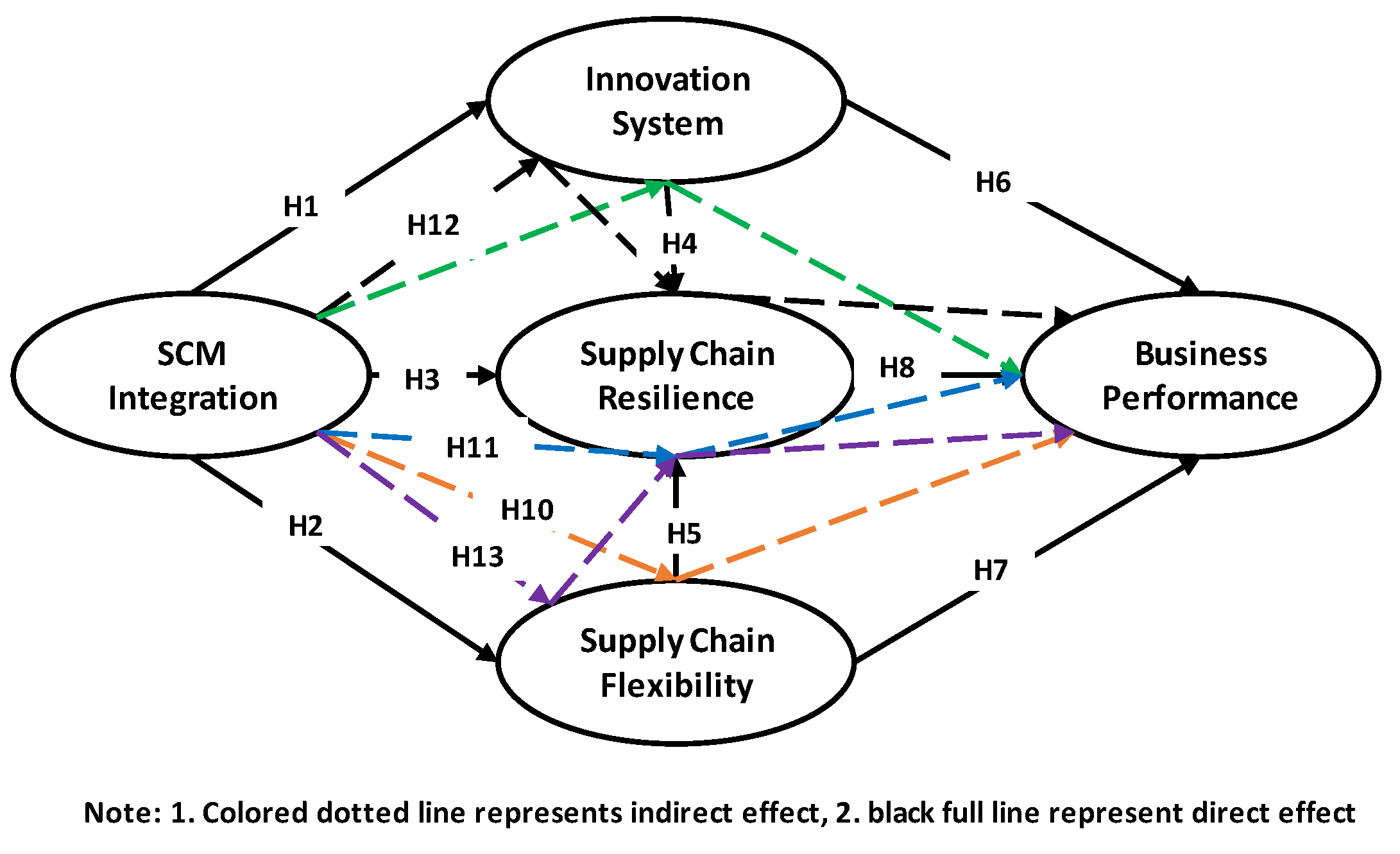
In summary, all constructs relationship and proposed hypothesis are shown in Figure 1.
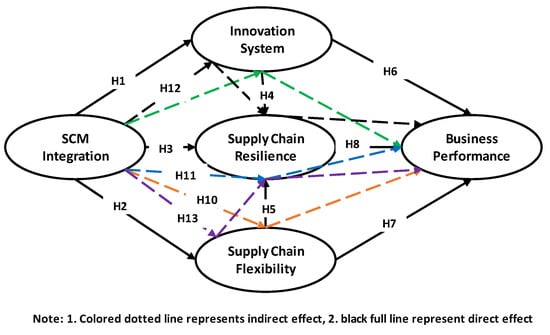
Figure 1.
The Research Model and The Related Hypothesis Developed.
3. Methodology
This study uses a quantitative research approach to examine the hypothesis proposed. Five constructs adopted in this study are supply chain integration, innovation system, supply chain flexibility, supply chain resilience, and business performance. Supply chain integration is defined as the extent to which the company integrate with an external partner and is measured using five items, namely, sharing complete product information (SCMI1), involving partners in product development (SCMI2), sharing inventory level (SCMI3), sharing production planning (SCMI4), coordinating with partners (SCMI5) [17,19,22,32,48]. Measurement items for supply chain flexibility consist of five items, namely, production planning flexibility (Fl. Sy1), changes in production processes (Fl. Sy2), volume flexibility (Fl. Sy3), manufacturing flexibility (Fl. Sy4), and product development flexibility [9,21,40,44]. The innovation system measures the extent to which the organization conducts innovation using five items, namely, latest best practice adoption (In.Sy1), continuous product development (In.Sy2), use of technology as needed (In.Sy3), the introduction of new products on an ongoing basis (In.Sy4), and on-time marketing of new products (In.Sy5) [11,15,37,38]. Furthermore, five items measure the supply chain resilience, namely, whether the company can handle sudden changes in customer demand (SCMR1), solve production problems quickly (SCMR2), change production planning quickly (SCMR3), overcome production material delays (SCMR4), and deal with customer complaints quickly (SCMR5) [25,39,47,48]. The business performance is measured by five items, namely, increased customer satisfaction (Bus.P1), increased company product quality (Bus.P2), increased accuracy of product delivery (Bus.P3), growth in product demand (Bus.P4), and fulfilling customer demand as required (Bus.P5) [15,26,37,39,42,47].
Data collection was done through a questionnaire designed with a five-point Likert scale and distributed via email to manufacturing companies and through WhatsApp groups and other social media. Data collection was carried out in March 2020–December 2020 using a Google Form distributed to companies registered on the Indonesian statistical center agency. The questionnaires were distributed to around 2000 respondents, and each questionnaire completed was rewarded IDR 50,000 as a form of credit assistance in filling out the questionnaire. The sampling technique used the purposive sampling technique approach with predetermined criteria requirements [64], namely, the respondents have been working for the company for at least one year, were permanent employees of the company, and were knowledgeable of the company overview. Of the initial sample of 492, a total of 470 subjects completed and returned the questionnaire (response rate of 95.5%). Hence, as many as 470 questionnaires were considered valid for further analysis. Data analysis used the partial least square (PLS) technique using smartPLS software version 3.0 [65,66]. The profiles of the respondents are indicated in Table 1.

Table 1.
Respondent Profile.
Table 1 shows that there were no significant differences between gender (female and male) who work in certain positions in the Indonesian manufacturing industry. This result revealed that gender is not a precondition to becoming a leader in the company, but it depends on individual capability. The majority of respondents are working in the production and marketing department with 254 respondents (54.04%), followed by the finance and accounting department with 69 respondents (14.68%), and the production planning department with 60 respondents (12.77%). This result indicates that the respondents represented cross-functional in the organization. The highest percentage of respondents’ working experience is 2–3 years of work, amounting to 183 respondents (38.94%). This finding shows that those respondents are young and tend to use social media to fill out questionnaires. The second percentage is the group with more than ten years of experience, at 134 respondents (28.51%), which shows that they have had a good experience. Many of those who have worked for ten years are members of the WhatsApp group with researchers, and there are relationships as college alumni, similarities in hobbies, and others. The number of workers is almost balanced between different company’s size involving in this survey (no big difference), which provides a good variance of manufacturing companies in this study. Interestingly, the working hours of 8 h or more applied to 88.30% of the organization. This result shows that during the emergence of the COVID-19 pandemic, Indonesia’s manufacturing companies continued to apply eight working hours according to the applicable regulations and only 11.70% had applied less than 8 working hours.
4. Result and Analysis
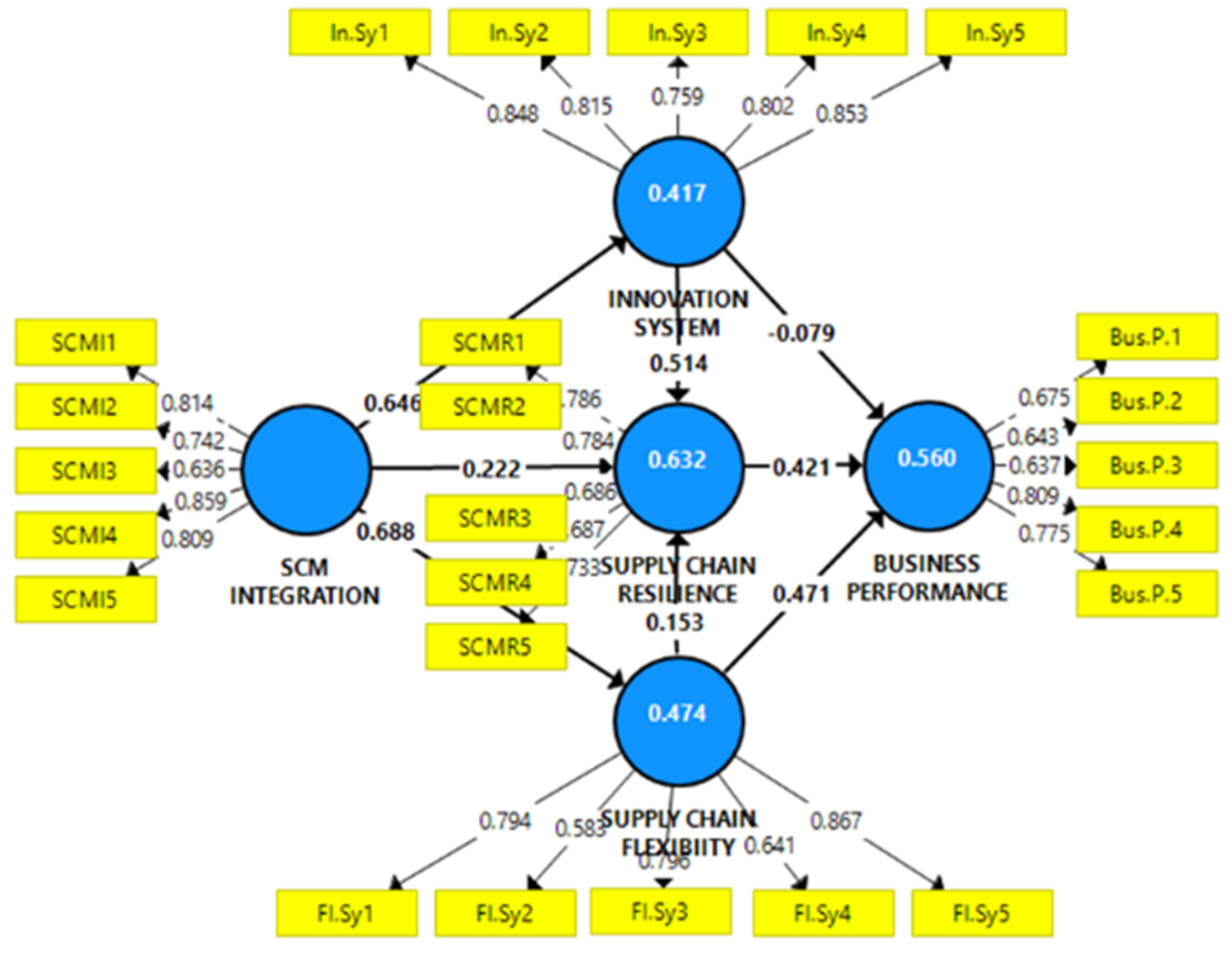
The first step was to assess the outer model (measurement model) to ensure that each indicator is valid and reliable. An indicator is considered valid when the loading factor value exceeds 0.50, and the factor loading is greater than cross-loading with other variables [65]. Table 2 illustrates the analysis result of factor loading and cross-loading of each indicator. The result demonstrated that the factor loading values are greater than 0.50 (value in bold), and the factor loading is greater than all cross-loading. Hence, those indicators of the variable are considered valid in terms of convergent validity and discriminant validity. Supply chain integration has the lowest factor loading value for item sharing inventory level (SCMI3), of 0.636 > 0.50. Furthermore, the innovation system has the lowest value of 0.759 for the indicator the technology used as needed (In.Sy3), which exceeds 0.50. Supply chain flexibility has the lowest factor loading value of 0.583 > 0.50 for item change in the production process (Fl.Sy2). Similarly, the supply chain resilience indicator with the lowest value at 0.686 is change production planning quickly (SCMR3). The last construct, business performance, has the lowest value of 0.643 for high product quality (Bus.P2). Those findings revealed that all measurement indicators are valid.
Table 2.
Indicator validity test result.
Reliability is another measurement for the extent to which the block of indicators measures the variable consistently. Table 3 illustrates the reliability test result for each construct in three measurements terms: Cronbach’s Alpha, Composite Reliability, and Average Variance Extracted (AVE).
Table 3.
Reliability, R2, and Q2 Test Result.
The block of indicators is considered reliable when the Cronbach’s Alpha > 0.70, composite reliability > 0.70, and AVE > 0.50 [66]. Table 3 reveals that the lowest Cronbach alpha value is 0.753 related to the business performance, and the lowest composite reliability value is 0.835, also related to the business performance, while the average variance extracted (AVE) value is above 0.500 for all variables. Based on this finding, all indicators are considered reliable, and further analysis is allowed. The value of R2 denotes the extent to which independent variables explain the variance of dependent variables. The closer the value of R2 to 1.0, the more variance of the dependent variable is explained by the independent variable. Table 4 illustrates the value of R2 for all dependent variables. Business performance has an R2 value of 0.560, which means that 56% of business performance is explained by four other variables simultaneously: supply chain management integration, innovation system, supply chain flexibility, and supply chain resilience. Another measurement necessary is to examine if the research model has a qualified predictive relevance referring to the predetermined requirement. The predictive relevance is expressed in Q2, and the result is provided by the analysis using the PLS technique. A research model is considered qualified to predict the value of the dependent variable when the value of Q2 is greater than 0.0. Table 3 shows the value of Q2 for each dependent variable of research and all values were greater than zero. This result indicates that the model has a qualified predictive relevance.
Table 4.
Direct and Indirect effect test result.
Further analysis was done to examine the predetermined hypotheses. The analysis is based on the significant level of 5% or the critical t-value of 1.96, or the p-value of 0.05. The hypothesis is empirically supported when the t-value exceeds 1.96 or the p-value less than 0.05 [66]. Figure 2 illustrates the research model and the analysis result using smartPLS software. Table 4 also demonstrates the analysis result from the direct effect reflected in hypothesis H1 up to H8 and indirect effect reflected in hypothesis H9 up to H13.
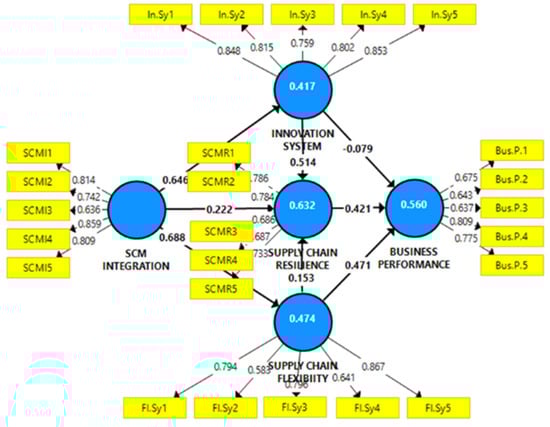
Figure 2.
Research Model and Analysis Result.
As shown in Table 4, all t-values > 1.96 and p-value < 0.05 except for hypothesis H6 for t-value < 1.96 and H9 for t-value of 1.122 < 1.96.
As determined previously, there are thirteen (13) hypotheses developed, and eleven (11) hypotheses were empirically supported with the t-values > 1.96, while two hypotheses (H6 and H9) were rejected with a t-value is 1.119 < 1.96 and 1.122 < 1.96, respectively. As shown in Table 4, those hypotheses consist of two groups: the direct effect (H1–H8) and the indirect effect or mediating role of the intervening variable (H9–H13).
5. Discussion and Managerial Implication
The results show that supply chain integration improves the innovation system in the company (H1). This result agrees with a previous study that supply chain management integration could improve innovation systems [11,13,19,33,58]. By sharing complete information with partners, supply chain integration enables the organization to perform innovations such as new product development, process innovation, and information technology application. The organization requires a new idea or part from the supplier to develop a customer’s new product. The supply chain management information is possible when the companies have implemented information technology that enables the internal integration between departments and external integration with suppliers and customers.
The second hypothesis (H2), that supply chain integration affects the supply chain flexibility, was supported by the data. This result shows that when the company shared complete product information and production planning with internal cross-function and external partners could increase the company’s flexibility, which is called supply chain flexibility. This research supports the research statement that supply chain integration can increase supply chain flexibility [9,17,19,23,27,60]. The third hypothesis (H3), that supply chain integration affects supply chain resilience, as expected, is also supported by data. This result confirmed the previous study by [47,48,61]. This study supports research stating that supply chain integration can improve supply chain resilience by easily responding to sudden changes. The integration with partners allows the company to coordinate and share the information in market demand changes. Since the company has integrated information systems internally and externally, it enables all parties to cope with changes such as production planning and material requirement, and order fulfillment. This information sharing and coordination between parties enables the supply chain to respond to the demand changes quickly.
The fourth hypothesis (H4), stating that the innovation system affects supply chain resilience, is supported by this research. This study supports previous research results, stating that innovation systems continuously improve supply chain resilience [26,39,62]. The company can innovate rapidly to develop new products and adjust the internal processes to respond to customer demand changes. Quick response to recover to the normal situation is a form of supply chain resilience goals. The fifth hypothesis (H5), that supply chain flexibility affects supply chain resilience, is accepted in this study. This result agrees with previous research that supply chain flexibility supports supply chain resilience [40,46,49,61,64]. The flexibility in product development and volume changes will respond to sudden changes in customer demand. A company’s ability to respond to changes quickly is the main goal of supply chain resilience.
In contrast to earlier findings [11,15,33,37,58], this study does not support the sixth hypothesis (H6), stating that innovation system affects business performance. This finding shows that the innovation system in developing new products and upgrading the business process does not directly affect business performance. However, this finding is considered reasonable in the context of the research model. Innovation is conducted by the internal process, while business performance is how the customers are satisfied after the product or services are received and enjoyed by the customer. This argument means that the product should be delivered and received by the customer through supply chain responsiveness. Innovation systems can improve business performance through the mediating role of supply chain resilience to respond to customers’ demand. This research can support previous research results that state that innovation systems can improve business performance through supply chain resilience [49,62].
Furthermore, the seventh hypothesis (H7), that supply chain flexibility affects business performance, is also supported. Supply chain flexibility can fulfill product demand following product variety and volume fluctuation to improve company performance. This finding is in line with previous studies stating that supply chain flexibility can improve business performance [9,41,42,49]. The flexibility is a key success factor in responding to high uncertainty during the COVID-19 pandemic era. The pandemic can disrupt the customer demand and material supply at any time as the pandemic exists and even worsen. Hence, the company has no choice other than to be flexible and responsive to the customer demand and material supply uncertainties. As discussed before, flexibility is possible when the company has established the integration with all partners from supplier, distributor, and retailer.
The eighth hypothesis (H8), that supply chain resilience affects business performance, as expected, is confirmed in this research. This study also supports the previous research results that supply chain resilience affects business performance [25,26,39,47,49]. When the company can respond to any change in customer demands such as new product variety, volume fluctuation, and time constraints, the customer will appreciate and dispose of paying it premium and becoming a loyal customer. The ability to cope with sudden customer demand changes and solve production problems quickly increase product demand growth and customer satisfaction. As discussed previously, the current COVID-19 pandemic has caused extreme uncertainty in all business sectors. The company should be able to respond to any uncertainty by practicing a resilient supply chain to survive.
In addition to the direct effect, this study has developed the indirect effect hypothesis through the intervening variable. The ninth hypothesis (H9) states that supply chain integration affects business performance through innovation systems, which is not supported in this study. However, it is reasonable that the hypothesis is rejected because the innovation system itself does not directly affect business performance (H6). Consequently, the innovation system does not mediate the impact of supply chain integration on business performance. Why the innovation system does not directly improve the business performance has been discussed previously. The tenth hypothesis (H10), that supply chain integration affects the business performance through supply chain flexibility, is supported. As expected, the mediating role of supply chain flexibility is supported. Supply chain integration in terms of information sharing, production planning, and involving the supplier in new product design will improve the supply chain flexibility in terms of deliveries, volume, time, and planning. Subsequently, this flexibility improves the business performance in terms of delivery as requested and improved customer demand fulfillment. Further, the eleventh hypothesis, that supply chain integration improves business performance through supply chain resilience, is supported. Since supply chain integration improves supply chain resilience and supply chain resilience improves business performance, supply chain integration indirectly improves business performance through supply chain resilience (H11). In this case, this study demonstrated the adoption of supply chain integration and establishing a resilient supply chain provide multiple impacts of the supply chain integration on the business performance.
Moreover, the twelfth hypothesis (H12), which states that supply chain integration improves business performance through innovation and supply chain resilience, is confirmed by this study. This finding proves that innovation supported by the resilient supply chain provides support to improve the business performance. Innovation provides the new product and process, and the resilient supply chain delivers the product to customers even in the extreme uncertainties during the pandemic era. The last finding of this study, hypothesis (H13), that supply chain integration enhances the business performance through supply chain flexibility and resilient supply chain, is supported as predicted. The supply chain integration enables the company to develop a resilient and flexible supply chain. This finding proved that flexibility and resilience are two key success factors to cope with changes and uncertainties caused by the pandemic. However, it is impossible to practice resilience and flexibility without integration with suppliers, distributors, and retailers. In this case, supply chain integration is the main enabler to establish and practice a resilient and flexible supply chain to enhance business performance.
This research gives companies practical contributions to make continuous updates to information technology systems to form internal integration and external integration as a form of supply chain integration. The company’s ability to manage integration will provide a fast response to the company’s supply chain flexibility, resilience, and innovation system in a pandemic era. Supply chain flexibility and resilience and a robust innovation system allow the company to anticipate sudden changes quickly. The company should practice reliable innovation systems and adaptation flexibility to overcome disruption and improve business performance.
This study’s findings can be highlighted in regards to the previous studies referred to in this research. The study has developed 13 hypotheses to be examined. Eight hypotheses concern the direct effect, while the rest concern the indirect effect. The direct effect hypotheses are based on the previous studies, while the indirect hypotheses were based on the direct effect hypotheses developed in the literature review section. Eleven (11) hypotheses were supported, while two hypotheses were not supported. The sixth hypothesis (H6), stating that innovation system affects the business performance, is not supported in this study. Consequently, hypothesis H9, which states that supply chain integration indirectly affects business performance through the innovation system, is not supported. This finding contradicts the previous study, which states that an innovation system affects business performance [12,23,43,48]. As defined previously, the innovation system is the extent to which the organization performs innovation measured with five items, namely, latest best practice adoption (In.Sy1), continuous product development (In.Sy2), use of technology as needed (In.Sy3), the introduction of new products on an ongoing basis (In.Sy4), and on-time marketing of new products (In.Sy5). Meanwhile, the business performance is assessed using five indicators, namely, increased customer satisfaction (Bus.P1), increased company product quality (Bus.P2), increased accuracy of product delivery (Bus.P3), growth in product demand (Bus.P4), and fulfilling customer demand as required (Bus.P5). Based on the indicators used, the innovation reflects how far the company innovates their product regarding product variation, usage of new technology, and on-time new product introduction. The innovation cannot directly enhance customer satisfaction, delivery, demand growth, and fulfillment. However, it does not mean that innovation is unnecessary. This study’s finding indicated that a resilient supply chain should support the innovation’s output, such as a new product to deliver it to the customer in the current crisis. During the pandemic, the people spend most of their time at home, and also the people have less money to spend due to unemployment, lockdown, social distancing, and traveling bans in many places. Based on this argument, it is reasonable that supply chain resilience and flexibility become key success factors for manufacturing companies. This finding, therefore, is essential as a new insight for the manufacturing management that, today, a resilient supply chain is highly required to survive and improve business performance. This study provides a managerial implication that the management should emphasize the improvement of supply chain integration to enable innovation, supply chain resilience, and supply chain flexibility to pursue better business performance during the current pandemic.
This work has some limitations, particularly in respect of the population and the variable involved. Further studies on the current topic are suggested to involve the variable such as supply chain risk management and customer relationship management to cover broader parties and functions involved in the supply chain network.
6. Conclusions
This study has investigated the effect of supply chain integration on business performance with the mediating effect of supply chain flexibility, innovation system, and resilient supply chain. The results indicated that, of thirteen hypotheses developed, twelve hypotheses were supported, and two hypotheses were rejected in this study. Supply chain integration affects innovation system (H1), supply chain flexibility (H2), and supply chain resilience (H3). Furthermore, innovation system improves supply chain resilience (H4), supply chain flexibility affects supply chain resilience (H5), innovation system does not affect business performance (H6), supply chain flexibility improves business performance (H7), and supply chain resilience improves business performance (H8).
Meanwhile, in the indirect effect, the innovation system did not mediate the influence of supply chain integration on business performance (H9), but through innovation and supply chain resilience, supply chain integration could improve the business performance (H12). Moreover, supply chain integration also indirectly affects business performance through supply chain flexibility (H10) and supply chain resilience (H11). The last finding indicated that supply chain integration improves business performance through supply chain flexibility and supply chain resilience.
This research has highlighted the importance of supply chain integration in supporting innovation, flexibility, and resilience to improve business performance. The collaboration of all parties in supply chain integration enables all parties to plan, produce, deliver, and share information. However, each party also should be committed to being resilient, flexible, and innovative. The present findings have important implications for solving the uncertainties and disruption caused by the COVID-19 pandemic. This research gives companies practical contributions to make continuous updates to information technology systems to form internal integration and external integration as a form of supply chain integration. The company’s ability to manage integration will provide a fast response to the company’s supply chain flexibility and innovation system in a pandemic era. Supply chain flexibility, supply chain resilience, and a robust innovation system enable the company to anticipate sudden supply and demand changes quickly. The company should practice reliable innovation systems and best practices in a resilient and flexible supply chain to overcome disruption and improve business performance. This study could contribute to the current research in the field of supply chain management theories.
Author Contributions
Z.J.H.T., background of research, literature review, conceptual model, methodology and descriptive statistics; H.S., using software PLS, validation, reliability analysis, and hypothesis analysis; F.J., original manuscript preparation, supervision, correcting writing errors, preparing discussion and conclusion, final article and final analysis. All authors have read and agreed to the published version of the manuscript.
Funding
No funding received for this research.
Institutional Review Board Statement
Not Applicable.
Informed Consent Statement
Not Applicable.
Data Availability Statement
The data presented in this study are available on request from the corresponding author. The data are not publicly available due to respondent request.
Conflicts of Interest
All authors declare no conflict of interest.
References
- Kraus, S.; Clauss, T.; Breier, M.; Gast, J.; Zardini, A.; Tiberius, V. The economics of COVID-19: Initial empirical evidence on how family firms in five European countries cope with the corona crisis. Int. J. Entrep. Behav. Res. 2020, 26, 1067–1092. [Google Scholar] [CrossRef]
- Nchanji, E.B.; Lutomia, C.K.; Chirwa, R.; Templer, N.; Rubyogo, J.C.; Onyango, P. Immediate impacts of COVID-19 pandemic on bean value chain in selected countries in sub-Saharan Africa. Agric. Syst. 2021, 188, 103034. [Google Scholar] [CrossRef] [PubMed]
- Al-Hyari, K. Initial empirical evidence on how Jordanian manufacturing SMEs cope with the covid-19 pandemic. Acad. Strateg. Manag. J. 2020, 19, 1–12. [Google Scholar]
- Kumar, R.; Mishra, R. COVID-19 Global Pandemic: Impact on Management of Supply Chain. Int. J. Emerg. Technol. Adv. Eng. 2020, 10, 132–139. [Google Scholar] [CrossRef]
- Zhu, G.; Chou, M.; Tsai, C. Lessons Learned from the COVID-19 Pandemic Exposing the Shortcomings of Current Supply Chain Operations: A Long-Term Prescriptive Offering. Sustainability 2020, 12, 5858. [Google Scholar] [CrossRef]
- Djalante, R.; Lassa, J.; Setiamarga, D.; Sudjatma, A.; Indrawan, M.; Haryanto, B.; Mahfud, C.; Sinapoy, M.S.; Djalante, S.; Rafliana, I.; et al. Review and analysis of current responses to COVID-19 in Indonesia: Period of January to March 2020. Prog. Disaster Sci. 2020, 6, 100091. [Google Scholar] [CrossRef]
- Paul, S.K.; Chowdhury, P. A production recovery plan in manufacturing supply chains for a high-demand item during COVID-19. Int. J. Phys. Distrib. Logist. Manag. 2020, 51, 104–125. [Google Scholar] [CrossRef]
- Yu, D.E.C.; Razon, L.F.; Tan, R.R. Can global pharmaceutical supply chains scale up sustainably for the COVID-19 crisis? Resour. Conserv. Recycl. 2020, 159, 104868. [Google Scholar] [CrossRef] [PubMed]
- Yu, K.; Luo, B.N.; Feng, X.; Liu, J. Supply chain information integration, flexibility, and operational performance: An archival search and content analysis. Int. J. Logist. Manag. 2018, 29, 340–364. [Google Scholar] [CrossRef]
- Chowdhury, M.H.; Quaddus, M. Supply chain resilience: Conceptualization and scale development using dynamic capability theory. Int. J. Prod. Econ. 2017, 188, 185–204. [Google Scholar] [CrossRef]
- Lii, P.; Kuo, F.-I. Innovation-oriented supply chain integration for combined competitiveness and firm performance. Int. J. Prod. Econ. 2016, 174, 142–155. [Google Scholar] [CrossRef]
- Kamal, A.; Azfar, R.; Salah, B.; Saleem, W.; Abas, M.; Khan, R.; Pruncu, C. Quantitative Analysis of Sustainable Use of Construction Materials for Supply Chain Integration and Construction Industry Performance through Structural Equation Modeling (SEM). Sustainability 2021, 13, 522. [Google Scholar] [CrossRef]
- Shamout, M.D. The nexus between supply chain analytic, innovation and robustness capability: Does firm age matter? VINE J. Inf. Knowl. Manag. Syst. 2020, 51, 163–176. [Google Scholar] [CrossRef]
- Liu, X.; Lin, K.; Wang, L.; Ding, L. Pricing Decisions for a Sustainable Supply Chain in the Presence of Potential Strategic Customers. Sustainability 2020, 12, 1655. [Google Scholar] [CrossRef]
- Tarigan, Z.J.H. The impact of organizational commitment to the process and product innovation in improving operational performance. Int. J. Bus. Soc. 2018, 19, 335–346. [Google Scholar]
- Mandal, S. Impact of supplier innovativeness, top management support and strategic sourcing on supply chain resilience. Int. J. Prod. Perform. Manag. 2020. [Google Scholar] [CrossRef]
- Chaudhuri, A.; Boer, H.; Taran, Y. Supply chain integration, risk management and manufacturing flexibility. Int. J. Oper. Prod. Manag. 2018, 38, 690–712. [Google Scholar] [CrossRef]
- Xu, D.; Huo, B.; Sun, L. Relationships between intra-organizational resources, supply chain integration and business performance: An extended resource-based view. Ind. Manag. Data Syst. 2014, 114, 1186–1206. [Google Scholar] [CrossRef]
- He, Y.; Lai, K.K.; Sun, H.; Chen, Y. The impact of supplier integration on customer integration and new product performance: The mediating role of manufacturing flexibility under trust theory. Int. J. Prod. Econ. 2014, 147, 260–270. [Google Scholar] [CrossRef]
- Munir, M.; Jajja, M.S.S.; Chatha, K.A.; Farooq, S. Supply chain risk management and operational performance: The enabling role of supply chain integration. Int. J. Prod. Econ. 2020, 227, 107667. [Google Scholar] [CrossRef]
- Putra, A.; Tarigan, Z.J.H.; Siagian, H. Influence of Information Quality on Retailer Satisfaction through Supply Chain Flexibility and Supplier Relationship Management in the Retail Industry. J. Tek. Ind. 2020, 22, 93–102. [Google Scholar] [CrossRef]
- Khalaf, M.A.; El Mokadem, M.Y. The relationship between internal integration and manufacturing flexibility in the Egyptian industry. Int. J. Qual. Serv. Sci. 2019, 11, 16–33. [Google Scholar] [CrossRef]
- Shukor, A.A.A.; Newaz, S.; Rahman, M.K.; Taha, A.Z. Supply chain integration and its impact on supply chain agility and organizational flexibility in manufacturing firms. Int. J. Emerg. Mark. 2020. [Google Scholar] [CrossRef]
- Shin, N.; Park, S. Evidence-Based Resilience Management for Supply Chain Sustainability: An Interpretive Structural Modelling Approach. Sustainability 2019, 11, 484. [Google Scholar] [CrossRef]
- Hohenstein, N.-O.; Feisel, E.; Hartmann, E.; Giunipero, L. Research on the phenomenon of supply chain resilience a systematic review and paths for further investigation. Int. J. Phys. Distrib. Logist. Manag. 2015, 45, 90–117. [Google Scholar] [CrossRef]
- Kwak, D.-W.; Seo, Y.-J.; Mason, R. Investigating the relationship between supply chain innovation, risk management capabilities and competitive advantage in global supply chains. Int. J. Oper. Prod. Manag. 2018, 38, 2–21. [Google Scholar] [CrossRef]
- Zhao, L.; Huo, B.; Sun, L.; Zhao, X. The impact of supply chain risk on supply chain integration and company performance: A global investigation. Supply Chain Manag. Int. J. 2013, 18, 115–131. [Google Scholar] [CrossRef]
- Huo, B. The impact of supply chain integration on company performance: An organizational capability perspective. Supply Chain Manag. Int. J. 2012, 17, 596–610. [Google Scholar] [CrossRef]
- Tarigan, Z.J.H.; Mochtar, J.; Basana, S.R.; Siagian, H. The effect of competency management on organizational performance through supply chain integration and quality. Uncertain Supply Chain Manag. 2021, 9, 283–294. [Google Scholar] [CrossRef]
- Wong, W.P.; Sinnandavar, C.M.; Soh, K.-L. The relationship between supply environment, supply chain integration and operational performance: The role of business process in curbing opportunistic behaviour. Int. J. Prod. Econ. 2021, 232, 107966. [Google Scholar] [CrossRef]
- Zhaoa, X.; Wangb, P.; Palb, R. The effects of agro-food supply chain integration on product quality and financial performance: Evidence from Chinese agro-food processing business. Int. J. Prod. Econ. 2021, 231, 107832. [Google Scholar] [CrossRef]
- Tarigan, Z.J.H.; Siagian, H. The effects of strategic planning, purchasing strategy and strategic partnership on operational performance. Uncertain Supply Chain Manag. 2021, 9, 363–372. [Google Scholar] [CrossRef]
- Tian, H.; Otchere, S.; Coffie, C.; Mensah, I.; Baku, R. Supply Chain Integration, Interfirm Value Co-Creation and Firm Performance Nexus in Ghanaian SMEs: Mediating Roles of Stakeholder Pressure and Innovation Capability. Sustainability 2021, 13, 2351. [Google Scholar] [CrossRef]
- Tiwari, S. Supply chain integration and Industry 4.0: A systematic literature review. Benchmarking Int. J. 2020, 990–1030. [Google Scholar] [CrossRef]
- Kristianto, I.; Tarigan, Z.J.H. The impact TQM System on Supply Chain Performance through Supply Chain Integration and Employee Satisfaction. Petra Int. J. Bus. Stud. 2019, 2, 8–17. [Google Scholar] [CrossRef]
- Xu, Q.; Hu, Q.; Chin, T.; Chen, C.; Shi, Y. How Supply Chain Integration Affects Innovation in a Digital Age: Moderating Effects of Sustainable Policy. Sustainability 2019, 11, 5460. [Google Scholar] [CrossRef]
- Wang, M.; Asian, S.; Wood, L.C.; Wang, B. Logistics innovation capability and its impacts on the supply chain risks in the Industry 4.0 era. Mod. Supply Chain Res. Appl. 2020, 2, 83–98. [Google Scholar] [CrossRef]
- Zimmermann, R.; Ferreira, L.M.D.; Moreira, A.C. The influence of supply chain on the innovation process: A systematic literature review. Supply Chain Manag. Int. J. 2016, 21, 289–304. [Google Scholar] [CrossRef]
- Abeysekara, N.; Wang, H.; Kuruppuarachchi, D. Effect of supply-chain resilience on firm performance and competitive advantage: A study of the Sri Lankan apparel industry. Bus. Process. Manag. J. 2019, 25, 1673–1695. [Google Scholar] [CrossRef]
- Rajesh, R. Flexible business strategies to enhance resilience in manufacturing supply chains: An empirical study. J. Manuf. Syst. 2020. [Google Scholar] [CrossRef]
- Blome, C.; Schoenherr, T.; Rexhausen, D. Antecedents and enablers of supply chain agility and its effect on performance: A dynamic capabilities perspective. Int. J. Prod. Res. 2013, 51, 1295–1318. [Google Scholar] [CrossRef]
- Gligor, D.M.; Esmark, C.L.; Holcomb, M.C. Performance outcomes of supply chain agility: When should you be agile? J. Oper. Manag. 2015, 33–34, 71–82. [Google Scholar] [CrossRef]
- Oniszczuk-Jastrząbek, A.; Czermański, E.; Cirella, G.T. Sustainable Supply Chain of Enterprises: Value Analysis. Sustainability 2020, 12, 419. [Google Scholar] [CrossRef]
- Pettit, T.J.; Croxton, K.L.; Fiksel, J. Ensuring Supply Chain Resilience: Development and Implementation of an Assessment Tool. J. Bus. Logist. 2013, 34, 46–76. [Google Scholar] [CrossRef]
- Pal, R.; Torstensson, H.; Mattila, H. Antecedents of organizational resilience in economic crises—An empirical study of Swedish textile and clothing SMEs. Int. J. Prod. Econ. 2014, 147, 410–428. [Google Scholar] [CrossRef]
- Ambulkar, S.; Blackhurst, J.; Grawe, S.J. Firm’s resilience to supply chain disruptions: Scale development and empirical examination. J. Oper. Manag. 2015, 33–34, 111–122. [Google Scholar] [CrossRef]
- Liu, C.-L.; Shang, K.-C.; Lirn, T.-C.; Lai, K.-H.; Lun, Y.V. Supply chain resilience, firm performance, and management policies in the liner shipping industry. Transp. Res. Part A: Policy Pr. 2018, 110, 202–219. [Google Scholar] [CrossRef]
- Chunsheng, L.; Wong, C.W.; Yang, C.-C.; Shang, K.-C.; Lirn, T.-C. Value of supply chain resilience: Roles of culture, flexibility, and integration. Int. J. Phys. Distrib. Logist. Manag. 2019, 50, 80–100. [Google Scholar] [CrossRef]
- Chong, A.Y.; Chan, F.T.; Ooi, K.; Sim, J. Can Malaysian firms improve organizational/innovation performance via SCM? Ind. Manag. Data Syst. 2011, 111, 410–431. [Google Scholar] [CrossRef]
- Lee, C.W.; Kwon, I.G.; Severance, D. Relationship between supply chain performance and degree of linkage among supplier, internal integration, and customer. Supply Chain Manag. Int. J. 2007, 12, 444–452. [Google Scholar] [CrossRef]
- Ince, H.; Imamoglu, S.Z.; Keskin, H.; Akgun, A.; Efe, M.N. The Impact of ERP Systems and Supply Chain Management Practices on Firm Performance: Case of Turkish Companies. Procedia Soc. Behav. Sci. 2013, 99, 1124–1133. [Google Scholar] [CrossRef]
- Al-Shboul, M.A.R.; Barber, K.D.; Garza-Reyes, J.A.; Kumar, V.; Abdi, M.R. The effect of supply chain management practices on supply chain and manufacturing firms’ performance. J. Manuf. Technol. Manag. 2017, 28, 577–609. [Google Scholar] [CrossRef]
- Sharma, S.; Gandhi, M.A. Exploring correlations in components of green supply chain practices and green supply chain performance. Compet. Rev. 2016, 26, 332–368. [Google Scholar] [CrossRef]
- Truong, H.Q.; Sameiro, M.; Fernandes, A.C.; Sampaio, P.; Duong, B.A.T.; Duong, H.H.; Vilhenac, E. Supply chain management practices and firms’ operational performance. Int. J. Qual. Reliab. Manag. 2017, 34, 176–193. [Google Scholar] [CrossRef]
- Tarigan, Z.J.H.; Siagian, H.; Jie, F. The Role of Top Management Commitment to Enhancing the Competitive Advantage Through ERP Integration and Purchasing Strategy. Int. J. Enterp. Inf. Syst. 2020, 16, 53–68. [Google Scholar] [CrossRef]
- De Paula, I.C.; De Campos, E.A.R.; Pagani, R.N.; Guarnieri, P.; Kaviani, M.A. Are collaboration and trust sources for innovation in the reverse logistics? Insights from a systematic literature review. Supply Chain Manag. Int. J. 2019, 25, 176–222. [Google Scholar] [CrossRef]
- Tarigan, Z.J.H.; Siagian, H.; Bua, R.R. The Impact of Information System Implementation to the Integrated System for Increasing the Supply Chain Performance of Manufacturing Companies. IOP Conf. Series: Mater. Sci. Eng. 2019, 473, 012050. [Google Scholar] [CrossRef]
- Siagian, H.; Jade, K.; Tarigan, Z.J.H. The role of affective leadership in improving firm performance through the integrated internal system and external integration FMCG Industry. Int. J. Data Netw. Sci. 2020, 4, 365–372. [Google Scholar] [CrossRef]
- Alfalla-Luque, R.; Marin-Garcia, J.A.; Medina-Lopez, C. An analysis of the direct and mediated effects of employee commitment and supply chain integration on organisational performance. Int. J. Prod. Econ. 2015, 162, 242–257. [Google Scholar] [CrossRef]
- Liu, C.-L.; Lee, M.-Y. Integration, supply chain resilience, and service performance in third-party logistics providers. Int. J. Logist. Manag. 2018, 29, 5–21. [Google Scholar] [CrossRef]
- Eltantawy, R.A. The role of supply management resilience in attaining ambidexterity: A dynamic capabilities approach. J. Bus. Ind. Mark. 2016, 31, 123–134. [Google Scholar] [CrossRef]
- Akgün, A.E.; Keskin, H. Organisational resilience capacity and firm product innovativeness and performance. Int. J. Prod. Res. 2014, 52, 6918–6937. [Google Scholar] [CrossRef]
- Jin, Y.; Vonderembse, M.; Ragu-Nathan, T.; Smith, J.T. Exploring relationships among IT-enabled sharing capability, supply chain flexibility, and competitive performance. Int. J. Prod. Econ. 2014, 153, 24–34. [Google Scholar] [CrossRef]
- Sekaran, U.; Bougie, R. Research Methods for Business: A Skill Building Approach, 7th ed.; John Wiley & Sons: Hoboken, NJ, USA, 2016; pp. 235–260. [Google Scholar]
- Khan, G.F.; Sarstedt, M.; Shiau, W.-L.; Hair, J.F.; Ringle, C.M.; Fritze, M.P. Methodological research on partial least squares structural equation modeling (PLS-SEM). Internet Res. 2019, 29, 407–429. [Google Scholar] [CrossRef]
- Hair, J.F., Jr.; Sarstedt, M.; Hopkins, L.; Kuppelwieser, V.G. Partial least squares structural equation modeling (PLS-SEM). Eur. Bus. Rev. 2014, 26, 106–121. [Google Scholar] [CrossRef]
Publisher’s Note: MDPI stays neutral with regard to jurisdictional claims in published maps and institutional affiliations. |
© 2021 by the authors. Licensee MDPI, Basel, Switzerland. This article is an open access article distributed under the terms and conditions of the Creative Commons Attribution (CC BY) license (https://creativecommons.org/licenses/by/4.0/).