


Abstract
(1) Background: This paper outlines the results of a literature review of meta-analyses published on motivation and evaluation in the last five years. (2) Methods: A systematic review of three educational databases (WoS, SCOPUS and ERIC) was conducted following the PRISMA and PICO approaches. A total of 54 peer-reviewed meta-analysis papers were selected, analysed and compared. (3) Results: A significant number and variety of meta-analyses have been conducted: motivation meta-analyses focus primarily on contextual variables, self-regulation and students’ academic performance, and evaluation meta-analyses examine the effectiveness of the teaching intervention, the use of teaching methodologies and technological resources for learning. (4) Conclusions: There are two important absences: on the one hand, it is necessary to develop meta-analyses that combine motivation and evaluation, also measuring their interaction, from the perspective of sustainability, and not only of educational improvement, and on the other hand, it is necessary to perform meta-analyses on the effectiveness of the formative and shared evaluation of the sustainability of learning processes.
1. Introduction
A quality education inspired by the social value of sustainability can be established as one that is able to provide meaningful and relevant learning environments, processes and tools for all students, ensuring access, promoting retention and contributing to the educational success of all in alignment with SDG number 4 of the 2030 Agenda framework: guaranteeing an inclusive, fair and quality education, and promoting opportunities for lifelong learning for all [1]. Furthermore, this kind of education must also promote the acquisition of reflective and critical competences for the development of a citizenship committed to the current challenges from a transversal, holistic and complex perspective [2,3]. Hargreaves and Fink [4] refer to such a scenario as sustainable education systems or actions to raise learning levels for all students, reduce learning gaps and increase public commitment to financing education. Therefore, we must consider an education inspired by sustainability as a framework for ensuring experiences that can positively impact on the development of a whole person’s capabilities, including lifelong learning from the capabilities perspective. Under the premise of sustainable education, shared learning spaces are to be created, where different agents can promote the development of the learner’s competences. This means that educational actors can be aware of their capacity to learn, to generate change and to make policy decisions through discourses that articulate and sustain good practices, as well as innovative approaches to new educational demands.
As stated above, this approach is related to the requirement of quality education. It should make it possible to change the aspects that can be improved and maintain those that work. All of this is based on criteria of quality and equity to guarantee successful learning experiences for all. In this sense, some dilemmas arise without a simple answer. However, this highlights the importance of spaces for intersubjective construction and collaboration in order to move towards quality education for all. Thus, an education inspired by the principle of sustainability must be able to create contexts, resources and processes for all learners to succeed [5].
Three questions are central to the deployment of successful education for all from the perspective of sustainability: (1) Contexts for successful learning must favour organisational, methodological and cultural conditions connected to the pedagogical principles of any learning action. (2) Resources are useful materials and instruments at the service of learning and teaching. Every resource has the role of helping the teacher to fulfil his or her educational function and the student to learn in coherence with the needs and objectives of the teaching–learning process. (3) The design and development of effective educational processes is essential for successful learning. Within this aspect, two processes are essential: The first educational process is linked to the motivation that allows the learners themselves to be guided towards well-defined learning outcomes [6]. The second educational process refers to assessment as a learning activity that enables learners to become aware of what and how they learn as acts of metacognition and self-regulation [7,8,9]. Both educational elements should not be interpreted as isolated elements but as processes aimed at enabling everyone to be producers and executors in self-academic, formative and professional itineraries sustained in their life projects in coexistence with others.
The aim of this paper is to map published meta-analyses on motivation and assessment throughout the teaching–learning process. To this end, a systematic review was carried out to serve as an umbrella and closure of the sustainability monograph in which this proposal is included.
2. Materials and Methods
A systematic review brings a focused view of a relevant issue of interest for the development of educational research [10,11]. It is thus a methodological strategy to screen, evaluate, synthesise and analyse the existing literature on the topic of motivation and evaluation or assessment in education.
2.1. Search Sources
This systematic review focuses on articles published in the last 5 years (January 2016–March 2021); concretely, meta-analyses included in the WoS, SCOPUS and ERIC databases are analysed. The search strategy was based on the use of terms on the subject of the study. The descriptors used were: motivation, evaluation, assessment and education. The search operators AND and OR were used.
2.2. Criteria for Inclusion and Exclusion of Articles
Inclusion criteria were as follows: (1) meta-analysis studies; (2) English language, (3) meta-analyses referring to motivation, evaluation and assessment; (4) articles collected from WoS, Scopus and ERIC databases; (5) articles within the field of educational research.
Exclusion criteria were as follows: (1) duplicate articles, (2) articles with limited information on content and methodology and (3) articles not within the time period of our analysis (January 2016 to March 2021).
2.3. Limits and Methodology of the Search
The search procedure was based on the application of the Preferred Reporting Items for Systematic Reviews and Meta-Analyses (PRISMA) [10]. The PICO strategy was also used to find key data on the following: year, country, studies, sample or participants, purpose, content and outcomes.
This review has at least four limitations to be taken into account, since it does not seek representativeness but rather the relevance and significance of the published works: (1) it includes studies published in the last five years; (2) the selection of articles is generic and not based on their internal content; (3) it assumes a broad sense of sustainability; (4) it only incorporates meta-analyses, ignoring articles that are systematic reviews.
2.4. Procedure
The time period for the identification and selection of articles based on meta-analyses on the research topics was between 1 December 2020 and 20 March 2021.
The stages of the research were as follows: (1) Setting criteria for inclusion/exclusion of articles. (2) Decision making on the databases to be reviewed for information extraction. Three databases were selected: WoS, Scopus and ERIC. (3) Defining the search descriptors, which was among the difficulties of the study. After an exhaustive review, it was decided to use three descriptors: motivation, evaluation and assessment. All three descriptors are widely accepted by the scientific community, and are used unambiguously and commonly in the literature. The problem was that there are a large number of papers published on these topics every year, which made the research inoperative. Even the shorter time period than the one finally chosen yielded a large quantity of publications. This suggested the possibility of separate searches but also the need to focus on a particular type of study. The results of separate searches were, on the one hand, motivation articles, and on the other hand, evaluation/assessment articles.
The search strategy combined two steps for identifying and selecting information: the first step, motivation AND meta-analysis, evaluation OR assessment AND meta-analysis, and the second step, motivation AND meta-analysis (educational research), evaluation OR assessment AND meta-analysis (educational research). (5) The articles were selected using the analysis tools of the different databases, and then incorporated into MENDELEY® to be read, analysed and compared. This process involved all the authors of this paper following an interjudge agreement procedure to make decisions on the suitability, relevance and fit of the selected articles. The result was a realistic and useful number of articles that were considered for further analysis.
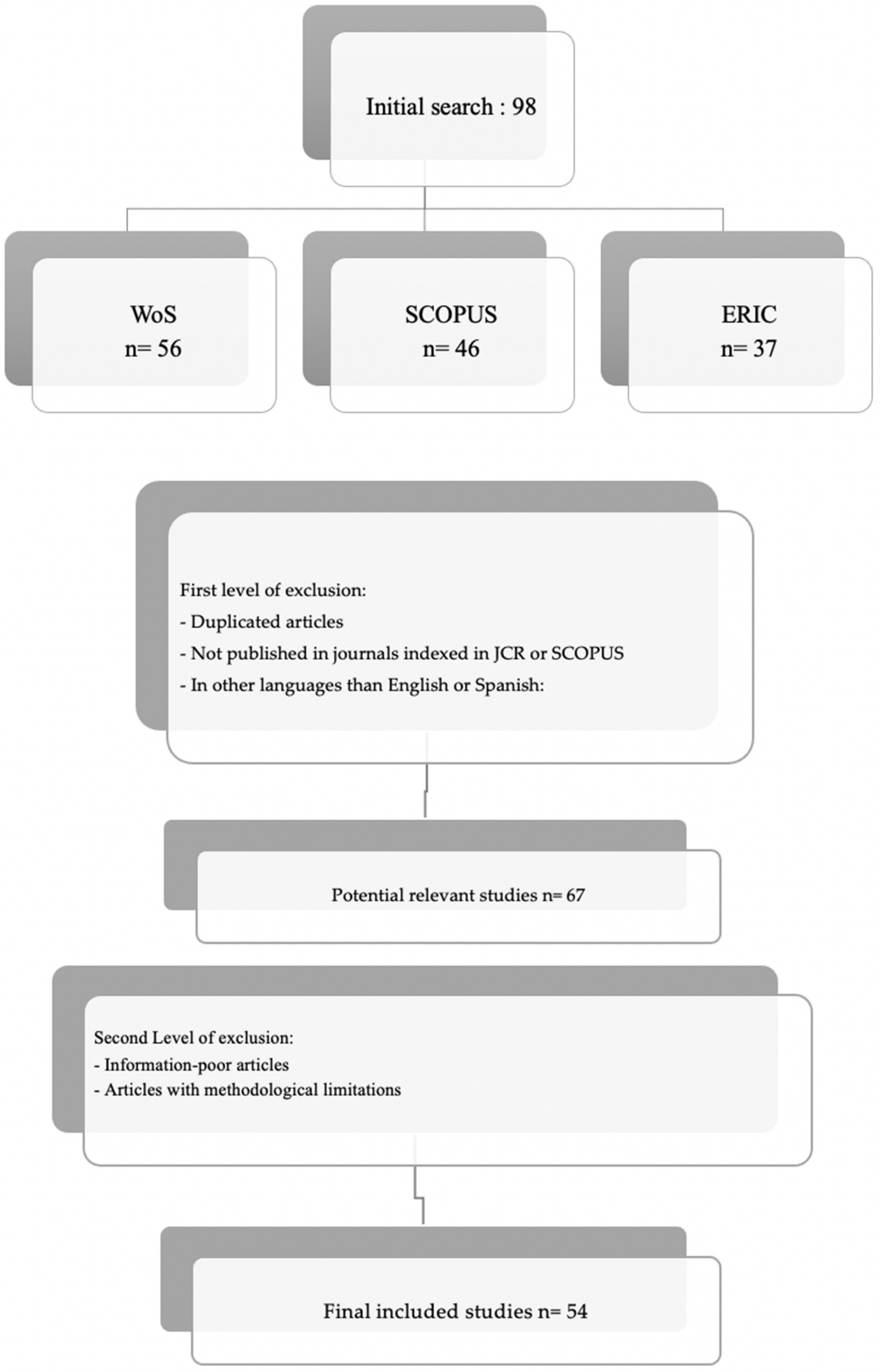
The search strategy was systematised using the PRISMA Flow Diagram template [10]. Its usefulness lies in its visual power and coherent organisation of the flow of action with its decisions and results. Thus, for each of the descriptors, motivation and evaluation/assessment, the initial search yielded a total of 98 documents. These documents were refined according to the criteria. After eliminating duplicates and a primary analysis (title, abstract and keywords), 69 records were explored by applying the inclusion/exclusion criteria to refine the selection through a detailed reading by the researchers, individually, and then shared, of the documents suitable for study according to the objectives of this research (Figure 1).
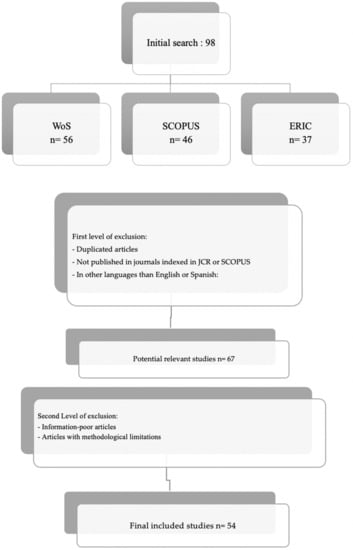
Figure 1.
Flow diagram of the systematic search process.
Six categories of analysis were used:
- (1)
- Author and year of publication: Which authors are involved in the meta-analysis? In which year was it published? The search period was the last five years in order to obtain a sufficient but manageable information base.
- (2)
- Country: descriptive but illustrative of where this type of study is produced and prioritized.
- (3)
- Studies: essential questions in meta-analyses. The studies used to carry out the systematic review provide information on the quality of the meta-analysis and its implications.
- (4)
- Sample: as with the previous criterion, in a meta-analysis, it is necessary to identify the sample used, not always the number of people, but the number of studies.
- (5)
- Purpose: the objective of meta-analysis.
- (6)
- Content: thematic descriptors that allow concepts to be associated with the descriptors of our study; it is essential to use the Boolean data search in English and Spanish. Therefore, each data set of the two levels refers to the established search descriptors.
2.5. Quality Assessment
The quality of the selection process, as well as the adequate implementation of the inclusion and exclusion criteria, was carried out by combining four strategies: (1) Inclusion of the review in PROSPERO of the Centre for Review and Dissemination. Application of the PRISMA protocol [10]. This was also combined with the use of AMSTAR [11], an excellent tool of critical appraisal for systematic reviews. (3) The Consolidated Standards of Reporting Trials Statement [12] was used. It is a set of 25 recommendations to inform trial design, analysis and interpretation. The inherent nature of meta-analyses recommended that this strategy also be applied. (4) The search procedure was initially conducted anonymously by two investigators, and the results were discussed by interjudge agreement. In the case of doubt, the register was consulted again, and collegial decisions were made.
3. Results
The results are a descriptive and comparative analysis of 53 meta-analyses.
3.1. Descriptive Analysis
The descriptive analysis shows the main key indicators of the sample of publications selected in this study. For this purpose, a table format was chosen to summarise the descriptive information for each of them. Information on the descriptor motivation is shown in Table 1, and information on the evaluation and assessment is shown in Table 2.

Table 1.
Summary of meta-analysis on motivation in education.
Table 2.
Summary of meta-analysis on evaluation/assessment in education.
3.2. Visual Comparative Analysis: Key Words
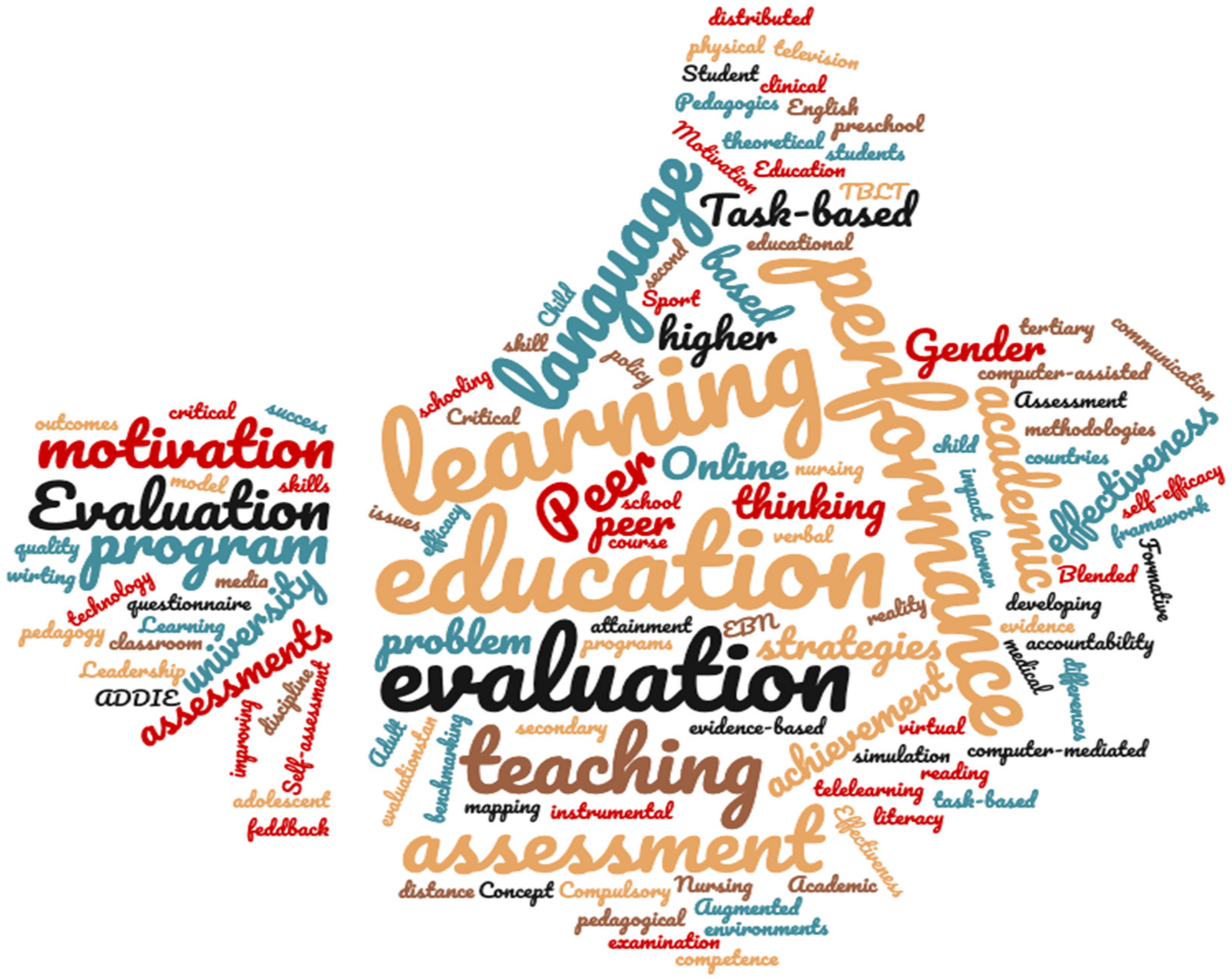
The comparative analysis informs five issues: (1) In recent years, we have witnessed a proliferation in the use of meta-analysis to provide empirical evidence on the effects of variables related to motivation, evaluation and assessment in education. (2) There is an important variety of issues concerning the topic of motivation and evaluation, although (3) motivation and assessment are jointly addressed when meta-analyses deal with the topics of testing, achievement or learning improvement. (4) Meta-analyses on motivation are mainly focused on the context and educational process variables, while meta-analyses on assessment are focused on the effectiveness of the intervention, the use of methodologies or technological resources or self-regulation in learning. (5) It is remarkable that there are very few meta-analyses on formative and shared assessment.
Figure 2 and Figure 3 show the key descriptors related to the meta-analysis studies analysed in this article.

Figure 2.
Descriptor cloud of meta-analyses on motivation.
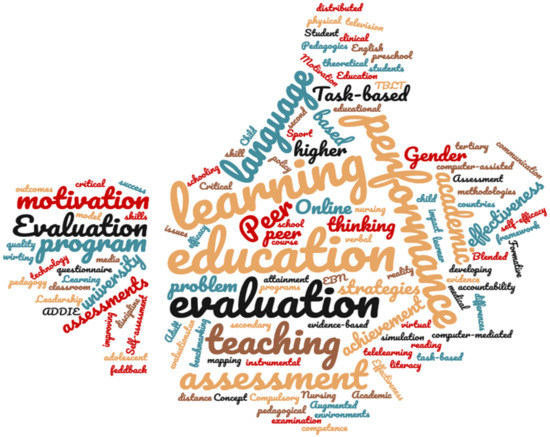
Figure 3.
Descriptor cloud of meta-analyses on evaluation or assessment.
4. Discussion and Conclusions
This article highlighted the importance of motivation and evaluation to our understanding of educational processes from a sustainable perspective. In other words, there is evidence that both topics are of interest to the scientific community, either because of the number of publications or the diversity of aspects they deal with. This was our intention from the outset. However, in addition, this map allows us to analyse motivation and evaluation in the current context in relation to the priorities, absences and possibilities for the development of research in education.
These issues point to at least two possible directions for further research: (1) the need for more meta-analyses covering the range of topics on motivation and evaluation; (2) the absence of publications undertaking a stated and defined perspective of the sustainability of educational processes is highlighted. There are no meta-analyses that study motivation from evaluation and evaluation from motivation guided by the perspective of the sustainability of educational processes. This is undoubtedly a manifest absence.
In sum, motivation and evaluation are key to promoting successful educational processes for all. These processes must be sustainable and must contribute to the sustainability of education. Despite the remarkable increase in meta-analyses on these topics, it is evident that there is a lack of a sustainable perspective, most likely the result of experimental studies that provide evidence in this area.
The review that we carried out must also be understood in terms of its limitations: (1) It focused on meta-analyses as a criterion of usefulness and priority in the generation of knowledge based on scientific evidence, but there are a large number of other valuable works. (2) Three of all existing databases were used. It is true that these three databases are of high quality, and the impact of international publications is included in them. (3) The use of PICO (adapted according to the nature of the study) is a guarantee of the quality of the work procedure, as well as PRISMA and the other tools used.
Author Contributions
Conceptualization, J.S.-S. and D.H.-A.; methodology, J.S.-S.; B.I.B.-C. and F.-M.L.-G.; software, J.S.-S.; validation, B.I.B.-C. and F.-M.L.-G.; formal analysis, J.S.-S.; F.-M.L.-G. and B.I.B.-C.; investigation, J.S.-S.; B.I.B.-C. and D.H.-A.; resources, F.-M.L.-G.; data curation, J.S.-S.; writing—original draft preparation, J.S.-S. and F.-M.L.-G.; writing—review and editing, J.S.-S. and D.H.-A.; visualization, D.H.-A. and B.I.B.-C.; supervision, J.S.-S. All authors have read and agreed to the published version of the manuscript.
Funding
This research received no external funding.
Institutional Review Board Statement
Not applicable for studies not involving humans or animals.
Informed Consent Statement
Not applicable for studies not involving humans or animals.
Data Availability Statement
The nature of the study (review) already implies in itself unique and complementary material. There is no need to attach further material.
Acknowledgments
We are grateful to the University of Castilla-La Mancha for the use of the officially registered databases.
Conflicts of Interest
The authors declare no conflict of interest.
References
- United Nations. Transforming Our World: The 2030 Agenda for Sustainable Development; UN: New York, NY, USA, 2015. [Google Scholar]
- Calvente, A.M. El Concepto Moderno de Sustentabilidad. UAIS Sustentabilidad 2007, 1, 1–7. [Google Scholar]
- Grosseck, G.; Țîru, L.G.; Bran, R.A. Education for sustainable development: Evolution and perspectives: A bibliometric review of research, 1992–2018. Sustainability 2019, 11, 6136. [Google Scholar] [CrossRef]
- Hargreaves, A.; Fink, D. Sustainable Leadership; Jossey-Bass: San Francisco, CA, USA, 2006. [Google Scholar]
- Sekhar, C.; Patwardhan, M.; Kumar, R. A literature review on motivation. Glob. Bus. Perspect. 2013, 1, 471–487. [Google Scholar] [CrossRef]
- Hortigüela-Alcalá, D.; Sánchez-Santamaría, J.; Pérez-Pueyo, Á.; Abella-García, V. Social networks to promote motivation and learning in higher education from the students’ perspective. Inno. Educ. Teach. Inter. 2019, 56, 412–422. [Google Scholar] [CrossRef]
- Murchan, D.; Shiel, G. Understanding and Applying Assessment in Education; Sage: London, UK, 2017. [Google Scholar]
- López-Pastor, V.M.; Pérez-Pueyo, Á. Buenas Prácticas Docentes: Evaluación Formativa y Compartida en Educación: Experiencias de Éxito en Todas las Etapas Educativas; Universidad de León: León, Spain, 2017. [Google Scholar]
- Zawacki-Richter, O.; Kerres, M.; Bedenlier, S.; Bond, M.; Buntins, K. Systematic Reviews in Educational Research: Methodology, Perspectives and Application, 1st ed.; Spring Nature: Wiesbaden, Germany, 2020; pp. 1–161. [Google Scholar]
- Moher, D.; Liberati, A.; Tetzlaff, J.; Altman, D.G. The PRISMA Group. Preferred Reporting Items for Systematic Reviews and Meta-Analyses: The PRISMA Statement. PLoS Med. 2009, 6, 336–341. [Google Scholar] [CrossRef]
- Reeves, B.; Wells, G.; Thuku, M.; Hamel, C.; Moran, J.; Henry, D. AMSTAR 2: A critical appraisal tool for systematic reviews that include randomized or non-randomised studies of healthcare interventions, or both. BMJ 2017, 358, 1–9. [Google Scholar] [CrossRef]
- Moher, D.; Schulz, K.F.; Altman, D. The CONSORT statement: Revised recommendations for improving the quality of reports of parallel-group randomized trials. JAMA 2001, 285, 1987–1991. [Google Scholar] [CrossRef] [PubMed]
- Noordzij, G.; Lisenne, G.; Van Mierlo, H. A meta-analysis of induced achievement goals: The moderating effects of goal standard and goal framing. Soc. Psychol. Educ. 2021, 24, 195–245. [Google Scholar] [CrossRef]
- Segaran, M.; Zuwati, H. Self-regulated learning through ePortfolio: A meta-analysis. Malays. J. Learn. Instr. 2021, 18, 131–156. [Google Scholar] [CrossRef]
- Turhan, N.S. Gender differences in academic motivation: A meta-analysis. IJPES 2020, 7, 211–224. [Google Scholar] [CrossRef]
- Lei, H.; Yunhuo, C.; Ming, C. The relationship between teacher support and students’ academic emotions: A meta-analysis. Front. Psychol. 2018, 8, 2288. [Google Scholar] [CrossRef]
- Scherrer, C.; Preckel, F. Development of motivational variables and self-esteem during the school career: A meta-analysis of longitudinal studies. Rev. Educ. Res. 2019, 89, 211–258. [Google Scholar] [CrossRef]
- Howard, J.L.; Jane, X.Y.; Bureau, J. The tripartite model of intrinsic motivation in education: A 30-year retrospective and meta-analysis. J. Personal. 2020, 88, 1268–1285. [Google Scholar] [CrossRef] [PubMed]
- Slemp, G.R.; Field, J.; Cho, A. A meta-analysis of autonomous and controlled forms of teacher motivation. J. Vocat. Behav. 2020, 121, 103459. [Google Scholar] [CrossRef]
- Li, Q.; Cho, H.; Cosso, J.; Maeda, Y. Relations Between Students’ Mathematics Anxiety and Motivation to Learn Mathematics: A Meta-Analysis. Educ. Psychol. Rev. 2021, 1–33. [Google Scholar] [CrossRef]
- Korpershoek, H.; Canrinus, E.T.; Fokkens-Bruinsma, M.; de Boer, H. The relationships between school belonging and students’ motivational, social-emotional, behavioural, and academic outcomes in secondary education: A meta-analytic review. Res. Pap. Educ. 2020, 35, 641–680. [Google Scholar] [CrossRef]
- Radkowitsch, A.; Vogel, F.; Fischer, F. Good for learning, bad for motivation? A meta-analysis on the effects of computer-supported collaboration scripts. IJCSCL 2020, 15, 5–47. [Google Scholar] [CrossRef]
- Zheng, L.; Bhagat, K.K.; Zhen, Y.; Zhang, X. The effectiveness of the flipped classroom on students’ learning achievement and learning motivation. J. Educ. Technol. Soc. 2020, 23, 1–15. [Google Scholar]
- Goksu, I.; Islam Bolat, Y. Does the ARCS motivational model affect students’ achievement and motivation? A meta-analysis. Rev. Educ. 2020, 1, 1–18. [Google Scholar] [CrossRef]
- Fernández-Espínola, C.; Abad Robles, M.T.; Collado-Mateo, D.; Almagro, B.J.; Castillo Viera, E.; Giménez Fuentes-Guerra, F.J. Effects of cooperative-learning interventions on physical education students’ intrinsic motivation: A systematic review and meta-analysis. IJERPH 2020, 17, 4451. [Google Scholar] [CrossRef]
- Mailool, J.; Retnawati, H.; Rogahang, H.J.; Weol, W.; Waney, M.W. Synthesis and detection of publication bias in relationship between Motivation and teacher performance: A meta-analysis review. Univ. J. Educ. Res. 2020, 8, 6208–62162. [Google Scholar] [CrossRef]
- Toste, J.R.; Didion, L.; Peng, P.; Filderman, M.J.; McClelland, A.M. A Meta-analytic review of the relations between motivation and reading achievement for K–12 students. Rev. Educ. Res. 2020, 90, 420–456. [Google Scholar] [CrossRef]
- Dinçer, S. The effects of materials based on ARCS Model on motivation: A meta-analysis. EEO 2020, 19, 1016–1042. [Google Scholar] [CrossRef]
- Koenka, A.C.; Linnenbrink-Garcia, L.; Moshontz, H.; Atkinson, K.M.; Sanchez, C.E.; Cooper, H. A meta-analysis on the impact of grades and comments on academic motivation and achievement: A case for written feedback. Educ. Psychol. 2019, 1–22. [Google Scholar] [CrossRef]
- Kriegbaum, K.; Becker, N.; Spinath, B. The relative importance of intelligence and motivation as predictors of school achievement: A meta-analysis. Educ. Res. Rev. 2018, 25, 120–148. [Google Scholar] [CrossRef]
- Volk, D.T. An Examination of the Relationship between School Climate, Self-Determined Academic Motivation, and Academic Outcomes among Middle and High School Students. Ph.D. Thesis, University of Connecticut, Storrs, CT, USA, 2020; p. 2435. [Google Scholar]
- Murthy, S.A.P.; Jiar, Y.K. A meta-analysis of the relationships among students’ anxiety, motivation and attitudes in learning English as Second Language. Man India 2017, 97, 349–361. [Google Scholar]
- Higgins, K.; Huscroft-D’Angelo, J.; Crawford, L. Effects of technology in mathematics on achievement, motivation, and attitude: A meta-analysis. JCER 2019, 57, 283–319. [Google Scholar] [CrossRef]
- Ergen, B.; Kanadli, S. The effect of self-regulated learning strategies on academic achievement: A meta-analysis study. Eurasian J. Educ. Res. 2017, 17, 55–74. [Google Scholar] [CrossRef]
- Lazowski, R.A.; Hulleman, C.S. Motivation interventions in education: A meta-analytic review. Rev. Educ. Res. 2016, 86, 602–640. [Google Scholar] [CrossRef]
- Hagger, M.S.; Chatzisarantis, N.L. The trans-contextual model of autonomous motivation in education: Conceptual and empirical issues and meta-analysis. Rev. Educ. Res. 2016, 86, 360–407. [Google Scholar] [CrossRef]
- Bak, B.G. Comparison of academic motivation between gifted and non-gifted students: A meta-analysis. Korean J. Educ. Psychol. 2016, 30, 315–344. [Google Scholar] [CrossRef]
- Maeng, U. L2 learning motivation and its correlates: A meta-analysis. Stud. Eng. Educ. 2016, 21, 1–37. [Google Scholar] [CrossRef]
- Rios, J.A.; Ihlenfeldt, S.D.; Chavez, C. Are accommodations for english learners on state accountability assessments evidence-based? A multistudy systematic review and meta-analysis. Educ. Meas. Issues Pract. 2020, 39, 65–75. [Google Scholar] [CrossRef]
- Li, H.; Xiong, Y.; Hunter, C.V.; Guo, X.; Tywoniw, R. Does peer assessment promote student learning? A meta-analysis. Assess. Eval. High. Educ. 2020, 45, 193–211. [Google Scholar] [CrossRef]
- Lee, H.; Chung, H.Q.; Zhang, Y.; Abedi, J.; Warschauer, M. The effectiveness and features of formative assessment in us k-12 education: A systematic review. Appl. Meas. Educ. 2020, 33, 124–140. [Google Scholar] [CrossRef]
- Double, K.S.; McGrane, J.A.; Hopfenbeck, T.N. The impact of peer assessment on academic performance: A meta-analysis of control group studies. Educ. Psychol. Rev. 2020, 32, 481–509. [Google Scholar] [CrossRef]
- Mortaz, H.S.; Jalili, M.; Masoomi, R.; Shirazi, M.; Nedjat, S.; Norcini, J. The utility of mini-Clinical Evaluation Exercise in undergraduate and postgraduate medical education: A BEME review: BEME Guide No. 59. Med. Teach. 2020, 42, 125–142. [Google Scholar] [CrossRef]
- Hanshaw, S.L.; Dickerson, S.S. High fidelity simulation evaluation studies in nursing education: A review of the literature. Nurse Educ. Pract. 2020, 46, 1–9. [Google Scholar] [CrossRef]
- Lai, J.W.; Bower, M. Evaluation of technology use in education: Findings from a critical analysis of systematic literature reviews. JCAL 2020, 36, 241–259. [Google Scholar] [CrossRef]
- Zhao, J.; Xu, X.; Jiang, H.; Ding, Y. The effectiveness of virtual reality-based technology on anatomy teaching: A meta-analysis of randomized controlled studies. BMC Med. Educ. 2020, 10, 1–10. [Google Scholar] [CrossRef]
- Lester, A.M.; Chow, J.C.; Melton, T.N. Quality is critical for meaningful synthesis of afterschool program effects: A systematic review and meta-analysis. J. Youth Adolesc. 2020, 49, 369–382. [Google Scholar] [CrossRef] [PubMed]
- Reyes, D.L.; Dinh, J.; Lacerenza, C.N.; Marlow, S.L.; Joseph, D.L.; Salas, E. The state of higher education leadership development program evaluation: A meta-analysis, critical review, and recommendations. Leadersh. Q. 2019, 30, 1–15. [Google Scholar] [CrossRef]
- Bryfonski, L.; McKay, T.H. TBLT implementation and evaluation: A meta-analysis. Lang. Teach. Res. 2019, 23, 603–632. [Google Scholar] [CrossRef]
- Huisman, B.; Saab, N.; Van den Broek, P.; Van Driel, J. The impact of formative peer feedback on higher education students’ academic writing: A Meta-Analysis. Assess. Eval. High. Educ. 2019, 44, 863–880. [Google Scholar] [CrossRef]
- Gegenfurtner, A.; Ebner, C. Webinars in higher education and professional training: A meta-analysis and systematic review of randomized controlled trials. Educ. Res. Rev. 2019, 28, 1–19. [Google Scholar] [CrossRef]
- Hurwitz, L.B. Getting a read on ready to learn media: A meta-analytic review of effects on literacy. Child Dev. 2019, 90, 1754–1771. [Google Scholar] [CrossRef]
- Castro, M.D.B.; Tumibay, G.M. A literature review: Efficacy of online learning courses for higher education institution using meta-analysis. Educ. Inf. Technol. 2019, 1, 1–19. [Google Scholar] [CrossRef]
- Petersen, J. Gender difference in verbal performance: A meta-analysis of United States state performance assessments. Educ. Psychol. Rev. 2018, 30, 1269–1281. [Google Scholar] [CrossRef]
- Maan, J.; Hussain, I.; Sharma, K. Curriculum assessment of teacher education program in physical education: A meta-analysis. Int. J. Educ. Sci. 2018, 22, 37–44. [Google Scholar] [CrossRef]
- Hamad, R.; Elser, H.; Tran, D.C.; Rehkopf, D.H.; Goodman, S.N. How and why studies disagree about the effects of education on health: A systematic review and meta-analysis of studies of compulsory schooling laws. Soc. Sci. Med. 2018, 212, 168–178. [Google Scholar] [CrossRef] [PubMed]
- Cui, C.; Li, Y.; Geng, D.; Zhang, H.; Jin, C. The effectiveness of evidence-based nursing on development of nursing students’ critical thinking: A meta-analysis. Nurse Educ. Today 2018, 65, 46–53. [Google Scholar] [CrossRef] [PubMed]
- Panadero, E.; Jonsson, A.; Botella, J. Effects of self-assessment on self-regulated learning and self-efficacy: Four meta-analyses. Rev. Educ. Res. 2017, 22, 74–98. [Google Scholar] [CrossRef]
- Conn, K.M. Identifying effective education interventions in sub-Saharan Africa: A meta-analysis of impact evaluations. Rev. Educ. Res. 2017, 87, 863–898. [Google Scholar] [CrossRef]
- Vo, H.M.; Zhu, C.; Diep, N.A. The effect of blended learning on student performance at course-level in higher education: A meta-analysis. Stud. Educ. Eval. 2017, 53, 17–28. [Google Scholar] [CrossRef]
- Yue, M.; Zhang, M.; Zhang, C.; Jin, C. The effectiveness of concept mapping on development of critical thinking in nursing education: A systematic review and meta-analysis. Nurse Educ. Today 2017, 52, 87–94. [Google Scholar] [CrossRef] [PubMed]
- Li, H.; Xiong, Y.; Zang, X.L.; Kornhaber, M.; Lyu, Y.; Chung, K.S.; Suen, H.K. Peer assessment in the digital age: A meta-analysis comparing peer and teacher ratings. Assess. Eval. High. Educ. 2016, 41, 245–264. [Google Scholar] [CrossRef]
- Sung, Y.T.; Chang, K.E.; Liu, T.C. The effects of integrating mobile devices with teaching and learning on students’ learning performance: A meta-analysis and research synthesis. Comput. Educ. 2016, 94, 252–275. [Google Scholar] [CrossRef]
- Zhou, J.; Zhou, S.; Huang, C.; Xu, R.; Zhang, Z.; Zeng, S.; Qian, G. Effectiveness of problem-based learning in Chinese pharmacy education: A meta-analysis. BMC Med. Educ. 2016, 16, 1–12. [Google Scholar] [CrossRef]

Publisher’s Note: MDPI stays neutral with regard to jurisdictional claims in published maps and institutional affiliations. |
© 2021 by the authors. Licensee MDPI, Basel, Switzerland. This article is an open access article distributed under the terms and conditions of the Creative Commons Attribution (CC BY) license (https://creativecommons.org/licenses/by/4.0/).