Disaster Risk Mapping: A Desk Review of Global Best Practices and Evidence for South Asia

Abstract
1. Introduction
Review of Existing Disaster Risk Mapping Tools
- Geophysical hazards such as earthquakes, tsunamis, volcanoes, and landslides (seismic induced);
- Hydro-meteorological hazards such as cyclones, floods, droughts, landslides (caused by precipitation), extreme rainfall events or heatwaves, and wildfires.
2. Materials and Methods
The Methodology of Risk Assessment
- In South Asia, OpenDRI supports the uploading of hazards and exposure data collected from various government departments and other sources onto open data sharing disaster-risk-information platform.
- At present, the risk platforms are available at http://geodash.gov.bd/ (accessed on 20 April 2021) in Bangladesh, http://drm.moha.gov.np/ (accessed on 1 March 2021) in Nepal, www.disasterinfo.gov.pk (accessed on 20 April 2021) in Pakistan, and http://riskinfo.lk/ (accessed on 20 April 2021) in Sri Lanka.
- Pakistan, Nepal, and Sri Lanka use open access Geonode (GeoNode, which is a web-based platform for developing geospatial information systems. It facilitates the uploading of spatial data and infrastructure http://geonode.org/ (accessed on 20 April 2021), while Bangladesh has created its own information platform.
- OpenDRI supports data collection by mapping buildings and roadways on crowdsourced OpenStreetMap database. So far, it has mapped 8500 buildings, 93 km of roads, and 50 km of drainage canals in Bangladesh; 2250 schools and 350 health facilities in Nepal; and 130,564 buildings and more than 1000 km of road in Sri Lanka. In Pakistan, it has trained people to use open access Geonode and OpenStreetMap.
- In Sri Lanka, assessments of the impacts of recent floods and the required risk mitigation response in the Gampaha district in the Western province used OpenStreetMap.
- UNEP/UNISDR 2013, UNISDR 2017, and EC 2017 estimate sub-national risk maps using an entirely probabilistic approach. The latter two mainly use the data generated in UNEP/UNISDR 2013.
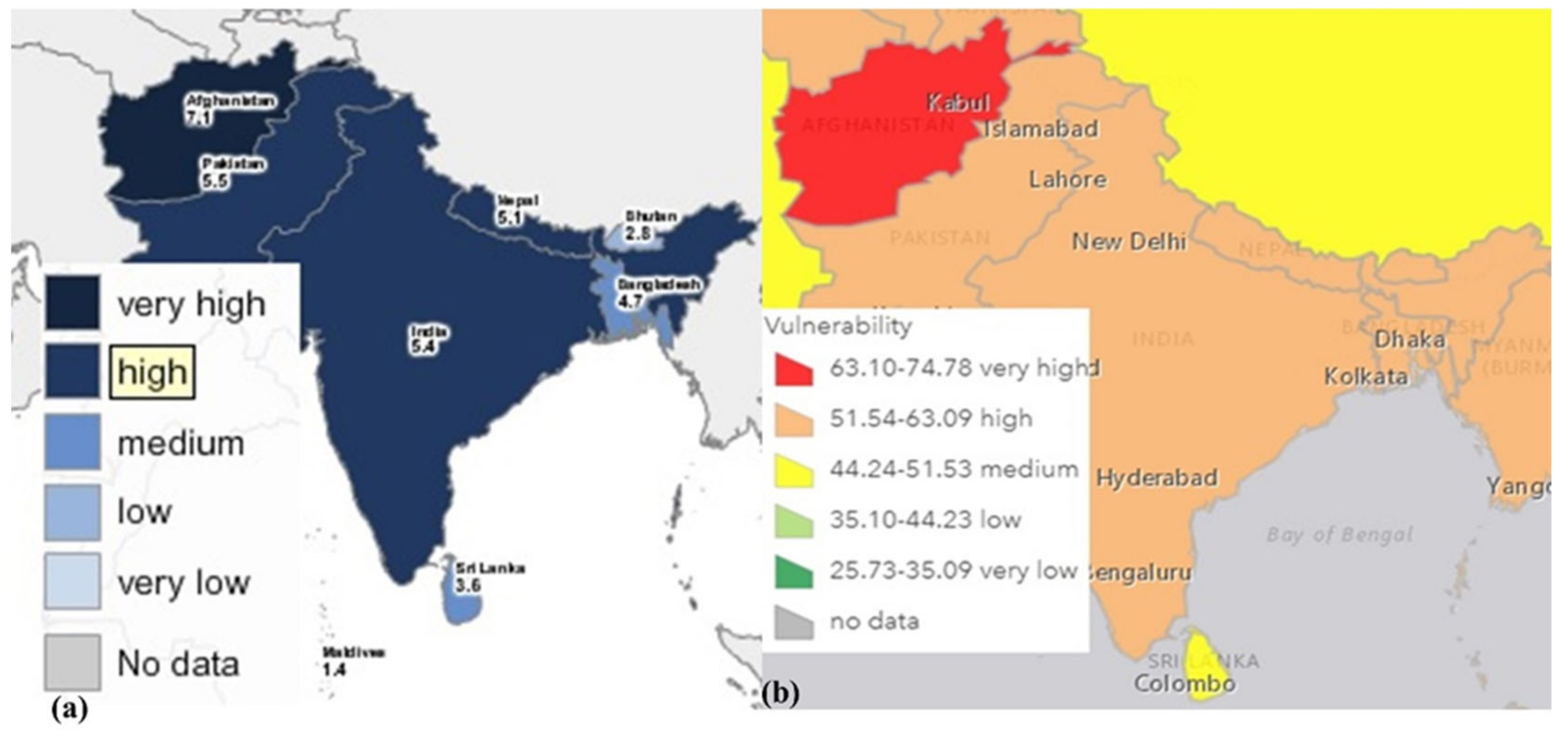
- IWMI 2017 is a regional assessment and focused on climate-related hazards at the sub-national level in South Asia. It combined the disaster exposure maps estimated at the grid level and the human development index (HDI) available at the district level to assess sub-national level vulnerability in SA. The HDI [48] is based mainly on socio-economic indicators of education, gross national income, and life expectancy at birth. The accuracy of this estimate depends on how far HDI accurately represents the vulnerability to hazards at the sub-national level.
- UNICEF 2014 and Action Aid 2014 focus on disaster risk management of different population segments, in particular women and children. They only have a regional focus—the former on Asia and the Pacific and the latter on the South Asian countries.
3. Results
3.1. Individual Hazard Maps
- The national-level hazard maps (IASC/EC 2015, University of Stuttgart 2015) are sufficient for comparisons across countries. The primary purpose of these maps is for the use of donors and funding agencies to prioritize support to states for disaster risk management.
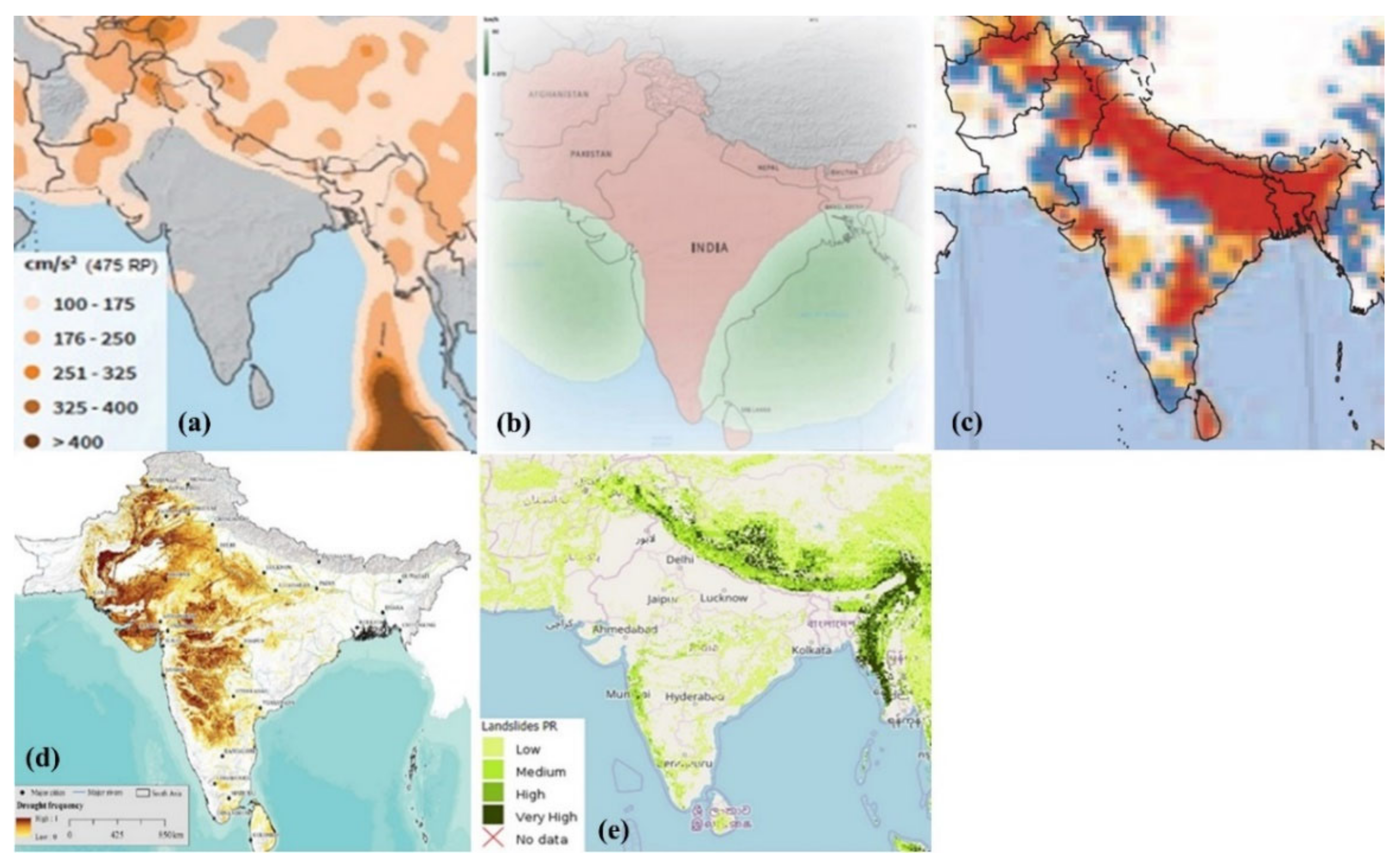
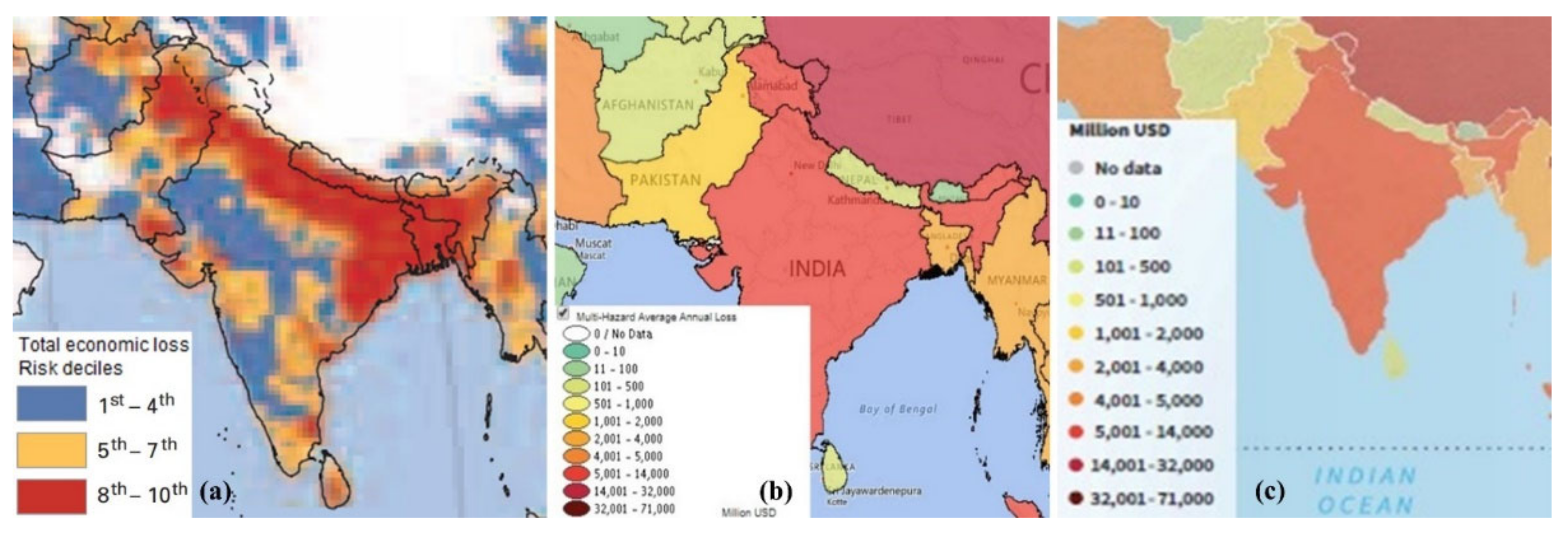
- However, the higher resolution hazard maps (UNEP/UNISDR 2013, UNISDR 2017, EC 2017) show considerable details of hazard exposure by combing the frequency and intensity of hazards in a probabilistic framework. They provide useful information for intensive hazards (Figure 1).
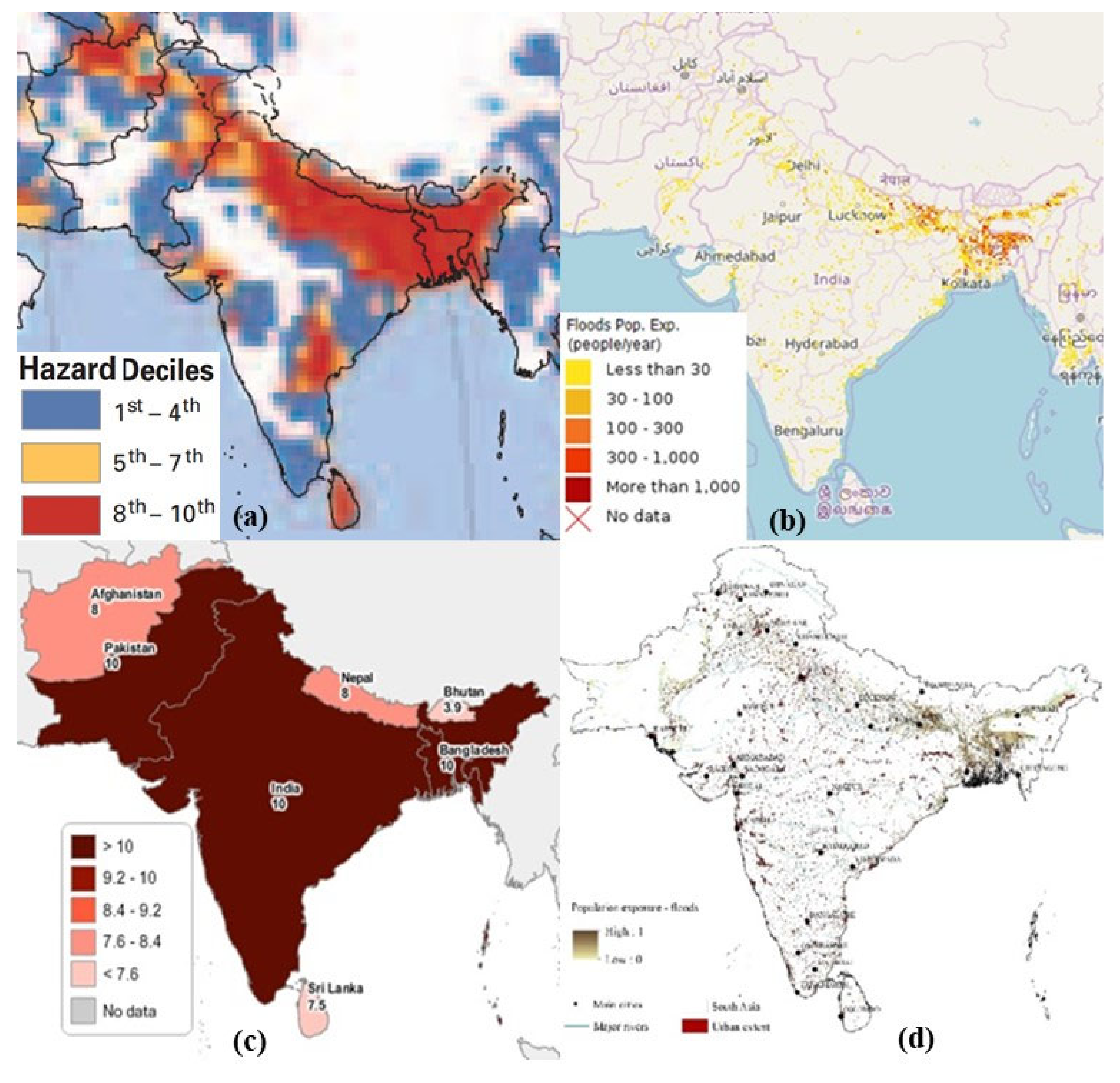
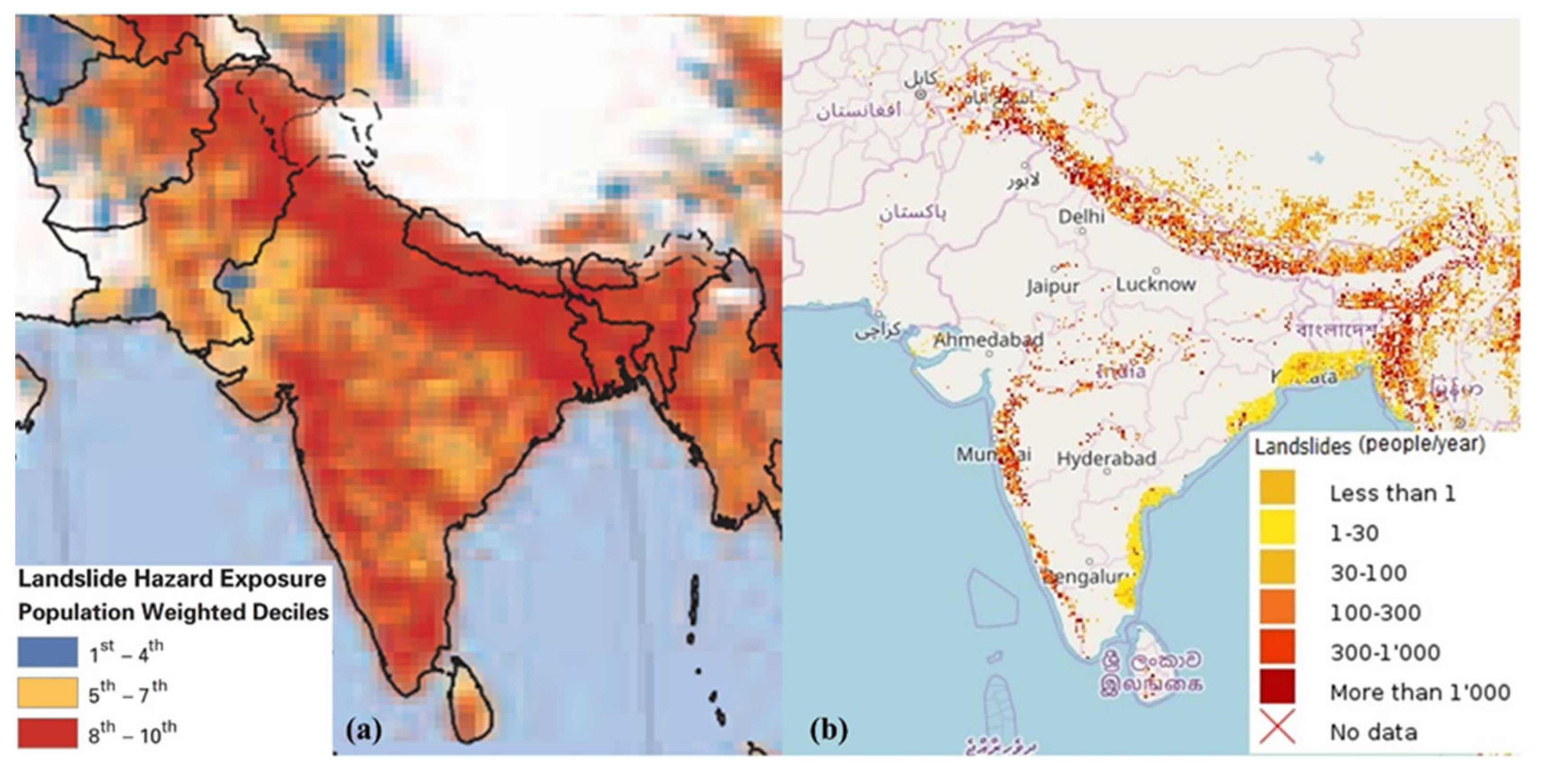
- IWMI 2017 exposure maps show the actual exposure regardless of the intensity of hazards. They use remote sensing images to identify the exposed pixels to disasters. The sub-national estimates derived from these are essential for local-level disaster-risk management planning.
- While most risk maps use similar hazard data, the disaster maps, assessed either with probabilistic or deterministic methods, generate different risk profiles for some regions. IASC/EC 2015 shows an extensive earthquake profile for India, but the UNEP/UNISDR 2013 and UNISDR 2017 display large parts which are free of seismic hazards.
- The hazard maps with more extended return periods show the exposure due to intensive hazards (i.e., frequent or short return periods with low intensity). However, with monsoonal and El Niño/Southern Oscillation (ENSO) dominated weather patterns, many locations in South Asia are exposed to recurrent or shorter (4–6 years) return period floods and droughts. The aggregate losses are generally more substantial due to extensive rather than intensive hazards (UNISDR 2015).
3.2. Multi-Hazard Maps
- Areas that are most likely to be exposed by multiple disasters;
- Disasters that occur immediately after the others, such as fires or landslides after earthquakes or cyclonic storms;
- Disasters that occur independently of each other with a considerable time lag, such as floods and droughts.
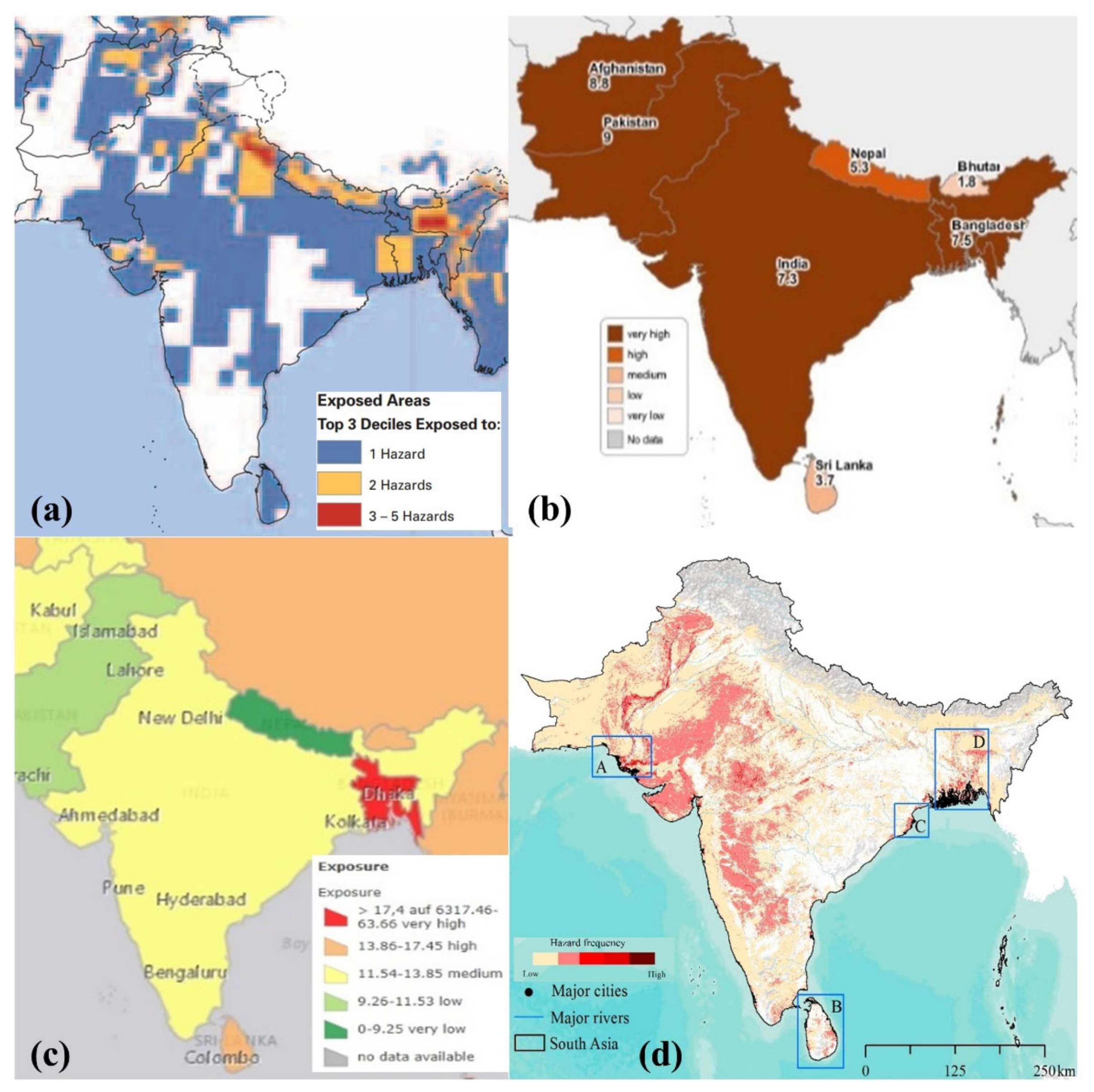
- WB 2005 and IWMI 2017 provide sub-national multi-hazard risk maps. WB 2005 has considered six hazards, while IWMI 2017 has considered five hazards. Only four hazards, tsunamis, floods, cyclones, and droughts, are common to both. Moreover, in WB 2005, the sum of the individual risk values of the top three deciles (in 8th–10th deciles) is the multi-hazard index, where higher values indicate high-intensity multiple hazards. In IWMI 2017, a multi-hazard index (between 1 and 5) shows only the number of hazard occurrences in a pixel. Because some disasters have more prominence in the indicator value such as earthquakes in Nepal these two maps, to some extent, are not even comparable.
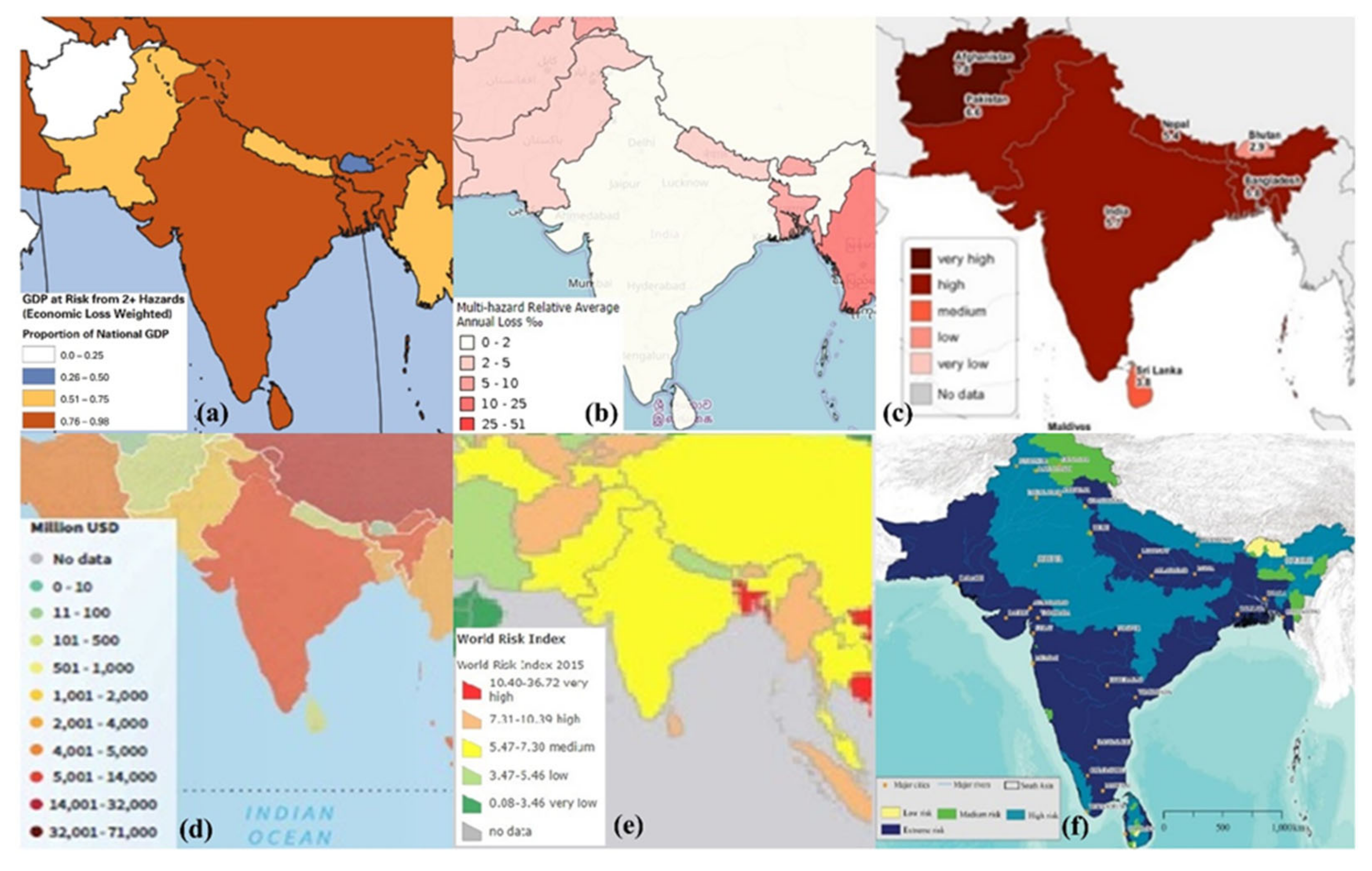
- IASC/EC 2015 and the University of Stuttgart 2015 show the aggregated risk of multi-hazards at the national level. They are thus adequate only for inter-country comparisons. They use a different number of hazards, indicators, and weights to aggregate indicators to assess risk components (exposure, vulnerability, and capacity). Moreover, the University of Stuttgart 2015 uses the arithmetic average, giving equal prominence to all risk components. However, IASC/EC utilizes the geometric average, giving differential prominence to different risk components. As a result, the risk pictures of some countries (Sri Lanka, Bhutan) show an opposite view.
3.3. Exposure Maps
- Population (humans or livestock) and/or their mortality;
- Infrastructure or businesses and their value and output;
- Economic activities and their losses;
- Ecosystems and their services.
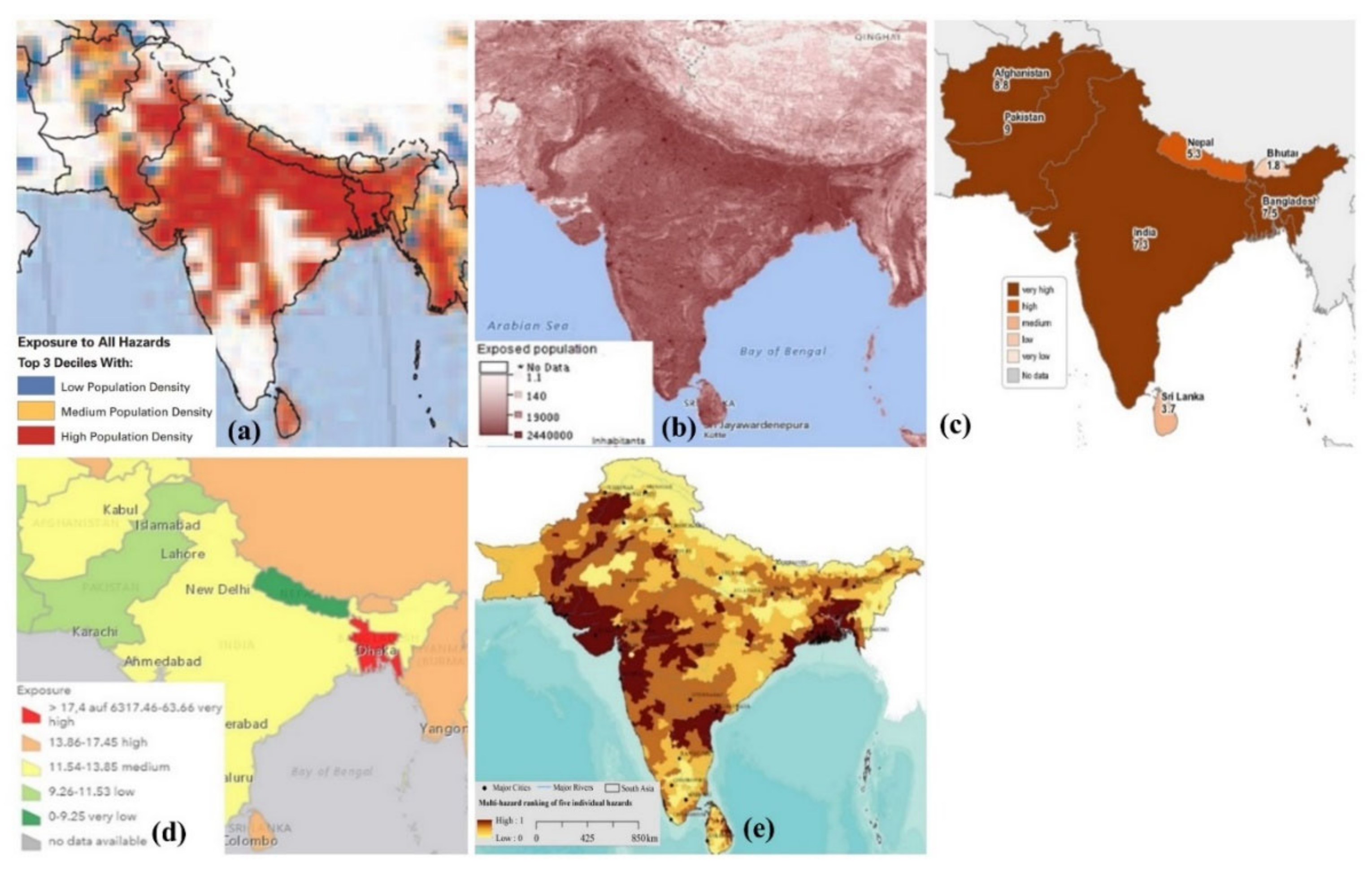
- The IASC/EC 2015 and University of Stuttgart 2015 assess the exposure to similar hazards. The former shows high to very high exposure to multi-hazards for all countries except Sri Lanka and Bhutan, and for them, the exposure varies from medium to low. The University of Stuttgart 2015 depicts a substantially different exposure profile for the SA countries.
- The sub-national exposure estimates for multi-hazards in WB 2005, UNEP/UNISDR 2013, and IWMI 2017 also vary. The number and the intensity of hazard treatment in the risk analyzed area are also significant factors in these differences.
- The WB 2005 study shows that 33% of the population (in 2005) were exposed to three or more hazards in Bangladesh, and about 33%, 18%, and 11% of the total population in Bangladesh, Pakistan, and India, respectively were exposed to two or more hazards. A detailed higher spatial resolution risk study of Sri Lanka showed not only vast spatial variation but also a distinct seasonal variation of exposure to multi-hazard risks.
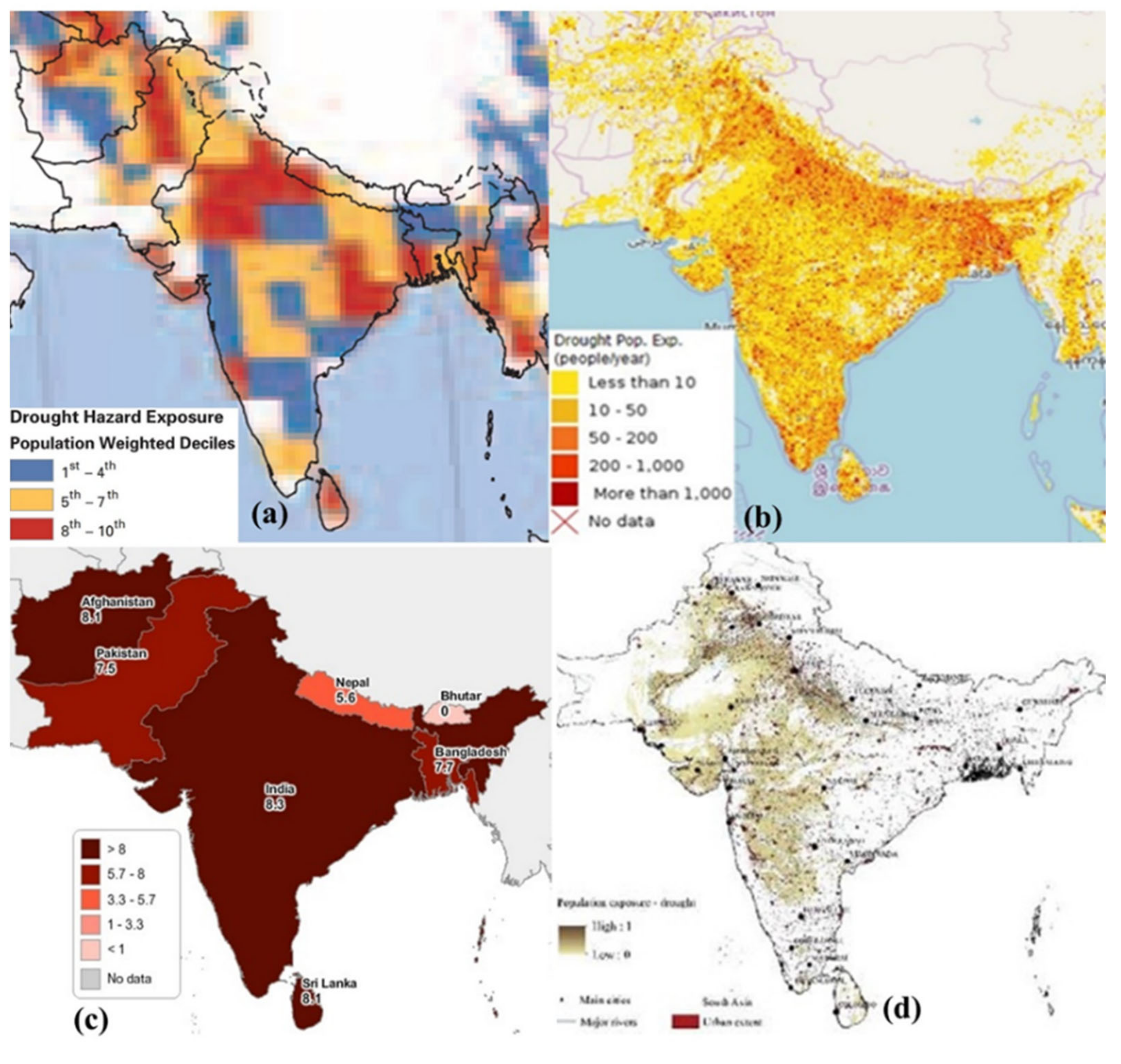
- The IWMI 2017 with a higher spatial resolution shows that two or more hazards affect about 20% of the population in Bangladesh and only 11% of the population in India. A substantially lower exposure in Nepal in IWMI 2017 was observed, due to the non-inclusion of earthquakes in the assessment. IWMI 2017 study shows that about 750 million people in South Asia are affected by one or more natural hazards. Of these, 72% are in India, and 14% are in Bangladesh and Pakistan.
- IWMI 2017 estimated that floods affected 170 million people in SA. Of this, 101 and 53 million are in India and Bangladesh, respectively. However, according to EC 2017, the flood-affected populations in India and Bangladesh are 220 and 71 million, respectively.
- Estimates of the drought-affected population also vary. Figure 6 shows a different picture of drought exposure as depicted by the WB 20105 and UNEP/UNISDR 2013. IWMI 2017 estimated that droughts affected 293 million people in South Asia. Of this, 233 and 54 million are in India and Pakistan.
3.4. Vulnerability Maps
3.5. Disaster Risks Maps
- WB 2005 shows high to medium risks for Sri Lanka, Bhutan, and Nepal, whereas UNEP/UNISDR 2013 shows low to substantially low risk for Sri Lanka, Nepal, and Bhutan. This variation may be due to the different spatial resolutions of hazard maps and different methods used for vulnerability estimation.
- The IASC/EC 2015 and University of Stuttgart 2015, which used a deterministic approach to vulnerability estimation, show a completely different risk picture. This difference may be due to various socio-economic development indicators and methods utilized for vulnerability estimation. For example, IASC/EC 2015 used a substantial number of socio-economic indicators for assessing vulnerability and coping capacity as compared to the University of Stuttgart 2015. Furthermore, the weights used for developing indexes are different. Moreover, IASC/EC 2015 used an arithmetic mean, while the University of Stuttgart 2015 used the geometric mean for estimating risk.
3.6. Social Development Indicators in Risk Maps
- Access to financial institutions;
- Access to micro-finance;
- Access to loans;
- Access to land;
- Unemployment rate;
- The number employed in the police force;
- Enrolment in primary-secondary schooling;
- Literacy rate, etc.
4. Discussion
4.1. An Example of Disaster Risk Assessments from the Asian Development Bank’s (ADB) Risk Strategies
4.2. Modeling and Future Applications
5. Conclusions
Author Contributions
Funding
Institutional Review Board Statement
Informed Consent Statement
Data Availability Statement
Acknowledgments
Conflicts of Interest
Appendix A

| No. | Name and Abbreviation | Agency and Year (Updates If Available) | Objectives (Link to Risk Maps or Mapping Tools) |
|---|---|---|---|
| 1 | Natural Disaster Hotspot: A Global Risk Analysis (Hotspot Study) | WB 2005 | The project enhances the knowledge of global risks of natural disasters by conducting an assessment with global datasets but taking into account the spatial variation of hazards, exposure, and vulnerabilities of six natural hazards. http://documents.worldbank.org/curated/en/621711468175150317/pdf/344230PAPER0Na101official0use0only1.pdf (accessed on 18 April 2021) |
| 2 | Open Data for Resilience Initiative (Open DRI) | WB/GFDRR 2011 | OpenDRI provides information about the rapidly changing dynamics of the risks and impacts due to population growth, economic expansion, and climate change. OpenDRI promotes spatially targeted investments, policy, or technical interventions that enhance the resilience of people and communities TABLEagainst climate change impacts. https://opendri.org/ (accessed on 18 April 2021) |
| 3 | Global Risk Data Platform (GRDP) | UNEP/UNISDR 2013 | The UNISDR organizes a biennial global gathering of member countries on reducing disaster risk and enhancing the resilience of communities and nations. The Global Assessment Reports (GARs) are UNISDRs flagship publications of Global Platform meetings. The GRDP is the warehouse of spatial information of exposure and risks generated by stakeholders for the biennial gatherings. http://preview.grid.unep.ch/index.php?preview=home&lang=eng (accessed on 18 April 2021) |
| 4 | Child-centered Risk Assessment: Regional Synthesis of UNICEF Assessments in Asia | UNICEF 2014 | UNICEF, with a mandate for humanitarian relief and development, especially for children, promotes child-centered disaster risk assessment. It informs the governments, the UNICEF country offices, and partner organizations on assessments of disaster risks for the survival and development of children. The evaluation explores ways to reduce vulnerability and build capacity to enhance resilience against disaster risks. https://www.preventionweb.net/publications/view/36688 (accessed on 12 April 2021) |
| 5 | South Asia Women’s Resilience Index (WRI) | Action Aid 2014 | The WRI-EIU shows the extent to which the disaster risk reduction and building national resilience initiatives in the South Asian counties incorporated gender inequality in risk estimation. http://www.actionaid.org/australia/digital-tool-womens-resilience-index-wri (accessed on 12 May 2021) |
| 6 | Index for Risk Management (INFORM) | IASC/EC 2015 | INFORM’s objective is to assess countries that are at a potentially high risk of hazards and inform the world and donors for prioritizing for international humanitarian assistance. http://www.inform-index.org/ (accessed on 14 Apr 2021) |
| 7 | The World Risk Index (WRI) | University Stuttgart 2015 | The World Risk Index combines physical hazard information with vulnerability (susceptibility, coping, and adaptive capacity) to assess the risk of people exposed to disasters. It provides the likelihood of natural hazards affecting people and their vulnerability to hazards. http://www.uni-stuttgart.de/ireus/Internationales/WorldRiskIndex/ (accessed on 11 June 2021) |
| 8 | The GAR Atlas: Unveiling Global Disaster Risk (GAR Atlas) | UNISDR 2017 | The GAR Atlas presents the results of the Global Risk Model, which uses a state-of-the-art probabilistic approach to assess hazards, exposure, and vulnerability. The UNISDRs GAR report [15] previewed the initial results of the Global Risk Model. https://www.preventionweb.net/english/hyogo/gar/atlas/ https://www.unisdr.org/we/inform/publications/42809 (accessed on 11 April 2021) |
| 9 | Atlas of the Human Planet: Global Exposure to Natural Hazards | EC 2017 | The Atlas shows the spatial patterns and temporal trends of exposure of human settlements to disaster risk and their relation to socio-economic vulnerability. They draw attention to geographical hotspots for a comprehensive understanding of disaster risks. https://ec.europa.eu/jrc/en/publication/eur-scientific-and-technical-research-reports/atlas-human-planet-2017-global-exposure-natural-hazards (accessed on 19 May 2021) |
| 10 | Mapping Multiple Climate-related Hazards in South Asia | IWMI 2017 | This study develops a high spatial resolution mapping of areas exposed to multi-climatic hazards and estimates exposure and vulnerability of population and agriculture to multi-hazard disaster risks. http://www.iwmi.cgiar.org/publications/iwmi-research-reports/iwmi-research-report-170/ (accessed on 28 May 2021) |
Appendix B
| Indicators in Different Risk Assessments | WB 2005 | UNEP/UNISDR 2013 | WB/GFDRR 2011 | UNICEF 2014 | ACTION Aid 2014 | IASC/EC 2015 | University of Stuttgart 2015 | EC 2017 | UNISDR 2017 | IWMI 2017 | |
|---|---|---|---|---|---|---|---|---|---|---|---|
| 1 | GDP per capita | x | x | ||||||||
| 2 | Human development index | x | x | x | |||||||
| 3 | Human poverty index | x | x | ||||||||
| 4 | Extreme poverty | ||||||||||
| 5 | GINI index | x | |||||||||
| 6 | Adult literacy rates | x | x | x | |||||||
| 7 | Gender inequality index | x | x | ||||||||
| 8 | Public aid received (total and % of GDP) | x | x | ||||||||
| 9 | Displaced people (total and % of the total population) | x | x | ||||||||
| 10 | Dependency ratio | x | x | ||||||||
| 11 | Prevalence of TBC | x | |||||||||
| 12 | Malaria mortality | x | |||||||||
| 14 | Adult HIV cases | x | |||||||||
| 15 | Children underweight | x | |||||||||
| 16 | Children morality rate | x | |||||||||
| 17 | Health expenditure per capita | x | x | ||||||||
| 18 | 1-year old fully immunized against | x | |||||||||
| 19 | Prevalence of undernourishment | x | |||||||||
| 20 | Average dietary energy supply adequacy | x | |||||||||
| 21 | Life expectancy at birth | x | |||||||||
| 22 | The domestic food price index | x | |||||||||
| 24 | Domestic food price volatility index | x | |||||||||
| 25 | Number of physicians per 10,000 inhabitants | x | x | x | |||||||
| 26 | Governance ineffective index | x | x | ||||||||
| 27 | Corruption perceptions index | x | x | ||||||||
| 28 | Access to electricity | x | x | x | |||||||
| 29 | Number of women in the police force | x | |||||||||
| 30 | Internet users | x | |||||||||
| 31 | Mobile phone subscriptions | x | |||||||||
| 32 | Road density | x | |||||||||
| 33 | Access to improved water supply | x | x | ||||||||
| 34 | Access to clean sanitation | x | x | ||||||||
| 35 | Number of hospital beds 10,000 inhabitants | x | x | ||||||||
| 36 | Insurance availability | x | |||||||||
| 37 | Share of females in the national parliament | x | |||||||||
| 38 | Water resources (Envir. security index) | x | |||||||||
| 39 | Biodiversity and habitat productions | x | |||||||||
| 40 | Forest management | x | |||||||||
| 41 | Agriculture management | x | |||||||||
| 42 | Government funding for disaster relief | x | |||||||||
| 43 | Country-level economic strength | x | |||||||||
| 44 | Personal finance of women | x | |||||||||
| 45 | Labor environment of women | x | |||||||||
| 46 | Communication | x | |||||||||
| 47 | Quality of power supply | x | |||||||||
| 48 | Environmental sanitation | x |
References
- The World Bank. Aftershocks: Remodeling the Past for a Resilient Future; Global Facility for Disaster Reduction and Recovery, The World Bank: Washington, DC, USA, 2018; p. 68. [Google Scholar]
- Sarker, M.N.I.; Peng, Y.; Yiran, C.; Shouse, R.C. Disaster resilience through big data: Way to environmental sustainability. Int. J. Disaster Risk Reduct. 2020, 51, 101769. [Google Scholar] [CrossRef] [Scilit]
- Tabari, H. Climate change impact on flood and extreme precipitation increases with water availability. Sci. Rep. 2020, 10, 13768. [Google Scholar] [CrossRef] [Scilit]
- The World Bank. Disaster Risk Management in South Asia: A Regional Review; The World Bank: Washington, DC, USA, 2012; pp. 1–166. Available online: https://openknowledge.worldbank.org/handle/10986/13218 (accessed on 15 July 2021).
- UN Office for Disaster Risk Reduction (UNDRR); Centre for Research on the Epidemiology of Disasters (CRED). The Human Cost of Disasters: An Overview of the Last 20 Years 2000–2019; UNDRR: Geneva, Switzerland; CRED: Brussels, Belgium, 2020; pp. 1–30. [Google Scholar]
- Alexander, D. Cascading Disasters: Multiple Risk Reduction and Resilience. In Handbook of Disaster Risk Reduction for Resilience: New Frameworks for Building Resilience to Disasters; Eslamian, S., Eslamian, F., Eds.; Springer: Cham, Switzerland, 2021; pp. 187–201. [Google Scholar]
- Zuccaro, G.; Leone, M.F.; Martucci, C. Future research and innovation priorities in the field of natural hazards, disaster risk reduction, disaster risk management and climate change adaptation: A shared vision from the ESPREssO project. Int. J. Disaster Risk Reduct. 2020, 51, 101783. [Google Scholar] [CrossRef] [Scilit]
- Lwanga-Ntale, C.; Owino, B.O. Understanding vulnerability and resilience in Somalia. Jàmbá 2020, 12, 856. [Google Scholar] [CrossRef] [Scilit]
- Chowdhury, R.I. Humanitarian Response for Improving Quality of Life of Persons with Disabilities: A study on Rohingya Camps of Cox’s Bazar, Bangladesh. J. Hum. Rights Peace Stud. 2020, 6, 60–88. Available online: https://so03.tci-thaijo.org/index.php/HRPS/article/view/241771 (accessed on 22 July 2021).
- Breiling, M. Global rural value chains and the role of natural disasters in their transformation. J. Soc. Econ. Dev. 2021, 23, 540–567. [Google Scholar] [CrossRef] [Scilit]
- United Nations International Strategy for Disaster Reduction (UNISDR). 2009 Global Assessment Report on Disaster Risk Reduction: Risk and Poverty in a Changing Climate-Invest Today for a Safer Tomorrow; UNISDR: Geneva, Switzerland, 2009. [Google Scholar]
- United Nations International Strategy for Disaster Reduction (UNISDR). Global Assessment Report on Disaster Risk Reduction: Revealing Risk, Redefining Development; UNISDR: Geneva, Switzerland, 2011. [Google Scholar]
- United Nations International Strategy for Disaster Reduction (UNISDR). Global Assessment Report on Disaster Risk Reduction: From Shared Risk to Shared Value: The Business Case for Disaster Risk Reduction; UNISDR: Geneva, Switzerland, 2013. [Google Scholar]
- United Nations Office for Disaster Risk Reduction (UNISDR). Making Development Sustainable: The Future of Disaster Risk Management. In Making Development Sustainable: The Future of Disaster Risk Management. Global Assessment Report on Disaster Risk Reduction; UNISDR: Geneva, Switzerland, 2015. [Google Scholar]
- United Nations Office for Disaster Risk Reduction (UNISDR). The GAR Atlas: Unveiling the Global Disaster Risk; UNISDR: Geneva, Switzerland, 2017. [Google Scholar]
- Amarnath, G.; Alahacoon, N.; Smakhtin, V.; Aggarwal, P. IWMI Research Report-170: Mapping Multiple Climate-Related Hazards in South Asia; International Water Management Institute (IWMI): Colombo, Sri Lanka, 2017; p. 41. [Google Scholar]
- Kumar, K.K.; Karunagoda, K.; Haque, E.; Venkatachelam, L.; Bahal, G.N. Addressing Long-term Challenges to Food Security and Rural Livelihoods in South Asia. Gates Open Res. 2019, 3, 721. [Google Scholar]
- Moşteanu, N.R.; Faccia, A.; Cavaliere, L.P.L. Disaster Management, Digitalization and Financial Resources: Key factors to keep the organization ongoing. In Proceedings of the 2020 4th International Conference on Cloud and Big Data Computing, New York, NY, USA, 26 August 2020; pp. 118–122. [Google Scholar]
- Kumar, A.; Pandey, A.C.; Khan, M.L. Urban Risk and Resilience to Climate Change and Natural Hazards: A Perspective from Million-Plus Cities on the Indian Subcontinent. In Techniques for Disaster Risk Management and Mitigation; Srivastava, P.K., Singh, S.S., Mohanty, U.C., Murty, T., Eds.; John Wiley & Sons, Inc.: Hoboken, NJ, USA, 2020; pp. 33–46. [Google Scholar]
- Govindan, R.; Al-Ansari, T. Computational decision framework for enhancing resilience of the energy, water and food nexus in risky environments. Renew. Sustain. Energy Rev. 2019, 112, 653–668. [Google Scholar] [CrossRef] [Scilit]
- Amarnath, G.; Matheswaran, K.; Pandey, P.; Alahacoon, N.; Yoshimoto, S. Flood mapping tools for disaster preparedness and emergency response using satellite data and hydrodynamic models: A case study of Bagmathi Basin, India. Proc. Natl. Acad. Sci. India Sect. A Phys. Sci. 2017, 87, 941–950. [Google Scholar] [CrossRef] [Scilit]
- Amarasinghe, U.A.; Amarnath, G.; Alahacoon, N. Vulnerable hotspots to water and agricultural risks in Sri Lanka. NeelaHaritha Clim. Chang. Mag. Sri Lanka 2020, 3, 1–11, ISSN 2536-8591. [Google Scholar]
- Alahacoon, N.; Matheswaran, K.; Pani, P.; Amarnath, G. A Decadal Historical Satellite Data and Rainfall Trend Analysis (2001–2016) for Flood Hazard Mapping in Sri Lanka. Remote Sens. 2018, 10, 448. [Google Scholar] [CrossRef] [Scilit]
- Amarnath, G.; Umer, Y.M.; Alahacoon, N.; Inada, Y. Modelling the flood-risk extent using LISFLOOD-FP in a complex watershed: Case study of Mundeni Aru River Basin, Sri Lanka. Proc. Int. Ass. Hydrol. Sci. 2015, 370, 131–138. [Google Scholar] [CrossRef] [Scilit]
- Urama, K.C.; Ozor, N. Impacts of climate change on water resources in Africa: The role of adaptation. Afr. Tech. Pol. Stud. Netw. 2010, 29, 1–29, Corpus ID: 130792900. [Google Scholar]
- Gill, J.C.; Malamud, B.D. Reviewing and visualizing the interactions of natural hazards. Rev. Geophys. 2014, 52, 680–722. [Google Scholar] [CrossRef] [Scilit]
- Van Westen, C.J.; Kappes, M.S.; Luna, B.Q.; Frigerio, S.; Glade, T.; Malet, J.P. Medium-scale multi-hazard risk assessment of gravitational processes. In Mountain Risks: From Prediction to Management and Governance; Asch, T.V., Corominas, J., Greiving, S., Malet, J.P., Sterlacchini, S., Eds.; Springer: New York, NY, USA, 2014; pp. 1–23. [Google Scholar]
- Van Westen, C.J.; Alkema, D.; Damen, M.C.J.; Kerle, N.; Kingma, N.C. Multi-hazard risk assessment. In Distance Education Course; United Nations University, ITC School on Disaster Geoinformation Management (UNU-ITC DGIM): Enschede, The Netherlands, 2011. [Google Scholar]
- Mix, K.; Groeger, A.W.; Lopes, V.L. Impacts of dam construction on streamflows during drought periods in the Upper Colorado River Basin, Texas. Lakes Reserv. Res. Manag. 2016, 21, 329–337. [Google Scholar] [CrossRef] [Scilit]
- Amarasinghe, U.A.; Sharma, B.R. Water Productivity and Poverty in the Transboundary River Basin of India and Bangladesh: A Situation Analysis. Project Report Submitted to IUCN under the Project “Water Productivity, Poverty and Food Security; International Water Management Institute (IWMI): New Delhi, India, 2011; p. 24. [Google Scholar]
- Sharma, B.; Amarasinghe, U.A.; Cai, X.; de Condappa, D.; Shah, T.; Mukherji, A.; Bharati, L.; Ambili, G.K.; Qureshi, A.S.; Pant, D.; et al. The Indus and the Ganges: River basins under extreme pressure. In Water, Food, and Poverty in River Basins: Defining the Limits; Fisher, M., Cook, S., Eds.; Routledge: London, UK, 2012; pp. 30–58. [Google Scholar]
- Ntajal, J.; Lamptey, B.L.; Mahamadou, I.B.; Nyarko, B.K. Flood disaster risk mapping in the lower Mono river basin in Togo, West Africa. Int. J. Disaster Risk Reduc. 2017, 23, 93–103. [Google Scholar] [CrossRef] [Scilit]
- Parker, L.; Bourgoin, C.; Martinez-Valle, A.; Läderach, P. Vulnerability of the agricultural sector to climate change: The development of a pan-tropical Climate Risk Vulnerability Assessment to inform sub-national decision making. PLoS ONE 2019, 14, e0213641. [Google Scholar] [CrossRef] [Scilit]
- Birkmann, J.; Welle, T. Assessing the risk of loss and damage: Exposure, vulnerability and risk to climate-related hazards for different country classifications. Int. J. Glob. Warm. 2015, 8, 191–212. [Google Scholar] [CrossRef] [Scilit]
- Seidler, R.; Dietrich, K.; Schweizer, S.; Bawa, K.S.; Chopde, S.; Zaman, F.; Khaling, S. Progress on integrating climate change adaptation and disaster risk reduction for sustainable development pathways in South Asia: Evidence from six research projects. Int. J. Disaster Risk Reduc. 2018, 31, 92–101. [Google Scholar] [CrossRef] [Scilit]
- Amarasinghe, U.; Amarnath, G.; Alahacoon, N.; Ghosh, S. How Do Floods and Drought Impact Economic Growth and Human Development at the Sub-National Level in India? Climate 2020, 8, 123. [Google Scholar] [CrossRef] [Scilit]
- The World Bank. Natural Disaster Hotspots: A Global Risk Analysis; Disaster Management Series No. 5; The World Bank, Hazard Management Unit: Washington, DC, USA, 2005. [Google Scholar]
- The World Bank. Vulnerability, Risk Reduction and Adaptation to Climate Change-Philippines; The World Bank Group, Global Facility for Disaster Risk Reduction (WB-GFDRR): Washington, DC, USA, 2011. [Google Scholar]
- United Nations Environment Programme (UNEP); The United Nations Office for Disaster Risk Reduction (UNISDR). Multiple Risk-Mortality Risk Index; The United Nations Office for Disaster Risk Reduction: Geneva, Switzerland, 2013. [Google Scholar]
- United Nations Children’s Fund (UNICEF). Child-Centered Risk Assessment: Regional Synthesis of UNICEF Assessments in Asia; UNICEF Regional Office for South Asia (ROSA): Kathmandu, Nepal, 2014. [Google Scholar]
- Economist Intelligence Unit (EIU). The South Asia Women’s Resilience Index: Examining the Role of Women in Preparing for and Recovering from Disasters; Economist Intelligence Unit: London, UK, 2014. [Google Scholar]
- De Groeve, T.; Poljansek, K.; Vernaccini, L. Index for Risk Management-INFORM: Concept and Methodology-Version 2015; Joint Research Centre, Institute for the Protection and the Security of the Citizen, Publications Office of the European Union: Luxembourg, 2015. [Google Scholar]
- Institute of Spatial and Regional Planning (IREUS). The World Risk Index. University of Stuttgart. 2015. Available online: https://www.ireus.uni-stuttgart.de/en/International/WorldRiskIndex/ (accessed on 20 June 2021).
- Pesaresi, M.; Ehrlich, D.; Kemper, T.; Siragusa, A.; Florczyk, A.J.; Freire, S.; Corban, C. Atlas of the Human Planet 2017: Global Exposure to Natural Hazards; EUR 28556 EN; Joint Research Centre, Publications Office of the European Union: Luxembourg, 2017. [Google Scholar]
- Lei, Y.; Wang, J.A.; Yue, Y.; Zhou, H.; Yin, W. Rethinking the relationships of vulnerability, resilience, and adaptation from a disaster risk perspective. Nat. Hazards 2014, 70, 609–627. [Google Scholar] [CrossRef] [Scilit]
- Ward, P.J.; Blauhut, V.; Bloemendaal, N.; Daniell, J.E.; Ruiter, M.C.; Duncan, M.J.; Emberson, R.; Jenkins, S.F.; Kirschbaum, D.; Kunz, M.; et al. Natural hazard risk assessments at the global scale. Nat. Hazards Earth Syst. Sci. 2020, 20, 1069–1096. [Google Scholar] [CrossRef] [Scilit]
- Mehryar, S.; Surminski, S. National laws for enhancing flood resilience in the context of climate change: Potential and shortcomings. Clim. Pol. 2020, 21, 133–151. [Google Scholar] [CrossRef] [Scilit]
- Roser, M. Human Development Index (HDI). Our World in Data. 2017. Available online: https://ourworldindata.org/human-development-index (accessed on 11 May 2021).
- Mirza, M.M. Climate change, flooding in South Asia and implications. Reg. Environ. Change 2011, 11, 95–107. [Google Scholar] [CrossRef] [Scilit]
- De Groeve, T.; Vernaccini, L.; Poljansek, K. Index for Risk Management-INFORM: Concept and Methodology-Version 2016; Joint Research Centre, Institute for the Protection and the Security of the Citizen, Publications Office of the European Union: Luxembourg, 2016. [Google Scholar]
- Kummu, M.; Taka, M.; Guillaume, J.H. Gridded global datasets for Gross Domestic Product and Human Development Index over 1990–2015. Sci. Data 2018, 5, 1–15. [Google Scholar] [CrossRef] [Scilit] [PubMed]
- Bhatt, M.R.; Durrani, K.K.; Wisner, B.; Bhatti, A.; Taher, M.; Fernando, K. Are We Building Back Better? Lessons from South Asia; Duryog Nivaran Secretariat: Colombo, Sri Lanka, 2016. [Google Scholar]
- ADB Disaster Risk Management and Country Partnership Strategies: A Practical Guide; Asian Development Bank: Manila, Philippines, 2017.
- ADB Disaster Risk Assessment for Project Preparation: A Practical Guide; Asian Development Bank: Manila, Philippines, 2017.
- ADB Natural Hazard Data: A Practical Guide; Asian Development Bank: Manila, Philippines, 2017.
- Minges, M. Disruptive Technologies and Their Use in Disaster Risk Reduction and Management; International Telecommunication Union (ITU): Geneva, Switzerland, 2019. [Google Scholar]
- United Nations International Strategy for Disaster Reduction (UNISDR). National Disaster Risk Assessment–Governance System, Methodologies, and Use of Results; The United Nations Office for Disaster Risk Reduction: Geneva, Switzerland, 2017. [Google Scholar]
- Amarnath, G.; Malik, R.P.S.; Taron, A. Scaling Up Index-Based Flood Insurance (IBFI) for Agricultural Resilience and Flood-Proofing Livelihoods in Developing Countries; International Water Management Institute (IWMI): Colombo, Sri Lanka, 2021. [Google Scholar]
- Nyagadza, B.; Nyauswa, T. Parametric insurance applicability in Zimbabwe: A disaster risk management perspective from selected practicing companies. Insur. Mark. Co. 2019, 10, 36–48. [Google Scholar] [CrossRef] [Scilit]

| No. | Name and Abbreviation (If Commonly Used) | Agency and Year (Updates If Available) | Publicly Accessible Tool | Publicly Available Assessment | Geographical Focus | Geographical Scale of Analysis |
|---|---|---|---|---|---|---|
| 1 | Natural Disaster Hotspot: A Global Risk Analysis (Hotspot s Study) | WB 2005 [37] | No | Yes | The world | Global to sub-national levels |
| 2 | Open Data for Resilience Initiative (Open DRI) | WB/GFDRR 2011 (Continuous updates by countries) [38] | No | Yes | All countries | Global to sub-national levels |
| 3 | Global Risk Data Platform (GRDP) | UNEP/UNISDR 2013 [39] | Yes | No | The world | Global to sub-national levels |
| 4 | Child-centered Risk Assessment: Regional Synthesis of UNICEF Assessments in Asia | UNICEF 2014 (continuous updates by country offices) [40] | No | Yes | Six countries in the Asia-Pacific including Nepal and India in South Asia | National to sub-national levels |
| 5 | South Asia Women’s Resilience Index (WRI) | Action Aid 2014 [41] | No | Yes | Countries in South Asia and Japan | National level only |
| 6 | Index for Risk Management (INFORM) | IASC/EC 2015 (updated every half year, last updates from mid-2018) [42] | No | Yes | All countries | Global to the national level (and sub-national levels for individual countries outside South Asia) |
| 7 | The World Risk Index (WRI) (For more information see: http://www.uni-stuttgart.de/ireus/Internationales/WorldRiskIndex/ (accessed on 11 June 2021)) | University of Stuttgart 2015 (updated annually) [43] | No | Yes | All countries | Global to national levels |
| 8 | The GAR Atlas: Unveiling Global Disaster Risk (GAR Atlas) | UNISDR 2017 (updated biennially) [15] | No | Yes | The world | Global to sub-national levels |
| 9 | Atlas of the Human Planet: Global Exposure to Natural Hazards | European Commission 2017 [44] | No | Yes | All countries | Global to national levels |
| 10 | Mapping Multiple Climate-related Hazards in South Asia | IWMI 2017 [16] | No | Yes | South Asia only | Regional to sub-national levels |
| No. | Name and Abbreviation | Geo-Physical Hazards | Hydro-Meteorological Hazards | Climate Change | Human-Made Hazards | |||||||||
|---|---|---|---|---|---|---|---|---|---|---|---|---|---|---|
| Volcanos | Earthquakes | Tsunamis | Landslides (Seismic) | Floods | Cyclones | Landslides (Precipitation) | Drought | Heat Waves and Cold Spells/Wind | Wildfires | Sea Level Rise/Storm Surge | Conflict | Industrial Accidents | ||
| 1 | WB 2005 | Y | Y | Y | N | Y | Y | Y | Y | N | Y | N | N | N |
| 2 | WB/GFDRR 2011 | Y | Y | Y | Y | Y | Y | Y | Y | Y | Y | N | N | N |
| 3 | UNEP/UNISDR 2013 | Y | Y | Y | N | Y | Y | N | N | N | N | N | N | N |
| 4 | UNICEF 2014 | Y | Y | Y | Y | Y | Y | Y | Y | N | N | N | N | N |
| 5 | Action Aid 2014 | N | N | N | N | N | N | N | N | N | N | N | N | N |
| 6 | IASC/EC 2015 | N | Y | Y | N | Y | Y | N | Y | N | N | N | Y | N |
| 7 | University of Stuttgart 2015 | N | Y | N | N | Y | Y | N | Y | N | N | Y | N | N |
| 8 | UNISDR 2017 | Y | Y | Y | N | Y | Y | N | N | Y | N | Y | N | N |
| 9 | EC 2017 | Y | Y | Y | N | Y | Y | N | N | N | N | Y | N | N |
| 10 | IWMI 2017 | N | N | Y | N | Y | Y | N | Y | Y | N | N | N | N |
| No. | Organization and Year | Geo-Physical Hazards | Hydro-Meteorological Hazards | Probabilistic or Deterministic | Multi-hazard Analysis | Climate Change | Exposure to Assets | Exposure to People | Gender and Age | Vulnerability | Social Development | Capacity |
|---|---|---|---|---|---|---|---|---|---|---|---|---|
| 1 | WB 2005 | Y | Y | Prob | Y | N | Y | Y | N | Y | N | N |
| 2 | WB/GFDRR 2011 | Y | Y | Det | Y | Y | Y | Y | Y | Y | Y | Y |
| 3 | UNEP/UNISDR 2013 | Y | Y | Prob | Y | N | Y | Y | N | Y | N | N |
| 4 | UNICEF 2014 | Y | Y | Both | Y | Y | Y | Y | Y | Y | Y | Y |
| 5 | Action Aid 2014 | N | N | Det | N | N | N | Y | Y | Y | Y | Y |
| 6 | IASC/EC 2015 | Y | Y | Both | Y | N | Y | Y | N | Y | Y | Y |
| 7 | University of Stuttgart 2015 | Y | Y | Both | Y | N | Y | Y | N | Y | Y | Y |
| 8 | UNISDR 2017 | Y | Y | Prob | Y | Y | Y | N | N | Y | N | N |
| 9 | EC 2017 | Y | Y | Prob | N | N | Y | Y | N | N | N | N |
| 10 | IWMI 2017 | Y | Y | Det | Y | Y | Y | Y | N | Y | N | N |
| Figures | Assessment | Data Source | Pixel/Temporal Resolution | Return Period | |
|---|---|---|---|---|---|
| Earthquakes | i | WB 2005 | Global Seismic Hazard Program (GSHAP) | 2.5′ | 475 |
| ii | UNEP/UNISDR 2013 | UNEP/GRID-Geneva preview/GSHAP | 2.5′ | 475 | |
| iii | IASC/EC 2015 | GSHAP Seismic hazard map | 2.5′ | 475 | |
| iv | UNISDR 2017 | UNEP/UNISDR 2013 | 2.5′ | 475 | |
| v | University Stuttgart 2015 | UNEP/UNISDR 2013 | 2.5′ | 475 | |
| vi | EC 2017 | EMMI-GSHAP hazard map | 2.5′ | 475 | |
| Cyclones | i | WB 2005 | UNEP/GRID-Geneva Preview | 30″ | 250 |
| ii | UNEP/UNISDR 2013 | UNEP/GRID-Geneva preview | 30″ | 250 | |
| iii | IASC/EC 2015 | Annual physical exposure 1969–2009 | 30″ | 250 | |
| iv | UNISDR 2017 | UNEP/UNISDR 2013 | 30″ | 250 | |
| V | University Stuttgart 2015 | UNEP/UNISDR 2013 | 30″ | 250 | |
| vi | EC 2017 | UNEP/UNISDR 2013 | 30″ | 250 | |
| Floods | i | WB 2005 | Dartmouth Flood Observatory, World Atlas of Large Flood Events | 1° | 200 |
| ii | UNEP/UNISDR 2013 | UNEP/GRID-Geneva preview | 1° | 200 | |
| iii | IASC/EC 2015 | Annual physical exposure 1999–2007 | |||
| iv | UNISDR 2017 | UNEP/UNISDR 2013 | |||
| v | University Stuttgart 2015 | UNEP/UNISDR 2013 | |||
| vi | EC 2017 | Flood map, JRC GloFAS | Raster/1 km | 100 | |
| vii | IWMI 2017 | MODIS | 500 m/8 days | - | |
| Droughts | i | WB 2005 | IRI (International Research Institute for Climate Prediction Climate Data) Library | 2.5° | 8 days |
| ii | UNEP/UNISDR 2013 | IRI Climate Data Library | |||
| iii | IASC/EC 2015 | Not available | |||
| iv | UNISDR 2017 | UNEP/UNISDR 2013 | |||
| v | University Stuttgart 2015 | UNEP/UNISDR 2013 | |||
| vi | IWMI 2017 | MODIS | 500 m/8 days | - | |
| Landslides | i | WB 2005 | Not available | ||
| ii | UNEP/UNISDR 2013 | Norwegian Geotechnical Institute (NGI) | 30″ | ||
| iii | IASC/EC 2017 | Not available | |||
| iv | UNISDR 2017 | Not available |
| Hazard | Assessment | % Population 1 Exposed to Disasters | |||||
|---|---|---|---|---|---|---|---|
| India | Pakistan | Bangladesh | Nepal | Sri Lanka | Bhutan | ||
| 3+ hazards 2 | WB 2005 | ||||||
| IWMI 2017 | 1% | 2% | 2% | 0% | 1% | 0% | |
| 2+ hazards 2 | WB 2005 | 11 | 18 | 33 | 51 | na | 29 |
| IWMI 2017 | 11 | 15 | 20 | 2 | 12 | 14 | |
| Floods | IWMI 2017 | 8 | 8 | 34 | 6 | 5 | 0 |
| EC 2017 | 18 | 35 | 46 | na | na | na | |
| Droughts | IWMI 2017 | 19 | 30 | 1 | 2 | 10 | 28 |
| Factor | Income Status | Cyclones | Droughts | Earthquakes | Floods | Landslides |
|---|---|---|---|---|---|---|
| Economic loss | Low | 26.64 | 0.18 | 1.33 | 7.00 | 0.07 |
| Lower middle | 0 | 0 | 0 | 5.26 | 0 | |
| Upper middle | 0 | 0 | 0 | 0 | 0 | |
| Upper | 0 | 0 | 0 | 0 | 0 | |
| Mortality | Low | 64.52 | 0.04 | 8.04 | 3.90 | 7.04 |
| Lower middle | 0 | 0 | 0 | 0 | 0 | |
| Upper middle | 0 | 0 | 0 | 0 | 0 | |
| Upper | 0 | 0 | 0 | 0 | 0 |
Publisher’s Note: MDPI stays neutral with regard to jurisdictional claims in published maps and institutional affiliations. |
© 2021 by the authors. Licensee MDPI, Basel, Switzerland. This article is an open access article distributed under the terms and conditions of the Creative Commons Attribution (CC BY) license (https://creativecommons.org/licenses/by/4.0/).
Share and Cite
Amarnath, G.; Amarasinghe, U.A.; Alahacoon, N. Disaster Risk Mapping: A Desk Review of Global Best Practices and Evidence for South Asia. Sustainability 2021, 13, 12779. https://doi.org/10.3390/su132212779
Amarnath G, Amarasinghe UA, Alahacoon N. Disaster Risk Mapping: A Desk Review of Global Best Practices and Evidence for South Asia. Sustainability. 2021; 13(22):12779. https://doi.org/10.3390/su132212779
Chicago/Turabian StyleAmarnath, Giriraj, Upali A. Amarasinghe, and Niranga Alahacoon. 2021. "Disaster Risk Mapping: A Desk Review of Global Best Practices and Evidence for South Asia" Sustainability 13, no. 22: 12779. https://doi.org/10.3390/su132212779
APA StyleAmarnath, G., Amarasinghe, U. A., & Alahacoon, N. (2021). Disaster Risk Mapping: A Desk Review of Global Best Practices and Evidence for South Asia. Sustainability, 13(22), 12779. https://doi.org/10.3390/su132212779