Decontamination Methods of N95 Respirators Contaminated with SARS-CoV-2
 , ,
, ,
Abstract
1. Introduction
2. Methods
3. SARS-CoV-2
4. The N95 Respirator
5. Decontamination Treatment for N95 Respirators
5.1. Ultraviolet Germicidal Irradiation (UVGI)
5.2. Hydrogen Peroxide Vapor (HPV)
5.3. Heat
5.3.1. Moist Heat
5.3.2. Dry Heat
5.4. Microwave Generated Steam (MGS)
5.5. Ethanol
5.6. Other Methods
5.7. Comparison of Decontamination Treatments for N95 Respirators
6. Decontamination System Design for N95 Respirators
6.1. Ultraviolet Germicidal Irradiation
6.2. Hydrogen Peroxide Vapor (HPV)
6.3. Heat
6.4. Microwave-Generated Steam (MGS)
6.5. Ethanol
7. Effectiveness of Decontamination Systems against SARS-CoV-2
7.1. Ultraviolet Germicidal Irradiation
7.2. Hydrogen Peroxide Vapor (HPV)
8. Conclusions
Author Contributions
Funding
Institutional Review Board Statement
Informed Consent Statement
Data Availability Statement
Acknowledgments
Conflicts of Interest
References
- World Health Organization. Coronavirus Disease 2019 (COVID-19): Situation Report, 94; World Health Organization: Geneva, Switzerland, 2020. [Google Scholar]
- World Health Organization. Shortage of Personal Protective Equipment Endangering Health Workers Worldwide. Available online: https://www.who.int/news/item/03-03-2020-shortage-of-personal-protective-equipment-endangering-health-workers-worldwide (accessed on 16 July 2021).
- Degesys, N.F.; Wang, R.C.; Kwan, E.; Fahimi, J.; Noble, J.A.; Raven, M.C. Correlation Between N95 Extended Use and Reuse and Fit Failure in an Emergency Department. JAMA 2020, 324, 94–96. [Google Scholar] [CrossRef] [PubMed]
- 3M. 3M™ Particulate Respirator, 8210, N95 Technical Specifications. Available online: https://multimedia.3m.com/mws/media/1425070O/3m-particulate-respirator-8210-n95-technical-specifications.pdf (accessed on 16 July 2021).
- Gray, A. Exploring the Shortage of Affordable Masks in Developing Countries. Available online: https://www.borgenmagazine.com/affordable-masks/ (accessed on 6 September 2021).
- Parshley, L. The Mask Shortage Is Forcing Health Workers to Disregard Basic Coronavirus Infection Control. Available online: https://www.vox.com/2020/4/3/21206726/coronavirus-masks-n95-hospitals-health-care-doctors-ppe-shortage (accessed on 6 September 2021).
- Centers for Disease Control and Prevention. Implementing Filtering Facepiece Respirator (FFR) Reuse, Including Reuse after Decontamination, When There Are Known Shortages of N95 Respirators. Available online: https://www.cdc.gov/coronavirus/2019-ncov/hcp/ppe-strategy/decontamination-reuse-respirators.html (accessed on 16 July 2021).
- Chen, Y.; Liu, Q.; Guo, D. Emerging coronaviruses: Genome structure, replication, and pathogenesis. J. Med. Virol. 2020, 92, 418–423. [Google Scholar] [CrossRef] [PubMed]
- Shereen, M.A.; Khan, S.; Kazmi, A.; Bashir, N.; Siddique, R. COVID-19 infection: Emergence, transmission, and characteristics of human coronaviruses. J. Adv. Res. 2020, 24, 91–98. [Google Scholar] [CrossRef] [PubMed]
- Zhang, Y.; Geng, X.; Tan, Y.; Li, Q.; Xu, C.; Xu, J.; Hao, L.; Zeng, Z.; Luo, X.; Liu, F.; et al. New understanding of the damage of SARS-CoV-2 infection outside the respiratory system. Biomed. Pharmacother. 2020, 127, 110195. [Google Scholar] [CrossRef]
- Chin, A.W.H.; Chu, J.T.S.; Perera, M.R.A.; Hui, K.P.Y.; Yen, H.L.; Chan, M.C.W.; Peiris, M.; Poon, L.L.M. Stability of SARS-CoV-2 in different environmental conditions. Lancet Microbe 2020, 1, e10. [Google Scholar] [CrossRef]
- Turtil, S. Sterility Review of 510(k) Submissions: Common Microbiology Issues Found in 510(k) Submissions. Available online: https://www.fda.gov/media/141277/download (accessed on 16 July 2021).
- Scientific Animations Inc. 3D Medical Animation Corona Virus. Available online: https://commons.wikimedia.org/wiki/File:3D_medical_animation_corona_virus.jpg (accessed on 16 July 2021).
- Centers for Disease Control and Prevention (CDC); National Institute for Occupational Safety and Health. Understanding the Diffrence. Available online: https://www.cdc.gov/niosh/npptl/pdfs/understanddifferenceinfographic-508.pdf (accessed on 16 July 2021).
- Ji, D.; Fan, L.; Li, X.; Ramakrishna, S. Addressing the worldwide shortages of face masks. BMC Mater. 2020, 2, 9. [Google Scholar] [CrossRef]
- O’Kelly, E.; Arora, A.; Pirog, S.; Ward, J.; Clarkson, P.J. Comparing the fit of N95, KN95, surgical, and cloth face masks and assessing the accuracy of fit checking. PLoS ONE 2021, 16, e0245688. [Google Scholar] [CrossRef]
- Henneberry, B. How to Make N95 Masks. Available online: https://www.thomasnet.com/articles/plant-facility-equipment/how-to-make-n95-masks/#_How_are_N95 (accessed on 16 July 2021).
- Huber, T.; Goldman, O.; Epstein, A.; Stella, G.; Sakmar, T. Principles and practice of SARS-CoV-2 decontamination of N95 masks with UV-C. Biophys. J. 2020, 120, 2927–2942. [Google Scholar] [CrossRef]
- U.S. Food Drug Administration. UV Lights and Lamps: Ultraviolet-C Radiation, Disinfection, and Coronavirus. Available online: https://www.fda.gov/medical-devices/coronavirus-covid-19-and-medical-devices/uv-lights-and-lamps-ultraviolet-c-radiation-disinfection-and-coronavirus (accessed on 16 July 2021).
- Ozog, D.M.; Sexton, J.Z.; Narla, S.; Pretto-Kernahan, C.D.; Mirabelli, C.; Lim, H.W.; Hamzavi, I.H.; Tibbetts, R.J.; Mi, Q.S. The effect of ultraviolet C radiation against different N95 respirators inoculated with SARS-CoV-2. Int. J. Infect. Dis. 2020, 100, 224–229. [Google Scholar] [CrossRef]
- Vo, E.; Rengasamy, S.; Shaffer, R. Development of a test system to evaluate procedures for decontamination of respirators containing viral droplets. Appl. Environ. Microbiol. 2009, 75, 7303–7309. [Google Scholar] [CrossRef][Green Version]
- Lindsley, W.G.; Martin, S.B., Jr.; Thewlis, R.E.; Sarkisian, K.; Nwoko, J.O.; Mead, K.R.; Noti, J.D. Effects of Ultraviolet Germicidal Irradiation (UVGI) on N95 Respirator Filtration Performance and Structural Integrity. J. Occup. Environ. Hyg. 2015, 12, 509–517. [Google Scholar] [CrossRef] [PubMed]
- Ozog, D.; Parks-Miller, A.; Kohli, I.; Lyons, A.B.; Narla, S.; Torres, A.E.; Levesque, M.; Lim, H.W.; Hamzavi, I.H. The importance of fit testing in decontamination of N95 respirators: A cautionary note. J. Am. Acad. Dermatol. 2020, 83, 672–674. [Google Scholar] [CrossRef] [PubMed]
- Sciences, S.L. The Advantages of Decontaminating with Vapor Phase Hydrogen Peroxide. Available online: https://www.sterislifesciences.com/resources/documents/technical-tips/the-advantages-of-decontaminating-with-vapor-phase-hydrogen-peroxide (accessed on 16 July 2021).
- Saini, V.; Sikri, K.; Batra, S.D.; Kalra, P.; Gautam, K. Development of a highly effective low-cost vaporized hydrogen peroxide-based method for disinfection of personal protective equipment for their selective reuse during pandemics. Gut Pathog. 2020, 12, 29. [Google Scholar] [CrossRef] [PubMed]
- Jatta, M.; Kiefer, C.; Patolia, H.; Pan, J.; Harb, C.; Marr, L.C.; Baffoe-Bonnie, A. N95 reprocessing by low temperature sterilization with 59% vaporized hydrogen peroxide during the 2020 COVID-19 pandemic. Am. J. Infect. Control 2021, 49, 8–14. [Google Scholar] [CrossRef]
- Lore, M.B.; Heimbuch, B.K.; Brown, T.L.; Wander, J.D.; Hinrichs, S.H. Effectiveness of three decontamination treatments against influenza virus applied to filtering facepiece respirators. Ann. Occup. Hyg. 2012, 56, 92–101. [Google Scholar] [CrossRef]
- Rockey, N.; Arts, P.J.; Li, L.; Harrison, K.R.; Langenfeld, K.; Fitzsimmons, W.J.; Lauring, A.S.; Love, N.G.; Kaye, K.S.; Raskin, L.; et al. Humidity and Deposition Solution Play a Critical Role in Virus Inactivation by Heat Treatment of N95 Respirators. mSphere 2020, 5. [Google Scholar] [CrossRef]
- Bopp, N.; Bouyer, D.; Gibbs, C.; Nichols, J.; Ntiforo, C.; Grimaldo, M. Multicycle Autoclave Decontamination of N95 Filtering Facepiece Respirators. Appl. Biosaf. 2020, 25, 150–156. [Google Scholar] [CrossRef]
- Anderegg, L.; Meisenhelder, C.; Ngooi, C.O.; Liao, L.; Xiao, W.; Chu, S.; Cui, Y.; Doyle, J.M. A scalable method of applying heat and humidity for decontamination of N95 respirators during the COVID-19 crisis. PLoS ONE 2020, 15, e0234851. [Google Scholar] [CrossRef]
- Xiang, Y.; Song, Q.; Gu, W. Decontamination of surgical face masks and N95 respirators by dry heat pasteurization for one hour at 70 °C. Am. J. Infect. Control 2020, 48, 880–882. [Google Scholar] [CrossRef]
- Pascoe, M.J.; Robertson, A.; Crayford, A.; Durand, E.; Steer, J.; Castelli, A.; Wesgate, R.; Evans, S.L.; Porch, A.; Maillard, J.Y. Dry heat and microwave-generated steam protocols for the rapid decontamination of respiratory personal protective equipment in response to COVID-19-related shortages. J. Hosp. Infect. 2020, 106, 10–19. [Google Scholar] [CrossRef]
- Viscusi, D.; King, W.P.; Shaffer, R. Effect of Decontamination on the Filtration Efficiency of Two Filtering Facepiece Respirator Models. J. Int. Soc. Respir. Prot. 2007, 24, 93. [Google Scholar]
- Fisher, E.M.; Williams, J.L.; Shaffer, R.E. Evaluation of microwave steam bags for the decontamination of filtering facepiece respirators. PLoS ONE 2011, 6, e18585. [Google Scholar] [CrossRef] [PubMed]
- Zulauf, K.E.; Green, A.B.; Nguyen Ba, A.N.; Jagdish, T.; Reif, D.; Seeley, R.; Dale, A.; Kirby, J.E. Microwave-Generated Steam Decontamination of N95 Respirators Utilizing Universally Accessible Materials. mBio 2020, 11. [Google Scholar] [CrossRef] [PubMed]
- Centers for Disease Control and Prevention. Chemical Disinfectants. Available online: https://www.cdc.gov/infectioncontrol/guidelines/disinfection/disinfection-methods/chemical.html (accessed on 16 July 2021).
- Liao, L.; Xiao, W.; Zhao, M.; Yu, X.; Wang, H.; Wang, Q.; Chu, S.; Cui, Y. Can N95 Respirators Be Reused after Disinfection? How Many Times? ACS Nano 2020, 14, 6348–6356. [Google Scholar] [CrossRef] [PubMed]
- Lendvay, T.S.; Chen, J.; Harcourt, B.H.; Scholte, F.E.M.; Lin, Y.L.; Kilinc-Balci, F.S.; Lamb, M.M.; Homdayjanakul, K.; Cui, Y.; Price, A.; et al. Addressing personal protective equipment (PPE) decontamination: Methylene blue and light inactivates severe acute respiratory coronavirus virus 2 (SARS-CoV-2) on N95 respirators and medical masks with maintenance of integrity and fit. Infect. Control. Hosp. Epidemiol. 2021, 1–10. [Google Scholar] [CrossRef]
- The NYC Health Department. COVID-19: Potential Decontamination Strategies for N95 Respirators. Available online: https://www1.nyc.gov/assets/doh/downloads/pdf/imm/n95-decontamination-strategies.pdf (accessed on 12 October 2021).
- Heimbuch, B.K.; Kinney, K.; Lumley, A.E.; Harnish, D.A.; Bergman, M.; Wander, J.D. Cleaning of filtering facepiece respirators contaminated with mucin and Staphylococcus aureus. Am. J. Infect. Control 2014, 42, 265–270. [Google Scholar] [CrossRef][Green Version]
- Mills, D.; Harnish, D.A.; Lawrence, C.; Sandoval-Powers, M.; Heimbuch, B.K. Ultraviolet germicidal irradiation of influenza-contaminated N95 filtering facepiece respirators. Am. J. Infect. Control 2018, 46, e49–e55. [Google Scholar] [CrossRef]
- Simmons, S.E.; Carrion, R.; Alfson, K.J.; Staples, H.M.; Jinadatha, C.; Jarvis, W.R.; Sampathkumar, P.; Chemaly, R.F.; Khawaja, F.; Povroznik, M.; et al. Deactivation of SARS-CoV-2 with pulsed-xenon ultraviolet light: Implications for environmental COVID-19 control. Infect. Control. Hosp. Epidemiol. 2021, 42, 127–130. [Google Scholar] [CrossRef]
- Rathnasinghe, R.; Karlicek, R.F.; Schotsaert, M.; Koffas, M.A.; Arduini, B.; Jangra, S.; Wang, B.; Davis, J.L.; Alnaggar, M.; Costa, A.; et al. Scalable, effective, and rapid decontamination of SARS-CoV-2 contaminated N95 respirators using germicidal ultra-violet C (UVC) irradiation device. medRxiv 2020. [Google Scholar] [CrossRef]
- Golovkine, G.R.; Roberts, A.W.; Cooper, C.; Riano, S.; DiCiccio, A.M.; Worthington, D.L.; Clarkson, J.P.; Krames, M.; Zhang, J.; Gao, Y.; et al. Practical considerations for Ultraviolet-C radiation mediated decontamination of N95 respirator against SARS-CoV-2 virus. PLoS ONE 2021, 16, e0258336. [Google Scholar] [CrossRef]
- Smith, J.S.; Hanseler, H.; Welle, J.; Rattray, R.; Campbell, M.; Brotherton, T.; Moudgil, T.; Pack, T.F.; Wegmann, K.; Jensen, S.; et al. Effect of various decontamination procedures on disposable N95 mask integrity and SARS-CoV-2 infectivity. J. Clin. Transl. Sci. 2020, 5, e10. [Google Scholar] [CrossRef] [PubMed]
- Fischer, R.J.; Morris, D.H.; van Doremalen, N.; Sarchette, S.; Matson, M.J.; Bushmaker, T.; Yinda, C.K.; Seifert, S.N.; Gamble, A.; Williamson, B.N.; et al. Assessment of N95 respirator decontamination and re-use for SARS-CoV-2. medRxiv 2020. [Google Scholar] [CrossRef]
- Geldert, A.; Su, A.; Roberts, A.W.; Golovkine, G.; Grist, S.M.; Stanley, S.A.; Herr, A.E. Nonuniform UV-C dose across N95 facepieces can cause 2.9-log variation in SARS-CoV-2 inactivation. medRxiv 2021. [Google Scholar] [CrossRef]
- Weaver, D.T.; McElvany, B.D.; Gopalakrishnan, V.; Card, K.J.; Crozier, D.; Dhawan, A.; Dinh, M.N.; Dolson, E.; Farrokhian, N.; Hitomi, M.; et al. UV decontamination of personal protective equipment with idle laboratory biosafety cabinets during the COVID-19 pandemic. PLoS ONE 2021, 16, e0241734. [Google Scholar] [CrossRef]
- Ludwig-Begall, L.F.; Wielick, C.; Jolois, O.; Dams, L.; Razafimahefa, R.M.; Nauwynck, H.; Demeuldre, P.-F.; Napp, A.; Laperre, J.; Thiry, E.; et al. “Don, doff, discard” to “don, doff, decontaminate”—FFR and mask integrity and inactivation of a SARS-CoV-2 surrogate and a norovirus following multiple vaporised hydrogen peroxide-, ultraviolet germicidal irradiation-, and dry heat decontaminations. PLoS ONE 2021, 16, e0251872. [Google Scholar] [CrossRef]
- Kayani, B.J.; Weaver, D.T.; Gopalakrishnan, V.; King, E.S.; Dolson, E.; Krishnan, N.; Pelesko, J.; Scott, M.J.; Hitomi, M.; Cadnum, J.L.; et al. UV-C tower for point-of-care decontamination of filtering facepiece respirators. Am. J. Infect. Control 2021, 49, 424–429. [Google Scholar] [CrossRef]
- Fisher, E.M.; Shaffer, R.E. A method to determine the available UV-C dose for the decontamination of filtering facepiece respirators. J. Appl. Microbiol. 2011, 110, 287–295. [Google Scholar] [CrossRef]
- He, W.; Guo, Y.; Gao, H.; Liu, J.; Yue, Y.; Wang, J. Evaluation of Regeneration Processes for Filtering Facepiece Respirators in Terms of the Bacteria Inactivation Efficiency and Influences on Filtration Performance. ACS Nano 2020, 14, 13161–13171. [Google Scholar] [CrossRef]
- Wigginton, K.R.; Arts, P.J.; Clack, H.L.; Fitzsimmons, W.J.; Gamba, M.; Harrison, K.R.; LeBar, W.; Lauring, A.S.; Li, L.; Roberts, W.W.; et al. Validation of N95 Filtering Facepiece Respirator Decontamination Methods Available at a Large University Hospital. Open Forum Infect. Dis. 2021, 8, ofaa610. [Google Scholar] [CrossRef]
- Lin, T.H.; Tang, F.C.; Hung, P.C.; Hua, Z.C.; Lai, C.Y. Relative survival of Bacillus subtilis spores loaded on filtering facepiece respirators after five decontamination methods. Indoor Air 2018, 28, 754–762. [Google Scholar] [CrossRef]
- Chen, P.Z.; Ngan, A.; Manson, N.; Maynes, J.T.; Borschel, G.H.; Rotstein, O.D.; Gu, F.X. Transmission of aerosols through pristine and reprocessed N95 respirators. medRxiv 2020. [Google Scholar] [CrossRef]
- Ou, Q.; Pei, C.; Chan Kim, S.; Abell, E.; Pui, D.Y.H. Evaluation of decontamination methods for commercial and alternative respirator and mask materials—View from filtration aspect. J. Aerosol Sci. 2020, 150, 105609. [Google Scholar] [CrossRef]
- Ontiveros, C.C.; Sweeney, C.L.; Smith, C.; MacIsaac, S.; Bennett, J.L.; Munoz, S.; Stoddart, A.K.; Gagnon, G.A. Assessing the impact of multiple ultraviolet disinfection cycles on N95 filtering facepiece respirator integrity. Sci. Rep. 2021, 11, 12279. [Google Scholar] [CrossRef]
- Kumar, A.; Kasloff, S.B.; Leung, A.; Cutts, T.; Strong, J.E.; Hills, K.; Vazquez-Grande, G.; Rush, B.; Lother, S.; Zarychanski, R.; et al. N95 Mask Decontamination using Standard Hospital Sterilization Technologies. medRxiv 2020. [Google Scholar] [CrossRef]
- Christie-Holmes, N.; Tyli, R.; Budylowski, P.; Guvenc, F.; Weiner, A.; Poon, B.; Speck, M.; Naugler, S.; Rainville, A.; Ghalami, A.; et al. Vapourized hydrogen peroxide decontamination in a hospital setting inactivates SARS-CoV-2 and HCoV-229E without compromising filtration efficiency of unexpired N95 respirators. Am. J. Infect. Control 2021, 49, 1227–1231. [Google Scholar] [CrossRef]
- Oral, E.; Wannomae, K.K.; Connolly, R.; Gardecki, J.; Leung, H.M.; Muratoglu, O.; Griffiths, A.; Honko, A.N.; Avena, L.E.; McKay, L.G.A.; et al. Vapor H2O2 sterilization as a decontamination method for the reuse of N95 respirators in the COVID-19 emergency. medRxiv 2020. [Google Scholar] [CrossRef]
- Dave, N.; Pascavis, K.S.; Patterson, J.; Wallace, D.; Chowdhury, A.; Abbaszadegan, M.; Alum, A.; Herckes, P.; Zhang, Z.; Kozicki, M.; et al. Characterization of a novel, low-cost, scalable vaporized hydrogen peroxide system for sterilization of N95 respirators and other COVID-19 related personal protective equipment. medRxiv 2020. [Google Scholar] [CrossRef]
- Moschella, P.; Liao, W.; Litwin, A.; Foulk, J.; Anthony, J.; Player, M.; Chang, J.; Cole, C. Repeated vaporised hydrogen peroxide disinfection of 3M 1860 N95 mask respirators does not degrade quantitative fit performance. Br. J. Anaesth. 2021, 126, e125–e127. [Google Scholar] [CrossRef] [PubMed]
- Russo, R.; Levine, C.; Grady, C.; Peixoto, B.; McCormick-Ell, J.; Block, T.; Gresko, A.; Delmas, G.; Chitale, P.; Frees, A.; et al. Decontaminating N95 respirators during the COVID-19 pandemic: Simple and practical approaches to increase decontamination capacity, speed, safety and ease of use. J. Hosp. Infect. 2021, 109, 52–57. [Google Scholar] [CrossRef]
- Al-Hadyan, K.; Alsbeih, G.; Nobah, A.; Lindstrom, J.; Falatah, S.; Faran, N.; Al-Ghamdi, S.; Moftah, B.; Alhmaid, R. In-House Filtration Efficiency Assessment of Vapor Hydrogen Peroxide Decontaminated Filtering Facepiece Respirators (FFRs). Int. J. Environ. Res. Public Health 2021, 18, 7169. [Google Scholar] [CrossRef] [PubMed]
- Levine, C.; Grady, C.; Block, T.; Hurley, H.; Russo, R.; Peixoto, B.; Frees, A.; Ruiz, A.; Alland, D. Use, re-use or discard? Quantitatively defined variance in the functional integrity of N95 respirators following vaporized hydrogen peroxide decontamination during the COVID-19 pandemic. J. Hosp. Infect. 2021, 107, 50–56. [Google Scholar] [CrossRef]
- Lieu, A.; Mah, J.; Zanichelli, V.; Exantus, R.C.; Longtin, Y. Impact of extended use and decontamination with vaporized hydrogen peroxide on N95 respirator fit. Am. J. Infect. Control 2020, 48, 1457–1461. [Google Scholar] [CrossRef]
- Beam, E.; Nesbitt, J.C.; Austin, M.D.; Ramar, K. Effect of vaporized hydrogen peroxide reprocessing on N95 respirators. Infect. Control. Hosp. Epidemiol. 2021, 42, 907–908. [Google Scholar] [CrossRef] [PubMed]
- Veronique Greenwood; Quanta Magazine. Why Does Heat Kill Cells? Available online: https://www.theatlantic.com/science/archive/2017/05/heat-kills-cells/526377/ (accessed on 16 July 2021).
- Kumar, A.; Kasloff, S.B.; Cutts, T.; Leung, A.; Sharma, N.; Vazquez-Grande, G.; Drew, T.; Laframboise, D.; Orofino, O.; Tanelli, J.; et al. Standard hospital blanket warming cabinets can be utilized for complete moist heat SARS-CoV2 inactivation of contaminated N95 masks for re-use. Sci. Rep. 2021, 11, 18316. [Google Scholar] [CrossRef] [PubMed]
- Choi, Y.W.; Richardson, A.W.; Sunderman, M.; Mladineo, M.J.; Keyes, P.H.; Hofacre, K.C.; Middleton, J.K. Decontamination of SARS-CoV-2 contaminated N95 filtering facepiece respirators (FFRs) with moist heat generated by a multicooker. Lett. Appl. Microbiol. 2021, 72, 366–374. [Google Scholar] [CrossRef] [PubMed]
- Oral, E.; Wannomae, K.K.; Gil, D.; Connolly, R.; Gardecki, J.A.; Leung, H.M.; Muratoglu, O.K.; Tsurumi, A.; Rahme, L.; Jaber, T.; et al. Efficacy of moist heat decontamination against various pathogens for the reuse of N95 respirators in the COVID-19 emergency. medRxiv 2020. [Google Scholar] [CrossRef]
- Daeschler, S.C.; Manson, N.; Joachim, K.; Chin, A.W.H.; Chan, K.; Chen, P.Z.; Tajdaran, K.; Mirmoeini, K.; Zhang, J.J.; Maynes, J.T.; et al. Effect of moist heat reprocessing of N95 respirators on SARS-CoV-2 inactivation and respirator function. CMAJ 2020, 192, E1189–E1197. [Google Scholar] [CrossRef]
- Harskamp, R.E.; van Straten, B.; Bouman, J.; van Maltha-van Santvoort, B.; van den Dobbelsteen, J.J.; van der Sijp, J.R.; Horeman, T. Reprocessing filtering facepiece respirators in primary care using medical autoclave: Prospective, bench-to-bedside, single-centre study. BMJ Open 2020, 10, e039454. [Google Scholar] [CrossRef]
- Czubryt, M.P.; Stecy, T.; Popke, E.; Aitken, R.; Jabusch, K.; Pound, R.; Lawes, P.; Ramjiawan, B.; Pierce, G.N. N95 mask reuse in a major urban hospital: COVID-19 response process and procedure. J. Hosp. Infect. 2020, 106, 277–282. [Google Scholar] [CrossRef]
- Benboubker, M.; Oumokhtar, B.; Hmami, F.; Mabrouk, K.E.; Alami, L.E.; Arhoune, B.; Belahsen, M.F.; Aboutajeddine, A. Covid-19 respiratory protection: The filtration efficiency assessment of decontaminated FFP2 masks responding to associated shortages. medRxiv 2021. [Google Scholar] [CrossRef]
- Doshi, S.; Banavar, S.P.; Flaum, E.; Kulkarni, S.; Kumar, S.; Chen, T.; Bhattacharya, A.; Prakash, M. Applying Heat and Humidity using Stove Boiled Water for Decontamination of N95 Respirators in Low Resource Settings. medRxiv 2020. [Google Scholar] [CrossRef] [PubMed]
- Perkins, D.J.; Nofchissey, R.A.; Ye, C.; Donart, N.; Kell, A.; Foo-Hurwitz, I.; Muller, T.; Bradfute, S.B. COVID-19 global pandemic planning: Dry heat incubation and ambient temperature fail to consistently inactivate SARS-CoV-2 on N95 respirators. Exp. Biol. Med. 2021, 246, 952–959. [Google Scholar] [CrossRef]
- Price, A.; Cui, Y.; Liao, L.; Xiao, W.; Yu, X.; Wang, H.; Zhao, M.; Wang, Q.; Chu, S.; Chu, L. Is the fit of N95 facial masks effected by disinfection? A study of heat and UV disinfection methods using the OSHA protocol fit test. medRxiv 2020. [Google Scholar] [CrossRef]
- Loh, M.; Clark, R.; Cherrie, J. Heat treatment for reuse of disposable respirators during Covid-19 pandemic: Is filtration and fit adversely affected? medRxiv 2020. [Google Scholar] [CrossRef]
- Nazeeri, A.I.; Hilburn, I.A.; Wu, D.-A.; Mohammed, K.A.; Badal, D.Y.; Chan, M.H.W.; Kirschvink, J.L. Ethanol-Drying Regeneration of N95 Respirators. medRxiv 2020. [Google Scholar] [CrossRef]



| Database | Search Terms | Results (n) | Studies Included (n) |
|---|---|---|---|
| PubMed | ((“N95 Respirators”[Mesh]) OR (“Respiratory Protective Devices”[Mesh]) OR (“Personal Protective Equipment”[Mesh])) AND ((“Decontamination”[Mesh]) OR (“Microbial Viability”[Mesh]) OR (“Virus Inactivation”[Mesh]) OR (“Equipment Reuse”[Mesh]) OR (“Sterilization”[Mesh])) | 781 | 35 |
| medRxiv | ((N95 respirators) OR (respiratory protective devices)) AND ((decontamination) OR (microbial viability) OR (virus inactivation)) | 149 | 12 |
| Other Relevant Studies | Low-cost mask decontamination, N95 decontamination, and SARS-CoV-2 inactivation | - | 14 |
| Decontamination Treatment | Advantages | Disadvantages |
|---|---|---|
| Ultraviolet germicidal irradiation (UVGI) | - Proven efficiency against SARS-CoV-2 - Fast disinfection - Easy parameter control (dosage) - No residue | - Not readily available - Basic expertise in handling needed - Mask performance affected at high doses |
| Hydrogen peroxide vapor (HPV) | - Proven efficiency against SARS-CoV-2 - Excellent virucidal activity against a variety of viruses. - Integrity of mask preserved - Multiple mask decontamination in one cycle | - Not readily available - Expensive - Basic expertise in handling needed - Complete cycle includes multiple stages of decontamination - Require enclosed air circulation set up |
| Moist heat | - Readily available - Good virucidal activity - No residue - Better decontamination results compared to dry heat decontamination | - Slow disinfection - Integrity of mask affected at high temperatures |
| Dry heat | - Readily available - Good virucidal activity - No residue | - Slow disinfection - Integrity of mask affected at high temperatures |
| Microwave-generated steam (MGS) | - Readily available - Good germicidal activity - No residue - Rapid disinfection | - Limited to one mask decontamination per cycle |
| Ethanol | - No residue | - Not readily available - Significant degradation to respirator integrity and performance |
| Study | Wavelength (nm) | Irradiance (W/m2) | Exposure Time (s) | Dosage (J/cm2) | Distance (cm) | Outcomes |
|---|---|---|---|---|---|---|
| Reduction in Pathogen Load (Various Pathogens) | ||||||
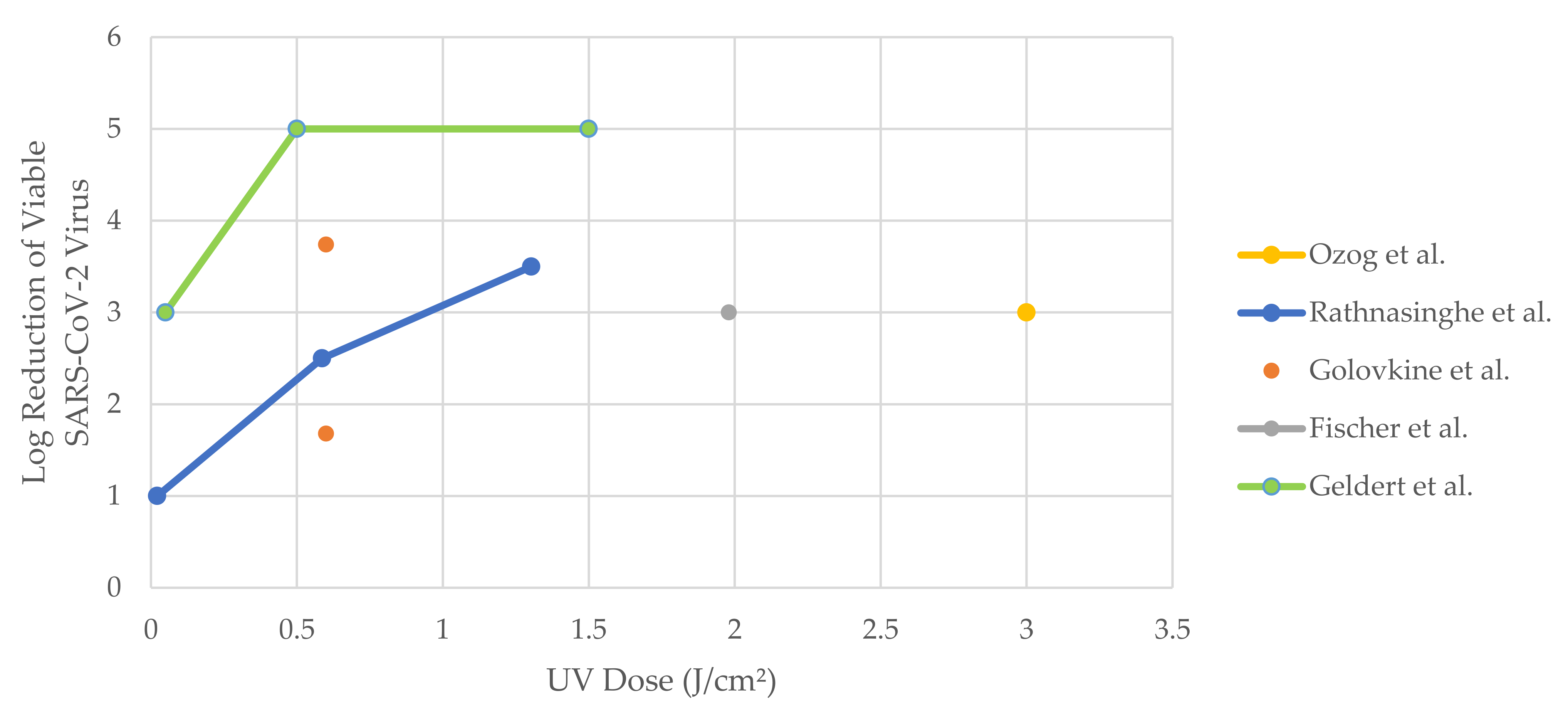
| [20] | 254 | 165 | 60–70 | 3 | 11.5 | - Log reduction of >3 in viable SARS-CoV-2 virus - Mask model: 3M 1860 |
| [42] | 253.7 | NA | 0–300 | NA | 100 | - Log reduction of >4.79 in viable SARS-CoV-2 virus - Mask model: 3M 1860 |
| [43] | 254 | 54.3 | 2–420 | 0.01086–2.2806 | 10 | - Log reduction of up to 3.5 in viable SARS-CoV-2 virus - Mask model: 3M 8211 |
| [44] | 254 | 10 | 300 | 0.3 | NA | - Average log reduction of 3.74 in viable SARS-CoV-2 virus at 0.6 J/cm2 dosage (3M 1860) - Average log reduction of 1.68 in viable SARS-CoV-2 virus at 0.6 J/cm2 dosage (3M 8210) - Mask model: 3M 1860 and 3M 8210 |
| 600 | 0.6 | |||||
| [45] | 254 | 3.18 | 1980 | 0.63 | NA | - No significant log reduction in viable SARS-CoV-2 RNA - Mask model: 3M 1860 |
| [46] | 260–285 | 5.5 | 600–3600 | 0.33–1.98 | 50 | - Log reduction of ≥3 in viable SARS-CoV-2 virus - Mask model: AOSafety N9504C |
| [47] | 254 | 64 | NA | 0.05–1.5 | 3.4 | - Log reduction of >3 in viable SARS-CoV-2 virus at 0.05–0.5 J/cm2 dosage - Log reduction of >5 in viable SARS-CoV-2 virus at 0.5–1.5 J/cm2 dosage - Mask model: 3M 1860 |
| [48] | 254 | 2.32 | 0–3600 | 0–0.8352 | 60.96 | - Log reduction of >3 (5 min of exposure) and complete decontamination (15 min of exposure) in viable NL63 coronavirus - Mask model: 3M 1860 |
| [49] | NA | NA | 120 | 2.6 | NA | - No virus detection after 2 or 5 cycles (porcine coronavirus and murine norovirus) - Mask model: KN95 FFR (Guangzhou Sunjoy Auto Supplies) |
| [41] | 254 | 3900 | 60 | 1 | 100 | - Log reduction of 3 in viable H1N1 influenza virus - Mask model: 3M 1860 |
| [27] | 254 | 16–22 | 900 | 1.8 | 25 | - Log reduction of ≥4.65 in viable H5N1 influenza virus - Mask model: 3M 1860 |
| [21] | 253.7 | 4 | 3600–18,000 | 1.44–7.2 | 42 | - Log reduction of ≥3 in viable MS2 at 4.32 J/cm2 - No virus detection at ≥7.20 J/cm2 - Mask model: Honeywell N1105 |
| [50] | 254 | ≥300 | 60 | ≥2 | NA | - Log reduction of ≥3 in viable MS2 - Mask model: 3M 1860 |
| [51] | 254 | 25 | 120–15,960 | 0.0038–0.4707 | NA | - Log reduction of >3 in viable MS2 at 0.1 J/cm2 - Mask model: 3M 1860 |
| [52] | 254 | NA | 300 | 0.126 | NA | - Complete inactivation of E. coli and B. subtilis after 300 s of exposure - Mask model: UVEX FFP2 |
| 600 | 0.256 | |||||
| 900 | 0.378 | |||||
| [53] | 200–315 | 0.069–0.1072 | 300 | NA | 180 | - Log reduction of 0.5–1.3 in MS2 - Log reduction of 0.0–2.0 in phi6 - Log reduction of 0.8–1.7 in IAV - Log reduction of 1.3–1.7 in MHV - Mask model: 3M 1860 |
| [54] | 254 | 189 | 60–1200 | 1.134–22.68 | 10 | - UVA could not decontaminate as effectively as UVC - No bacteria recovered after 5 min of UVC exposure - Mask model: 3M 8210 |
| 365 | 312 | 1.872–37.44 | ||||
| Performance or Structural Integrity | ||||||
| [22] | 254 | NA | NA | 0–950 | 6.2 | - Filtration performance slightly affected - No effect on flow resistance - Mask model: 3M 1860 |
| [27] | 254 | 16–22 | 900 | 1.8 | 25 | - Mean penetration: 0.99% at 300nm - Mask model: 3M 1860s |
| [37] | 254 | NA | 1800 | NA | NA | - Efficiency of meltblown layer: (≥96% at 10 cycles) and (≥93% at 20 cycles) - Mask model: 3M 8210 |
| [45] | 254 | 3.18 | 57,600 (Exterior) | 18.4 | NA | - Mask integrity was significantly impaired - Average fit score: ≥ 100 - Mask model: 3M 1860 |
| 14,400 (Interior) | 4.6 | |||||
| [49] | NA | NA | 120 | 2.6 | NA | - Remained physically unaffected up to 5 cycles - Filtration efficiency of >95% up to 5 cycles - Breathability well within allowed range after 5 cycles - Mask model: KN95 FFR (Guangzhou Sunjoy Auto Supplies) |
| [52] | 254 | NA | 300 | 0.126 | NA | - Filtration efficiency maintained up to dosage of 0.378 J/cm2 - Mask model: UVEX FFP2 |
| 600 | 0.256 | |||||
| 900 | 0.378 | |||||
| [55] | 254 | ≥24.31 | NA | ≥1 | 30.48 | - Expected penetration: 1.121% (0.3μm, 5 cycles, 3M 1860) and 0.258% (0.3μm, 5 cycles, 3M 8210) - Mask model: 3M 1860 and 3M 8210 |
| [56] | NA | NA | 300 | >1 | 100 | - Filtration performance preserved up to 10 cycles - Mask model: 3M 8210 |
| [57] | 254 | 55.56 | 180 | 1 | 36.8 | - No visual abnormalities on mask integrity - Mean breaking force of 34.8 ± 5.23 N - Average filtration efficiency = >95% - Fit factor = >100% - Mask model: 3M 8110S |
| Study | Method | Concentration of HPV Used/Achieved | Exposure Time (min) | Outcome |
|---|---|---|---|---|
| Reduction in Pathogen Load (Various Pathogens) | ||||
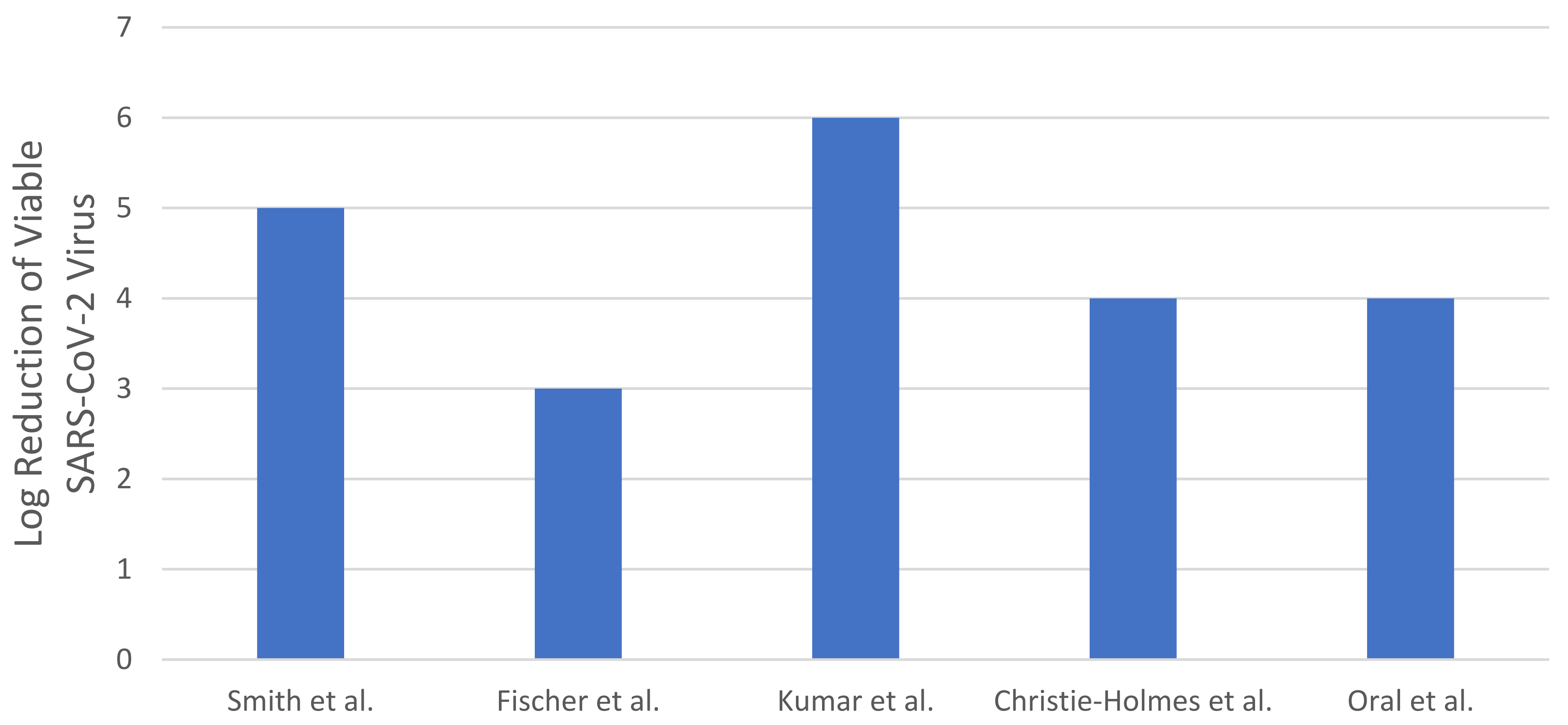
| [45] | Bioquell Z vaporizer | 30% (Peak 500 ppm) | Gassing: 20 Dwell: 60 Aeration: 210 | - Log reduction of ≈5 in viable SARS-CoV-2 RNA - Mask model: 3M 1860 |
| [46] | Panasonic MCO-19AIC-PT | ≈ 1000 ppm | Gas: 7 | - Log reduction of ≥ 3 viable SARS-CoV-2 virus - Mask model: AOSafety N9504C |
| [58] | VHP® ARD system | 35% (Peak 750 ppm) | Conditioning: 3 Decontamination: 30 Aeration: 20 | - Log reduction of 5.2–6.3 in viable SARS-CoV-2 virus - Mask model: 3M 1860 and 3M 8210 |
| [59] | V-PRO maX low-temperature sterilization system by Steris | NA | Non-lumen cycle: 28 | - Log reduction of 4 in viable SARS-CoV-2 titer and 5 in HCoV-229E - Mask model: 3M 8210 |
| [60] | Steris ARD1000® | 410 ± 83 ppm | Gas: 180 | - Log reduction of >4 in viable SARS-CoV-2 - Mask model: 3M 1860 |
| [49] | V-PRO maX low-temperature sterilization system by Steris | 59% | Non-lumen cycle: 28 | - No virus detection after 2 or 5 cycles (porcine coronavirus and murine norovirus) - Mask model: KN95 FFR (Guangzhou Sunjoy Auto Supplies) |
| [61] | A novel HPV-based system was constructed | 3% | Gassing: 3–5 Dwell: 60 Aeration: 15 | - Log reduction of >6 in P22 bacteriophage - Mask model: 3M 1860 |
| [62] | Bioquell® BQ-50 | 35% | NA | - No growth of 6-log Geobacillus stearothermophilus spores post decontamination - Mask model: 3M 1860 |
| [63] | VHP® VICTORY unit | 35% (400–800 ppm) | Conditioning and Gassing: 90 Dwell: 180 Aeration: 900–1080 | - No growth of 6-log Geobacillus stearothermophilus spores post decontamination (1st, 7th day) - Mask model: 3M 1860s |
| Performance or Structural Integrity | ||||
| [26] | V-PRO maX low-temperature sterilization system by Steris | 59% | Inject: 18 Aeration: 8 | - Mask fit and filtration efficiency preserved up to 10 cycles - Mask model: 3M 8211 |
| [45] | Bioquell Z vaporizer | 30% (Peak 500 ppm) | Gassing: 20 Dwell: 60 Aeration: 210 | - Mask integrity minimally affected - Average fit score: ≥ 100 - Mask model: 3M 1860 |
| [46] | Panasonic MCO-19AIC-PT | ≈ 1000 ppm | Gas: 7 | - Filtration performance preserved after 1 treatment - Mask model: AOSafety N9504C |
| [49] | V-PRO maX low-temperature sterilization system by Steris | 59% | Non-lumen cycle: 28 | - Remained physically unaffected up to 5 cycles - Filtration efficiency of >95% up to 5 cycles - Breathability well within allowed range after 5 cycles -Mask model: KN95 FFR (Guangzhou Sunjoy Auto Supplies) |
| [55] | V-PRO maX low-temperature ster-ilization system by Steris (Masks were enclosed within Vis-U-AllTM low-temperature sterilization pouches) | 59% | Full cycle: 28 | - Expected penetration: 0.277% (0.3μm, 5 cycles, 3M 1860) and 0.424% (0.3μm, 5 cycles, 3M 8210) - Mask model: 3M 1860 and 3M 8210 |
| [58] | VHP® ARD system | 35% (Peak 750 ppm) | Conditioning: 3 Decontamination: 30 Aeration: 20 | - Structural and functional integrity preserved - Mask model: 3M 1860 and 3M 8210 |
| [59] | V-PRO maX low-temperature sterilization system by Steris | NA | Non-lumen cycle: 28 | - Filtration efficiency retained - Mask model: 3M 8210 |
| [60] | Steris ARD1000® | 410 ± 83 ppm | Gas: 180 | - Mask fit and filtration efficiency preserved after 1 cycle - Mask model: 3M 1860 |
| [61] | A novel HPV-based system was constructed | 3% | Gassing: 3–5 Dwell: 60 Aeration: 15 | - Minimum required filtration efficiency value of 95% preserved up to 20 cycles - Mask model: 3M 1860 |
| [62] | Bioquell® BQ-50 | 35% | NA | - All processed masks passed fit testing - Mask model: 3M 1860 |
| [64] | V-PRO maX low-temperature sterilization system by Steris | NA | Non-lumen cycle: 28 | - Filtration efficiency significantly affected (80.4–91.8%), particularly at a lower particle diameter - Mask model: 3M 8210 |
| [65] | VHP® VICTORY unit | 35% (400–800 ppm) | Conditioning and Gassing: NA Dwell: 180 Aeration: overnight | - Integrity (mask fit) of the mask preserved up to 8 decontamination cycles - Mask model: 3M 1860s |
| [66] | V-PRO maX low-temperature ster-ilization system by Steris (masks were enclosed within Tyvek pouches) | NA | Non-lumen cycle: 28 | - 66% of the respirators failed fit testing after one decontamination cycle - Mask model: 3M 1860s |
| [67] | Bioquell Clarus C | 35% (±480 ppm) | Gassing: 25 Dwell: 20 | - All the tested masks passed fit testing up to 10 cycles - Mask model: 3M 1870 + |
| Study | Method | Temperature (°C) | Exposure Time (min) | Relative Humidity (%) | Outcome |
|---|---|---|---|---|---|
| Reduction in Pathogen Load (Various Pathogens) | |||||
| [69] | - 57 L model BD 56 standard incubator - Humidity induced by placing 400 mL of water-filled pan below the incubator | 70 | 180–360 | ≈<5–32 | - Complete decontamination of SARS-CoV-2 at 5 hrs of exposure - Mask model: 3M 1860, 3M 8210, and Moldex 1510 |
| [70] | - Multicookers with the sous vide function - Humidity induced by placing 500 mL of water in the multicooker pot | 65 | 30 | 94 ± 0.5 (measured inside the paper bag) | - Inactivation of SARS-CoV-2 virus beyond detection limit within 10 min of exposure - Stacked mask does not hinder decontamination - Mask model: 3M 1860 and 3M 8210 |
| [27] | - Mask loaded to a sealed container placed inside a heated oven - Container filled with 1 L tap water | 65 ± 5 | 20 | NA | - Log reduction of ≥4.62 log in viable H5N1 influenza - Mask model: 3M 1860 |
| [71] | - Circulating water bath | 60 ± 2 | 30 | 80 ± 5 | - Log reduction of ≥4.35 in influenza A virus (InfA) - Log reduction of >5.32 in S. aureus - Mask model: 3M 1860s |
| [28] | - Conducted using TestEquity 123H temperature/humidity chamber | 72, 82 | 30 | 1–89 | - Increase in treatment temperature and humidity results in an increased log reduction of pathogen - Mask model: 3M 1860 |
| [52] | - Samples were steamed above boiling water | NA | 30, 60, 90 | 70–85 | - Log reduction of >4 in E. coli and B. subtilis at 30 and 90 min of exposure - Mask model: UVEX FFP2 |
| [53] | - Ziploc container | 80 | 30 | ≈70 | - Log reduction of >6.9 in MS2 - Log reduction of >7.2 in phi6 - Log reduction of >3.4 in IAV - Log reduction of >0.4 in MHV - Mask model: 3M 1860 |
| - Humidity-controlled oven | 82 | 30 | ≈50 | - Log reduction of >6.6 in MS2 - Log reduction of >6.7 in phi6 - Log reduction of >3.9 in IAV - Log reduction of >2.7 in MHV - Mask model: 3M 1860 | |
| [72] | - BevLes heated holding cabinet with humidity (masks were enclosed within steril-peel pouches) | 70, 90 | 60 | 0, 25, 40, 50, 70 | - Inactivation of E. coli beyond detection limit at (70 °C, 50%RH) and (90 °C, 70%RH) - Mask model: 3M 1860s |
| Performance or Structural Integrity | |||||
| [27] | - Mask loaded to a sealed container placed inside a heated oven - Container filled with 1 L tap water | 65 ± 5 | 20 | NA | - Mean penetration of 1.04% at 300-nm particle size - Mask model: 3M 1860 |
| [29] | - Moist-heat autoclave | 115–130 | 2–60 | NA | - Molded N95 respirators failed all tested fit testing - Slight degradation to filtration efficiency was notable - Mask model: 3M 1860 |
| [30] | - Conducted using a convection oven (Despatch LAC1-38-8, 3.7 cu. Ft.) | 70–85 | 30 | 60–85 | - Passed fit testing - Filtration efficiency not affected - Mask model: 3M 1860 |
| [52] | - Samples were steamed above boiling water | NA | 30, 60, 90 | 70–85 | - Slight decrease in filtration efficiency from 98.86% and 99.51% to 97.58% and 98.79% for 50 and 100 nm particles, respectively - Mask model: UVEX FFP2 |
| [55] | - Masks were enclosed in STERIL-PEEL® sterilization pouches and loaded into the convection heating system with controlled humidity. | 75 | 60 | 75 | - Expected penetration: 1.195% (0.3 μm, 5 cycles, 3M 1860) and 1.924% (0.3 μm, 5 cycles, 3M 8210) - Mask model: 3M 1860, 3M 8210, and Moldex 1510 |
| [69] | - 57 L model BD 56 standard incubator - Humidity induced by placing 400 mL of water-filled pan below the incubator | 70 | 180–360 | ≈<5–32 | - Structural and functional integrity of the respirators preserved up to five cycles - Mask model: 3M 1860, 3M 8210 and Moldex 1510 |
| [70] | - Multicookers with the sous vide function - Humidity induced by placing 500 mL of water in the multicooker pot | 65 | 30 | 94 ± 0.5 (measured inside the paper bag) | - Collection efficiency and inhalation resistance was above the required value of >95% and <35 mmH2O, respectively, for all tested masks upon 5 treatment cycles - A slight change (<10%) in strap elasticity was noted for mask model 3M 1860 - Mask model: 3M 1860 and 3M 8210 |
| [72] | - BevLes heated holding cabinet with humidity (masks were enclosed within steril-peel pouches) | 70, 90 | 60 | 0, 50 | - All processed masks passed fit testing up to 15 cycles - Excellent filtration efficiency of >95%. - Breathing resistance was well within the tolerable resistant standard - Mask model: 3M 1860s and 3M 8210 |
| [73] | - Cylindrical chamber tabletop autoclave (Kronus S18) | 121 | 17 | NA | - No visible damage to the mask after treatment - Slight degradation to filtration capacity of 94.4 ± 1.6% after three cycles - Number of reuse does not affect the flow resistance of the mask - Mask model: 3M Aura 1862+ |
| [74] | - Steris Amsco 400 Series prevacuum steam sterilizer model 20 | 121 | 30 | NA | - 100% (1 cycle) and 86% (2 cycles) of the samples passed fit testing - Mask model: AO Safety 1054S Pleats Plus |
| [75] | NA | 121 | 20 | NA | - Decrease of 20 Pa in respiratory resistance after 4 cycles - Mask model: Duckbill FPP2 |
| [76] | - Sealed respirator container placed inside boiled water | >65 | 30 | 50 | - Filtration efficiency was recorded above 97% up to 5 cycles - Mask model: Kimberly Clark |
| Study | Method/Equipment | Temperature (°C) | Exposure Time (min) | Outcome |
|---|---|---|---|---|
| Reduction in Pathogen Load (Various Pathogens) | ||||
| [72] | BevLes heated holding cabinet with humidity (masks were enclosed within steril-peel pouches) | 70 | 60 | - Inactivation of SARS-CoV-2 virus beyond the detection limit - Mask model: 3M 1860s and 3M 8210 |
| [77] | Laboratory dry oven (Fisher Scientific Isotemp 500 series) | 60–75 | 30, 60 | - N95 coupons placed in tissue culture plate wells yielded better decontamination results compared to the one placed in parchment paper - No required SARS-CoV-2 virus inactivation achieved in suspended intact N95 respirators - Mask model: 3M 1860, 3M 1860s, and 3M 8200 |
| Open drying (room conditions) | 22–23 | 7200 | - 5/9 coupons contained live SARS-CoV-2 virus - Mask model: 3M 1860s | |
| [49] | FFRs hung horizontally on a metal frame were inserted into an electrically heated vessel | 102 ± 4 | 60 ± 15 | - No virus detection after 2 or 5 cycles (porcine coronavirus and murine norovirus) - Mask model: KN95 FFR (Guangzhou Sunjoy Auto Supplies) |
| [31] | Electric oven | 60, 70 | 60–180 | - 1 h of exposure could successfully kill 7 types of bacteria as well as inactivate the H1N1 virus - Mask model: 3M 1860 |
| Performance or Structural Integrity | ||||
| [31] | Electric oven | 60, 70 | 60–180 | - No significant effect on the shape and filtration efficiency after exposure up to 3 h - Mask model: 3M 1860 |
| [49] | FFRs hung horizontally on a metal frame were inserted into an electrically heated vessel | 102 ± 4 | 60 ± 15 | - Signs of degradation or burning visible after 5 cycles - Filtration efficiency dropped to 94.16% after 3 cycles - Breathability well within allowed range after 5 cycles - Mask model: KN95 FFR (Guangzhou Sunjoy Auto Supplies) |
| [55] | VWR® forced air oven | 100 | 30 | - Expected penetration: 0.562% (0.3 μm, 5 cycles, 3M 1860) and 8.107% (0.3 μm, 5 cycles, 3M 8210) - Mask model: 3M 1860 and 3M 8210 |
| [78] | 5-sided heating vacuum oven | 75 | 30 | -No effect on the fit factor of the mask up to 5 cycles - Mask model: 3M 8210 |
| [79] | Oven (masks were enclosed within nylon heat-resistant bags) | 65, 86 | 34–56 | - All processed masks passed fit testing - Mask model: 3M 8810, 3M 8833, and 3M 8835 |
| Study | Method/Equipment | Exposure Time (s) | Outcome |
|---|---|---|---|
| Reduction in Pathogen Load (Various Pathogens), Performance or Structural Integrity | |||
| [34] | - N95 respirators placed inside Medela Quick CleanTM MICRO-STEAMTM BAGS - Steam bags were placed inside Sharp Model R-305KS (2450 MHz, 1100 W) microwave oven | 90 | - Log reduction of ≥3 in viable MS2 - Filtration efficiency preserved after 1 cycle - Mask model: 3M 1860 and 3M 8210 |
| [35] | - 1150 W and 1100 W microwave oven used - 1st set up: N95 respirator placed on mesh over mug containing water - 2nd set up: N95 respirator placed on mesh over glass container containing water | 180 | - Log reduction of ≥4 in viable MS2 with one cycle - Fit, seal, and filtration preserved up to 20 cycles - Mask model: 3M 1860 |
| [52] | - Household microwave oven (Wave 300, 400 W) was used - FFR circular samples were placed on a plastic Petri dish | 4–6 (Multiple specified cycles) | - Log reduction of >4 in E. coli and B. subtilis at 10 and 20 min of exposure - Filtration efficiency maintained - Mask model: UVEX FFP2 |
| Study | Concentration Used | Exposure Time (h) | Outcome |
|---|---|---|---|
| Reduction in Pathogen Load (Various Pathogens) | |||
| [45] | - 70% ethanol was sprayed 10 times on the mask exterior and 5 times on the interior - Placed in a sealed plastic bag overnight | Air drying: ~8 | - No detection of viable SARS-CoV-2 RNA - Mask model: 3M 1860 |
| [52] | - Samples were immersed in 75% ethanol for 2 min | Depends on air drying time | - Complete inactivation of E. coli and B. subtilis - Mask model: UVEX FFP2 |
| Performance or Structural Integrity | |||
| [37] | - Samples were immersed in 75% ethanol | Depends on air drying time | - Significant decrease in filtration efficiency (56.33 ± 3.03%) - Mask model: 3M 8210 |
| [45] | -70% ethanol was sprayed 10 times on the mask exterior and 5 times on the interior - Placed in a sealed plastic bag overnight | Air drying: ~8 | - Mask integrity was significantly impaired - Average fit score: ≥100 - Mask model: 3M 1860 |
| [52] | - Samples were immersed in 75% ethanol for 2 min | Depends on air drying time | - Significant decrease in filtration efficiency - Mask model: UVEX FFP2 |
| [80] | - Approximately 50 mL of 70% ethanol solution was poured over each mask | Air drying: 2–3 | - Filtration efficiency of the mask dropped by 20–30% - It was also noted that 99% of their initial filtration efficiency was restored after vacuum drying - Mask model: 3M 8200, 3M 8210, and 3M 8511 |
Publisher’s Note: MDPI stays neutral with regard to jurisdictional claims in published maps and institutional affiliations. |
© 2021 by the authors. Licensee MDPI, Basel, Switzerland. This article is an open access article distributed under the terms and conditions of the Creative Commons Attribution (CC BY) license (https://creativecommons.org/licenses/by/4.0/).
Share and Cite
Gopalan, T.; Mohd Yatim, R.‘A.; Muhamad, M.R.; Mohamed Nazari, N.S.; Awanis Hashim, N.; John, J.; Wai Hoe, V.C. Decontamination Methods of N95 Respirators Contaminated with SARS-CoV-2. Sustainability 2021, 13, 12474. https://doi.org/10.3390/su132212474
Gopalan T, Mohd Yatim R‘A, Muhamad MR, Mohamed Nazari NS, Awanis Hashim N, John J, Wai Hoe VC. Decontamination Methods of N95 Respirators Contaminated with SARS-CoV-2. Sustainability. 2021; 13(22):12474. https://doi.org/10.3390/su132212474
Chicago/Turabian StyleGopalan, Thirumaaran, Rabi’atul ‘Adawiyah Mohd Yatim, Mohd Ridha Muhamad, Nor Shafina Mohamed Nazari, N. Awanis Hashim, Jacob John, and Victor Chee Wai Hoe. 2021. "Decontamination Methods of N95 Respirators Contaminated with SARS-CoV-2" Sustainability 13, no. 22: 12474. https://doi.org/10.3390/su132212474
APA StyleGopalan, T., Mohd Yatim, R. ‘A., Muhamad, M. R., Mohamed Nazari, N. S., Awanis Hashim, N., John, J., & Wai Hoe, V. C. (2021). Decontamination Methods of N95 Respirators Contaminated with SARS-CoV-2. Sustainability, 13(22), 12474. https://doi.org/10.3390/su132212474