


A Survey-Based Study of Students’ Expectations vs. Experience of Sustainability Issues in Architectural Education at Wroclaw University of Science and Technology, Poland


Abstract
:1. Introduction
1.1. Sustainable Development and UN 17 Sustainable Development Goals
1.2. Sustainable Development in the Building Industry and Architecture
1.3. Sustainability and Ecology in Architectural Education
1.4. Aim of the Research
2. Literature Study
2.1. Method and Eligibility Criteria
2.2. Previous Research, State of the Art
2.3. Research Gap, Innovative Nature of the Presented Study
3. Methods
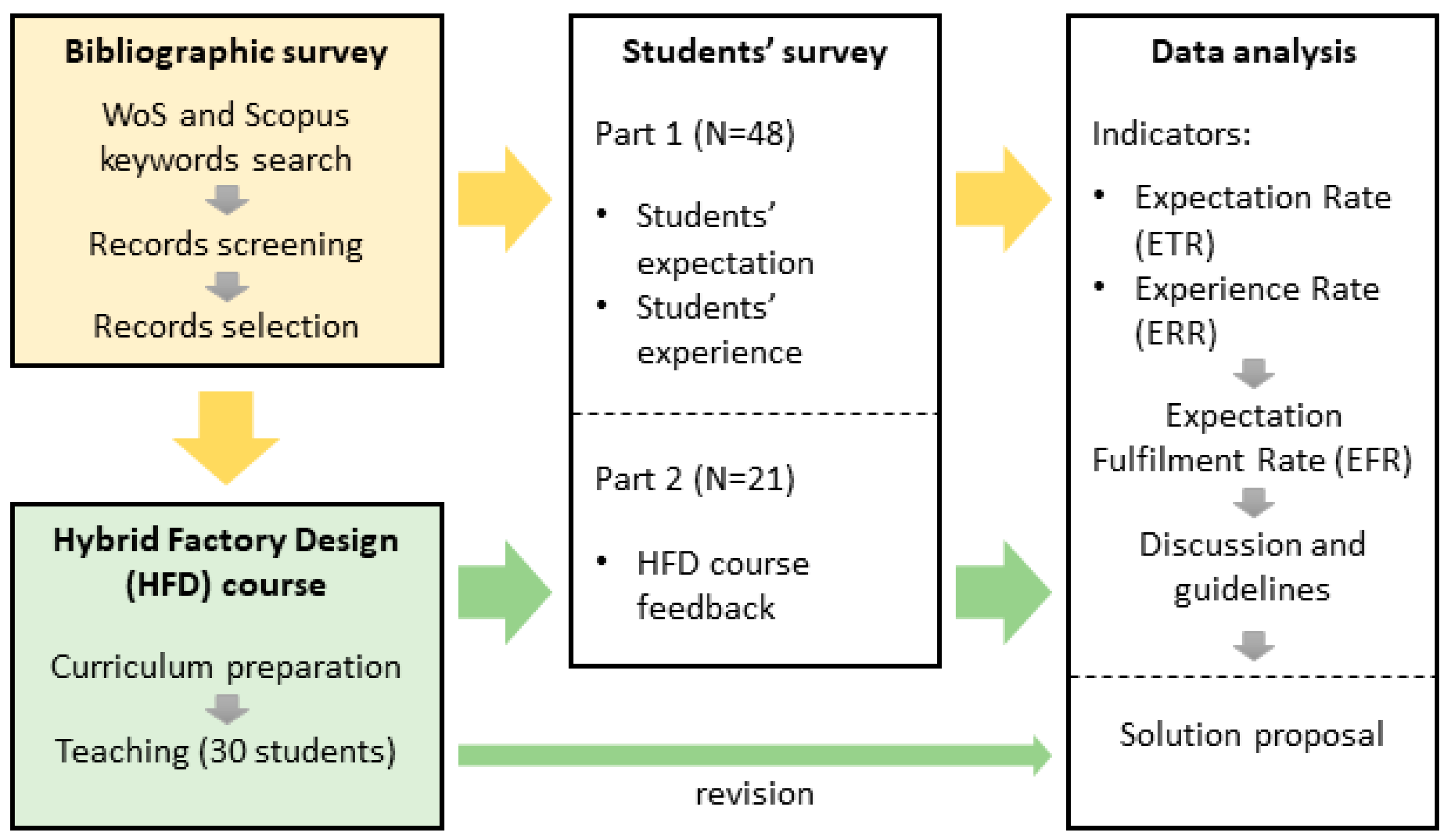
- A bibliographic survey conducted according to the methodology presented in Section 2.1.
- A case study of an innovative Hybrid Factory Design (HFD) course taught for a group of M.Sc. architecture students.
- A survey among students, regarding their experience of sustainability in architectural education and feedback from the HFD course.
- Analysis of the survey results and discussion with a solution proposal.
- The adopted methodology is presented in Figure 1.
3.1. Students’ Survey
- Group A, composed of students in the third year of Bachelor in architecture (N = 27, age 21–23 years old);
- Group B, composed of students in the first year of Master in architecture (N = 21, age 22–24 years old), who attended the HFD course in the semester preceding the survey.
3.2. Data Analysis
4. Survey Results
4.1. Reported Students’ Expectations
- Renewable energy (4.67);
- Rehabilitation and adaptation of damaged areas (4.63);
- Eco-friendly and bio-based building materials (4.59);
- Architectural design (4.58).
4.2. Reported Students’ Experience
- Architectural design (3.75);
- Renewable energy (3.69);
- Energy-saving systems (3.25).
- Rehabilitation and adaptation of damaged areas (2.13);
- Renovation and adaptation of monuments (2.21);
- Spatial planning and ecosystem protection (2.35);
- Closed-loop material cycle (2.46).
- Architectural design (0.82);
- Renewable energy (0.79);
- Energy-saving systems and technologies (0.72).
- Rehabilitation and adaptation of damaged areas (0.46);
- Spatial planning and ecosystem protection (0.52);
- Closed-loop material cycle (0.56);
- Restoration and adaptation of monuments (0.56).
5. Solution Proposal
5.1. Course Description
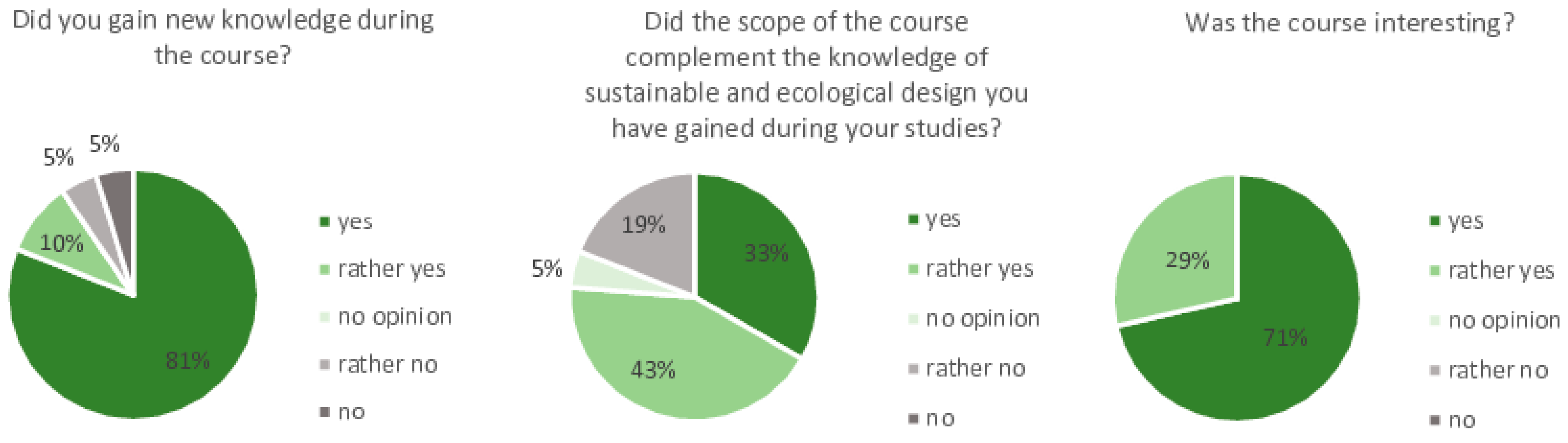
5.2. Course Feedback
- Use of natural environmental conditions in the designing process;
- Energy-saving technologies and renewable energy;
- Adaptive facades;
- Vertical farms and hydroponics;
- Water-saving systems.
5.3. Future Courses Suggestions
6. Conclusions
6.1. Limitation of the Study
6.2. Future Research
Supplementary Materials
Author Contributions
Funding
Institutional Review Board Statement
Informed Consent Statement
Conflicts of Interest
References
- Agbedahin, A.V. Sustainable Development, Education for Sustainable Development, and the 2030 Agenda for Sustainable Development: Emergence, Efficacy, Eminence, and Future. Sustain. Dev. 2019, 27, 669–680. [Google Scholar] [CrossRef]
- Mossin, N.; Stilling, S.; Bøjstrup, T.C.; Hau, I.C.; Møller, C.S.; Blegvad, A. An Architecture Guide to the UN 17 Sustainable Development Goals—SDG Dhaka Declaration; Royal Danish Academy: Copenhagen, Denmark, 2020; Volume 2, ISBN 9788778308313. [Google Scholar]
- Eurostat Generation of Waste by Waste Category, Hazardousness and NACE Rev. 2 Activity. Available online: http://appsso.eurostat.ec.europa.eu/nui/show.do?lang=en&dataset=env_wasgen (accessed on 27 July 2021).
- Eurostat Treatment of Waste by Waste Category, Hazardousness and Waste Management Operations. Available online: http://appsso.eurostat.ec.europa.eu/nui/show.do?lang=en&dataset=env_wastrt (accessed on 27 July 2021).
- United Nations Environment Programme. 2020 Global Status Report for Buildings and Construction—Towards a Zero-Emissions, Efficient and Resilient Buildings and Construction Sector; United Nations Environment Programme: Nairobi, Kenya, 2020. [Google Scholar]
- Iulo, L.D.; Gorby, C.; Poerschke, U.; Kalisperis, L.N.; Woollen, M. Environmentally Conscious Design—Educating Future Architects. Int. J. Sustain. High. Educ. 2013, 14, 434–448. [Google Scholar] [CrossRef]
- Khan, A.Z.; Vandevyvere, H.; Allacker, K. Design for the Ecological Age Rethinking the Role of Sustainability in Architectural Education. J. Archit. Educ. 2013, 67, 175–185. [Google Scholar] [CrossRef] [Green Version]
- Koszewski, K. Edukacja Architektoniczna w Dobie Rewolucji Informatycznej. Refleksje Nad Założeniami Programu Studiów Architecture for Society and Knowledge w Kontekście Antualnej Konducji Dyscypliny. Kwart. Archit. Urban. 2014, 59, 25–37. [Google Scholar]
- Álvarez, S.P.; Lee, K.; Park, J.; Rieh, S.-Y. A Comparative Study on Sustainability in Architectural Education in Asia—With a Focus on Professional Degree Curricula. Sustainability 2016, 8, 290. [Google Scholar] [CrossRef] [Green Version]
- Hassanpour, B.; Atun, R.A.; Ghaderi, S. From Words to Action: Incorporation of Sustainability in Architectural Education. Sustainability 2017, 9, 1790. [Google Scholar] [CrossRef] [Green Version]
- Ismail, M.A.; Keumala, N.; Dabdoob, R.M. Review on Integrating Sustainability Knowledge into Architectural Education: Practice in the UK and the USA. J. Clean. Prod. 2017, 140, 1542–1552. [Google Scholar] [CrossRef]
- Donovan, E. Sustainable Architecture Theory in Education: How Architecture Students Engage and Process Knowledge of Sustainable Architecture. In Implementing Sustainability in the Curriculum of Universities; Springer: Cham, Switzerland, 2018; pp. 31–47. [Google Scholar]
- Albareda-Tiana, S.; Vidal-Raméntol, S.; Fernández-Morilla, M. Implementing the Sustainable Development Goals at University Level. Int. J. Sustain. High. Educ. 2018, 19, 473–497. [Google Scholar] [CrossRef]
- Mahomed, K.E.; Elias-Ozkan, S.T. New Directions in Teaching and Research. Vet. Rec. 2013, 172, 572. [Google Scholar] [CrossRef]
- Celadyn, M. Integrative Design Classes for Environmental Sustainability of Interior Architectural Design. Sustainability 2020, 12, 7383. [Google Scholar] [CrossRef]
- Xiang, X.; Yang, X.; Chen, J.; Tang, R.; Hu, L. A Comprehensive Model of Teaching Digital Design in Architecture That Incorporates Sustainability. Sustainability 2020, 12, 8368. [Google Scholar] [CrossRef]
- Fernandez-Antolin, M.M.; Del-Río, J.M.; del Ama Gonzalo, F.; Gonzalez-Lezcano, R.A. The Relationship between the Use of Building Performance Simulation Tools by Recent Graduate Architects and the Deficiencies in Architectural Education. Energies 2020, 13, 1134. [Google Scholar] [CrossRef] [Green Version]
- Taleghani, M.; Ansari, H.R.; Jennings, P. Sustainability in Architectural Education: A Comparison of Iran and Australia. Renew. Energy 2011, 36, 2021–2025. [Google Scholar] [CrossRef]
- Grover, R.; Emmitt, S.; Copping, A. Critical Learning for Sustainable Architecture: Opportunities for Design Studio Pedagogy. Sustain. Cities Soc. 2020, 53, 101876. [Google Scholar] [CrossRef]
- Kowaltowski, D.C.C.K.; da Silva, V.G.; de O. Neves, L.; Deliberador, M.S.; Zara, O.O.D.C.; Colleto, G.M.; Victorio, E.R. Action Research and Architectural Sustainable Design Education: A Case Study in Brazil. Int. J. Technol. Des. Educ. 2020, 30, 815–836. [Google Scholar] [CrossRef]
- Altomonte, S.; Rutherford, P.; Wilson, R. Mapping the Way Forward: Education for Sustainability in Architecture and Urban Design. Corp. Soc. Responsib. Environ. Manag. 2014, 21, 143–154. [Google Scholar] [CrossRef]
- Boarin, P.; Martinez-Molina, A.; Juan-Ferruses, I. Understanding Students’ Perception of Sustainability in Architecture Education: A Comparison among Universities in Three Different Continents. J. Clean. Prod. 2020, 248, 119237. [Google Scholar] [CrossRef]
- Nunnally, J. Introduction to Psychological Measurement; McGraw-Hill: New York, NY, USA, 1970; ISBN 9780070475595. [Google Scholar]
- Wallin, P.; Adawi, T. The Reflective Diary as a Method for the Formative Assessment of Self-Regulated Learning. Eur. J. Eng. Educ. 2018, 43, 507–521. [Google Scholar] [CrossRef] [Green Version]
- Spivakovskiy, A.; Petukhova, L.; Spivakovska, E.; Kotkova, V.; Kravtsov, H. Comparative analysis of learning in three-subjective didactic model. CEUR Workshop Proc. 2013, 1000, 236–251. [Google Scholar]

| Goal | Examples of Implementation | |
|---|---|---|
| GOAL 1 | No Poverty |
|
| GOAL 3 | Good Health and Well-Being |
|
| GOAL 6 | Clean Water and Sanitation |
|
| GOAL 7 | Affordable and Clean Energy |
|
| GOAL 9 | Industry, Innovation and Infrastructure |
|
| GOAL 11 | Sustainable Cities and Communities |
|
| GOAL 12 | Responsible Consumption and Production |
|
| No. | Authors | Year | Type of Research 1 | Research Focus | Research Gap |
|---|---|---|---|---|---|
| 1 | Iulo et al. [6] | 2011 | course review | ● A model for environmentally conscious content. | ● Conclusions were drawn from the assessment of a limited number of programs. No survey-based study. |
| 2 | Taleghani et al. [18] | 2011 | course review | ● Establishing renewable energy courses related to architecture and other engineering fields of study ● Providing opportunities for continuing professional education. | ● The paper addresses some pioneering efforts in the field. No survey-based study. |
| 3 | Khan et al. [7] | 2013 | curriculum review, pedagogical study | ● Sustainability is seen as an integrative framework, and design is the most appropriate (synthesis) field for exploring and dealing with this integrative endeavor. | ● The overlapping layers model presented a rather theoretical study. No students‘ feedback was included. |
| 4 | Altomonte et al. [21] | 2014 | survey-based (not revealed) | ● Identified some of the key hindrances to the successful integration of sustainability in teaching. | ● Outcomes of a European project EDUCATE after the Bologna unification process are presented. Practitioners were surveyed, not students. |
| 5 | Koszewski | 2014 | curriculum review | ● The social context of the discipline with a special focus on the idea of a society of knowledge. | ● Interesting course curriculum review. No students’ surveys were presented. |
| 6 | Alvarez et al. [9] | 2016 | curriculum review | ● Economic aspects are almost totally absent. | ● Interesting and exhaustive course curriculum review. Only East Asian universities were reviewed. |
| 7 | Hassanpour et al. [10] | 2017 | survey-based (293) | ● Horizontal and vertical relations between different course types that share similar learning objectives are very important. ● The integration of sustainability issues in the architecture curriculum. | ● Questions asked respondents to compare the level of sustainability incorporation in design studios. No further expectation study was performed. |
| 8 | Ismail et al. [11] | 2017 | curriculum review | ● An absence of an obvious framework of how knowledge of sustainable architecture was integrated into the curriculum. | ● A review of integration principles, values and practices at 10 conveniently sampled architecture schools in the UK and USA. Geographically limited. |
| 9 | Donovan [12] | 2018 | case study, direct observation | ● Need for full integration of sustainability into architecture education. ● Need to address multiple disciplines and actors. | ● Example from Denmark, Aarhus School of Architecture. Geographically limited, no students‘ opinions included. |
| 10 | Albareda-Tiana et al. [13] | 2018 | curriculum analysis and interviews with deans | ● The importance of using active teaching-learning strategies. ● Holistic methodological strategies relate theory to practice. | ● Global competencies related to education for sustainable development were not studied. |
| 11 | Kowaltowski et al. [20] | 2019 | survey-based (150) | ● Novice designers could be overwhelmed by the complexity of a design process. ● Sustainability as a concept can be overwhelming and care must be taken to avoid frustration. | ● Students‘ feedback included, but some reflections and resulting actions came from the teaching staff. |
| 12 | Mohamed & Elias-Ozkan [14] | 2019 | course report (22), survey-based (not revealed) | ● Integrating sustainability principles into the architecture design studio. | ● Single course report of ”sustainable design studio”. Some students‘ feedback included. |
| 13 | Grover et al. [19] | 2020 | survey-based (20) | ● Shifting the focus of teaching interactions towards sustainable design can increase its value within the architectural studio. | ● The research adopted a qualitative approach. Lack of quantitative study. |
| 14 | Boarin et al. [22] | 2020 | survey-based (283) | ● Sustainability as a critical aspect in architectural education. ● Sustainability education should be delivered within a more fully integrated pedagogical framework. | ● The lack of data from individual courses to which the questionnaire was offered. ● Lower response rate. |
| 15 | Celadyn [15] | 2020 | course report, survey | ● Integrative classes as supportive instruments in the transformation of the learning process. | ● Integrative classes are discussed in the paper. No survey details revealed. |
| 16 | Fernandez-Antolin [17] | 2020 | survey-based (171) | ● Deficiency in Spain in the current training of architecture students at universities in Building Performance Simulation. | ●Spain-based study. Geographically limited. |
| 17 | Xiang et al. [16] | 2020 | course review, survey (29) | ● The close relationship between the teaching level and the transfer of architectural knowledge. ● Sustainable development concepts into digital architectural design. | ● The study focused exclusively on Chinese universities and all the research was conducted in the Chinese education system. Geographically limited. |
| Questions: Are the issues related to sustainable and ecological design in the following areas important? Should they be a part of architectural education? (ETR) Were the issues related to sustainable and ecological design in the following areas included in the curriculum? Did you get enough information in these areas? (ERR) | |||||||
| Category | Parameter | Group A | Group B | All Students | |||
| Average Response | Standard Deviation | Average Response | Standard Deviation | Average Response | Standard Deviation | ||
| Urban design | ETR | 4.56 | 0.63 | 4.33 | 0.94 | 4.46 | 0.79 |
| ERR | 2.78 | 0.99 | 2.43 | 0.85 | 2.63 | 0.95 | |
| Spatial planning and ecosystem protection | ETR | 4.56 | 0.79 | 4.57 | 0.66 | 4.56 | 0.73 |
| ERR | 2.15 | 1.15 | 2.62 | 1.09 | 2.35 | 1.15 | |
| Architectural design | ETR | 4.48 | 0.63 | 4.71 | 0.45 | 4.58 | 0.57 |
| ERR | 3.67 | 0.67 | 3.86 | 0.89 | 3.75 | 0.78 | |
| Design of green spaces | ETR | 4.37 | 0.82 | 4.57 | 0.58 | 4.46 | 0.73 |
| ERR | 2.70 | 1.27 | 3.10 | 1.06 | 2.88 | 1.20 | |
| Rehabilitation and adaptation of damaged areas | ETR | 4.67 | 0.67 | 4.57 | 0.79 | 4.63 | 0.73 |
| ERR | 1.96 | 1.07 | 2.33 | 1.28 | 2.13 | 1.18 | |
| Restoration and adaptation of monuments | ETR | 3.96 | 1.04 | 3.86 | 1.49 | 3.92 | 1.26 |
| ERR | 2.07 | 0.94 | 2.38 | 1.05 | 2.21 | 1.00 | |
| Eco-friendly and natural building materials | ETR | 4.62 | 0.68 | 4.55 | 0.74 | 4.59 | 0.71 |
| ERR | 3.15 | 0.85 | 2.86 | 0.99 | 3.02 | 0.92 | |
| Energy-saving systems and technologies | ETR | 4.59 | 0.62 | 4.43 | 1.05 | 4.52 | 0.84 |
| ERR | 3.19 | 1.09 | 3.33 | 0.84 | 3.25 | 0.99 | |
| Renewable energy | ETR | 4.81 | 0.39 | 4.48 | 0.79 | 4.67 | 0.62 |
| ERR | 3.67 | 0.72 | 3.71 | 0.82 | 3.69 | 0.77 | |
| Water-saving systems and technologies | ETR | 4.74 | 0.44 | 4.33 | 1.08 | 4.56 | 0.81 |
| ERR | 3.00 | 1.05 | 3.10 | 0.97 | 3.04 | 1.02 | |
| Closed-loop material cycle | ETR | 4.41 | 0.73 | 4.33 | 0.89 | 4.38 | 0.81 |
| ERR | 2.26 | 1.07 | 2.71 | 0.93 | 2.46 | 1.04 | |
| Topic | Representative Quotes |
|---|---|
| Learning outside the classroom | “I gained most of my practical knowledge about ecological design reading about them on my own.” “Studies should be one of the main sources of knowledge on the subject but social media also play an important role here.” “Tutors are not able to present all the issues in detail, but only to indicate the right direction. It is important to study this topic outside the classroom.” |
| Sustainable design in elective classes | “’Most of the positively assessed topics were elaborated on in elective classes.” |
| Outdated knowledge | “Very little information is up to date and most of it is typical greenwashing.” “In classes, design suggestions are often based on tested, safe solutions.” |
| Importance of the topic | “Sustainable and ecological design is important and should be a key component of architectural studies.” “These are very important issues considering the current climate situation.” |
| Lack of knowledge provided in the courses | “Few tutors talk about it (sustainable design), and even fewer provide practical knowledge on the subject.” “It (sustainable technology) is definitely in the background and could have been explained to the students more.” “Knowledge on specific topics (regarding sustainable design) was required but not always clearly presented during the classes.” |
| Superficial approach to the problem | “It (sustainable design) is often limited to theory and very basic aspects such as the installation of photovoltaic panels.” |
| Category | Expectation Fulfilment Rate | ||
|---|---|---|---|
| Group A | Group B | All Students | |
| Urban design | 0.61 | 0.56 | 0.59 |
| Spatial planning and ecosystem protection | 0.47 | 0.57 | 0.52 |
| Architectural design | 0.82 | 0.82 | 0.82 |
| Design of green spaces | 0.62 | 0.68 | 0.64 |
| Rehabilitation and adaptation of damaged areas | 0.42 | 0.51 | 0.46 |
| Restoration and adaptation of monuments | 0.52 | 0.62 | 0.56 |
| Eco-friendly and natural building materials | 0.68 | 0.63 | 0.66 |
| Energy-saving systems and technologies | 0.69 | 0.75 | 0.72 |
| Renewable energy | 0.76 | 0.83 | 0.79 |
| Water-saving systems and technologies | 0.63 | 0.71 | 0.67 |
| Closed-loop material cycle | 0.51 | 0.63 | 0.56 |
| Topics | Representative Quotes |
|---|---|
| Interdisciplinary approach | “By dividing the whole process into individual stages and areas, each area could be properly considered and contributed to the design.” “The visits of the interdisciplinary guests were a great advantage of this course” |
| Opportunity to organize the knowledge | “Presentations during the energy module finally allowed me to systematize my knowledge” |
| Lack of time to cover all the aspects | “Due to the large scope of the architectural and spatial concept itself, there is no more time for green area design.” “Far too little time has been spent on the surrounding of the building, which I consider to be very important.” |
| Differences in quality of modules | “The urban planning and green areas modules were not well prepared. While the lectures on green areas were interesting, there was a lack of in-depth revision of projects in this aspect.” |
| Components of the Educational Process | Traditional Method | Innovation |
|---|---|---|
| Learning objectives | ● Providing students with the skill and competencies to execute an architectural design. | ● Providing students with knowledge and rapid execution in the design phase. ● Formation of competence to work in the group, leadership skills and self-reliance. ● Increasing the ability to work within the schedule. |
| Course content | ● Design brief, site layout. | ● Digitalized lectures. ● Digitalized case studies. ● Urban, greenery and sustainability modules. ● Additional study materials (regulations, building codes). |
| Study methods | ● Reproductive, explanatory, illustrative. ● Oral methods of knowledge transfer. ● Hand notes during lectures. | ● Problem-based research. ● Direct application of knowledge. ● Blended learning. ● Flipped classroom. ● Upload of all phases of the design. |
| Study means | ● Traditional visual: books, papers, hand sketches. ● Traditional oral, word transfer. | ● Hypertext. ● Multimedia training facilities. ● Videoconferencing (Microsoft Teams). ● Creation of Moodle-based online teaching environment. ● Students’ immersion in new media. ● Reflective diary for better rapport and instant personal problem solving. |
Publisher’s Note: MDPI stays neutral with regard to jurisdictional claims in published maps and institutional affiliations. |
© 2021 by the authors. Licensee MDPI, Basel, Switzerland. This article is an open access article distributed under the terms and conditions of the Creative Commons Attribution (CC BY) license (https://creativecommons.org/licenses/by/4.0/).
Share and Cite
Brzezicki, M.; Jasiolek, A. A Survey-Based Study of Students’ Expectations vs. Experience of Sustainability Issues in Architectural Education at Wroclaw University of Science and Technology, Poland. Sustainability 2021, 13, 10960. https://doi.org/10.3390/su131910960
Brzezicki M, Jasiolek A. A Survey-Based Study of Students’ Expectations vs. Experience of Sustainability Issues in Architectural Education at Wroclaw University of Science and Technology, Poland. Sustainability. 2021; 13(19):10960. https://doi.org/10.3390/su131910960
Chicago/Turabian StyleBrzezicki, Marcin, and Agata Jasiolek. 2021. "A Survey-Based Study of Students’ Expectations vs. Experience of Sustainability Issues in Architectural Education at Wroclaw University of Science and Technology, Poland" Sustainability 13, no. 19: 10960. https://doi.org/10.3390/su131910960
APA StyleBrzezicki, M., & Jasiolek, A. (2021). A Survey-Based Study of Students’ Expectations vs. Experience of Sustainability Issues in Architectural Education at Wroclaw University of Science and Technology, Poland. Sustainability, 13(19), 10960. https://doi.org/10.3390/su131910960

