Article

Does the Mixed-Ownership Reform Affect the Innovation Strategy Choices of Chinese State-Owned Enterprises?

1
School of Economics and Management, Yanshan University, Qinhuangdao 066004, China
2
Faculty of Management Sciences, University of Kotli, Azad Jammu and Kashmir, Kotli 11100, Pakistan
3
Business School, University of Leeds, Leeds LS2 9JT, UK
*
Authors to whom correspondence should be addressed.
Sustainability 2020, 12(7), 2587; https://doi.org/10.3390/su12072587
Submission received: 26 February 2020 / Revised: 21 March 2020 / Accepted: 22 March 2020 / Published: 25 March 2020

Abstract

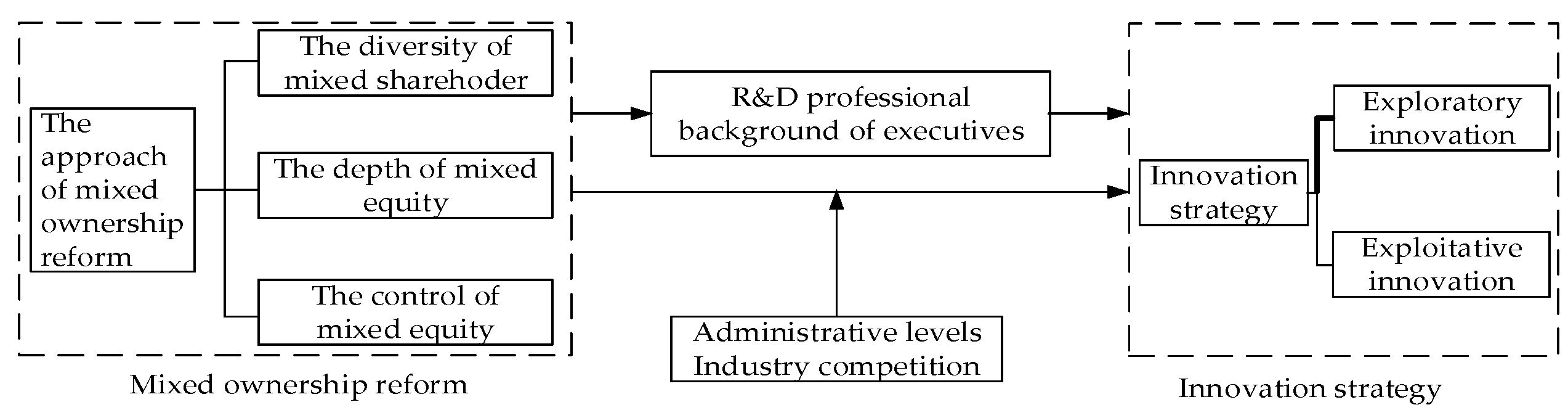
In recent years, the innovation of state-owned listed enterprises has gained substantial momentum in academic research due to their vital role in sustainable economic development. This article examines and evaluates the influence of mixed-ownership reform on the innovation strategy of Chinese State-Owned Enterprises (SOEs) from the two dimensions of ownership structure adjustment and control right allocation. We extend extant research in that: The diversity of mixed shareholders, the depth of mixed equity, and the control of mixed equity can significantly promote the exploratory innovation investment of SOEs. Our study investigates the impact of the shareholding ratio of foreign investors, natural persons, and institutional investors. The empirical results found a significant positive correlation between the increase of the shareholding ratio of institutional investors and the exploratory and exploitative innovation investment. On the other hand, private shareholders’ shareholding ratio has no impact on the innovation strategy choices of SOEs. Specifically, the results proved that the promotion of exploratory innovation investment by mixed-ownership reform is more significant in SOEs controlled by the central government or in competitive industries. To a large extent, this promotion is achieved by improving the proportion of executives with a professional R&D background in SOEs.
Keywords: mixed-ownership reform; exploratory innovation; exploitative innovation; state-owned enterprises mixed-ownership reform; exploratory innovation; exploitative innovation; state-owned enterprises