
Abstract
Online shopping has become increasingly popular in the past two decades. Yet, despite its popularity, the use of online stores on the African continent pales in comparison to other parts of the world. Moreover, in many economic contexts in Africa and including Ghana, there has been very limited research on the subject of online adoption and in particular, the fundamental factors that can influence its initial adoption, especially among young and relatively educated consumers who constitute the largest demographic group there. We, therefore, make a determined effort to fill this growing knowledge gap by exploring some fundamental factors associated to shop online by young and educated consumers. This exploratory research draws on the stimulus-organism-response (SOR) framework and focuses on five variables of interest namely perceived ease of use, government support infrastructure, and economic considerations about pricing, perceived convenience and use intentions of online retail stores. Evidence collected from 294 research participants provides support for our research propositions Finally, our research contributions and future study directions are considered in the concluding part of the paper.
1. Introduction
Online shopping, necessitated by Internet penetration, has emerged as an important phenomenon worldwide. It is known that the proportion of consumers using online retail stores has, in the past two decades, increased progressively [1]. Moreover, given that online shopping can be performed at any time and place, it is believed to confer more advantages to consumers than traditional retail stores and particularly concerning the perceived value of convenience [2,3,4]. Yet, despite the popularity as well as benefits of online shopping to consumers worldwide, online shopping in many African countries today and including Ghana pales in comparison to other parts of the world. Africa’s share of the business to consumer eCommerce transactions worldwide was less than 2% in 2015 [5], although in 2018, for example, the projection for a total volume of eCommerce transactions in Africa was about US $50 billion up from US $8 billion in 2013 [5]. At the same time, Internet penetration in Ghana remains very low to date—in particular, merely 33.6% of the population have Internet access—compared to countries such as Libya (North Africa), which despite the persisting internal conflicts there, has an Internet penetration of 57.8% [5].
Moreover, recent polling of online shopping experience in Ghana and four other African nations, reveals that more than 55% of Ghanaians are yet to make purchases online [6]. This said, according to Alexa [7] report, the web portals of online retail stores such as Jumia Ghana (Accra, Ghana) and Amazon consult (Kumasi, Ghana) are among the most visited by Ghanaian online users. In fact, according to this report, Jumia Ghana ranks in the eleventh (11th) position in the country and closely followed by the US giant retail store Amazon (15th position). Against this background, it is important to know what will motivate consumers—particularly those who are not only young and educated but also live in urban areas where there is likely to be greater Internet access—towards the use of online retail stores. Unfortunately, and due to limited research on the emerging phenomenon of online shopping in contexts such as Ghana where Internet penetration is low to this day, the motivation behind the use of online retail stores is unclear in the literature.
Indeed, this lack of online shopping adoption research in Ghana and other African nations contrasts sharply with similar developing nations such as China, India, and Malaysia and not to even mention western nations. The significant disparity in research can be seen in recent surveys of the literature [8,9,10]. For example, in the meta-analysis of Kim & Peterson [9], no African study was mentioned, meaning that the phenomenon of online shopping has been easily overlooked by researchers in this region. The implication, therefore, is that there is little or no empirical data on online shopping adoption research in all African nations. Little reason, therefore, studies have urged researchers from the continent to develop frameworks that will lead to a better understanding of this phenomenon and in particular its essential drivers [11,12,13,14].
This study, in particular, focuses on exploring the fundamental drivers of use intentions of online retail stores. Because this is an exploratory study and since we do not want to limit ourselves to extant technology adoption models such as TAM and UTAUT, it is important, therefore, to draw on a model that allows us to gain initial insights into the research issue. Hence, we consider the use of stimuli-organism-response (SOR) model [15,16,17] as adequately appropriate in this work. This paper, therefore, contents that in Ghana, where due to inadequate information and communications infrastructure there is low Internet penetration, the construct government support infrastructure will play a key role in intentions to use online retail stores by enhancing perceived convenience (see also [14,18]). We, therefore, hold the view that government support infrastructure is a fundamental macro-environmental stimulus for consumers’ behavioural intentions towards online shopping through the mechanism of the perceived value of convenience. Moreover, since common wisdom and classic economic theories suggest that market-based stimuli such as price/economic considerations influence consumers’ decisions in multiple and significant ways [19]; this paper, therefore, test the proposition that economic considerations, particularly concerning pricing, positively stimulate adopt decisions concerning online stores use intentions by enhancing perceived convenience. Finally, because it has long been articulated that ease of use is an influential factor in adoption decisions [8,20,21,22,23,24], this study further tests the proposition that ease of use will influence intended use of online retail stores by enhancing perceived convenience.
To sum up, this research matters because it theorizes and investigates the argument that government support infrastructure, economic considerations particularly pricing, and ease of use are influencers of perceived convenience. This, in turn, is theorized to influence the intended use of online retail stores among Ghanaian consumers. By testing these arguments, it permits an understanding of the key issues that need to be taken into consideration when thinking of incentivizing consumers’ decisions towards the use of online retail stores in contexts where online shopping is emerging gradually. Besides, a significant value of the present analysis is that it widens the scope of geographic inquiry on online shopping adoption decisions to the Ghanaian context, a context hitherto overlooked in online shopping research. Another value of our analysis is that it provides some insight for coordinated government agencies aimed at building and sustaining a competitive eMarketplace environment, especially in places like Ghana where the phenomenon of online shopping is new. Similarly, for online retailers to sustain in the digitalized world, insights shed in this study will benefit them by assisting in the implementation of strategies that could drive adoption rates in Ghana and elsewhere in Africa. Finally, for e-vendors to ensure sustainability in their operations in a lower Internet penetrated region as earlier elaborated in the paper, we make a determined effort to examine some empirical antecedents from segment of the millennia (mostly university students) who have the penchant to use the technology.
This paper has been organised as follows. Immediately following this section is background and discussions of the theoretical framework associated with this study. The discussion of the conceptual foundations of the study, as well as the research propositions, is presented in the third section of this academic writing. Next, is the presentation of the research methodology and this pertains to data collection, measurement instruments, and the employed statistical method. Subsequently, the results of the study are presented. We then focus on the discussion of the results and implications of the research. Finally, we conclude the research report by summarizing its major findings, recommendations for future research and limitations of the study are also included.
2. Stimulus-Organism-Response Framework
Research on Stimulus-Organism-Response (S-O-R) has been extensively conducted in environmental psychology, specifically behavioural sciences, which includes: sociology, political science, anthropology, and economics of/within the academic disciplines [15,16,25,26]. Mehrabian and Russel [16] firstly proposed the S-O-R theory to establish the mechanism through which our environment negatively or positively affects our human behaviour in general. Again, the works of Donovan et al. [27] shed more light on the S-O-R by replicating the model in a retail store environment to assess the shopping behaviour of customers. The S-O-R theory, however, suggests that environmental factors (stimulus) acts as some stimuli that affect one’s internal experiences, herein as (organism), and consequently results in the person’s (responses). Stimulus here refers to social, design or ambiance factors associated with the tendency for the individual to embark on a transaction [27].
Also, Mehrabian and Russel [16] define the act of stimuli as the overall cues that can be seen and touched in the shopping environment. The organism, on the other hand, considers the innate perception, feeling, thinking associated with the stimuli and how consumers react in the shopping environment. Thus, the perceptual, physiological, feeling and activities which arouse to regulate the sensitiveness of the consumer in question. Lastly, the term Response is defined in the context of consumers’ ultimate decisions coupled with behavioural intentions [16]. As earlier indicated, the S-O-R model has been widely used in numerous studies of the ‘brick and mortar and brick and click ‘retail stores [15,16,27,28]. The S-O-R model in its context has been theoretically championed in studies relating to online consumer behaviour specifically to examine how human-computer interactions lead to behavioural interactions [28]. Again, extant studies offer credence to the fact that the adoption of this model is viable for explaining customers’ internal reactions and behavioural response to environmental signs [29,30].
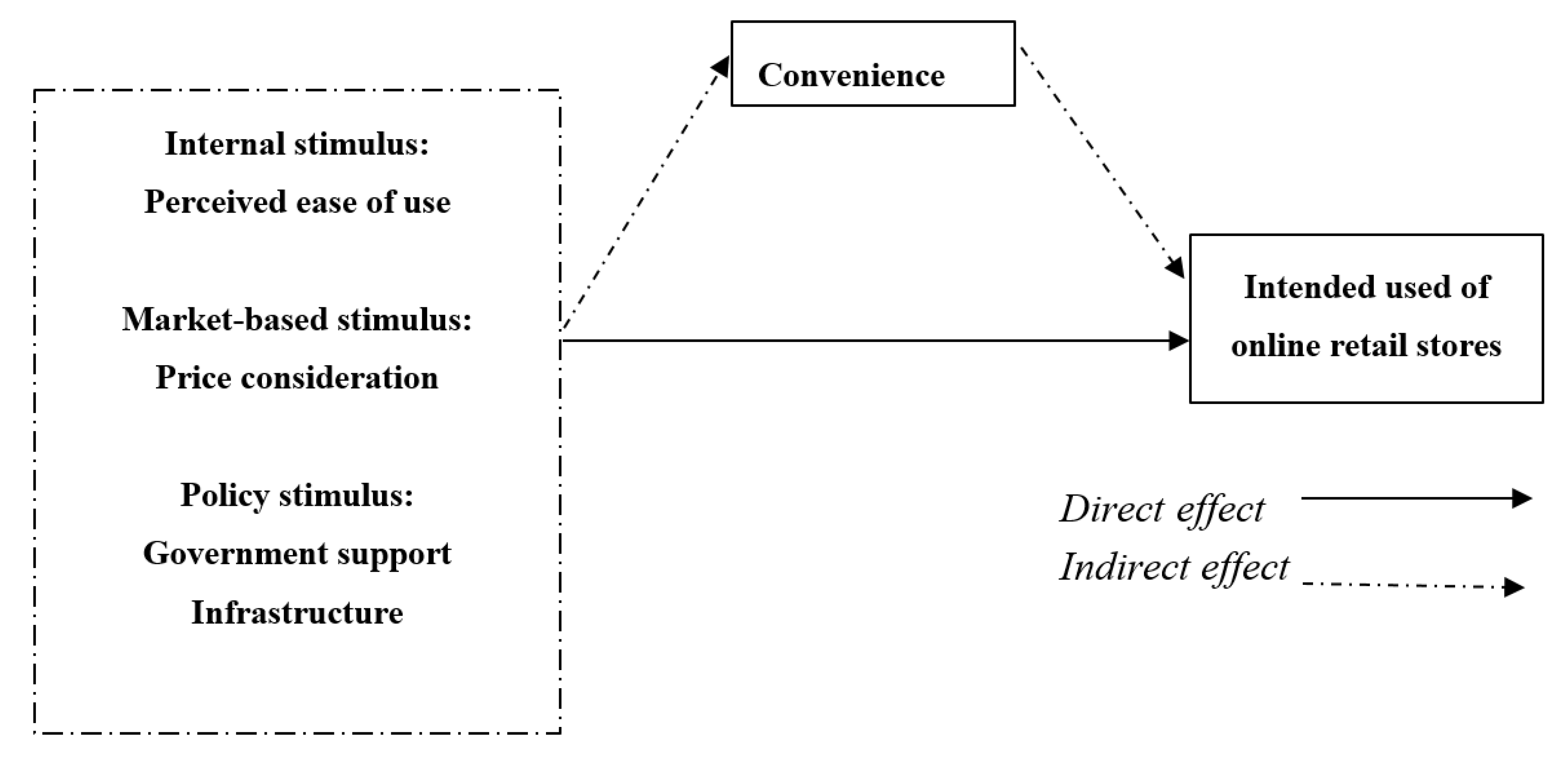
The theory behind the adoption of the three stimuli (namely; internal, market-based and policy) is the fact that S-O-R model considers exogenous variables from the exposed environment (Stimulus) which potentially triggers internal emotion (Organism) and lead to resulting behavior/attitude (Response) [14]. By virtue of this analogy, consumers may respond in a different way to the given cues based upon their internal primary emotional reaction. Against this notion that we deployed these factors (Perceived ease of use, Price consideration, convenience, Government support infrastructure, and Intent) so as to test the S-O-R model for the present study particularly in a different geographical setting like Ghana. We used the S–O–R model to determine the cognitive-affective factors (stimuli) in order to evaluate purchasing intention towards e-shopping behaviour in the context of environmental psychology. The model suggests that stimuli from environments influence an individual’s cognitive and affective mechanism, which subsequently leads to some response and behaviour. By further extension, the adopted model has been widely extended and has been broadly applied to shopping outcomes of online stores. In the context of online shopping, the stimulus (S) is defined as “the total sum of all the cues that are visible and audible to the online shopper”. The internal states (Organism) affect consumer responses, such as purchase intention (Response). Therefore, the aim of this model is to provide a simplified view to established the mediating role of convenience (as affective responses) towards online purchasing intention. We have acknowledged there are multiple mechanisms through which the stimuli (including government support infrastructure, price/economic considerations, and ease of use) potentially predict the response behavioural outcome of the intended use of online retail stores. But for the sake of argument, we will be limiting the investigation to the mechanism of convenience alone. In framing our arguments, we have been inspired by the ideological framework of Stimuli-Organism-Response (SOR) [15,16,17]. As noted, SOR forms the base of the current investigation. In short, the SOR model makes an additional contribution to understanding the complex reality of online shopping (and Table 1 shows Summary of Related works using the SOR model in a developing economy).
Table 1.
Summary of Related Work Using SOR Model in a developing and developed economies.
3. Hypothesis Development
3.1. Perceived Ease of Use and Convenience in Online Shopping
Perceived ease of use is a construct under the perspective of TAM [20]. It is defined as the extent to which a person believes that the system will or new technology is presumed to be effortless. Similarly, in the perspective of UTAUT, perceived ease of use refers to effort expectancy which assumed the degree of ease associated with the use of the system. Again, like perceived usefulness, perceived ease of use has been studied in the context of e-banking and m-banking [34,35,36]. Ease of use is frequently cited and found to be closely linked to individual perceptions of complexity in terms of adoption and use of the system. A related inquiry has shown that consumers would reject an innovation if it is very complex and not user-friendly when they perform transactions electronically [37]. In the context of technology adoption regarding the online related transaction, the user-friendliness of the adoption of Internet activities makes it suitable in the minds of users. Also, this perception of user-friendliness created in the minds of the shopper consequently triggers the intention to use or accept online related services. Therefore, in light of this, we hypothesized that;
Hypothesis 1 (H1).
Perceived ease of use will predict intention to in transacting online retail stores via the mediating effect of perceived convenience.
3.2. Price Consideration and Perceived Convenience in Online Shopping
The Internet continue to be the major communicating medium that is progressively being used worldwide as an innovative tool for marketing goods and services. Concerning that, consumers′ choices of shopping channels may be affected by the economic consideration or perceived price of the channel [38]. Reibstein [39,40] indicates that online consumers typically consider price information from different retailers for the same product to make the most favourable economic decision. Vijayasarathy & Jones [38] and Dholakia & Chiang, [41] in their studies discovered that savings in transaction costs that lead to better deals on price can positively influence consumers′ attitudes on the intention to shop online.
Similarly, Jian, Yang and Jun [40] considers that a better price is one of the reasons that motivate U.S. consumers to make purchases online. A study from Shim, Eastlick, and Lotz [42] supported the former and indicated that the prices of products sold online in the U.S. are usually 9 to 16% lower than products sold in traditional retail shops. In light of this analogy, a low price may also attract price-sensitive customers to swiftly engaged in online shopping since consumers in general or even in an economic perspective are considered rational regarding the behaviour of prices in the market. So, when potential shoppers can experience (discover) such a good price in the market (a retail store), the economic situation becomes a suitable (convenient) environment to trigger shoppers’ intent to shop online. Hence, with this evidence from the literature, we proposed that;
Hypothesis 2 (H2).
Economic considerations will predict intention to transact in online retail stores via the mediating effect of perceived convenience.
3.3. Government Support Infrastructure and Perceived Convenience in Online Shopping
Perceived convenience has been largely associated with the adoption of a new system in which online shopping environments cannot be excluded [43,44] such as online shopping. Shopping convenience is acknowledged to be the major motivating factor in the decisions of consumers to buy products at home. Darian [43] identified five types of convenience for in-home shopping: reduction in shopping time, timing flexibility, saving the physical effort of visiting a traditional store, saving of aggravation, and providing the opportunity to engage in impulse buying, or directly responding to an advertisement [44]. Also, customers who value convenience are inclined to make purchases via the Internet more often and may persist to spend more time in their quest to engage in online shopping [45]. In their research, they propose that consumers′ perceptions of convenience positively impact on their willingness to purchase via the Internet and also prefer to patronage from Internet retail stores. Nevertheless, as consumers derive utilitarian value from efficient and timely transactions, both time and effort savings positively influence customers′ online purchase intention [46].
However, the role of government in stimulating the swift growth of Internet penetration is key. Therefore, in an attempt by a government to create an enabling environment for the information system (technological base) to thrive, firms that operate within the online space would be willing to invest [14]. This investment such as, Internet extension, broadband connection, among others would ultimately trigger and stimulate user’s intention towards the use of the system in which online shopping cannot be isolated. In light of this, the following hypothesis is proposed;
Hypothesis 3 (H3).
Government support infrastructure will predict intention to transact in online retail stores via the mediating effect of perceived convenience.
After a careful review of the literature, our conceptual model is carved from stimuli-organism-response (SOR) as a support base for the validation of the proposed model (see Figure 1).
Figure 1.
Theoretical model to be validated.
4. Methodology
4.1. Sample and Data Collection
This study adopts a deductive research paradigm to implement the research objective. To test the model and the hypotheses, we used a survey-based research design to collect quantitative data from a large number of respondents. The questionnaire was purposefully targeted at university students in some selected public higher institutions in Ghana (University of Cape Coast (UCC), University of Ghana (UG), Kwame Nkrumah University of Science and Technology (KNUST), and the University for development studies (UDS) and more particularly undergraduate students who frequently visit the Internet-daily and/or weekly activity. These participants were selected for this study for a major reason in that, it was essential to consider university students in our survey as previous research has confirmed that they are the largest age group in using the Internet and technology [36], thereby they are most likely acquainted with the Internet-related transactions, and also student sample reflects current and future e-shopping behaviour. This was made possible as a result of getting a fair representation of university students across the length and breadth in Ghana. We must emphasize that all the selected universities are dispersed in all the three belts in Ghana, thus the Northern, Southern, and Middle belt of Ghana. Data collection was undertaken in the months between June to September 2019. The first author who was on the ground along with some trained assistants politely urged about 301 students on these campuses to fill the questionnaire, out of which 294 were completed. On average, the questionnaire took 10 min to fill. In the final analysis, only 294 responses were used for data processing/analysis. A quick preview of our demographic variables indicates that out of samples who took part in the research, about ninety-three (93) of these research participants have not used the online medium for transaction whiles the remaining out of the entire participants have used the means. While frequency usage of the Internet usage shows that only 101 respondents regularly use the internet and the rest have been noted to use the Internet weekly, monthly, with the year (see Table 2 for the summary of respondents’ demography). We controlled for respondents’ age, gender and visit (or not) to online shopping websites. Software used was ADANCO 2.O.1 and a bootstrapping resampling of 999 attempts.
Table 2.
Socio-demographic characteristics of respondents.
4.2. Construct Measurement
The items used for measuring the constructs were adapted from the existing literature. For clarity, all items were measured on a five-point Likert scale (1 = completely disagree, 2 = disagree, 3 = neutral, 4 = agree and 5 = completely agree). Also, all of the measurement items were in a positive statement. Therefore, Table 3, shows a summary of construct indicators questionnaire items with their respective literature sourced and a measurement scale.
Table 3.
Constructs and their sources.
5. Results
It is pertinent to note that, before the event of executing the overall aim of the study, we used the partial least squares structural equation modelling (PLS-SEM) approach to assess our measurement model and the hypotheses of this study by deploying the statistical software ADANCO 2.1 [51]. PLS-SEM is noted to be appropriate for testing hierarchical latent variable models, hierarchical component models or higher-order constructs compared to covariance-based structural equation. Again, PLS-SEM holds no assumption about distributions of data and can easily converge smaller sample sizes [52]. To start with, we summarized the demographic data of our subjects (see Table 1).
5.1. Test for Common Method Bias (CMB)
Any serious concerns about CMB have been dealt with and correctly checked and taken care of in this analysis. Therefore, CMB is not a strong concern in our analysis [53]. Besides, in the work of Bagozzi and Yi, [54] the constructs were carefully worded and an assurance was given in the cover page of the questionnaire that respondents’ responses will be treated in strict confidence. Also, those who indicated on the questionnaire that they hurriedly filled it and/or reported that their responses were not objective were removed from the eventual analysis. All this has guarded against the commonly known issue associated with using single sources for both dependent variable(s) and independent variable(s). In short, our work is consistent with the works of Bagozzi and Yi [54]. Since this work also is particularly concerned with the test of indirect/mediating effect, the issue of CMB is of least concern since the respondents could not have imagined this complex test.
5.2. Measurement Model Assessment
To begin with PLS-SEM, the assessment of the measurement models is the first stage in any SEM process. This stage ensures that statements (unobserved variables) are measured constructs (observed variables). Hence, we examine our measurement model using three main criteria: convergent validity, reliability and discriminant validity, following the suggestion of Hair et al. [55]. Convergent validity of the items was assessed by outer loadings and average variance extracted (AVE). All outer loadings for items are above 0.6, which is above the minimum threshold value of 0.6 as suggested by Bagozzi and Yi [56]. The outer loadings, therefore, provided support for convergent validity as indicated by eminent scholars (see Hair et al., 2014). The AVE values of 0.5874 to 0.7311 are well above the minimum required level of 0.50, as suggested by Fornell and Larcker [57], thus also demonstrating the convergent validity for all constructs. Moreover, the composite reliability (CR) measures were all higher than the 0.7 thresholds (see Table 4) [58]. That is, among measurement models, the reliability measure of constructs in this study were above the acceptable satisfactory levels (see Table 4). Again, discriminant validity was evaluated based on the Fornell-Lacker criterion and cross-loadings. The Fornell-Larcker criterion [57] suggested that the estimate of the square root of the AVE should be greater than the correlation shared between the construct and the other constructs (see Table 5). Readers must take a careful look at the Inter-construct correlation matrix and discriminant validity (see Table 5) to understand that the bolded values in the diagonal line show the level of correlation coefficient amongst the observed variables. The discriminant is established when a construct has a higher value of loaded coefficient beyond other observed variables in a single row or column as indicated in Table 5. In light of this test, we can proceed for subsequent inquiry of the study.
Table 4.
Construct reliability and validity.
Table 5.
Inter-construct correlation matrix and discriminant validity.
5.3. Structural Model Assessment
Following the validity of the measurement model, assessment of the structural model is necessary and because it justifies the model’s ability to predict the endogenous variables or constructs. Assessment of the structural model follows a procedure suggested by [58] to advance issues in partial least squares structural equation modelling. The technique is porous in establishing the effects and significance of the path coefficients which involve testing the proposed hypothesis. Also, with regards to the statistical significance of our observed construct, bootstrapping was performed with t-test (t > 1.96 or p-value < 0.05) as the critical value to gauge the level of significance among the observed variables, with Cohen’s f2 showing the effect size of the predictive relevance (see Table 6).
Table 6.
Assessing structural path coefficients with mediating effects of convenience.
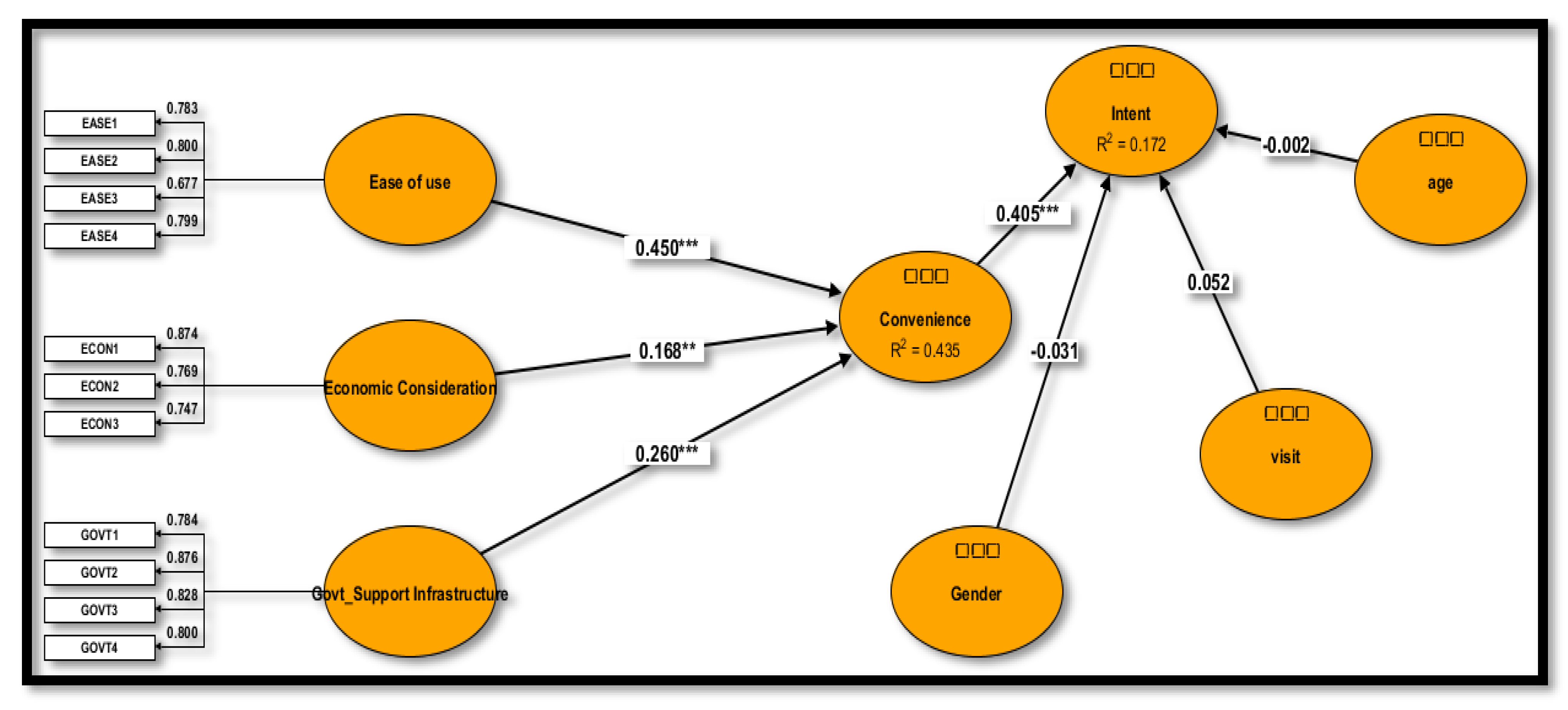
Interestingly, all the research hypotheses were supported based on the test performed. With the three hypotheses (H1): Perceived ease of use will predict intention to transact online via the mediating effect of perceived convenience (β = 0.1823, t = 9.1346), (H2): Economic considerations will predict intention to transact online via the mediating effect of perceived convenience (β = 0.0682, t = 2.5981), and (H3): Government support infrastructure will predict intention to transact online via the mediating effect of perceived convenience (β = 0.1055, t = 3.8273) (see Table 6). The control variable i.e., gender, age had a negative direct effect of an intention to use online stores for transactions, while the number of the visit was found to be positive but had no statistically implications for intention to use online stores. Also, (see Figure A1) in the Appendix A which shows the visual estimates of the validated model.
Concerning the predictive power (coefficient of determination, R2) of the regression model, the coefficient indicates the percentage of variation in the dependent variable that is been explained by the predictor (independent) variable, (see Table 7). In the same vein, the Adjusted R2 shows the amount of variance in the endogenous construct explained by the exogenous constructs. From Table 6, the estimated adjusted R2 of 0.4375 with (p < 0.05) showed that perceived ease of use, economic consideration, and government support infrastructure, together explain 44% of the variance in the dependent variable (convenience). Again, the model also tested the, perceived ease of use, economic consideration, government support infrastructure, and convenience on intent, and the adjusted R2 of 0.1685 (17%) with (p < 0.05) was significant, and these estimates could be traced in Table 7 below.
Table 7.
Variations of the dependent variable explained by the independent variables.
6. Discussion and Research Implications
This study investigated the various components of external stimuli that affect customer intent to shop online in the retailing environment in the Ghanaian context. The study had three main hypotheses with perceived convenience (endogenous variable) as the mediating construct whiles controlling respondents’ age, gender and visit (or not) to online shopping websites. The findings suggest that all the observed variables; trust and perceived ease of use, economic consideration, government support infrastructure, perceived convenience, and intention to shop online concerning Ghana, are multidimensional constructs. Though their importance in customers’ shopping decision-making varies from one context to another, and the various dimensions of the research constructs (observed variables) precisely the exogenous variables, do not contribute equally to overall perceived convenience (endogenous variable).
The results also suggest that since there are variations in the individual construct contribution towards the intention to shop online in the retail platforms, the study confirms their effects to be significant. Consequently, potential online shoppers in Ghana would prefer to engage in electronic commerce (e-commerce) when their perception regarding perceived ease of use and perceived convenience are established per the present study. These factors are significant factors affecting the purchase intention in the emerging markets in which Ghana, where the present study is undertaken, is one of them. This finding corroborated with the earlier works of Griffith [47,59] and that of Morris and Venkatesh [48].
Regarding economic consideration, it is important to acknowledge the presence of ICTs as a catalyst that has a positive impact on businesses in their quest to thrive and achieve sustainable competitiveness [18]. Hence, the trending issue in a retail marketing environment concerning the adoption and implementation of ICTs which enables business organizations to harness the practical benefits of online shopping. From our survey, subjects who took part in the inquiry believe that having a low cost of the Internet accessibility, availability of suitable electronic facilities including broadband connection, discounted prices of online transactions, among others, all together, positively trigger their (customers) intention to engage in online shopping. Again, in the context of the Internet shopping environment, the consequence of price is more influential than the offline environment in that customers prefer to compare prices with a click of a button across multiple e-vendors on identical products. Our current evidence was largely supported by the write-ups of Venkatesh, and Gu, Lee, and Suh [49,59] by confirming the significant role of the price (economic condition) regarding shoppers’ decisions towards online purchase intention in the retail store. Therefore, it is expected that consumer’s intention to engage in online shopping is largely influenced by product/brand price, especially for early adopters and price-survey consumers. In many empirical studies on Internet shopping behavior, perceived price (economic consideration) has been frequently cited as a key motivator (driver) for consumers to shop online [48,49,60].
Furthermore, with the relationship between government support infrastructure and intention to transact online via the mediating effect of perceived convenience, it was ascertained that when government regulation is tailored toward business growth and development, such environment consequently becomes a conduit for potential business and even existing e-commerce to thrive. This favourable environment, if created by the government, would boost investors’ confidence in the e-market space and ultimately make online transactions attractive to online consumers. This study further corroborated by related works of Nabareseh et al. [14] as well as that of Faqih [49].
Concerning managerial relevance, the study propels a framework and also consistently reminds practitioners of the composite dimensions of behavioural intention towards online shopping in the retailing environment. By and large, the article reveals the significant mechanism in which managers of e-commerce would deploy to attract prospective shoppers who would like to engage in the Internet shopping space. Similarly, practitioners of e-commerce, having seen this model and the analyses, would be able to gauge them the preferred motivating construct that has a higher tendency to trigger shoppers’ intention to accept a system (Internet shopping). In as much as the success of online businesses relied heavily upon its ability to attract customers, practitioners should improve their systems to provide pre-purchase and post-purchase information to both experienced and inexperienced shoppers [60,61,62].
Concerning the theoretical relevance, our research whilst contributing to a growing body of work on online shopping behaviour offers a diverse perspective on the motivator factors that trigger the usage and adoption of Internet shopping. Previous research has declined the inclusion of some important extraneous variables like government support infrastructure as a composite function of policy stimulus towards response (intent) to used online retail stores [62]. Additionally, with the continuous growth of Internet use and adoption, a review of Internet shopping specific concepts or factors (stimuli) would offer a better explanation of online shopping adoption and usage in the retailing environment.
7. Conclusions, Limitations and Future Study Direction
Following the trend of marketing by the presence of the Internet, the insufficient understanding factors that motivate Internet users from their quest to adopt the online shopping in a retail store in a developing country, this investigation is therefore intended to underline the possible factors responsible for their engagement in the e-commerce space. To achieve this objective, we proposed a research model composing underlined factors established in the literature as key potential drivers for predicting individuals’ behavioural intention to adopt new technologies. The proposed factors were drawn from popular information system/information technology (IS/IT) adoption theories. Notable factors include perceived ease of use, perceived convenience, government support infrastructure, economic (price) consideration, and intention to adopt online shopping. Also, demographic factors including gender, age, and visit were considered as control variables.
This study was implemented by collecting data through a self-administered questionnaire and online survey to both online and offline users from June 2019 to September 2019. Concerning the data analyses, 301 cases were received out of which 294 valid datasets were accomplished by using ADANCO 2.1 version. The results provide significant statistical evidence in support of all the factors hypothesized to influence behavioural intention to adopt online shopping in a retail store.
Though, the study cannot be without limitations. There are several limitations to this study, requiring further examination and additional research. First, this study has focused on subjects in a developing country (Ghana) with both users (experience) and novice in online shopping. Therefore, further research is needed to verify the research model from a cross-cultural perspective. Second, since this study only considered online shopping in the retailing environment, it is unclear whether the analytical results are sufficient to generalize the behavioural intention of customers in all e-commerce transactions with a specific focus on product or service in the sub-Sahara region (Ghana). Also, since the current research circumvent around the domain of a developing country, it would be necessary if future researchers could explore other constructs (stimuli) from technology adoption theories (such UTAUT, TPB, etc.) to examine other types of online retailers, example, consumer attitudes, subjective norms, and perceived behavioural control to shop online are context-dependent and may be related to specific products and services. Finally, the sample has 294 respondents. Therefore, adding to this limitation is the fact that, the study was conducted using a student population and so makes it difficult to generalize beyond the target population. Although the sample is well enough, this sample is somewhat below the recommendations of the pioneer scholars well versed with the application of the structural equation model [58]. Future research should consider augmenting the sample size for the given model.
Author Contributions
A.B.J.—conceptualization, methodology, validation, investigation, writing—original draft preparation, M.A.K.—conceptualization, methodology, validation, investigation, writing—original draft preparation, M.P.—supervision, E.B.—supervision, writing—review, and editing, and C.N.O.—supervision, writing—review, and editing. All authors have read and agreed to the published version of the manuscript.
Funding
This work was supported by the Internal Grant Agency of FaME through TBU in Zlín No. IGA/FaME/2019/008; IGA/FaME/2020/002-The Impact of Digital Transformation On Consumer Behaviour and Firm’s Sustainable Performance and further by the financial support of research project NPU I no. MSMT-7778/2018 RVO-Digital Transformation and its Impact on Customer Behavioural and Business Processes in Traditional and Online markets.
Acknowledgments
We would like to thank Bedrich Zimola (vice-dean for international relations), and Assoc. Miloslava Chovancova (Chairperson, Academic board senate), all at Faculty of Management and Economics-TBU in Zlin for their consistency and persistence scholarly advice on data analysis for this new epistle.
Conflicts of Interest
The authors declare no conflict of interest of whatsoever.
Appendix A
A graphical view of the hypothetical structural path.
Figure A1.
Tested research model.
References
- Yao, Y.; Boardman, R.; Vazquez, D. Cultural Considerations in Social Commerce: The Differences and Potential Opportunities in China. In Social Commerce; Palgrave Macmillan: London, UK, 2019; pp. 43–58. [Google Scholar] [CrossRef]
- Pham, Q.; Tran, X.; Misra, S.; Maskeliūnas, R.; Damaševičius, R. Relationship between convenience, perceived value, and repurchase intention in online shopping in Vietnam. Sustainability 2018, 10, 156. [Google Scholar] [CrossRef]
- Chiu, Y.P.; Lo, S.K.; Hsieh, A.Y.; Hwang, Y. Exploring why people spend more time shopping online than in offline stores. Comput. Hum. Behav. 2019, 95, 24–30. [Google Scholar] [CrossRef]
- Ladhari, R.; Gonthier, J.; Lajante, M. Generation Y and online fashion shopping: Orientations and profiles. J. Retail. Consum. Serv. 2019, 48, 113–121. [Google Scholar] [CrossRef]
- International Trade Centre (ITC). International E-Commerce in Africa: The Way Forward; Technical paper Doc.No. EC-15-364. E; ITC: Kolkata, India, 2015; 47p, Available online: http://www.intracen.org/uploadedFiles/intracenorg/Content/Publications/International%20E-Commerce%20in%20Africa_Low-res.pdf (accessed on 30 July 2019).
- Business Day. Online Shopping Edging up, but Sub-Saharan Africans still don’t Trust e-Commerce. 2016. Available online: https://www.businesslive.co.za/bd/business-and-economy/2016-12-20-online-shopping-edging-up-but-sub-saharan-africans-still-dont-trust-e-commerce/ (accessed on 15 August 2019).
- Alexa. Top Sites in Ghana. 2018. Available online: https://www.alexa.com/topsites/countries/GH (accessed on 20 August 2019).
- Ingham, J.; Cadieux, J.; Berrada, A.M. e-Shopping acceptance: A qualitative and meta-analytic review. Inf. Manag. 2015, 52, 44–60. [Google Scholar] [CrossRef]
- Kim, Y.; Peterson, R.A. A meta-analysis of online trust relationships in E-commerce. J. Interact. Market. 2017, 38, 44–54. [Google Scholar] [CrossRef]
- Toufaily, E.; Ricard, L.; Perrien, J. Customer loyalty to a commercial website. Descriptive meta-analysis of the empirical literature and proposal of an integrative model. J. Bus. Res. 2013, 66, 1436–1447. [Google Scholar] [CrossRef]
- Inegbedion, H.E.; Obadiaru, D.E.; Bello, V.D. Factors that Influence Consumers’ Attitudes toward Internet Buying in Nigeria. J. Internet Commer. 2016, 15, 353–375. [Google Scholar] [CrossRef]
- Lim, W.M. Antecedents and consequences of e-shopping: An integrated model. Internet Res. 2015, 25, 184–217. [Google Scholar] [CrossRef]
- Mpinganjira, M. An investigation of customer attitude towards online stores. African Journal of Science, Technology. Innov. Dev. 2016, 8, 447–456. [Google Scholar] [CrossRef]
- Nabareseh, S.; Oskawe, C.N.; Klimek, P.; Chovancova, M. A Comparative Study of Consumers’ Readiness for Internet Shopping in Two African Emerging Economies: Some Preliminary Findings. Mediterr. J. Soc. Sci. 2014, 5, 1882–1889. [Google Scholar] [CrossRef][Green Version]
- Arora, R. Validation of an S-O-R Model for Situation, Enduring, and Response Components of Involvement. J. Market. Res. 1982, 19, 505–516. [Google Scholar] [CrossRef]
- Mehrabian, A.; Russell, J.A. An Approach to Environmental Psychology; The MIT Press: Cambridge, MA, USA, 1974. [Google Scholar]
- Chan, T.; Cheung, C.; Lee, Z.W.Y. The state of online impulse-buying research: A literature analysis. Inf. Manag. 2016, 54, 204–217. [Google Scholar] [CrossRef]
- Jibril, A.B.; Kwarteng, M.A.; Chovancova, M.; Pilik, M. The impact of social media on consumer-brand loyalty: A mediating role of online based-brand community. Cogent Bus. Manag. 2019, 6, 1673640. [Google Scholar] [CrossRef]
- Sheehan, D.; Hardesty, D.M.; Ziegler, A.H.; Chen, H.A. Consumer reactions to price discounts across online shopping experiences. J. Retail. Consum. Serv. 2019, 51, 129–138. [Google Scholar] [CrossRef]
- Davis, F.D. User acceptance of information technology: System characteristics, user perceptions and behavioral impacts. Int. J. Man-Mach. Stud. 1993, 38, 475–487. [Google Scholar] [CrossRef]
- King, W.R.; He, J. A meta-analysis of the technology acceptance model. Inf. Manag. 2006, 43, 740–755. [Google Scholar] [CrossRef]
- Ofori, D.; Appiah-Nimo, C. Determinants of online shopping among tertiary students in Ghana: An extended technology acceptance model. Cogent Bus. Manag. 2019, 6, 1644715. [Google Scholar] [CrossRef]
- Schepers, J.; Wetzels, M. A meta-analysis of the technology acceptance model: Investigating subjective norm and moderation effects. Inf. Manag. 2007, 44, 90–103. [Google Scholar] [CrossRef]
- Ping, L.; Gyamfi, S.A.; Hossin, M.A. Online shopping in Sub-Saharan Africa: Evidence from Ghana. In Proceedings of the 2018 International Conference on Information Management & Management Science ACM, Chengdu, China, 25–27 August 2018; pp. 58–66. [Google Scholar] [CrossRef]
- Jacoby, J. Stimulus-organism-response reconsidered: An evolutionary step in modeling (consumer) behavior. J. Consum. Psychol. 2002, 12, 51–57. [Google Scholar] [CrossRef]
- Goi, M.T.; Kalidas, V.; Zeeshan, M. Comparison of Stimulus-Organism-Response Framework between International and Local Retailer. Procedia Soc. Behav. Sci. 2014, 130, 461–468. [Google Scholar] [CrossRef]
- Lim, W.M. Toward a theory of online buyer behavior using structural equation modeling. Mod. Appl. Sci. 2013, 7, 34. [Google Scholar] [CrossRef]
- Zhang, K.Z.; Benyoucef, M. Consumer behavior in social commerce: A literature review. Decis. Support Syst. 2016, 86, 95–108. [Google Scholar] [CrossRef]
- Islam, J.U.; Rahman, Z. The impact of online brand community characteristics on customer engagement: An application of Stimulus-Organism-Response paradigm. Telemat. Inform. 2017, 34, 96–109. [Google Scholar] [CrossRef]
- Kamboj, S.; Sarmah, B.; Gupta, S.; Dwivedi, Y. Examining branding co-creation in brand communities on social media: Applying the paradigm of Stimulus-Organism-Response. Int. J. Inf. Manag. 2018, 39, 169–185. [Google Scholar] [CrossRef]
- Wu, Y.; Li, E. Marketing mix, customer value, and customer loyalty in social commerce: A stimulus-organism-response perspective. Internet Res. 2018, 28, 74–104. [Google Scholar] [CrossRef]
- Kwarteng, M.A.; Jibril, A.B.; Nwaiwu, F.; Pilik, M.; Ali, M. Internet-Based Channel Orientation for Domesticated Services Firm: Some Drivers and Consequences. In International Working Conference on Transfer and Diffusion of IT; Springer: Cham, Switzerland, 2019; pp. 90–103. [Google Scholar] [CrossRef]
- Chang, H.J.; Eckman, M.; Yan, R.N. Application of the Stimulus-Organism-Response model to the retail environment: The role of hedonic motivation in impulse buying behavior. Int. Rev. Retail Distrib. Consum. Res. 2011, 21, 233–249. [Google Scholar] [CrossRef]
- Chopdar, P.K.; Korfiatis, N.; Sivakumar, V.J.; Lytras, M.D. Mobile shopping apps adoption and perceived risks: A cross-country perspective utilizing the Unified Theory of Acceptance and Use of Technology. Comput. Hum. Behav. 2018, 86, 109–128. [Google Scholar] [CrossRef]
- Abbasi, G.A.; Goh, Y.N.; Ariffin, S.K. Stimulating Online Buying Behaviour among Millennials in Pakistan: A conceptual model and Research Propositions. J. Entrep. Bus. Econ. 2019, 7, 189–219. [Google Scholar]
- Tan, K.S.; Chong, S.C.; Loh, P.L.; Lin, B. An evaluation of e-banking and m-banking adoption factors and preference in Malaysia: A case study. Int. J. Mob. Commun. 2010, 8, 507–527. [Google Scholar] [CrossRef]
- Venkatesh, V.; Morris, M.G.; Davis, G.B.; Davis, F.D. User acceptance of information technology: Toward a unified view. MIS Q. 2003, 27, 425–478. [Google Scholar] [CrossRef]
- Tarhini, A.; El-Masri, M.; Ali, M.; Serrano, A. Extending the UTAUT model to understand the customers’ acceptance and use of Internet banking in Lebanon: A structural equation modeling approach. Inf. Technol. People 2016, 29, 830–849. [Google Scholar] [CrossRef]
- Reibstein, D.J. What attracts customers to online stores, and what keeps them coming back? J. Acad. Market. Sci. 2002, 30, 465. [Google Scholar] [CrossRef]
- Vijayasarathy, L.R.; Jones, J.M. Print and Internet catalog shopping: Assessing attitudes and intentions. Internet Res. 2000, 10, 191–202. [Google Scholar] [CrossRef]
- Chiang, K.P.; Dholakia, R.R. Factors driving consumer intention to shop online: An empirical investigation. J. Consum. Psychol. 2003, 13, 177–183. [Google Scholar] [CrossRef]
- Jiang, L.A.; Yang, Z.; Jun, M. Measuring consumer perceptions of online shopping convenience. J. Serv. Manag. 2013, 24, 191–214. [Google Scholar] [CrossRef]
- Darian, J.C. In-home shopping: Are there consumer segments? J. Retail. 1987, 63, 163. [Google Scholar]
- Shim, S.; Eastlick, M.A.; Lotz, S. Examination of US Hispanic-owned, small retail and service businesses: An organizational life cycle approach. J. Retail. Consum. Serv. 2000, 7, 19–32. [Google Scholar] [CrossRef]
- Prasad, C.J.; Aryasri, A.R. Determinants of shopper behaviour in e-tailing: An empirical analysis. Paradigm 2009, 13, 73–83. [Google Scholar] [CrossRef]
- Childers, T.L.; Carr, C.L.; Peck, J.; Carson, S. Hedonic and utilitarian motivations for online retail shopping behavior. J. Retail. 2001, 77, 511–535. [Google Scholar] [CrossRef]
- Griffith, D.A. An examination of the influences of store layout in online retailing. J. Bus. Res. 2005, 58, 1391–1396. [Google Scholar] [CrossRef]
- Rakesh, S.; Khare, A. Impact of promotions and value consciousness in online shopping behaviour in India. J. Database Market. Custom. Strategy Manag. 2012, 19, 311–320. [Google Scholar] [CrossRef]
- Faqih, K.M. An empirical analysis of factors predicting the behavioral intention to adopt Internet shopping technology among non-shoppers in a developing country context: Does gender matter? J. Retail. Consum. Serv. 2016, 30, 140–164. [Google Scholar] [CrossRef]
- Venkatesh, V. Determinants of perceived ease of use: Integrating control, intrinsic motivation, and emotion into the technology acceptance model. Inf. Syst. Res. 2000, 11, 342–365. [Google Scholar] [CrossRef]
- Henseler, J.; Dijkstra, T.K. ADANCO 2.1, Composite Modelling; GmbH & Co. KG: Kleve, Germany, 2018. [Google Scholar]
- Hair, J.F., Jr.; Hult, G.T.M.; Ringle, C.; Sarstedt, M. A Primer on Partial Least Squares Structural Equation Modeling (PLS-SEM); Sage Publications: Thousand Oaks, CA, USA, 2016. [Google Scholar]
- Osakwe, C.N.; Boateng, H.; Popa, S.; Chovancová, M.; Soto-Acosta, P. Understanding cosmopolitan consumers’ repeat purchasing in the eMarketplace: Contribution from a brand orientation theoretical perspective. E a M Ekonom. Manag. 2016. Available online: http://hdl.handle.net/10453/106516 (accessed on 23 January 2020). [CrossRef]
- Podsakoff, P.M.; MacKenzie, S.B.; Lee, J.; Podsakoff, N.P. Common Method Bias in Behavioral Research: A Critical Review of the Literature and recommended remedies. J. Appl. Psychol. 2003, 38, 879–903. [Google Scholar] [CrossRef] [PubMed]
- Hair, J., Jr.; Sarstedt, M.; Hopkins, L.G.; Kuppelwieser, V. Partial least squares structural equation modeling (PLS-SEM) An emerging tool in business research. Eur. Bus. Rev. 2014, 26, 106–121. [Google Scholar] [CrossRef]
- Bagozzi, R.P.; Yi, Y. On the evaluation of structural equation models. J. Acad. Market. Sci. 1988, 16, 74–94. [Google Scholar] [CrossRef]
- Fornell, C.; Larcker, D.F. Evaluating structural equation models with unobservable variables and measurement error. J. Market. Res. 1981, 18, 39–50. [Google Scholar] [CrossRef]
- Hair, J.F.; Ringle, C.M.; Sarstedt, M. PLS-SEM: Indeed, a silver bullet. J. Market. Theory Pract. 2011, 19, 139–152. [Google Scholar] [CrossRef]
- Goldsmith, R.E. Explaining and Predicting Consumer Intention to Purchase Over the Internet: An Exploratory Study. J. Market. Theory Pract. 2002, 10, 22–28. [Google Scholar] [CrossRef]
- Morris, M.G.; Venkatesh, V. Age differences in technology adoption decisions: Implications for a changing work force. Pers. Psychol. 2000, 53, 375–403. [Google Scholar] [CrossRef]
- Gu, J.C.; Lee, S.C.; Suh, Y.H. Determinants of behavioral intention to mobile banking. Expert Syst. Appl. 2009, 36, 11605–11616. [Google Scholar] [CrossRef]
- Sohaib, O.; Kang, K. Individual level culture influence on online consumer iTrust aspects towards purchase intention across cultures: A SOR model. Int. J. Electron. Bus. 2015, 12, 142–161. Available online: http://hdl.handle.net/10453/37979 (accessed on 23 January 2020). [CrossRef]
© 2020 by the authors. Licensee MDPI, Basel, Switzerland. This article is an open access article distributed under the terms and conditions of the Creative Commons Attribution (CC BY) license (http://creativecommons.org/licenses/by/4.0/).