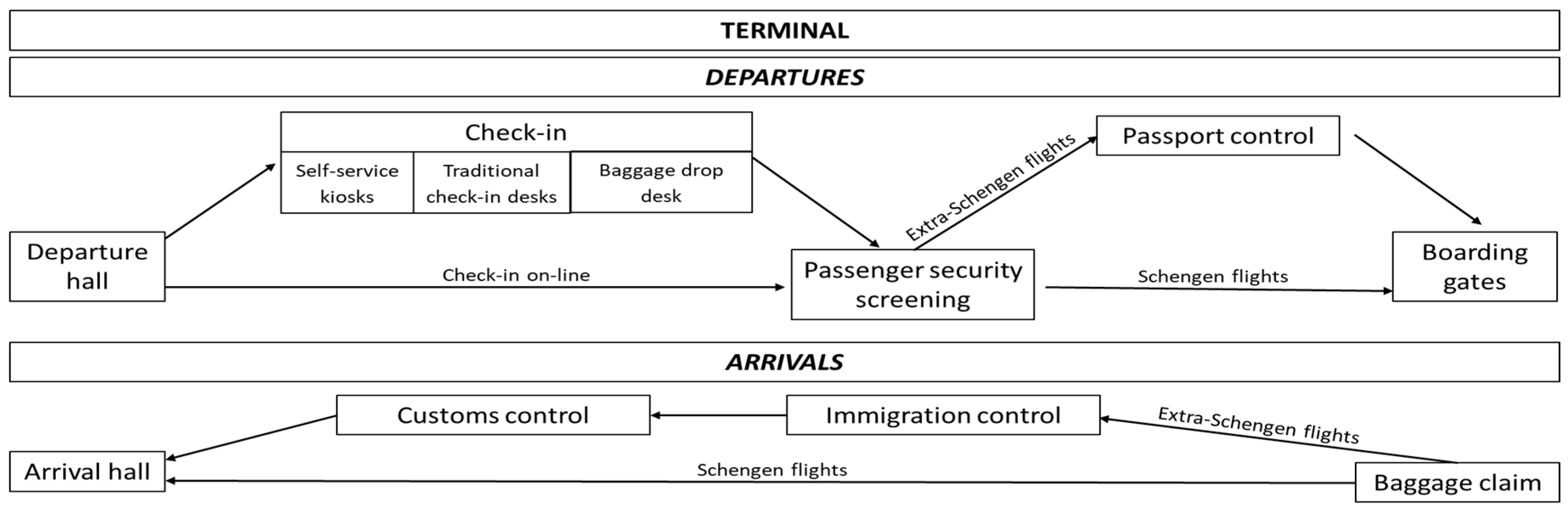
Airport Landside Sustainable Capacity and Level of Service of Terminal Functional Subsystems




Abstract
1. Introduction
2. The International Air Transport Association (IATA) Reference Manuals
3. Methods
3.1. Spreadsheet n.1—Departure Hall
3.2. Spreadsheet n.2—Check-In Facilities
3.2.1. Self-Service Facilities
3.2.2. Traditional Check-In
3.2.3. Baggage Drop Facilities
3.3. Spreadsheet n.3—Passenger Security Screening
3.4. Spreadsheet n.4—Passport Control Area
3.5. Spreadsheet n.5—Boarding Gates
3.6. Spreadsheet n.6—Baggage Claim
3.7. Spreadsheet n.7—Immigration Facility
3.8. Spreadsheet n.8—Custom Process
3.9. Spreadsheet n.9—Arrivals Hall
3.10. Case Study
- arrivals and departures components are 60% and 65% of the total passenger peak, respectively;
- arrival hourly peaks for Schengen and extra-Schengen flows are 50% and 40%, respectively; and
- departing hourly peaks for Schengen and extra-Schengen flows are 55% and 40% of the overall peak, respectively.
4. Results
5. Discussion
6. Conclusions
Author Contributions
Funding
Conflicts of Interest
References
- Graham, B.; Guyer, C. Environmental sustainability, airport capacity and European air transport liberalization: Irreconcilable goals? J. Transp. Geogr. 1999, 7, 165–180. [Google Scholar] [CrossRef] [Scilit]
- Stanners, D.; Bourdeau, P. (Eds.) Europe’s Environment: The Dobris Assessment; Office for Official Publications of the European Communities, Luxembourg/European Environment Agency: Copenhagen, Denmark, 1995. [Google Scholar]
- Postorino, M.N.; Mantecchini, L.; Paganelli, F. Improving taxi-out operations at city airports to reduce CO2 emissions. Transp. Policy 2019, 80, 167–176. [Google Scholar] [CrossRef] [Scilit]
- Button, K.; Nijkamp, P. Social change and sustainable transport. J. Transp. Geogr. 1997, 5, 215–218. [Google Scholar] [CrossRef] [Scilit]
- Lopes Craveiro, G. Airport Capacity Enhancement Analysis through Fast-Time Simulations. Lisbon’s Airport Case Study. 2017. Available online: https://pdfs.semanticscholar.org/8abf/eeef9fa6dd2b7113a94bf8cd4c30a1c5e5c1.pdf (accessed on 18 August 2020).
- Di Mascio, P.; Cervelli, D.; Comoda Correra, A.; Frasacco, L.; Luciano, E.; Moretti, L.; Nichele, S. Capacity studies for airport planning. J. Airpt. Manag. 2020, 14, 307–321. [Google Scholar]
- Di Mascio, P.; Cervelli, D.; Comoda Correra, A.; Frasacco, L.; Luciano, E.; Moretti, L. Effects of Departure MANager (DMAN) and Arrival MANager (AMAN) systems on airport capacity. J. Airpt. Manag. (accepted paper).
- Leonelli, F.; Di Mascio, P.; Germinario, A.; Picarella, F.; Moretti, L.; Cassata, M.; De Rubeis, A. Laboratory and on-site tests for rapid runway repair. Appl. Sci. 2017, 7, 1192. [Google Scholar] [CrossRef] [Scilit]
- Potente, C.; Ragnoli, A.; Tamasi, G.; Vergari, R.; Di Mascio, P. Quantitative Risk Assessment of Temporary Hazards and Maintenance Worksites in the Airport Safety Areas: A case study. Transp. Res. Procedia 2018, 35, 166–175. [Google Scholar] [CrossRef] [Scilit]
- Di Mascio, P.; Moretti, L. Implementation of a pavement management system for maintenance and rehabilitation of airport surfaces. Case Stud. Constr. Mater. 2019, 11, e00251. [Google Scholar] [CrossRef] [Scilit]
- Blumstein, A. An Analytical Investigation of Airport Capacity; Report Ho. TA-1358-G-1 Internal Research; Cornell Aeronautical Laboratory Inc.: New York, NY, USA, 1960. [Google Scholar]
- ACRP. Evaluating Airfield Capacity; Report 079; Transportation Research Board: Washington, DC, USA, 2012. [Google Scholar]
- Postorino, M.N.; Mantecchini, L.; Malandri, C.; Paganelli, F. A methodological framework to evaluate the impact of disruptions on airport turnaround operations: A case study. Case Stud. Transp. Policy 2020, 8, 429–439. [Google Scholar] [CrossRef] [Scilit]
- Ignaccolo, M. A simulation model for airport capacity and delay analysis. Transp. Plan. Technol. 2003, 26, 135–170. [Google Scholar] [CrossRef] [Scilit]
- Čokorilo, O. Human Factor Modelling for Fast-Time Simulations in Aviation. Aircr. Eng. Aerosp. Technol. 2013, 85, 389–405. [Google Scholar] [CrossRef] [Scilit]
- Tee, Y.Y.; Zhong, Z.W. Modelling and simulation studies of the runway capacity of Changi Airport. Aeronaut. J. 2018, 122, 1022–1037. [Google Scholar] [CrossRef] [Scilit]
- Di Mascio, P.; Carrara, R.; Frasacco, L.; Luciano, E.; Moretti, L.; Ponziani, A. Influence of Tower Air Traffic Controller workload and airport layout on airport capacity. J. Airpt. Manag. (accepted paper).
- FAA. Simmod Manual: How Simmod Work. 2010. Available online: http://www.tc.faa.gov/acb300/how_simmod_works.pdf (accessed on 22 August 2020).
- Airtopsoft. Airtopsoft Overview. Airtopsoft.com. Available online: http://airtopsoft.com (accessed on 22 August 2020).
- EASA ECDC COVID-19 Aviation Health Safety Protocol. Available online: https://www.easa.europa.eu/document-library/general-publications/covid-19-aviation-health-safety-protocol (accessed on 22 August 2020).
- ENAC. 2020/001- Emergenza COVID-19. Linee Guida per la Ripresa del Traffico Negli Aeroporti, a Partire Dalla “Fase 2”. Available online: https://www.enac.gov.it/ (accessed on 12 July 2020).
- Jim, H.K.; Chang, Z.Y. An airport passenger terminal simulator: A planning and design tool. Simul. Pract. Theory 1998, 6, 387–396. [Google Scholar]
- IATA. International Air Transport. Association, Airport Development Reference Manual, 9th ed.; IATA: Motreal, QC, Canada, 2004. [Google Scholar]
- IATA. International Air Transport. Association, Airport Development Reference Manual, 10th ed.; IATA: Motreal, QC, Canada, 2014. [Google Scholar]
- Lee, C.K.M.; Yaqiong, Y.N.; Yaqiong, L.; Taezoon, P. Empirical Analysis of a Self-Service Check-In Implementation in Singapore Changi Airport. Int. J. Eng. Bus. Manag. 2014, 6, 6. [Google Scholar] [CrossRef] [Scilit]
- Bevilacqua, M.; Ciarapica, F. Analysis of Check-in procedure using simulation: A case study. In Proceedings of the 2010 IEEE IEEM II, Macao, China, 7–10 December 2010; pp. 1621–1625. [Google Scholar] [CrossRef] [Scilit]
- CAST Terminal Simulation—ARC Aachen. Available online: https://arc.de/cast-terminal-simulation/ (accessed on 18 September 2020).
- Airport Simulation. Available online: https://www.flexsim.com/airport-simulation/ (accessed on 18 September 2020).
- Perboli, G.; Musso, S.; Perfetti, F.; Trapani, P. Simulation of new policies for the baggage check in the security gates of the airports: The Logiscan case study. Proc. Soc. Behav. Sci. 2014, 111, 58–67. [Google Scholar] [CrossRef] [Scilit]
- Andreatta, G.; Brunetta, L.; Righi, L.; dan Jacur, G. Simulation vs. Analytical Models for The Evaluation of an Airport Landside. Comput. Sci. 2001, 67228513. Available online: http://www.aerohabitat.eu/uploads/media/25-01-2010_-_Simulation_vs_Analytical_models_-_Airport_side_Brunetta_Andreatta.pdf (accessed on 18 September 2020).
- Guizzi, G.; Murino, T.; Romano, E. A discrete event simulation to model passenger flow in the airport terminal. In Proceedings of the 11th WSEAS International Conference on Mathematical Methods and Computational Techniques in Electrical Engineering, Stevens Point, WI, USA, 28 September 2009. [Google Scholar]
- Postorino, M.N.; Mantecchini, L.; Malandri, C.; Paganelli, F. Airport Passenger Arrival Process: Estimation of Earliness Arrival Functions. Transp. Res. Proc. 2019, 37, 338–345. [Google Scholar] [CrossRef] [Scilit]
- Frey, M.; Kiermaier, F.; Kolisch, R. Optimizing Inbound Baggage Handling at Airports. Transp. Sci. 2017, 51, 1210–1225. [Google Scholar] [CrossRef] [Scilit]
- Cavada, J.P.; Cortés, C.E.; Rey, P.A. A simulation approach to modelling baggage handling systems at an international airport. Simul. Model. Pract. Theory 2017, 75, 146–164. [Google Scholar] [CrossRef] [Scilit]
- van Boekhold, J.; Faghri, A.; Li, M. Evaluating security screening checkpoints for domestic flights using a general microscopic simulation model. J. Transp. Secur. 2014, 7, 45–67. [Google Scholar] [CrossRef] [Scilit]
- Tuchen, S.; Arora, M.; Blessing, L. Airport user experience unpacked: Conceptualizing its potential in the face of COVID-19. J. Air Transp. Manag. 2020, 89, 101919. [Google Scholar] [CrossRef] [Scilit] [PubMed]
- AC-150-5360-13A-Airport-Terminal-Planning. Available online: https://www.faa.gov/airports/resources/advisory_circulars/index.cfm/go/document.current/documentNumber/150_5360-13 (accessed on 24 July 2020).
- ACRP. Volume 1. Research sponsored by the Federal Aviation Administration. In REPORT 25, Airport Passenger Terminal Planning and Design; Transportation Research Board: Washington, DC, USA, 2010. [Google Scholar]
- IATA. International Air Transport Association. 2015. Available online: IATA.org/service/consulting/documents/consapcsnlosiar (accessed on 3 January 2020).



| Level of Service | Flow | Passenger Comfort | Delays |
|---|---|---|---|
| A—Excellent | Free | Excellent | No delay |
| B—High | Stable | High | Very few |
| C—Good | Stable | Good | Acceptable |
| D—Adequate | Unstable | Adequate | Acceptable for short periods |
| E—Inadequate | Unstable | Inadequate | Unacceptable |
| F—Unacceptable | Cross-flows, system breakdowns | Unacceptable | Unacceptable |
| LoS Parameters | SPACE | |||
|---|---|---|---|---|
| Over Design Excessive or Empty Space | Optimum Sufficient Space to Accommodate Necessary Function in a Comfortable Environment | Sub-Optimum Crowded and Uncomfortable | ||
| MAXIMUM WAITING TIME | Over design Over provision of resources | over design | optimum | sub-optimum |
| Optimum Acceptable processing and waiting time | optimum | optimum | sub-optimum | |
| Sub-optimum Unacceptable processing and waiting time | sub-optimum | sub-optimum | under-provided Reconfigure | |
| LoS Guidelines | Space (m2/pax) | Maximum Waiting Time Economy Class (Minutes) | Maximum Waiting Time Business/First Class/Fast Track (Minutes) | Other Guidelines and Remarks | ||||||||||
|---|---|---|---|---|---|---|---|---|---|---|---|---|---|---|
| Over Design | Optimum | Sub Optimum | Over Design | Optimum | Sub Optimum | Over Design | Optimum | Sub Optimum | Over Design | Optimum | Sub Optimum | |||
| Public departure hall | >2.3 | 2.0–2.3 | <2.0 | n/a | n/a | Optimum % of seated occupants: 15–20 | ||||||||
| Check-in | Self-service kiosks | >1.8 | 1.3–1.8 | <1.3 | <1 | 1–2 | >2 | <1 | 1–2 | >2 | ||||
| Traditional check-in desks | >1.8 | 1.3–1.8 | <1.3 | <10 | 10–20 | >20 | Business class | |||||||
| <3 | 3–5 | >5 | ||||||||||||
| First class | ||||||||||||||
| <1 | 1–3 | >3 | ||||||||||||
| Bag drop desks | >1.8 | 1.3–1.8 | <1.3 | <1 | 1–5 | >5 | <1 | 1–3 | >3 | |||||
| Security control | >1.2 | 1.0–1.2 | <1.2 | <5 | 5–10 | >10 | <1 | 1–3 | >3 | queue width 1.2 m | ||||
| Passport control | >1.2 | 1.0–1.2 | <1.2 | <5 | 5–10 | >10 | <1 | 1–3 | >3 | queue width 1.2 m | ||||
| Gate holdroom | Seating | >1.7 | 1.5–1.7 | <1.5 | n/a | n/a | Optimum % of seated occupants: 50–70 | |||||||
| Standing | >1.2 | 1.0–1.2 | <1.0 | |||||||||||
| Immigration control | >1.2 | 1.0–1.2 | <1.2 | <5 | 5–10 | >10 | <1 | 1–5 | >5 | queue width 1.2 m | ||||
| Baggage reclaim | Narrow body aircraft | >1.7 | 1.5–1.7 | <1.5 | 0 | 0/15 * | >15 | 0 | 0/15 * | >15 | * The first value relates to “first passenger to first bag”. The second value relates to “last bag on belt” | |||
| Wide body aircraft | >1.7 | 1.5–1.7 | <1.5 | 0 | 0/25 * | >25 | ||||||||
| Custom Control | >1.8 | 1.3–1.8 | <1.3 | <1 | 1–5 | >5 | <1 | 1–5 | >5 | |||||
| Public arrival hall | >2.3 | 2.0–2.3 | <2.0 | n/a | n/a | Optimum % of seated occupants: 15–20 | ||||||||
| Fleet Mix | Code Letter | Wing Span (m) | Clearance (m) | Seatings | |
|---|---|---|---|---|---|
| Side 1 | A318 | C | 34 | 4.5 | 132 |
| A320 | D | 35.8 | 7.5 | 180 | |
| B737/300 | C | 33.4 | 4.5 | 149 | |
| B767/300 | D | 47.6 | 7.5 | 259 | |
| Side 2 | B757/200 | D | 38.1 | 7.5 | 295 |
| B767/200 | D | 47.6 | 7.5 | 290 | |
| A310 | D | 28.47 | 4.5 | 230 | |
| A340/200 | E | 60.3 | 7.5 | 300 |
| Input Values | Equation | Output Values | ||
|---|---|---|---|---|
| Departing peak hour passenger (pax/h) | DPHP = 5200 | (1) | People in the departure hall | PD = 1733 |
| Average residence time for passenger (min) | TP = 5 | |||
| Average residence time for passenger (min) | TV = 16 | |||
| Number of visitors for passenger | VRD = 1 | |||
| Seat ratio (in %) | SR = 20% | (2) | Departure hall required area (m2) | A1 = 2461 |
| Space per seating person (m2) | SPS = 2.3 | |||
| Space per standing person (m2) | SPST = 1.2 | |||
| Input Values | Equation | Output Values | ||
|---|---|---|---|---|
| Departing peak hour passenger (pax/h) | DPHP = 5200 | (3) and (4) | Total number of self-service kiosks | SS = 32 |
| Peak 30-min factor (% DPHP) | PK2_1 = 82% | |||
| Ratio of Passengers Using Self-Service | SSR = 10% | |||
| Process time for passenger at self-service (sec) | PT_SS = 120 | Maximum number of passengers waiting in queue | QMAX2_1 = 52 | |
| Maximum queuing time (min) (Table 3) | MQT2_1 = 3 | |||
| Correction factors | Cf = 1.2 Qf = 0.121 | |||
| Area occupied by a single self-service kiosk (m2) | SSa = 0.36 | (5) | Area required for the self-service kiosks (m2) | A2_1 = 152 |
| Adjustment area for a single self-service kiosk | AA = 300% | |||
| Space for person (m2/pax) (Table 3) | SP = 1.5 | |||
| Circulation area factor (%) | CAF = 35% | |||
| Input Values | Equation | Output Values | ||
|---|---|---|---|---|
| Departing peak hour passenger (pax/h) | DPHP = 5200 | (6)–(13) | Approximate number of service desks for economy/business/first class passengers | CDY = 52 CDJ = 10 CDf = 7 |
| Peak 30-min factor (% of DPHP) | PK2_2 = 50% | |||
| Proportion of business/first class passengers (% of DPHP) | PJ = 10% Pf = 5% | |||
| Ratio of passengers using traditional check-in facilities | CR = 50% | |||
| Process time for passenger at service desks for economy/business/first class passengers (sec) | PT_CDY = 140 PT_CDJ = 150 PT_CDf = 150 | total number of service desks | CD = 70 | |
| Maximum queuing time for economy/business/first class passengers (min) | MQT2_2Y = 20 MQT2_2J = 5 MQT2_2f = 3 | Maximum number of passengers waiting in queue at desks | QMAX2_2 = 493 | |
| Depth of the check-in process area (m) | CDd = 6,5 | (14) | Area required for the service desks facility (m2) | A2_2 = 1601 |
| Width of one service desk (m) | CDw = 2 | |||
| Space for person (m2/pax) | SP = 1.4 | |||
| Input Values | Equation | Output Values | ||
|---|---|---|---|---|
| Departing peak hour passenger (pax/h) | DPHP = 5200 | (15)–(19) | Approximate number of baggage drop positions for economy/business/first class passenger | BDY = 21 BDJ = 4 |
| Peak 30-min factor (% of DPHP) | PK2_3 = 60% | |||
| Proportion of business/first class passengers (% of DPHP) | PJ = 15% Pf = 0% | |||
| Ratio of passengers using traditional check-in and by-passing the bag drop facilities (in %) | BPR = 85% | |||
| Process time for passenger at baggage drop for economy/business/first class (sec) | PT_BDY = 110 PT_BDJ = 100 | total number of baggage drop positions | BD = 30 | |
| Maximum queuing time for economy/business/first class passengers (min) | MQTY = 5 MQTJ = 3 | |||
| Maximum number of passengers waiting in queue at baggage drop | QMAX2_3Y = 82 | |||
| Depth of the baggage drop process area (m), including a courtesy distance between desks and queue | BDd = 6.5 | (21) | Area required for the baggage drop facility (m2) | A2_3 = 538 |
| Width of one baggage drop position (m), obtained from typical dimensions | BDw = 2 | |||
| Space per person (m2/pax) (Table 3) | SP = 1.3 | |||
| Input Values | Equation | Output Values | ||
|---|---|---|---|---|
| Number of service desks open | CD = 70 | (22) | Throughput 30-min demand arriving at the passenger security screening | PK330MIN = 2574 |
| Process time for service at desks (sec) | PTCD = 140 | |||
| Number of baggage drop positions open | BD = 30 | |||
| Process time at baggage drop (in seconds) | PTBD = 110 | |||
| Departing peak hour passenger (pax/h) | DPHP = 5200 | |||
| Peak 30-min factor (in % di DPHP) | PK4 = 65% | |||
| Ratio of passengers using traditional check-in facilities | CR = 50% | |||
| Ratio of passengers using baggage drop | BR = 15% | |||
| Process time for passenger at security screening (sec) | PTSEC = 22 | (23) | Total number of security lanes | SEC = 26 |
| Maximum queuing time (min) | MQT3 = 10 | |||
| Correction factor | Cf = 1.1 | |||
| Correction factor | Qf = 1.1 | (24) and (25) | Maximum number of passengers waiting in queue | QMAX3 = 744 |
| Depth of one security lane (m) | SECd = 14 | |||
| Width of one security lane (m) | SECW = 3 | |||
| Space for person (m2/pax) (Table 3) | SP = 1 | Area required for the security screening facility (m2) | A3 = 2109 | |
| Egress width behind lanes (in m) | W3 = 3.5 | |||
| Input Values | Equation | Output Values | ||
|---|---|---|---|---|
| Number of processing desks open | CD = 70 | (26) | Throughput 30-min demand from initial processing | PK430MIN = 1865 |
| Process time for service at desks (seconds) | PTCD = 140 | |||
| Number of baggage drop positions open | BD = 30 | |||
| Process time at baggage drop (seconds) | PTBD = 110 | |||
| Departing peak hour extra-Schengen passenger (pax/h) | DPHPX = 2080 | |||
| Peak 30-min factor (in % di DPHP_X) | PK4 = 65% | |||
| Ratio of passengers using traditional check-in facilities | CR = 50% | |||
| Ratio of passengers using baggage drop facilities | BR = 15% | |||
| Process time for passenger at departure passport control (in seconds) | PTPD = 60 | (27) and (28) | Total number of departure control desks | PD = 50 |
| Maximum queuing time (min) (Table 3) | MQT4 = 10 | Maximum number of passengers waiting in queue | QMAX4 = 539 | |
| Correction factors | Cf = 1.1 Qf = 0.289 | |||
| Depth of one departure control desk (m) | PDd = 3 | (29) | Area required for the departure passport control facility (m2) | A4 = 1254 |
| Width of one departure control desk (m) | PDW = 2.2 | |||
| Space for Person (m2/pax) (Table 3) | SP = 1 | |||
| Corridor width behind desks (m) | W = 3.5 | |||
| Input Values | Equation | Output Values | ||
|---|---|---|---|---|
| Departing peak hour Schengen passenger (pax/h) | DPHPS = 2860 | (30) | Number of gates Schengen | GS = 3 |
| Time turnaround Schengen (min) | TturnS = 50 | |||
| Departing peak hour extra-Schengen passenger (pax/h) | DPHPX = 2080 | Number of gates extra Schengen | GX = 5 | |
| Time turnaround extra-Schengen (min) | TturnX = 90 | |||
| Aircraft load factor | LFX = 70% LFS = 85% | (26) and (27) | Area for seating passengers area for standing passengers | AS_S = 2.686 AS_X = 3.686 Ast_S = 930, Ast_X = 1.276 |
| Seat ratio (Table 3) | SR = 70% | |||
| Seat ratio adjustment factor | SRf = 10% | |||
| Open Gate Lounge Factor | Gf = 90% | |||
| Space for seated/standing person (m2/pax) (Table 3) | SS = 1.5 SST = 1.0 | |||
| Additional space ratio to account for boarding operation, % of global gate area | X = 15% | (33) | Total Area | A5S = 4.159 A5X = 5.707 |
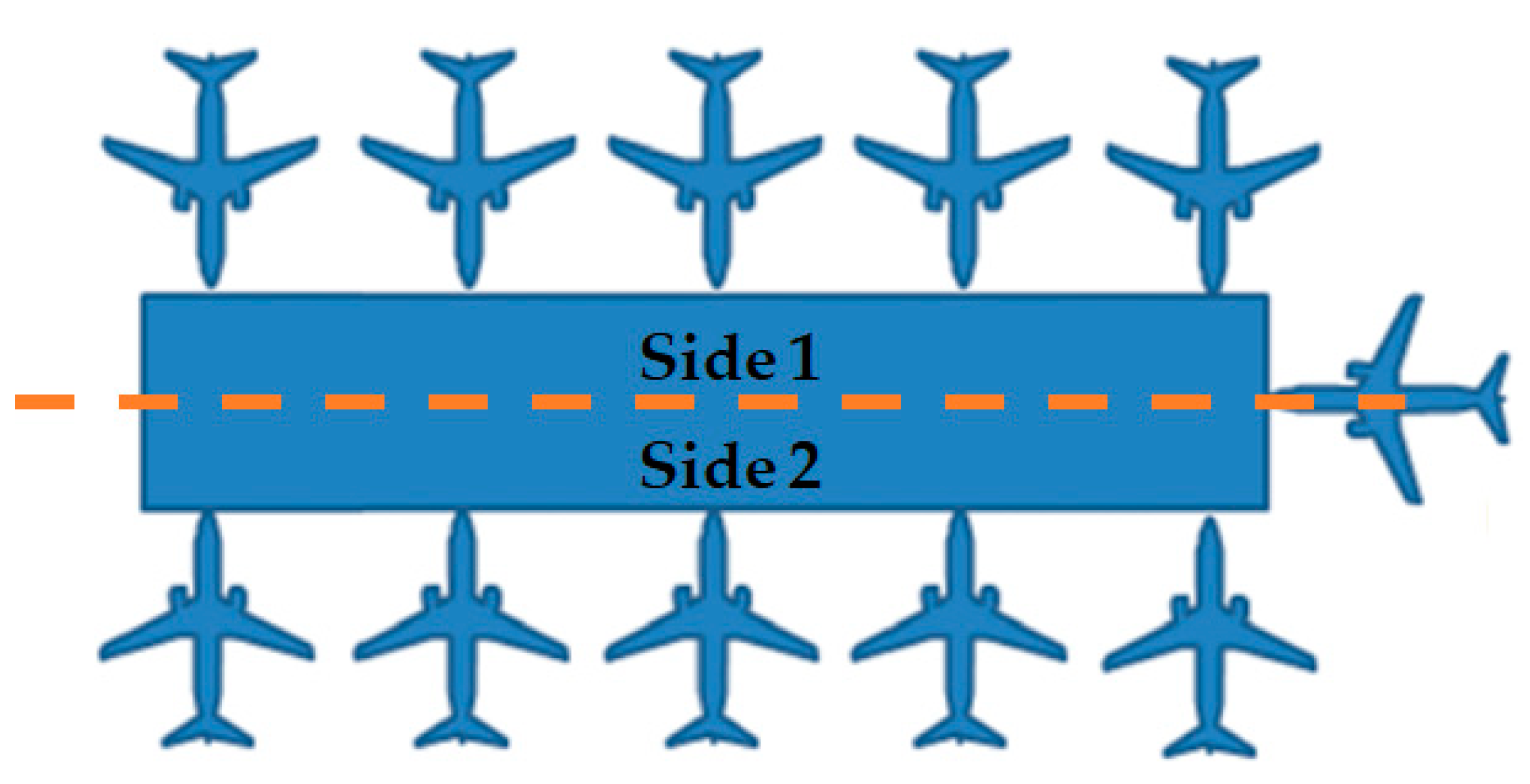
| Pier length (m) | PL = 170 | (34) | Gate lounge depth of side 1 and 2 of the pier (in m) | GLd1 = 25.00 GLd2 = 34.00 |
| Width of the circulation corridor including moving devices (m) | W = 10 | (35) | Pier Width (m) | Pw = 69 |
| Input Values | Equation | Output Values | ||
|---|---|---|---|---|
| Number of passengers in the design aircraft (Narrow Body/Wide Body—Schengen) | PAXNB-S = 180 PAXWB-S = 290 | (36) | Carousel frontage for passenger line up (m) | CLWB = 107 CLNB = 75 |
| Number of passengers in the design aircraft (Narrow Body/Wide Body-extra-Schengen) | PAXNB-X = 230 PAXWB-X = 300 | |||
| Claim frontage for passenger (m) (Table 3) | SP6 = 0.85 | |||
| Ratio of passengers collecting bags (in %) | PRX = 90% PRS = 50% | |||
| Recirculation Rate (in %) | RRX = 25% RRS = 40% | |||
| Terminating Peak Hour Schengen/extra-Schengen Passengers (pax/h) | APHP_X = 1920 APHP_S = 2400 | (37) | Number of Narrow Body/Wide Body baggage claim units Schengen/extra-Schengen | BC(WB,NB)S = 3 BC(WB,NB)X = 3 |
| Proportion of passengers arriving by Narrow Body/Wide Body aircraft, Schengen (in %) | PNB-S=70% PWB-S=30% | |||
| Proportion of passengers arriving by Narrow Body/Wide Body aircraft, extra-Schengen (in %) | PNB-X = 30% PWB-X = 70% | |||
| Average claim device occupancy time for Narrow Body/Wide Body (minutes) (Table 3) | OTNB = 10 OTWB = 20 | |||
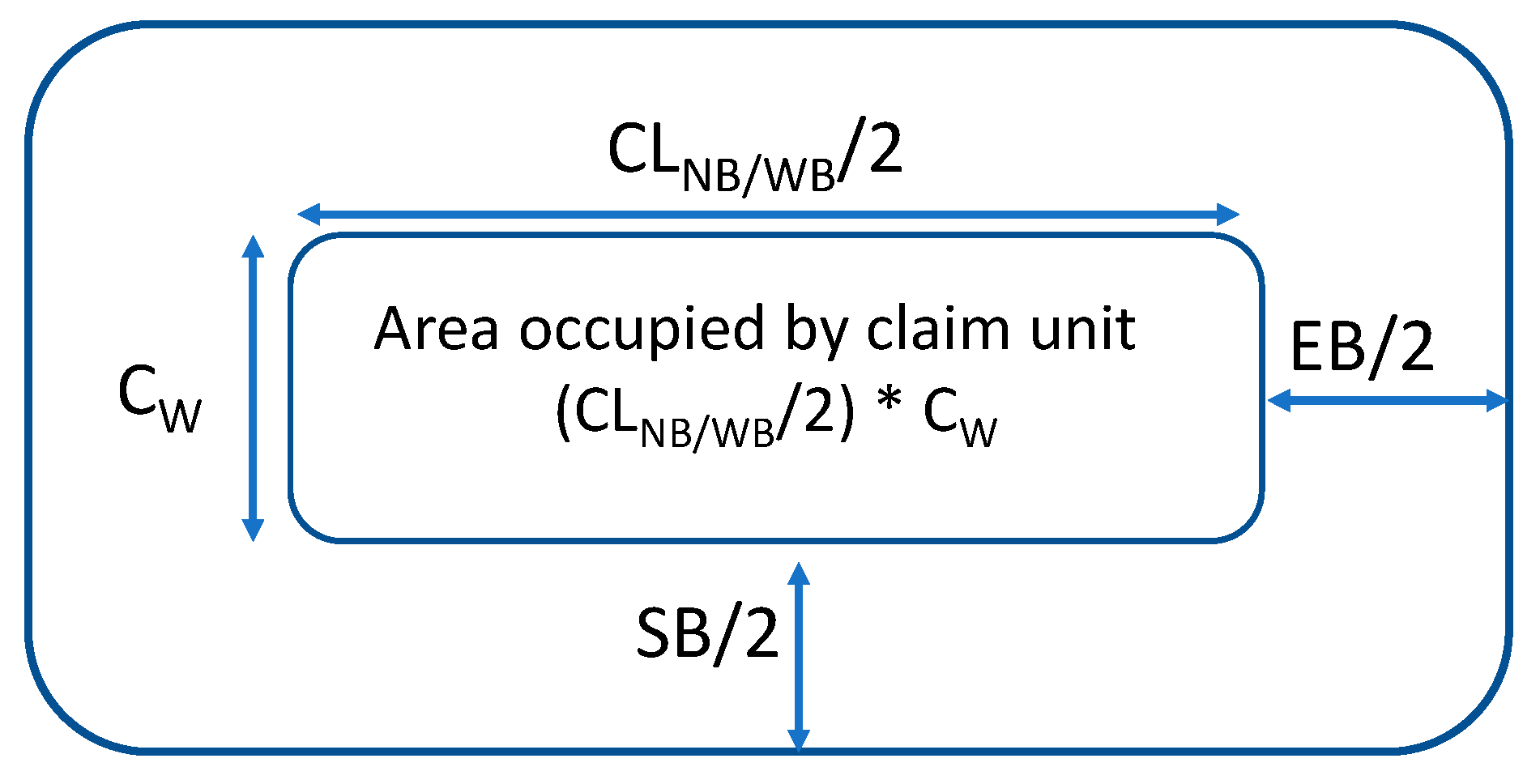
| Carousel width (m) | Cw = 6 | (38) and (39) | Carousel area for narrow body/wide body aircraft (m2) | ACWB = 806.7 ACNB = 630.2 |
| Side buffer to allow passenger movement around the reclaim belt for both sides | SB = 5 | |||
| End buffer to allow passenger movement around the reclaim belt for both sides (m) | EB = 10 | Baggage claim hall area (m2) | A6S = 938 A6X = 1204 | |
| Input Values | Equation | Output Values | ||
|---|---|---|---|---|
| Terminating peak hour extra-Schengen passengers (pax/h) | APHP_X = 1920 | (40) and (41) | Approximate number of arrival passport control desks | PCi = 34 |
| Peak 30-min factor (in % of APHPX) | PK7 = 70% | Total number of arrival passport control desks | PC = 36 | |
| Process time for passenger at arrival passport control (sec) | PT = 60 | |||
| Maximum queuing time (min) (Table 3) | MQT7 = 10 | Maximum number of passengers waiting in queue | QMAX7 = 389 | |
| Correction factor | Cf = 1.1 | |||
| Depth of one arrival passport control booth (m) | PCd = 3 | (38) | Area required for the arrival passport control facility (in m2) | A7 = 904 |
| Width of one arrival passport control booth (m) | PCw = 2.2 | |||
| Space for person (m2/pax) (Table 3) | SP = 1 | |||
| Corridor width behind desks (m) | W7 = 3.5 | |||
| Input Values | Equation | Output Values | ||
|---|---|---|---|---|
| Terminating peak hour extra-Schengen passengers (pax/h) | APHP_X = 1920 | (43) and (44) | Number of primary inspection booths (single units) | PI = 7 |
| Peak 30-min factor (% of APHP_X) | PK8 = 60% | |||
| Process (throughput) Time for Passenger at Primary Inspection Booth (seconds) | PTPI = 10 | Maximum number of passengers waiting in queue | QMAXPI = 211 | |
| Maximum queuing time at primary inspection booth (min) (Table 3) | MQTPI = 5 | |||
| Correction factor | Cf = 1.15 Qf = 0.121 | |||
| Depth of one primary inspection booth lane (m) | Pld = 3 | (45) | Area required for the primary inspection facility (m2) | API = 367 |
| Width of one primary inspection booth lane (m) | Plw = 2.2 | |||
| Process (throughput) Time for Passenger at X-ray Facility (seconds) | PTXR = 20 | (46) and (47) | Number of X-ray units | XR = 2 |
| Maximum queuing time at X-ray facility (minutes) (Table 3) | MQTXR = 3 | Maximum number of passengers waiting in queue | QMAXXR = 14 | |
| Ratio of passengers to be inspected (%) | IR = 10% | |||
| Depth of one X-ray lane (m) | XRd = 4 | (48) | Area required for the X-ray facility (m2) | A8 = 60 |
| Width of One X-ray Lane (m). Includes X-ray Equipment, Circulation and Operator Position | XRw = 3 | |||
| Space for person (m2/pax) (Table 3) | SP = 1.3 | |||
| Corridor Width Before/Behind Desks (m) | W8 = 3 | |||
| Input Values | Equation | Output Values | ||
|---|---|---|---|---|
| Terminating peak hour passengers (pax/h) | APHP = 4.800 | (46) | Passengers in arrivals hall | P = 1600 |
| Dwell time for passengers/visitors (min) (Table 3) | TP = 5 TV = 15 | |||
| Ratio of visitors for arrivals passenger | VRA = 1 | |||
| Seat ratio (in %) | SR = 20% | (45) | Arrivals hall area (m2) | A9 = 2272 |
| Space for seated/standing person (m2/pax) (Table 3) | SPS = 2.3 SPST = 1.2 | |||
| Spreadsheet | Subsystem | Need | Availability | LoS | |
|---|---|---|---|---|---|
| 1 | Departure hall | space | 2461 m2 | 14,120 m2 | Over design |
| 2 | Check-in | space | 2291 m2 | 5410 m2 | Over design |
| desks | 102 | 221 | |||
| 3 | Passenger security screening | space | 2109 m2 | 400 | Under provided |
| security lines | 26 | 14 | |||
| 4 | Passport control | space | 1254 m2 | 90 m2 | Under provided |
| desks | 50 | 8 | |||
| 5 | Schengen boarding gates | space | 4159 m2 | 9045 m2 | Over design |
| gates | 3 | 34 | |||
| Extra-Schengen boarding gates | space | 5707 m2 | 10,305 m2 | Over design | |
| gates | 5 | 30 | |||
| 6 | Schengen baggage claim | space | 938 m2 | 2885 m2 | Over design |
| belts | 3 | 5 | |||
| Extra-Schengen baggage claim | space | 1204 m2 | 2885 m2 | Over design | |
| belts | 3 | 5 | |||
| 7 | Immigration facility | space | 904 m2 | 610 m2 | Under provided |
| positions | 36 | 10 | |||
| 8 | Primary inspection facility | space | 367 m2 | 390 m2 | Optimum |
| positions | 7 | 7 | |||
| X-ray facility | space | 60 m2 | 65 m2 | Optimum | |
| positions | 2 | 2 | |||
| 9 | Arrivals hall | space | 2272 m2 | 11,155 m2 | Over design |
Publisher’s Note: MDPI stays neutral with regard to jurisdictional claims in published maps and institutional affiliations. |
© 2020 by the authors. Licensee MDPI, Basel, Switzerland. This article is an open access article distributed under the terms and conditions of the Creative Commons Attribution (CC BY) license (http://creativecommons.org/licenses/by/4.0/).
Share and Cite
Di Mascio, P.; Moretti, L.; Piacitelli, M. Airport Landside Sustainable Capacity and Level of Service of Terminal Functional Subsystems. Sustainability 2020, 12, 8784. https://doi.org/10.3390/su12218784
Di Mascio P, Moretti L, Piacitelli M. Airport Landside Sustainable Capacity and Level of Service of Terminal Functional Subsystems. Sustainability. 2020; 12(21):8784. https://doi.org/10.3390/su12218784
Chicago/Turabian StyleDi Mascio, Paola, Laura Moretti, and Massimiliano Piacitelli. 2020. "Airport Landside Sustainable Capacity and Level of Service of Terminal Functional Subsystems" Sustainability 12, no. 21: 8784. https://doi.org/10.3390/su12218784
APA StyleDi Mascio, P., Moretti, L., & Piacitelli, M. (2020). Airport Landside Sustainable Capacity and Level of Service of Terminal Functional Subsystems. Sustainability, 12(21), 8784. https://doi.org/10.3390/su12218784