Abstract
The present study utilized the Technology Acceptance Model (TAM 3) to explore the learning attitudes of college students with respect to English e-tutoring websites, an approach that has rarely been employed from the perspective of information technology and the global e-digital market. More specifically, the study used college students’ assessments of self-paced business English e-learning websites to investigate the adoption of those sites. Using simple linear regression analysis, the research explored the question of whether engagement in e-learning was able to enhance the students’ willingness to learn. The results of the analysis indicated that the majority of English e-tutoring users felt that online sources for learning English offer greater convenience and are more effective than noninternet resources. This finding suggests, in turn, that the web designers of business English e-learning websites could maintain and enhance the loyalty of site users by taking care to ensure the quality of the sites’ content. In particular, the knowledge management functions and interface requirements of student users should be adequately addressed by web designers so that the students can operate the websites more easily in the course of the learning process.
1. Introduction
1.1. Background
English has become the common language of the world due to trade and politics, which have also promoted the popularity of English usage. A British Council report estimated that, in 2015, approximately 30 million people around the world were engaged in active efforts to learn spoken English, with the majority of new growth markets for English teaching efforts being found in the developing world. English is critical to the school curricula in many countries, and the demand for English instruction in China and India, for example, is enormous. Moreover, English is an official and/or first language in numerous countries. Relatedly, at least 25% of the world’s population speaks English, and knowledge of English is often an effective means of enhancing one’s prospects for a good-paying job [1]. The broad usage of English enables a true single market regarding knowledge and ideas [2].
Because Internet technology has become increasingly developed in the 21st century, the Internet plays an essential role in our lives. Using the Internet to learn languages is more common than ever before. As Internet technology advances, learning English is not limited to classrooms, and it is more popular to use the Internet to learn English. Through use of the Internet, people can learn English from any location. Instructors can teach English through the Internet instead of traditional teaching methods. E-teaching not only has many advantages and benefits for teaching and learning environments but also provides new directions and new modes of thinking.
A large number of multinational companies utilize English as their main language for internal and external communications, and there are, relatedly, several English proficiency tests that are well-known worldwide, including the TOEIC (The Test of English for International Communication), TOEFL (The Test of English as a Foreign Language), GEPT (General English Proficiency Test), and IELTS (The International English Language Testing System). Of those tests, the TOEIC is focused primarily on terms used in business and related contexts, and as such, successful completion of the TOEIC is commonly used by businesses as a requirement for employment. The TOEIC itself can be viewed as various types of test, including a proficiency test, placement test, or achievement test, depending on the reason for which it is being taken.
It is perhaps due to the importance of the aforementioned tests that English programs in China [3] and other Asian nations [4] still commonly utilize a test-oriented emphasis in their teaching and learning activities.
1.2. Computer-Based Tests
Certain computer-based tests (also known as “computer-assisted” or “web-based”) are small-scale “home-grown” tests that are available on websites.
Students receive prompts in the form of spoken or written stimuli from the computerized test and are required to type their responses. Nearly all computer-based test items have fixed, closed-ended responses; however, tests such as the Test of English as a Foreign Language (TOEFL) offer a written essay section that must be scored by humans. An effective development of successful English e-tutoring websites depends on students’ individual acceptance; however, they have recently gained momentum. In a computer-adaptive test (CAT), each test-taker receives a set questions that meet the test specifications and that are generally appropriate for his or her performance level. Relatedly, in the design of learning systems for English e-learners, it is now generally regarded as important that the technology acceptance model be utilized as the fundamental theory in guiding design efforts [5,6].
With or without CAT technology, computer-based tests provide the following benefits:
- Can be conducted in classrooms
- Can be self-directed
- Some personalization with CATs
- Large-scale standardized tests that can easily be administered to thousands of test-takers at many different locations that are then scored electronically for the rapid reporting of results
Computer technology can be a large step towards examining communicative language. By using superior technology, instructors will be able to enhance authenticity, to increase interactive exchange, and to promote autonomy [7].
The demands of English learners outside of the U.S. with respect to English language teaching (ELT) and e-learning for English language learners (ELL) are significantly different from those of learners in the U.S. As such, the e-digital products, including tutoring and instructional e-programs, for these different categories of English learners also differ substantially. Relatedly, one report indicated, as shown in Table 1, that the global market for global English language learning (ELL) was among the largest and fastest-growing in the entire education sector from 2012–2017.
Table 1.
English E-learning market.
1.3. Research Motivations
In recent decades, English has, in effect, become the common language around the globe. Paper-based learning was the focus of numerous previous studies of language learning, but because it lacks an interactive aspect, paper-based learning seems to decrease the willingness of students to learn. In contrast, students’ desire to learn appears to be increased when they engage in learning through many of the interactive websites used for online language learning today. The key contribution of the present study was its use of the technology acceptance model (TAM 3) to achieve the integration of e-learning into language teaching and, in turn, its use of the theory to investigate e-tutoring TOEIC courses with respect to the learning behaviors of the students using them. Drawing upon past research, this study proposed two objectives, which included exploring (1) whether e-tutoring TOEIC affected students and (2) whether self-paced e-tutoring increased students’ willingness to learn business English.
2. Literature Review
In a previous study investigating teaching and learning, Tan (2013b) stated that the two activities are like two sides of the same coin [8]. Meanwhile, the findings of various studies exploring the degree to which university students accept e-learning suggests the value of using various models of learning, including, for example, the recently developed e-learning model acceptance measure (Elam). In fact, the use of the ElAM for the purposes of collecting data on how students react to the implementation of a given lesson via e-learning or e-testing is now regarded as critical by some researchers. Along these lines, investigations and models that provide a clear picture of the degree to which students accept or do not accept e-learning would enhance our knowledge of the behaviors of students when using computers. This knowledge, in turn, would be of value to teachers as they make decisions pertaining to instructional design, teaching strategies, and resource allocation [9]. Furthermore, such knowledge can affect the interests of educational stakeholders in a variety of important ways [10]. Relatedly, a study by Teo provided support for the factorial structure of the ElAM, in addition to indicating that utilization of the ElAM could be of value for educational researchers.
Assessment is an integral part of the teaching learning cycle.
In interactive, communication courses, assessment is nearly constant.
Testing, which is a subset of the assessment, can ensure data authenticity, motivation, and feedback to the learner. Testing is an important part of the success of a course and partners in the learning process. Remember these basic principles [7]:
- Regular assessment, formal and informal, can be used as milestones to increase students’ learning motivation.
- Appropriate assessment helps to strengthen and retain information.
- Assessing areas of strength can confirm and identify where further work is needed.
- Assessment can provide a closed cycle within the course modules.
- Assessments can promote student autonomy by encouraging their student progress self-evaluation.
- Assessments may cause learners to set targets for themselves.
- Assessments can help in the evaluation of teaching.
2.1. The Development of English Learning
From the globalization perspective, the dominant position of English is beyond doubt. The British council has predicted that by 2015, approximately 3 billion people will be able to speak English worldwide. That is approximately half of the current population of the world.
English is a part of school curriculums all over the world. In many places, English is no longer a foreign language; soon, half of the world’s population will speak English as “the language of globalization”.
David Crystal (1997) notes that “English is the language of globalization” [11]. English has become the language of the world hegemony. Knowledge, information, business, entertainment, tourism, and the Internet are increasingly developed using English; with the support of the national power of the United States, English is becoming a need for everyone. If business people do not understand English, their business will inevitably stumble. Regarding outstanding scholarship, if it is not published in English, its status will be lower. One can also hear political figures around the world speaking English on television. Regardless of where one travels, one finds English signs and advertisements. English has become increasingly important. This does not mean that the English language is of higher quality; the focus on English is caused by “nonlinguistic factors”.
2.2. E-Learning
Over the last decade, online learning or e-learning has become an important part of the education agenda around the world. E-learning is becoming an important factor in higher education [12]. Advances in computing and information technology have changed the modes of learning. The development of information technology has influenced the learning flow and reduced the lifecycle of learning material as well as learning activities [13]. Information technology is also dramatically affecting the means by which people teach and learn. IT helps people meet, talk, and work together outside of traditional meeting and office spaces. E-learning is the product of digital technology and turns traditional courses into virtual courses. The concept of an online course is the use of virtual environments to replace a part of physical classrooms [14]. E-learning has enabled universities to expand their current geographical reach, to capitalize on new prospective students and to establish themselves as global educational providers [15]. However, the dual perspectives of language learning and information technology system design have rarely been utilized in prior studies aimed at designing English evaluation and teaching device systems [16].
E-learning represents a new generation of electronic teaching methods. By connecting to the network, teachers and learners can experience interactive learning on the Internet. In addition to being a new instruction media, e-learning is a new tool and a completely new learning environment; it also overcomes the limitations of traditional teaching environments [8,9].
- Initiate and sustain informal conversations (Twitter, Facebook, Line, Google, and Wechat)
- Rapidly read and absorb written documents, such as: financial reports, statistics, and articles
- Write letters and faxes in a suitable style
- Take notes and write reports
- Use phrases and terminology that are associated with specific fields of activity
2.3. TOEIC (Test of English for International Communication)
The Global Self-Paced eLearning Market from 2013–2018
In 2014, Sam S. Adkins authored an Ambient Insight Premium Report titled “The 2013–2018 Worldwide Digital English Language Learning Market” which stated that “The top buying countries throughout the forecast period are China, the US, South Korea, Japan, and Brazil. In 2013, China barely edged out the United States to become the top digital English language learning buying country in the world”. Relatedly, it would be unwise to ignore the fact that several of the largest buyers in the global self-paced e-learning market are located in Asia. Table 2 lists the top fifteen purchasers in the global market for 2013–2018:
Table 2.
Top fifteen digital English language learning buying countries for 2013 and 2018: a global digital English language learning market [17].
2.3.1. Test Type and Comparison Sheet of English Licensing Tests
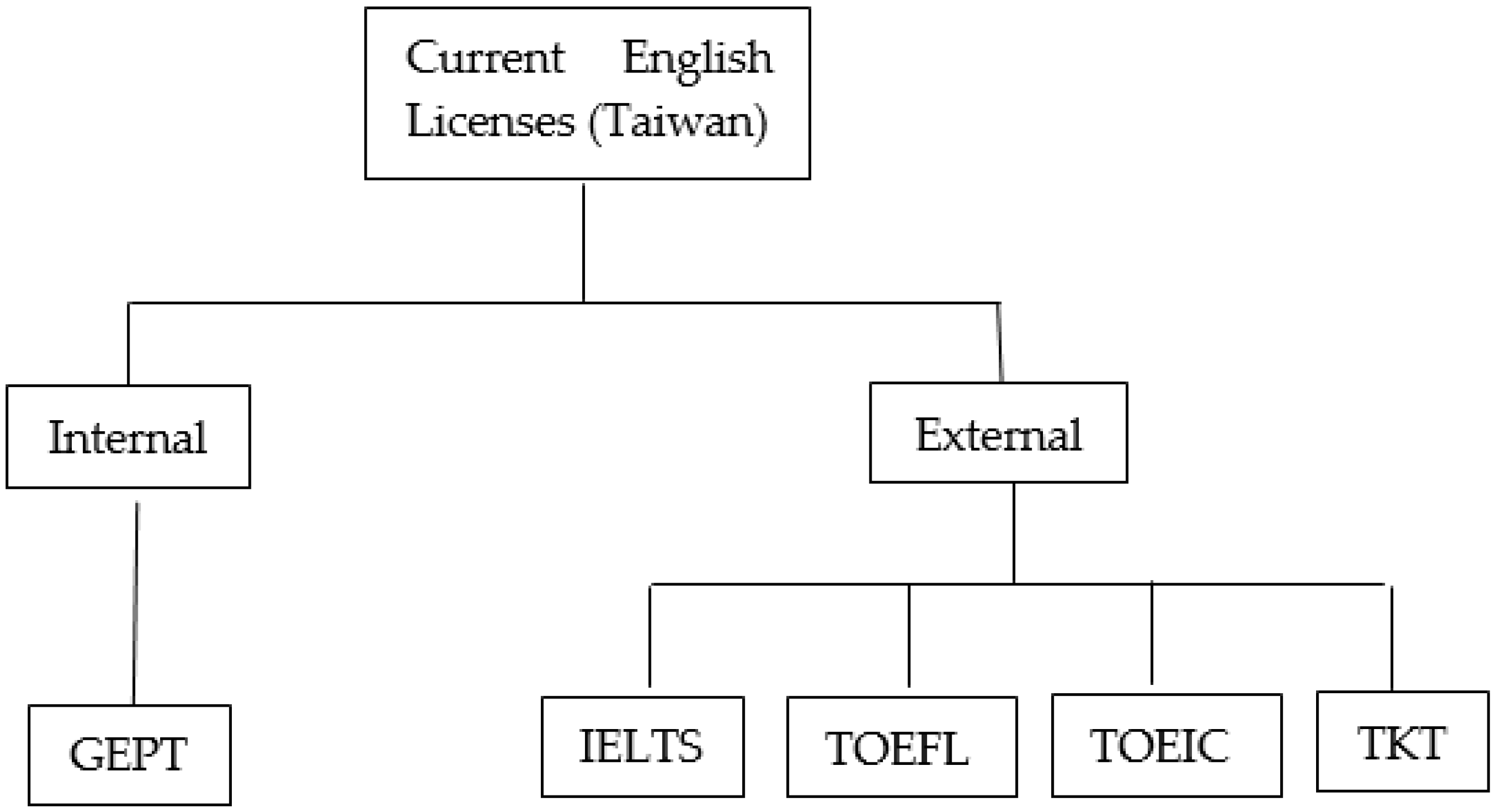
Figure 1 is the test type and comparison sheet of English licensing tests.
Figure 1.
Various tests in Taiwan. Resource: ESP Test Licensing Policies for Junior College Levels in Taiwan. A case study [18].
2.3.2. Why Assessment
There are many types of assessment tasks (Table 3). Regarding assessment tasks, we must know the reasons why learners need assessments and the reasons why teachers assess learners. According to Mary Spratt, Alan Paleness, and Melanie Williams [19], the first is a diagnostic test. This type of test begins in the first class. The information from the assessment can help the teacher understand what learners know, where they need to improve, and what teachers can teach. The second is the placement test; this is a test that is administered when learners study in a language school or something similar. The school needs to assess the learners’ level and thus determine which class learners should be in. The third test is a formative assessment, also called a progress test. This is commonly used in society. The formative assessment helps teachers determine whether their teaching has been successful. In addition, the assessment also provides learners with feedback on their strengths and weaknesses. Another test is an achievement or summative test. This is a type of test in which learners receive scores or marks, and it always occurs after the end of the course. Teachers may know how well learners have learned after this assessment [5].
Table 3.
Comparison sheet of English licensing tests in Taiwan.
In fact, TOEFL is the most widely used commercially available standardized test of proficiency. This test is highly respected because of the thorough program of ongoing research and development conducted by ETS. TOEFL’s primary use is to establish proficiency standards for international students seeking admission to English-speaking universities.
Specifications: Listening: One-hundred items through tape management. Four types of tasks: representatives, lack of doubt, short dialogues, and short talks (approximately 45 min). Read: 100 projects. Three types of tasks: Close sentences, error recognition, and reading comprehension (75 min).
The TOEIC is widely accepted internationally among communications in workplace settings where English is required for job performance. The test is appropriate for use in educational settings where vocational or workplace English courses are being offered [7].
2.3.3. Growth of the TOEIC in Taiwan
While the TOEIC was first administered in Taiwan in 2002, its popularity at that time was limited. By 2005, however, increasing numbers of people had begun taking the TOEIC for a variety of reasons, and just over a decade later, ETS published data indicating that 393,410 people had taken the test in Taiwan in 2016 (Table 4).
Table 4.
Test of English for International Communication (TOEIC) growth in Taiwan.
According to research regarding the motives of individual junior high school and university students for taking the TOEIC, 70% of the former expressed the view that a good TOEIC score would help them in applying to better universities, while 92% of the latter expressed the view that a good TOEIC score would assist them in finding a desirable job [21].
2.4. ESP—English for Specific Purposes
ESP (English for specific purposes) is generally assumed to be of academic use. ESP is not a university study or special lesson; it is preparation for the business and working world.
English for specific purposes (ESP) is a term used to refer to situations in which people are learning English for a particular purpose, such as an occupational or business-related purpose, including situations in which a teacher provides relevant information and skills for a targeted situation or context.
2.5. Assessment
Test-driven learning is a worldwide issue. In Japan, Korea, and Taiwan, students approaching their last year of secondary school obsessively focus on passing the year-end college entrance examination, a major section of which is English [4]. Minimal focus is accorded to any topic or task that does not directly contribute to passing that one exam. In the United States, high school seniors are forced to provide nearly as much attention to their SAT scores [7].
2.5.1. Assessment Methods
Placement Test
Online Learning Tool Provides the necessary E-materials to make their learning more vivid.
Placement exams help one achieve success in learning and help one choose from the items available. By determining one’s position or placement, the assessment center provides information that will aid in determining the initial position or need for a tutor to help the student. The purpose of the test is to ensure that the student has the reading, writing, or math skills necessary to successfully achieve their educational goals (Tan, 2013b).
Of worldwide Internet users, 49% are in Asia, 11% are in Africa, 8.2% are in North America, 0.7% is in Oceania/Australia, 16.8% are in Europe, 10.4% are in Latin America, and 3.9% are in the Middle East. E-methods enable people to exchange and create increasingly more information and is an important source of knowledge building and sharing. The Internet also opens doors to new learning technologies, systems, and methods. Live online classes and live tutoring sessions are very popular in Asian communities. Chinese corporations are strong buyers of specialized forms of English courses, particularly business English. Thus, the growth in language program training is the largest technical development trend in the past few years in several Asian regions. This issue also raises new special topics regarding how we can develop a massive database for storing, sharing, and analyzing information for new learners when using digital learning tools to support their learning activities.
Source: Internet World Stats, June 2018 [22].
2.6. Theoretical Background of the TAM Model
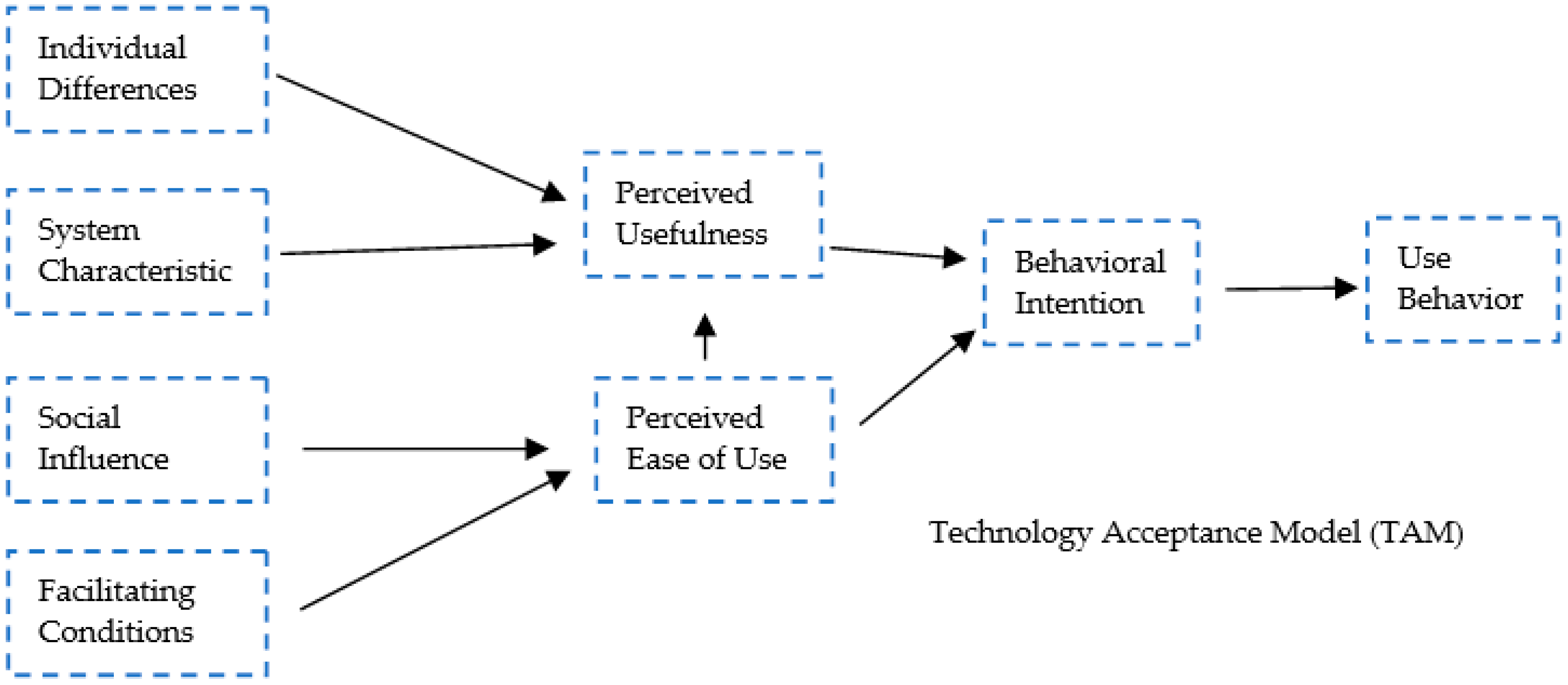
The Theory of Reasoned Action (TRA) and the Theory of Planned Behavior (TPB) provide the foundation for the Technology Acceptance Model (TAM), which was designed and introduced by Davis in 1986 and serves as a method for exploring how the beliefs, attitudes, and intentions of e-learning users relate to different e-learning methods. According to Hong et al. [23], the TAM constitutes the most simple and generic model for the study of both initial and ongoing IT (information technology) acceptance (Figure 2).
Figure 2.
Theoretical framework.
2.6.1. Determinants of Perceived Usefulness
Venkatesh and Davis (2000) proposed an extension of TAM—TAM2—by identifying and theorizing about the general determinants of perceived usefulness—that is, subjective norm, image, job relevance, output quality, result demonstrability, and perceived ease of use—and two moderators—that is, experience and voluntariness (Table 5) [24].
Table 5.
Determinants of perceived usefulness.
The first two determinants fall into the category of social influence and the remaining determinants are system characteristics as per the theoretical framework shown in Figure 2.
TAM2 posits that perceived ease of use and result demonstrability will have a positive direct influence on perceived usefulness. Job relevance and output quality will have a moderating effect on perceived usefulness such that the higher the output quality, the stronger the effect job relevance will have on perceived usefulness. Vankatesh and Davis found strong support for TAM2 in longitudinal field studies conducted at four organizations [24].
2.6.2. New Development of TAM3
We combined TAM2 [24] and the model of the determinants of perceived ease of use [28], and develop an integrated model of Venkatesh and Bala [29]. See Table 6.
Table 6.
Determinants of perceived ease of use.
TAM3 presents a complete homological network of the determinants of individuals’ IT adoption and use. We suggest three theoretical extension beyond TAM2 and the model of the determinants of perceived of use.
2.6.3. New Relationship Posited in TAM3
TAM3 posits three relationships that were not empirically tested in Venkatesh (2000) and Venkatesh and Davis (2000) [24,28]. We suggest that experience will moderate the relationship between (i) perceived usefulness; (ii) computer anxiety and perceived ease of use; and (iii) perceived ease of use and behavioral intention. In fact, the TAM 3 was formerly developed by Venkatesh and Bala (2008) [29].
2.6.4. Perceived Ease of Use to Perceived Usefulness, Moderated by Experience
We suggest that with increasing hands-on experience with a system, a user will have more information on how easy or difficult the system is to use. While perceived ease of use may not be as important in forming behavioral intention in a later period of system use [32], users will still value perceived ease of use in forming perception about usefulness (Table 7).
Table 7.
Hypotheses arising from Technology Acceptance Model 3 (TAM3).
Simple linear regression analysis results indicated correlation in each construct. Hypothesis 1 proposed that perceived usefulness positively affects the behavioral intention to use. The effect of perceived usefulness on behavioral intention to use suggested that online language learning affects learners’ behavior. The results of this study corresponded to those reported in past studies on e-learning. See Table 8.
Table 8.
Review of the studies on the technology acceptance model.
3. Research Methodology
This study uses the literature review method and the questionnaire survey method as the major research tools for the following qualitative and quantitative research.
With the advanced and dynamic growth of technologies, how rapidly consumers accept these technologies depends on a number of factors, such as availability of technology, convenience, consumers’ need, security etc. There have been a number of researchers addressing consumers’ adoption of new technologies [51,52,53,54].
Technology Acceptance Model 2 (TAM2) [24], Unified Theory of Acceptance and Use of Technology (UTAUT) [32], and Technology Acceptance Model 3 (TAM3) [29]. This review could shed some light and potential applications for technology applications for future researchers to conceptualize, distinguish, and comprehend the underlying technology models and theories that might affect the previous, current, and future application of technology adoption.
Venkatesh and Bala (2008) developed the TAM3 using four different factors [29], including individual differences, system characteristics, social influence, and facilitation conditions, which are determinants of perceived usefulness and perceived ease of use. In the TAM3 research model, the perceived ease of use to perceived usefulness, computer anxiety to perceived ease of use, and perceived ease of use to behavioral intention were moderated by experiences. The TAM3 research model was tested in real-world settings of IT implementations.
3.1. The Comparison of various Models
The TAM, TRA, TPB, TAM2, TAM3, and UTAUT have been used over the years by various researchers to explain the adoption of technology. This section will briefly discuss the comparisons of these theories and why TAM is selected for the novel technology of single-platform E-business.
Technology Acceptance Models (TAM), Theory of Reasoned Action (TRA) and Theory of Planned Behavior (TPB). In addition, this paper will discuss the extended TAM models (TAM2, TAM3, UTAUT) and then discuss the TAM as a fundamental and theoretical framework for novel English tutoring websites.
UTAUT is an extension of TAM2, and TAM3 is an extension of TAM2 that includes social influence. Therefore, they will not be used in this study based on social norm. TAM2, TAM3, and UTAUT use moderators, but the present study only focuses on the factors and consumers’ intention to use single-platform E-business systems. Furthermore, TAM2, TAM3, and UTAUT do not include direct relational studies.
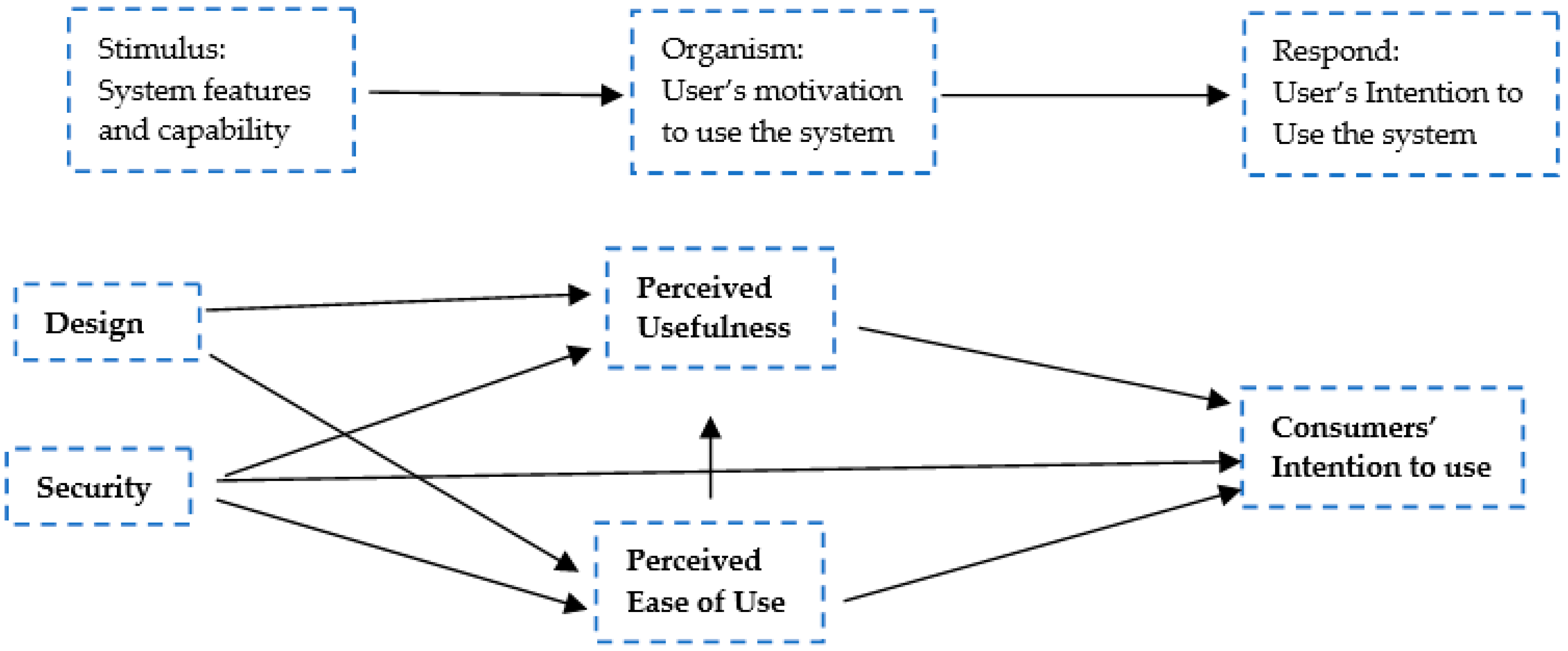
According to Lai (2016), design and security are the stimuli that lead to a system’s capabilities, while the perceived ease of use and perceived usefulness represent the motivation to use the system. Figure 3 shows the “Design and Security Stimulus Research Theoretical Hypothesis” [54].
Figure 3.
Stimulus theoretical framework (Lai 2016).
3.2. Participants
The data used in the present study were gathered through a questionnaire and a review of the relevant literature. More specifically, a questionnaire for measuring the perceptions of Taiwanese college students was developed and distributed to 456 Taiwanese students, with 426 being returned. Three hundred and ninety-seven of the returned questionnaires were valid, yielding a 93.19% valid return rate, with the majority of the respondents being female. The resulting data, which indicated the intentions of the students toward using a number of TOEIC e-tutoring learning websites, were then analyzed using simple linear regression analysis.
3.3. Instruments (TAM Model. SPSS)
We used the TAM model 3 to evaluate our questionnaire results to explore how using the Internet to learn the TOEIC will affect learners. After collecting the questionnaires, we used SPSS to analyze the responses and the basic TAM model 3 to explore their relations. The survey questions were adopted from Venkatesh et al. (2003) [32]. The survey collected demographic information and data on the overt variables for the five constructs in the model using a 5-point Likert scale (1 = strongly disagree, 5 = strongly agree), see Appendix A and Appendix B.
3.4. Reliability
The Cronbach’s α value for this research was 0.914. This indicated that the research was reliable, given that Cronbach’s α scores greater than 0.75 indicate reliability.
4. Results
Questionnaire Data Analysis Results
The Statistical Package for Social Sciences (SPSS) software was used to analyze the questionnaire data. The Cronbach’s α values for the composite reliabilities of the constructs, which are listed in Table 9, ranged from a low of 0.514 to a high of 0.914, with all but one of the Cronbach’s α values exceeding the recommended 0.70 threshold value.
Table 9.
Reliability statistics and research variables.
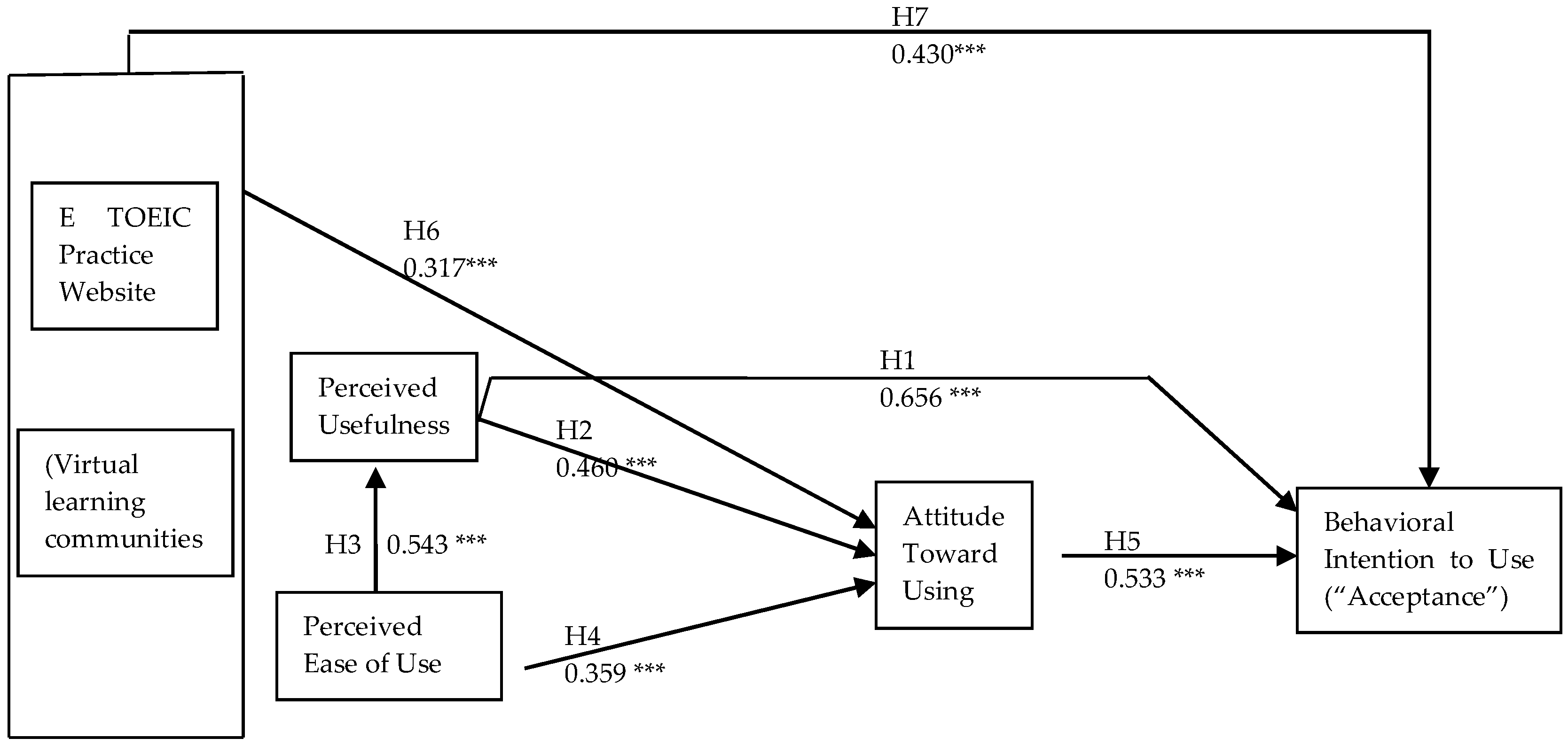
All factors are higher than 0.50 and most are above 0.70. Every item is significantly loaded (p < 0.01 in all cases) on its constructs (Table 10, Figure 4). Therefore, all of the constructs in the model have adequate reliability and convergent validity. The correlation results are shown in Table 11.
Table 10.
Analysis of hypotheses.
Figure 4.
Scale validation: Analysis of the measurement model. Note: p > 0.05: * p < 0.05; ** p < 0.01; *** p < 0.001.
Table 11.
Correlation of factors.
5. Discussion
In the present study, we verified the utilization of a well-accepted model of technology usage through a literature review and the collection of original data via a questionnaire. The literature review indicated that students receive various benefits through e-learning, and the current study investigated students’ perceptions of said benefits. In addition, the literature review provided general support for the relevance of the TAM 3 model in evaluations of this form of reassurance. A total of 397 valid copies of the questionnaire, which contained 19 questions, were returned by the participating college student respondents. The SPSS software was then used to determine the TAM 3 coefficients for the questionnaire data, all of which were found to be statistically significant.
The key findings of the study were the following:
- Behavioral intention to use (BIU) was positively affected by perceived usefulness (PU).
- Attitude (ATU) was positively affected by perceived usefulness (PU).
- Perceived usefulness (PU) was positively affected by perceived ease of use (PEOU).
- Attitude (ATU) was positively affected perceived ease of use (PEOU).
- The behavioral intention to use (BIU) was positively affected by attitude toward using (ATU).
- Regardless of a user’s location, the learning motivation of a user is enhanced by using the Internet to learn.
- Students are now quite likely to utilize the Internet to prepare for the TOEIC due to the fact that it is currently viewed as being very easy to use.
Use of the Internet to study and practice for the TOEIC is feasible in general, with E-TOEIC test learners expressing the view that such usage is convenient because it allows them to study for the TOEIC whenever they like.
The TAM3 model was used in the present study to create hypotheses regarding the relationships among the various factors of the model, with the simple linear regression analysis results revealing significant and positive relationships among the factors. Relatedly, the hypotheses were all confirmed and proof of various correlations was obtained. In light of these results, we could infer, in turn, that using the Internet to study enhanced the resources of the E-TOEIC test learner respondents. More specifically, significant effects were found in regard to Hypotheses 1, 2, and 3, which contained suppositions regarding perceived ease of use, perceived usefulness, and attitude. Taken together, the results indicated that the learning model in question can already be effectively applied to the e-learning of students and as a means for providing professional TOEIC test tutoring. In addition, the analysis results regarding Hypotheses 4 and 5 indicated that, regardless of a user’s location, his or her learning motivation will be enhanced by using the internet to learn. The data further indicated the student respondents were interested in and invested considerable time in TOEIC e-learning over the course of the learning process. Meanwhile, the analysis results regarding Hypotheses 6 and 7 indicated that the student respondents felt that using the internet to learn increased the convenience of studying and, as such, was of assistance for TOEIC-related learning. In other words, the data showed that the students perceived TOEIC e-learning to be helpful and that their willingness to learn was increased by it.
6. Conclusions
The following four types of factors are essential in knowledge management and with respect to the basic concepts of digital product design:
- (1)
- Natural environment and social factors: Natural environment factors consist of energy, resources, and other materials acquired from nature, while social factors consist of factors relating to religion, culture, and politics.
- (2)
- Technological factors: Technological factors consist of factors related to function, energy, and processing techniques, with such factors being those that restrict the implementation of a design most directly.
- (3)
- Aesthetic factors: Aesthetic factors are multifaceted in nature and incorporate the educational level, social environment, value system, personality, and cultural differences of the object in question.
- (4)
- Human factors: A review of the history of the design of digital system products reveals that it is only during the so-called digital age that a “people-oriented” approach has truly emerged. The future development of digital design, meanwhile, will increasingly be focused more on developing the relevant technological, human, and environmental elements in a coordinated manner.
6.1. Research and Development Efforts for Digital Product Sustainability
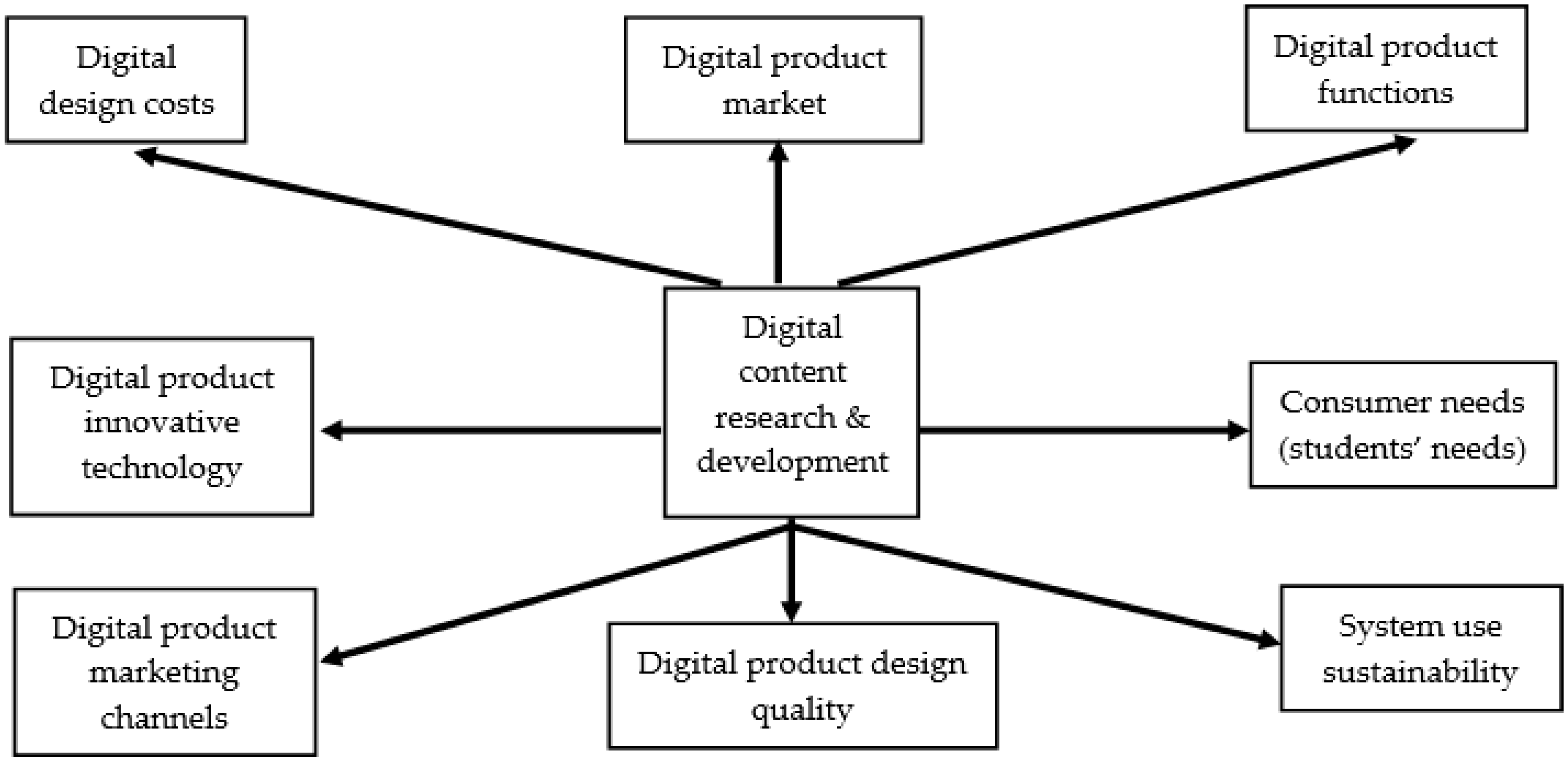
A company typically takes the lead role in determining its own digital product models, materials, aesthetics, colors, and service quality. By doing so, the company can then cause the aesthetic appreciation of its customers and, in turn, the company’s own competitiveness to be increased. The demands of consumers with respect to high-quality digital products must be taken into account and satisfied in the manufacturing of such products, with the designers of the products being sure to incorporate ideas from a wide range of different consumers. In addition, the creative and aesthetic designs of such products should be enhanced as much as possible in terms of their technological capability, and the users of such products should be assisted in solving any system issues, with comprehensive digital product design services being offered by the company in order to ensure sustainability (as shown below in Figure 5) [6,55].
Figure 5.
Digital product research and development processes.
6.2. Implications for Practice
All four of the above types of factors and 10 evaluation criteria must be considered in digital product design such that a given digital product will satisfy the demands of the market and be suitable for social development and production [55]. The 10 criteria are (1) security, (2) reliability, (3) access, (4) communication, (5) courtesy, (6) tangibles, (7) competence, (8) responsiveness, (9) credibility, and (10) understanding. (Tan & Hsu 2018a,b).
Information technologies play a key role in supporting the overall digitalization of a company. In achieving such digitalization, a number of key steps must be undertaken, including which system or concept is to be applied [56], the establishment of the direction for digitalization users, the defining of knowledge management for product innovations, the optimal uses to which the digital product can be put, and the determination of the basic knowledge and abilities required for the product innovations [6].
The contributions of this paper to the literature for the sustainable literacy are as follow:
- Provides information related to the quality design of business English e-tutoring websites that can be used to improve such sites in terms of the development of basic requirements (that is, information regarding aesthetic perceptions) [9].
- Provides information on how to develop a better English e-learning environment for e-commercial websites (that is, information regarding educational perceptions) [16].
- Provides empirical evidence regarding the real market value of the language learning industry (that is, evidence regarding digital learning market perceptions) [5].
- Provides empirical evidence regarding trends in the development of aesthetic sustainability for the language learning industry (that is, evidence regarding cultural perceptions).
In conclusion, the rapid growth of the digital learning market has triggered extensive research on the effectiveness of digital learning in order to increase its application. However, schools are faced with unpredictable barriers related to user acceptance. This study used the TAM 3 model to understand the learning experience of students and thus identify the learning barriers that may be addressed.
Funding
This research received no external funding.
Conflicts of Interest
The authors declare no conflict of interest.
Abbreviation
| PEOU | perceived ease of use |
| ATU | attitude toward computer use |
| PU | perceived usefulness |
| BIU | behavioral intention to use |
| VLC | virtual learning communities |
| TAM | technology acceptance model |
| TRA | theory of reasoned action |
| UTAUT | Unified Theory of Acceptance and Use of Technology |
| TOEIC | The Test of English for International Communication |
| TOEFL | The Test of English as a Foreign Language |
| GEPT | General English Proficiency Test |
| IELTS | The International English Language Testing System (IELTS) |
Appendix A. Participant Questionnaire
Table A1.
Basic information.
Table A1.
Basic information.
| Have you ever studying business English with e-tutoring websites? Yes □ No □ Gender Male □ Female □ How long have you been learning business English by using e-tutoring websites? Under 1 year □ 1–3 years □ 4–6 years □ 7–10 years □ Over 10 years □ |
Appendix B. Constituent Constructs of the Hypothetical Research Model (TAM 3)
Table A2.
Summary of the measurement scales.
Table A2.
Summary of the measurement scales.
| Constructs | College Students’ Attitudes toward Business English E-Tutoring Websites | Strongly Agree | Agree | Neutral | Disagree | Strongly Disagree |
|---|---|---|---|---|---|---|
| PEOU | 1: It is easy for me to use e-websites to practice the TOEIC test. | □ | □ | □ | □ | □ |
| 2: I can easily navigate to the TOEIC practice e-websites by just entering the keyword “TOEIC”. | □ | □ | □ | □ | □ | |
| 3: The e-website to practice the TOEIC test is clear and understandable and works for me. | □ | □ | □ | □ | □ | |
| 4: I can manage the e-websites to practice the TOEIC test easily. | □ | □ | □ | □ | □ | |
| ATU | 5: I can receive resources by using e-websites to practice the TOEIC test. | □ | □ | □ | □ | □ |
| 6: My attitude toward TOEIC practice e-websites is active. | □ | □ | □ | □ | □ | |
| PU | 7: Using the TOEIC practice e-websites greatly helps my TOEIC test preparation and improves my study. | □ | □ | □ | □ | □ |
| 8: I think that TOEIC practice e-websites are useful in my study. | □ | □ | □ | □ | □ | |
| 9: Using TOEIC practice e-websites enhances my TOEIC test (score). | □ | □ | □ | □ | □ | |
| 10: Using TOEIC practice e-websites helps me to finish the TOEIC test more quickly. | □ | □ | □ | □ | □ | |
| BIU | 11: I intend to use e-websites to practice the TOEIC test during my studies. | □ | □ | □ | □ | □ |
| 12: I utilize TOEIC practice e-websites when I have a question. | □ | □ | □ | □ | □ | |
| 13: I intend to practice for TOEIC on e-websites to improve my study. | □ | □ | □ | □ | □ | |
| 14: I will use TOEIC practice e-websites as my main learning tools. | □ | □ | □ | □ | □ | |
| 15: Utilizing TOEIC practice e-websites is smart. | □ | □ | □ | □ | □ | |
| Virtual Learning Communities (VLC) | 16: I’d like to use TOEIC e-websites with other learners to improve my studies. | □ | □ | □ | □ | □ |
| 17: I will encourage my friends to use TOEIC e-websites to learn. | □ | □ | □ | □ | □ | |
| 18: I often discuss the effect of TOEIC practice e-websites with other users or teachers. | □ | □ | □ | □ | □ | |
| 19: I often use TOEIC practice e-websites with other learners to study for the TOEIC test. | □ | □ | □ | □ | □ |
References
- Williams, A., Jr. International Education Global Growth and Prosperity: An Accompanying Analytical Narrative United Kingdom Government. Available online: https://assets.publishing.service.gov.uk/government/uploads/system/uploads/attachment_data/file/340600/bis-13-1081-international-education-global-growth-and-prosperity-revised.pdf (accessed on 29 July 2013).
- English Effect Report. 2013. Available online: http://www.britishcouncil.org (accessed on 19 March 2019).
- Pan, L.; Block, D. English as a “global language” in China: An investigation into learners’ and teachers’ language beliefs. System 2011, 39, 391–402. [Google Scholar] [CrossRef]
- Akiko, K. Strategies-Based Instruction in Japanese BIGB Schools. Unpublished Master’s Thesis, Department of English, San Francisco State University, San Francisco, CA, USA, 2002. [Google Scholar]
- Tan, P.J.B.; Hsu, M.-H. Understanding the needs and criteria of employees in the electronics industry for English e-learning website programmes. In Proceedings of the 2017 International Conference on Industrial Informatics & Computational Intelligence, Siem Reap, Cambodia, 18–20 June 2017. [Google Scholar]
- Tan, P.J.B.; Hsu, M. Designing a System for English Evaluation and Teaching Devices: A PZB and TAM Model Analysis. Eurasia J. Math. Sci. Technol. Educ. 2018, 14, 2107–2119. [Google Scholar] [CrossRef]
- Douglas, B.H. Language Assessment: Principles and Classroom Practices; Pearson Education: White Plains, NY, USA, 2004; pp. 14–33. [Google Scholar]
- Juinn, P.; Tan, B. Students’ Adoptions and Attitudes towards Electronic Placement Tests: A UTAUT Analysis. Am. J. Comput. Technol. Appl. 2013, 1, 14–24. [Google Scholar]
- Juinn, P.; Tan, B. Applying the UTAUT to Understand Factors Affecting the Use of English E-Learning Websites in Taiwan. J. Sage Open 2013, 3, 2158244013503837. [Google Scholar]
- Teo, T. Development and validation of the E-Learning Acceptance Measure (ElAM). Internet High. Educ. 2010, 13, 148–152. [Google Scholar] [CrossRef]
- Crystal, D. English as a Global Language; Cambridge University Press: Cambridge, UK, 1997. [Google Scholar]
- Frommann, U.; Phan, T.T. On the Didactical Potential of E-learning Courseware; L3S Research Center: Heidelberg, Germany, 2006; Available online: http://www.zfhe.at/index.php/zfhe/article/view/183/310 (accessed on 3 June 2015). [CrossRef]
- Ronsenbeg, M.J. E-Learning: Strategies for Delivering Knowledge in the Digital Age; MC Graw-Hill: New York, NY, USA, 2001. [Google Scholar]
- Huei, M.C. Simulation-Based Investigation of Multi-Agent Process in E-learning System. Master’s Thesis, Department of Information Management, Tatung University, Taipei, Taiwan, 2003; pp. 6, 27. [Google Scholar]
- Gurmak, S.; John, O.; Harvey, W. A Study into the Effects Of e-Learning on Higher Education. J. Univ. Teach. Learn. Pract. 2004, 2, 14–15. Available online: https://ro.uow.edu.au/cgi/viewcontent.cgi?article=1020&context=jutlp (accessed on 19 March 2019).
- Tan, P.J.B.; Hsu, M.H. Developing a system for English evaluation and teaching devices. In Proceedings of the 2017 International Conference on Applied System Innovation (ICASI), Sapporo, Japan, 13–17 May 2017; pp. 938–941. [Google Scholar] [CrossRef]
- Available online: https://www.statista.com/statistics/693260/global-self-paced-e-learning-industry-revenue-by-region/ (accessed on 6 January 2019).
- Juinn, P.; Tan, B. ESP Test Licensing Policies for Junior College Levels in Taiwan—A case study at the National Penghu Institute of Technology. In International Conference on Task-Based Language Teaching, TBLT-2005: From Theory to Practice; Katholieke Universiteit of Leuven: Leuven, Belgium, 2005; Available online: http://www.tblt.org/publication_proceedings.htm (accessed on 19 March 2019).
- Mary, S.; Alan, P.; Melanie, W. Assessment types and tasks. In The TKT Course; Cambridge University Press: Cambridge, UK, 2005; pp. 71–73. Available online: http://assets.cambridge.org/052160/9925/sample/0521609925ws.pdf (accessed on 19 March 2019).
- Test of English for international Communication. Available online: http://www.toeic.com.tw/toeic_news_page.jsp?type=4 (accessed on 20 February 2017).
- Test of English for international Communication. 2016. Available online: http://www.toeic.com.tw (accessed on 20 February 2017).
- Internet World Stats. 2018. Available online: https://www.internetworldstats.com/stats.htm (accessed on 20 February 2017).
- Hong, S.; Thong, J.Y.; Tam, K.Y. Understanding continued information technology usage behavior: A comparison of three models in the context of mobile internet. Decis. Support Syst. 2006, 42, 1819–1834. [Google Scholar] [CrossRef]
- Venkatesh, V.; Davis, F.D. A theoretical extension of the technology acceptance model: Four longitudinal studies. Manag. Sci. 2000, 46, 186–204. [Google Scholar] [CrossRef]
- Davis, F.D.; Bagozzi, R.P.; Warshaw, P.R. User acceptance of computer technology a comparison of two theoretical models. Manag. Sci. 1989, 35, 982–1003. [Google Scholar] [CrossRef]
- Fishbein, M.; Ajzen, I. Belief, Attitude, Intention and Behavior: An Introduction to Theory and Research; Addision-Wasely: Reading, MA, USA, 1975. [Google Scholar]
- Moore, G.C.; Benbasat, I. Development of an instrument to measure the perceptions of adopting an information technology innovation. Inf. Syst. Res. 1991, 2, 192–222. [Google Scholar] [CrossRef]
- Venkatesh, V. Determinants of perceived ease of use: Integrating perceived behavior control, computer anxiety and enjoyment into the technology acceptance model. Inf. Syst. Res. 2000, 11, 342–365. [Google Scholar] [CrossRef]
- Venkatesh, V.; Bala, H. Technology Acceptance Model 3 and a Research Agenda on Interventions. Decis. Sci. 2008, 39, 273–312. [Google Scholar] [CrossRef]
- Compeau, D.R.; Higgins, C.A. Application of social cognitive theory to training for computer skills. Inf. Syst. Res. 1995, 6, 118–143. [Google Scholar] [CrossRef]
- Compeau, D.R.; Higgins, C.A. Computer self-efficacy: Development of a measure and initial test. MIS Q. 1995, 19, 189–211. [Google Scholar] [CrossRef]
- Venkatesh, V.; Morris, M.G.; Davis, G.B.; Davis, F.D. User acceptance of information technology: Toward a unified view. MIS Q. 2003, 27, 425–478. [Google Scholar] [CrossRef]
- Webster, B.C.; Martocchio, J.J. Microcomputer playfulness: Development of a measure with workplace implications. MIS Q. 1992, 16, 201–226. [Google Scholar] [CrossRef]
- Davis, F.D. A Technology Acceptance Model for Empirically Testing New End-User Information Systems: Theory and Results. Ph.D. Dissertation, Sloan School of Management, Massachusetts Institute of Technology, Cambridge, MA, USA, 1986. [Google Scholar]
- Cheng, T.C.E.; Lam, D.Y.C.; Yeung, A.C.L. Adoption of internet banking: An empirical study 921 in Hong Kong. Decis. Support Syst. 2006, 42, 1558–1572. [Google Scholar] [CrossRef]
- Davis, F.D. Perceived usefulness, perceived ease of use and user acceptance of information technology. MIS Q. 1989, 13, 319–340. [Google Scholar] [CrossRef]
- Chen, L.D.; Gillenson, M.L.; Sherrell, D.L. Enticing online consumers: An extended technology acceptance perspective. Inf. Manag. 2002, 39, 705–719. [Google Scholar] [CrossRef]
- Wixom, B.H.; Todd, P.A. A theoretical integration of user satisfaction and technology acceptance. Inf. Syst. Res. 2005, 16, 85–102. [Google Scholar] [CrossRef]
- Taylor, S.; Todd, P.A. Assessing IT usage: The role of prior experience. MIS Q. 1995, 19, 561–570. [Google Scholar] [CrossRef]
- Lai, V.S.; Li, H. Technology acceptance model for internet banking: An invariance analysis. Inf. Manag. 2005, 42, 373–386. [Google Scholar] [CrossRef]
- Bitner, N.; Bitner, J. Integrating technology into the classroom: Eight keys to success. J. Technol. Teach. Educ. 2002, 10, 95–100. [Google Scholar]
- Dillon, A. Design a better learning Environment with the web: Problems and prospects. Cyber Psychol. Behav. 2000, 3, 97–102. [Google Scholar] [CrossRef]
- Knowles, M.S. The Making of an Adult Educator: An Autobiographical Journey; Jossey-Bass.: San Francisco, CA, USA, 1989. [Google Scholar]
- Agarwal, R.; Prasad, J. The role of innovation characteristics and perceived voluntariness in the acceptance of information technologies. Decis. Sci. 1997, 28, 557–582. [Google Scholar] [CrossRef]
- Chau, P.Y.K.; Hu, P.J.H. Information technology acceptance by individual professionals: A model comparison approach. Decis. Sci. 2001, 32, 699–719. [Google Scholar] [CrossRef]
- Liaw, S.S.; Huang, H.M.; Chen, G.D. Surveying instructor and learner attitudes toward E-learning. Comput. Educ. 2007, 49, 1066–1810. [Google Scholar] [CrossRef]
- Chuttur, M.Y. Overview of the Technology Acceptance Model: Origins, Developments and Future Directions; Sprouts: Working Papers on Information Systems; Indiana University: Bloomington, IN, USA, 2009. [Google Scholar]
- Richard, J.H.; Ben, T.K. The Technology Acceptance Model: Its past and its future in health care. J. Biomed. Inform. 2010, 43, 159–172. [Google Scholar]
- Juinn, P.; Tan, B.; Chen, W. Factors Influencing E-Learners Access to Japanese e-Learning Websites: An Empirical Study in Taiwan. The Asian Conference on Arts and Humanities 2012 Official Conference Proceedings. Available online: https://issuu.com/iafor/docs/acah-librasia_programme_2012_reduced (accessed on 19 March 2019).
- Juinn, P.; Tan, B. English e-learning in the virtual classroom and the factors that influence ESL (English as a Second Language): Taiwanese citizens’ acceptance and use of the Modular Object-Oriented Dynamic Learning Environment. Soc. Sci. Inf. 2015, 54, 211–228. [Google Scholar]
- Lai, P.C.; Ahmad, Z.A. Perceived Enjoyment of Malaysian consumers’ intention to use a single platform E-payment. Presented at International Conference on Liberal Arts & Social Sciences, Hanoi, Vietnam, 25–29 April 2014. [Google Scholar]
- Lai, P.C.; Zainal, A.A. Perceived Risk as an Extension to TAM Model: Consumers’ Intention to Use A Single Platform E-Payment. Austria J. Basic Appl. Sci. 2015, 9, 323–330. [Google Scholar]
- Lai, P.C. The Literature Review of Technology Adoption Models and Theories for the Novelty Technology. J. Inf. Syst. Technol. Manag. 2017, 14, 21–38. [Google Scholar] [CrossRef]
- Lai, P.C. Design and Security impact on consumers’ intention to use single platform E-payment. Interdiscip. Inf. Sci. 2016, 22, 111–122. [Google Scholar] [CrossRef]
- Tan, P.J.B.; Hsu, M.H. Management of Educational Needs of Employees in the Electronics Industry Using English e-Learning Website Programs. In Management of Information Systems; Intech Open: London, UK, 2018; pp. 203–221. Available online: https://www.intechopen.com/download/pdf/62860 (accessed on 19 March 2019).
- William, K.K.; Michael, J.S. Psychophysical assessments of image-sensor fused imagery. Hum. Factors 2002, 44, 257–271. [Google Scholar]
© 2019 by the author. Licensee MDPI, Basel, Switzerland. This article is an open access article distributed under the terms and conditions of the Creative Commons Attribution (CC BY) license (http://creativecommons.org/licenses/by/4.0/).