You are currently viewing a new version of our website. To view the old version click .
Sustainability
  • Article
  • Open Access

27 November 2019

Characterizing Stakeholders of Aging-in-Place through Social Network Analysis: A Study of Nanjing, China

,
,
,
,
and
1
Department of Civil Engineering, The University of Hong Kong, Hong Kong SAR 999077, China
2
Department of Construction and Real Estate, Southeast University, Nanjing 211189, China
3
The People’s Livelihood Research Center, Southeast University, Nanjing 211189, China
*
Author to whom correspondence should be addressed.
This article belongs to the Special Issue Aging: Healthcare, Inequalities, Challenges and Trends

Abstract

China currently has an elderly population of 249 million with over 97% of them ending up aging in place. Although various regional pilot programs have been conducted, a sustainable aging-in-place system has not been established to effectively and efficiently provide aging services in many cities of China. The characteristics of stakeholder networks in the aging-in-place systems have not attracted great attention from researchers. This research applies social network analysis to characterize the interactions of stakeholders in aging-in-place systems to facilitate cooperation and coordination amongst them. Using Nanjing as a case study, 23 stakeholders in Nanjing’s aging-in-place system are identified, such as the Aging Affairs Committee, Aging-in-Place Service Association, and aging-in-place service centers; and then the relationship networks of these stakeholders in terms of communication, supervision, and trust are developed and analyzed. The results show that the aging-in-place system suffers from certain defects, including the loose connection of government departments, redundant information channels, low trustworthiness of certain aging-in-place service centers, poor credibility of third-party training and assessment institutions, and excess power of the industry association. To tackle these issues, a wide spectrum of actionable measures applicable to Nanjing’s conditions, as well as high-level policy implications for other cities of China, are proposed for augmenting the communication, supervision, and trust among stakeholder groups.

1. Introduction

China is one of the most populated countries in the world with more than 1.4 billion people, and 17.9% of this population (i.e., 249 million) was over 60 years old as of 2018 [1]. It is estimated that nearly 500 million people in China will be at or beyond the age of 60 by 2050 [2], which is a massive challenge for policymaking, human resource management, and facility investments for aging services provision [3,4,5,6]. Analogous to other countries, there are two main policy models for treating the aging population in China, namely aging-in-institutions and aging-in-place (AIP). In the USA, AIP is defined as older people living in their own homes and requiring convenient access to services regardless of age, income, or ability level [7]. The Chinese government also envisages that AIP should consist of two essential elements, i.e., living at home and being able to acquire the necessary services from the community conveniently [5,8,9].
AIP systems in China are affected by two main factors: (i) built facilities (e.g., beds in aging services institution) for the elderly care can only accommodate around 3% of the aged population, which means around 97% of older people would have to end up staying in their current residences after retirement [8]; and (ii) Chinese people practice the Confucian principle of filial piety where descendants would prefer to live with their parents and take care of them when they get old [9,10]. The one-child policy introduced in China in the late 70s, however, has resulted in the emergence of many 4–2–1 families (i.e., the paternal and maternal grandparents, two parents, and one child). Many youngsters in China find it increasingly difficult to support and look after their senior family members [8,11], and they heavily rely on a sustainable AIP system to provide support for taking care of older people.
The development of AIP in China, however, is still in its infancy, as most cities began to develop AIP after 2010 and even 2015 [12,13]. Therefore, an AIP system that could effectively and efficiently provide the required aging services has not been established in most cities [14]. The AIP system consists of different stakeholders (i.e., government authorities, service providers, older people, third-party assessment agencies, non-governmental organizations (NGOs), etc.) [9]. Among these stakeholders, there are also various activities and interactions that form intricate social networks [9]. In such social networks, stakeholders are faced with multifarious problems, like loose connections between stakeholders, unbalanced distributions of authorities among government departments, and unreasonable allocations of stakeholder duties [9,15,16,17,18]. Besides, the lack of supervision for a few institutions, as well as the low-quality of aging services delivered by some vendors, critically hinder the sustainable development of AIP systems [15,16,17,18,19]. The success of AIP systems necessitates a thorough understanding of the characteristics and constraints of AIP stakeholders and the complex relationships among them.
In response, this research applies social network analysis (SNA) to characterize the AIP stakeholders in Nanjing, China, in order to help policymakers identify specific issues that exist in the AIP system. Nanjing was selected as the city for investigation because it is not only one of the largest cities of China (8.4 million citizens, with 1.4 million aged 60 or above) but also an officially certified model AIP city in China. In this work, 23 key AIP-related stakeholder groups are firstly identified, which are regarded as the nodes of social networks. The relationships between each pair of stakeholders are subsequently investigated and used as the weighted edges in the networks, After establishing the social networks of AIP stakeholders, the authors harnessed typical network indicators (i.e., degree centrality, betweenness centrality, and closeness centrality) to unravel the stakeholder conditions in current AIP system, and corresponding policy measures and implications are discussed.

3. Materials and Methods

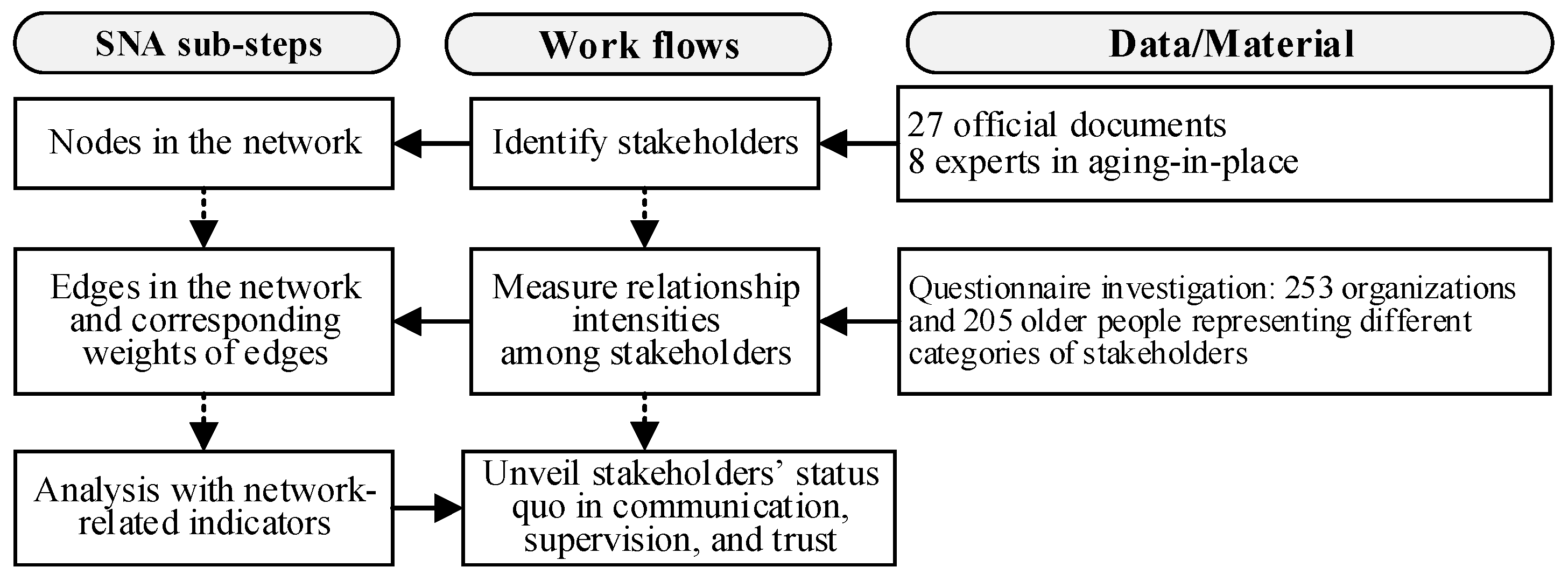
Figure 1 illustrates the main research process, which contains three steps. The first step in the workflow is the identification of major stakeholders and their roles in the AIP system; these stakeholders will be regarded as the nodes in SNA. The methods for measuring the relationship intensities of communication, supervision, and trust amongst various stakeholders are then devised, and the relationship intensities are manipulated as the weights of edges connecting stakeholder nodes. Finally, the characteristics of stakeholders regarding communication, supervision, and trust relationships are revealed through network indicators.
Figure 1. The main process of this research.

3.1. Identification of Stakeholders as the Network Nodes

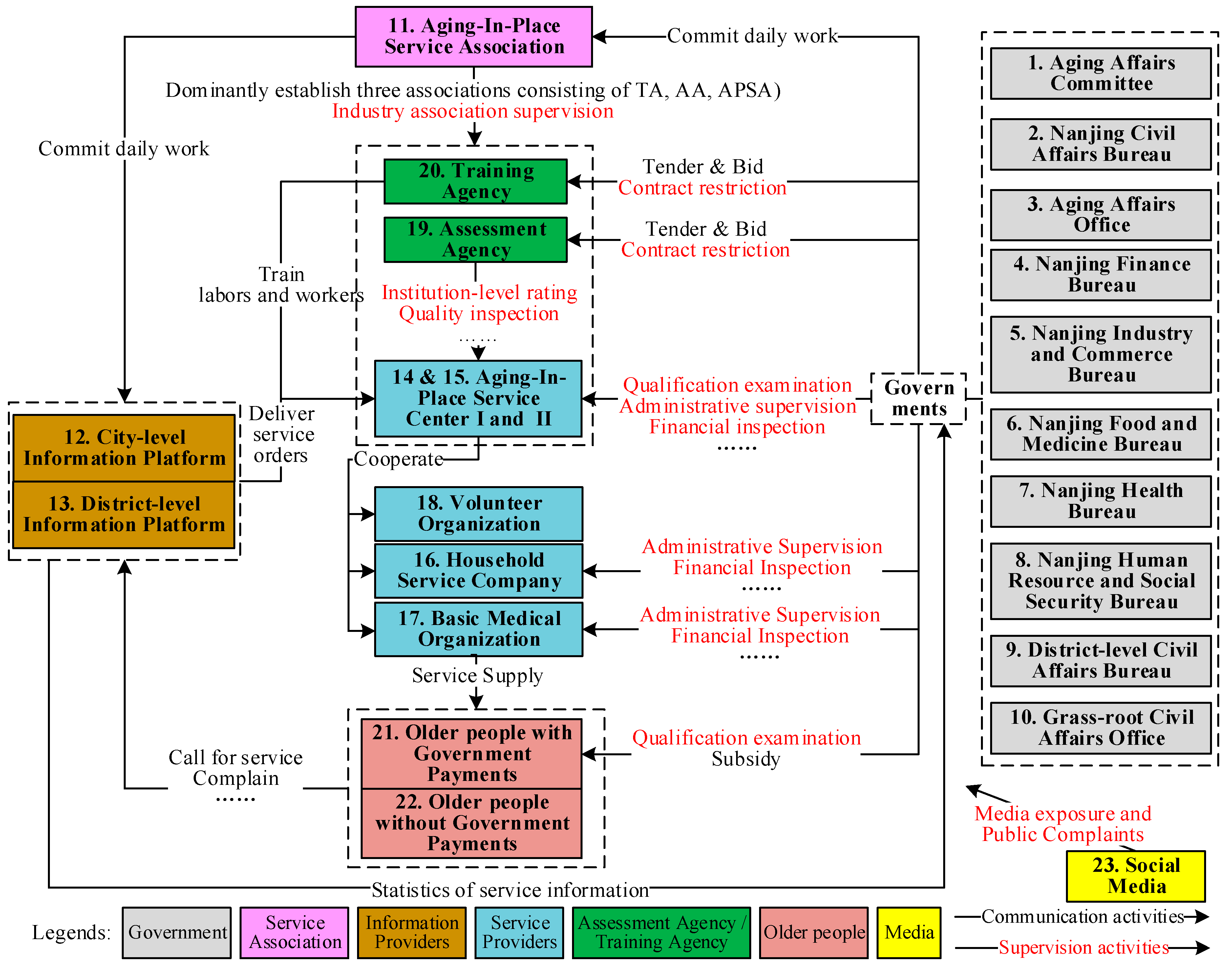
In this research, stakeholders could be groups of either organizations or individuals participating in or significantly influencing the AIP services [49]. To identify the AIP stakeholders, 27 official documents (Table S1) regarding the AIP system of Nanjing are solicited and reviewed, and they cover seven themes, including city-level AIP system design; tender and bidding process; subsidy schemes; service standards; personnel training; service assessment; and institution performance evaluation. From which, 23 categories (Table 1) of stakeholders are found in the collected documents. These stakeholders include service associations, government departments, information providers, older people, service providers, training agencies, assessment agencies, and social media. Moreover, 8 interviews are conducted with experts (Table S2) who are familiar with Nanjing’ AIP to help confirm the identified stakeholders and the general operation mechanism of the AIP system, the general operation of Nanjing’s AIP is displayed in Figure 2.
Table 1. Brief introduction of identified stakeholders.
Figure 2. General operation framework of aging-in-place (AIP) in Nanjing.

3.2. Measurement of Stakeholder Relationship as EDGEs

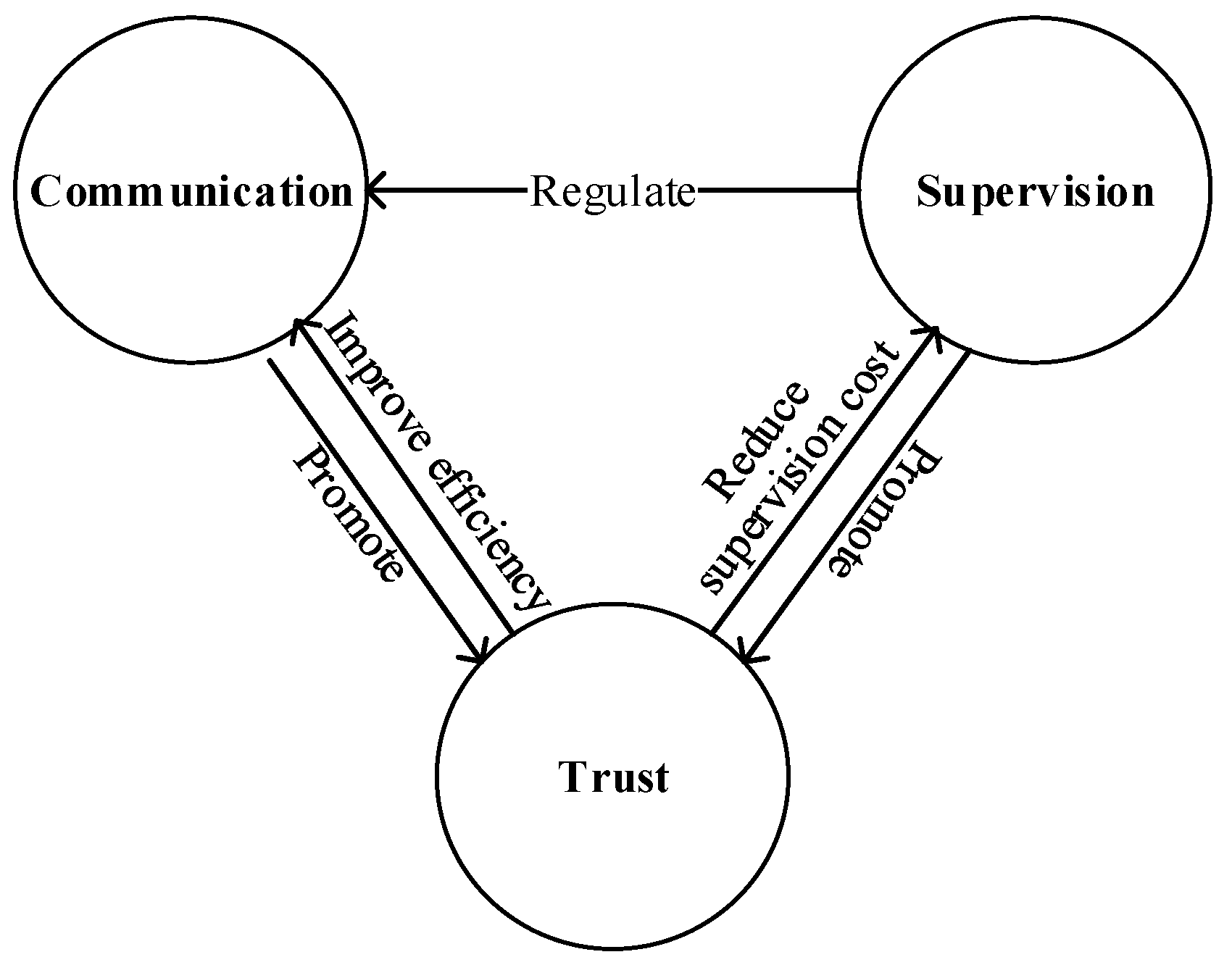
The network governance theory proposes three types of relationships that exist between stakeholders (Figure 3). The “communication relationship” is the most extensive. The “supervision relationship” is related to specific supervision activities and regulates communication activities. The “trust relationship” is produced by communication and supervision [44,50]; trust, in turn, promotes communication and reduces the supervision cost [44].
Figure 3. Effects among communication, supervision, and trust.
The communication relationship in this study is determined by formal activities (i.e., meetings, trades, orders, etc.) in the AIP system. Examples of communication activities include the city-level information platform updating and providing transaction information to the Nanjing Civil Affairs Bureau every month, the aging affair committee holding joint meetings of government departments once a year, and the information platforms delivering dozens of service orders to each aging-in-place service center every day. The communication relationship, therefore, could demonstrate the interaction, active degree, and status of each stakeholder in the AIP network [36]. The communication intensity could be measured by the frequency of communication activities per year; it is divided into four levels, namely “none”, “one to six times per year”, “seven to twelve times per year”, and “more than once every month” corresponding to 0, 1, 2, and 3 points respectively (Table 2).
Table 2. Measurements of relationship intensity of communication, supervision, and trust.
Supervision relationship intensities are determined by supervision activities like contract restrictions, institution-level rating, and quality inspection. The eight types of supervision activities in Table 2 are extracted from the official documents (Table S1), and the intensities of these activities are assessed by the experts based on their experiences and knowledge (Table S2). Additionally, the implementation of these supervision activities is further differentiated into strong or weak degrees, which have different scores (Table 2) [51].
The trust relationship is a relatively subjective concept, so it is difficult to reach a consensus on a clear definition [52]. One widely accepted decomposition of trust is from Geyskens and Steenkamp who regard ability, reliability, and friendship as critical factors of trust [52]. Ability implies stakeholders meeting demands, reliability refers to stakeholders fulfilling their responsibilities in accordance with formal or informal agreements, and friendship refers to stakeholders considering the interests of others when making a decision [52]. The three indicators possess the same weights (i.e., 1/3) for measuring the trust relationship between two stakeholders (Table 2).
After determining the conceptual measurement methods for communication, supervision, and trust relationships, the questionnaire is devised and attached in Table S3; its structure is similar to Table 2. Specific organizations or individuals representing each stakeholder group are randomly selected for the surveys. The recruitment work is divided into two parts respectively for institutions and individuals. The questionnaires are distributed to the eligible institutions until the number of respondents satisfies the requirements, and the authors employ the “12349” hotline operated by the city-level information platform to call the older people who are randomly selected from the registered population database. Table 1 shows that the numbers of organizations in different categories of stakeholders are of considerable variety, so the number of selected respondents is varied for particular stakeholder groups. For example, the older people (no. 21 and 22 in Table 1) are individuals, at least 100 people are chosen randomly for both groups in the survey. As for the AIP service organizations (no. 14–18 in Table 1), at least 30 organizations under each group are investigated. The respondent should list the communication activities between their own organization with each other type of stakeholder, judge the enforcement degrees of the supervision activities that they are constrained by, as well as evaluate the ability, reliability, and friendship regarding other stakeholder groups. After receiving the answers of respondents from the same category of stakeholders, the majority (i.e., the mode of a set of numbers) of the answers would be regarded as the intensity result between this stakeholder group with another one. Finally, 253 different organizations (e.g., Nanjing Aging-in-Place Service Association) and 205 older people answer the questionnaires, and all respondents give their informed consent for inclusion before they participated in the study. Details of the surveyed organizations are accessible in Table S4, and raw survey results (Table S5) have also passed the test of reliability and validity.

3.3. Indicators for Analyzing Networks

After obtaining the matrices recording communication, supervision, and trust relationships between each pair of stakeholders (Table S6), a set of network indicators are adopted to analyze each stakeholder, and they include degree centrality, betweenness centrality, and closeness centrality through an open-source software Gephi 0.9.2.
Degree centrality (DC) describes the status of one stakeholder in the network; it can be measured by the weights of connections with other stakeholders [36]. A high DC indicates the criticality of a stakeholder in the AIP system [35]. The DC value of stakeholder i could be acquired through Equation (1) where N represents the number of stakeholders and W i j denotes the weight of the edge connecting node i and j. Notably, the communication network is an undirected network, while the supervision and trust network are directed. The DC, therefore, is differentiated into in-degree centrality (IDC) and out-degree centrality (ODC) for directed networks.
Betweenness centrality (BC) describes the ability of nodes to control the resource flow. It is equal to the number of shortest paths from all vertices to all others that pass through that node. In AIP, stakeholders with high BC have a dominant influence on the transfer of information or resources through the network, and they can be regarded as the bridges of the network, under the assumption that any resource transfer follows the shortest path [35]. In Equation (2), C B C ( i ) is the betweenness centrality of node i, and G j k denotes the number of shortest paths between node j and k. Among these paths from j to k, the number of paths through node i is G j k ( i ) .
Closeness centrality (CC) illustrates how short the minimal paths of one node are in relation to others [36]. In AIP, stakeholders with high CC normally can transmit, control, and obtain information and resources easily rather than depending on other nodes [36]. C C C ( i ) could be measured with Equation (3) where D i j denotes the distance of shortest paths from node i to j.
C D C ( i ) = j = 1 N 1 W i j N 1 ,
C B C ( i ) = j < k   G j k ( i ) G j k
C C C ( i ) = N 1 j = 1 N D i j

4. Results

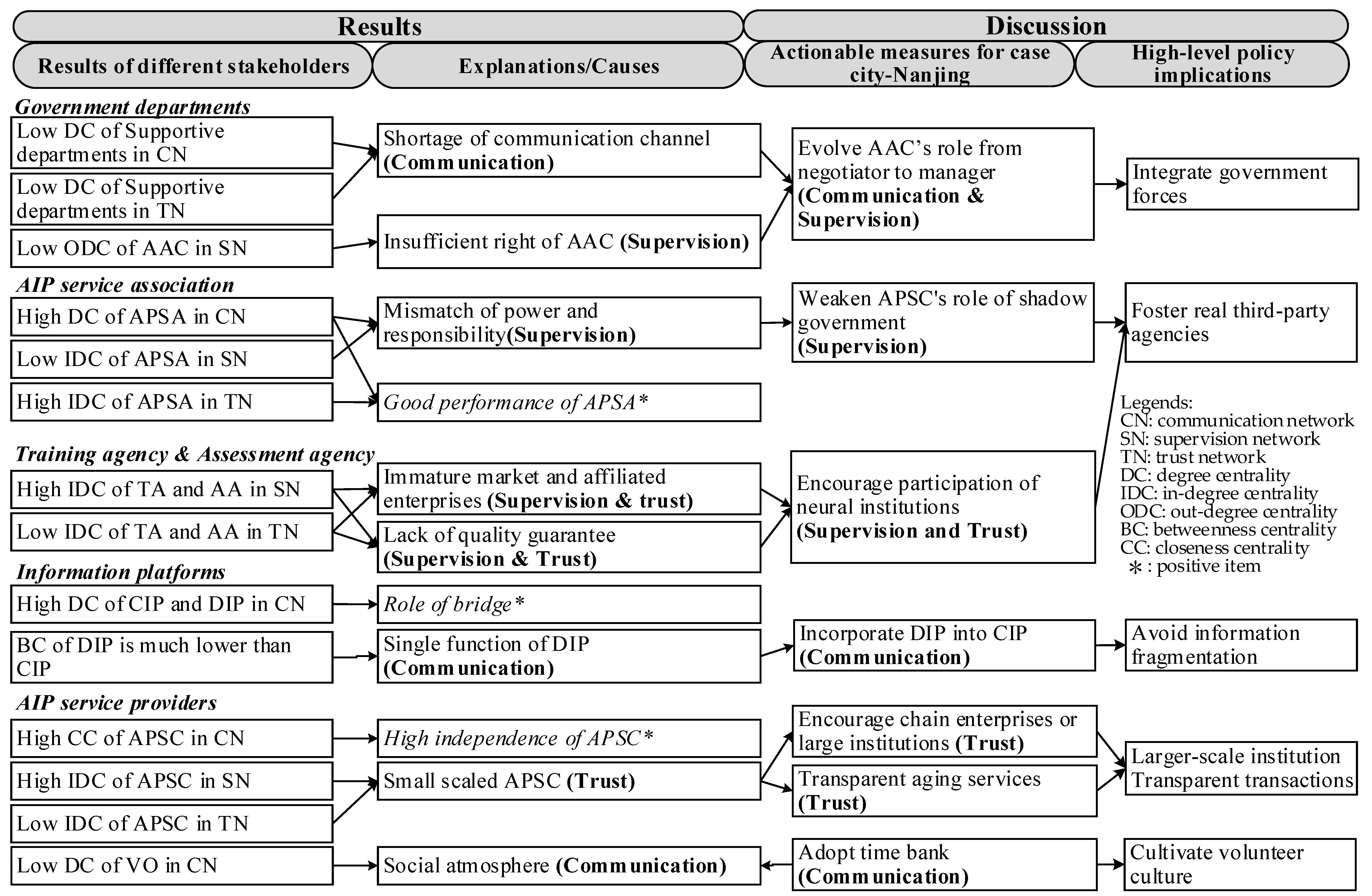
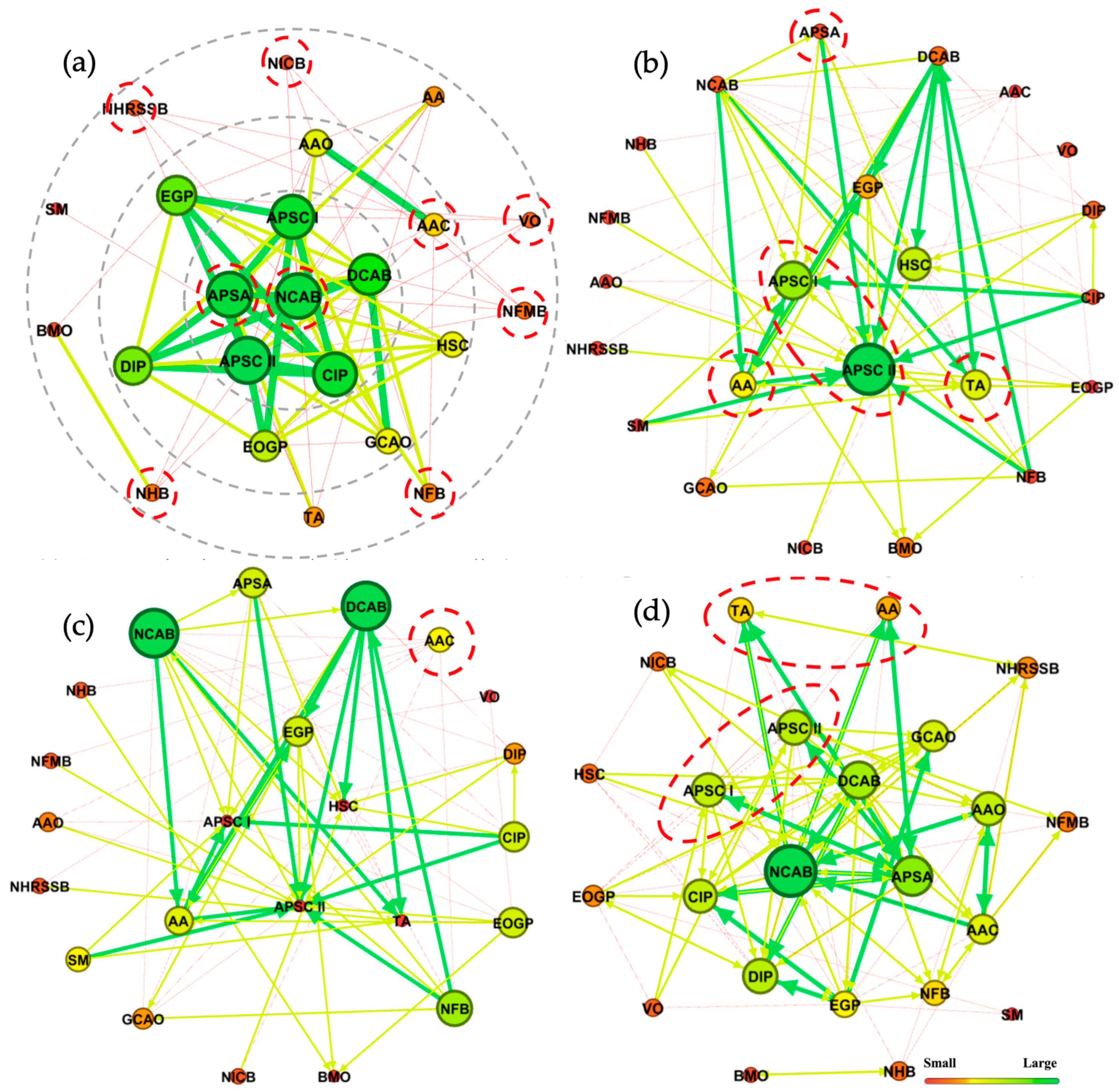
The indicator results of each stakeholder in the communication, supervision, and trust networks are presented in Table 3 and Figure 4, and the critical characteristics have also been summarized in the left part of Figure 5. Notably, Nanjing’s AIP system has achieved significant success [53,54], but the results in this study focus on the issues facing the existing AIP system for further improvements.
Table 3. Stakeholders and indicator results.
Figure 4. Communication, supervision, and trust networks. (a) degree centrality of the communication network; (b) in-degree centrality of the supervision network; (c) out-degree centrality of the supervision network; and (d) in-degree centrality of the trust network. Node color and size and edge color and width represent the size of the value. Red circles refer to stakeholders that are frequently mentioned in the Results and Discussion sections to help readers find them easily.
Figure 5. Actionable measures and policy implications corresponding to the results.

4.1. Government Departments

In the communication network (Figure 4a), the Nanjing Civil Affairs Bureau (1.14) occupies the central role in the AIP system, which is decided by its functions (Table 1) in the AIP system. The degree centrality also shows that the supportive government departments, including the Nanjing Finance Bureau (0.27), Nanjing Industry and Commerce Bureau (0.14), Nanjing Food and Medicine Bureau (0.23), Nanjing Health Bureau (0.23), and Nanjing Human Resource and Social Security Bureau (0.18) are negative in the communication network, and they all lie in the external layer in Figure 4a. The Nanjing Civil Affairs Bureau is in the same hierarchy with other government departments (e.g., Nanjing Health Bureau), so it may lack enough authority to require other sectors to conduct active cooperation [55]. Considering this, the Aging Affairs Committee (0.41) is set as the leading government department to promote the communication among government departments, but it holds joint meetings with these departments only once a year, and, thus, there is no stable communication channel for facilitating cross-sector collaboration in the AIP system.
The low out-degree (Figure 4c) of the Aging Affairs Committee (0.32) in the supervision network means that it does not have enough power to supervise those government departments. The Aging Affairs Committee currently serves as a coordinator rather than a manager [54]; its weak supervision authority exacerbates the ineffective cooperation among various government departments [56], as those supportive departments may still act in their own interests, instead of proactively facilitating cross-department collaboration [56].
Except for departments regarding civil affairs (i.e., Nanjing Civil Affairs Bureau, District-level Civil Affairs Bureau, and Grass-root Civil Affairs Office), other government departments, such as the Nanjing Finance Bureau (0.41), Nanjing Food and Medicine Bureau (0.23), Nanjing Human Resource and Social Security Bureau (0.23), Nanjing Health Bureau (0.23), and Nanjing Industry and Commerce Bureau (0.18) do not gain the trust from other stakeholders (Figure 4d), and this phenomenon may result from their inactive participation in AIP system [44,50], which echoes their low degree centralities in the communication network.

4.2. AIP Service Association

Non-governmental industry associations are established in many of China’s cities to help build a market-dominated AIP service provision system [8]. In Nanjing, the degree centrality of the Aging-in-Place Service Association (1.14) in the communication network is significant (Figure 4a). Because there are limited human resources responsible for AIP affairs in the Nanjing Civil Affairs Bureau, the Aging-in-Place Service Association is empowered to undertake a series of government affairs (e.g., daily supervisions and tenders) as presented in Table 1. This finding is consistent with the phenomenon of industry association offsides within certain other fields [57]; a high frequency of the Aging-in-Place Service Association’s participation in AIP affairs leads to the prominent status in the AIP communication network [54].
The in-degree centrality (Figure 4b) of the Aging-in-Place Service Association in the supervision network (0.09) is extremely low, which illustrates that the industry association is not strictly supervised by others. Such an imbalance between weak supervision and excess power is severe, as stakeholders with high authority should normally be strictly supervised [44].
The deficiency of supervision, however, does not affect the high level of trust (Figure 4d) of the Aging-in-Place Service Association (1.00); this mainly attributable to its excellent performance during the development of AIP over the last few years [54]. To some extent, its role as a “shadow government” and outstanding performance mask the weak supervision of the Aging-in-Place Service Association.

4.3. Training Agency and Assessment Agency

Both the Assessment Agency and Training Agency are designed as independent third-parties in the AIP system; they accept relatively strong supervision from other stakeholder groups in the supervision network, as can be seen in the in-degree centralities of the Assessment Agency (0.50) and Training Agency (0.64) shown in Figure 4b.
In contrast, the Assessment Agency (0.45) and Training Agency (0.41) do not gain sufficient trust from other types of stakeholders. The Assessment Agency works on assessing service organizations; the duty of the Training Agency is issuing personnel training certificates [58]. As the market for AIP assessment and training in China is relatively immature, some AIP service organizations have developed subsidiary companies to conduct training and assessment works, which may undermine the credibility of assessment and training qualities [44,59]. Additionally, the qualities of assessment and training currently can only be indirectly supervised by consumers and Social Media through complaints, the vulnerabilities of the rules further degrade trust in these so-called independent third-party agencies [54].

4.4. Information Platforms

The degree centralities (Figure 4a) of the city-level information platform (1.09) and district-level information platform (0.91) are large in the communication network, as they are information hubs matching the demands and supplies of aging services. As presented in Table 1, information platforms play an indispensable role in exchange information between the older people and the aging-in-place service centers, which can also assist in digitally monitoring the long-term development of AIP services of the whole city.
However, in terms of the betweenness centrality, the district-level information platform (0.01) significantly lags behind the city-level information platform (0.10), as the former supplies call services only while the latter undertakes more tasks, such as official service satisfaction surveys and transaction data statistics [60]. The “bridge” effect of the district-level information platform thus is much weaker than that of the city-level information platform, and the duplications of information platforms also wastefully consume extra resources.

4.5. AIP service Providers

In the AIP system, the majority of service providers are aging-in-place service centers [54], which could be witnessed from the degree centralities (Figure 4a) of the two kinds of institutions, i.e., APSC I (1.09) and APSC II (1.03); the values are much larger than the degree centralities of the Household Service Company (0.50), Voluntary Organization (0.18), and Basic Medical Organization (0.14) in the communication network. Moreover, the closeness centralities of APSC I (0.71) and APSC II (0.73) illustrates the great independence of aging-in-place service centers. Specifically, the “government offside” is not significant in Nanjing, and the aging-in-place service centers are relatively independent in handling aging-in-place related affairs [54]. During our investigation, it was found that Nanjing’s government encourages the private sector to make investments in AIP services [60]. As of 2018, more than 50% of aging-in-place service centers are privately-owned, a larger ratio than many other Chinese cities, and the long-term aim of Nanjing’s AIP is that 90% of the aging-in-place service centers should be privately-owned [60].
The in-degree centralities (Figure 4b) show that APSC I and APSC II are the most strictly supervised stakeholders in the supervision network (0.96 and 1.41), but their performance (0.69, 0.70) in the trust network (Figure 4d) is poor and inconsistent with the expectation, as stricter supervision should normally bring stronger trust [44]. Such a phenomenon illustrates that stricter supervision on APSC in Nanjing does not bring greater trust, which is rather abnormal and discussed in Section 5.3.
Besides the commercial providers of AIP services, volunteers could be a sustainable and valuable driving force for providing aging services, which are supplemental to market forces [61]. The degree centrality of the Voluntary Organization (0.18) in the communication network reveals its low participation in Nanjing’s AIP (Figure 4a), which is different from Western countries where volunteers are relatively active in public services [62].

5. Discussion

Corresponding to the results, potential measures for improving communication, supervision, and trust of stakeholders in Nanjing’s AIP system have been discussed. Besides the operation-level measures for Nanjing, there are also high-level policy implications proposed for the AIP development of other Chinese cities. Figure 5 links the results of network indicators with the derived measures and policy implications.

5.1. Improving Communication Amongst Stakeholders

The following three suggestions are proposed to reinforce the communication network: (i) empowering Aging Affairs Committee’s more authorities, (ii) removing redundant information platforms, and (iii) attracting volunteers.
Past studies have reached a consensus on the importance of enhancing the cross-sector collaboration in the provision of aging services, but few works have pointed out the involved government sectors and operational measures [53]. In the Nanjing’s AIP system, changing the role of the Aging Affairs Committee from a coordinator to a manager is to strengthen its power in orchestrating disparate government departments. Increasing the frequency of joint meetings with the supportive government departments (e.g., Nanjing Civil Affairs Bureau, Nanjing Finance Bureau, and Nanjing Industry and Commerce Bureau), as well as empowering Aging Affairs Committee to appraise their performance related to AIP services, are crucial for integrating government departments.
Previous works put the city-level and district-level information platforms together, and few publications differentiate them [54]. Both city-level and district-level information platforms contribute significantly to the ‘informalization’ of the aging-in-place services provision, but their redundancy is ignored. The co-existence of dozens of information platforms may lead to information being scattered in different databases; therefore, it is suggested to incorporate the district-level information platform into the city-level information platform to avoid a waste of resources and reduce the redundancy of the communication network. If a single platform possesses the complete information, it should be more efficient for monitoring the industry conditions, informing governments to make subsidies decisions, and comprehensively understanding older people’s preferences. The redundancy phenomenon is also seen in mobile apps regarding AIP services. There are dozens of apps (e.g., “my Nanjing”, “Smart Aging Service”, and “AIP in Nanjing”) developed by these information platforms for providing AIP services or processing AIP-related affairs. The redundant platforms not only waste capital and resources but also make information fragmented, which is counter to the original intention of setting information platforms for bolstering stakeholder communication efficiency.
Results regarding the low participation of volunteer organizations in the AIP system is consistent with the conclusion of volunteer research in other domains in China [61]. The root cause is related to the social atmospheres and Chinese traditional culture; it is hard, if not impossible, to make significant changes in the short term [61]. The government in Nanjing has begun to advocate a “time bank” initiative to promote volunteer activities and has made some achievements [63]. As of 2018, nearly 6000 volunteers have joined this program; the participants can accumulate volunteer service hours that are deposited in the “time bank” and spend the time (i.e., acquire volunteer aging services) when they are aged [63]. Although volunteers are currently a small force for AIP in China, they could be an indispensable element for aging-friendly communities in the future, so a long-term plan for cultivating volunteer organizations is of great importance for responding to China’s aging population challenge.

5.2. Strengthening Supervision of Independent Stakeholders

To optimize the existing supervision network of the AIP system, it is imperative to (i) eliminate the “shadow government” role of the Aging-in-Place Service Association and (ii) develop authentically independent third-party agencies for assessment and training works.
Most past publications acknowledge the positive effects and excellent performance of the Aging-in-Place Service Association in Nanjing’s AIP [56], but the risk of the supervision gap is neglected. The Aging-in-Place Service Association is designed as a non-profit industrial association, but it weakens the government’s supervisory capacity. The dual identities (i.e., shadow government and industry association) of the Aging-in-Place Service Association make it powerful and capable of achieving resource monopoly in the AIP stakeholder network [36]. As the market of AIP grows, it can be risky if others do not strictly supervise such a powerful organization. To tackle the problem, the government affairs (e.g., tender) should not be committed to the industrial association, and the Nanjing Civil Affairs Bureau should establish strong ties with the Training Agency and Assessment Agency, the connection ties between them currently is weak in Figure 4a.
Besides the Nanjing’s AIP system, the scarcity of independent third parties in China is also severe in many other service fields [64]. Independent third parties should try to keep reasonable distances to the service providers and the public simultaneously [65]. In this case study, certain assessment agencies and training agencies are inextricably linked with AIP service providers, which make the identities of these third parties vague, negatively affecting trust from the public and consumers. Specifically, the government should restrain or even forbid AIP service organizations from developing subsidiary agencies for assessment or training. To help cultivate third-party agencies, certain institutions (e.g., healthcare schools) could be encouraged to undertake assessment and training tasks because they not only possess enough professional skills to ensure training and assessment qualities but also are relatively impartial as non-profit organizations.

5.3. Promoting Trust of Aging-in-Place Service Centers

As shown in Figure 3, trust can be intensified by the measures proposed for enhancing the communication and supervision networks in the previous two Section 5.1 and Section 5.2. Irrespective of whether stakeholders are currently performing well or poorly in the trust network, gaining deeper trust from others is always helpful [44].
As the cornerstone of service providers in the AIP system, aging-in-place service centers have attracted much attention from researchers; the status quo of the strict supervision for aging-in-place service centers are widely recognized by researchers [58], but the fact that rigorous supervision does not bring deep trust of aging-in-place service centers has not been realized. One of the reasons is that the AIP market in China is unprofitable and immature; most of the aging-in-place service centers are of rather small scales [9]. These small-scale service providers do not have long-term aims and abundant resources, their aims are reaching the bottom-lines of service standards [66]. The proposed measure is attracting and encouraging investors and enterprises that hold long-term goals and ambitious devotion to service qualities. In the last five years, the development of Nanjing’s AIP system was quantity-oriented, so a large number of policies were released to attract more AIP investors to establish aging-in-place service centers, these policies helped the coverage rate of aging-in-place service centers increase from around 5% to 90% in all communities of Nanjing [60]. The coverage rate currently is higher than 90%; it is time to raise the entry and exit thresholds to rule out opportunistic investors, which means transferring the policy direction from “quantity-oriented development” to “quality-oriented development”.
Another potential solution is making the aging-in-place service process more transparent and traceable. Specifically, the information platform currently only delivers orders to the service providers; it could be upgraded with extra functions like showing consumer comments and the number of orders accomplished by the service provider. Since more aging-in-place service transaction information is available and accessible by the public after desensitization, it could help eliminate the information asymmetry between older people and aging-in-place service centers, which could contribute to increasing the trust in service providers.

5.4. Potential Transferability to More Cities

As shown in Figure 5, the proceeding implications are divided into two categories, namely actionable measures specific for Nanjing and high-level policy implications for other Chinese cities. These measures for Nanjing cannot be indiscriminately imitated and directly transplanted to other cities, as the population, economy, and AIP development history of different cities vary. Specifically, cities in Mainland China are officially and quantitatively delineated into five categories, i.e., “Super cities", “Mega cities”, and “Large/Medium/Small cities”, according to the scales of population and economy [67]. Nanjing is one of sixteen “Mega cities”, the operational measures of Nanjing’s AIP system are more meaningful for cities in the same category (e.g., Chengdu, Hangzhou, and Tianjin) than for cities in other categories. Although the economies and populations are different, there are still commonalities in terms of government structure and social culture (e.g., Confucian principle) [9,10]. Hence, the high-level policy directions in Figure 5 are instructive for many other cities in Mainland China, including integrating government departments, fostering third-party organizations, reducing redundant platforms to avoid information fragmentation, and cultivating volunteer organizations. All the lessons from Nanjing’s AIP system could be referred to by the cities that are latecomers, especially for many “second/third/fourth/fifth-tier cities” where the development of AIP is in the initial stage.
Besides transferring the AIP-related policy implications, the SNA-based methodology also possesses the transferability to other cities; it is useful for discovering localized stakeholder characteristics, as there are no one-size-fits-all measures or policies applicable to different cities. Firstly, the researchers could identify the stakeholder groups in the target city and regard them as the nodes in the network, which should be slightly different from Nanjing. For example, the AIP service associations have not been established in the AIP system of some small-scale cities (e.g., Zhenjiang) [53]. After determining the stakeholders, a similar questionnaire survey process could be implemented to measure the relationships between each pair of stakeholders. Finally, the network indicators could be harnessed to discover the issues regarding communication, supervision, and trust of the stakeholder network in the target cities, which should be different from the findings of Nanjing, and further measures with relevance to conditions in the target city can be envisaged. Such a transferability of the methodology is particularly meaningful for the cities in different categories from Nanjing, it should be infeasible and unreasonable to transfer the specific policies of Nanjing to them indiscriminately.

5.5. Limitations and Further Direction

It should be acknowledged that some limitations of this work. Firstly, the proposed methodology for characterizing stakeholders in the aging-in-place system is far from perfect. The stakeholder relationships, in reality, are much more complicated than communication, supervision, and trust [36]. The measurement methods of the three relationships used in this research are simplified. Particularly, trust is a rather subjective concept, and the uncertainty of the selected samples in the survey may disturb the SNA results. Further studies could investigate other types of relationship networks and design more comprehensive measurement ways for quantifying the relationships. Secondly, like previous studies with SNA, there are no absolute standards to judge whether the results of each stakeholder is good or bad, which can only be qualitatively judged based on expertise [45]. Thus, SNA is a semi-quantitative method and incorporating more qualitative data (e.g., conducting interviews with a wide spectrum of stakeholders) would help better explain and provide evidence for the SNA results. Additionally, the indicators of SNA are also not limited to the degree centrality, betweenness centrality, and closeness centrality, some other network indicators (e.g., group centrality, percolation, and Vote rank) may provide extra stakeholder information beyond the findings in this paper. Thirdly, further studies on the validation work will significantly contribute to the AIP policymaking process. For example, it is found that the volunteering participation is inactive in Nanjing’s AIP system, and the Nanjing government starts the “Time Bank” program. The time-series comparison of volunteer organizations’ degree centralities would be meaningful to validate the policy effectiveness of “time bank”. Besides the proceeding example, each adopted measures or policy calls for a long-term observation to validate their effectiveness.

6. Conclusions

This work contributes to applying SNA to characterizing the stakeholders in the AIP system for discovering issues related to them. In Nanjing, 23 stakeholders of AIP are identified, and three stakeholder networks regarding communication, supervision, and trust relationships are established and analyzed. A series of problems in Nanjing’s AIP system have been extracted, such as the loose connection of diverse government departments, redundant information platforms, the imbalance between the excess power and weak supervision of industry associations, non-independent assessment and training agencies, and low-trustworthiness AIP service providers albeit being strictly supervised.
Corresponding to the drawbacks of the existing AIP system in Nanjing, specific measures are proposed. In the communication network, it is suggested to empower the Aging Affairs Committee with more authority to coordinate government departments; incorporate the district-level information platform into the city-level information platform to reduce the redundancy of information platforms; as well as innovatively encouraging voluntary organizations to attend AIP activities. In the supervision network, the shadow government role of the Aging-in-Place Service Association should be removed to eradicate the defects of supervision and affiliated enterprises should be forbidden from participating in personnel training and institution assessment. As for the trust network, large-scale aging-in-place service centers and transparent and traceable AIP service processes should be advocated. From the lessons of Nanjing, some universal policy directions could be suggested for other cities in Mainland China, including integrating government departments, avoiding information fragmentation, cultivating volunteer culture, fostering third-party agencies, attracting quality-oriented service providers, and creating transparent industry environment. Moreover, the applied SNA-based methodology also holds the potential to be transferred to more cities to discover localized stakeholder characteristics.

Supplementary Materials

The following are available online at https://www.mdpi.com/2071-1050/11/23/6722/s1, Table S1: 27 official documents for identifying the stakeholders, Table S2: Experts for helping verify the identified stakeholders, Table S3: Questionnaire adopted for investigating intensities of stakeholder relationships, Table S4: Lists of organizations attending the questionnaire survey, Table S5: Raw results of questionnaire survey, and Table S6: Matrices recording stakeholder relationships on communication, supervision, and trust.

Author Contributions

Conceptualization, S.Z., S.T.N, J.Z., J.F., and Y.Y.; methodology, S.Z., S.T.N, D.L., and J.F.; writing—original draft preparation, S.Z.; writing—review and editing, D.L. and S.T.N.; funding acquisition, J.Z.

Funding

This research was funded by the National Social Science Fund of China [No. 14AJY013].

Acknowledgments

The Aging-in-Place Office, Aging-in-Place Service Association, and city-level information platform are appreciated for their support during the research process. Thank Dr. Prince Antw Afari for polishing the language of this paper.

Conflicts of Interest

The authors declare no conflict of interest.

References

  1. Chinese National Bureau of Statistics. Statistical Communiqué of the People’s Republic of China on the 2018 National Economic and Social Development. Available online: http://www.stats.gov.cn/english/PressRelease/201902/t20190228_1651335.html (accessed on 28 February 2019).
  2. China National Committee on Ageing. Text Records of The National Health and Health Committee’s Press Conference. Available online: http://www.cncaprc.gov.cn/llxw/190637.jhtml (accessed on 16 October 2019).
  3. Cheng, Y.; Rosenberg, M.W.; Wang, W.; Yang, L.; Li, H. Aging, health and place in residential care facilities in Beijing, China. Soc. Sci. Med. 2011, 72, 365–372. [Google Scholar] [CrossRef] [PubMed]
  4. Xu, X.; Chen, L. Projection of Long-Term Care Costs in China, 2020–2050, Based on the Bayesian Quantile Regression Method. Sustainability 2019, 11, 3530. [Google Scholar] [CrossRef]
  5. Wiles, J.L.; Leibing, A.; Guberman, N.; Reeve, J.; Allen, R.E. The meaning of “aging in place” to older people. Gerontologist 2012, 52, 357–366. [Google Scholar] [CrossRef] [PubMed]
  6. Yu, J.; Rosenberg, M.W. Aging and the changing urban environment: The relationship between older people and the living environment in post-reform Beijing, China. Urban Geogr. 2019. [Google Scholar] [CrossRef]
  7. USA National Center For Environmental Health. Health Places Terminology. Available online: http://www.cdc.gov/healthyplaces/terminology.htm (accessed on 15 October 2009).
  8. Chinese Ministry of Civil Affairs. Guidance for the Development of Aging Services during 2011–2015. Available online: http://www.gov.cn/xxgk/pub/govpublic/mrlm/201112/t20111227_64699.html (accessed on 16 December 2011).
  9. Zhang, F.; Li, D.; Ahrentzen, S.; Zhang, J. Assessing spatial disparities of accessibility to community-based service resources for Chinese older adults based on travel behavior: A city-wide study of Nanjing, China. Habitat Int. 2019, 88, 101984. [Google Scholar] [CrossRef]
  10. Hwang, E. Exploring Aging-in-Place Among Chinese and Korean Seniors in British Columbia, Canada. Ageing Int. 2008, 32, 205–218. [Google Scholar] [CrossRef]
  11. Cheng, Y.; Xi, J.; Rosenberg, M.W.; Gao, S. Intergenerational differences in social support for the community-living elderly in Beijing, China. Health Sci. Rep. 2018, 1, e96. [Google Scholar] [CrossRef] [PubMed]
  12. Chen, L.; Han, W.-J. Shanghai: Front-runner of community-based eldercare in China. J. Aging Soc. Policy 2016, 28, 292–307. [Google Scholar] [CrossRef] [PubMed]
  13. Cheng, Y.; Gao, S.; Li, S.; Zhang, Y.; Rosenberg, M. Understanding the spatial disparities and vulnerability of population aging in China. Asia Pac. Policy Stud. 2019, 6, 73–89. [Google Scholar] [CrossRef]
  14. Lu, S. Does the community you live in make a difference? Multilevel analysis of ageing-in-place preference in china. Innov. Aging 2018, 2 (Suppl. 1), 953. [Google Scholar]
  15. Yu, J.; Ma, G.; Cai, S. Disparities in the provision of aging-friendly communities in old and new urban neighborhoods in China. Eng. Constr. Archit. Manag. 2019, 26, 1277–1293. [Google Scholar] [CrossRef]
  16. Gu, L.; Cheng, Y.; Phillips, D.R.; Rosenberg, M. Understanding the wellbeing of the oldest-old in China: A study of socio-economic and geographical variations based on CLHLS Data. Int. J. Environ. Res. Public Health 2019, 16, 601. [Google Scholar] [CrossRef] [PubMed]
  17. Jiang, N.; Lou, V.W.; Lu, N. Does social capital influence preferences for aging in place? Evidence from urban China. Aging Ment. Health 2018, 22, 405–411. [Google Scholar] [CrossRef] [PubMed]
  18. Zhou, S.; Xie, M.; Kwan, M.-P. Ageing in place and ageing with migration in the transitional context of urban China: A case study of ageing communities in Guangzhou. Habitat Int. 2015, 49, 177–186. [Google Scholar] [CrossRef]
  19. Luo, J.; Chen, G.; Li, C.; Xia, B.; Sun, X.; Chen, S. Use of an E2SFCA method to measure and analyse spatial accessibility to medical services for elderly people in wuhan, china. Int. J. Environ. Res. Public Health 2018, 15, 1503. [Google Scholar] [CrossRef]
  20. Hammarström, G.; Torres, S. Variations in subjective well-being when ‘aging in place’—A matter of acceptance, predictability and control. J. Aging Stud. 2012, 26, 192–203. [Google Scholar] [CrossRef]
  21. Cise, A.; Cise, A.; Lindquist, L.; Cameron, K. Successful Aging in Place: Seniors’ Reflections and Perspectives About What Constitutes Successful Aging. J. Am. Med. Dir. Assoc. 2018, 19, B30. [Google Scholar] [CrossRef]
  22. Riley, R.J.; Burgener, S.; Buckwalter, K.C. Anxiety and Stigma in Dementia: A Threat to Aging in Place. Nurs. Clin. N. Am. 2014, 49, 213–231. [Google Scholar] [CrossRef]
  23. Carlson, B.W.; Palmer, M.H. Nocturia in Older Adults: Implications for Nursing Practice and Aging in Place. Nurs. Clin. N. Am. 2014, 49, 233–250. [Google Scholar] [CrossRef]
  24. Chen, S.; Powell, J.L. “Aging in Community”: Historical and Comparative Study of Aging Welfare and Social Policy. In Aging Welfare and Social Policy: China and the Nordic Countries in Comparative Perspective; Jing, T.-K., Kuhnle, S., Pan, Y., Chen, S., Eds.; Springer: Cham, Germany, 2019; pp. 55–69. [Google Scholar]
  25. Greenfield, E.A.; Scharlach, A.; Lehning, A.J.; Davitt, J.K. A conceptual framework for examining the promise of the NORC program and Village models to promote aging in place. J. Aging Stud. 2012, 26, 273–284. [Google Scholar] [CrossRef]
  26. Warner, M.E.; Homsy, G.C.; Morken, L.J. Planning for aging in place: Stimulating a market and government response. J. Plan. Educ. Res. 2017, 37, 29–42. [Google Scholar] [CrossRef]
  27. Bergwarman, A.; Brodsky, J. The supportive community: A new concept for enhancing the quality of life of elderly living in the community. J. Aging Soc. Policy 2006, 18, 69–83. [Google Scholar] [CrossRef] [PubMed]
  28. Hanlon, N.; Skinner, M.W.; Joseph, A.E.; Ryser, L.; Halseth, G. Place integration through efforts to support healthy aging in resource frontier communities: The role of voluntary sector leadership. Health Place 2014, 29, 132–139. [Google Scholar] [CrossRef] [PubMed]
  29. Yu, P.; McMillan, M. Effective ‘ageing in place’: Empowered by visualisable information presented by a clinical information system. Australas. J. Ageing 2006, 25, 167. [Google Scholar] [CrossRef]
  30. Bookman, A.; Harrington, M. Family caregivers: A shadow workforce in the geriatric health care system? J. Health Polit. Policy Law 2008, 32, 1005–1041. [Google Scholar] [CrossRef] [PubMed]
  31. Fritz, R.L.; Dermody, G. A nurse-driven method for developing artificial intelligence in “smart” homes for aging-in-place. Nurs. Outlook 2019, 67, 140–153. [Google Scholar] [CrossRef]
  32. Castle, N.; Ferguson, J.; Schulz, R. Aging-Friendly Health and Long-Term-Care Services. Gener. J. Am. Soc. Aging 2009, 33, 44–50. [Google Scholar]
  33. Black, K. Health and Aging-in-Place: Implications for Community Practice. J. Community Pract. 2008, 16, 79–95. [Google Scholar] [CrossRef]
  34. Mur, I.; Van, R.A. Integration of services and the European Union: Does EU policy make sense? Int. J. Integr. Care 2003, 3, 713–727. [Google Scholar] [CrossRef][Green Version]
  35. Pappi, F.U.; Scott, J. Social Network Analysis: A Handbook; SAGE Publications: London, UK, 1993; pp. 1–16. [Google Scholar]
  36. Wasserman, S.; Faust, K. Social Network Analysis: Methods and Applications; Cambridge University: Cambridge, UK, 1994; pp. 169–251. [Google Scholar]
  37. Bae, S.H.; Nikolaev, A.; Seo, J.Y.; Castner, J. Health care provider social network analysis: A systematic review. Nurs. Outlook 2015, 63, 566–584. [Google Scholar] [CrossRef]
  38. Knox, J.; Schneider, J.; Greene, E.; Nicholson, J.; Hasin, D.; Sandfort, T. Using social network analysis to examine alcohol use among adults: A systematic review. PLoS ONE 2019, 14, e0221360. [Google Scholar] [CrossRef] [PubMed]
  39. Sabot, K.; Wickremasinghe, D.; Blanchet, K.; Avan, B.; Schellenberg, J. Use of social network analysis methods to study professional advice and performance among healthcare providers: A systematic review. Syst. Rev. 2017, 6, 208. [Google Scholar] [CrossRef] [PubMed]
  40. Gardner, P.J. Natural neighborhood networks - Important social networks in the lives of older adults aging in place. J. Aging Stud. 2011, 25, 263–271. [Google Scholar] [CrossRef]
  41. Xiao, Q.; Wu, M.L.Y.; Zeng, T.Y. Social support networks in Chinese older adults: Health outcomes and health related behaviors: A path analysis. Aging Ment. Health 2019, 23, 1382–1390. [Google Scholar] [CrossRef] [PubMed]
  42. Jang, Y.R.; Kim, K.; Park, N.S.; Chiriboga, D.A. Emotional Confidants in Ethnic Communities: Social Network Analysis of Korean American Older Adults. J. Aging Health 2016, 28, 324–340. [Google Scholar] [CrossRef]
  43. Chaffin, B.C.; Garmestani, A.S.; Gosnell, H.; Craig, R.K. Institutional networks and adaptive water governance in the Klamath River Basin, USA. Environ. Sci. Policy 2016, 57, 112–121. [Google Scholar] [CrossRef]
  44. Goldsmith, S.; Eggers, W.D. Governing by Network; Brookings Institution Press: Washington, DC, USA, 2004; pp. 55–178. [Google Scholar]
  45. Popelier, L. A scoping review on the current and potential use of social network analysis for evaluation purposes. Evaluation 2018, 24, 325–352. [Google Scholar] [CrossRef]
  46. Barrera, D.; Bunt, G.G.V.D. Learning to Trust: Networks Effects Through Time. Eur. Sociol. Rev. 2009, 25, 709–721. [Google Scholar] [CrossRef]
  47. Boyer, L.; Belzeaux, R.; Maurel, O.; Baumstarckbarrau, K.; Samuelian, J.C. A social network analysis of healthcare professional relationships in a French hospital. Int. J. Health Care Qual. Assur. 2010, 23, 460–469. [Google Scholar] [CrossRef]
  48. Stein, C.; Ernstson, H.; Barron, J. A social network approach to analyzing water governance: The case of the Mkindo catchment, Tanzania. Phys. Chem. Earth 2011, 36, 1085–1092. [Google Scholar] [CrossRef]
  49. Mitchell, R.K.; Agle, B.R.; Wood, D.J. Toward a theory of stakeholder identification and salience: Defining the principle of who and what really counts. Acad. Manag. Rev. 1997, 22, 853–886. [Google Scholar] [CrossRef]
  50. Thomas, G.F.; Zolin, R.; Hartman, J.L. The central role of communication in developing trust and its effect on employee involvement. Int. J. Bus. Commun. 2009, 46, 287–310. [Google Scholar] [CrossRef]
  51. May, P.J.; Winter, S.C. Politicians, managers, and street-level bureaucrats: Influences on policy implementation. J. Publ. Adm. Res. Theory 2007, 19, 453–476. [Google Scholar] [CrossRef]
  52. Geyskens, I.; Steenkamp, J.-B.E.M.; Scheer, L.K.; Kumar, N. The effects of trust and interdependence on relationship commitment: A trans-Atlantic study. Int. J. Mark. Res. 1996, 13, 303–317. [Google Scholar] [CrossRef]
  53. Fan, H.; Cheng, H. Relationships between Urban Residents’ Attitudes and Aging Policies: A case of Nanjing. J. Jiangsu Univ. 2018, 20, 62–70. (In Chinese) [Google Scholar]
  54. Li, F.; Wang, Y.Y. The Status Quo and Influencing Factors of Aging-in-Place Services: The Survey of Gulou District in Nanjing. Popul. Soc. 2016, 32, 51–60. (In Chinese) [Google Scholar]
  55. Lu, Y.N.; Li, Y.W. Cross-sector collaboration in times of crisis: Findings from a study of the Funing tornado in China. Local Gov. Stud. 2019. [Google Scholar] [CrossRef]
  56. Argyres, N.; Bercovitz, J.; Zanarone, G. The role of relationship scope in sustaining relational contracts in interfirm networks. Strateg. Manag. J. 2019. [Google Scholar] [CrossRef]
  57. Wang, L.; Tan, J. Social Structure of Regional Entrepreneurship: The Impacts of Collective Action of Incumbents on De Novo Entrants. Entrep. Theory Pract. 2019, 43, 855–879. [Google Scholar] [CrossRef]
  58. Zhang, X.S.; Mou, L.D. Innovation of Aging-in-Place Service Supply System in Civil Affairs Department: A case of Y District in Nanjing. J. Wuhan Univ. Technol. 2013, 26, 425–431. (In Chinese) [Google Scholar]
  59. Qi, X.M.; Guo, Z.Q. Status Quo and Countermeasures in the Development of Aging-in-Place Service Organizations: The Case of Xuanwu District in Nanjing. Jiangsu Soc. Sci. 2017, 5, 25–31. (In Chinese) [Google Scholar]
  60. Nanjing Civil Affairs Bureau. Plan on Facilitating the Development of Aging-in-Place Services in Nanjing. Available online: http://mzj.nanjing.gov.cn/njsmzj/ztzl/njylfw/ylzcwj/201802/t20180210_593982.html (accessed on 10 February 2018).
  61. Cheung, C.-K.; Lo, T.W.; Liu, S.-C. Measuring volunteering empowerment and competence in Shanghai. Adm. Soc. Work 2012, 36, 149–174. [Google Scholar] [CrossRef]
  62. Brudney, J.L. Volunteer Involvement in the Delivery of Public Services: Advantages and Disadvantages. Public Prod. Manag. Rev. 1993, 16, 283–297. [Google Scholar] [CrossRef]
  63. Nanjing Civil Affairs Bureau. Implementation Plan of “Time Bank” in Nanjing. Available online: http://mzj.nanjing.gov.cn/njsmzj/ztzl/njylfw/ylzcwj/201908/t20190821_1631631.html (accessed on 20 July 2019).
  64. Zhang, M.; Hui, Q.; Xu, W.; Pu, M.-Z.; Yu, Z.-J.; Zheng, F.-T. The third-party regulation on food safety in China: A review. J. Integr. Agric. 2015, 14, 2176–2188. [Google Scholar] [CrossRef]
  65. Brach, S.; Walsh, G.; Shaw, D. Sustainable consumption and third-party certification labels: Consumers’ perceptions and reactions. Eur. Manag. J. 2018, 36, 254–265. [Google Scholar] [CrossRef]
  66. Scott, M.; Bruce, R. Five stages of growth in small business. Long Range Plan. 1987, 20, 45–52. [Google Scholar] [CrossRef]
  67. China State Council. Standard of the City Classification. Available online: http://www.gov.cn/zhengce/content/2014-11/20/content_9225.htm (accessed on 20 November 2014).
Article Metrics

Citations

Article Access Statistics

Multiple requests from the same IP address are counted as one view.