

The Impact of Value Created by Culture on Approaching the Sustainable Development Goals: Case of the Baltic States



Abstract
1. Introduction
- Goal 4, target 7: By 2030, ensure that all learners acquire the knowledge and skills needed to promote sustainable development, including, among others, through education for sustainable development and sustainable lifestyles, human rights, gender equality, promotion of a culture of peace and non-violence, global citizenship, and appreciation of cultural diversity and of culture’s contribution to sustainable development;
- Goal 8, target 9: By 2030, devise and implement policies to promote sustainable tourism that creates jobs and promotes local culture and products;
- Goal 11, target 4: Strengthen efforts to protect and safeguard the world’s cultural and natural heritage (indicator: National and municipal expenditure spent on the preservation of cultural heritage);
- Goal 12, target b: Develop and implement tools to monitor sustainable development impacts for sustainable tourism that creates jobs and promotes local culture and products;
- Goal 16, evaluation indicators: Primary government expenditures as a proportion of original approved budget, by sector (Lithuania’s national sustainable development indicators: The implementation of government budget expenditure plan for leisure, culture, and religion);
- Lithuania’s national sustainable development indicators: 17 goals evaluation indicators: The numbers of international agreements in the areas of education, culture, youth, science, technology, sport (encompassing all or parts of areas, including education).
2. Literature Review
2.1. Culture as Sustainable Development Pillars, Conceptualisation
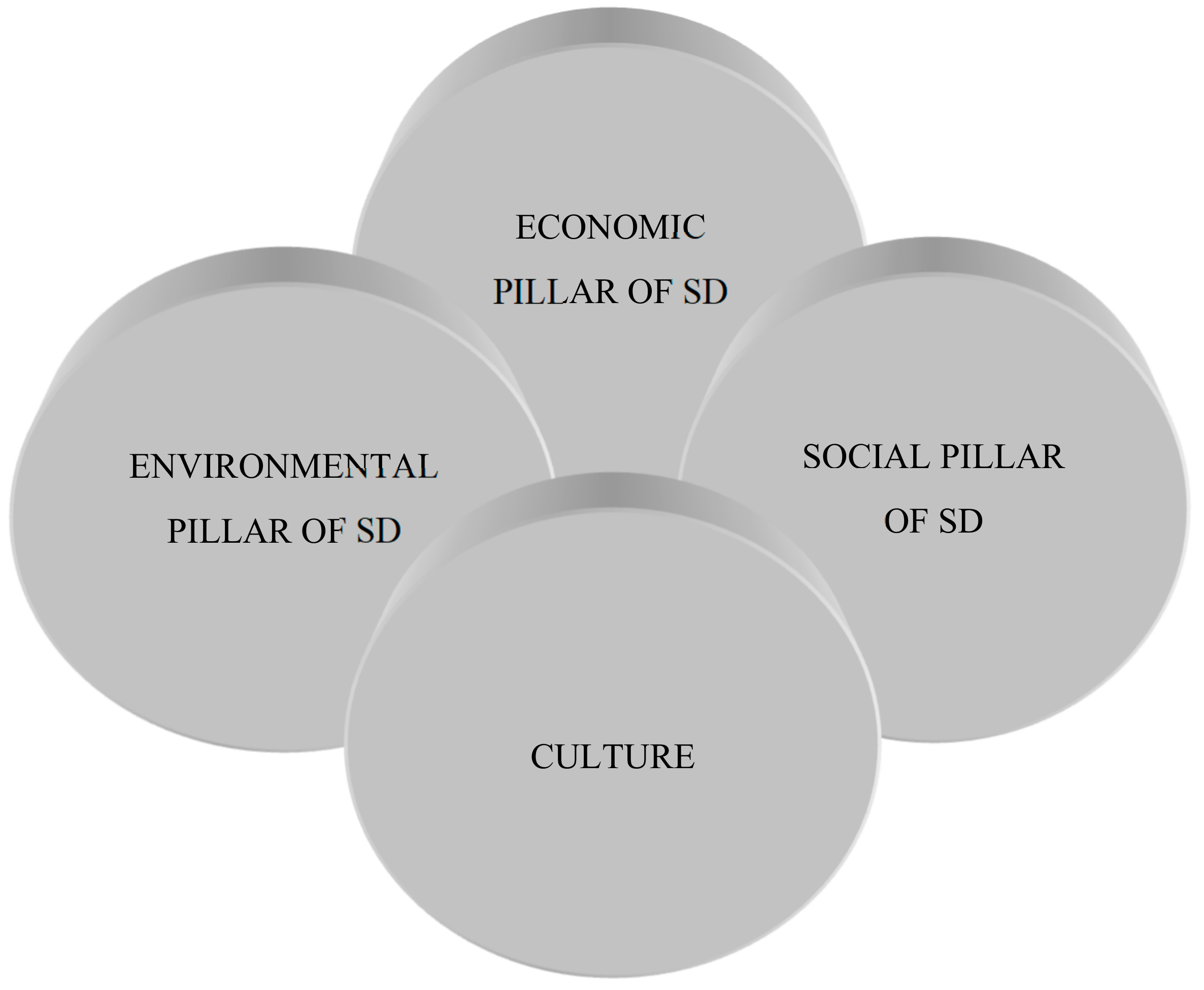
- Supportive and self-promoting role (characterised as culture in sustainable development), which simply and unquestionably expands conventional sustainable development discourse by adding culture as a more or less self-standing fourth dimension. Culture is related, but independent from its separate environmental, social, and economic aspects. Figure 1. Presents the concept of supportive and self-promoting role of culture.
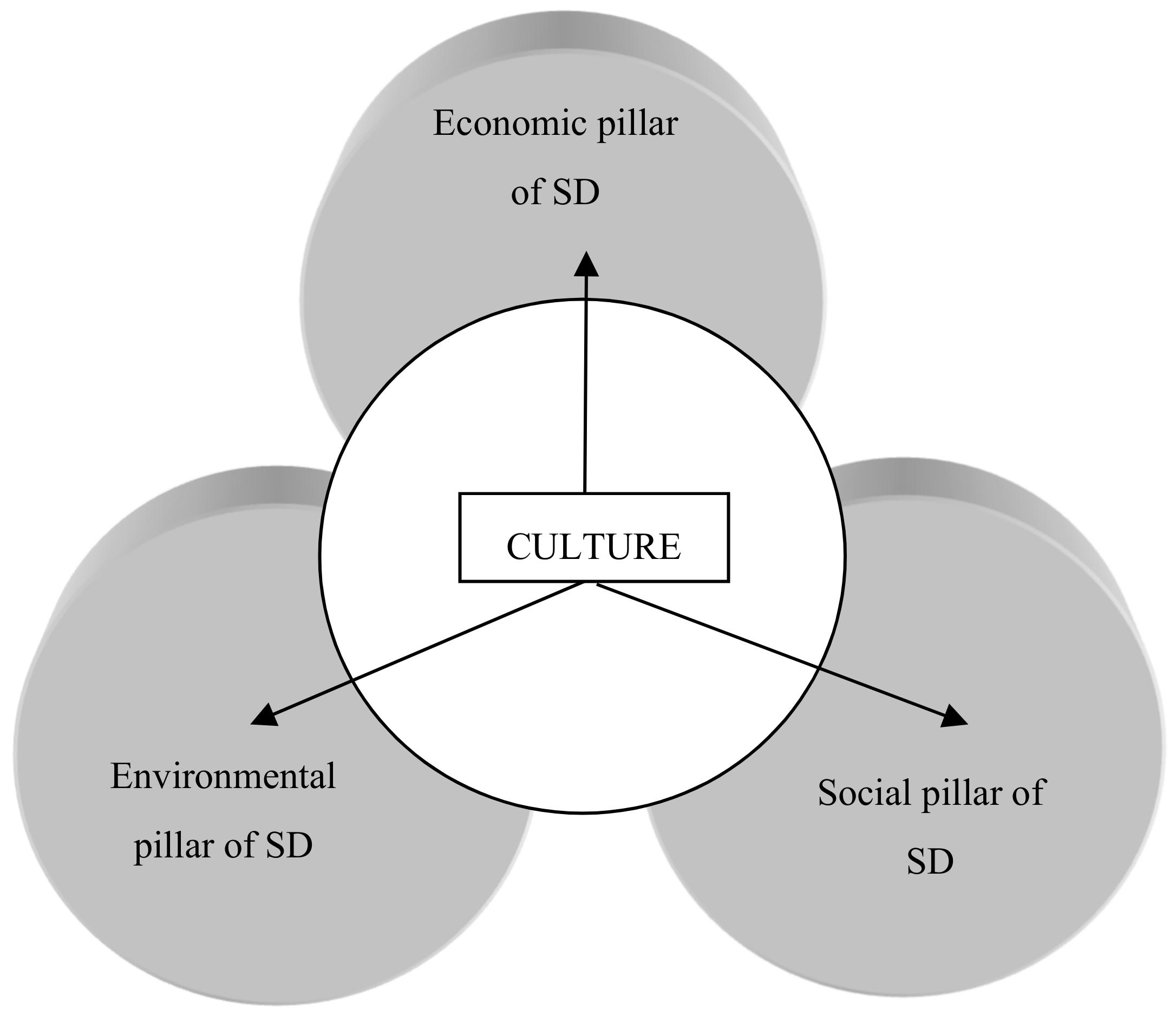
- The second role is described as culture for sustainable development, which offers to assess culture as a more influential force that can operate beyond the boundaries of sustainable development. This role moves culture into framing, contextualising, and mediating mode; one that can balance all three of the existing pillars and guide the process of sustainable development between economic, social, and ecological pressures by forming a variety of needs that arise from cultural goals and actions. Figure 2 provides the concept of culture for sustainable development.
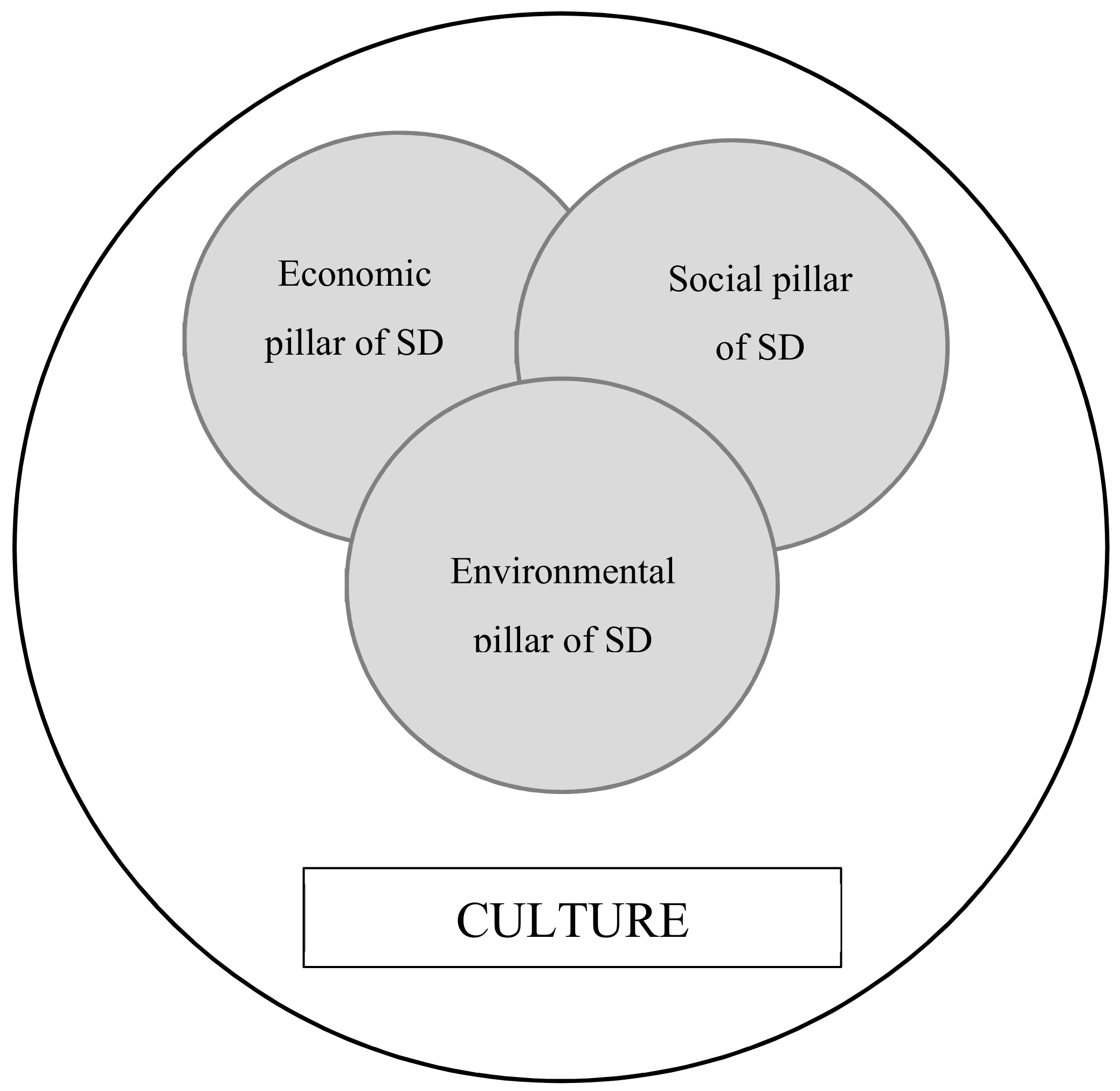
- This role describes culture as sustainable development, where culture is seen as the essential foundation and structure for achieving the aims of sustainable development. When recognising culture as the root of all human decisions and actions and even a new paradigm in sustainable development thinking, culture and sustainability become mutually intertwined, whereas economic, social, and environmental dimensions differ, because they do not have such a close connection. Figure 3 presents the concept of culture as sustainable development.
2.2. Sustainable Development Goals and Culture
3. Research Methodology
4. Discussion of Results
4.1. The Value Created by Culture for Country’s Economy
4.2. The Assessment of the Value Created by Culture in the Baltic States
5. Conclusions
Author Contributions
Funding
Conflicts of Interest
References
- Nocca, F. The Role of Cultural Heritage in Sustainable Development: Multidimensional Indicators as Decision-Making Tool. Sustainability 2017, 9, 1882. [Google Scholar] [CrossRef]
- Brocchi, D. The Cultural Dimension of Sustainability. In Sustainability: A New Frontier for the Arts and Culture; Kagan, S., Kirchberg, V., Eds.; Verlag für Akademische Schriften: Frankfurt, Germany, 2008; pp. 26–58. [Google Scholar]
- Choe, S.-C.; Marcotullio, P.J.; Piracha, A.L. Approaches to Cultural Indicators. In Urban Crisis; Nadarajah, M., Yamamoto, A.T., Eds.; UNU Press: Tokyo, Japan, 2007. [Google Scholar]
- Nurse, K. Culture as the Fourth Pillar of Sustainable Developmentreport; Report Prepared for Commonwealth Secretariat; Commonwealth Secretariat: London, UK, 2004. [Google Scholar]
- Soini, K.; Dessein, J. Culture-sustainability relation: Towards a conceptual framework. Sustainability 2016, 8, 167. [Google Scholar] [CrossRef]
- Wu, S.R.; Fan, P.; Chen, J. Incorporating culture into sustainable development: A cultural sustainability index framework for green buildings. Sustain. Dev. 2016, 24, 64–76. [Google Scholar] [CrossRef]
- Duxbury, N.; Jeannotte, M.S. Introduction: Culture and Sustainable Communities. Cult. Local Gov. 2011, 3, 1–2. [Google Scholar] [CrossRef]
- Tubadji, A.; Pelzel, F. Culture based development: Measuring an invisible resource using the PLS-PM method. Int. J. Soc. Econ. 2015, 42, 1050–1070. [Google Scholar] [CrossRef]
- Opoku, M.O. Information Management and Organisational Performance: A Review of Literature. Mediterr. J. Soc. Sci. 2015, 6, S1. [Google Scholar] [CrossRef]
- Nadarajah, M.; Yamamoto, A.T. (Eds.) Urban Crisis: Culture and the Sustainability of Cities; UNU Press: Tokyo, Japan, 2007. [Google Scholar]
- Swanson, K.K.; DeVereaux, C. A theoretical framework for sustaining culture: Culturally sustainable entrepreneurship. Ann. Tour. Res. 2017, 62, 78–88. [Google Scholar] [CrossRef]
- Blagoeva-Yarkova, Y. The Role of Local Cultural Institutions for Local Sustainable Development. The case-study of Bulgaria. Trakia J. Sci. 2012, 10, 42–52. [Google Scholar]
- Fanea-Ivanovici, M. Culture as a Prerequisite for Sustainable Development. An Investigation into the Process of Cultural Content Digitisation in Romania. Sustainability 2018, 10, 1859. [Google Scholar] [CrossRef]
- Anheier, H.K.; Isar, Y.R.; Hoelscher, M. Cultural Policy and Governance in a New Metropolitan Age; The Cultures and Globalization Series; Sage: London, UK, 2012; Volume 5, pp. 73–86. [Google Scholar]
- Hooper, A. Culture and Sustainable Development in the Pacific; ANU E Press/Asia Pacific Press: Canberra, Australia, 2005. [Google Scholar]
- Jeannotte, M.S.; Andrew, C. Operational Guidelines for Incorporating Culture into Sustainable Development Policies: A Canadian Perspective; Report Prepared for Department of Canadian Heritage; Canadian Heritage: Ottawa, ON, Canada, 2008. [Google Scholar]
- Wróblewski, I.; Bilinska-Reformat, K.; Grzesiak, M. Sustainable Activity of Cultural Service Consumers of Social Media Users-Influence on the Brand Capital of Cultural Institutions. Sustainability 2018, 10, 3986. [Google Scholar] [CrossRef]
- Dessein, J.; Soini, K.; Fairclough, G.; Horlings, L. Culture in, for and as Sustainable Development; Conclusions from the COST Action IS1007 Investigating Cultural Sustainability; University of Jyväskylä: Jyväskylä, Finland, 2015. [Google Scholar]
- Tsai, P.H.; Lin, C.T. How Should National Museums Create Competitive Advantage Following Changes in the Global Economic Environment? Sustainability 2018, 10, 3749. [Google Scholar] [CrossRef]
- Grazuleviciute, I. Cultural heritage in the context of sustainable development. Environ. Res. Eng. Manag. 2006, 3, 74–79. [Google Scholar]
- Di Fabio, A.; Gori, A. Developing a New Instrument for Assessing Acceptance of Change. Front. Psychol. 2016, 7, 802. [Google Scholar] [CrossRef] [PubMed]
- Di Fabio, A.; Gori, A. Assessing workplace relational civility (WRC) with a new multidimensional “mirror” measure. Front. Psychol. 2016, 7, 890. [Google Scholar] [CrossRef] [PubMed]
- Meyer, W. Evaluation of Sustainable Development: A Social Science Approach. In Sustainable Development in Europe: Concepts, Evaluation and Applications; Cornwall: Cheltenham, UK, 2007. [Google Scholar]
- Perello-Marín, M.; Ribes-Giner, G.; Pantoja Díaz, O. Education for Sustainable Development in Environmental University Programmes: A Co-Creation Approach. Sustainability 2018, 10, 158. [Google Scholar] [CrossRef]
- Popov, E.V.; Veretennikova, A.Y.; Kozinskaya, K.M. Formal Institutional Environment Influence on Social Entrepreneurship in Developed Countries. Montenegrin J. Econ. 2019, 14, 45–56. [Google Scholar] [CrossRef]
- Sala, S.; Ciufo, B.; Nijkamp, P. A systemic framework for sustainability assessment. Ecol. Econ. 2015, 119, 314–325. [Google Scholar] [CrossRef]
- UNESCO. ‘Mexico City Declaration on Cultural Policies’, quoted in UNESCO. In Change in Continuity. Concepts and Tools for a Cultural Approach to Development; UNESCO: Paris, France, 2000; p. 25. Available online: http://unesdoc.unesco.org/images/0012/001216/121608EB.pdf (accessed on 23 November 2018).
- Soini, K.; Birkeland, I. Exploring the scientific discourse of cultural sustainability. Geoforum 2014, 51, 213–223. [Google Scholar] [CrossRef]
- Hawkes, J. The Fourth Pillar of Sustainability: Culture’s Essential Role in Public Planning, Cultural Development Network (Vic.); Common Ground: Libraries, Australia, 2001. [Google Scholar]
- Horlings, L.G. The Worldview and Symbolic Dimension in Territorialisation: How Human Values Play a Role in a Dutch Neighbourhood. In Cultural Sustainability and Regional Development: Theories and Practices of Territorialisation; Dessein, J., Battaglini, E., Horlings, L., Eds.; Routledge: London, UK, 2015. [Google Scholar]
- Chakori, S. Building a Sustainable Society: The Necessity to Change the Term ‘Consumer’. Interdiscip. J. Partnersh. Stud. 2017, 4. [Google Scholar] [CrossRef]
- Sachs, J.; Schmidt- Traub, G.; Kroll, C.; Durand-Delacre, D.; Teksoz, K. SDG Index and Dashboards—Global Report; Bertelsmann Stiftung and Sustainable Development Solutions Network (SDSN): New York, NY, USA, 2016. [Google Scholar]
- Throsby, D. Cultural Sustainability. In A Handbook of Cultural Economics; Towse, R., Ed.; Edward Elgar: Cheltenham, UK, 2003; pp. 183–186. ISBN 978-1-84064-338-2. [Google Scholar]
- Balta Portoles, J.; Dragićevic Šešić, M. Cultural rights and their contribution to sustainable development: Implications for cultural policy. Int. J. Cult. Policy 2017, 23, 159–173. [Google Scholar] [CrossRef]
- Kregždaitė, R. The Modelling of Cultural and Creative Industries Assessment in EU Member States. Ph.D. Thesis, MRU, Vilnius, Lithuanian, 2017. [Google Scholar]
- Eurostat Statistics Explained. Culture Statistics—Cultural Enterprises. Prieiga per Internet. Available online: https://ec.europa.eu/eurostat/statistics-explained/index.php?title=Culture_statistics_-_cultural_enterprises#SBS_data.C2.A0:_number_of_cultural_enterprises.2C_value_added_and_turnover? (accessed on 10 June 2019).
- SDG Index and Dashboards Report. Global Responsibilities Implementing the Goals. 2018. Available online: https://sdgindex.org/reports/sdg-index-and-dashboards-2018 (accessed on 10 September 2019).

| SD Goal No. | SD Goal | Role of Culture in the Implementation of SD Goal |
|---|---|---|
| Goal 1 | End poverty in all its forms everywhere. Indicators:
| Cultural services are such services that should be accessible to everyone; special attention should be given to poor and vulnerable persons, ensuring equal access. The creation of places for cultural expression, services, goods and heritage could contribute to the inclusive and sustainable economic development. |
| Goal 2 | End hunger, achieve food security and improved nutrition, and promote sustainable agriculture. | In every location, there should be acknowledged and retained traditional knowledge that allow protect the generic resources available. This would reduce the threat of hunger, possibly improve the nutrition opportunities for local residents by using genetic diversity of seeds and encouraging correct payments in agriculture. The usage of usual farming, livestock, and crop traditions could encourage sustainable agriculture development. |
| Goal 3 | Ensure healthy lives and promote wellbeing for all at all ages. | The newly developed health policy and healthy-life promotion programmes have to be important from the cultural perspective. Local customs that can be integrated into traditional healthcare systems (traditional healthcare involves the healthcare beliefs and practices that have been established by indigenous people) play an important role. The participation of individuals in the cultural life of a country can improve their health and wellbeing as well. |
| Goal 4 | Ensure inclusive and equitable quality education and promote lifelong learning opportunities for all. Indicators:
| Cultural diversity, art education, linguistic, and cultural aspects that play an important role in sustainable development should be integrated at all levels of education programmes. Cultural approach, including acknowledgement of local languages and local level abilities and participation of cultural shareholders, should prevail when creating teaching programmes on all levels: this corresponds to human rights and could contribute to educational goals, including student motivation and community relations. The goal could be implemented by ensuring that all learners would acquire knowledge and skills necessary to encourage sustainable development. This could be achieved by employing the priorities of sustainable development and sustainable lifestyle, human rights, gender equality, peace, and non-governmental cultural encouragement as well as possibilities for world citizenship education, cultural diversity, and cultural input to sustainable development. |
| Goal 5 | Achieve gender equality and empower all women and girls. | Gender equality should be achieved in cultural life as well. Thus, it is necessary to expand women and girls’ possibilities to actively participate in cultural life and manage their projects and organisations in this area. The cultural practices that are mostly implemented by women and girls should be more visible and recognised. Narratives that talk about gender discrimination or portray important roles of women and girls in cultural life are necessary. |
| Goal 6 | Ensure access to water and sanitation for all. | Traditional knowledge, values, and customs can provide an opportunity to learn how to use ecosystems appropriately, which is directly related to the access to clean water and sanitation. |
| Goal 7 | Ensure access to affordable, reliable, sustainable, and modern energy. | Some cultural factors could be used as energy production and consumption models. Creative persons, employing traditional businesses and knowledge of cultural heritage, can participate when creating education and awareness-raising activities related to energy production and consumption, especially in the area of cost-effective energy. |
| Goal 8 | Promote inclusive and sustainable economic growth, employment and decent work for all Indicators:
| Cultural and creative sectors can become the areas of inclusive, sustainable, and decent occupation, because decent working conditions corresponding to international human rights are ensured. Cultural aspects could be integrated to tourism strategies. It is very important to ensure that cultural identities and related activities and assets would not be decoded, and the received benefit would be reinvested in cultural activities. The goal could be implemented by funding productive activities, creating workplaces, entrepreneurship, creativity, and innovations when developing small and medium-sized enterprises, using local opportunities, human resources of regions and individual sites, and appropriate financing. Sustainable tourism encourages local culture, which in turn creates workplaces and encourages the creation of goods that are valuable from the cultural perspective. |
| Goal 9 | Build resilient infrastructure, promote sustainable industrialisation, and foster innovation. Indicators:
| If the cultural infrastructure (museums, libraries, cultural centres, concert halls, theatres, and more) is created correctly, it ensures available and equal access to cultural life, which is a part of qualitative, reliable, sustainable, and resilient infrastructure that should be accessible to all. Artists and creative persons can participate in the processes devoted to research, development, and innovation in various fields of industry. |
| Goal 10 | Reduce inequality within and among countries. | The participation of individuals in cultural life contributes to the reduction of inequality, because participation should be independent of age, gender, disability, race, ethnic origin, religion, economic, or other status. State artists and creative person have an opportunity to participate when creating and presenting narratives that provide exceptional status for the developing countries. All attitudes to migration should encompass a cultural aspect and a dialogue of cultures. |
| Goal 11 | Make cities inclusive, safe, resilient, and sustainable. Indicators:
| Many important objects and elements of material and intangible cultural heritage are in the cities and they play an important role in sustainable local development, in fact, cultural aspects are essential when aiming to encourage sustainable local development. Green and public areas could help to develop cultural activities and should be accessible to all. Traditional construction methods and traditional knowledge about local materials could provide information about the renovation of existing buildings and design of new buildings. Cultural factors inform about behaviour in cities, including transport and mobility, use of environment, etc. The realisation of this goal enables to strengthen efforts put into protecting world cultural and natural heritage, ensuring access to safe, inclusive and accessible, green and public spaces, especially for women and children, elderly, and disabled. |
| Goal 12 | Ensure sustainable consumption and production patterns Indicator:
| For the realisation of this goal, traditional goods that are suitable for the sustainable development encouragement should be acknowledged and evaluated. |
| Goal 13 | To take urgent action to combat climate change and its impacts. Indicator:
| It is necessary to research and encourage intercultural activities and traditional knowledge on environmentally friendly practices. Culture specialists have the possibility to inform society about climate change and its consequences through cultural activities. |
| Goal 14 | Conserve and sustainably use the oceans, seas, and marine resources. | The implementation of goal is possible by determining and strengthening certain cultures that foster traditions related to marine and coastal ecosystem protection. |
| Goal 15 | Protect, restore, and promote sustainable use of terrestrial ecosystems, sustainably manage forests, combat desertification, halt and reverse land degradation, halt biodiversity loss. | Cultural factors related to the protection of terrestrial ecosystems, including appropriate local and traditional knowledge, should be included in the preparation, implementation, and assessment of this field policy and programmes. |
| Goal 16 | Promote just, peaceful, and inclusive societies aiming for sustainable development, ensure access to justice for all, and create effective, accountable inclusive institutions at all levels. Indicators:
| When implementing this goal of sustainable development, nationalised or otherwise alienated cultural objects should be returned to the appropriate communities. Citizens should have an opportunity to participate in preparation, implementation, and assessment of cultural policy and programmes. Cultural objects, including libraries and knowledge centres, encourage access to information. Cultural component should be incorporated into the strategies that condemn violence and encourage peace. |
| Goal 17 | Strengthen the means of implementation and revitalize the global partnership for sustainable development. | Cultural aspect should be integrated in international, national, and local sustainable development strategies, including those that aim to implement 2030 Agenda. Cultural shareholders abilities should be strengthened that they could solve problems related to sustainable development and create conditions for other sustainable development groups to understand the importance of cultural aspects. Cultural shareholders possibilities to produce and distribute cultural goods and services. |
| Lithuania |
| preserve cultural heritage and foster national cultural identity; encourage creativity and diversity of art; develop information society; encourage cultural openness and presentation abroad; ensure society’s participation in cultural life and cultural consumption. |
| Latvia |
| protect and develop cultural capital by involving community members in cultural processes; create creative lifelong learning and cultural education systems that are oriented to workforce employment; develop cultural and creative sectors that have huge export potential; improve availability of cultural territories and cultural services. |
| Estonia |
| create conditions for creators and viewers in all countries to use cultural measures, including improvement of cultural education; adapt higher education in the cultural area to society’s needs and demographic changes and make it competitive on an international level; involve professional associations in the decision-making processes in the cultural area; support creative enterprises with national and international financing; improve legal conditions for self-employed cultural workers; provide conditions for international cultural cooperation and participation in international cultural organisation’s activities; support preservation of Estonian and other identities of local nationalities and support communities of Estonian migrants connected to Estonia; support creative and cultural industry as a part of the knowledge economy; continue to protect copyrights, digital cultural heritage in coordination with international standards; indicate responsibilities and tasks for local authorities and the State; improve possibilities of people with special needs to participate in cultural life. |
| Title of the Legal Act, Year of Adoption | ||
|---|---|---|
| Lithuania | Latvia | Estonia |
| Principles of Lithuanian Cultural Policy 2001; Guidelines for Alternation of Lithuanian Cultural Policy 2010; Culture Development Programme of the Regions 2002; 2011; State’s Long-term Development Strategy 2002; State Programme for the Development of Ethnic Culture 2003; 2010; Government Programme and Action Plan for the year 2012-2016; 2012; Law of Government 1994; 1998; Law of Culture Council of Lithuania 2012; Regulation of Lithuanian Culture and Art Council 2001; 2009; Law of Local Self-government 2000; Law of Culture Support Fund 1998; 2012; Government’s Resolution on Regulation of the Ministry of Culture 2010; Law on Press, Radio and Television Support Fund (Media Support Fund) 1996; Law on Cinema 2002; 2011; Law on the Status of Art Creator and Art Creators’ Organisations 1996; 2011; Law on Theatres and Concert Institutions 2004; Guidelines for National Protection of Cultural Heritage 2012; Law on Protection of Immovable Cultural Heritage 1994; 2005; Law on the Protection of Movable Cultural Properties 1996; 2010; Government’s Resolution on the Programme of Museums Modernisation. 2007; Law on Protected Territories 2001; Law on Planning of Territories 1995; 2004; Law on State Commission on Protection of Cultural Heritage 2005; Law on the Principles of the State Protection of Ethnic Culture 1999; Law on Museums 1995; 2003; Law on National Produce Heritage 2007; Law on Documents and Archives 1995; 2004; Regulation on State indemnity for temporary imported cultural goods to Lithuania 2003; Government Resolution on Strategy of Digitalisation of Lithuanian Cultural Heritage 2009; Law on Authors and Related Rights 1999; 2003; 2006; Copyright and Related Rights Protection Strategy 2000. | Law on Cultural Institutions 1998 Copyright Law 2000 Law on Libraries 1998 Law on Museums 2006 Law on Archives 2011 Law on the Protection of Cultural Monuments 1992 Law on Film 2010 Law on the Realisation of the National Library 2003 Law on Latvian National Opera 2002 Law on Obligatory Deposit of Printed and other Publications 1997 Legal Deposit Law 2006 Law on the National Library of Latvia 1992/1993 Law on the Preservation and Protection of Riga’s Historical Centre 2003 Law on the Song and Dance Celebration 2005 Law on the State Cultural Capital Foundation 2003/2004 Law on the Service Pension of State and Local Government Professional Orchestras, Choirs, Concert Organisations, Theatre and Circus Artists and the Allowance for Creative Work of Ballet Artists 2004/2005 Law on the Museum of Occupation of Latvia 2006 Law on the Dome Church and Monastery Ensemble 2005 Electronic Mass Media Law 2010 Law on Press and Other Mass Media 1991; Law on Architecture 2015; Law on Intangible Cultural Heritage 2015; Law on the Status of Creative Persons and Professional Creative Organizations 2016. | Foundations of the Cultural Policy of the Republic of Estonia 1998; Income Tax Act 1999, 2012; Value Added Tax Act 2003, 2012; Gambling Tax Act 1995; 1997; 2002; 2009; The National Library of Estonia Act 1990; 1998; 2011; The Copyright Act 1992; 2013; Law on Cultural Autonomy of National Minorities 1993; 2002); Law on Media Services 2010; 2011; 2012; The Estonian National Broadcasting Act 2007; 2011; The Public Libraries Act 1994; 1998; 2010; Heritage Conservation Act 1994; 1997; 2002; 2011; Cultural Endowment of Estonia Act 1994; 2012; The Estonian Language Act 1995; 2011; 2012; Act on Creative Artists and Creative Artists’ Unions 2004; 2014; By-Laws of the Ministry of Culture 1996; 2013; Museums Act 1996; 2011; Compulsory Copies Act 1997; 2010; National Opera Act 1997; 2000; 2002; 2003; Act to Regulate Dissemination of Works which Contain Pornography or Promote Violence or Cruelty 1997; 2011; Sports Act 1998; 2005; 2012; State Cultural Awards and Cultural Grants Act 1998; 2007; Performance Establishment Act 1997; 2003; 2008; 2009; Law on Return of Cultural Objects Unlawfully Removed from the Territory of a European Union Member State 2003; 2011; Law on the Export and Import of Cultural Objects 2007; 2010; 2011; Placing Orders for Works of Art Act 2010; 2014; The Laws on State Budget (annual). |
| GEO | Cultural Enterprises * | Value Added at Factor Cost ** | Turnover *** (Gross Premiums Written) | |||
|---|---|---|---|---|---|---|
| % of Total Economy | Min-Max Index | % of Total Economy | Min-Max Index | % of Total Economy | Min-Max Index | |
| Belgium | 6.5 | 0.8358 | 2.3 | 0.3448 | 1.5 | 0.2917 |
| Bulgaria | 3.1 | 0.3284 | 1.7 | 0.1379 | 1.0 | 0.0833 |
| Czechia | 4.5 | 0.5373 | - | - | - | - |
| Denmark | 5.9 | 0.7463 | 2.5 | 0.4138 | 1.7 | 0.3750 |
| Germany | 5.3 | 0.6567 | 2.7 | 0.4828 | 1.5 | 0.2917 |
| Estonia | 4.6 | 0.5522 | 2.1 | 0.2759 | 1.2 | 0.1667 |
| Ireland | - | - | - | - | - | - |
| Greece | 4.2 | 0.4925 | 2.2 | 0.3103 | 1.4 | 0.2500 |
| Spain | - | - | - | - | - | - |
| France | 5.5 | 0.6866 | 2.8 | 0.5172 | 1.8 | 0.4167 |
| Croatia | 4.5 | 0.5373 | 2.5 | 0.4138 | 2.0 | 0.5000 |
| Italy | 4.8 | 0.5821 | 2.5 | 0.4138 | 1.7 | 0.3750 |
| Cyprus | 4.4 | 0.5224 | 3.5 | 0.7586 | 3.2 | 1.0000 |
| Latvia | 4.2 | 0.4925 | 1.8 | 0.1724 | 1.1 | 0.1250 |
| Lithuania | 5.5 | 0.6866 | 1.8 | 0.1724 | 1.0 | 0.0833 |
| Luxembourg | 0.9 | 0.0000 | - | - | - | - |
| Hungary | 4.9 | 0.5970 | 1.7 | 0.1379 | 1.3 | 0.2083 |
| Malta | - | - | - | - | - | - |
| Netherlands | 7.3 | 0.9552 | - | - | - | - |
| Austria | 5.2 | 0.6418 | 2.2 | 0.3103 | 1.6 | 0.3333 |
| Poland | 4.4 | 0.5224 | 2.4 | 0.3793 | 1.5 | 0.2917 |
| Portugal | 3.8 | 0.4328 | 2.1 | 0.2759 | 1.5 | 0.2917 |
| Romania | 3.4 | 0.3731 | - | - | 1.0 | 0.0833 |
| Slovenia | 6.4 | 0.8209 | 2.1 | 0.2759 | 1.6 | 0.3333 |
| Slovakia | 2.7 | 0.2687 | 1.3 | 0.0000 | 0.8 | 0.0000 |
| Finland | 4.4 | 0.5224 | 2.3 | 0.3448 | 1.6 | 0.3333 |
| Sweden | 7.6 | 1.0000 | 2.6 | 0.4483 | 2.0 | 0.5000 |
| United Kingdom | 5.0 | 0.6119 | 4.2 | 1.0000 | 2.7 | 0.7917 |
| GEO/TIME | Cultural Employment * | |||||
|---|---|---|---|---|---|---|
| Min-Max Index | Mean Index | |||||
| 2013 | 2015 | 2017 | 2013 | 2015 | 2017 | |
| Belgium | 0.5714 | 0.6579 | 0.6923 | 1 | 1.0811 | 1.1316 |
| Bulgaria | 0.3095 | 0.3421 | 0.2821 | 0.7105 | 0.7568 | 0.7105 |
| Czechia | 0.5952 | 0.5789 | 0.5897 | 1.0263 | 1 | 1.0263 |
| Denmark | 0.7857 | 0.8158 | 0.6923 | 1.2368 | 1.2432 | 1.1316 |
| Germany | 0.6667 | 0.6842 | 0.6154 | 1.1053 | 1.1081 | 1.0526 |
| Estonia | 1 | 1 | 1 | 1.4737 | 1.4324 | 1.4474 |
| Ireland | 0.5476 | 0.5526 | 0.4872 | 0.9737 | 0.9730 | 0.9211 |
| Greece | 0.5000 | 0.3684 | 0.4103 | 0.9211 | 0.7838 | 0.8421 |
| Spain | 0.4286 | 0.5000 | 0.5128 | 0.8421 | 0.9189 | 0.9474 |
| France | 0.5000 | 0.4474 | 0.4872 | 0.9211 | 0.8649 | 0.9211 |
| Croatia | 0.4762 | 0.5000 | 0.4872 | 0.8947 | 0.9189 | 0.9211 |
| Italy | 0.5000 | 0.5263 | 0.5128 | 0.9211 | 0.9459 | 0.9474 |
| Cyprus | 0.4524 | 0.5000 | 0.4872 | 0.8684 | 0.9189 | 0.9211 |
| Latvia | 0.5952 | 0.6579 | 0.6154 | 1.0263 | 1.0811 | 1.0526 |
| Lithuania | 0.5714 | 0.6579 | 0.5385 | 1 | 1.0811 | 0.9737 |
| Luxembourg | 0.9048 | 0.9211 | 0.7692 | 1.3684 | 1.3514 | 1.2105 |
| Hungary | 0.5952 | 0.5789 | 0.4359 | 1.0263 | 1 | 0.8684 |
| Malta | 0.6667 | 0.7368 | 0.7949 | 1.1053 | 1.1622 | 1.2368 |
| Netherlands | 0.7857 | 0.8158 | 0.7436 | 1.2368 | 1.2432 | 1.1842 |
| Austria | 0.6667 | 0.6579 | 0.6410 | 1.1053 | 1.0811 | 1.0789 |
| Poland | 0.4286 | 0.4737 | 0.4872 | 0.8421 | 0.8919 | 0.9211 |
| Portugal | 0.3571 | 0.4211 | 0.3846 | 0.7632 | 0.8378 | 0.8158 |
| Romania | 0 | 0 | 0 | 0.3684 | 0.4054 | 0.4211 |
| Slovenia | 0.8571 | 0.7895 | 0.7949 | 1.3158 | 1.2162 | 1.2368 |
| Slovakia | 0.1905 | 0.2632 | 0.3333 | 0.5789 | 0.6757 | 0.7632 |
| Finland | 0.8095 | 0.9474 | 0.7949 | 1.2632 | 1.3784 | 1.2368 |
| Sweden | 0.8095 | 0.8421 | 0.8205 | 1.2632 | 1.2703 | 1.2632 |
| United Kingdom | 0.7381 | 0.8158 | 0.7949 | 1.1842 | 1.2432 | 1.2368 |
| Indicator | Weight of the Indicator |
|---|---|
| Cultural enterprises value added at factor cost, % of total gross value added of the country (i3) | 0.0868 |
| Mean consumption expenditure of private households on cultural goods and services, PPS (i9) | 0.0868 |
| Cultural employment, % of total employment (i1) | 0.0830 |
| Participation in any cultural or sport activities in the last 12 months, % (i5) | 0.0830 |
| General government expenditure on recreation, culture and religion, % of gross domestic product (GDP) (i10) | 0.0792 |
| Cultural enterprises, % of total economy (i2) | 0.0755 |
| Museums visitors per 1000 population (i12) | 0.0717 |
| Theatres (state) visitors per 1000 population (i11) | 0.0679 |
| Library users per 1000 population (i13) | 0.0679 |
| Cultural enterprises turnover (gross premiums written, % of total economy) (i4) | 0.0642 |
| Import in cultural goods by product, Thousand euro (i6) | 0.0604 |
| Cinema admissions per capita (i14) | 0.0604 |
| Export in cultural goods by product, Thousand euro (i7) | 0.0566 |
| Export in cultural goods by product, % of total (i8) | 0.0566 |
| Indicators | Min/Max Value | ||
|---|---|---|---|
| Estonia | Latvia | Lithuania | |
| Cultural employment, % of total employment (i1) | 1.0000 | 0.2500 | 0.0000 |
| Cultural enterprises, % of total economy (i2) | 0.2308 | 0.0000 | 1.0000 |
| Cultural enterprises value added at factor cost, % of total economy (i3) | 1.0000 | 0.1667 | 0.0000 |
| Cultural enterprises turnover (gross premiums written, % of total economy) (i4) | 1.0000 | 0.4000 | 0.0000 |
| Participation in any cultural or sport activities in the last 12 months, % (i5) | 1.0000 | 0.3735 | 0.0000 |
| Import in cultural goods by product, Thousand euro (i6) | 0.0000 | 1.0000 | 0.4830 |
| Export in cultural goods by product, Thousand euro (i7) | 0.1148 | 1.0000 | 0.0000 |
| Export in cultural goods by product, % of total (i8) | 0.3209 | 1.0000 | 0.0000 |
| Mean consumption expenditure of private households on cultural goods and services, PPS (i9) | 0.0000 | 0.0514 | 1.0000 |
| General government expenditure on recreation, culture and religion, % of gross domestic product (GDP) (i10) | 1.0000 | 0.5667 | 0.0000 |
| Theatres (state) visitors per 1000 population (i11) | 1.0000 | 0.5940 | 0.0000 |
| Museums visitors per 1000 population (i12) | 1.0000 | 0.3127 | 0.0000 |
| Library users per 1000 population (i13) | 1.0000 | 0.0000 | 0.0943 |
| Cinema admissions per capita (i14) | 1.0000 | 0.0242 | 0.0000 |
| Indicators | Country | |||||
|---|---|---|---|---|---|---|
| Estonia | Latvia | Lithuania | ||||
| Importance of the Indicator | Position | Importance of the Indicator | Position | Importance of the Indicator | Position | |
| Cultural employment, % of total employment (i1) | 0.0830 | 1 | 0.0208 | 2 | 0.0000 | 3 |
| Cultural enterprises, % of total economy (i2) | 0.0174 | 2 | 0.0000 | 3 | 0.0755 | 1 |
| Cultural enterprises value added at factor cost, % of total economy (i3) | 0.0868 | 1 | 0.0145 | 2 | 0.0000 | 3 |
| Cultural enterprises turnover (gross premiums written, % of total economy) (i4) | 0.0642 | 1 | 0.0257 | 2 | 0.0000 | 3 |
| Participation in any cultural or sport activities in the last 12 months, % (i5) | 0.0830 | 1 | 0.0310 | 2 | 0.0000 | 3 |
| Import in cultural goods by product, Thousand euro (i6) | 0.0000 | 3 | 0.0604 | 1 | 0.0292 | 2 |
| Export in cultural goods by product, Thousand euro (i7) | 0.0065 | 1 | 0.0566 | 2 | 0.0000 | 3 |
| Export in cultural goods by product, % of total (i8) | 0.0182 | 2 | 0.0566 | 1 | 0.0000 | 3 |
| Mean consumption expenditure of private households on cultural goods and services, PPS (i9) | 0.0000 | 3 | 0.0045 | 2 | 0.0868 | 1 |
| General government expenditure on recreation, culture and religion, % of gross domestic product (GDP) (i10) | 0.0792 | 1 | 0.0449 | 2 | 0.0000 | 3 |
| Theatres (state) visitors per 1000 population (i11) | 0.0679 | 1 | 0.0403 | 2 | 0.0000 | 3 |
| Museums visitors per 1000 population (i12) | 0.0717 | 1 | 0.0224 | 2 | 0.0000 | 3 |
| Library users per 1000 population (i13) | 0.0679 | 1 | 0.0000 | 3 | 0.0064 | 2 |
| Cinema admissions per capita (i14) | 0.0604 | 1 | 0.0015 | 2 | 0.0000 | 3 |
| In total (IKKV) | 0.7062 | 1 | 0.3792 | 2 | 0.1979 | 3 |
| Indicators | Correlation Coefficient |
|---|---|
| Cultural employment, % of total employment (i1) | 0.9971 |
| Cultural enterprises, % of total economy (i2) | −0.5811 |
| Cultural enterprises value added at factor cost, % of total economy (i3) | 0.9868 |
| Cultural enterprises turnover (gross premiums written, % of total economy) (i4) | 0.9959 |
| Participation in any cultural or sport activities in the last 12 months, % (i5) | 0.9982 |
| Import in cultural goods by product, Thousand euro (i6) | −0.6510 |
| Export in cultural goods by product, Thousand euro (i7) | −0.0996 |
| Export in cultural goods by product, % of total (i8) | 0.1145 |
| Mean consumption expenditure of private households on cultural goods and services, PPS (i9) | −0.7757 |
| General government expenditure on recreation, culture and religion, % of gross domestic product (GDP) (i10) | 0.9605 |
| Theatres (state) visitors per 1000 population (i11) | 0.9514 |
| Museums visitors per 1000 population (i12) | 0.9999 |
| Library users per 1000 population (i13) | 0.9194 |
| Cinema admissions per capita (i14) | 0.9560 |
© 2019 by the authors. Licensee MDPI, Basel, Switzerland. This article is an open access article distributed under the terms and conditions of the Creative Commons Attribution (CC BY) license (http://creativecommons.org/licenses/by/4.0/).
Share and Cite
Streimikiene, D.; Mikalauskiene, A.; Kiausiene, I. The Impact of Value Created by Culture on Approaching the Sustainable Development Goals: Case of the Baltic States. Sustainability 2019, 11, 6437. https://doi.org/10.3390/su11226437
Streimikiene D, Mikalauskiene A, Kiausiene I. The Impact of Value Created by Culture on Approaching the Sustainable Development Goals: Case of the Baltic States. Sustainability. 2019; 11(22):6437. https://doi.org/10.3390/su11226437
Chicago/Turabian StyleStreimikiene, Dalia, Asta Mikalauskiene, and Ilona Kiausiene. 2019. "The Impact of Value Created by Culture on Approaching the Sustainable Development Goals: Case of the Baltic States" Sustainability 11, no. 22: 6437. https://doi.org/10.3390/su11226437
APA StyleStreimikiene, D., Mikalauskiene, A., & Kiausiene, I. (2019). The Impact of Value Created by Culture on Approaching the Sustainable Development Goals: Case of the Baltic States. Sustainability, 11(22), 6437. https://doi.org/10.3390/su11226437

